

Revenue, 2025
USD 227.2 Bn
Forecast, 2035
USD 339.6 Bn
CAGR, 2025-2035
4.1%
Report Coverage
Global
Market Size and Forecast
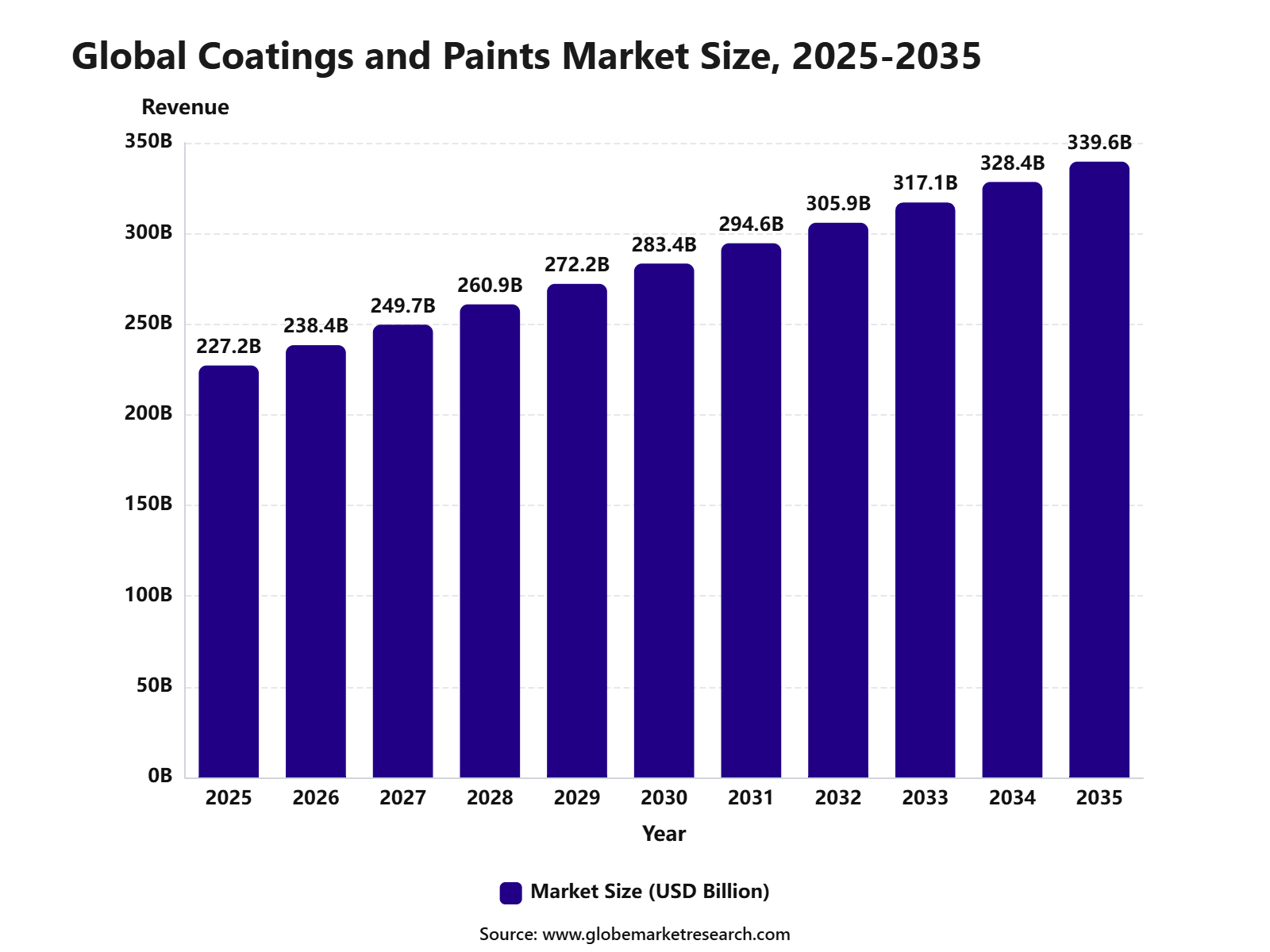
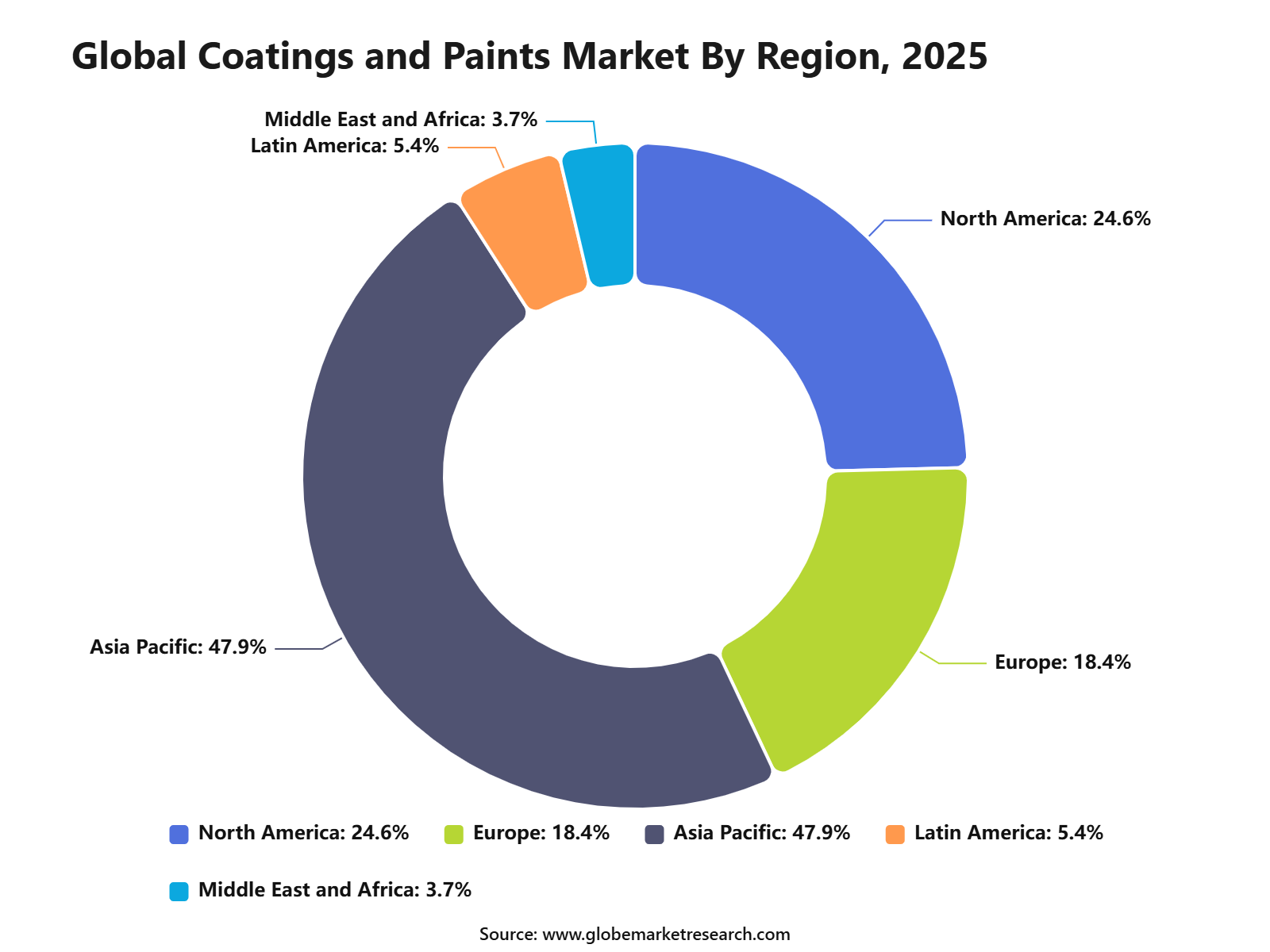
The Global Coatings and Paints Market was worth USD 227.2 billion in 2025 and is expected to reach USD 339.6 billion by 2035, growing at a CAGR of 4.1% from 2025 to 2035. Based on this growth rate, the market is estimated to reach around USD 238.4 billion in 2026. Asia Pacific held the largest regional share of 47.9% in 2025, valued at around USD 108.8 billion, supported by rapid construction activity, industrial manufacturing, automotive production, infrastructure development, and rising demand for decorative and protective coatings.
The Coatings and Paints Market includes decorative paints, industrial coatings, protective coatings, automotive coatings, marine coatings, powder coatings, wood coatings, and specialty surface finishes. These products are used to improve appearance, protect surfaces from corrosion, weathering, chemicals, abrasion, and moisture, and extend the service life of buildings, vehicles, machinery, and infrastructure assets. The market is closely linked with construction, renovation, manufacturing, transportation, and industrial maintenance.
Key Parameter | Report Details |
|---|---|
Market Revenue, 2025 | USD 227.2 Billion |
Projected Revenue, 2035 | USD 339.6 Billion |
CAGR (2025-2035) | 4.1% |
Largest Region | Asia Pacific (47.9%, USD 108.8 Bn) |
Market Concentration | Medium |
Base Year | 2024 |
Forecast Period | 2025-2035 |
The market outlook remains steady as urbanization, housing demand, and infrastructure upgrades continue to support consumption. Growth can be attributed to rising demand for low-VOC coatings, water-based paints, high-performance protective coatings, and durable finishes for industrial and architectural applications. Asia Pacific’s strong manufacturing base, expanding middle-class housing demand, and large infrastructure pipeline are expected to support long-term market growth.
 iThe graph shows projected market growth until 2035 based on CAGR analysis. Actual outcomes may vary depending on changing demand, competition, and economic factors.To gain greater insights - request a sample report PDF
Key Market Insights
Polyurethane led the resin type segment with 35.8% share, supported by its strong durability, abrasion resistance, flexibility, and wide use in protective, industrial, automotive, and architectural coating applications.
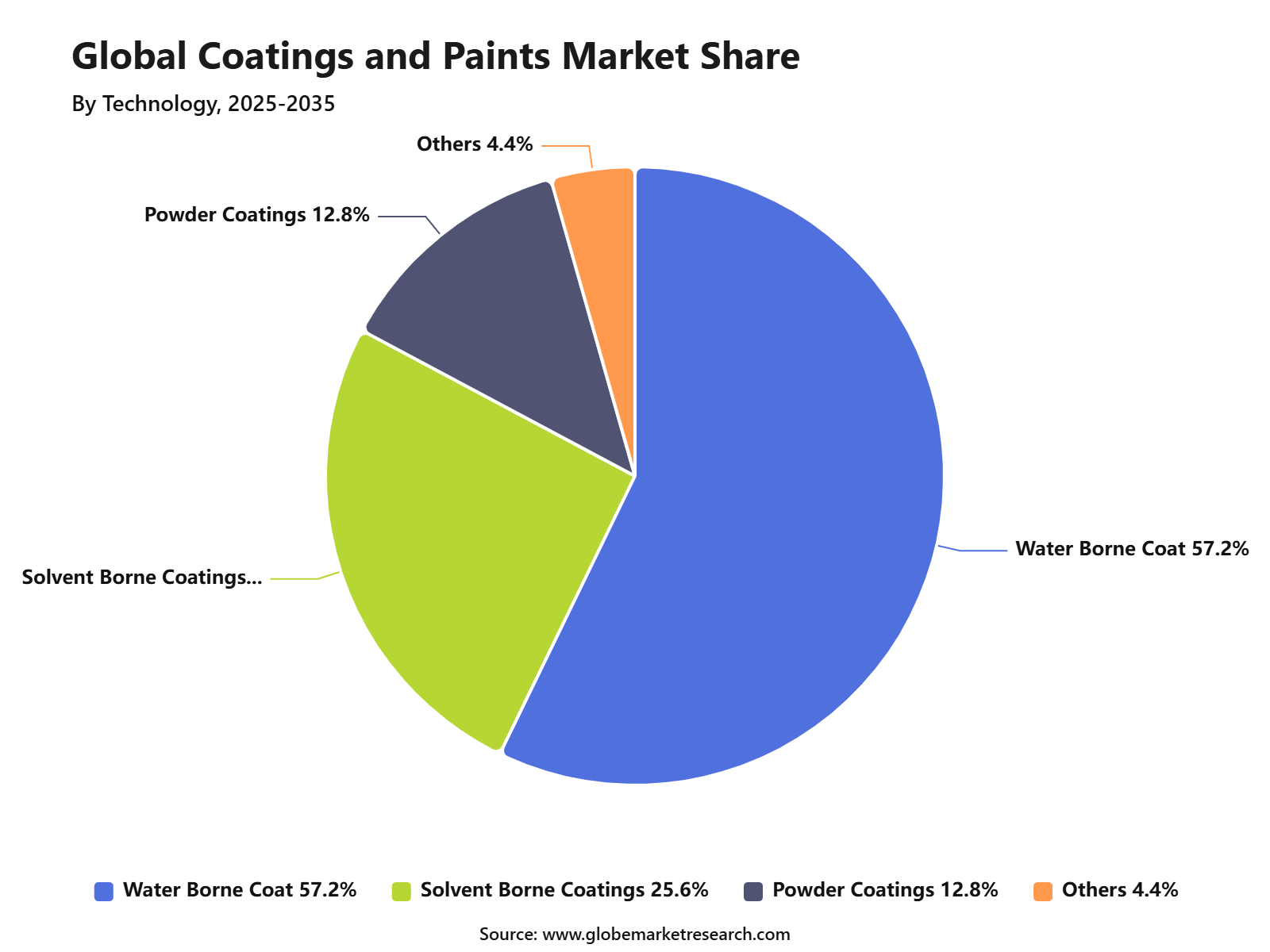
Water-borne coatings accounted for 57.2% share, driven by rising demand for low-VOC formulations, easier application, faster cleanup, and better compliance with environmental standards.
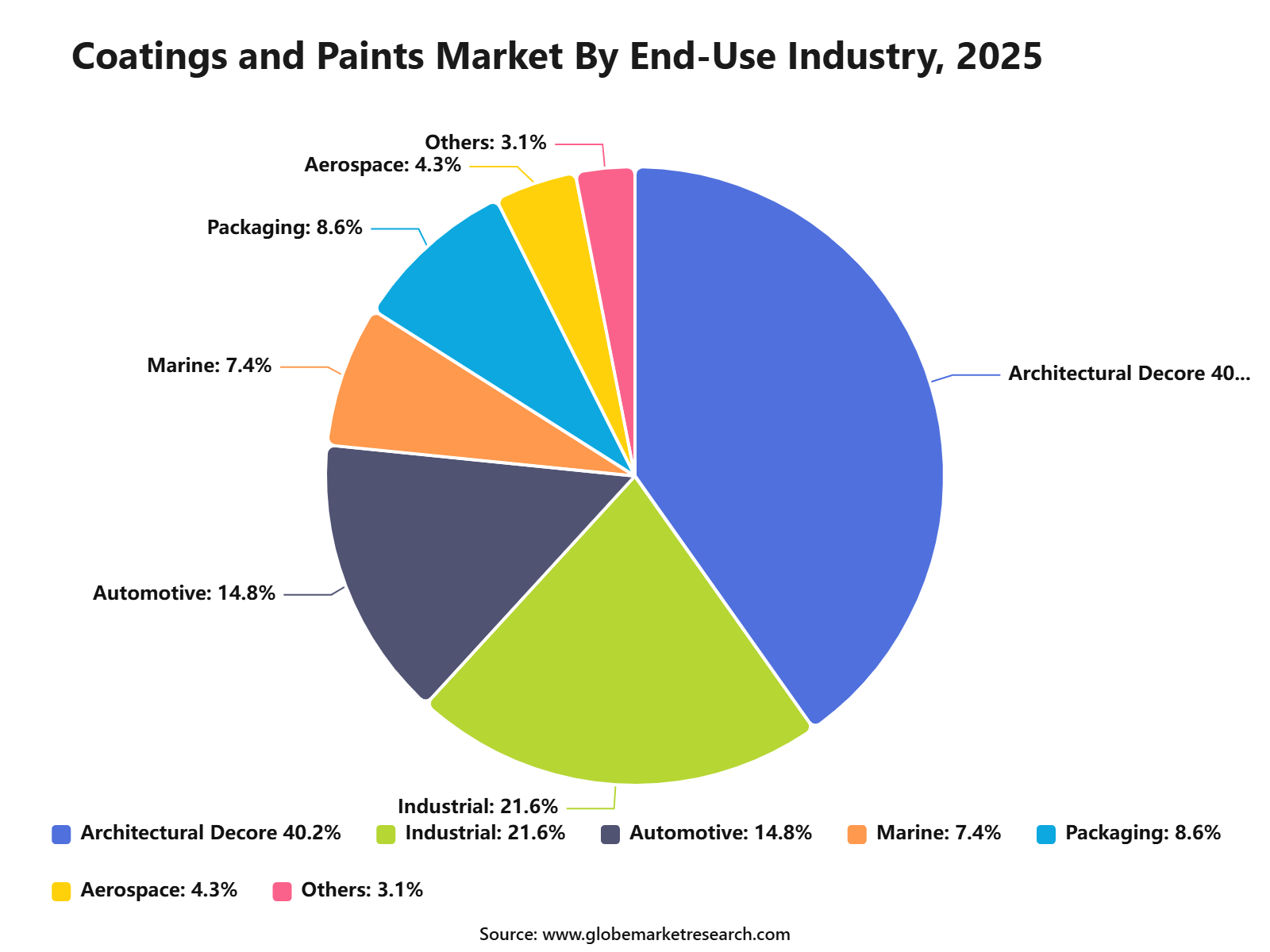
Architectural and decorative applications held 40.2% share by end-use industry, supported by strong demand from residential buildings, commercial spaces, renovation activity, and interior and exterior surface protection.
Asia Pacific led the coatings and paints market with 47.9% share, valued at USD 108.8 billion, supported by rapid construction growth, expanding manufacturing activity, rising urbanization, and strong demand across China, India, Japan, and Southeast Asia.
Top Funding and Investment
Top Investments
PPG announced a USD 380 million investment to build an aerospace coatings and sealants manufacturing facility in Shelby, North Carolina. The 198,000-square-foot plant will occupy a 62-acre site, employ more than 110 people, and manufacture PPG’s complete aerospace coatings and sealants portfolio. Construction began in October 2025, with completion planned during the first half of 2027.
AkzoNobel committed EUR 50 million to upgrade its aerospace coatings manufacturing facility in Waukegan, Illinois. The two-phase project includes additional production capacity, new machinery, greater automation, and supporting warehouse infrastructure in Wisconsin. The site manufactures aerospace primers, basecoats, clearcoats, pre-treatment products, and specialized colour solutions for North American customers.
AkzoNobel announced a EUR 22 million investment to modernize its Montataire facility and establish it as a major decorative paint production centre in France. The program covers manufacturing improvements, operating consolidation, and greater production efficiency. The site will support the company’s decorative paint portfolio and improve its ability to supply professional and consumer customers across the French market.
BASF Coatings expanded polyester and polyurethane resin production at its Caojing facility in Shanghai. Annual capacity increased from 8,000 tonnes to 18,800 tonnes, representing growth of more than 135%. BASF also scheduled additional electrocoat binder and intermediate grind-resin capacity improvements from early 2026 to support automotive original equipment manufacturers and component suppliers across Asia Pacific.
PPG commissioned a waterborne automotive coatings plant in Samut Prakan, Thailand, with annual production capacity of 2,000 tonnes. The facility manufactures lower-VOC basecoats and primers and includes an automated spray application centre. The investment strengthens local supply for vehicle manufacturers and supports increasing demand from electric vehicle and conventional automotive producers across Southeast Asia.
Top Funding Transactions
Ecoat secured more than EUR 21 million to expand its water-based and bio-based binder business for decorative, wood, and metal coatings. The financing included EUR 18 million in equity from Yotta Capital, the European Circular Bioeconomy Fund, and Starquest, with further public and debt support. Ecoat plans to increase Roussillon production capacity to 30,000 tonnes annually.
Impact Coatings raised approximately SEK 26.6 million before transaction expenses through a rights issue priced at SEK 1.50 per share. Investors subscribed for nearly 17.7 million new shares. The proceeds support coating-service operations, product industrialization, working capital, supply-chain development, and thin-film coating applications for fuel cells, power systems, and other advanced industrial components.
Naco Technologies expanded its pre-Series A financing round to EUR 2.5 million, including an additional EUR 1.5 million investment from Radix Ventures. The capital is being used to prepare a high-capacity production facility in Poland, expand internationally, strengthen research activities, and manufacture nano-coated components for electrolyzers, fuel cells, and other energy equipment.
Top Acquisitions
Sherwin-Williams completed its USD 1.15 billion all-cash acquisition of BASF’s Brazilian architectural paints business, including the Suvinil and Glasu! brands. The acquired operation generated approximately USD 525 million in annual sales, employed about 1,000 people, and operated two manufacturing facilities. Sherwin-Williams also acquired its product technologies, distribution relationships, customer network, and established Brazilian market presence.
Sherwin-Williams completed the acquisition of Shingels, a Barcelona-based developer and manufacturer of aluminium coil coatings. The transaction included topcoats, primers, basecoats, backing coats, low-temperature coating technology, manufacturing operations, and approximately 55 employees. Shingels’ location and flexible batch capabilities strengthen Sherwin-Williams’ supply and distribution position across Spain, Europe, and Africa.
By Resin Type
Polyurethane accounted for 35.8% share of the Coatings and Paints Market. This leading position is supported by its strong durability, abrasion resistance, weather protection, chemical resistance, and high-quality surface finish across architectural, automotive, industrial, wood, and protective coating applications.
The segment is widely preferred because polyurethane coatings provide excellent gloss retention, flexibility, and long service life. These coatings are commonly used on floors, furniture, vehicles, metal structures, machinery, exterior walls, and decorative surfaces where both appearance and protection are important.
Demand for polyurethane coatings is expected to remain strong as construction, infrastructure, automotive refinishing, and industrial maintenance activities continue to expand. Their ability to improve surface life and reduce maintenance needs will continue to support segment leadership.
By Technology
Water-borne coatings accounted for 57.2% share of the Coatings and Paints Market. This dominance is driven by rising demand for low-odor, low-VOC, safer, and more environmentally acceptable coating systems across residential, commercial, and industrial applications.
These coatings use water as the main carrier, which helps reduce solvent emissions while maintaining good adhesion, color stability, drying performance, and surface protection. They are widely used in architectural paints, decorative coatings, wood coatings, industrial finishes, and automotive applications.
The segment is expected to maintain its leading position as regulations and consumer preferences continue to shift toward cleaner coating technologies. Product improvements in resin performance, drying speed, and durability will further support water-borne coatings across high-volume applications.
 iThe graph shows projected market growth until 2035 based on CAGR analysis. Actual outcomes may vary depending on changing demand, competition, and economic factors.To gain greater insights - request a sample report PDF
By End-Use Industry
Architectural and decorative applications held 40.2% share of the Coatings and Paints Market. This leading share is supported by strong demand from residential buildings, commercial spaces, renovation projects, public infrastructure, and interior and exterior decoration.
Coatings and paints are widely used on walls, ceilings, façades, doors, windows, flooring, and decorative surfaces. These products help improve appearance, protect surfaces from moisture and weathering, and support longer building life.
The segment is expected to remain the largest end-use area as urban housing, commercial construction, and renovation activity continue to grow. Demand will remain supported by premium paints, washable coatings, exterior protection systems, and color-focused interior design trends.
 iThe graph shows projected market growth until 2035 based on CAGR analysis. Actual outcomes may vary depending on changing demand, competition, and economic factors.To gain greater insights - request a sample report PDF
By Region
Asia Pacific accounted for 47.9% share of the Coatings and Paints Market, reaching USD 108.8 billion. The region’s leadership is supported by rapid construction activity, large manufacturing capacity, rising vehicle production, and strong demand from residential, commercial, and industrial sectors.
China, India, Japan, South Korea, Indonesia, Vietnam, and other Southeast Asian economies are key contributors to regional demand. The region benefits from expanding urban populations, infrastructure development, housing projects, and growth in furniture, automotive, packaging, and industrial goods production.
Asia Pacific is expected to maintain its leading position as construction investment, renovation demand, and industrial output continue to increase. Demand for polyurethane, water-borne, architectural, decorative, and protective coatings will remain strong across the region.
 iThe graph shows projected market growth until 2035 based on CAGR analysis. Actual outcomes may vary depending on changing demand, competition, and economic factors.To gain greater insights - request a sample report PDF
Regional Impact Analysis
Asia Pacific leads the Coatings and Paints Market with 47.9% share in 2025, valued at around USD 108.8 billion, supported by large construction activity, industrial manufacturing, automotive production, infrastructure development, and consumer repainting demand. China and India remain the largest regional growth engines because of strong building and manufacturing activity.
Europe remains important because of low-VOC regulation, renovation demand, and advanced industrial coatings. North America supports steady value growth through residential repainting, infrastructure maintenance, automotive refinish, and high-performance protective coating demand.
Impact Factor | Estimated CAGR Impact | Regional Relevance | Market Impact |
|---|---|---|---|
Asia Pacific market leadership | +1.6% | Asia Pacific, 47.9% share in 2025 | Leads global value demand. |
China construction and manufacturing scale | +1.1% | China | Drives large-volume consumption. |
India housing and infrastructure growth | +0.9% | India | Supports future paint demand. |
Europe sustainable coating demand | +0.6% | Germany, France, UK, Italy | Adds premium low-VOC value. |
North America repainting and maintenance | +0.5% | U.S. and Canada | Supports steady replacement demand. |
Go-To-Market and Sales Economics
Coatings suppliers should prioritise architects, contractors, property managers, infrastructure agencies, and industrial asset owners through specification-led selling. U.S. construction spending reached a seasonally adjusted annual rate of USD 2.21 trillion in May 2026, including USD 930.2 billion in residential work. Early colour selection, product approval, and contractor training can improve conversion and repeat purchases.
A direct-to-professional distribution model can strengthen pricing control, product availability, and technical support. Sherwin-Williams’ Paint Stores Group generated USD 3.05 billion in first-quarter 2026 sales, up 3.7%, while same-store sales increased 2.4%. Manufacturers should combine local branches, digital ordering, jobsite delivery, colour tools, and loyalty programmes to deepen contractor relationships.
Automotive coatings require long qualification cycles and close collaboration with vehicle manufacturers, component suppliers, and repair networks. EU car registrations increased 4% through May 2026, while 950,521 battery-electric cars represented 20% of registrations. Suppliers should tailor primers, lightweight coatings, thermal-management materials, and refinishing systems to changing vehicle substrates and electric-platform designs.
Risk Factors & Market Barriers
Construction weakness can reduce demand for new-build architectural coatings even when renovation activity remains resilient. U.S. housing starts fell to an annualised 1.177 million units in May 2026, down 15.4% from April and 8.7% year over year. Producers should balance exposure across repaint, commercial maintenance, infrastructure, and protective applications rather than depend heavily on housing completions.
Pigment concentration and input inflation can pressure formulation costs and customer margins. USGS valued 2025 U.S. titanium dioxide pigment production at approximately USD 3 billion, supplied by four companies operating five facilities. PPG also reported rising raw-material, energy, logistics, and packaging costs in 2026, reinforcing the need for dual sourcing, indexed pricing, and formulation flexibility.
Environmental compliance creates reformulation, testing, labelling, and capital requirements. U.S. architectural-coating VOC standards are estimated to reduce emissions by 113,500 tons annually by limiting product VOC content. Suppliers must expand water-based, high-solids, powder, and lower-hazard systems while maintaining drying time, durability, colour stability, and application performance demanded by professional users.
Revenue Potential Analysis
Revenue Landscape Across
Architectural coatings provide revenue through residential repainting, commercial renovation, public buildings, and new construction. PPG reported first-quarter 2026 architectural-coatings sales of USD 965 million, an increase of 13%, while segment income rose 31% to USD 155 million. Premium interior finishes, exterior weather protection, roof coatings, and contractor services can support stronger product mix.
Industrial coatings generate opportunities across automotive components, appliances, packaging, machinery, metal fabrication, and general manufacturing. PPG’s Industrial Coatings segment recorded USD 1.63 billion in first-quarter 2026 sales, up 4%, with volumes increasing 1%. Growth can be captured through automation-compatible products, lower-temperature curing, corrosion resistance, digital colour matching, and customer-specific application support.
Aerospace and marine applications offer specialised, higher-value revenue because qualification, safety, and durability requirements are demanding. Airbus delivered 351 commercial aircraft to 77 customers during the first half of 2026. Coating companies can pursue primers, topcoats, sealants, cabin finishes, antifouling systems, and maintenance products supported by certified laboratories and globally coordinated service teams.
Financial Impact
Pricing discipline and distribution scale can materially improve earnings during mixed demand conditions. Sherwin-Williams reported first-quarter 2026 sales of USD 5.67 billion, up 6.8%, and EBITDA of USD 998.2 million, equal to 17.6% of sales. Margin protection depends on timely price adjustments, manufacturing productivity, inventory control, store utilisation, and efficient customer acquisition spending.
Portfolio mix influences profitability because coatings categories carry different service requirements and competitive intensity. PPG generated USD 3.93 billion in first-quarter 2026 segment sales and USD 636 million in segment income. EBITDA margins reached 19.1% in architectural coatings, 24.4% in performance coatings, and 15.0% in industrial coatings, supporting selective capital allocation and product prioritisation.
Cash conversion can remain uneven despite margin improvement, particularly when inventory, receivables, restructuring, and currency movements increase. AkzoNobel reported first-quarter 2026 adjusted EBITDA of EUR 345 million and a 14.5% margin, while operating cash flow was negative EUR 86 million. Producers should link expansion spending to secured volumes, payment terms, and measurable working-capital targets.
Drivers Impact Analysis
The Coatings and Paints Market is driven by construction activity, infrastructure development, automotive production, industrial maintenance, furniture demand, and rising use of protective coatings. Paints and coatings are widely used to improve surface protection, appearance, durability, corrosion resistance, and weather performance.
Asia Pacific leads the market due to large construction volumes, strong manufacturing output, urbanization, and rising consumer spending on homes, vehicles, and industrial goods. China, India, Japan, South Korea, Indonesia, Vietnam, and Thailand remain major contributors because of growing building, automotive, marine, and industrial applications.
Impact Factor | Estimated CAGR Impact | Regional Relevance | Market Impact |
|---|---|---|---|
Rising construction and housing activity | +1.3% | Asia Pacific, Middle East, North America | Drives architectural paint demand. |
Infrastructure development | +1.0% | China, India, Southeast Asia | Supports protective and industrial coatings. |
Automotive production and refinishing | +0.8% | Asia Pacific, Europe, North America | Adds demand for OEM and refinish coatings. |
Industrial maintenance needs | +0.7% | Manufacturing and energy sectors | Supports protective coating use. |
Demand for decorative home improvement | +0.5% | Urban and residential markets | Builds retail paint demand. |
Restraints Impact Analysis
The market faces restraints from raw material price volatility, environmental regulations, VOC restrictions, and margin pressure among paint manufacturers. Pigments, resins, solvents, additives, and packaging costs can affect production economics.
Another restraint is competition from low-cost local brands in emerging markets. Large producers must balance pricing, quality, sustainability, and distribution strength to protect market share.
Impact Factor | Estimated CAGR Impact | Regional Relevance | Market Impact |
|---|---|---|---|
Raw material price volatility | -0.8% | Global coatings producers | Affects margins and pricing. |
VOC and environmental regulations | -0.6% | Europe, North America, Asia Pacific | Raises formulation cost. |
Intense price competition | -0.5% | Emerging paint markets | Limits premium growth. |
Supply chain and logistics pressure | -0.4% | Global manufacturing networks | Impacts delivery and cost. |
Slower replacement in mature markets | -0.3% | Europe and North America | Limits volume expansion. |
Opportunities Impact Analysis
Opportunities are strong in water-based coatings, powder coatings, low-VOC paints, anti-corrosion coatings, automotive coatings, marine coatings, coil coatings, wood coatings, and construction paints. These areas benefit from rising quality expectations and cleaner formulation demand.
Higher-value opportunities are emerging in smart coatings, cool roof coatings, antimicrobial coatings, fire-resistant coatings, and high-performance industrial coatings. Companies that combine durability, sustainability, and cost-effective performance can capture stronger long-term demand.
Impact Factor | Estimated CAGR Impact | Regional Relevance | Market Impact |
|---|---|---|---|
Water-based coating expansion | +1.2% | Asia Pacific, Europe, North America | Supports cleaner formulation demand. |
Protective and anti-corrosion coatings | +0.9% | Industrial, marine, infrastructure markets | Improves asset life. |
Powder coating adoption | +0.8% | Automotive and appliance sectors | Reduces solvent use. |
Cool roof and energy-efficient coatings | +0.6% | Hot climate regions | Adds sustainability value. |
Smart and functional coatings | +0.5% | Industrial and healthcare applications | Builds premium demand. |
Challenges Impact Analysis
The main challenge is maintaining product performance while reducing environmental impact. Paint makers need coatings that meet durability, color, adhesion, drying, gloss, and weatherability requirements while using safer and lower-emission ingredients.
Another challenge is managing fragmented demand. Architectural, automotive, industrial, marine, aerospace, furniture, and packaging coatings each require different formulations, testing standards, and distribution models.
Impact Factor | Estimated CAGR Impact | Regional Relevance | Market Impact |
|---|---|---|---|
Balancing performance and sustainability | -0.7% | Global coatings producers | Raises R&D complexity. |
Product formulation complexity | -0.5% | Industrial and specialty coatings | Increases development cost. |
Fragmented end-use requirements | -0.4% | Construction, auto, marine, furniture | Requires wider product portfolios. |
Quality consistency across regions | -0.4% | Multinational paint brands | Affects customer trust. |
Skilled applicator availability | -0.3% | Construction and industrial users | Influences finish quality. |
Segment Covered in the Report
By Resin Type
Polyurethane
Acrylic
Epoxy
Alkyd
Polyester
Others
By Technology
Water-Borne Coatings
Solvent-Borne Coatings
Powder Coatings
Others
By End-Use Industry
Architectural & Decorative
Industrial
Automotive
Marine
Packaging
Aerospace
Others
By Region
North America
Europe
Asia Pacific
Latin America
Middle East and Africa
Market Trend Analysis
The market trend is moving toward low-VOC paints, waterborne coatings, powder coatings, sustainable resins, high-solid formulations, and longer-lasting protective coatings. Customers are also looking for paints that offer better washability, weather resistance, color retention, and lower odor.
Asia Pacific remains the largest value region because of its construction base, manufacturing scale, and expanding middle-class consumption. Europe and North America support premium demand through regulatory compliance, renovation activity, and high-performance industrial coatings.
Impact Factor | Estimated CAGR Impact | Regional Relevance | Market Impact |
|---|---|---|---|
Low-VOC paint adoption rises | +1.1% | Asia Pacific, Europe, North America | Supports safer indoor applications. |
Waterborne coatings gain share | +0.9% | Architectural and industrial markets | Reduces solvent dependence. |
Powder coatings expand | +0.7% | Automotive, appliances, metal finishing | Improves environmental profile. |
Premium decorative paints grow | +0.6% | Urban residential markets | Adds value through aesthetics. |
Long-life protective coatings increase | +0.5% | Infrastructure and energy assets | Supports maintenance savings. |
Investor Type Impact Matrix
Investors should focus on companies with strong distribution, raw material control, sustainable formulation capability, brand strength, and exposure to fast-growing construction and industrial markets. Product quality, pricing discipline, and channel reach are key success factors.
Strategic investors can also target waterborne coating producers, powder coating firms, protective coating specialists, resin suppliers, pigment and additive companies, and premium decorative paint brands. Companies that combine scale, sustainability, and regional distribution strength are better positioned for steady growth.
Investor Type | Estimated CAGR Impact | Regional Relevance | Market Impact |
|---|---|---|---|
Paint and Coating Manufacturers | +1.0% | Global | Expands decorative and industrial supply. |
Protective Coating Specialists | +0.8% | Infrastructure and marine markets | Supports asset durability. |
Waterborne and Low-VOC Formulation Firms | +0.6% | Regulated and urban markets | Improves sustainability positioning. |
Resin, Pigment, and Additive Suppliers | +0.5% | Coatings supply chains | Supports formulation performance. |
Strategic Building Materials Investors | +0.4% | Asia Pacific, Europe, North America | Funds scale and distribution growth. |
Recent Developments
In June 2026, BASF completed its EUR 7.7 billion coatings transaction with Carlyle, receiving approximately EUR 5.8 billion before taxes while retaining a 40% interest in the standalone surface-solutions company.
In April 2026, PPG acquired Ozark Materials for USD 65 million, adding pavement-marking coatings, thermoplastics, and related transportation solutions while expanding its infrastructure-focused product portfolio and United States manufacturing presence.
In April 2026, Kansai Paint merged Kuboko Paint into Kansai Paint Sales, consolidating domestic operations and supporting improved coordination, efficiency, product delivery, and customer service across its Japanese paints and coatings business.
In August 2025, Berger Paints outlined plans to double its distributor network from 50,000 to 100,000 by 2030, strengthening coverage in underpenetrated Indian states while expanding urban sales and brand investment.
Competitive Landscape
The market is characterized by intense competition among established players and emerging companies. Strategic partnerships, mergers and acquisitions, and product innovation are key strategies employed by market participants.
Key Market Players
The Sherwin-Williams Company
PPG Industries, Inc.
Akzo Nobel N.V.
Nippon Paint Holdings Co., Ltd.
RPM International Inc.
Axalta Coating Systems
BASF SE
Kansai Paint Co., Ltd.
Asian Paints Limited
Jotun A/S
Hempel A/S
Berger Paints India Limited
Masco Corporation
Tikkurila Oyj
DuluxGroup
Other Key Players
Research Methodology
This market study is prepared using a combination of primary and secondary research. Primary research includes discussions with manufacturers, suppliers, distributors, consultants, industry experts, and end users. Secondary research covers company reports, government databases, trade associations, technical publications, regulatory sources, and trusted industry documents. The collected information is used to assess market demand, pricing trends, technology adoption, competitive activity, and regional performance.
AI language models are not used as primary data sources, and publicly available AI-generated content is not treated as market evidence. Computational tools may be used to support data processing, translation, data classification, and pattern identification. However, every published assessment is supported by verified sources, human review, and primary market discussions.
Market estimates are developed through top-down and bottom-up approaches and validated using data triangulation. Revenue, production, shipment, pricing, and application-level data are compared across multiple sources. Forecasts consider economic conditions, regulatory changes, investment activity, innovation, supply chain developments, and industry risks. All findings are reviewed through source verification and internal quality checks before publication.
Part I
Source Management & Input Data Standards
Who provides data, how sources are qualified, and what types of evidence are admissible.
Part II
Research Scope & Market Coverage
How we define the markets we assess and the parameters that govern each product.
Part III
Data Collection, Verification & Submission
The mechanics of gathering, cross-checking, and hierarchically ranking evidence.
Part IV
Assessment Determination & Quality Controls
How raw data becomes a published assessment — normalisation, expert judgement, and outlier exclusion.
Part V
Publication, Corrections & Revision
Our publication schedule, corrections policy, and methodology review cycle.
Part VI
Independence, Ethics & Complaints
Conflict-of-interest policies, editorial independence, and how clients raise concerns.
Google · Preferred Sources
Don't miss the latest market research insights and industry updates on Google.
Add Globe Market Research as a preferred source in the Google app to see our reports, analysis, and market stories in your news suggestions.
Frequently Asked Questions
Related Reports
More in Chemical and Material
Sulfuric Acid Market to Hit USD 61.5 Billion by 2035
Sulfuric Acid Market Size, Share, Analysis By Raw Material (Elemental Sulfur, Base Metal Smelters, Pyrite Ore, Others), By Application (Fertilizers, Chemical Manufacturing, Metal Processing, Petroleum Refining, Textile, Automotive, Pulp and Paper, Others), By Distribution Channel (Direct Sales, Distributors), By Regional Insights, Business plan and Project Report, Investment Opportunities, Profitability, Industry Trends, Leading Companies and Growth Forecasts by 2026-2035
Powder Metallurgy Market to Hit USD 17.0 Billion by 2035
Powder Metallurgy Market Size, Share, Analysis By Material (Ferrous Metals, Non-Ferrous Metals, Others), By Process (Additive Manufacturing, Powder Metal Hot Isostatic Pressing, Conventional Powder Metallurgy), By Application (Automotive, Aerospace and Defense, Healthcare, Electrical and Electronics, Industrial Machinery, Others) , By Regional Insights, Business plan and Project Report, Investment Opportunities, Profitability, Industry Trends, Leading Companies and Growth Forecasts by 2026-2035
Bromine Market to Hit USD 1.5 Billion by 2035
Bromine Market Size, Share, Analysis By Derivative (Organobromine, Clear Brine Fluids, Hydrogen Bromide, Others), By Application (Flame Retardants, Oil and Gas Drilling, Biocides, PTA Synthesis, Plasma Etching, Pharmaceuticals, Energy Storage, Others), By End-Use Industry (Chemicals, Oil and Gas, Pharmaceuticals, Electrical and Electronics, Automotive, Agriculture, Others), By Regional Insights, Business plan and Project Report, Investment Opportunities, Profitability, Industry Trends, Leading Companies and Growth Forecasts by 2026-2035
Hydrogen Cyanide Market to Hit USD 5.95 Billion by 2035
Hydrogen Cyanide Market Size, Share, Analysis By Product Form (Hydrogen Cyanide Liquid, Hydrogen Cyanide Gas), By Application (Adiponitrile, Acetone Cyanohydrin, Sodium Cyanide and Potassium Cyanide, Methionine, Cyanuric Chloride, Others), By End-Use Industry (Chemicals, Mining and Metallurgy, Pharmaceuticals, Agriculture, Textiles, Others), By Regional Insights, Business plan and Project Report, Investment Opportunities, Profitability, Industry Trends, Leading Companies and Growth Forecasts by 2026-2035