

Revenue, 2025
$5.9 Bn
Forecast, 2035
$18.8 Bn
CAGR, 2025-2035
12.3%
Report Coverage
Global
Market Size and Forecast
The global Digital Comics market was valued at USD 5.9 billion in 2025 and is projected to reach USD 18.8 billion by 2035, expanding at a CAGR of 12.3% during the forecast period 2025-2035. The market growth is supported by increasing smartphone usage, rising popularity of webtoons, and wider adoption of subscription-based digital reading platforms. APAC accounted for 78.9% of the global market share, driven by rapid digital content consumption, expanding online comic subscriptions, and increasing adoption of mobile entertainment applications.
The Digital Comics market refers to the distribution and reading of comics through online platforms, mobile applications, websites, e-readers, and subscription-based digital libraries. It includes webcomics, manga, webtoons, superhero comics, graphic novels, and creator-led digital comic content. The market is expanding as readers shift from print formats to mobile-first and app-based comic reading.
The growth of the Digital Comics market can be attributed to the rising use of smartphones and mobile reading platforms. Digital comics are easy to access, affordable, and suitable for short reading sessions, which makes them popular among younger users and mobile-first audiences. The ITU estimates that around 6 billion people, or 74% of the global population, were using the internet in 2025, creating a strong base for digital content consumption.
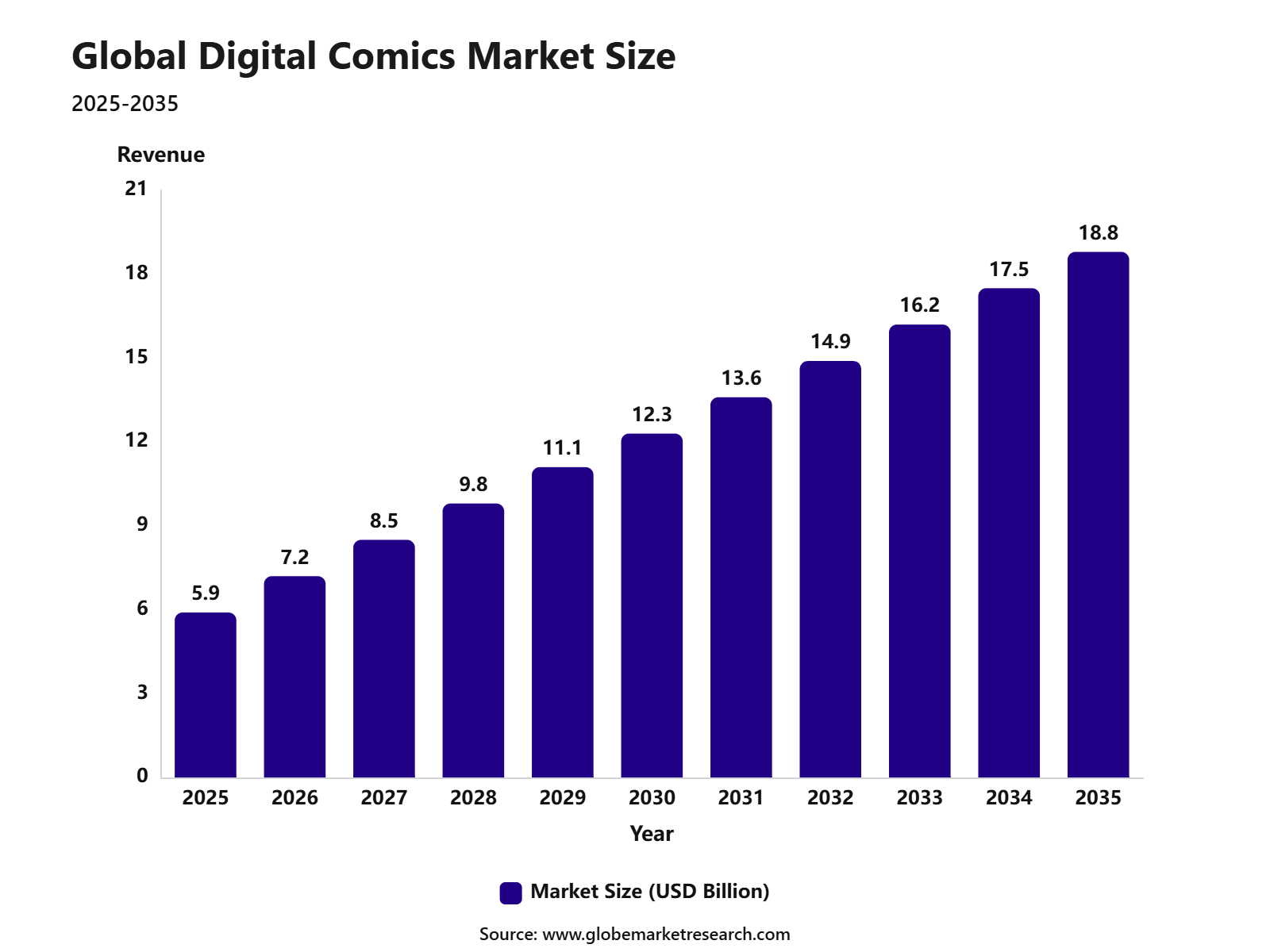 iThe graph shows projected market growth until 2035 based on CAGR analysis. Actual outcomes may vary depending on changing demand, competition, and economic factors.To gain greater insights - request a sample report PDF
Key Insight Summary
Manga leads the Digital Comics market with around 61.8% share, supported by strong reader demand and wide digital availability across major platforms.
Action genre accounts for 33.2% share, driven by high reader engagement, strong visual storytelling, and frequent series consumption.
Adults dominate the market with 69.1% share, supported by higher spending capacity and growing preference for mobile-based comic reading.
Subscription-based models lead the revenue structure with 75.9% share, as readers prefer affordable access to large digital comic libraries.
APAC holds the leading position in the Digital Comics market with 78.9% share, driven by strong manga culture, high smartphone usage, and established digital reading platforms.
Drivers Impact Analysis
Impact Factor | Estimated CAGR Impact | Regional Relevance | Market Impact |
|---|---|---|---|
Rising smartphone and tablet usage | +3.2% | Global, Asia Pacific, North America | Expands digital comic readership. |
Growth of manga and webtoon consumption | +3.6% | Japan, South Korea, China, India, U.S. | Drives strong user engagement. |
Subscription-based reading platforms | +2.8% | Global | Supports recurring revenue growth. |
Increasing internet penetration | +2.4% | Asia Pacific, Latin America, MEA | Improves access to digital content. |
Rising youth and adult readership | +2.6% | Global | Broadens the consumer base. |
Restraints Impact Analysis
Impact Factor | Estimated CAGR Impact | Regional Relevance | Market Impact |
|---|---|---|---|
Piracy and illegal content sharing | -2.0% | Global | Reduces paid platform revenue. |
High content licensing cost | -1.5% | North America, Europe, Asia Pacific | Pressures publisher margins. |
Limited monetization in emerging markets | -1.3% | India, Southeast Asia, Latin America, Africa | Slows revenue conversion. |
Strong competition from free content | -1.4% | Global | Affects paid user growth. |
Digital fatigue among users | -0.9% | Developed markets | Limits reading time and retention. |
Opportunities Impact Analysis
Impact Factor | Estimated CAGR Impact | Regional Relevance | Market Impact |
|---|---|---|---|
Expansion of webtoon platforms | +3.3% | South Korea, Japan, U.S., India, Southeast Asia | Creates new content demand. |
Growth in localized digital comics | +2.7% | Asia Pacific, Latin America, Europe | Improves regional user adoption. |
Rising demand for anime and comic-based IP | +2.9% | Japan, South Korea, U.S., China | Supports cross-media monetization. |
Creator-led publishing models | +2.2% | Global | Increases independent content supply. |
In-app purchases and microtransactions | +2.1% | Asia Pacific, North America | Improves platform revenue. |
By Type Analysis
In 2025, Manga leads the Digital Comics Market with 61.8% share, supported by strong reader loyalty, wide story variety, and the shift from print to mobile-based reading. The format has a strong base in Japan and has gained wider demand across global markets through translated content, anime-linked titles, and easy access through digital platforms. In Japan, electronic manga sales reached a record level in 2024, showing that digital reading has become a core part of manga consumption.
The growth of manga in digital comics is also supported by serialized publishing, where readers return regularly for new chapters. This format helps platforms maintain high engagement and supports recurring revenue. Digital manga accounted for about 73% of Japan’s domestic manga sales in 2024, which reflects the strong movement from physical volumes to online reading.
By Genre Analysis
In 2025, the action genre accounts for 33.2% share in the Digital Comics Market, driven by fast storytelling, strong visual scenes, and repeat engagement from readers. Action-based titles often include adventure, fantasy, martial arts, superheroes, and survival themes, which makes the genre suitable for both short reading sessions and long story arcs on mobile platforms.
The genre also benefits from cross-media appeal, as many action comics are connected with animation, gaming, films, and merchandise. Digital comic platforms commonly list action among major reading categories, which shows its strong visibility across webcomics, manga, and manhwa formats. This supports steady audience retention, especially among readers who prefer high-energy stories with regular chapter releases.
By Target Audience Analysis
In 2025, Adults hold the largest audience share at 69.1%, supported by higher spending capacity, paid content adoption, and interest in long-form stories across romance, action, thriller, fantasy, slice-of-life, and mature drama. Adult readers are also more likely to use subscription plans, pay-per-chapter access, and premium episodes, which makes this group important for platform monetisation.
Adults hold the largest audience share, supported by higher spending capacity, paid content adoption, and interest in long-form stories across romance, action, thriller, fantasy, slice-of-life, and mature drama. Adult readers are also more likely to use subscription plans, pay-per-chapter access, and premium episodes, which makes this group important for platform monetisation.
The adult audience is expanding as comics are no longer viewed only as youth entertainment. Mobile reading has made digital comics more accessible during travel, breaks, and leisure time. The growth of digital platforms has also improved access to diverse content, including translated manga and webtoons, which has widened the adult reader base across Asia, North America, and Europe.
By Revenue Model Analysis
In 2025, Subscription-based models dominate the Digital Comics Market with 75.9% share, as readers prefer regular access to large content libraries, ad-free reading, early chapter releases, and exclusive titles. This model helps platforms build predictable revenue while improving user retention through monthly or annual plans.
The model is also supported by the increasing use of freemium and paid-content systems in digital comic platforms. Readers can start with free chapters and then move to paid access for premium episodes or complete series. This structure has become important for manga and webtoon platforms, as it balances audience growth with stable monetisation. WEBTOON’s public brand information also highlights a large creator base and global platform ecosystem, which supports regular content supply.
Key Market Segments
By Type
Manga
Manhwa
Manhua
Western Comics
Others
By Genre
Action
Comedy
Sci-Fi
Horror
Romance
Others
By Target Audience
Kids
Adults
By Revenue Model
Subscription-based
Ad-based
Key Regions and Countries
North America
US
Canada
Europe
Germany
France
The UK
Spain
Italy
Rest of Europe
Asia Pacific
China
Japan
South Korea
India
Australia
Rest of APAC
Latin America
Brazil
Mexico
Rest of Latin America
Middle East & Africa
South Africa
Saudi Arabia
UAE
Rest of MEA
Regional Analysis
In 2025, APAC leads the Digital Comics Market with 78.9% share, mainly due to the strong presence of manga, manhwa, webtoons, mobile-first reading habits, and established comic cultures in Japan, South Korea, China, and Southeast Asia. The region has a mature reader base, strong content production, and high acceptance of digital entertainment formats.
Japan and South Korea remain key growth centres in the region. Japan’s comic market reached a record level in 2024, while South Korean webtoon platforms have expanded strongly into global markets. Investor activity also shows the value of APAC digital comics, as Reuters reported a USD 1.74 billion bid for a major Japanese digital comic distributor in 2024.
Impact Factor | Estimated CAGR Impact | Regional Relevance | Market Impact |
|---|---|---|---|
Asia Pacific market leadership | +4.2% | Japan, South Korea, China, India, Southeast Asia | Dominates digital comic consumption. |
North America paid readership growth | +2.8% | U.S. and Canada | Supports premium subscriptions. |
Europe digital content adoption | +2.1% | UK, Germany, France, Italy, Spain | Expands paid reading platforms. |
Latin America mobile readership | +1.8% | Brazil, Mexico, Argentina, Chile | Supported by smartphone use. |
Middle East and Africa emerging demand | +1.5% | GCC, South Africa, Egypt | Shows early growth potential. |
Top Emerging Trends
Webtoons and mobile-first comics are becoming a major trend in the Digital Comics market. Their vertical format, short episodes, and frequent updates are well suited for mobile users. This trend is helping platforms attract younger readers and convert free users into paid subscribers through premium chapters and early access models.
Another key trend is the growing link between digital comics, animation, films, gaming, and merchandise. Popular comic characters and storylines are increasingly being used for screen adaptations and franchise development. In 2025, Disney acquired a 2% stake in Webtoon Entertainment and planned to bring Disney, Marvel, Star Wars, and other titles into a unified digital comics service, showing how major entertainment companies are entering this space.
Market Trend Analysis
Impact Factor | Estimated CAGR Impact | Regional Relevance | Market Impact |
|---|---|---|---|
Vertical scrolling webtoons | +3.1% | Asia Pacific, North America, Europe | Improves mobile reading experience. |
AI-assisted translation and localization | +2.0% | Global | Speeds content expansion. |
Short-form comic content | +1.8% | Global | Supports quick reading habits. |
Anime-linked comic demand | +2.6% | Japan, South Korea, U.S., China | Boosts franchise readership. |
Paid chapter release models | +2.2% | Asia Pacific, North America | Strengthens platform revenue. |
Growth Factors
The market is supported by strong internet penetration, growing smartphone ownership, and changing entertainment habits. In low- and middle-income economies, 84% of adults own a mobile phone, and around 3 billion adults own smartphones, creating a wider user base for digital media platforms.
Growth is also being supported by creator-led content and self-publishing platforms. Independent artists can publish comics digitally without relying only on traditional print distribution. This increases content variety, improves platform engagement, and allows niche genres to reach global audiences.
Investment Opportunities
Investment opportunities are expected to remain strong in subscription-based comic platforms, mobile comic apps, localized manga and webtoon content, AI-based content discovery, digital translation, creator monetization tools, and cross-media franchise development. Platforms that combine large content libraries, low-cost access, and strong user engagement are expected to attract higher investor interest.
Asia Pacific offers the strongest investment potential due to its large youth population, strong manga and webtoon culture, and high mobile content consumption. North America and Europe are also expected to grow steadily as digital comic platforms expand through licensed franchises, creator-owned content, and partnerships with entertainment studios.
Impact Factor | Estimated CAGR Impact | Regional Relevance | Market Impact |
|---|---|---|---|
Manga and webtoon platforms | +3.5% | Asia Pacific, U.S., Europe | Offers strong platform growth. |
Original digital IP development | +2.8% | Japan, South Korea, U.S., China | Supports long-term monetization. |
Localization and translation services | +2.3% | Global | Expands cross-border reach. |
Subscription-based platforms | +2.6% | Global | Builds predictable revenue. |
Creator monetization tools | +2.1% | Global | Attracts independent creators. |
Recent Developments
March 2026, GlobalComix raised USD 13 million in funding and acquired INKR to expand its global digital comics distribution network and subscription services.
January 2026, WEBTOON Entertainment and The Walt Disney Company completed a strategic agreement that included Disney acquiring nearly 2% equity stake in WEBTOON Entertainment.
September 2025, WEBTOON Entertainment partnered with Disney to launch a unified digital comics platform featuring more than 35,000 comics from Marvel, Star Wars, Pixar, and Disney franchises.
September 2025, DC Comics partnered with GlobalComix to release over 30,000 digital comic titles through a new global distribution agreement.
Report Scope
Report Highlights | Details |
|---|---|
Market Revenue (2025) | USD 5.9 Billion |
Forecast Revenue (2035) | USD 18.8 Bn |
CAGR (2025-2034) | 12.3% |
Base Year for Estimation | 2024 |
Historic Data | 2020-2023 |
Forecast Period | 2025-2034 |
Report Coverage | AI impact analysis, Revenue projections, company positioning, competitive analysis, growth drivers, and emerging market trends |
Segments Covered | By Type (Manga, Manhwa, Manhua, Western Comics and Others), By Genre (Action, Comedy, Sci-Fi, Horror and Others), By Target Audience (Kids and Adults), By Revenue Model (Subscription-based and Ad-based), By Regional Insights, Adoption Trends, Leading Companies |
Regional Analysis | Europe – Germany, France, The UK, Spain, Italy, Russia, Netherlands, Rest of Europe; North America – US, Canada; Asia Pacific – China, Japan, South Korea, India, New Zealand, Singapore, Thailand, Vietnam, Rest of Latin America; Latin America – Brazil, Mexico, Rest of Latin America; Middle East & Africa – South Africa, Saudi Arabia, UAE, Rest of MEA |
Key companies profiled | DC Comics (Warner Bros), ComiXology (Amazon), Digital Manga Publishing, WEBTOON Entertainment Inc., Kakao Corporation, Lezhin Entertainment, Marvel Entertainment and Others |
Customization Scope | Tailored insights for specific regions, countries, and market segments can be provided. Additional report customization is available upon request. |
Competitive Landscape
The market is characterized by intense competition among established players and emerging companies. Strategic partnerships, mergers and acquisitions, and product innovation are key strategies employed by market participants.
Key Market Players
DC Comics (Warner Bros)
ComiXology (Amazon)
Digital Manga Publishing
WEBTOON Entertainment Inc.
Kakao Corporation
Lezhin Entertainment
Marvel Entertainment
Others
Research Methodology
This market study is prepared using a combination of primary and secondary research. Primary research includes discussions with manufacturers, suppliers, distributors, consultants, industry experts, and end users. Secondary research covers company reports, government databases, trade associations, technical publications, regulatory sources, and trusted industry documents. The collected information is used to assess market demand, pricing trends, technology adoption, competitive activity, and regional performance.
AI language models are not used as primary data sources, and publicly available AI-generated content is not treated as market evidence. Computational tools may be used to support data processing, translation, data classification, and pattern identification. However, every published assessment is supported by verified sources, human review, and primary market discussions.
Market estimates are developed through top-down and bottom-up approaches and validated using data triangulation. Revenue, production, shipment, pricing, and application-level data are compared across multiple sources. Forecasts consider economic conditions, regulatory changes, investment activity, innovation, supply chain developments, and industry risks. All findings are reviewed through source verification and internal quality checks before publication.
Part I
Source Management & Input Data Standards
Who provides data, how sources are qualified, and what types of evidence are admissible.
Part II
Research Scope & Market Coverage
How we define the markets we assess and the parameters that govern each product.
Part III
Data Collection, Verification & Submission
The mechanics of gathering, cross-checking, and hierarchically ranking evidence.
Part IV
Assessment Determination & Quality Controls
How raw data becomes a published assessment — normalisation, expert judgement, and outlier exclusion.
Part V
Publication, Corrections & Revision
Our publication schedule, corrections policy, and methodology review cycle.
Part VI
Independence, Ethics & Complaints
Conflict-of-interest policies, editorial independence, and how clients raise concerns.
Google · Preferred Sources
Don't miss the latest market research insights and industry updates on Google.
Add Globe Market Research as a preferred source in the Google app to see our reports, analysis, and market stories in your news suggestions.
Meet the Team
This report was prepared by our expert analysts with deep industry knowledge and research experience.
Kimaya brings more than five years of experience in market research, content review, and industry analysis to Globe Market Research. She plays an important role in maintaining the accuracy, clarity, consistency, and relevance of research content across a wide range of industries. Her responsibilities include reviewing market data, segment analysis, competitive landscapes, industry trends, company developments, and strategic insights. Each report is carefully assessed to ensure that the findings are supported by reliable data, presented in a structured format, and aligned with the information needs of business decision-makers. Kimaya has research experience across healthcare, information technology, consumer goods, and several cross-industry domains.
Manoj H. is a Senior Research Analyst with more than 4 years of experience in market research, industry analysis, competitive intelligence, and strategic assessment. He has contributed to syndicated reports, customized research studies, market sizing, forecasting, company profiling, and competitive landscape analysis. His industry expertise covers Healthcare and Pharmaceuticals, Manufacturing and Construction, and Agriculture. He evaluates regulatory developments, production trends, technology adoption, supply chain structures, customer demand, investment activity, and competitive strategies across these industries.
Frequently Asked Questions
Related Reports
More in Information and Technology
Shooting Games Market Size to hit USD 238.9 bn by 2035 | CAGR of 10.7%
Shooting Games Market Insights Analysis by Product (Shooting Gallery, Light Gun Shooter, First-Person Shooter, Third-Person Shooter, and Others), by Device Type (PC/MMO, Tablet, Mobile Phone, and TV/Console), by End User (Male and Female), Regional Insights, Technology Trends, Competitive Landscape, Strategic Opportunities, and Growth Forecast, 2026-2035
AI Data Centre Cooling Market Size to Reach USD 52.2 billion by 2035
AI Data Centre Cooling Market Size, Share, Trends and Growth Analysis Report By Cooling Type (Air Cooling, Liquid Cooling, Hybrid Cooling Systems), By Data Centre Type (Hyperscale Data Centres, Colocation Data Centres, Enterprise Data Centres, Edge Data Centres), By Cooling Component (Cooling Units, Chillers, Air Handling Units, Pumps, Heat Exchangers), By End User (Cloud Service Providers, Colocation Providers, Enterprises, Government and Defense), By Regional Insights, Technology Trends, Competitive Landscape, Strategic Opportunities and Growth Forecast, 2026-2035
Agentic AI Security Market Size to hit USD 52.3 billion by 2035 | CAGR of 44.5%
Agentic AI Security Market Size, Share, Trends and Growth Analysis Report By Security Function (Identity and Access Security, AI Governance and Risk Platforms, Threat Detection and Response, Data Security and Privacy, Vulnerability Assessment and Remediation, Security Orchestration, Automation and Response, Security Posture Management, Deception Technology), By Offering (Solutions, Tools and Point Solutions, Managed Security Services, Professional and Integration Services, Training and Certification Services), By Level of Autonomy (Semi-Autonomous Systems, Fully Autonomous Security Agents), By Deployment Layer (Model Layer, Agent and Orchestration Layer, Application Layer, Data Layer, Infrastructure Layer, Integration Layer), By Deployment Mode (Cloud-Based, On-Premises, Hybrid), By Organization Size (Large Enterprises, Small and Medium Enterprises), By Application (Enterprise IT Security, Financial Services Compliance, Healthcare Data Protection, Government and Defense, Cloud Security), By Vertical (BFSI, Healthcare and Life Sciences, Government, Defense, IT and ITES, Telecommunications, Retail and E-commerce, Energy and Utilities, Manufacturing, Other Verticals), By Regional Insights, Technology Trends, Competitive Landscape, Strategic Opportunities and Growth Forecast, 2026-2035
South Korea Physical AI Market Size to Reach USD 3.6 billion by 2035
South Korea Physical AI Market Size, Share, Trends and Growth Analysis Report By Deployment (On-Device AI, Cloud-Based AI), By Component (Hardware, Software, Services), By Technology (Computer Vision, Speech and Natural Language Processing, Gesture and Movement Recognition, Reinforcement Learning and Control Systems, Other Technologies), By Robot Type (Service Robots, Humanoid and Social Robots, Collaborative Robots, Exoskeletons and Prosthetics, Mobile Robots and Drones, Industrial Robots), By Application (Healthcare, Manufacturing and Automotive, Logistics and Warehousing, Retail and Hospitality, Other Applications), By Technology Trends, Competitive Landscape, Strategic Opportunities and Growth Forecast, 2026-2035