

Revenue, 2026
USD 0.2 Bn
Forecast, 2035
USD 3.6 Bn
CAGR, 2026-2035
38.2%
Report Coverage
South Korea
Market Size and Forecast
The South Korea Physical AI Market was valued at USD 0.2 billion in 2026 and is projected to reach approximately USD 3.6 billion by 2035, growing at a CAGR of 38.2% from 2026 to 2035. Market expansion is being supported by South Korea’s advanced electronics and automotive manufacturing base, high industrial automation adoption, strong semiconductor capabilities and increasing investment in humanoid robots, autonomous vehicles, smart factories and AI-enabled machinery.
Key Parameter | Report Details |
|---|---|
Market Revenue, 2026 | USD 0.2 Billion |
Projected Revenue, 2035 | USD 3.6 Billion |
CAGR, 2026-2035 | 38.2% |
Country Scope | South Korea |
Market Concentration | Medium |
Forecast Period | 2026-2035 |
Key Market Insights
On-device AI led the deployment segment with 56.8% share, supported by faster local processing, lower latency, better data control, and strong use in robots, smart devices, and industrial automation systems.
Hardware accounted for 55.3% share by component, driven by demand for sensors, cameras, processors, actuators, control units, and edge computing devices used in physical AI applications.
Computer vision held 46.3% share by technology, supported by its wide use in object detection, quality inspection, navigation, motion tracking, safety monitoring, and machine vision systems.
Industrial robots captured 42.9% share by robot type, driven by South Korea’s strong manufacturing base, advanced factory automation, electronics production, and automotive robotics adoption.
Manufacturing and automotive led the application segment with 25.9% share, supported by rising use of physical AI for assembly automation, inspection, predictive maintenance, warehouse movement, and smart production workflows.
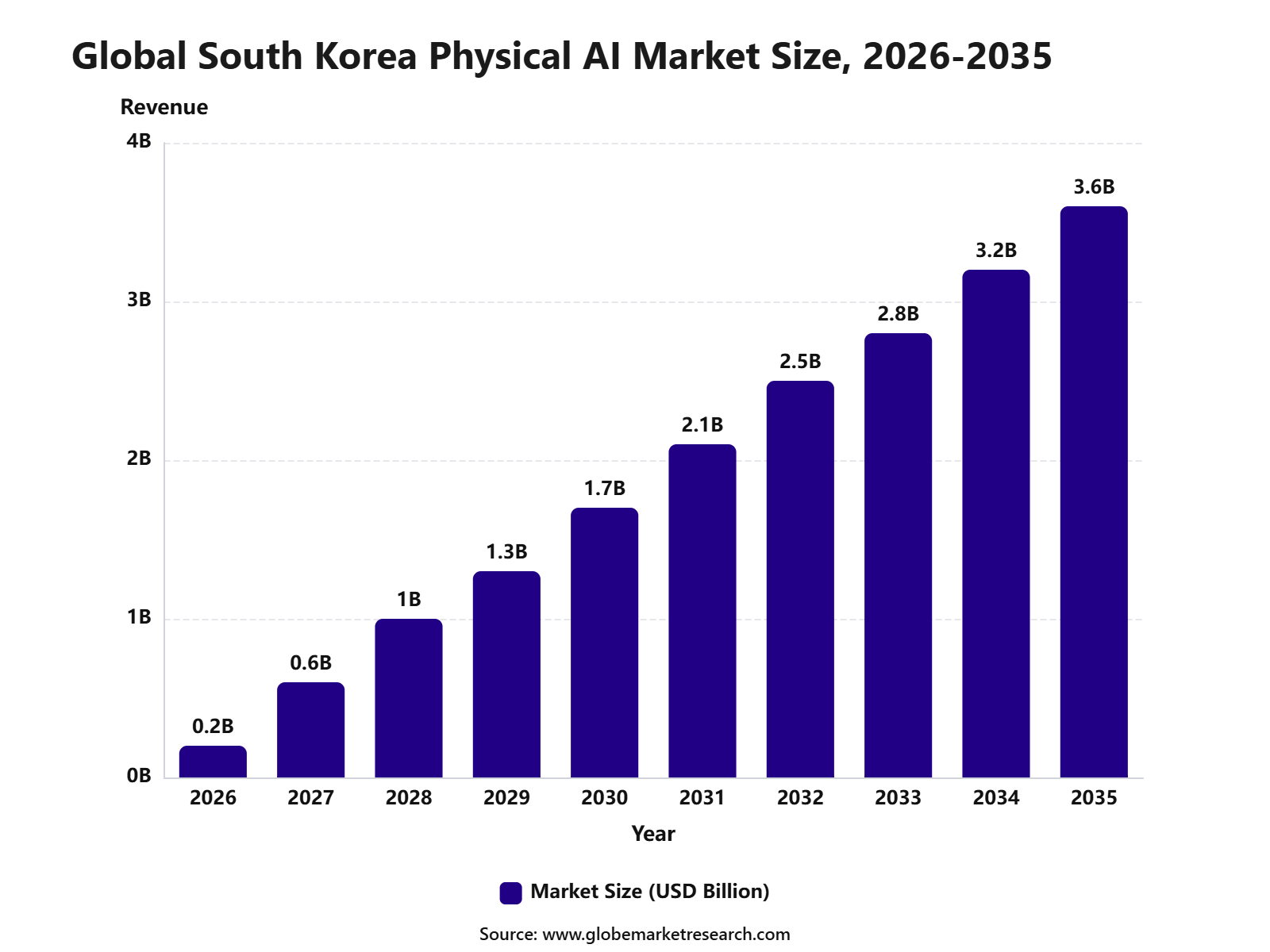 iThe graph shows projected market growth until 2035 based on CAGR analysis. Actual outcomes may vary depending on changing demand, competition, and economic factors.To gain greater insights - request a sample report PDF
Market Overview
Physical AI combines artificial intelligence with robots, vehicles, industrial equipment and other machines that can perceive, understand and respond to real-world environments. These systems use computer vision, sensors, edge AI, simulation, reinforcement learning and motion-control technologies. Applications are expanding across automotive production, electronics manufacturing, logistics, healthcare, defence, construction and public services, where intelligent machines can improve productivity, precision and workplace safety.
Government and municipal investment accelerated in 2026. South Korea allocated KRW 2.3 trillion to AI research and development, an increase of 106.1%, with physical AI, low-power AI, foundation models and AI semiconductor infrastructure identified as priority areas. Seoul also established a dedicated physical AI investment category with a targeted fund size of KRW 150 billion and a municipal commitment of KRW 10 billion for robotics, autonomous driving and related applications.
Adoption Rate and Usage Statistics
According to the South Korean Ministry of Trade, Industry and Energy and Korea International Trade Association, 37.1% of surveyed Korean companies were using AI in business operations during 2025. Adoption reached 65.1% among large enterprises, compared with 35.6% among small companies and 31.3% among mid-sized firms. Among exporters, 16.9% actively used AI, although 78% considered adoption necessary. These indicators support future demand for AI-enabled robots, autonomous manufacturing systems, machine vision and intelligent industrial equipment.
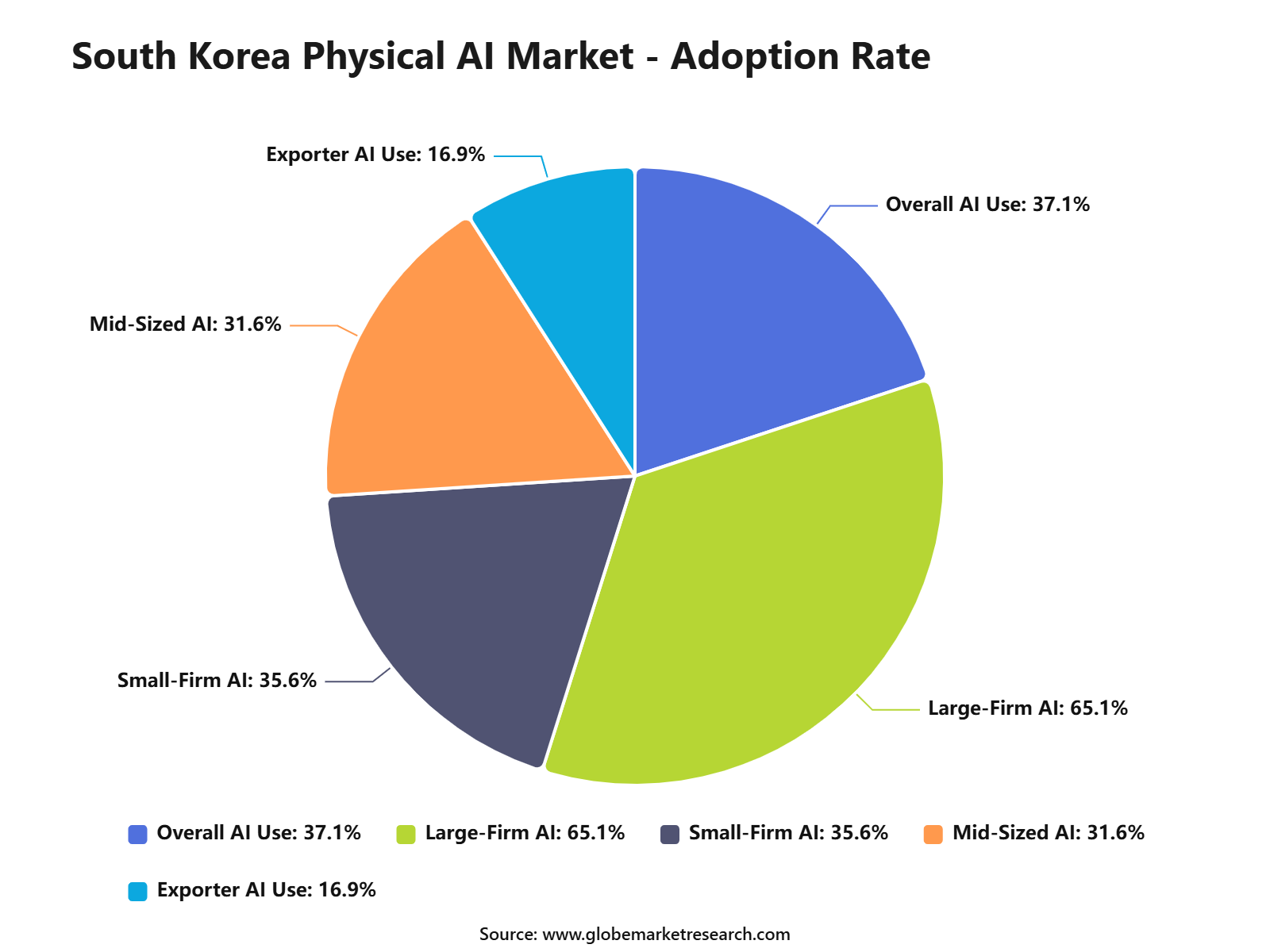 iThe graph shows projected market growth until 2035 based on CAGR analysis. Actual outcomes may vary depending on changing demand, competition, and economic factors.To gain greater insights - request a sample report PDF
According to the International Federation of Robotics, South Korea’s Ministry of Trade, Industry and Energy, and Korea.net, South Korea recorded the world’s highest manufacturing robot density at 1,220 robots per 10,000 employees. The country installed 30,600 industrial robots in the latest reporting year and represented 6% of global installations. The K-Humanoid Alliance initially brought together approximately 40 organizations, while five domestic robot manufacturers agreed to supply humanoid platforms for developing a shared robot AI foundation model.
Metric | Deployment Scale |
|---|---|
Robot Density | 1,220 per 10,000 workers |
Annual Installations | 30,600 robots |
Global Install Share | 6% |
Humanoid Alliance | 40 organizations |
Robot AI Suppliers | 5 companies |
Deployment Insights
On-device AI accounted for 56.8% of the South Korea Physical AI Market by deployment. This model processes information directly within robots, vehicles, industrial machines and connected devices. Local processing reduces dependence on continuous cloud access and supports faster responses when physical systems must detect changes and act immediately.
In May 2025, South Korea announced a program to develop on-device AI semiconductor technologies across four major industrial areas. The initiative includes applications in mobility, robotics, home appliances and aerospace systems, reflecting the country’s focus on placing AI computing directly inside physical products.
On-device deployment is particularly suitable for factories and autonomous machines where network delays can affect operating safety. It also allows sensitive production information to remain closer to the equipment. Future adoption will depend on low-power processors, efficient AI models and reliable performance under limited memory and energy conditions.
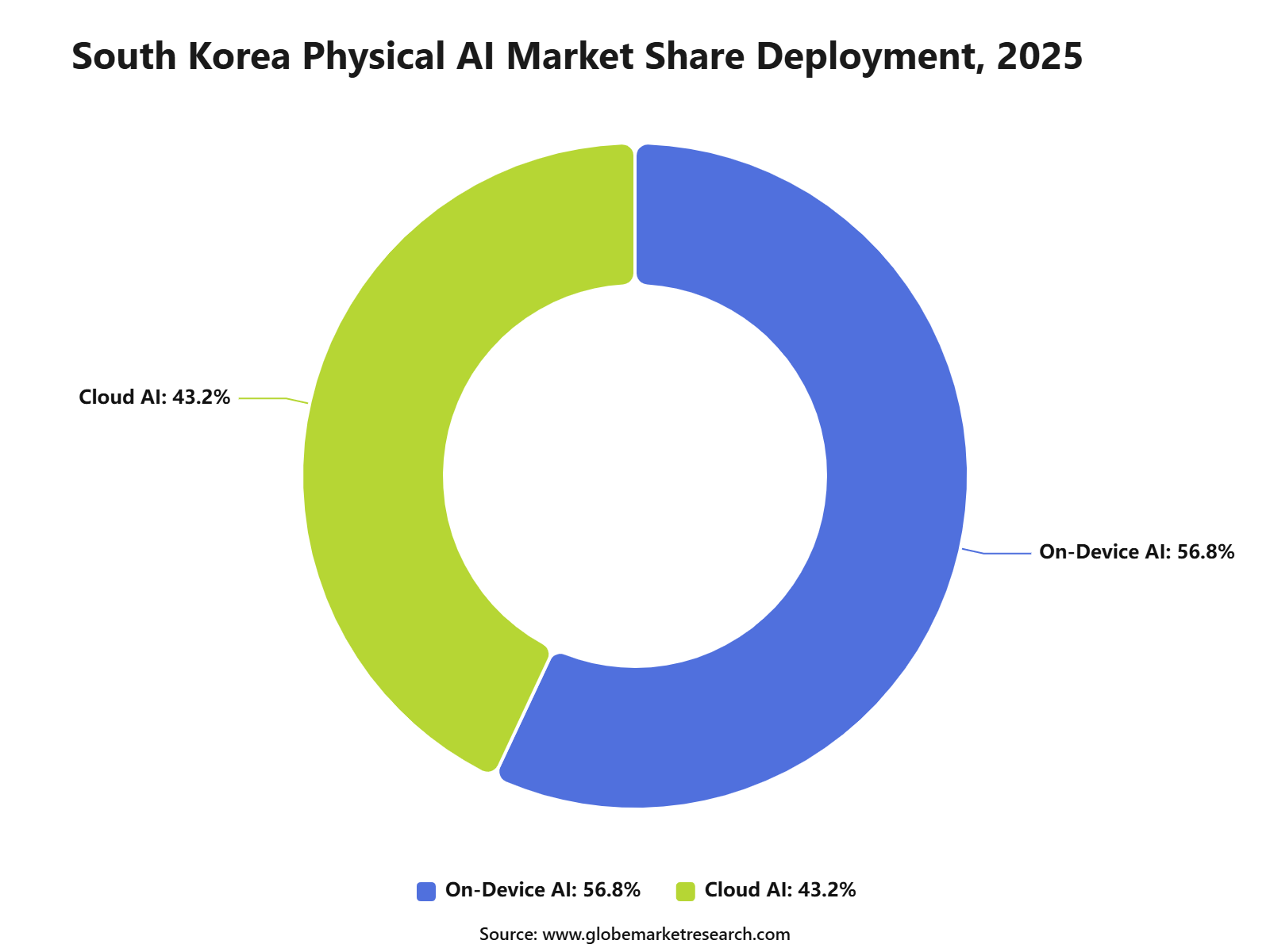 iThe graph shows projected market growth until 2035 based on CAGR analysis. Actual outcomes may vary depending on changing demand, competition, and economic factors.To gain greater insights - request a sample report PDF
Component Insights
Hardware represented 55.3% of the market by component. Physical AI requires sensors, processors, cameras, motors, actuators, controllers and communication modules to connect digital intelligence with physical movement. South Korea’s established semiconductor, electronics and manufacturing capabilities provide a strong foundation for producing these components.
In 2025, the Ministry of Science and ICT selected 17 consortia involving 59 research and industry institutions for the K-Cloud technology program. The initiative includes five initial infrastructure and hardware tasks focused on AI semiconductor-based computing systems and related equipment.
Hardware suppliers are expected to focus on compact designs, lower power use and closer integration between sensors and processors. Physical AI equipment must also remain reliable under heat, vibration, dust and continuous operating conditions. Strong coordination between semiconductor, robotics and control-system developers will be important for commercial deployment.
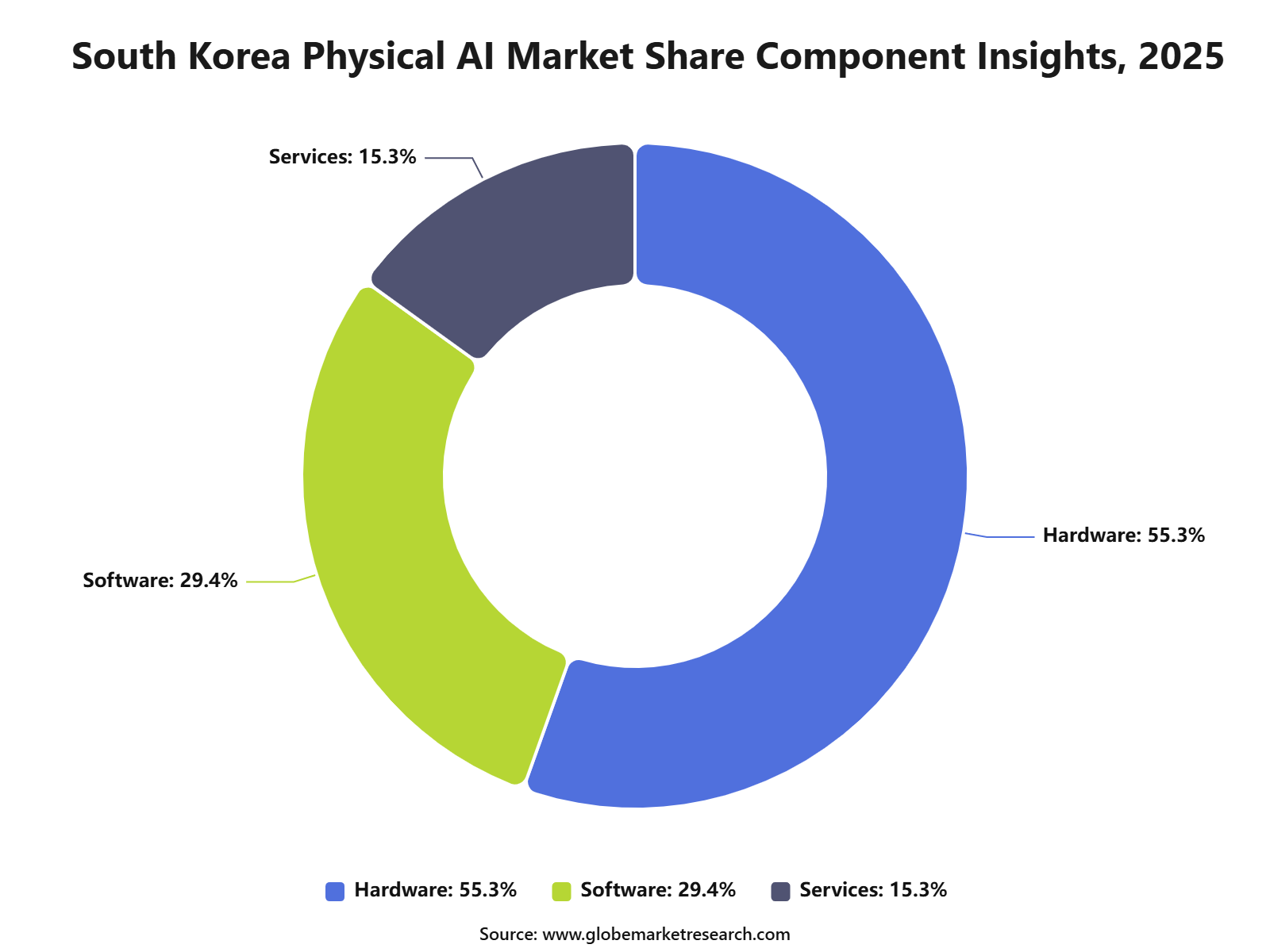 iThe graph shows projected market growth until 2035 based on CAGR analysis. Actual outcomes may vary depending on changing demand, competition, and economic factors.To gain greater insights - request a sample report PDF
Technology Insights
Computer vision accounted for 46.3% of the market by technology. It enables robots and machines to recognize objects, inspect products, measure distances and understand workplace conditions through cameras and image-processing systems. This makes it important for quality control, robotic movement and automated material handling.
By October 2025, South Korea’s AI Factory initiative had expanded to more than 100 pilot projects. The projects included AI-based semiconductor inspection, flexible production using intelligent robotic arms and automated maintenance, showing the growing use of visual recognition and inspection technologies within manufacturing environments.
Computer vision performance depends on camera quality, training data and the system’s ability to operate under changing lighting and production conditions. Demand will favor technologies that identify defects quickly while limiting false detections. Edge processing will also become important where visual data must be analyzed without sending large video files to external servers.
Technology | Market Share |
|---|---|
Computer Vision | 46.3% |
Speech and Natural Language Processing | 16.8% |
Reinforcement Learning and Control Systems | 14.7% |
Gesture and Movement Recognition | 12.3% |
Other Technologies | 9.9% |
Robot Type Insights
Industrial robots held 42.9% of the market by robot type. Their leading position is supported by South Korea’s highly automated electronics, automotive, semiconductor and machinery industries. Physical AI allows industrial robots to move beyond fixed programming and adjust their actions according to objects, production schedules and surrounding activity.
In March 2026, the government unveiled a domestically developed physical AI factory platform combining technologies from nine specialist participants. The integrated system included sensors, controllers, humanoid robots, autonomous mobile robots, transport equipment, virtual training tools and AI data infrastructure.
Industrial robots will increasingly be required to handle product variation and smaller production batches. This will increase demand for machines that can be reconfigured without lengthy programming. Safety systems, accurate motion control and effective coordination between fixed robots and mobile equipment will remain central purchasing factors.
Robot Type | Market Share |
|---|---|
Industrial Robots | 42.9% |
Service Robots | 16.4% |
Collaborative Robots | 13.8% |
Mobile Robots and Drones | 11.2% |
Humanoid and Social Robots | 9.1% |
Exoskeletons and Prosthetics | 6.6% |
Application Insights
Manufacturing and automotive applications accounted for 25.9% of the South Korea Physical AI Market. These sectors use intelligent robots, machine vision and autonomous handling systems for assembly, welding, inspection, logistics and production planning. Adoption is supported by the need to maintain output quality while responding to labor and cost pressures.
South Korea recorded 813,000 eco-friendly vehicle sales in 2025, representing 48% of total new vehicle sales. The transition toward electric and hybrid production is increasing the need for flexible assembly systems, battery inspection, intelligent material handling and robotic manufacturing equipment.
Physical AI can help automotive factories manage new vehicle platforms and changing component requirements without rebuilding complete production lines. Manufacturers will require systems that can learn from production data, detect quality issues and coordinate equipment in real time. Integration with existing factory software will be necessary for wider adoption.
Application | Market Share |
|---|---|
Manufacturing and Automotive | 25.9% |
Healthcare | 20.8% |
Logistics and Warehousing | 18.9% |
Retail and Hospitality | 17.4% |
Other Applications | 17.0% |
Key Market Segments
By Deployment
On-Device AI
Cloud-Based AI
By Component
Hardware
Software
Services
By Technology
Computer Vision
Speech and Natural Language Processing
Gesture and Movement Recognition
Reinforcement Learning and Control Systems
Other Technologies
By Robot Type
Service Robots
Humanoid and Social Robots
Collaborative Robots
Exoskeletons and Prosthetics
Mobile Robots and Drones
Industrial Robots
By Application
Healthcare
Manufacturing and Automotive
Logistics and Warehousing
Retail and Hospitality
Other Applications
Key Market Drivers
World-leading industrial robot adoption: South Korea has the highest manufacturing robot density globally, with 1,220 industrial robots per 10,000 manufacturing employees. Robot density has increased by an average of approximately 7% annually since 2019, supported by strong electronics and automotive production.
National focus on Physical AI leadership: The government has identified Physical AI as a strategic growth area that combines artificial intelligence with manufacturing capabilities. Seven flagship Physical AI projects are being promoted, including AI-powered robots and intelligent automobiles.
Large government R&D allocation: South Korea’s 2026 government R&D budget reached a record KRW 35.3 trillion, representing a 19.3% increase. Commercialization of autonomous driving technologies and humanoid robots has been included among the main technology priorities.
Availability of strategic investment capital: A KRW 50 trillion high-tech strategic industry fund was announced in 2025 to finance semiconductors, artificial intelligence, robotics, biotechnology, secondary batteries, and other strategically important technologies. This funding can support the hardware, sensors, chips, and software required for Physical AI development.
Strong electronics and automotive manufacturing base: South Korea’s established semiconductor, automotive, display, battery, telecommunications, and industrial equipment sectors provide suitable environments for deploying intelligent robots, autonomous machines, inspection systems, and AI-controlled production equipment.
Expansion of private-sector manufacturing investment: Six major South Korean business groups announced combined domestic investment plans of approximately KRW 312 trillion in July 2026. The plans included humanoid robot production lines, advanced manufacturing facilities, semiconductors, batteries, and AI infrastructure.
Emerging South Korea Physical AI Trends
Humanoid robots for manufacturing: Humanoid robots are being developed for assembly, material movement, inspection, equipment operation, and tasks in facilities designed for human workers. South Korea’s 2026 R&D priorities specifically include the rapid commercialization of humanoid technologies.
Physical AI data factories: Specialized facilities are emerging to capture real-world movement, environmental, sensor, image, and interaction data. These datasets can be used to improve robot perception, movement control, decision-making, and task generalization.
AI-powered autonomous mobility: Physical AI is being integrated into passenger vehicles, logistics vehicles, delivery systems, mobile robots, and advanced driver-assistance systems. Autonomous driving has been included among South Korea’s priority technologies for near-term commercialization.
Intelligent quadruped robots: Four-legged robots are being developed for indoor and outdoor patrol, industrial inspection, intrusion detection, agricultural operations, and difficult terrain. Current South Korean systems can recognize surroundings and independently calculate movement routes without continuous manual control.
AI semiconductor integration: Physical AI systems require processors capable of managing vision, sensor fusion, spatial reasoning, motion planning, and real-time decisions. South Korea’s semiconductor capability supports the development of edge processors, high-bandwidth memory, automotive chips, and robotics control hardware.
Simulation-first robot development: Digital twins and virtual manufacturing environments are increasingly being used to train robots and test operational scenarios before physical deployment. This approach can reduce equipment damage, development costs, safety risks, and time required for real-world testing.
5 Best Physical AI Technologies in South Korea
AI-Powered Humanoid Robots: Humanoid systems combine vision, language understanding, robotic arms, mobility, balance control, and task planning. Their leading opportunities are expected in automotive plants, electronics assembly, logistics facilities, laboratories, and hazardous work environments.
Smart Factory Robotics: Industrial robots equipped with AI vision and adaptive control can perform assembly, welding, inspection, packaging, machine tending, and material handling. South Korea’s high robot density and advanced manufacturing base provide a strong foundation for wider adoption.
Autonomous Mobility Systems: These technologies combine cameras, radar, lidar, navigation, AI processors, mapping, and real-time decision systems. Applications include autonomous vehicles, mobile warehouse robots, delivery machines, port equipment, and factory transportation systems.
Physical AI Data and Simulation Platforms: Data platforms collect real-world robot information, while simulation environments reproduce factories, roads, warehouses, buildings, and operating conditions. Together, they support model training, safety validation, synthetic data generation, and faster deployment.
Edge AI Processors and Intelligent Sensors: Edge systems process vision, movement, audio, pressure, distance, and environmental data directly inside robots and machines. Local processing reduces response time, protects operational data, and allows Physical AI systems to operate when network connectivity is limited.
Market Dynamics
Drivers Impact Analysis
The South Korea Physical AI Market is driven by rising adoption of intelligent robots, autonomous machines, smart factories, AI-powered industrial systems, humanoid robots, logistics automation, and AI-enabled manufacturing equipment. Physical AI is becoming important as machines move beyond software intelligence into real-world sensing, movement, control, and decision-making.
South Korea has strong demand potential due to its advanced electronics industry, robotics capability, semiconductor ecosystem, automotive manufacturing, shipbuilding, healthcare technology, and smart factory development. The country’s high industrial automation base supports faster adoption of AI-powered physical systems.
Impact Factor | Estimated CAGR Impact | Regional Relevance | Market Impact |
|---|---|---|---|
Rising industrial robotics adoption | +10.7% | South Korean manufacturing hubs | Drives core Physical AI deployment. |
Growth in smart factory automation | +9.4% | Electronics, automotive, machinery | Supports AI-enabled production systems. |
Expansion of AI-powered robots | +8.6% | Industrial and service sectors | Adds high-value automation demand. |
Strong semiconductor and sensor ecosystem | +7.4% | South Korea | Improves hardware readiness. |
Labor productivity and automation pressure | +6.5% | Manufacturing and logistics | Encourages autonomous machine adoption. |
Restraints Impact Analysis
The market faces restraints from high robot hardware cost, complex AI integration, safety validation needs, real-world reliability concerns, and limited skilled workforce availability. Physical AI systems require sensors, actuators, edge AI chips, control software, simulation tools, and field testing before commercial deployment.
Another restraint is slow adoption among small and mid-sized enterprises. While large manufacturers can invest in advanced robotics and AI systems, smaller factories may face cost barriers, technical gaps, and uncertainty around return on investment.
Impact Factor | Estimated CAGR Impact | Regional Relevance | Market Impact |
|---|---|---|---|
High robotics hardware cost | -5.2% | SMEs and industrial users | Slows wider deployment. |
Complex AI-system integration | -4.5% | Existing factory environments | Delays implementation. |
Safety and liability concerns | -4.0% | Human-facing robotics | Raises testing requirements. |
Real-world reliability challenges | -3.4% | Logistics, healthcare, factories | Affects buyer confidence. |
Skilled AI robotics talent shortage | -2.8% | South Korea | Limits scaling speed. |
Opportunities Impact Analysis
Opportunities are strong in humanoid robots, collaborative robots, autonomous mobile robots, AI inspection systems, logistics robots, smart manufacturing equipment, healthcare robots, and autonomous service robots. These areas benefit from South Korea’s advanced industrial base and demand for productivity improvement.
Higher-value opportunities are emerging in robot foundation models, edge AI control systems, AI vision, tactile sensing, autonomous navigation, digital twins, and simulation-trained robots. Companies that combine hardware engineering with AI intelligence can capture stronger long-term value.
Impact Factor | Estimated CAGR Impact | Regional Relevance | Market Impact |
|---|---|---|---|
Humanoid robot development | +10.3% | South Korea robotics ecosystem | Builds next-generation market opportunity. |
Collaborative robot adoption | +8.9% | Manufacturing and assembly lines | Supports flexible automation. |
Autonomous mobile robots | +8.1% | Logistics and warehouses | Expands commercial deployment. |
AI vision inspection systems | +7.0% | Semiconductor and electronics plants | Improves quality control. |
Robot foundation model development | +6.2% | Advanced AI developers | Enhances machine autonomy. |
Challenges Impact Analysis
The main challenge is building Physical AI systems that can work safely and consistently in real industrial and public environments. Robots must handle changing surroundings, unexpected human movement, equipment variation, and complex task conditions.
Another challenge is moving from pilot projects to scaled commercial use. Companies need reliable hardware, strong service support, AI model validation, cybersecurity controls, maintenance planning, and clear productivity gains before investing at scale.
Impact Factor | Estimated CAGR Impact | Regional Relevance | Market Impact |
|---|---|---|---|
Human-machine safety requirements | -4.8% | Factories, hospitals, service spaces | Affects deployment approval. |
Pilot-to-scale difficulty | -4.1% | Robotics startups and enterprises | Slows commercialization. |
Hardware durability needs | -3.5% | Industrial operations | Raises engineering cost. |
AI model validation challenges | -3.0% | Autonomous systems | Impacts trust and certification. |
ROI measurement difficulty | -2.5% | Enterprise buyers | Slows investment decisions. |
South Korea Physical AI Case Study
Hyundai’s Physical AI Ecosystem in South Korea
Hyundai Motor Group provides a strong example of how South Korea is combining artificial intelligence, robotics, autonomous mobility, digital twins, semiconductors, and advanced manufacturing. The company is working with NVIDIA to establish an AI factory that will support model training, testing, and deployment across autonomous vehicles, smart factories, and robotic systems.
The planned computing infrastructure will use 50,000 NVIDIA Blackwell GPUs. Hyundai Motor Group and NVIDIA also announced approximately USD 3 billion in investment to support South Korea’s national physical AI cluster. The programme includes a Physical AI Application Center, an NVIDIA AI Technology Center, and regional physical AI data centres.
Hyundai Motor Group is also expanding its domestic AI and robotics capabilities through a broader KRW 125.2 trillion investment programme in South Korea between 2026 and 2030. Of this total, KRW 50.5 trillion is allocated to future businesses including AI, robotics, software-defined vehicles, electrification, and hydrogen, while KRW 38.5 trillion is planned for research and development.
Go-to-Market and Sales Economics
The go-to-market approach for the South Korea Physical AI Market should focus on automotive manufacturing, electronics, logistics, shipbuilding and precision machinery. Vendors should demonstrate how intelligent robots can improve production quality, workplace safety and equipment utilization. The International Federation of Robotics reported in April 2026 that South Korea had the world’s highest robot density, with 1,220 industrial robots per 10,000 manufacturing employees.
Sales strategies should begin with controlled deployments in inspection, material handling, machine operation and quality control. Performance should be measured through defect reduction, production speed, downtime and task-completion accuracy. A government-supported physical AI verification project found that digital-twin-based process control could potentially reduce injection-moulding defects by approximately 15%, demonstrating a measurable industrial selling point.
The strongest commercial model will combine robot hardware with AI software, digital twins, maintenance, remote monitoring and system integration. Robotics-as-a-Service can reduce initial customer spending while generating recurring supplier income. Hyundai Motor Group announced in January 2026 that it aims to establish production capacity for 30,000 robots annually, indicating movement from pilot development toward scaled commercialization.
Recent Developments
In July 2026, Samsung Electronics created the Robotics eXperience, or RX, division, reporting directly to the chief executive. The division will oversee robotics strategy, core technology development, commercialisation, and research expansion, with humanoid robots initially targeting manufacturing applications before entering home and retail environments.
In January 2026, Hyundai Motor Group presented Boston Dynamics’ Atlas as a general-purpose industrial humanoid. Atlas has 56 degrees of freedom, tactile hands, advanced sensors, and capabilities covering material sequencing, assembly, machine tending, navigation, and task learning within human-oriented manufacturing facilities.
In July 2026, the government placed physical AI alongside semiconductors and AI data centres within its economic growth strategy. Commercialisation and demonstration support will be expanded across factories, robotics, autonomous vehicles, shipbuilding, home appliances, drones, and semiconductors.
Acquisitions
In July 2026, Hyundai disclosed plans to buy SoftBank’s remaining Boston Dynamics stake. Financial terms were not officially disclosed, although local reporting indicated a possible transaction value of approximately KRW 500 billion, or about USD 335 million.
In July 2026, Blackstone entered an agreement to make a significant investment in South Korean high-precision actuator supplier Futronic. The transaction valued the company at approximately KRW 1 trillion, equivalent to around USD 676 million.
Funding
South Korea is investing approximately KRW 700 billion, or about USD 500 million, during 2026 through its national humanoid manufacturing alliance. The programme is designed to strengthen robot production, components, software, testing, workforce capabilities, and commercial deployment.
In February 2026, RLWRLD completed a USD 26 million Seed 2 round, taking its total seed financing to USD 41 million. The funding is being used to expand robotics foundation models, industrial proof-of-concept projects, overseas operations, and partnerships in South Korea, Japan, and North America.
Futronic produces high-precision actuators for automotive and industrial robots. The investment provides capital for international expansion and demonstrates investor interest in components that determine robot movement, accuracy, payload handling, durability, and safety.
Hyundai Motor Group previously announced plans to invest KRW 125.2 trillion in South Korea between 2026 and 2030. The programme includes robotics, artificial intelligence infrastructure, an AI data centre, advanced manufacturing, and hydrogen-related projects.
Competitive Landscape
The market is characterized by intense competition among established players and emerging companies. Strategic partnerships, mergers and acquisitions, and product innovation are key strategies employed by market participants.
Key Market Players
LG Electronics Inc.
SK Telecom Co., Ltd.
Samsung Electronics Co., Ltd.
Hyundai Motor Company
NAVER Corporation
Doosan Robotics Inc.
Rainbow Robotics
Clobot Inc.
Superb AI, Inc.
ROBROS
Holiday Robotics
Other Key Players
Research Methodology
This market study is prepared using a combination of primary and secondary research. Primary research includes discussions with manufacturers, suppliers, distributors, consultants, industry experts, and end users. Secondary research covers company reports, government databases, trade associations, technical publications, regulatory sources, and trusted industry documents. The collected information is used to assess market demand, pricing trends, technology adoption, competitive activity, and regional performance.
AI language models are not used as primary data sources, and publicly available AI-generated content is not treated as market evidence. Computational tools may be used to support data processing, translation, data classification, and pattern identification. However, every published assessment is supported by verified sources, human review, and primary market discussions.
Market estimates are developed through top-down and bottom-up approaches and validated using data triangulation. Revenue, production, shipment, pricing, and application-level data are compared across multiple sources. Forecasts consider economic conditions, regulatory changes, investment activity, innovation, supply chain developments, and industry risks. All findings are reviewed through source verification and internal quality checks before publication.
Part I
Source Management & Input Data Standards
Who provides data, how sources are qualified, and what types of evidence are admissible.
Part II
Research Scope & Market Coverage
How we define the markets we assess and the parameters that govern each product.
Part III
Data Collection, Verification & Submission
The mechanics of gathering, cross-checking, and hierarchically ranking evidence.
Part IV
Assessment Determination & Quality Controls
How raw data becomes a published assessment — normalisation, expert judgement, and outlier exclusion.
Part V
Publication, Corrections & Revision
Our publication schedule, corrections policy, and methodology review cycle.
Part VI
Independence, Ethics & Complaints
Conflict-of-interest policies, editorial independence, and how clients raise concerns.
Google · Preferred Sources
Don't miss the latest market research insights and industry updates on Google.
Add Globe Market Research as a preferred source in the Google app to see our reports, analysis, and market stories in your news suggestions.
Meet the Team
This report was prepared by our expert analysts with deep industry knowledge and research experience.
Kimaya brings more than five years of experience in market research, content review, and industry analysis to Globe Market Research. She plays an important role in maintaining the accuracy, clarity, consistency, and relevance of research content across a wide range of industries. Her responsibilities include reviewing market data, segment analysis, competitive landscapes, industry trends, company developments, and strategic insights. Each report is carefully assessed to ensure that the findings are supported by reliable data, presented in a structured format, and aligned with the information needs of business decision-makers. Kimaya has research experience across healthcare, information technology, consumer goods, and several cross-industry domains.
Prashant S. is a Research Analyst at Globe Market Research with more than four years of experience in market research and industry analysis. He specializes in the Aerospace and Defence, Automotive and Transportation, Semiconductor and Electronics, Information and Technology sectors, with expertise in market sizing, trend analysis, competitive assessment, and industry forecasting. He applies primary and secondary research, data validation, company analysis, and market estimation methods to deliver reliable insights for strategic planning and business decision-making.
Frequently Asked Questions
Related Reports
More in Information and Technology
Physical AI Market Size to hit USD 2,129.0 billion by 2035
Physical AI Market Size, Share, Trends and Growth Analysis Report By Component (Hardware, Software, Services), By Technology (Computer Vision, Machine Learning and Deep Learning, Natural Language Processing, Edge AI, Other Technologies), By Product (Robots, Exoskeletons, Autonomous Systems, Smart Appliances), By Application (Automation and Manufacturing, Logistics and Supply Chain, Healthcare, Automotive, Defense and Security, Retail, Education, Other End Uses), By Regional Insights, Technology Trends, Competitive Landscape, Strategic Opportunities and Growth Forecast, 2026-2035
Edtech SaaS Tools Market Size to hit USD 217.6 billion by 2035
EdTech SaaS Tools Market Size, Share, Trends and Growth Analysis Report By Software (Classroom Management Systems, Document Management Systems, Learning and Gamification Platforms, Learning Management Systems, Student Collaboration Systems, Assessment and Analytics Tools, Content Authoring Tools, Other Software), By Sector (Preschool, K-12, Higher Education, Other Education Sectors), By Deployment (Cloud-Based, Hybrid), By End Use (Businesses, Educational Institutions, Individual Learners and Consumers), By Regional Insights, Technology Trends, Competitive Landscape, Strategic Opportunities and Growth Forecast, 2026–2035
Marketing Technology Market Size to Reach USD 3,810.8 billion by 2035
Marketing Technology Market Size, Share, Trends and Growth Analysis Report By Marketing Type (Digital Marketing, Offline Marketing), By Product (Social Media Tools, Content Marketing Tools, Rich Media Tools, Marketing Automation Tools, Data and Analytics Tools, Sales Enablement Tools), By Deployment (Cloud-Based, On-Premises, Other Deployment Models), By Enterprise Type (Large Enterprises, Small and Medium-Sized Enterprises), By Application (IT and Telecommunication, Retail and E-commerce, Healthcare, Media and Entertainment, Sports and Events, BFSI, Real Estate, Other Applications), By Regional Insights, Technology Trends, Competitive Landscape, Strategic Opportunities and Growth Forecast, 2026-2035
AI Watermarking Market Size to hit USD 10.9 billion by 2035
AI Watermarking Market Size, Share, Trends and Growth Analysis Report By Type (Invisible Watermarking, Visible Watermarking), By Technology (Non-Reversible Watermarking, Reversible Watermarking), By Deployment (Cloud, On-Premises), By Application (Copyright Protection, Authentication and Security, Branding and Marketing, Other Applications), By Content Type (Video, Image, Model Watermarking, Audio, Text), By End Use (Media and Entertainment, BFSI, Healthcare, Government and Defense, Retail and E-commerce, Other End-Use Industries), By Regional Insights, Technology Trends, Regulatory Landscape, Competitive Analysis, Strategic Opportunities and Growth Forecast, 2026-2035