

Revenue, 2026
USD 95.7 Bn
Forecast, 2035
USD 238.9 Bn
CAGR, 2026-2035
10.7%
Report Coverage
Global
Market Size and Forecast
According to Globe Market Research, the global Shooting Games Market was valued at USD 95.7 billion in 2026 and is projected to reach USD 238.9 billion by 2035, growing at a CAGR of 10.7% from 2026 to 2035. Asia Pacific accounted for around 47.9% of the market, equivalent to approximately USD 45.8 billion in 2026. The region’s strong market position reflects its large mobile gaming population, expanding esports ecosystem, widespread smartphone access, competitive free-to-play titles and growing investment in local game development and publishing.
Key Parameter | Report Details |
|---|---|
Market Revenue, 2026 | USD 95.7 Billion |
Projected Revenue, 2035 | USD 238.9 Billion |
CAGR, 2026-2035 | 10.7% |
Largest Region | Asia Pacific, 47.9% Share |
Market Concentration | Medium |
Forecast Period | 2026-2035 |
Key Takeaways
By product, the first-person shooter segment led the market with a 47.8% share, supported by immersive gameplay, competitive formats and strong player engagement.
By device type, mobile phones accounted for 43.2% of the market, driven by wider smartphone access, improved mobile graphics and the increasing availability of free-to-play games.
By game mode, the multiplayer segment captured 69.1% of the market, reflecting strong demand for team-based gameplay, online competitions and real-time social interaction.
By revenue model, the free-to-play segment represented 60.1% of the market, supported by in-game purchases, advertisements, battle passes and downloadable content.
By end user, the male segment held a 72.3% market share, while participation among female players continues to increase across mobile, PC and console platforms.
Asia Pacific dominated the global shooting games market with a 47.9% share, supported by a large gaming population, expanding internet access, growing esports participation and strong demand across China, Japan, South Korea and Southeast Asia.
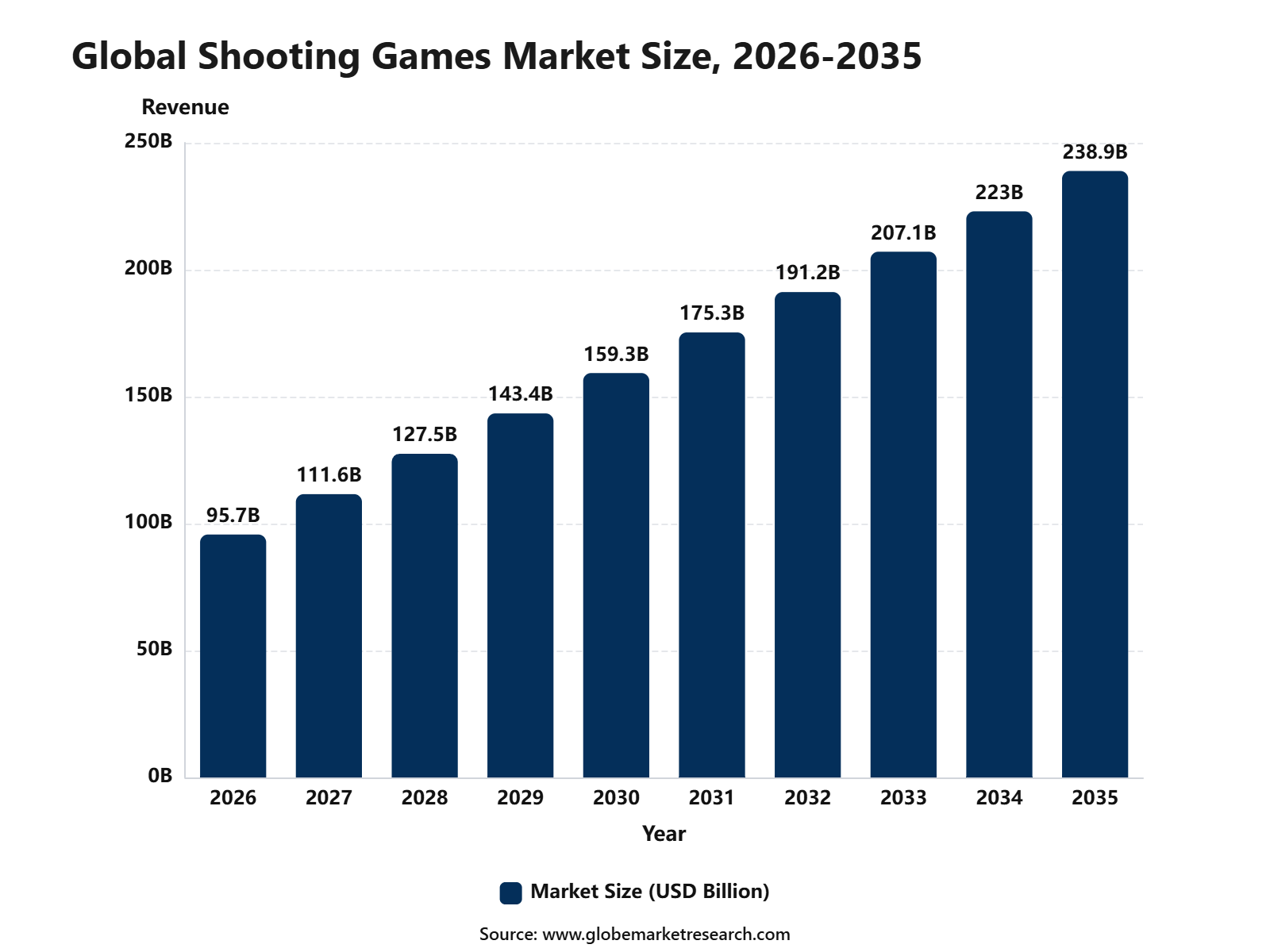 iThe graph shows projected market growth until 2035 based on CAGR analysis. Actual outcomes may vary depending on changing demand, competition, and economic factors.To gain greater insights - request a sample report PDF
What is the Shooting Games Market?
The shooting games market includes the development, publishing, distribution and monetization of video games centred on firearm-based or ranged combat. It covers first-person shooters, third-person shooters, tactical shooters, battle royale games, extraction shooters, light-gun games and shooting-gallery titles. Revenue is generated through game purchases, subscriptions, downloadable content, in-game transactions, advertising and esports activities across mobile phones, PCs, tablets, consoles and cloud gaming platforms.
Shooter games remained one of the most widely played console genres in 2026. Around 60% of U.S. console players reported playing shooter titles, placing the category alongside action and arcade games among the leading console genres. Mobile devices were used by 80% of video game players across age groups, supporting the expansion of mobile shooting games through free-to-play access, shorter match formats and frequent content updates.
Adoption and Usage Statistics
According to the Entertainment Software Association, 37% of U.S. video game players aged eight and above regularly played shooter games during the past year. Adoption was highest among Gen Z players at 57%, followed by male players at 50%, millennials at 43%, and Generation Alpha players at 41%. The figures indicate strong demand across younger and competitive gaming audiences.
Metric | Adoption Rate |
|---|---|
Overall Shooter Play | 37% |
Gen Z Shooter Play | 57% |
Male Shooter Play | 50% |
Millennial Shooter Play | 43% |
Alpha Shooter Play | 41% |
According to Steam, Counter-Strike 2 recorded 1.24 million peak concurrent players on July 25, 2026. PUBG: Battlegrounds reached 748,578 players, followed by Apex Legends with 203,096, Delta Force with 123,862, and Battlefield 6 with 68,363. These figures cover Steam activity only and exclude console users and players accessing the titles through other PC platforms.
Metric | Daily Peak Players |
|---|---|
Counter-Strike 2 | 1.24 million |
PUBG: Battlegrounds | 748,578 |
Apex Legends | 203,096 |
Delta Force | 123,862 |
Battlefield 6 | 68,363 |
Product Insights
First-person shooter games accounted for 47.8% of the Shooting Games Market by product. These games present the action from the player character’s viewpoint, creating an immersive experience built around aiming, movement, tactical positioning and fast decision-making. Military shooters, battle royale titles, extraction shooters and team-based arena games are among the major formats supporting the segment.
The Battlefield franchise has attracted more than 100 million players and generated over 5 billion hours of gameplay. Battlefield 6 also introduced several multiplayer formats, including Conquest, Breakthrough, Rush, Domination and Team Deathmatch. These figures demonstrate the sustained audience demand for large-scale first-person combat experiences.
Demand is being strengthened by realistic graphics, responsive controls, competitive ranking systems and frequent content updates. Developers are also combining traditional shooting mechanics with survival, exploration, vehicle combat and role-playing features. Future product success will depend on balanced gameplay, reliable anti-cheat systems, accessible controls and a steady supply of maps, weapons and seasonal events.
Category | Market Share |
|---|---|
First-Person Shooter | 47.8% |
Third-Person Shooter | 22.4% |
Light Gun Shooter | 12.1% |
Others | 9.0% |
Shooting Gallery | 8.7% |
Device Type Insights
Mobile phones accounted for 43.2% of the Shooting Games Market by device type. Smartphones allow users to access shooting games without purchasing a dedicated console or high-performance computer. Improved mobile processors, larger screens, higher refresh rates and better network connectivity have enabled more advanced graphics, competitive matchmaking and real-time multiplayer experiences.
In 2025, 82% of U.S. video game players aged eight and older used a mobile device for gaming. U.S. consumer spending on mobile games reached USD 26.7 billion during the year, supported by live-service content, hybrid monetization and wider mobile adoption. Mobile shooting games benefit from free access, short match formats, portable gameplay and large addressable user populations.
However, performance differences between devices, touchscreen accuracy, storage requirements, battery use and device heating remain important development challenges. Games offering adjustable graphics, controller support, low-latency servers and cross-platform progression are positioned to attract broader participation.
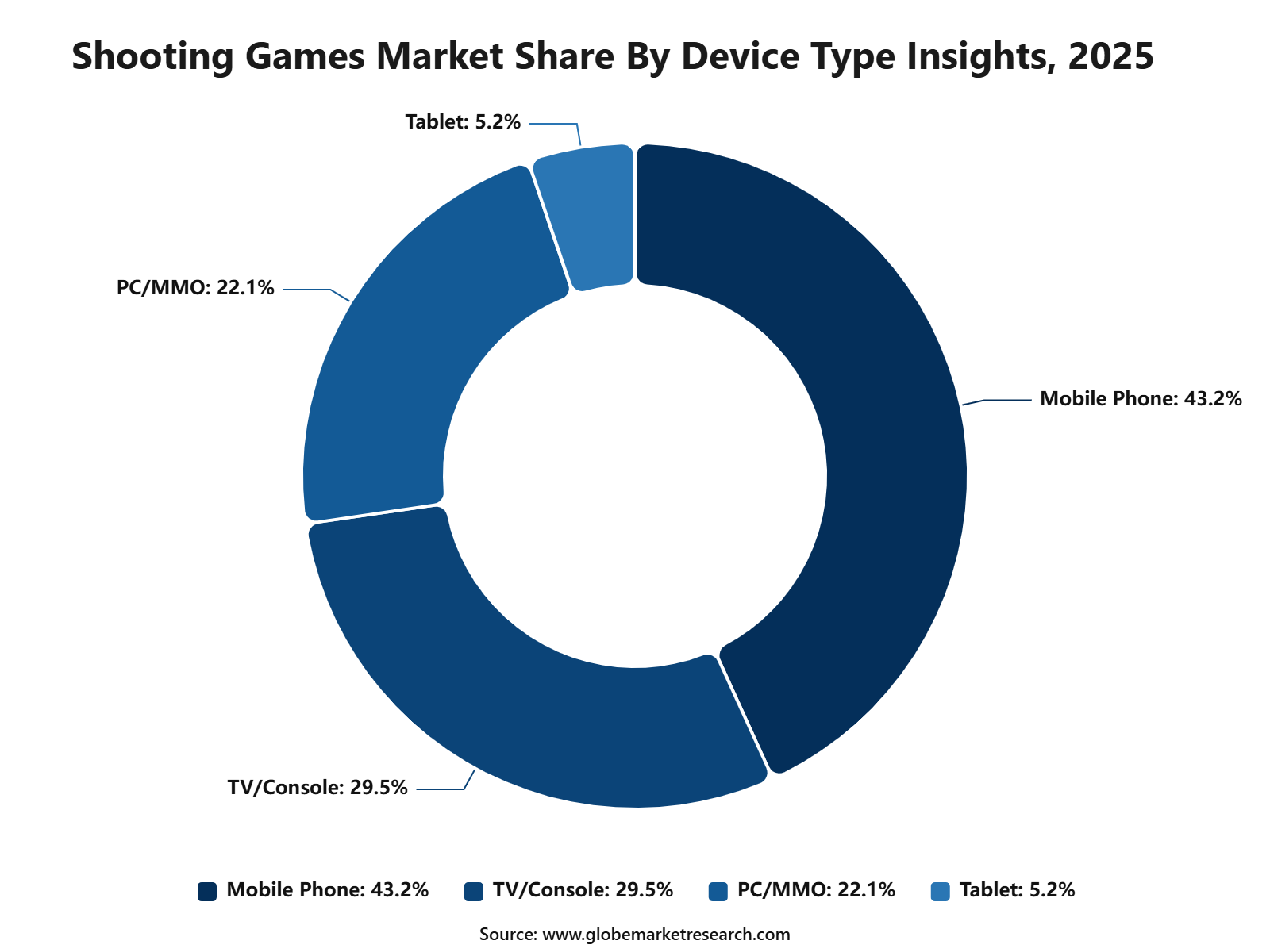 iThe graph shows projected market growth until 2035 based on CAGR analysis. Actual outcomes may vary depending on changing demand, competition, and economic factors.To gain greater insights - request a sample report PDF
Game Mode Insights
Multiplayer games represented 69.1% of the Shooting Games Market by game mode. Multiplayer formats allow users to compete or cooperate through team battles, battle royale matches, ranked competitions, survival missions and objective-based gameplay. Interaction with real players creates unpredictable situations that can increase replay value and extend the active life of a title.
The Entertainment Software Association reported in 2025 that 55% of U.S. players played video games with other people every week, while 72% had played with others at some point. A further 78% believed that video games could introduce them to new friends and relationships.
The popularity of multiplayer shooting games is increasing the importance of reliable servers, skill-based matchmaking and active community management. Cross-platform play can expand player pools and reduce waiting times, while cooperative missions can attract users who prefer team-based experiences. Stronger voice-chat moderation, anti-cheat systems and player-reporting tools will remain essential for maintaining safe and competitive communities.
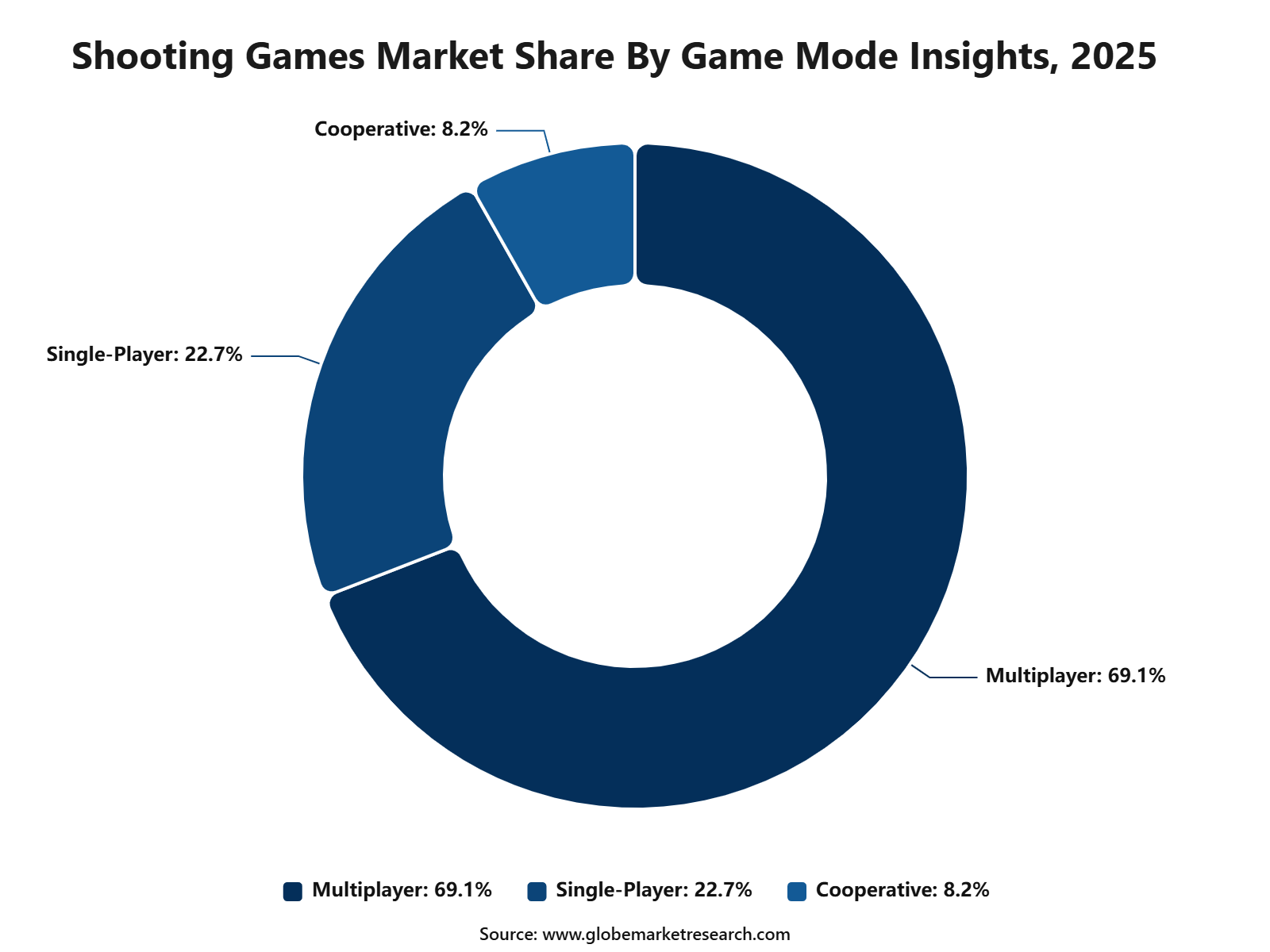 iThe graph shows projected market growth until 2035 based on CAGR analysis. Actual outcomes may vary depending on changing demand, competition, and economic factors.To gain greater insights - request a sample report PDF
Revenue Model Insights
Free-to-play games accounted for 60.1% of the market by revenue model. This model removes the initial purchase barrier and enables publishers to build large player communities across mobile phones, computers and consoles. Revenue is commonly generated through cosmetic items, character skins, battle passes, virtual currencies, optional subscriptions and advertising.
The 2026 Essential Facts report found that 58% of U.S. players had downloaded a game for free during the previous 12 months, compared with 43% who purchased a game. The report also found that most Generation Alpha, Generation Z and millennial players had purchased in-game content, generally spending a median of USD 20 per month.
Free-to-play shooting games depend on continuous engagement rather than a single product purchase. New maps, characters, weapons, events and cosmetic collections can encourage players to return and spend over longer periods. Publishers must maintain transparent purchasing systems and avoid pay-to-win mechanics because aggressive monetization can weaken player trust, competitive fairness and long-term retention.
Category | Market Share |
|---|---|
Free-to-Play | 60.1% |
Premium or Pay-to-Play | 24.5% |
Subscription-Based | 8.2% |
Others | 7.2% |
End-User Insights
Male players accounted for 72.3% of the Shooting Games Market by end user. Shooting titles have traditionally attracted a strong male audience because of their emphasis on competitive combat, military settings, esports, tactical teamwork and weapon-based action. Participation is particularly visible among teenage and young adult users playing through consoles, computers and mobile devices.
The Entertainment Software Association reported in June 2026 that men represented 53% of active U.S. video game players, while women represented 46%. The wider gaming population is therefore relatively balanced, although shooter and action categories can continue to record a stronger concentration of male users.
Developers are expanding character choices, storylines, accessibility features and cooperative modes to attract a more diverse audience. Inclusive representation and adjustable difficulty settings can support participation among women, older users and casual players. Safer online communication will also be important because harassment, abusive language and toxic behaviour can discourage users from continuing to participate.
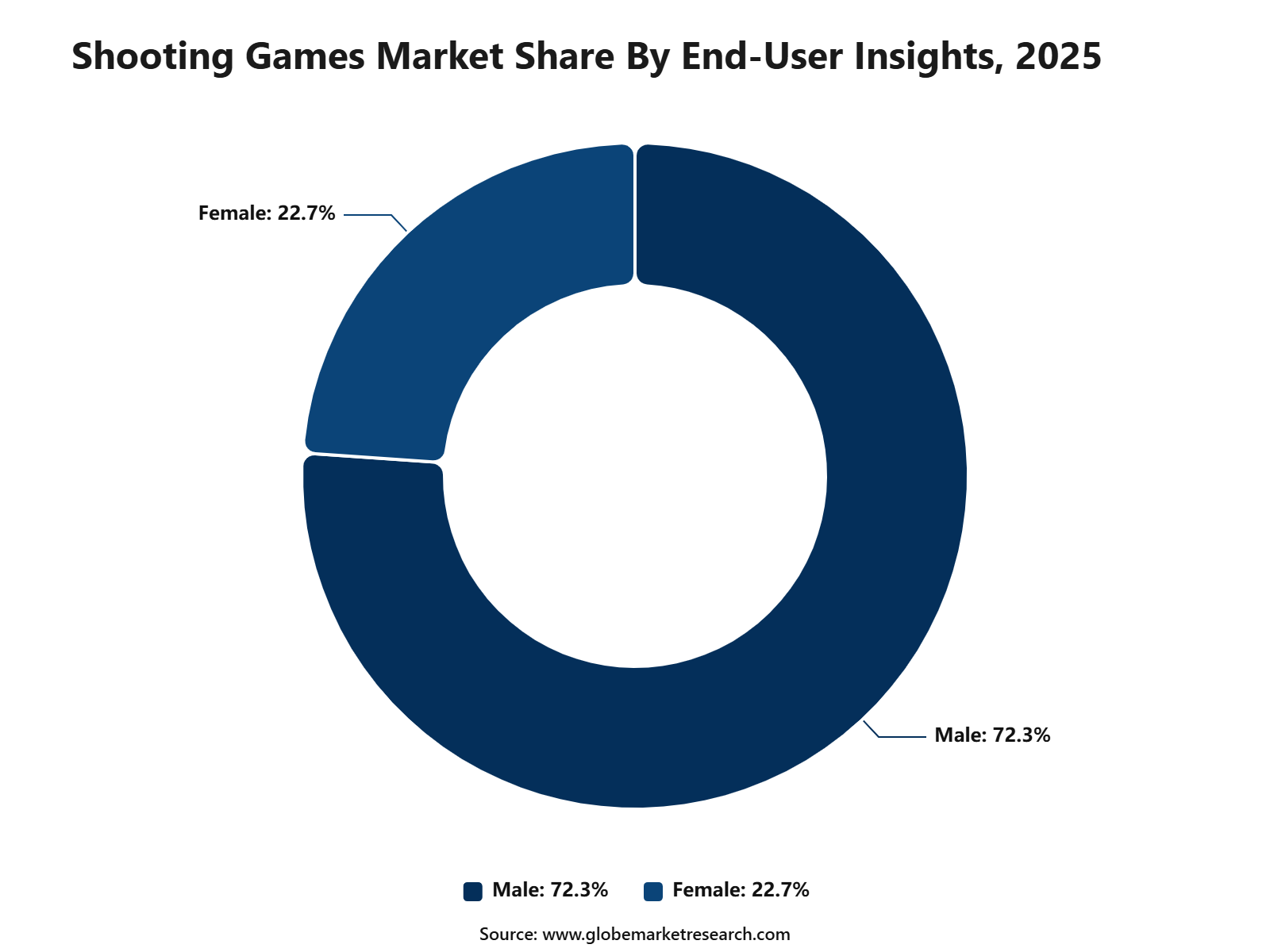 iThe graph shows projected market growth until 2035 based on CAGR analysis. Actual outcomes may vary depending on changing demand, competition, and economic factors.To gain greater insights - request a sample report PDF
Regional Insights
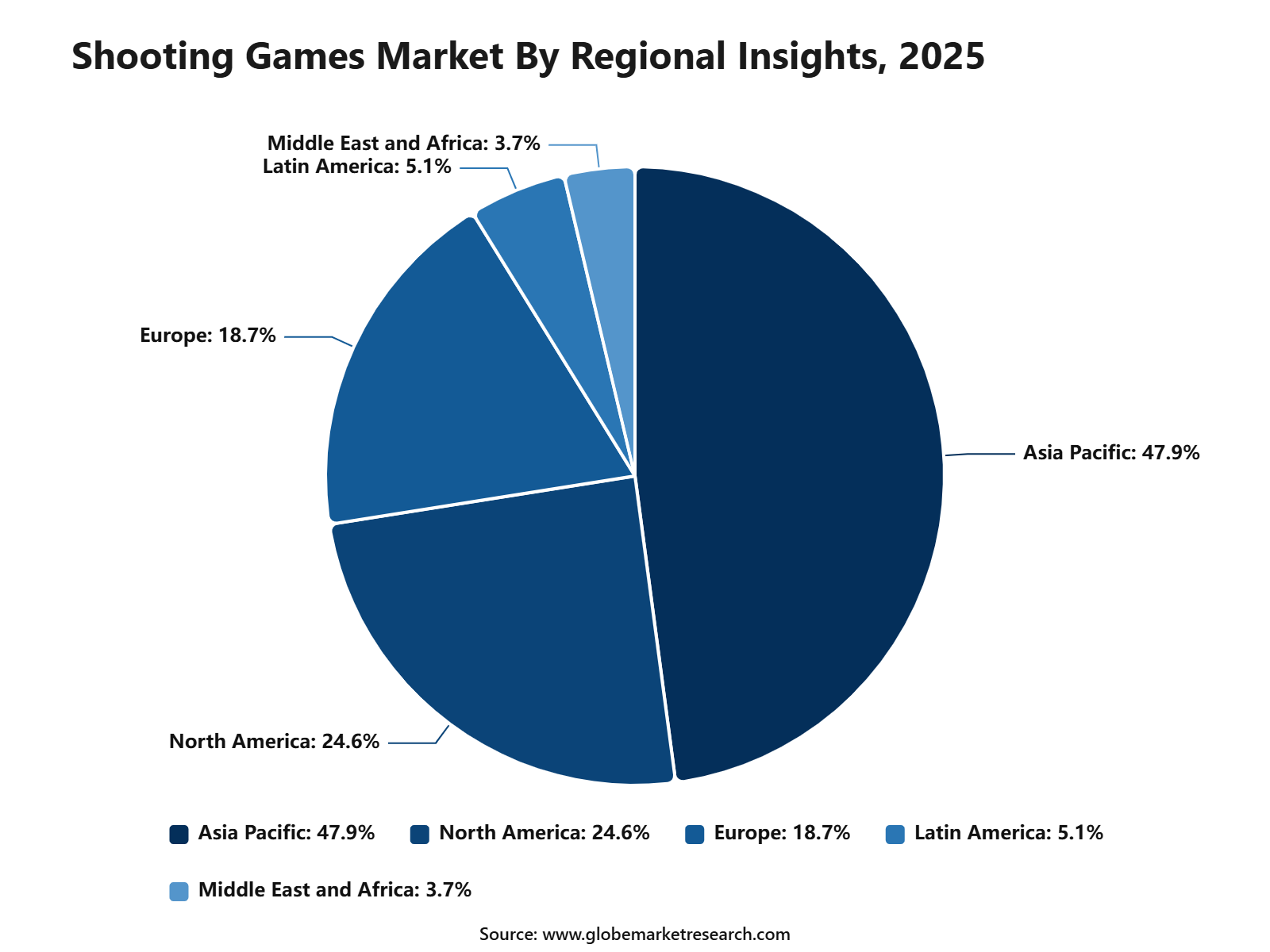
Asia Pacific accounted for 47.9% of the Shooting Games Market. The region contains several of the world’s largest gaming populations and benefits from extensive smartphone usage, competitive esports communities, digital-payment adoption and strong game-development capabilities. China, India, Japan, South Korea and Southeast Asian countries are important markets for mobile and online shooting titles.
China’s domestic game market served 683 million users in 2025, representing an increase of 1.35% from the previous year. Annual game sales exceeded CNY 350 billion, equivalent to approximately USD 49.6 billion, and increased by 7.68% year over year. Regional growth is being supported by affordable smartphones, expanding internet access, local-language content and active esports participation.
Publishers are increasingly developing titles for both domestic and international audiences. However, game-approval requirements, youth-protection policies, data regulations and differences in cultural preferences must be considered when launching and operating shooting games across Asia Pacific.
 iThe graph shows projected market growth until 2035 based on CAGR analysis. Actual outcomes may vary depending on changing demand, competition, and economic factors.To gain greater insights - request a sample report PDF
Regional Market | Market Insight |
|---|---|
U.S. Shooting Games Market Insight | The U.S. has more than 212 million video game players. Strong console, PC and esports participation supports shooting game demand. |
Europe Shooting Games Market Insight | More than half of Europe’s population plays video games. Multiplayer adoption and established console communities support the market. |
U.K. Shooting Games Market Insight | U.K. digital console spending reached £2.49 billion in 2025, while mobile game spending reached £2.07 billion. |
Germany Shooting Games Market Insight | Battlefield 6 was Germany’s second-bestselling new game of 2025. Call of Duty: Black Ops 7 ranked eighth. |
Asia-Pacific Shooting Games Market Insights | Asia Pacific held 47.9% of the market. Expanding 5G connectivity supports mobile multiplayer and competitive shooting games. |
Japan Shooting Games Market Insight | Tokyo Game Show 2025 attracted 263,101 visitors and 772 exhibitors from 46 countries and regions. |
China Shooting Games Market Insight | China had 683 million game users in 2025. Its esports audience exceeded 495 million, supporting competitive shooting titles. |
Key Market Segments
By Product
Shooting Gallery
Light Gun Shooter
First-Person Shooter
Third-Person Shooter
Others
By Device Type
PC/MMO
Tablet
Mobile Phone
TV/Console
By End User
Male
Female
By Region
North America
Europe
Asia Pacific
Latin America
Middle East and Africa
Top 5 Key Market Drivers
Growing demand for multiplayer gaming: Competitive and cooperative multiplayer modes are increasing player engagement, repeat participation, and the operating life of shooting games.
Expansion of free-to-play games: Free access helps publishers attract larger player communities and generate revenue through cosmetic items, battle passes, characters, and seasonal content.
Rising mobile gaming adoption: Improved smartphones, faster internet connectivity, and mobile-optimized controls are expanding access to shooting games across developed and emerging markets.
Growth of esports and competitive gaming: Professional tournaments, ranked gameplay, live streaming, and sponsorship activities are strengthening demand for tactical and team-based shooting titles.
Continuous live-service content updates: New maps, weapons, missions, events, and collaborations are helping publishers retain players and generate recurring in-game revenue.
Top 5 Emerging Trends
Cross-platform play and progression: Players can increasingly compete across PC, console, and mobile devices while retaining their rankings, inventories, and account progress.
AI-powered anti-cheat systems: Behavioral analytics, hardware verification, and server-side monitoring are being used to detect cheating and improve competitive fairness.
Hybrid PvP and PvE gameplay: Developers are combining player-versus-player competition with cooperative missions, computer-controlled enemies, survival mechanics, and extraction formats.
User-generated shooting content: Creator platforms are allowing players to develop custom maps, weapons, challenges, and complete shooting-game experiences.
Low-latency and cloud gaming technology: Faster rendering, regional servers, cloud delivery, and latency-reduction systems are improving gameplay performance across different devices.
5 Best Shooting Game Technologies
Cross-Platform Multiplayer and Netcode: These systems synchronize player movement, shooting, physics, damage, and match results across different devices. Strong netcode, regional servers, latency compensation, and scalable matchmaking are essential for maintaining fair competitive play.
AI-Powered Anti-Cheat and Hardware Attestation: Modern security systems combine machine learning, server-side analytics, kernel-level monitoring, Secure Boot, TPM verification, and account-risk analysis. A layered approach is required because cheat developers continuously change their methods.
Low-Latency Rendering Technology: Latency-reduction tools, high-refresh-rate displays, AI upscaling, frame generation, and optimized graphics pipelines improve aiming responsiveness and visual clarity. These capabilities are particularly important for tactical and esports-focused shooters.
Live Operations and Player Analytics Platforms: Live-service systems monitor retention, matchmaking quality, weapon balance, map usage, spending, progression, and seasonal participation. The resulting data helps developers adjust content and maintain player interest after launch.
User-Generated Content and Creator Platforms: Integrated development tools allow players and independent creators to build maps, modes, challenges, and complete shooting experiences. Publishing, discovery, analytics, moderation, and engagement-based payments are turning creator platforms into important content pipelines.
Shooting Games Market Case Study
Call of Duty: Black Ops 6
Microsoft and Activision’s Call of Duty: Black Ops 6 demonstrates how shooting games are being expanded through cross-platform access, subscription distribution, multiplayer content, and regular live-service updates. The first-person shooter was released across Xbox, PlayStation, PC, Steam, Battle.net, and Game Pass, with 16 multiplayer maps available at launch. By July 2025, Black Ops 6 had attracted 50 million players and generated more than 2 billion gameplay hours, showing the strong engagement potential of established shooting-game franchises.
The game recorded the largest Call of Duty launch at that time, setting franchise records for first-day players and Game Pass subscriber additions. Unit sales across PlayStation and Steam increased by more than 60% year over year, while Black Ops 6 became the top-selling game on both Xbox and PlayStation during Microsoft’s fiscal second quarter. Game Pass PC subscribers increased by over 30%, indicating that subscription access can expand player reach without removing demand for direct game purchases.
Market Dynamics
Drivers Impact Analysis
The Shooting Games Market is driven by the growing global gaming population, rising smartphone penetration, increasing demand for multiplayer games, esports participation, live-service gaming models, and improvements in gaming hardware. Shooting games attract large player communities through competitive gameplay, social interaction, regular content updates, and cross-platform access.
Asia Pacific leads the market due to its large mobile gaming population, expanding internet connectivity, strong esports participation, affordable smartphones, and growing investment in gaming content. China, Japan, South Korea, and India are major contributors, supported by large player bases, established game publishers, streaming communities, and strong adoption of free-to-play shooting games.
Impact Factor | Estimated CAGR Impact | Regional Relevance | Market Impact |
|---|---|---|---|
Growth in global gaming population | +3.8% | Asia Pacific, North America, Europe | Expands the addressable player base for shooting games. |
Rising mobile gaming adoption | +3.5% | Asia Pacific, Latin America, Middle East | Increases access to free-to-play shooting games. |
Multiplayer and social gaming demand | +3.2% | Global gaming markets | Supports longer engagement and recurring participation. |
Expansion of esports and game streaming | +2.9% | China, South Korea, U.S., Europe | Improves game visibility, competition, and audience growth. |
Frequent updates and live-service content | +2.6% | North America, Europe, Asia Pacific | Supports player retention and recurring revenue. |
Restraints Impact Analysis
The market faces restraints from high game development costs, intense competition, player fatigue, regulatory concerns related to in-game purchases, and restrictions on violent content. Developing competitive shooting games requires substantial investment in graphics, servers, gameplay design, cybersecurity, marketing, and continuous content updates.
Another restraint is growing concern regarding excessive gaming, online toxicity, cyberbullying, data privacy, and youth access to violent content. Governments and digital platforms are introducing stronger age verification, content rating, data protection, and monetization requirements, which can increase compliance costs and restrict certain revenue models.
Impact Factor | Estimated CAGR Impact | Regional Relevance | Market Impact |
|---|---|---|---|
High game development and maintenance costs | -2.3% | Large game development markets | Limits entry by smaller developers and publishers. |
Strong competition and market saturation | -2.0% | North America, Europe, Asia Pacific | Increases user acquisition costs and reduces game visibility. |
Regulation of loot boxes and in-game purchases | -1.8% | Europe, Asia Pacific, selected U.S. states | Restricts monetization options for publishers. |
Concerns regarding violent gaming content | -1.5% | Global consumer markets | Increases regulatory and parental scrutiny. |
Player fatigue and declining retention | -1.3% | Mature gaming markets | Reduces long-term engagement with repetitive titles. |
Opportunities Impact Analysis
Opportunities are expanding in mobile shooting games, cross-platform gameplay, cloud gaming, esports tournaments, virtual reality shooting games, and user-generated content. These formats allow developers to reach wider audiences while improving accessibility, player engagement, and monetization.
Higher-value opportunities are emerging in AI-based matchmaking, personalized game content, creator-led gaming communities, branded virtual items, regional-language games, and subscription-based gaming services. Developers that combine competitive gameplay, social features, regular updates, and secure payment systems can capture stronger demand across developed and emerging markets.
Impact Factor | Estimated CAGR Impact | Regional Relevance | Market Impact |
|---|---|---|---|
Cross-platform gaming expansion | +4.1% | North America, Europe, Asia Pacific | Connects mobile, PC, and console player communities. |
Mobile shooting game development | +3.8% | Asia Pacific, Latin America, Middle East | Expands access among smartphone-based players. |
Esports tournaments and professional leagues | +3.4% | China, South Korea, U.S., Europe | Creates sponsorship, advertising, and media opportunities. |
Cloud gaming and subscription services | +3.0% | Developed digital markets | Reduces dependence on high-cost gaming hardware. |
AI-based personalization and matchmaking | +2.7% | Global online gaming platforms | Improves player experience and long-term retention. |
Challenges Impact Analysis
The main challenge is maintaining player engagement in a highly competitive market. Shooting game developers must continuously introduce new maps, characters, weapons, missions, seasonal events, and multiplayer features. Delays in content updates or poor gameplay balance can quickly reduce active player numbers.
Another challenge is controlling cheating, hacking, account theft, toxic behaviour, and unfair matchmaking. Publishers must balance game performance, cybersecurity, content moderation, server reliability, and monetization without reducing the quality of the player experience. Differences in device capability, internet speed, platform policies, and regional regulations further increase operational complexity.
Impact Factor | Estimated CAGR Impact | Regional Relevance | Market Impact |
|---|---|---|---|
Cheating and unauthorized game modifications | -2.2% | Competitive multiplayer markets | Reduces trust and damages the player experience. |
Difficulty in maintaining player retention | -2.0% | Global online gaming platforms | Increases dependence on frequent content releases. |
Online toxicity and content moderation | -1.7% | Multiplayer gaming communities | Raises moderation costs and brand risks. |
Server performance and latency issues | -1.5% | Emerging and geographically dispersed markets | Affects real-time gameplay quality and participation. |
Device and platform fragmentation | -1.2% | Mobile, PC, and console markets | Increases development, testing, and optimization costs. |
Recent Developments
January 2026, Highguard entered the free-to-play shooter market: Wildlight Entertainment launched Highguard as a free-to-play 3v3 first-person raid shooter on Xbox Series X|S and other supported platforms. The independently published game was developed by industry veterans associated with Apex Legends, Titanfall, and Call of Duty. Monthly additions of characters, maps, modes, and other content were planned to support long-term engagement.
January 2026, EA discontinued Anthem’s online services: Electronic Arts shut down Anthem’s servers on January 12, 2026. The decision demonstrated the commercial and operational risks associated with always-online shooting games, particularly when player engagement is insufficient to support continuing server, development, and moderation costs.
February 2026, High on Life 2 expanded the single-player FPS category: Squanch Games released High on Life 2 on February 13 for Xbox Series X|S and PC, with day-one availability through Game Pass. The game combines first-person shooting with movement systems, narrative content, comedy, and skateboarding mechanics, showing continued demand for differentiated single-player shooting experiences.
March 2026, Bungie launched Marathon across major platforms: Marathon was released on March 5 for PlayStation 5, Xbox Series X|S, and PC with full cross-play and cross-save support. Bungie adopted a paid-entry model supported by free seasonal gameplay updates, including new maps, equipment, Runner shells, events, and gameplay systems.
April 2026, Sony released Saros for PlayStation 5: Housemarque launched Saros on April 30 as a fast-paced, single-player third-person shooting game. The title uses Unreal Engine 5 and includes persistent progression, weapons, boss encounters, changing environments, accessibility tools, and PlayStation 5 Pro enhancements.
June 2026, Marathon introduced its second live-service season: Bungie launched Marathon Season 2 with a new Night Marsh zone, new enemies, weapons, equipment, and a temporary open-play period. The company also continued making changes to matchmaking, progression, onboarding, solo play, and end-game systems based on player feedback.
Mergers
January 2026, Ubisoft reorganised its business around specialised creative units: Ubisoft announced a restructuring that divided its operations into five Creative Houses. The Tencent-backed Vantage Studios unit was assigned responsibility for major franchises that include Rainbow Six and Far Cry, giving individual business units greater responsibility for development, budgets, publishing, and brand strategy.
July 2026, specialist shooter-studio merger activity remained limited: No major merger of equals between leading shooting-game studios was identified in the reviewed public announcements through July 25, 2026. Industry consolidation was mainly being conducted through publisher acquisitions, minority investments, corporate restructuring, and developer-publisher partnerships.
July 2026, partnerships remained important for franchise expansion: PlayStation’s collaboration with Oh Bibi on Ranger Rumble and Microsoft’s cross-platform expansion of Halo and Call of Duty show that companies are using licensing, development partnerships, and wider platform distribution as alternatives to full corporate mergers.
Acquisitions
July 2026, the proposed USD 55 billion acquisition of Electronic Arts received EU merger approval: The European Commission approved the acquisition of EA by an investor consortium led by Saudi Arabia’s Public Investment Fund, Silver Lake, and Affinity Partners under normal EU merger rules. EA owns the Battlefield franchise, making the transaction directly relevant to the competitive structure of the shooting games market.
July 2026, the EA transaction remained subject to an additional regulatory review: Although the transaction received EU merger approval, it continued to be reviewed under the European Union’s Foreign Subsidies Regulation. The proposed USD 55 billion deal would be among the largest ownership changes in the global gaming industry.
July 2026, acquisition interest remained concentrated around established intellectual property: The EA transaction indicates that investors are placing substantial value on publishers with recognised franchises, live-service ecosystems, development studios, digital distribution systems, and large global player communities. Battlefield represents an important shooting-game asset within this wider portfolio.
July 2026, completed acquisitions of independent specialist shooter studios remained limited: Apart from the broader EA ownership transaction, no comparable completed acquisition of a major independent shooting-game specialist was identified in the reviewed 2026 public announcements. Smaller developers continued to rely mainly on venture funding, publishing agreements, and strategic backing.
Funding
February 2026, Ares Interactive raised USD 70 million: The game developer and publisher completed a Series A round led by General Catalyst. The funding supports cross-platform, free-to-play game development and the expansion of its portfolio, which includes Mercenary Syndicate, a tactical roguelike survival shooter.
March 2026, Antihero Studios raised USD 4.5 million: The Barcelona-based studio secured seed financing co-led by A16z Speedrun and Laton Ventures to develop MISFITZ, a mobile-focused social extraction shooter. A pre-alpha test attracted more than 70,000 participants, providing an early indicator of demand for mobile extraction experiences.
May 2026, BulletFarm secured new strategic backing: The studio established by former Call of Duty developer David Vonderhaar returned under the GreaterThan Group after losing its previous NetEase support. The company is developing a cinematic multiplayer and cooperative PvPvE first-person shooter, although the value of the new financial backing was not disclosed.
July 2026, investors continued to favour differentiated shooting concepts: Funding was directed toward mobile extraction games, cross-platform free-to-play titles, tactical survival shooters, and experimental PvPvE formats. However, developers were increasingly required to demonstrate player demand through playtests, active communities, retention indicators, and controlled production budgets before receiving larger investments.
Competitive Landscape
The market is characterized by intense competition among established players and emerging companies. Strategic partnerships, mergers and acquisitions, and product innovation are key strategies employed by market participants.
Key Market Players
Activision Blizzard
Electronic Arts Inc.
Epic Games, Inc.
Valve Corporation
Tencent Holdings Limited
Rockstar Games
Ubisoft Entertainment SA
NetEase, Inc.
NetEase, Inc.
Gameloft SE
DICE
Riot Games
Other Key Players
Research Methodology
This market study is prepared using a combination of primary and secondary research. Primary research includes discussions with manufacturers, suppliers, distributors, consultants, industry experts, and end users. Secondary research covers company reports, government databases, trade associations, technical publications, regulatory sources, and trusted industry documents. The collected information is used to assess market demand, pricing trends, technology adoption, competitive activity, and regional performance.
AI language models are not used as primary data sources, and publicly available AI-generated content is not treated as market evidence. Computational tools may be used to support data processing, translation, data classification, and pattern identification. However, every published assessment is supported by verified sources, human review, and primary market discussions.
Market estimates are developed through top-down and bottom-up approaches and validated using data triangulation. Revenue, production, shipment, pricing, and application-level data are compared across multiple sources. Forecasts consider economic conditions, regulatory changes, investment activity, innovation, supply chain developments, and industry risks. All findings are reviewed through source verification and internal quality checks before publication.
Part I
Source Management & Input Data Standards
Who provides data, how sources are qualified, and what types of evidence are admissible.
Part II
Research Scope & Market Coverage
How we define the markets we assess and the parameters that govern each product.
Part III
Data Collection, Verification & Submission
The mechanics of gathering, cross-checking, and hierarchically ranking evidence.
Part IV
Assessment Determination & Quality Controls
How raw data becomes a published assessment — normalisation, expert judgement, and outlier exclusion.
Part V
Publication, Corrections & Revision
Our publication schedule, corrections policy, and methodology review cycle.
Part VI
Independence, Ethics & Complaints
Conflict-of-interest policies, editorial independence, and how clients raise concerns.
Google · Preferred Sources
Don't miss the latest market research insights and industry updates on Google.
Add Globe Market Research as a preferred source in the Google app to see our reports, analysis, and market stories in your news suggestions.
Meet the Team
This report was prepared by our expert analysts with deep industry knowledge and research experience.
Kimaya brings more than five years of experience in market research, content review, and industry analysis to Globe Market Research. She plays an important role in maintaining the accuracy, clarity, consistency, and relevance of research content across a wide range of industries. Her responsibilities include reviewing market data, segment analysis, competitive landscapes, industry trends, company developments, and strategic insights. Each report is carefully assessed to ensure that the findings are supported by reliable data, presented in a structured format, and aligned with the information needs of business decision-makers. Kimaya has research experience across healthcare, information technology, consumer goods, and several cross-industry domains.
Prashant S. is a Research Analyst at Globe Market Research with more than four years of experience in market research and industry analysis. He specializes in the Aerospace and Defence, Automotive and Transportation, Semiconductor and Electronics, Information and Technology sectors, with expertise in market sizing, trend analysis, competitive assessment, and industry forecasting. He applies primary and secondary research, data validation, company analysis, and market estimation methods to deliver reliable insights for strategic planning and business decision-making.
Frequently Asked Questions
Related Reports
More in Information and Technology
AI Data Centre Cooling Market Size to Reach USD 52.2 billion by 2035
AI Data Centre Cooling Market Size, Share, Trends and Growth Analysis Report By Cooling Type (Air Cooling, Liquid Cooling, Hybrid Cooling Systems), By Data Centre Type (Hyperscale Data Centres, Colocation Data Centres, Enterprise Data Centres, Edge Data Centres), By Cooling Component (Cooling Units, Chillers, Air Handling Units, Pumps, Heat Exchangers), By End User (Cloud Service Providers, Colocation Providers, Enterprises, Government and Defense), By Regional Insights, Technology Trends, Competitive Landscape, Strategic Opportunities and Growth Forecast, 2026-2035
Agentic AI Security Market Size to hit USD 52.3 billion by 2035 | CAGR of 44.5%
Agentic AI Security Market Size, Share, Trends and Growth Analysis Report By Security Function (Identity and Access Security, AI Governance and Risk Platforms, Threat Detection and Response, Data Security and Privacy, Vulnerability Assessment and Remediation, Security Orchestration, Automation and Response, Security Posture Management, Deception Technology), By Offering (Solutions, Tools and Point Solutions, Managed Security Services, Professional and Integration Services, Training and Certification Services), By Level of Autonomy (Semi-Autonomous Systems, Fully Autonomous Security Agents), By Deployment Layer (Model Layer, Agent and Orchestration Layer, Application Layer, Data Layer, Infrastructure Layer, Integration Layer), By Deployment Mode (Cloud-Based, On-Premises, Hybrid), By Organization Size (Large Enterprises, Small and Medium Enterprises), By Application (Enterprise IT Security, Financial Services Compliance, Healthcare Data Protection, Government and Defense, Cloud Security), By Vertical (BFSI, Healthcare and Life Sciences, Government, Defense, IT and ITES, Telecommunications, Retail and E-commerce, Energy and Utilities, Manufacturing, Other Verticals), By Regional Insights, Technology Trends, Competitive Landscape, Strategic Opportunities and Growth Forecast, 2026-2035
South Korea Physical AI Market Size to Reach USD 3.6 billion by 2035
South Korea Physical AI Market Size, Share, Trends and Growth Analysis Report By Deployment (On-Device AI, Cloud-Based AI), By Component (Hardware, Software, Services), By Technology (Computer Vision, Speech and Natural Language Processing, Gesture and Movement Recognition, Reinforcement Learning and Control Systems, Other Technologies), By Robot Type (Service Robots, Humanoid and Social Robots, Collaborative Robots, Exoskeletons and Prosthetics, Mobile Robots and Drones, Industrial Robots), By Application (Healthcare, Manufacturing and Automotive, Logistics and Warehousing, Retail and Hospitality, Other Applications), By Technology Trends, Competitive Landscape, Strategic Opportunities and Growth Forecast, 2026-2035
Physical AI Market Size to hit USD 2,129.0 billion by 2035
Physical AI Market Size, Share, Trends and Growth Analysis Report By Component (Hardware, Software, Services), By Technology (Computer Vision, Machine Learning and Deep Learning, Natural Language Processing, Edge AI, Other Technologies), By Product (Robots, Exoskeletons, Autonomous Systems, Smart Appliances), By Application (Automation and Manufacturing, Logistics and Supply Chain, Healthcare, Automotive, Defense and Security, Retail, Education, Other End Uses), By Regional Insights, Technology Trends, Competitive Landscape, Strategic Opportunities and Growth Forecast, 2026-2035