
Revenue, 2026
USD 14.1 Bn
Forecast, 2035
USD 52.2 Bn
CAGR, 2026-2035
15.7%
Report Coverage
Global
Market Size and Forecast
According to Globe Market Research, the global AI Data Centre Cooling Market was valued at USD 14.1 billion in 2026 and is projected to reach approximately USD 52.2 billion by 2035, growing at a CAGR of 15.7% from 2026 to 2035. North America accounted for around 42.9% of the market, equivalent to approximately USD 6.0 billion in 2026. The region’s strong market position reflects rapid hyperscale and AI data centre construction, high-density GPU deployment, substantial cloud investment and early adoption of advanced liquid-cooling infrastructure.
Key Parameter | Report Details |
|---|---|
Market Revenue, 2026 | USD 14.1 Billion |
Projected Revenue, 2035 | USD 52.2 Billion |
CAGR, 2026-2035 | 15.7% |
Largest Region | North America, 42.9% Share |
Market Concentration | Medium |
Forecast Period | 2026-2035 |
Key Market Insights
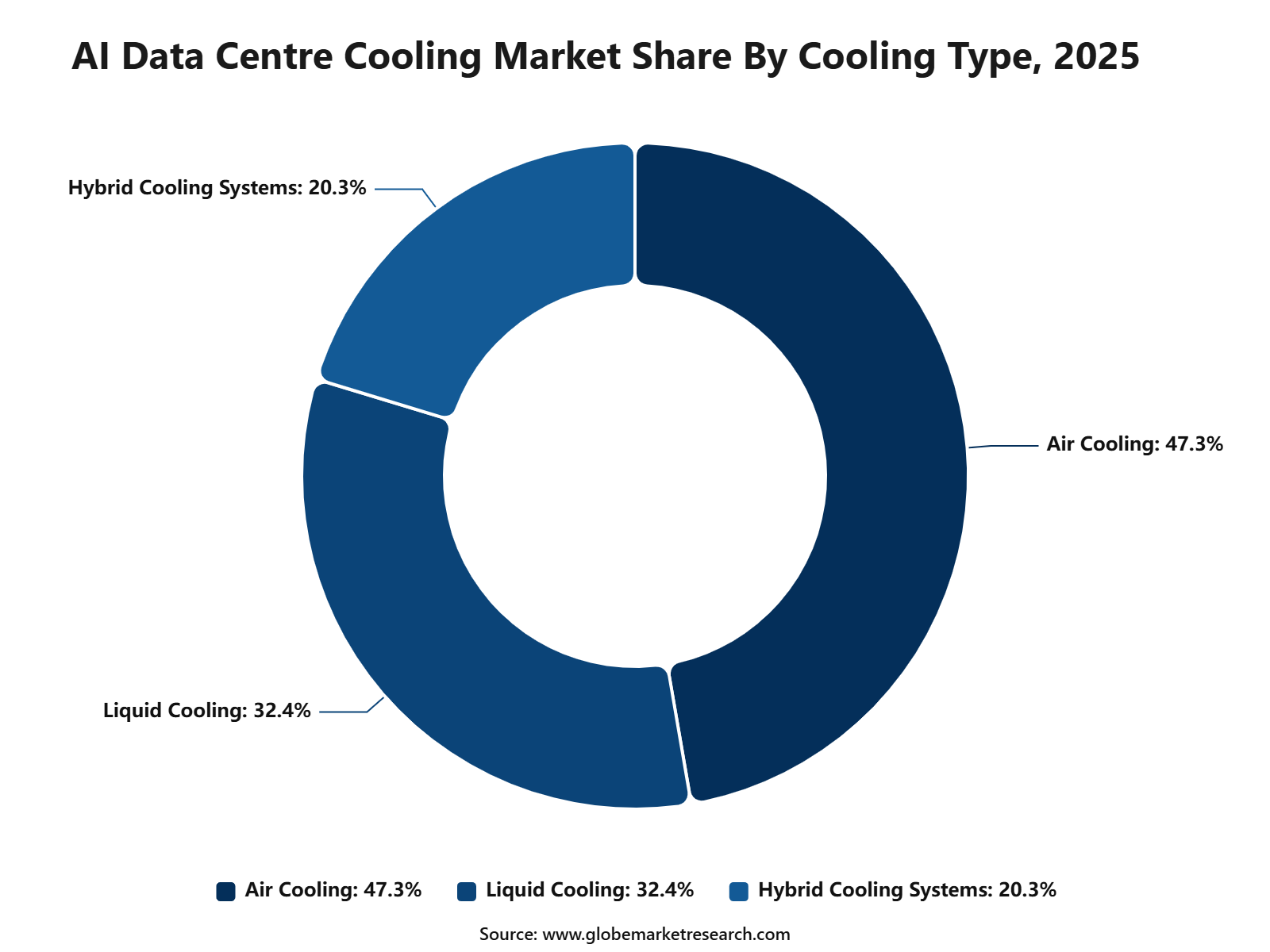
Air cooling led the cooling type segment with 47.3% share, supported by lower installation cost, easier maintenance, established use in data centres, and suitability for moderate-density AI workloads.
Hyperscale data centres accounted for 40.1% share, driven by rising AI model training, high-performance computing demand, large server clusters, and rapid cloud infrastructure expansion.
Cooling units held 35.3% share by cooling component, supported by strong demand for chillers, air handlers, precision cooling systems, and thermal management equipment used in AI-ready facilities.
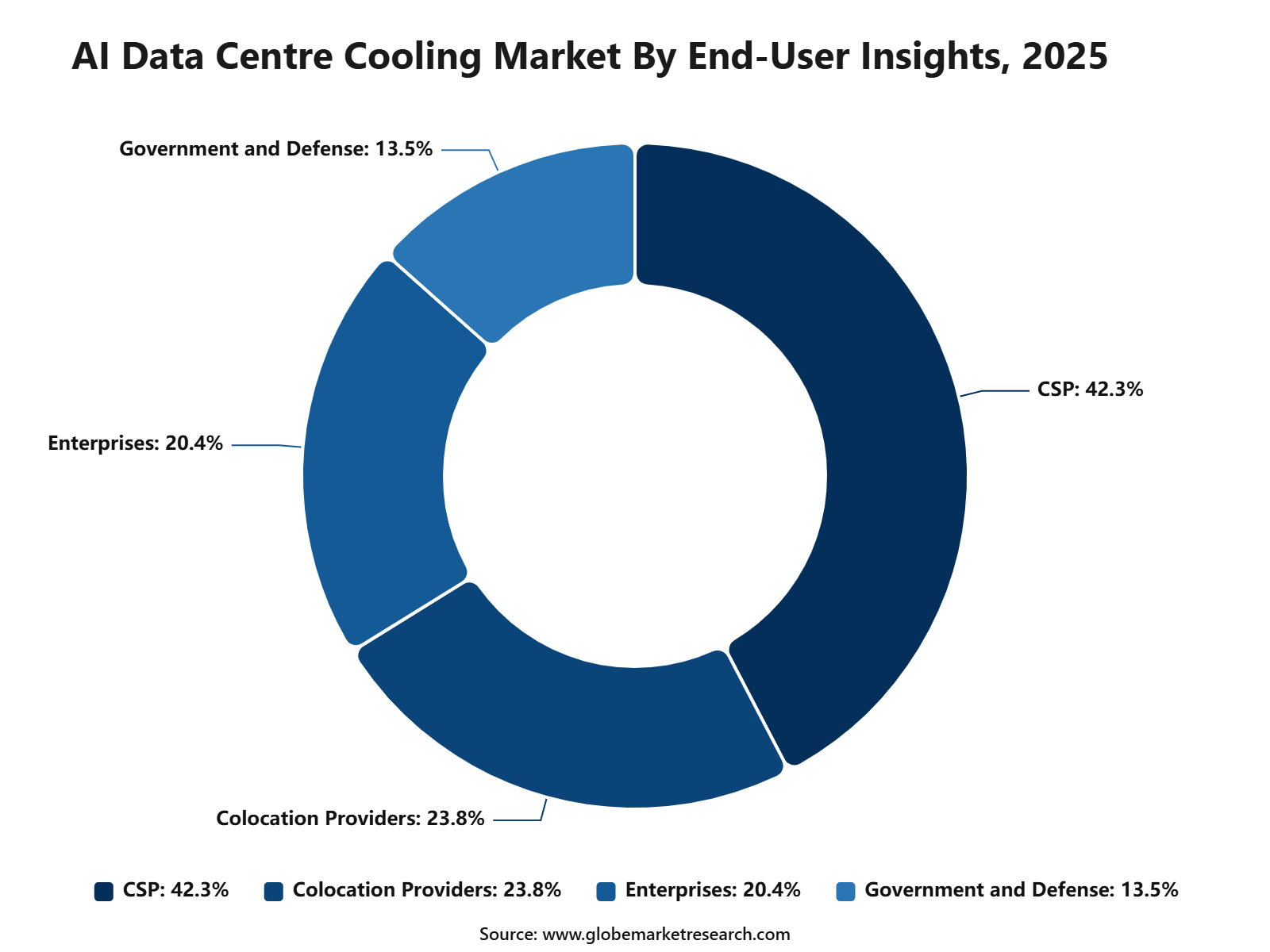
Cloud service providers captured 42.3% share by end user, driven by large AI infrastructure investments, growing demand for hosted AI services, and higher need for efficient cooling in cloud data centres.
North America led the AI data centre cooling market with 42.9% share, supported by strong hyperscale cloud presence, high AI infrastructure investment, advanced data centre capacity, and rising adoption of efficient cooling technologies.
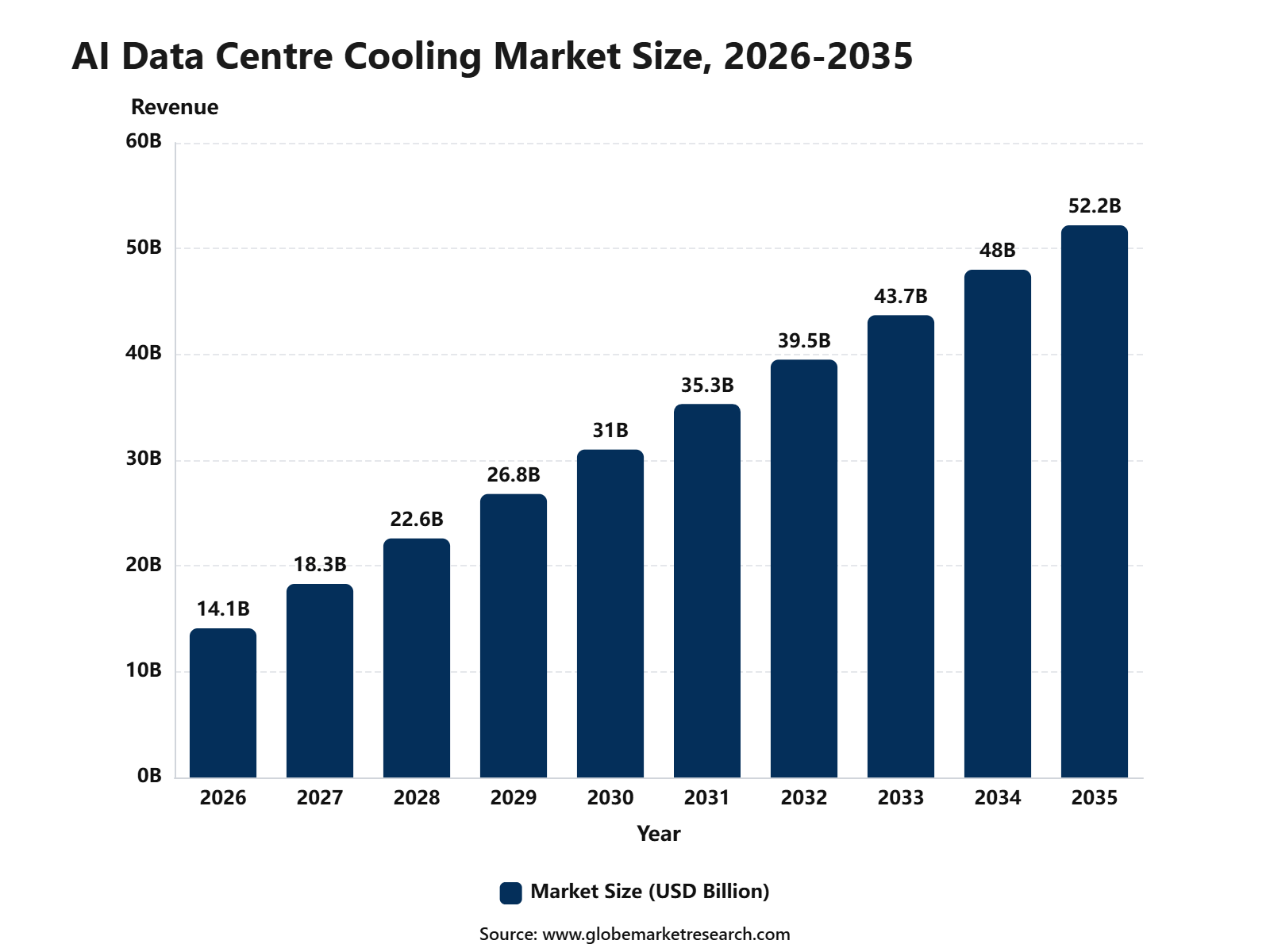 iThe graph shows projected market growth until 2035 based on CAGR analysis. Actual outcomes may vary depending on changing demand, competition, and economic factors.To gain greater insights - request a sample report PDF
What is AI data centre cooling?
AI data centre cooling includes equipment, software and services used to remove heat generated by high-performance processors, accelerators, servers and networking systems. Major technologies include air cooling, direct-to-chip liquid cooling, immersion cooling, rear-door heat exchangers, coolant distribution units and AI-based thermal-management software.
Cooling can represent approximately 7% of electricity use in efficient hyperscale facilities and more than 30% in less-efficient enterprise data centres, making thermal efficiency an important operational and sustainability priority. Technology development accelerated during 2026 as AI rack power densities increased. NVIDIA’s Vera Rubin NVL72 platform uses single-phase direct liquid cooling with a 45°C water-supply temperature, allowing facilities to reduce dependence on mechanical chillers.
The company’s third-generation MGX architecture introduced fanless compute trays and 100% liquid cooling designed for 45°C warm-water operation. The Open Compute Project also published new AI data centre reference designs covering liquid-cooling distribution units, advanced power systems and standardised facility infrastructure, helping operators deploy high-density AI capacity more quickly.
Adoption Rate and Usage Statistics
According to Uptime Institute and Upsite Technologies, 19% of surveyed data-centre operators had implemented liquid cooling, while 36% expected to adopt it within one to two years. Around 73% of colocation providers planned to increase cooling-equipment spending for 2025. AI-based control of cooling equipment set points would be permitted by 35% of operators, while 15% of facilities had achieved a PUE of 1.3 or better.
Metric | Adoption Rate |
|---|---|
Liquid Cooling Use | 19% |
Near-Term Cooling Plans | 36% |
Cooling Spend Increase | 73% |
AI Cooling Controls | 35% |
Low-PUE Facilities | 15% |
According to International Energy Agency, NVIDIA, and Microsoft, the weighted average data-centre PUE stood at 1.54 in 2025, while cooling accounted for around 7% of electricity use in efficient hyperscale facilities and over 30% in less-efficient enterprise facilities. NVIDIA’s liquid-cooled GB200 NVL72 racks consume approximately 120 kW and can deliver up to 300 times greater water efficiency than traditional air-cooled architectures. Microsoft’s closed-loop cooling design is expected to avoid more than 125 million litres of water annually at each data centre.
Metric | Cooling Usage |
|---|---|
Average Data-Centre PUE | 1.54 |
Cooling Energy Share | 7% to over 30% |
AI Rack Power | Around 120 kW |
Water Efficiency Gain | Up to 300 times |
Annual Water Avoidance | Over 125 million litres per site |
Cooling Type Insights
Air cooling accounted for 47.3% of the AI Data Centre Cooling Market by cooling type. Its leading position is supported by established installation practices, lower initial complexity and compatibility with conventional servers, networking equipment and lower-density computing areas. Many operators continue using air cooling independently or as part of hybrid thermal-management systems.
Microsoft explained in a 2026 data-centre cooling update that direct-air systems can use outside air with little or no water, with water generally required only when outdoor temperatures exceed 85°F, or 29.4°C. This operating model can reduce dependence on mechanical refrigeration in suitable climates.
Air cooling will remain important for general server rooms, storage equipment and supporting infrastructure, even as liquid cooling expands for high-density AI racks. Suppliers are improving airflow containment, fan efficiency and automated temperature control to reduce hot spots and unnecessary power consumption.
 iThe graph shows projected market growth until 2035 based on CAGR analysis. Actual outcomes may vary depending on changing demand, competition, and economic factors.To gain greater insights - request a sample report PDF
Data Centre Type Insights
Hyperscale data centres represented 40.1% of the market by data centre type. These facilities operate large numbers of servers and AI accelerators, creating substantial and continuous heat loads. Their scale allows operators to invest in custom cooling designs, advanced monitoring and centralized thermal-management systems.
The number of hyperscale data centres reached 1,360 at the end of the fourth quarter of 2025, accounting for approximately 48% of worldwide data-centre capacity. The continuing expansion of these large facilities is increasing demand for cooling systems capable of supporting higher rack densities.
Hyperscale operators require cooling infrastructure that can be expanded without interrupting active computing services. Future facilities are expected to combine air, direct-to-chip liquid cooling and heat-rejection systems according to workload density. Energy efficiency and water availability will increasingly influence site selection and equipment design.
Data Centre Type | Market Share |
|---|---|
Hyperscale Data Centres | 40.1% |
Colocation Data Centres | 24.6% |
Enterprise Data Centres | 20.1% |
Edge Data Centres | 15.2% |
Cooling Component Insights
Cooling units accounted for 35.3% of the market by cooling component. This category includes computer-room air handlers, precision cooling systems, chillers, coolant distribution units, heat exchangers and direct-to-chip cooling assemblies. These systems remove heat from servers and maintain stable operating conditions across data-centre environments.
NVIDIA reported in 2025 that next-generation AI data-centre power infrastructure is being designed to support racks ranging from 100 kW to more than 1 MW. These higher power densities increase the need for larger cooling units, stronger heat-transfer systems and precise rack-level temperature management.
Cooling-unit manufacturers are developing modular equipment that can be installed as computing capacity expands. Demand is shifting toward systems with variable-speed operation, real-time monitoring and compatibility with both air- and liquid-cooled servers. Serviceability and equipment redundancy remain important because cooling failures can interrupt expensive AI workloads.
Cooling Component | Market Share |
|---|---|
Cooling Units | 35.3% |
Chillers | 19.4% |
Air Handling Units | 16.8% |
Heat Exchangers | 15.1% |
Pumps | 13.4% |
End-User Insights
Cloud service providers accounted for 42.3% of the AI Data Centre Cooling Market by end user. These companies operate extensive computing infrastructure for AI training, cloud applications, storage and digital services. Rapid changes in processor density require cloud providers to redesign cooling systems more frequently than conventional enterprise data centres.
Google announced a USD 40 billion investment in Texas through 2027 to develop new cloud and AI infrastructure, including data-centre campuses in Armstrong and Haskell counties. Projects of this scale create demand for precision cooling, heat-rejection equipment and advanced facility-control systems.
Cloud providers are increasingly selecting cooling technologies at the server, rack and facility levels rather than relying on one system throughout the building. Their purchasing decisions consider energy consumption, water availability, operating reliability and the ability to support future generations of AI processors.
 iThe graph shows projected market growth until 2035 based on CAGR analysis. Actual outcomes may vary depending on changing demand, competition, and economic factors.To gain greater insights - request a sample report PDF
Regional Insights
North America accounted for 42.9% of the AI Data Centre Cooling Market. Regional leadership is supported by major cloud platforms, large hyperscale campuses, AI research activity and extensive investment in data-centre construction. The United States remains the primary contributor, particularly across Virginia, Texas, Arizona and other emerging infrastructure locations.
The U.S. Energy Information Administration reported in May 2026 that servers accounted for an estimated 7% of commercial-sector electricity consumption in 2025. Growing server energy use increases both heat production and the importance of efficient cooling infrastructure across American data centres.
North American operators are adopting direct-to-chip liquid cooling, advanced air management and closed-loop systems to support higher computing densities. Regional demand will also be shaped by grid capacity, water constraints and local approval requirements. Cooling suppliers that reduce energy and water use while maintaining dependable operation are likely to receive stronger demand.
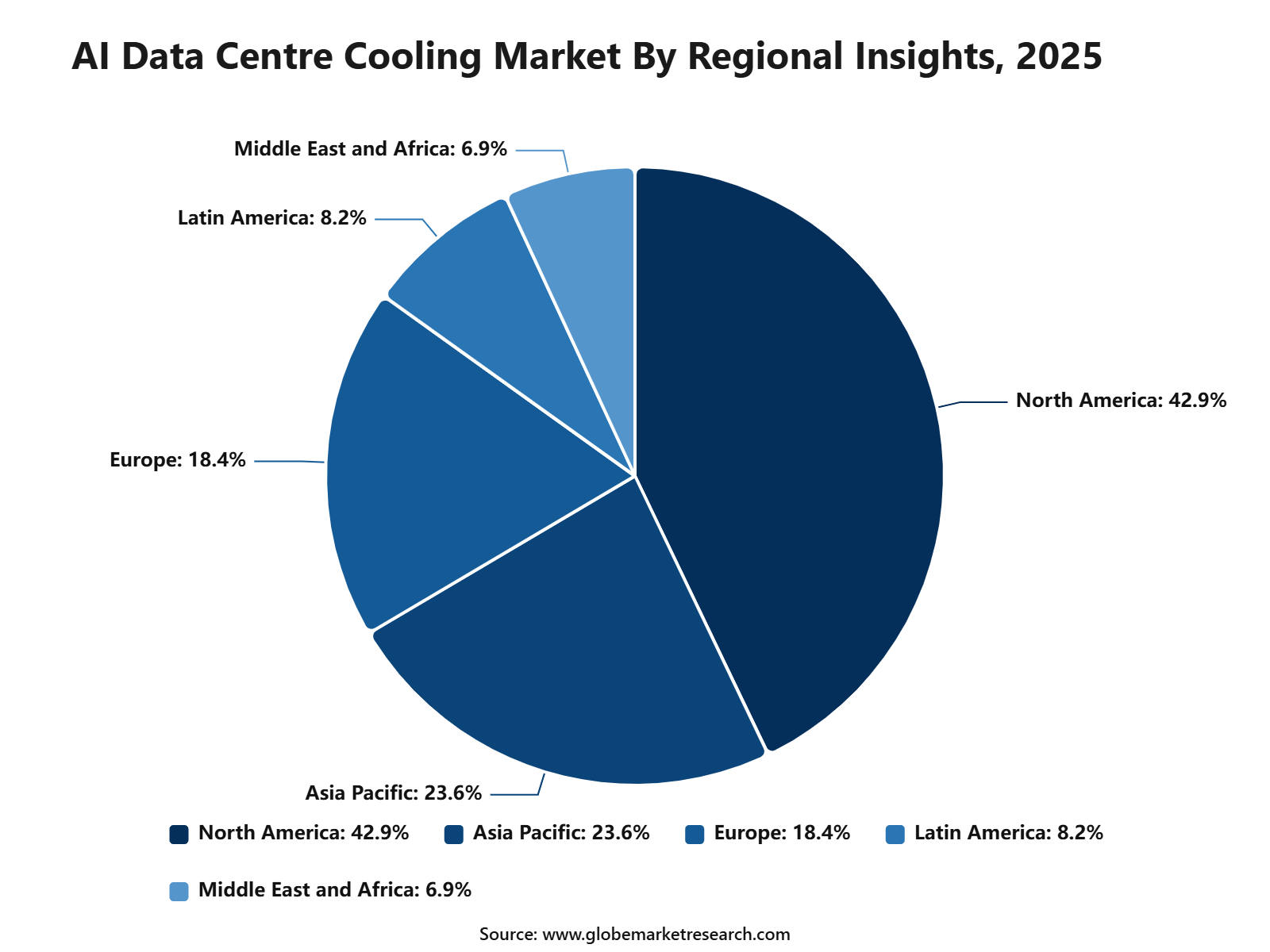 iThe graph shows projected market growth until 2035 based on CAGR analysis. Actual outcomes may vary depending on changing demand, competition, and economic factors.To gain greater insights - request a sample report PDF
Key Market Drivers
Increasing AI server power density: AI accelerators consume substantially more electricity and generate more heat than conventional enterprise servers. Google announced an infrastructure architecture capable of increasing rack capacity from approximately 100 kW to as much as 1 MW per rack, illustrating the scale of future cooling requirements.
Limitations of conventional air cooling: Traditional computer-room air-conditioning systems can struggle to remove heat efficiently from densely packed GPU clusters. Microsoft reported that conventional air cooling cannot adequately manage the density of modern AI hardware, resulting in greater use of pipes that circulate cooling liquid directly through servers.
Expansion of liquid-cooled AI infrastructure: Direct liquid cooling transfers heat from processors through cold plates, manifolds, coolant loops, and cooling distribution units. Google has already deployed four generations of liquid cooling for its tensor processing units and announced its fifth-generation Project Deschutes cooling distribution unit in 2025.
Need to reduce cooling electricity consumption: Cooling can represent a substantial portion of non-IT data centre energy consumption. The U.S. Department of Energy’s COOLERCHIPS program is targeting cooling energy expenditure of less than 5% of IT load for high-density computing systems. The program has committed USD 42 million across 15 technology projects.
Growing water-efficiency requirements: Data centre operators are under pressure to reduce freshwater use, particularly in drought-affected and water-stressed locations. Microsoft’s closed-loop direct-to-chip design recirculates cooling water without operational evaporation, reducing dependence on continuous freshwater withdrawal.
Emerging AI Data Centre Cooling Trends
Direct-to-chip liquid cooling: Cold plates are being attached directly to GPUs, CPUs, memory units, and networking components. Liquid absorbs heat close to the source and transfers it through manifolds and cooling distribution units to the facility cooling system.
Warm-water cooling: New AI equipment can operate with higher coolant temperatures, reducing dependence on energy-intensive refrigeration. NVIDIA reported in June 2026 that its newest AI servers can use cooling liquid at temperatures of up to 45°C, improving opportunities for economization and heat reuse.
Cooling distribution units as critical infrastructure: CDUs isolate the facility water loop from the sensitive technology cooling loop. They manage coolant temperature, pressure, filtration, flow rate, monitoring, and heat exchange while protecting servers from facility-side contamination.
Hybrid air and liquid cooling: Not every component inside an AI rack requires direct liquid cooling. Hybrid systems use liquid for high-heat processors while air remains responsible for storage, power supplies, networking equipment, and lower-power components.
Air-assisted liquid cooling for legacy facilities: Air-assisted liquid-cooling racks are being introduced where full facility water infrastructure is unavailable. Meta reported that this configuration enables liquid-cooled AI equipment to be deployed more rapidly in existing air-cooled data centres.
Immersion cooling: Servers or selected components are submerged in electrically non-conductive fluid. Single-phase and two-phase immersion systems can provide high heat-transfer capacity, although fluid compatibility, maintenance procedures, hardware warranties, and standardization remain important adoption considerations.
5 Best AI Data Centre Cooling Technologies
Direct-to-Chip Liquid Cooling: Cold plates are placed directly on GPUs and CPUs to remove heat at its source. This technology is highly suitable for high-density AI training, inference, and high-performance computing environments.
Cooling Distribution Units: CDUs control the transfer of heat between technology and facility water loops. They provide pumping, filtration, pressure control, temperature management, monitoring, and protection against coolant contamination.
Immersion Cooling Systems: Servers are submerged in dielectric fluid that absorbs heat directly from the equipment. Immersion cooling can support very high computing densities while reducing fan requirements and internal airflow dependence.
Rear-Door Heat Exchangers: Liquid-cooled doors are installed behind server racks to capture hot exhaust air. They are particularly useful for retrofitting existing data centres that cannot immediately move to complete direct-to-chip cooling.
AI-Enabled Thermal Management Platforms: These platforms combine sensors, data centre infrastructure management software, analytics, and automated controls. They continuously optimize coolant flow, fan speeds, workload placement, temperatures, energy use, and equipment health.
Key Market Segments
By Cooling Type
Air Cooling
Liquid Cooling
Hybrid Cooling Systems
By Data Centre Type
Hyperscale Data Centres
Colocation Data Centres
Enterprise Data Centres
Edge Data Centres
By Cooling Component
Cooling Units
Chillers
Air Handling Units
Pumps
Heat Exchangers
By End User
Cloud Service Providers
Colocation Providers
Enterprises
Government and Defense
By Region
North America
Europe
Asia Pacific
Latin America
Middle East and Africa
Market Dynamics
Drivers Impact Analysis
The AI Data Centre Cooling Market is driven by rapid growth in AI workloads, GPU-dense server racks, hyperscale data centres, cloud AI infrastructure, and high-performance computing. AI servers generate much higher heat density than traditional IT systems, increasing demand for advanced cooling technologies.
North America leads the market due to large hyperscale data centre expansion, strong AI cloud investment, enterprise AI adoption, and high deployment of GPU clusters. The U.S. remains the main contributor because of strong demand from cloud providers, AI labs, colocation operators, and enterprise data centre users.
Impact Factor | Estimated CAGR Impact | Regional Relevance | Market Impact |
|---|---|---|---|
Growth in AI GPU workloads | +4.8% | North America, Europe, Asia Pacific | Drives high-density cooling demand. |
Hyperscale data centre expansion | +4.3% | U.S., Canada, Europe, Asia Pacific | Supports large cooling system deployment. |
Rising rack power density | +3.8% | AI and HPC facilities | Increases need for liquid cooling. |
Cloud AI infrastructure investment | +3.4% | North America and global cloud hubs | Expands cooling demand across new builds. |
Energy efficiency requirements | +2.8% | Large data centre operators | Supports advanced thermal management. |
Restraints Impact Analysis
The market faces restraints from high installation cost, complex retrofitting, water availability concerns, skilled engineering needs, and integration challenges with existing air-cooled data centres. Advanced cooling systems require careful design, testing, and facility-level planning. Another restraint is operational risk. Liquid cooling, immersion cooling, and direct-to-chip cooling must be reliable, safe, and compatible with servers, racks, pumps, coolant distribution units, and monitoring systems.
Impact Factor | Estimated CAGR Impact | Regional Relevance | Market Impact |
|---|---|---|---|
High upfront cooling system cost | -2.4% | Hyperscale and colocation facilities | Slows adoption in cost-sensitive projects. |
Retrofit complexity | -2.0% | Existing data centres | Limits fast conversion from air cooling. |
Water usage concerns | -1.7% | Water-stressed regions | Pushes need for efficient designs. |
Skilled installation requirements | -1.4% | Advanced cooling projects | Raises deployment complexity. |
Reliability and leakage concerns | -1.2% | Liquid cooling systems | Increases buyer caution. |
Opportunities Impact Analysis
Opportunities are strong in direct-to-chip cooling, immersion cooling, rear-door heat exchangers, coolant distribution units, AI rack cooling, modular data centre cooling, and thermal monitoring systems. These solutions help operators support high-density AI servers while reducing power usage.
Higher-value opportunities are emerging in liquid cooling retrofits, hybrid air-liquid cooling, cooling-as-a-service, heat reuse, low-water cooling systems, and AI-based thermal optimization. Companies that combine cooling hardware, software, and facility design can capture stronger demand.
Impact Factor | Estimated CAGR Impact | Regional Relevance | Market Impact |
|---|---|---|---|
Direct-to-chip cooling adoption | +4.6% | North America and hyperscale markets | Supports high-density AI racks. |
Immersion cooling deployment | +4.0% | HPC and AI facilities | Enables extreme heat management. |
Cooling distribution unit demand | +3.5% | Liquid-cooled data centres | Builds supporting infrastructure demand. |
Hybrid air-liquid cooling systems | +3.0% | Existing and new data centres | Supports phased adoption. |
Heat reuse and efficiency solutions | +2.5% | Europe and North America | Improves sustainability value. |
Challenges Impact Analysis
The main challenge is matching cooling systems with fast-changing AI hardware. GPU servers, accelerators, rack designs, and power densities are evolving quickly, requiring cooling providers to adapt designs and performance standards. Another challenge is balancing performance, cost, energy use, water use, and uptime. Data centre operators need cooling systems that reduce power consumption without increasing operational risk or maintenance complexity.
Impact Factor | Estimated CAGR Impact | Regional Relevance | Market Impact |
|---|---|---|---|
Rapid AI hardware evolution | -2.3% | AI data centre operators | Creates design uncertainty. |
High-density rack thermal risk | -2.0% | GPU and HPC clusters | Requires advanced engineering. |
Facility downtime sensitivity | -1.7% | Mission-critical data centres | Raises adoption caution. |
Coolant compatibility issues | -1.4% | Liquid and immersion systems | Affects vendor qualification. |
Power and water efficiency tradeoffs | -1.1% | Large-scale facilities | Complicates system selection. |
AI Data Centre Cooling Market Case Study
Microsoft Fairwater
Microsoft’s Fairwater AI data centre in Wisconsin shows how liquid cooling is being adopted to manage high-density AI computing. Traditional air-cooling systems are becoming less suitable as AI racks move beyond 135 kW per rack, compared with about 20 kW in earlier facilities. Fairwater circulates cooling liquid directly through server systems and uses 172 twenty-foot fans to remove heat before the liquid is returned to the facility.
More than 90% of the data centre’s capacity uses closed-loop cooling, with water added once during construction and continuously reused without evaporation losses. The design demonstrates how direct-to-chip cooling can increase rack density while reducing operational water requirements. Microsoft estimates that its next-generation cooling design can avoid more than 125 million litres of water consumption annually per data centre.
Its average Water Usage Effectiveness improved from 0.49 litres per kWh in 2021 to 0.30 litres per kWh, representing a 39% improvement. NVIDIA’s liquid-cooled GB200 NVL72 platform also reports 25 times higher energy efficiency and more than 300 times greater water efficiency than traditional air-cooled infrastructure, although these performance values are vendor-reported and depend on workload and facility design.
Recent Developments
Market News
In January 2026, NVIDIA introduced Vera Rubin NVL72 systems using single-phase, direct liquid cooling with a 45°C warm-water supply. In June 2026, NVIDIA stated that the Rubin generation would use 100% liquid cooling across processors, networking equipment, and other system components through a closed-loop architecture without server fans.
In February 2026, NxtGen AI announced a national-scale sovereign AI factory using more than 4,000 NVIDIA Blackwell GPUs and Dell PowerEdge XE9685L liquid-cooled servers. Vertiv is providing high-capacity coolant distribution units, secondary piping skids, perimeter cooling, and ambient-compatible heat-rejection systems.
In March 2026, Google procurement representatives held discussions with Envicool and other Chinese companies regarding cooling equipment for data centres. The discussions reflected tight supplies of coolant distribution units, cold plates, pumps, connectors, and other liquid-cooling components across existing Asian supply chains.
In March 2026, Accelsius introduced the NeuCool IR150, an integrated rack designed for two-phase, direct-to-chip liquid cooling. In April 2026, the company announced general availability of the system and introduced a programme intended to help operators evaluate and deploy the technology in AI and high-performance computing facilities.
In April 2026, Delta presented a grid-to-chip infrastructure platform that combines electrical distribution, cooling equipment, intelligent controls, uninterruptible power systems, and battery infrastructure. The architecture is designed to reduce integration complexity in high-density AI factories and data centres.
Acquisitions
In February 2026, Trane announced an agreement to acquire LiquidStack, a specialist in direct-to-chip and immersion cooling. The transaction is intended to expand Trane’s thermal-management portfolio for AI, hyperscale, high-performance computing, and high-density data centre environments. Financial terms were not publicly disclosed.
In March 2026, Eaton completed the purchase of Boyd Thermal from Goldman Sachs Asset Management. Boyd Thermal provides liquid-cooling components and thermal-management systems and operates manufacturing facilities across North America, Asia, and Europe. The acquisition allows Eaton to combine electrical power infrastructure with server-level thermal systems.
In March 2026, Ecolab entered into a definitive agreement to purchase CoolIT Systems, a direct-liquid-cooling provider expected to generate approximately USD 550 million in sales over the following 12 months. The acquisition was designed to combine CoolIT’s cold plates and coolant distribution equipment with Ecolab’s water-treatment, cooling-fluid, and digital-monitoring capabilities.
In July 2026, Ecolab completed the acquisition for approximately USD 4.75 billion. CoolIT’s year-to-date sales had increased by more than 100%, supported by rising demand for liquid cooling in AI data centres. Ecolab plans to integrate CoolIT equipment with advanced cooling fluids and digital water-management systems.
Funding
In January 2026, Accelsius completed a USD 65 million Series B round led by Johnson Controls, with Legrand also joining the financing. The funding supports the expansion of two-phase, direct-to-chip cooling systems for gigawatt-scale AI factories and high-performance computing facilities.
In May 2026, Cambridge University spinout Barocal secured USD 10 million from investors including World Fund, Breakthrough Energy Discovery, Cambridge Enterprise Ventures, and IP Group. The company is commercialising solid-state cooling technology designed to replace conventional vapour-compression systems and refrigerant gases, with data centre cooling identified as an initial target market.
In May 2026, Australian cooling-technology company Enaxiom completed a seed round led by Epic Angels, with participation from BlackNova and Antler. The funding supports commercial deployment of its HydroCool system, workforce expansion, and entry into the U.S. market. The system is intended to operate alongside direct-to-chip and immersion cooling while recovering usable water from non-potable water sources.
In May 2026, Iceotope completed a Series B round led by Two Seas Capital and Barclays Climate Ventures. The company plans to expand product development, engineering, patents, and ecosystem partnerships for precision liquid cooling systems used in AI data centres, enterprise facilities, and edge computing environments.
In June 2026, ZutaCore announced a Series C round backed by Mitsubishi Electric, Carrier Ventures, Samsung Ventures, and other investors. The financing will support global commercialisation and research into waterless two-phase direct-to-chip cooling for next-generation processors exceeding 4,000 watts. ZutaCore reported more than 75 deployments across the Americas, Europe, and Asia.
Market Impact
Liquid cooling is moving toward mainstream AI adoption: In March 2026, industry estimates cited by Reuters projected that the global market for AI server liquid-cooling systems would exceed USD 17 billion in 2026, compared with USD 8.9 billion in 2025. Growth is being supported by NVIDIA platforms, custom AI accelerators, hyperscale cloud facilities, and specialised AI cloud providers.
Warm-water cooling can reduce dependence on chillers: NVIDIA’s 45°C liquid-cooling architecture allows facilities in suitable climates to reject heat using ambient outdoor air. This can reduce compressor and chiller operation while allocating a larger share of available electricity to computing equipment rather than facility cooling.
Coolant distribution units are becoming critical infrastructure: CDUs separate facility water systems from server cooling loops and control coolant temperature, pressure, filtration, and flow. Growth in rack density is therefore increasing demand for pumps, valves, manifolds, sensors, heat exchangers, leak detection, controls, and fluid-management software alongside cold plates.
Water availability is affecting site and technology decisions: The OpenAI-NEXTDC project demonstrates that cooling architecture can be determined by local access to recycled-water pipelines, grid capacity, planning requirements, and environmental restrictions. Operators may be required to choose between lower-water solutions with higher electricity requirements and water-based systems with more efficient heat rejection.
Supply-chain competition is widening: Discussions between Google and Chinese cooling suppliers indicate that hyperscalers are seeking additional sources for CDUs and other cooling components because of capacity constraints in established supply markets. Manufacturing expansion is being pursued across China, Thailand, the United States, Taiwan, and other regional production centres.
Competitive Landscape
The market is characterized by intense competition among established players and emerging companies. Strategic partnerships, mergers and acquisitions, and product innovation are key strategies employed by market participants.
Key Market Players
Amazon Web Services
Alphabet Inc. (Google)
Carrier Global Corporation
Asetek
CoolIT Systems
Dell Technologies Inc.
Hewlett Packard Enterprise
Huawei Technologies Co., Ltd.
Intel Corporation
Schneider Electric SE
Research Methodology
This market study is prepared using a combination of primary and secondary research. Primary research includes discussions with manufacturers, suppliers, distributors, consultants, industry experts, and end users. Secondary research covers company reports, government databases, trade associations, technical publications, regulatory sources, and trusted industry documents. The collected information is used to assess market demand, pricing trends, technology adoption, competitive activity, and regional performance.
AI language models are not used as primary data sources, and publicly available AI-generated content is not treated as market evidence. Computational tools may be used to support data processing, translation, data classification, and pattern identification. However, every published assessment is supported by verified sources, human review, and primary market discussions.
Market estimates are developed through top-down and bottom-up approaches and validated using data triangulation. Revenue, production, shipment, pricing, and application-level data are compared across multiple sources. Forecasts consider economic conditions, regulatory changes, investment activity, innovation, supply chain developments, and industry risks. All findings are reviewed through source verification and internal quality checks before publication.
Part I
Source Management & Input Data Standards
Who provides data, how sources are qualified, and what types of evidence are admissible.
Part II
Research Scope & Market Coverage
How we define the markets we assess and the parameters that govern each product.
Part III
Data Collection, Verification & Submission
The mechanics of gathering, cross-checking, and hierarchically ranking evidence.
Part IV
Assessment Determination & Quality Controls
How raw data becomes a published assessment — normalisation, expert judgement, and outlier exclusion.
Part V
Publication, Corrections & Revision
Our publication schedule, corrections policy, and methodology review cycle.
Part VI
Independence, Ethics & Complaints
Conflict-of-interest policies, editorial independence, and how clients raise concerns.
Google · Preferred Sources
Don't miss the latest market research insights and industry updates on Google.
Add Globe Market Research as a preferred source in the Google app to see our reports, analysis, and market stories in your news suggestions.
Meet the Team
This report was prepared by our expert analysts with deep industry knowledge and research experience.
Kimaya brings more than five years of experience in market research, content review, and industry analysis to Globe Market Research. She plays an important role in maintaining the accuracy, clarity, consistency, and relevance of research content across a wide range of industries. Her responsibilities include reviewing market data, segment analysis, competitive landscapes, industry trends, company developments, and strategic insights. Each report is carefully assessed to ensure that the findings are supported by reliable data, presented in a structured format, and aligned with the information needs of business decision-makers. Kimaya has research experience across healthcare, information technology, consumer goods, and several cross-industry domains.
Prashant S. is a Research Analyst at Globe Market Research with more than four years of experience in market research and industry analysis. He specializes in the Aerospace and Defence, Automotive and Transportation, Semiconductor and Electronics, Information and Technology sectors, with expertise in market sizing, trend analysis, competitive assessment, and industry forecasting. He applies primary and secondary research, data validation, company analysis, and market estimation methods to deliver reliable insights for strategic planning and business decision-making.
Frequently Asked Questions
Related Reports
More in Information and Technology
Shooting Games Market Size to hit USD 238.9 bn by 2035 | CAGR of 10.7%
Shooting Games Market Insights Analysis by Product (Shooting Gallery, Light Gun Shooter, First-Person Shooter, Third-Person Shooter, and Others), by Device Type (PC/MMO, Tablet, Mobile Phone, and TV/Console), by End User (Male and Female), Regional Insights, Technology Trends, Competitive Landscape, Strategic Opportunities, and Growth Forecast, 2026-2035
Agentic AI Security Market Size to hit USD 52.3 billion by 2035 | CAGR of 44.5%
Agentic AI Security Market Size, Share, Trends and Growth Analysis Report By Security Function (Identity and Access Security, AI Governance and Risk Platforms, Threat Detection and Response, Data Security and Privacy, Vulnerability Assessment and Remediation, Security Orchestration, Automation and Response, Security Posture Management, Deception Technology), By Offering (Solutions, Tools and Point Solutions, Managed Security Services, Professional and Integration Services, Training and Certification Services), By Level of Autonomy (Semi-Autonomous Systems, Fully Autonomous Security Agents), By Deployment Layer (Model Layer, Agent and Orchestration Layer, Application Layer, Data Layer, Infrastructure Layer, Integration Layer), By Deployment Mode (Cloud-Based, On-Premises, Hybrid), By Organization Size (Large Enterprises, Small and Medium Enterprises), By Application (Enterprise IT Security, Financial Services Compliance, Healthcare Data Protection, Government and Defense, Cloud Security), By Vertical (BFSI, Healthcare and Life Sciences, Government, Defense, IT and ITES, Telecommunications, Retail and E-commerce, Energy and Utilities, Manufacturing, Other Verticals), By Regional Insights, Technology Trends, Competitive Landscape, Strategic Opportunities and Growth Forecast, 2026-2035
South Korea Physical AI Market Size to Reach USD 3.6 billion by 2035
South Korea Physical AI Market Size, Share, Trends and Growth Analysis Report By Deployment (On-Device AI, Cloud-Based AI), By Component (Hardware, Software, Services), By Technology (Computer Vision, Speech and Natural Language Processing, Gesture and Movement Recognition, Reinforcement Learning and Control Systems, Other Technologies), By Robot Type (Service Robots, Humanoid and Social Robots, Collaborative Robots, Exoskeletons and Prosthetics, Mobile Robots and Drones, Industrial Robots), By Application (Healthcare, Manufacturing and Automotive, Logistics and Warehousing, Retail and Hospitality, Other Applications), By Technology Trends, Competitive Landscape, Strategic Opportunities and Growth Forecast, 2026-2035
Physical AI Market Size to hit USD 2,129.0 billion by 2035
Physical AI Market Size, Share, Trends and Growth Analysis Report By Component (Hardware, Software, Services), By Technology (Computer Vision, Machine Learning and Deep Learning, Natural Language Processing, Edge AI, Other Technologies), By Product (Robots, Exoskeletons, Autonomous Systems, Smart Appliances), By Application (Automation and Manufacturing, Logistics and Supply Chain, Healthcare, Automotive, Defense and Security, Retail, Education, Other End Uses), By Regional Insights, Technology Trends, Competitive Landscape, Strategic Opportunities and Growth Forecast, 2026-2035