

Revenue, 2025
$ 84.3 Bn
Forecast, 2035
$ 162.9 Bn
CAGR, 2025-2035
6.8%
Report Coverage
Global
Market Size and Forecast
The Global Engineering Plastics Market was worth USD 84.3 billion in 2025 and is expected to reach USD 162.9 billion by 2035, growing at a CAGR of 6.8% from 2025 to 2035. Based on this growth rate, the market is estimated to reach around USD 92.2 billion in 2026. Asia Pacific held the largest regional share of 47.6% in 2025, valued at around USD 40.1 billion, supported by strong automotive production, electronics manufacturing, industrial applications, and rising demand for lightweight high-performance materials.
The Engineering Plastics Market includes advanced plastic materials designed to offer better strength, heat resistance, chemical stability, and mechanical performance than standard plastics. These materials include polyamide, polycarbonate, ABS, polyacetal, PET, PBT, fluoropolymers, and other specialty polymers. They are widely used in automotive, electrical and electronics, consumer goods, industrial equipment, medical devices, and packaging applications.
Key Parameter | Report Details |
|---|---|
Market Revenue, 2025 | USD 84.3 Billion |
Projected Revenue, 2035 | USD 162.9 Billion |
CAGR (2025-2035) | 6.8% |
Largest Region | Asia Pacific (47.6%, USD 40.1 Bn) |
Fastest Growing Region | North America |
Market Concentration | Medium |
Base Year | 2025 |
Forecast Period | 2025-2035 |
The market outlook remains positive as industries continue to replace metals and conventional materials with lighter and more durable plastic solutions. Growth can be attributed to rising demand for fuel-efficient vehicles, miniaturized electronic components, and high-performance industrial parts. The expansion of Asia Pacific manufacturing hubs, EV production, and specialty polymer innovation is expected to support long-term market demand.
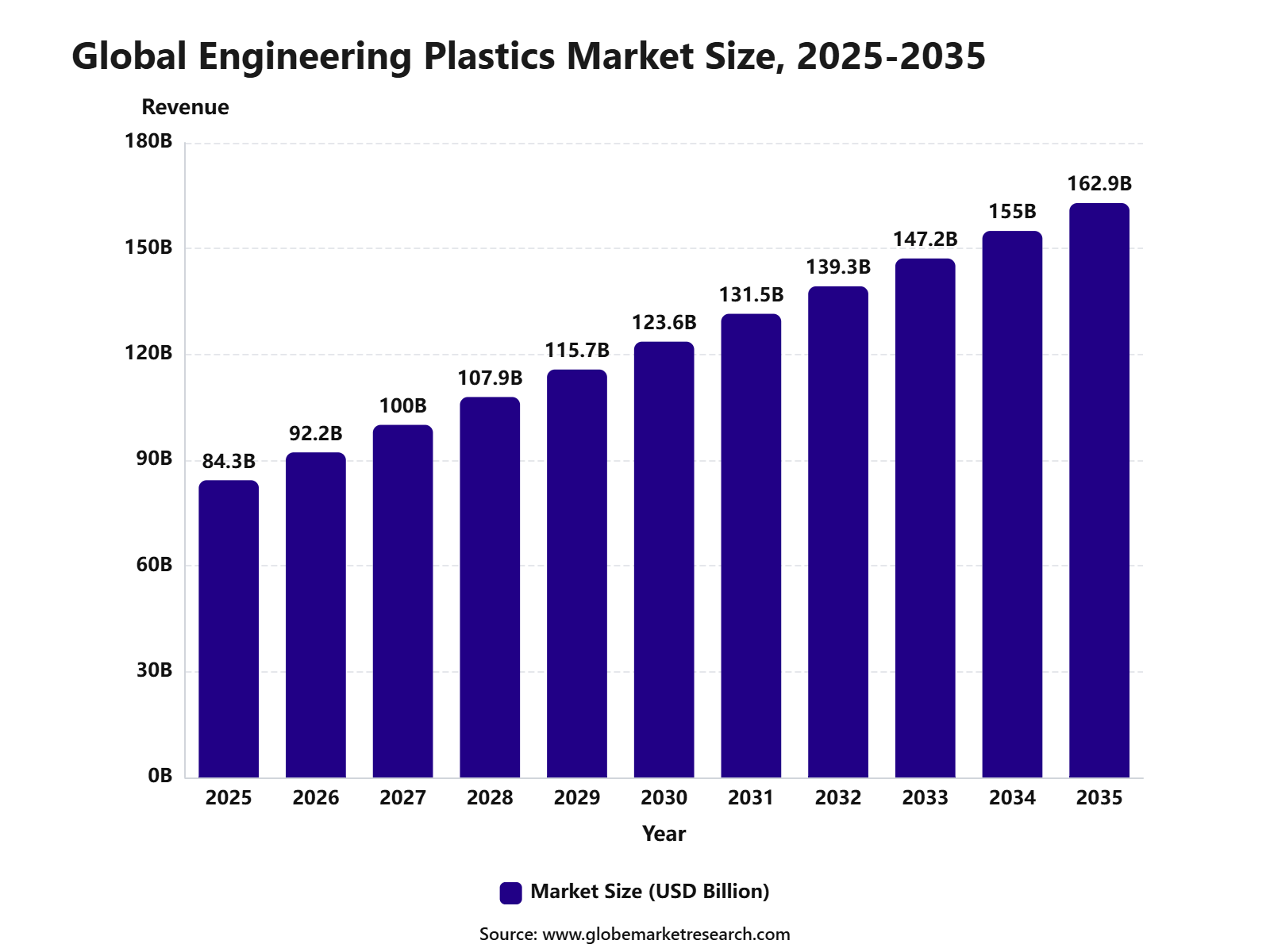 iThe graph shows projected market growth until 2035 based on CAGR analysis. Actual outcomes may vary depending on changing demand, competition, and economic factors.To gain greater insights - request a sample report PDF
Key Market Insights
Polyamide led the material type segment with 30.5% share, supported by its high strength, heat resistance, durability, and wide use in automotive, electrical, industrial, and consumer applications.
Automotive accounted for 34.8% share by end use, driven by rising demand for lightweight, impact-resistant, and high-performance plastic materials in vehicle components, under-the-hood parts, and interior applications.
Asia Pacific led the engineering plastics market with 47.6% share, valued at USD 40.1 billion, supported by strong automotive production, expanding electronics manufacturing, and high industrial plastic consumption across China, India, Japan, and Southeast Asia.
Top Funding and Investment
Top Investment
In May 2026, Deepak Nitrite planned a ₹11,000 crore investment for India’s first integrated polycarbonate facility, with 165,000 MTPA planned polycarbonate resin capacity and a 60:40 debt-equity funding structure.
In January 2025, Covestro announced a low triple-digit million euro investment at its Hebron, Ohio site to expand customized polycarbonate compounds and blends production, with operations expected by the end of 2026.
In January 2025, Envalior announced investment in a new PPS compounding facility in Uerdingen, Germany, supporting Xytron PPS production for automotive, electronics, and industrial applications.
In May 2025, Syensqo announced a capital investment to expand Ryton PPS compounding at Augusta, Georgia, adding local supply for PPS, PPA, and PEEK-based specialty polymer materials.
In January 2025, Toray announced a new high-performance plastic resin compounds production facility at Toray Resins Foshan in Guangdong, China, with operations planned from April 2025.
Top Funding
In 2025 to 2026, CARBIOS confirmed €42.5 million in public funding for its Longlaville PET biorecycling plant, including a €30 million ADEME grant and €12.5 million regional aid.
In April 2025, DePoly secured USD 23 million to launch a 500-tonne-per-year showcase plant for converting PET and polyester waste into virgin-quality raw materials.
In March 2026, Epoch Biodesign closed USD 12 million in strategic funding to scale enzymatic recycling for nylon 6,6 and circular engineering plastics production.
Top Acquisition
In January 2026, Mutares agreed to acquire SABIC’s regional Engineering Thermoplastics business in the Americas and Europe for USD 450 million enterprise value. It acquired SABIC’s engineering thermoplastics business assets in those regions.
In May 2026, Lone Star Funds completed the acquisition of DOMO Engineered Materials. It acquired a polyamide-based engineered materials business, including the TECHNYL brand.
By Material Type
Polyamide accounted for 30.5% share of the Engineering Plastics Market. This leading position is supported by its strong mechanical strength, heat resistance, chemical resistance, wear resistance, and broad use across automotive, electrical, electronics, industrial, and consumer goods applications.
The segment is widely preferred because polyamide offers a good balance of durability, lightweight performance, and processing flexibility. It is commonly used in engine components, connectors, gears, bearings, housings, cable ties, films, and precision molded parts.
Demand for polyamide is expected to remain strong as manufacturers replace metals with high-performance plastic materials. Its suitability for lightweight automotive parts, electrical insulation, and durable industrial components will continue to support its dominant position in the market.
By End Use
Automotive accounted for 34.8% share of the Engineering Plastics Market. This dominance is driven by rising demand for lightweight, fuel-efficient, durable, and heat-resistant materials used in modern vehicle manufacturing.
Engineering plastics are used in under-the-hood components, connectors, sensors, fuel systems, interior parts, exterior trims, battery housings, and electrical systems. These materials help reduce vehicle weight while improving design flexibility, safety, and long-term performance.
The segment is expected to remain the largest end-use area as electric vehicles, hybrid vehicles, and advanced mobility platforms continue to expand. Demand will be supported by thermal management needs, electrical insulation, component miniaturization, and higher use of durable plastic parts.
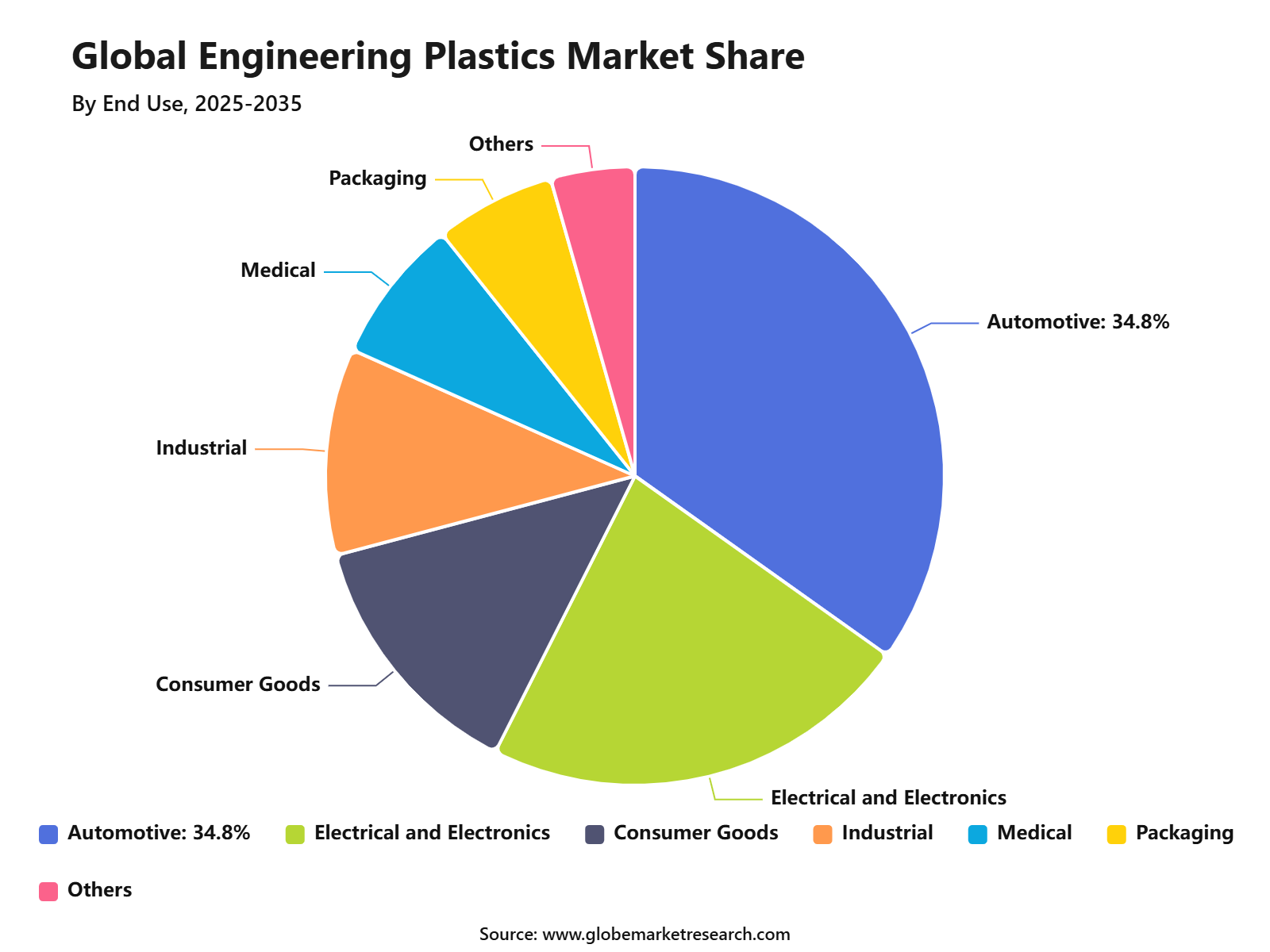 iThe graph shows projected market growth until 2035 based on CAGR analysis. Actual outcomes may vary depending on changing demand, competition, and economic factors.To gain greater insights - request a sample report PDF
By Region
Asia Pacific accounted for 47.6% share of the Engineering Plastics Market, reaching USD 40.1 billion. This leading position is supported by strong automotive production, electronics manufacturing, industrial output, and rising demand for high-performance plastic materials.
China, India, Japan, South Korea, Indonesia, Vietnam, and other Southeast Asian countries are major contributors to regional consumption. The region benefits from large manufacturing capacity, expanding electric vehicle production, and strong demand from consumer electronics and industrial components.
Asia Pacific is expected to maintain its leading position as manufacturing investment, urbanization, and technology-led production continue to grow. Demand for lightweight, heat-resistant, and application-specific engineering plastics will remain strong across automotive, electrical and electronics, packaging, and industrial sectors.
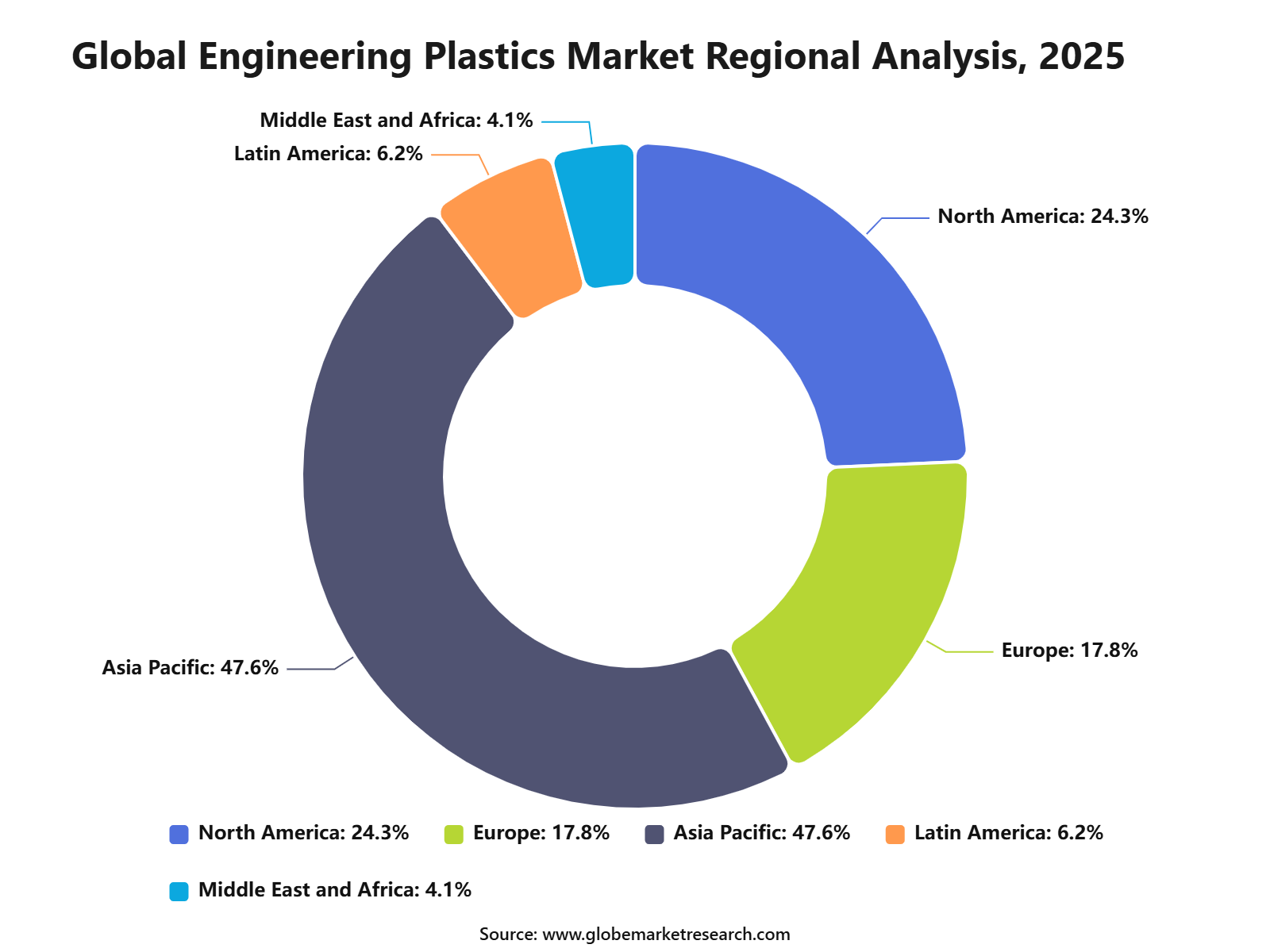 iThe graph shows projected market growth until 2035 based on CAGR analysis. Actual outcomes may vary depending on changing demand, competition, and economic factors.To gain greater insights - request a sample report PDF
Regional Impact Analysis
Asia Pacific leads the Engineering Plastics Market with 47.6% share in 2025, equal to about USD 40.1 billion, supported by automotive production, electronics manufacturing, consumer goods output, and industrial processing. China, India, Japan, South Korea, and Southeast Asia remain major contributors.
North America remains important because of automotive, healthcare, aerospace, electronics, and industrial applications. Europe supports value growth through electric vehicles, lightweighting, circular materials, strict safety standards, and high-performance engineering plastic innovation.
Impact Factor | Estimated CAGR Impact | Regional Relevance | Market Impact |
|---|---|---|---|
Asia Pacific market leadership | +2.4% | Asia Pacific, 47.6% share in 2025 | Leads global demand. |
China electronics and automotive demand | +1.5% | China | Drives regional consumption. |
India manufacturing and consumer goods growth | +1.1% | India | Supports future expansion. |
North America medical and industrial demand | +0.8% | U.S. and Canada | Adds high-value growth. |
Europe EV and circular plastics adoption | +0.7% | Germany, France, UK, Italy | Supports specialty demand. |
Go-To-Market and Sales Economics
Engineering plastics are commercialized through resin producers, compounders, distributors, tier suppliers, OEM qualification programs, and direct technical sales. Demand is led by automotive, electrical and electronics, industrial machinery, medical devices, packaging, and consumer goods. U.S. plastic resin output is expected to rise only 0.7% in 2026, so supplier selection and pricing discipline remain important.
Sales economics are strongest where engineering plastics replace metal, improve part life, reduce weight, and support electrical safety. Automotive remains a key channel, as EU battery-electric cars reached 950,521 registrations in the first five months of 2026 and held 20% share. This supports demand for connectors, housings, battery parts, and thermal-resistant polymers.
High-value selling depends on material performance, technical support, and long qualification cycles. BASF increased North American prices in June 2026 by USD 0.14/lb for Ultramid, Capron, and Nypel polyamide compounds, and USD 0.20/lb for Ultraform POM products. This indicates cost pressure but also pricing power in specialized grades.
Risk Factors & Market Barriers
The main barrier is weak industrial demand and price pressure across chemicals. The American Chemistry Council expects global chemical production to grow only 0.5% in 2026, while U.S. specialty chemical output is expected to decline 0.3%. This can slow orders for engineering plastics used in machinery, construction, consumer goods, and packaging.
Feedstock, energy, and regional competitiveness remain major risks. Plastics Europe reported that Europe’s share of global plastics production fell from 22% in 2006 to 12% in 2024, while global plastics production rose 4.1% in 2024. Engineering plastics suppliers in high-cost regions may face margin and export pressure.
Customer qualification is another barrier because engineering plastics must meet strict heat, flame, impact, chemical, dimensional, and electrical requirements. Switching materials can require testing, tooling changes, validation, and regulatory documentation. This slows adoption in vehicles, electronics, medical parts, and appliances, even when lighter or higher-performance polymers offer clear technical value.
Revenue Potential Analysis
Revenue Landscape Across
Revenue is spread across polyamide, polycarbonate, ABS, PBT, PET, POM, fluoropolymers, PPS, and specialty blends. Electronics is a strong revenue landscape, as global semiconductor sales reached USD 298.5 billion in Q1 2026, up 25% from Q4 2025. This supports demand for high-performance insulating and structural polymer parts.
Automotive revenue is shifting toward EV and hybrid platforms where engineering plastics are used in charging systems, battery modules, sensors, lightweight interiors, and under-hood components. Hybrid-electric vehicles captured 37.8% of the EU market in the first five months of 2026, creating wider demand for heat-resistant and electrically stable materials.
Industrial and healthcare applications provide higher-value opportunities because technical performance matters more than resin price alone. DuPont reported Q1 2026 net sales of USD 1.68 billion, up 4%, with Healthcare Technologies sales up high-single digits organically and Industrial Technologies supported by aerospace and automotive strength.
Financial Impact
Engineering plastics create financial impact by reducing component weight, extending product life, lowering assembly cost, and improving safety performance. Their value is strongest in parts where failure costs are high, including electrical connectors, gears, housings, medical components, battery systems, and precision industrial parts. This supports premium pricing for proven grades and qualified suppliers.
Producer margins depend on raw material spreads, plant utilization, compounding cost, energy cost, and customer mix. SABIC reported Q1 2026 revenue of SAR 26.15 billion, or USD 6.97 billion, and adjusted EBITDA of SAR 4.15 billion, up 25% from Q4 2025. This shows recovery potential when operational efficiency improves.
The strongest financial returns are expected from flame-retardant, high-heat, reinforced, medical-grade, and EV-ready materials. However, Europe’s plastics sector generated EUR 398 billion in turnover in 2024, down 13% from 2022. This makes specialty applications, circular-content solutions, and long-term OEM supply agreements important for margin protection.
Drivers Impact Analysis
The Engineering Plastics Market is driven by rising demand from automotive, electrical and electronics, consumer goods, industrial equipment, medical devices, packaging, and construction applications. Engineering plastics offer higher strength, heat resistance, chemical resistance, dimensional stability, and durability compared with commodity plastics.
Asia Pacific leads the market due to strong automotive production, electronics manufacturing, industrial output, and consumer goods demand. China, India, Japan, South Korea, and Southeast Asia remain key contributors because of large manufacturing bases and growing use of high-performance plastic materials.
Impact Factor | Estimated CAGR Impact | Regional Relevance | Market Impact |
|---|---|---|---|
Growth in automotive lightweighting | +1.8% | Asia Pacific, Europe, North America | Drives core material demand. |
Expansion of electronics manufacturing | +1.5% | China, Japan, South Korea, Taiwan | Supports high-performance plastics. |
Rising demand from consumer goods | +1.2% | Asia Pacific and global retail markets | Builds recurring consumption. |
Industrial machinery and equipment growth | +1.0% | Manufacturing hubs | Adds durable plastic use. |
Replacement of metals with polymers | +0.8% | Automotive and industrial sectors | Supports material substitution. |
Restraints Impact Analysis
The market faces restraints from raw material price volatility, high processing cost, and competition from metals, composites, and commodity plastics. Many engineering plastics depend on petrochemical feedstocks, which makes pricing sensitive to energy and chemical supply conditions.
Another restraint is growing pressure around plastic waste and end-of-life management. Although engineering plastics are durable and high-value, recycling can be more complex due to additives, blends, flame retardants, and application-specific formulations.
Impact Factor | Estimated CAGR Impact | Regional Relevance | Market Impact |
|---|---|---|---|
Raw material price volatility | -0.9% | Global producers and converters | Pressures margins. |
High processing and molding cost | -0.8% | Automotive, electronics, industrial users | Limits low-cost applications. |
Recycling and end-of-life challenges | -0.7% | Europe, North America, Japan | Adds sustainability pressure. |
Competition from metals and composites | -0.6% | Automotive and industrial sectors | Affects material selection. |
Supply chain disruption risk | -0.5% | Global manufacturing networks | Impacts production planning. |
Opportunities Impact Analysis
Opportunities are strong in polyamide, polycarbonate, ABS, PBT, PET, polyacetal, fluoropolymers, and high-performance polymer blends. These materials benefit from rising use in automotive components, connectors, housings, gears, medical parts, and electrical systems.
Higher-value opportunities are also emerging in electric vehicles, battery components, miniaturized electronics, 5G devices, medical-grade plastics, and sustainable engineering plastics. Companies that improve heat resistance, flame retardancy, recyclability, and lightweight performance can capture stronger long-term demand.
Impact Factor | Estimated CAGR Impact | Regional Relevance | Market Impact |
|---|---|---|---|
Electric vehicle component demand | +1.7% | China, Europe, U.S., Japan | Builds future growth. |
Electronics and connector applications | +1.4% | Asia Pacific manufacturing hubs | Adds high-value demand. |
Medical-grade engineering plastics | +1.1% | North America, Europe, Asia Pacific | Supports premium use. |
Flame-retardant polymer grades | +0.9% | Electronics and electrical markets | Improves safety compliance. |
Sustainable and recycled engineering plastics | +0.7% | Europe, U.S., Japan | Supports circular material goals. |
Challenges Impact Analysis
The main challenge is meeting strict performance requirements while controlling cost. Engineering plastics must deliver mechanical strength, heat resistance, chemical stability, electrical insulation, and long service life across demanding applications.
Another challenge is maintaining consistent quality across complex formulations. Automotive, electronics, and medical customers often require tight specifications, testing records, traceability, and reliable long-term supply.
Impact Factor | Estimated CAGR Impact | Regional Relevance | Market Impact |
|---|---|---|---|
Meeting high-performance specifications | -0.8% | Automotive, electronics, medical users | Raises development complexity. |
Managing formulation consistency | -0.7% | Global compounders and processors | Affects customer qualification. |
Balancing cost and performance | -0.6% | Mass manufacturing sectors | Influences material adoption. |
Improving recyclability of specialty grades | -0.5% | Regulated plastic markets | Adds technical pressure. |
Maintaining supply reliability | -0.4% | Global OEM supply chains | Supports production continuity. |
Segment Covered in the Report
By Material Type
Polyamide
Polycarbonate
ABS
Polyacetal
PET
PBT
Fluoropolymers
Others
By End Use
Automotive
Electrical and Electronics
Consumer Goods
Industrial
Medical
Packaging
Others
By Region
North America
Europe
Asia Pacific
Latin America
Middle East and Africa
Market Trend Analysis
The market trend is moving toward lightweight automotive plastics, flame-retardant electronics materials, high-heat polyamides, transparent polycarbonate, medical-grade polymers, and sustainable engineering plastics. Demand is increasing as manufacturers replace heavier materials with durable polymer solutions.
Asia Pacific remains the main volume center because of strong automotive, electronics, and consumer goods production. Europe and North America support value growth through electric vehicles, high-performance materials, recycled engineering plastics, and stricter product performance standards.
Impact Factor | Estimated CAGR Impact | Regional Relevance | Market Impact |
|---|---|---|---|
Automotive lightweighting trend strengthens | +1.6% | Asia Pacific, Europe, North America | Supports material substitution. |
Flame-retardant plastics gain demand | +1.3% | Electronics and electrical sectors | Builds safety-led demand. |
High-heat polymer grades expand | +1.1% | Automotive and industrial markets | Adds premium applications. |
Medical-grade plastics gain use | +0.9% | Healthcare manufacturing regions | Supports regulated demand. |
Recycled engineering plastics rise | +0.7% | Europe, U.S., Japan | Improves sustainability position. |
Investor Type Impact Matrix
Investors should focus on engineering plastic companies with strong compounding capability, specialty grade portfolios, customer qualification, recycling readiness, and exposure to automotive, electronics, healthcare, and industrial customers. Product consistency, technical support, and application-specific performance are key success factors.
Strategic investors can also target specialty compounders, high-performance resin producers, recycled engineering plastic firms, medical-grade polymer suppliers, and EV material platforms. Companies that combine material performance with sustainability and supply reliability are better positioned for long-term growth.
Investor Type | Estimated CAGR Impact | Regional Relevance | Market Impact |
|---|---|---|---|
Engineering Plastic Producers | +1.4% | Global | Expands high-performance polymer supply. |
Specialty Plastic Compounders | +1.2% | Automotive, electronics, industrial markets | Builds higher-value demand. |
Medical-Grade Polymer Suppliers | +1.0% | North America, Europe, Asia Pacific | Supports regulated applications. |
Recycled Engineering Plastic Companies | +0.8% | Europe, U.S., Japan, Asia Pacific | Improves circular material growth. |
Strategic Advanced Material Investors | +0.7% | Global manufacturing markets | Funds specialty polymer expansion. |
Recent Developments
In January 2026, SABIC agreed to divest its regional Engineering Thermoplastics business in the Americas and Europe to Mutares, covering differentiated thermoplastics and supporting SABIC’s portfolio optimization for long-term growth.
In June 2026, Celanese announced optimization of its Asia engineered-materials compounding footprint, including closure of the Ulsan facility, to strengthen competitiveness, simplify manufacturing and protect customer supply continuity for engineering polymer customers.
In November 2025, BASF made Ultradur specialty PBT grades, including flame-retardant and hydrolysis-resistant variants, available from India, strengthening local engineering-plastics supply for electrical, electronics, automotive and industrial customers with faster response and reliability.
Competitive Landscape
The market is characterized by intense competition among established players and emerging companies. Strategic partnerships, mergers and acquisitions, and product innovation are key strategies employed by market participants.
Key Market Players
BASF SE
DuPont
Covestro AG
SABIC
LG Chem Ltd.
Mitsubishi Engineering-Plastics Corporation
Solvay S.A.
Evonik Industries AG
Celanese Corporation
Arkema S.A.
Asahi Kasei Corporation
Toray Industries, Inc.
Röhm GmbH
Other Key Players
Research Methodology
This market study is prepared using a combination of primary and secondary research. Primary research includes discussions with manufacturers, suppliers, distributors, consultants, industry experts, and end users. Secondary research covers company reports, government databases, trade associations, technical publications, regulatory sources, and trusted industry documents. The collected information is used to assess market demand, pricing trends, technology adoption, competitive activity, and regional performance.
AI language models are not used as primary data sources, and publicly available AI-generated content is not treated as market evidence. Computational tools may be used to support data processing, translation, data classification, and pattern identification. However, every published assessment is supported by verified sources, human review, and primary market discussions.
Market estimates are developed through top-down and bottom-up approaches and validated using data triangulation. Revenue, production, shipment, pricing, and application-level data are compared across multiple sources. Forecasts consider economic conditions, regulatory changes, investment activity, innovation, supply chain developments, and industry risks. All findings are reviewed through source verification and internal quality checks before publication.
Part I
Source Management & Input Data Standards
Who provides data, how sources are qualified, and what types of evidence are admissible.
Part II
Research Scope & Market Coverage
How we define the markets we assess and the parameters that govern each product.
Part III
Data Collection, Verification & Submission
The mechanics of gathering, cross-checking, and hierarchically ranking evidence.
Part IV
Assessment Determination & Quality Controls
How raw data becomes a published assessment — normalisation, expert judgement, and outlier exclusion.
Part V
Publication, Corrections & Revision
Our publication schedule, corrections policy, and methodology review cycle.
Part VI
Independence, Ethics & Complaints
Conflict-of-interest policies, editorial independence, and how clients raise concerns.
Google · Preferred Sources
Don't miss the latest market research insights and industry updates on Google.
Add Globe Market Research as a preferred source in the Google app to see our reports, analysis, and market stories in your news suggestions.
Meet the Team
This report was prepared by our expert analysts with deep industry knowledge and research experience.
Pratiksha K. is a Senior Research Analyst with more than five years of experience in market research, industry analysis, competitive intelligence, and business strategy. She has contributed to detailed market reports, customized research studies, company profiling, market sizing, trend analysis, and strategic consulting projects for clients across different regions. Her industry expertise covers Chemical and Material, Consumer Goods, Food & Beverages and Energy & Power. She closely evaluates changing customer requirements, technology developments, regulatory conditions, supply chain structures, investment activity, and competitive strategies to provide clear and practical market insights.
Sayali brings more than 7 years of experience to Globe Market Research, supporting the accuracy, clarity, and relevance of research content across multiple industries. She reviews market data, segment analysis, competitive insights, and industry trends to ensure each report meets strong quality standards and provides practical value to business decision-makers. Her expertise spans healthcare, information technology, consumer goods, and diverse cross-industry domains. With a strong focus on data reliability, structured analysis, and clear presentation, Sayali helps ensure that each research output delivers well-reviewed insights for clients, investors, consultants, and industry stakeholders.
Frequently Asked Questions
Related Reports
More in Chemical and Material
Sulfuric Acid Market to Hit USD 61.5 Billion by 2035
Sulfuric Acid Market Size, Share, Analysis By Raw Material (Elemental Sulfur, Base Metal Smelters, Pyrite Ore, Others), By Application (Fertilizers, Chemical Manufacturing, Metal Processing, Petroleum Refining, Textile, Automotive, Pulp and Paper, Others), By Distribution Channel (Direct Sales, Distributors), By Regional Insights, Business plan and Project Report, Investment Opportunities, Profitability, Industry Trends, Leading Companies and Growth Forecasts by 2026-2035
Powder Metallurgy Market to Hit USD 17.0 Billion by 2035
Powder Metallurgy Market Size, Share, Analysis By Material (Ferrous Metals, Non-Ferrous Metals, Others), By Process (Additive Manufacturing, Powder Metal Hot Isostatic Pressing, Conventional Powder Metallurgy), By Application (Automotive, Aerospace and Defense, Healthcare, Electrical and Electronics, Industrial Machinery, Others) , By Regional Insights, Business plan and Project Report, Investment Opportunities, Profitability, Industry Trends, Leading Companies and Growth Forecasts by 2026-2035
Bromine Market to Hit USD 1.5 Billion by 2035
Bromine Market Size, Share, Analysis By Derivative (Organobromine, Clear Brine Fluids, Hydrogen Bromide, Others), By Application (Flame Retardants, Oil and Gas Drilling, Biocides, PTA Synthesis, Plasma Etching, Pharmaceuticals, Energy Storage, Others), By End-Use Industry (Chemicals, Oil and Gas, Pharmaceuticals, Electrical and Electronics, Automotive, Agriculture, Others), By Regional Insights, Business plan and Project Report, Investment Opportunities, Profitability, Industry Trends, Leading Companies and Growth Forecasts by 2026-2035
Hydrogen Cyanide Market to Hit USD 5.95 Billion by 2035
Hydrogen Cyanide Market Size, Share, Analysis By Product Form (Hydrogen Cyanide Liquid, Hydrogen Cyanide Gas), By Application (Adiponitrile, Acetone Cyanohydrin, Sodium Cyanide and Potassium Cyanide, Methionine, Cyanuric Chloride, Others), By End-Use Industry (Chemicals, Mining and Metallurgy, Pharmaceuticals, Agriculture, Textiles, Others), By Regional Insights, Business plan and Project Report, Investment Opportunities, Profitability, Industry Trends, Leading Companies and Growth Forecasts by 2026-2035