

Revenue, 2025
$ 86.8 Bn
Forecast, 2035
$ 215.1 Bn
CAGR, 2025-2035
9.5%
Report Coverage
Global
Market Size and Forecast
The Global Fermentation Chemicals Market was worth USD 86.8 billion in 2025 and is expected to reach USD 215.1 billion by 2035, growing at a CAGR of 9.5% from 2025 to 2035. Based on this growth rate, the market is estimated to reach around USD 99.6 billion in 2026. North America held the largest regional share of 35.9% in 2025, supported by strong biotechnology capacity, advanced food processing, bio-based chemical production, and rising demand from pharmaceutical and industrial fermentation applications.
Key Parameter | Report Details |
|---|---|
Market Revenue, 2025 | USD 86.8 Billion |
Projected Revenue, 2035 | USD 215.1 Billion |
CAGR (2025-2035) | 9.5% |
Largest Region | North America |
Fastest Growing Region | Asia Pacific |
Market Concentration | Medium |
Base Year | 2025 |
Forecast Period | 2025-2035 |
What is Fermentation Chemicals Market?
The Fermentation Chemicals Market includes chemicals produced or used through microbial fermentation processes to support food, pharmaceutical, agriculture, biofuel, and industrial applications. These chemicals include alcohols, organic acids, enzymes, amino acids, vitamins, antibiotics, and biopolymers. The market is closely linked with bioprocessing, industrial biotechnology, sustainable chemistry, and large-scale microbial production systems.
The market outlook remains strong as industries continue to shift toward bio-based production methods and cleaner chemical processing. Growth can be attributed to rising demand for fermented food ingredients, biofuels, pharmaceutical intermediates, and sustainable industrial chemicals. The expansion of precision fermentation, enzyme-based processing, and bio-manufacturing infrastructure is expected to support long-term market demand.
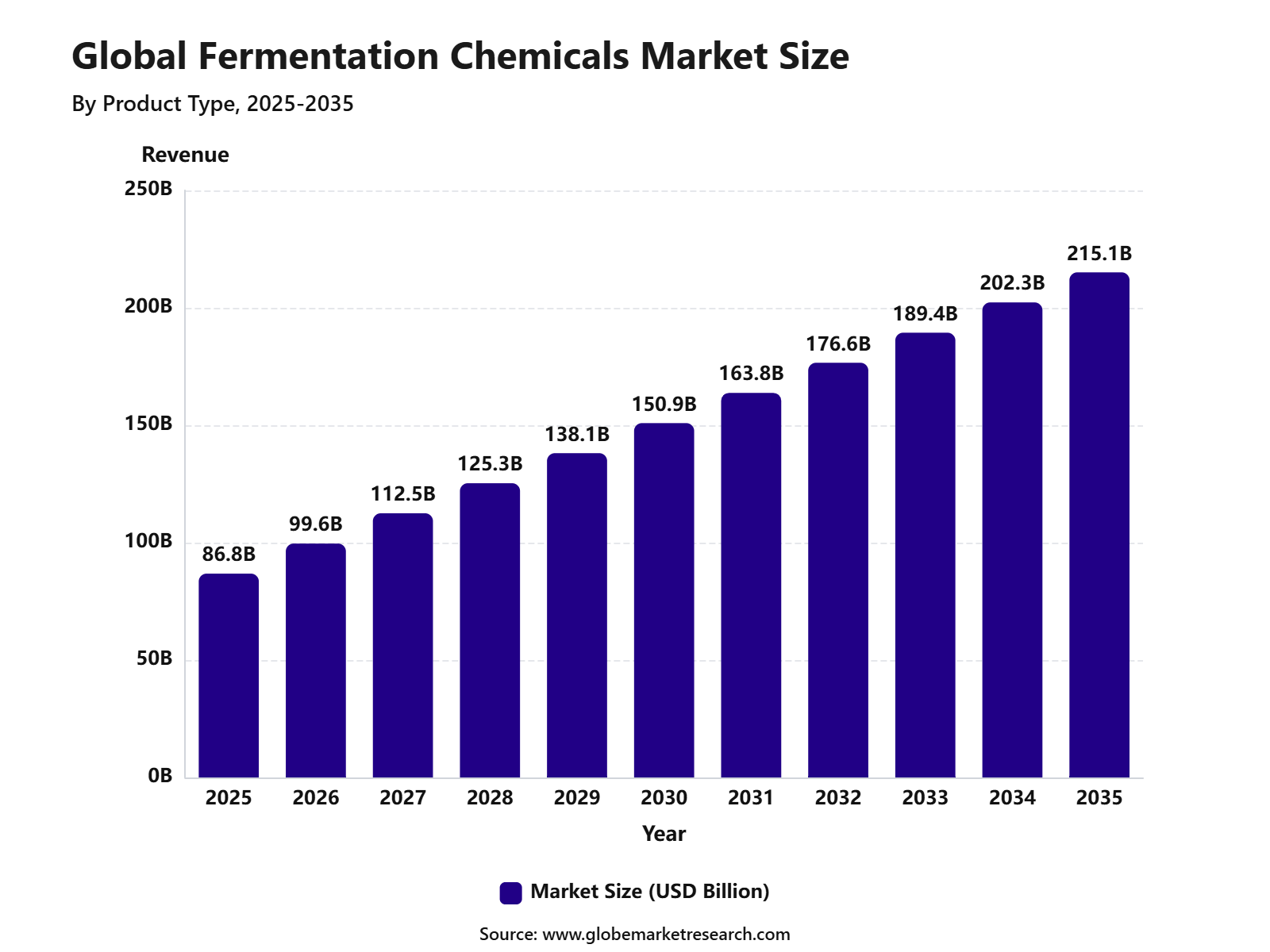 iThe graph shows projected market growth until 2035 based on CAGR analysis. Actual outcomes may vary depending on changing demand, competition, and economic factors.To gain greater insights - request a sample report PDF
Key Market Insights
Alcohols led the product type segment with 53.8% share, supported by strong use in solvents, biofuels, pharmaceuticals, food processing, and industrial chemical production.
Industrial applications accounted for 43.5% share, driven by broad use of fermentation chemicals in manufacturing, bio-based processing, specialty chemicals, and large-scale production systems.
Batch fermentation held 47.9% share by process, supported by its operational flexibility, controlled production environment, and suitability for producing alcohols, organic acids, enzymes, and other fermentation-based chemicals.
North America led the fermentation chemicals market with 35.9% share, supported by advanced biotechnology infrastructure, strong industrial bioprocessing activity, and rising demand for bio-based chemical solutions.
Top Funding and Investment
NatureWorks received authorization from its parent companies, Cargill and GC, to invest more than USD 600.0 million in a fully integrated Ingeo PLA manufacturing complex in Thailand. The facility includes lactic acid, lactide, and polymer production sites and is designed for 75,000 tons per year of Ingeo biopolymer capacity. This investment supports fermentation-linked lactic acid production for bio-based plastics and specialty materials.
BioMADE is investing USD 400.0 million in a U.S. network of bioindustrial pilot plants to support domestic biomanufacturing of critical chemicals and materials. The platform had 306 member organizations, 75 technology projects, and 25 education and workforce projects as of September 2025. This funding helps de-risk scale-up for fermentation-based and bio-manufactured chemical production.
Solugen raised more than USD 350.0 million in Series C funding to expand its Bioforge platform for lower-carbon and carbon-negative chemicals. In 2024, the company also secured a USD 213.6 million conditional loan guarantee from the U.S. Department of Energy for its Bioforge Marshall facility. The plant is planned to produce bio-based organic acids for wastewater treatment, construction, agriculture, and energy applications.
Cargill and HELM invested a combined USD 300.0 million to build the first commercial-scale renewable 1,4-butanediol facility in the U.S. The QIRA bio-BDO product is made biologically through fermentation of plant-based sugars and can reduce greenhouse gas emissions by up to 93% compared with conventional BDO. The facility was launched in 2025 with 66,000 metric tons of annual QIRA capacity.
Corbion announced an investment of about USD 190.0 million for a new 125,000 metric tons per year lactic acid plant in Thailand. The project was designed to support PLA bioplastics and other fermentation-based lactic acid derivatives. Corbion later announced mechanical completion of the new circular lactic acid plant in Rayong, Thailand, in December 2023.
By Product Type
Alcohols accounted for 53.8% share of the Fermentation Chemicals Market. This leading position can be attributed to their high-volume use across industrial solvents, fuels, pharmaceuticals, food and beverages, cosmetics, personal care, and chemical manufacturing. Fermentation-based alcohols such as ethanol, butanol, and other bio-based alcohols are widely preferred because they can be produced from and chemical manufacturing.
Fermentation-based alcohol renewable feedstocks. Their use supports cleaner production routes and helps industries reduce dependence on fully petrochemical-based inputs. Demand for alcohols is expected to remain strong due to their broad application base and established production infrastructure. Growth is further supported by rising use in biofuels, sanitizers, extraction solvents, industrial cleaners, and specialty chemical intermediates.
By Application
Industrial applications held 43.5% share of the Fermentation Chemicals Market. This dominance is supported by the large use of fermentation chemicals in solvents, enzymes, organic acids, biofuels, plastics, coatings, cleaning products, and chemical intermediates. Industrial users prefer fermentation chemicals because they offer functional performance while supporting lower-emission and bio-based production strategies.
These chemicals are used in manufacturing processes where consistency, scalability, and cost efficiency are important. The segment is expected to remain a major demand area as industries shift toward sustainable raw materials and circular production systems. Demand is especially strong in chemicals, energy, pharmaceuticals, food processing, textiles, and industrial biotechnology.
By Process
Batch fermentation accounted for 47.9% share of the Fermentation Chemicals Market. Its strong position is driven by operational flexibility, easier process control, and suitability for producing a wide range of fermentation-derived chemicals. This process is widely used because each production cycle can be controlled separately, allowing better quality management and contamination control.
It is suitable for alcohols, organic acids, enzymes, amino acids, antibiotics, and other specialty biochemical products. Batch fermentation remains important for both large-scale and specialty production. Its use is expected to continue where product purity, controlled conditions, and flexible production planning are required across industrial and biotechnology applications.
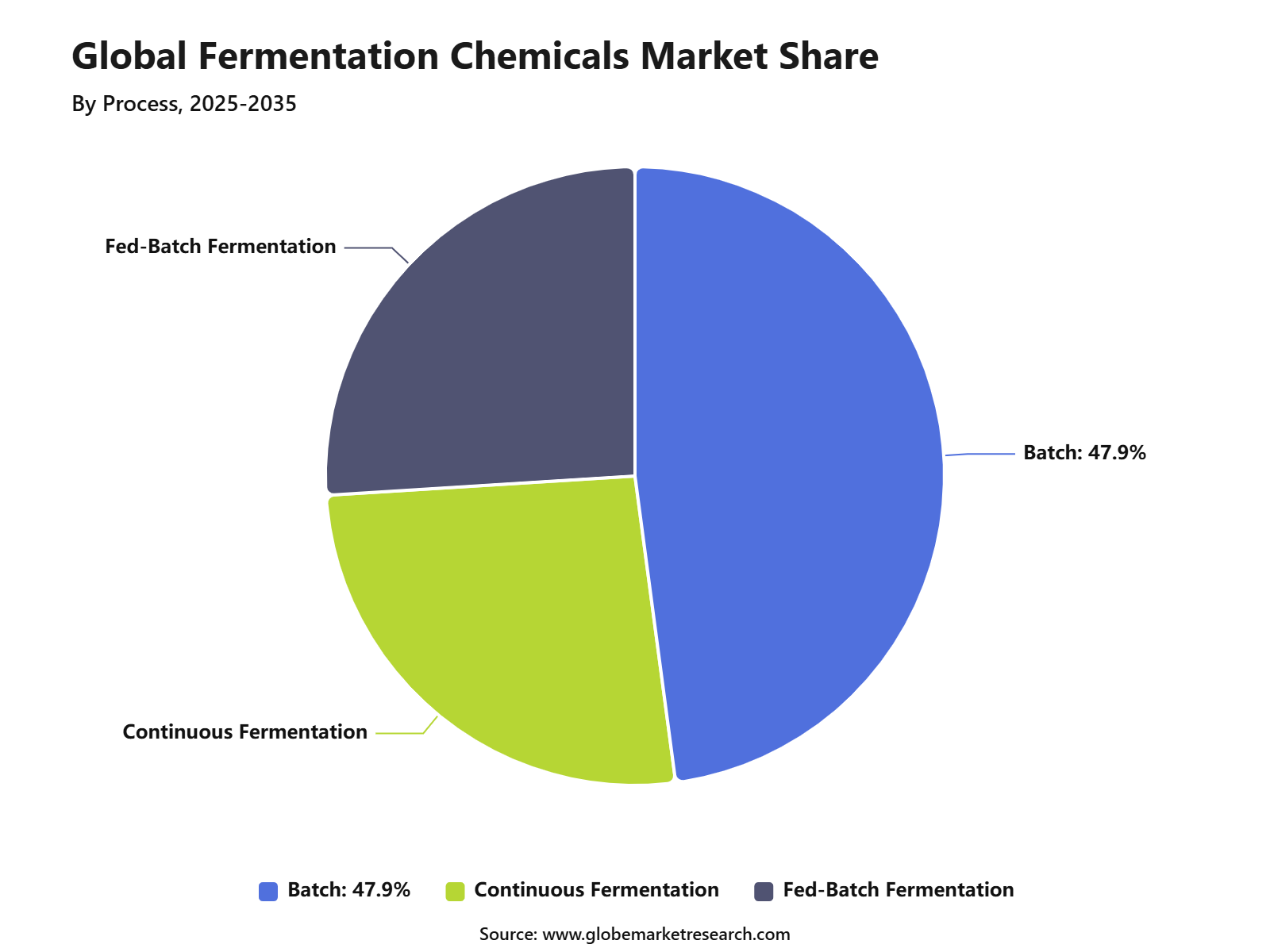 iThe graph shows projected market growth until 2035 based on CAGR analysis. Actual outcomes may vary depending on changing demand, competition, and economic factors.To gain greater insights - request a sample report PDF
By Region
North America accounted for 35.9% share of the Fermentation Chemicals Market, making it the leading regional market. The region benefits from strong industrial biotechnology capabilities, established ethanol production, advanced food processing, and high demand from pharmaceuticals and specialty chemicals.
The United States is a major contributor due to its large fermentation capacity, strong agricultural feedstock base, and mature biofuel industry. Demand is also supported by growing use of bio-based ingredients in industrial, healthcare, food, and personal care applications.
North America is expected to maintain a strong position as companies invest in cleaner production technologies and bio-based chemical platforms. The region’s focus on renewable inputs, process efficiency, and advanced biomanufacturing will continue to support market growth.
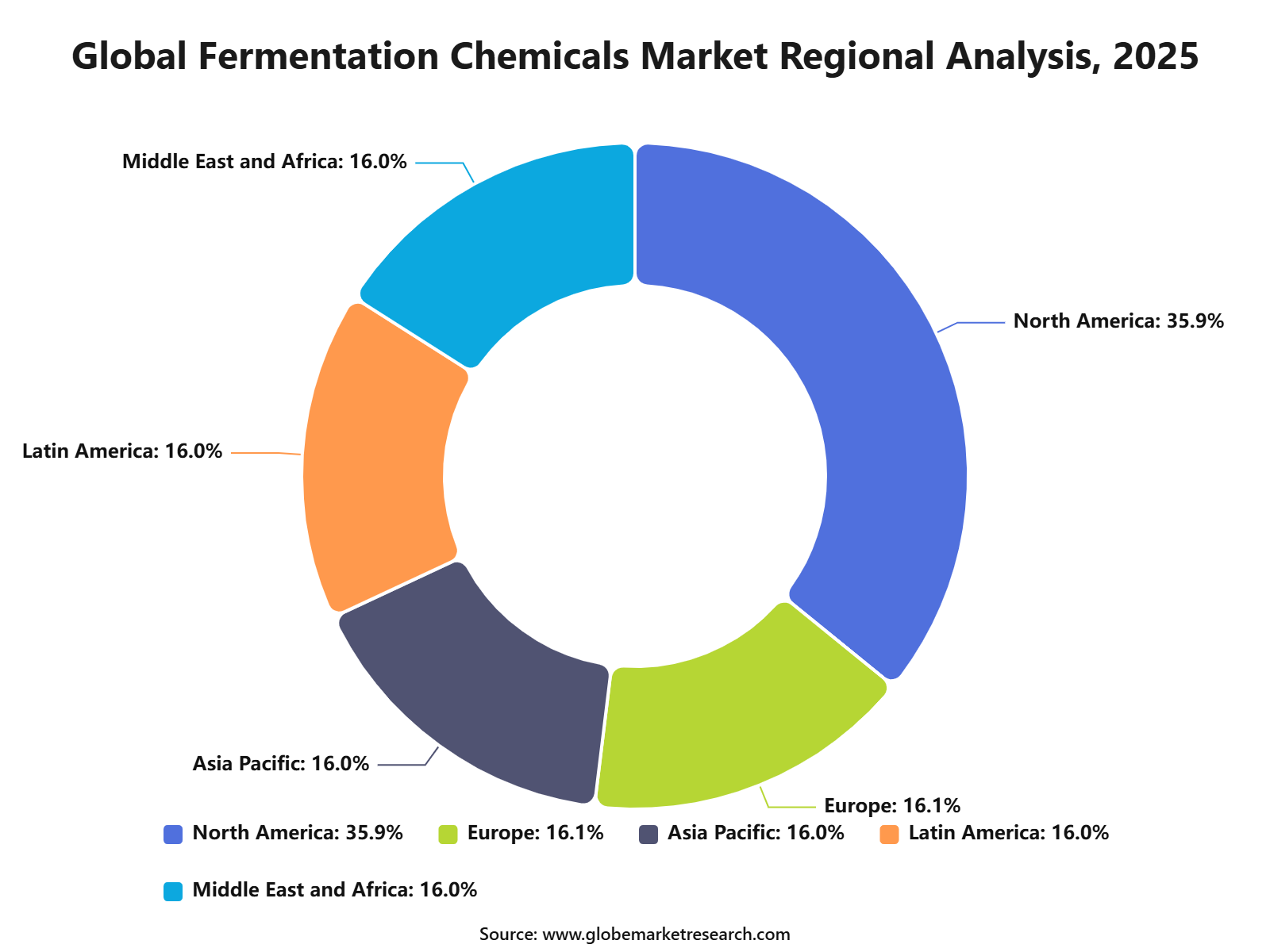 iThe graph shows projected market growth until 2035 based on CAGR analysis. Actual outcomes may vary depending on changing demand, competition, and economic factors.To gain greater insights - request a sample report PDF
Go-To-Market and Sales Economics
The Fermentation Chemicals Market should be positioned through food processors, pharmaceutical manufacturers, biofuel producers, nutraceutical brands, animal feed companies, cosmetic formulators, textile processors, and industrial chemical buyers in 2026. Selling should focus on renewable origin, process efficiency, lower petrochemical dependence, batch consistency, and strong technical support across fermentation-derived acids, alcohols, enzymes, amino acids, vitamins, and solvents.
Sales economics should be built around long-term supply agreements, application trials, and customer-specific formulation support. Fermentation chemicals are used in food preservation, flavoring, cleaning, fuel blending, bioplastics, personal care, agriculture, and industrial processing. Suppliers should provide stability data, purity specifications, regulatory documents, fermentation yield support, and reliable delivery for large-volume and specialty buyers.
Channel strategy should combine direct enterprise selling with distributors serving food, feed, pharma, industrial biotechnology, and specialty chemicals. India’s bioeconomy reached USD 195.3 billion in 2025, contributed around 4.8% to GDP, and was supported by more than 11,800 biotech startups, showing stronger demand for bio-based manufacturing solutions.
Risk Factors & Market Barriers
The main barriers are feedstock volatility, fermentation contamination risk, strain performance, downstream purification cost, and regulatory approval. Fermentation chemicals depend on sugar, starch, corn, molasses, biomass hydrolysates, nutrients, enzymes, water, energy, and process chemicals. Any change in feedstock quality can affect yield, purity, production cost, and customer acceptance.
Regulatory risk is important for food, feed, pharmaceutical, and nutraceutical applications. FDA states that food additive petitions or GRAS notices for enzyme preparations should include safety information and details on proteins derived from major food allergens. This creates documentation requirements for fermentation-derived enzymes, food ingredients, probiotics, and specialty additives.
Cost pressure also affects producers because fermentation plants require sterilization, controlled temperature, clean utilities, drying, filtration, and wastewater treatment. FRED reported the U.S. ethyl alcohol manufacturing index at 215.746 in May 2026, up from 183.885 in January 2026. This shows pricing movement in a key fermentation-linked chemical category.
Revenue Potential Analysis
Revenue Landscape Across
Revenue opportunities are strongest across ethanol, citric acid, lactic acid, acetic acid, amino acids, enzymes, vitamins, antibiotics, organic solvents, xanthan gum, biopolymers, and specialty bio-based intermediates. Demand is supported by food and beverages, pharmaceuticals, detergents, agriculture, animal nutrition, biofuels, cosmetics, and biodegradable material applications.
Biofuel and renewable fuel demand provides a large revenue base for fermentation-linked chemicals. EIA forecast U.S. ethanol net exports and production to remain near record highs in 2026, supported by expected record corn production. USDA also forecast U.S. food, seed, and industrial corn use at 7.0 billion bushels for 2026/27.
Industrial biotechnology also supports revenue diversification beyond fuel ethanol. IEA stated that renewable fuels are set to account for 5.5% of energy consumption from industry, buildings, and transport by 2030. Fermentation chemical suppliers can benefit through bioethanol, biobutanol, organic acids, bio-based solvents, and platform chemicals used in lower-carbon value chains.
Financial Impact
The financial impact in 2026 will depend on sugar and starch costs, microbial yield, fermentation time, energy use, purification efficiency, wastewater treatment, and customer qualification. FRED reported the U.S. basic organic chemicals index at 341.198 in May 2026, compared with 276.839 in January, showing wider cost pressure in organic chemical inputs.
Margins can improve when producers sell higher-value fermentation chemicals instead of only commodity alcohols. Specialty enzymes, amino acids, organic acids, vitamins, pharmaceutical intermediates, bio-based monomers, and precision fermentation ingredients can support stronger unit economics. However, profitability depends on batch reliability, contamination control, downstream recovery, and regulatory readiness.
Financial returns can be strengthened through integrated feedstock sourcing, high-yield strains, continuous fermentation, energy-efficient distillation, byproduct valorization, and long-term contracts. Producers that convert residues into animal feed, bioenergy, or fertilizer can reduce waste cost. Stronger returns are expected where fermentation platforms serve multiple end markets instead of one commodity route.
Drivers Impact Analysis
The Fermentation Chemicals Market is driven by rising demand from food and beverages, pharmaceuticals, biotechnology, animal nutrition, biofuels, personal care, agriculture, and industrial processing. Fermentation chemicals are widely used to produce alcohols, enzymes, organic acids, amino acids, vitamins, antibiotics, and bio-based intermediates.
North America leads the market due to strong pharmaceutical manufacturing, industrial biotechnology, food processing, biofuel production, and advanced fermentation capacity. The U.S. remains the major regional contributor because of its strong biotech ecosystem, research base, and commercial-scale bioprocessing infrastructure.
Impact Factor | Estimated CAGR Impact | Regional Relevance | Market Impact |
|---|---|---|---|
Growth in pharmaceutical fermentation | +2.4% | North America, Europe, Asia Pacific | Drives premium demand. |
Rising food and beverage applications | +2.0% | Global food processing hubs | Supports volume usage. |
Expansion of industrial biotechnology | +1.8% | U.S., Europe, China, India | Builds bio-based production. |
Demand for organic acids and amino acids | +1.6% | Food, feed, pharma sectors | Adds steady consumption. |
Biofuel and bioprocessing growth | +1.3% | U.S., Brazil, Europe, Asia Pacific | Supports renewable output. |
Restraints Impact Analysis
The market faces restraints from high production cost, feedstock price volatility, and strict process control requirements. Fermentation depends on raw materials such as sugar, starch, corn, molasses, biomass, and other carbohydrate sources, so cost changes can affect margins. Quality and contamination control also remain important restraints. Fermentation processes require clean facilities, controlled temperature, pH balance, microbial stability, and downstream purification, which increases capital and operating cost for producers.
Impact Factor | Estimated CAGR Impact | Regional Relevance | Market Impact |
|---|---|---|---|
Feedstock price volatility | -1.2% | Global producers | Pressures margins. |
High fermentation setup cost | -1.0% | Industrial biotech producers | Limits smaller players. |
Contamination risk in production | -0.9% | Pharma, food, enzyme sectors | Affects batch reliability. |
Energy and water consumption | -0.8% | Large fermentation plants | Raises operating burden. |
Strict quality and safety standards | -0.7% | North America, Europe, Japan | Adds compliance cost. |
Opportunities Impact Analysis
Opportunities are strong in bio-based chemicals, precision fermentation, pharmaceutical intermediates, food enzymes, organic acids, amino acids, probiotics, and sustainable ingredient production. These areas benefit from demand for cleaner manufacturing and reduced dependence on petrochemical routes.
Higher-value growth is also emerging in specialty fermentation chemicals used in healthcare, nutrition, cosmetics, and agriculture. Companies that improve yield, purity, and process efficiency can capture stronger demand from regulated and premium end-use industries.
Impact Factor | Estimated CAGR Impact | Regional Relevance | Market Impact |
|---|---|---|---|
Bio-based chemical production | +2.3% | North America, Europe, Asia Pacific | Builds sustainable growth. |
Precision fermentation expansion | +2.0% | U.S., Europe, Japan, Singapore | Adds high-value demand. |
Pharmaceutical intermediate production | +1.8% | North America, Europe, India, China | Supports premium usage. |
Food enzyme and probiotic ingredients | +1.5% | Global nutrition markets | Expands application base. |
Specialty organic acid production | +1.3% | Food, pharma, industrial sectors | Improves value mix. |
Challenges Impact Analysis
The main challenge is scaling fermentation from laboratory or pilot production to commercial output. Producers must maintain microbial performance, product purity, yield consistency, and cost efficiency across larger batch or continuous systems. Another challenge is downstream processing. Fermentation output often needs separation, concentration, purification, drying, or stabilization, and these steps can increase cost if process design is not optimized.
Impact Factor | Estimated CAGR Impact | Regional Relevance | Market Impact |
|---|---|---|---|
Scaling commercial fermentation | -1.1% | Global biotech producers | Raises technical risk. |
Maintaining yield consistency | -0.9% | Industrial and pharma plants | Protects production economics. |
Downstream purification cost | -0.8% | Pharma, food, specialty chemicals | Increases final cost. |
Managing microbial strain stability | -0.7% | Enzyme and biochemical producers | Affects batch output. |
Regulatory approval complexity | -0.6% | Food, pharma, biotech sectors | Slows product launches. |
Segment Covered in the Report
By Product Type
Organic Acids
Enzymes
Amino Acids
Antibiotics
Vitamins
Others
By Application
Industrial
Pharmaceuticals
Plastics and Fibers
Nutritional and Personal Care
Others
By Process
Batch Fermentation
Continuous Fermentation
Fed-Batch Fermentation
By Region
North America
Europe
Asia Pacific
Latin America
Middle East and Africa
Recent Developments
In 2026, BASF commissioned its BioHub fermentation plant at Ludwigshafen for biological and biotechnology-based crop protection products. The facility uses microorganisms to convert renewable raw materials such as glucose into active ingredients for biological fungicides and seed treatment products. The project is backed by a high double-digit million-euro investment and strengthens in-house fermentation flexibility.
In 2026, Novonesis signed an MoU with Nhà Xanh Viet Nam to support Vietnam’s E10 biofuel rollout. The partnership is focused on improving ethanol yields, reducing production costs, and using corn and cassava-based biofuel production more efficiently. This development supports domestic ethanol production and increases the use of agricultural feedstocks in fermentation-based fuel supply chains.
Competitive Landscape
The market is characterized by intense competition among established players and emerging companies. Strategic partnerships, mergers and acquisitions, and product innovation are key strategies employed by market participants.
Key Market Players
BASF SE
Cargill, Incorporated
Archer Daniels Midland Company
Evonik Industries AG
Novonesis
DSM-Firmenich
DuPont
Ajinomoto Co., Inc.
AB Enzymes
Amano Enzyme Inc.
Chr. Hansen Holding A/S
Dow Inc.
Other Key Players
Research Methodology
This market study is prepared using a combination of primary and secondary research. Primary research includes discussions with manufacturers, suppliers, distributors, consultants, industry experts, and end users. Secondary research covers company reports, government databases, trade associations, technical publications, regulatory sources, and trusted industry documents. The collected information is used to assess market demand, pricing trends, technology adoption, competitive activity, and regional performance.
AI language models are not used as primary data sources, and publicly available AI-generated content is not treated as market evidence. Computational tools may be used to support data processing, translation, data classification, and pattern identification. However, every published assessment is supported by verified sources, human review, and primary market discussions.
Market estimates are developed through top-down and bottom-up approaches and validated using data triangulation. Revenue, production, shipment, pricing, and application-level data are compared across multiple sources. Forecasts consider economic conditions, regulatory changes, investment activity, innovation, supply chain developments, and industry risks. All findings are reviewed through source verification and internal quality checks before publication.
Part I
Source Management & Input Data Standards
Who provides data, how sources are qualified, and what types of evidence are admissible.
Part II
Research Scope & Market Coverage
How we define the markets we assess and the parameters that govern each product.
Part III
Data Collection, Verification & Submission
The mechanics of gathering, cross-checking, and hierarchically ranking evidence.
Part IV
Assessment Determination & Quality Controls
How raw data becomes a published assessment — normalisation, expert judgement, and outlier exclusion.
Part V
Publication, Corrections & Revision
Our publication schedule, corrections policy, and methodology review cycle.
Part VI
Independence, Ethics & Complaints
Conflict-of-interest policies, editorial independence, and how clients raise concerns.
Google · Preferred Sources
Don't miss the latest market research insights and industry updates on Google.
Add Globe Market Research as a preferred source in the Google app to see our reports, analysis, and market stories in your news suggestions.
Meet the Team
This report was prepared by our expert analysts with deep industry knowledge and research experience.
Prashant S. is a Research Analyst at Globe Market Research with more than four years of experience in market research and industry analysis. He specializes in the Aerospace and Defence, Automotive and Transportation, Semiconductor and Electronics, Information and Technology sectors, with expertise in market sizing, trend analysis, competitive assessment, and industry forecasting. He applies primary and secondary research, data validation, company analysis, and market estimation methods to deliver reliable insights for strategic planning and business decision-making.
Sayali brings more than 7 years of experience to Globe Market Research, supporting the accuracy, clarity, and relevance of research content across multiple industries. She reviews market data, segment analysis, competitive insights, and industry trends to ensure each report meets strong quality standards and provides practical value to business decision-makers. Her expertise spans healthcare, information technology, consumer goods, and diverse cross-industry domains. With a strong focus on data reliability, structured analysis, and clear presentation, Sayali helps ensure that each research output delivers well-reviewed insights for clients, investors, consultants, and industry stakeholders.
Frequently Asked Questions
Related Reports
More in Chemical and Material
Sulfuric Acid Market to Hit USD 61.5 Billion by 2035
Sulfuric Acid Market Size, Share, Analysis By Raw Material (Elemental Sulfur, Base Metal Smelters, Pyrite Ore, Others), By Application (Fertilizers, Chemical Manufacturing, Metal Processing, Petroleum Refining, Textile, Automotive, Pulp and Paper, Others), By Distribution Channel (Direct Sales, Distributors), By Regional Insights, Business plan and Project Report, Investment Opportunities, Profitability, Industry Trends, Leading Companies and Growth Forecasts by 2026-2035
Powder Metallurgy Market to Hit USD 17.0 Billion by 2035
Powder Metallurgy Market Size, Share, Analysis By Material (Ferrous Metals, Non-Ferrous Metals, Others), By Process (Additive Manufacturing, Powder Metal Hot Isostatic Pressing, Conventional Powder Metallurgy), By Application (Automotive, Aerospace and Defense, Healthcare, Electrical and Electronics, Industrial Machinery, Others) , By Regional Insights, Business plan and Project Report, Investment Opportunities, Profitability, Industry Trends, Leading Companies and Growth Forecasts by 2026-2035
Bromine Market to Hit USD 1.5 Billion by 2035
Bromine Market Size, Share, Analysis By Derivative (Organobromine, Clear Brine Fluids, Hydrogen Bromide, Others), By Application (Flame Retardants, Oil and Gas Drilling, Biocides, PTA Synthesis, Plasma Etching, Pharmaceuticals, Energy Storage, Others), By End-Use Industry (Chemicals, Oil and Gas, Pharmaceuticals, Electrical and Electronics, Automotive, Agriculture, Others), By Regional Insights, Business plan and Project Report, Investment Opportunities, Profitability, Industry Trends, Leading Companies and Growth Forecasts by 2026-2035
Hydrogen Cyanide Market to Hit USD 5.95 Billion by 2035
Hydrogen Cyanide Market Size, Share, Analysis By Product Form (Hydrogen Cyanide Liquid, Hydrogen Cyanide Gas), By Application (Adiponitrile, Acetone Cyanohydrin, Sodium Cyanide and Potassium Cyanide, Methionine, Cyanuric Chloride, Others), By End-Use Industry (Chemicals, Mining and Metallurgy, Pharmaceuticals, Agriculture, Textiles, Others), By Regional Insights, Business plan and Project Report, Investment Opportunities, Profitability, Industry Trends, Leading Companies and Growth Forecasts by 2026-2035