

Revenue, 2026
USD 163.7 Bn
Forecast, 2035
USD 460.6 Bn
CAGR, 2026-2035
10.9%
Report Coverage
Global
Market Size and Forecast
The Global Green Chemicals Market was worth USD 163.7 billion in 2025 and is expected to reach USD 460.6 billion by 2035, growing at a CAGR of 10.9% from 2025 to 2035. Based on this growth rate, the market is estimated to reach around USD 196.7 billion in 2026. Asia Pacific held the largest regional share of 38.7% in 2025, valued at around USD 63.3 billion, supported by strong bio-based chemical production, rising industrial sustainability goals, renewable feedstock availability, and growing demand from packaging, agriculture, textiles, and consumer goods.
The Green Chemicals Market includes bio-based, renewable, low-toxicity, and environmentally preferred chemicals used as alternatives to conventional petroleum-based products. It covers bio-alcohols, bio-organic acids, bio-polymers, bio-solvents, bio-surfactants, and other sustainable chemical solutions. These products are widely used in industrial processing, food and beverages, packaging, construction, automotive, personal care, agriculture, and specialty chemical applications.
Key Parameter | Report Details |
|---|---|
Market Revenue, 2025 | USD 163.7 Billion |
Projected Revenue, 2035 | USD 460.6 Billion |
CAGR (2025-2035) | 10.9% |
Largest Region | Asia Pacific (38.7%, USD 63.3 Bn) |
Market Concentration | Medium |
Base Year | 2024 |
Forecast Period | 2025-2035 |
The market outlook remains strong as manufacturers shift toward cleaner raw materials, lower carbon production, and circular economy practices. Growth can be attributed to rising demand for biodegradable materials, stricter environmental regulations, and increasing investment in renewable feedstock-based chemical manufacturing. Asia Pacific’s large manufacturing base, expanding consumer markets, and policy support for sustainable industrial development are expected to support long-term market growth.
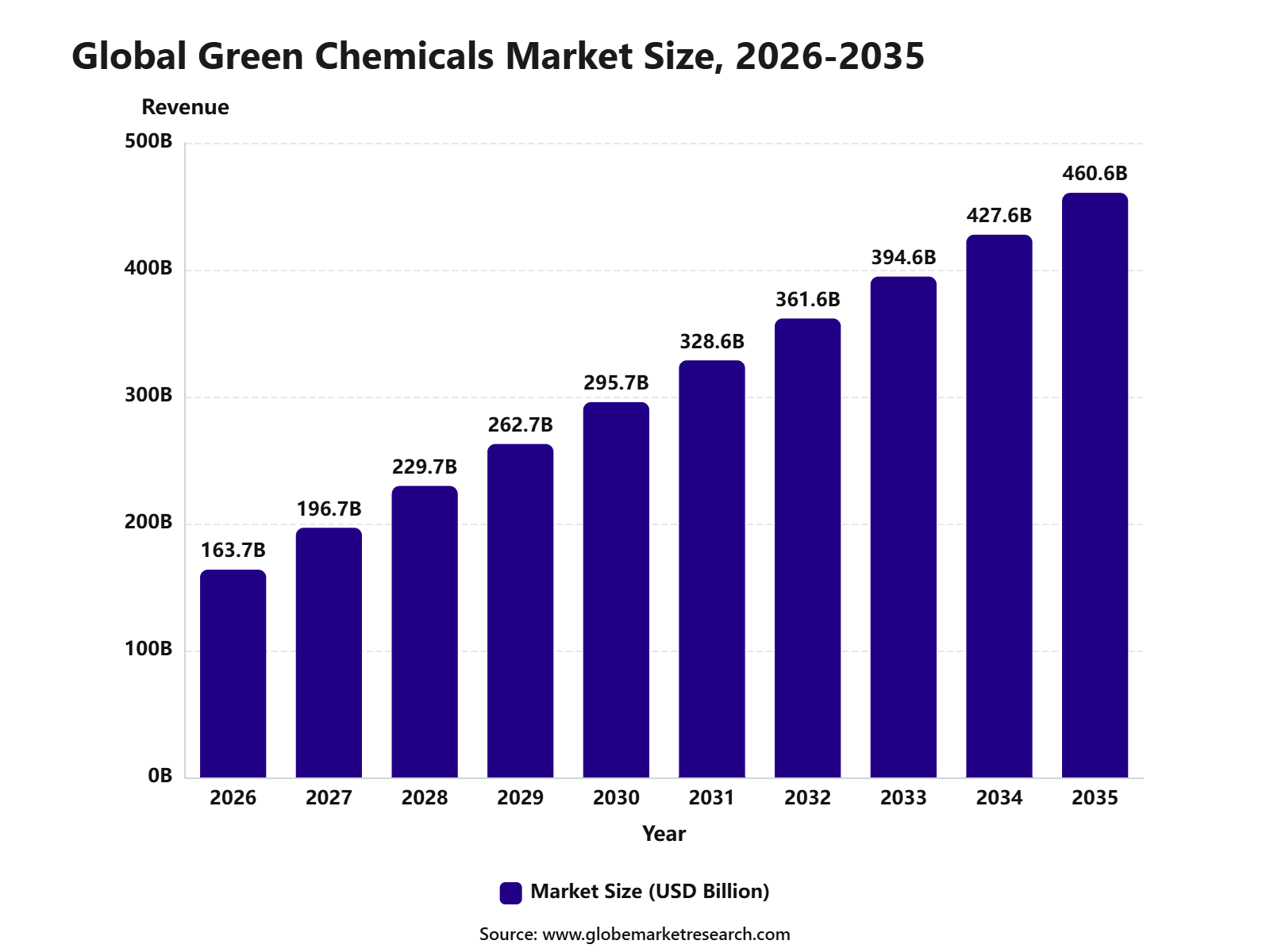 iThe graph shows projected market growth until 2035 based on CAGR analysis. Actual outcomes may vary depending on changing demand, competition, and economic factors.To gain greater insights - request a sample report PDF
Key Market Insights
Bio-alcohols led the type segment with 49.2% share, supported by their strong use in biofuels, solvents, industrial chemicals, pharmaceuticals, cosmetics, and sustainable chemical formulations.
Sugar and starch crops accounted for 30.7% share by feedstock, driven by their wide availability, established processing routes, and strong use in fermentation-based green chemical production.
Industrial and chemical applications held 64.5% share, supported by rising demand for bio-based solvents, intermediates, polymers, additives, and lower-carbon chemical inputs.
Asia Pacific led the green chemicals market with 38.7% share, valued at USD 63.3 billion, supported by strong agricultural feedstock availability, expanding chemical manufacturing, and rising adoption of sustainable production across China, India, Japan, and Southeast Asia.
Top Funding and Investment
Top Investments
UPM produced its first commercial product at its Leuna biorefinery following an estimated investment of EUR 1.275 billion. Once fully operational, the facility will manufacture 220,000 tonnes of advanced biochemicals annually from sustainably sourced hardwood. Its product portfolio includes renewable glycols, industrial sugars, lignin, and renewable functional fillers intended to replace fossil-based chemical inputs.
Cargill and HELM’s Qore joint venture opened a USD 300 million commercial-scale production facility in Eddyville, Iowa. The plant produces QIRA, a bio-based 1,4-butanediol, using locally sourced corn instead of conventional fossil feedstocks. The renewable intermediate can be used in spandex, footwear, coatings, adhesives, and other chemical applications.
L’Oréal launched L’AcceleratOR with an investment commitment of EUR 100 million over five years to identify, test, and scale sustainable technologies. By January 2026, the company had selected 13 businesses from nearly 1,000 applications across 101 countries. Selected technologies include renewable raw materials, green chemistry processes, bio-sourced ingredients, bioplastics, and waste-derived chemical inputs.
BASF commissioned its BioHub fermentation facility at the Ludwigshafen site following an investment in the high double-digit million-euro range. The facility produces biological and biotechnology-based active ingredients for crop protection products. In-house fermentation is expected to improve production flexibility, strengthen supply security, and expand BASF’s portfolio of biologically derived chemical solutions.
Verbio invested EUR 27.7 million in a metathesis catalyst manufacturing facility in Gödöllő, supported by EUR 5.5 million from the Hungarian government. The plant will manufacture molybdenum-, tungsten-, and ruthenium-based catalysts for converting renewable vegetable oils into chemicals used in lubricants, cleaning products, polymers, fragrances, and agrochemicals. Verbio plans to produce up to 60,000 tonnes of renewable chemical products annually at its connected Bitterfeld operation.
Top Funding Transactions
LanzaTech closed USD 40 million in preferred equity capital to support its operations and carbon-recycling technology platform. The company uses biological processes to convert industrial waste carbon into ethanol and chemical intermediates that can be used in materials, fuels, and consumer products. The financing strengthened liquidity while the company advanced commercial carbon-conversion projects.
P2 Science closed an oversubscribed USD 23 million funding round led by Sofinnova Partners, with participation from Emerald Technology Ventures, GS Futures, BASF, Chanel, dsm-firmenich ventures, and other investors. The capital will expand its green chemistry platform into performance polymers, coatings, home care, crop care, aroma chemicals, and plant-based personal care ingredients.
Reduciner raised EUR 3.6 million in its first funding round from Voima Ventures, Lifeline Ventures, and the Mikko Kodisoja Foundation. VTT also transferred technology and intellectual property rights as an in-kind investment. The funding will support technology that converts captured carbon dioxide into carbon monoxide and activated carbon for use in sustainable fuels, industrial chemicals, and circular carbon applications.
Top Acquisitions
Nextchem, Italy, June 2026: Acquisition of Ballestra Group for EUR 148.2 Million
Nextchem, part of MAIRE, completed the acquisition of the entire share capital of Ballestra Group for EUR 148.2 million. The transaction included Ballestra S.p.A., the Mazzoni brand, BUSS ChemTech AG, and Ballestra Engineering and Projects.
Nextchem acquired technologies for bio-based detergents, surfactants, soaps, oleochemicals, sustainable fertilizers, fluorine derivatives, and the pyrolysis of difficult-to-recycle plastic waste. The acquired group has approximately 460 employees, more than 6,400 installed plants across 120 countries, and a backlog of about EUR 270 million as of March 2026.
Covestro, Switzerland, August 2025: Acquisition of Pontacol for EUR 28 Million
Covestro completed the acquisition of 100% of Pontacol AG for EUR 28 million in cash, with potential earn-out payments of up to EUR 5 million. Pontacol manufactures multilayer thermoplastic adhesive films and operates production facilities in Switzerland and Germany.
The acquisition transferred Pontacol’s manufacturing capacity, specialized film technologies, product portfolio, customer relationships, and operating companies to Covestro. The materials are supplied to mobility, textile, electronics, medical technology, and industrial applications, supporting Covestro’s expansion into sustainable and specialized material solutions.
By Type
Bio-alcohols accounted for 49.2% share of the Green Chemicals Market. This leading position is supported by their wide use in fuels, solvents, disinfectants, chemical intermediates, personal care products, pharmaceuticals, and industrial formulations.
The segment is widely preferred because bio-alcohols can be produced from renewable feedstocks such as sugar crops, starch crops, and biomass. Ethanol, butanol, and other bio-based alcohols are gaining demand as industries reduce dependence on fossil-based chemicals and seek lower-impact alternatives.
Demand for bio-alcohols is expected to remain strong as fuel blending, industrial solvents, and sustainable chemical production continue to expand. Their established production infrastructure, broad application base, and compatibility with existing supply chains will continue to support segment leadership.
By Feedstock
Sugar and starch crops held 30.7% share of the Green Chemicals Market. This dominance is supported by the large availability of feedstocks such as sugarcane, corn, wheat, cassava, and beet, which are widely used in bio-based chemical production.
These crops are important because they provide fermentable sugars that can be converted into bio-alcohols, organic acids, biopolymers, and other renewable chemicals. Their strong supply base and mature processing routes make them suitable for commercial-scale production.
The segment is expected to maintain a strong position as producers continue to use agricultural feedstocks for renewable chemical manufacturing. Demand will remain supported by bio-refineries, fermentation technologies, and rising interest in plant-derived industrial inputs.
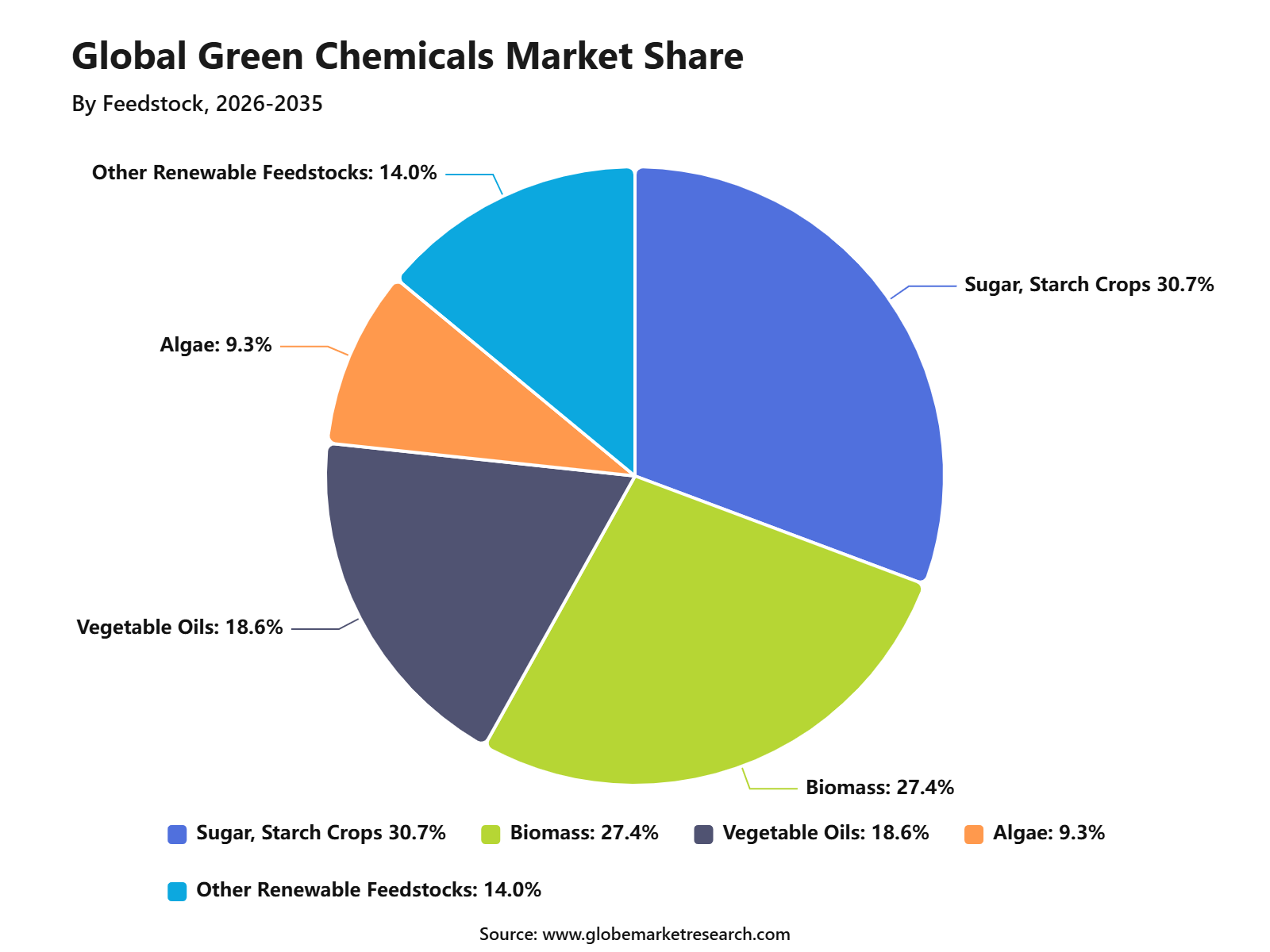 iThe graph shows projected market growth until 2035 based on CAGR analysis. Actual outcomes may vary depending on changing demand, competition, and economic factors.To gain greater insights - request a sample report PDF
By Application
Industrial and chemical applications accounted for 64.5% share of the Green Chemicals Market. This leading share is driven by strong use of bio-based chemicals in solvents, coatings, plastics, resins, surfactants, lubricants, adhesives, and specialty chemical production.
Industries are adopting green chemicals to reduce fossil-feedstock dependence, improve sustainability performance, and meet customer demand for cleaner materials. These chemicals are also used as intermediates in manufacturing processes where performance, consistency, and lower environmental impact are required.
The segment is expected to remain the largest application area as chemical companies expand renewable product portfolios. Demand will be supported by industrial decarbonization, circular material strategies, and wider use of bio-based inputs in manufacturing.
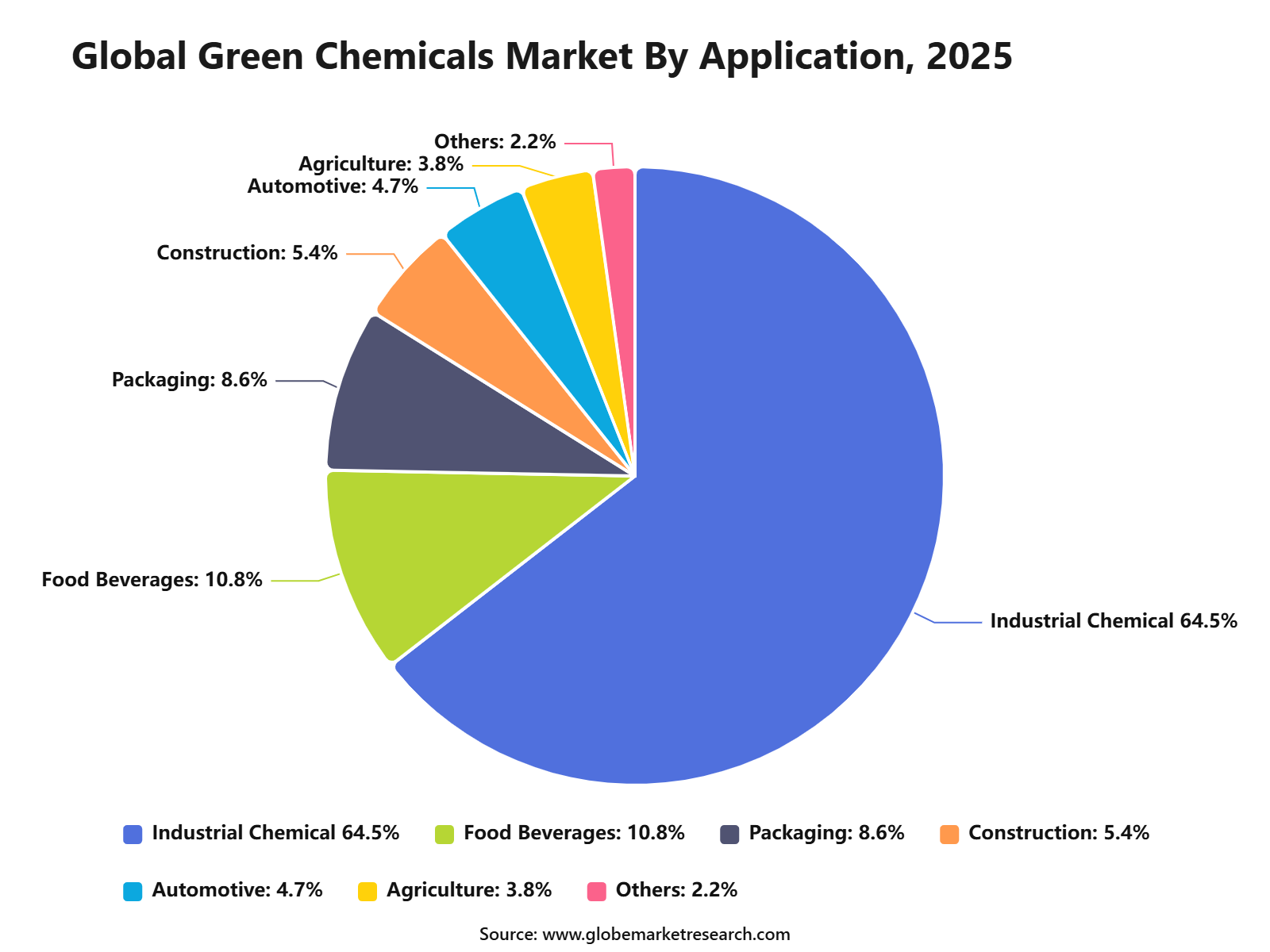 iThe graph shows projected market growth until 2035 based on CAGR analysis. Actual outcomes may vary depending on changing demand, competition, and economic factors.To gain greater insights - request a sample report PDF
By Region
Asia Pacific accounted for 38.7% share of the Green Chemicals Market, reaching USD 63.3 billion. The region’s leadership is supported by strong manufacturing activity, large agricultural feedstock availability, growing bio-based chemical production, and rising demand from packaging, automotive, textiles, agriculture, and industrial sectors.
China, India, Japan, South Korea, Thailand, Indonesia, and other Southeast Asian countries are key contributors to regional demand. The region benefits from expanding industrial capacity, growing consumer markets, and increasing investment in renewable materials and bio-refinery infrastructure.
Asia Pacific is expected to maintain its leading position as industries shift toward sustainable chemicals and lower-carbon production. Demand will remain supported by bio-alcohols, sugar and starch crop feedstocks, and wider adoption of green chemicals across industrial and chemical applications.
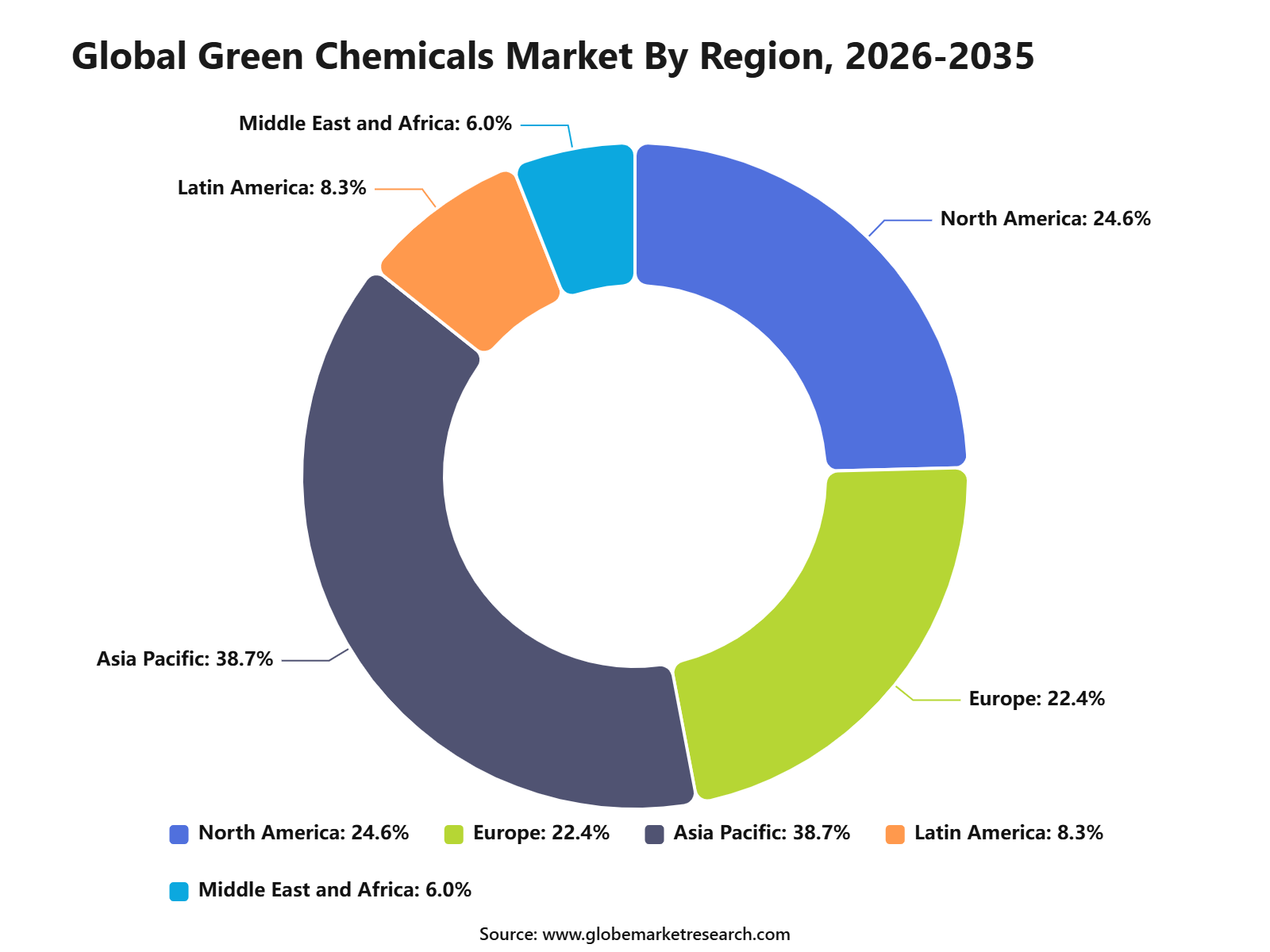 iThe graph shows projected market growth until 2035 based on CAGR analysis. Actual outcomes may vary depending on changing demand, competition, and economic factors.To gain greater insights - request a sample report PDF
Regional Impact Analysis
Asia Pacific leads the Green Chemicals Market with 38.7% share in 2025, valued at around USD 63.3 billion, supported by large chemical manufacturing, renewable feedstock availability, packaging demand, and growth in industrial applications. China, India, Japan, South Korea, Thailand, Indonesia, and Malaysia remain major regional contributors.
Europe remains important because of sustainability regulation, circular economy policies, and strong demand for bio-based packaging and specialty chemicals. North America supports value growth through bio-refinery capacity, sustainable consumer products, agricultural feedstocks, and green chemical innovation.
Impact Factor | Estimated CAGR Impact | Regional Relevance | Market Impact |
|---|---|---|---|
Asia Pacific market leadership | +3.5% | Asia Pacific, 38.7% share in 2025 | Leads global value demand. |
China chemical and packaging scale | +2.4% | China | Drives regional production and consumption. |
India bio-based chemical growth | +1.9% | India | Supports future demand expansion. |
Europe circular economy demand | +1.5% | Germany, France, Italy, Netherlands | Adds premium sustainability value. |
North America bio-refinery strength | +1.2% | U.S. and Canada | Supports green chemical innovation. |
Go-To-Market and Sales Economics
Green chemical suppliers should prioritise packaging converters, consumer-goods manufacturers, food processors, construction-material producers, and agricultural input companies. BASF expects global chemical production to increase 2.4% in 2026, but customers remain highly price-sensitive. Sales teams should therefore lead with measurable carbon reduction, technical performance, regulatory compliance, and total ownership cost rather than environmental claims alone.
Packaging offers a clear route to commercial scale because the European Packaging and Packaging Waste Regulation will generally apply from 12 August 2026. It covers all packaging and packaging waste placed on the European market. Suppliers of bio-based polymers, coatings, adhesives, inks, and barrier materials should work directly with brand owners during redesign, testing, and certification cycles.
Market entry should be supported by joint development agreements, pilot production, and regional application laboratories. A 2026 European biofertiliser programme includes a EUR 1.8 million cascade fund helping 30 small companies prepare feasibility studies and market plans. This model shows how technical mentoring and demonstration projects can shorten qualification periods and strengthen customer confidence.
Risk Factors & Market Barriers
Feedstock traceability is becoming a direct market-access requirement. The European Union Deforestation Regulation will apply to large and medium operators from 30 December 2026, covering relevant commodities such as soy, palm oil, rubber, and wood. Chemical producers using these inputs will require verified sourcing records, supplier mapping, due diligence systems, and auditable chain-of-custody documentation.
Price competition from conventional chemicals remains a major barrier, particularly when buyers cannot recover a sustainability premium. BASF reported first-quarter 2026 sales of EUR 16.02 billion, down EUR 488 million, as competitive pressure reduced prices across several chemical segments. Green suppliers must control conversion costs, improve plant utilisation, and use flexible feedstock-linked pricing clauses.
Feedstock movements can reduce selling prices before manufacturing savings are fully realised. Corbion reported that its Functional Ingredients and Solutions margin fell from 12.1% to 9.0% in the first quarter of 2026, partly because lower sugar costs reduced lactic-acid-to-PLA pricing. Strong pass-through formulas, inventory controls, and product-mix management are therefore essential.
Revenue Potential Analysis
Revenue Landscape Across
Sustainable agricultural inputs provide a growing revenue channel across Europe. A 2026 European programme allocated EUR 6.9 million to eight biofertiliser and biostimulant investment cases operating across Italy, France, Portugal, Spain, and Belgium. Suppliers can generate revenue from fermentation inputs, organic acids, microbial formulations, stabilisers, carrier materials, formulation support, and contract manufacturing services.
Marine biomass is creating opportunities beyond traditional crop-based feedstocks. A European seaweed initiative received EUR 6.8 million and connects 16 partners across 13 regions to develop food ingredients, cosmetics, fertilisers, and bioplastics. Green chemical companies can participate through extraction technologies, functional additives, preservation systems, purification services, and scalable processing agreements with coastal producers.
India offers substantial feedstock and biorefining potential for bio-alcohols, organic acids, solvents, and intermediates. The IEA reported in January 2026 that annual ethanol consumption had exceeded 11 billion litres, while about 170 compressed-biogas plants were operating and almost 300 projects were under construction. Integrated supply partnerships can convert this infrastructure into chemical production opportunities.
Financial Impact
Financial performance improves when green chemicals are sold through long-term contracts with volume commitments and feedstock adjustment mechanisms. Corbion maintained its 2026 outlook for 3% to 6% organic sales growth, an adjusted EBITDA margin near 17%, and free cash flow of EUR 85 million to EUR 90 million. Contract visibility and disciplined pricing remain central to delivery.
Biopolymer scale-up can create revenue, but early profitability may remain limited. The TotalEnergies Corbion joint venture recorded first-quarter 2026 sales of EUR 36.7 million, adjusted EBITDA of EUR 2.0 million, and a 5.3% margin. Returns will depend on capacity utilisation, sugar costs, customer qualification, product mix, logistics efficiency, and consistent premium acceptance.
Large chemical producers must balance transition spending with cash generation. BASF expects 2026 capital expenditure of EUR 3.4 billion and free cash flow between EUR 1.5 billion and EUR 2.3 billion. Green chemical investments should therefore be phased against secured demand, supported by modular capacity, and measured through contribution margin, payback, utilisation, and working-capital requirements.
Drivers Impact Analysis
The Green Chemicals Market is driven by rising demand for bio-based materials, lower-carbon production, renewable feedstocks, sustainable packaging, and cleaner industrial chemicals. Companies are shifting from fossil-based inputs to bio-alcohols, bio-organic acids, bio-polymers, bio-solvents, and renewable chemical intermediates.
Asia Pacific leads the market due to strong manufacturing capacity, large agricultural feedstock availability, growing packaging demand, and government support for sustainable industrial production. China, India, Japan, South Korea, Indonesia, Thailand, and Malaysia remain key contributors because of expanding chemical, packaging, textile, automotive, and consumer goods industries.
Impact Factor | Estimated CAGR Impact | Regional Relevance | Market Impact |
|---|---|---|---|
Rising demand for bio-based chemicals | +3.1% | Asia Pacific, Europe, North America | Drives core market expansion. |
Growth in sustainable packaging | +2.7% | China, India, Japan, Europe | Supports bio-polymer and bio-solvent demand. |
Renewable feedstock availability | +2.2% | Asia Pacific, Latin America, Europe | Improves production scalability. |
Corporate decarbonization targets | +1.8% | Global manufacturing sectors | Supports green chemical sourcing. |
Consumer preference for sustainable products | +1.4% | Food, cosmetics, packaging, personal care | Builds downstream demand. |
Restraints Impact Analysis
The market faces restraints from higher production costs, feedstock price volatility, limited large-scale processing capacity, and performance gaps compared with conventional chemicals. Green chemical production often requires specialized fermentation, biomass processing, purification, and quality control systems.
Another restraint is supply consistency. Agricultural and biomass feedstocks can be affected by crop cycles, weather conditions, logistics constraints, and competing demand from food, fuel, and animal feed sectors.
Impact Factor | Estimated CAGR Impact | Regional Relevance | Market Impact |
|---|---|---|---|
Higher production cost | -1.5% | Global producers and buyers | Slows price-sensitive adoption. |
Feedstock supply and price volatility | -1.3% | Biomass and crop-based regions | Affects production margins. |
Limited commercial-scale capacity | -1.1% | Emerging green chemical markets | Restricts faster volume growth. |
Performance comparison with petrochemicals | -0.9% | Packaging, automotive, industrial users | Requires product validation. |
Complex processing and purification needs | -0.7% | Bio-refinery operators | Raises operating cost. |
Opportunities Impact Analysis
Opportunities are strong in bio-alcohols, bio-organic acids, bio-polymers, bio-solvents, bio-surfactants, bio-lubricants, and renewable chemical intermediates. These product groups benefit from demand in packaging, food and beverages, cosmetics, construction, automotive, agriculture, and industrial applications.
Higher-value opportunities are emerging in biodegradable plastics, sustainable coatings, renewable solvents, plant-based surfactants, and bio-based specialty chemicals. Companies that offer consistent quality, scalable supply, and competitive pricing can capture stronger long-term demand.
Impact Factor | Estimated CAGR Impact | Regional Relevance | Market Impact |
|---|---|---|---|
Bio-polymer and biodegradable plastic growth | +3.0% | Asia Pacific, Europe, North America | Builds high-volume opportunity. |
Bio-alcohol use in industrial applications | +2.5% | China, India, Southeast Asia, U.S. | Supports chemical and fuel-linked demand. |
Bio-organic acid expansion | +2.1% | Food, pharma, packaging, agriculture | Adds broad downstream use. |
Renewable solvents and coatings | +1.7% | Industrial and construction markets | Supports cleaner formulations. |
Bio-surfactants and personal care chemicals | +1.3% | Cosmetics and consumer goods | Adds premium product value. |
Challenges Impact Analysis
The main challenge is scaling green chemical production while keeping cost, quality, and supply reliability competitive with conventional chemicals. Producers need stable feedstocks, efficient conversion technologies, strong logistics, and reliable downstream offtake agreements.
Another challenge is meeting strict performance requirements across industries. Packaging, automotive, construction, electronics, agriculture, and personal care customers need green chemicals that perform consistently under real operating conditions.
Impact Factor | Estimated CAGR Impact | Regional Relevance | Market Impact |
|---|---|---|---|
Scaling production economically | -1.4% | Global green chemical producers | Affects market competitiveness. |
Maintaining consistent product quality | -1.2% | Specialty and industrial users | Influences customer acceptance. |
Competing with low-cost petrochemicals | -1.0% | Price-sensitive applications | Limits rapid substitution. |
Managing biomass logistics | -0.8% | Agricultural and rural feedstock regions | Adds supply chain complexity. |
Meeting application-specific standards | -0.7% | Packaging, automotive, construction | Requires testing and certification. |
Segment Covered in the Report
By Type
Bio-Alcohols
Bio-Organic Acids
Bio-Ketones
Bio-Polymers
Others
By Feedstock
Sugar & Starch Crops
Biomass
Vegetable Oils
Algae
Other Renewable Feedstocks
By Application
Industrial & Chemical
Food & Beverages
Packaging
Construction
Automotive
Agriculture
Others
By Region
North America
Europe
Asia Pacific
Latin America
Middle East and Africa
Market Trend Analysis
The market trend is moving toward bio-based polymers, renewable solvents, plant-derived surfactants, green coatings, biodegradable materials, and circular chemical production. Companies are linking green chemical adoption with carbon reduction, waste reduction, and sustainable sourcing goals.
Asia Pacific remains the largest value region because of its manufacturing scale, renewable feedstock access, and strong downstream demand. Europe supports premium demand through sustainability rules and circular economy goals, while North America expands through bio-refineries, green packaging, and specialty chemical innovation.
Impact Factor | Estimated CAGR Impact | Regional Relevance | Market Impact |
|---|---|---|---|
Bio-based polymer adoption rises | +2.9% | Asia Pacific, Europe, North America | Supports sustainable packaging. |
Renewable solvent demand grows | +2.3% | Industrial and coatings markets | Reduces fossil-based chemical use. |
Bio-surfactants gain attention | +1.9% | Personal care and cleaning products | Adds consumer-facing demand. |
Circular chemical production expands | +1.5% | Europe, Japan, South Korea | Supports waste and carbon reduction. |
Green specialty chemicals increase | +1.2% | High-value industrial applications | Improves product differentiation. |
Investor Type Impact Matrix
Investors should focus on companies with strong renewable feedstock access, scalable production technology, stable offtake agreements, and proven product performance. Cost competitiveness, sustainability certification, and supply reliability are key success factors.
Strategic investors can also target bio-polymer producers, bio-refinery operators, renewable solvent companies, bio-surfactant firms, biomass processing companies, and specialty green chemical manufacturers. Companies that combine scale, verified sustainability, and strong downstream demand are better positioned for long-term growth.
Investor Type | Estimated CAGR Impact | Regional Relevance | Market Impact |
|---|---|---|---|
Green Chemical Manufacturers | +2.5% | Global | Expands renewable chemical supply. |
Bio-Polymer Producers | +2.1% | Asia Pacific, Europe, North America | Supports sustainable packaging demand. |
Bio-Refinery Operators | +1.7% | Feedstock-rich markets | Builds integrated production value. |
Renewable Solvent and Surfactant Firms | +1.4% | Industrial and consumer goods markets | Adds specialty product growth. |
Strategic Sustainability Investors | +1.1% | Global green materials markets | Funds scale and commercialization. |
Recent Developments
In April 2026, Corbion reported higher Biochemicals sales, driven by lactic acid and derivatives, alongside strong lactic-acid deliveries to its PLA joint venture and high-single-digit growth in biomaterials sales volumes.
In April 2026, DuPont highlighted Cyrel ReNew flexographic plates containing more than 50% ISCC PLUS-certified bio-circular raw materials, reducing reliance on virgin fossil resources and lowering product carbon footprint by 15%.
In February 2026, Toray developed proprietary technology for producing bio-based 2-pyrrolidone, the raw material for polyamide 4, advancing renewable polymer production and supporting high-performance, biodegradable material development across multiple applications.
In October 2025, Genomatica partnered with Sojitz, which made a strategic investment to accelerate commercialisation of 100% renewable-carbon nylon-6 and support formation of a consortium for a flagship production plant.
Competitive Landscape
The market is characterized by intense competition among established players and emerging companies. Strategic partnerships, mergers and acquisitions, and product innovation are key strategies employed by market participants.
Key Market Players
BASF SE
Cargill, Incorporated
ADM
Braskem S.A.
Corbion N.V.
DuPont
Mitsubishi Chemical Group Corporation
DSM-Firmenich
Evonik Industries AG
Arkema S.A.
LyondellBasell Industries
TotalEnergies Corbion
Toray Industries
Genomatica
NatureWorks LL
Other Key Players
Research Methodology
This market study is prepared using a combination of primary and secondary research. Primary research includes discussions with manufacturers, suppliers, distributors, consultants, industry experts, and end users. Secondary research covers company reports, government databases, trade associations, technical publications, regulatory sources, and trusted industry documents. The collected information is used to assess market demand, pricing trends, technology adoption, competitive activity, and regional performance.
AI language models are not used as primary data sources, and publicly available AI-generated content is not treated as market evidence. Computational tools may be used to support data processing, translation, data classification, and pattern identification. However, every published assessment is supported by verified sources, human review, and primary market discussions.
Market estimates are developed through top-down and bottom-up approaches and validated using data triangulation. Revenue, production, shipment, pricing, and application-level data are compared across multiple sources. Forecasts consider economic conditions, regulatory changes, investment activity, innovation, supply chain developments, and industry risks. All findings are reviewed through source verification and internal quality checks before publication.
Part I
Source Management & Input Data Standards
Who provides data, how sources are qualified, and what types of evidence are admissible.
Part II
Research Scope & Market Coverage
How we define the markets we assess and the parameters that govern each product.
Part III
Data Collection, Verification & Submission
The mechanics of gathering, cross-checking, and hierarchically ranking evidence.
Part IV
Assessment Determination & Quality Controls
How raw data becomes a published assessment — normalisation, expert judgement, and outlier exclusion.
Part V
Publication, Corrections & Revision
Our publication schedule, corrections policy, and methodology review cycle.
Part VI
Independence, Ethics & Complaints
Conflict-of-interest policies, editorial independence, and how clients raise concerns.
Google · Preferred Sources
Don't miss the latest market research insights and industry updates on Google.
Add Globe Market Research as a preferred source in the Google app to see our reports, analysis, and market stories in your news suggestions.
Meet the Team
This report was prepared by our expert analysts with deep industry knowledge and research experience.
Pratiksha K. is a Senior Research Analyst with more than five years of experience in market research, industry analysis, competitive intelligence, and business strategy. She has contributed to detailed market reports, customized research studies, company profiling, market sizing, trend analysis, and strategic consulting projects for clients across different regions. Her industry expertise covers Chemical and Material, Consumer Goods, Food & Beverages and Energy & Power. She closely evaluates changing customer requirements, technology developments, regulatory conditions, supply chain structures, investment activity, and competitive strategies to provide clear and practical market insights.
Sayali brings more than 7 years of experience to Globe Market Research, supporting the accuracy, clarity, and relevance of research content across multiple industries. She reviews market data, segment analysis, competitive insights, and industry trends to ensure each report meets strong quality standards and provides practical value to business decision-makers. Her expertise spans healthcare, information technology, consumer goods, and diverse cross-industry domains. With a strong focus on data reliability, structured analysis, and clear presentation, Sayali helps ensure that each research output delivers well-reviewed insights for clients, investors, consultants, and industry stakeholders.
Frequently Asked Questions
Related Reports
More in Chemical and Material
Sulfuric Acid Market to Hit USD 61.5 Billion by 2035
Sulfuric Acid Market Size, Share, Analysis By Raw Material (Elemental Sulfur, Base Metal Smelters, Pyrite Ore, Others), By Application (Fertilizers, Chemical Manufacturing, Metal Processing, Petroleum Refining, Textile, Automotive, Pulp and Paper, Others), By Distribution Channel (Direct Sales, Distributors), By Regional Insights, Business plan and Project Report, Investment Opportunities, Profitability, Industry Trends, Leading Companies and Growth Forecasts by 2026-2035
Powder Metallurgy Market to Hit USD 17.0 Billion by 2035
Powder Metallurgy Market Size, Share, Analysis By Material (Ferrous Metals, Non-Ferrous Metals, Others), By Process (Additive Manufacturing, Powder Metal Hot Isostatic Pressing, Conventional Powder Metallurgy), By Application (Automotive, Aerospace and Defense, Healthcare, Electrical and Electronics, Industrial Machinery, Others) , By Regional Insights, Business plan and Project Report, Investment Opportunities, Profitability, Industry Trends, Leading Companies and Growth Forecasts by 2026-2035
Bromine Market to Hit USD 1.5 Billion by 2035
Bromine Market Size, Share, Analysis By Derivative (Organobromine, Clear Brine Fluids, Hydrogen Bromide, Others), By Application (Flame Retardants, Oil and Gas Drilling, Biocides, PTA Synthesis, Plasma Etching, Pharmaceuticals, Energy Storage, Others), By End-Use Industry (Chemicals, Oil and Gas, Pharmaceuticals, Electrical and Electronics, Automotive, Agriculture, Others), By Regional Insights, Business plan and Project Report, Investment Opportunities, Profitability, Industry Trends, Leading Companies and Growth Forecasts by 2026-2035
Hydrogen Cyanide Market to Hit USD 5.95 Billion by 2035
Hydrogen Cyanide Market Size, Share, Analysis By Product Form (Hydrogen Cyanide Liquid, Hydrogen Cyanide Gas), By Application (Adiponitrile, Acetone Cyanohydrin, Sodium Cyanide and Potassium Cyanide, Methionine, Cyanuric Chloride, Others), By End-Use Industry (Chemicals, Mining and Metallurgy, Pharmaceuticals, Agriculture, Textiles, Others), By Regional Insights, Business plan and Project Report, Investment Opportunities, Profitability, Industry Trends, Leading Companies and Growth Forecasts by 2026-2035