

Revenue, 2025
$9.7 Bn
Forecast, 2035
$263.6Bn
CAGR, 2025-2035
39.1%
Report Coverage
Global
Market Size and Forecast
The Global Humanoid Robot Market was valued at USD 9.7 billion in 2025 and is projected to reach USD 263.6 billion by 2035, growing at a CAGR of 39.1% during the forecast period. Asia Pacific led the market with 44.6% share in 2025, supported by strong robotics manufacturing, rapid automation adoption, rising investment in AI-enabled machines, and expanding use of humanoid robots across healthcare, logistics, retail, education, and industrial environments.
Humanoid robots are human-like robotic systems designed to perform tasks that require mobility, interaction, object handling, communication, and decision support. The growth of the market can be attributed to advances in artificial intelligence, machine vision, sensors, actuators, natural language processing, and battery technology. Demand is also increasing as businesses look for robotic systems that can support labor shortages, repetitive work, customer service, elderly care, and high-risk operational tasks.
The U.S. Humanoid Robot Market was valued at USD 0.8 billion in 2025 and is expected to grow at a CAGR of 17.15% during the forecast period. Growth in the U.S. is being supported by rising investment in robotics startups, warehouse automation, healthcare robotics, defense applications, and AI-based service robots. Strong research activity, advanced semiconductor capabilities, and increasing enterprise interest in general-purpose robots are also strengthening market development. The market outlook remains highly positive as humanoid robots move from research and pilot projects toward commercial deployment.
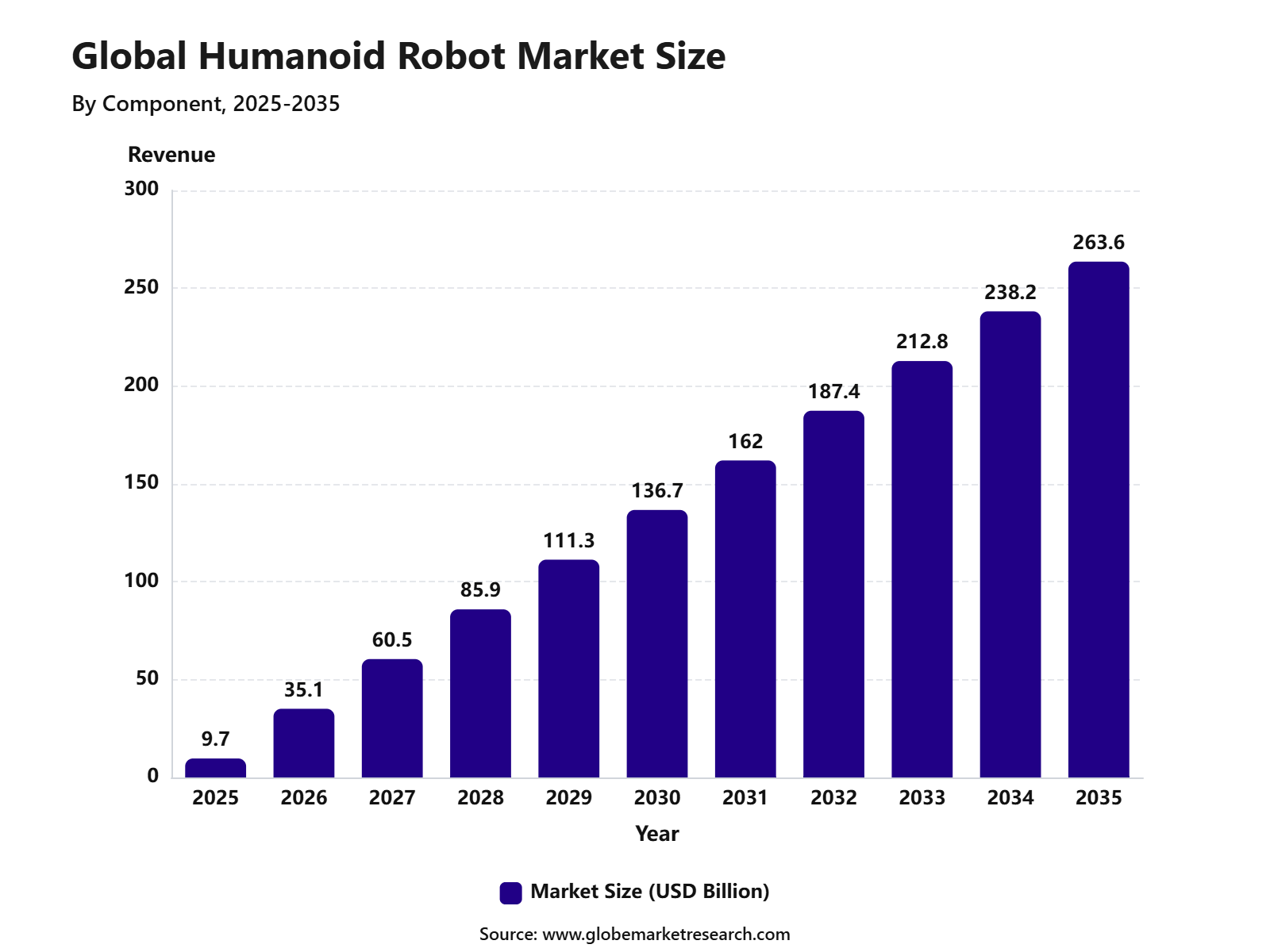 iThe graph shows projected market growth until 2035 based on CAGR analysis. Actual outcomes may vary depending on changing demand, competition, and economic factors.To gain greater insights - request a sample report PDF
Key Market Insights
Wheeled humanoid robots led the product segment with 44.6% share, supported by easier mobility, lower balance-control complexity, and strong use in service, retail, hospitality, and facility assistance applications.
Actuators accounted for 60.2% share by component, driven by their critical role in movement control, joint motion, grip strength, walking support, and human-like robotic actions.
Retail captured 28.3% share by application, supported by growing use of humanoid robots for customer assistance, product guidance, store navigation, queue support, and brand engagement.
Asia Pacific led the humanoid robot market with 44.6% share, supported by strong robotics manufacturing, high automation adoption, technology investment, and rising deployment across retail, healthcare, and public service settings.
Go-to-Market and Sales Strategy
The Humanoid Robot Market needs a task-led go-to-market strategy because buyers are not purchasing robots for novelty. They are looking for machines that can perform repetitive, unsafe, physically tiring, or labor-constrained tasks in factories, warehouses, logistics centers, retail stores, and service environments. The strongest early use cases are box handling, parts movement, machine tending, kitting, inspection, shelf stocking, and basic warehouse operations.
IFR stated in its 2026 robotics trends that humanoid robots are gaining attention for industrial use where flexibility is needed in environments designed for humans. Sales economics are still developing because humanoid robots require hardware, AI models, sensors, actuators, batteries, safety systems, maintenance, teleoperation support, and customer training.
The strongest sales model is likely to be robot-as-a-service, leasing, pilot-to-scale contracts, and long-term service agreements rather than one-time hardware sales. Apptronik raised USD 520 million in 2026 to scale its Apollo humanoid robot, expand production, grow its workforce beyond 300 employees, and support commercial agreements with Mercedes-Benz and GXO Logistics. This shows that investors are funding commercialization, but customer adoption still depends on proven reliability and clear payback.
Revenue Potential Analysis
Revenue Landscape Across
The revenue landscape is expected to develop first across manufacturing, automotive plants, warehouses, logistics centers, electronics assembly, industrial inspection, retail operations, and facility services. These sectors have repetitive work, labor gaps, safety risks, and existing automation budgets. Schaeffler and Humanoid announced plans to deploy 1,000 to 2,000 humanoid robots at Schaeffler’s global manufacturing sites by 2032, with initial deployment planned from December 2026 to June 2027 at two German locations.
China is also becoming a major demand and supply center for humanoid robotics. IFR reported in May 2026 that China placed robotics at the center of its 15th Five-Year Plan and already had an industrial robot operational stock of around 2 million units, about 4.5 times larger than Japan’s. China’s Ministry of Commerce also announced 17 measures in June 2026 to promote AI integration into product and service consumption, including development of a market for humanoid robots.
Financial Impact
The financial impact can be positive for companies that provide complete humanoid robot systems, including hardware, AI software, safety validation, fleet management, maintenance, data training, and customer support. Revenue can be generated from robot sales, leasing, robot-as-a-service contracts, integration fees, replacement parts, software subscriptions, and performance-based service agreements. Nvidia also stated in June 2026 that it plans to work with humanoid robot makers in the U.S., Europe, South Korea, and China, showing that chip and AI-platform companies are preparing for a wider physical AI ecosystem.
Financial risk remains high because humanoid robots are expensive to build, hard to scale, and dependent on advanced components such as actuators, sensors, batteries, AI chips, and precision mechanics. Tesla’s Optimus program is still being positioned around internal factory and future general-purpose use, with Reuters reporting in January 2026 that output would start "agonizingly slow" before ramping later. For humanoid robot suppliers, stronger financial results will depend on moving from pilot projects to repeatable deployments, reducing unit cost, improving uptime, and proving measurable productivity gains for customers.
Motion Type Analysis
Wheeled humanoid robots led the Humanoid Robot Market with 44.6% share, supported by their stability, lower mobility complexity, and suitability for indoor service environments. These robots are widely used in retail stores, airports, hospitals, hotels, offices, museums, and public service areas where smooth floor movement is more important than complex walking ability. The growth of this segment can be attributed to easier deployment and lower operating risk compared with fully bipedal humanoid robots.
Wheeled humanoid robots can perform customer interaction, guidance, information support, delivery assistance, and basic operational tasks with better balance and longer operating time. Demand is expected to remain strong as businesses look for robots that are practical, safe, and cost-effective for real-world service tasks. The segment is likely to benefit from improvements in navigation, voice interaction, facial recognition, battery life, and AI-based decision support.
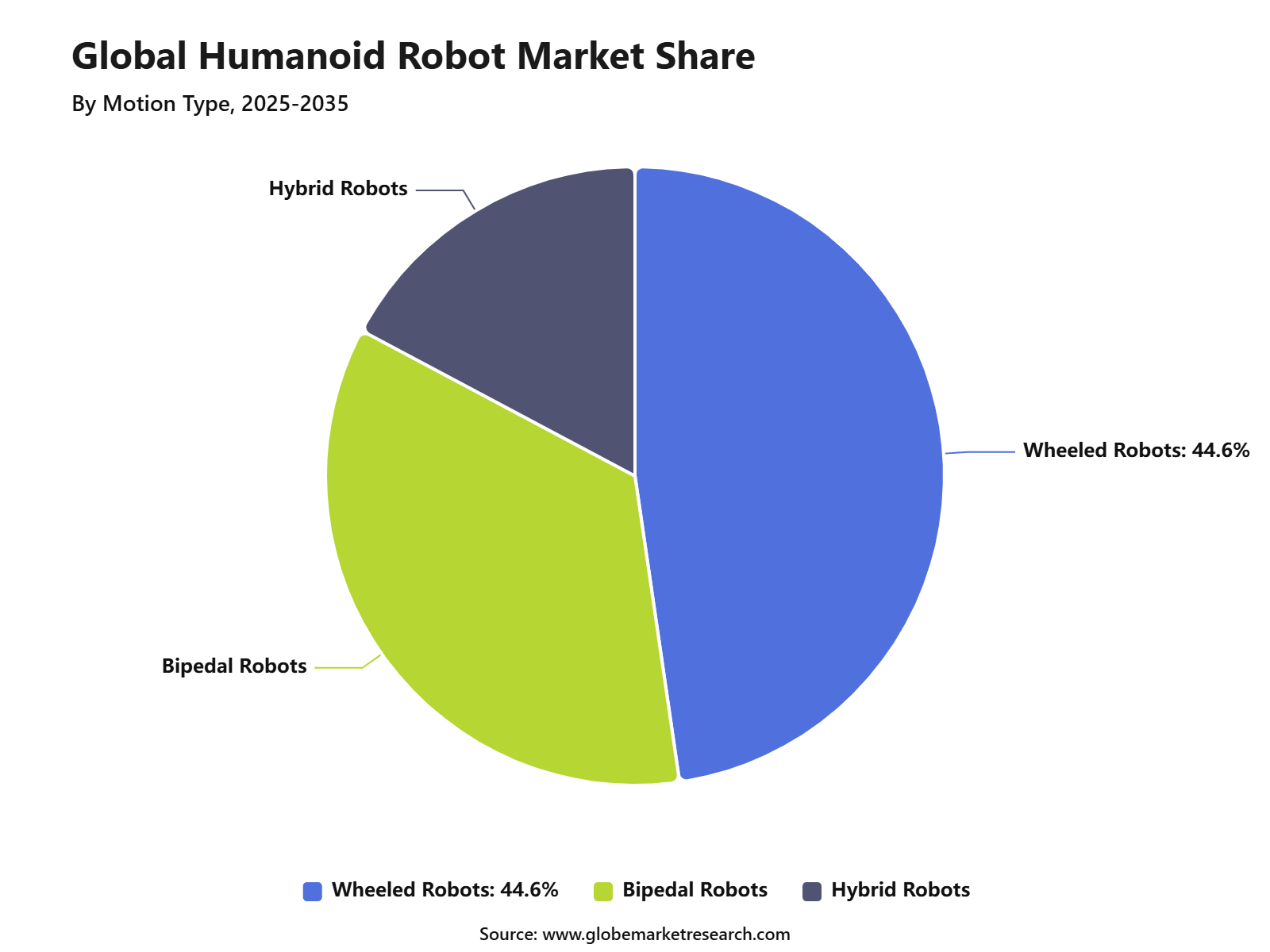 iThe graph shows projected market growth until 2035 based on CAGR analysis. Actual outcomes may vary depending on changing demand, competition, and economic factors.To gain greater insights - request a sample report PDF
Component Analysis
Actuators accounted for 60.2% share of the Humanoid Robot Market, making them the leading component segment. Actuators are essential because they allow humanoid robots to move arms, hands, heads, wheels, legs, joints, and other mechanical systems with controlled motion. The segment is supported by the need for precise movement, smooth interaction, and reliable physical performance.
Humanoid robots require advanced actuators to support gestures, object handling, mobility, balance, and task execution in human-centered environments. Actuators are expected to remain a major cost and performance driver in humanoid robots. Growth opportunities are likely to be seen in compact actuators, torque-dense motors, lightweight motion systems, energy-efficient movement units, and safer actuation systems for human-robot interaction.
Application Analysis
Retail led the application segment with 28.3% share, supported by rising use of humanoid robots for customer greeting, product guidance, inventory assistance, queue support, in-store navigation, and promotional engagement. Retailers are adopting humanoid robots to improve customer experience and support store-level automation. The growth of this segment can be linked to labor shortages, rising service expectations, and the need for more interactive shopping experiences.
Humanoid robots can answer basic questions, guide shoppers to product locations, collect customer feedback, and support brand engagement inside stores. Retail adoption is expected to increase as robots become more conversational, multilingual, and connected with store systems. Demand is likely to grow in supermarkets, electronics stores, shopping malls, fashion outlets, airports, and large-format retail environments.
Regional Analysis
Asia Pacific led the Humanoid Robot Market with 44.6% share, supported by strong robotics manufacturing, government support, advanced electronics supply chains, and high investment in automation. China, Japan, South Korea, and India are important contributors due to their strong technology base and growing interest in service and industrial robotics. The region’s leadership is supported by rapid development in AI, sensors, actuators, battery systems, and robot manufacturing.
China is especially important because its humanoid robot industry is moving toward mass production, while Japan and South Korea continue to support robotics adoption in service, healthcare, retail, and industrial settings. Asia Pacific is expected to remain the leading market as humanoid robots shift from pilot use to wider commercial deployment. Future opportunities are likely to be seen in retail robots, hospitality robots, factory support robots, elderly care assistance, public service robots, and AI-enabled human interaction systems.
 iThe graph shows projected market growth until 2035 based on CAGR analysis. Actual outcomes may vary depending on changing demand, competition, and economic factors.To gain greater insights - request a sample report PDF
Regional Impact Analysis
Impact Factor | Estimated CAGR Impact | Regional Relevance | Market Impact |
|---|---|---|---|
Asia Pacific market leadership | +10.8% | China, Japan, South Korea, India | Drives volume adoption. |
North America AI robotics innovation | +9.2% | U.S. and Canada | Supports advanced development. |
Europe industrial automation demand | +7.8% | Germany, France, UK, Italy | Strengthens factory use. |
Middle East service robot adoption | +5.4% | UAE, Saudi Arabia, Qatar | Supports hospitality use. |
Latin America emerging robotics demand | +3.8% | Brazil, Mexico, Chile | Builds gradual adoption. |
Risk Factors & Market Barriers
The main risk factor is technical reliability in real-world environments. Humanoid robots must walk or move safely, handle objects of different shapes, maintain balance, understand tasks, avoid humans, and operate for long periods without failure. Factory and warehouse buyers will not scale deployment unless robots can work safely across full shifts with limited human intervention. This creates a high barrier because demonstrations are easier than continuous commercial operation.
A second barrier is competition from simpler robot designs. Reuters reported in June 2026 that Genesis AI introduced Eno, a non-humanoid general-purpose robot with wheels and human-like hands, designed for manufacturing, logistics, laboratories, and later healthcare or hospitality. This matters because many customers may prefer wheeled robots if they are cheaper, safer, more energy efficient, and easier to maintain than full bipedal humanoids.
Regulatory & Compliance Risks
Regulatory risk is high because humanoid robots work close to people and may use AI, cameras, voice systems, biometric data, cloud software, and autonomous decision-making. Safety standards are becoming more important as robots move from cages into shared workspaces. ANSI and A3 published the revised R15.06-2025 industrial robot safety standard, which includes updated safety requirements, robot classifications, testing methods, and collaborative robot applications.
AI compliance is also becoming a key issue in Europe. The EU AI Act entered into force on August 1, 2024, and the European Commission states that it becomes fully applicable on August, 2026, with some exceptions. Humanoid robots used in safety-sensitive workplaces may face stronger requirements around risk management, human oversight, data governance, cybersecurity, transparency, and post-market monitoring.
Market Adoption Barriers
Market adoption is slowed by high upfront cost, uncertain payback, limited field data, worker safety concerns, and integration difficulty. Buyers need proof that humanoid robots can reduce downtime, improve throughput, handle labor shortages, and operate without damaging products or interrupting production. This is why early adoption is strongest in controlled industrial environments, where tasks can be clearly defined and tested before wider rollout.
Labor and workforce concerns may also affect adoption. Hyundai Motor Group plans to deploy Boston Dynamics Atlas humanoid robots at its U.S. factory from 2028, starting with parts sequencing and expanding toward more complex tasks by 2030. Hyundai also stated that people will still be needed to maintain and train robots, which shows that adoption is likely to reshape work roles rather than simply replace all workers at once.
Segment Covered in the Report
By Component
Actuators
Sensors
By Motion Type
Bipedal Humanoid Robots
Upper-Body Humanoid Robots
Wheeled Humanoid Robots
By Application
Underwater Systems
Military and Defense
Construction
Healthcare
Hospitality
Education and Scientific Research
Residential
Retail
Others
By Region
North America
Europe
Asia Pacific
Latin America
Middle East and Africa
Drivers Impact Analysis
Impact Factor | Estimated CAGR Impact | Regional Relevance | Market Impact |
|---|---|---|---|
Rising labor automation demand | +10.2% | North America, Europe, Asia Pacific | Reduces manual workload. |
Growth in AI and robotics integration | +9.6% | U.S., China, Japan, South Korea | Improves robot intelligence. |
Increasing use in manufacturing and logistics | +8.7% | Asia Pacific, North America, Europe | Supports industrial automation. |
Demand for service robots in healthcare and retail | +7.9% | U.S., Europe, Japan, China | Expands service applications. |
Advancements in sensors and motion control | +7.2% | Global robotics hubs | Improves robot performance. |
Restraints Impact Analysis
Impact Factor | Estimated CAGR Impact | Regional Relevance | Market Impact |
|---|---|---|---|
High development and purchase cost | -5.0% | SMEs and emerging markets | Limits early adoption. |
Complex hardware and software integration | -4.5% | Global | Slows commercialization. |
Limited battery life and mobility constraints | -4.0% | Industrial and service settings | Affects operating time. |
Safety concerns around human interaction | -3.6% | Healthcare, homes, public spaces | Raises deployment caution. |
Lack of skilled robotics workforce | -3.2% | Global | Slows scaling. |
Opportunities Impact Analysis
Impact Factor | Estimated CAGR Impact | Regional Relevance | Market Impact |
|---|---|---|---|
Expansion in industrial automation | +9.8% | China, Japan, Germany, U.S. | Drives large-scale deployment. |
Growth in elderly care and assisted living | +8.6% | Japan, Europe, North America | Supports care applications. |
Use in warehouse and fulfillment centers | +8.1% | U.S., China, Europe, India | Improves logistics productivity. |
Humanoid robots for retail and hospitality | +7.4% | Asia Pacific, Middle East, Europe | Enhances customer service. |
Robotics-as-a-service models | +6.8% | North America, Europe, Asia Pacific | Lowers adoption barriers. |
Challenges Impact Analysis
Impact Factor | Estimated CAGR Impact | Regional Relevance | Market Impact |
|---|---|---|---|
Achieving reliable human-like movement | -4.7% | Global robotics developers | Raises engineering difficulty. |
Real-world safety validation | -4.2% | Healthcare, homes, factories | Extends testing cycles. |
Public acceptance and trust issues | -3.7% | Consumer and service markets | Slows mass adoption. |
High maintenance and repair needs | -3.3% | Commercial users | Increases ownership cost. |
Regulatory uncertainty for autonomous robots | -3.0% | U.S., Europe, Asia Pacific | Delays market rollout. |
Recent Developments
January 2026, Boston Dynamics unveiled the product version of its new Atlas humanoid robot and said manufacturing would begin immediately. The company scheduled 2026 deployments with Hyundai and Google DeepMind, with additional customers expected later. Atlas is being trained with AI foundation models for industrial tasks, beginning with automotive-sector use cases.
January 2026, Hyundai Motor Group announced its AI Robotics Strategy at CES 2026 and confirmed that Boston Dynamics’ Atlas would be deployed at Hyundai Motor Group Metaplant America by 2028 for sequencing tasks. Reuters reported that Hyundai plans to manufacture 30,000 Atlas humanoid robots per year and gradually expand use from parts sequencing to component assembly and more complex operations by 2030.
Report Scope
Report Highlights | Details |
|---|---|
Market Revenue (2025) | USD 9.7 Billion |
Forecast Revenue (2035) | USD 263.6 Billion |
CAGR (2025-2035) | 39.1% |
Base Year for Estimation | 2025 |
Historic Data | 2020-2024 |
Forecast Period | 2025-2035 |
Report Coverage | AI market impact analysis, market surveys, trade analysis, Industry & competitive intelligence, Revenue projections, company positioning, competitive analysis, growth drivers, and emerging market trends, Strategic Consultation & Advisory Services |
Segments Covered | By Component (Actuators, Sensors), By Motion Type (Bipedal Humanoid Robots, Upper-Body Humanoid Robots, Wheeled Humanoid Robots), By Application (Underwater Systems, Military and Defense, Construction, Healthcare, Hospitality, Education and Scientific Research, Residential, Retail, Others), By Regional Insights |
Regional Analysis | North America - US, Canada; Europe - Germany, France, The UK, Spain, Italy, Russia, Netherlands, Rest of Europe; Asia Pacific - China, Japan, South Korea, India, New Zealand, Singapore, Thailand, Vietnam, Rest of Latin America; Latin America - Brazil, Mexico, Rest of Latin America; Middle East & Africa - South Africa, Saudi Arabia, UAE, Rest of MEA |
Key companies profiled | UBTech Robotics Corp Ltd., Unitree Robotics, Agility Robotics, Inc., Fourier Intelligence Co., Ltd., SoftBank Robotics Group Corp., PAL Robotics, Figure AI, Honda Motor Co., Ltd., Toyota Motor Corporation, Boston Dynamics, Hanson Robotics, Sanctuary Cognitive Systems Corporation, NVIDIA Corporation, Tokyo Robotics Inc. and Other Key Players |
Customization Scope | Tailored insights for specific regions, countries, and market segments can be provided. Additional report customization is available upon request. |
Competitive Landscape
The market is characterized by intense competition among established players and emerging companies. Strategic partnerships, mergers and acquisitions, and product innovation are key strategies employed by market participants.
Key Market Players
UBTech Robotics Corp Ltd.
Unitree Robotics
Agility Robotics, Inc.
Fourier Intelligence Co., Ltd.
SoftBank Robotics Group Corp.
PAL Robotics
Figure AI
Honda Motor Co., Ltd.
Toyota Motor Corporation
Boston Dynamics
Sanctuary Cognitive Systems Corporation
NVIDIA Corporation
Other Key Players
Meet the Team
This report was prepared by our expert analysts with deep industry knowledge and research experience.
Pratiksha is market research analyst with strong experience in industry research, market forecasting, and competitive analysis. She specializes in identifying market trends, evaluating growth opportunities, and preparing data-driven insights across global industries. Her work supports businesses in understanding market dynamics, customer demand, regional opportunities, and strategic investment areas.
Sayali brings more than 5 years of experience to Globe Market Research, supporting the accuracy, clarity, and relevance of research content across multiple industries. She reviews market data, segment analysis, competitive insights, and industry trends to ensure each report meets strong quality standards and provides practical value to business decision-makers. Her expertise spans healthcare, information technology, consumer goods, and diverse cross-industry domains. With a strong focus on data reliability, structured analysis, and clear presentation, Sayali helps ensure that each research output delivers well-reviewed insights for clients, investors, consultants, and industry stakeholders.
Frequently Asked Questions
Related Reports
More in Smart Technologies
Digital Travel Market Size to hit USD 3,075.6 billion by 2035
Global Digital Travel Market Size, Go-to-Market Strategy Analysis By Booking Type (Transportation Booking, Accommodation Booking, Vacation Packages, Activities and Experiences, Others), By Platform (Desktop, Mobile Application, Tablet), By Tour Type (International Travel, Domestic Travel), By Consumer Orientation (Women, Men), By Age Group (Below 21 Years, 22-31 Years, 32-43 Years, Above 43 Years), By Regional Insights, Business plan and Project Report, Investment Opportunities, Profitability, Industry Trends, Leading Companies and Growth Forecasts By 2025-2035
Comic Book Subscription Service Market to hit USD 7.8 Bn by 2035
Global Comic Book Subscription Service Market By Subscription Type (Digital Subscription, Physical Subscription, Hybrid Subscription), By Content Type (Superhero Comics, Manga,Indie Comics, Graphic Novels), By Target Audience (Children, Teens, Adults, Collectors), By Pricing Model (Monthly Subscription, Annual Subscription, Pay-Per-Comic), By Regional Insights, Leading Companies and Growth Forecasts By 2025-2035
Esports Market to Surpass USD 84.0 Billion by 2035
Global Esports Market By Revenue Model (Sponsorship, Advertising, Media Rights, Merchandise & Tickets, Publisher Fees, Others), By Platform (PC-Based Esports, Mobile & Tablet Esports, Console-Based Esports), By Streaming Type (Live Streaming, Video-on-Demand), By Audience Type (Casual Viewers, Esports Enthusiasts, Professional Players, Amateur Players), By End User (Game Publishers, Tournament Organizers, Esports Teams, Streaming Platforms, Advertisers & Sponsors, Fans), By Regional Insights, Leading Companies and Growth Forecasts By 2025-2035
Virtual Tour Market to Exceed USD 308.2 Billion by 2035
Global Virtual Tour Market By Component (Software, Hardware, Services), By Technology (Semi & Fully Immersive, Non-Immersive), By Type (360-Degree Video, 3D Virtual Tours, Interactive Virtual Tours), By Application (Real Estate, Tourism & Hospitality, Art Galleries & Museums, Education, Retail, Others), By Platform / Deployment (Cloud-Based, On-Premise), By Regional Insights, Leading Companies and Growth Forecasts By 2025-2035