

Revenue, 2025
$6.5 Bn
Forecast, 2035
$84.9 Bn
CAGR, 2025-2035
29.3%
Report Coverage
Italy
Market Size and Forecast
The Italy Applied AI Market was worth USD 6.5 billion in 2025 and is expected to reach USD 84.9 billion by 2035, growing at a CAGR of 29.3% from 2025 to 2035. The market growth is supported by rising AI adoption across manufacturing, finance, healthcare , retail, public services, and logistics, along with stronger use of automation, predictive analytics, and intelligent software systems.
The Italy Applied AI Market includes artificial intelligence solutions used to improve business operations, customer experience, decision-making, production efficiency, and service delivery. These solutions include machine learning, natural language processing, computer vision, generative AI , robotic process automation, predictive maintenance, fraud detection, and AI-enabled analytics platforms. The market is closely linked with digital transformation, Industry 4.0, smart factories, cloud computing, and enterprise software adoption.
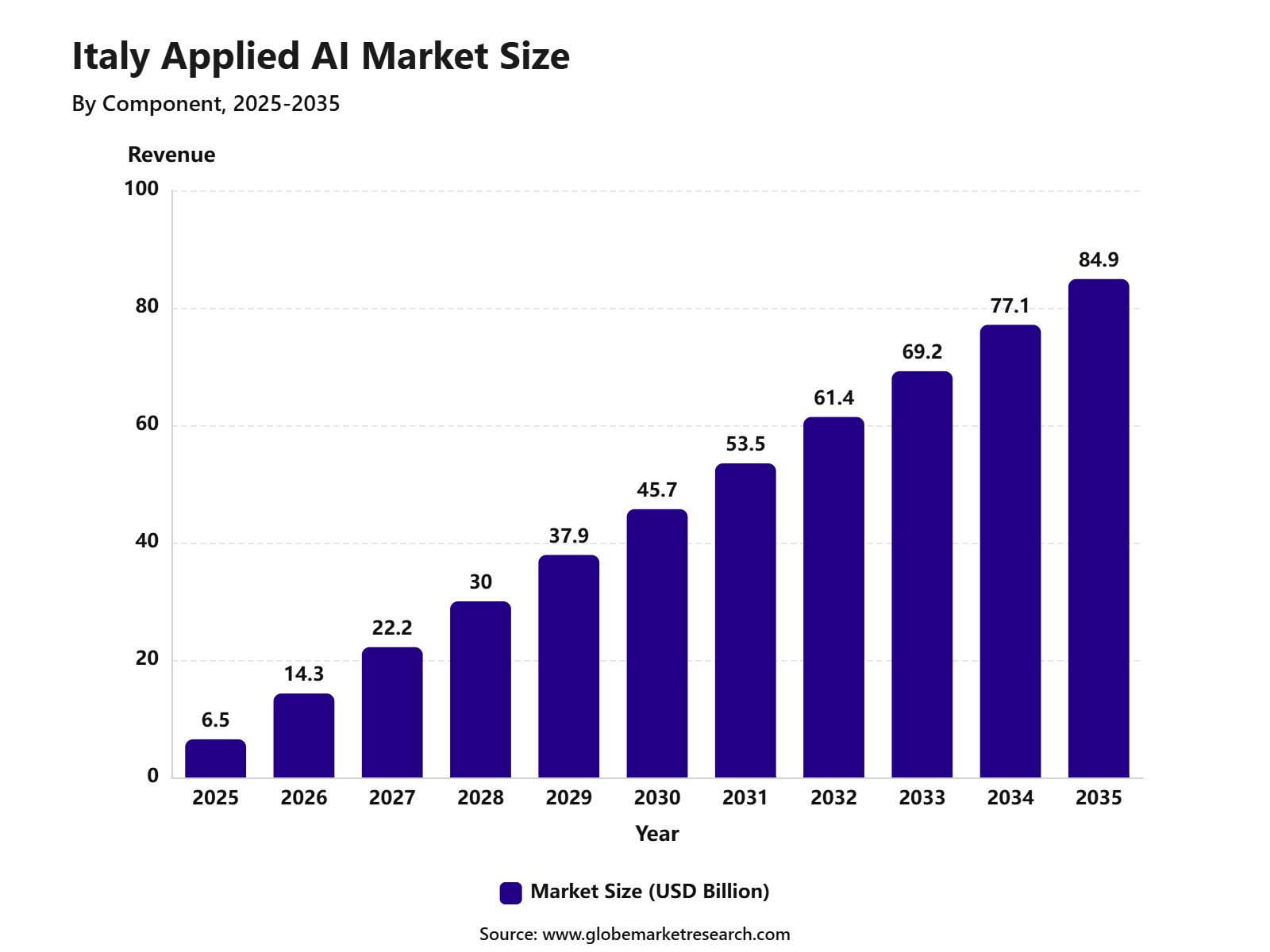 iThe graph shows projected market growth until 2035 based on CAGR analysis. Actual outcomes may vary depending on changing demand, competition, and economic factors.To gain greater insights - request a sample report PDF
The market outlook remains strong as Italian companies continue to invest in AI for productivity improvement, cost control, and better operational accuracy. Growth can be attributed to wider use of AI in industrial automation, financial services, medical diagnostics, supply chain planning, and customer support. The expansion of cloud-based AI platforms, data infrastructure, and sector-specific AI applications is expected to support long-term market growth.
Report Highlights | Details |
|---|---|
Market Revenue (2025) | USD 6.5 billion |
Forecast Revenue (2035) | USD 84.9 billion |
CAGR (2025-2035) | 29.3% |
Base Year for Estimation | 2025 |
Historic Data | 2020-2024 |
Forecast Period | 2025-2035 |
Key Market Insights
Software led the component segment with 70.6% share, supported by growing use of AI platforms, analytics tools, automation software, and industry-specific AI solutions.
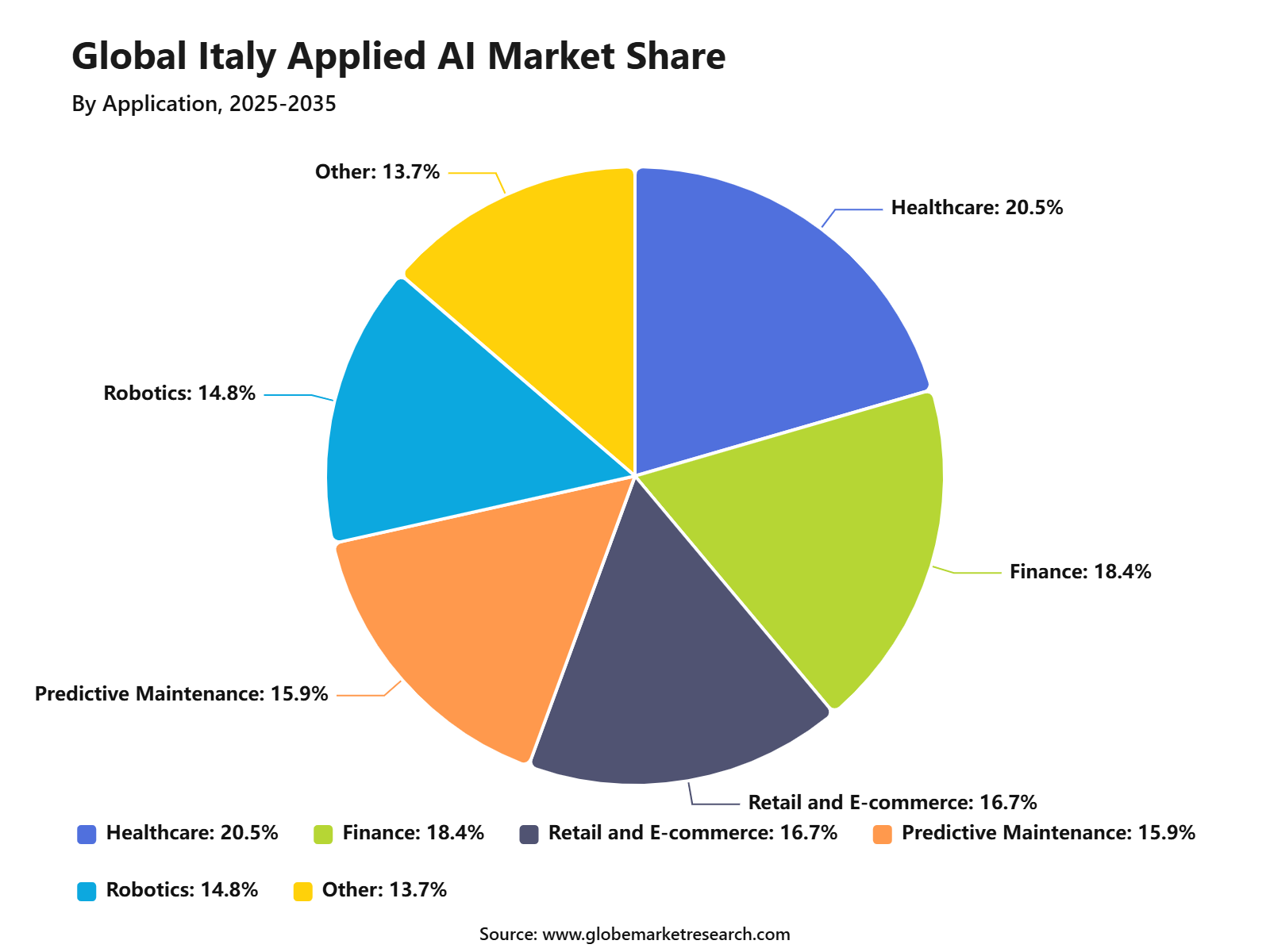
Healthcare accounted for 20.5% share by application, driven by rising AI use in diagnostics, patient monitoring, medical imaging, and clinical decision support.
Small and medium enterprises held 57.1% share by organization size, supported by wider access to affordable AI tools, cloud-based platforms, and automation solutions for business operations.
Adoption and Usage Statistics
Based on data from ISTAT, Italy’s applied AI market is gaining stronger business adoption, although usage remains at an early-to-mid stage. In 2025, 16.4% of Italian enterprises with at least 10 employees used at least one AI technology, rising from 8.2% in 2024 and 5.0% in 2023. Adoption was much higher among large enterprises at 53.1% , while SME usage stood at 15.7%. The North-West region recorded stronger adoption at 19.3% , showing that AI use is more concentrated in advanced industrial and service hubs.
AI usage in Italy is mainly driven by text-based and generative applications. Text extraction was the most used AI function at 70.8% , followed by generative AI at 59.1% and speech-to-text tools at 41.3%. Machine learning for data analysis accounted for 20.0% , while image recognition and workflow automation each stood at 18.0% . In business functions, AI was most used in marketing and sales at 33.1% , administrative processes at 25.7% , and R&D or innovation at 20.0% , indicating strong potential for wider applied AI adoption across Italian enterprises.
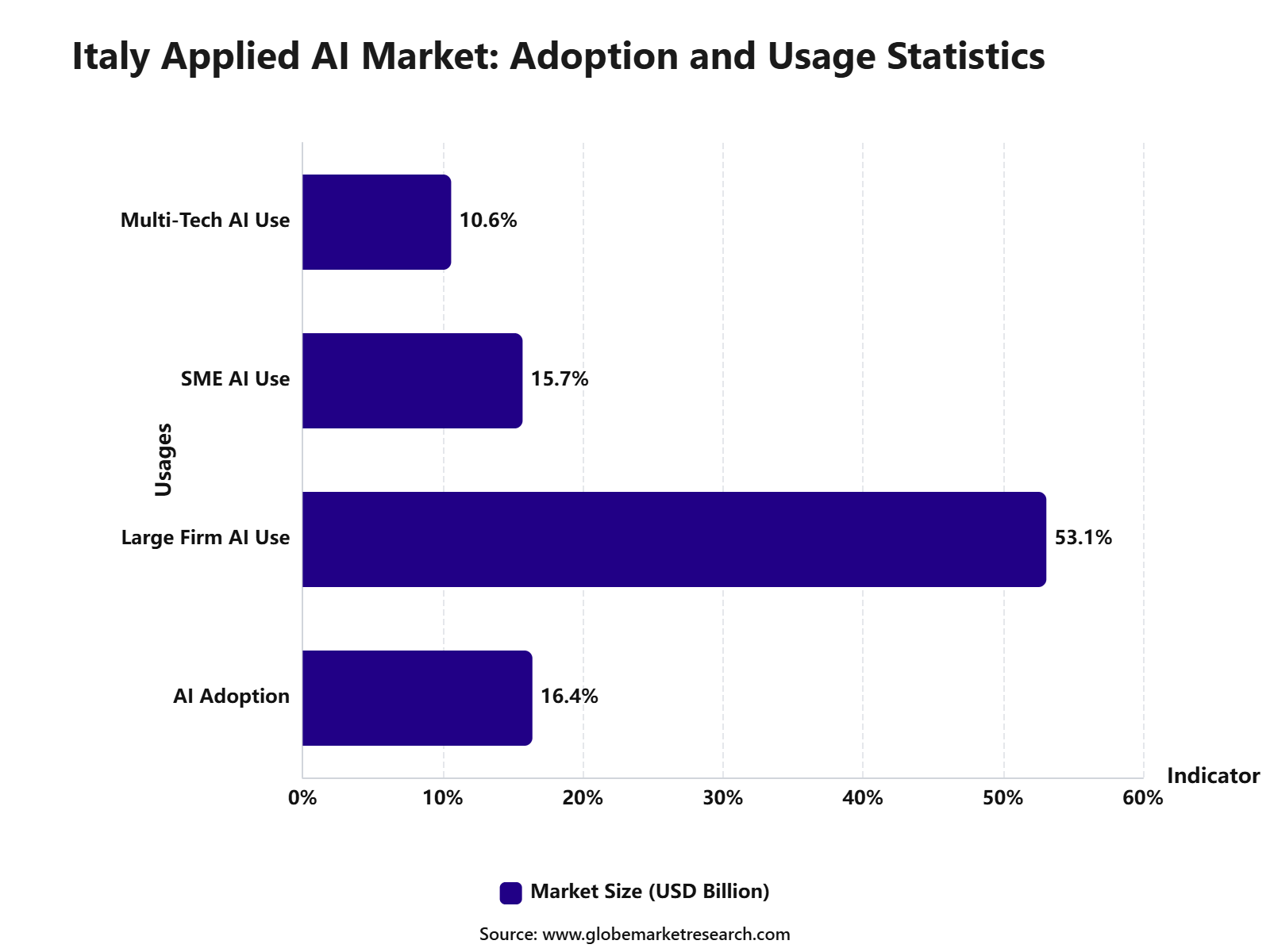 iThe graph shows projected market growth until 2035 based on CAGR analysis. Actual outcomes may vary depending on changing demand, competition, and economic factors.To gain greater insights - request a sample report PDF
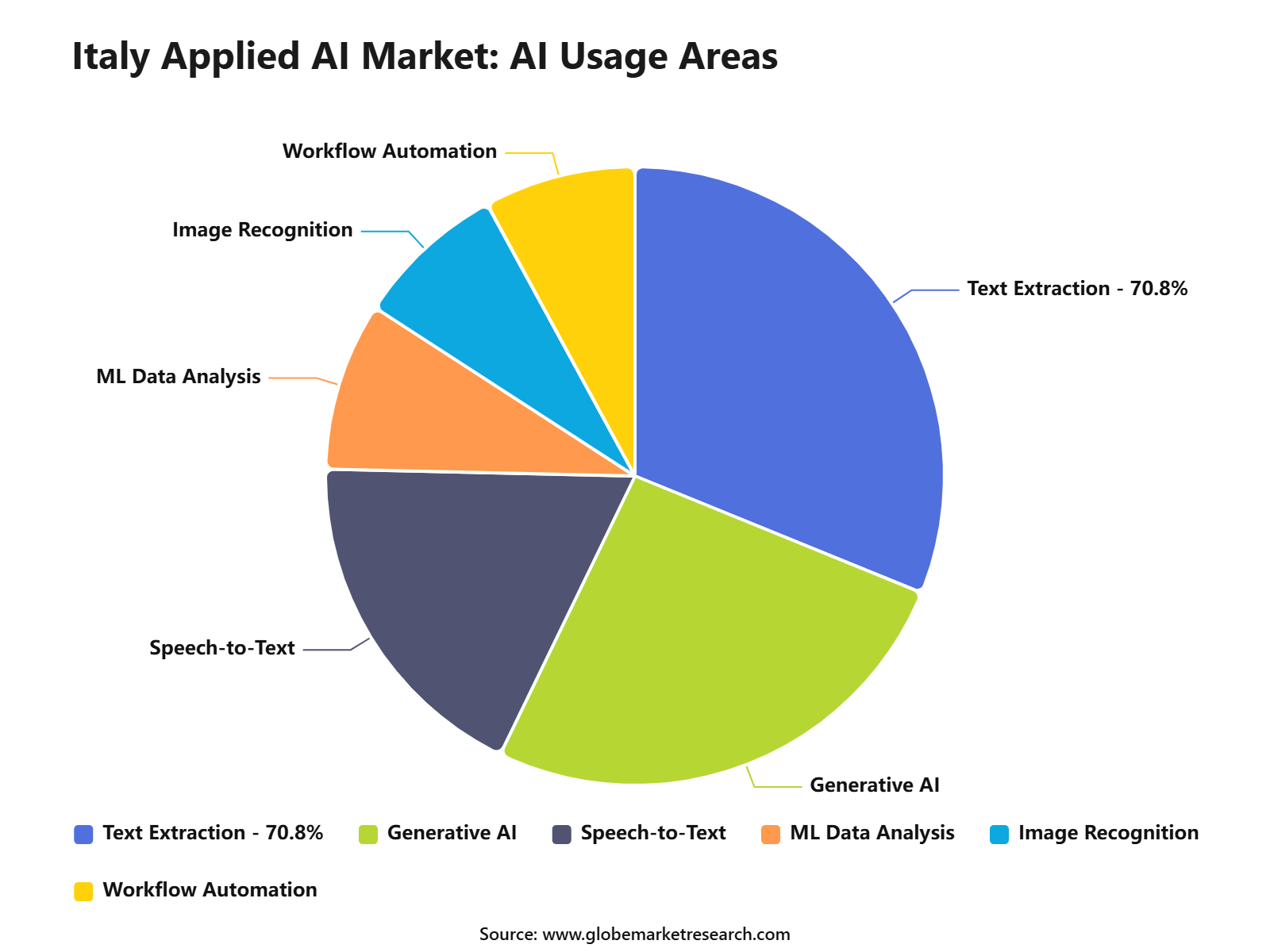 iThe graph shows projected market growth until 2035 based on CAGR analysis. Actual outcomes may vary depending on changing demand, competition, and economic factors.To gain greater insights - request a sample report PDF
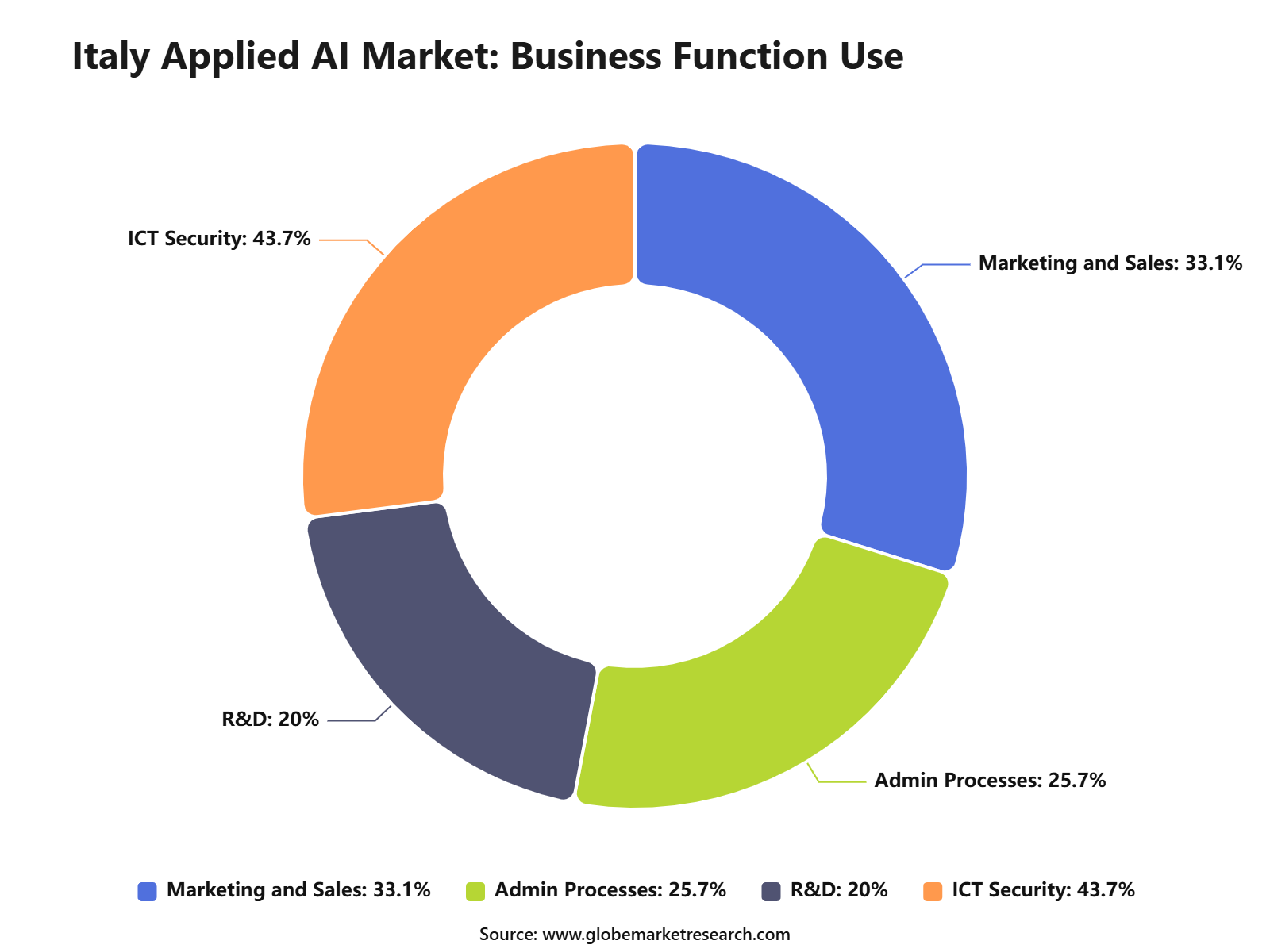 iThe graph shows projected market growth until 2035 based on CAGR analysis. Actual outcomes may vary depending on changing demand, competition, and economic factors.To gain greater insights - request a sample report PDF
By Component
Software led the component segment with 70.6% share, supported by wider use of AI platforms, generative AI tools, workflow automation systems, analytics software, and sector-specific applications. In Italy, applied AI adoption is being shaped more by software deployment than by hardware spending because companies are first using AI for text, images, documents, customer support, administration, and business intelligence.
The software segment is supported by Italy’s sharp increase in enterprise AI use. ISTAT data reported in 2025 showed that 16.4% of Italian firms with at least 10 employees used some form of AI, compared with much lower adoption in earlier years. The most common AI uses were text data extraction at 70.8% , generative AI for language and images at 59.1% , and speech-to-text technologies at 41.3%.
Software also benefits from the broader European shift toward AI-based business functions. Eurostat reported that in 2025, EU enterprises using AI commonly applied it to marketing or sales at 34.70% and business administration or management processes at 31.05% . These use cases are mainly software-led, which supports the strong position of software in Italy’s applied AI market.
By Application
Healthcare led the application segment with 20.5% share, supported by rising use of AI in diagnostics, clinical documentation, imaging, patient triage, workflow management, and digital health services. The segment is gaining attention because Italy’s healthcare system needs faster decision support, better data use, and improved care coordination across hospitals, clinics, and community health networks.
Healthcare adoption is supported by growing physician interest in AI. A 2026 national cross-sectional study of 587 Italian physicians found that 21.6% had used AI in clinical practice, while 81.9% were willing to integrate AI into their work. The same study reported that 93.5% of physicians were interested in receiving AI training, showing a strong base for future clinical adoption.
Digital health activity is also strengthening AI use in Italian healthcare. In 2025, Italy’s digital health data showed that 46% of general practitioners and 26% of specialists had used generative AI tools, while 41% of citizens actively used the Electronic Health Record. These figures show that AI adoption is moving into practical healthcare workflows, although governance, validation, and clinical safety remain important.
 iThe graph shows projected market growth until 2035 based on CAGR analysis. Actual outcomes may vary depending on changing demand, competition, and economic factors.To gain greater insights - request a sample report PDF
By Organization Size
Large Enterprises led the organization size segment with 53.5% share, supported by stronger budgets, larger data pools, and clearer internal capacity to deploy applied AI across departments. In Italy, larger enterprises are using AI for document processing, customer support, predictive analytics, cybersecurity, finance operations, manufacturing control, and business administration.
The segment is supported by a clear adoption gap between large companies and smaller firms. ISTAT-based reporting showed that 53.1% of Italian firms with more than 250 employees used AI in 2025, compared with 15.7% among smaller firms. This confirms why enterprises hold the stronger position in applied AI adoption, especially where IT teams, compliance systems, and structured datasets are already available.
Enterprise adoption is also supported by broader EU trends. Eurostat reported that 55.03% of large EU enterprises used AI in 2025, compared with 30.36% of medium enterprises and 17.0% of small enterprises. For Italy, this wider European pattern is relevant because large companies are better placed to invest in AI governance, cloud systems, model testing, employee training, and integration with existing business software.
Market Entry and Revenue Strategy
The go-to-market approach for the Italy Applied AI Market should focus on practical use cases that solve immediate business problems. Italian enterprise AI adoption doubled to 16.4% in 2025, which shows that demand is moving beyond early testing, but adoption is still not mature across the full productive system. This creates strong room for vendors offering applied AI for workflow automation, customer support, marketing, data analysis, compliance and operational planning.
Sales economics in Italy is strongly linked to the country’s SME base and uneven digital readiness. The European Commission reported that 70.2% of Italian SMEs had at least a basic level of digital intensity, while AI adoption remained much lower across enterprises. This means suppliers need simple pricing, guided onboarding, local-language support and clear return-on-investment measurement to convert smaller businesses.
The strongest sales opportunities are expected in sectors where applied AI can improve daily work without heavy infrastructure change. Italy’s national AI strategy for 2024 to 2026 focuses on research, public administration, enterprises and education, which supports wider use of AI in business services and public delivery. For vendors, this policy direction creates demand for compliant, secure and sector-specific AI systems.
Revenue Potential Analysis
Revenue Landscape Across
Revenue potential is strongest in sectors where AI is already moving from testing to operational use. In 2025, information and communication services led AI adoption in Italy at 51.3% , followed by professional, scientific and technical activities at 35.7%. By business function, marketing and sales accounted for 33.1% of AI use, administrative process organization stood at 25.7%, and research and development or innovation reached 20.0%.
The public sector and regulated industries are also becoming important revenue pools because Italy is moving toward clearer AI governance. Italy’s 2024-2026 AI strategy includes guidelines for AI adoption in public administration, better service delivery and ethical deployment. In 2025, Italy also moved ahead with national AI rules aligned with the EU AI Act, while policy support includes up to € 1 billion for AI, cybersecurity and related technology companies.
The broader digital funding environment supports long-term demand for applied AI platforms, data services and implementation partners. Italy’s Digital Decade roadmap includes 67 measures with a total budget of €62.3 billion , while €46.8 billion from the Recovery and Resilience Plan and €4.9 billion from Cohesion funds are linked to digital transformation. This improves revenue visibility for AI vendors serving enterprise modernization, public services, cloud migration, automation and digital skills programs.
Financial Impact
The financial impact of applied AI in Italy will be seen first in cost control, faster decision-making and productivity gains. Euro area survey data from 2025 showed that more than 70% of firms reported using AI, but only 7% used it intensively, which shows that the next value step is deeper integration rather than basic tool adoption. For Italy, this supports demand for AI systems that are embedded into workflows, not only used as standalone software.
AI investment is also becoming part of normal capital planning for European firms. The ECB reported that firms expected to allocate about 9% of total investment to AI over the next 12 months, with AI mainly used to improve business processes. This points to stronger sales potential for applied AI vendors that can connect pricing to measurable outcomes such as lower manual work, fewer process errors, faster reporting and improved customer conversion.
However, financial returns will depend on skills, data quality and implementation readiness. Italy had only 4% ICT specialists in total employment in 2024, and only 45.8% of the population had basic digital skills. These gaps may slow adoption, but they also create strong demand for managed AI services, training, system integration and compliance support, especially among SMEs and public-sector buyers.
Segment Covered in the Report
By Component
Software
Services
By Application
Healthcare
Finance
Retail and E-commerce
Predictive Maintenance
Industrial Robotics
Natural Language Processing
Energy and Utilities
Agriculture
Cybersecurity
Education
Entertainment and Media
Real Estate
Transportation and Logistics
Environmental Monitoring
Human Resources
Others
By Organization Size
Small and Medium Enterprise
Large Enterprise
Drivers Impact Analysis
Impact Factor | Estimated CAGR Impact | Regional Relevance | Market Impact |
|---|---|---|---|
Rising enterprise AI adoption | +7.6% | Northern and Central Italy | Drives digital transformation. |
Growth in AI-enabled healthcare solutions | +6.4% | Lombardy, Lazio, Emilia-Romagna | Improves clinical efficiency. |
Expansion of predictive maintenance | +5.5% | Industrial and manufacturing regions | Supports factory automation. |
Increasing AI use in finance and retail | +4.8% | Milan, Rome, Turin | Improves customer insights. |
Government support for digital innovation | +4.1% | National | Encourages AI deployment. |
Restraints Impact Analysis
Impact Factor | Estimated CAGR Impact | Regional Relevance | Market Impact |
|---|---|---|---|
Limited AI talent availability | -3.8% | Italy-wide | Slows project execution. |
High implementation cost for SMEs | -3.2% | Small and medium businesses | Limits adoption speed. |
Data privacy and compliance concerns | -2.7% | Healthcare, finance, public sector | Raises governance burden. |
Legacy IT infrastructure | -2.3% | Traditional industries | Delays integration. |
Low digital maturity among smaller firms | -1.9% | Southern Italy and rural regions | Creates adoption gaps. |
Opportunities Impact Analysis
Impact Factor | Estimated CAGR Impact | Regional Relevance | Market Impact |
|---|---|---|---|
AI adoption among SMEs | +6.9% | Italy-wide | Expands market base. |
Healthcare AI and diagnostics | +5.8% | Lombardy, Lazio, Veneto | Builds high-value demand. |
Industrial robotics and automation | +5.2% | Emilia-Romagna, Piedmont, Lombardy | Supports manufacturing strength. |
AI in retail and e-commerce | +4.4% | Urban consumer markets | Improves personalization. |
AI for public services | +3.7% | National and municipal bodies | Enhances service delivery. |
Challenges Impact Analysis
Impact Factor | Estimated CAGR Impact | Regional Relevance | Market Impact |
|---|---|---|---|
Building trusted AI governance | -3.4% | Regulated industries | Affects deployment confidence. |
Managing fragmented enterprise data | -2.9% | Manufacturing, retail, healthcare | Reduces model quality. |
Scaling pilot projects commercially | -2.5% | SMEs and mid-sized firms | Limits revenue conversion. |
Ensuring explainability in AI systems | -2.1% | Finance, healthcare, public sector | Raises compliance needs. |
Cybersecurity risks in AI platforms | -1.8% | Digital-first enterprises | Increases protection costs. |
Recent Developments
Market News
In June 2026, Italgas announced a EUR 13 billion investment plan through 2032, with stronger focus on artificial intelligence and digital infrastructure. The company raised its AI-driven productivity gain target to EUR 100 million , compared with the earlier target of EUR 70 million . This shows that applied AI in Italy is moving into core infrastructure operations, including smart meters, sensors, network efficiency, and predictive maintenance.
In September 2025, Italy passed a comprehensive artificial intelligence law, becoming the first EU country to align national AI rules with the EU AI Act. The law covers human oversight, transparency, privacy, cybersecurity, healthcare, work, education, justice, copyright, and deepfake misuse. It also assigned oversight roles to the Agency for Digital Italy and the National Cybersecurity Agency, while including a EUR 1 billion fund for AI and related technologies.
Mergers
Large pure-play AI mergers in Italy have remained limited in recent public announcements. The market is currently being shaped more by acquisitions, partnerships, and enterprise-level technology agreements than by full legal mergers between AI companies. This pattern reflects the early-stage structure of Italy’s applied AI ecosystem, where many firms are still scaling products for industry, finance, public sector, and infrastructure use.
In October 2025, Stellantis and Mistral AI expanded their AI partnership at Italian Tech Week in Turin. The initiative included an Innovation Lab for sales and aftersales use cases and a Transformation Academy for production-related AI applications. This reflects how applied AI partnerships are being used in Italy’s industrial base to improve manufacturing, customer service, and operational efficiency.
Acquisitions
In April 2026, Milan-based Domyn acquired 100% of Oròbix, an Italian AI company based in Bergamo. Oròbix brings expertise in computer vision, multimodal agents, and AI deployment across regulated and industrial sectors. The acquisition strengthens Domyn’s position in applied AI by combining language models with practical AI systems for manufacturing, agriculture, energy, infrastructure, and advanced operations.
In July 2025, expert.ai signed an agreement linked to the acquisition of 100% of ISED, a historic Italian technology company. The transaction was connected with a reserved capital increase of up to EUR 20 million. This is relevant to Italy’s applied AI market because expert.ai operates in natural language AI, enterprise automation, and knowledge processing, which are key applied AI use cases across regulated and document-heavy sectors.
Funding
Italy’s public AI funding base was strengthened in 2024 through CDP Venture Capital. The Italian state lender announced plans to invest EUR 1 billion over five years in AI and cybersecurity, including EUR 580 million for startups, EUR 300 million for companies ready to expand internationally, and EUR 120 million for technology transfer, mainly from university research. This funding structure is expected to support applied AI commercialization across enterprise software, cybersecurity, public services, and industrial automation.
Domyn, formerly iGenius, has become one of Italy’s most visible AI funding stories. Reuters reported in 2024 that the company was targeting EUR 650 million in new funding to support generative AI for financial services and the public sector. The company was also positioned above USD 1 billion valuation, showing that Italy is beginning to build AI companies with European-scale ambitions.
In 2026, Domyn continued to attract strategic backing from global financial and technology investors. Reuters noted that the company is backed by G42, Eurizon Capital, Rabobank, and BNY, while Rabobank separately announced a minority equity investment in Domyn in April 2026 to support sovereign AI adoption in financial services. This funding direction shows strong demand for Italian AI platforms designed for banks, public institutions, and other regulated sectors.
Competitive Landscape
The market is characterized by intense competition among established players and emerging companies. Strategic partnerships, mergers and acquisitions, and product innovation are key strategies employed by market participants.
Key Market Players
Microsoft
IBM
Amazon
NVIDIA
Salesforce
OpenAI
Baidu
SAP
Other Key Players
Research Methodology
This market study is prepared using a combination of primary and secondary research. Primary research includes discussions with manufacturers, suppliers, distributors, consultants, industry experts, and end users. Secondary research covers company reports, government databases, trade associations, technical publications, regulatory sources, and trusted industry documents. The collected information is used to assess market demand, pricing trends, technology adoption, competitive activity, and regional performance.
AI language models are not used as primary data sources, and publicly available AI-generated content is not treated as market evidence. Computational tools may be used to support data processing, translation, data classification, and pattern identification. However, every published assessment is supported by verified sources, human review, and primary market discussions.
Market estimates are developed through top-down and bottom-up approaches and validated using data triangulation. Revenue, production, shipment, pricing, and application-level data are compared across multiple sources. Forecasts consider economic conditions, regulatory changes, investment activity, innovation, supply chain developments, and industry risks. All findings are reviewed through source verification and internal quality checks before publication.
Part I
Source Management & Input Data Standards
Who provides data, how sources are qualified, and what types of evidence are admissible.
Part II
Research Scope & Market Coverage
How we define the markets we assess and the parameters that govern each product.
Part III
Data Collection, Verification & Submission
The mechanics of gathering, cross-checking, and hierarchically ranking evidence.
Part IV
Assessment Determination & Quality Controls
How raw data becomes a published assessment — normalisation, expert judgement, and outlier exclusion.
Part V
Publication, Corrections & Revision
Our publication schedule, corrections policy, and methodology review cycle.
Part VI
Independence, Ethics & Complaints
Conflict-of-interest policies, editorial independence, and how clients raise concerns.
Google · Preferred Sources
Don't miss the latest market research insights and industry updates on Google.
Add Globe Market Research as a preferred source in the Google app to see our reports, analysis, and market stories in your news suggestions.
Meet the Team
This report was prepared by our expert analysts with deep industry knowledge and research experience.
Pratiksha K. is a Senior Research Analyst with more than five years of experience in market research, industry analysis, competitive intelligence, and business strategy. She has contributed to detailed market reports, customized research studies, company profiling, market sizing, trend analysis, and strategic consulting projects for clients across different regions. Her industry expertise covers Chemical and Material, Consumer Goods, Food & Beverages and Energy & Power. She closely evaluates changing customer requirements, technology developments, regulatory conditions, supply chain structures, investment activity, and competitive strategies to provide clear and practical market insights.
Sayali brings more than 7 years of experience to Globe Market Research, supporting the accuracy, clarity, and relevance of research content across multiple industries. She reviews market data, segment analysis, competitive insights, and industry trends to ensure each report meets strong quality standards and provides practical value to business decision-makers. Her expertise spans healthcare, information technology, consumer goods, and diverse cross-industry domains. With a strong focus on data reliability, structured analysis, and clear presentation, Sayali helps ensure that each research output delivers well-reviewed insights for clients, investors, consultants, and industry stakeholders.
Frequently Asked Questions
Related Reports
More in Information and Technology
Physical AI Market Size to hit USD 2,129.0 billion by 2035
Physical AI Market Size, Share, Trends and Growth Analysis Report By Component (Hardware, Software, Services), By Technology (Computer Vision, Machine Learning and Deep Learning, Natural Language Processing, Edge AI, Other Technologies), By Product (Robots, Exoskeletons, Autonomous Systems, Smart Appliances), By Application (Automation and Manufacturing, Logistics and Supply Chain, Healthcare, Automotive, Defense and Security, Retail, Education, Other End Uses), By Regional Insights, Technology Trends, Competitive Landscape, Strategic Opportunities and Growth Forecast, 2026-2035
Edtech SaaS Tools Market Size to hit USD 217.6 billion by 2035
EdTech SaaS Tools Market Size, Share, Trends and Growth Analysis Report By Software (Classroom Management Systems, Document Management Systems, Learning and Gamification Platforms, Learning Management Systems, Student Collaboration Systems, Assessment and Analytics Tools, Content Authoring Tools, Other Software), By Sector (Preschool, K-12, Higher Education, Other Education Sectors), By Deployment (Cloud-Based, Hybrid), By End Use (Businesses, Educational Institutions, Individual Learners and Consumers), By Regional Insights, Technology Trends, Competitive Landscape, Strategic Opportunities and Growth Forecast, 2026–2035
Marketing Technology Market Size to Reach USD 3,810.8 billion by 2035
Marketing Technology Market Size, Share, Trends and Growth Analysis Report By Marketing Type (Digital Marketing, Offline Marketing), By Product (Social Media Tools, Content Marketing Tools, Rich Media Tools, Marketing Automation Tools, Data and Analytics Tools, Sales Enablement Tools), By Deployment (Cloud-Based, On-Premises, Other Deployment Models), By Enterprise Type (Large Enterprises, Small and Medium-Sized Enterprises), By Application (IT and Telecommunication, Retail and E-commerce, Healthcare, Media and Entertainment, Sports and Events, BFSI, Real Estate, Other Applications), By Regional Insights, Technology Trends, Competitive Landscape, Strategic Opportunities and Growth Forecast, 2026-2035
AI Watermarking Market Size to hit USD 10.9 billion by 2035
AI Watermarking Market Size, Share, Trends and Growth Analysis Report By Type (Invisible Watermarking, Visible Watermarking), By Technology (Non-Reversible Watermarking, Reversible Watermarking), By Deployment (Cloud, On-Premises), By Application (Copyright Protection, Authentication and Security, Branding and Marketing, Other Applications), By Content Type (Video, Image, Model Watermarking, Audio, Text), By End Use (Media and Entertainment, BFSI, Healthcare, Government and Defense, Retail and E-commerce, Other End-Use Industries), By Regional Insights, Technology Trends, Regulatory Landscape, Competitive Analysis, Strategic Opportunities and Growth Forecast, 2026-2035