
Revenue, 2026
USD 0.9 Bn
Forecast, 2035
USD 11.6 Bn
CAGR, 2026-2035
32.9%
Report Coverage
Japan
Market Size and Forecast
AI data centers are specialised facilities equipped with high-performance GPUs, CPUs, networking systems, storage platforms and advanced cooling infrastructure for artificial intelligence workloads. These facilities support AI model training, inference, natural language processing, computer vision, robotics and large-scale data analytics. In Japan, demand is being strengthened by enterprise digitalisation, sovereign AI requirements, cloud adoption and the need to process sensitive industrial and consumer data within the country.
According to Globe Market Research, The Japan AI Data Center Market was valued at USD 0.9 billion in 2026 and is projected to reach approximately USD 11.64 billion by 2035, growing at a CAGR of 32.9% from 2026 to 2035. Expansion is being supported by investment in hyperscale infrastructure, high-density computing, liquid cooling and renewable power integration. Demand is particularly strong across the IT and telecommunications, manufacturing, financial services, healthcare, automotive and government sectors, where AI models require secure and low-latency computing capacity.
Key Parameter | Report Details |
|---|---|
Market Revenue, 2026 | USD 0.9 Billion |
Projected Revenue, 2035 | USD 11.64 Billion |
CAGR, 2026-2035 | 32.9% |
Country Scope | Japan |
Market Concentration | Medium |
Base Year | 2025 |
Forecast Period | 2026-2035 |
Infrastructure deployment accelerated further in January 2026 when KDDI commenced operations at the Osaka Sakai Data Center, offering GPU infrastructure and on-premises access to Google’s Gemini models for sectors including pharmaceuticals and manufacturing. Japan’s Ministry of Economy, Trade and Industry has identified rising AI use and communications traffic as major drivers of data-center demand and has introduced coordinated planning between electricity and communications infrastructure.
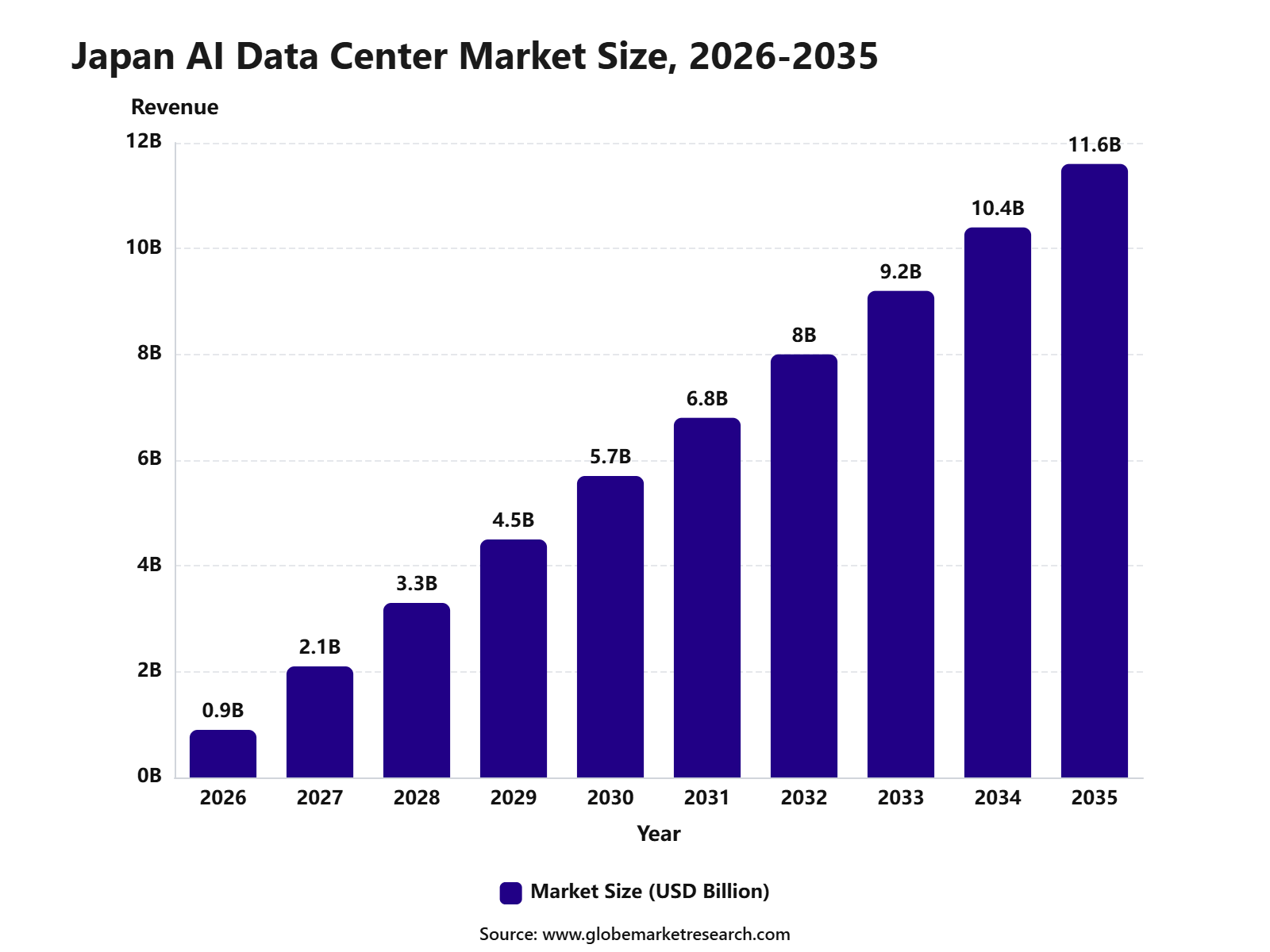 iThe graph shows projected market growth until 2035 based on CAGR analysis. Actual outcomes may vary depending on changing demand, competition, and economic factors.To gain greater insights - request a sample report PDF
Key Market Insights
The global AI Data Center Market size was valued at USD 19.6 billion in 2025 and is projected to grow from USD 43.9 billion in 2026 to USD 262.7 billion by 2035, registering a CAGR of 29.6% from 2025 to 2035. North America dominated the market with a revenue share of 41% in 2025.
Hardware led the component segment with 74.3% share, supported by strong demand for AI servers, GPUs, accelerators, storage systems, networking equipment, and power infrastructure.
Cloud-based deployment accounted for 60.4% share, driven by scalable AI computing needs, faster workload deployment, and rising enterprise use of hosted AI infrastructure.
Hyperscale data centers held 48.2% share, supported by large AI training workloads, high-density computing demand, and growing investment in advanced data center capacity.
AI model training captured 36.3% share by application, driven by rising demand for large-scale compute power, data processing, and advanced machine learning development.
IT and telecom led the industry vertical segment with 33.8% share, supported by strong cloud adoption, 5G expansion, data traffic growth, and rising use of AI-enabled digital services in Japan.
Adoption Rate and Usage Statistics
According to Microsoft and OECD, AI adoption is strengthening across Japan’s consumer and enterprise sectors. Microsoft 365 Copilot is used by 94% of Nikkei 225 companies, while nearly one in five working-age people in Japan uses generative AI tools. A separate February 2025 survey measured generative AI adoption at 42.5% among Japanese respondents. The difference reflects distinct survey populations and measurement methods, but both findings indicate rising demand for domestic GPU, cloud, storage, and AI data-center infrastructure.
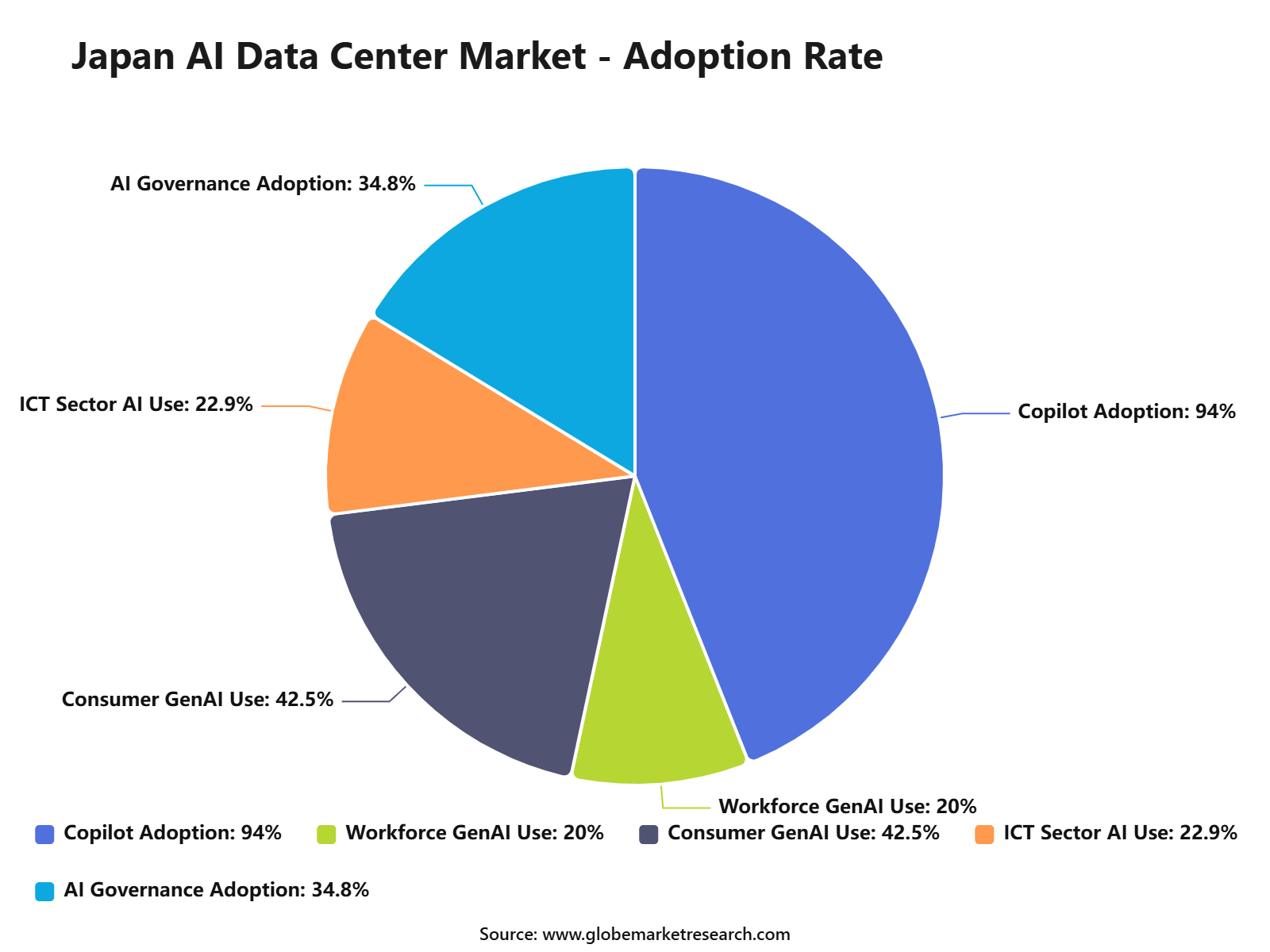 iThe graph shows projected market growth until 2035 based on CAGR analysis. Actual outcomes may vary depending on changing demand, competition, and economic factors.To gain greater insights - request a sample report PDF
According to SoftBank and Japan’s National Institute of Advanced Industrial Science and Technology, Japan is developing large-scale computing infrastructure for generative AI training and inference. SoftBank’s Tomakomai facility is expected to expand beyond 300 MW and operate using 100% locally produced renewable electricity, while the Osaka Sakai facility is planned to begin with approximately 150 MW of power capacity. ABCI 3.0 provides 6,128 NVIDIA H200 GPUs and 6.22 EFLOPS of AI performance, strengthening domestic access to advanced computing resources for AI models, research, and commercial applications.
Component Insights
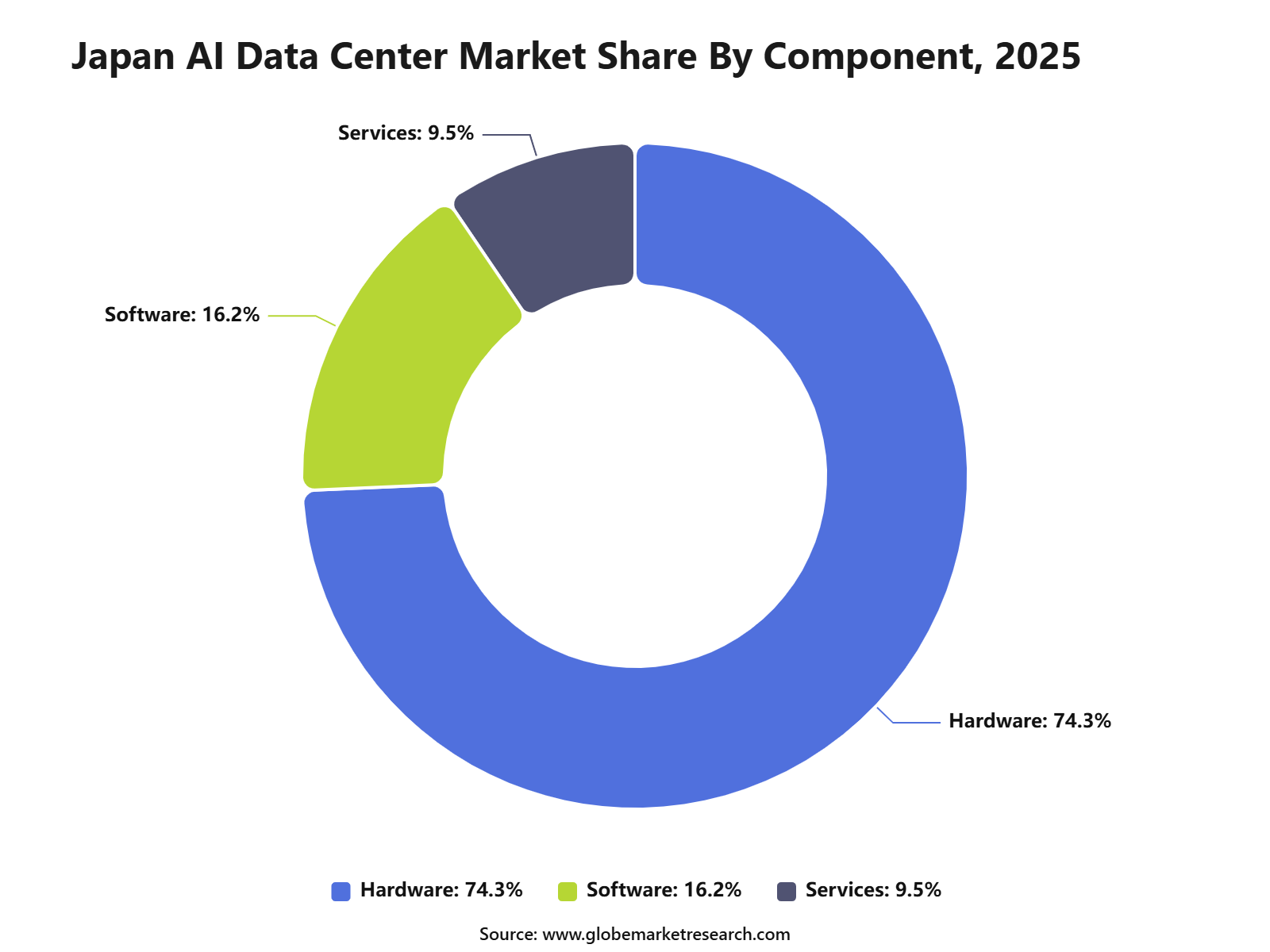
Hardware accounted for 74.3% of the Japan AI Data Center Market by component. Its leading position is supported by the high equipment requirements of AI workloads, including accelerated servers, processors, storage systems, high-speed networking, power distribution and advanced cooling. AI data centers require significantly denser computing configurations than conventional enterprise facilities.
According to Japan’s ABCI computing infrastructure, ABCI 3.0 includes 766 computing nodes equipped with 6,128 AI accelerators, supported by 75 PB of physical storage capacity. The infrastructure also uses a high-speed network to connect computing and storage resources, demonstrating the scale of hardware required for advanced AI research and model development.
Component | Market Share |
|---|---|
Hardware | 74.3% |
Software | 16.2% |
Services | 9.5% |
Hardware demand is increasingly being influenced by higher rack density and electricity use. Data presented by the Japan Data Center Council in January 2025 showed that cloud data centers can operate at 12 kVA or more per rack, compared with approximately 6 kVA per rack for traditional enterprise facilities. This shift is increasing demand for liquid cooling, efficient power systems and high-capacity networking equipment.
 iThe graph shows projected market growth until 2035 based on CAGR analysis. Actual outcomes may vary depending on changing demand, competition, and economic factors.To gain greater insights - request a sample report PDF
Deployment Insights
Cloud-based deployment represented 60.4% of the market by deployment. Cloud infrastructure provides access to scalable computing capacity without requiring every organization to build and maintain its own AI facility. It also supports centralized model management, flexible resource allocation and faster deployment across multiple business locations.
According to Japan’s Digital Agency, the number of systems using Government Cloud increased by 335%, rising from 671 systems in August 2024 to 2,918 systems in February 2025. This rapid migration shows that cloud-based infrastructure is becoming an important operating model for large and security-sensitive information systems.
Deployment | Market Share |
|---|---|
Cloud-Based | 60.4% |
On-Premises | 24.1% |
Hybrid | 15.5% |
Cloud deployment is well suited to AI workloads because computing requirements can change significantly between model development, testing and inference. Providers must still address data residency, cybersecurity, service continuity and the cost of continuous computing. Secure cloud regions and clearly defined data governance controls will remain important for Japanese enterprises and public institutions.
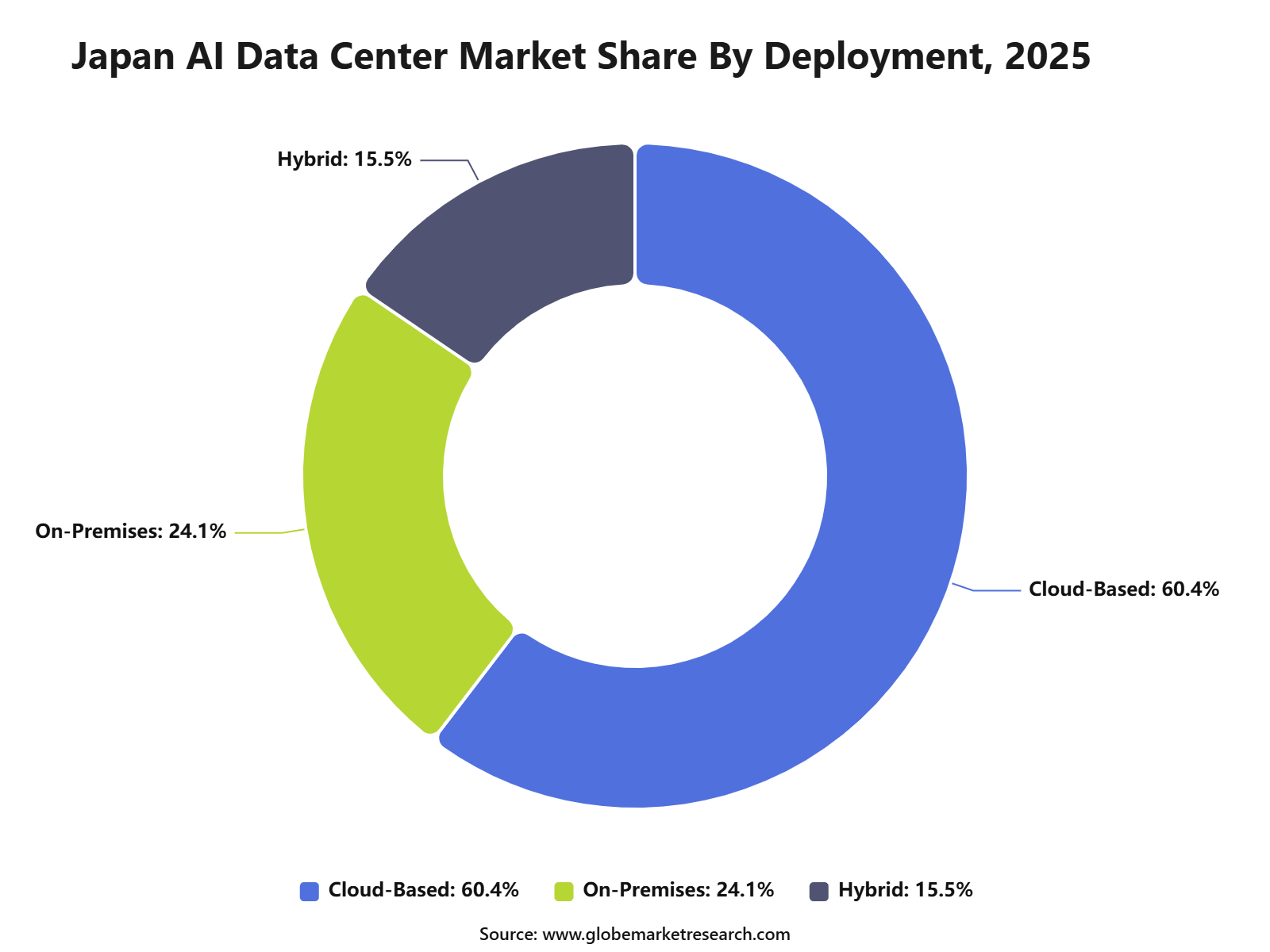 iThe graph shows projected market growth until 2035 based on CAGR analysis. Actual outcomes may vary depending on changing demand, competition, and economic factors.To gain greater insights - request a sample report PDF
Data Center Type Insights
Hyperscale data centers accounted for 48.2% of the market by data center type. These facilities are designed to operate large numbers of servers and support highly concentrated cloud, storage and AI computing workloads. Their scale allows processors, networking systems and power infrastructure to be managed more efficiently across shared environments.
Based on data from Japan Data Center Council, more than half of the servers operating in Japan are owned by hyperscale providers. The council also reported that hyperscale operators are leading AI infrastructure deployment, supported by large computing clusters and global equipment procurement capabilities.
Data Center Type | Market Share |
|---|---|
Hyperscale Data Centers | 48.2% |
Enterprise Data Centers | 20.6% |
Colocation Data Centers | 15.4% |
Edge Data Centers | 10.2% |
Modular and Portable Data Centers | 5.6% |
Hyperscale development is closely connected with access to electricity and telecommunications networks. In June 2025, Japan’s Ministry of Economy, Trade and Industry and Ministry of Internal Affairs and Communications identified rising AI use and communications traffic as major drivers of data center demand. Their Watt-Bit Collaboration initiative is intended to coordinate data center, power and telecommunications infrastructure more effectively.
Application Insights
AI model training held 36.3% of the market by application. Training large AI models requires extensive computing power, high-speed data transfer and continuous access to large datasets. These workloads commonly use clusters of accelerators operating together for long periods, creating substantial demand for specialized data center capacity.
According to Japan’s Ministry of Economy, Trade and Industry, 16 projects were selected under the fourth cycle of the GENIAC computing resource support program in June 2026. The projects are being provided with computing resources required for AI model development, reflecting continued national efforts to strengthen domestic foundation-model capabilities.
Application | Market Share |
|---|---|
AI Model Training | 36.3% |
AI Model Inference | 20.1% |
Big Data Analytics | 13.2% |
Computer Vision Processing | 9.8% |
Natural Language Processing | 8.5% |
Autonomous Systems and Robotics | 6.7% |
Cybersecurity and Fraud Detection | 5.4% |
AI training places greater pressure on storage, memory bandwidth, networking and cooling than many traditional business applications. METI has stated that generative AI training and inference are similar to high-performance computing tasks and require substantial infrastructure and expertise in large-scale distributed training. Facilities offering efficient cluster management and reliable high-density operations are therefore likely to receive stronger demand.
Industry Vertical Insights
IT and telecom accounted for 33.8% of the market by industry vertical. The segment’s leading position is supported by its direct involvement in cloud services, network operations, software platforms, data processing and digital service delivery. IT and telecom organizations also operate many of the systems that connect enterprise users with AI computing resources.
According to Japan’s Digital Agency, Government Solution Services had expanded to 13 ministries and agencies by February 2025, representing a 30% increase from 10 agencies a year earlier. Around 42,000 users were connected to the standardized government network environment, demonstrating rising demand for secure communications and centralized digital infrastructure.
Industry Vertical | Market Share |
|---|---|
IT and Telecom | 33.8% |
BFSI | 15.4% |
Manufacturing | 10.8% |
Healthcare | 9.2% |
Retail and E-commerce | 8.4% |
Government and Defense | 7.1% |
Media and Entertainment | 6.3% |
Automotive | 5.2% |
Energy and Utilities | 3.8% |
IT and telecom providers are expected to play an important role in connecting AI data centers with enterprises, public institutions and edge locations. Demand will be shaped by high-capacity fibre networks, low-latency connectivity, cybersecurity and reliable cloud access. Cooperation between telecommunications operators, electricity providers and data center developers will be required as AI-related communication traffic continues to increase.
Government Incentives for AI Data Centers in Japan
Japan provides direct financial support for domestic AI computing infrastructure under the Economic Security Promotion Act. The Ministry of Economy, Trade and Industry approved subsidies of up to JPY 72.5 billion for five projects developing GPU and cloud computing capacity required for artificial intelligence applications. The supported operators included Sakura Internet, KDDI, GMO Internet Group, Highreso, and RUTILEA-related projects. Source: Ministry of Economy, Trade and Industry.
Regional data center incentives have also been introduced to reduce the concentration of facilities around Tokyo and Osaka. Eligible projects could receive subsidies covering up to 50% of qualified expenses, including land development, power infrastructure, telecommunications connections, buildings, and computing equipment. However, the published scheme relates to an earlier application round, so developers should confirm current availability and eligibility before including the subsidy in investment plans. Source: Japan External Trade Organization.
Energy-efficient AI data centers may also benefit from Japan’s Green Innovation Fund. NEDO supports the development of optical interconnection systems, low-power processors, accelerators, storage technologies, and disaggregated computing systems, with a target of improving data center energy efficiency by at least 40%. These programs indicate that projects combining domestic AI capacity, regional development, renewable electricity, and measurable energy savings are likely to receive stronger policy support. Source: New Energy and Industrial Technology Development Organization.
Case Study
Microsoft, Sakura Internet and SoftBank Expand Japan’s AI Data Center Infrastructure
In April 2026, Microsoft announced an investment of USD 10 billion, approximately JPY 1.6 trillion, in Japan between 2026 and 2029. The program covers domestic AI infrastructure, cybersecurity capabilities and workforce development. It represents Microsoft’s largest investment in Japan and expands the company’s earlier cloud and AI infrastructure program.
The project addresses growing demand for high-performance GPU infrastructure that can support Japanese-language models, robotics, precision manufacturing and other physical AI applications. These workloads require significant computing capacity, low-latency access and clear controls over where sensitive information is stored. Data sovereignty has therefore become an important purchasing factor for Japanese enterprises and public-sector organizations.
Microsoft is collaborating with Sakura Internet and SoftBank to make domestically operated GPU computing resources available through the Azure environment. Customers will be able to access local AI computing capacity while keeping their data within Japan. This structure combines Microsoft’s cloud services with infrastructure operated by domestic providers, supporting organizations that have strict confidentiality, governance and data-residency requirements.
The project demonstrates how Japan’s AI data center model is moving toward partnerships between global cloud platforms, domestic telecommunications companies and local infrastructure operators. Nearly one in five working-age people in Japan now uses generative AI, while Microsoft 365 Copilot has been adopted by 94% of Nikkei 225 companies. This rising enterprise adoption is expected to support demand for GPU capacity, liquid cooling, high-density racks, secure networks and managed AI infrastructure.
Market Dynamics
Drivers Impact Analysis
The Japan AI Data Center Market is driven by rising demand for AI model training, AI inference, cloud computing, generative AI applications, robotics, autonomous systems, and high-performance computing. Japan’s strong base in electronics, telecom, automotive, robotics, financial services, and manufacturing supports demand for advanced AI-ready data center capacity.
The market is also supported by growing enterprise AI adoption, government-backed digital transformation, edge computing needs, and demand for secure domestic data infrastructure. AI workloads require high power density, GPU clusters, liquid cooling, low-latency connectivity, and reliable cloud infrastructure.
Impact Factor | Estimated CAGR Impact | Regional Relevance | Market Impact |
|---|---|---|---|
Rising AI model training and inference demand | +9.8% | Japan enterprise and cloud markets | Drives high-performance data center growth. |
Growth in generative AI adoption | +8.6% | Japan technology, BFSI, media, retail | Expands AI compute requirements. |
Expansion of cloud and hyperscale infrastructure | +7.4% | Tokyo, Osaka, regional hubs | Supports large-scale AI hosting. |
Robotics and autonomous system development | +6.2% | Manufacturing, automotive, industrial Japan | Adds AI workload demand. |
Demand for secure domestic data processing | +5.1% | Government, BFSI, healthcare | Supports local AI infrastructure investment. |
Restraints Impact Analysis
The market faces restraints from high power consumption, land constraints, grid pressure, high construction cost, GPU supply challenges, and cooling complexity. AI data centers require significant capital investment and specialized infrastructure compared with traditional data centers. Another restraint is Japan’s limited availability of large-scale power and suitable land near major connectivity hubs. Developers must manage energy sourcing, permitting, construction timelines, sustainability requirements, and hardware procurement risks.
Impact Factor | Estimated CAGR Impact | Regional Relevance | Market Impact |
|---|---|---|---|
High power consumption | -5.8% | Japan AI data center operators | Raises operating cost. |
Limited land availability | -4.9% | Tokyo, Osaka, urban hubs | Restricts large campus development. |
GPU and AI hardware supply constraints | -4.2% | Cloud and hyperscale operators | Delays capacity expansion. |
High construction and cooling cost | -3.7% | AI-ready facilities | Pressures project economics. |
Grid connection and permitting delays | -3.1% | Data center development zones | Slows project execution. |
Opportunities Impact Analysis
Opportunities are strong in GPU data centers, hyperscale AI campuses, sovereign AI infrastructure, liquid-cooled facilities, edge AI data centers, cloud AI platforms, and enterprise colocation services. Japan’s advanced industrial base creates demand for AI compute across robotics, automotive, electronics, telecom, healthcare, and manufacturing.
Higher-value opportunities are emerging in AI inference hosting, private AI clouds, enterprise AI platforms, modular data centers, renewable-powered facilities, and low-latency AI infrastructure. Companies that combine power availability, cooling efficiency, cloud connectivity, and compliance strength can capture stronger market value.
Impact Factor | Estimated CAGR Impact | Regional Relevance | Market Impact |
|---|---|---|---|
GPU-based AI data centers | +9.5% | Japan hyperscale and enterprise markets | Builds core AI infrastructure demand. |
Liquid cooling deployment | +7.8% | High-density AI facilities | Supports advanced compute loads. |
Sovereign and private AI cloud demand | +6.7% | Government, BFSI, healthcare | Adds secure infrastructure opportunity. |
Edge AI data center expansion | +5.4% | Industrial and telecom networks | Supports low-latency AI use cases. |
Renewable-powered AI facilities | +4.6% | Sustainability-focused operators | Improves long-term project appeal. |
Challenges Impact Analysis
The main challenge is scaling AI data center capacity while managing power, cooling, cost, and sustainability. AI workloads require dense compute clusters that can strain facility design, grid capacity, and operating efficiency. Another challenge is balancing domestic demand with global competition for AI chips, servers, skilled engineers, and advanced cooling systems. Japan must strengthen its AI infrastructure supply chain to support long-term growth.
Impact Factor | Estimated CAGR Impact | Regional Relevance | Market Impact |
|---|---|---|---|
Scaling high-density AI infrastructure | -5.6% | Japan AI data center developers | Raises design complexity. |
Managing energy efficiency | -4.8% | High-power AI facilities | Affects operating margins. |
Competing for AI chips and servers | -4.1% | Cloud and colocation providers | Creates procurement pressure. |
Shortage of specialized data center talent | -3.4% | Engineering and operations teams | Slows deployment. |
Sustainability and carbon reduction pressure | -2.9% | Enterprise and government users | Requires cleaner energy planning. |
Key Market Segments
By Component
Hardware
Software
Services
By Deployment
Cloud-Based
On-Premises
Hybrid
By Data Center Type
Hyperscale Data Centers
Enterprise Data Centers
Colocation Data Centers
Edge Data Centers
Modular and Portable Data Centers
By Application
AI Model Training
AI Model Inference
Big Data Analytics
Computer Vision Processing
Natural Language Processing
Autonomous Systems and Robotics
Cybersecurity and Fraud Detection
By Industry Vertical
IT and Telecom
BFSI
Healthcare
Retail and E-commerce
Manufacturing
Government and Defense
Media and Entertainment
Automotive
Energy and Utilities
Market Trend Analysis
The market trend is moving toward GPU clusters, high-density racks, liquid cooling, AI inference hubs, private AI clouds, modular facilities, and data centers located near strong power and network infrastructure. Japan’s AI infrastructure is shifting from general-purpose cloud capacity toward AI-optimized compute environments.
Tokyo and Osaka remain major connectivity and enterprise demand centers, while regional locations can gain importance where power availability, land cost, and disaster-resilience planning are more favorable. Demand from robotics, automotive, telecom, and manufacturing will shape long-term market development.
Impact Factor | Estimated CAGR Impact | Regional Relevance | Market Impact |
|---|---|---|---|
High-density AI rack deployment | +8.9% | Japan hyperscale and colocation facilities | Supports GPU-intensive workloads. |
AI inference capacity expansion | +7.6% | Enterprise and cloud platforms | Builds recurring compute demand. |
Liquid-cooled data center trend | +6.5% | New AI-ready facilities | Improves thermal performance. |
Regional data center development | +5.2% | Outside Tokyo and Osaka | Supports power and land availability. |
Private AI cloud adoption | +4.4% | Regulated and large enterprises | Adds secure AI hosting demand. |
Technology Adoption Analysis
Technology adoption is focused on GPUs, AI accelerators, high-bandwidth networking, liquid cooling, direct-to-chip cooling, power management systems, modular infrastructure, DCIM platforms, and AI workload orchestration. These technologies help data centers handle training, inference, storage, and high-performance computing workloads. Operators are also adopting renewable energy procurement, advanced battery backup, immersion cooling, automated monitoring, and security-by-design infrastructure. These upgrades support uptime, efficiency, and enterprise trust.
Impact Factor | Estimated CAGR Impact | Regional Relevance | Market Impact |
|---|---|---|---|
GPU and AI accelerator deployment | +9.2% | Japan AI data centers | Drives compute capacity growth. |
Liquid and immersion cooling systems | +7.5% | High-density facilities | Improves heat management. |
High-speed networking infrastructure | +6.3% | AI clusters and cloud platforms | Reduces latency and bottlenecks. |
Data center automation and monitoring | +5.1% | Large operators | Improves uptime and efficiency. |
Renewable energy and power optimization | +4.2% | Sustainability-focused facilities | Supports long-term operating resilience. |
Recent Developments
Market News
In January 2026, KDDI commenced operations at the Osaka Sakai Data Center. The facility uses 100% renewable electricity and became KDDI’s first commercial data center to introduce large-scale liquid cooling, supporting the higher power density and heat output associated with AI servers and advanced GPUs.
In February 2026, SuperX expanded its presence in Japan through collaborations with Digital Dynamic, eole, and Woodman to assess modular AI data-center projects. The initial pilot in Mie Prefecture is intended to demonstrate faster deployment of scalable AI infrastructure, while Digital Dynamic plans to complete additional AI data centers in Kagoshima and Fukushima during 2026.
In April 2026, Microsoft announced a USD 10 billion investment in Japan from 2026 through 2029. The programme includes expansion of in-country AI infrastructure, collaboration with domestic infrastructure partners, stronger cybersecurity cooperation with national institutions, and AI training for more than one million engineers, developers, and workers by 2030.
In April 2026, JFE Holdings and Mitsubishi Corporation signed a second memorandum of understanding for an integrated power and data-center project in the Ohgishima area near Tokyo. The companies are planning an initial 60 MW data center for fiscal 2031, with the site capable of supporting several hundred megawatts of future IT capacity.
In April 2026, NTT DATA opened the Keihanna OSK11 Data Center in Kyoto Prefecture. The AI-ready facility provides 30 MW of IT capacity, dual power substations, carrier-neutral connectivity, N+1 cooling infrastructure, and enhanced physical security for hyperscale and enterprise customers.
Acquisitions
In March 2026, DigitalBridge and Japan Extensive Infrastructure completed the acquisition of selected NEC data-center assets in Kanagawa and Kobe. The facilities will operate as a standalone data-center platform, while NEC will remain an anchor customer and the sites will be opened to additional colocation clients. Financial terms were not disclosed.
In March 2026, CapitaLand Ascendas REIT agreed to acquire a 49% interest in a 40.5 MW hyperscale data center in Greater Osaka for approximately SGD 620.7 million, or about USD 485.2 million. The facility was fully occupied by a major tenant and had a further 5.4 MW of potential expansion capacity.
In April 2026, DigitalBridge shareholders approved the company’s acquisition by Japan-based SoftBank Group. The transaction values DigitalBridge at approximately USD 4 billion and is expected to close during the second half of 2026, subject to regulatory approvals and other closing conditions.
Funding
In April 2026, Microsoft committed USD 10 billion to AI infrastructure, cybersecurity, and workforce development in Japan between 2026 and 2029. The investment was described as Microsoft’s largest commitment to Japan and includes AI infrastructure operating within the country.
In June 2026, Blackstone outlined a planned USD 30 billion investment in Japanese AI data centers over three to five years. The proposed programme could support more than 1 GW of capacity and indicates stronger interest from infrastructure funds in Japan’s AI computing, real estate, power, and digital connectivity sectors.
Japan’s Ministry of Economy, Trade and Industry has approved subsidies of up to JPY 72.5 billion for five domestic AI computing projects. The recipients include Sakura Internet, KDDI, GMO Internet Group, Highreso and Highreso Kagawa, and a joint project involving RUTILEA and AI Fukushima.
Sakura Internet received approval for up to approximately JPY 50.1 billion, representing the largest allocation under the AI computing subsidy programme. KDDI was approved for up to approximately JPY 10.24 billion, while Highreso and Highreso Kagawa were approved for up to approximately JPY 7.70 billion.
Competitive Landscape
The market is characterized by intense competition among established players and emerging companies. Strategic partnerships, mergers and acquisitions, and product innovation are key strategies employed by market participants.
Key Market Players
NTT Global Data Centers
Equinix, Inc.
MC Digital Realty, Inc.
Amazon Web Services, Inc.
Microsoft Corporation
Google Cloud
Oracle Corporation
KDDI Corporation
SoftBank Corp.
Internet Initiative Japan Inc.
SAKURA Internet Inc.
Colt Data Centre Services
NEC Corporation
Fujitsu Limited
NVIDIA Corporation
Other Key Players
Research Methodology
This market study is prepared using a combination of primary and secondary research. Primary research includes discussions with manufacturers, suppliers, distributors, consultants, industry experts, and end users. Secondary research covers company reports, government databases, trade associations, technical publications, regulatory sources, and trusted industry documents. The collected information is used to assess market demand, pricing trends, technology adoption, competitive activity, and regional performance.
AI language models are not used as primary data sources, and publicly available AI-generated content is not treated as market evidence. Computational tools may be used to support data processing, translation, data classification, and pattern identification. However, every published assessment is supported by verified sources, human review, and primary market discussions.
Market estimates are developed through top-down and bottom-up approaches and validated using data triangulation. Revenue, production, shipment, pricing, and application-level data are compared across multiple sources. Forecasts consider economic conditions, regulatory changes, investment activity, innovation, supply chain developments, and industry risks. All findings are reviewed through source verification and internal quality checks before publication.
Part I
Source Management & Input Data Standards
Who provides data, how sources are qualified, and what types of evidence are admissible.
Part II
Research Scope & Market Coverage
How we define the markets we assess and the parameters that govern each product.
Part III
Data Collection, Verification & Submission
The mechanics of gathering, cross-checking, and hierarchically ranking evidence.
Part IV
Assessment Determination & Quality Controls
How raw data becomes a published assessment — normalisation, expert judgement, and outlier exclusion.
Part V
Publication, Corrections & Revision
Our publication schedule, corrections policy, and methodology review cycle.
Part VI
Independence, Ethics & Complaints
Conflict-of-interest policies, editorial independence, and how clients raise concerns.
Google · Preferred Sources
Don't miss the latest market research insights and industry updates on Google.
Add Globe Market Research as a preferred source in the Google app to see our reports, analysis, and market stories in your news suggestions.
Meet the Team
This report was prepared by our expert analysts with deep industry knowledge and research experience.
Prashant S. is a Research Analyst at Globe Market Research with more than four years of experience in market research and industry analysis. He specializes in the Aerospace and Defence, Automotive and Transportation, Semiconductor and Electronics, Information and Technology sectors, with expertise in market sizing, trend analysis, competitive assessment, and industry forecasting. He applies primary and secondary research, data validation, company analysis, and market estimation methods to deliver reliable insights for strategic planning and business decision-making.
Sayali brings more than 7 years of experience to Globe Market Research, supporting the accuracy, clarity, and relevance of research content across multiple industries. She reviews market data, segment analysis, competitive insights, and industry trends to ensure each report meets strong quality standards and provides practical value to business decision-makers. Her expertise spans healthcare, information technology, consumer goods, and diverse cross-industry domains. With a strong focus on data reliability, structured analysis, and clear presentation, Sayali helps ensure that each research output delivers well-reviewed insights for clients, investors, consultants, and industry stakeholders.
Frequently Asked Questions
Related Reports
More in Information and Technology
South Korea Physical AI Market Size to Reach USD 3.6 billion by 2035
South Korea Physical AI Market Size, Share, Trends and Growth Analysis Report By Deployment (On-Device AI, Cloud-Based AI), By Component (Hardware, Software, Services), By Technology (Computer Vision, Speech and Natural Language Processing, Gesture and Movement Recognition, Reinforcement Learning and Control Systems, Other Technologies), By Robot Type (Service Robots, Humanoid and Social Robots, Collaborative Robots, Exoskeletons and Prosthetics, Mobile Robots and Drones, Industrial Robots), By Application (Healthcare, Manufacturing and Automotive, Logistics and Warehousing, Retail and Hospitality, Other Applications), By Technology Trends, Competitive Landscape, Strategic Opportunities and Growth Forecast, 2026-2035
Physical AI Market Size to hit USD 2,129.0 billion by 2035
Physical AI Market Size, Share, Trends and Growth Analysis Report By Component (Hardware, Software, Services), By Technology (Computer Vision, Machine Learning and Deep Learning, Natural Language Processing, Edge AI, Other Technologies), By Product (Robots, Exoskeletons, Autonomous Systems, Smart Appliances), By Application (Automation and Manufacturing, Logistics and Supply Chain, Healthcare, Automotive, Defense and Security, Retail, Education, Other End Uses), By Regional Insights, Technology Trends, Competitive Landscape, Strategic Opportunities and Growth Forecast, 2026-2035
Edtech SaaS Tools Market Size to hit USD 217.6 billion by 2035
EdTech SaaS Tools Market Size, Share, Trends and Growth Analysis Report By Software (Classroom Management Systems, Document Management Systems, Learning and Gamification Platforms, Learning Management Systems, Student Collaboration Systems, Assessment and Analytics Tools, Content Authoring Tools, Other Software), By Sector (Preschool, K-12, Higher Education, Other Education Sectors), By Deployment (Cloud-Based, Hybrid), By End Use (Businesses, Educational Institutions, Individual Learners and Consumers), By Regional Insights, Technology Trends, Competitive Landscape, Strategic Opportunities and Growth Forecast, 2026–2035
Marketing Technology Market Size to Reach USD 3,810.8 billion by 2035
Marketing Technology Market Size, Share, Trends and Growth Analysis Report By Marketing Type (Digital Marketing, Offline Marketing), By Product (Social Media Tools, Content Marketing Tools, Rich Media Tools, Marketing Automation Tools, Data and Analytics Tools, Sales Enablement Tools), By Deployment (Cloud-Based, On-Premises, Other Deployment Models), By Enterprise Type (Large Enterprises, Small and Medium-Sized Enterprises), By Application (IT and Telecommunication, Retail and E-commerce, Healthcare, Media and Entertainment, Sports and Events, BFSI, Real Estate, Other Applications), By Regional Insights, Technology Trends, Competitive Landscape, Strategic Opportunities and Growth Forecast, 2026-2035