

Revenue, 2026
USD 2.8 Bn
Forecast, 2035
USD 6.1 Bn
CAGR, 2026-2035
9.1%
Report Coverage
Global
Market Size and Forecast
The Global Mezcal Market was worth USD 2.8 billion in 2026 and is expected to reach USD 6.1 billion by 2035, growing at a CAGR of 9.1% from 2026 to 2035. North America held the largest regional share of 63.5% in 2026, valued at around USD 1.7 billion, supported by strong demand for premium spirits, craft alcoholic beverages, cocktail culture, and rising consumer interest in authentic agave-based products.
The Mezcal Market includes artisanal, premium, and commercial mezcal produced mainly from agave plants using traditional and modern distillation methods. Mezcal is widely consumed through bars, restaurants, retail stores, specialty liquor shops, duty-free channels, and premium hospitality venues. The market is closely linked with craft spirits, cultural origin, small-batch production, and premium drinking experiences.
Market growth is being supported by rising demand for smoky flavor profiles, handcrafted spirits, and higher-quality alcoholic beverages among adult consumers. Premiumization is playing a major role as buyers show interest in aged mezcal, organic mezcal, single-origin agave varieties, and sustainable production practices. Brands are also using storytelling, origin labeling, and cocktail-focused positioning to improve consumer awareness.
Key Parameter | Report Details |
|---|---|
Market Revenue, 2026 | USD 2.8 Billion |
Projected Revenue, 2035 | USD 6.1 Billion |
CAGR (2026-2035) | 9.1% |
Largest Region | North America (63.5%, USD 1.7 Bn) |
Fastest Growing Region | Asia Pacific |
Market Concentration | Medium |
Base Year | 2025 |
Forecast Period | 2026-2035 |
North America is expected to remain the leading region due to strong consumption in the United States, expanding bar and restaurant menus, and growing retail availability of premium mezcal. Demand is also supported by mixologists, specialty beverage retailers, and consumers shifting from standard spirits toward distinctive craft options. Long-term market growth will depend on agave supply stability, responsible sourcing, regulatory compliance, brand education, and consistent product quality.
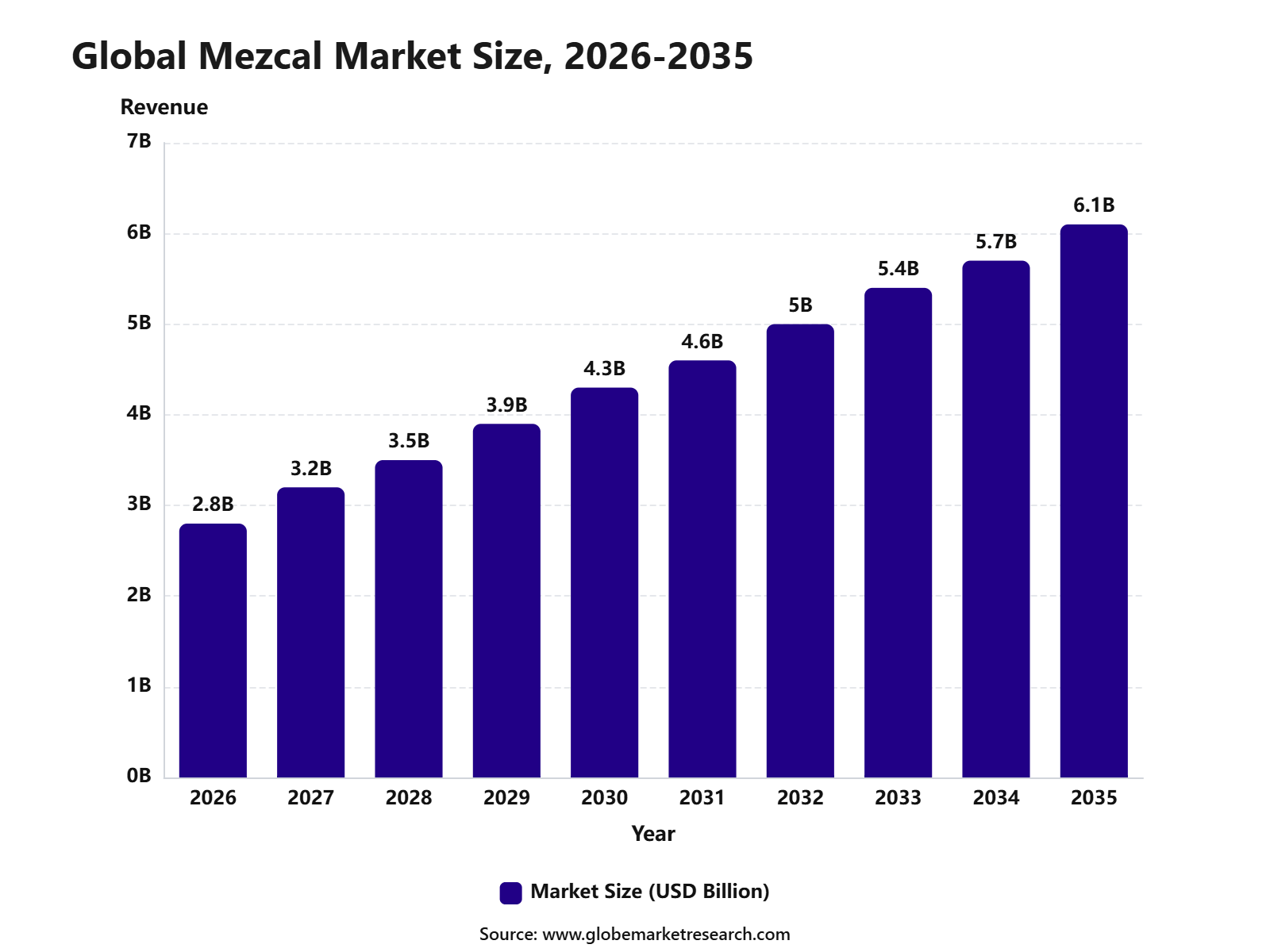 iThe graph shows projected market growth until 2035 based on CAGR analysis. Actual outcomes may vary depending on changing demand, competition, and economic factors.To gain greater insights - request a sample report PDF
Key Market Insights
Joven mezcal led the product segment with 74.1% share, supported by its fresh agave taste, wider consumer acceptance, lower aging cost, and strong use in cocktails and on-trade consumption.
100% agave formulations accounted for 73.5% share, driven by rising demand for authentic, premium, craft-positioned, and higher-quality mezcal products.
On-trade distribution held 69.2% share, supported by strong sales through bars, restaurants, hotels, clubs, tasting rooms, and premium cocktail venues.
Premium and luxury mezcal captured 38.5% share, driven by growing interest in artisanal spirits, heritage-based production, limited batches, and high-value agave-based drinking experiences.
North America led the mezcal market with 63.5% share, valued at USD 1.7 billion, supported by strong cocktail culture, premium spirits consumption, Mexican cuisine influence, and rising demand for craft agave spirits.
Top Funding and Investment
Top Investments
In February 2025, No Sleep Beverage made a strategic investment in Madre Mezcal to support its expansion as an independent premium mezcal brand. The investment provided commercial resources, operating expertise, distribution support, and brand-development capabilities. The transaction value was not publicly disclosed.
In April 2025, wine entrepreneur Sacha Lichine invested in Rosaluna Mezcal through its Series A transaction. The investment was combined with a commercial partnership involving Shaw-Ross International Importers to expand Rosaluna’s sales, brand visibility, retailer access, and distribution across the United States. The investment amount was not disclosed.
In December 2025, Dos Hombres secured a USD 15 million growth-equity investment. The capital was allocated to expand distribution, strengthen field sales, increase consumer marketing, improve brand awareness, and introduce additional premium products within the wider agave spirits category.
In May 2026, Ofrenda Agave Spirits completed a crowdfunding campaign that raised USD 52,261. The investment supported the development and commercialization of its premium mezcal portfolio, including production, inventory, packaging, sales execution, and broader market expansion.
In 2026, Artisanal Distillates, the company behind Mezcales de Leyenda, conducted an equity crowdfunding campaign through StartEngine. The campaign exceeded its minimum funding target and accepted investments to support mezcal inventory, brand development, distribution expansion, and working-capital requirements. The final verified amount was not publicly stated in the available disclosure.
Top Funding
In December 2025, Dos Hombres raised USD 15 million in growth financing. The round was intended to accelerate national and international distribution, expand the company’s sales team, strengthen marketing activities, and support premium agave product innovation.
In April 2025, Rosaluna Mezcal completed a Series A financing round led by Sacha Lichine. The capital is being used to strengthen the brand’s U.S. commercial presence and support growth through Shaw-Ross International Importers. The financing amount was not publicly disclosed.
In May 2026, Ofrenda Spirits Mezcal completed a funding campaign with USD 52,261 raised from participating investors. The proceeds were directed toward scaling the premium mezcal business, increasing market access, and supporting commercial operations.
Top Acquisitions
In 2025, IJW Whiskey acquired Mezcal El Silencio. Through the transaction, IJW obtained ownership of the Oaxacan mezcal brand, its trademarks, product portfolio, customer relationships, commercial rights, and brand-development platform. El Silencio was subsequently relaunched in November 2025 under a new ownership and growth strategy.
In April 2025, Diageo obtained a majority interest in Lobos 1707 through a transaction with Main Street Advisors. Lobos 1707 produces both tequila and mezcal. Diageo acquired controlling rights to the brand, its mezcal and tequila portfolio, commercial operations, intellectual property, and growth platform, while transferring its North American rights in Cîroc as part of the asset exchange.
By Product
Joven accounted for 74.1% share of the Mezcal Market. This leading position is supported by its fresh, unaged profile, strong agave flavor, and broad use across bars, restaurants, cocktails, and premium tasting occasions.
The segment is widely preferred because joven mezcal preserves the natural smoky, earthy, and herbal character of agave. It is commonly used by mixologists and consumers who want a clean and authentic mezcal taste without the influence of barrel aging.
Demand is expected to remain strong as premium spirits consumers continue to explore craft, small-batch, and agave-based drinks. Joven mezcal will continue to benefit from cocktail culture, on-trade visibility, and rising interest in traditional Mexican spirits.
By Formulation
100% agave mezcal accounted for 73.5% share of the Mezcal Market. This dominance is driven by consumer preference for authentic, high-quality products made fully from agave rather than blended formulations.
The segment is widely associated with purity, traditional production methods, and stronger product identity. Consumers and premium buyers often prefer 100% agave mezcal because it offers clearer flavor depth, better origin value, and stronger positioning in the craft spirits category.
Demand is expected to remain high as buyers become more aware of product labels, agave varieties, and regional production methods. Premiumization, authenticity claims, and growing interest in artisanal spirits will continue to support 100% agave formulations.
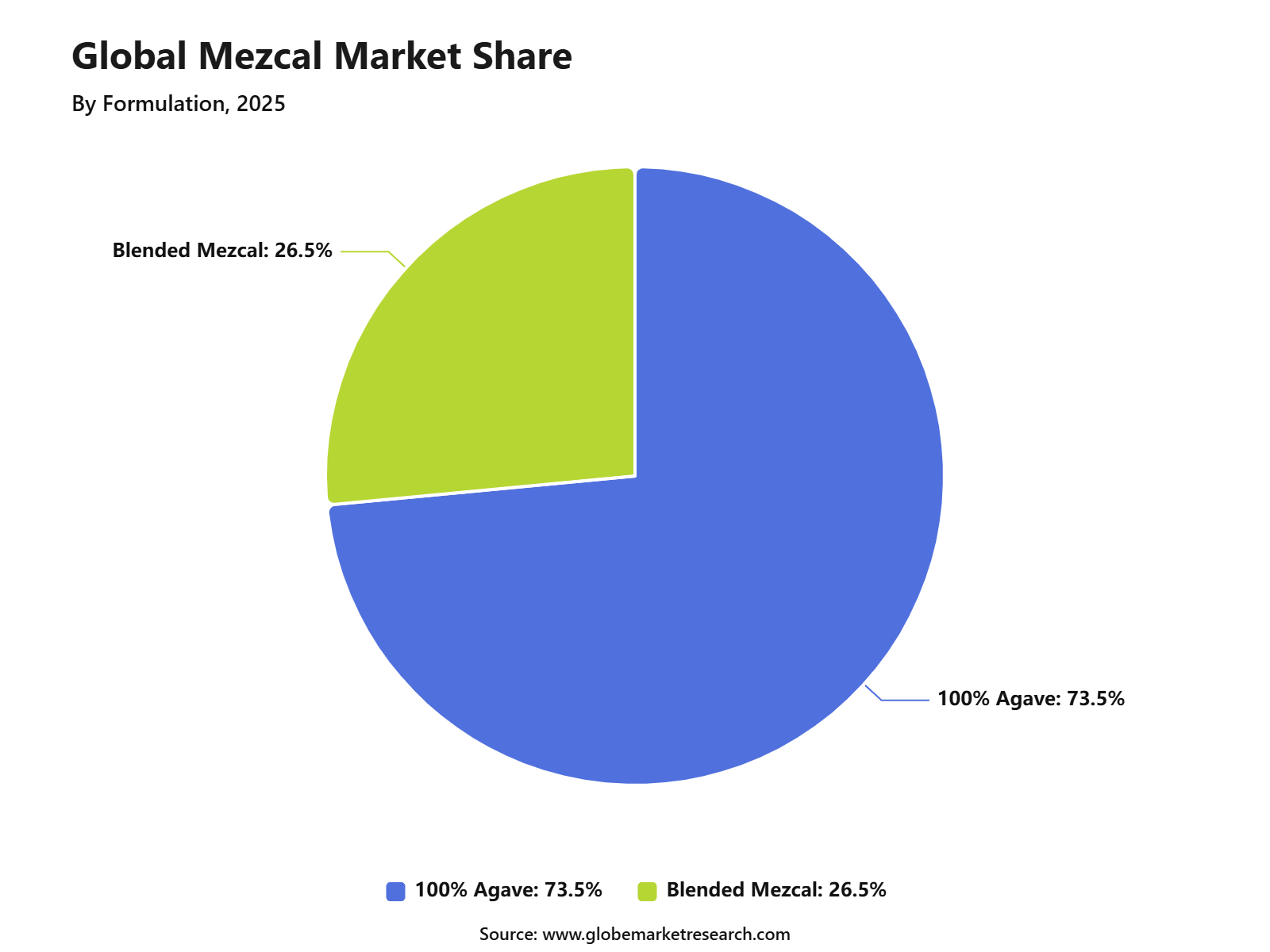 iThe graph shows projected market growth until 2035 based on CAGR analysis. Actual outcomes may vary depending on changing demand, competition, and economic factors.To gain greater insights - request a sample report PDF
By Distribution Channel
On-trade channels accounted for 69.2% share of the Mezcal Market. This leading share is supported by strong consumption through bars, restaurants, hotels, lounges, clubs, and premium cocktail venues.
The channel is important because mezcal discovery often happens through bartender recommendations, tasting menus, cocktail pairings, and social drinking occasions. On-trade venues help educate consumers about joven mezcal, agave varieties, smoky flavor profiles, and premium serving styles.
Demand through on-trade channels is expected to remain strong as cocktail culture and premium nightlife continue to expand. Restaurants and bars will remain key for brand visibility, trial generation, and higher-value mezcal consumption.
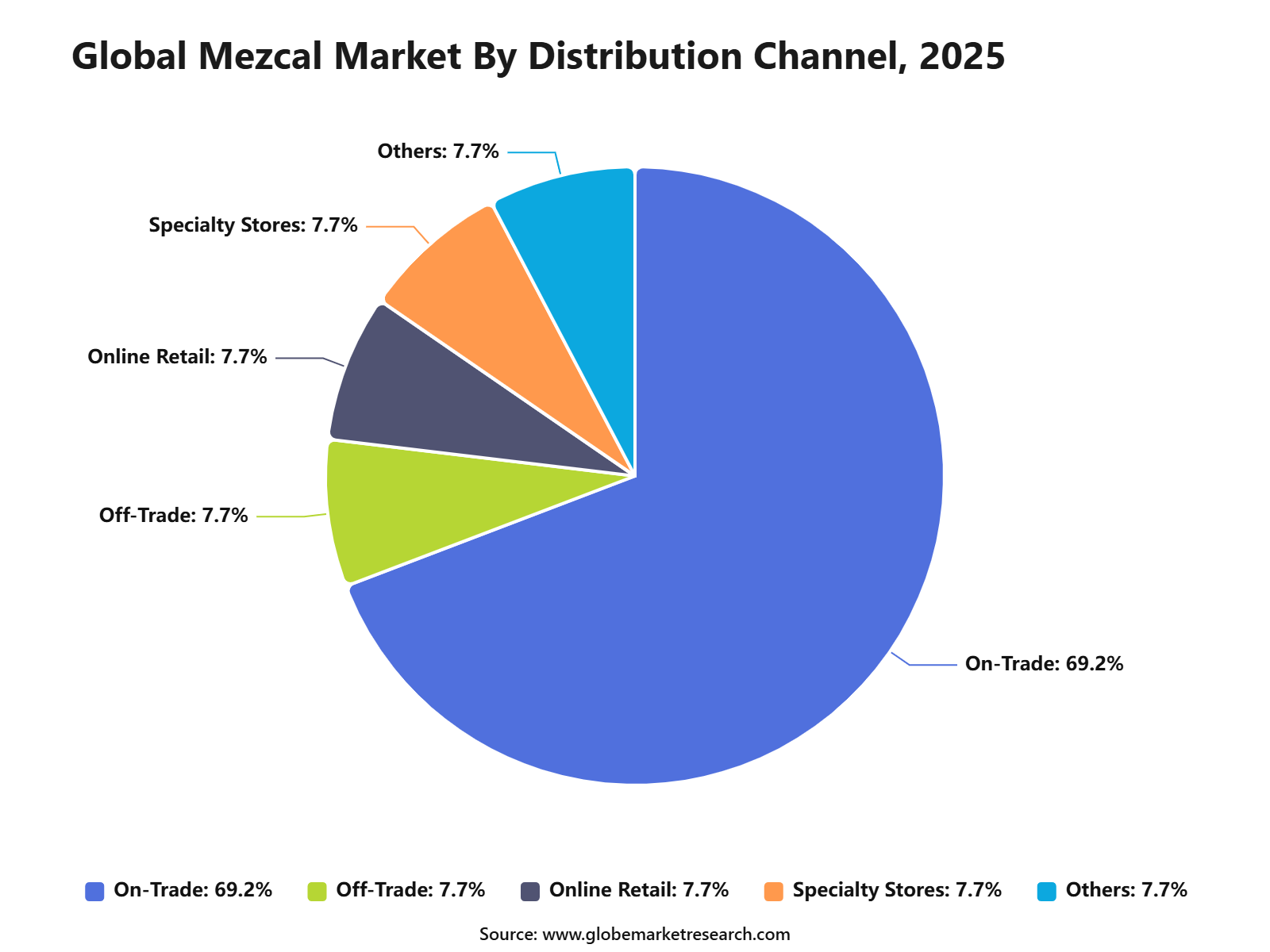 iThe graph shows projected market growth until 2035 based on CAGR analysis. Actual outcomes may vary depending on changing demand, competition, and economic factors.To gain greater insights - request a sample report PDF
By Price Range
Premium and luxury mezcal accounted for 38.5% share of the Mezcal Market. This leading position is supported by rising consumer interest in high-quality agave spirits, limited-batch products, artisanal production, and origin-based storytelling.
The segment is widely preferred by consumers seeking unique flavor, heritage value, and elevated drinking experiences. Premium mezcal is often linked with traditional distillation, mature agave sourcing, small producer identity, and distinctive regional taste profiles.
Demand is expected to remain strong as mezcal gains wider recognition among premium spirits buyers. Growth will be supported by craft spirits adoption, cocktail bars, gifting demand, and consumers trading up to higher-quality agave-based products.
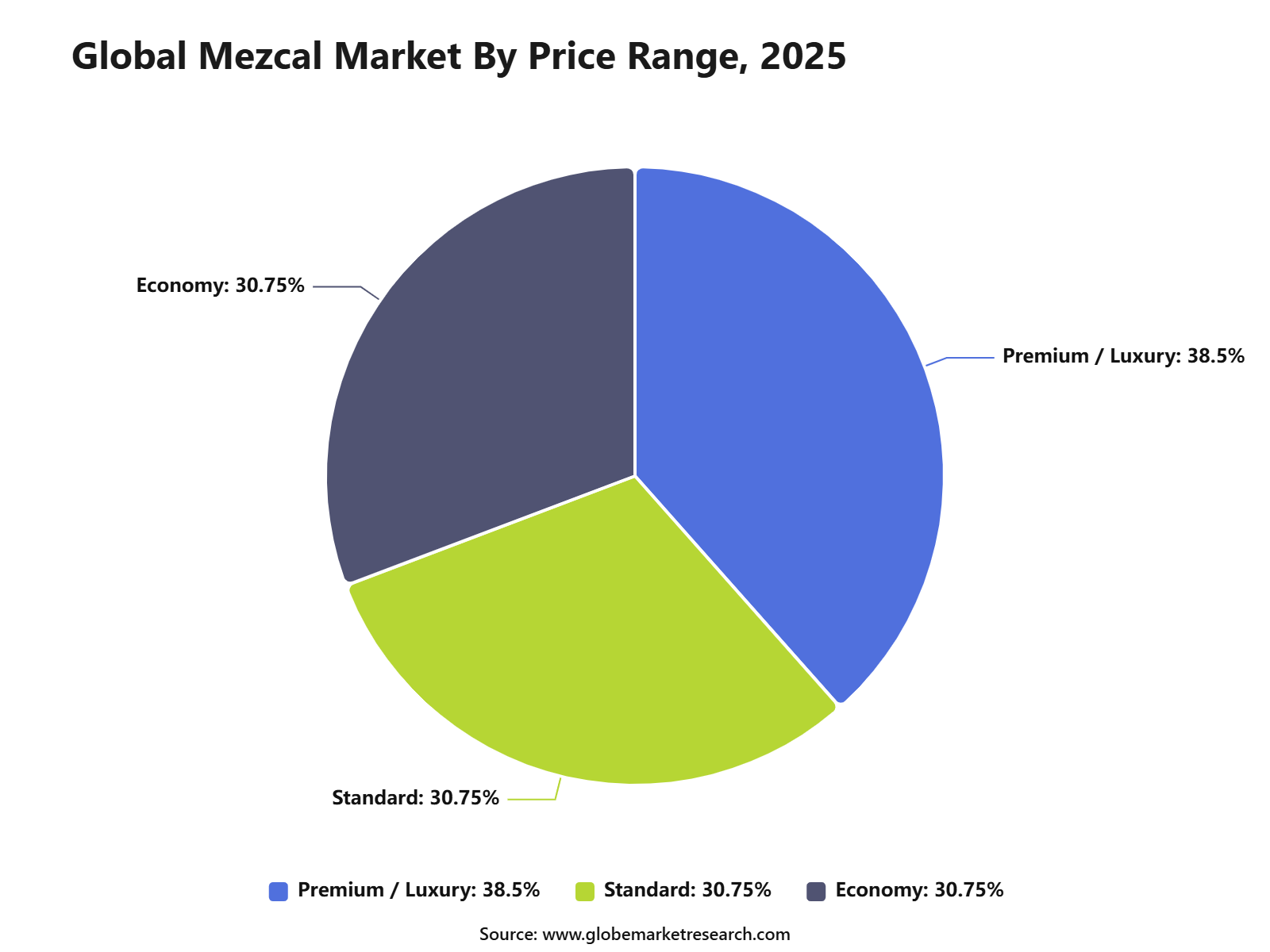 iThe graph shows projected market growth until 2035 based on CAGR analysis. Actual outcomes may vary depending on changing demand, competition, and economic factors.To gain greater insights - request a sample report PDF
By Region
North America accounted for 63.5% share of the Mezcal Market, reaching USD 1.7 billion. The region’s leadership is supported by strong demand from the United States, where premium tequila and mezcal consumption has increased across retail and on-trade channels.
The region benefits from established cocktail culture, growing consumer awareness of agave spirits, and strong distribution through bars, restaurants, specialty liquor stores, and e-commerce alcohol platforms. Joven and 100% agave products remain especially important for consumer trial and premium positioning.
North America is expected to maintain its leading position as consumers continue to explore authentic, craft, and premium spirits. Demand will remain supported by on-trade adoption, luxury mezcal launches, cocktail innovation, and rising preference for agave-based alcoholic beverages.
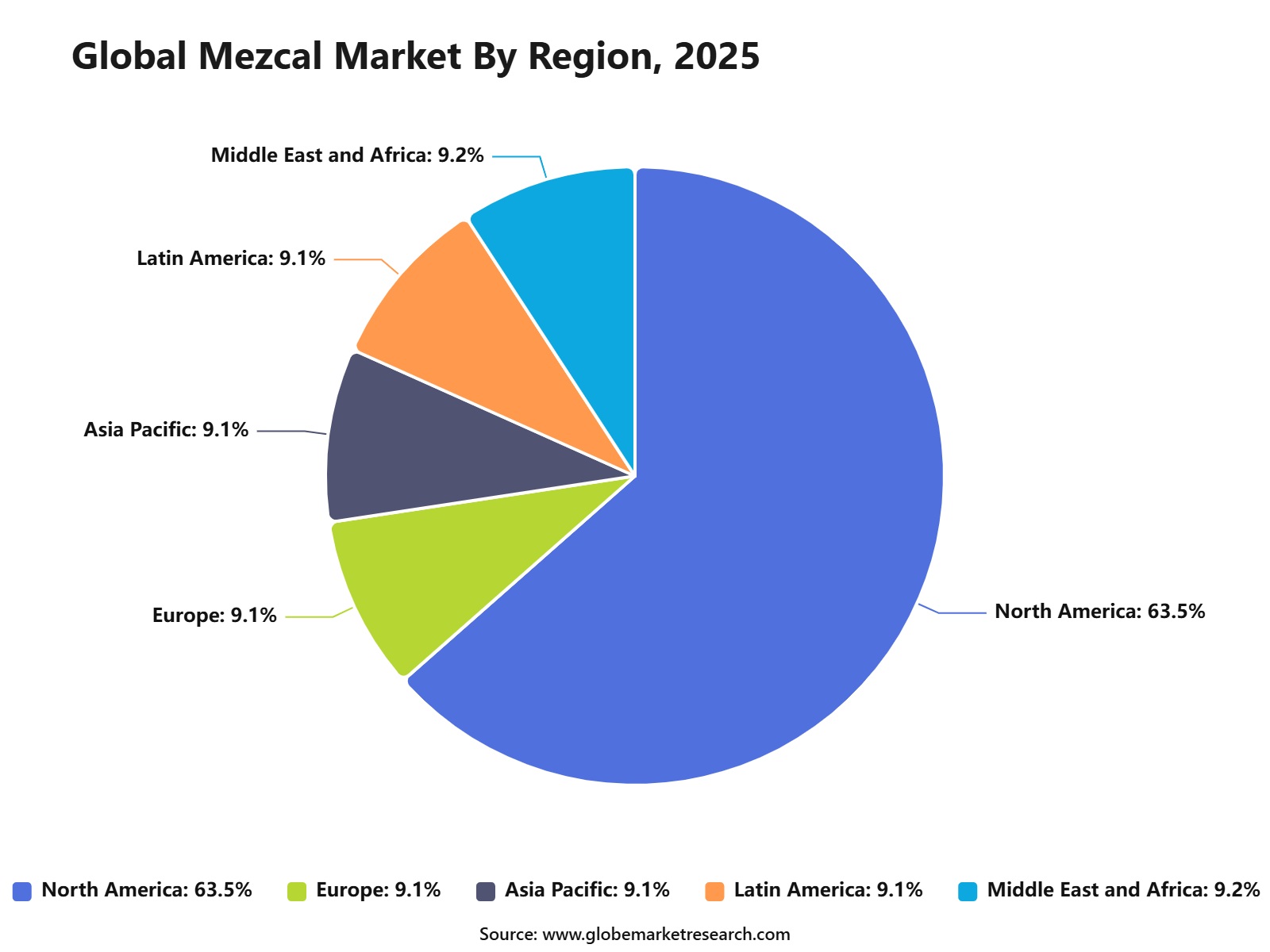 iThe graph shows projected market growth until 2035 based on CAGR analysis. Actual outcomes may vary depending on changing demand, competition, and economic factors.To gain greater insights - request a sample report PDF
Regional Impact Analysis
North America leads the Mezcal Market with 63.5% share in 2026, valued at around USD 1.8 billion, supported by strong U.S. and Mexico demand, premium agave spirit consumption, cocktail culture, and retail expansion. The U.S. remains the main demand center because mezcal has become more visible across bars, restaurants, liquor stores, and premium spirit menus.
Europe remains important because of growing interest in craft spirits, cocktail bars, and premium Mexican beverages. Asia Pacific is still smaller but has future potential in luxury hospitality, high-end bars, travel retail, and urban premium alcohol consumption.
Impact Factor | Estimated CAGR Impact | Regional Relevance | Market Impact |
|---|---|---|---|
North America market leadership | +2.8% | North America, 63.5% share in 2026 | Leads global value demand. |
U.S. premium agave spirits demand | +2.3% | U.S. | Drives major revenue contribution. |
Mexico production and heritage base | +1.8% | Mexico | Supports authenticity and supply. |
Europe craft spirits discovery | +1.2% | UK, Germany, France, Spain | Adds premium export demand. |
Asia Pacific luxury bar expansion | +0.8% | Japan, South Korea, Australia, Singapore | Builds future niche demand. |
Export Demand Shapes Mezcal Growth
International demand is the most important factor influencing the Mezcal Market. Mexico’s Ministry of Agriculture reported that tequila and mezcal exports generated USD 433 million during November 2025, confirming the commercial importance of agave-based spirits in overseas markets. Export demand supports mezcal producers through premium pricing, wider distribution and increased visibility across the United States, Europe and other specialty-spirit markets.
However, producers must prepare for weaker and more volatile export conditions. Official Mexican trade data showed that tequila and mezcal exports declined by 12.1% in December 2025, while total agricultural and fisheries exports decreased by 12.7% year over year. The figures are reported jointly for tequila and mezcal, so they should not be interpreted as mezcal-only performance. They still indicate that export diversification, reliable agave sourcing and stronger premium positioning are essential growth factors for mezcal companies in 2026.
Go-To-Market and Sales Economics
Mezcal producers should prioritise specialist importers, premium bars, restaurants, independent retailers, and controlled e-commerce channels. The U.S. tequila and mezcal category sold 32.1 million nine-litre cases in 2025. Distributor training, guided tastings, cocktail menus, origin storytelling, and selective account placement can strengthen trial while protecting artisanal positioning and price integrity.
Commercial portfolios should cover accessible joven products, premium single-agave expressions, and limited ancestral releases. DISCUS reported that super-premium tequila and mezcal reached nearly 7.5 million nine-litre cases in 2025, after increasing more than 1,400% since 2003. Tiered pack architecture can serve different occasions without weakening brand authenticity or producer identity.
Export plans should be built around certified supply, importer compliance, and dependable bottling schedules. COMERCAM recorded 428 exported mezcal brands in its 2026 report, while 7.72 million litres were bottled for export during 2025. Shared export platforms, consolidated logistics, market-specific labels, and trained representatives can improve access for smaller producers.
Risk Factors & Market Barriers
Supply availability is the most immediate barrier. Certified mezcal production fell 39% in 2025 to 6.91 million litres at 45% alcohol by volume, according to COMERCAM. Producers should align sales commitments with mature-agave inventories, diversify approved growers, expand planting records, and avoid aggressive export agreements that exceed dependable production capacity.
Geographic concentration creates climate, disease, and logistics exposure. Oaxaca supplied 89.47% of certified production in 2025, while Espadín represented 84.53% of the agave used. Broader sourcing within the denomination, nursery development, varietal diversification, water planning, and long-term farmer contracts can reduce operational dependence on one region and one agave type.
Demand conditions remain difficult across the wider spirits sector. U.S. tequila and mezcal supplier revenue declined 4.1% to USD 6.4 billion in 2025, while total spirits sales fell 2.2%. Mezcal companies should control promotions, monitor distributor inventories, and protect cash by avoiding overproduction, excessive discounting, and unsupported expansion into weak accounts.
Revenue Potential Analysis
Revenue Landscape Across
The United States provides the largest visible commercial opportunity through premium retail, cocktail bars, restaurants, and travel retail. Tequila and mezcal retained USD 6.4 billion in U.S. supplier revenue during 2025 despite category contraction. Mezcal brands can expand through bartender education, regional distributors, curated tastings, and differentiated agave, village, and production-method claims.
Mexico provides revenue through tourism, hospitality, specialist stores, festivals, and direct regional distribution. COMERCAM reported 2.86 million litres bottled for the domestic market in 2025, down 9.39% from 2024. Producers can improve domestic performance through tasting-room sales, culinary partnerships, smaller bottles, gift packs, and destination-based experiences linked to producing communities.
International diversification remains important because 7.72 million litres were bottled for export in 2025, substantially exceeding domestic bottling. Oaxaca accounted for 80.12% of export packaging, while Puebla contributed 7.64%. Producers outside Oaxaca can build revenue through origin-specific positioning, importer partnerships, collective logistics, and certified expressions that broaden the category’s regional story.
Financial Impact
Premiumisation can improve unit economics when higher pricing is supported by verified origin and production detail. High-end tequila and mezcal volumes have increased 1,268% since 2003, while super-premium volumes have risen more than 1,400%. Small-batch allocation, single-agave releases, and hospitality-led education can support stronger gross profit per litre despite limited production.
Distribution disruption can quickly weaken margins and cash flow. Becle reported first-quarter 2026 net sales of MXN 7.41 billion, down 23.1%, while EBITDA fell 52.5% to MXN 1.03 billion during a U.S. distributor transition. Mezcal suppliers should diversify distributors, set inventory limits, secure payment terms, and monitor depletion rather than shipment volume alone.
Working-capital discipline is essential because agave cultivation, maturation, certification, glass, inventory, and export logistics require funding before revenue is collected. COMERCAM recorded 62.35 million registered agave plants across 50,354 hectares in 2025. Producers should link planting, bottling, and marketing expenditure to contracted demand, cash conversion, contribution margin, and realistic inventory turnover.
Drivers Impact Analysis
The Mezcal Market is driven by rising demand for premium agave spirits, craft cocktails, authentic Mexican beverages, artisanal production, and luxury sipping spirits. Mezcal benefits from its smoky flavor profile, heritage positioning, small-batch production, and strong appeal among premium alcohol consumers.
North America leads the market due to strong demand in the U.S. and Mexico, rising cocktail culture, premium bar programs, and growing consumer interest in agave-based spirits. The U.S. remains a major growth contributor because premium tequila and mezcal demand has expanded across restaurants, bars, liquor stores, and online retail channels.
Impact Factor | Estimated CAGR Impact | Regional Relevance | Market Impact |
|---|---|---|---|
Rising premium agave spirit demand | +2.6% | North America, Europe | Drives mezcal category growth. |
Growth in craft cocktail culture | +2.1% | U.S., Canada, Mexico, UK | Supports on-trade consumption. |
Demand for artisanal and authentic spirits | +1.8% | Premium alcohol markets | Adds strong brand differentiation. |
Expansion of retail and online liquor sales | +1.4% | North America | Improves product availability. |
Tourism and Mexican cuisine influence | +1.1% | U.S., Mexico, Europe | Supports consumer discovery. |
Restraints Impact Analysis
The market faces restraints from high production cost, limited agave availability, long agave maturation cycles, certification requirements, and premium pricing. Mezcal production is more resource-intensive than many mass-market spirits, which can limit price-sensitive demand.
Another restraint is supply consistency. Artisanal mezcal depends on agave quality, traditional production methods, regional rules, skilled producers, and batch-level variation, which can make scaling more difficult for larger brands.
Impact Factor | Estimated CAGR Impact | Regional Relevance | Market Impact |
|---|---|---|---|
High production and labor cost | -1.2% | Mexico and export markets | Raises retail pricing. |
Limited mature agave supply | -1.0% | Mezcal-producing regions | Affects supply stability. |
Long agave growth cycle | -0.9% | Oaxaca and other producing states | Limits quick capacity expansion. |
Certification and labeling requirements | -0.7% | Export and regulated markets | Adds compliance cost. |
Premium price sensitivity | -0.6% | Mass retail consumers | Limits broad adoption. |
Opportunities Impact Analysis
Opportunities are strong in premium mezcal, joven mezcal, 100% agave formulations, cocktail-focused products, luxury gifting, limited-edition releases, and regional origin storytelling. These categories benefit from consumers seeking distinctive taste, craftsmanship, and premium drinking experiences.
Higher-value opportunities are emerging in sustainable agave sourcing, women-led mezcal brands, organic positioning, direct-to-consumer storytelling, and premium on-trade partnerships. Brands that combine authenticity, responsible sourcing, and consistent quality can capture stronger long-term demand.
Impact Factor | Estimated CAGR Impact | Regional Relevance | Market Impact |
|---|---|---|---|
Premium and luxury mezcal growth | +2.5% | North America, Europe | Builds high-margin category value. |
Cocktail-led on-trade expansion | +2.0% | U.S., Canada, Mexico | Supports bar and restaurant demand. |
Limited-edition and aged mezcal | +1.6% | Premium retail and gifting | Adds collectible product value. |
Sustainable agave sourcing | +1.3% | Mexico and export markets | Improves brand trust. |
Regional origin-based branding | +1.0% | Global premium consumers | Strengthens authenticity positioning. |
Challenges Impact Analysis
The main challenge is scaling production while protecting authenticity. Mezcal buyers often value traditional methods, regional origin, producer identity, and small-batch quality, so aggressive industrial scaling can weaken brand perception.
Another challenge is managing sustainability. Agave cultivation, wood-fired roasting, water use, waste handling, and biodiversity concerns require careful planning as demand grows across North America and other export markets.
Impact Factor | Estimated CAGR Impact | Regional Relevance | Market Impact |
|---|---|---|---|
Scaling without losing authenticity | -1.1% | Premium mezcal brands | Affects brand credibility. |
Agave sustainability concerns | -0.9% | Mexico producing regions | Impacts long-term supply. |
Batch consistency challenges | -0.8% | Artisanal producers | Affects export reliability. |
Competition from tequila and other spirits | -0.7% | North America and Europe | Limits shelf and bar share. |
Regulatory and import complexity | -0.6% | Export markets | Raises distribution burden. |
Segment Covered in the Report
By Product
Joven
Reposado
Añejo
Others
By Formulation
100% Agave
Blended Mezcal
By Distribution Channel
On-Trade
Off-Trade
Online Retail
Specialty Stores
Others
By Price Range
Premium / Luxury
Standard, Economy
By Region
North America
Europe
Asia Pacific
Latin America
Middle East and Africa
Market Trend Analysis
The market trend is moving toward premium sipping mezcal, cocktail-forward offerings, origin-based labels, artisanal production stories, sustainable agave practices, and small-batch brand launches. Consumers are shifting from basic spirit consumption toward experience-led and heritage-led purchasing.
North America remains the largest value region because of strong U.S. demand for agave spirits, Mexican cultural influence, and high premium alcohol spending. Europe supports premium discovery, while Asia Pacific is gradually developing through luxury bars, hospitality, and international spirits retail.
Impact Factor | Estimated CAGR Impact | Regional Relevance | Market Impact |
|---|---|---|---|
Premiumization trend strengthens | +2.4% | North America, Europe | Supports higher-value mezcal sales. |
Craft cocktail use increases | +1.9% | Bars and restaurants | Expands on-trade visibility. |
Artisanal brand storytelling grows | +1.5% | Premium retail channels | Improves consumer connection. |
Sustainable agave practices gain focus | +1.2% | Mexico and export markets | Supports long-term brand value. |
Mezcal education and tasting events rise | +0.9% | U.S., Canada, Europe | Builds consumer awareness. |
Investor Type Impact Matrix
Investors should focus on companies with certified production, strong agave sourcing, authentic brand identity, export capability, premium pricing power, and responsible supply chain practices. Product quality, origin credibility, distribution, and consumer education are key success factors.
Strategic investors can also target mezcal producers, agave farms, premium spirits distributors, craft alcohol brands, sustainable production facilities, and hospitality-led brand platforms. Companies that combine authenticity with scalable distribution are better positioned for long-term growth.
Investor Type | Estimated CAGR Impact | Regional Relevance | Market Impact |
|---|---|---|---|
Premium Mezcal Producers | +2.0% | Mexico, North America, Europe | Expands core brand value. |
Agave Farming and Supply Partners | +1.6% | Mexico | Supports long-term raw material security. |
Spirits Distribution Companies | +1.3% | North America and Europe | Improves retail and on-trade access. |
Craft Alcohol Brand Investors | +1.0% | Premium spirits markets | Supports portfolio diversification. |
Sustainable Production Investors | +0.8% | Mezcal-producing regions | Funds responsible growth and compliance. |
Recent Developments
In July 2026, Diageo Mexico continued managing Mezcal Unión, Pierde Almas and Sombra within its agave portfolio, using its local innovation platform to develop products and consumer experiences for Latin American markets.
In July 2026, Rey Campero’s fruit-and-spice destilado con expression was highlighted as a leading product within the expanding protein-free pechuga style, extending the producer-owned brand beyond traditional single-agave mezcal offerings.
In July 2026, Pierde Almas remained within Diageo Mexico’s mezcal portfolio alongside Mezcal Unión and Sombra, supported by the company’s local innovation platform for developing products, flavors and consumer experiences.
Competitive Landscape
The market is characterized by intense competition among established players and emerging companies. Strategic partnerships, mergers and acquisitions, and product innovation are key strategies employed by market participants.
Key Market Players
Bacardi Limited
Diageo plc
Pernod Ricard
Davide Campari-Milano N.V.
Brown-Forman Corporation
Del Maguey
Ilegal Mezcal
El Silencio
Mezcal Vago
Los Amantes Mezcal
Rey Campero
Pierde Almas
Mezcal Amores
Clase Azul
400 Conejos
Other Key Players
Research Methodology
This market study is prepared using a combination of primary and secondary research. Primary research includes discussions with manufacturers, suppliers, distributors, consultants, industry experts, and end users. Secondary research covers company reports, government databases, trade associations, technical publications, regulatory sources, and trusted industry documents. The collected information is used to assess market demand, pricing trends, technology adoption, competitive activity, and regional performance.
AI language models are not used as primary data sources, and publicly available AI-generated content is not treated as market evidence. Computational tools may be used to support data processing, translation, data classification, and pattern identification. However, every published assessment is supported by verified sources, human review, and primary market discussions.
Market estimates are developed through top-down and bottom-up approaches and validated using data triangulation. Revenue, production, shipment, pricing, and application-level data are compared across multiple sources. Forecasts consider economic conditions, regulatory changes, investment activity, innovation, supply chain developments, and industry risks. All findings are reviewed through source verification and internal quality checks before publication.
Part I
Source Management & Input Data Standards
Who provides data, how sources are qualified, and what types of evidence are admissible.
Part II
Research Scope & Market Coverage
How we define the markets we assess and the parameters that govern each product.
Part III
Data Collection, Verification & Submission
The mechanics of gathering, cross-checking, and hierarchically ranking evidence.
Part IV
Assessment Determination & Quality Controls
How raw data becomes a published assessment — normalisation, expert judgement, and outlier exclusion.
Part V
Publication, Corrections & Revision
Our publication schedule, corrections policy, and methodology review cycle.
Part VI
Independence, Ethics & Complaints
Conflict-of-interest policies, editorial independence, and how clients raise concerns.
Google · Preferred Sources
Don't miss the latest market research insights and industry updates on Google.
Add Globe Market Research as a preferred source in the Google app to see our reports, analysis, and market stories in your news suggestions.
Frequently Asked Questions
Related Reports
More in Food and Beverages
Frozen Meat and Seafood Market to Hit USD 181.1 Billion by 2035
Frozen Meat and Seafood Market Size, Share, Analysis By Product (Frozen Meat, Frozen Seafood), By Seafood Form (Whole, Fillets, Processed Seafood, Other Forms), By Seafood End Use (Retail and Household, Foodservice, Industrial), By Regional Insights, Business plan and Project Report, Investment Opportunities, Profitability, Industry Trends, Leading Companies and Growth Forecasts by 2026-2035
Frozen Meals Market to Hit USD 74.2 Billion by 2035
Frozen Meals Market Size, Share, Analysis By Product (Frozen, Chilled, Canned, Shelf-Stable), By Meal Type (Vegetarian, Non-Vegetarian, Vegan), By Distribution Channel (Supermarkets and Hypermarkets, Online Retail, Convenience Stores, Specialty Stores), By Regional Insights, Business plan and Project Report, Investment Opportunities, Profitability, Industry Trends, Leading Companies and Growth Forecasts by 2026-2035
Food Colorants Market to Hit USD 8.6 Billion by 2035
Food Colorants Market Size, Share, Analysis By Type (Natural, Synthetic, Nature-Identical), By Form (Powder, Liquid, Gel), By Application (Beverages, Bakery and Confectionery, Dairy, Meat Products, Snacks, Other Applications), By Regional Insights, Business plan and Project Report, Investment Opportunities, Profitability, Industry Trends, Leading Companies and Growth Forecasts by 2026-2035
Sweeteners Market to Hit USD 145.7 Billion by 2035
Sweeteners Market Size, Share, Analysis "By Product (Sucrose, High-Fructose Corn Syrup, Glucose Syrup, High-Intensity Sweeteners, Other Products), By Form (Solid, Liquid), By Application (Bakery and Confectionery, Beverages, Dairy, Pharmaceuticals, Other Applications), By Regional Insights, Business plan and Project Report, Investment Opportunities, Profitability, Industry Trends, Leading Companies and Growth Forecasts by 2026-2035