

Revenue, 2026
USD 45.8 Bn
Forecast, 2035
USD 74.2 Bn
CAGR, 2026-2035
5.5%
Report Coverage
Global
Market Size and Forecast
The Global Frozen Meals Market was worth USD 45.8 billion in 2026 and is expected to reach USD 74.2 billion by 2035, growing at a CAGR of 5.5% from 2026 to 2035. North America held the largest regional share of 40.5% in 2026, valued at around USD 18.5 billion, supported by busy lifestyles, strong frozen food retail networks, high household demand for convenience meals, and growing acceptance of ready-to-heat food products.
The Frozen Meals Market includes frozen ready meals, frozen entrees, frozen pizza, frozen pasta, rice-based meals, meat-based meals, seafood meals, plant-based frozen meals, and ethnic meal options. These products are widely used by households, working professionals, students, single-person homes, foodservice operators, and institutional buyers. Frozen meals are preferred because they offer longer shelf life, easy preparation, portion control, and consistent taste.
Market growth is being supported by rising demand for quick, affordable, and easy-to-store meal solutions. Consumers are looking for healthier frozen meals with better ingredients, higher protein, lower sodium, clean-label claims, plant-based options, and global flavors. Brands are also improving packaging, microwave-ready formats, and premium recipes to attract health-conscious and convenience-focused buyers.
Key Parameter | Report Details |
|---|---|
Market Revenue, 2026 | USD 45.8 Billion |
Projected Revenue, 2035 | USD 74.2 Billion |
CAGR (2026-2035) | 5.5% |
Largest Region | North America (40.5%, USD 18.5 Bn) |
Fastest Growing Region | Asia Pacific |
Market Concentration | Medium |
Forecast Period | 2026-2035 |
North America is expected to remain a leading region due to its mature frozen food industry, strong supermarket presence, and high demand for meal convenience. Online grocery platforms and quick-commerce delivery are also improving access to frozen products. Long-term market growth will depend on product quality, cold-chain efficiency, healthier formulations, price stability, and continued innovation in premium and functional frozen meals.
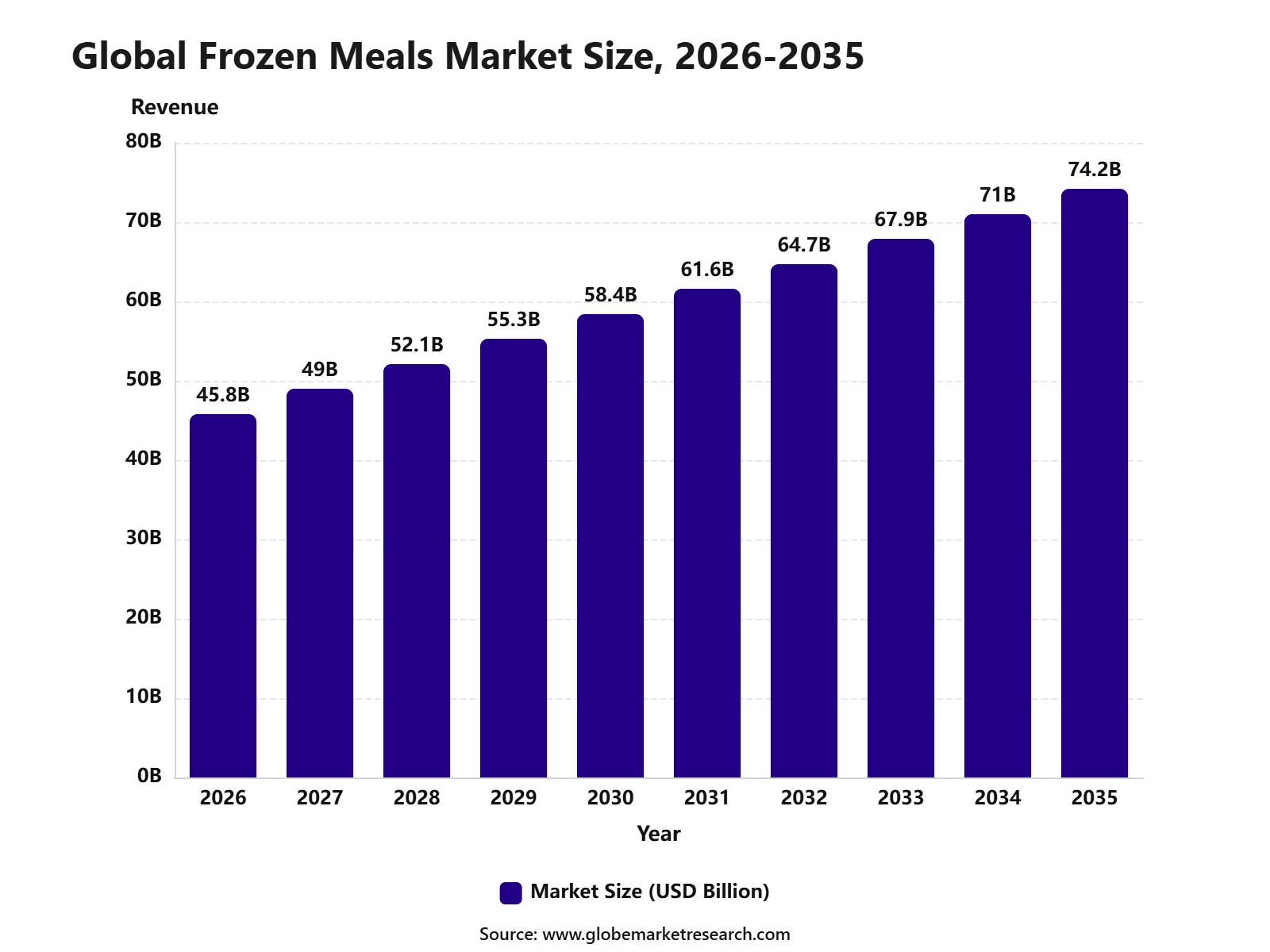 iThe graph shows projected market growth until 2035 based on CAGR analysis. Actual outcomes may vary depending on changing demand, competition, and economic factors.To gain greater insights - request a sample report PDF
Key Market Insights
Frozen products led the product segment with 45.5% share, supported by longer shelf life, easy storage, quick preparation, and strong demand from busy households.
Vegetarian frozen meals accounted for 45.6% share by meal type, driven by rising preference for plant-based, affordable, convenient, and ready-to-heat meal options.
Supermarkets and hypermarkets held 40.3% share by distribution channel, supported by organized frozen food sections, wide product availability, promotional offers, and regular grocery purchases.
North America led the frozen meals market with 40.5% share, valued at USD 18.5 billion, supported by mature frozen food consumption, busy lifestyles, strong retail networks, and high demand for convenient meal solutions.
Top Funding and Investment
Top Investments
In September 2025, Nomad Foods inaugurated a new production line at its Reken, Germany facility following an investment of approximately EUR 49 million (USD 56 million). The expansion increases manufacturing capacity for frozen ready meals and frozen convenience foods while improving automation and production efficiency across the site.
During fiscal 2025, Conagra Brands continued capital investments across its frozen food manufacturing network to expand production capacity for brands including Healthy Choice, Marie Callender's and Banquet. The program focused on automation, packaging upgrades and higher production efficiency to meet growing demand for frozen ready meals.
In 2025, Nestlé continued investing in its North American frozen foods manufacturing network to increase production capacity for Lean Cuisine, Stouffer's and Life Cuisine products. The investment focused on production modernization, automation and supply-chain improvements supporting frozen prepared meals. The investment amount was not separately disclosed.
In 2025, Ajinomoto Foods North America advanced manufacturing upgrades across its frozen meal production facilities to increase output of frozen rice meals, Asian prepared meals and appetizers. The investments included production-line improvements and automation to strengthen supply for retail and foodservice customers.
In 2025, Bellisio Foods continued investing in automation and production improvements across its frozen entrée manufacturing operations to increase production efficiency, packaging capability and product quality for single-serve frozen meals distributed throughout North America.
Top Funding
In April 2025, Swedish food technology company Hooked Foods secured a new equity financing round to expand its plant-based frozen seafood portfolio, accelerate research and development, and increase commercial production of frozen convenience products across Europe.
In June 2025, Anjoy Foods announced plans to raise approximately USD 336.3 million through a Hong Kong public offering. The proceeds are intended to expand frozen food production capacity, modernize manufacturing facilities and strengthen its cold-chain distribution network.
In February 2025, FroGo secured approximately USD 1.15 million in seed funding led by Inflection Point Ventures. The financing supports expansion of its temperature-controlled distribution network and cold-chain infrastructure serving frozen food manufacturers and retailers.
Top Acquisitions
In March 2026, Seneca Foods acquired the Green Giant U.S. frozen business from B&G Foods. The acquisition included the Green Giant frozen brand and intellectual property, frozen inventory, customer relationships, and the frozen vegetable manufacturing facility in Yuma, Arizona, together with a long-term supply agreement for selected frozen products.
As part of the same 2026 transaction, B&G Foods transferred its U.S. frozen vegetable business, including intellectual property, business assets, inventory, customer information and frozen manufacturing operations in Arizona, for approximately USD 63.2 million.
By Product
Frozen products accounted for 45.5% share of the Frozen Meals Market. This leading position is supported by strong demand for convenient, ready-to-heat, and longer-shelf-life meal options across households, retail stores, and foodservice channels.
The segment is widely preferred because frozen meals help preserve taste, texture, nutrition, and product freshness for extended periods. These products are commonly used for quick lunches, dinners, single-serve meals, family packs, and time-saving meal solutions.
Demand is expected to remain strong as busy lifestyles, urbanization, and working households continue to increase the need for easy meal preparation. Growth will be supported by frozen entrees, ready meals, ethnic food options, healthier recipes, and premium frozen meal formats.
By Meal Type
Vegetarian frozen meals accounted for 45.6% share of the Frozen Meals Market. This leading share is supported by rising demand for plant-based, meat-free, and vegetable-rich meal options among health-focused and flexitarian consumers.
The segment is widely preferred because vegetarian frozen meals offer convenience while supporting dietary preferences, affordability, and wider consumer acceptance. These meals include vegetable curries, pasta, rice dishes, pizzas, wraps, bowls, snacks, and plant-based protein meals.
Demand is expected to remain strong as consumers look for healthier, lighter, and sustainable ready-meal choices. Product innovation in plant-based ingredients, ethnic cuisines, clean-label recipes, and high-protein vegetarian meals will continue to support segment growth.
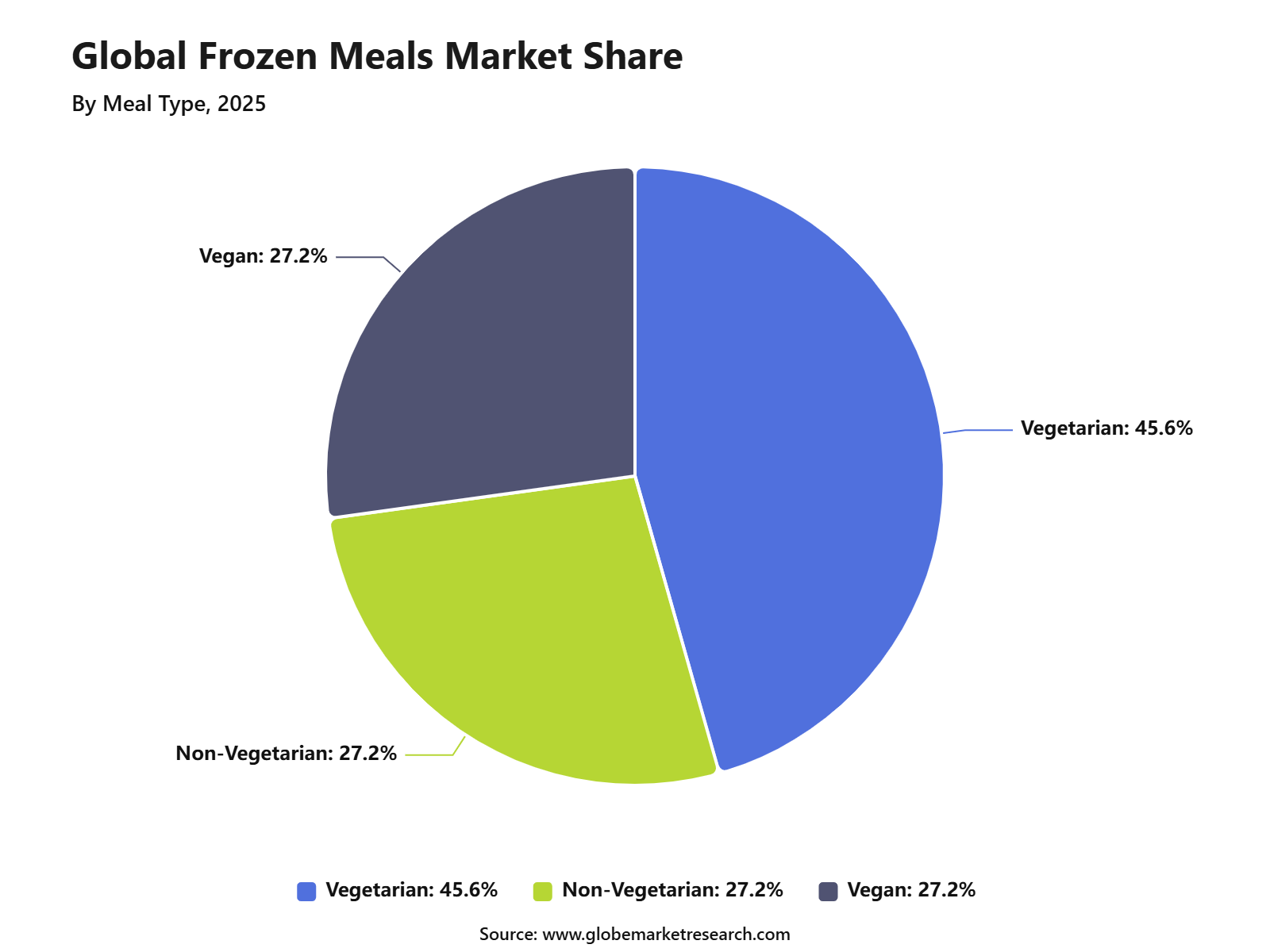 iThe graph shows projected market growth until 2035 based on CAGR analysis. Actual outcomes may vary depending on changing demand, competition, and economic factors.To gain greater insights - request a sample report PDF
By Distribution Channel
Supermarkets and hypermarkets accounted for 40.3% share of the Frozen Meals Market. This dominance is driven by wide product availability, large frozen food sections, competitive pricing, and consumer preference for one-stop grocery shopping.
The channel is important because frozen meals require proper cold-chain storage, product visibility, and trusted retail handling. Supermarkets and hypermarkets provide dedicated freezer aisles, promotional offers, private-label products, and broad brand choices across different meal categories.
Demand through this channel is expected to remain strong as consumers continue to purchase frozen meals during regular grocery trips. Growth will be supported by larger frozen assortments, premium meal ranges, vegetarian options, and improved in-store freezer infrastructure.
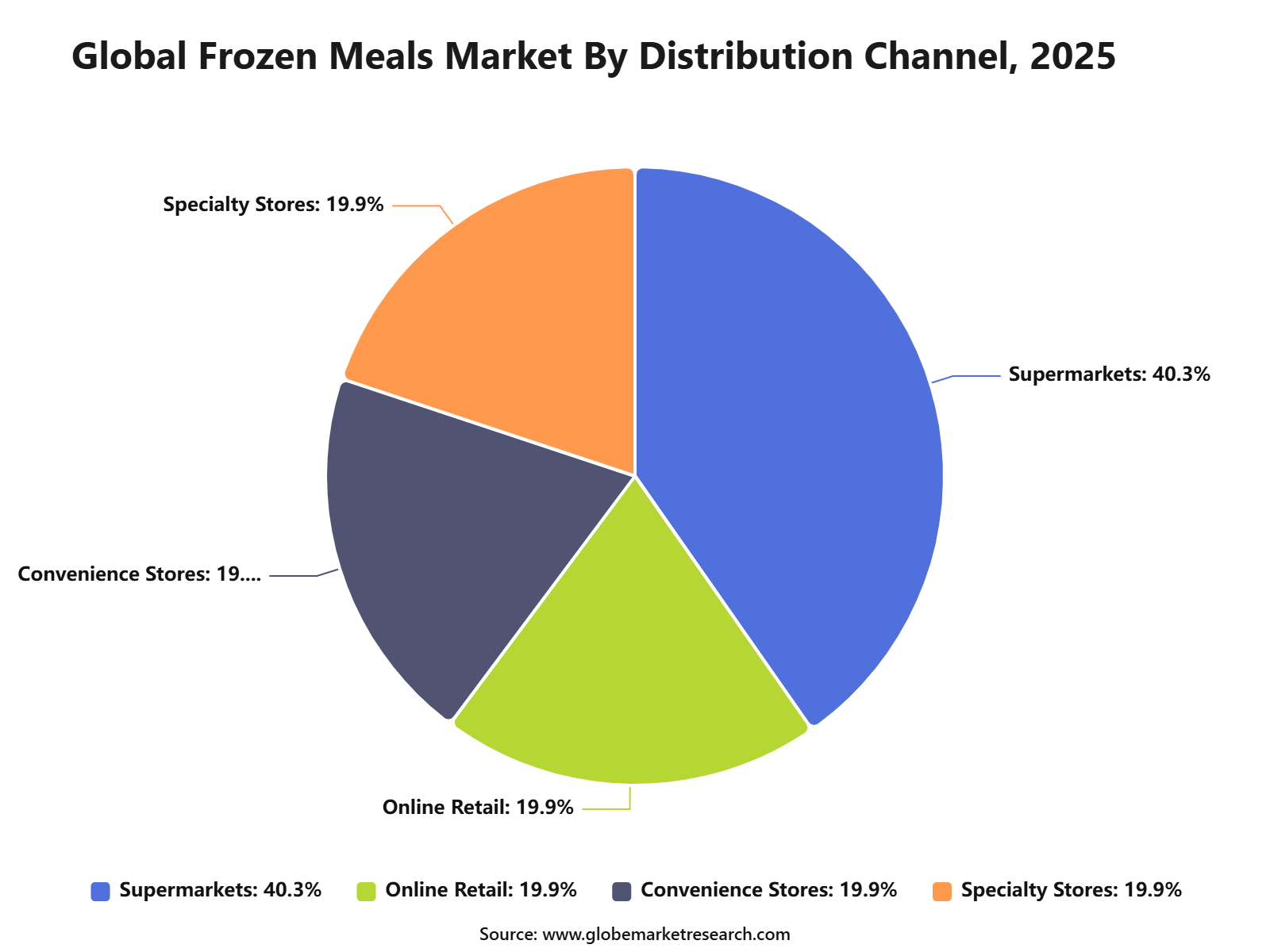 iThe graph shows projected market growth until 2035 based on CAGR analysis. Actual outcomes may vary depending on changing demand, competition, and economic factors.To gain greater insights - request a sample report PDF
By Region
North America accounted for 40.5% share of the Frozen Meals Market, reaching USD 18.5 billion. The region’s leadership is supported by high consumption of convenience foods, strong frozen food retail networks, busy consumer lifestyles, and established cold-chain infrastructure.
The United States and Canada are key contributors to regional demand. The region benefits from strong supermarket penetration, high household freezer usage, demand for ready-to-eat meals, and rising interest in vegetarian, healthy, and premium frozen meal products.
North America is expected to maintain its leading position as consumers continue to seek convenient meal solutions with better taste, nutrition, and variety. Demand will remain supported by frozen products, vegetarian meal options, supermarket and hypermarket sales, and continued innovation in ready-meal formats.
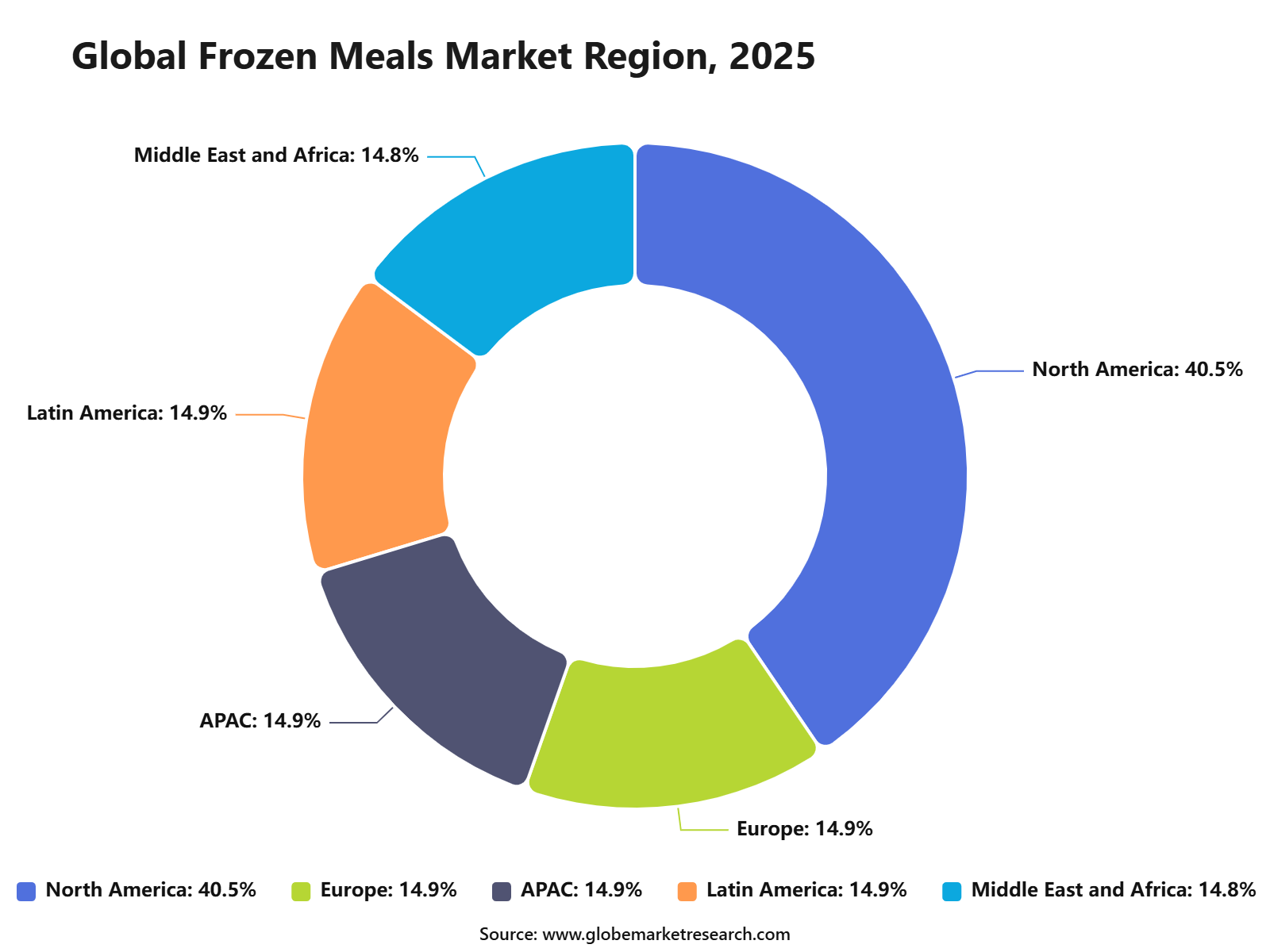 iThe graph shows projected market growth until 2035 based on CAGR analysis. Actual outcomes may vary depending on changing demand, competition, and economic factors.To gain greater insights - request a sample report PDF
Regional Impact Analysis
North America leads the Frozen Meals Market with 40.5% share in 2026, valued at around USD 18.5 billion, supported by high frozen food consumption, strong supermarket freezer sections, mature cold-chain systems, and strong demand for convenient meal options. The U.S. remains the main contributor due to established frozen meal brands and high household freezer usage.
Europe remains important because of demand for premium frozen meals, clean-label recipes, vegetarian products, and convenient ready meals. Asia Pacific supports future growth through rising urbanization, modern retail development, online grocery expansion, and increasing demand for quick meal solutions.
Impact Factor | Estimated CAGR Impact | Regional Relevance | Market Impact |
|---|---|---|---|
North America market leadership | +1.8% | North America, 40.5% share in 2026 | Leads global value demand. |
U.S. frozen food consumption | +1.4% | U.S. | Drives major regional revenue. |
Canada premium frozen meal demand | +0.9% | Canada | Supports steady category growth. |
Europe clean-label frozen meals | +0.8% | UK, Germany, France, Italy | Adds premium product demand. |
Asia Pacific modern retail expansion | +0.7% | China, India, Japan, Southeast Asia | Builds future market growth. |
Go-To-Market and Sales Economics
Frozen-meal producers should focus on supermarkets, mass retailers, convenience stores, online grocery platforms, and workplace food channels. Consumer positioning should emphasize convenience, portion control, dependable taste, and reduced preparation time. In 2026, 40% of U.S. consumers used frozen foods daily or every few days, compared with 35% in 2019.
Product portfolios should be organized around clear meal occasions, including family dinners, single-serve lunches, high-protein meals, vegetarian options, and internationally inspired recipes. Around 77% of frozen-food consumers purchased products for a specific meal or day in 2026. This supports targeted promotions, multipack formats, meal bundles, and demand-based retail assortment planning.
Sales economics should balance competitive pricing with reliable cold-chain execution and ingredient quality. USDA expects food-at-home prices to increase 2.8% during 2026, while food-away-from-home prices may rise 3.6%. Frozen meals can gain volume when they provide a lower-cost alternative to restaurant purchases without reducing portion size, taste, or nutritional value.
Risk Factors & Market Barriers
Cold-chain dependence remains a major operational barrier because product quality can decline when freezing temperatures are not maintained during storage, transport, or retail display. Producers must invest in temperature monitoring, backup power, qualified logistics partners, and retailer compliance systems. Any disruption can create spoilage, product rejection, consumer complaints, and costly inventory write-offs.
Food-safety failures can cause recalls, legal expenses, and long-term brand damage. The FDA’s 2026 recall programme included food products associated with powdered milk because of potential Salmonella contamination. Frozen-meal manufacturers must closely verify dairy powders, proteins, vegetables, sauces, and seasoning inputs, while maintaining environmental monitoring and complete supplier traceability.
Ingredient inflation can limit margins, particularly in products containing beef, vegetables, wheat, and dairy. USDA expects wholesale beef prices to increase 9.4%, farm-level vegetables by 27.6%, and wheat prices by 21.1% in 2026. Manufacturers may require flexible recipes, multiple suppliers, smaller package options, and carefully managed promotional spending.
Revenue Potential Analysis
Revenue Landscape Across
North America provides substantial revenue potential because frozen products are established within weekly household meal planning. The U.S. frozen-food industry was valued at approximately USD 93.5 billion in 2026. Revenue growth can be supported through premium single-serve meals, protein-rich recipes, ethnic cuisines, family packs, and products developed for air fryers.
Asia offers attractive expansion opportunities as urban consumers seek convenient foods that require limited preparation. Japan’s food-processing sector generated approximately USD 174 billion in 2025, with frozen foods identified among the categories recording growth. Localized flavors, smaller package sizes, seafood-based meals, rice dishes, and reliable regional distribution can strengthen customer acceptance.
Emerging Southeast Asian markets provide additional opportunities through expanding food manufacturing and modern retail networks. The Philippines’ food and beverage manufacturing sector is expected to grow by about 5% in 2026. Frozen-meal suppliers can benefit through local production partnerships, affordable meal formats, distributor coverage, and recipes aligned with regional tastes and household budgets.
Financial Impact
Frozen meals can improve household value perception by reducing preparation time, ingredient waste, and dependence on higher-priced restaurant food. USDA projects overall food prices to rise 3.2% in 2026. Brands offering complete meals at accessible price points can capture cost-conscious demand, although promotional discounts must be controlled carefully to protect gross margins.
Manufacturing profitability depends on plant utilization, energy efficiency, production scale, and accurate sales forecasting. Frozen inventories have longer commercial lives than chilled meals, but excessive stock still increases warehousing and electricity expenses. Producers should coordinate retailer orders, promotional calendars, manufacturing runs, and safety-stock levels to reduce working-capital pressure and prevent slow-moving inventory.
Ingredient substitution can materially influence financial performance. USDA expects egg prices to decrease 30.4% in 2026, while poultry prices are projected to rise by only 1.6%. These movements may support improved economics for breakfast meals, poultry-based dishes, and selected protein formulations, partly offsetting stronger inflation in beef, vegetables, and wheat.
Drivers Impact Analysis
The Frozen Meals Market is driven by rising demand for convenient, ready-to-heat food, busy lifestyles, dual-income households, urban living, and wider access to freezer-based retail formats. Frozen meals help consumers save preparation time while offering portion control, longer shelf life, and consistent product quality.
North America leads the market due to strong supermarket penetration, high frozen food consumption, mature cold-chain infrastructure, and broad availability of single-serve, family-size, vegetarian, high-protein, and ethnic frozen meals. The U.S. remains the main regional contributor because frozen meals are deeply integrated into household shopping behavior.
Impact Factor | Estimated CAGR Impact | Regional Relevance | Market Impact |
|---|---|---|---|
Rising demand for convenient meals | +1.7% | North America, Europe, Asia Pacific | Drives core frozen meal consumption. |
Growth in working households | +1.4% | U.S., Canada, urban Europe | Supports ready-to-heat food demand. |
Expansion of freezer retail space | +1.1% | Supermarkets and hypermarkets | Improves product availability. |
Demand for longer shelf-life foods | +0.9% | Global retail markets | Reduces household food waste. |
Growth in single-serve meal formats | +0.7% | Urban and young consumers | Supports portion-based consumption. |
Restraints Impact Analysis
The market faces restraints from consumer concerns about sodium, preservatives, artificial ingredients, and highly processed food perception. Some consumers still prefer fresh meals, meal kits, or restaurant delivery over frozen options.
Another restraint is high cold-chain cost. Frozen meals require controlled storage, refrigerated transport, freezer space, and reliable last-mile handling, which can increase cost for manufacturers, retailers, and online grocery platforms.
Impact Factor | Estimated CAGR Impact | Regional Relevance | Market Impact |
|---|---|---|---|
Processed food perception | -0.8% | North America and Europe | Limits health-conscious adoption. |
High sodium and additive concerns | -0.7% | Health-focused consumers | Pressures reformulation. |
Cold-chain logistics cost | -0.6% | Global frozen food supply chains | Raises operating expenses. |
Competition from fresh ready meals | -0.5% | Urban retail and foodservice | Reduces repeat purchase. |
Freezer storage limitation | -0.4% | Small households and urban stores | Limits basket size. |
Opportunities Impact Analysis
Opportunities are strong in premium frozen meals, clean-label recipes, high-protein products, plant-based meals, gluten-free meals, ethnic cuisines, vegetarian frozen meals, and family-size formats. These categories help brands move beyond basic convenience and build stronger value perception.
Higher-value opportunities are emerging in online grocery, subscription frozen meal boxes, diet-specific frozen meals, chef-inspired offerings, and healthy frozen bowls. Companies that improve nutrition, taste, texture, and packaging can capture stronger consumer loyalty.
Impact Factor | Estimated CAGR Impact | Regional Relevance | Market Impact |
|---|---|---|---|
Premium frozen meal growth | +1.6% | North America and Europe | Builds higher-margin demand. |
Clean-label frozen recipes | +1.3% | Health-conscious markets | Improves consumer trust. |
Plant-based and vegetarian meals | +1.1% | U.S., Canada, Europe | Adds fast-growing product formats. |
Ethnic and global cuisine meals | +0.9% | Urban consumer markets | Supports product differentiation. |
Online grocery frozen delivery | +0.7% | Developed digital retail markets | Expands purchase access. |
Challenges Impact Analysis
The main challenge is maintaining taste, texture, and nutritional quality after freezing, storage, and reheating. Frozen meals must perform well across microwave, oven, air fryer, and stovetop formats to meet consumer expectations.
Another challenge is balancing price with ingredient quality. Consumers want affordable frozen meals, but premium proteins, clean-label sauces, vegetables, and sustainable packaging can raise production costs.
Impact Factor | Estimated CAGR Impact | Regional Relevance | Market Impact |
|---|---|---|---|
Maintaining taste after reheating | -0.7% | Global frozen meal brands | Affects repeat purchase. |
Texture degradation risk | -0.6% | Pasta, rice, vegetables, proteins | Impacts product quality. |
Ingredient cost inflation | -0.5% | Meat, dairy, vegetables, packaging | Pressures margins. |
Freezer burn and storage quality issues | -0.4% | Retail and home storage | Reduces consumer satisfaction. |
Private-label price competition | -0.3% | Supermarket channels | Limits branded pricing power. |
Segment Covered in the Report
By Product
Frozen
Chilled
Canned
Shelf-Stable
By Meal Type
Vegetarian
Non-Vegetarian
Vegan
By Distribution Channel
Supermarkets and Hypermarkets
Online Retail
Convenience Stores
Specialty Stores
By Region
North America
Europe
Asia Pacific
Latin America
Middle East and Africa
Cold Chain Enables Market Growth
Cold-chain infrastructure is the most important factor driving the Frozen Meals Market because frozen products require uninterrupted temperature control from manufacturing to retail. According to the U.S. Department of Agriculture, the value of U.S. frozen food exports exceeded USD 9.5 billion, reflecting strong international demand supported by reliable refrigerated logistics. Efficient cold storage and transportation directly influence product safety, shelf life and market expansion.
Consumer spending on food also continues to support frozen meal demand. USDA reported total U.S. food expenditures reached approximately USD 2.51 trillion, including USD 1.41 trillion spent on food away from home and USD 1.10 trillion on food at home. As households continue purchasing convenient meal solutions, frozen food manufacturers are investing in automated freezing, sustainable packaging and modern distribution systems to improve product availability and operational efficiency.
Important Data | Numeric Value |
|---|---|
Total Food Expenditure | USD 2.51 trillion |
Food Away From Home | USD 1.41 trillion |
Food At Home | USD 1.10 trillion |
Frozen Food Export Value | USD 9.5 billion |
Food Away From Home Share | 56.3% |
Food At Home Share | 43.7% |
Disposable Income Spent On Food | 9.7% |
Market Trend Analysis
The market trend is moving toward healthier frozen meals, high-protein bowls, plant-based recipes, ethnic flavors, low-calorie options, premium ingredients, and convenient microwaveable packaging. Consumers are increasingly choosing frozen meals that offer both convenience and better nutrition.
North America remains the largest value region because of its mature frozen food category, strong retail freezer infrastructure, and high household acceptance. Europe supports demand through premium and clean-label meals, while Asia Pacific is growing through urbanization and modern retail expansion.
Impact Factor | Estimated CAGR Impact | Regional Relevance | Market Impact |
|---|---|---|---|
Health-focused frozen meals rise | +1.5% | North America and Europe | Supports premium product demand. |
High-protein meal formats grow | +1.2% | Fitness and wellness consumers | Adds value-led positioning. |
Ethnic frozen meals expand | +1.0% | U.S., Canada, UK, Australia | Improves product variety. |
Plant-based frozen meals gain adoption | +0.8% | Developed consumer markets | Supports vegetarian demand. |
Convenient packaging innovation grows | +0.6% | Retail and online grocery | Improves user experience. |
Investor Type Impact Matrix
Investors should focus on companies with strong frozen food manufacturing, cold-chain access, supermarket distribution, brand recognition, product innovation, and margin control. Taste, nutrition, convenience, packaging, and retail freezer placement are key success factors.
Strategic investors can also target frozen meal producers, plant-based frozen food companies, cold-chain logistics firms, private-label manufacturers, packaging innovators, and online grocery platforms. Companies that combine convenience with healthier recipes and reliable distribution are better positioned for long-term growth.
Investor Type | Estimated CAGR Impact | Regional Relevance | Market Impact |
|---|---|---|---|
Frozen Meal Producers | +1.3% | North America, Europe, Asia Pacific | Expands core product revenue. |
Plant-Based Frozen Food Companies | +1.0% | Developed consumer markets | Supports vegetarian meal growth. |
Cold-Chain Logistics Providers | +0.8% | Global frozen food supply chains | Improves distribution scale. |
Private-Label Manufacturers | +0.7% | Supermarket and hypermarket channels | Supports value-based demand. |
Strategic Food Investors | +0.5% | Global packaged food markets | Funds innovation and market expansion. |
Recent Developments
May 2026: Kraft Heinz expanded its frozen-potato portfolio through Ore-Ida Dino and Star Tater Tots, the brand’s first new permanent shapes in nearly twenty years, targeting family meals and freezer-aisle growth.
May 2026: Amy’s Kitchen secured distribution for organic frozen meals across more than 150 Costco warehouses, broadening household access while extending the company’s national retail reach in vegetarian, organic, and convenience-focused prepared foods.
November 2025: McCain Foods agreed to acquire Penobscot McCrum, adding a major North American supplier of frozen potato specialties and strengthening manufacturing capacity, customer service, sourcing flexibility, and its regional prepared-potato network.
Competitive Landscape
The market is characterized by intense competition among established players and emerging companies. Strategic partnerships, mergers and acquisitions, and product innovation are key strategies employed by market participants.
Key Market Players
Nestlé S.A.
Conagra Brands, Inc.
The Kraft Heinz Company
General Mills, Inc.
Tyson Foods, Inc.
Nomad Foods Limited
Ajinomoto Co., Inc.
McCain Foods Limited
Bellisio Foods, Inc.
Amy’s Kitchen, Inc.
Other Key Players
Research Methodology
This market study is prepared using a combination of primary and secondary research. Primary research includes discussions with manufacturers, suppliers, distributors, consultants, industry experts, and end users. Secondary research covers company reports, government databases, trade associations, technical publications, regulatory sources, and trusted industry documents. The collected information is used to assess market demand, pricing trends, technology adoption, competitive activity, and regional performance.
AI language models are not used as primary data sources, and publicly available AI-generated content is not treated as market evidence. Computational tools may be used to support data processing, translation, data classification, and pattern identification. However, every published assessment is supported by verified sources, human review, and primary market discussions.
Market estimates are developed through top-down and bottom-up approaches and validated using data triangulation. Revenue, production, shipment, pricing, and application-level data are compared across multiple sources. Forecasts consider economic conditions, regulatory changes, investment activity, innovation, supply chain developments, and industry risks. All findings are reviewed through source verification and internal quality checks before publication.
Part I
Source Management & Input Data Standards
Who provides data, how sources are qualified, and what types of evidence are admissible.
Part II
Research Scope & Market Coverage
How we define the markets we assess and the parameters that govern each product.
Part III
Data Collection, Verification & Submission
The mechanics of gathering, cross-checking, and hierarchically ranking evidence.
Part IV
Assessment Determination & Quality Controls
How raw data becomes a published assessment — normalisation, expert judgement, and outlier exclusion.
Part V
Publication, Corrections & Revision
Our publication schedule, corrections policy, and methodology review cycle.
Part VI
Independence, Ethics & Complaints
Conflict-of-interest policies, editorial independence, and how clients raise concerns.
Google · Preferred Sources
Don't miss the latest market research insights and industry updates on Google.
Add Globe Market Research as a preferred source in the Google app to see our reports, analysis, and market stories in your news suggestions.
Frequently Asked Questions
Related Reports
More in Food and Beverages
Refrigerated Ready Meals Market to Hit USD 355.8 Billion by 2035
Refrigerated Ready Meals Market Size, Share, Analysis By Product (Refrigerated Meals, Frozen Meals, Shelf-Stable Meals, Canned Meals), By Meal Type (Vegetarian, Non-Vegetarian, Vegan), By Distribution Channel (Supermarkets and Hypermarkets, Convenience Stores, Online Retail, Specialty Stores), By Regional Insights, Business plan and Project Report, Investment Opportunities, Profitability, Industry Trends, Leading Companies and Growth Forecasts by 2026-2035
Frozen Desserts Market to Hit USD 298.8 Billion by 2035
Frozen Desserts Market Size, Share, Analysis By Product (Ice Cream, Frozen Yogurt, Gelato, Sorbet, Frozen Cakes, Other Products), By Consumption (Retail Consumption, Foodservice Consumption), By Distribution Channel (Supermarkets and Hypermarkets, Convenience Stores, Specialty Stores, Online Retail), By Regional Insights, Business plan and Project Report, Investment Opportunities, Profitability, Industry Trends, Leading Companies and Growth Forecasts by 2026-2035
Frozen Meat and Seafood Market to Hit USD 181.1 Billion by 2035
Frozen Meat and Seafood Market Size, Share, Analysis By Product (Frozen Meat, Frozen Seafood), By Seafood Form (Whole, Fillets, Processed Seafood, Other Forms), By Seafood End Use (Retail and Household, Foodservice, Industrial), By Regional Insights, Business plan and Project Report, Investment Opportunities, Profitability, Industry Trends, Leading Companies and Growth Forecasts by 2026-2035
Food Colorants Market to Hit USD 8.6 Billion by 2035
Food Colorants Market Size, Share, Analysis By Type (Natural, Synthetic, Nature-Identical), By Form (Powder, Liquid, Gel), By Application (Beverages, Bakery and Confectionery, Dairy, Meat Products, Snacks, Other Applications), By Regional Insights, Business plan and Project Report, Investment Opportunities, Profitability, Industry Trends, Leading Companies and Growth Forecasts by 2026-2035