

Revenue, 2025
$ 112.6 Bn
Forecast, 2035
$ 264.1 Bn
CAGR, 2025-2035
8.9%
Report Coverage
Global
Market Size and Forecast
The Global Nutraceutical Ingredients Market was worth USD 112.6 billion in 2025 and is expected to reach USD 264.1 billion by 2035, growing at a CAGR of 8.9% from 2025 to 2035. Based on this growth rate, the market is estimated to reach around USD 127.8 billion in 2026. Asia Pacific held the largest regional share of 37.7% in 2025, supported by rising health awareness, strong dietary supplement consumption, growing functional food demand, and expanding wellness-focused product manufacturing.
Key Parameter | Report Details |
|---|---|
Market Revenue, 2025 | USD 112.6 Billion |
Projected Revenue, 2035 | USD 264.1 Billion |
CAGR (2025-2035) | 8.9% |
Largest Region | Asia Pacific |
Market Concentration | Medium |
Base Year | 2025 |
Forecast Period | 2025-2035 |
What is Nutraceutical Ingredients Market?
The Nutraceutical Ingredients Market includes bioactive ingredients used to improve nutritional value, support preventive health, and enhance the functional benefits of food, beverages, and supplements. These ingredients include vitamins, minerals, probiotics, prebiotics, proteins, amino acids, omega fatty acids, fibers, botanical extracts, and specialty nutrients. The market is closely linked with dietary supplements, fortified foods, sports nutrition, clinical nutrition, and personalized wellness products.
The market outlook remains strong as consumers continue to prefer preventive healthcare, clean-label nutrition, and functional daily-use products. Growth can be attributed to rising demand for immunity support, digestive health, heart health, weight management, and healthy aging solutions. The expansion of plant-based ingredients, probiotic formulations, and science-backed nutraceutical products is expected to support long-term market demand.
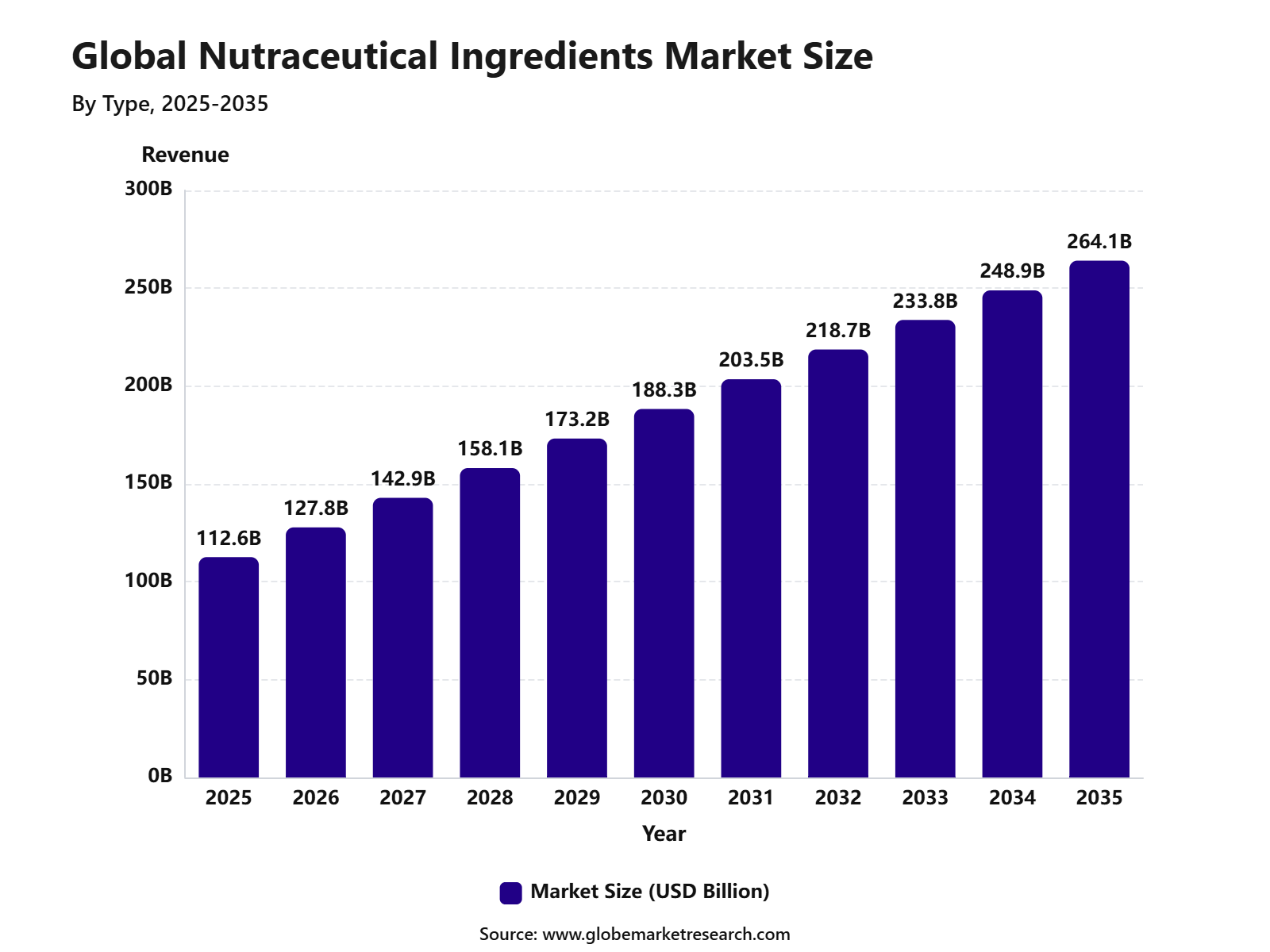 iThe graph shows projected market growth until 2035 based on CAGR analysis. Actual outcomes may vary depending on changing demand, competition, and economic factors.To gain greater insights - request a sample report PDF
Key Market Insights
Probiotics led the type segment with 31.2% share, supported by rising demand for digestive health, immunity support, gut microbiome balance, and functional nutrition products.
Powder form accounted for 69.1% share, driven by easy formulation, longer shelf life, better handling, and wide use in supplements, functional foods, and fortified beverages.
Dietary supplements held 42.9% share by application, supported by growing consumer focus on preventive health, daily nutrition, immunity, and wellness-based product consumption.
Asia Pacific led the nutraceutical ingredients market with 37.7% share, supported by rising health awareness, expanding supplement consumption, strong functional food demand, and growing middle-class spending across major regional markets.
Top Funding and Investment
Investment in the nutraceutical ingredients market is being led by botanical extracts, probiotic strains, prebiotics, bioavailability platforms, functional mushroom extracts, bioactive proteins, clean-label actives, and capsule delivery systems. Capital is moving toward science-backed ingredients with stronger clinical positioning, better absorption, cleaner labels, and scalable manufacturing.
In March 2026, Lonza signed an agreement to divest its Capsules & Health Ingredients business to Lone Star Funds for an enterprise value of CHF 2.3 billion, or about USD 3 billion. Lonza will receive CHF 1.7 billion in upfront proceeds and retain a 40% stake in the business. This deal is important for the nutraceutical ingredients market because CHI supplies capsule technologies and health ingredient delivery systems used across dietary supplements and nutrition products.
In June 2025, Danone acquired The Akkermansia Company, a Belgian biotics specialist with nearly 20 years of research history. The acquisition gives Danone access to Akkermansia muciniphila MucT, a patented next-generation biotic strain used in gut health and metabolic wellness research. This deal shows rising strategic interest in clinically backed microbiome ingredients, especially probiotics linked to gut barrier function, weight management, and cardiometabolic health.
In 2025, Botanic Healthcare raised INR 250 crore from Stakeboat Capital and Abakkus Four2Eight Opportunities Fund. The funds are being used to consolidate group entities and support global growth. Botanic Healthcare is active in organic extracts, plant extracts, essential oils, natural vitamins, natural minerals, carotenoids, liposomes, and branded nutraceutical ingredients, making this one of the most relevant investments in India’s botanical ingredient chain.
By Type
Probiotics accounted for 31.2% share of the Nutraceutical Ingredients Market. This leading position can be attributed to rising consumer interest in digestive health, immunity support, gut microbiome balance, and preventive wellness products. These ingredients are widely used in dietary supplements, functional foods, dairy products, beverages, infant nutrition, and clinical nutrition.
Their demand is supported by growing awareness of gut health and the role of beneficial bacteria in overall well-being. The segment is expected to remain strong as brands develop strain-specific probiotic products for immunity, women’s health, digestive support, and metabolic health. Product innovation in capsules, powders, gummies, and fortified foods will further support probiotic adoption.
By Form
Powder form held 69.1% share of the Nutraceutical Ingredients Market. Its dominance is supported by easier handling, longer shelf life, better blending ability, and suitability for large-scale manufacturing across supplements, functional foods, and beverages. Powder ingredients are widely used in protein blends, vitamin mixes, probiotic formulations, sports nutrition, meal replacements, and fortified food products.
This form allows manufacturers to improve dosage control, formulation stability, and product consistency. Demand for powder-based nutraceutical ingredients is expected to remain high because they are cost-efficient and flexible for multiple product formats. Their use is especially strong in sachets, tubs, capsules, tablets, drink mixes, and ready-to-mix nutrition products.
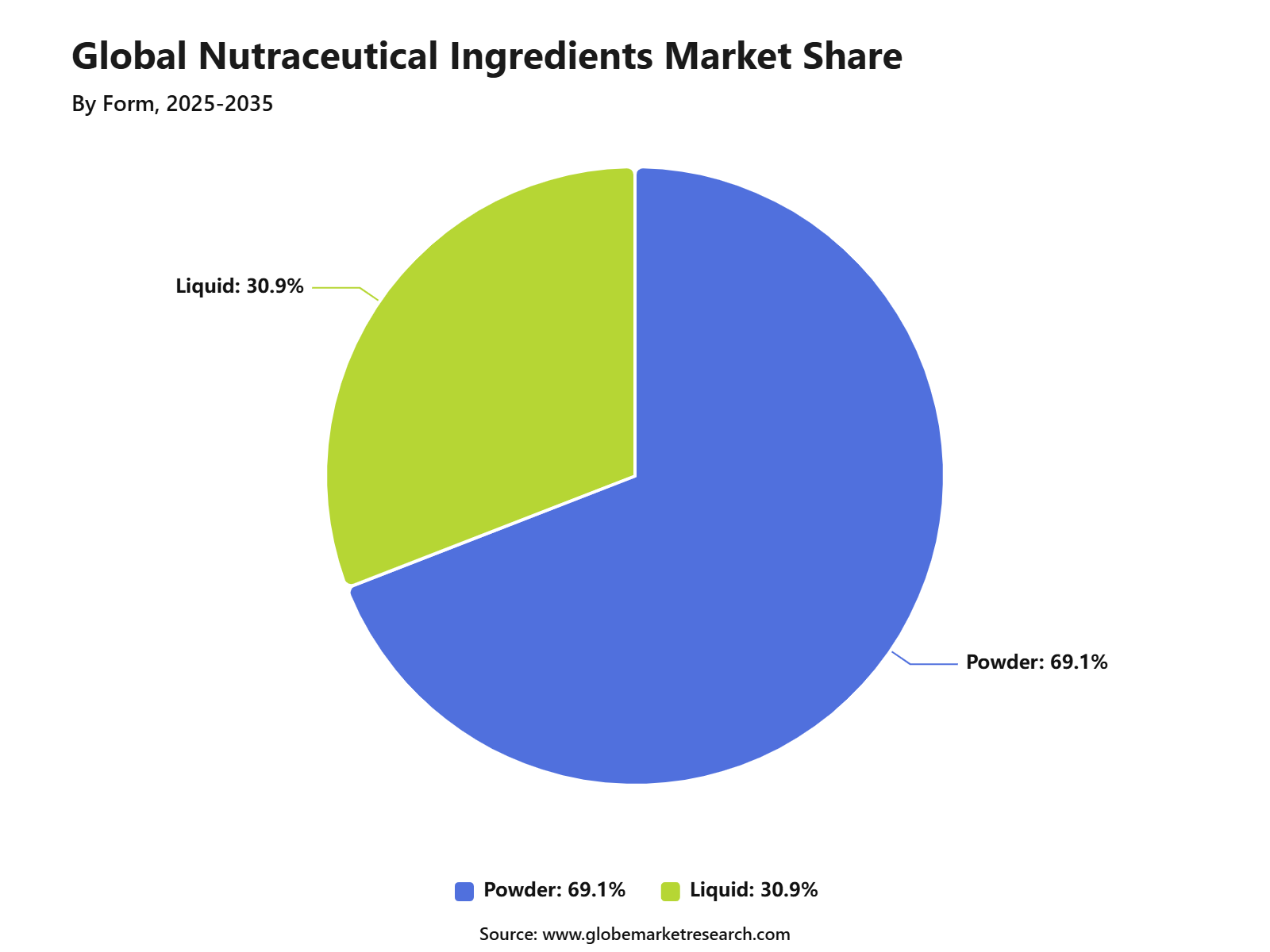 iThe graph shows projected market growth until 2035 based on CAGR analysis. Actual outcomes may vary depending on changing demand, competition, and economic factors.To gain greater insights - request a sample report PDF
By Application
Dietary supplements captured 42.9% share of the Nutraceutical Ingredients Market. This leading share is driven by rising use of vitamins, minerals, probiotics, amino acids, botanicals, fibers, omega ingredients, and specialty nutrients for daily health support. Consumers are increasingly using supplements for immunity, digestion, energy, bone health, heart health, weight management, and healthy aging.
This has encouraged manufacturers to launch targeted formulations with clean labels, convenient dosage forms, and science-backed ingredients. The segment is expected to remain a major demand center as preventive healthcare becomes more important. Capsules, tablets, gummies, powders, and liquid shots are supporting wider adoption among adults, elderly consumers, athletes, and health-focused households.
By Region
Asia Pacific accounted for 37.7% share of the Nutraceutical Ingredients Market, making it the leading regional market. Growth is supported by rising health awareness, expanding middle-class income, aging populations, and strong demand for functional foods and supplements. China, India, Japan, South Korea, Australia, and Southeast Asian countries are key demand centers.
The region benefits from strong traditional wellness practices, growing e-commerce access, and increasing use of fortified nutrition products across urban consumers. Asia Pacific is expected to maintain its leading position as preventive health spending, dietary supplement use, and functional food consumption continue to expand. Demand for probiotics, vitamins, herbal extracts, proteins, and immunity-focused ingredients will further support regional market growth.
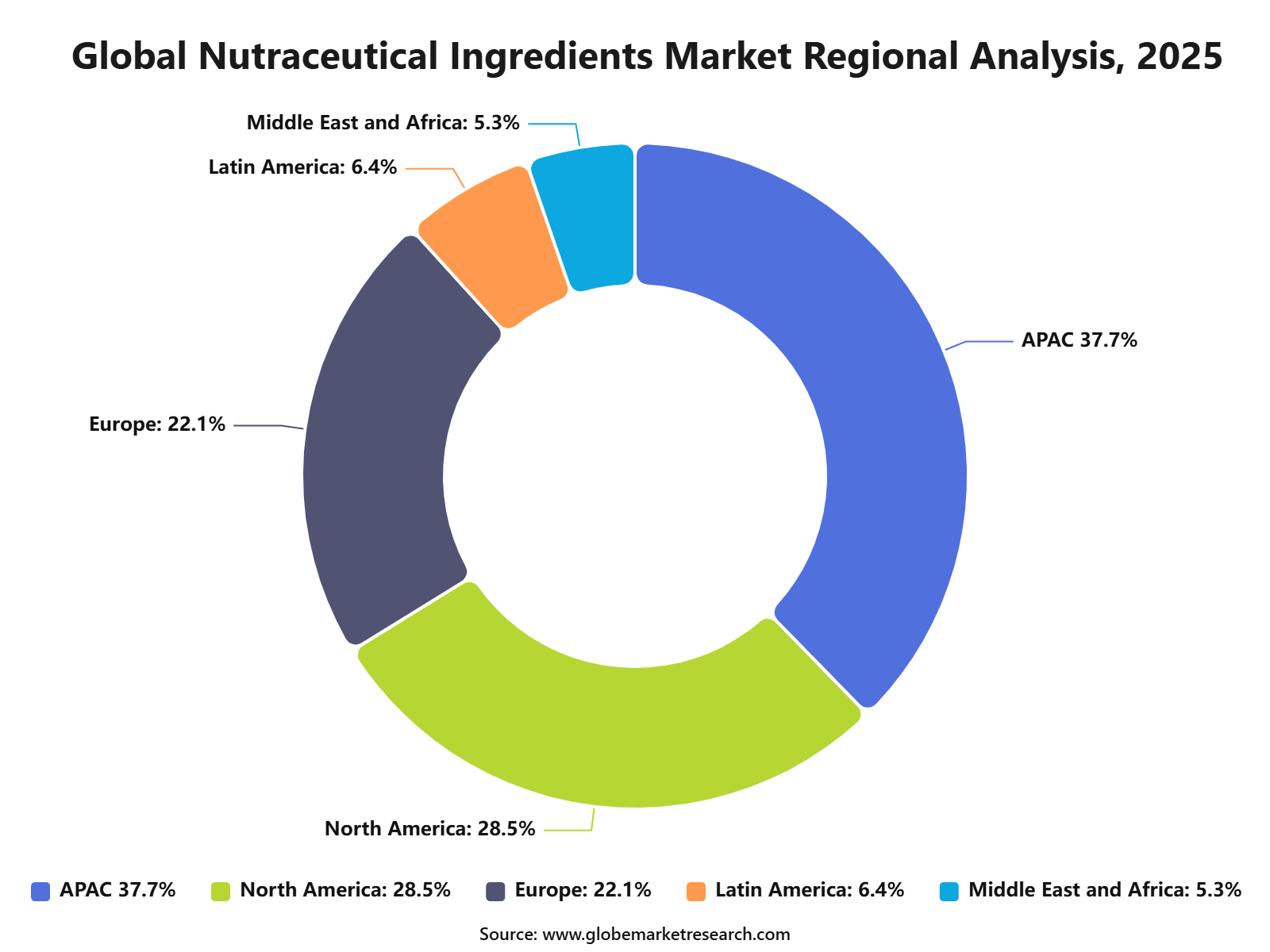 iThe graph shows projected market growth until 2035 based on CAGR analysis. Actual outcomes may vary depending on changing demand, competition, and economic factors.To gain greater insights - request a sample report PDF
Go-To-Market and Sales Economics
The Nutraceutical Ingredients Market is driven by demand for vitamins, minerals, amino acids, probiotics, prebiotics, omega-3 fatty acids, botanical extracts, fibers, enzymes, proteins, and functional lipids. These ingredients are mainly sold to dietary supplement brands, functional food makers, beverage companies, sports nutrition brands, contract manufacturers, and wellness-focused private labels. The go-to-market model is strongly B2B, where ingredient approval depends on purity, stability, clinical support, traceability, safety data, and label-claim suitability.
Sales economics are strongest when suppliers move beyond commodity ingredients and provide branded, clinically supported, or application-ready ingredients. Higher-value opportunities are seen in formats such as gummies, capsules, ready-to-mix powders, functional drinks, protein snacks, sachets, and personalized nutrition packs. In 2025, a U.S. consumer survey showed that probiotic supplements were purchased by 23% of millennials and 22% of Gen X consumers, while essential fatty acids such as fish oil showed steady purchase across age groups at 14% to 18%.
Risk Factors & Market Barriers
The main barriers are regulatory scrutiny, claim substantiation, adulteration risk, and ingredient quality variation. Nutraceutical ingredients must be supported by identity testing, purity testing, potency records, allergen controls, and supplier verification. FDA’s 2026 recall of honey dietary supplements with undeclared sildenafil and tadalafil shows the damage caused by illegal or hidden active substances.
Advertising and health-claim risk is also rising. FTC listed several 2026 actions linked with health claims, including actions involving dietary supplements for children and adults. This means brands and ingredient suppliers must avoid disease-treatment claims unless legally supported, while using careful wording for immunity, gut health, cognitive support, weight management, and energy benefits.
Supply-chain risk is important because many ingredients depend on botanical crops, marine oils, dairy proteins, fermentation inputs, vitamins, minerals, and specialty extraction systems. USDA reported May 2026 food prices were 3.1% higher than May 2025, while sugar and sweets prices rose 7.1%, affecting gummies, fortified foods, and flavored supplement formats.
Revenue Potential Analysis
Revenue Landscape Across
Revenue opportunities are strongest across vitamins, minerals, probiotics, prebiotics, omega-3, plant proteins, collagen, botanical extracts, enzymes, amino acids, fibers, carotenoids, and functional blends. NIH states that the U.S. dietary supplement market includes more than 100,000 products, showing wide formulation demand across capsule, tablet, powder, gummy, softgel, beverage, and food applications.
Functional food and beverage applications can expand ingredient revenue beyond traditional supplements. USDA forecasted 2026 food-at-home prices to increase 2.8%, while food-away-from-home prices are expected to rise 3.6%. This can support at-home wellness products such as fortified drinks, nutrition bars, protein powders, meal mixes, and digestive health products.
Regional revenue should remain stronger where supplement use, preventive wellness, aging populations, and e-commerce access are high. North America and Europe support premium validated ingredients, while Asia Pacific supports volume demand through functional foods, herbal traditions, beauty nutrition, and sports nutrition. Higher-value growth can come from personalized nutrition and clinically backed blends.
Financial Impact
The financial impact in 2026 will depend on ingredient sourcing, extraction yield, fermentation productivity, encapsulation cost, testing expense, packaging, freight, and regulatory documentation. FRED reported the U.S. vitamin, nutrient, and hematinic preparations index at 162.333 in May 2026, showing a measurable pricing base for nutrient-linked manufacturing inputs.
Margins can improve where suppliers sell branded ingredients, patented strains, standardized botanical extracts, specialty minerals, omega-3 concentrates, and clinically tested functional blends. Commodity vitamins and minerals may face stronger price pressure, while differentiated ingredients can support better unit economics through proof of efficacy, traceability, quality certification, and formulation support.
Financial returns can be strengthened through long-term contracts, dual sourcing, stability-tested formats, and customer-specific premixes. Producers that reduce batch failures, protect active potency, and maintain clean-label compatibility can improve profitability. Stronger returns are expected where ingredients are sold into supplements, functional beverages, medical nutrition, sports nutrition, and healthy-aging products.
Drivers Impact Analysis
The Nutraceutical Ingredients Market is driven by rising consumer interest in preventive health, immunity, digestive wellness, sports nutrition, healthy aging, weight management, and personalized nutrition. Ingredients such as vitamins, minerals, probiotics, prebiotics, proteins, omega fatty acids, amino acids, botanicals, and fibers are widely used in supplements, functional foods, beverages, and fortified products.
Asia Pacific leads the market due to strong demand for dietary supplements, traditional wellness ingredients, functional foods, and preventive healthcare products. China, India, Japan, South Korea, Australia, and Southeast Asia support growth through expanding middle-class income, aging populations, and higher health awareness.
Impact Factor | Estimated CAGR Impact | Regional Relevance | Market Impact |
|---|---|---|---|
Rising preventive healthcare demand | +2.3% | Asia Pacific, North America, Europe | Drives core growth. |
Growth in dietary supplements | +2.0% | China, India, U.S., Japan | Supports ingredient usage. |
Increasing demand for immunity products | +1.7% | Global consumer markets | Builds recurring demand. |
Expansion of functional foods and drinks | +1.5% | Asia Pacific, Europe, North America | Adds formulation volume. |
Healthy aging and digestive wellness trend | +1.2% | Japan, Europe, U.S., China | Supports premium ingredients. |
Restraints Impact Analysis
The market faces restraints from regulatory complexity, product claim restrictions, and quality control challenges. Nutraceutical ingredients are used in health-positioned products, so brands must manage safety, purity, labeling, dosage, and evidence-based claims. Raw material cost variation is another restraint, especially for botanical extracts, omega ingredients, probiotics, vitamins, and specialty proteins. Supply disruption, seasonal sourcing, and quality differences can affect pricing and product consistency.
Impact Factor | Estimated CAGR Impact | Regional Relevance | Market Impact |
|---|---|---|---|
Strict health claim regulations | -1.1% | North America, Europe, Japan | Limits marketing flexibility. |
Ingredient quality and purity concerns | -0.9% | Global supplement markets | Affects consumer trust. |
Raw material price volatility | -0.8% | Asia Pacific, Europe, North America | Pressures margins. |
Risk of adulteration in botanicals | -0.7% | Herbal and plant-based ingredients | Raises testing needs. |
Complex formulation stability | -0.6% | Functional food and beverage producers | Slows product development. |
Opportunities Impact Analysis
Opportunities are strong in probiotics, prebiotics, plant proteins, vitamins, minerals, omega fatty acids, botanical extracts, and personalized nutrition ingredients. These categories benefit from demand for gut health, immunity, heart health, energy, beauty-from-within, and active lifestyle products.
Higher-value growth is also emerging in clean-label and clinically supported ingredients. Companies that provide traceable sourcing, scientific backing, better bioavailability, and application support can capture stronger demand from supplement, food, beverage, and wellness brands.
Impact Factor | Estimated CAGR Impact | Regional Relevance | Market Impact |
|---|---|---|---|
Probiotic and prebiotic ingredient growth | +2.2% | Asia Pacific, Europe, North America | Builds digestive health demand. |
Plant-based protein expansion | +1.9% | Global nutrition markets | Supports clean-label products. |
Personalized nutrition ingredients | +1.6% | U.S., Europe, Japan, South Korea | Adds premium value. |
Botanical and herbal extract demand | +1.4% | India, China, Europe, U.S. | Supports natural positioning. |
High-bioavailability ingredient formats | +1.2% | Developed wellness markets | Improves product performance. |
Challenges Impact Analysis
The main challenge is proving ingredient effectiveness while maintaining affordability. Consumers want products that support real health benefits, but brands must balance scientific validation, dosage, taste, stability, and cost. Another challenge is meeting different regulatory and cultural expectations across regions. A botanical or probiotic ingredient accepted in one market may require different documentation, claims, or safety review in another market.
Impact Factor | Estimated CAGR Impact | Regional Relevance | Market Impact |
|---|---|---|---|
Proving clinical effectiveness | -1.0% | Global premium markets | Affects brand credibility. |
Managing ingredient stability | -0.8% | Food, beverage, supplement producers | Impacts product quality. |
Meeting regional compliance rules | -0.7% | U.S., Europe, Japan, China | Raises approval burden. |
Maintaining taste and texture | -0.6% | Functional foods and beverages | Affects repeat purchase. |
Controlling premium ingredient cost | -0.5% | Mass consumer markets | Limits broader adoption. |
Segment Covered in the Report
By Type
Prebiotics
Probiotics
Vitamin
Mineral
Proteins and Amino Acids
Omega-3 Ingredients
Others
By Form
Powder
Liquid
By Application
Functional Food
Functional Beverage
Dietary Supplements
Animal Nutrition
Others
By Region
North America
Europe
Asia Pacific
Latin America
Middle East and Africa
Market Trend Analysis
The market trend is moving toward probiotics, vitamins, minerals, proteins, amino acids, omega ingredients, fibers, and botanical extracts. Consumers are choosing ingredients that support immunity, digestion, heart health, bone health, energy, and mental wellness.
Clean-label, plant-based, sugar-reduced, and functional nutrition products are also shaping ingredient selection. Asia Pacific continues to lead volume demand, while North America and Europe support premium products with stronger clinical positioning and regulatory transparency.
Impact Factor | Estimated CAGR Impact | Regional Relevance | Market Impact |
|---|---|---|---|
Probiotics gain wider adoption | +2.1% | Asia Pacific, Europe, North America | Supports gut health demand. |
Vitamins and minerals remain essential | +1.8% | Global supplement markets | Leads daily nutrition usage. |
Plant-based ingredients gain traction | +1.6% | Europe, North America, Asia Pacific | Supports clean-label growth. |
Functional beverage formulations rise | +1.3% | Asia Pacific, U.S., Europe | Builds new product demand. |
Beauty-from-within ingredients expand | +1.1% | Japan, South Korea, China, Europe | Adds premium wellness use. |
Investor Type Impact Matrix
Investors should focus on nutraceutical ingredient companies with strong sourcing, quality testing, clinical support, formulation capability, and exposure to supplements, functional foods, beverages, and sports nutrition. These areas provide both volume and premium growth opportunities.
Strategic investors can also target probiotics, precision nutrition, plant proteins, botanical extracts, and high-bioavailability ingredient technologies. Companies that combine scientific backing, clean-label positioning, and supply reliability are better positioned for long-term growth.
Investor Type | Estimated CAGR Impact | Regional Relevance | Market Impact |
|---|---|---|---|
Nutraceutical Ingredient Producers | +2.0% | Global | Expands ingredient supply. |
Probiotic and Fermentation Companies | +1.7% | Asia Pacific, Europe, North America | Supports gut health demand. |
Functional Food and Beverage Suppliers | +1.4% | Asia Pacific, Europe, North America | Drives formulation use. |
Botanical Extract Manufacturers | +1.2% | India, China, Europe, U.S. | Builds natural product value. |
Strategic and Wellness Investors | +1.0% | Global wellness markets | Funds premium growth. |
Recent Developments
In 2026, FDA announced a public meeting on dietary supplement innovation and the scope of dietary ingredients. This is important for nutraceutical ingredient suppliers because new ingredients, postbiotics, botanicals, and novel delivery formats need clearer regulatory pathways before wider commercial adoption.
In 2026, Kerry highlighted Plenibiotic, a heat-inactivated rice-derived postbiotic for digestive comfort, especially for GLP-1 users. In Kerry’s four-week study of 233 U.S. adults using GLP-1 medications, 76% reported moderate to major digestive health improvement and 89% showed purchase interest.
In 2026, Lonza Capsugel released peer-reviewed research on Licaps DUOCAP capsule-in-capsule technology. The study showed up to four times higher enzyme activity in the upper small intestine compared with standard immediate-release capsules, supporting stronger delivery of acid-sensitive digestive enzyme ingredients.
Competitive Landscape
The market is characterized by intense competition among established players and emerging companies. Strategic partnerships, mergers and acquisitions, and product innovation are key strategies employed by market participants.
Key Market Players
Cargill, Incorporated
Archer Daniels Midland Company
DSM-Firmenich
BASF SE
International Flavors & Fragrances Inc.
Kerry Group plc
Ingredion Incorporated
Tate & Lyle PLC
Associated British Foods PLC
Amway Corporation
Lonza Group AG
Givaudan S.A.
Glanbia PLC
Corbion N.V.
Ajinomoto Co., Inc.
Novonesis A/S
Other Key Players
Research Methodology
This market study is prepared using a combination of primary and secondary research. Primary research includes discussions with manufacturers, suppliers, distributors, consultants, industry experts, and end users. Secondary research covers company reports, government databases, trade associations, technical publications, regulatory sources, and trusted industry documents. The collected information is used to assess market demand, pricing trends, technology adoption, competitive activity, and regional performance.
AI language models are not used as primary data sources, and publicly available AI-generated content is not treated as market evidence. Computational tools may be used to support data processing, translation, data classification, and pattern identification. However, every published assessment is supported by verified sources, human review, and primary market discussions.
Market estimates are developed through top-down and bottom-up approaches and validated using data triangulation. Revenue, production, shipment, pricing, and application-level data are compared across multiple sources. Forecasts consider economic conditions, regulatory changes, investment activity, innovation, supply chain developments, and industry risks. All findings are reviewed through source verification and internal quality checks before publication.
Part I
Source Management & Input Data Standards
Who provides data, how sources are qualified, and what types of evidence are admissible.
Part II
Research Scope & Market Coverage
How we define the markets we assess and the parameters that govern each product.
Part III
Data Collection, Verification & Submission
The mechanics of gathering, cross-checking, and hierarchically ranking evidence.
Part IV
Assessment Determination & Quality Controls
How raw data becomes a published assessment — normalisation, expert judgement, and outlier exclusion.
Part V
Publication, Corrections & Revision
Our publication schedule, corrections policy, and methodology review cycle.
Part VI
Independence, Ethics & Complaints
Conflict-of-interest policies, editorial independence, and how clients raise concerns.
Google · Preferred Sources
Don't miss the latest market research insights and industry updates on Google.
Add Globe Market Research as a preferred source in the Google app to see our reports, analysis, and market stories in your news suggestions.
Meet the Team
This report was prepared by our expert analysts with deep industry knowledge and research experience.
Pratiksha K. is a Senior Research Analyst with more than five years of experience in market research, industry analysis, competitive intelligence, and business strategy. She has contributed to detailed market reports, customized research studies, company profiling, market sizing, trend analysis, and strategic consulting projects for clients across different regions. Her industry expertise covers Chemical and Material, Consumer Goods, Food & Beverages and Energy & Power. She closely evaluates changing customer requirements, technology developments, regulatory conditions, supply chain structures, investment activity, and competitive strategies to provide clear and practical market insights.
Sayali brings more than 7 years of experience to Globe Market Research, supporting the accuracy, clarity, and relevance of research content across multiple industries. She reviews market data, segment analysis, competitive insights, and industry trends to ensure each report meets strong quality standards and provides practical value to business decision-makers. Her expertise spans healthcare, information technology, consumer goods, and diverse cross-industry domains. With a strong focus on data reliability, structured analysis, and clear presentation, Sayali helps ensure that each research output delivers well-reviewed insights for clients, investors, consultants, and industry stakeholders.
Frequently Asked Questions
Related Reports
More in Food and Beverages
Food Preservatives Market to Hit USD 8.0 Billion by 2035
Food Preservatives Market Size, Share, Analysis By Source (Natural, Synthetic), By Function (Antimicrobial, Antioxidant, Other Functions), By Application (Meat, Poultry and Seafood, Bakery, Dairy, Beverages, Snacks, Other Applications), By Regional Insights, Business plan and Project Report, Investment Opportunities, Profitability, Industry Trends, Leading Companies and Growth Forecasts by 2026-2035
Mezcal Market to Hit USD 6.1 Billion by 2035 | CAGR of 9.1%
Mezcal Market Size, Share, Analysis By Product (Joven, Reposado, Añejo, Others), By Formulation: (100% Agave, Blended Mezcal), By Distribution Channel (On-Trade, Off-Trade, Online Retail, Specialty Stores, Others), By Price Range (Premium / Luxury, Standard, Economy), By Regional Insights, Business plan and Project Report, Investment Opportunities, Profitability, Industry Trends, Leading Companies and Growth Forecasts by 2026-2035
Food Flavors and Enhancers Market to Hit USD 18.40 Bn by 2035 | CAGR of 6.1%
Food Flavors and Enhancers Market Size, Share, Analysis By Product Type (Glutamates, Yeast Extracts, Acidulants, Hydrolyzed Vegetable Protein, Others), By Source (Plant-Based, Synthetic, Microbial, Animal-Based, Others), By Application (Processed Foods, Soups & Sauces, Snacks, Meat Products, Beverages, Others), By Regional Insights, Business plan and Project Report, Investment Opportunities, Profitability, Industry Trends, Leading Companies and Growth Forecasts by 2026-2035
Ready-to-Cook Food Market to Hit USD 10.3 Bn by 2035 | CAGR of 8.1%
Ready-to-Cook Food Market Size, Share, Analysis By Product Type (Frozen Meals, Ready-to-Cook Mixes, Meal Kits, Instant Food Products, Others), By Distribution Channel (Supermarkets & Hypermarkets, Convenience Stores, Online Retail, Specialty Stores, Others), By End User (Household / Residential, Foodservice, Institutional, Others), By Cuisine Type (Western Cuisine, Asian Cuisine, Italian Cuisine, Indian Cuisine, Others), By Regional Insights, Business plan and Project Report, Investment Opportunities, Profitability, Industry Trends, Leading Companies and Growth Forecasts by 2026-2035