

Revenue, 2026
USD 10.80 Bn
Forecast, 2035
USD 18.40 Bn
CAGR, 2026-2035
6.1%
Report Coverage
Global
Market Size and Forecast
The Global Food Flavors and Enhancers Market was worth USD 10.80 billion in 2026 and is expected to reach USD 18.40 billion by 2035, growing at a CAGR of 6.1% from 2026 to 2035. Asia Pacific held the largest regional share of 40.8% in 2026, valued at around USD 4.4 billion, supported by rising packaged food consumption, strong food processing activity, and growing demand for taste-rich convenience products.
The Food Flavors and Enhancers Market includes natural flavors, synthetic flavors, flavor enhancers, yeast extracts, hydrolyzed vegetable proteins, acids, sweet flavor systems, savory flavor systems, and specialty taste modifiers. These ingredients are widely used in snacks, beverages, bakery products, dairy items, sauces, ready meals, processed meat, soups, noodles, and frozen foods.
Market growth is being supported by consumers seeking better taste, clean-label ingredients, ethnic flavors, and healthier processed foods. Demand is rising for natural flavor solutions, reduced-sodium enhancers, plant-based taste systems, sugar-reduction support, and customized flavor blends. Food brands are also using flavors and enhancers to improve product differentiation, repeat purchases, and sensory appeal.
Key Parameter | Report Details |
|---|---|
Market Revenue, 2026 | USD 10.80 Billion |
Projected Revenue, 2035 | USD 18.40 Billion |
CAGR (2026-2035) | 6.1% |
Largest Region | Asia Pacific (40.8%, USD 4.4 Bn) |
Market Concentration | Medium |
Base Year | 2025 |
Forecast Period | 2026-2035 |
Asia Pacific is expected to remain a leading region due to its large food manufacturing base, expanding middle-class population, and strong demand for packaged meals, snacks, beverages, and quick-service foods. Countries such as China, India, Japan, South Korea, and Southeast Asian markets are driving product innovation across sweet, savory, spicy, and functional food categories. Long-term growth will depend on ingredient transparency, regulatory compliance, cost control, natural formulation, and stronger demand for region-specific taste profiles.
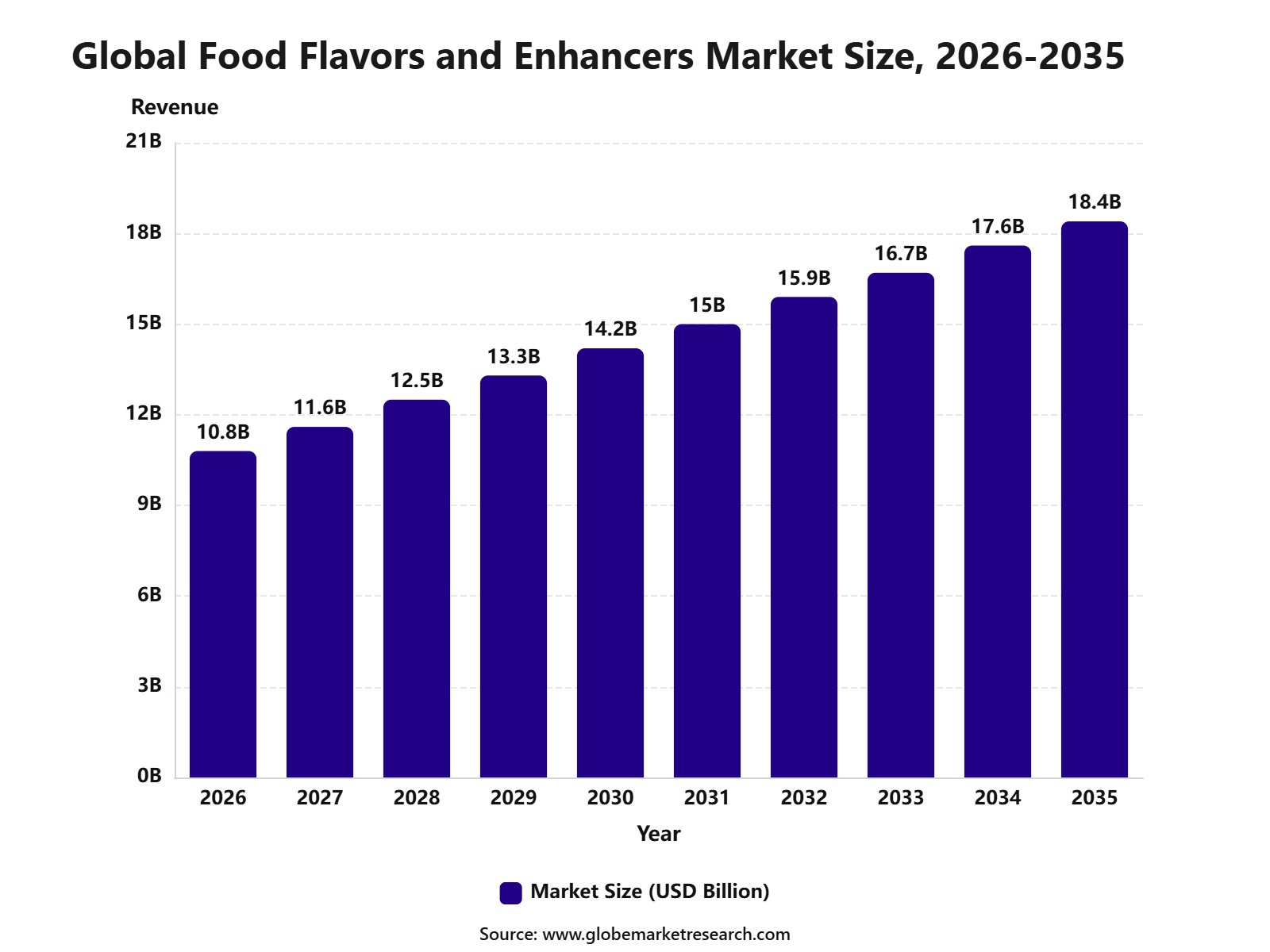 iThe graph shows projected market growth until 2035 based on CAGR analysis. Actual outcomes may vary depending on changing demand, competition, and economic factors.To gain greater insights - request a sample report PDF
Key Market Insights
Glutamates led the product type segment with 39.2% share, supported by their strong use in improving savory taste, umami flavor, and overall palatability in packaged and prepared foods.
Plant-based sources accounted for 45.6% share, driven by rising demand for natural, clean-label, and vegetarian-friendly flavor enhancement ingredients.
Processed foods held 37.2% share by application, supported by high use of flavors and enhancers in snacks, ready meals, sauces, soups, noodles, and convenience food products.
Asia Pacific led the food flavors and enhancers market with 40.8% share, valued at USD 4.4 billion, supported by strong processed food consumption, expanding food manufacturing, and rising demand for flavorful packaged products across China, India, Japan, and Southeast Asia.
Top Funding and Investment
Top Investments
In October 2025, Givaudan began constructing a new Taste & Wellbeing production facility near Cincinnati, Ohio, supported by a CHF 187 million investment. The plant will strengthen North American production of liquid and powdered flavor solutions for food and beverage manufacturers.
In April 2025, MANE opened a new liquid-flavor manufacturing facility in Lebanon, Ohio, following an investment exceeding USD 100 million. The approximately 100,000-square-foot plant can produce up to 15,000 metric tons annually, providing nearly five times MANE’s previous regional liquid-flavor capacity.
In December 2025, MANE announced the second phase of its production facility in Pinghu, China, representing a total investment of USD 70 million. The 14,000-square-metre expansion will increase localized production of flavors and ingredients for food and beverage customers across China and wider Asian markets.
In July 2025, T. Hasegawa disclosed plans to invest approximately JPY 6 billion in its Fukaya plant in Saitama Prefecture, Japan, by the fiscal year ending September 2026. The investment will replace aging infrastructure, improve automation and strengthen domestic flavor-production capabilities.
In January 2026, ADM announced a USD 26 million investment to upgrade its flagship flavor facility in Erlanger, Kentucky. This followed a separate USD 15 million investment in 2025 that expanded its customer innovation centre by 7,200 square feet, supporting flavor, taste and color reformulation projects.
Top Funding Rounds
In June 2025, Tastewise raised USD 50 million in Series B funding. The company provides an AI-based intelligence platform that helps food and beverage businesses identify emerging consumer tastes, ingredients, recipes and flavor combinations, supporting faster product development and commercialization decisions.
In June 2025, French food-technology company Fungu’it raised EUR 4 million in a round led by Asterion Ventures, with participation from Evolem and UI Investissement. The capital will fund an industrial pilot plant for natural flavorings produced through solid-state fungal fermentation of agricultural materials.
In September 2025, SUMM Ingredients raised EUR 1.7 million, approximately USD 2 million, from EIFO, BoxOne and existing investors. The funding is supporting the commercial launch of FermiPro, a fermented multifunctional ingredient designed to improve umami taste, texture, nutrition and juiciness in food formulations.
Top Acquisitions
In September 2025, CAPOL acquired Blue Pacific Flavors, a California-based developer of natural and organic flavor systems. CAPOL obtained Blue Pacific’s flavor-development capabilities, customer relationships, application expertise and portfolio of natural flavor solutions for beverages, bakery, dairy, confectionery and nutritional products. Financial terms were not disclosed.
In December 2025, Prodalim acquired René Laurent from International Flavors & Fragrances. The acquisition added René Laurent’s beverage-flavor operations, specialist formulation knowledge and customized natural flavor portfolio covering syrups, liqueurs, coffee and other beverage applications. The transaction value was not publicly disclosed.
By Product Type
Glutamates accounted for 39.2% share of the Food Flavors and Enhancers Market. This leading position is supported by their strong ability to improve savory taste, depth, and overall flavor balance in processed and packaged food products.
The segment is widely used in soups, sauces, snacks, noodles, ready meals, seasonings, meat products, frozen foods, and convenience meals. Glutamates help enhance umami taste, improve palatability, and reduce the need for excessive salt in certain formulations.
Demand is expected to remain strong as food manufacturers focus on taste consistency, cost-efficient flavor improvement, and product differentiation. The high use of glutamates in processed foods and convenience meals will continue to support segment leadership.
By Source
Plant-based sources held 45.6% share of the Food Flavors and Enhancers Market. This dominance is driven by rising preference for ingredients derived from vegetables, grains, fruits, herbs, spices, yeast, and other botanical sources.
Plant-based flavors and enhancers are widely used because they support clean-label positioning, vegetarian formulations, and growing consumer demand for natural-origin ingredients. These sources are used in snacks, beverages, sauces, bakery products, dairy alternatives, meat substitutes, and ready-to-eat foods.
The segment is expected to maintain a strong position as brands continue to reformulate products with plant-derived taste solutions. Demand will remain supported by vegan food innovation, natural flavor claims, and wider use of botanical extracts in packaged foods.
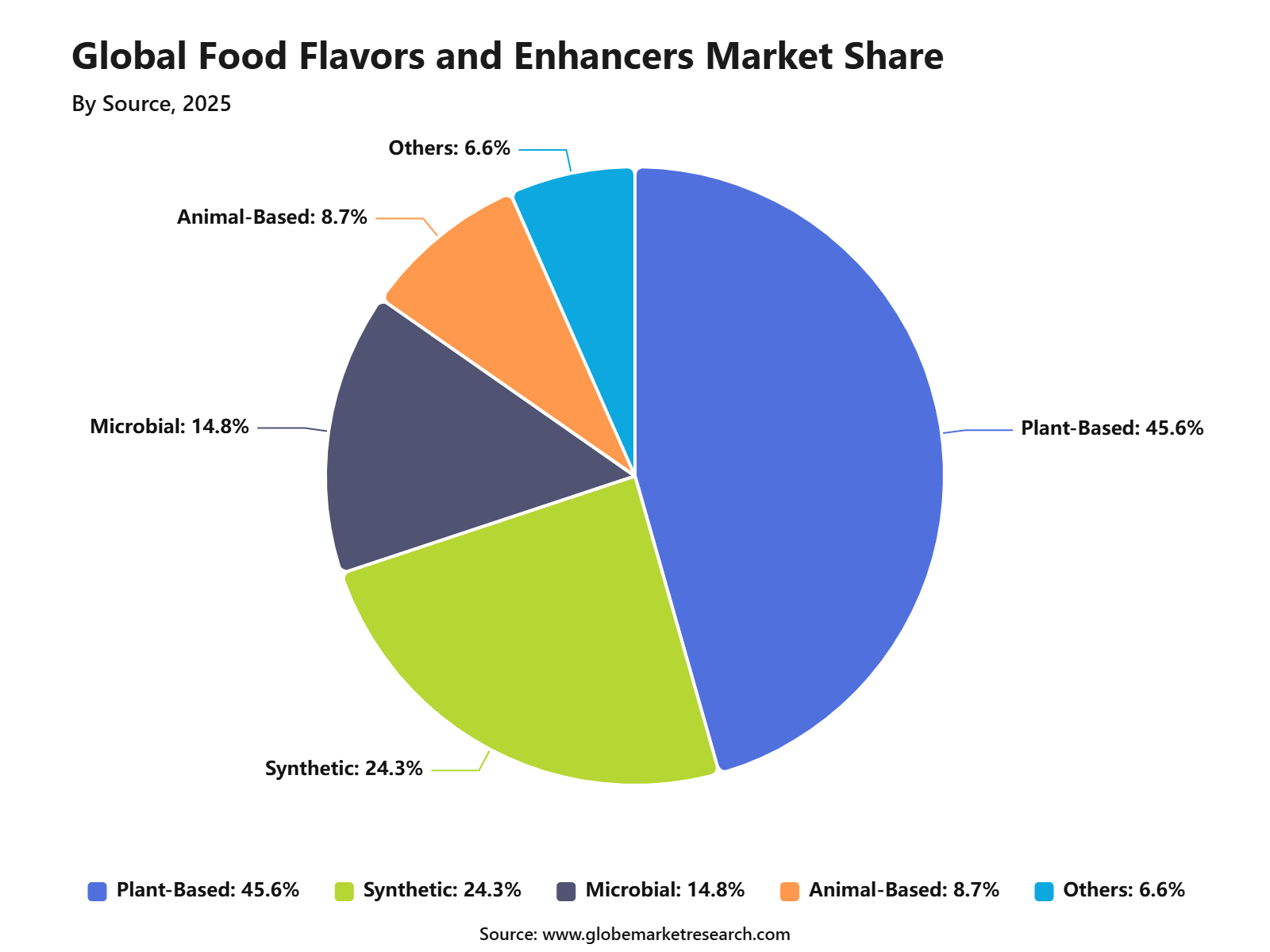 iThe graph shows projected market growth until 2035 based on CAGR analysis. Actual outcomes may vary depending on changing demand, competition, and economic factors.To gain greater insights - request a sample report PDF
By Application
Processed foods accounted for 37.2% share of the Food Flavors and Enhancers Market. This leading share is supported by high use of flavor ingredients in packaged meals, snacks, sauces, soups, bakery products, dairy products, frozen foods, and instant food items.
Flavors and enhancers are important in processed foods because they improve taste, aroma, mouthfeel, and product appeal. They also help maintain consistent flavor quality across large production batches and different storage conditions.
Demand from processed foods is expected to remain strong as consumers continue to seek convenient, affordable, and tasty food options. Growth will be supported by urban lifestyles, ready-to-eat meals, snack consumption, and product innovation in healthier processed food formats.
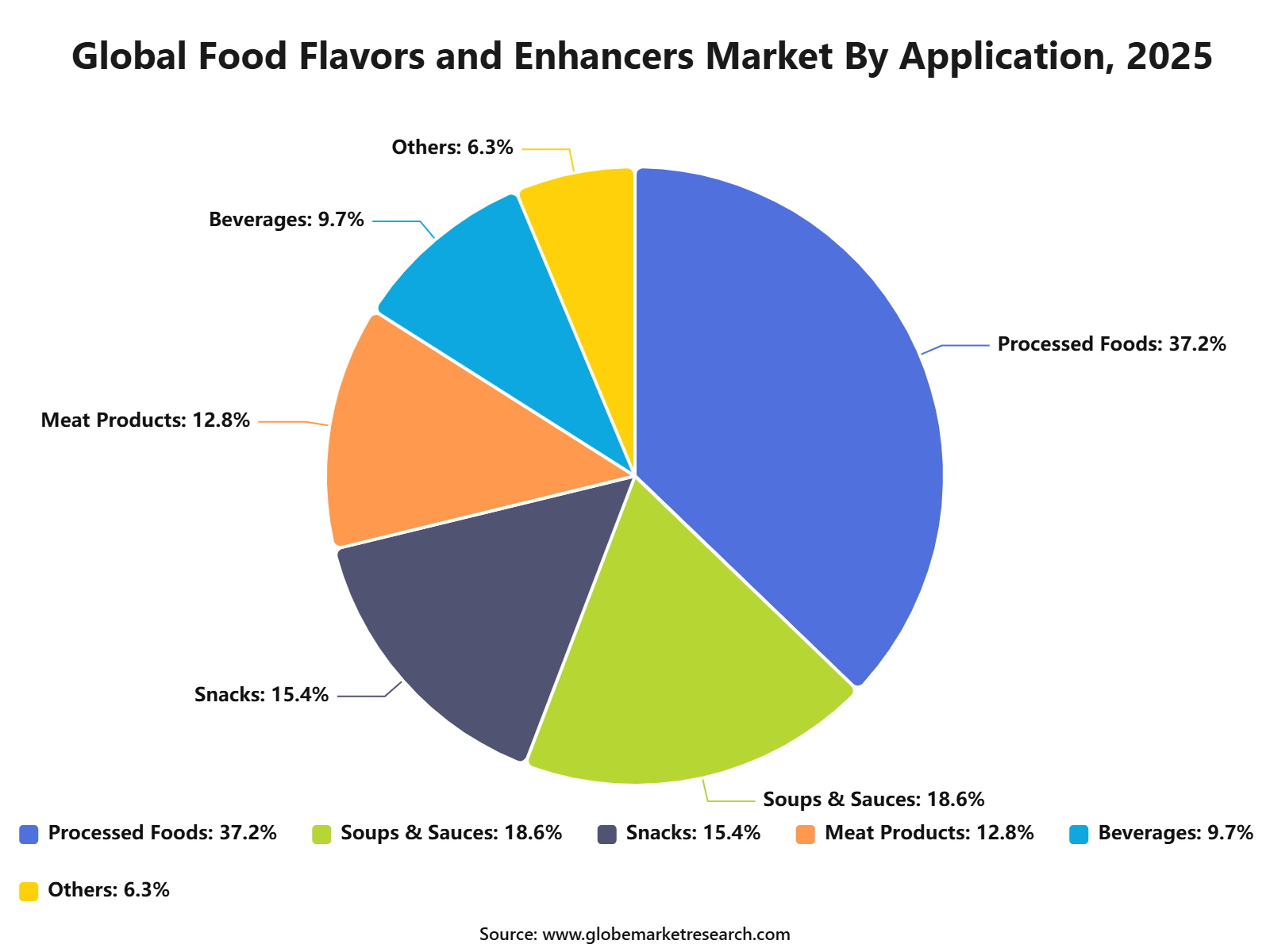 iThe graph shows projected market growth until 2035 based on CAGR analysis. Actual outcomes may vary depending on changing demand, competition, and economic factors.To gain greater insights - request a sample report PDF
By Region
Asia Pacific accounted for 40.8% share of the Food Flavors and Enhancers Market, reaching USD 4.4 billion. The region’s leadership is supported by large food processing capacity, rising packaged food consumption, and strong demand for savory, spicy, and regional flavor profiles.
China, India, Japan, South Korea, Indonesia, Thailand, Vietnam, and other Southeast Asian countries are key contributors to regional demand. The region benefits from strong consumption of noodles, sauces, snacks, ready meals, seasonings, beverages, and convenience foods.
Asia Pacific is expected to maintain its leading position as food manufacturers expand plant-based flavors, glutamate-based enhancers, and localized taste solutions. Demand will remain supported by processed food growth, modern retail expansion, rising income levels, and increasing preference for convenient packaged foods.
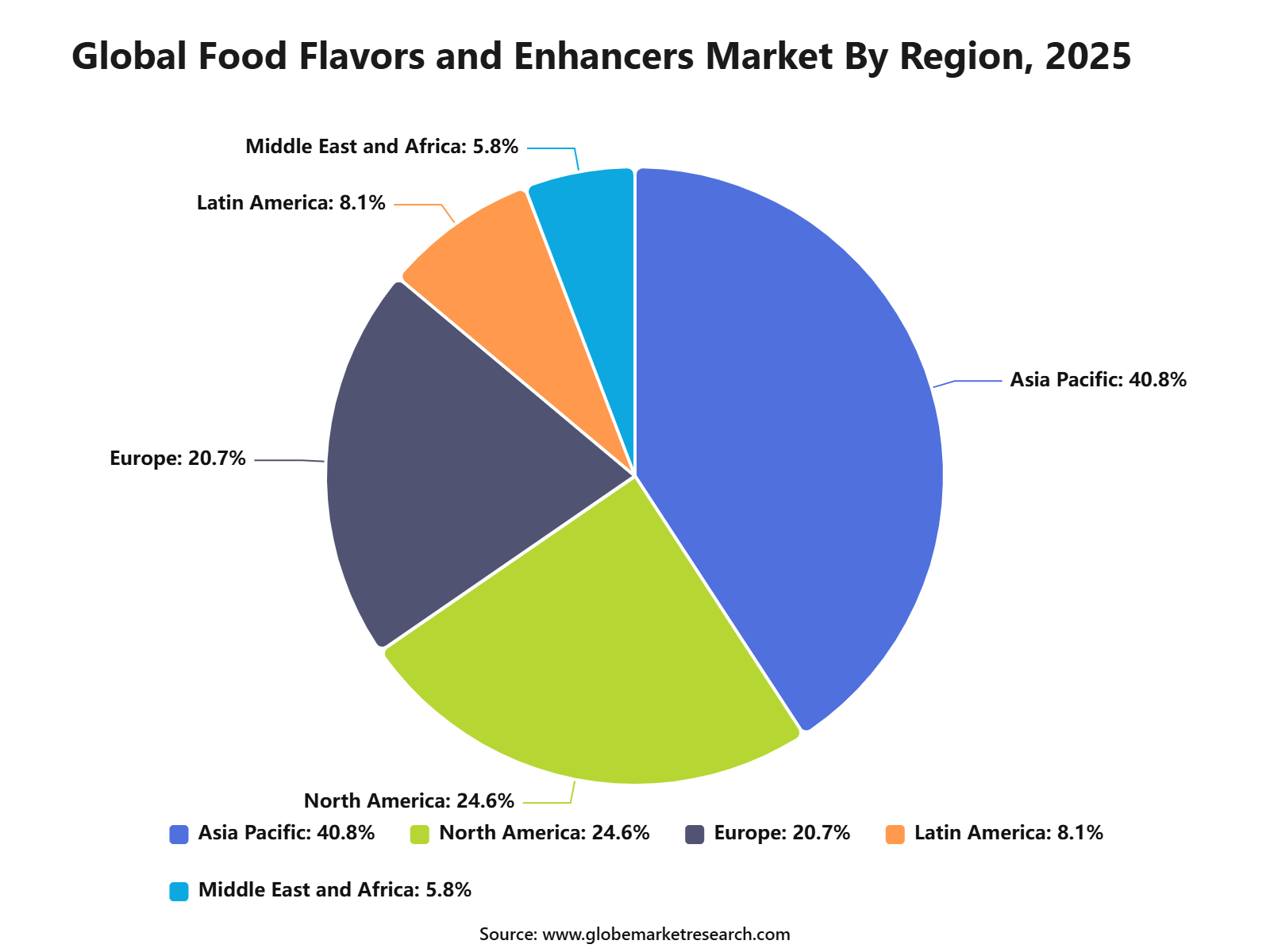 iThe graph shows projected market growth until 2035 based on CAGR analysis. Actual outcomes may vary depending on changing demand, competition, and economic factors.To gain greater insights - request a sample report PDF
Regional Impact Analysis
Asia Pacific leads the Food Flavors and Enhancers Market with 40.8% share in 2026, valued at around USD 4.4 billion, supported by packaged food growth, large food manufacturing capacity, and strong demand for regional taste profiles. China, India, Japan, South Korea, Indonesia, Thailand, and Vietnam remain key regional markets.
North America remains important because of processed food innovation, snack consumption, beverage launches, and demand for clean-label flavor systems. Europe supports value growth through natural ingredients, regulatory compliance, premium food products, and sodium-reduction reformulation.
Impact Factor | Estimated CAGR Impact | Regional Relevance | Market Impact |
|---|---|---|---|
Asia Pacific market leadership | +2.1% | Asia Pacific, 40.8% share in 2026 | Leads global value demand. |
China packaged food scale | +1.5% | China | Drives regional consumption. |
India snack and convenience food growth | +1.2% | India | Supports future demand expansion. |
Japan and South Korea premium flavors | +0.9% | Japan, South Korea | Adds high-value formulation demand. |
North America and Europe clean-label demand | +0.7% | U.S., Canada, Germany, France, UK | Supports natural flavor growth. |
Go-To-Market and Sales Economics
Food flavor and enhancer suppliers should prioritise direct sales to beverage, dairy, snack, bakery, culinary, and prepared-food manufacturers. IFF reported first-quarter 2026 Taste sales of USD 656 million, with comparable currency-neutral growth of 2% across all regions. Co-development, sensory testing, reformulation support, and rapid sample delivery can improve qualification rates and recurring orders.
Regional manufacturing should be placed close to food-processing clusters and major customers. In July 2026, Givaudan opened a CHF 50 million facility in Indonesia covering 24,000 square metres, designed to produce savory, sweet, and snack flavor powders. Local capacity can shorten lead times, reduce freight exposure, and improve responsiveness to regional taste preferences.
Sales teams should combine key-account management with culinary studios, distributor coverage, and digital customer tools. U.S. retail and food-services sales reached USD 763.7 billion in May 2026, increasing 6.9% annually. Suppliers can segment opportunities by application, offer small development batches, and support customers with trend insights, menu concepts, and production-scale validation.
Risk Factors & Market Barriers
Food inflation can delay customer launches and intensify price negotiations across flavor systems and enhancers. USDA expects total food prices to rise 3.2% in 2026, including 2.8% for food consumed at home and 3.6% for foodservice. Indexed contracts, formulation flexibility, alternative raw materials, and productivity savings are required to protect supplier margins.
Regulatory scrutiny creates additional testing, documentation, and reformulation requirements. FDA’s 2026 priorities include an added-sugar reduction strategy, an evaluation of voluntary sodium targets, and online grocery-labelling guidance. Flavor companies must validate taste-modulation claims, approved use levels, allergen information, and ingredient declarations while ensuring that reduced-sugar or reduced-sodium products remain acceptable to consumers.
Natural flavor supply chains face traceability and agricultural sourcing risks. The EU Deforestation Regulation will apply to large and medium operators from 30 December 2026, affecting commodities including cocoa, coffee, palm oil, and soy. Suppliers should map origins, maintain due-diligence records, qualify secondary sources, and strengthen inventory planning for affected extracts, carriers, and derivatives.
Revenue Potential Analysis
Revenue Landscape Across
Snack, dairy, and natural-colour applications offer strong near-term revenue potential. Givaudan generated CHF 871 million from Taste & Wellbeing in the first quarter of 2026 and reported solid growth in snacks, dairy, and natural colours. Suppliers can expand account value through seasoning blends, masking systems, sweetness enhancement, mouthfeel solutions, and application-specific flavor delivery technologies.
Savory seasonings and umami solutions provide a substantial revenue channel across instant foods, sauces, noodles, meat products, and foodservice formulations. Ajinomoto’s Seasonings and Foods segment recorded sales of JPY 936.9 billion for the year ended March 2026, increasing 4.6%. Customized solutions, local culinary profiles, and manufacturing consistency can support higher contract retention.
Asia Pacific provides attractive expansion opportunities, although demand differs by region and application. Givaudan’s first-quarter 2026 Taste & Wellbeing sales increased 4.1% like for like in Asia Pacific, compared with 0.1% growth in North America and a 0.4% decline in Europe. Local innovation centres and market-specific portfolios can improve regional performance.
Financial Impact
High-value flavor systems can generate attractive margins when pricing, volume, and productivity are managed together. IFF’s Taste segment produced first-quarter 2026 adjusted operating EBITDA of USD 153 million and a 23.3% margin, while comparable EBITDA increased 18%. Premium natural flavors, taste modulation, and technical services can strengthen contribution margins and customer switching costs.
Seasoning businesses can convert moderate sales growth into stronger earnings through pricing and manufacturing efficiency. Ajinomoto reported JPY 143.0 billion of business profit from Seasonings and Foods for the year ended March 2026, increasing 6.6%. However, overseas profit faced raw-material cost pressure, reinforcing the need for procurement discipline, formula optimisation, and timely price recovery.
Foreign exchange, freight, and energy costs can reduce reported profitability even when underlying demand remains positive. dsm-firmenich reported first-quarter 2026 sales of EUR 2.276 billion, adjusted EBITDA of EUR 434 million, and a 19.1% margin, while currency had a 6% negative sales impact. Regional production and disciplined working-capital management can improve resilience.
Drivers Impact Analysis
The Food Flavors and Enhancers Market is driven by rising demand for processed foods, ready meals, snacks, beverages, bakery products, dairy items, and convenience foods. Flavors and enhancers help improve taste, aroma, mouthfeel, product identity, and consumer acceptance.
Asia Pacific leads the market due to large food manufacturing capacity, rising packaged food consumption, urban lifestyles, and strong demand for localized taste profiles. China, India, Japan, South Korea, Indonesia, Thailand, and Vietnam remain major contributors due to rapid retail and foodservice expansion.
Impact Factor | Estimated CAGR Impact | Regional Relevance | Market Impact |
|---|---|---|---|
Rising processed food consumption | +1.8% | Asia Pacific, North America, Europe | Drives core flavor and enhancer demand. |
Growth in snacks and ready meals | +1.5% | China, India, Southeast Asia | Supports savory and convenience food use. |
Beverage product innovation | +1.2% | Asia Pacific and global markets | Adds demand for fruit, botanical, and functional flavors. |
Demand for localized taste profiles | +1.0% | Asia Pacific | Supports regional flavor development. |
Expansion of foodservice chains | +0.8% | Urban markets | Increases seasoning and flavor system use. |
Restraints Impact Analysis
The market faces restraints from clean-label pressure, artificial additive concerns, strict food safety rules, and price sensitivity among food manufacturers. Many consumers are checking labels more closely and prefer natural flavors, lower sodium, and fewer synthetic ingredients.
Another restraint is raw material volatility. Natural extracts, spices, herbs, fruits, yeast extracts, amino acids, and aroma compounds can face supply and cost changes due to crop output, weather, logistics, and quality requirements.
Impact Factor | Estimated CAGR Impact | Regional Relevance | Market Impact |
|---|---|---|---|
Clean-label and additive concerns | -0.8% | Europe, North America, urban Asia | Pressures reformulation. |
Raw material price volatility | -0.7% | Global flavor supply chains | Affects margins and pricing. |
Strict food safety regulations | -0.6% | Global processed food markets | Raises compliance cost. |
Sodium reduction pressure | -0.5% | Snacks, sauces, ready meals | Requires better enhancer solutions. |
Competition from low-cost suppliers | -0.4% | Emerging food markets | Reduces pricing power. |
Opportunities Impact Analysis
Opportunities are strong in natural flavors, savory enhancers, yeast extracts, plant-based flavor systems, beverage flavors, clean-label taste modulators, and sodium-reduction ingredients. These product types benefit from growing demand for better taste with healthier positioning.
Higher-value opportunities are emerging in functional beverages, plant-based foods, ethnic cuisines, protein products, low-sugar foods, and premium snack formulations. Suppliers that combine taste performance, safety, and clean-label credibility can capture stronger demand.
Impact Factor | Estimated CAGR Impact | Regional Relevance | Market Impact |
|---|---|---|---|
Natural flavor expansion | +1.7% | Asia Pacific, Europe, North America | Builds clean-label growth. |
Savory enhancer demand | +1.4% | Snacks, sauces, ready meals | Improves taste intensity. |
Plant-based food flavor systems | +1.2% | Urban and flexitarian markets | Supports meat and dairy alternative products. |
Sodium and sugar reduction solutions | +1.0% | Health-focused food categories | Adds reformulation opportunity. |
Ethnic and regional flavor innovation | +0.8% | Asia Pacific and global retail | Supports product differentiation. |
Challenges Impact Analysis
The main challenge is maintaining strong taste while reducing salt, sugar, fat, and artificial ingredients. Food brands need flavors and enhancers that deliver the same sensory impact without weakening nutrition claims or ingredient transparency.
Another challenge is matching taste expectations across different countries and cuisines. Flavor preferences vary sharply by region, age group, food category, and eating occasion, so suppliers need strong local consumer insight.
Impact Factor | Estimated CAGR Impact | Regional Relevance | Market Impact |
|---|---|---|---|
Balancing taste and clean-label needs | -0.8% | Global food manufacturers | Affects product acceptance. |
Regional taste variation | -0.7% | Asia Pacific, Europe, North America | Requires localized formulation. |
Natural ingredient consistency | -0.6% | Extracts, spices, botanicals | Impacts product quality. |
Stability in processed foods | -0.5% | Heat-treated and packaged foods | Raises testing requirements. |
Short product innovation cycles | -0.4% | Snacks, beverages, ready meals | Requires faster development. |
Reformulation Drives Flavor Ingredient Demand
The most important factor influencing the Food Flavors and Enhancers Market is the rapid reformulation of processed foods. U.S. food spending reached USD 2.51 trillion, including USD 1.41 trillion spent on food away from home and USD 1.10 trillion on food consumed at home. This large commercial food base increases demand for flavor systems that maintain taste consistency across packaged meals, snacks, sauces, beverages, bakery products, and restaurant foods.
Nutrition requirements are accelerating the need for advanced flavor enhancers. The FDA proposed front-of-package labeling covering saturated fat, sodium, and added sugars, while its sodium-reduction program includes targets across 163 processed and prepared food categories. The targets are intended to reduce average sodium consumption toward approximately 2,750 milligrams per day, creating opportunities for yeast extracts, natural flavors, umami ingredients, masking agents, and taste-modulation technologies.
Segment Covered in the Report
By Product Type
Glutamates
Yeast Extracts
Acidulants
Hydrolyzed Vegetable Protein
Others
By Source
Plant-Based
Synthetic
Microbial
Animal-Based
Others
By Application
Processed Foods
Soups & Sauces
Snacks
Meat Products
Beverages
Others
By Region
North America
Europe
Asia Pacific
Latin America
Middle East and Africa
Market Trend Analysis
The market trend is moving toward natural flavors, clean-label enhancers, umami-rich ingredients, yeast extracts, botanical flavors, ethnic taste profiles, and taste modulation systems. Food brands are using these ingredients to improve product appeal while responding to health and transparency demands.
Asia Pacific remains the largest value region because of its large packaged food base, strong foodservice demand, and diverse local cuisine needs. Europe and North America support premium growth through natural ingredients, sodium reduction, and clean-label product reformulation.
Impact Factor | Estimated CAGR Impact | Regional Relevance | Market Impact |
|---|---|---|---|
Natural and clean-label flavors rise | +1.6% | Asia Pacific, Europe, North America | Supports premium formulation. |
Umami and savory enhancement grows | +1.3% | Instant foods, sauces, snacks | Improves taste depth. |
Botanical and fruit flavors expand | +1.1% | Beverages and dairy products | Adds fresh product appeal. |
Ethnic flavor launches increase | +0.9% | Asia Pacific and urban markets | Supports flavor variety. |
Taste modulation gains use | +0.7% | Low-sugar and low-sodium foods | Supports health-focused reformulation. |
Investor Type Impact Matrix
Investors should focus on companies with strong sensory science, natural ingredient sourcing, regulatory expertise, regional formulation capability, and relationships with packaged food and beverage brands. Taste performance, consistency, safety, and customer co-development are key success factors.
Strategic investors can also target natural flavor producers, savory enhancer suppliers, yeast extract companies, beverage flavor houses, taste modulation firms, and plant-based food ingredient companies. Companies that combine local taste knowledge with scalable clean-label solutions are better positioned for long-term growth.
Investor Type | Estimated CAGR Impact | Regional Relevance | Market Impact |
|---|---|---|---|
Food Flavor Manufacturers | +1.3% | Global | Expands core flavor supply. |
Natural Ingredient Suppliers | +1.0% | Asia Pacific, Europe, North America | Supports clean-label demand. |
Savory Enhancer Companies | +0.8% | Snacks, sauces, ready meals | Adds taste performance value. |
Beverage Flavor Specialists | +0.7% | Functional and packaged beverages | Supports product innovation. |
Strategic Food Ingredient Investors | +0.5% | Global food manufacturing markets | Funds formulation and regional expansion. |
Recent Developments
In April 2026, Robertet reported significant 2025 investment in flavor creation and application capabilities, adding creative centers in Shanghai, Singapore, Mexico and Indonesia while integrating Omega UK and India-based Sonarome.
In January 2026, ADM announced a USD 26 million investment in its Erlanger facility, following USD 15 million invested during 2025, expanding customer co-creation capabilities for taste, flavor, color and food reformulation.
In January 2026, MANE acquired ChemoSensoryx Biosciences, adding receptor-based screening and predictive modelling capabilities to advance sweetness, bitterness, umami, kokumi, cooling and spiciness research for more precise flavor and taste-modulation solutions.
In February 2025, Flavorchem expanded its pilot-plant capabilities by adding a pilot canning line, enabling beverage manufacturers to test formulations, processing conditions and packaged prototypes before committing to full-scale commercial production.
Competitive Landscape
The market is characterized by intense competition among established players and emerging companies. Strategic partnerships, mergers and acquisitions, and product innovation are key strategies employed by market participants.
Key Market Players
Ajinomoto Co., Inc.
Givaudan
Kerry Group
International Flavors & Fragrances Inc.
Symrise AG
Sensient Technologies Corporation
ADM
dsm-firmenich
Takasago International Corporation
MANE SA
Robertet Group
T. Hasegawa Co., Ltd.
Bell Flavors & Fragrances
McCormick & Company
Flavorchem
Other Key Players
Research Methodology
This market study is prepared using a combination of primary and secondary research. Primary research includes discussions with manufacturers, suppliers, distributors, consultants, industry experts, and end users. Secondary research covers company reports, government databases, trade associations, technical publications, regulatory sources, and trusted industry documents. The collected information is used to assess market demand, pricing trends, technology adoption, competitive activity, and regional performance.
AI language models are not used as primary data sources, and publicly available AI-generated content is not treated as market evidence. Computational tools may be used to support data processing, translation, data classification, and pattern identification. However, every published assessment is supported by verified sources, human review, and primary market discussions.
Market estimates are developed through top-down and bottom-up approaches and validated using data triangulation. Revenue, production, shipment, pricing, and application-level data are compared across multiple sources. Forecasts consider economic conditions, regulatory changes, investment activity, innovation, supply chain developments, and industry risks. All findings are reviewed through source verification and internal quality checks before publication.
Part I
Source Management & Input Data Standards
Who provides data, how sources are qualified, and what types of evidence are admissible.
Part II
Research Scope & Market Coverage
How we define the markets we assess and the parameters that govern each product.
Part III
Data Collection, Verification & Submission
The mechanics of gathering, cross-checking, and hierarchically ranking evidence.
Part IV
Assessment Determination & Quality Controls
How raw data becomes a published assessment — normalisation, expert judgement, and outlier exclusion.
Part V
Publication, Corrections & Revision
Our publication schedule, corrections policy, and methodology review cycle.
Part VI
Independence, Ethics & Complaints
Conflict-of-interest policies, editorial independence, and how clients raise concerns.
Google · Preferred Sources
Don't miss the latest market research insights and industry updates on Google.
Add Globe Market Research as a preferred source in the Google app to see our reports, analysis, and market stories in your news suggestions.
Meet the Team
This report was prepared by our expert analysts with deep industry knowledge and research experience.
Pratiksha K. is a Senior Research Analyst with more than five years of experience in market research, industry analysis, competitive intelligence, and business strategy. She has contributed to detailed market reports, customized research studies, company profiling, market sizing, trend analysis, and strategic consulting projects for clients across different regions. Her industry expertise covers Chemical and Material, Consumer Goods, Food & Beverages and Energy & Power. She closely evaluates changing customer requirements, technology developments, regulatory conditions, supply chain structures, investment activity, and competitive strategies to provide clear and practical market insights.
Sayali brings more than 7 years of experience to Globe Market Research, supporting the accuracy, clarity, and relevance of research content across multiple industries. She reviews market data, segment analysis, competitive insights, and industry trends to ensure each report meets strong quality standards and provides practical value to business decision-makers. Her expertise spans healthcare, information technology, consumer goods, and diverse cross-industry domains. With a strong focus on data reliability, structured analysis, and clear presentation, Sayali helps ensure that each research output delivers well-reviewed insights for clients, investors, consultants, and industry stakeholders.
Frequently Asked Questions
Related Reports
More in Food and Beverages
Food Colorants Market to Hit USD 8.6 Billion by 2035
Food Colorants Market Size, Share, Analysis By Type (Natural, Synthetic, Nature-Identical), By Form (Powder, Liquid, Gel), By Application (Beverages, Bakery and Confectionery, Dairy, Meat Products, Snacks, Other Applications), By Regional Insights, Business plan and Project Report, Investment Opportunities, Profitability, Industry Trends, Leading Companies and Growth Forecasts by 2026-2035
Sweeteners Market to Hit USD 145.7 Billion by 2035
Sweeteners Market Size, Share, Analysis "By Product (Sucrose, High-Fructose Corn Syrup, Glucose Syrup, High-Intensity Sweeteners, Other Products), By Form (Solid, Liquid), By Application (Bakery and Confectionery, Beverages, Dairy, Pharmaceuticals, Other Applications), By Regional Insights, Business plan and Project Report, Investment Opportunities, Profitability, Industry Trends, Leading Companies and Growth Forecasts by 2026-2035
Food Enzymes Market to Hit USD 7.5 Billion by 2035
Food Enzymes Market Size, Share, Analysis By Type (Carbohydrases, Proteases, Lipases, Other Enzymes), By Source (Microbial, Plant, Animal), By Application (Dairy Processing, Bakery, Beverages, Processed Foods, Animal Feed), By Regional Insights, Business plan and Project Report, Investment Opportunities, Profitability, Industry Trends, Leading Companies and Growth Forecasts by 2026-2035
Food Preservatives Market to Hit USD 8.0 Billion by 2035
Food Preservatives Market Size, Share, Analysis By Source (Natural, Synthetic), By Function (Antimicrobial, Antioxidant, Other Functions), By Application (Meat, Poultry and Seafood, Bakery, Dairy, Beverages, Snacks, Other Applications), By Regional Insights, Business plan and Project Report, Investment Opportunities, Profitability, Industry Trends, Leading Companies and Growth Forecasts by 2026-2035