

Revenue, 2026
USD 4.8 Bn
Forecast, 2035
USD 8.0 Bn
CAGR, 2026-2035
5.9%
Report Coverage
Global
Market Size and Forecast
The Global Food Preservatives Market was worth USD 4.8 billion in 2026 and is expected to reach USD 8.0 billion by 2035, growing at a CAGR of 5.9% from 2026 to 2035. North America held the largest regional share of 43.7% in 2026, valued at around USD 2.0 billion, supported by strong packaged food consumption, strict food safety standards, and rising demand for longer shelf-life products.
The Food Preservatives Market includes natural and synthetic preservatives used to protect food products from spoilage, microbial growth, oxidation, and quality loss. These preservatives are widely used in bakery products, dairy items, meat and poultry, seafood, beverages, snacks, sauces, frozen foods, and ready-to-eat meals. The market is closely linked with food safety, convenience food demand, cold-chain expansion, and processed food consumption.
Market growth is being supported by rising demand for packaged foods that remain fresh, safe, and stable during storage and distribution. Consumers are also showing stronger interest in clean-label preservatives, natural extracts, vinegar-based solutions, rosemary extract, cultured ingredients, and reduced chemical formulations. Food companies are using preservatives to improve product consistency, reduce waste, and meet retailer shelf-life requirements.
Key Parameter | Report Details |
|---|---|
Market Revenue, 2026 | USD 4.8 Billion |
Projected Revenue, 2035 | USD 8.0 Billion |
CAGR (2026-2035) | 5.9% |
Largest Region | North America (43.7%, USD 2.0 Bn) |
Fastest Growing Regio | Asia Pacific |
Market Concentration | Medium |
Forecast Period | 2026-2035 |
North America is expected to remain a leading region due to its mature processed food industry, strong retail networks, and high demand for convenience meals, bakery products, snacks, and frozen foods. Growth will depend on natural preservative innovation, regulatory compliance, transparent labeling, cost control, and stronger demand for safe, shelf-stable, and minimally processed food products.
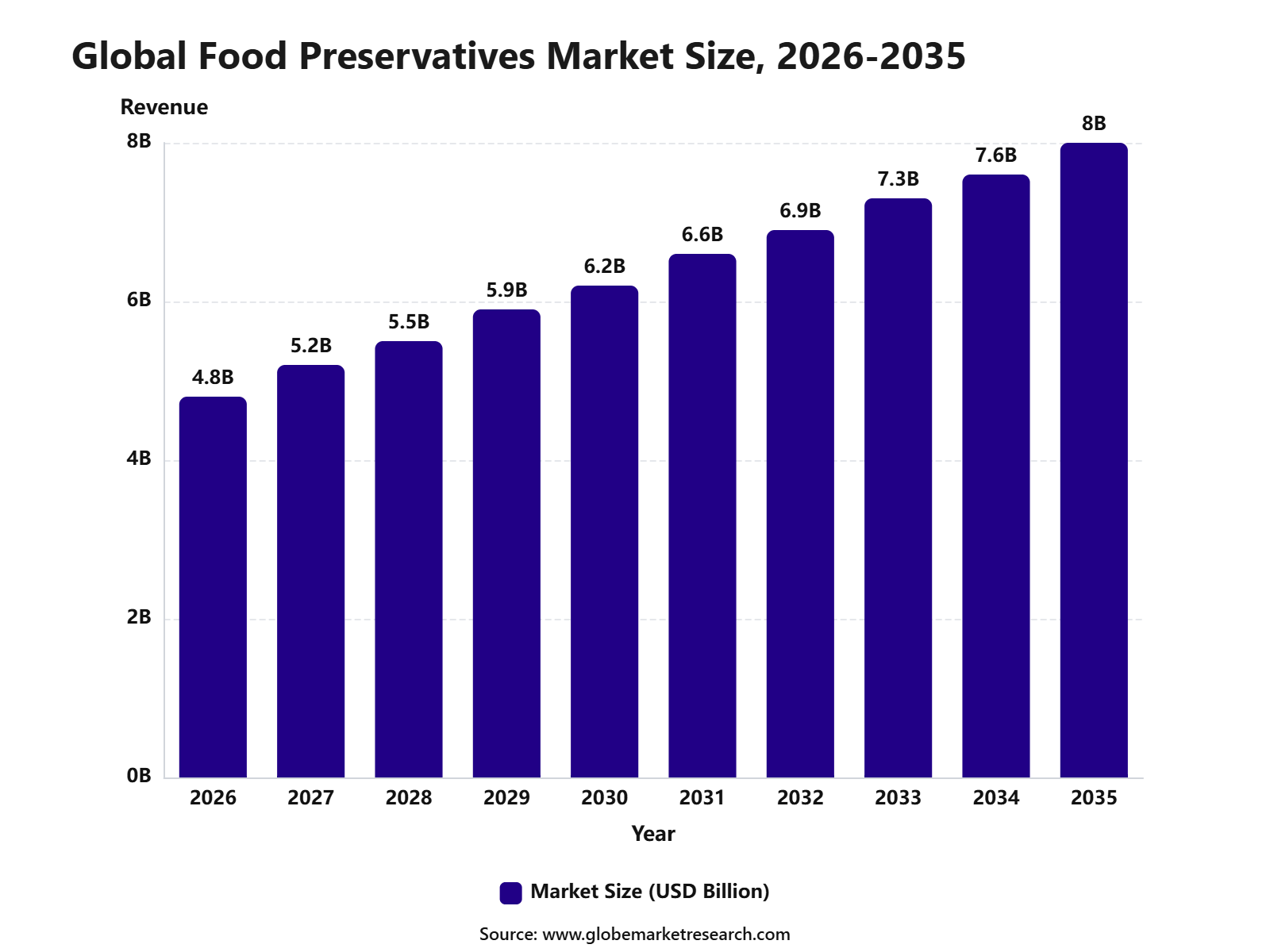 iThe graph shows projected market growth until 2035 based on CAGR analysis. Actual outcomes may vary depending on changing demand, competition, and economic factors.To gain greater insights - request a sample report PDF
Key Market Insights
Natural preservatives led the source segment with 64.3% share, supported by rising demand for clean-label ingredients, safer food formulations, and plant-based preservation solutions.
Antimicrobial preservatives accounted for 45.6% share by function, driven by their strong role in controlling bacterial growth, extending shelf life, and improving food safety.
Meat, poultry, and seafood applications held 45.3% share, supported by high spoilage risk, strict storage needs, and strong demand for longer-lasting packaged protein products.
North America led the food preservatives market with 43.7% share, valued at USD 2.0 billion, supported by mature packaged food consumption, strong food safety standards, and rising demand for clean-label preservation.
Top Funding and Investment
Top Investments
In February 2026, Bramble Partners invested an estimated GBP 1 million to GBP 5 million in Klura Labs through its GBP 100 million Pioneer Fund. Klura develops antimicrobial films and stickers that protect food from bacteria and mould. In a grape trial, only 7 Klura-protected packs spoiled by day ten, compared with 60 conventionally packaged packs.
In 2026, Kerry disclosed that it had invested approximately EUR 3 billion in innovation and technology over the previous decade, supporting fermentation, food protection and shelf-life solutions. The company employs around 1,200 scientists, while fermentation-derived technologies account for approximately 40% of its taste solutions.
In October 2025, Walmart announced a reformulation program covering approximately 1,000 U.S. private-label food products. The company is removing synthetic dyes and 30 additional additives, including potassium bromate, from Great Value, Marketside, Freshness Guaranteed and Bettergoods products by January 2027, increasing demand for natural preservation and shelf-life alternatives.
In May 2026, Aldi announced plans to eliminate 44 additional ingredients from its private-label food, vitamin and supplement portfolio by December 2027. The removal list includes artificial preservatives such as BHA, BHT and parabens, requiring investment in replacement formulations that maintain food safety, stability and shelf life.
In November 2025, Atlantic Sea Solutions, operating as Atlas, began developing a spray-applied edible coating made from sugar kelp. The coating is designed to reduce fresh-produce losses by more than 50% while providing a flavourless, organic-certifiable alternative to conventional preservation and post-harvest treatment systems.
Top Funding
In July 2026, Saudi food-technology company Uvera completed a seed funding round backed by Morgan Stanley. The capital is being used to scale commercial deployments of its proprietary shelf-life extension platform, which combines food-preservation technology with blockchain traceability and IoT-based monitoring.
In November 2025, Atlas received USD 175,000 through a U.S. Department of Agriculture Small Business Innovation Research grant. The funding supports development of a seaweed-extract coating intended to extend the shelf life of fruits and vegetables and reduce spoilage during distribution.
In November 2025, South Korean agri-food technology company EcoGear secured seed funding from 500 Global, Infobank and Sopoong Connect. The financing supports automation of its nano-coating production system and expansion of preservation technologies designed to improve freshness across agricultural and food distribution chains.
Top Acquisitions
In December 2025, ICL agreed to acquire Bartek Ingredients, the world’s largest producer of malic acid and food-grade fumaric acid. ICL acquired Bartek’s acidulant portfolio, Canadian manufacturing operations, production technology, customer relationships and ingredients used to enhance flavour, control acidity and extend the shelf life of food, beverages, confectionery and bakery products.
In May 2026, CVC Capital Partners agreed to acquire IFF’s Food Ingredients business for approximately USD 4.3 billion. The acquired operations include food ingredient manufacturing assets, formulation technologies, customer contracts and functional solutions used across processed foods, including ingredients that support product stability, freshness and shelf-life performance.
By Source
Natural preservatives accounted for 64.3% share of the Food Preservatives Market. This leading position is supported by rising demand for clean-label food products, safer ingredient lists, and naturally sourced preservation solutions.
The segment is widely preferred because natural preservatives such as vinegar, salt, sugar, rosemary extract, cultured sugar, citric acid, and plant-based extracts help extend shelf life while meeting consumer preference for recognizable ingredients. Food brands use these solutions to reduce spoilage, maintain freshness, and support label transparency.
Demand is expected to remain strong as consumers continue to avoid artificial additives and seek minimally processed food products. Growth will be supported by natural preservation in meat, poultry, seafood, bakery, dairy, snacks, sauces, and ready-to-eat food categories.
By Function
Antimicrobial preservatives accounted for 45.6% share of the Food Preservatives Market. This dominance is driven by their important role in controlling bacteria, yeast, mold, and other microorganisms that can reduce food safety and shelf life.
The segment is widely used in packaged foods, meat products, poultry, seafood, beverages, dairy products, bakery items, sauces, and convenience meals. Antimicrobial preservatives help food manufacturers maintain product quality, reduce contamination risk, and support longer distribution cycles.
Demand is expected to remain strong as food safety, cold-chain reliability, and packaged food consumption remain key industry priorities. The need to reduce food waste and improve shelf stability will continue to support antimicrobial preservative use.
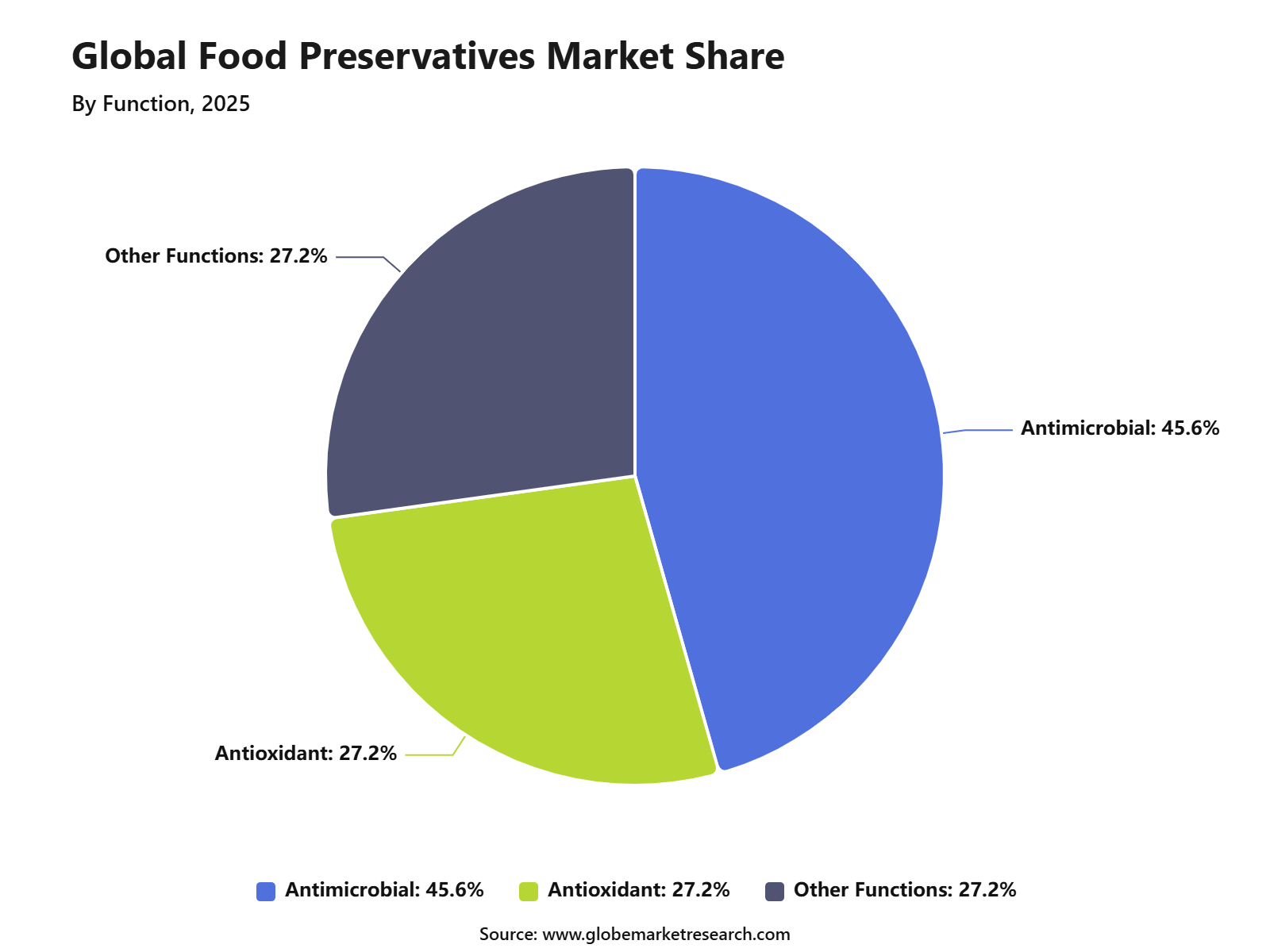 iThe graph shows projected market growth until 2035 based on CAGR analysis. Actual outcomes may vary depending on changing demand, competition, and economic factors.To gain greater insights - request a sample report PDF
By Application
Meat, poultry and seafood accounted for 45.3% share of the Food Preservatives Market. This leading share is supported by the high perishability of protein-based foods and the strong need to control microbial growth, oxidation, odor, and quality loss.
Preservatives are widely used in fresh, frozen, processed, cured, marinated, and ready-to-cook meat and seafood products. They help maintain color, flavor, texture, freshness, and safety during processing, storage, transportation, and retail display.
Demand from this application is expected to remain strong as consumers increase purchases of packaged protein foods and convenience meat products. Growth will be supported by chilled foods, frozen seafood, ready meals, processed meats, and demand for safer shelf-life extension solutions.
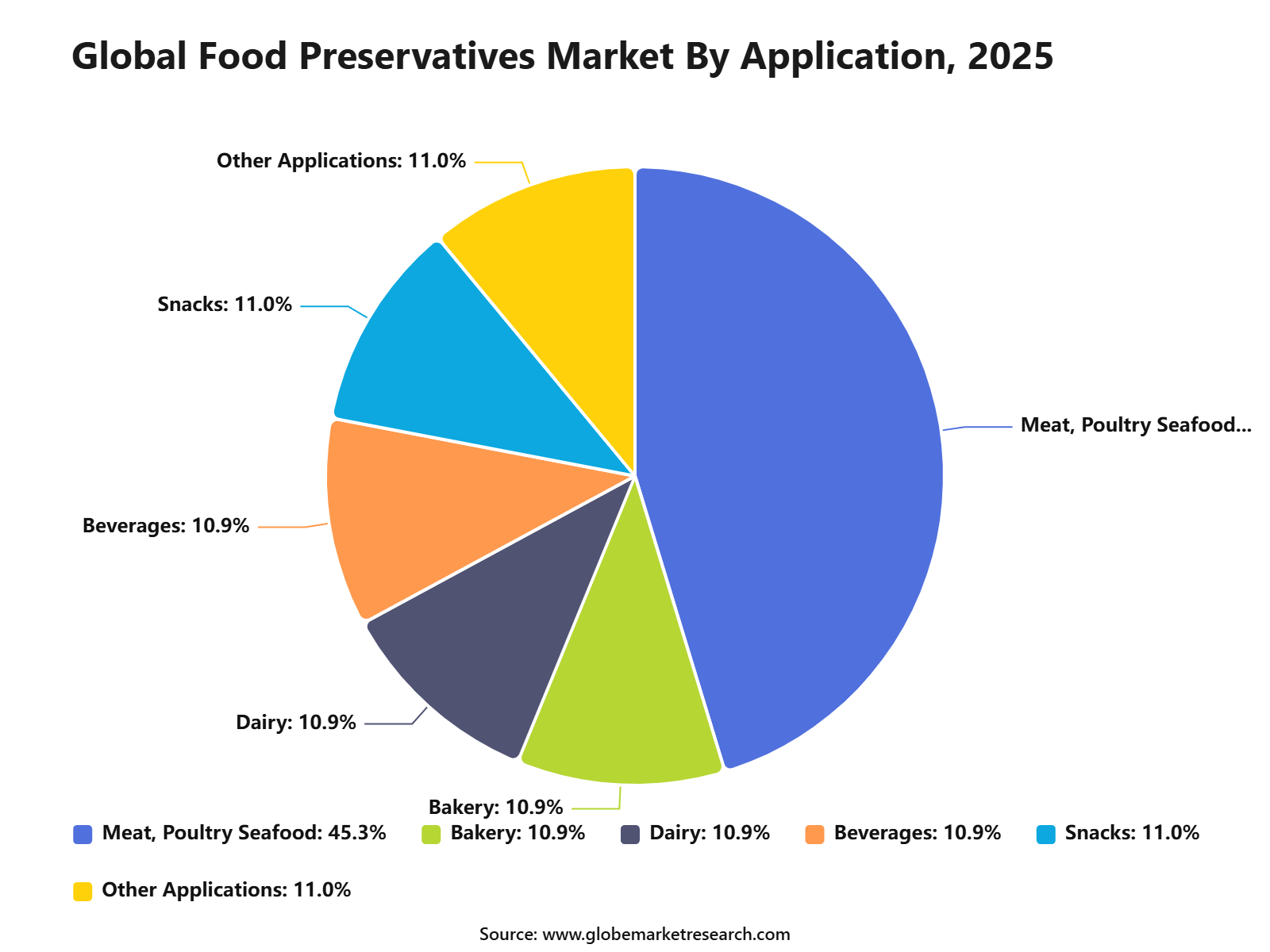 iThe graph shows projected market growth until 2035 based on CAGR analysis. Actual outcomes may vary depending on changing demand, competition, and economic factors.To gain greater insights - request a sample report PDF
By Region
North America accounted for 43.7% share of the Food Preservatives Market, reaching USD 2.0 billion. The region’s leadership is supported by high consumption of packaged foods, processed meat products, frozen meals, bakery items, sauces, snacks, and ready-to-eat products.
The United States and Canada are key contributors to regional demand. The region benefits from strong food processing infrastructure, advanced cold-chain systems, strict food safety standards, and high consumer awareness of clean-label and natural ingredients.
North America is expected to maintain its leading position as demand grows for safer, longer-lasting, and minimally processed foods. Natural preservatives, antimicrobial functions, and meat, poultry and seafood applications will continue to support market growth across the region.
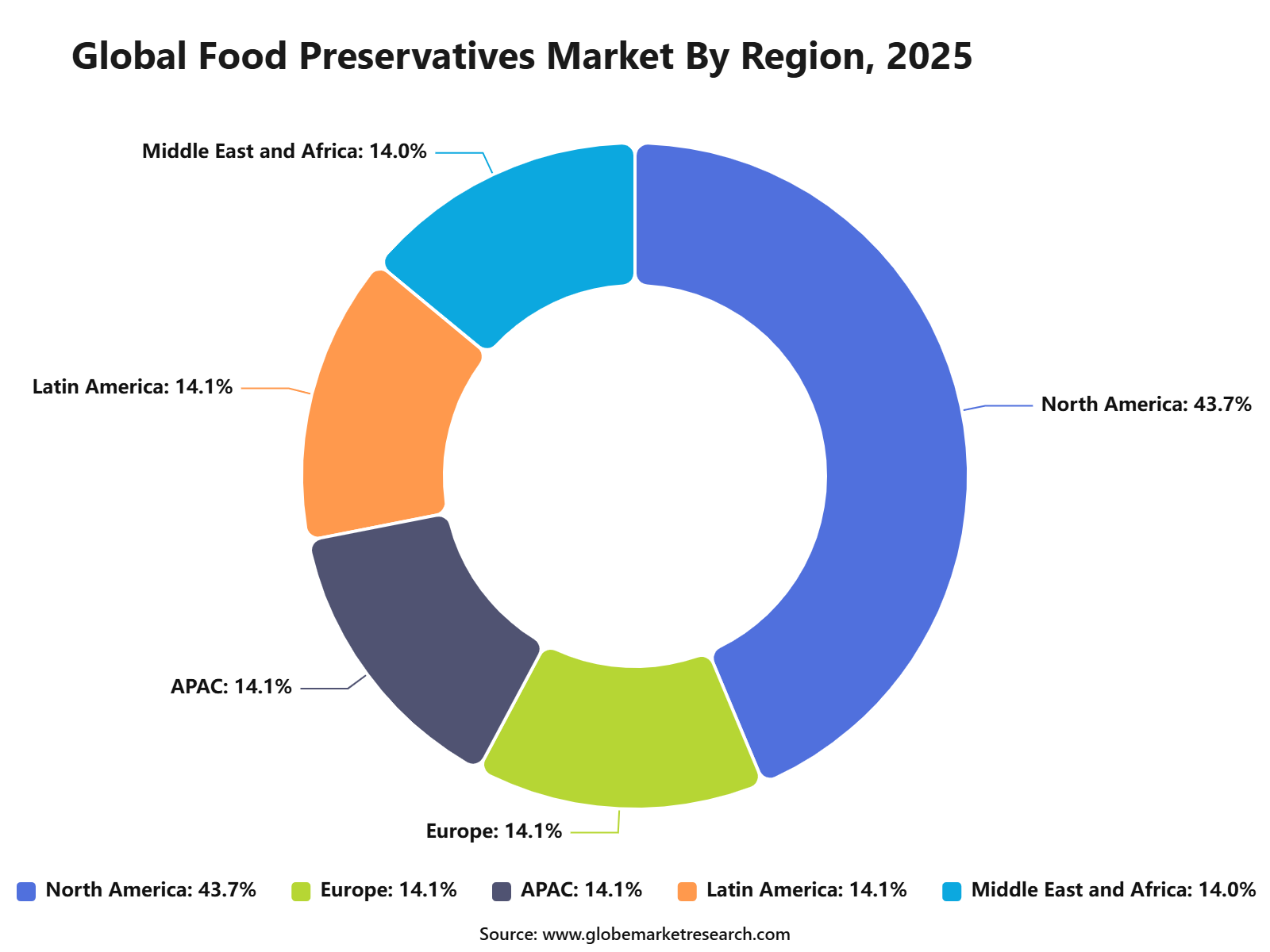 iThe graph shows projected market growth until 2035 based on CAGR analysis. Actual outcomes may vary depending on changing demand, competition, and economic factors.To gain greater insights - request a sample report PDF
Regional Impact Analysis
North America leads the Food Preservatives Market with 43.7% share in 2026, valued at around USD 2.1 billion, supported by high packaged food consumption, strong meat and poultry processing, broad retail distribution, and strict food safety requirements. The U.S. remains the main contributor due to its large processed food industry and strong demand for convenient packaged products.
Europe remains important because of clean-label reformulation, bakery demand, dairy processing, and strict additive regulation. Asia Pacific supports future growth through rising packaged food production, urbanization, cold-chain expansion, and increasing consumption of convenience foods.
Impact Factor | Estimated CAGR Impact | Regional Relevance | Market Impact |
|---|---|---|---|
North America market leadership | +1.9% | North America, 43.7% share in 2026 | Leads global value demand. |
U.S. packaged food demand | +1.5% | U.S. | Supports high preservative usage. |
Canada clean-label food demand | +1.0% | Canada | Adds natural preservative opportunity. |
Europe additive reformulation trend | +0.9% | UK, Germany, France, Italy | Supports clean-label innovation. |
Asia Pacific food processing growth | +0.8% | China, India, Japan, Southeast Asia | Builds future market expansion. |
Go-To-Market and Sales Economics
Food preservative suppliers should prioritize meat, seafood, bakery, dairy, beverages, and convenience-food manufacturers where shelf-life control directly affects product losses and distribution costs. Meat processing represents 22.2% of total value added within U.S. food manufacturing, creating a large customer base for antimicrobial systems, oxidation control, and customized preservation blends.
Sales strategies should combine direct technical selling with regional ingredient distributors. India’s food-processing sector is expected to reach USD 535 billion in fiscal year 2026, supported by expanding packaged and value-added food demand. Local formulation support, application testing, regulatory documentation, and smaller order quantities can improve entry into fast-growing Asian processing clusters.
Pricing should reflect the financial value created through longer shelf life, fewer product returns, wider distribution, and reduced waste rather than ingredient cost alone. USDA forecasts overall U.S. food prices to rise 3.2% in 2026, while food-at-home prices are expected to increase 2.8%, strengthening manufacturers’ focus on yield protection and operating efficiency.
Risk Factors & Market Barriers
Regulatory compliance remains a major market-entry barrier because permitted ingredients, usage limits, labelling rules, and supporting safety evidence vary across countries. China’s food-safety standards catalogue contained 1,725 national standards in January 2026. Suppliers must therefore maintain country-specific dossiers, exposure assessments, purity specifications, traceability records, and updated technical documentation before commercial supply.
Scientific reassessment can create reformulation expenses and uncertainty for established preservative products. EFSA updated its food-additive application risk-assessment guidance in 2026, strengthening expectations concerning toxicology, exposure, manufacturing information, and supporting data. In the United States, the FDA was reviewing selected food ingredients and chemicals as of May 12, 2026, increasing the importance of regulatory monitoring.
Raw-material price volatility can reduce margins for preservative manufacturers and their food-processing customers. USDA expects farm-level vegetable prices to rise 27.6% and wheat prices to increase 21.1% during 2026. Such movements raise fermentation, carbohydrate, botanical-extract, transport, and processing costs, making dual sourcing, indexed contracts, inventory planning, and formulation flexibility increasingly important.
Revenue Potential Analysis
Revenue Landscape Across
Asia provides strong revenue potential because packaged-food manufacturing and modern retail channels continue to expand. India’s food-processing sector is expected to reach USD 535 billion in fiscal year 2026, while Vietnam’s food-processing industry reached approximately USD 88 billion. Suppliers offering clean-label antimicrobials, antioxidants, mould inhibitors, and application support can address diverse regional manufacturing requirements.
Latin America presents opportunities through its established agricultural base and export-oriented processing operations. Brazil’s food-processing sector generated approximately USD 248 billion in revenue during 2025, increasing 8% from the previous year. Demand can be developed across meat, bakery, beverages, dairy products, sauces, and processed fruit, particularly where extended distribution distances increase spoilage exposure.
European revenue opportunities are attractive but require strong regulatory capabilities and differentiation beyond basic preservation. Germany’s five largest retail groups account for approximately 76% of sector revenue, indicating concentrated purchasing power and demanding supplier qualification processes. Growth can be supported through natural preservatives, combination systems, lower-dose solutions, reformulation services, and documentation aligned with European food-additive requirements.
Financial Impact
Preservatives can protect processor revenue by reducing losses before products reach consumers. FAO estimates that 13.3% of food was lost globally across post-harvest, transport, storage, wholesale, and processing activities. Fruit and vegetables recorded a 25.4% loss rate, while meat and animal products reached 14%, highlighting significant financial exposure across highly perishable categories.
Longer shelf life can lower disposal expenses, improve inventory turnover, reduce rejected deliveries, and expand the commercially viable delivery radius. In the United States, food waste is estimated at 30% to 40% of the food supply. Effective preservation must be combined with hygienic processing, suitable packaging, temperature control, and accurate shelf-life validation to capture these savings.
Profitability will increasingly depend on formulation efficiency and the ability to manage rising customer costs. USDA forecasts fresh-vegetable retail prices to increase 7.7%, sugar and sweets prices by 6.9%, and non-alcoholic beverage prices by 5.7% in 2026. Preservation systems that reduce dosage, protect yield, and limit spoilage can deliver measurable financial value.
Drivers Impact Analysis
The Food Preservatives Market is driven by rising demand for packaged foods, ready-to-eat meals, processed meat, bakery products, sauces, snacks, beverages, and frozen food products. Food manufacturers use preservatives to extend shelf life, reduce spoilage, maintain quality, and support long-distance distribution.
North America leads the market due to high packaged food consumption, strong retail distribution, large meat and poultry processing, and strict food safety expectations. Demand is also supported by consumer preference for convenient foods with longer freshness and lower waste.
Impact Factor | Estimated CAGR Impact | Regional Relevance | Market Impact |
|---|---|---|---|
Growth in packaged food consumption | +1.8% | North America, Europe, Asia Pacific | Drives core preservative demand. |
Rising ready-to-eat food demand | +1.5% | U.S., Canada, Europe | Supports shelf-life extension. |
Expansion of processed meat and poultry | +1.2% | North America and Asia Pacific | Increases antimicrobial preservative use. |
Need to reduce food spoilage | +1.0% | Global food supply chains | Improves product stability. |
Growth in bakery and snack products | +0.8% | Urban consumer markets | Adds steady formulation demand. |
Restraints Impact Analysis
The market faces restraints from clean-label demand, consumer concern over synthetic additives, regulatory limits, and pressure to reduce chemical-sounding ingredients. Many food brands are reformulating products to use natural preservatives or shorter ingredient labels.
Another restraint is the technical challenge of replacing synthetic preservatives without reducing product safety, texture, flavor, or shelf life. Natural alternatives often require careful formulation and may increase product cost.
Impact Factor | Estimated CAGR Impact | Regional Relevance | Market Impact |
|---|---|---|---|
Clean-label consumer pressure | -0.9% | North America and Europe | Limits synthetic preservative growth. |
Regulatory restrictions on additives | -0.7% | Developed food markets | Increases compliance burden. |
Higher cost of natural preservatives | -0.6% | Premium and clean-label foods | Raises formulation cost. |
Taste and texture impact risk | -0.5% | Bakery, meat, dairy, beverages | Affects product acceptance. |
Reformulation complexity | -0.4% | Food manufacturers | Slows product launches. |
Opportunities Impact Analysis
Opportunities are strong in natural preservatives, plant-based extracts, fermentation-derived antimicrobials, clean-label shelf-life solutions, organic acids, vinegar-based systems, rosemary extract, cultured sugar, and protective cultures. These solutions support brands that want safer, fresher, and more natural product positioning.
Higher-value opportunities are emerging in meat preservation, seafood protection, bakery freshness, dairy stability, beverage preservation, and active packaging. Suppliers that offer application-specific solutions and technical support can capture stronger demand.
Impact Factor | Estimated CAGR Impact | Regional Relevance | Market Impact |
|---|---|---|---|
Natural preservative adoption | +1.7% | North America, Europe, Asia Pacific | Builds clean-label growth. |
Plant-based antimicrobial solutions | +1.4% | Premium packaged foods | Supports natural positioning. |
Fermentation-derived preservatives | +1.1% | Dairy, bakery, meat products | Adds advanced formulation value. |
Active and intelligent packaging | +0.9% | Developed retail markets | Extends freshness with lower additive use. |
Application-specific preservative blends | +0.7% | Food processors | Improves performance and margins. |
Challenges Impact Analysis
The main challenge is balancing food safety, shelf life, clean-label demand, and cost. Food manufacturers must ensure microbial control while responding to consumers who prefer simple and recognizable ingredients.
Another challenge is meeting different regional regulations. Preservative approval, dosage limits, labeling rules, and permitted food applications vary across markets, making global formulation and product rollout more complex.
Impact Factor | Estimated CAGR Impact | Regional Relevance | Market Impact |
|---|---|---|---|
Balancing safety with clean label | -0.8% | Global packaged food brands | Creates formulation pressure. |
Regional regulatory variation | -0.6% | Export-oriented manufacturers | Adds compliance complexity. |
Natural preservative performance limits | -0.5% | High-moisture and meat products | Affects shelf-life targets. |
Raw material supply fluctuation | -0.4% | Natural extract suppliers | Impacts pricing stability. |
Consumer distrust of additives | -0.3% | North America and Europe | Limits synthetic ingredient acceptance. |
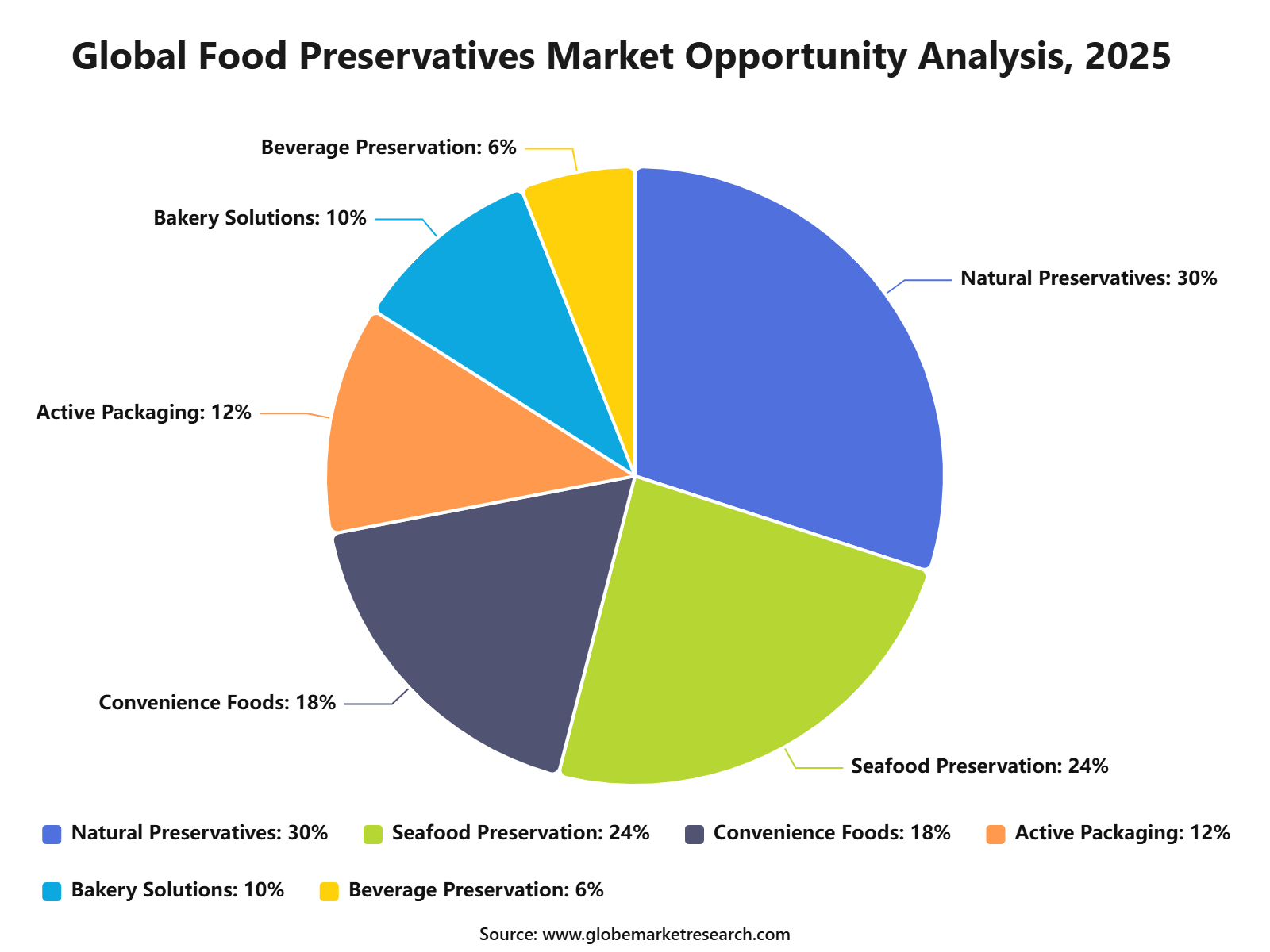
Food Preservatives Market Opportunity Analysis
The Food Preservatives Market is supported by rising demand for longer shelf life, safer packaged foods and convenient meal options. Antimicrobial preservatives remain the most important function because they control bacteria, yeast and mold in meat, seafood, bakery, dairy and ready-to-eat products. Natural and clean-label preservation systems are becoming increasingly important as food manufacturers reduce synthetic ingredients.
Future opportunities will come from plant-based antimicrobials, fermentation-derived preservatives, natural antioxidants, active packaging and combined preservation technologies. Companies should focus on solutions for meat, poultry and seafood because this application represents 45.3% of the market. Asia Pacific also offers strong expansion potential due to packaged-food production, urbanization and improving cold-chain infrastructure.
 iThe graph shows projected market growth until 2035 based on CAGR analysis. Actual outcomes may vary depending on changing demand, competition, and economic factors.To gain greater insights - request a sample report PDF
Segment Covered in the Report
By Source
Natural
Synthetic
By Function
Antimicrobial
Antioxidant
Other Functions
By Application
Meat
Poultry and Seafood
Bakery
Dairy
Snacks
Other Applications
By Region
North America
Europe
Asia Pacific
Latin America
Middle East and Africa
Market Trend Analysis
The market trend is moving toward natural preservatives, clean-label ingredients, antimicrobial blends, plant extracts, fermentation-based solutions, and packaging-supported shelf-life extension. Brands are looking for preservation systems that maintain safety while aligning with consumer-friendly labels.
North America remains the largest value region because of its advanced processed food sector, high retail packaged food demand, and strong food safety focus. Europe supports clean-label innovation, while Asia Pacific is growing through expanding packaged food manufacturing and urban retail.
Impact Factor | Estimated CAGR Impact | Regional Relevance | Market Impact |
|---|---|---|---|
Natural preservatives gain share | +1.6% | North America and Europe | Supports clean-label growth. |
Antimicrobial blends expand | +1.3% | Meat, poultry, seafood, bakery | Improves shelf-life performance. |
Plant extracts become more common | +1.0% | Premium food brands | Adds natural ingredient appeal. |
Shelf-life extension packaging grows | +0.8% | Retail and cold-chain markets | Reduces spoilage risk. |
Reformulation toward simple labels | +0.6% | Developed consumer markets | Changes product development strategy. |
Investor Type Impact Matrix
Investors should focus on companies with strong technical formulation capability, food safety expertise, natural ingredient portfolios, regulatory knowledge, and application-specific customer support. Preservative performance, label acceptance, cost efficiency, and compatibility with food systems are key success factors.
Strategic investors can also target natural preservative producers, plant extract suppliers, fermentation technology firms, food ingredient companies, active packaging providers, and specialty formulation businesses. Companies that combine clean-label positioning with proven preservation performance are better positioned for long-term growth.
Investor Type | Estimated CAGR Impact | Regional Relevance | Market Impact |
|---|---|---|---|
Natural Preservative Producers | +1.3% | North America, Europe, Asia Pacific | Expands clean-label preservation supply. |
Food Ingredient Companies | +1.1% | Global packaged food markets | Supports broad formulation demand. |
Fermentation Technology Firms | +0.9% | Dairy, bakery, meat applications | Adds natural antimicrobial value. |
Active Packaging Providers | +0.7% | Retail and cold-chain markets | Supports shelf-life extension. |
Strategic Food-Tech Investors | +0.5% | Global food processing markets | Funds innovation and scale-up. |
Recent Developments
July 2026: Kemin showcased clean-label preservation solutions at IFT FIRST, including SHIELD Pure mold inhibitor, BactoCEASE Pure buffered-vinegar fermentate, and FORTIUM R rosemary extract, helping manufacturers replace synthetic preservatives and extend shelf life.
February 2026: Celanese confirmed its continuing 30% interest in Nutrinova, the Mitsui-led food-ingredients joint venture. Nutrinova manufactures potassium sorbate and sorbic acid preservatives for beverages, bakery, confectionery, dairy, and other consumer-food applications.
January 2026: ADM announced a USD 26 million Erlanger expansion, following USD 15 million invested in 2025. The project adds automated handling, digital upgrades, and greater capacity for food and beverage reformulation.
Competitive Landscape
The market is characterized by intense competition among established players and emerging companies. Strategic partnerships, mergers and acquisitions, and product innovation are key strategies employed by market participants.
Key Market Players
Kemin Industries, Inc.
Kerry Group plc
Corbion N.V.
Archer Daniels Midland Company
DSM-Firmenich
BASF SE
Celanese Corporation
Cargill, Incorporated
Tate & Lyle PLC
Galactic S.A.
Other Key Players
Research Methodology
This market study is prepared using a combination of primary and secondary research. Primary research includes discussions with manufacturers, suppliers, distributors, consultants, industry experts, and end users. Secondary research covers company reports, government databases, trade associations, technical publications, regulatory sources, and trusted industry documents. The collected information is used to assess market demand, pricing trends, technology adoption, competitive activity, and regional performance.
AI language models are not used as primary data sources, and publicly available AI-generated content is not treated as market evidence. Computational tools may be used to support data processing, translation, data classification, and pattern identification. However, every published assessment is supported by verified sources, human review, and primary market discussions.
Market estimates are developed through top-down and bottom-up approaches and validated using data triangulation. Revenue, production, shipment, pricing, and application-level data are compared across multiple sources. Forecasts consider economic conditions, regulatory changes, investment activity, innovation, supply chain developments, and industry risks. All findings are reviewed through source verification and internal quality checks before publication.
Part I
Source Management & Input Data Standards
Who provides data, how sources are qualified, and what types of evidence are admissible.
Part II
Research Scope & Market Coverage
How we define the markets we assess and the parameters that govern each product.
Part III
Data Collection, Verification & Submission
The mechanics of gathering, cross-checking, and hierarchically ranking evidence.
Part IV
Assessment Determination & Quality Controls
How raw data becomes a published assessment — normalisation, expert judgement, and outlier exclusion.
Part V
Publication, Corrections & Revision
Our publication schedule, corrections policy, and methodology review cycle.
Part VI
Independence, Ethics & Complaints
Conflict-of-interest policies, editorial independence, and how clients raise concerns.
Google · Preferred Sources
Don't miss the latest market research insights and industry updates on Google.
Add Globe Market Research as a preferred source in the Google app to see our reports, analysis, and market stories in your news suggestions.
Meet the Team
This report was prepared by our expert analysts with deep industry knowledge and research experience.
Pratiksha K. is a Senior Research Analyst with more than five years of experience in market research, industry analysis, competitive intelligence, and business strategy. She has contributed to detailed market reports, customized research studies, company profiling, market sizing, trend analysis, and strategic consulting projects for clients across different regions. Her industry expertise covers Chemical and Material, Consumer Goods, Food & Beverages and Energy & Power. She closely evaluates changing customer requirements, technology developments, regulatory conditions, supply chain structures, investment activity, and competitive strategies to provide clear and practical market insights.
Sayali brings more than 7 years of experience to Globe Market Research, supporting the accuracy, clarity, and relevance of research content across multiple industries. She reviews market data, segment analysis, competitive insights, and industry trends to ensure each report meets strong quality standards and provides practical value to business decision-makers. Her expertise spans healthcare, information technology, consumer goods, and diverse cross-industry domains. With a strong focus on data reliability, structured analysis, and clear presentation, Sayali helps ensure that each research output delivers well-reviewed insights for clients, investors, consultants, and industry stakeholders.
Frequently Asked Questions
Related Reports
More in Food and Beverages
Frozen Meals Market to Hit USD 74.2 Billion by 2035
Frozen Meals Market Size, Share, Analysis By Product (Frozen, Chilled, Canned, Shelf-Stable), By Meal Type (Vegetarian, Non-Vegetarian, Vegan), By Distribution Channel (Supermarkets and Hypermarkets, Online Retail, Convenience Stores, Specialty Stores), By Regional Insights, Business plan and Project Report, Investment Opportunities, Profitability, Industry Trends, Leading Companies and Growth Forecasts by 2026-2035
Food Colorants Market to Hit USD 8.6 Billion by 2035
Food Colorants Market Size, Share, Analysis By Type (Natural, Synthetic, Nature-Identical), By Form (Powder, Liquid, Gel), By Application (Beverages, Bakery and Confectionery, Dairy, Meat Products, Snacks, Other Applications), By Regional Insights, Business plan and Project Report, Investment Opportunities, Profitability, Industry Trends, Leading Companies and Growth Forecasts by 2026-2035
Sweeteners Market to Hit USD 145.7 Billion by 2035
Sweeteners Market Size, Share, Analysis "By Product (Sucrose, High-Fructose Corn Syrup, Glucose Syrup, High-Intensity Sweeteners, Other Products), By Form (Solid, Liquid), By Application (Bakery and Confectionery, Beverages, Dairy, Pharmaceuticals, Other Applications), By Regional Insights, Business plan and Project Report, Investment Opportunities, Profitability, Industry Trends, Leading Companies and Growth Forecasts by 2026-2035
Food Enzymes Market to Hit USD 7.5 Billion by 2035
Food Enzymes Market Size, Share, Analysis By Type (Carbohydrases, Proteases, Lipases, Other Enzymes), By Source (Microbial, Plant, Animal), By Application (Dairy Processing, Bakery, Beverages, Processed Foods, Animal Feed), By Regional Insights, Business plan and Project Report, Investment Opportunities, Profitability, Industry Trends, Leading Companies and Growth Forecasts by 2026-2035