

Revenue, 2025
$ 3.7 Bn
Forecast, 2035
$ 17.5 Bn
CAGR, 2025-2035
16.8%
Report Coverage
Global
Market Size and Forecast
The Global Portable Solar Charger Market was worth USD 3.7 billion in 2025 and is expected to reach USD 17.5 billion by 2035, growing at a CAGR of 16.8% from 2025 to 2035. Asia Pacific held the largest regional share of 34.7% in 2025, supported by rising outdoor recreation, growing smartphone use, expanding off-grid power needs, and increasing demand for compact renewable charging solutions across urban and remote locations.
The Portable Solar Charger Market includes lightweight solar-powered devices used to charge smartphones, tablets, power banks, cameras, GPS devices, and small electronic equipment. These chargers are commonly used by travelers, campers, hikers, emergency response users, and consumers in areas with limited grid access. The market is closely linked with foldable solar panels, monocrystalline technology, USB charging systems, battery storage, and portable clean energy products.
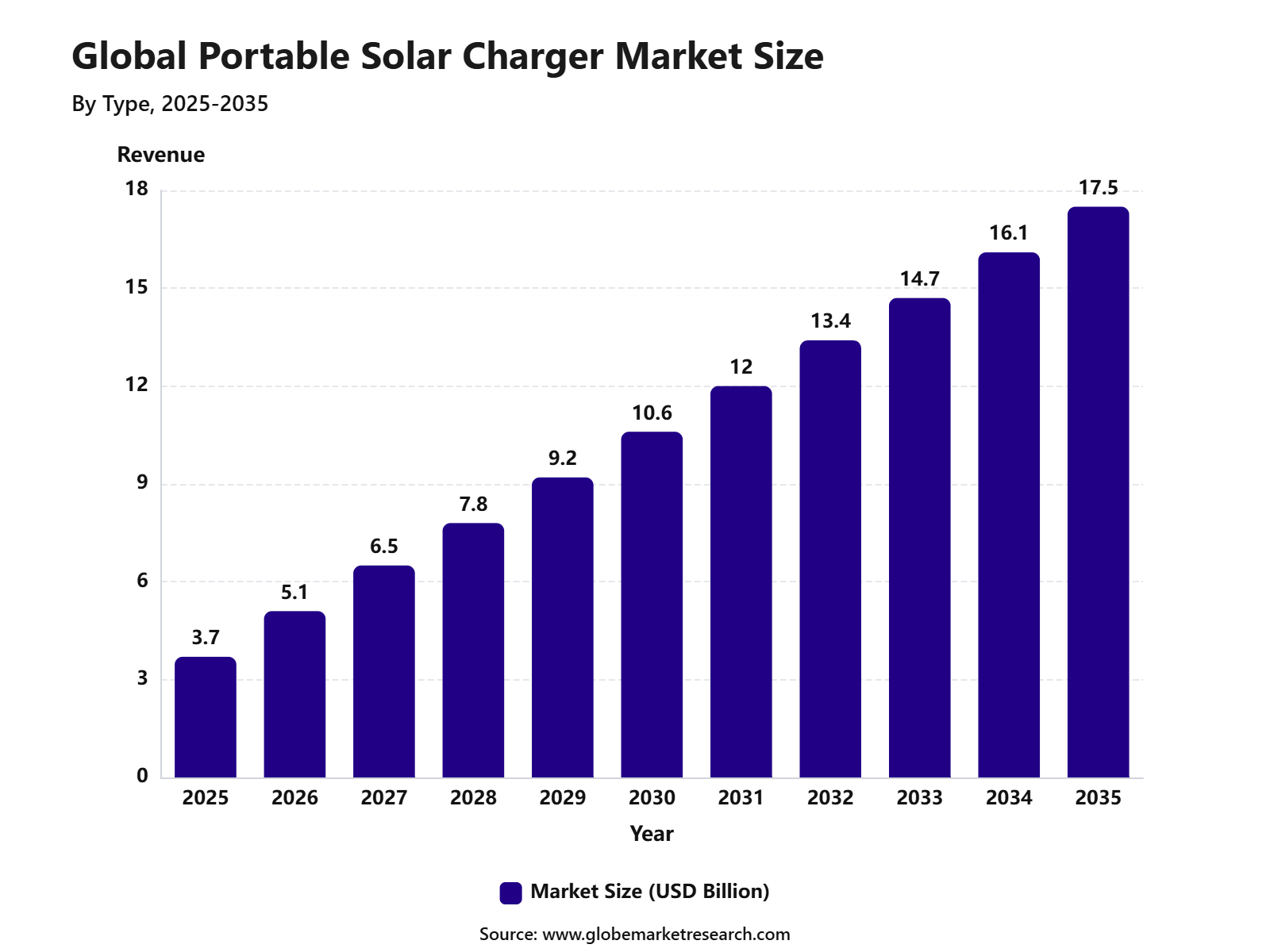 iThe graph shows projected market growth until 2035 based on CAGR analysis. Actual outcomes may vary depending on changing demand, competition, and economic factors.To gain greater insights - request a sample report PDF
The market outlook remains positive as consumers increasingly seek reliable, mobile, and eco-friendly charging options. Growth can be attributed to higher use of connected devices, rising demand for emergency backup power, and wider adoption of solar products for outdoor and travel applications. The expansion of e-commerce channels, improved panel efficiency, and compact product designs is expected to support long-term demand for portable solar chargers.
Key Market Insights
Foldable chargers led the type segment with 43.5% share, supported by portability, compact storage, easy outdoor use, and strong demand from travelers, campers, and emergency users.
Monocrystalline panels accounted for 55.1% share, driven by higher energy efficiency, better performance in limited sunlight, and wider use in premium portable solar chargers.
Individual consumers held 49.9% share by application, supported by rising use of portable chargers for outdoor activities, travel, backup power, and personal electronics.
Online channels captured 57.8% share, driven by wide product availability, price comparison, user reviews, and increasing direct-to-consumer sales.
Asia Pacific held 34.7% share of the portable solar charger market, supported by rising mobile device usage, growing outdoor recreation, and increasing adoption of portable renewable energy products.
Go-To-Market Strategy
The Portable Solar Charger Market should be positioned through outdoor users, travelers, students, field workers, emergency-preparedness buyers, and off-grid households in 2026. Demand is supported by rising mobile device dependence, as GSMA reported 5.8 billion unique mobile subscribers, equal to nearly 70% of the global population. This creates a large user base for portable charging solutions.
The go-to-market strategy should focus on online retail, outdoor equipment stores, travel platforms, camping retailers, electronics stores, and emergency supply channels. Product messaging should highlight lightweight design, foldable panels, USB-C fast charging, water resistance, backup battery capacity, and multi-device use. Clear wattage, charging time, and battery capacity details should be shown to reduce purchase uncertainty.
Partnerships with travel brands, hiking communities, telecom accessory sellers, and disaster-preparedness distributors can improve customer acquisition. The outdoor recreation economy accounted for USD 696.7 billion, or 2.4% of U.S. GDP in 2024, according to BEA data released in 2026. This supports demand from camping, RVing, boating, fishing, hiking, and remote work users.
Revenue Potential Analysis
Revenue potential is supported by the growing need for portable energy in mobile-first lifestyles. Solar chargers serve smartphones, cameras, tablets, GPS devices, wireless earbuds, lanterns, power banks, and small camping electronics. As mobile technologies generated USD 7.6 trillion for the global economy in 2025, accessories that protect device uptime can benefit from the broader mobile ecosystem.
The market also benefits from rising interest in backup power and energy resilience. IEA forecast global electricity demand to grow 3.6% annually from 2026 to 2030, supported by industry, electric vehicles, air conditioning, and data centers. Higher demand and grid pressure can support consumer interest in portable backup charging for emergencies and travel.
Product revenue can be strengthened through bundled solutions, such as solar panel plus power bank kits, camping lantern kits, carabiner chargers, and rugged travel packs. Premium pricing can be supported by high-efficiency panels, strong casing, certified battery cells, warranty coverage, and faster charging. Value products can target students, commuters, and entry-level outdoor users.
Revenue Landscape Across
Across product types, foldable solar chargers are attractive for hikers, campers, and long-distance travelers because they offer wider panel area with compact storage. Compact solar power banks are more suitable for casual users and emergency kits. Higher-watt panel kits can serve RV users, field teams, photographers, and remote workers needing stronger off-grid charging.
Across regions, North America and Europe are supported by outdoor recreation, travel spending, emergency preparedness, and premium electronics adoption. Asia Pacific can provide volume demand through smartphone use, e-commerce growth, and off-grid charging needs in rural or semi-urban areas. Africa and parts of Latin America can benefit where grid access and charging reliability remain uneven.
Across channels, online marketplaces are expected to remain the strongest revenue route because shoppers compare wattage, reviews, charging ports, capacity, and price. Specialty outdoor stores can support premium trust, while telecom accessory channels can drive impulse purchases. Institutional demand may come from relief agencies, field service teams, defense support, and remote infrastructure operators.
Financial Impact
The financial impact will depend on solar panel efficiency, battery cell cost, certification expense, warranty claims, and return rates. Solar PV costs have structurally improved as global installations scaled, with IEA reporting that solar PV additions surpassed 600 GW in 2025 and cumulative solar capacity reached about 2,800 GW. This scale supports component availability.
However, profitability can weaken if products are overdesigned, poorly tested, or returned due to weak field performance. Charging claims must match real outdoor conditions to reduce refunds and negative reviews. Companies also need strong battery management systems, thermal protection, overcharge control, short-circuit protection, and compliance testing to reduce safety incidents and liability risk.
Financial returns can improve through differentiated product tiers and recurring accessory sales. Entry-level chargers can build volume, while premium rugged models can support higher margins. Add-on revenue may come from cables, cases, adapters, replacement batteries, solar lanterns, and emergency kits. Strong after-sales support can also improve rating scores and lower customer acquisition cost.
Type Analysis
Foldable chargers led the Portable Solar Charger Market with 43.5% share, supported by their compact design, easy portability, and suitability for outdoor charging needs. These chargers are widely used by travelers, campers, hikers, emergency users, field workers, and consumers who need backup power away from fixed electricity sources.
The growth of this segment can be attributed to rising demand for lightweight and space-saving charging solutions. Foldable chargers can be packed easily, opened when sunlight is available, and used to charge smartphones, cameras, power banks, GPS devices, tablets, and other small electronics.
Foldable chargers are expected to remain a leading product type as consumers seek practical renewable charging options for outdoor and emergency use. Demand will be supported by better panel efficiency, improved durability, waterproof designs, USB-C compatibility, and integration with portable battery storage.
Panel Type Analysis
Monocrystalline panels accounted for 55.1% share, making them the leading panel type in the Portable Solar Charger Market. These panels are preferred because they offer higher efficiency, better performance in limited space, and stronger suitability for compact portable charging products.
The growth of this segment can be linked to consumer demand for faster charging and reliable energy output from smaller devices. Monocrystalline panels are especially useful in portable solar chargers because users often need maximum power generation from limited surface area during outdoor activities.
Monocrystalline panel demand is expected to remain strong as brands focus on higher conversion efficiency and improved product design. Future growth is likely to be supported by lighter panels, foldable formats, rugged materials, and portable chargers designed for travel, adventure, and emergency preparedness.
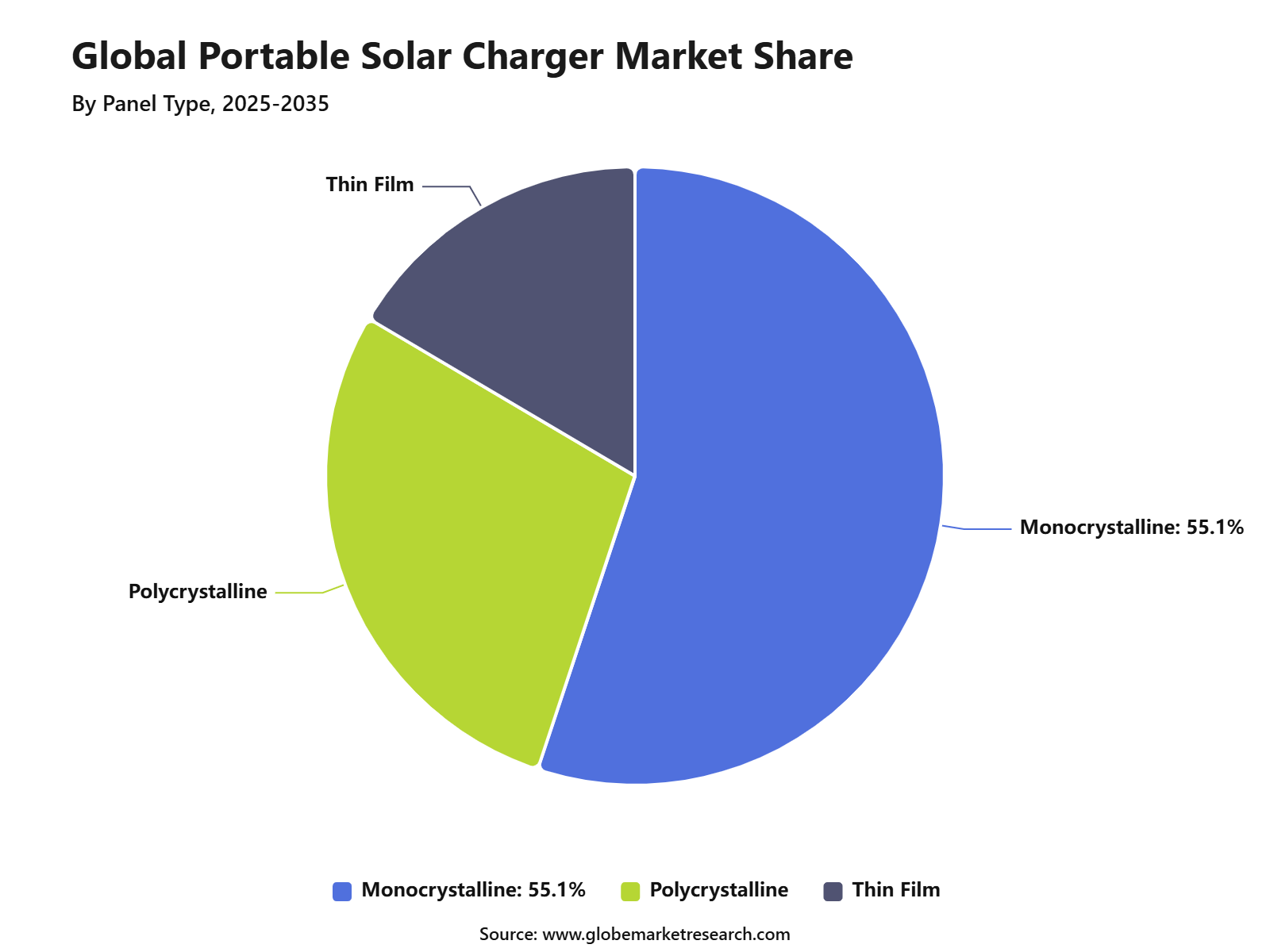 iThe graph shows projected market growth until 2035 based on CAGR analysis. Actual outcomes may vary depending on changing demand, competition, and economic factors.To gain greater insights - request a sample report PDF
Application Analysis
Individual consumers led the application segment with 49.9% share, supported by strong demand for personal charging devices across travel, outdoor recreation, remote work, and emergency backup use. Consumers are using portable solar chargers to power smartphones, earbuds, tablets, cameras, watches, lights, and battery banks.
The segment is growing because mobile devices have become essential for communication, navigation, payments, work, entertainment, and safety. Portable solar chargers provide an added layer of energy security, especially during camping trips, power outages, long travel, and off-grid activities.
Individual consumer demand is expected to remain strong as portable energy products become more affordable and user-friendly. Brands that offer compact size, fast charging, multiple ports, durable build quality, and clear performance claims are likely to gain higher preference.
Distribution Channel Analysis
Online channels held 57.8% share of the Portable Solar Charger Market, supported by wide product availability, price comparison, customer reviews, and direct-to-consumer brand sales. Consumers often prefer online platforms because portable solar chargers require comparison across wattage, charging speed, size, weight, panel type, and compatibility.
The growth of online sales can be attributed to rising e-commerce adoption and strong product research behavior among buyers. Online platforms allow brands to display technical specifications, use-case images, product demonstrations, customer ratings, and bundled offers with power banks or cables.
Online distribution is expected to remain the leading channel as digital retail becomes central to consumer electronics purchasing. Demand will also be supported by seasonal promotions, influencer reviews, outdoor gear marketplaces, fast delivery, and easier access to imported or niche portable solar products.
Regional Analysis
Asia Pacific led the Portable Solar Charger Market with 34.7% share, supported by a large mobile-device user base, rising outdoor activity, growing e-commerce penetration, and strong solar product manufacturing capacity. China, India, Japan, South Korea, and Southeast Asian countries are key contributors to regional demand.
The region’s growth is supported by strong consumer electronics usage and rising interest in affordable backup power solutions. Portable solar chargers are gaining relevance for travel, outdoor work, rural charging needs, emergency preparedness, and areas with inconsistent electricity access.
Asia Pacific is expected to remain a leading regional market due to its strong manufacturing ecosystem and large consumer base. Opportunities are likely to remain strong in foldable chargers, monocrystalline panel products, online retail sales, compact personal chargers, and solar power banks for everyday and outdoor use.
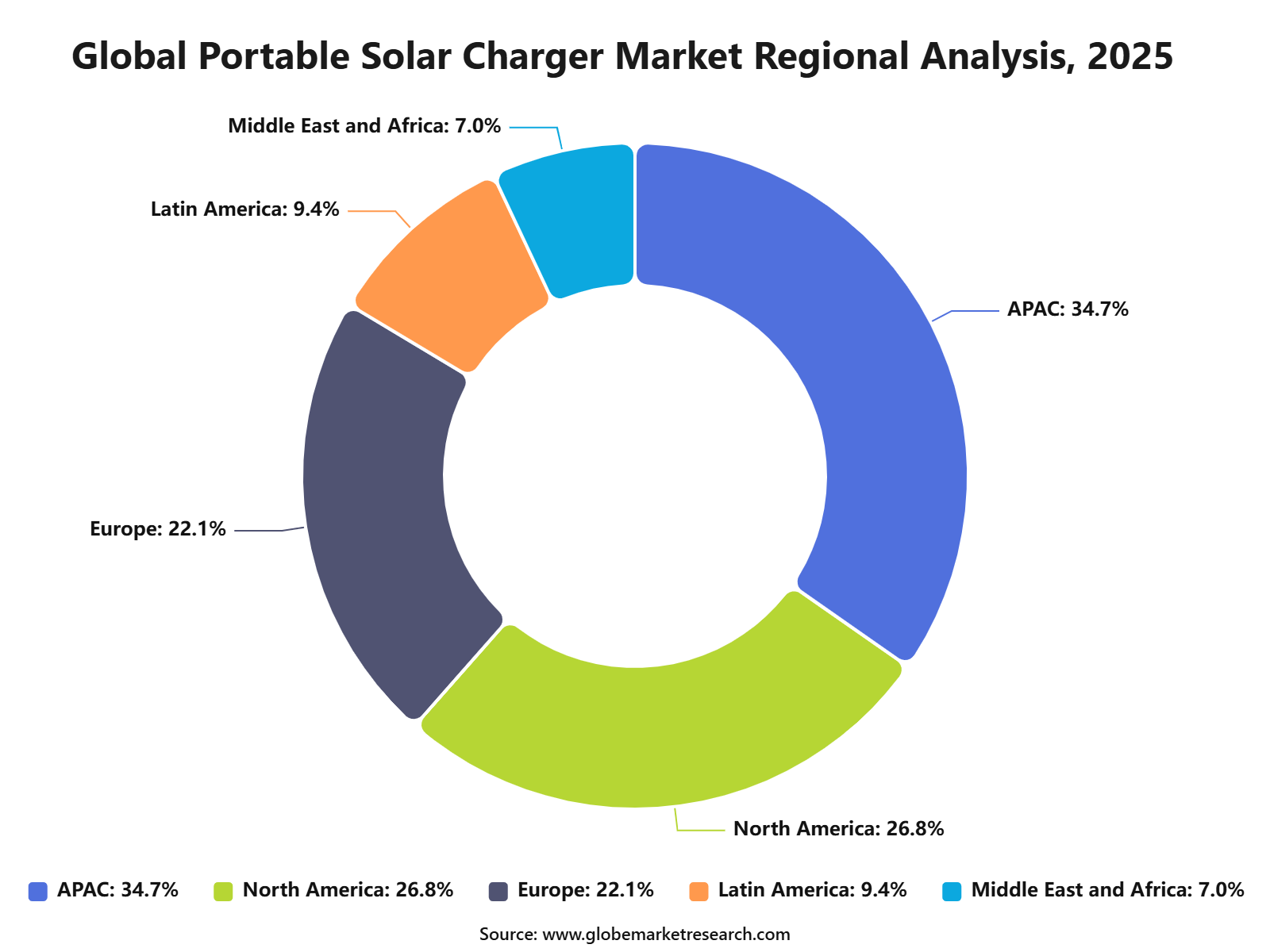 iThe graph shows projected market growth until 2035 based on CAGR analysis. Actual outcomes may vary depending on changing demand, competition, and economic factors.To gain greater insights - request a sample report PDF
Regional Impact Analysis
Impact Factor | Estimated CAGR Impact | Regional Relevance | Market Impact |
|---|---|---|---|
Asia Pacific market leadership | +4.6% | Asia Pacific, 34.7% share in 2025 | Leads volume demand. |
China manufacturing strength | +3.4% | China | Supports affordable supply. |
North America outdoor recreation demand | +3.0% | U.S. and Canada | Drives premium adoption. |
Europe sustainability-led consumer buying | +2.6% | Germany, UK, France, Nordic countries | Supports green products. |
Middle East and Africa off-grid charging need | +1.9% | GCC, Africa, remote areas | Builds future demand. |
Risk Factors & Market Barriers
The main barriers are slow charging speed, weather dependence, product durability, battery safety, and consumer trust. Portable solar chargers depend on sunlight intensity, panel angle, cloud cover, and device power needs. Buyers may be disappointed when real charging performance is lower than advertised, making transparent product testing and realistic charging claims important for brand credibility.
Battery safety is a serious risk because many portable solar chargers include lithium-ion power banks. In April 2026, CPSC reannounced the recall of about 429,200 Casely wireless portable power banks due to fire and burn hazards. The agency reported one fatality, one serious airplane incident, and additional overheating or fire reports after the earlier recall.
Travel rules also create product design limitations for power-bank-based solar chargers. FAA states that rechargeable lithium-ion batteries are generally limited to 100 watt-hours per battery for passengers, while larger 101 Wh to 160 Wh spare batteries require airline approval. This makes compact, compliant battery capacity an important requirement for travel-focused solar charger brands.
Market Trend Analysis
Impact Factor | Estimated CAGR Impact | Regional Relevance | Market Impact |
|---|---|---|---|
Foldable chargers lead product demand | +4.2% | Global outdoor and travel users | Improves portability. |
Monocrystalline panels gain preference | +3.6% | Premium consumer markets | Enhances power output. |
Individual consumers dominate usage | +3.2% | Asia Pacific, Europe, North America | Drives retail sales. |
Online sales channels expand quickly | +2.9% | Global | Improves purchase access. |
Solar chargers enter emergency preparedness kits | +2.4% | North America, Asia Pacific, Europe | Supports backup demand. |
Investor Type Impact Matrix
Investor Type | Estimated CAGR Impact | Regional Relevance | Market Impact |
|---|---|---|---|
Portable Solar Charger Manufacturers | +3.8% | Global | Expands product capacity. |
Consumer Electronics Companies | +3.3% | Asia Pacific, North America, Europe | Strengthens product portfolios. |
E-commerce and Retail Investors | +2.9% | Global | Improves sales reach. |
Outdoor Gear Brands | +2.5% | North America, Europe, Australia | Builds niche demand. |
Clean Energy Product Investors | +2.2% | Asia Pacific, Europe, North America | Supports green adoption. |
Segment Covered in the Report
By Type
Small Portable Charger
Foldable Charger
Backpack Solar Charger
Others
By Panel Type
Monocrystalline
Polycrystalline
Thin Film
By Application
Individual Consumer
Defense
Transportation
Camping and Outdoor
Others
By Distribution Channel
Online
Offline
By Region
North America
Europe
Asia Pacific
Latin America
Middle East and Africa
Drivers Impact Analysis
Impact Factor | Estimated CAGR Impact | Regional Relevance | Market Impact |
|---|---|---|---|
Rising demand for portable power solutions | +4.3% | Asia Pacific, North America, Europe | Drives device adoption. |
Growth in outdoor recreation and travel | +3.7% | U.S., Europe, China, Japan, Australia | Supports consumer demand. |
Increasing smartphone and gadget usage | +3.4% | Global | Expands charging needs. |
Growing awareness of clean energy products | +2.9% | Asia Pacific, Europe, North America | Supports solar adoption. |
Demand for emergency backup power | +2.5% | Disaster-prone and remote regions | Improves product relevance. |
Restraints Impact Analysis
Impact Factor | Estimated CAGR Impact | Regional Relevance | Market Impact |
|---|---|---|---|
Dependence on sunlight availability | -1.9% | Cloudy and low-irradiance regions | Limits charging reliability. |
Lower charging speed than wall chargers | -1.6% | Global consumer markets | Affects user convenience. |
High cost of advanced solar chargers | -1.4% | Price-sensitive markets | Restricts mass adoption. |
Durability issues in low-cost products | -1.1% | Asia Pacific, Latin America, Africa | Reduces consumer trust. |
Limited awareness in rural markets | -0.9% | Emerging regions | Slows product penetration. |
Opportunities Impact Analysis
Impact Factor | Estimated CAGR Impact | Regional Relevance | Market Impact |
|---|---|---|---|
Expansion of foldable solar chargers | +4.1% | Asia Pacific, North America, Europe | Supports easy portability. |
Growth in monocrystalline panel adoption | +3.6% | Developed and premium markets | Improves charging efficiency. |
Rising demand from individual consumers | +3.2% | Global | Builds direct sales. |
Online distribution channel growth | +2.9% | Asia Pacific, North America, Europe | Expands market reach. |
Use in camping, trekking, and emergency kits | +2.5% | Outdoor and disaster-prone markets | Drives niche demand. |
Challenges Impact Analysis
Impact Factor | Estimated CAGR Impact | Regional Relevance | Market Impact |
|---|---|---|---|
Maintaining performance in variable weather | -1.7% | Global | Affects reliability. |
Competition from power banks | -1.5% | Global consumer electronics markets | Pressures adoption. |
Product quality variation across brands | -1.2% | Online marketplaces | Creates buyer hesitation. |
Battery storage and safety concerns | -1.0% | Global | Raises compliance needs. |
Balancing lightweight design with durability | -0.9% | Outdoor product markets | Impacts user satisfaction. |
Recent Developments
June 2026: Jackery launched its Jackery Ark AI EMS and solar garden concept at Intersolar Europe 2026. The company also introduced a Solar Gazebo measuring 4.5 x 3 meters, with integrated solar modules capable of producing up to 2,000 W of photovoltaic power.
June 2026: Jackery and Homey announced a partnership to advance plug-in home battery integration in Europe. Jackery SolarVault 3 and selected Homey products were scheduled to be showcased at The smarter E Europe in Munich from 23 to 25 June 2026, supporting smart energy control for plug-in solar users.
June 2026: Renogy strengthened its off-grid solar visibility through its ShadowFlux 200W solar panel, which was highlighted for RV and mobile power use. The panel offers 200W maximum output, 20.7% module efficiency, N-type solar cells, IP68-rated construction, and a weight of 10.8 kg.
Report Scope
Report Highlights | Details |
|---|---|
Market Revenue (2025) | USD 3.7 Billion |
Forecast Revenue (2035) | USD 17.5 Billion |
CAGR (2025-2035) | 16.8% |
Base Year for Estimation | 2025 |
Historic Data | 2020-2024 |
Forecast Period | 2025-2035 |
Report Coverage | AI market impact analysis, market surveys, trade analysis, Industry & competitive intelligence, Revenue projections, company positioning, competitive analysis, growth drivers, and emerging market trends, Strategic Consultation & Advisory Services |
Segments Covered | By Type (Small Portable Charger, Foldable Charger, Backpack Solar Charger, Others), By Panel Type (Monocrystalline, Polycrystalline, Thin Film), By Application (Individual Consumer, Defense, Transportation, Camping and Outdoor, Others), By Distribution Channel (Online, Offline) |
Regional Analysis | North America - US, Canada; Europe - Germany, France, The UK, Spain, Italy, Russia, Netherlands, Rest of Europe; Asia Pacific - China, Japan, South Korea, India, New Zealand, Singapore, Thailand, Vietnam, Rest of Latin America; Latin America - Brazil, Mexico, Rest of Latin America; Middle East & Africa - South Africa, Saudi Arabia, UAE, Rest of MEA |
Key companies profiled | Anker, Goal Zero, BigBlue, Jackery, BioLite, SunJack, Renogy, X-Dragon, Voltaic Systems, RAVPower |
Customization Scope | Tailored insights for specific regions, countries, and market segments can be provided. Additional report customization is available upon request. |
Competitive Landscape
The market is characterized by intense competition among established players and emerging companies. Strategic partnerships, mergers and acquisitions, and product innovation are key strategies employed by market participants.
Key Market Players
Anker
Goal Zero
BigBlue
Jackery
BioLite
SunJack
Renogy
X-Dragon
Voltaic Systems
RAVPower
Meet the Team
This report was prepared by our expert analysts with deep industry knowledge and research experience.
Pratiksha is market research analyst with strong experience in industry research, market forecasting, and competitive analysis. She specializes in identifying market trends, evaluating growth opportunities, and preparing data-driven insights across global industries. Her work supports businesses in understanding market dynamics, customer demand, regional opportunities, and strategic investment areas.
Sayali brings more than 5 years of experience to Globe Market Research, supporting the accuracy, clarity, and relevance of research content across multiple industries. She reviews market data, segment analysis, competitive insights, and industry trends to ensure each report meets strong quality standards and provides practical value to business decision-makers. Her expertise spans healthcare, information technology, consumer goods, and diverse cross-industry domains. With a strong focus on data reliability, structured analysis, and clear presentation, Sayali helps ensure that each research output delivers well-reviewed insights for clients, investors, consultants, and industry stakeholders.
Frequently Asked Questions
Related Reports
More in Energy and Power
Hydropower Generation Market to Hit USD 560.9 Billion by 2035
Hydropower Generation Market Size, Share, Analysis By Plant Type (Large Hydropower Plant, Small Hydropower Plant, Pumped Storage Hydropower), By Application (Utility, Industrial, Rural Electrification), By Regional Insights, Business plan and Project Report, Investment Opportunities, Profitability, Industry Trends, Leading Companies and Growth Forecasts by 2025-2035
Power Generation Market to Hit USD 2,539.5 Billion by 2035
Power Generation Market Size, Share, Analysis By Type (Conventional/Non-Renewable (Nuclear and Fossil Fuels), Non-Conventional/Renewable (Solar, Wind, Hydro, and Others)), By End-User (Residential, Commercial, Industrial, Others), By Regional Insights, Business plan and Project Report, Investment Opportunities, Profitability, Industry Trends, Leading Companies and Growth Forecasts by 2025-2035
Single Phase String Inverters Market to Hit USD 5.1 Billion by 2035
Single Phase String Inverters Market Size, Share, Analysis By Connectivity (On-Grid, Off-Grid), By Power Rating (Below 1 kW, 1 kW to 3 kW, 3 kW to 5 kW, Above 5 kW), By Application (Residential, Commercial), By Regional Insights, Business plan and Project Report, Investment Opportunities, Profitability, Industry Trends, Leading Companies and Growth Forecasts by 2025-2035
Hydrogen Fuel Cells Market to Hit USD 70.2 Billion by 2035
Hydrogen Fuel Cells Market Size, Share, Analysis By Type (Air-Cooled Type, Water-Cooled Type), By Application (Stationary, Transport, Portable), By Regional Insights, Business plan and Project Report, Investment Opportunities, Profitability, Industry Trends, Leading Companies and Growth Forecasts by 2025-2035