

Revenue, 2025
$67.8Bn
Forecast, 2035
$154.7Bn
CAGR, 2025-2035
8.6%
Report Coverage
Global
Market Size and Forecast
The Global Ramen Noodles Market was valued at USD 67.8 billion in 2025 and is projected to reach USD 154.7 billion by 2035, growing at a CAGR of 8.6% during the forecast period. Asia Pacific accounted for 55.3% of the market in 2025, generating approximately USD 37.4 billion in revenue. The growth of the ramen noodles market can be attributed to rising demand for convenient, affordable, and ready-to-cook meal options. Increasing urbanization, busy consumer lifestyles, wider retail availability, and strong demand from students, working professionals, and young consumers are supporting market expansion.
Key Parameter | Report Details |
|---|---|
Current Revenue, 2025 | USD 67.8 Billion |
Projected Revenue, 2035 | USD 154.7 Billion |
CAGR, 2025- 2035 | 8.6% |
Largest Region | Asia Pacific |
Fastest Growing Region | North America |
Market Concentration | Medium |
Base Year | 2025 |
Forecast Period | 2025-2035 |
Another important factor supporting the market is the shift toward premium, healthier, and flavor-rich ramen products. Consumers are increasingly choosing ramen noodles with low sodium, high protein, plant-based ingredients, regional flavors, and convenient cup formats. Manufacturers are also expanding through online grocery platforms, supermarkets, convenience stores, and quick-commerce channels, which is improving product visibility and repeat purchases across both developed and emerging markets.
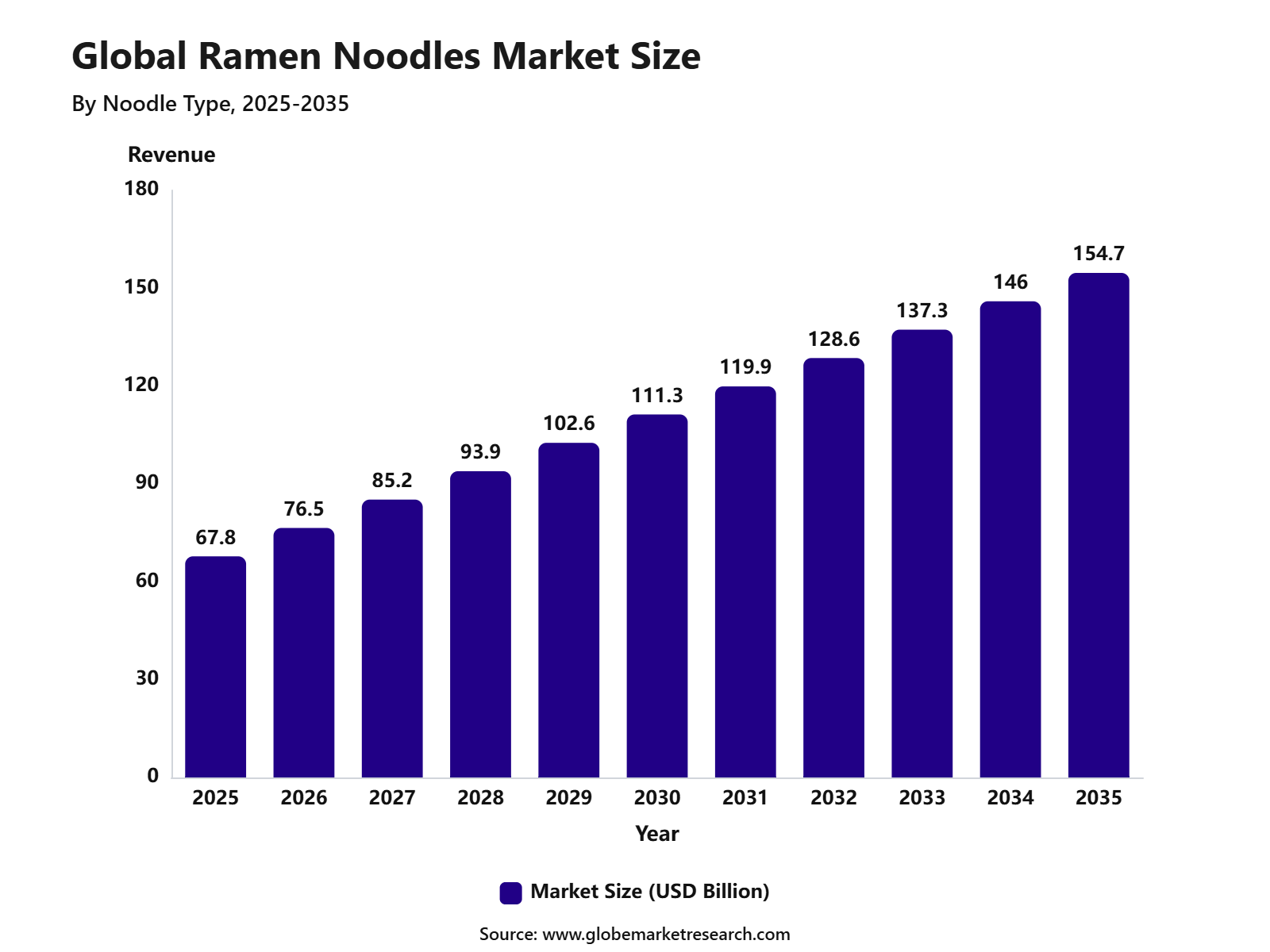 iThe graph shows projected market growth until 2035 based on CAGR analysis. Actual outcomes may vary depending on changing demand, competition, and economic factors.To gain greater insights - request a sample report PDF
Top Market Takeaways
Instant ramen noodles led the product type segment with 72.6% share, supported by strong demand for quick, affordable, and easy-to-prepare meals.
Packets and pouches accounted for 57.9% share by packaging type, driven by low cost, longer shelf life, and high household consumption.
Cup and bowl noodles captured 45.3% share by cup format, supported by convenience, portability, and rising demand from students, office workers, and travelers.
Fried noodles held 69.2% share by noodle type, driven by their longer shelf stability, familiar taste, and wide use in instant noodle products.
Supermarkets and hypermarkets accounted for 44.3% share by distribution channel, supported by wide product availability, bulk buying, and strong retail visibility.
Asia Pacific led the ramen noodles market with 55.3% share, supported by high consumption in China, Japan, South Korea, India, and Southeast Asian countries.
Market Overview
The ramen noodles market refers to the global business of instant ramen, cup noodles, bowl noodles, fried noodles, non-fried noodles, frozen ramen, and ready-to-cook noodle products sold through supermarkets, convenience stores, online platforms, foodservice channels, and specialty Asian food stores. The market is driven by consumers who want affordable, quick, filling, and easy-to-prepare meals. Ramen has moved beyond its traditional low-cost image and is now being positioned through premium flavors, spicy variants, protein-enriched products, healthier recipes, and restaurant-style formats.
One of the top driving factors for the ramen noodles market is the rising demand for quick and low-cost meals. Urban consumers, students, working professionals, and low-income households continue to prefer ramen because it can be cooked within a few minutes and requires limited kitchen preparation. Food inflation has also supported demand for affordable packaged meals, as the FAO Food Price Index showed that global food prices were still 4.3% higher in 2025 compared with 2024, even though some commodity prices declined at the end of the year.
Convenience is the strongest growth driver for the ramen noodles market. Urban consumers, students, working professionals, and single-person households prefer ramen because it can be prepared within a few minutes and does not require advanced cooking skills. The product also has a long shelf life, which makes it suitable for home storage, emergency food kits, travel, and low-cost meal planning. Affordability is another major factor supporting market demand. Ramen noodles are widely consumed in both developed and developing countries because they offer a low-cost meal option during inflationary periods and income pressure.
By Product Type: Instant Ramen Noodles
In 2025, Instant ramen noodles led the market with 72.6% share, supported by strong demand for quick meals, low-cost food options, and easy preparation. This segment is widely consumed by students, working professionals, travelers, and households that need affordable meals with long shelf life. Global instant noodle consumption reached around 123.1 billion servings in 2024, which shows the large consumer base for instant ramen products across both developed and emerging economies.
The growth of instant ramen noodles can also be linked to flavor innovation, single-serve packaging, and rising demand for convenient food in urban markets. Brands are introducing spicy, premium, vegan, low-sodium, and regional taste variants to attract younger consumers and repeat buyers. Demand remains especially strong in Asia, where China/Hong Kong consumed 43.8 billion servings, Indonesia consumed 14.7 billion servings, and India consumed 8.3 billion servings in 2024.
By Packaging Type: Packets and Pouches
In 2025, Packets and pouches accounted for 57.9% share, driven by affordability, easy storage, and strong availability across retail stores. This format is preferred by price-sensitive consumers because it usually costs less than cup or bowl noodles and can be purchased in single packs or multi-pack bundles. Packets also help brands reach wider markets through grocery stores, kirana stores, supermarkets, convenience outlets, and online platforms.
The segment benefits from high household consumption, especially in markets where ramen is prepared as a meal base with vegetables, eggs, meat, sauces, or local spices. Packets and pouches also support better shelf efficiency for retailers, allowing more flavors and pack sizes to be displayed in limited space. Rising demand in developing countries is supported by the low price point of packet noodles, while premium packet formats are gaining traction among urban consumers seeking better taste and quality.
By Cup Format: Cup and Bowl Noodles
In 2025, Cup and bowl noodles held 45.3% share, supported by rising demand for on-the-go meals and ready-to-eat food formats. This segment is popular among office workers, college students, travelers, and consumers who want a quick meal with limited preparation. The format requires only hot water, making it useful in workplaces, hostels, airports, convenience stores, and vending-led retail locations.
Growth in cup and bowl noodles is being supported by premiumization, improved packaging, and flavor-led product launches. Many consumers now prefer cup formats for portion control, hygiene, and convenience, especially in urban areas where eating habits are becoming more flexible. The segment also benefits from stronger demand for Korean, Japanese, and spicy Asian-style ramen varieties, which are widely sold through modern retail and e-commerce channels.
By Noodle Type: Fried Noodles
In 2025, Fried noodles dominated the market with 69.2% share, mainly because of their faster cooking time, better texture, and longer shelf stability. This noodle type is commonly used in instant ramen products because frying reduces moisture and improves storage life. It also delivers a familiar taste and mouthfeel, which supports repeat consumption among mass-market buyers.
The segment remains strong in Asia Pacific, where fried instant noodles are deeply established in regular food consumption. Fried noodles are also favored by manufacturers because they support large-scale production, consistent quality, and easier distribution across long-distance supply chains. However, demand for healthier options is encouraging brands to introduce air-dried, baked, and low-oil alternatives, although fried noodles continue to lead due to taste, price, and consumer familiarity.
By Distribution Channel: Supermarkets and Hypermarkets
In 2025, Supermarkets and hypermarkets captured 44.3% share, supported by wide product availability, brand visibility, and frequent promotional offers. These stores remain important for ramen noodle sales because consumers can compare prices, flavors, pack sizes, and brands in one location. Multi-pack deals, shelf displays, and seasonal discounts further support higher purchase volumes through this channel.
The channel also benefits from rising demand for premium ramen, imported noodles, and family-size packs. Supermarkets and hypermarkets are increasingly used by consumers for planned grocery purchases, while instant ramen is often added as a pantry product. The presence of both economy and premium noodle options helps this channel serve different income groups and consumption needs.
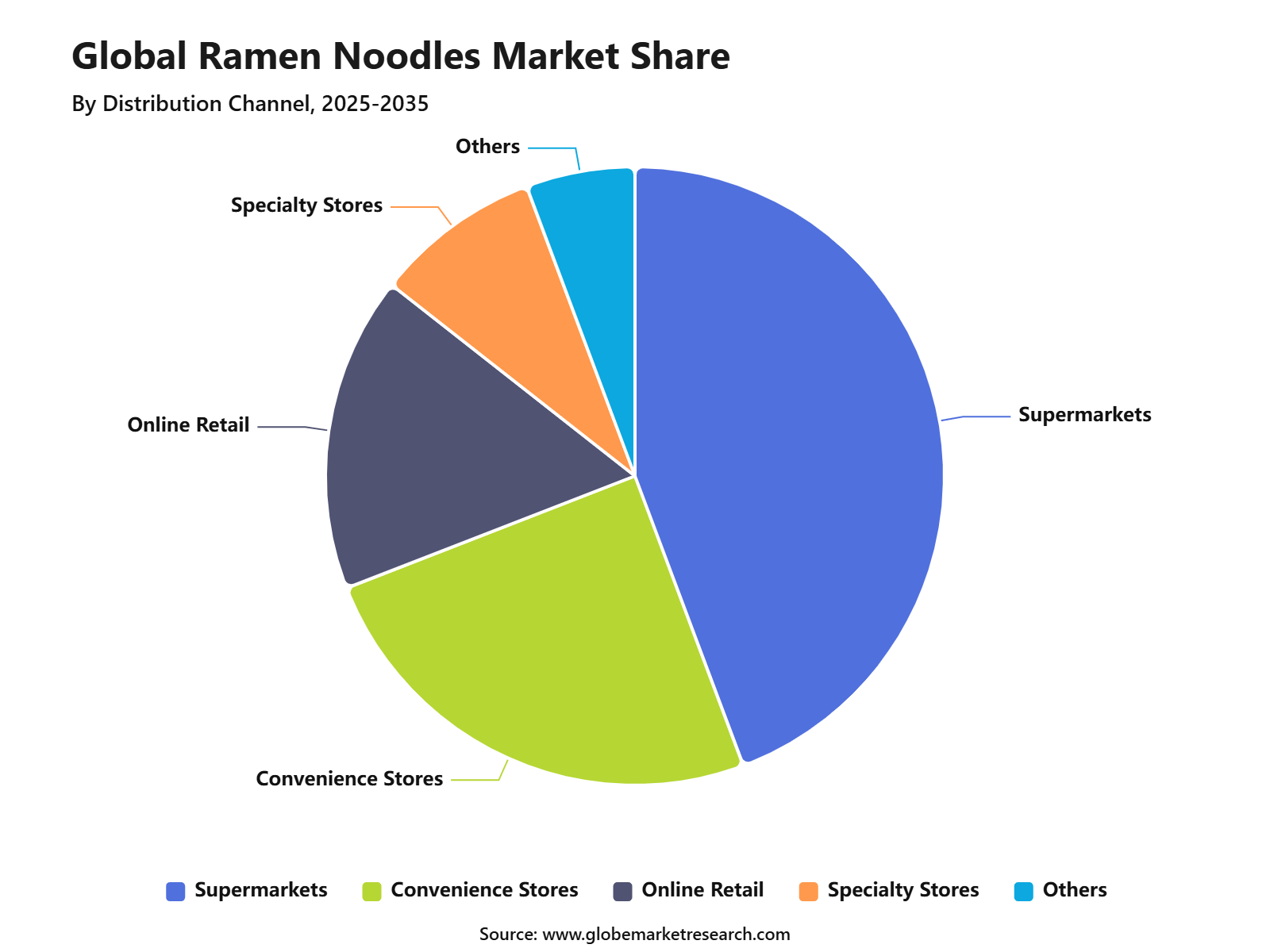 iThe graph shows projected market growth until 2035 based on CAGR analysis. Actual outcomes may vary depending on changing demand, competition, and economic factors.To gain greater insights - request a sample report PDF
By Region: Asia Pacific
In 2025, Asia Pacific led the ramen noodles market with 55.3% share, supported by strong noodle-based food culture, large population, high urbanization, and affordable product pricing. The region includes several of the world’s largest instant noodle-consuming countries, including China/Hong Kong, Indonesia, India, Vietnam, and Japan. WINA data shows that these markets remained among the top global consumers in 2024, confirming the region’s strong demand base.
Impact Factor | Estimated CAGR Impact | Regional Relevance | Market Impact |
|---|---|---|---|
Asia Pacific market leadership | +3.2% | China, Japan, South Korea, India, Southeast Asia | Leads global consumption. |
North America premium ramen demand | +1.8% | U.S. and Canada | Supports value growth. |
Europe convenience food adoption | +1.5% | UK, Germany, France, Italy, Spain | Expands retail sales. |
Latin America affordable meal demand | +1.2% | Brazil, Mexico, Chile, Colombia | Builds volume growth. |
Middle East and Africa emerging demand | +1.0% | GCC, South Africa, Egypt, Nigeria | Shows early growth potential. |
Regional growth is also supported by local flavor innovation, strong retail penetration, and rising demand for convenient meals among younger consumers. Countries such as South Korea, Japan, China, India, Indonesia, Thailand, and Vietnam continue to influence global ramen trends through spicy flavors, premium broths, cup formats, and ready-meal innovations. Asia Pacific is expected to remain the key demand center as ramen continues to serve both everyday meals and affordable snacking occasions.
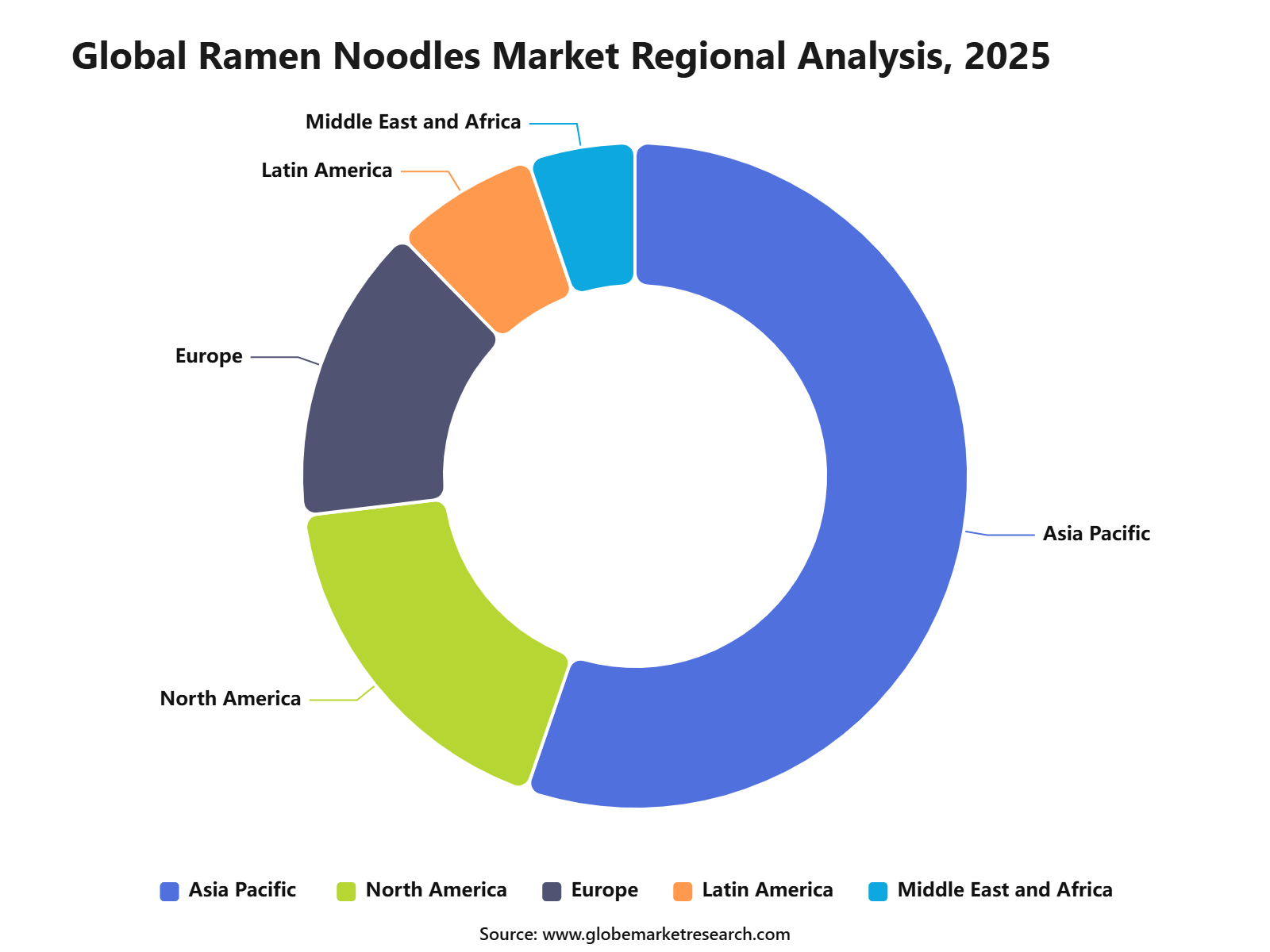 iThe graph shows projected market growth until 2035 based on CAGR analysis. Actual outcomes may vary depending on changing demand, competition, and economic factors.To gain greater insights - request a sample report PDF
Key Market Segments
By Product Type
Instant Ramen Noodles
Fresh Ramen Noodles
Frozen Ramen Noodles
Dried Ramen Noodles
By Packaging Type
Packets and Pouches
Cups and Bowls
By Noodle Type
Fried Noodles
Non-Fried Noodles
By Cup Format
Cup and Bowl Noodles
Tray-based Ramen Noodles
Mini Cup Noodles
Premium Bowl Ramen
Other Formats
By Distribution Channel
Supermarkets and Hypermarkets
Convenience Stores
Online Retail
Specialty Stores
Others
By Region
North America
Europe
Asia Pacific
Latin America
Middle East & Africa
Drivers Impact Analysis
Impact Factor | Estimated CAGR Impact | Regional Relevance | Market Impact |
|---|---|---|---|
Rising demand for convenient meals | +2.3% | Global, Asia Pacific, North America | Supports frequent consumption. |
Growth in urban working population | +2.0% | Asia Pacific, Europe, Latin America | Drives quick meal demand. |
Affordable pricing of instant noodles | +1.8% | Asia Pacific, Africa, Latin America | Expands mass-market adoption. |
Expansion of retail and e-commerce channels | +1.6% | Global | Improves product availability. |
Rising demand for flavored and regional variants | +1.5% | Asia Pacific, North America, Europe | Increases consumer preference. |
Restraints Impact Analysis
Impact Factor | Estimated CAGR Impact | Regional Relevance | Market Impact |
|---|---|---|---|
Health concerns over high sodium content | -1.5% | North America, Europe, urban Asia | Limits health-conscious demand. |
Growing preference for fresh food | -1.2% | Developed markets | Slows repeat consumption. |
Raw material price volatility | -1.0% | Global | Pressures producer margins. |
Regulatory focus on food labeling | -0.8% | U.S., Europe, Japan, India | Raises compliance requirements. |
Competition from ready-to-eat meals | -0.9% | Global | Affects category growth. |
Opportunities Impact Analysis
Impact Factor | Estimated CAGR Impact | Regional Relevance | Market Impact |
|---|---|---|---|
Demand for healthier noodle options | +2.1% | North America, Europe, Asia Pacific | Supports premium product launches. |
Growth in cup and bowl noodles | +1.9% | Asia Pacific, U.S., Europe | Improves on-the-go consumption. |
Expansion in emerging markets | +1.8% | India, Indonesia, Africa, Latin America | Opens volume growth. |
Premium and gourmet ramen products | +1.5% | Japan, South Korea, U.S., Europe | Builds higher-value demand. |
Plant-based and clean-label noodles | +1.4% | North America, Europe, developed Asia | Attracts health-focused consumers. |
Challenges Impact Analysis
Impact Factor | Estimated CAGR Impact | Regional Relevance | Market Impact |
|---|---|---|---|
Negative perception of processed foods | -1.3% | Developed markets | Affects brand positioning. |
Strong price competition | -1.1% | Asia Pacific, Latin America, Africa | Limits profit margins. |
Supply chain disruption risk | -0.9% | Global | Affects product availability. |
Packaging waste concerns | -0.8% | Europe, North America, Japan | Increases sustainability pressure. |
Changing consumer taste preferences | -0.7% | Global | Requires faster product innovation. |
Recent Developments
May 2026 – Samyang Foods continued to benefit from global demand for Buldak spicy ramen. The Buldak brand crossed 8 billion cumulative units by the first half of 2025, with nearly 80% sold overseas. This shows strong export demand for Korean spicy ramen across the U.S., Europe, and Asia.
January 2026 – Nongshim continued its export expansion strategy with a dedicated ramen export factory in Busan. The company is investing about KRW 191.8 billion, or nearly USD 132.8 million, to strengthen global supply of Shin Ramyun and other export products.
August 2025 – Nissin Foods USA scheduled the start of operations at its new Greenville County, South Carolina plant. The facility involved about USD 228 million in capital investment and was designed to produce bag-type and cup-type instant noodle products.
Report Scope
Report Highlights | Details |
|---|---|
Market Revenue (2025) | USD 67.8 Bn |
Forecast Revenue (2035) | USD 154.7 Bn |
CAGR (2025-2035) | 8.6% |
Base Year for Estimation | 2025 |
Historic Data | 2020-2024 |
Forecast Period | 2025-2035 |
Report Coverage | Revenue projections, company positioning, competitive analysis, growth drivers, and emerging market trends |
Segments Covered | By Product Type (Instant Ramen Noodles, Fresh Ramen Noodles, Frozen Ramen Noodles, Dried Ramen Noodles), By Packaging Type (Packets and Pouches, Cups and Bowls), By Noodle Type (Fried Noodles, Non-Fried Noodles), By Cup Format (Cup and Bowl Noodles, Tray-based ramen noodles, Mini cup noodles, Premium bowl ramen and Other formats), By Distribution Channel (Supermarkets and Hypermarkets, Convenience Stores, Online Retail, Specialty Stores, Others) |
Regional Analysis | North America – US, Canada; Europe – Germany, France, The UK, Spain, Italy, Russia, Netherlands, Rest of Europe; Asia Pacific – China, Japan, South Korea, India, New Zealand, Singapore, Thailand, Vietnam, Rest of Latin America; Latin America – Brazil, Mexico, Rest of Latin America; Middle East & Africa – South Africa, Saudi Arabia, UAE, Rest of MEA |
Key companies profiled | Nissin Foods, Toyo Suisan Kaisha (Maruchan), Indofood Sukses Makmur, Nestlé S.A., Ottogi, Nongshim, Samyang Foods, Uni-President Enterprises, Acecook, Paldo, Myojo Foods, Sanyo Foods, Vifon, Mamee-Double Decker, Tat Hui Foods (Koka), Thai President Foods (Mama), Ajinomoto Co., Campbell Soup Company (Pacific Foods), Newlat Food, Tingyi Holding Corp. and Others |
Customization Scope | Tailored insights for specific regions, countries, and market segments can be provided. Additional report customization is available upon request. |
Competitive Landscape
The market is characterized by intense competition among established players and emerging companies. Strategic partnerships, mergers and acquisitions, and product innovation are key strategies employed by market participants.
Key Market Players
Tingyi Holding Corp. / Master Kong
Indofood Sukses Makmur
Nissin Foods Holdings
Uni-President Enterprises
Nongshim
Toyo Suisan Kaisha (Maruchan)
Acecook
Paldo
Myojo Foods
Sanyo Foods
Vifon
Mamee-Double Decker
Tat Hui Foods (Koka)
Thai President Foods (Mama)
Nestlé S.A.
Others Key Players
Research Methodology
This market study is prepared using a combination of primary and secondary research. Primary research includes discussions with manufacturers, suppliers, distributors, consultants, industry experts, and end users. Secondary research covers company reports, government databases, trade associations, technical publications, regulatory sources, and trusted industry documents. The collected information is used to assess market demand, pricing trends, technology adoption, competitive activity, and regional performance.
AI language models are not used as primary data sources, and publicly available AI-generated content is not treated as market evidence. Computational tools may be used to support data processing, translation, data classification, and pattern identification. However, every published assessment is supported by verified sources, human review, and primary market discussions.
Market estimates are developed through top-down and bottom-up approaches and validated using data triangulation. Revenue, production, shipment, pricing, and application-level data are compared across multiple sources. Forecasts consider economic conditions, regulatory changes, investment activity, innovation, supply chain developments, and industry risks. All findings are reviewed through source verification and internal quality checks before publication.
Part I
Source Management & Input Data Standards
Who provides data, how sources are qualified, and what types of evidence are admissible.
Part II
Research Scope & Market Coverage
How we define the markets we assess and the parameters that govern each product.
Part III
Data Collection, Verification & Submission
The mechanics of gathering, cross-checking, and hierarchically ranking evidence.
Part IV
Assessment Determination & Quality Controls
How raw data becomes a published assessment — normalisation, expert judgement, and outlier exclusion.
Part V
Publication, Corrections & Revision
Our publication schedule, corrections policy, and methodology review cycle.
Part VI
Independence, Ethics & Complaints
Conflict-of-interest policies, editorial independence, and how clients raise concerns.
Google · Preferred Sources
Don't miss the latest market research insights and industry updates on Google.
Add Globe Market Research as a preferred source in the Google app to see our reports, analysis, and market stories in your news suggestions.
Frequently Asked Questions
Related Reports
More in Food and Beverages
Gourmet Food Market to Hit USD 1,033.1 Billion by 2035
Gourmet Food Market Size, Share, Analysis By Product (Cheese and Dairy, Gourmet Packaged Foods, Meat and Seafood, Bakery and Confectionery, Beverages, Other Products), By Distribution Channel (Supermarkets and Hypermarkets, Specialty Stores, Online and Direct-to-Consumer, Other Channels), By End Use (Household, Foodservice, Hospitality, Gifting), By Regional Insights, Business plan and Project Report, Investment Opportunities, Profitability, Industry Trends, Leading Companies and Growth Forecasts by 2026-2035
Paraben Market to Hit USD 1.6 Billion by 2035 | CAGR of 7.8%
Paraben Market Size, Share, Analysis By Product Type (Methyl Paraben, Propyl Paraben, Butyl Paraben, Ethyl Paraben, Others), By Application (Cosmetics and Personal Care, Pharmaceuticals, Food and Beverages, Household Products, Others), By Form (Powder, Liquid), By Regional Insights, Business plan and Project Report, Investment Opportunities, Profitability, Industry Trends, Leading Companies and Growth Forecasts by 2026-2035
Refrigerated Ready Meals Market to Hit USD 355.8 Billion by 2035
Refrigerated Ready Meals Market Size, Share, Analysis By Product (Refrigerated Meals, Frozen Meals, Shelf-Stable Meals, Canned Meals), By Meal Type (Vegetarian, Non-Vegetarian, Vegan), By Distribution Channel (Supermarkets and Hypermarkets, Convenience Stores, Online Retail, Specialty Stores), By Regional Insights, Business plan and Project Report, Investment Opportunities, Profitability, Industry Trends, Leading Companies and Growth Forecasts by 2026-2035
Frozen Desserts Market to Hit USD 298.8 Billion by 2035
Frozen Desserts Market Size, Share, Analysis By Product (Ice Cream, Frozen Yogurt, Gelato, Sorbet, Frozen Cakes, Other Products), By Consumption (Retail Consumption, Foodservice Consumption), By Distribution Channel (Supermarkets and Hypermarkets, Convenience Stores, Specialty Stores, Online Retail), By Regional Insights, Business plan and Project Report, Investment Opportunities, Profitability, Industry Trends, Leading Companies and Growth Forecasts by 2026-2035