

Revenue, 2026
USD 195.3 Bn
Forecast, 2035
USD 355.8 Bn
CAGR, 2026-2035
6.9%
Report Coverage
Global
Market Size and Forecast
The Global Refrigerated Ready Meals Market was worth USD 195.3 billion in 2026 and is expected to reach USD 355.8 billion by 2035, growing at a CAGR of 6.9% from 2026 to 2035. North America held the largest regional share of 45.5% in 2026, valued at around USD 88.8 billion, supported by strong demand for fresh convenience meals, organized retail networks, busy consumer lifestyles, and rising preference for quick meal solutions.
The Refrigerated Ready Meals Market includes chilled prepared meals, fresh pasta meals, rice-based meals, meat-based meals, seafood meals, vegetarian meals, salads, soups, side dishes, meal kits, and microwave-ready food products. These meals are widely sold through supermarkets, hypermarkets, convenience stores, online grocery platforms, foodservice outlets, and specialty retail channels.
Market growth is being supported by rising demand for fresh, ready-to-eat, and ready-to-heat meals that save cooking time without fully relying on frozen formats. Consumers are looking for healthier refrigerated meals with better ingredients, cleaner labels, higher protein, plant-based options, ethnic flavors, and portion-controlled packaging. Retailers and food brands are also expanding chilled meal sections to capture demand from working professionals, students, and single-person households.
Key Parameter | Report Details |
|---|---|
Market Revenue, 2026 | USD 195.3 Billion |
Projected Revenue, 2035 | USD 355.8 Billion |
CAGR (2026-2035) | 6.9% |
Largest Region | North America (45.5%, USD 88.8 Bn) |
Fastest Growing Region | Asia Pacific |
Market Concentration | Medium |
Forecast Period | 2026-2035 |
North America is expected to remain a leading region due to its mature prepared food industry, advanced cold-chain infrastructure, and strong consumer acceptance of refrigerated convenience meals. Regional growth is supported by premium meal kits, fresh deli meals, online grocery delivery, and demand for balanced everyday food options. Long-term market growth will depend on freshness, shelf-life management, packaging quality, food safety compliance, pricing stability, and continued innovation in healthy chilled meals.
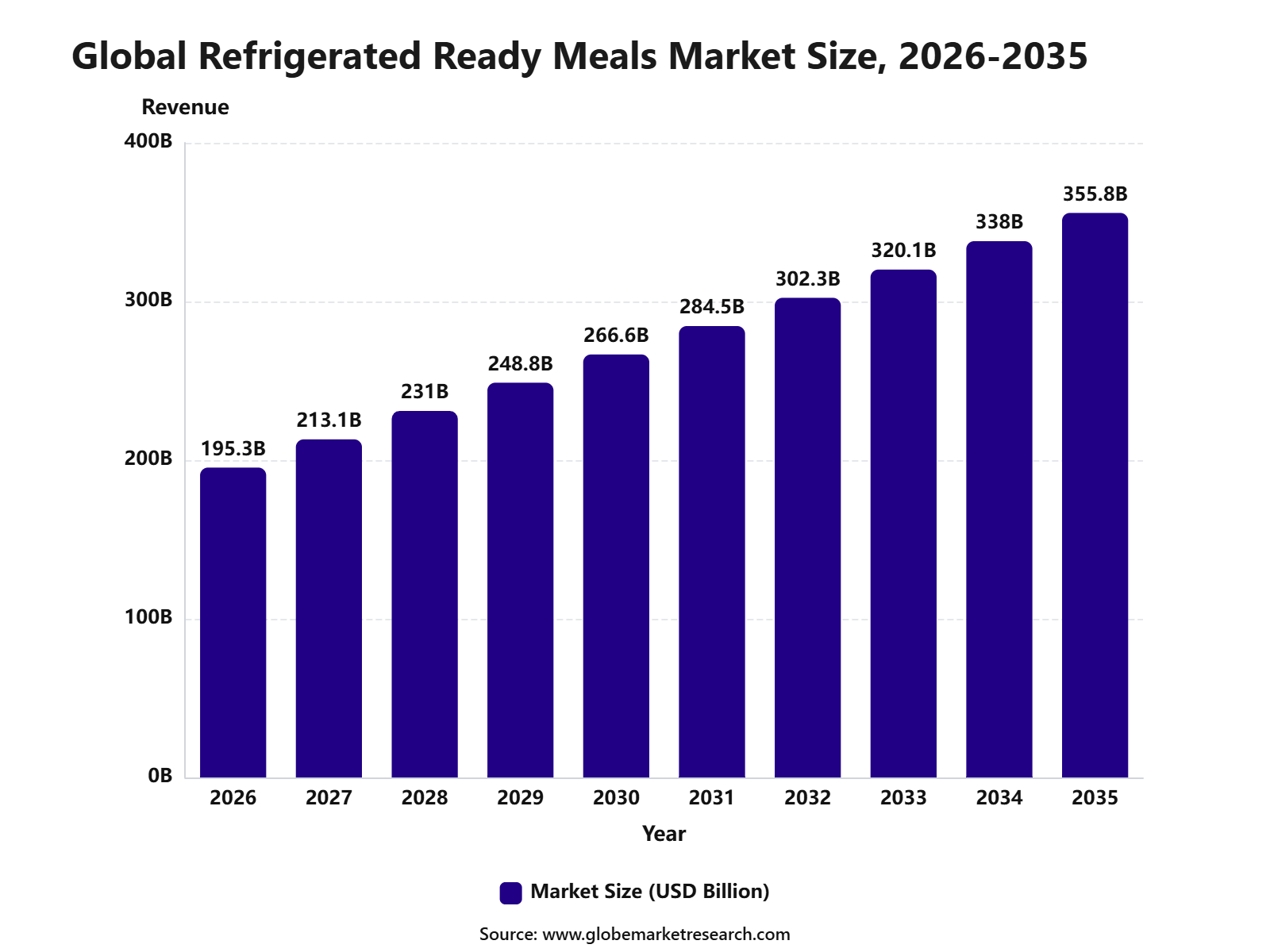 iThe graph shows projected market growth until 2035 based on CAGR analysis. Actual outcomes may vary depending on changing demand, competition, and economic factors.To gain greater insights - request a sample report PDF
Key Market Insights
Frozen meals led the product segment with 53.3% share, supported by strong demand for convenient, ready-to-heat meal options with longer shelf life and easy storage.
Vegetarian meals accounted for 45.2% share by meal type, driven by rising preference for plant-based meals, healthier food choices, and affordable ready-to-eat options.
Supermarkets and hypermarkets held 45.2% share by distribution channel, supported by organized chilled food sections, wide product availability, promotional pricing, and regular household grocery purchases.
North America led the refrigerated ready meals market with 45.5% share, valued at USD 88.8 billion, supported by busy consumer lifestyles, mature retail infrastructure, strong chilled food demand, and high adoption of convenient meal solutions.
Top Funding and Investment
Top Investments
In March 2026, HelloFresh launched Factor production at its semi-automated facility in Verden, Germany. The plant manufactures fresh, fully prepared meals requiring refrigeration and supports Factor’s expansion across Germany and Austria. HelloFresh also consolidated its German meal-kit production at Barleben as part of its wider global product and manufacturing investment programme.
During fiscal 2025, Greencore increased production to approximately 148 million chilled ready meals, compared with 125 million in fiscal 2024. Growth was supported by the onboarding and scaling of a major ready-meals contract at its Kiveton manufacturing operation. Chilled ready-meal volumes had increased 23.5% year over year during the first quarter of fiscal 2025.
In June 2026, refrigerated prepared-meal company Frive advanced plans for a purpose-built production facility capable of manufacturing up to 1.5 million meals per week. Frive generated approximately GBP 50 million in 2025 revenue, served around 30,000 households weekly and employed approximately 500 people across its meal-production and corporate operations.
During 2025 and 2026, Simmer Eats reinvested operating profits in production automation, packaging and fulfilment capacity for its refrigerated ready-to-heat meals. The company generated GBP 36.1 million in revenue in the year ending January 2025 and expected revenue to approximately double during the following financial year.
In 2025, Chef Robotics expanded deployments of AI-enabled food assembly systems used by prepared-meal producers, including refrigerated meal companies. Its robots had processed nearly 2,000 ingredients and produced more than 44 million food servings, supporting higher-throughput portioning, filling and packaging operations in fresh-food factories.
Top Funding
In July 2025, refrigerated ready-meal subscription company Calo raised USD 39 million in a Series B extension led by AlJazira Capital. The transaction increased its total Series B financing to USD 64 million and total capital raised to more than USD 90 million. Funding supports UK expansion, personalised meal services, cloud kitchens and new retail meal formats.
In April 2025, Chef Robotics secured USD 20.6 million in Series A funding, led by Avataar Venture Partners. The company also obtained USD 22.5 million in equipment financing from Silicon Valley Bank. The capital supports additional robotic systems for food preparation, portioning and packaging in refrigerated and prepared-meal production facilities.
In 2026, fresh prepared-meal manufacturer FreshRealm sought USD 63 million in debtor-in-possession financing to maintain operations during its restructuring. FreshRealm manufactured refrigerated meals and meal kits for major U.S. retailers and brands. The restructuring arrangement also included approximately USD 42 million in cash and other consideration connected with transferring Blue Apron production.
Top Acquisitions
In January 2026, Greencore completed its approximately GBP 1.2 billion acquisition of Bakkavor. Greencore acquired Bakkavor’s chilled ready-meal, salad, pizza, bread, dip, sauce and dessert operations, together with its manufacturing facilities, customer contracts, workforce and U.S. and UK prepared-food businesses. The combined company generated approximately GBP 4.1 billion in pro forma fiscal 2025 revenue and employed around 28,000 people.
In January 2026, The Compleat Food Group acquired Greencore’s Bristol chilled soups and sauces operation as part of the regulatory remedy required for the Bakkavor transaction. The acquired business included the Bristol manufacturing facility, production equipment, employees, customer relationships and chilled-food product lines. The site had generated approximately GBP 47 million in annual revenue before the divestment.
By Product
Frozen meals accounted for 53.3% share of the Refrigerated Ready Meals Market. This leading position is supported by strong demand for convenient, time-saving, and easy-to-prepare meal options across households, retail stores, and foodservice channels.
The segment is widely preferred because frozen ready meals offer longer shelf life, controlled portions, and reliable product quality. These meals are commonly used for quick lunches, dinners, workplace meals, family packs, and single-serve consumption.
Demand is expected to remain strong as busy lifestyles, urbanization, and working consumers increase the need for ready-to-heat food options. Growth will be supported by healthier frozen recipes, ethnic cuisines, premium meal formats, and wider retail freezer availability.
By Meal Type
Vegetarian meals accounted for 45.2% share of the Refrigerated Ready Meals Market. This leading share is supported by rising demand for plant-based, meat-free, and vegetable-rich ready meal options among health-conscious and flexitarian consumers.
The segment is widely preferred because vegetarian ready meals offer convenience, affordability, and broad consumer acceptance. These products include vegetable curries, pasta meals, rice bowls, soups, wraps, noodles, salads, and plant-based protein meal formats.
Demand is expected to remain strong as consumers seek lighter, cleaner, and more sustainable meal choices. Product innovation in high-protein vegetarian meals, ethnic flavors, clean-label ingredients, and chilled meal kits will continue to support segment growth.
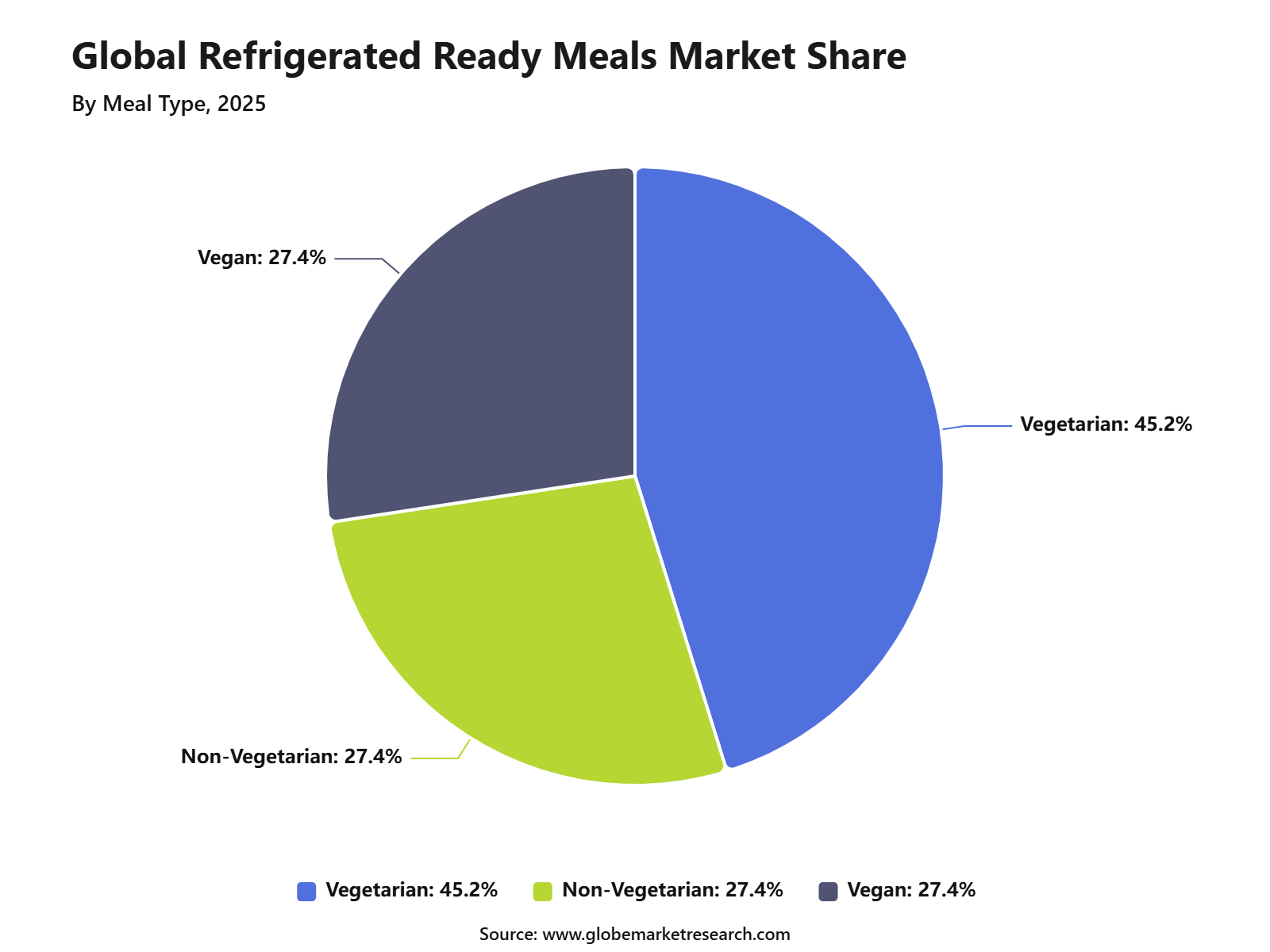 iThe graph shows projected market growth until 2035 based on CAGR analysis. Actual outcomes may vary depending on changing demand, competition, and economic factors.To gain greater insights - request a sample report PDF
By Distribution Channel
Supermarkets and hypermarkets accounted for 45.2% share of the Refrigerated Ready Meals Market. This dominance is driven by wide product availability, dedicated chilled food sections, strong brand visibility, and consumer preference for one-stop grocery shopping.
The channel is important because refrigerated ready meals require proper cold-chain storage, frequent replenishment, and clear product display. Supermarkets and hypermarkets provide chilled aisles, private-label options, promotional pricing, and wide choices across meal types and cuisines.
Demand through this channel is expected to remain strong as consumers continue to buy ready meals during regular grocery visits. Growth will be supported by expanded chilled shelves, premium ready meal ranges, vegetarian options, and improved in-store refrigeration infrastructure.
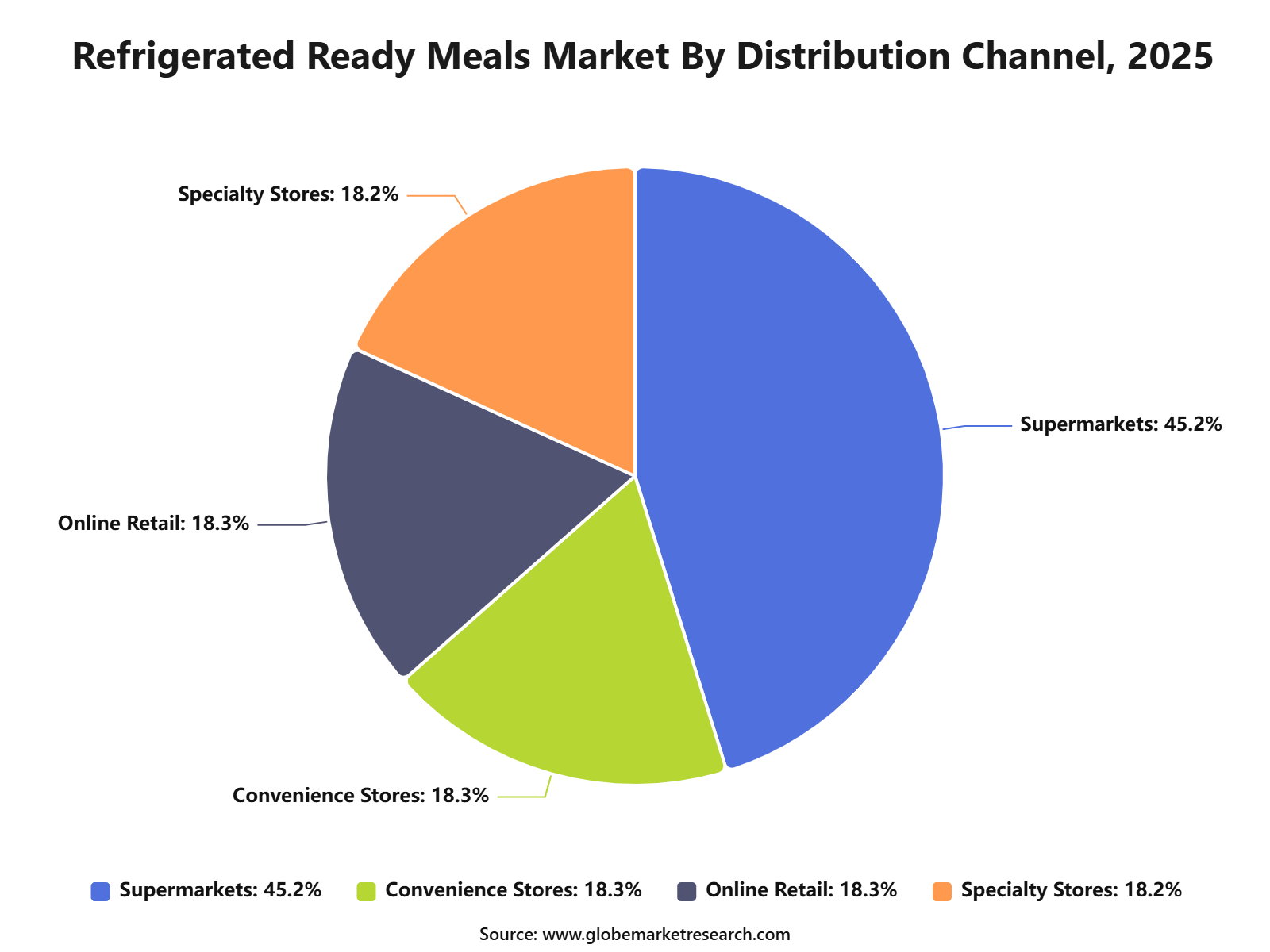 iThe graph shows projected market growth until 2035 based on CAGR analysis. Actual outcomes may vary depending on changing demand, competition, and economic factors.To gain greater insights - request a sample report PDF
By Region
North America accounted for 45.5% share of the Refrigerated Ready Meals Market, reaching USD 88.8 billion. The region’s leadership is supported by high demand for convenience foods, strong supermarket penetration, busy consumer lifestyles, and mature cold-chain infrastructure.
The United States and Canada are key contributors to regional demand. The region benefits from high household spending on prepared foods, strong retail refrigeration networks, and growing demand for healthier, vegetarian, premium, and portion-controlled meal solutions.
North America is expected to maintain its leading position as consumers continue to seek fresh, convenient, and ready-to-heat meal options. Demand will remain supported by frozen meals, vegetarian meal types, supermarket and hypermarket sales, and continued innovation in chilled ready meal formats.
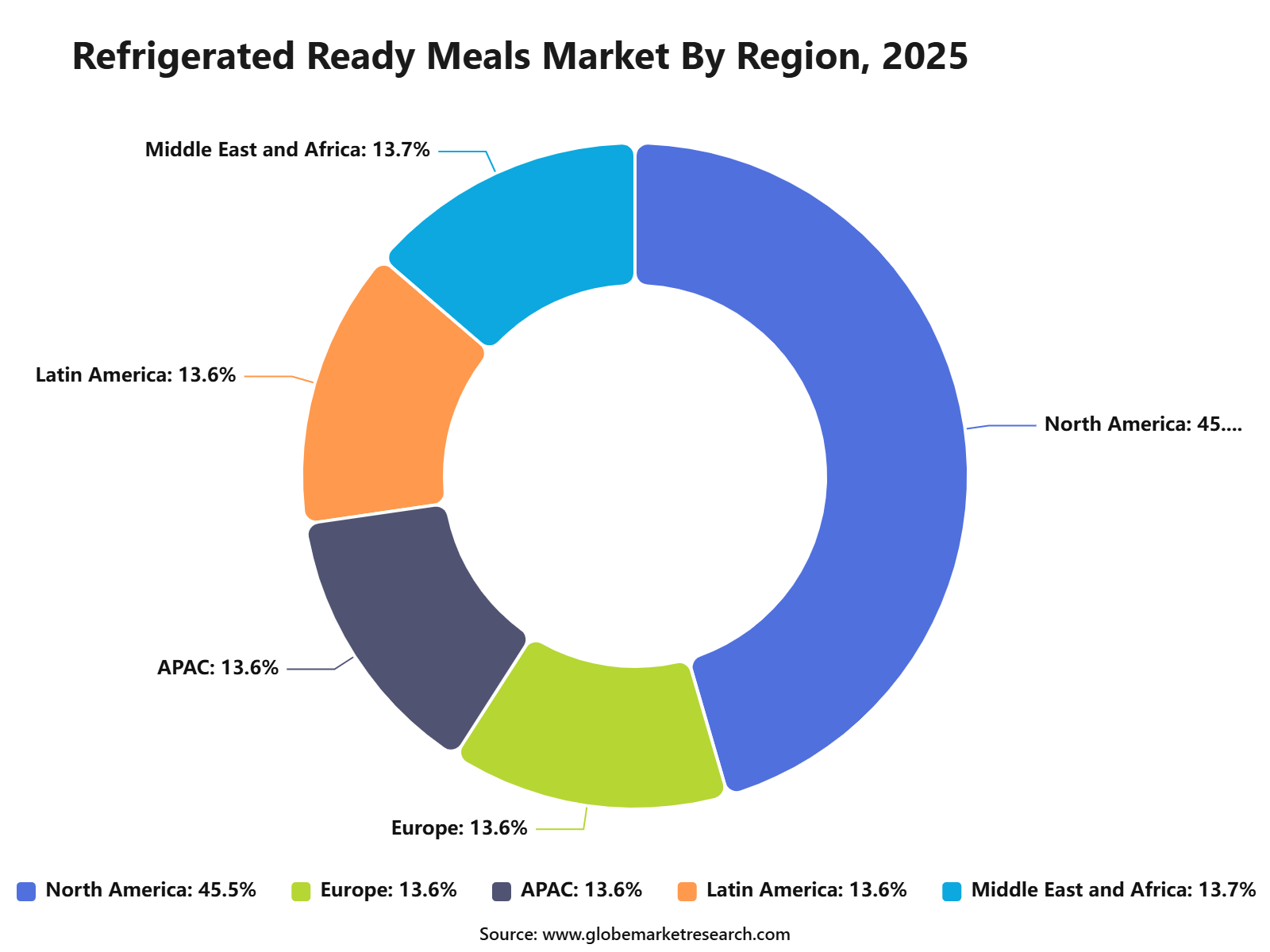 iThe graph shows projected market growth until 2035 based on CAGR analysis. Actual outcomes may vary depending on changing demand, competition, and economic factors.To gain greater insights - request a sample report PDF
Regional Impact Analysis
North America leads the Refrigerated Ready Meals Market with 45.5% share in 2026, valued at around USD 88.9 billion, supported by high demand for convenient fresh meals, strong supermarket chilled sections, advanced cold-chain systems, and broad acceptance of ready-to-heat meal formats. The U.S. remains the main contributor due to strong retail penetration and high household consumption of prepared meals.
Europe remains important because of premium chilled meal demand, fresh prepared foods, clean-label recipes, and strong private-label supermarket offerings. Asia Pacific supports future growth through urbanization, rising disposable income, modern grocery expansion, and increasing adoption of convenient meal solutions.
Impact Factor | Estimated CAGR Impact | Regional Relevance | Market Impact |
|---|---|---|---|
North America market leadership | +2.0% | North America, 45.5% share in 2026 | Leads global value demand. |
U.S. chilled meal consumption | +1.6% | U.S. | Drives major regional revenue. |
Canada premium ready meal demand | +1.1% | Canada | Supports steady category growth. |
Europe private-label chilled meals | +1.0% | UK, Germany, France, Italy | Adds value-led product demand. |
Asia Pacific modern retail expansion | +0.8% | China, India, Japan, Southeast Asia | Builds future market growth. |
Go-To-Market and Sales Economics
Refrigerated ready-meal producers should prioritize supermarkets, convenience stores, online grocery platforms, workplaces, hospitals, and food-service outlets. Product portfolios should cover single-person portions, family trays, high-protein meals, vegetarian recipes, and regional cuisines. The Philippine food retail sector is forecast to grow 5% in 2026 as modern stores and e-commerce expand.
Direct retailer partnerships are important because chilled meals require accurate demand forecasts, short replenishment cycles, controlled display temperatures, and limited markdown losses. Manufacturers should combine private-label contracts with differentiated branded products. Japan’s food-processing industry generated USD 174 billion in 2025, with continued opportunities in convenient, health-oriented, and value-added food categories.
Pricing should reflect ingredient quality, preparation convenience, packaging, shelf life, refrigeration, retailer deductions, and unsold-product risk. Smaller packs can maintain accessible price points, while premium recipes can improve margins. USDA expects U.S. food prices to rise 2.9% in 2026, increasing the importance of disciplined promotional planning and price-pack management.
Risk Factors & Market Barriers
Limited shelf life creates a major operating barrier because production, distribution, and retail demand must remain closely aligned. Forecasting errors can cause markdowns, expired inventory, and product disposal. Manufacturers require frequent deliveries, temperature monitoring, retailer-level sales data, and flexible production schedules to protect freshness while avoiding excessive working capital tied to short-dated stock.
Listeria contamination represents a serious safety and financial risk for refrigerated ready-to-eat products. In June 2026, U.S. authorities issued a public-health alert for ready-to-eat chicken wraps that could contain contaminated ingredients. Strong environmental monitoring, sanitation verification, supplier controls, and finished-product traceability are required throughout chilled-meal manufacturing facilities.
Regulatory oversight is becoming more detailed for ready-to-eat processors. In January 2026, USDA inspection instructions continued expanded testing for non-Listeria species at establishments preparing, processing, or importing ready-to-eat meat and poultry. Producers may face higher laboratory, sanitation, documentation, and corrective-action costs when operating across multiple facilities or supplier networks.
Revenue Potential Analysis
Revenue Landscape Across
North America provides revenue opportunities through retail meal trays, protein bowls, prepared pasta, refrigerated breakfast products, and workplace lunches. The widening gap between grocery and restaurant pricing can support at-home meal solutions. USDA expects food-away-from-home prices to increase faster than food-at-home prices during 2026, strengthening the value proposition of convenient refrigerated meals.
Asia offers strong potential as urbanization, modern grocery formats, and demand for convenient foods increase. The Philippine food and beverage manufacturing sector is expected to expand by approximately 5% in 2026. Affordable portions, familiar regional flavors, local ingredient sourcing, and distribution through convenience stores can strengthen adoption among younger and time-constrained consumers.
European and Latin American markets provide opportunities where chilled foods are already integrated into supermarket shopping. In Colombia, consumer preference for chilled processed products remains stronger than for frozen alternatives, particularly in urban areas. Mexican, Italian, and Chinese preparations are commonly preferred, supporting localized menu development and differentiated refrigerated meal ranges.
Financial Impact
Financial performance depends on sell-through rates, production scheduling, labour efficiency, packaging cost, and retailer markdown arrangements. Unlike frozen products, refrigerated meals provide a shorter period for recovering manufacturing and distribution expenses. Real-time demand information, regional production hubs, smaller batch sizes, and accurate expiry-date management can therefore materially improve gross margin and reduce disposal costs.
Ingredient inflation can quickly change recipe profitability because refrigerated meals frequently contain meat, vegetables, dairy, sauces, grains, and packaging-intensive components. USDA projects food prices to increase 2.9% in 2026. Manufacturers should use multiple approved suppliers, adaptable recipes, menu engineering, and selective portion adjustments while protecting taste and nutritional quality.
Food-safety investment creates additional cost but protects revenue, retailer access, and brand value. USDA launched a 2026 pilot to strengthen oversight of post-lethality-exposed ready-to-eat meat products. Expenditure on zoning, sanitation, environmental testing, cold-room controls, and digital traceability can reduce the probability of recalls, production shutdowns, and lost customer contracts.
Convenience Demand Expands Refrigerated Meals
Consumer spending is the most important factor supporting the Refrigerated Ready Meals Market. Total U.S. food spending reached USD 2.51 trillion, including USD 1.10 trillion for food at home and USD 1.41 trillion for food away from home. Consumers also allocated 9.7% of disposable personal income to food, showing that convenient meal formats compete across both retail and prepared-food occasions.
Cold-chain reliability and food safety determine whether this demand can be converted into profitable sales. USDA surveys more than 800 commercial and public warehouses storing refrigerated products for at least 30 days, showing the scale of temperature-controlled infrastructure. FDA guidance also warns that longer refrigerator storage increases the opportunity for Listeria growth, making shelf-life control, sanitation and fast stock rotation essential.\
Important Data | Numeric Value |
|---|---|
Total Food Spending | USD 2.51 trillion |
At-Home Food Spending | USD 1.10 trillion |
Away-From-Home Spending | USD 1.41 trillion |
Annual Household Food Spending | USD 10,169 |
Annual At-Home Spending | USD 6,224 |
Food Income Share | 9.7% |
Refrigerated Warehouses | More than 800 |
Food Price Increase | 3.1% |
Drivers Impact Analysis
The Refrigerated Ready Meals Market is driven by rising demand for fresh, convenient, ready-to-eat and ready-to-heat meals. Consumers prefer refrigerated meals because they offer fresher taste, shorter preparation time, controlled portions, and better meal variety compared with many shelf-stable options.
North America leads the market due to strong supermarket penetration, high demand for chilled convenience foods, busy lifestyles, mature cold-chain infrastructure, and large retail meal sections. The U.S. remains the main contributor because refrigerated meals are widely sold through supermarkets, hypermarkets, convenience stores, and online grocery channels.
Impact Factor | Estimated CAGR Impact | Regional Relevance | Market Impact |
|---|---|---|---|
Rising demand for convenient fresh meals | +2.0% | North America, Europe, Asia Pacific | Drives core refrigerated meal consumption. |
Growth in working households | +1.6% | U.S., Canada, Europe | Supports ready-to-heat meal demand. |
Expansion of chilled retail sections | +1.4% | Supermarkets and hypermarkets | Improves product visibility and access. |
Demand for healthier prepared meals | +1.1% | Urban and premium consumers | Supports fresh and balanced meal formats. |
Growth in online grocery delivery | +0.9% | Developed digital retail markets | Expands chilled meal reach. |
Restraints Impact Analysis
The market faces restraints from high cold-chain cost, short shelf life, food safety risk, and product waste. Refrigerated ready meals require strict temperature control from production to retail and delivery, making operations more complex than ambient packaged foods.
Another restraint is price sensitivity. Refrigerated meals often cost more than frozen or shelf-stable alternatives because of fresh ingredients, packaging, distribution, and faster inventory turnover requirements.
Impact Factor | Estimated CAGR Impact | Regional Relevance | Market Impact |
|---|---|---|---|
High cold-chain logistics cost | -0.9% | Global chilled food supply chains | Raises operating expenses. |
Shorter shelf life than frozen meals | -0.8% | Retail and online grocery | Increases waste risk. |
Food safety and spoilage concerns | -0.7% | North America and Europe | Requires strict quality control. |
Higher retail price points | -0.6% | Price-sensitive consumers | Limits frequent purchase. |
Inventory management complexity | -0.5% | Supermarkets and convenience stores | Pressures margins and stock planning. |
Opportunities Impact Analysis
Opportunities are strong in premium refrigerated meals, healthy bowls, vegetarian meals, high-protein meals, ethnic cuisine, fresh pasta, prepared salads, chilled breakfast meals, and family-size meal kits. These formats serve consumers looking for convenience without fully compromising freshness.
Higher-value opportunities are emerging in clean-label recipes, calorie-controlled meals, plant-based refrigerated meals, online grocery partnerships, private-label chilled meals, and foodservice-style retail meals. Brands that combine freshness, nutrition, taste, and convenience can capture stronger repeat demand.
Impact Factor | Estimated CAGR Impact | Regional Relevance | Market Impact |
|---|---|---|---|
Premium chilled meal innovation | +1.8% | North America and Europe | Builds higher-margin demand. |
Healthy and balanced meal formats | +1.5% | Urban consumers and wellness buyers | Supports better-for-you positioning. |
Vegetarian and plant-based meals | +1.2% | U.S., Canada, Europe | Adds lifestyle-driven demand. |
Ethnic and global cuisine meals | +1.0% | Urban multicultural markets | Improves product differentiation. |
Private-label refrigerated meals | +0.8% | Supermarket channels | Supports value and retailer growth. |
Challenges Impact Analysis
The main challenge is maintaining freshness, taste, texture, and food safety during production, transport, retail display, and home storage. Even small breaks in temperature control can affect product quality and consumer trust.
Another challenge is balancing freshness with scalable production. Manufacturers must manage ingredient sourcing, batch consistency, packaging, shelf-life testing, and rapid replenishment while keeping prices acceptable for everyday consumers.
Impact Factor | Estimated CAGR Impact | Regional Relevance | Market Impact |
|---|---|---|---|
Maintaining freshness through distribution | -0.8% | Chilled meal supply chains | Affects product quality. |
Temperature abuse during delivery | -0.7% | Retail and online grocery | Increases spoilage risk. |
Ingredient cost inflation | -0.6% | Fresh produce, meat, dairy, packaging | Pressures margins. |
Batch consistency challenges | -0.5% | Large meal manufacturers | Impacts consumer experience. |
Retail waste management | -0.4% | Supermarkets and convenience stores | Reduces profitability. |
Market Trend Analysis
The market trend is moving toward fresh ready meals, clean-label recipes, vegetarian meals, protein-rich bowls, globally inspired cuisines, chilled meal kits, and premium supermarket meal solutions. Consumers want fast meals that feel closer to home-cooked or restaurant-quality food.
North America remains the largest value region because of strong chilled food retail, high convenience meal demand, and well-developed cold-chain infrastructure. Europe supports premium chilled meals, while Asia Pacific is growing through urban lifestyles, modern retail, and rising demand for convenient prepared foods.
Impact Factor | Estimated CAGR Impact | Regional Relevance | Market Impact |
|---|---|---|---|
Fresh and clean-label meals gain demand | +1.7% | North America and Europe | Supports premium chilled meal sales. |
Protein-rich meal bowls expand | +1.4% | Health-focused consumers | Adds nutrition-led value. |
Vegetarian refrigerated meals grow | +1.1% | Developed consumer markets | Supports lifestyle-based demand. |
Global cuisine formats increase | +0.9% | Urban retail markets | Improves product variety. |
Chilled meal kits gain traction | +0.7% | Supermarkets and online grocery | Bridges cooking and convenience. |
Investor Type Impact Matrix
Investors should focus on companies with strong chilled food manufacturing, cold-chain reliability, retailer relationships, product innovation, food safety systems, and waste control. Taste, freshness, nutrition, shelf life, and retail replenishment efficiency are key success factors.
Strategic investors can also target refrigerated meal producers, private-label manufacturers, cold-chain logistics firms, packaging technology providers, vegetarian meal brands, and online grocery platforms. Companies that combine fresh quality with scalable distribution are better positioned for long-term growth.
Investor Type | Estimated CAGR Impact | Regional Relevance | Market Impact |
|---|---|---|---|
Refrigerated Meal Producers | +1.5% | North America, Europe, Asia Pacific | Expands core product revenue. |
Private-Label Meal Manufacturers | +1.2% | Supermarket and hypermarket channels | Supports retailer-led growth. |
Cold-Chain Logistics Providers | +1.0% | Chilled food supply chains | Improves market reach and quality control. |
Packaging Technology Firms | +0.8% | Refrigerated food manufacturers | Supports freshness and waste reduction. |
Strategic Food Investors | +0.6% | Global prepared food markets | Funds innovation and market expansion. |
Recent Developments
February 2026: Nestlé disclosed advanced negotiations to sell its remaining ice cream operations to Froneri, continuing portfolio rationalisation and concentrating resources on coffee, pet care, nutrition, and selected regional food and snack businesses.
March 2026: General Mills announced new Häagen-Dazs Chocolate Brownie, Strawberry Mochi and Tiramisu ice creams for international markets, alongside Belgian Chocolate reformulated with 72% cocoa and additional fruit-inspired stick bars.
March 2026: Blue Bell introduced Blue Bell PRO, a high-protein dairy dessert, expanding its frozen portfolio beyond traditional ice cream while adding a functionality-focused product range alongside its established flavours and novelty offerings.
Competitive Landscape
The market is characterized by intense competition among established players and emerging companies. Strategic partnerships, mergers and acquisitions, and product innovation are key strategies employed by market participants.
Key Market Players
Bakkavor Group plc
Greencore Group plc
Nestlé S.A.
Conagra Brands, Inc.
General Mills, Inc.
The Kraft Heinz Company
Tyson Foods, Inc.
Campbell Soup Company
Hormel Foods Corporation
Nomad Foods Limited
Other Key Players
Research Methodology
This market study is prepared using a combination of primary and secondary research. Primary research includes discussions with manufacturers, suppliers, distributors, consultants, industry experts, and end users. Secondary research covers company reports, government databases, trade associations, technical publications, regulatory sources, and trusted industry documents. The collected information is used to assess market demand, pricing trends, technology adoption, competitive activity, and regional performance.
AI language models are not used as primary data sources, and publicly available AI-generated content is not treated as market evidence. Computational tools may be used to support data processing, translation, data classification, and pattern identification. However, every published assessment is supported by verified sources, human review, and primary market discussions.
Market estimates are developed through top-down and bottom-up approaches and validated using data triangulation. Revenue, production, shipment, pricing, and application-level data are compared across multiple sources. Forecasts consider economic conditions, regulatory changes, investment activity, innovation, supply chain developments, and industry risks. All findings are reviewed through source verification and internal quality checks before publication.
Part I
Source Management & Input Data Standards
Who provides data, how sources are qualified, and what types of evidence are admissible.
Part II
Research Scope & Market Coverage
How we define the markets we assess and the parameters that govern each product.
Part III
Data Collection, Verification & Submission
The mechanics of gathering, cross-checking, and hierarchically ranking evidence.
Part IV
Assessment Determination & Quality Controls
How raw data becomes a published assessment — normalisation, expert judgement, and outlier exclusion.
Part V
Publication, Corrections & Revision
Our publication schedule, corrections policy, and methodology review cycle.
Part VI
Independence, Ethics & Complaints
Conflict-of-interest policies, editorial independence, and how clients raise concerns.
Google · Preferred Sources
Don't miss the latest market research insights and industry updates on Google.
Add Globe Market Research as a preferred source in the Google app to see our reports, analysis, and market stories in your news suggestions.
Meet the Team
This report was prepared by our expert analysts with deep industry knowledge and research experience.
Kimaya brings more than five years of experience in market research, content review, and industry analysis to Globe Market Research. She plays an important role in maintaining the accuracy, clarity, consistency, and relevance of research content across a wide range of industries. Her responsibilities include reviewing market data, segment analysis, competitive landscapes, industry trends, company developments, and strategic insights. Each report is carefully assessed to ensure that the findings are supported by reliable data, presented in a structured format, and aligned with the information needs of business decision-makers. Kimaya has research experience across healthcare, information technology, consumer goods, and several cross-industry domains.
Pratiksha K. is a Senior Research Analyst with more than five years of experience in market research, industry analysis, competitive intelligence, and business strategy. She has contributed to detailed market reports, customized research studies, company profiling, market sizing, trend analysis, and strategic consulting projects for clients across different regions. Her industry expertise covers Chemical and Material, Consumer Goods, Food & Beverages and Energy & Power. She closely evaluates changing customer requirements, technology developments, regulatory conditions, supply chain structures, investment activity, and competitive strategies to provide clear and practical market insights.
Frequently Asked Questions
Related Reports
More in Food and Beverages
Frozen Desserts Market to Hit USD 298.8 Billion by 2035
Frozen Desserts Market Size, Share, Analysis By Product (Ice Cream, Frozen Yogurt, Gelato, Sorbet, Frozen Cakes, Other Products), By Consumption (Retail Consumption, Foodservice Consumption), By Distribution Channel (Supermarkets and Hypermarkets, Convenience Stores, Specialty Stores, Online Retail), By Regional Insights, Business plan and Project Report, Investment Opportunities, Profitability, Industry Trends, Leading Companies and Growth Forecasts by 2026-2035
Frozen Meat and Seafood Market to Hit USD 181.1 Billion by 2035
Frozen Meat and Seafood Market Size, Share, Analysis By Product (Frozen Meat, Frozen Seafood), By Seafood Form (Whole, Fillets, Processed Seafood, Other Forms), By Seafood End Use (Retail and Household, Foodservice, Industrial), By Regional Insights, Business plan and Project Report, Investment Opportunities, Profitability, Industry Trends, Leading Companies and Growth Forecasts by 2026-2035
Frozen Meals Market to Hit USD 74.2 Billion by 2035
Frozen Meals Market Size, Share, Analysis By Product (Frozen, Chilled, Canned, Shelf-Stable), By Meal Type (Vegetarian, Non-Vegetarian, Vegan), By Distribution Channel (Supermarkets and Hypermarkets, Online Retail, Convenience Stores, Specialty Stores), By Regional Insights, Business plan and Project Report, Investment Opportunities, Profitability, Industry Trends, Leading Companies and Growth Forecasts by 2026-2035
Food Colorants Market to Hit USD 8.6 Billion by 2035
Food Colorants Market Size, Share, Analysis By Type (Natural, Synthetic, Nature-Identical), By Form (Powder, Liquid, Gel), By Application (Beverages, Bakery and Confectionery, Dairy, Meat Products, Snacks, Other Applications), By Regional Insights, Business plan and Project Report, Investment Opportunities, Profitability, Industry Trends, Leading Companies and Growth Forecasts by 2026-2035