

Revenue, 2026
USD 525.3 Bn
Forecast, 2035
USD 1,033.1 Bn
CAGR, 2026-2035
7.8%
Report Coverage
Global
Market Size and Forecast
The Global Gourmet Food Market was worth USD 525.3 billion in 2026 and is expected to reach USD 1,033.1 billion by 2035, growing at a CAGR of 7.8% from 2026 to 2035. Europe held the largest regional share of 40.6% in 2026, valued at around USD 213.2 billion, supported by strong premium food culture, high consumer spending on specialty products, and mature retail and hospitality channels.
The Gourmet Food Market includes premium, specialty, artisanal, organic, imported, and high-quality food products designed for taste, authenticity, and superior ingredients. It covers gourmet cheese, chocolates, bakery products, sauces, oils, condiments, seafood, meat products, ready meals, desserts, beverages, and fine packaged foods. The market is closely linked with premium retail, fine dining, gifting, tourism, and home-based culinary experiences.
Market growth is being supported by rising consumer interest in premium ingredients, global cuisines, clean-label products, and restaurant-quality food at home. Consumers are spending more on specialty foods that offer better taste, origin-based quality, natural ingredients, and unique flavors. Demand is also increasing through online gourmet platforms, premium supermarkets, specialty stores, and luxury foodservice channels.
Key Parameter | Report Details |
|---|---|
Market Revenue, 2026 | USD 525.3 Billion |
Projected Revenue, 2035 | USD 1,033.1 Billion |
CAGR (2026-2035) | 7.8% |
Largest Region | Europe (40.6%, USD 213.2 Bn) |
Fastest Growing Region | Asia Pacific |
Market Concentration | Medium |
Forecast Period | 2026-2035 |
Europe is expected to remain the leading region due to its strong culinary heritage, established specialty food brands, premium dairy and bakery sectors, and high demand from France, Italy, Germany, Spain, and the U.K. Regional growth is supported by gourmet gifting, tourism, fine dining, and premium grocery expansion. Long-term market growth will depend on ingredient quality, authenticity, sustainable sourcing, pricing stability, and continued innovation in premium food experiences.
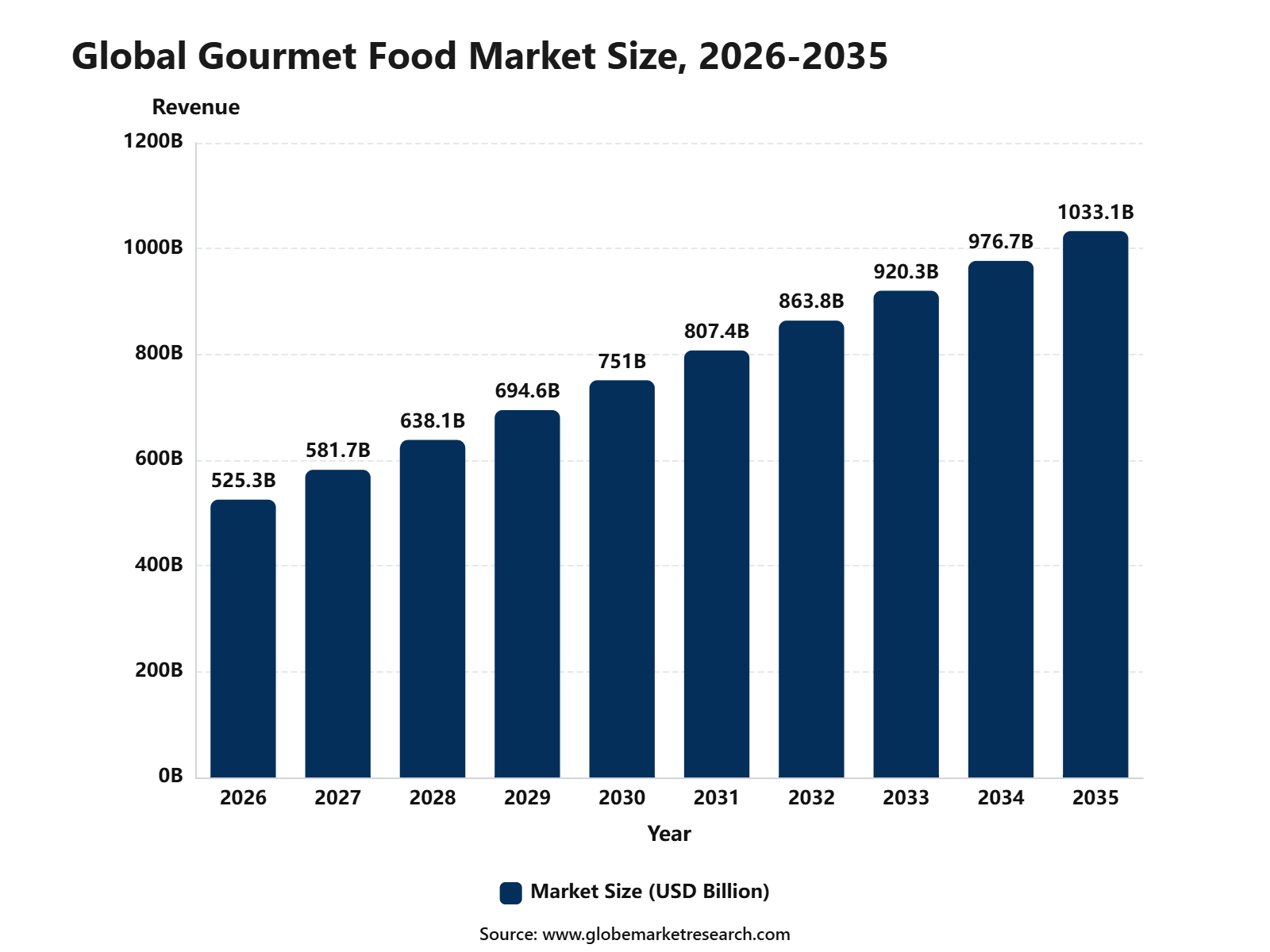 iThe graph shows projected market growth until 2035 based on CAGR analysis. Actual outcomes may vary depending on changing demand, competition, and economic factors.To gain greater insights - request a sample report PDF
Key Market Insights
Cheese and dairy led the product segment with 30.5% share, supported by strong demand for premium cheeses, specialty dairy products, artisanal varieties, and high-quality ingredients used in gourmet meals.
Supermarkets and hypermarkets accounted for approximately 48.5% share by distribution channel, driven by wide product availability, premium shelf placement, imported food sections, and convenient access for household buyers.
Household consumption held approximately 55.6% share by end use, supported by rising interest in premium home dining, specialty ingredients, gifting products, and restaurant-style cooking at home.
Europe led the gourmet food market with 40.6% share, valued at USD 213.2 billion, supported by strong culinary traditions, high premium food consumption, established specialty food retail, and demand for artisanal dairy, bakery, meat, and packaged gourmet products.
Top Funding and Investment
Top Investments
In April 2025, Ferrero announced a CAD 445 million investment to expand and modernize its Brantford, Ontario, manufacturing facility. The project will add production lines for premium confectionery products, create approximately 500 jobs, increase automation and strengthen North American supply for brands including Ferrero Rocher, Nutella, Kinder and Tic Tac.
Lindt & Sprüngli invested CHF 330.5 million during 2025, representing a 5.2% annual increase. Capital was directed toward manufacturing infrastructure, capacity improvements and premium chocolate retail expansion. The company also opened 53 new stores worldwide, including flagship locations in London and Vienna, while 2025 sales reached CHF 5.92 billion.
In 2025, Chobani announced a USD 1.2 billion dairy processing facility in New York and a USD 500 million expansion in Idaho. The combined investment supports premium yogurt, high-protein beverages and other refrigerated food products. Chobani expected 2025 net sales of approximately USD 3.8 billion, up 28% year over year.
In 2025, Mars announced plans to invest USD 2 billion in U.S. manufacturing through 2026. The programme covers new production technology, automation, capacity expansion and product innovation across its premium chocolate and snacking portfolio, including brands such as M&M’s, Snickers, Dove, Twix and KIND.
In 2026, Safcol progressed an approximately AUD 80 million manufacturing facility in Edinburgh, South Australia, designed to replace its existing Elizabeth operation and double production capacity. The company also opened an AUD 11 million seafood market with modern refrigeration, digital traceability and upgraded handling systems supporting premium fresh and gourmet seafood distribution.
Top Funding
In October 2025, premium frozen-dessert company Alec’s Ice Cream secured USD 11 million in Series A funding. The financing supports national retail distribution, manufacturing scale-up, expansion of its cultured frozen-dessert portfolio and the transition of additional dairy suppliers toward regenerative farming practices.
In February 2025, Oobli raised USD 18 million in Series B1 financing from Khosla Ventures, Piva Capital, Global Brain, Norinchukin Bank and Kirin Holdings. The funding supports regulatory approvals and commercial manufacturing of fermentation-derived sweet proteins for premium chocolates, beverages, baked foods and reduced-sugar gourmet products.
In October 2025, French food-technology company Nutropy raised EUR 7 million, approximately USD 8.1 million, to scale precision-fermented casein proteins. The capital supports pilot production and commercialization of dairy proteins designed for premium cheese applications, with the company targeting launch of its “cheeseable milk” ingredient in 2027.
Top Acquisitions
In August 2025, Premier Foods agreed to acquire 100% of Merchant Gourmet for GBP 48 million. Premier Foods acquired the premium food brand, microwaveable lentil and grain portfolio, chestnut and mushroom products, intellectual property, customer relationships and distribution network. Merchant Gourmet was expected to generate approximately GBP 28 million in annual revenue.
In June 2025, HC Private Investments created Artisan Bakery through the acquisitions of Snackwerks and Specialty Bakers. The acquired assets included premium brownie, cookie, snack-cake and baked-dessert portfolios, manufacturing facilities, co-manufacturing operations, recipes, employees and retail customer relationships. The combined platform has a manufacturing heritage extending back to 1901.
By Product
Cheese and dairy accounted for 30.5% share of the Gourmet Food Market. This leading position is supported by strong demand for premium cheese, artisanal dairy products, specialty butter, flavored yogurt, cream-based products, and high-quality dairy ingredients.
The segment is widely preferred because cheese and dairy products are strongly linked with premium food experiences, restaurant menus, gifting, snacking, and home cooking. Consumers often associate gourmet dairy with better taste, origin value, craftsmanship, and natural ingredient quality.
Demand is expected to remain strong as consumers continue to spend on premium cheese boards, specialty dairy, organic products, and international food formats. Growth will be supported by fine dining, retail gourmet sections, home entertaining, and rising preference for high-quality dairy-based foods.
By Distribution Channel
Supermarkets and hypermarkets accounted for approximately 48.5% share of the Gourmet Food Market. This dominance is driven by wide product availability, organized shelf space, premium food aisles, and strong consumer trust in large retail formats.
The channel is widely preferred because consumers can compare gourmet products, check labels, explore international brands, and purchase premium foods during regular grocery shopping. Supermarkets and hypermarkets also support impulse buying through attractive displays, sampling, discounts, and seasonal gourmet collections.
Demand through this channel is expected to remain strong as retailers expand premium food sections and chilled gourmet offerings. Growth will be supported by cheese and dairy products, imported foods, specialty snacks, ready-to-eat gourmet items, and rising middle-income consumer spending.
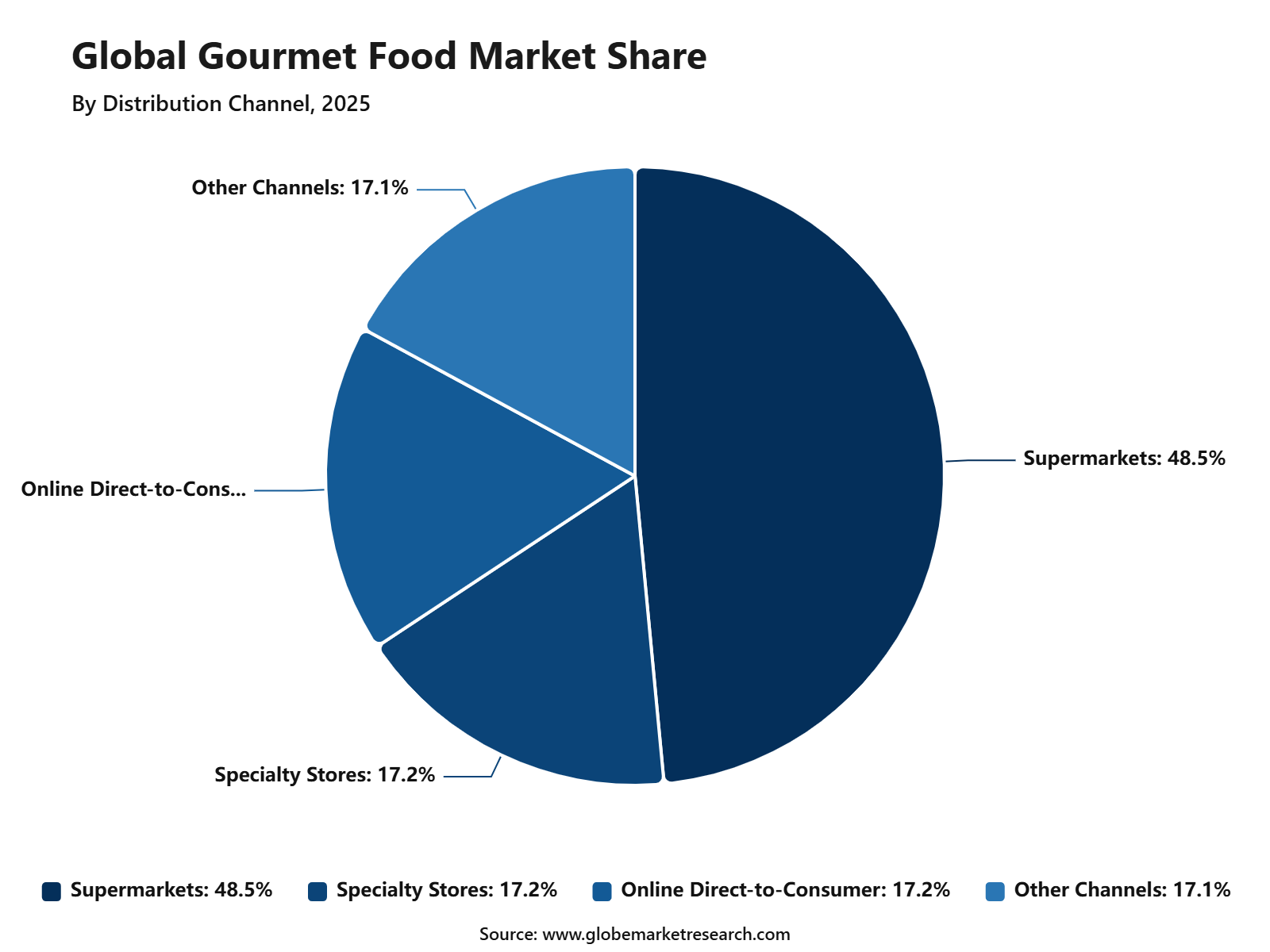 iThe graph shows projected market growth until 2035 based on CAGR analysis. Actual outcomes may vary depending on changing demand, competition, and economic factors.To gain greater insights - request a sample report PDF
By End Use
Household consumption accounted for approximately 55.6% share of the Gourmet Food Market. This leading share is supported by rising consumer interest in premium meals, home dining, gifting, celebration foods, and high-quality packaged gourmet products.
The segment is widely driven by consumers who want restaurant-like food experiences at home. Gourmet cheese, dairy products, sauces, bakery items, desserts, snacks, chocolates, and ready-to-serve foods are increasingly used for family meals, parties, festivals, and personal indulgence.
Demand from households is expected to remain strong as consumers continue to upgrade everyday food choices. Growth will be supported by premium retail access, online grocery platforms, home cooking trends, and rising preference for high-quality, flavorful, and convenient gourmet foods.
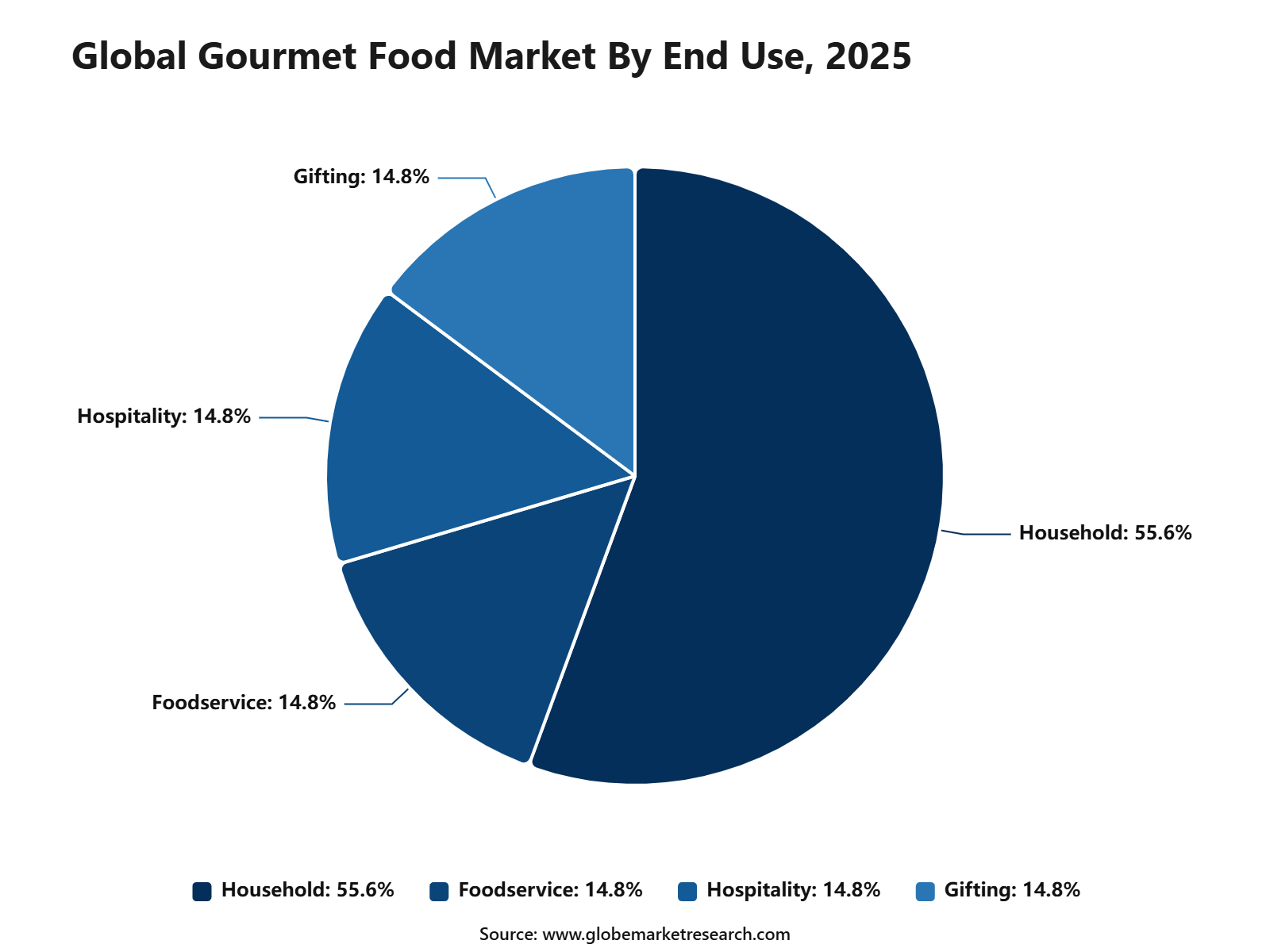 iThe graph shows projected market growth until 2035 based on CAGR analysis. Actual outcomes may vary depending on changing demand, competition, and economic factors.To gain greater insights - request a sample report PDF
By Region
Europe accounted for 40.6% share of the Gourmet Food Market, reaching USD 213.2 billion. The region’s leadership is supported by strong food culture, established cheese and dairy industries, premium bakery traditions, specialty meats, chocolates, wine-paired foods, and high consumer preference for artisanal products.
France, Italy, Germany, Spain, Switzerland, the Netherlands, and the United Kingdom are key contributors to regional demand. The region benefits from strong culinary heritage, protected origin food systems, premium retail networks, and high consumption of specialty cheese, dairy, bakery, and confectionery products.
Europe is expected to maintain its leading position as consumers continue to value authenticity, quality ingredients, and traditional food craftsmanship. Demand will remain supported by cheese and dairy products, supermarket and hypermarket distribution, household consumption, and growing interest in premium gourmet food experiences.
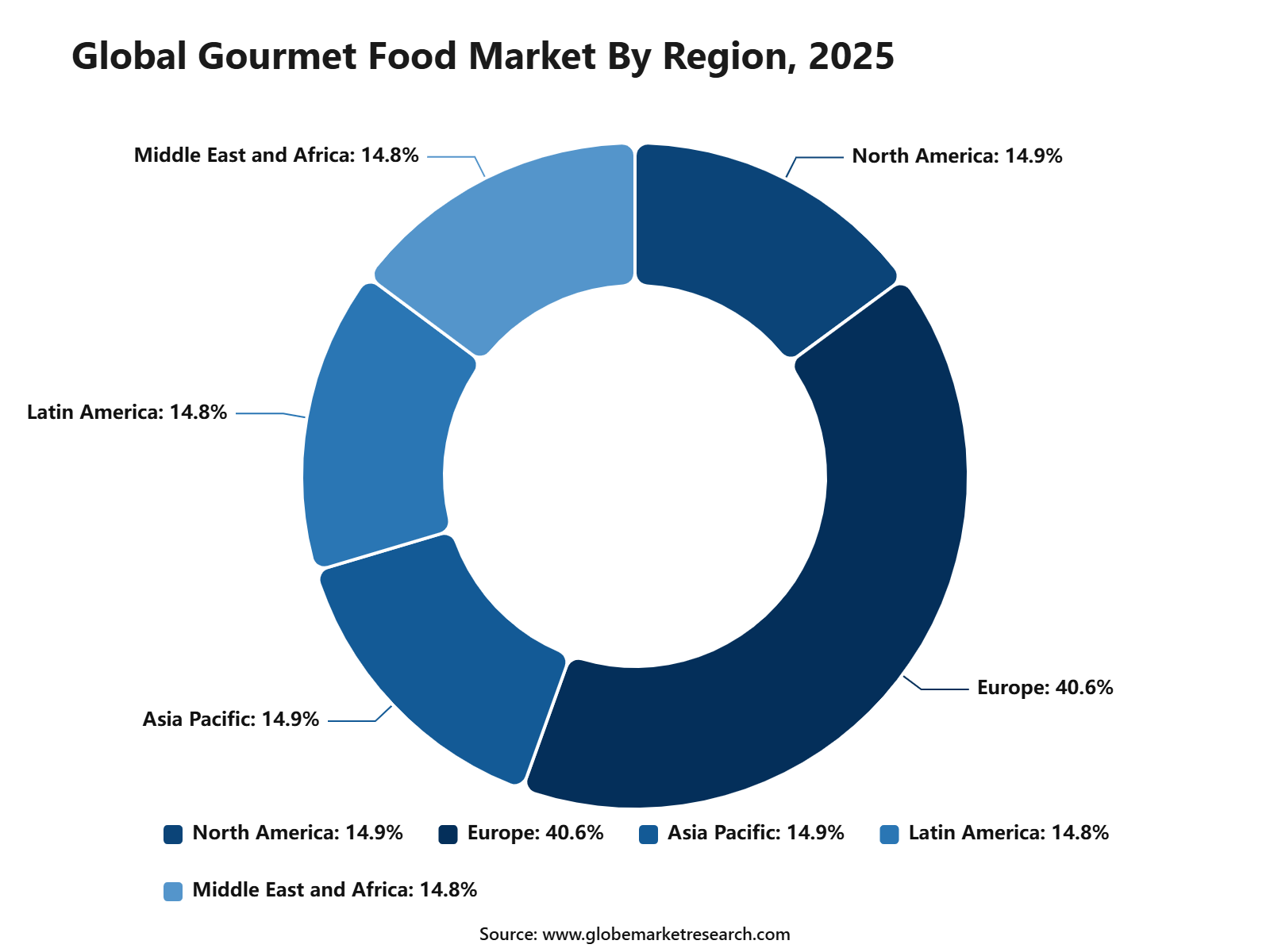 iThe graph shows projected market growth until 2035 based on CAGR analysis. Actual outcomes may vary depending on changing demand, competition, and economic factors.To gain greater insights - request a sample report PDF
Regional Impact Analysis
Europe leads the Gourmet Food Market with 40.6% share in 2026, valued at around USD 213.2 billion, supported by strong demand for specialty cheese, premium dairy, bakery, confectionery, sauces, oils, and regional foods. France, Italy, Germany, Spain, Switzerland, and the UK remain major contributors due to deep culinary heritage and premium retail maturity.
North America remains important due to demand for premium snacks, organic foods, specialty dairy, gourmet frozen meals, and chef-inspired products. Asia Pacific supports future growth through rising disposable income, premium gifting, imported gourmet foods, and expansion of luxury food retail.
Impact Factor | Estimated CAGR Impact | Regional Relevance | Market Impact |
|---|---|---|---|
Europe market leadership | +2.3% | Europe, 40.6% share in 2026 | Leads global value demand. |
France and Italy gourmet heritage | +1.8% | France and Italy | Drives premium regional food sales. |
Germany and UK specialty retail demand | +1.4% | Germany and UK | Supports high-volume premium retail. |
North America premium food innovation | +1.1% | U.S. and Canada | Adds new product growth. |
Asia Pacific luxury food demand | +0.9% | China, Japan, South Korea, Southeast Asia | Builds future premium consumption. |
Premium Experiences Drive Gourmet Demand
Regional gourmet food demand is shaped by consumer purchasing power, restaurant spending, tourism, premium retail availability and interest in authentic food experiences. Europe leads with a 40.6% share valued at USD 213.2 billion, supported by established specialty-food traditions, premium cheese, confectionery, bakery products and hospitality demand. North America benefits from USD 2.51 trillion in U.S. food spending, including USD 1.41 trillion spent away from home.
Asia Pacific offers strong expansion opportunities through urbanization, digital commerce and restaurant consumption. China’s catering revenue reached CNY 5.80 trillion in 2025, increasing 3.2%, while first-quarter 2026 catering revenue rose 4.2% to CNY 1.46 trillion. These figures indicate growing demand for premium dining, imported products, gifting foods and chef-inspired retail offerings.
Region | Market Position | Regional Data | Key Demand Factors |
|---|---|---|---|
North America | Major premium food market | Strong spending across specialty retail, restaurants, online grocery and gourmet gifting | High disposable income, demand for convenient premium meals, international cuisines and direct-to-consumer food brands |
Europe | Leading regional market | 40.6% share, valued at USD 213.2 billion | Established culinary traditions, strong specialty cheese and confectionery consumption, premium bakery demand and preference for authentic regional products |
Asia Pacific | Fastest-growing region | Expanding premium food consumption across China, Japan, India, South Korea and Southeast Asia | Urbanization, rising household income, luxury gifting, international food adoption and rapid growth of online grocery platforms |
Latin America | Emerging regional market | Increasing demand in major urban and tourism centres | Local premium ingredients, specialty coffee, chocolate, meat products, restaurant expansion and growing modern retail access |
Middle East and Africa | Developing premium segment | Demand concentrated in affluent cities, hospitality hubs and tourism destinations | Luxury hotels, premium gifting, imported foods, high-end dining and growing demand for halal-certified gourmet products |
Go-To-Market and Sales Economics
Gourmet food suppliers should segment customers across premium supermarkets, specialty stores, hotels, restaurants, gifting platforms, and online marketplaces. Product offers should emphasize origin, craftsmanship, ingredients, flavor, and presentation. The 2026 sofi Awards received more than 1,280 entries across over 25 categories, showing strong competition and continued product innovation within specialty food retail.
Large retailers should be approached through direct category management, seasonal launch calendars, sampling programs, and exclusive product formats. Smaller producers can expand through specialty distributors and digital marketplaces that support limited production volumes. The Specialty Food Association’s 2026 outlook identifies economic uncertainty, challenger brands, wellness, and changing consumer priorities as major influences on purchasing decisions.
Pricing should reflect ingredient quality, production scale, packaging, import costs, retailer margins, and brand positioning. Entry-size packs can reduce purchase barriers, while gift boxes and limited editions can support premium margins. U.S. food-at-home prices are forecast to increase 2.8% in 2026, making price-pack architecture important for maintaining consumer accessibility.
Risk Factors & Market Barriers
Premium food demand can weaken when household budgets become constrained because gourmet products frequently carry higher prices than standard alternatives. Consumer expectations for food inflation reached 3.9% over the following twelve months in a 2026 Purdue assessment. Producers must therefore provide visible quality differences, practical serving value, and smaller purchase formats to protect repeat demand.
Raw-material volatility creates significant risk because gourmet products often depend on chocolate, dairy, meat, vegetables, nuts, specialty oils, and imported ingredients. USDA forecasts farm-level vegetable prices to rise 27.6% and wholesale beef prices by 9.4% in 2026. Multi-origin sourcing, seasonal menus, flexible recipes, and forward purchasing can help control margin pressure.
Food safety and traceability requirements can be demanding for small-batch producers using imported, artisanal, or minimally processed ingredients. Strong supplier approval, allergen management, temperature control, batch coding, and recall procedures are required. The FAO Food Price Index reached 130.3 points in June 2026, remaining 1.7% above its year-earlier level and indicating continued supply uncertainty.
Revenue Potential Analysis
Revenue Landscape Across
North America offers revenue through premium snacks, cheese, confectionery, sauces, frozen specialties, beverages, charcuterie, and international foods. The 2026 sofi Awards recognized products across more than 25 categories, with convenience, bold flavors, regional ingredients, and distinctive packaging visible among leading entries. These trends support focused launches rather than broad, undifferentiated product portfolios.
Europe provides opportunities for artisanal cheese, bakery products, chocolate, seafood, preserves, olive oils, and regionally protected foods. However, pricing power differs substantially between countries. Eurostat reported that 2025 food and non-alcoholic beverage prices were 22% above the European Union average in Luxembourg, while Romanian prices were 20% below the average.
Asia and other emerging urban markets offer potential through imported delicacies, premium gifting, international cuisine, specialty beverages, and locally adapted luxury foods. Commercial success will depend on distributor quality, cold-chain availability, cultural relevance, and accessible pack sizes. Globally, food commodity prices in June 2026 remained below their 2022 peak despite being higher year over year.
Financial Impact
Profitability depends on maintaining a sufficient premium over higher ingredient, packaging, certification, distribution, and marketing expenses. Gross margins can be improved through smaller portions, direct-to-consumer sales, subscriptions, corporate gifting, and seasonal collections. However, rising grocery prices may limit unit volume, as total U.S. food prices are projected to increase 3.2% during 2026.
Commodity exposure can materially affect contribution margins across premium meat, confectionery, dairy, and vegetable products. In May 2026, U.S. sugar and sweets prices were 7.1% above the previous year, while wholesale beef prices were 15.9% higher. Pricing reviews, recipe engineering, pack adjustments, and supplier diversification should therefore be completed before margin deterioration becomes significant.
Inventory economics require careful control because many gourmet products have limited production volumes, seasonal demand, fragile packaging, or short shelf lives. Slow-moving products can create markdowns, storage costs, and write-offs. Data-led assortment planning, preorder models, gift-season forecasting, and limited batches can improve cash conversion while preserving exclusivity and reducing unsold inventory exposure.
Drivers Impact Analysis
The Gourmet Food Market is driven by rising demand for premium cheese, dairy products, specialty bakery items, artisanal chocolates, premium meat, seafood, sauces, oils, condiments, and ready-to-eat luxury foods. Consumers are spending more on quality, taste, origin, authenticity, and better food experiences.
Europe leads the market due to its strong gourmet food culture, premium dairy base, specialty cheese production, fine bakery traditions, luxury confectionery, wine-paired foods, and established retail channels. France, Italy, Germany, Spain, Switzerland, and the UK remain major demand centers.
Impact Factor | Estimated CAGR Impact | Regional Relevance | Market Impact |
|---|---|---|---|
Rising demand for premium food | +2.3% | Europe, North America, Asia Pacific | Drives core gourmet food growth. |
Growth in specialty cheese and dairy | +1.9% | Europe and North America | Supports high-value consumption. |
Expansion of premium retail channels | +1.5% | Supermarkets, specialty stores, online | Improves product access. |
Demand for authentic regional foods | +1.2% | Europe and urban global markets | Strengthens origin-based branding. |
Growth in gifting and celebration foods | +0.9% | Premium consumer markets | Adds seasonal and occasion demand. |
Restraints Impact Analysis
The market faces restraints from high product pricing, limited shelf life, premium ingredient cost, cold-chain requirements, and sensitivity to inflation. Gourmet foods often depend on quality raw materials, skilled production, specialty packaging, and premium distribution.
Another restraint is uneven consumer affordability. Premium food demand is strong in developed and urban markets, but price-sensitive consumers may shift to private-label or standard packaged food during economic pressure.
Impact Factor | Estimated CAGR Impact | Regional Relevance | Market Impact |
|---|---|---|---|
High product pricing | -1.0% | Global premium food markets | Limits mass adoption. |
Ingredient cost volatility | -0.8% | Dairy, cocoa, meat, seafood, oils | Pressures margins. |
Short shelf life for fresh gourmet items | -0.7% | Cheese, bakery, fresh meals | Increases waste risk. |
Cold-chain and storage cost | -0.6% | Dairy, seafood, chilled premium foods | Raises operating cost. |
Inflation-led consumer trade-down | -0.5% | Europe and North America | Affects discretionary purchases. |
Opportunities Impact Analysis
Opportunities are strong in premium dairy, gourmet cheese, specialty bakery, artisanal confectionery, organic gourmet foods, plant-based premium foods, luxury ready meals, and regional specialty products. Consumers increasingly want food that feels authentic, high-quality, and experience-driven.
Higher-value opportunities are emerging in online gourmet retail, subscription boxes, chef-curated meal products, premium gifting, specialty frozen foods, and clean-label gourmet snacks. Brands that combine taste, origin, quality, and convenience can capture stronger repeat demand.
Impact Factor | Estimated CAGR Impact | Regional Relevance | Market Impact |
|---|---|---|---|
Premium cheese and dairy expansion | +2.2% | Europe, North America | Builds strong category value. |
Online gourmet food retail growth | +1.8% | Developed digital markets | Expands direct-to-consumer reach. |
Organic and clean-label gourmet foods | +1.5% | Europe and premium urban markets | Supports trust-led demand. |
Luxury ready meals and meal kits | +1.2% | Urban households | Adds convenience-led premium sales. |
Premium gifting and festive foods | +0.9% | Europe, Asia Pacific, Middle East | Supports high-margin seasonal demand. |
Challenges Impact Analysis
The main challenge is maintaining premium quality across sourcing, production, storage, transport, and retail. Gourmet food buyers expect strong taste, texture, packaging, freshness, and brand story, which increases execution pressure.
Another challenge is balancing authenticity with scale. Many gourmet foods rely on artisanal methods, regional ingredients, and limited production, making large-scale expansion difficult without affecting quality perception.
Impact Factor | Estimated CAGR Impact | Regional Relevance | Market Impact |
|---|---|---|---|
Maintaining consistent premium quality | -0.9% | Global gourmet food brands | Affects brand loyalty. |
Scaling artisanal production | -0.8% | Specialty food producers | Limits supply expansion. |
Supply chain complexity | -0.7% | Imported and regional foods | Raises distribution risk. |
Freshness and spoilage management | -0.6% | Dairy, bakery, chilled foods | Increases waste and cost. |
Counterfeit or low-quality premium claims | -0.4% | Export and online channels | Weakens consumer trust. |
Segment Covered in the Report
By Product
Cheese and Dairy
Gourmet Packaged Foods
Meat and Seafood
Bakery and Confectionery
Beverages
Other Products
By Distribution Channel
Supermarkets and Hypermarkets
Specialty Stores
Online and Direct-to-Consumer
Other Channels
By End Use
Household
Foodservice
Hospitality
Gifting
By Region
North America
Europe
Asia Pacific
Latin America
Middle East and Africa
Market Trend Analysis
The market trend is moving toward premiumization, regional authenticity, clean-label ingredients, organic gourmet foods, artisanal production, specialty cheese, high-end confectionery, and chef-inspired packaged foods. Consumers are choosing gourmet products for taste, health perception, gifting, and lifestyle value.
Europe remains the largest value region because of its deep food heritage, premium retail base, and strong specialty food exports. North America supports innovation in gourmet snacks and ready meals, while Asia Pacific is growing through luxury consumption and premium gifting culture.
Impact Factor | Estimated CAGR Impact | Regional Relevance | Market Impact |
|---|---|---|---|
Premiumization across food categories | +2.1% | Europe, North America, Asia Pacific | Supports higher-value growth. |
Regional and origin-based foods rise | +1.7% | Europe and export markets | Builds authenticity-led demand. |
Clean-label gourmet products expand | +1.4% | Developed consumer markets | Improves trust and brand value. |
Chef-inspired packaged foods grow | +1.1% | Urban premium consumers | Adds restaurant-style convenience. |
Gourmet snacking gains demand | +0.8% | North America and Europe | Supports everyday premium consumption. |
Investor Type Impact Matrix
Investors should focus on companies with strong brand reputation, premium sourcing, product authenticity, food safety systems, specialty distribution, and consumer loyalty. Quality consistency, origin proof, packaging, pricing power, and retail access are key success factors.
Strategic investors can also target gourmet dairy companies, specialty bakery brands, premium confectionery producers, organic gourmet food companies, specialty retailers, online gourmet platforms, and premium foodservice suppliers. Companies that combine authenticity, quality, and scalable distribution are better positioned for long-term growth.
Investor Type | Estimated CAGR Impact | Regional Relevance | Market Impact |
|---|---|---|---|
Gourmet Dairy and Cheese Producers | +1.6% | Europe, North America, Asia Pacific | Expands core premium food value. |
Premium Confectionery Companies | +1.3% | Gifting and specialty retail | Supports high-margin demand. |
Specialty Food Retailers | +1.1% | Europe and urban markets | Improves product access. |
Online Gourmet Platforms | +0.9% | Developed digital markets | Builds direct sales growth. |
Strategic Premium Food Investors | +0.7% | Global gourmet food markets | Funds brand expansion and distribution. |
Recent Developments
June 2026: Conagra Brands introduced dozens of frozen meals, breakfast products, snacks and side dishes across leading brands, emphasizing bold flavors, convenient preparation, higher protein content and accessible consumer pricing.
May 2026: Campbell’s completed the acquisition of a 49% interest in La Regina, producer of Rao’s Homemade tomato sauces, strengthening supply continuity and supporting further expansion of the billion-dollar premium brand.
March 2026: Lindt & Sprüngli reported 2025 capital investment of CHF 330.5 million, mainly supporting manufacturing infrastructure, production capacity and retail-network expansion as global demand for premium chocolate remained resilient.
Competitive Landscape
The market is characterized by intense competition among established players and emerging companies. Strategic partnerships, mergers and acquisitions, and product innovation are key strategies employed by market participants.
Key Market Players
Nestlé S.A.
Ferrero Group
Mondelez International, Inc.
Lindt & Sprüngli AG
The Kraft Heinz Company
General Mills, Inc.
Campbell Soup Company
Conagra Brands, Inc.
Danone S.A.
Unilever PLC
Other Key Players
Research Methodology
This market study is prepared using a combination of primary and secondary research. Primary research includes discussions with manufacturers, suppliers, distributors, consultants, industry experts, and end users. Secondary research covers company reports, government databases, trade associations, technical publications, regulatory sources, and trusted industry documents. The collected information is used to assess market demand, pricing trends, technology adoption, competitive activity, and regional performance.
AI language models are not used as primary data sources, and publicly available AI-generated content is not treated as market evidence. Computational tools may be used to support data processing, translation, data classification, and pattern identification. However, every published assessment is supported by verified sources, human review, and primary market discussions.
Market estimates are developed through top-down and bottom-up approaches and validated using data triangulation. Revenue, production, shipment, pricing, and application-level data are compared across multiple sources. Forecasts consider economic conditions, regulatory changes, investment activity, innovation, supply chain developments, and industry risks. All findings are reviewed through source verification and internal quality checks before publication.
Part I
Source Management & Input Data Standards
Who provides data, how sources are qualified, and what types of evidence are admissible.
Part II
Research Scope & Market Coverage
How we define the markets we assess and the parameters that govern each product.
Part III
Data Collection, Verification & Submission
The mechanics of gathering, cross-checking, and hierarchically ranking evidence.
Part IV
Assessment Determination & Quality Controls
How raw data becomes a published assessment — normalisation, expert judgement, and outlier exclusion.
Part V
Publication, Corrections & Revision
Our publication schedule, corrections policy, and methodology review cycle.
Part VI
Independence, Ethics & Complaints
Conflict-of-interest policies, editorial independence, and how clients raise concerns.
Google · Preferred Sources
Don't miss the latest market research insights and industry updates on Google.
Add Globe Market Research as a preferred source in the Google app to see our reports, analysis, and market stories in your news suggestions.
Meet the Team
This report was prepared by our expert analysts with deep industry knowledge and research experience.
Kimaya brings more than five years of experience in market research, content review, and industry analysis to Globe Market Research. She plays an important role in maintaining the accuracy, clarity, consistency, and relevance of research content across a wide range of industries. Her responsibilities include reviewing market data, segment analysis, competitive landscapes, industry trends, company developments, and strategic insights. Each report is carefully assessed to ensure that the findings are supported by reliable data, presented in a structured format, and aligned with the information needs of business decision-makers. Kimaya has research experience across healthcare, information technology, consumer goods, and several cross-industry domains.
Pratiksha K. is a Senior Research Analyst with more than five years of experience in market research, industry analysis, competitive intelligence, and business strategy. She has contributed to detailed market reports, customized research studies, company profiling, market sizing, trend analysis, and strategic consulting projects for clients across different regions. Her industry expertise covers Chemical and Material, Consumer Goods, Food & Beverages and Energy & Power. She closely evaluates changing customer requirements, technology developments, regulatory conditions, supply chain structures, investment activity, and competitive strategies to provide clear and practical market insights.
Frequently Asked Questions
Related Reports
More in Food and Beverages
Paraben Market to Hit USD 1.6 Billion by 2035 | CAGR of 7.8%
Paraben Market Size, Share, Analysis By Product Type (Methyl Paraben, Propyl Paraben, Butyl Paraben, Ethyl Paraben, Others), By Application (Cosmetics and Personal Care, Pharmaceuticals, Food and Beverages, Household Products, Others), By Form (Powder, Liquid), By Regional Insights, Business plan and Project Report, Investment Opportunities, Profitability, Industry Trends, Leading Companies and Growth Forecasts by 2026-2035
Refrigerated Ready Meals Market to Hit USD 355.8 Billion by 2035
Refrigerated Ready Meals Market Size, Share, Analysis By Product (Refrigerated Meals, Frozen Meals, Shelf-Stable Meals, Canned Meals), By Meal Type (Vegetarian, Non-Vegetarian, Vegan), By Distribution Channel (Supermarkets and Hypermarkets, Convenience Stores, Online Retail, Specialty Stores), By Regional Insights, Business plan and Project Report, Investment Opportunities, Profitability, Industry Trends, Leading Companies and Growth Forecasts by 2026-2035
Frozen Desserts Market to Hit USD 298.8 Billion by 2035
Frozen Desserts Market Size, Share, Analysis By Product (Ice Cream, Frozen Yogurt, Gelato, Sorbet, Frozen Cakes, Other Products), By Consumption (Retail Consumption, Foodservice Consumption), By Distribution Channel (Supermarkets and Hypermarkets, Convenience Stores, Specialty Stores, Online Retail), By Regional Insights, Business plan and Project Report, Investment Opportunities, Profitability, Industry Trends, Leading Companies and Growth Forecasts by 2026-2035
Frozen Meat and Seafood Market to Hit USD 181.1 Billion by 2035
Frozen Meat and Seafood Market Size, Share, Analysis By Product (Frozen Meat, Frozen Seafood), By Seafood Form (Whole, Fillets, Processed Seafood, Other Forms), By Seafood End Use (Retail and Household, Foodservice, Industrial), By Regional Insights, Business plan and Project Report, Investment Opportunities, Profitability, Industry Trends, Leading Companies and Growth Forecasts by 2026-2035