

Revenue, 2026
USD 150.7 Bn
Forecast, 2035
USD 298.8 Bn
CAGR, 2026-2035
7.9%
Report Coverage
Global
Market Size and Forecast
The Global Frozen Desserts Market was worth USD 150.7 billion in 2026 and is expected to reach USD 298.8 billion by 2035, growing at a CAGR of 7.9% from 2026 to 2035. North America held the largest regional share of 36.8% in 2026, valued at around USD 55.4 billion, supported by strong ice cream consumption, premium dessert demand, organized retail availability, and rising preference for convenient indulgence products.
The Frozen Desserts Market includes ice cream, frozen yogurt, gelato, sorbet, frozen cakes, frozen custard, plant-based frozen desserts, and other chilled sweet products. These desserts are widely sold through supermarkets, hypermarkets, convenience stores, specialty shops, foodservice outlets, online grocery platforms, and quick-commerce channels. The market is closely linked with consumer indulgence, snacking habits, flavor innovation, and retail freezer expansion.
Market growth is being supported by rising demand for premium, low-sugar, dairy-free, high-protein, and plant-based frozen dessert options. Consumers are looking for products that offer better taste, unique flavors, portion-controlled formats, and cleaner ingredient labels. Brands are also introducing seasonal flavors, mini packs, functional desserts, and healthier alternatives to reach both indulgence-focused and wellness-conscious buyers.
Key Parameter | Report Details |
|---|---|
Market Revenue, 2026 | USD 150.7 Billion |
Projected Revenue, 2035 | USD 298.8 Billion |
CAGR (2026-2035) | 7.9% |
Largest Region | North America (36.8%, USD 55.4 Bn) |
Fastest Growing Region | Asia Pacific |
Market Concentration | Medium |
Forecast Period | 2026-2035 |
North America is expected to remain a leading region due to its mature frozen dessert industry, strong cold-chain network, and high household demand for ice cream and novelty desserts. Regional growth is supported by premium product launches, online grocery delivery, foodservice dessert menus, and wider availability of plant-based frozen treats. Long-term market growth will depend on flavor innovation, pricing stability, clean-label positioning, freezer logistics, and stronger demand for premium and better-for-you desserts.
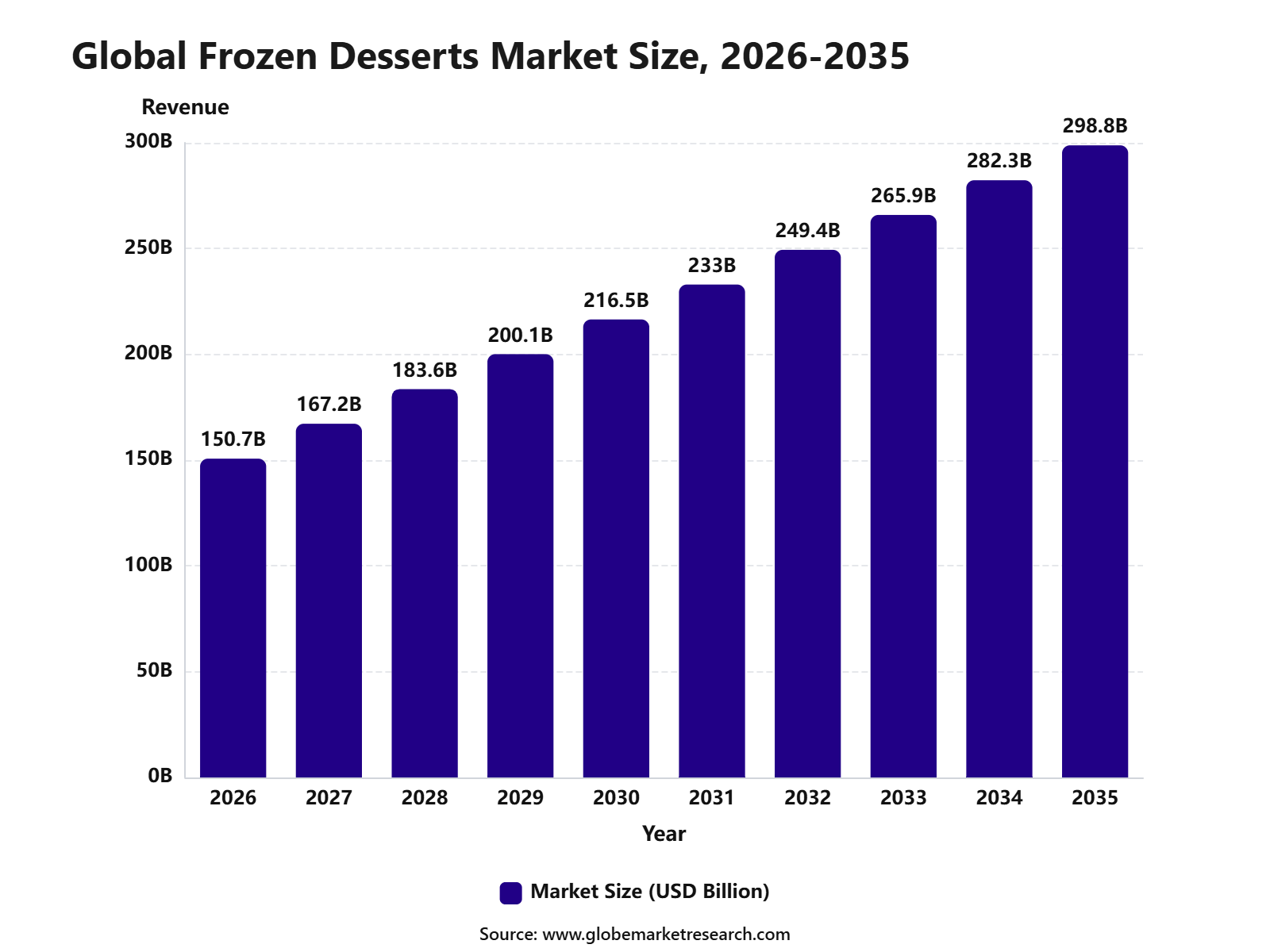 iThe graph shows projected market growth until 2035 based on CAGR analysis. Actual outcomes may vary depending on changing demand, competition, and economic factors.To gain greater insights - request a sample report PDF
Key Market Insights
Ice cream led the product segment with 57.3% share, supported by strong consumer preference, wide flavor variety, impulse purchases, and broad availability across retail and foodservice channels.
Retail consumption accounted for 62.2% share, driven by high household demand, take-home packs, single-serve products, and regular purchases through grocery and convenience stores.
Retail distribution held 66.3% share by distribution channel, supported by supermarkets, hypermarkets, convenience stores, specialty outlets, and strong frozen dessert shelf visibility.
North America led the frozen desserts market with 36.8% share, valued at USD 55.4 billion, supported by high ice cream consumption, mature cold-chain infrastructure, strong brand presence, and steady demand for premium frozen treats.
Top Funding and Investment
Top Investments
In November 2025, Ferrero announced a EUR 140 million investment to transform its Ice Cream Factory Comaker facility in Alzira, Spain, into a European ice cream technology hub. The program will expand production capacity, modernize manufacturing lines, introduce advanced automation, improve sustainability and shift the plant toward Ferrero-owned frozen dessert brands by the end of 2026.
In November 2025, The Magnum Ice Cream Company announced a GBP 50 million investment in its Gloucester facility, the United Kingdom’s largest ice cream factory. The project will install new production technology, improve efficiency and increase the plant’s manufacturing capacity by approximately 50% by 2027 for brands including Magnum, Ben & Jerry’s and Wall’s.
In July 2026, Glacier launched a EUR 45 million investment program across its European ice cream and frozen dessert operations. The program includes new lines for extruded ice creams, spiral ice lollies and fruit-coated sticks. One line is expected to double Glacier’s manufacturing capacity for these frozen novelty formats while supporting automation and international expansion.
In September 2025, The Magnum Ice Cream Company announced an AUD 35 million investment in its Minto manufacturing facility in New South Wales, Australia. The project covers production-line upgrades, modern equipment and operational improvements designed to strengthen domestic manufacturing of ice creams and frozen novelties for Australian consumers.
In 2025, Mars announced plans to invest USD 2 billion in U.S. manufacturing through 2026, following USD 6 billion invested over the previous five years. The broader program supports upgraded automation, production capacity and product-development infrastructure across Mars’ snacking portfolio, which includes frozen confectionery and ice cream products sold through its Dove and M&M’s brands.
Top Funding Developments
In 2025, PAI Partners and the Abu Dhabi Investment Authority invested approximately EUR 1.4 billion in Froneri through a wider EUR 3.6 billion continuation transaction. The financing valued the ice cream manufacturer at about EUR 15 billion, including debt, and supports continued expansion of its international production and brand portfolio.
In October 2025, Alec’s Ice Cream secured USD 11 million in Series A funding. The financing supports national distribution growth, expansion of its Culture Cup frozen dessert line and the transition of additional dairy suppliers toward regenerative agricultural practices.
In 2026, U.S.-based Frozen One raised USD 2 million in seed funding led by Supernatural Ventures and The Angel Group. The company will use the capital to scale manufacturing and retail distribution of its high-protein frozen desserts, which provide 40 grams of protein and 18 grams of fibre per pint.
Top Acquisitions
In January 2025, Davidson Kempner Capital Management and Afendis Capital completed the acquisition of Belgian ice cream producer YSCO through their Glacier platform. Glacier acquired YSCO’s private-label ice cream manufacturing operations, production facilities, customer relationships, workforce and European retail supply capabilities.
In June 2025, Marubeni acquired 100% of Bubbies Homemade Ice Cream & Desserts, making the Arizona-based producer a wholly owned subsidiary. Marubeni acquired Bubbies’ mochi ice cream brand, U.S. manufacturing operations, recipes, intellectual property, customer network and retail distribution platform, marking its entry into U.S. ice cream manufacturing.
By Product
Ice cream accounted for 57.3% share of the Frozen Desserts Market. This leading position is supported by its strong consumer acceptance, wide flavor availability, and high demand across households, restaurants, cafés, retail stores, and impulse purchase occasions.
The segment is widely preferred because ice cream offers indulgence, convenience, and variety across cups, cones, tubs, bars, sandwiches, and premium formats. It is also supported by innovation in low-sugar, high-protein, dairy-free, plant-based, and artisanal product lines.
Demand is expected to remain strong as consumers continue to buy ice cream for snacking, celebrations, desserts, and at-home consumption. Growth will be supported by premium flavors, single-serve formats, seasonal launches, and wider frozen dessert availability through modern retail channels.
By Consumption
Retail consumption accounted for 62.2% share of the Frozen Desserts Market. This dominance is driven by strong household purchases through supermarkets, hypermarkets, convenience stores, specialty stores, and online grocery platforms.
The segment is widely preferred because consumers can store frozen desserts at home and consume them as snacks, desserts, or family treats. Retail packs such as tubs, multipacks, cones, sticks, and single-serve cups remain important for repeat purchases and planned consumption.
Demand from retail consumption is expected to remain strong as consumers seek convenient dessert options with longer shelf life. Growth will be supported by household freezer usage, premium retail packs, plant-based frozen desserts, and rising demand for portion-controlled products.
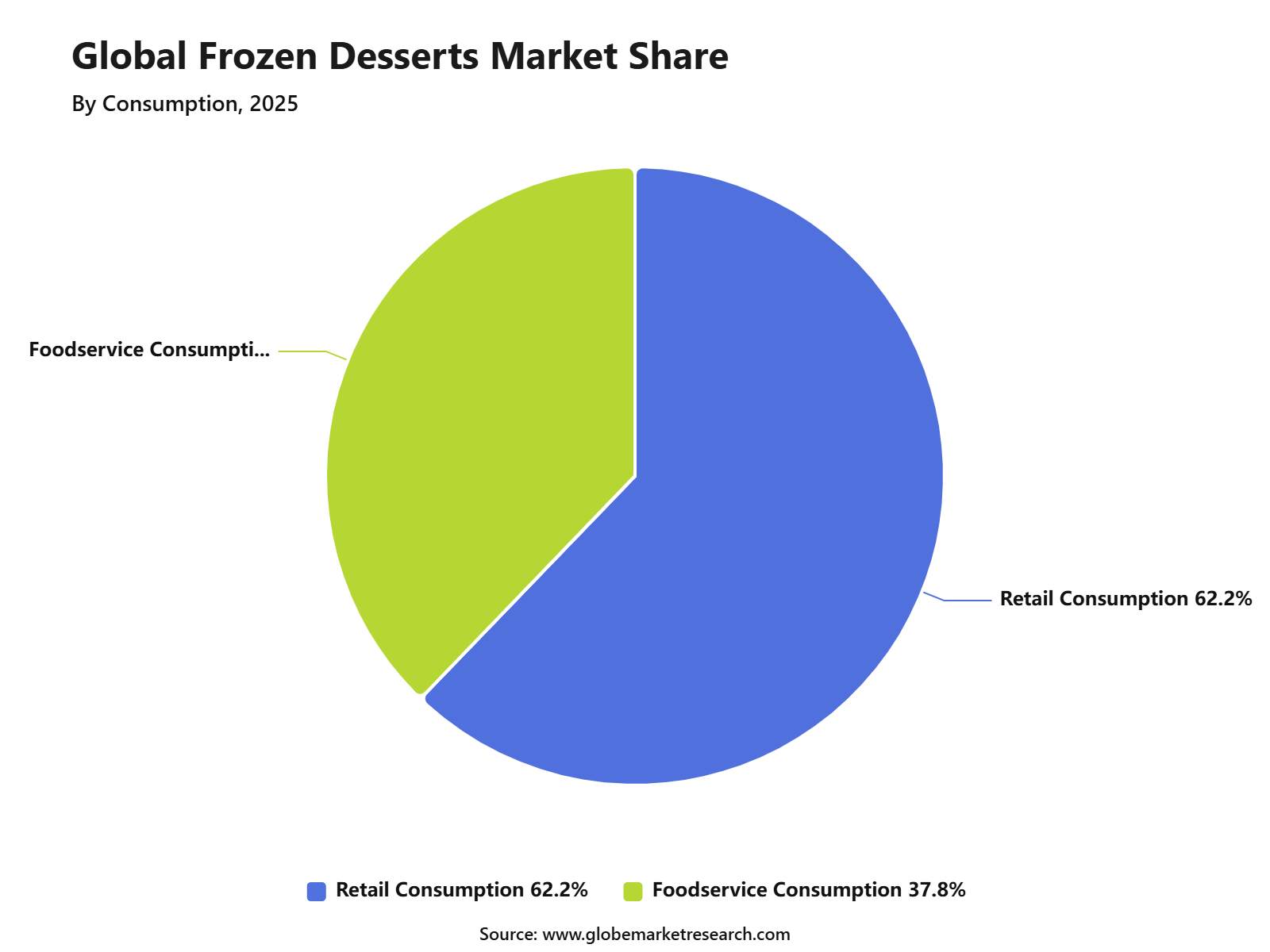 iThe graph shows projected market growth until 2035 based on CAGR analysis. Actual outcomes may vary depending on changing demand, competition, and economic factors.To gain greater insights - request a sample report PDF
By Distribution Channel
Retail distribution accounted for 66.3% share of the Frozen Desserts Market. This leading position is supported by the strong role of supermarkets, hypermarkets, convenience stores, frozen food outlets, and online grocery channels in product availability.
Retail distribution is important because frozen desserts require proper cold-chain storage, freezer visibility, and convenient access for consumers. Large retail stores offer broad assortments across brands, flavors, formats, price points, and dietary preferences.
The segment is expected to maintain its leading position as retailers expand freezer space and improve frozen category merchandising. Demand will remain supported by premium ice cream, family packs, impulse formats, private-label products, and stronger online frozen food delivery.
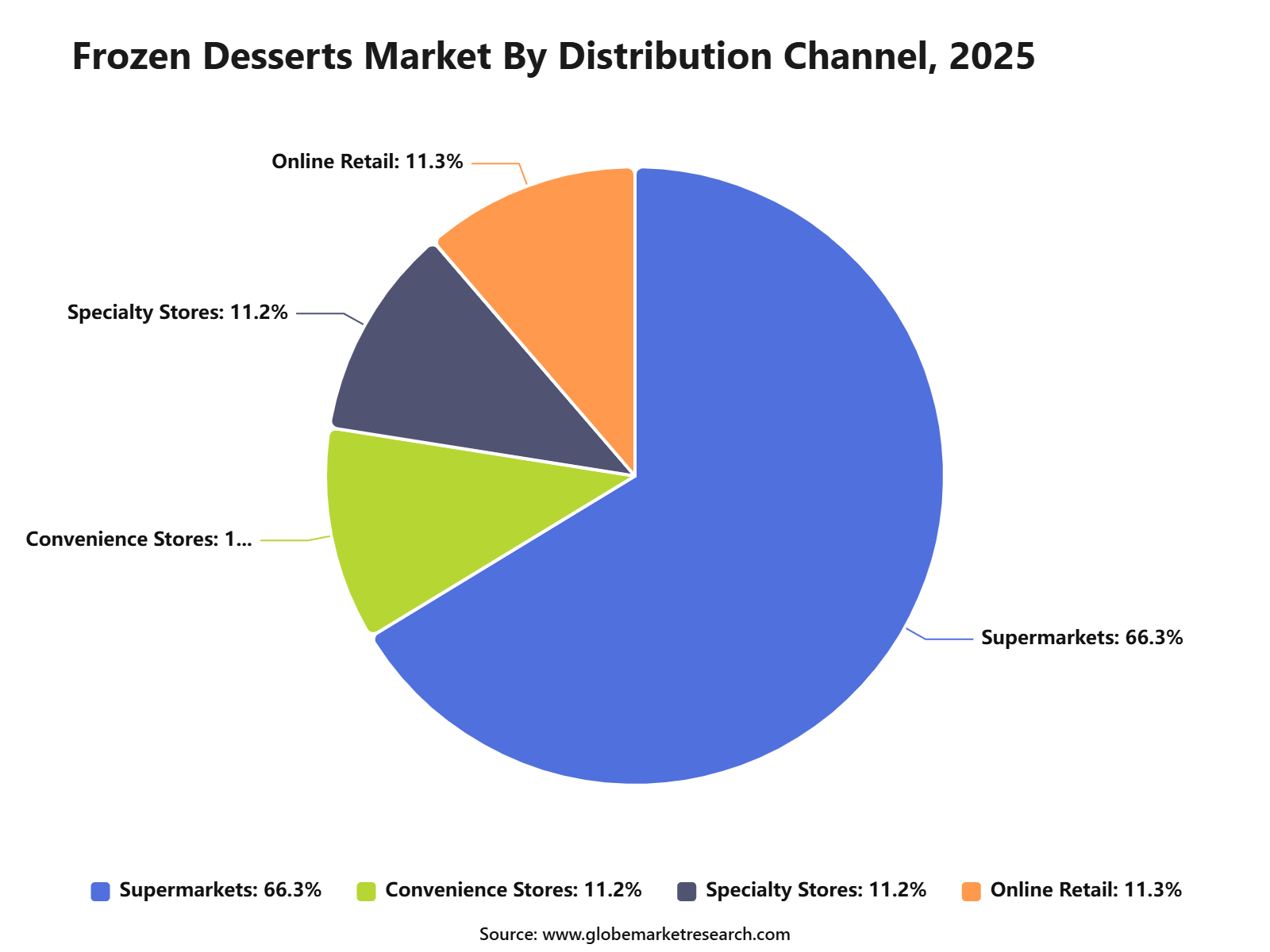 iThe graph shows projected market growth until 2035 based on CAGR analysis. Actual outcomes may vary depending on changing demand, competition, and economic factors.To gain greater insights - request a sample report PDF
By Region
North America accounted for 36.8% share of the Frozen Desserts Market, reaching USD 55.4 billion. The region’s leadership is supported by high ice cream consumption, mature frozen food retail networks, strong cold-chain infrastructure, and broad consumer demand for premium dessert products.
The United States and Canada are key contributors to regional demand. The region benefits from strong supermarket penetration, high household freezer ownership, frequent dessert consumption, and rising interest in indulgent, plant-based, low-calorie, and functional frozen dessert options.
North America is expected to maintain a strong position as consumers continue to seek convenient and premium frozen treats. Demand will remain supported by ice cream, retail consumption, retail distribution, and continued product innovation across flavor, format, and health-focused dessert categories.
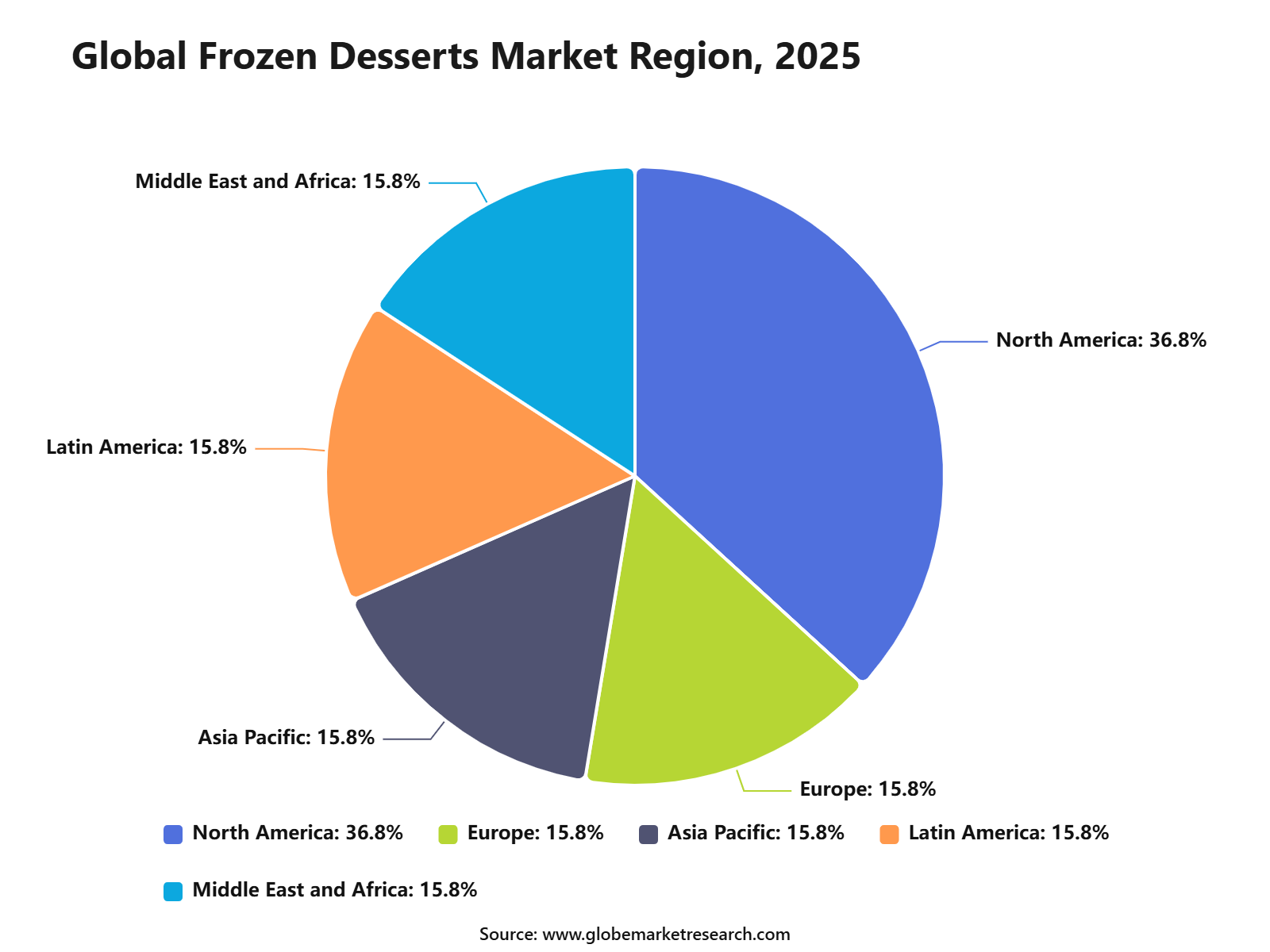 iThe graph shows projected market growth until 2035 based on CAGR analysis. Actual outcomes may vary depending on changing demand, competition, and economic factors.To gain greater insights - request a sample report PDF
Regional Impact Analysis
North America leads the Frozen Desserts Market with 36.8% share in 2026, valued at around USD 55.4 billion, supported by high ice cream consumption, strong freezer retail networks, premium dessert demand, and broad availability across supermarkets, convenience stores, and foodservice channels. The U.S. remains the main contributor due to strong household demand and mature frozen dessert brands.
Europe remains important because of premium ice cream, gelato, clean-label desserts, and growing plant-based frozen treat demand. Asia Pacific supports future growth through urbanization, modern retail expansion, rising disposable income, and increasing demand for packaged frozen desserts.
Impact Factor | Estimated CAGR Impact | Regional Relevance | Market Impact |
|---|---|---|---|
North America market leadership | +2.2% | North America, 36.8% share in 2026 | Leads global value demand. |
U.S. ice cream and novelty demand | +1.7% | U.S. | Drives major regional revenue. |
Canada premium frozen dessert demand | +1.1% | Canada | Supports steady category growth. |
Europe gelato and premium dessert demand | +1.0% | Italy, Germany, France, UK | Adds value-led product demand. |
Asia Pacific modern retail expansion | +0.9% | China, India, Japan, Southeast Asia | Builds future market growth. |
Frozen Production Supports Dessert Growth
Frozen-product output is the most important factor shaping the Frozen Desserts Market because it directly reflects manufacturing activity and consumer demand. USDA recorded 69.2 million gallons of regular hard ice cream in May 2026, representing a 7.1% increase from May 2025. Sherbet production reached 1.95 million gallons and increased 16.1%, indicating strong opportunities beyond traditional ice cream.
Broader food spending also supports retail and foodservice demand. U.S. food expenditures reached USD 2.51 trillion in 2025, including USD 1.10 trillion spent on food at home and USD 1.41 trillion spent away from home. This large consumer spending base supports frozen dessert sales through supermarkets, convenience outlets, restaurants, delivery platforms and specialty dessert stores.
Important Data | Numeric Value |
|---|---|
Regular Ice Cream | 69.2 million gallons |
Low-Fat Ice Cream | 36.4 million gallons |
Sherbet Production | 1.95 million gallons |
Frozen Yogurt | 3.17 million gallons |
Ice Cream Growth | 7.1% |
Sherbet Growth | 16.1% |
Food Expenditure | USD 2.51 trillion |
At-Home Spending | USD 1.10 trillion |
Go-To-Market and Sales Economics
Frozen dessert producers should organize portfolios around ice cream, frozen yogurt, gelato, sorbet, cakes, bars, and dairy-free products. Retailers increasingly require clear differences in flavor, nutrition, pack size, and consumption occasion. In Indonesia, dairy consumption by volume is expected to grow further in 2026 after an estimated 6% increase during 2025.
Large supermarket groups should be served through direct account management, promotional planning, private-label production, and reliable freezer availability. Convenience stores, restaurants, cafés, and independent retailers can be reached through specialist frozen-food distributors. Australia imported USD 19.8 million of U.S. ice cream, demonstrating continued demand for branded, premium, and differentiated frozen desserts.
Pricing should reflect ingredient quality, serving size, product overrun, packaging, cold storage, and promotional support. Multipacks can protect household value, while smaller portions can maintain accessible price points. USDA expects overall U.S. food prices to increase 3.2% in 2026, requiring careful price-pack architecture and disciplined discounting across retail channels.
Risk Factors & Market Barriers
Cold-chain dependence remains a major operating barrier because temperature variation can cause ice crystal growth, texture deterioration, melting, and package damage. Manufacturers must maintain controlled production, storage, transportation, and retail display conditions. Backup power, temperature monitoring, qualified logistics providers, and retailer freezer audits are required to limit product losses and customer complaints.
Ingredient inflation can reduce margins across dairy, chocolate, fruit, nuts, sugar, and packaging inputs. USDA reported that sugar and sweets prices were 7.1% higher in May 2026 than one year earlier, while farm-level milk prices increased 8% between April and May. Flexible formulations and multi-supplier contracts can reduce exposure.
Food safety, allergen control, and foreign-material prevention create additional financial and reputational risks. A frozen dessert recall posted by the FDA covered multiple product dates because cashew inclusions could contain stones or other hard materials. Strong supplier verification, allergen segregation, metal detection, inspection, and complete batch traceability should therefore be maintained.
Revenue Potential Analysis
Revenue Landscape Across
North America offers revenue through premium pints, family tubs, novelties, frozen cakes, high-protein products, and dairy-free desserts. Growth can be supported through seasonal launches and limited flavors, but affordability remains important. USDA expects dairy product prices to increase moderately in 2026, while sugar and sweets prices are forecast to rise 6.9%.
Asia provides attractive opportunities because dairy consumption, modern retail, and frozen-food availability are expanding. Japan’s food-processing industry generated approximately USD 174 billion in 2025, with frozen foods among the categories showing growth. Localized flavors, portion-controlled products, gifting formats, and convenience-store distribution can improve market acceptance across dense urban locations.
Southeast Asia provides further potential for ice cream, frozen yogurt, and plant-based desserts. Indonesia’s food-processing sector is valued at approximately USD 101 billion, while dairy consumption is expected to continue growing in 2026. Local manufacturing, halal compliance, tropical flavors, affordable single servings, and stable regional cold chains can improve commercial reach.
Financial Impact
Profitability depends heavily on product overrun, ingredient cost, freezer utilization, line efficiency, and inventory turnover. Excessive air can weaken perceived quality, while insufficient overrun raises cost per serving. Manufacturers should measure contribution margins by format and channel, including retailer fees, promotional deductions, cold-storage expenses, returns, and damaged inventory.
Commodity movements can materially change recipe economics. USDA forecasts farm-level milk prices to rise 2.7% in 2026, while sugar and sweets prices are expected to increase 6.9%. Reformulating solids, inclusions, sweeteners, and pack sizes can protect margins, provided that taste, texture, melting performance, and consumer satisfaction remain consistent.
International expansion can improve factory utilization and diversify seasonal revenue, but freight and freezer costs must be controlled. U.S. ice cream exports to Australia totaled USD 19.8 million, indicating demand for imported branded products. Export profitability can be strengthened through concentrated distribution, longer production runs, premium positioning, and packaging designed for extended transportation.
Drivers Impact Analysis
The Frozen Desserts Market is driven by rising demand for ice cream, frozen yogurt, gelato, sorbet, frozen cakes, novelty desserts, and premium indulgence products. Consumers are buying frozen desserts for taste, convenience, family consumption, celebrations, and impulse purchases across retail and foodservice channels.
North America leads the market due to strong ice cream consumption, mature freezer retail infrastructure, premium dessert brands, and high household demand for take-home frozen treats. The U.S. remains the main contributor because frozen desserts are widely sold through supermarkets, convenience stores, specialty shops, and online grocery platforms.
Impact Factor | Estimated CAGR Impact | Regional Relevance | Market Impact |
|---|---|---|---|
Rising demand for indulgent desserts | +2.2% | North America, Europe, Asia Pacific | Drives core frozen dessert consumption. |
Growth in premium ice cream products | +1.9% | U.S., Canada, Europe | Supports higher-value sales. |
Expansion of retail freezer space | +1.5% | Supermarkets and convenience stores | Improves product availability. |
Increasing demand for novelty formats | +1.2% | Urban and family consumers | Adds impulse-driven purchases. |
Growth in foodservice dessert menus | +0.9% | Restaurants, cafés, QSR chains | Supports out-of-home consumption. |
Restraints Impact Analysis
The market faces restraints from health concerns related to sugar, fat, calories, artificial additives, and overconsumption. Consumers are becoming more selective, especially in mature markets where wellness, weight management, and clean-label preferences influence dessert choices.
Another restraint is high cold-chain and storage cost. Frozen desserts require controlled temperature during manufacturing, transport, retail display, and last-mile delivery, which increases operating expenses and affects margins.
Impact Factor | Estimated CAGR Impact | Regional Relevance | Market Impact |
|---|---|---|---|
Sugar and calorie concerns | -1.1% | North America and Europe | Limits frequent consumption. |
High cold-chain logistics cost | -0.9% | Global frozen food supply chains | Raises operating expenses. |
Seasonal demand variation | -0.7% | Temperate climate markets | Creates sales volatility. |
Competition from fresh desserts | -0.6% | Foodservice and bakery channels | Reduces basket share. |
Freezer storage limitations | -0.5% | Small stores and households | Limits product stocking. |
Opportunities Impact Analysis
Opportunities are strong in premium ice cream, low-sugar desserts, plant-based frozen desserts, dairy-free products, protein-enriched ice cream, gelato, frozen yogurt, and portion-controlled treats. These categories help brands serve both indulgence and health-conscious consumers.
Higher-value opportunities are emerging in vegan frozen desserts, functional frozen treats, ethnic flavors, frozen dessert cakes, online grocery delivery, and private-label premium products. Companies that improve taste, texture, nutrition, and packaging can capture stronger repeat demand.
Impact Factor | Estimated CAGR Impact | Regional Relevance | Market Impact |
|---|---|---|---|
Premium frozen dessert innovation | +2.1% | North America, Europe | Builds higher-margin demand. |
Plant-based and dairy-free desserts | +1.7% | U.S., Canada, Europe | Adds health and lifestyle-driven growth. |
Low-sugar and better-for-you products | +1.4% | Developed consumer markets | Expands wellness-positioned demand. |
Frozen cakes and celebration desserts | +1.1% | Retail and family consumers | Supports occasion-based purchases. |
Online grocery and delivery growth | +0.9% | North America and digital retail markets | Improves product reach. |
Challenges Impact Analysis
The main challenge is maintaining taste, creaminess, texture, and stability while reducing sugar, fat, or dairy content. Consumers expect frozen desserts to feel indulgent, so reformulated products must deliver strong sensory quality.
Another challenge is managing melting risk and product damage during distribution. Frozen desserts are highly temperature-sensitive, and poor handling can affect texture, shape, packaging, and customer satisfaction.
Impact Factor | Estimated CAGR Impact | Regional Relevance | Market Impact |
|---|---|---|---|
Maintaining creamy texture | -1.0% | Ice cream and dairy-free products | Affects repeat purchase. |
Temperature abuse during transport | -0.8% | Retail and online delivery | Reduces product quality. |
Reformulation complexity | -0.7% | Low-sugar and plant-based products | Raises development cost. |
Ingredient cost pressure | -0.6% | Dairy, cocoa, nuts, fruit, packaging | Pressures margins. |
Private-label competition | -0.5% | Supermarket channels | Limits branded pricing power. |
Segment Covered in the Report
By Product
Ice Cream
Frozen Yogurt
Gelato
Sorbet
Frozen Cakes
Other Products
By Consumption
Retail Consumption
Foodservice Consumption
By Distribution Channel
Supermarkets and Hypermarkets
Convenience Stores
Specialty Stores
Online Retail
By Region
North America
Europe
Asia Pacific
Latin America
Middle East and Africa
Market Trend Analysis
The market trend is moving toward premiumization, plant-based frozen desserts, low-sugar products, clean-label ingredients, global flavors, mini portions, and indulgent frozen snack formats. Consumers want frozen desserts that offer both enjoyment and better ingredient transparency.
North America remains the largest value region because of strong frozen dessert consumption, mature freezer distribution, and high retail availability. Europe supports premium and artisanal formats, while Asia Pacific is growing through urbanization, modern retail, and rising demand for Western-style desserts.
Impact Factor | Estimated CAGR Impact | Regional Relevance | Market Impact |
|---|---|---|---|
Premiumization gains momentum | +2.0% | North America, Europe | Supports value-led growth. |
Plant-based frozen desserts expand | +1.6% | U.S., Canada, UK, Germany | Adds lifestyle-driven demand. |
Low-sugar product launches rise | +1.3% | Health-conscious consumers | Supports wellness-positioned sales. |
Global and ethnic flavors grow | +1.0% | Urban consumer markets | Improves product differentiation. |
Mini and portion-controlled packs increase | +0.8% | Family and impulse channels | Supports controlled indulgence. |
Investor Type Impact Matrix
Investors should focus on companies with strong frozen dessert brands, retail freezer distribution, product innovation, cold-chain reliability, premium positioning, and margin control. Taste, texture, packaging, flavor variety, and channel reach are key success factors.
Strategic investors can also target ice cream manufacturers, plant-based frozen dessert companies, frozen cake producers, cold-chain logistics firms, private-label manufacturers, specialty gelato brands, and packaging technology providers. Companies that combine indulgence, convenience, and better-for-you positioning are better placed for long-term growth.
Investor Type | Estimated CAGR Impact | Regional Relevance | Market Impact |
|---|---|---|---|
Ice Cream Manufacturers | +1.6% | North America, Europe, Asia Pacific | Expands core category revenue. |
Plant-Based Frozen Dessert Companies | +1.3% | Developed consumer markets | Supports dairy-free product growth. |
Cold-Chain Logistics Providers | +1.0% | Global frozen dessert supply chains | Improves market reach and quality. |
Private-Label Dessert Manufacturers | +0.8% | Supermarket and hypermarket channels | Supports value-based retail demand. |
Strategic Food Investors | +0.6% | Global packaged dessert markets | Funds innovation and expansion. |
Recent Developments
March 2026: General Mills announced new Häagen-Dazs Chocolate Brownie, Strawberry Mochi and Tiramisu ice creams for international markets, alongside Belgian Chocolate reformulated with 72% cocoa and additional fruit-inspired stick bars.
March 2026: Blue Bell introduced Blue Bell PRO, a high-protein dairy dessert, expanding its frozen portfolio beyond traditional ice cream while adding a functionality-focused product range alongside its established flavours and novelty offerings.
February 2026: Nestlé disclosed advanced negotiations to sell its remaining ice cream operations to Froneri, continuing portfolio rationalisation and concentrating resources on coffee, pet care, nutrition, and selected regional food and snack businesses.
Competitive Landscape
The market is characterized by intense competition among established players and emerging companies. Strategic partnerships, mergers and acquisitions, and product innovation are key strategies employed by market participants.
Key Market Players
The Magnum Ice Cream Company
Froneri International Limited
Nestlé S.A.
General Mills, Inc.
Wells Enterprises, Inc.
Blue Bell Creameries
Danone S.A.
Yili Group
Lotte Corporation
Meiji Holdings Co., Ltd.
Other Key Players
Research Methodology
This market study is prepared using a combination of primary and secondary research. Primary research includes discussions with manufacturers, suppliers, distributors, consultants, industry experts, and end users. Secondary research covers company reports, government databases, trade associations, technical publications, regulatory sources, and trusted industry documents. The collected information is used to assess market demand, pricing trends, technology adoption, competitive activity, and regional performance.
AI language models are not used as primary data sources, and publicly available AI-generated content is not treated as market evidence. Computational tools may be used to support data processing, translation, data classification, and pattern identification. However, every published assessment is supported by verified sources, human review, and primary market discussions.
Market estimates are developed through top-down and bottom-up approaches and validated using data triangulation. Revenue, production, shipment, pricing, and application-level data are compared across multiple sources. Forecasts consider economic conditions, regulatory changes, investment activity, innovation, supply chain developments, and industry risks. All findings are reviewed through source verification and internal quality checks before publication.
Part I
Source Management & Input Data Standards
Who provides data, how sources are qualified, and what types of evidence are admissible.
Part II
Research Scope & Market Coverage
How we define the markets we assess and the parameters that govern each product.
Part III
Data Collection, Verification & Submission
The mechanics of gathering, cross-checking, and hierarchically ranking evidence.
Part IV
Assessment Determination & Quality Controls
How raw data becomes a published assessment — normalisation, expert judgement, and outlier exclusion.
Part V
Publication, Corrections & Revision
Our publication schedule, corrections policy, and methodology review cycle.
Part VI
Independence, Ethics & Complaints
Conflict-of-interest policies, editorial independence, and how clients raise concerns.
Google · Preferred Sources
Don't miss the latest market research insights and industry updates on Google.
Add Globe Market Research as a preferred source in the Google app to see our reports, analysis, and market stories in your news suggestions.
Frequently Asked Questions
Related Reports
More in Food and Beverages
Refrigerated Ready Meals Market to Hit USD 355.8 Billion by 2035
Refrigerated Ready Meals Market Size, Share, Analysis By Product (Refrigerated Meals, Frozen Meals, Shelf-Stable Meals, Canned Meals), By Meal Type (Vegetarian, Non-Vegetarian, Vegan), By Distribution Channel (Supermarkets and Hypermarkets, Convenience Stores, Online Retail, Specialty Stores), By Regional Insights, Business plan and Project Report, Investment Opportunities, Profitability, Industry Trends, Leading Companies and Growth Forecasts by 2026-2035
Frozen Meat and Seafood Market to Hit USD 181.1 Billion by 2035
Frozen Meat and Seafood Market Size, Share, Analysis By Product (Frozen Meat, Frozen Seafood), By Seafood Form (Whole, Fillets, Processed Seafood, Other Forms), By Seafood End Use (Retail and Household, Foodservice, Industrial), By Regional Insights, Business plan and Project Report, Investment Opportunities, Profitability, Industry Trends, Leading Companies and Growth Forecasts by 2026-2035
Frozen Meals Market to Hit USD 74.2 Billion by 2035
Frozen Meals Market Size, Share, Analysis By Product (Frozen, Chilled, Canned, Shelf-Stable), By Meal Type (Vegetarian, Non-Vegetarian, Vegan), By Distribution Channel (Supermarkets and Hypermarkets, Online Retail, Convenience Stores, Specialty Stores), By Regional Insights, Business plan and Project Report, Investment Opportunities, Profitability, Industry Trends, Leading Companies and Growth Forecasts by 2026-2035
Food Colorants Market to Hit USD 8.6 Billion by 2035
Food Colorants Market Size, Share, Analysis By Type (Natural, Synthetic, Nature-Identical), By Form (Powder, Liquid, Gel), By Application (Beverages, Bakery and Confectionery, Dairy, Meat Products, Snacks, Other Applications), By Regional Insights, Business plan and Project Report, Investment Opportunities, Profitability, Industry Trends, Leading Companies and Growth Forecasts by 2026-2035