

Revenue, 2025
$245.3 Bn
Forecast, 2035
$647.9 Bn
CAGR, 2025-2035
10.2%
Report Coverage
Global
Market Size and Forecast
The Global Second-Hand Apparel Market was worth USD 245.3 billion in 2025 and is expected to reach USD 647.9 billion by 2035, growing at a CAGR of 10.2% from 2025 to 2035. North America held the largest regional share of 39.5% in 2025, supported by strong consumer acceptance of resale fashion, growing use of online thrift platforms, rising demand for affordable branded clothing, and increasing focus on sustainable shopping.
Key Parameter | Report Details |
|---|---|
Market Revenue, 2025 | USD 245.3 Billion |
Projected Revenue, 2035 | USD 647.9 Billion |
CAGR (2025-2035) | 10.2% |
Largest Region | North America |
Leading Segment | Offline platforms |
Market Concentration | Medium |
Base Year | 2025 |
Forecast Period | 2025-2035 |
The Second-Hand Apparel Market includes pre-owned clothing, footwear, fashion accessories, luxury resale items, vintage apparel, and refurbished garments sold through online platforms, thrift stores, consignment shops, charity shops, and peer-to-peer resale channels. The market is closely linked with circular fashion, recommerce platforms, textile waste reduction, changing consumer spending habits, and the growing popularity of value-based fashion.
The market outlook remains positive as consumers increasingly prefer affordable, sustainable, and unique fashion choices. Growth can be attributed to rising awareness about textile waste, higher demand for branded products at lower prices, and wider adoption of digital resale platforms among younger consumers. The expansion of authentication services, organized resale marketplaces, and retailer-led take-back programs is expected to support long-term market growth.
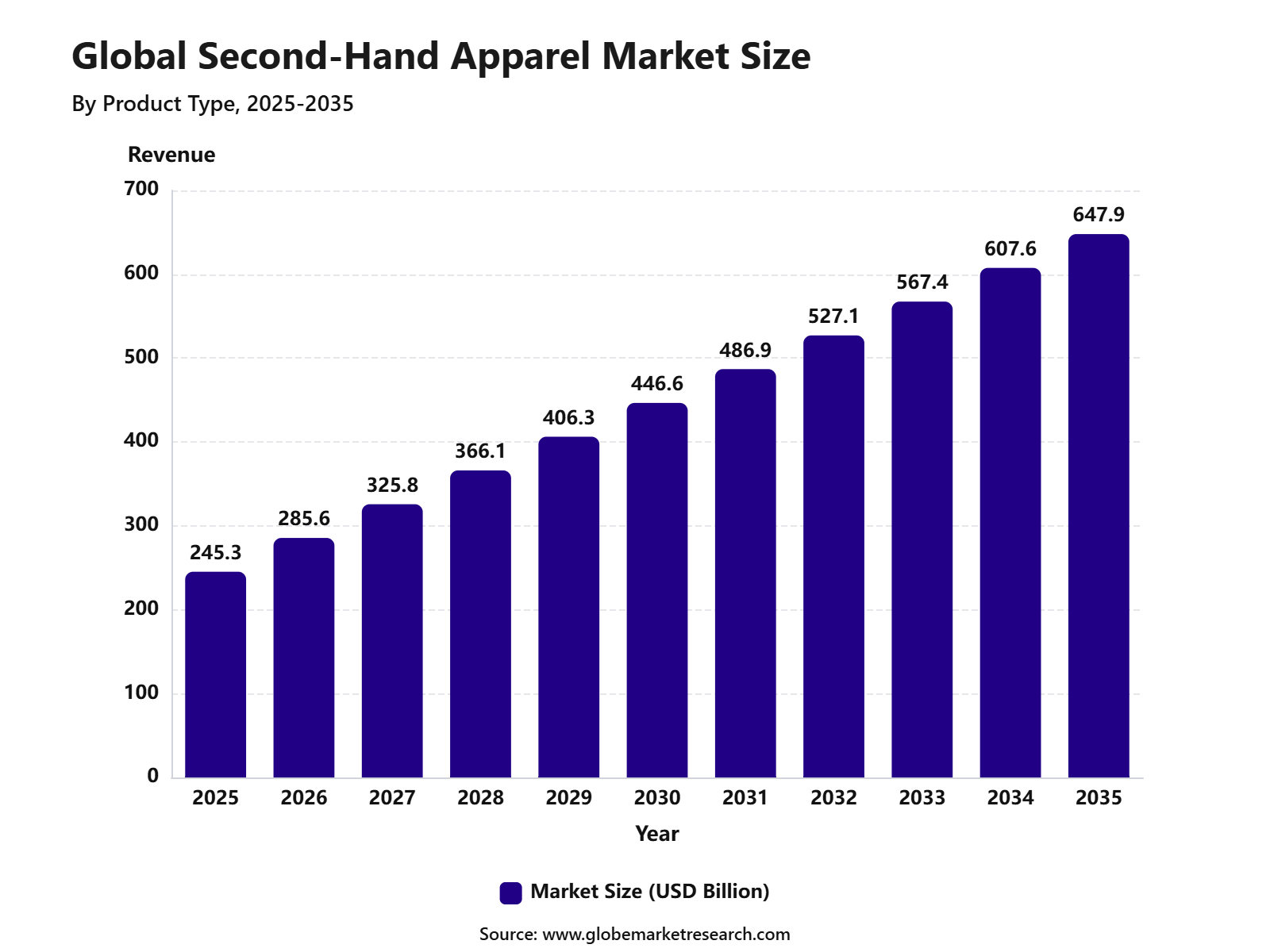 iThe graph shows projected market growth until 2035 based on CAGR analysis. Actual outcomes may vary depending on changing demand, competition, and economic factors.To gain greater insights - request a sample report PDF
Key Market Insights
Tops and T-shirts led the product type segment with 39.2% share, supported by high purchase frequency, affordable pricing, and strong demand for casual and everyday second-hand clothing.
Women’s wear accounted for 55.5% share by category, driven by wider product availability, higher fashion rotation, and growing consumer preference for affordable branded and vintage apparel.
Mid-range apparel held 46.1% share in the price segment, supported by strong demand from value-conscious buyers seeking quality clothing at lower prices than new retail products.
Offline platforms captured 57.1% share by sales channel, driven by thrift stores, resale boutiques, charity shops, and local second-hand apparel outlets that allow consumers to check product quality before purchase.
North America held the leading regional share of 39.5% , supported by a mature resale culture, strong thrift store networks, rising sustainability awareness, and growing acceptance of pre-owned fashion among younger consumers.
Go-to-Market and Sales Economics
The go-to-market strategy in the second-hand apparel market should focus on digital resale platforms, thrift stores, consignment stores, social commerce, brand-owned resale programs, offline collection points, and peer-to-peer selling communities. The latest resale data shows that second-hand clothing sales are expected to reach USD 289 billion in 2026, supported by affordability, social media discovery, AI-based product matching, and rising consumer acceptance of pre-owned fashion.
Sales economics in this market depend on inventory inflow, seller participation, item authentication, return handling, product photography, listing speed, warehousing, shipping cost, and buyer trust. Unlike traditional apparel retail, resale platforms must first unlock supply from consumers before demand can be fully served. ThredUp’s 2026 report notes that the U.S. resale market can unlock USD 23.3 billion in incremental value if selling becomes easier, which shows that supply collection and listing convenience are now major revenue levers.
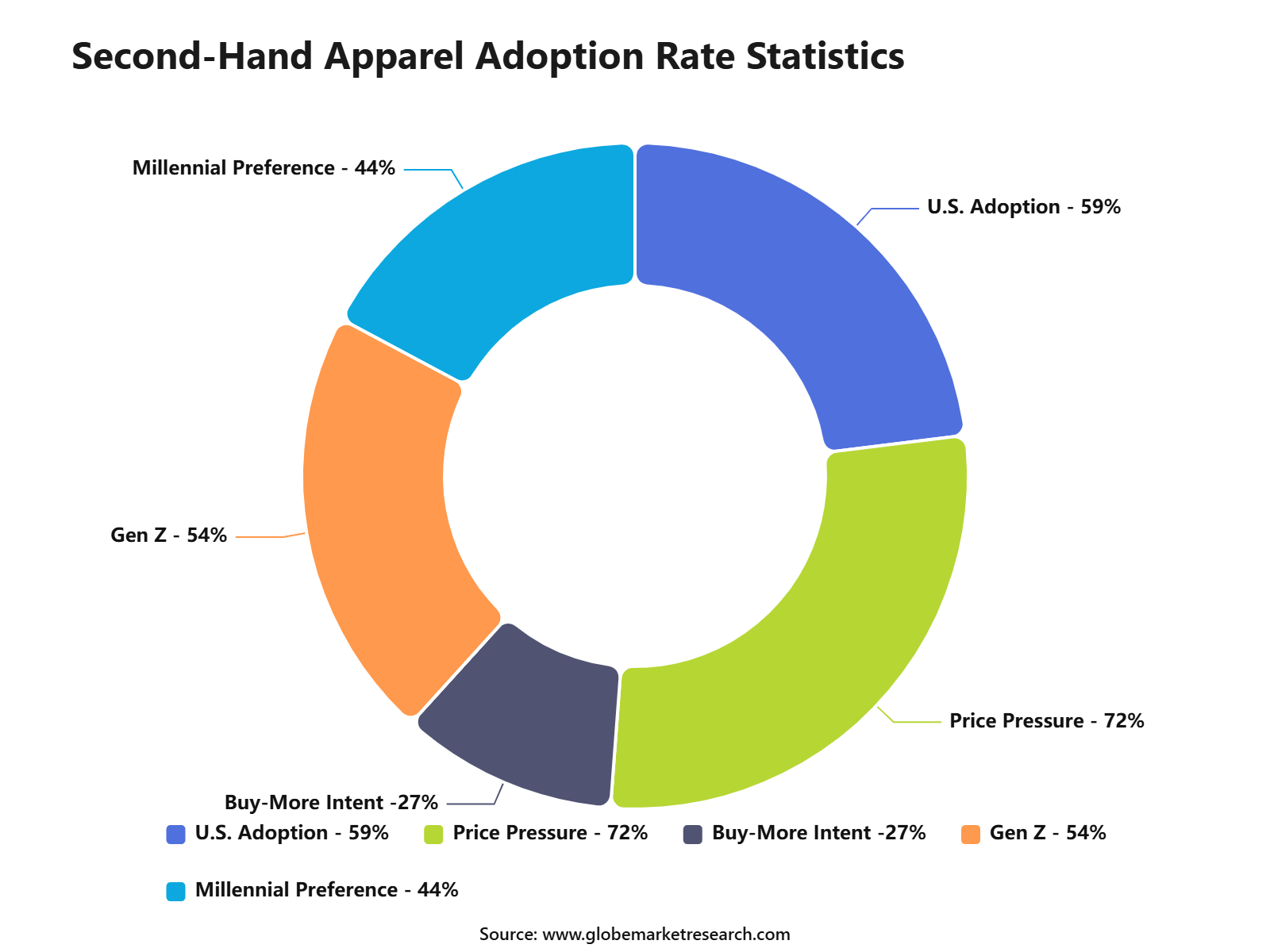 iThe graph shows projected market growth until 2035 based on CAGR analysis. Actual outcomes may vary depending on changing demand, competition, and economic factors.To gain greater insights - request a sample report PDF
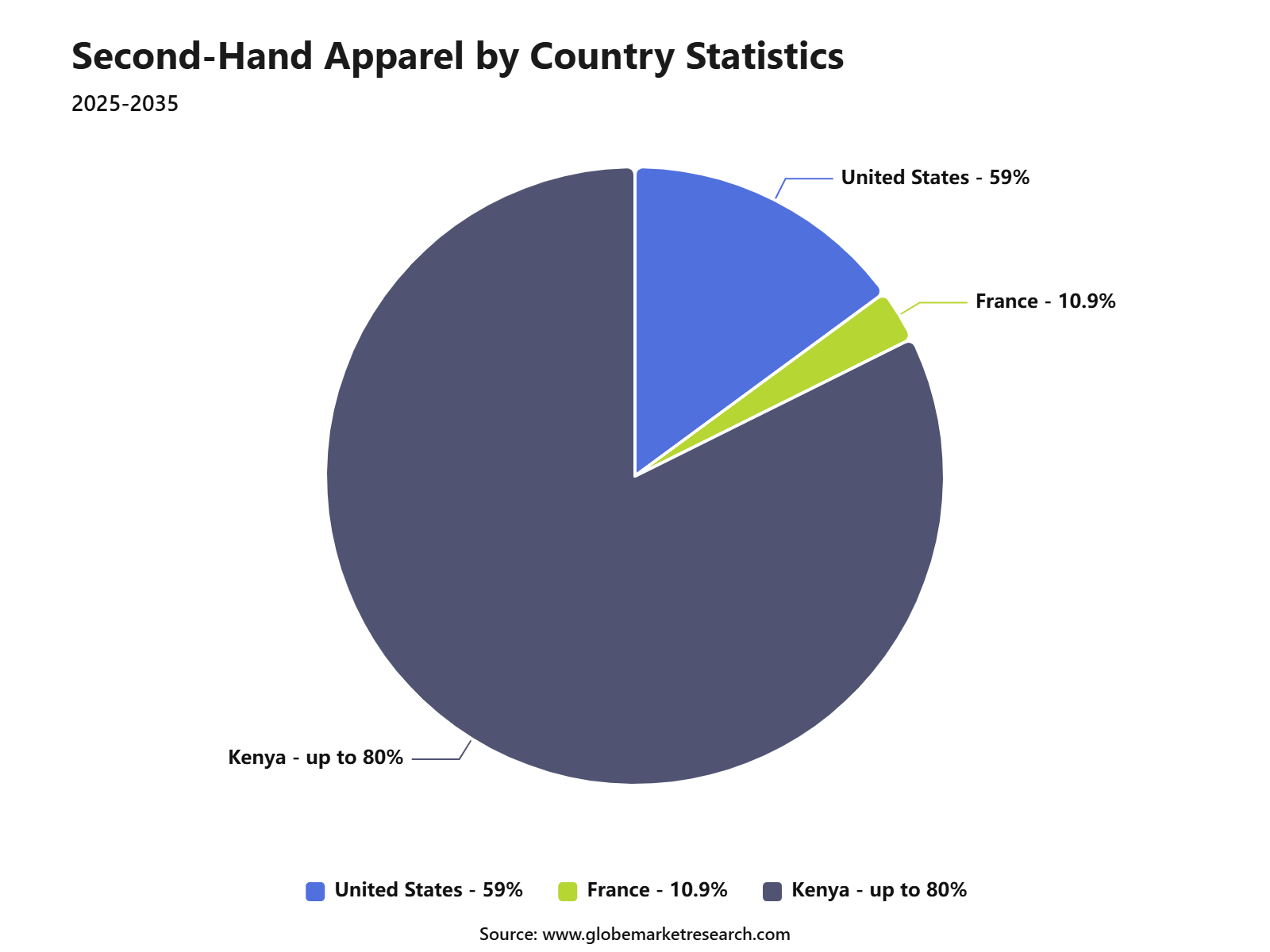 iThe graph shows projected market growth until 2035 based on CAGR analysis. Actual outcomes may vary depending on changing demand, competition, and economic factors.To gain greater insights - request a sample report PDF
Revenue Potential Analysis
Revenue potential is being supported by consumers who are using second-hand apparel for savings, sustainability, and access to branded fashion at lower prices. The global second-hand market is projected to reach USD 393 billion by 2030, while resale is expected to represent around 10% of total apparel spending, based on the 2026 resale outlook.
Higher revenue can be created through managed marketplaces, peer-to-peer resale, luxury authentication, brand resale partnerships, repair and resale programs, subscription-style thrift boxes , social commerce, and AI-powered discovery tools. Gen Z and millennials are expected to drive 71% of second-hand market growth through 2030, while nearly 50% of shoppers now discover second-hand items through social media, creators, and influencer feeds.
Revenue Landscape Across
The revenue landscape is spread across online resale platforms, thrift chains, luxury consignment, offline resale stores, charity shops, brand recommerce, managed resale services, and C2C marketplace models. Online resale is gaining stronger momentum because consumers can compare prices, filter by brand and size, verify product condition, and receive home delivery.
Vinted’s 2025 results show how large-scale marketplace economics are developing, with €10.8 billion in GMV, €1.1 billion in revenue, and €62 million in net profit. Brand-owned resale is also becoming a stronger revenue route because retailers can retain customers after the first sale and extend the value of used clothing. Products such as tops, T-shirts, denim, dresses, jackets, sneakers, handbags, kidswear, and luxury apparel are attractive because they have frequent turnover and strong resale demand.
eBay’s agreement to buy Depop for about USD 1.2 billion in cash shows how large platforms are using second-hand fashion to reach younger shoppers and strengthen recommerce capabilities. Depop had 7 million active buyers and more than 3 million active sellers as of December, 2025, with nearly 90% of active buyers under age 34.
Financial Impact
The financial impact of second-hand apparel is strongly linked to affordability. Vinted reported that its members saved €21.6 billion on adult fashion in 2025 compared with original retail prices for new items, while the average fashion item on Vinted was 72% lower than the original retail price. The same data shows that 88% of buyers check Vinted before buying something new, which indicates that resale platforms are influencing new apparel purchase decisions.
For sellers, resale provides a way to recover value from unused clothing and turn idle wardrobe inventory into cash. Vinted stated that €10.8 billion was returned directly to sellers’ pockets in 2025, while 52% of sellers listed items to avoid wasting clothing that another person might want. This creates a strong financial case for resale because both buyers and sellers receive direct value, while platforms earn through service fees, payment services, shipping partnerships, premium visibility, authentication, and managed resale solutions.
By Product Type
Tops and T-shirts led the product type segment with 39.2% share, supported by high daily-use demand, easy resale, and frequent wardrobe replacement. These items are less complex to size compared with formalwear, denim, or outerwear, which makes them more suitable for resale buyers. Their lower ticket size also encourages trial purchases among new second-hand shoppers.
The segment is further supported by strong demand for casual apparel across offline thrift stores and online resale platforms. In a 2025 U.S. consumer survey of 2,000 adults, clothing was the most popular thrifted category, with 71% of thrifters saying they buy second-hand clothing. This shows why commonly worn items such as T-shirts, tops, shirts, and casual upperwear remain central to resale demand.
Tops and T-shirts also benefit from the sustainability shift in fashion consumption. UNEP reported in 2025 that 92 million tonnes of textile waste are produced globally each year, while garment use duration has fallen by 36% . This waste pressure is pushing more consumers and retailers toward reuse, resale, and longer product life, which directly supports high-volume categories such as everyday tops.
By Category
Women’s wear accounted for 55.5% share, driven by wider product variety, faster fashion turnover, and stronger resale participation among female shoppers. Dresses, tops, shirts, jackets, occasionwear, and seasonal apparel create a large supply base for resale platforms and thrift stores. This makes women’s wear one of the most active categories in both buying and selling.
The category is supported by frequent wardrobe refresh cycles and wider style diversity. The U.S. Bureau of Labor Statistics noted in its 2026 article that second-hand apparel was added to the CPI pricing sample in early 2025, reflecting its growing role in consumer clothing purchases. The same source also noted that U.S. consumers are buying more second-hand clothing due to cost and sustainability concerns.
Women’s wear also benefits from stronger resale suitability because many items are fashion-led but still usable after limited wear. The BLS official breakdown showed that women’s clothing accounted for 42.8% of second-hand apparel expenditures in its detailed expenditure sample, which was the largest clothing category in that dataset. This supports the continued leadership of women’s wear in the second-hand apparel market.
By Price
Mid-range apparel captured 46.1% share, supported by consumer preference for better quality at lower prices than new retail products. This segment appeals to buyers who want durable fabric, recognizable styles, and good condition without paying premium resale prices. It also attracts shoppers who avoid very low-cost used apparel because of concerns around quality, hygiene, or product life.
Price pressure is a strong driver for this segment. A 2025 U.S. survey found that second-hand shoppers buy thrifted products to save money, while 51% enjoy finding a good deal. These findings show that affordability remains a practical purchase trigger, especially for mid-range second-hand apparel where value and quality are balanced.
Mid-range apparel also benefits from household budget caution. The same 2025 survey found that 52% of respondents were worried about their finances, and discretionary spending had dropped by 42% over the previous year. This environment supports resale buying, as consumers continue to seek wearable branded or quality clothing at lower prices.
By Sales Channel
Offline platforms held 57.1% share, supported by the continued importance of thrift stores, charity shops, consignment stores, flea markets, and local resale outlets. Physical stores remain highly relevant because buyers can inspect fabric quality, check fit, compare colors, and assess garment condition before purchase. This is especially important for used apparel, where product condition varies more than new clothing.
The offline channel is also supported by the shopping experience itself. A 2025 survey found that 37% of thrifters like visiting multiple stores in one day, while 29% prefer thrifting with a friend. These figures show that thrift shopping is not only a price-driven activity, but also a social and discovery-led retail experience.
At the same time, offline stores are supported by established second-hand retail habits. The BLS noted in 2026 that brick-and-mortar, donation-based thrift stores have historically been the largest used-clothing store format in the U.S., even as online resale continues to grow. This explains why offline platforms still lead despite the rising role of digital resale channels.
By Region
North America led the regional segment with 39.5% share, supported by mature thrift culture, strong resale acceptance, and wide availability of donation-based and consignment retail formats. The U.S. has a well-established second-hand clothing ecosystem, supported by thrift chains, local stores, garage sales, resale boutiques, and digital resale platforms. This gives the region a strong base across both supply and consumer demand.
Consumer participation remains one of the strongest regional drivers. In 2025, 66% of surveyed American adults said they regularly turn to thrifting, while 17% thrifted as often as once per week. Gen Z showed even higher activity, with 28% shopping second-hand every week, supporting long-term resale adoption among younger consumers.
North America’s position is also supported by formal recognition of second-hand apparel in inflation measurement. The U.S. Bureau of Labor Statistics began including second-hand apparel in the CPI pricing sample in early 2025 to better reflect changing consumer buying habits. This step shows that second-hand apparel has moved from a niche retail activity to a measurable part of household clothing consumption.
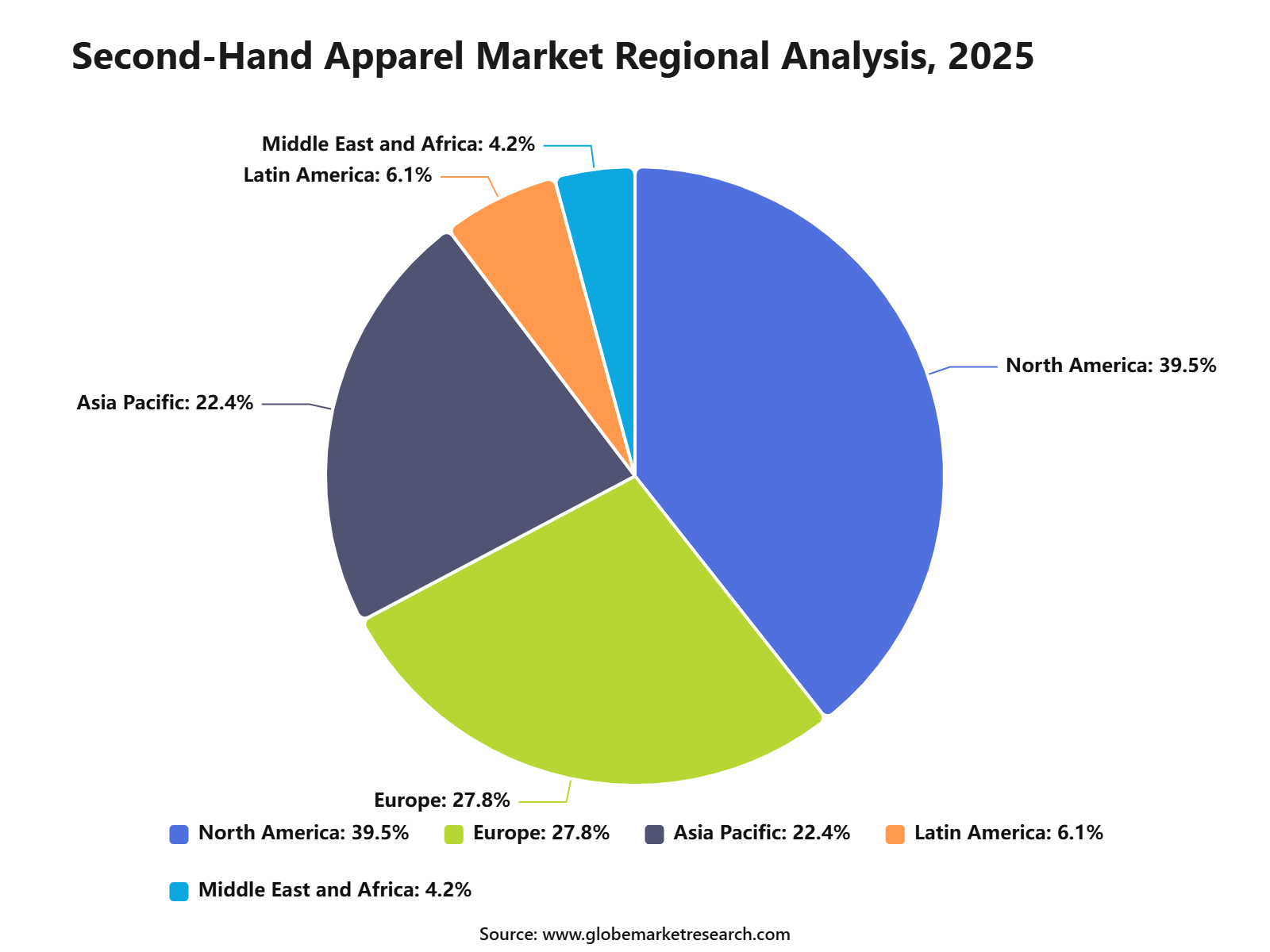 iThe graph shows projected market growth until 2035 based on CAGR analysis. Actual outcomes may vary depending on changing demand, competition, and economic factors.To gain greater insights - request a sample report PDF
Segment Covered in the Report
By Product Type
Tops & T-Shirts
Bottom Wear
Dresses & Ethnic Wear
Others
By Category
Men’s Wear
Women’s Wear
Kids’ Wear
Unisex
By Price Segment
Budget Apparel
Mid-range Apparel
Premium/Luxury Apparel
By Sales Channel
Online Platforms
Offline Platforms
By Region
North America
Europe
Asia Pacific
Latin America
Middle East and Africa
Driver Analysis
Value Shopping and Resale Acceptance
The main driver for the Second-Hand Apparel Market is the rising acceptance of resale as a normal shopping choice, especially among younger consumers and price-sensitive buyers. ThredUp’s 2026 Resale Report stated that the U.S. secondhand market grew nearly 4 times faster than the broader retail clothing market in 2025. This shows that resale is moving beyond thrift buying and becoming a regular part of apparel purchasing. The shift is supported by affordability, sustainability awareness, and wider availability through online resale platforms.
Consumer behavior is also changing because shoppers are comparing resale products before buying new clothing. ThredUp reported that Gen Z and Millennials are expected to drive more than 70% of secondhand apparel growth through 2030, which makes younger consumers a core demand base for the market. This group is more comfortable with mobile resale apps, peer-to-peer selling, and branded resale programs. As a result, resale platforms are gaining stronger relevance across fashion discovery, value shopping, and circular consumption.
Restraint Analysis
Quality, Trust, and Product Condition Concerns
A major restraint for the Second-Hand Apparel Market is the difficulty of maintaining consistent product quality across used clothing inventory. Each item can differ by brand, size, fit, fabric condition, age, wear level, and authenticity. This makes resale more complex than new apparel retail, where products are standardized and easier to list. For buyers, uncertainty around product condition can reduce confidence and increase return risk.
Trust is especially important in online resale because customers cannot physically inspect the item before purchase. Platforms must invest in clear product images, accurate condition grading, authentication checks, and fair pricing tools to reduce buyer hesitation. Vogue reported in June 2026 that StockX introduced an AI-driven listing feature for pre-owned and vintage items, using photo analysis, product matching, and pricing insights to reduce resale friction.
Opportunity Analysis
AI-Enabled Resale and Brand-Owned Recommerce
A strong opportunity is emerging from AI-enabled resale platforms that make second-hand shopping easier, faster, and more personalized. AI can support product matching, visual search, automated descriptions, pricing guidance, size recommendations, and counterfeit risk checks. Time reported that ThredUp used AI search across about 4.5 million secondhand clothing items, and searches per session increased by 38% after the tool was launched.
Brand-owned recommerce is another opportunity because apparel companies are under pressure to extend product life and reduce waste. The Ellen MacArthur Foundation states that circular fashion business models must keep products in use through resale, rental, repair, and remaking services. This supports more direct involvement by brands, retailers, and marketplaces in second-hand apparel sales.
Challenge Analysis
Collection, Sorting, and Textile Waste Pressure
The key challenge for the Second-Hand Apparel Market is the limited ability to collect, sort, grade, and redirect large volumes of used clothing efficiently. The Ellen MacArthur Foundation has highlighted that 73% of materials used to produce clothing are landfilled or burned at end of life, while less than 1% of old clothing is used to make new clothing. This shows that resale still operates within a wider textile system where recovery and reuse infrastructure remain weak.
Policy pressure is also increasing, especially in Europe. The European Environment Agency stated that the Waste Framework Directive requires EU Member States to establish separate collection systems for used textiles from 2025. This can increase the supply of collected textiles, but it also creates a practical challenge around sorting capacity, quality grading, recycling routes, and resale suitability.
Recent Developments
June 2026: StockX launched StockX Listings, a new AI-supported feature that allows users to sell used sneakers, vintage apparel, and other unique items. The tool uses AI photo analysis to help create listings faster, while seller fees are waived during the launch period. This shows how resale platforms are moving toward faster listing, better product matching, and easier resale participation.
May 2026: eBay named Trosort as the global winner of its 2026 Circular Fashion Fund. Trosort will have the opportunity to receive a USD 300,000 investment from eBay Ventures for its AI-powered textile sorting technology, which supports second-hand clothing sorting, resale listing, and recycling decisions.
May 2026: ThredUp strengthened its Resale-as-a-Service model by reducing upfront and monthly costs for brands. The company said its RaaS platform powers resale for more than 60 brands, including J.Crew, Tommy Hilfiger, and Madewell, while branded resale adoption had increased 37% since May 2025.
May 2026: The RealReal reported stronger performance in luxury resale during the first quarter of 2026. The company said gross merchandise value and total revenue increased 24% and 19% , respectively, compared with the first quarter of 2025, supported by authenticated luxury consignment demand.
Research Methodology
Methodology Area | Coverage Details |
|---|---|
Primary Research | Interviews with manufacturers, suppliers, distributors, consultants, procurement teams, and industry experts. |
Secondary Research | Company filings, annual reports, regulatory databases, government publications, trade associations, and verified industry sources. |
Data Validation | Cross-verification through source triangulation, historical trend review, demand-side checks, and supply-side assessment. |
Market Estimation | Bottom-up and top-down analysis based on product demand, regional consumption, company presence, and application-level usage. |
Forecasting Approach | Forecasts based on regulatory shifts, infrastructure investment, technology adoption, pricing trends, industrial expansion, and end-use demand. |
Quality Review | Analyst review, peer validation, outlier checks, internal consistency review, and final publication approval. |
AI Policy | AI is not used as a primary data source. All published insights are reviewed against human-verified evidence. |
Competitive Landscape
The market is characterized by intense competition among established players and emerging companies. Strategic partnerships, mergers and acquisitions, and product innovation are key strategies employed by market participants.
Key Market Players
ThredUp Inc
The RealReal Inc.
Vinted
Poshmark Inc.
Vestiaire Collective
eBay Inc.
Depop
Mercari Inc.
Goodwill Industries International
Buffalo Exchange
Crossroads Trading Co.
Swap.com
Goodfair, Beyond Retro
Other Key Players
Meet the Team
This report was prepared by our expert analysts with deep industry knowledge and research experience.
Pratiksha is market research analyst with strong experience in industry research, market forecasting, and competitive analysis. She specializes in identifying market trends, evaluating growth opportunities, and preparing data-driven insights across global industries. Her work supports businesses in understanding market dynamics, customer demand, regional opportunities, and strategic investment areas.
Sayali brings more than 5 years of experience to Globe Market Research, supporting the accuracy, clarity, and relevance of research content across multiple industries. She reviews market data, segment analysis, competitive insights, and industry trends to ensure each report meets strong quality standards and provides practical value to business decision-makers. Her expertise spans healthcare, information technology, consumer goods, and diverse cross-industry domains. With a strong focus on data reliability, structured analysis, and clear presentation, Sayali helps ensure that each research output delivers well-reviewed insights for clients, investors, consultants, and industry stakeholders.
Frequently Asked Questions
Related Reports
More in Consumer Goods
Sustainable Casket and Coffin Market Size to hit USD 5.9 bn by 2035
Global Sustainable Casket and Coffin Market Size, Go-to-Market Strategy Analysis By Material (Soft Wooden, Cardboard, Wicker, Others), By Price (Low, Medium, High), By Distribution Channel (Online, Offline), By Regional Insights, Business plan and Project Report, Investment Opportunities, Profitability, Industry Trends, Leading Companies and Growth Forecasts By 2025-2035
Sports Sponsorship Market to hit USD 215.8 billion by 2035
Global Sports Sponsorship Market Size, Go-to-Market Strategy Analysis By Sponsorship Type (Team/Club, Athlete, Events, Venue, Others), By Sports Category (Football, Cricket, E-sports, Others), By Event Type (International, League, Domestic), By Application (Competition Sponsorship, Training Sponsorship, Others), By Regional Insights, Business plan and Project Report, Investment Opportunities, Profitability, Industry Trends, Leading Companies and Growth Forecasts By 2025-2035
Subscription Box Market to hit USD 225.2 billion by 2035
Global Subscription Box Market Size, Go-to-Market Strategy Analysis By Type (Replenishment Subscription, Curation Subscription, Access Subscription), By Price Range (Budget-friendly, Mid-range, Premium/Luxury), By Application (Beauty and Personal Care, Food and Beverages, Fashion and Apparel, Pet Products, Health and Fitness, Kids and Baby Products, Books and Entertainment, Home Goods, Tech and Gadgets, Arts and Crafts, Others), By Regional Insights, Business plan and Project Report, Investment Opportunities, Profitability, Industry Trends, Leading Companies and Growth Forecasts By 2025-2035
Pet Toys Market to hit USD 35.6 billion by 2035
Global Pet Toys Market Size, Share Analysis By Product Type (Plush, Rope, Balls, Others), By Pet Type (Dogs, Cats, Others), By Distribution Channel (Offline, Online), By Regional Insights, Business plan and Project Report, Investment Opportunities, Profitability, Industry Trends, Leading Companies and Growth Forecasts By 2025-2035