

Revenue, 2026
USD 2.3 Bn
Forecast, 2035
USD 30.1 Bn
CAGR, 2026-2035
33.1%
Report Coverage
Global
Market Size and Forecast
According to Globe Market Research, the global Space Tourism Market was valued at USD 2.3 billion in 2026 and is projected to reach approximately USD 30.1 billion by 2035, growing at a CAGR of 33.1% from 2026 to 2035. North America accounted for around 39.4% of the market, equivalent to approximately USD 0.9 billion at the stated 2026 value. Regional leadership is supported by established commercial spaceflight operators, advanced launch infrastructure, private investment and regulatory support for human spaceflight activities.
Key Parameter | Report Details |
|---|---|
Market Revenue, 2026 | USD 2.3 Billion |
Projected Revenue, 2035 | USD 30.1 Billion |
CAGR, 2026-2035 | 33.1% |
Largest Region | North America, 39.4% Share |
Market Concentration | Medium |
Forecast Period | 2026-2035 |
Space Tourism Market Key Insights
Sub-orbital space tourism led the type segment with 52.5% share, supported by shorter flight duration, lower mission complexity, relatively lower ticket cost, and rising demand for space-edge travel experiences.
Commercial end use accounted for 55.8% share, driven by growing private-sector participation, premium leisure travel demand, spaceflight bookings, and expanding interest from high-net-worth consumers.
North America led the space tourism market with 39.4% share, supported by strong private space companies, advanced launch infrastructure, high investment activity, and early adoption of commercial space travel services.
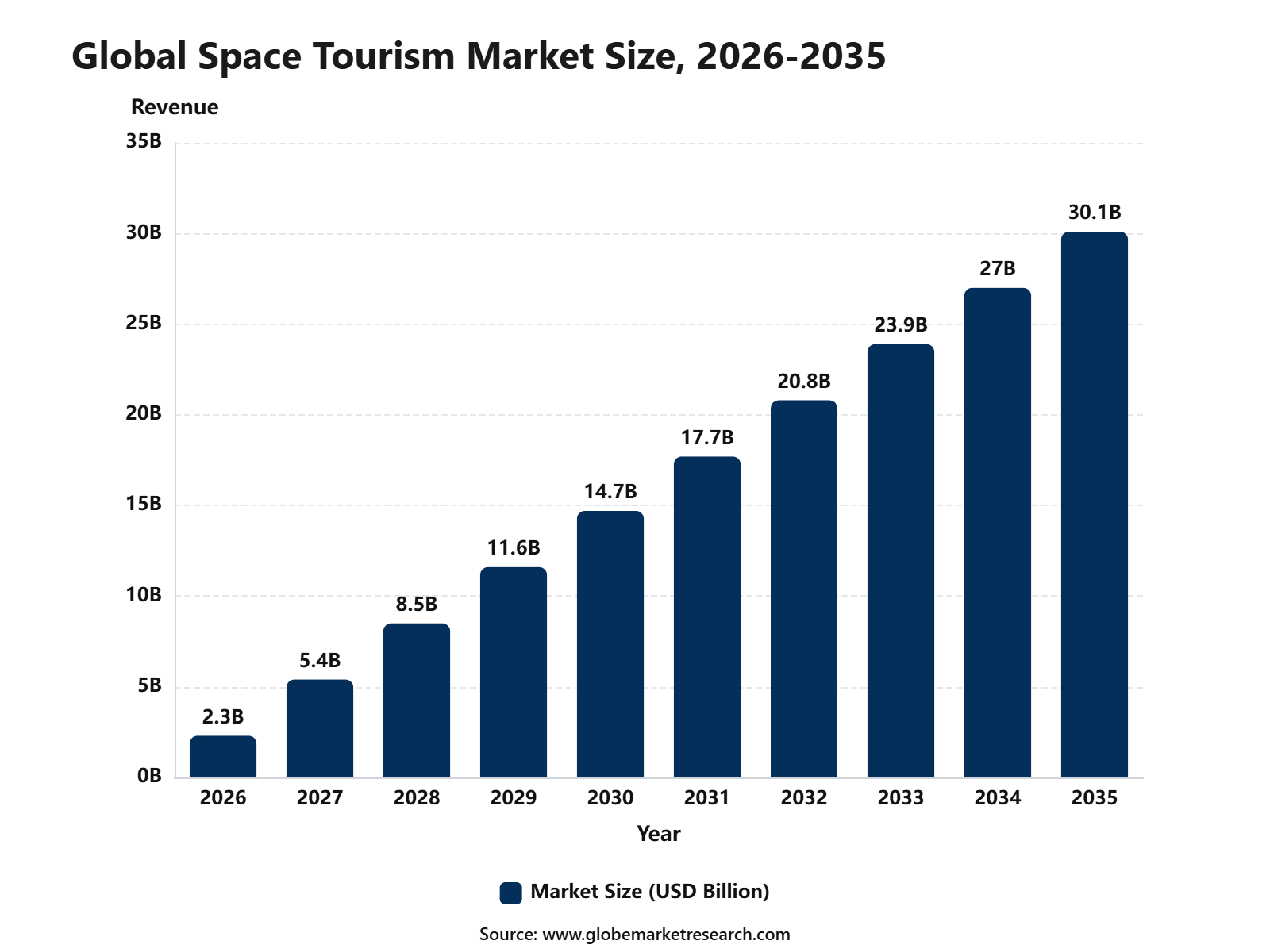 iThe graph shows projected market growth until 2035 based on CAGR analysis. Actual outcomes may vary depending on changing demand, competition, and economic factors.To gain greater insights - request a sample report PDF
What is Space tourism?
Space tourism includes commercial travel beyond Earth’s atmosphere for recreational, research and educational purposes. Services include short suborbital flights, orbital missions, private astronaut visits to space stations and planned lunar experiences. Companies are developing reusable launch vehicles, passenger spacecraft, training programmes and spaceport infrastructure to improve flight frequency, safety and customer accessibility. Commercial activity continued to advance during 2026.
Blue Origin completed its 38th New Shepard mission in January, taking six people to space and increasing the programme’s cumulative total to 98 human passengers, including 92 unique individuals. Virgin Galactic reopened limited spaceflight sales at USD 750,000 per seat and reported that commercial operations with its next-generation spacecraft remained scheduled to begin in the fourth quarter of 2026. The FAA continues to license commercial human spaceflight operations, inspect vehicles and integrate launch and re-entry activities into the national airspace, supporting the development of a regulated passenger-spaceflight ecosystem.
Adoption Indicators and Usage Statistics
According to the Federal Aviation Administration, Blue Origin, and Virgin Galactic, commercial human spaceflight is increasingly accessible to private individuals, although adoption remains limited by high ticket prices, restricted flight capacity, and safety requirements. Blue Origin reported a multi-year customer backlog and nearly 99% vehicle dry-mass reuse. Virgin Galactic reopened limited expedition sales at USD 750,000 per seat and held USD 78.5 million in customer deposits at the end of 2025.
Metric | Adoption Indicator |
|---|---|
Customer Backlog | Multi-year backlog |
Spacecraft Reuse | Nearly 99% |
Expedition Price | USD 750,000 per seat |
Customer Deposits | USD 78.5 million |
FY2026 Operations | 209–214 projected |
According to Blue Origin, New Shepard had completed 38 missions and carried 98 human occupants, representing 92 different individuals, by January 2026. The reusable suborbital system accommodates six people and provides an approximately 11-minute journey beyond the Kármán line, including several minutes of weightlessness. These figures show that commercial tourism operations have moved beyond demonstration flights, but passenger volumes remain small compared with conventional premium travel markets.
Metric | Passenger Usage |
|---|---|
New Shepard Passengers | 98 human flight |
Unique Space Travelers | 92 individuals |
New Shepard Flights | 38 missions |
Flight Duration | Around 11 minutes |
Capsule Capacity | 6 passengers |
Type Insights
Sub-orbital tourism accounted for 52.5% of the Space Tourism Market by type. Sub-orbital flights provide several minutes of microgravity and views of Earth without requiring the higher cost, training and mission duration associated with orbital travel. The shorter flight profile makes this category more suitable for first-time private space travellers.
Blue Origin completed its 38th New Shepard mission in January 2026. By that flight, the reusable sub-orbital system had carried 98 human passengers, representing 92 individuals, beyond the recognized boundary of space. This operating history demonstrates the commercial feasibility of short-duration human spaceflight.
Sub-orbital operators must continue improving flight frequency, passenger preparation and vehicle turnaround. However, service availability remains sensitive to company strategy and vehicle schedules. Blue Origin announced in January 2026 that it would pause New Shepard flights for at least two years while redirecting resources toward lunar programs.
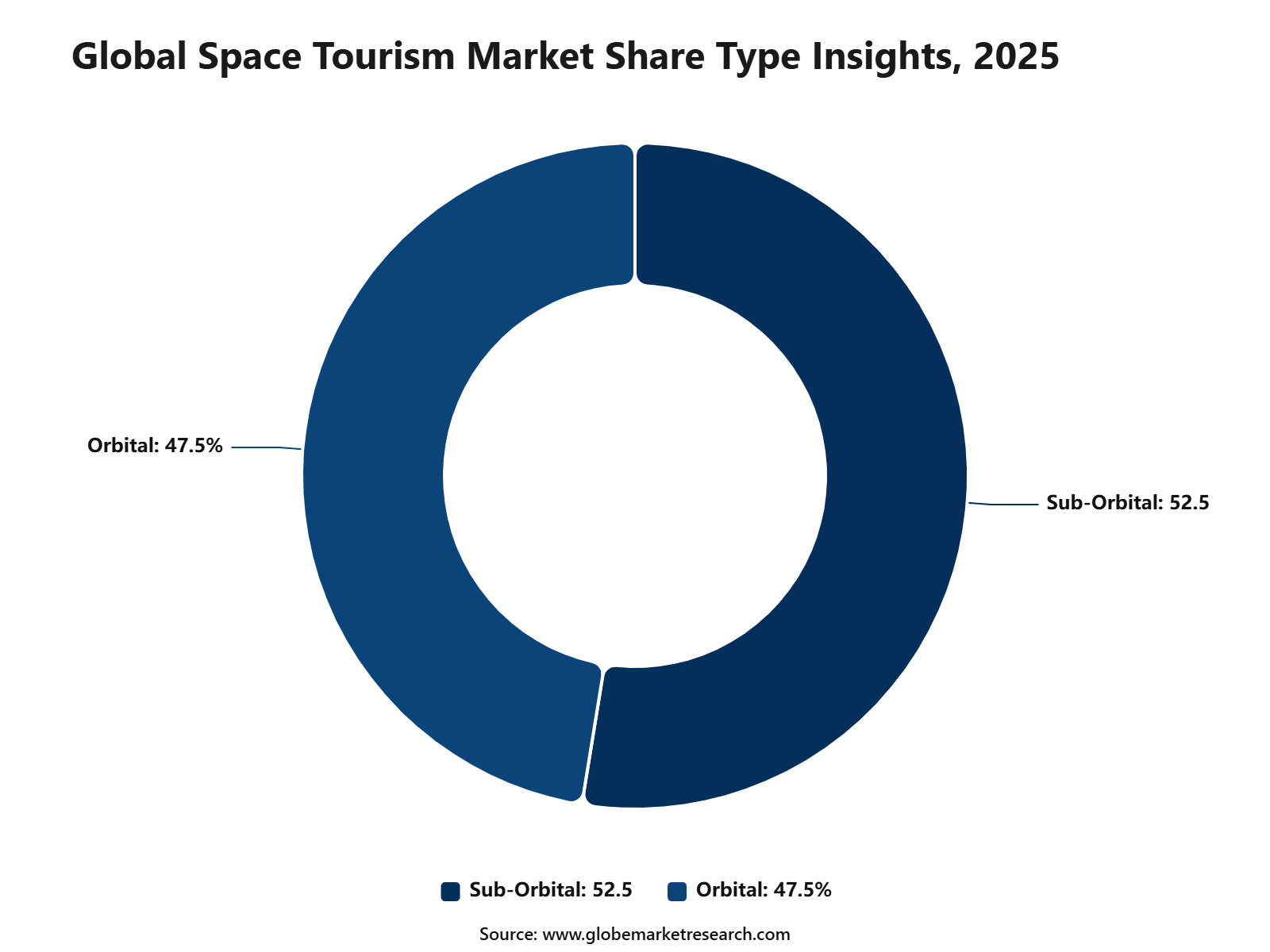 iThe graph shows projected market growth until 2035 based on CAGR analysis. Actual outcomes may vary depending on changing demand, competition, and economic factors.To gain greater insights - request a sample report PDF
End-Use Insights
Commercial customers represented 55.8% of the market by end use. This segment includes privately funded passengers, corporate researchers, media participants and organizations purchasing access to space for professional or promotional purposes. Commercial operators are widening participation beyond government astronaut programs.
Axiom Mission 4 launched from Florida in June 2025 with four private astronauts and completed an 18-day mission aboard the International Space Station. The mission demonstrated how commercial providers can coordinate transport, training and orbital operations through partnerships with established space agencies and launch companies.
Commercial demand will depend on lower mission costs, transparent safety procedures and predictable scheduling. Operators can also diversify revenue by combining passenger flights with scientific payloads, training services and sponsored activities. NASA sought proposals in 2025 for two additional private astronaut missions targeted for 2026 and 2027, supporting continued commercial participation in low Earth orbit.
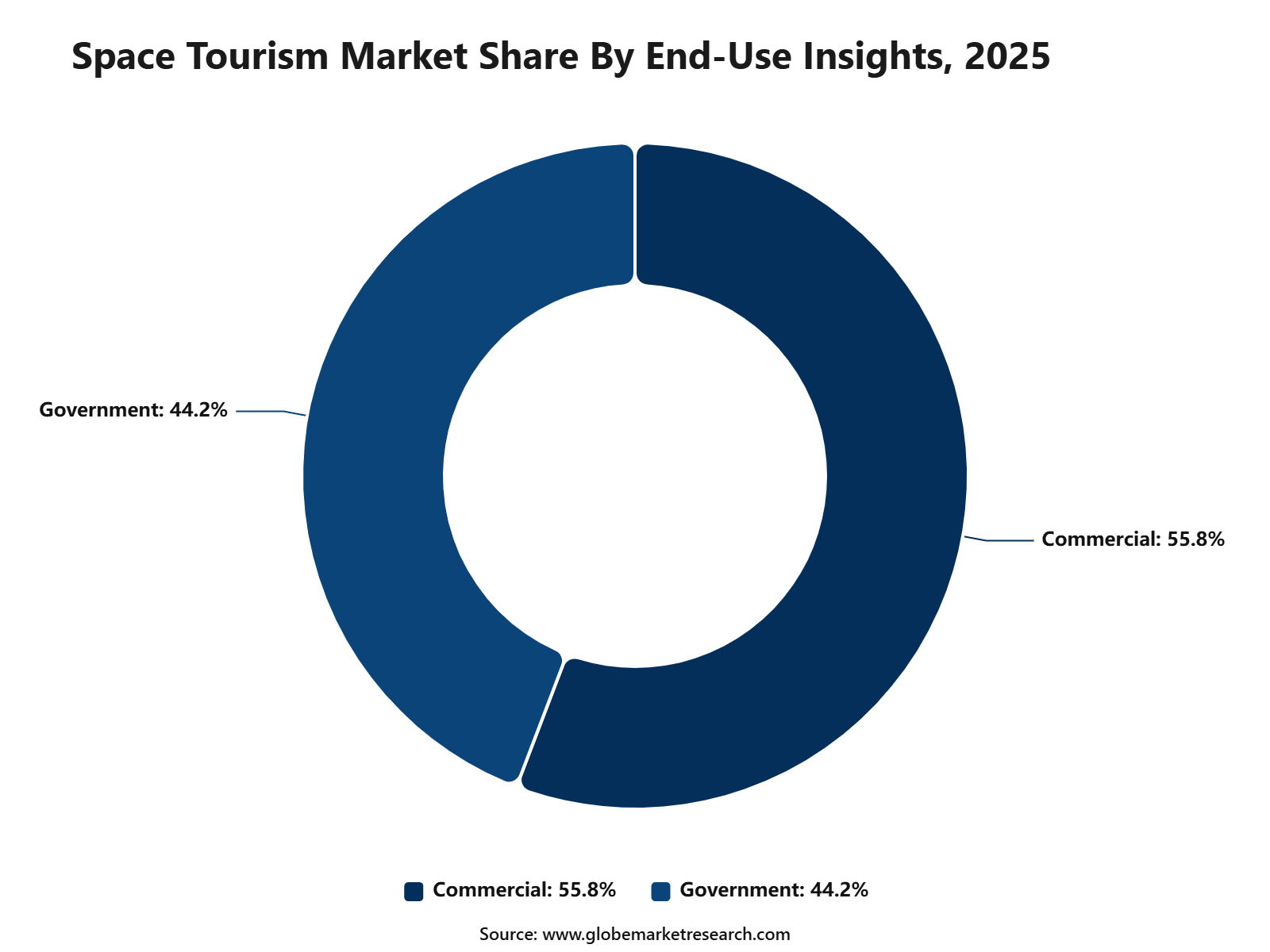 iThe graph shows projected market growth until 2035 based on CAGR analysis. Actual outcomes may vary depending on changing demand, competition, and economic factors.To gain greater insights - request a sample report PDF
Regional Insights
North America accounted for 39.4% of the Space Tourism Market. Regional leadership is supported by established launch sites, reusable vehicle development, private space companies and an experienced commercial-space regulatory system. The United States remains the primary contributor through launch infrastructure in Florida, Texas, New Mexico and other locations.
The U.S. Federal Aviation Administration recorded its 1,000th licensed or permitted commercial-space operation on August 14, 2025. The milestone reflects more than three decades of regulated launch and re-entry activity and demonstrates the scale of the commercial-space operating environment in the country.
North America also provides infrastructure for both sub-orbital and orbital tourism. NASA’s fourth private astronaut mission launched from Kennedy Space Center in 2025, while the FAA continued evaluating higher launch frequencies for reusable vehicles. Future regional growth will depend on regulatory capacity, launch-site availability and consistent passenger-flight schedules.
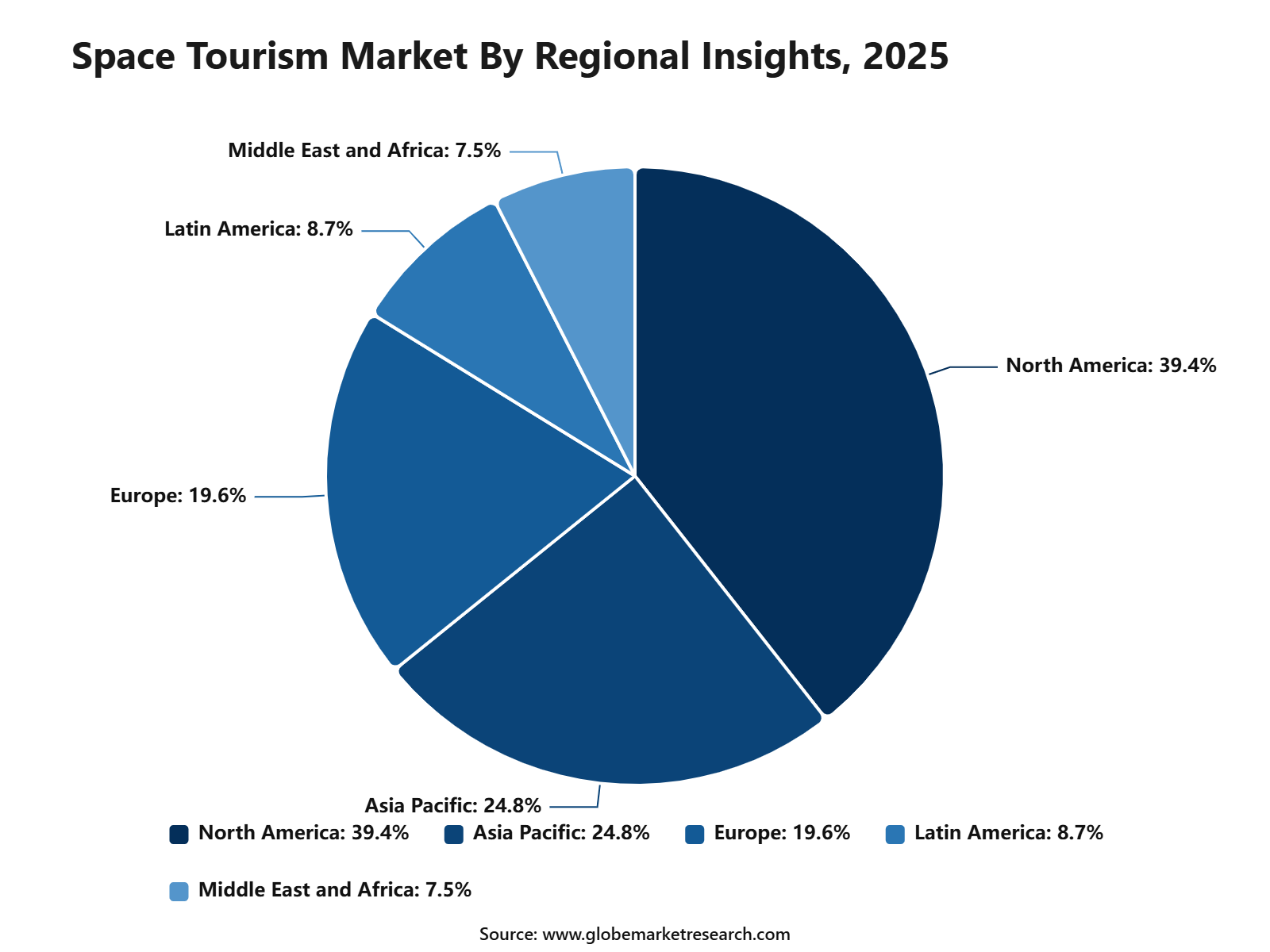 iThe graph shows projected market growth until 2035 based on CAGR analysis. Actual outcomes may vary depending on changing demand, competition, and economic factors.To gain greater insights - request a sample report PDF
Regional Market | Market Insights | Details |
|---|---|---|
U.S. Space Tourism Market Insight | The FAA recorded 204 licensed launch and re-entry operations in fiscal year 2025. | Strong launch infrastructure and private operators support market leadership. |
Europe Space Tourism Market Insight | European public space budgets reached €13.5 billion in 2025. | Public funding supports commercial spaceflight development. |
U.K. Space Tourism Market Insight | The U.K. space sector generates £18.9 billion in annual income. | Growth is supported by training, insurance and spaceport services. |
Germany Space Tourism Market Insight | Germany committed approximately €5.4 billion to European space programs in 2025. | Aerospace expertise supports human-spaceflight technologies. |
Asia-Pacific Space Tourism Market Insights | Australia invested AUD 10 million in Southern Launch in 2026. | New spaceports and launch companies support regional expansion. |
Japan Space Tourism Market Insight | Japan’s Space Strategy Fund provides approximately JPY 1 trillion over ten years. | Government investment supports private spaceflight development. |
China Space Tourism Market Insight | China had 12 commercial-space unicorns in early 2025. | Strong commercial launch activity supports future passenger missions. |
Key Market Segments
By Type
Orbital
Sub-Orbital
By End Use
Government
Commercial
By Region
North America
Europe
Asia Pacific
Latin America
Middle East and Africa
Key Market Drivers
Expansion of commercial spaceflight activity: The FAA recorded its 1,000th licensed or permitted commercial space operation in August 2025. By June 2026, the agency had issued commercial spaceflight licenses to 31 operators conducting missions from the United States, other countries, and international waters.
Growing number of private astronaut missions: Axiom Mission 4 carried four private astronauts to the International Space Station in June 2025 for an 18-day mission. The flight demonstrated continued demand for privately organized orbital missions involving research, national astronauts, outreach, and commercial activities.
Development of a multi-provider orbital ecosystem: NASA selected Axiom Space for its fifth private astronaut mission, Vast for its sixth, and Voyager Technologies for its seventh. These missions are targeted for 2027 and 2028, expanding competition beyond a single private mission provider.
Commercialization of low Earth orbit: NASA is supporting commercially owned and operated destinations where government agencies, researchers, companies, and private customers can purchase services. This transition can create dedicated capacity for tourism, research, media production, training, and extended stays in orbit.
Introduction of higher-capacity suborbital vehicles: Virgin Galactic reported in March 2026 that its Delta-class spacecraft remained scheduled to begin commercial operations in the fourth quarter of 2026. New reservations were being offered at USD 750,000 per seat, showing that the initial customer base remains concentrated in the premium travel segment.
Expansion of spaceport infrastructure: Commercial spaceports are being developed to support launch, re-entry, passenger preparation, vehicle servicing, training, and tourism-related activities. The FAA established a dedicated Office of Spaceports to improve infrastructure, licensing, safety, competitiveness, and international cooperation.
Emerging Space Tourism Trends
Shift from individual missions to scheduled services: Operators are developing reusable vehicles intended to fly at greater frequency. The transition from occasional demonstration flights to regular schedules is essential for increasing passenger capacity and improving the economics of space tourism.
Private astronaut missions with national participation: Governments and research organizations are increasingly using commercial missions to send national astronauts to orbit. Axiom Mission 4 included participants connected with India, Hungary, and Poland, showing how commercial missions can provide countries with access without requiring independent crewed spacecraft programs.
Commercial space stations as tourism destinations: Future privately operated stations are being planned as mixed-use platforms for government astronauts, researchers, manufacturers, media companies, and private visitors. NASA intends to purchase services from commercial destinations rather than remain the sole operator of low Earth orbit infrastructure.
Short-duration orbital stays: NASA’s fifth and sixth private astronaut missions are expected to spend up to 14 days aboard the International Space Station. This model offers a structured pathway between brief suborbital flights and longer stays on future commercial stations.
Research integrated with passenger experiences: Private astronauts are being trained to conduct experiments, technology demonstrations, educational programs, and outreach activities. Research-linked missions can improve vehicle utilization and provide institutional funding alongside passenger revenue.
Premium expedition-style packages: Space tourism is increasingly being marketed as a complete journey that includes medical screening, training, accommodation, mission preparation, community events, and post-flight activities rather than only the flight itself.
Greater use of autonomous spacecraft: Fully autonomous flight systems can reduce pilot requirements and standardize passenger missions. New Shepard operates without onboard pilots, using automated launch, flight, separation, and landing systems.
5 Best Space Tourism Technologies in 2026
Reusable Suborbital Spaceflight Systems: Reusable rockets and spaceplanes are designed to carry passengers above the recognized boundary of space and return the vehicle for additional flights. Reusability is essential for increasing flight frequency and controlling vehicle replacement costs.
Crewed Orbital Transportation Systems: Human-rated capsules provide launch, life support, navigation, docking, emergency escape, re-entry, and recovery capabilities. These systems enable private passengers to travel to the International Space Station and future commercial orbital destinations.
Commercial Space Stations and Habitable Modules: Commercial stations provide accommodation, life support, research facilities, observation windows, communications, food storage, sanitation, and emergency systems. They are expected to become the main infrastructure for multi-day orbital tourism.
Astronaut Training and Simulation Platforms: High-fidelity simulators, virtual reality, centrifuges, emergency trainers, and cabin replicas prepare passengers for acceleration, weightlessness, spacecraft procedures, and unexpected events. These technologies reduce operational risk and improve passenger confidence.
Passenger Health and Life-Support Systems: Medical monitoring, cabin-pressure control, oxygen supply, carbon-dioxide removal, temperature management, radiation monitoring, and emergency equipment are essential for safely carrying non-professional astronauts with different physical profiles.
Market Dynamics
Drivers Impact Analysis
The Space Tourism Market is driven by rising interest in commercial spaceflight, private astronaut missions, sub-orbital tourism, orbital stays, space hotels, and luxury adventure travel. High-net-worth individuals, research travelers, media projects, and early commercial passengers are supporting the first phase of demand.
North America leads the market due to its strong private space ecosystem, commercial launch infrastructure, aerospace innovation, and early space tourism operators. The U.S. remains the main contributor because of advanced reusable launch systems, private spaceports, and growing consumer interest in commercial space experiences.
Impact Factor | Estimated CAGR Impact | Regional Relevance | Market Impact |
|---|---|---|---|
Rising demand for commercial spaceflight | +10.5% | North America, Europe, Asia Pacific | Drives early market expansion. |
Growth in sub-orbital tourism | +8.8% | U.S. and commercial spaceports | Supports shorter-duration space travel. |
Expansion of private astronaut missions | +7.6% | North America and Europe | Builds premium orbital demand. |
Reusable launch vehicle progress | +6.9% | U.S.-led aerospace ecosystem | Reduces long-term access cost. |
Luxury adventure travel demand | +5.4% | High-income consumer markets | Supports premium passenger interest. |
Restraints Impact Analysis
The market faces restraints from extremely high ticket prices, limited passenger capacity, safety risk, regulatory approvals, and dependence on specialized launch infrastructure. Space tourism is still an early-stage market, and affordability remains limited to a small consumer base. Another restraint is operational risk. Launch delays, technical failures, insurance costs, weather conditions, astronaut training requirements, and mission safety standards can slow commercialization and reduce passenger confidence.
Impact Factor | Estimated CAGR Impact | Regional Relevance | Market Impact |
|---|---|---|---|
High ticket pricing | -6.8% | Global consumer markets | Limits mass-market adoption. |
Safety and launch risk | -5.9% | Commercial spaceflight operators | Affects passenger confidence. |
Limited launch capacity | -4.8% | North America and Europe | Restricts near-term revenue scale. |
Strict regulatory approvals | -4.1% | U.S., Europe, Asia Pacific | Slows commercial expansion. |
High insurance and training cost | -3.5% | Private astronaut missions | Raises operating expenses. |
Opportunities Impact Analysis
Opportunities are strong in sub-orbital flights, orbital tourism, private astronaut missions, space hotels, lunar flyby concepts, zero-gravity training, space-themed hospitality, and commercial research travel. These areas create premium revenue channels beyond traditional aerospace services.
Higher-value opportunities are emerging in reusable launch systems, passenger training centers, commercial spaceports, space tourism insurance, luxury travel partnerships, media-based space experiences, and microgravity research packages. Companies that improve safety, reliability, and customer experience can capture strong long-term demand.
Impact Factor | Estimated CAGR Impact | Regional Relevance | Market Impact |
|---|---|---|---|
Sub-orbital flight commercialization | +10.2% | North America and Europe | Builds near-term tourism revenue. |
Orbital space tourism growth | +8.7% | Private astronaut missions | Supports premium long-duration experiences. |
Space hotel development | +7.3% | Future commercial space stations | Adds long-term hospitality demand. |
Commercial spaceport investment | +6.1% | U.S., UAE, Europe, Asia Pacific | Expands launch access. |
Luxury travel partnerships | +4.9% | High-net-worth traveler markets | Improves customer acquisition. |
Challenges Impact Analysis
The main challenge is making space tourism safe, repeatable, and commercially scalable. Operators must manage launch safety, passenger training, medical screening, spacecraft reliability, emergency response, and regulatory compliance. Another challenge is reducing cost without reducing safety. Space tourism companies must improve launch frequency, vehicle reuse, passenger capacity, ground operations, and mission planning while maintaining very high safety standards.
Impact Factor | Estimated CAGR Impact | Regional Relevance | Market Impact |
|---|---|---|---|
Commercial launch reliability | -6.2% | Space tourism operators | Affects market trust and scale. |
Passenger safety management | -5.4% | Sub-orbital and orbital flights | Increases compliance requirements. |
Cost reduction complexity | -4.7% | Reusable launch systems | Slows affordability improvements. |
Medical and training barriers | -3.9% | High-net-worth travelers | Limits eligible passenger base. |
Public perception after incidents | -3.2% | Global space tourism market | Can reduce demand confidence. |
Space Tourism Case Study
Case Study: Virgin Galactic Develops a Scalable Space Tourism Service
Virgin Galactic provides a practical example of how space tourism is progressing from occasional demonstration flights toward a repeatable commercial service. The company’s model combines suborbital passenger flights, premium customer experiences, astronaut training, microgravity research, and reusable aerospace vehicles.
The company has already flown 23 paying private astronauts. As of December 31, 2025, approximately 675 future astronauts held reservations, representing about USD 188 million in expected future spaceflight revenue once the reserved flights are completed. This backlog provides evidence of demand, although the revenue cannot be recognized until customers are flown.
Virgin Galactic reopened sales for a limited group of spaceflight expeditions at a base price of USD 750,000 per seat in early 2026. The sales process is based on individual consultation rather than standard online ticketing because customers require detailed information about training, medical preparation, flight risks, travel arrangements, and the complete astronaut experience.
Recent Developments
Market News
Blue Origin completed its 38th New Shepard flight: In January 2026, Blue Origin operated the NS-38 suborbital mission with six passengers. Following the mission, New Shepard had completed 38 flights and carried 98 people above the Kármán line, while more than 200 research and educational payloads had also been launched.
Blue Origin paused New Shepard operations: On January 30, 2026, Blue Origin announced that New Shepard flights would be suspended for no less than two years. Resources are being redirected toward the company’s human lunar programme, even though New Shepard has accumulated a multi-year customer backlog.
Virgin Galactic reopened limited spaceflight sales: In March 2026, Virgin Galactic released a limited number of spaceflight reservations priced at USD 750,000 per passenger. The first next-generation spaceship was scheduled to enter ground testing in April, with flight testing planned for the third quarter and commercial operations targeted for the fourth quarter of 2026.
Vast expanded the private astronaut mission pipeline: In June 2026, ESA, the Czech Republic, NASA, and Vast announced plans for a private astronaut mission to the International Space Station in 2027. ESA reserve astronaut Aleš Svoboda is planned to serve as mission pilot, subject to international approval, with SpaceX providing the Dragon spacecraft and Falcon 9 launch.
Mergers
Quantum Space announced a SPAC combination: In June 2026, spacecraft infrastructure developer Quantum Space agreed to merge with Inflection Point Acquisition in a transaction valuing the combined company at approximately USD 1.2 billion. Although the company is not a direct passenger-tourism operator, orbital transport and infrastructure transactions can support the wider private-spaceflight ecosystem.
World View was combined with Ondas: In April 2026, World View Enterprises became a wholly owned Ondas subsidiary through a statutory merger. World View was previously associated with stratospheric passenger concepts, although its current commercial focus is centred on high-altitude sensing, autonomous systems, and defence applications.
Commercial partnerships are acting as merger alternatives: The Vast, ESA, Czech Republic, NASA, and SpaceX mission framework combines astronaut selection, government approval, mission management, transportation, and orbital access without requiring the participating organisations to merge.
Strategic investors are becoming operational partners: Axiom Space’s 2026 financing included MUFG Bank and continued support from 4iG Group. The partnerships cover commercial stations, human spaceflight, orbital data centres, microgravity programmes, and broader space infrastructure development.
Acquisitions
Ondas completed its acquisition of World View: On April 1, 2026, Ondas acquired World View Enterprises through a merger transaction involving up to approximately 12.8 million Ondas shares and around USD 7.3 million toward outstanding obligations.
Funding
Axiom Space closed more than USD 525 million: In June 2026, Axiom Space completed an oversubscribed financing round exceeding USD 525 million. The capital is being directed toward human spaceflight, Axiom Station, lunar spacesuits, and commercial low-Earth-orbit infrastructure.
Vast raised USD 500 million: In March 2026, Vast secured USD 500 million consisting of USD 300 million in Series A equity and USD 200 million in debt. The funding supports facilities, workforce expansion, Haven-2 development, and infrastructure intended to succeed the International Space Station.
Virgin Galactic raised capital through equity issuance: Virgin Galactic generated USD 11 million through its at-the-market programme during the first quarter of 2026 and approximately USD 52 million during April. The proceeds support spacecraft testing, rocket-motor manufacturing, and preparation for renewed commercial operations.
Blue Origin was linked to a potential major fundraise: In July 2026, industry reporting indicated that Blue Origin could seek approximately USD 10 billion in new capital. This potential financing had not been confirmed as completed and should therefore be treated as a reported funding plan rather than a closed transaction.
Competitive Landscape
The market is characterized by intense competition among established players and emerging companies. Strategic partnerships, mergers and acquisitions, and product innovation are key strategies employed by market participants.
Key Market Players
Airbus
Blue Origin
The Boeing Company
Space Adventures, Inc.
Space Perspective
SpaceX
Virgin Galactic Holdings, Inc.
World View Enterprises, Inc.
Zero 2 Infinity S.L.
Zero Gravity Corporation
Other Key Players
Research Methodology
This market study is prepared using a combination of primary and secondary research. Primary research includes discussions with manufacturers, suppliers, distributors, consultants, industry experts, and end users. Secondary research covers company reports, government databases, trade associations, technical publications, regulatory sources, and trusted industry documents. The collected information is used to assess market demand, pricing trends, technology adoption, competitive activity, and regional performance.
AI language models are not used as primary data sources, and publicly available AI-generated content is not treated as market evidence. Computational tools may be used to support data processing, translation, data classification, and pattern identification. However, every published assessment is supported by verified sources, human review, and primary market discussions.
Market estimates are developed through top-down and bottom-up approaches and validated using data triangulation. Revenue, production, shipment, pricing, and application-level data are compared across multiple sources. Forecasts consider economic conditions, regulatory changes, investment activity, innovation, supply chain developments, and industry risks. All findings are reviewed through source verification and internal quality checks before publication.
Part I
Source Management & Input Data Standards
Who provides data, how sources are qualified, and what types of evidence are admissible.
Part II
Research Scope & Market Coverage
How we define the markets we assess and the parameters that govern each product.
Part III
Data Collection, Verification & Submission
The mechanics of gathering, cross-checking, and hierarchically ranking evidence.
Part IV
Assessment Determination & Quality Controls
How raw data becomes a published assessment — normalisation, expert judgement, and outlier exclusion.
Part V
Publication, Corrections & Revision
Our publication schedule, corrections policy, and methodology review cycle.
Part VI
Independence, Ethics & Complaints
Conflict-of-interest policies, editorial independence, and how clients raise concerns.
Google · Preferred Sources
Don't miss the latest market research insights and industry updates on Google.
Add Globe Market Research as a preferred source in the Google app to see our reports, analysis, and market stories in your news suggestions.
Meet the Team
This report was prepared by our expert analysts with deep industry knowledge and research experience.
Kimaya brings more than five years of experience in market research, content review, and industry analysis to Globe Market Research. She plays an important role in maintaining the accuracy, clarity, consistency, and relevance of research content across a wide range of industries. Her responsibilities include reviewing market data, segment analysis, competitive landscapes, industry trends, company developments, and strategic insights. Each report is carefully assessed to ensure that the findings are supported by reliable data, presented in a structured format, and aligned with the information needs of business decision-makers. Kimaya has research experience across healthcare, information technology, consumer goods, and several cross-industry domains.
Prashant S. is a Research Analyst at Globe Market Research with more than four years of experience in market research and industry analysis. He specializes in the Aerospace and Defence, Automotive and Transportation, Semiconductor and Electronics, Information and Technology sectors, with expertise in market sizing, trend analysis, competitive assessment, and industry forecasting. He applies primary and secondary research, data validation, company analysis, and market estimation methods to deliver reliable insights for strategic planning and business decision-making.
Frequently Asked Questions
Related Reports
More in Aerospace and Defence
US Drone Market Size to hit USD 73.2 Bn by 2035
U.S. Drone Market Size, Share, Trends and Growth Analysis Report By Component (Hardware, Software, Services), By Product (Fixed-Wing, Multi-Rotor, Single-Rotor, Hybrid), By Technology (Remotely Operated, Semi-Autonomous, Fully Autonomous), By Payload Capacity (Up to 2 kg, 2 kg to 19 kg, 20 kg to 200 kg, Over 200 kg), By Power Source (Battery-Powered, Gasoline-Powered, Hydrogen Fuel Cell, Solar), By End Use (Consumer, Commercial, Military, Government and Law Enforcement), By Technology Trends, Competitive Landscape, Strategic Opportunities and Growth Forecast, 2026-2035
Ballistic Protective Equipment Market Size to hit USD 11.6 billion by 2035
Ballistic Protective Equipment Market Size, Share, Trends and Growth Analysis Report By Product (Head Protection, Soft Armor, Hard Armor), By Material Type (Aramid, Composites, Ultra-High-Molecular-Weight Polyethylene, Steel, Other Materials), By End Use (Defense, Law Enforcement and Security, Commercial), By Regional Insights, Technology Trends, Competitive Landscape, Strategic Opportunities and Growth Forecast, 2026-2035
Drone Market Size to hit USD 103.9 billion by 2035 | CAGR of 10.9%
Drone Market Size, Share, Trends and Growth Analysis Report By Type (Fixed-Wing, Rotary-Wing, Hybrid), By Component (Hardware, Software, Accessories), By Payload Capacity (Below 25 Kilograms, 25-170 Kilograms, Above 170 Kilograms), By Point of Sale (Original Equipment Manufacturers, Aftermarket), By End-Use Industry (Construction, Agriculture, Military and Defense, Law Enforcement, Logistics, Media and Entertainment, Other Industries), By Regional Insights, Technology Advancements, Competitive Landscape, Strategic Opportunities and Growth Forecast, 2026-2035
Defense Cybersecurity Market Size to Reach USD 114.7 Billion By 2035
Defense Cybersecurity Market Size, Share, Trends and Growth Analysis Report By Offering (Hardware, Services, Software), By Security Type (Application Security, Cloud Security, Critical Infrastructure Security and Resilience, Endpoint Security, Network Security), By Application (Communication Networks, Military Operations, Public Utilities, Other Applications), By Solution (Content Security, Cyber Threat Protection, Data Loss Prevention Management, Enterprise Risk and Compliance, Identity and Access Management, Managed Security Services, Network Fortification, Security and Vulnerability Management, Threat Evaluation, Training Services, Unified Threat Management, Other Solutions), By Deployment (Cloud, On-Premises), By End User (Air Force, Army, Navy), By Enterprise Size (Large Enterprises, Small and Medium-Sized Enterprises), By Regional Insights, Technology Trends, Competitive Landscape, Strategic Opportunities and Growth Forecast, 2026-2035