

Revenue, 2026
USD 38.5 Bn
Forecast, 2035
USD 114.7 Bn
CAGR, 2026-2035
12.9%
Report Coverage
Global
Market Size and Forecast
The global Defense Cybersecurity Market was valued at USD 38.5 billion in 2026 and is projected to reach approximately USD 114.7 billion by 2035, growing at a CAGR of 12.9% from 2026 to 2035. North America accounted for around 39.7% of the market, equivalent to approximately USD 15.3 billion at the stated 2026 value. Regional leadership is supported by substantial military cybersecurity spending, advanced defence networks, an established security technology industry and continued modernisation of command, communications and intelligence systems.
Key Parameter | Report Details |
|---|---|
Market Revenue, 2026 | USD 38.5 Billion |
Projected Revenue, 2035 | USD 114.7 Billion |
CAGR, 2026-2035 | 12.9% |
Largest Region | North America, 39.7% Share |
Market Concentration | Medium |
Forecast Period | 2026-2035 |
Key Market Insights
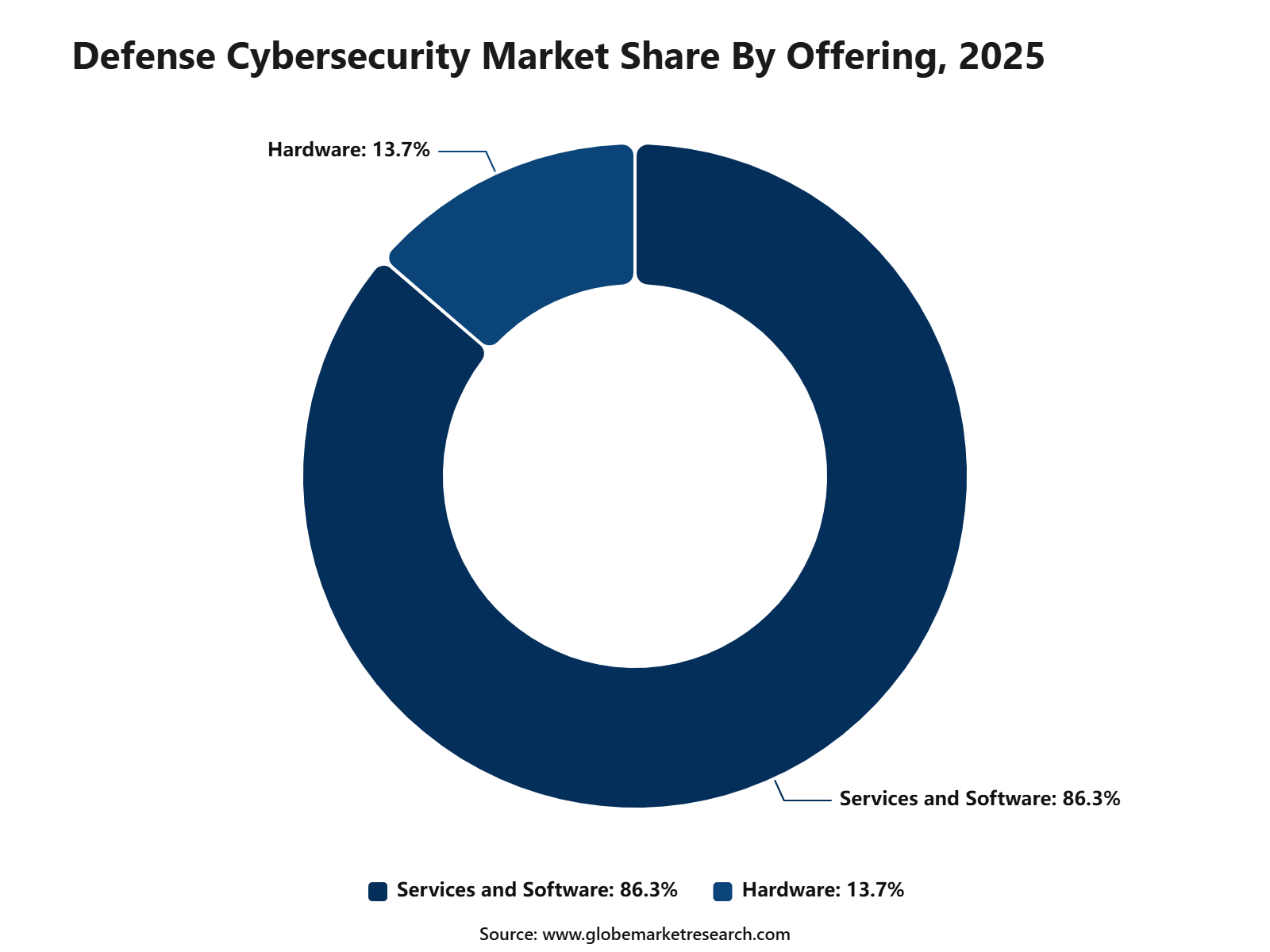
Services and software led the offering segment with 86.3% share, supported by strong demand for managed security services, threat monitoring, defense-grade software, incident response, and cyber risk management.
Endpoint security accounted for 56.2% share by security type, driven by rising protection needs for military devices, command systems, field terminals, servers, and connected defense networks.
Military applications held 75.9% share, supported by growing cyber threats against defense operations, communication systems, mission platforms, and classified data infrastructure.
Cyber threat protection captured 38.9% share by solution, driven by demand for real-time threat detection, intrusion prevention, malware defense, vulnerability management, and secure network operations.
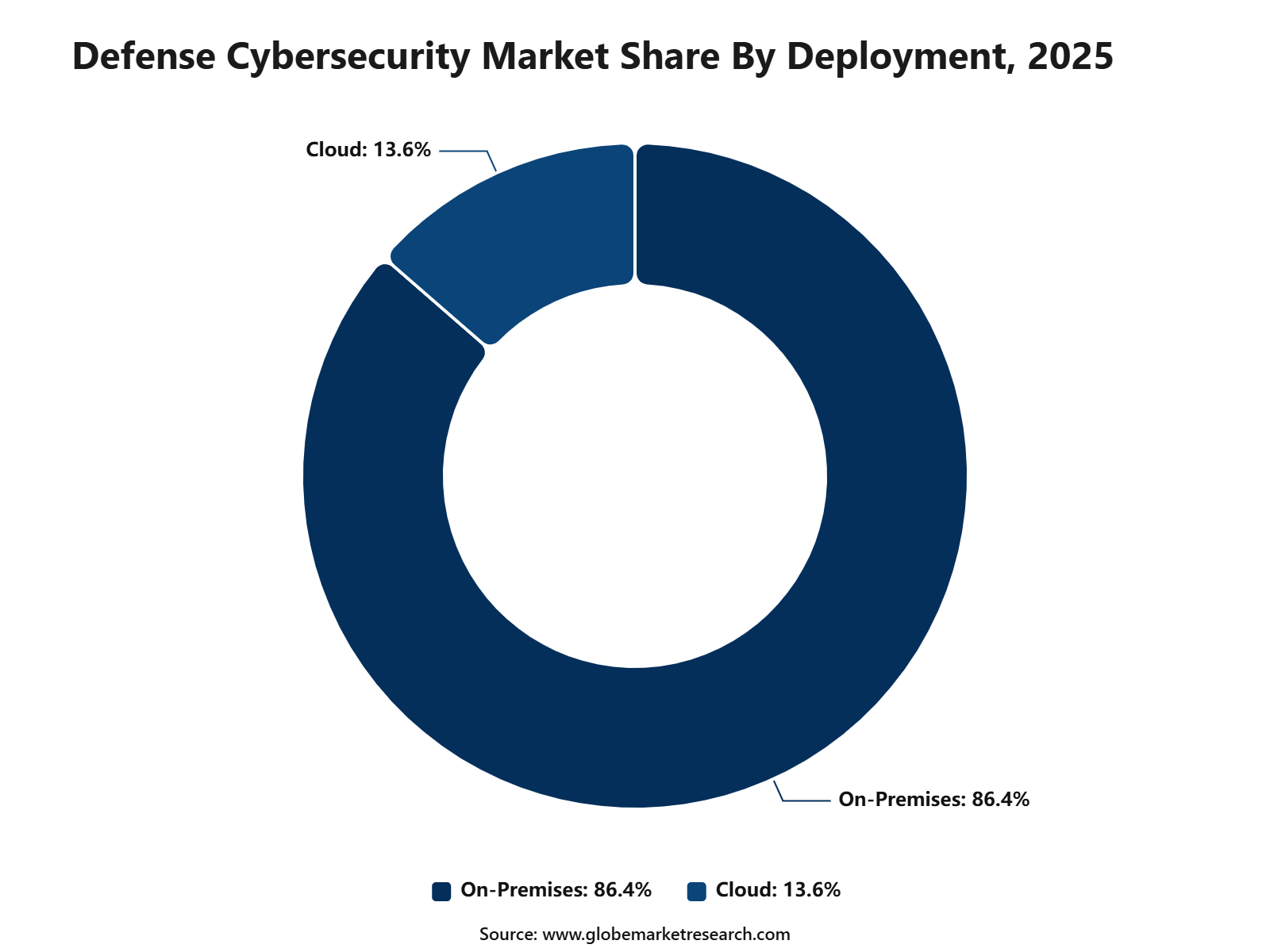
On-premises deployment led with 86.4% share, supported by strict data control needs, classified infrastructure, national security requirements, and preference for internally managed defense systems.
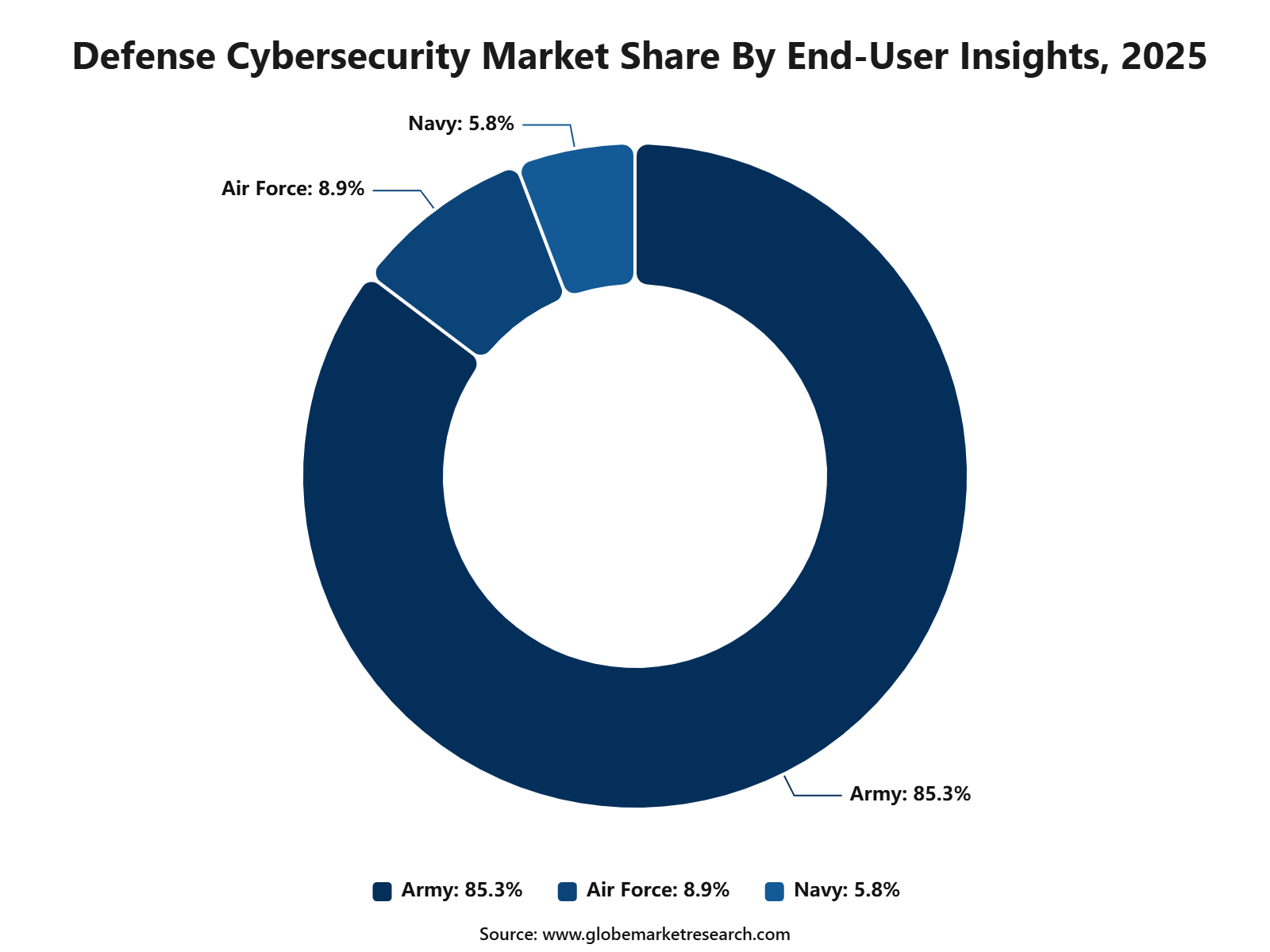
Army end users held 85.3% share, driven by high cybersecurity needs across battlefield communication, weapons systems, command centers, logistics networks, and tactical operations.
Large enterprises accounted for 69.1% share, supported by complex defense IT environments, higher security budgets, and large-scale deployment of cybersecurity platforms.
North America led the defense cybersecurity market with 39.7% share, supported by advanced defense infrastructure, high military spending, strong cybersecurity investment, and rising protection needs across critical defense systems.
Market Overview
Defense cybersecurity includes technologies and services used to protect military networks, operational technology, weapons platforms, satellites, cloud environments and defence supply chains from cyberattacks. Major solutions include network security, identity and access management, encryption, threat intelligence, endpoint protection, zero-trust architecture and incident-response services. Demand is expanding as armed forces adopt connected platforms, autonomous systems, cloud computing and software-defined military capabilities that require continuous monitoring and secure data exchange.
Cybersecurity investment and multinational defence exercises increased further in 2026. The U.S. fiscal year 2026 defence programme included USD 15.1 billion for cybersecurity to protect military advantages and strengthen operations in cyberspace. More than 4,000 cyber defenders participated in NATO’s Locked Shields 2026, one of the world’s largest live-fire cyber-defence exercises. NATO’s 2026 International Conference on Cyber Conflict also brought together 800 experts and decision-makers from 48 countries, demonstrating the growing importance of cooperation between governments, armed forces, technology companies and research institutions.
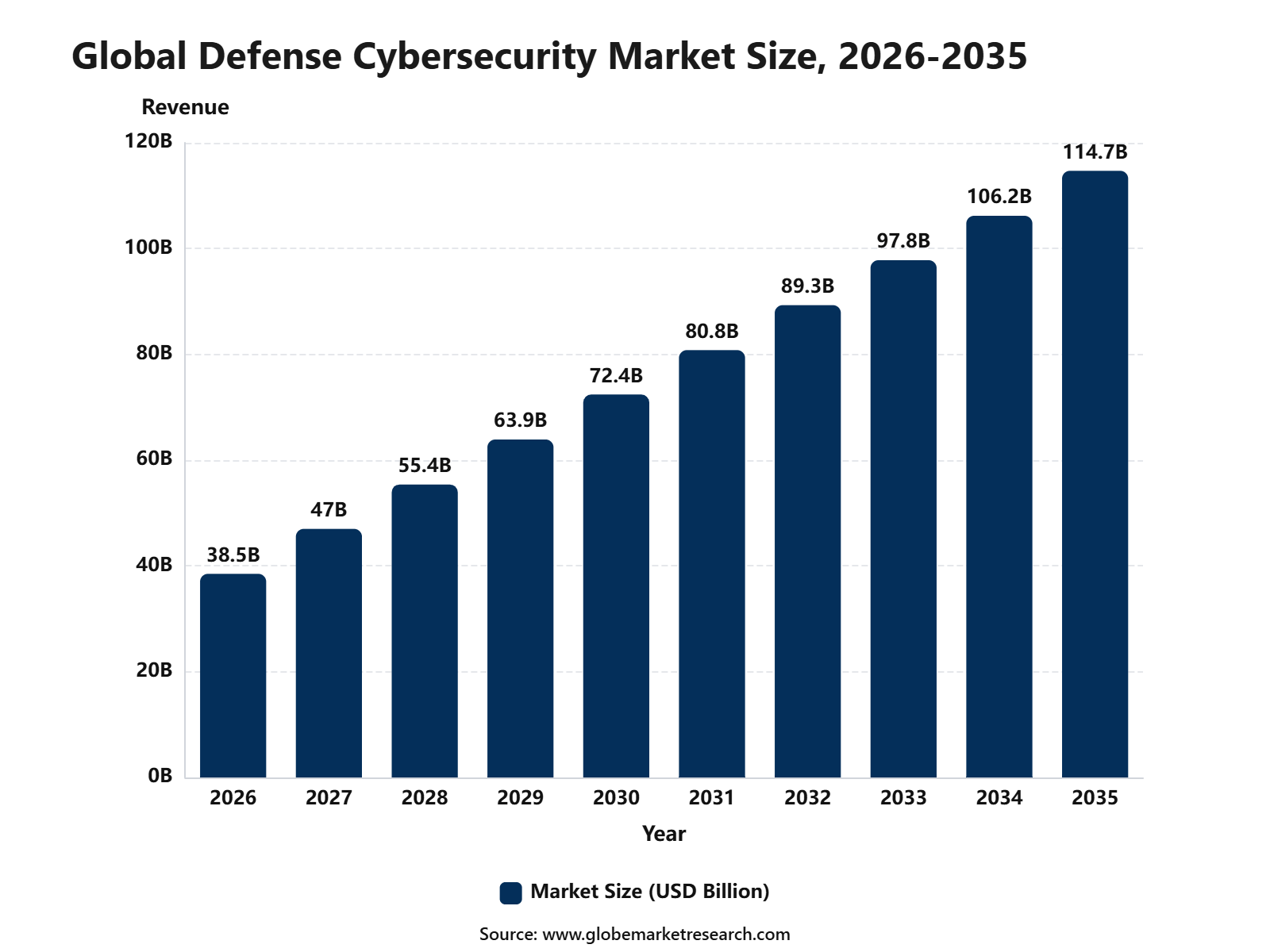 iThe graph shows projected market growth until 2035 based on CAGR analysis. Actual outcomes may vary depending on changing demand, competition, and economic factors.To gain greater insights - request a sample report PDF
Adoption Rate and Usage Statistics
According to Fortra and Redspin, 54% of surveyed organizations used the NIST Cybersecurity Framework, while 29% had started implementing zero-trust security. Around 24% were working with external partners on zero-trust roadmaps, and 7% reported using the defense-specific CMMC framework. An estimated 87% of surveyed defense contractors had taken some form of CMMC preparation action, calculated from the 13% reporting no action.
CMMC Phase I self-assessment requirements remain in effect, although the planned Phase II requirements were suspended in July 2026. This continues to support demand for compliance assessment, identity security, continuous monitoring, endpoint protection and managed cybersecurity services.
Metric | Adoption Rate |
|---|---|
NIST Framework Use | 54% |
Zero Trust Rollout | 29% |
ZT Partner Support | 24% |
CMMC Framework Use | 7% |
CMMC Action Taken | 87% |
According to the U.S. Department of Defense Cyber Crime Center, the Defense Industrial Base cybersecurity program supports more than 1,100 contractor and government partners. During 2025, its information-sharing operations produced 1,296 cyber-threat reports and generated 170,503 actionable indicators of compromise. The program also completed 26 analytical outreach sessions and 14 cybersecurity briefings for defense and counterintelligence organizations.
Metric | Operational Usage |
|---|---|
DIB Partners | Over 1,100 |
Threat Indicators | 170,503 IOCs |
Threat Products | 1,296 reports |
Analyst Sessions | 26 sessions |
Cyber Briefings | 14 briefings |
Offering Insights
Services and software accounted for 86.3% of the Defense Cybersecurity Market by offering. Defense organizations require security software for threat monitoring, identity management, vulnerability detection, encryption and incident response. Services are equally important because military networks need continuous assessment, integration, maintenance and specialist support.
CISA reported that it published more than 1,600 cybersecurity products and triaged over 30,000 incidents through its operations centre during 2025. The volume of alerts and reported incidents highlights the need for automated security platforms supported by experienced analysts and incident-response teams.
Defense customers will increasingly prefer integrated software and service contracts rather than isolated security tools. Providers must support rapid updates, classified environments, secure system integration and continuous monitoring across military bases, field equipment and defense contractors.
 iThe graph shows projected market growth until 2035 based on CAGR analysis. Actual outcomes may vary depending on changing demand, competition, and economic factors.To gain greater insights - request a sample report PDF
Security Type Insights
Endpoint security represented 56.2% of the market by security type. Military endpoints include workstations, mobile devices, servers, tactical computers, sensors and connected weapons platforms. Each device can become an entry point when software is outdated, credentials are compromised or unauthorized applications are installed.
A joint CISA advisory updated in June 2025 reported that approximately 900 organizations had been affected by exploitation linked to Play ransomware as of May 2025. The advisory emphasized patching, multifactor authentication and regular vulnerability assessments, all of which are central to endpoint protection.
Security Type | Market Share |
|---|---|
Endpoint Security | 56.2% |
Network Security | 14.8% |
Cloud Security | 11.6% |
Critical Infrastructure Security and Resilience | 9.7% |
Application Security | 7.7% |
Defense endpoint platforms must provide malware prevention, device control, behavioral monitoring and rapid isolation of compromised equipment. Demand will favor products that operate with limited connectivity and continue protecting devices deployed outside conventional office networks.
Application Insights
Military applications accounted for 75.9% of the Defense Cybersecurity Market. Armed forces depend on secure digital systems for command, communications, intelligence, logistics, surveillance and weapons control. A cyberattack against these systems can interrupt missions even when physical military equipment remains operational.
The proposed U.S. fiscal year 2026 defense budget included USD 15.1 billion for cybersecurity, intended to protect military advantages, support joint operations and defend national interests in cyberspace. This allocation shows that cybersecurity is being treated as an operational defense capability rather than only an information technology expense.
Military buyers require security solutions that remain operational during disrupted communications, electronic warfare and active cyberattacks. Systems must also protect information across several classification levels while allowing approved intelligence to reach personnel quickly.
Application | Market Share |
|---|---|
Military Operations | 75.9% |
Communication Networks | 11.2% |
Public Utilities | 7.4% |
Other Applications | 5.5% |
Solution Insights
Cyber threat protection accounted for 38.9% of the market by solution. These systems identify malicious activity, analyze attack methods and support rapid containment before adversaries can move across military networks. Threat protection commonly combines intelligence feeds, analytics, automated detection and incident-response workflows.
NATO’s Cyber Coalition exercise in 2025 brought together 1,300 cyber defenders from 29 NATO Allies and seven partner countries. The exercise tested the ability of participating organizations to protect networks, respond to incidents and coordinate defensive operations across national boundaries. Future solutions must detect both known attacks and unusual behavior that may indicate a new threat. Defense organizations will also require better information sharing between military units, intelligence agencies, governments and trusted technology providers.
Solution | Market Share |
|---|---|
Cyber Threat Protection | 38.9% |
Managed Security Services | 9.4% |
Identity and Access Management | 7.8% |
Network Fortification | 7.1% |
Security and Vulnerability Management | 6.5% |
Enterprise Risk and Compliance | 5.8% |
Data Loss Prevention Management | 5.2% |
Threat Evaluation | 4.7% |
Unified Threat Management | 4.2% |
Content Security | 3.7% |
Training Services | 3.4% |
Other Solutions | 3.3% |
Deployment Insights
On-premises deployment represented 86.4% of the Defense Cybersecurity Market. Military organizations frequently retain security applications within controlled facilities because they manage classified information, operational plans and sensitive intelligence. Local deployment also provides greater control over system access, network configuration and encryption keys.
The Department of Defense’s final CMMC contracting rule took effect on November 10, 2025, beginning a three-year implementation period for cybersecurity requirements across defense contracts. The program requires contractors handling protected defense information to demonstrate that suitable security controls are operating within their environments.
On-premises systems will remain important for classified and mission-critical workloads, although they will increasingly connect with private cloud and tactical edge environments. Vendors must support centralized management without requiring sensitive defense information to leave approved infrastructure.
 iThe graph shows projected market growth until 2035 based on CAGR analysis. Actual outcomes may vary depending on changing demand, competition, and economic factors.To gain greater insights - request a sample report PDF
End-User Insights
The Army accounted for 85.3% of the market by end user. Ground forces operate large numbers of communication devices, vehicles, command systems and connected weapons across widely distributed locations. Protecting these assets requires cybersecurity systems that can operate in headquarters, military bases and active field environments.
The proposed U.S. fiscal year 2026 defense budget allocated USD 197.4 billion to the Army. This large operational and modernization base supports investment in secure communications, cyber defense, digital command systems and protection for connected battlefield equipment. Army cybersecurity solutions must be lightweight, resilient and easy to manage under changing operational conditions. Priority areas include tactical network protection, secure identity management, endpoint monitoring and rapid recovery after a network disruption.
 iThe graph shows projected market growth until 2035 based on CAGR analysis. Actual outcomes may vary depending on changing demand, competition, and economic factors.To gain greater insights - request a sample report PDF
Enterprise Size Insights
Large enterprises represented 69.1% of the market by enterprise size. Major defense contractors manage complex supply chains, engineering information, weapons designs and government data. Their large technology environments create extensive attack surfaces across offices, factories, cloud systems and supplier connections.
The U.K. Cyber Security Breaches Survey 2025/2026 found that 41% of large businesses had experienced a cybersecurity breach or attack during the preceding 12 months. The rate was significantly higher than the previous survey period, demonstrating the exposure faced by organizations with large workforces and complex digital operations.
Enterprise Size | Market Share |
|---|---|
Large Enterprises | 69.1% |
Small and Medium-Sized Enterprises | 30.9% |
Large defense enterprises require security platforms that can manage thousands of users and devices while supporting government compliance requirements. Investment will focus on identity security, supply-chain monitoring, vulnerability management and unified threat visibility across business and production systems.
Regional Insights
North America accounted for 39.7% of the Defense Cybersecurity Market. Regional leadership is supported by substantial defense spending, advanced cyber capabilities and a large defense industrial base. The United States remains the primary contributor, while Canada also invests in military network security and cooperation with NATO partners.
A Congressional Research Service review found that approximately USD 2.8 billion of the U.S. fiscal year 2026 cyber budget request was directed to military services, the Joint Staff, intelligence organizations and defense research bodies. The funding supports cyber operations, infrastructure protection and implementation of Zero Trust security.
North American demand will remain concentrated on protecting classified networks, defense suppliers, tactical communications and military platforms. Procurement will increasingly require measurable cybersecurity performance, continuous monitoring and compatibility with joint and allied defense systems.
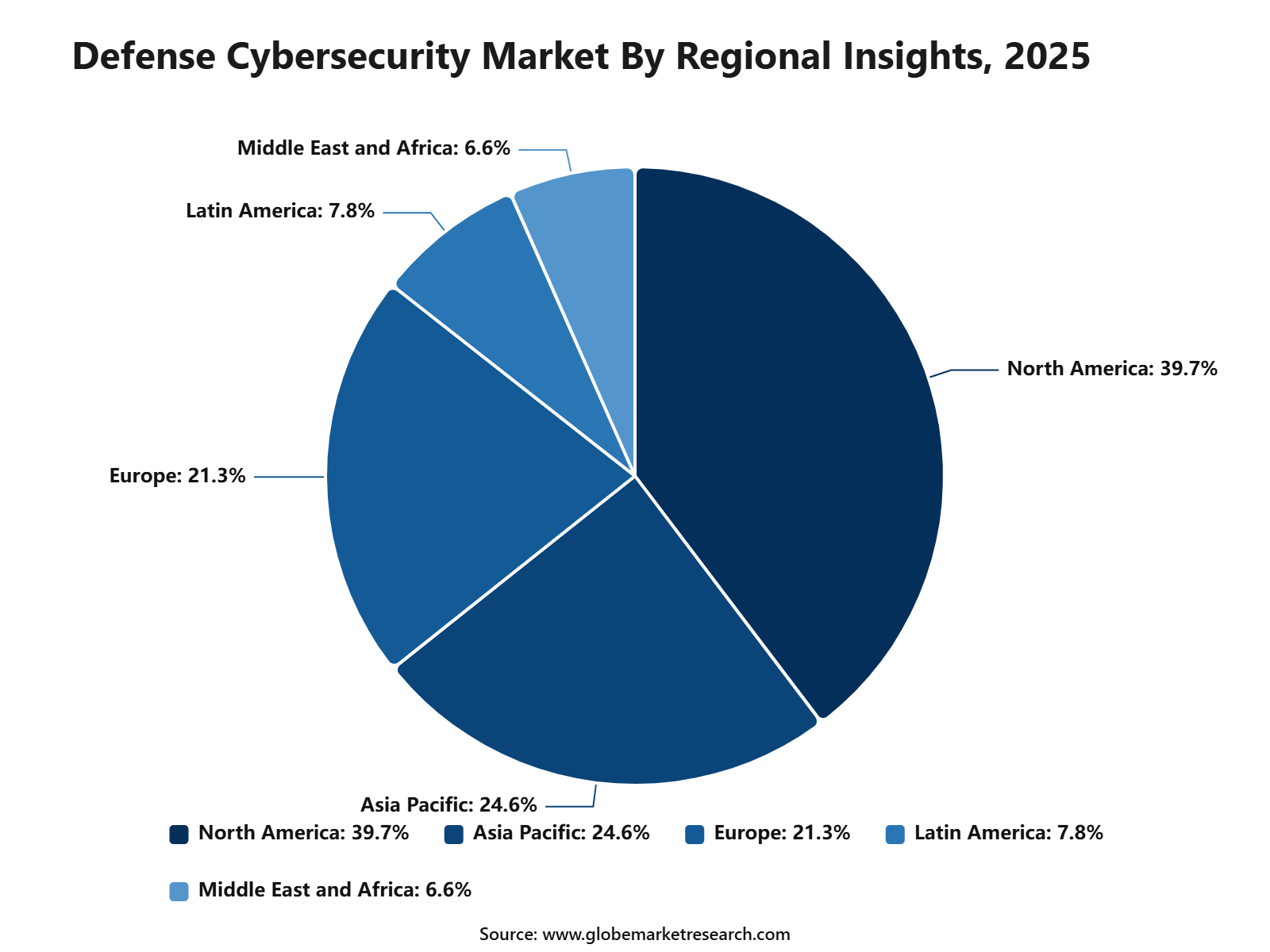 iThe graph shows projected market growth until 2035 based on CAGR analysis. Actual outcomes may vary depending on changing demand, competition, and economic factors.To gain greater insights - request a sample report PDF
Key Market Drivers
Rising defence cybersecurity investment: The U.S. Department of Defense requested approximately USD 9.1 billion for cybersecurity activities in fiscal year 2026. Funding is being directed toward network defence, cyber operations, zero-trust implementation, threat detection, secure communications, and protection of mission-critical systems.
Growth of state-sponsored cyber threats: Defence networks, government services, military suppliers, and critical infrastructure continue to face cyber espionage, disruption, data theft, and destructive attacks. NATO stated in July 2025 that malicious cyber activities attributed to Russian military intelligence had targeted several NATO members and Ukraine.
Expansion of zero-trust security: Defence agencies are replacing perimeter-based protection with continuous verification of users, devices, applications, and data access. The U.S. Department of Defense expects to complete 91 of its 152 target-level zero-trust activities by fiscal year 2027.
Increasing protection of the defence industrial base: Military information is distributed across large networks of manufacturers, technology companies, engineering firms, and subcontractors. The Cybersecurity Maturity Model Certification requirements began entering U.S. defence contracts on November 10, 2025, starting a three-year implementation period for contractors handling federal and controlled unclassified information.
Digitalization of military operations: Cloud platforms, battlefield networks, satellites, drones, sensors, autonomous vehicles, and command systems are increasing the number of potential attack points. Cybersecurity is therefore being incorporated into defence systems from the design stage rather than being added after deployment.
Growing need to secure AI systems: Artificial intelligence is being adopted for surveillance, decision support, logistics, cyber operations, and autonomous platforms. The NSA issued joint guidance in May 2025 covering the protection of data used to train and operate AI systems, including controls for data integrity, access, provenance, monitoring, and supply-chain security.
Emerging Defense Cybersecurity Trends
AI-assisted threat detection and response: Artificial intelligence is being used to analyze network activity, identify unusual behaviour, prioritize alerts, detect malicious code, and support faster incident response. NATO noted in March 2026 that AI can improve detection speed and allow cyber defence capabilities to operate at a larger scale.
Zero trust for military operational technology: Zero-trust controls are being extended from office networks to industrial controls, military facilities, logistics systems, sensors, and operational technology. U.S. defence guidance issued in 2025 established implementation activities for applying zero-trust principles to operational technology environments.
Identity-first defence security: Access decisions are increasingly being based on user identity, device condition, location, data sensitivity, and real-time risk. NATO’s 2026 Digital Transformation Implementation Strategy places zero trust, identity management, data-centric security, asset management, and security accreditation at the centre of its cybersecurity framework.
Cybersecurity at the tactical edge: Security tools are being deployed closer to soldiers, vehicles, aircraft, ships, drones, and battlefield sensors. Edge-based protection is required because military systems may operate with limited bandwidth, disrupted communications, or no access to central security services.
Secure integration of AI into operational systems: Defence agencies are developing governance and assurance procedures for AI-enabled equipment. Joint guidance released in December 2025 recommends that security, safety, monitoring, and human oversight be integrated when AI is introduced into operational technology.
Security controls for agentic AI: Agentic AI systems can independently access tools, execute actions, and communicate with other systems. Cyber agencies issued guidance in 2026 recommending controlled permissions, strong authentication, activity logging, human approval, and restricted access when agentic AI is used in defence and critical environments.
5 Best Defense Cybersecurity Technologies
Zero-Trust Identity and Access Management: Zero-trust platforms continuously verify users, devices, workloads, and access requests. Important capabilities include multifactor authentication, privileged-access management, device assessment, microsegmentation, least-privilege access, and continuous authorization.
AI-Powered Extended Detection and Response: XDR platforms combine endpoint, network, identity, cloud, email, and application telemetry. AI-supported analysis helps security teams detect coordinated attacks, reduce alert volumes, investigate incidents, and automate containment actions.
Operational Technology and Weapon-System Security: These technologies protect military vehicles, industrial controls, base infrastructure, radar, communications equipment, autonomous platforms, and embedded systems. Key capabilities include asset discovery, network monitoring, protocol analysis, secure gateways, anomaly detection, and system isolation.
Post-Quantum Cryptography and Crypto-Agility: Quantum-resistant solutions protect sensitive military communications, stored intelligence, software signatures, and authentication systems. Crypto-agile architecture allows encryption algorithms and keys to be replaced without rebuilding the entire defence system.
Software Supply-Chain Security Platforms: These platforms identify software components, open-source libraries, dependencies, vulnerabilities, build-system risks, and unauthorized code changes. Software Bills of Materials, code signing, secure development controls, vulnerability scanning, and continuous verification are becoming central defence procurement requirements.
Segments Covered in the Report
By Offering
Hardware
Software
Services
By Security Type
Application Security
Cloud Security
Critical Infrastructure Security
Endpoint Security
Network Security
By Solution
Identity and Access Management
Managed Security Services
Data Loss Prevention
Threat Intelligence and Evaluation
Network Fortification
Security and Vulnerability Management
Enterprise Risk and Compliance
Unified Threat Management
Content Security
Training Services
Other Solutions
By Deployment Mode
Cloud-Based
On-Premises
By Application
Military Operations
Communication Networks
Public Utilities and Critical Infrastructure
Other Applications
By Defense Branch
Air Force
Army
Navy
By Organization Size
Large Enterprises
Small and Medium-Sized Enterprises
By Region
North America
Europe
Asia Pacific
Latin America
Middle East and Africa
Market Dynamics
Drivers Impact Analysis
The Defense Cybersecurity Market is driven by rising cyber threats against military networks, command systems, defense contractors, satellites, critical infrastructure, and weapons platforms. Defense agencies are investing in cybersecurity to protect classified data, secure communications, prevent espionage, and maintain operational readiness.
North America leads the market due to strong defense spending, advanced cyber command capabilities, large military IT infrastructure, and high investment in zero-trust security, cloud defense, endpoint protection, and threat intelligence. The U.S. remains the main regional contributor because of its large defense ecosystem and strong focus on cyber resilience.
Impact Factor | Estimated CAGR Impact | Regional Relevance | Market Impact |
|---|---|---|---|
Rising state-sponsored cyberattacks | +4.0% | North America, Europe, Asia Pacific | Drives urgent defense cybersecurity spending. |
Growth in military digital infrastructure | +3.4% | U.S., NATO countries, Asia Pacific | Expands attack surface protection needs. |
Demand for secure command systems | +3.0% | Defense communication networks | Supports mission-critical security adoption. |
Expansion of cloud-based defense systems | +2.5% | North America and Europe | Increases cloud security demand. |
Rising protection needs for defense contractors | +2.1% | U.S., Canada, Europe | Strengthens supply chain cybersecurity. |
Restraints Impact Analysis
The market faces restraints from high implementation cost, complex procurement cycles, shortage of skilled cyber defense professionals, and difficulty securing legacy military systems. Defense cybersecurity requires continuous upgrades, advanced monitoring, and strict compliance, which raises spending pressure. Another restraint is technology fragmentation. Military agencies often operate classified systems, older platforms, multiple vendors, and disconnected networks, making cybersecurity modernization complex and time-consuming.
Impact Factor | Estimated CAGR Impact | Regional Relevance | Market Impact |
|---|---|---|---|
High cybersecurity implementation cost | -1.9% | Defense agencies and contractors | Slows adoption in smaller programs. |
Legacy military system limitations | -1.6% | Existing defense infrastructure | Delays modernization. |
Skilled cyber workforce shortage | -1.4% | North America, Europe, Asia Pacific | Affects monitoring and response capacity. |
Long defense procurement cycles | -1.2% | Government defense buyers | Slows vendor commercialization. |
Complex compliance requirements | -1.0% | Defense contractors and suppliers | Raises operating burden. |
Opportunities Impact Analysis
Opportunities are strong in zero-trust architecture, secure defense cloud, AI-powered threat detection, endpoint security, identity and access management, encryption, cyber range training, and managed security services. These areas directly support secure military modernization.
Higher-value opportunities are emerging in satellite cybersecurity, unmanned platform protection, operational technology security, quantum-safe encryption, and defense supply chain cyber compliance. Vendors that provide mission-ready, scalable, and compliant cybersecurity solutions can capture stronger demand.
Impact Factor | Estimated CAGR Impact | Regional Relevance | Market Impact |
|---|---|---|---|
Zero-trust defense architecture | +3.8% | North America and NATO markets | Builds high-priority security demand. |
AI-powered threat detection | +3.2% | Military SOCs and cyber commands | Improves response speed. |
Secure defense cloud adoption | +2.8% | U.S., Canada, Europe | Expands cloud cybersecurity spending. |
Satellite and space system security | +2.4% | North America, Europe, Asia Pacific | Adds high-value protection needs. |
Defense supply chain cybersecurity | +2.0% | Defense contractors and suppliers | Supports compliance-led growth. |
Challenges Impact Analysis
The main challenge is defending against fast-changing threats from nation-state actors, ransomware groups, insider threats, and advanced persistent threat campaigns. Defense cybersecurity systems must detect, prevent, and respond to attacks across highly sensitive environments. Another challenge is balancing security with mission performance. Military systems need strong protection without slowing communication, decision-making, battlefield operations, or real-time data exchange.
Impact Factor | Estimated CAGR Impact | Regional Relevance | Market Impact |
|---|---|---|---|
Advanced persistent threat activity | -1.8% | Military and intelligence networks | Raises security complexity. |
Securing classified data environments | -1.5% | Defense agencies | Requires strict controls. |
Balancing security and mission speed | -1.3% | Command and battlefield systems | Creates operational tradeoffs. |
Insider threat management | -1.1% | Defense organizations | Adds monitoring requirements. |
Cybersecurity interoperability issues | -0.9% | Joint and allied operations | Limits system integration. |
Defense Cybersecurity Case Study
DISA Scales Zero-Trust Cybersecurity Across Defense Networks
The Defense Information Systems Agency’s Thunderdome programme provides a practical example of how zero-trust cybersecurity is being introduced across large and complex military networks. The system is designed to continuously verify users, devices, applications, and access requests instead of automatically trusting activity originating inside a defence network.
Thunderdome combines secure access service edge technology, software-defined wide-area networking, identity management, endpoint security, network segmentation, application protection, and continuous monitoring. Access can be approved, restricted, or blocked based on factors such as user identity, device condition, location, application sensitivity, and the time of the request.
During the prototype stage, approximately 1,500 users across three locations tested its remote and on-premises capabilities while completing their normal responsibilities. The trial demonstrated that commercial cybersecurity technologies could be integrated with existing defence infrastructure and applied across both classified and unclassified environments.
The programme also demonstrated improved remote-access network performance while enabling conditional access based on user and device characteristics. Thunderdome received operational authorization for use on DISA’s classified and unclassified networks, supporting its transition from a limited prototype to wider implementation.
Recent Developments
Market News
January 2026 the U.S. defence department released updated Zero Trust Implementation Guidelines covering discovery, implementation phases, continuous authentication, least-privilege access, asset visibility, network segmentation, and data-centred security. The guidance supports the wider transition toward consistent zero-trust outcomes across military organisations and technology environments.
January 2026 the U.S. Army selected Seekr to deploy AI agents across Aviation and Missile Center weapon systems. The agents are intended to identify cyber, system, and mission vulnerabilities, helping teams assess how security weaknesses could affect critical missile and aviation functions.
February 2026 the United Kingdom led Defence Cyber Marvel from Singapore, bringing together more than 2,500 personnel from 29 countries and 70 organisations. The exercise tested responses to realistic attacks involving traditional information technology, industrial control systems, defence networks, and multinational operational coordination.
April 2026 Curtiss-Wright launched a continuous monitoring system for tactical network security and cyber compliance. The platform is designed to provide real-time security visibility across distributed military systems, supporting compliance monitoring and protection in disconnected or operationally restricted environments.
Mergers
January 2026 the United Kingdom and Japan upgraded their existing cyber relationship into a Strategic Cyber Partnership. The arrangement covers threat sharing, capacity development, emerging technologies, international standards, and closer coordination on malicious state-linked cyber activity.
March 2026 the United Kingdom and Ireland signed an updated defence cooperation memorandum covering cyber defence, maritime security, air-domain information sharing, training, and possible joint procurement. The agreement demonstrates how government partnerships can combine capabilities without requiring corporate consolidation.
May 2026 NATO expanded formal cooperation with Microsoft, Palo Alto Networks, and ESET. The partnerships are intended to improve cyber-threat information sharing, resilience, technical collaboration, and access to commercial cybersecurity expertise across the Alliance.
June 2026 Booz Allen and OpenAI formed a partnership to deploy mission-ready AI across defence, intelligence, critical infrastructure, and other national-security environments. The collaboration focuses on secure model deployment, mission-specific applications, and faster adoption within complex government systems.
Acquisitions
January 2026 CrowdStrike agreed to acquire SGNL to add continuous identity authorisation to the Falcon platform. SGNL adjusts access permissions using real-time risk information, supporting security for employees, service accounts, non-human identities, and autonomous AI agents.
January 2026 CrowdStrike agreed to acquire Seraphic Security to extend protection into enterprise web browsers. The acquired technology monitors browser sessions and helps secure interactions with cloud applications, web-based tools, sensitive information, and AI agents.
January 2026 Palo Alto Networks completed its acquisition of Chronosphere. The transaction added cloud-native observability technology that can monitor large data volumes and provide the operational context required for automated security investigation and remediation.
Funding
March 2026 Australia’s National Reconstruction Fund committed approximately AUD 200 million to Macquarie Technology. The investment supports sovereign cloud, artificial intelligence, data-centre, and cybersecurity infrastructure, with additional skilled employment planned across security, software engineering, and AI roles.
April 2026 Rilian raised USD 17.5 million in seed and seed-extension funding led by 8VC, First In, and Tamarack Global. The capital is being used to expand agentic AI cybersecurity systems for government, defence, critical infrastructure, air-gapped networks, and sovereign cloud environments.
July 2026 Arkenstone Defense emerged from stealth with USD 35 million in seed funding. Its platform helps technology companies manage cybersecurity compliance, accreditation, personnel security, contracting, and other operating requirements needed to enter the U.S. defence market.
July 2026 Neo launched with USD 100 million in seed and Series A capital from Andreessen Horowitz, Bessemer Venture Partners, Craft Ventures, and Merlin Ventures. The company provides visibility and security controls for software applications that gain autonomous or AI-enabled capabilities.
July 2026 Harpoon Ventures closed a USD 155 million defence-technology fund focused on national-security capabilities including autonomous systems, underwater platforms, resilient navigation, and post-quantum cryptography. The fund reflects stronger investor interest in technologies that combine physical defence and cybersecurity.
Competitive Landscape
The market is characterized by intense competition among established players and emerging companies. Strategic partnerships, mergers and acquisitions, and product innovation are key strategies employed by market participants.
Key Market Players
General Dynamics Corporation
BAE Systems plc
Booz Allen Hamilton Inc.
CACI International Inc.
Leidos Holdings, Inc.
Cisco Systems, Inc.
Microsoft Corporation
Lockheed Martin Corporation
IBM Corporation
Northrop Grumman Corporation
Thales Group
RTX Corporation
L3Harris Technologies, Inc.
Leonardo S.p.A.
Other Key Players
Research Methodology
This market study is prepared using a combination of primary and secondary research. Primary research includes discussions with manufacturers, suppliers, distributors, consultants, industry experts, and end users. Secondary research covers company reports, government databases, trade associations, technical publications, regulatory sources, and trusted industry documents. The collected information is used to assess market demand, pricing trends, technology adoption, competitive activity, and regional performance.
AI language models are not used as primary data sources, and publicly available AI-generated content is not treated as market evidence. Computational tools may be used to support data processing, translation, data classification, and pattern identification. However, every published assessment is supported by verified sources, human review, and primary market discussions.
Market estimates are developed through top-down and bottom-up approaches and validated using data triangulation. Revenue, production, shipment, pricing, and application-level data are compared across multiple sources. Forecasts consider economic conditions, regulatory changes, investment activity, innovation, supply chain developments, and industry risks. All findings are reviewed through source verification and internal quality checks before publication.
Part I
Source Management & Input Data Standards
Who provides data, how sources are qualified, and what types of evidence are admissible.
Part II
Research Scope & Market Coverage
How we define the markets we assess and the parameters that govern each product.
Part III
Data Collection, Verification & Submission
The mechanics of gathering, cross-checking, and hierarchically ranking evidence.
Part IV
Assessment Determination & Quality Controls
How raw data becomes a published assessment — normalisation, expert judgement, and outlier exclusion.
Part V
Publication, Corrections & Revision
Our publication schedule, corrections policy, and methodology review cycle.
Part VI
Independence, Ethics & Complaints
Conflict-of-interest policies, editorial independence, and how clients raise concerns.
Google · Preferred Sources
Don't miss the latest market research insights and industry updates on Google.
Add Globe Market Research as a preferred source in the Google app to see our reports, analysis, and market stories in your news suggestions.
Meet the Team
This report was prepared by our expert analysts with deep industry knowledge and research experience.
Kimaya brings more than five years of experience in market research, content review, and industry analysis to Globe Market Research. She plays an important role in maintaining the accuracy, clarity, consistency, and relevance of research content across a wide range of industries. Her responsibilities include reviewing market data, segment analysis, competitive landscapes, industry trends, company developments, and strategic insights. Each report is carefully assessed to ensure that the findings are supported by reliable data, presented in a structured format, and aligned with the information needs of business decision-makers. Kimaya has research experience across healthcare, information technology, consumer goods, and several cross-industry domains.
Prashant S. is a Research Analyst at Globe Market Research with more than four years of experience in market research and industry analysis. He specializes in the Aerospace and Defence, Automotive and Transportation, Semiconductor and Electronics, Information and Technology sectors, with expertise in market sizing, trend analysis, competitive assessment, and industry forecasting. He applies primary and secondary research, data validation, company analysis, and market estimation methods to deliver reliable insights for strategic planning and business decision-making.
Frequently Asked Questions
Related Reports
More in Aerospace and Defence
US Drone Market Size to hit USD 73.2 Bn by 2035
U.S. Drone Market Size, Share, Trends and Growth Analysis Report By Component (Hardware, Software, Services), By Product (Fixed-Wing, Multi-Rotor, Single-Rotor, Hybrid), By Technology (Remotely Operated, Semi-Autonomous, Fully Autonomous), By Payload Capacity (Up to 2 kg, 2 kg to 19 kg, 20 kg to 200 kg, Over 200 kg), By Power Source (Battery-Powered, Gasoline-Powered, Hydrogen Fuel Cell, Solar), By End Use (Consumer, Commercial, Military, Government and Law Enforcement), By Technology Trends, Competitive Landscape, Strategic Opportunities and Growth Forecast, 2026-2035
Space Tourism Market Size to Reach USD 30.1 Billion By 2035
Space Tourism Market Size, Share and Growth Analysis Report By Type (Orbital, Sub-Orbital), By End Use (Government, Commercial), By Regional Insights, Technology Trends, Competitive Landscape, Strategic Opportunities and Growth Forecast, 2026-2035
Ballistic Protective Equipment Market Size to hit USD 11.6 billion by 2035
Ballistic Protective Equipment Market Size, Share, Trends and Growth Analysis Report By Product (Head Protection, Soft Armor, Hard Armor), By Material Type (Aramid, Composites, Ultra-High-Molecular-Weight Polyethylene, Steel, Other Materials), By End Use (Defense, Law Enforcement and Security, Commercial), By Regional Insights, Technology Trends, Competitive Landscape, Strategic Opportunities and Growth Forecast, 2026-2035
Drone Market Size to hit USD 103.9 billion by 2035 | CAGR of 10.9%
Drone Market Size, Share, Trends and Growth Analysis Report By Type (Fixed-Wing, Rotary-Wing, Hybrid), By Component (Hardware, Software, Accessories), By Payload Capacity (Below 25 Kilograms, 25-170 Kilograms, Above 170 Kilograms), By Point of Sale (Original Equipment Manufacturers, Aftermarket), By End-Use Industry (Construction, Agriculture, Military and Defense, Law Enforcement, Logistics, Media and Entertainment, Other Industries), By Regional Insights, Technology Advancements, Competitive Landscape, Strategic Opportunities and Growth Forecast, 2026-2035