

Revenue, 2026
USD 32.3 Bn
Forecast, 2035
USD 73.2 Bn
CAGR, 2026-2035
9.5%
Report Coverage
US
Market Size and Forecast
According to Globe Market Research, the U.S. Drone Market was valued at USD 32.3 billion in 2026 and is projected to reach approximately USD 73.2 billion by 2035, growing at a CAGR of 9.5% from 2026 to 2035. Market expansion is being supported by commercial delivery networks, defence procurement, public-safety operations, precision agriculture, infrastructure inspection and aerial data collection.
Key Parameter | Report Details |
|---|---|
Market Revenue, 2026 | USD 32.3 Billion |
Projected Revenue, 2035 | USD 73.2 Billion |
CAGR, 2026-2035 | 9.5% |
Country Scope | United States |
Market Concentration | Medium |
Forecast Period | 2026-2035 |
Drones are remotely operated or autonomous aircraft equipped with cameras, sensors, navigation systems, communication modules and specialised payloads. The global Drone Market was valued at USD 36.9 billion in 2026 and is projected to reach approximately USD 103.9 billion by 2035, representing an implied CAGR of around 12.2% from 2026 to 2035.The U.S. market includes consumer, commercial, military, government and law-enforcement applications. Artificial intelligence, computer vision, beyond-visual-line-of-sight operations and automated fleet management are improving drone navigation, real-time data analysis and the ability to complete complex missions with limited human control.
Commercial deployment accelerated during 2026. Wing and Walmart confirmed seven additional metropolitan markets and are building a network of more than 270 drone-delivery locations capable of reaching over 40 million Americans by 2027. Zipline surpassed 2 million commercial deliveries and raised more than USD 600 million while expanding its U.S. operations into Houston, Phoenix and other metropolitan areas. During the first half of 2026, the number of businesses offering delivery through Zipline increased thirteenfold, indicating stronger adoption of autonomous delivery across retail, food and healthcare services.
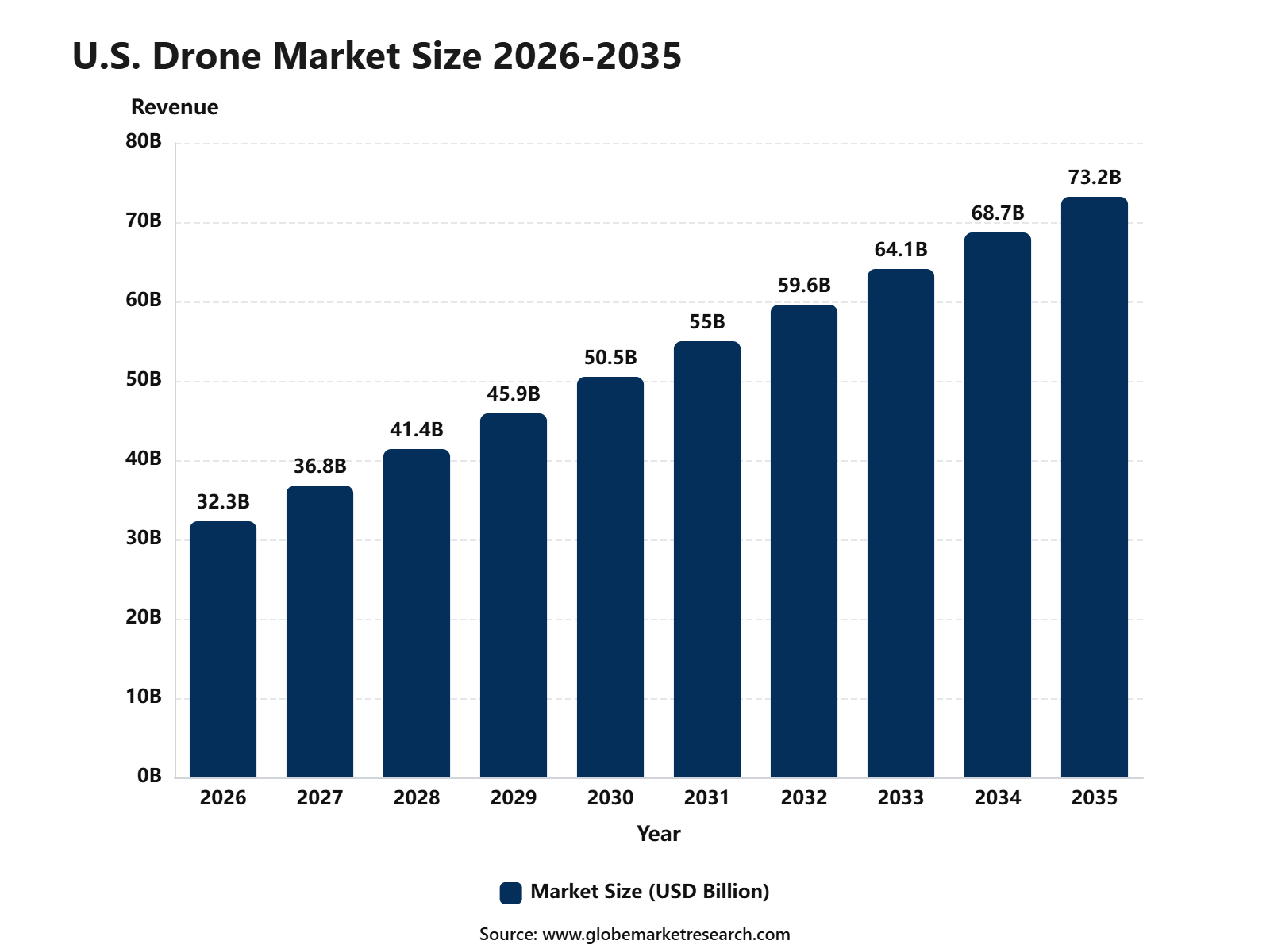 iThe graph shows projected market growth until 2035 based on CAGR analysis. Actual outcomes may vary depending on changing demand, competition, and economic factors.To gain greater insights - request a sample report PDF
U.S. Drone Market Key Insights
Hardware led the component segment with 70.4% share, supported by strong demand for drone frames, sensors, cameras, batteries, propulsion systems, and control units.
Multi-rotor drones accounted for 48.2% share by product, driven by easy maneuverability, vertical take-off capability, lower operating complexity, and wide use across defense, inspection, and surveillance applications.
Remotely operated drones held 59.0% share by technology, supported by strong operator control needs, mission flexibility, regulatory familiarity, and practical use in security and tactical operations.
Drones with payload capacity up to 2 kg captured 53.3% share, driven by high demand for lightweight drones used in imaging, monitoring, reconnaissance, mapping, and small equipment delivery.
Battery-powered drones led the power source segment with 57.4% share, supported by lower operating cost, easier maintenance, quieter operation, and suitability for short- to medium-range missions.
Military end use held 43.5% share, driven by rising adoption of drones for intelligence, surveillance, reconnaissance, border monitoring, training, and tactical mission support.
Adoption and Usage Statistics
According to the Federal Aviation Administration, recreational operators reported a 29% increase in the average number of drones owned, while the active commercial fleet added approximately 24,000 aircraft during 2025. Remote pilot certifications increased by more than 70,000, and new large-drone registrations rose by 70%. Among emergency-response organizations using drones, 95% applied them across multiple activities, including search and rescue, training, tactical support, and disaster response.
Metric | Adoption Indicator |
|---|---|
Fleet Ownership Growth | 29.0% year over year |
Commercial Fleet Increase | 24,000 aircraft |
Remote Pilot Growth | Over 70,000 certificates |
Large Drone Growth | 70% year over year |
Emergency Multi-Use | 95% of operators |
The United States had an estimated active recreational fleet of 1.59 million drones and 424,516 active commercial drones at the end of 2025. The ecosystem included 493,396 certified remote pilots and 8,637 active large unmanned aircraft. More than 126,000 commercial drones were newly registered during the year, demonstrating continued usage across inspection, mapping, agriculture, public safety, delivery, construction, and infrastructure monitoring.
Metric | Market Usage |
|---|---|
Recreational Fleet | 1.59 million drones |
Commercial Fleet | 424,516 drones |
Certified Pilots | 493,396 pilots |
Large Drone Fleet | 8,637 drones |
New Commercial Drones | Over 126,000 registrations |
Component Insights
Hardware accounted for 70.4% of the U.S. Drone Market by component. A drone requires an airframe, propulsion system, sensors, cameras, communication modules, controllers and navigation equipment before software can support flight or mission functions. Replacement parts, payload upgrades and specialized sensors further strengthen hardware demand.
The Federal Aviation Administration reported 837,513 registered drones in the United States in 2026. This large operating base creates continued demand for aircraft platforms, batteries, motors, propellers, cameras and communication equipment used across recreational, commercial, public-safety and government applications.
Hardware manufacturers are focusing on lower aircraft weight, improved obstacle detection and stronger onboard processing. Buyers increasingly require systems that can support several payloads without replacing the complete aircraft. Product durability and compatibility with domestic communication and security requirements will remain important purchasing factors.
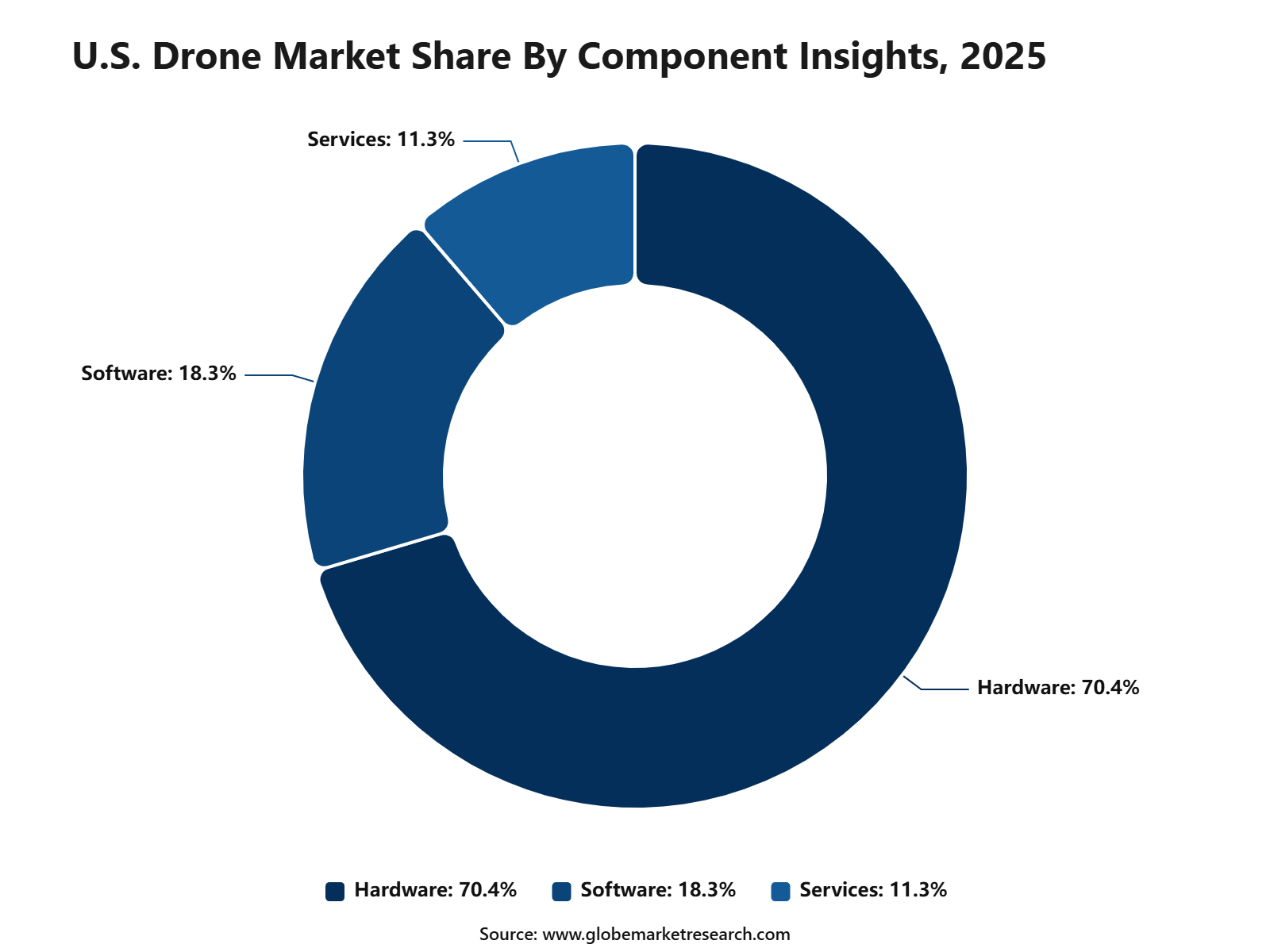 iThe graph shows projected market growth until 2035 based on CAGR analysis. Actual outcomes may vary depending on changing demand, competition, and economic factors.To gain greater insights - request a sample report PDF
Product Insights
Multi-rotor drones represented 48.2% of the market by product. Their vertical take-off capability, hovering stability and compact design make them suitable for photography, surveying, inspections, public safety and short-distance delivery. They can also operate in confined locations where fixed-wing aircraft require more launch and landing space.
The FAA’s 2025 aerospace forecast estimated that the U.S. commercial and non-model small-drone fleet would reach approximately 1.03 million units in 2025 under its base scenario. The expanding small-drone fleet supports demand for flexible multi-rotor platforms that can serve multiple commercial activities.
Multi-rotor development is moving toward longer flight duration, quieter propulsion and automated route planning. Manufacturers must balance battery capacity and payload weight because additional equipment can reduce operating time. Foldable and modular designs are expected to remain attractive to users who transport drones between work locations.
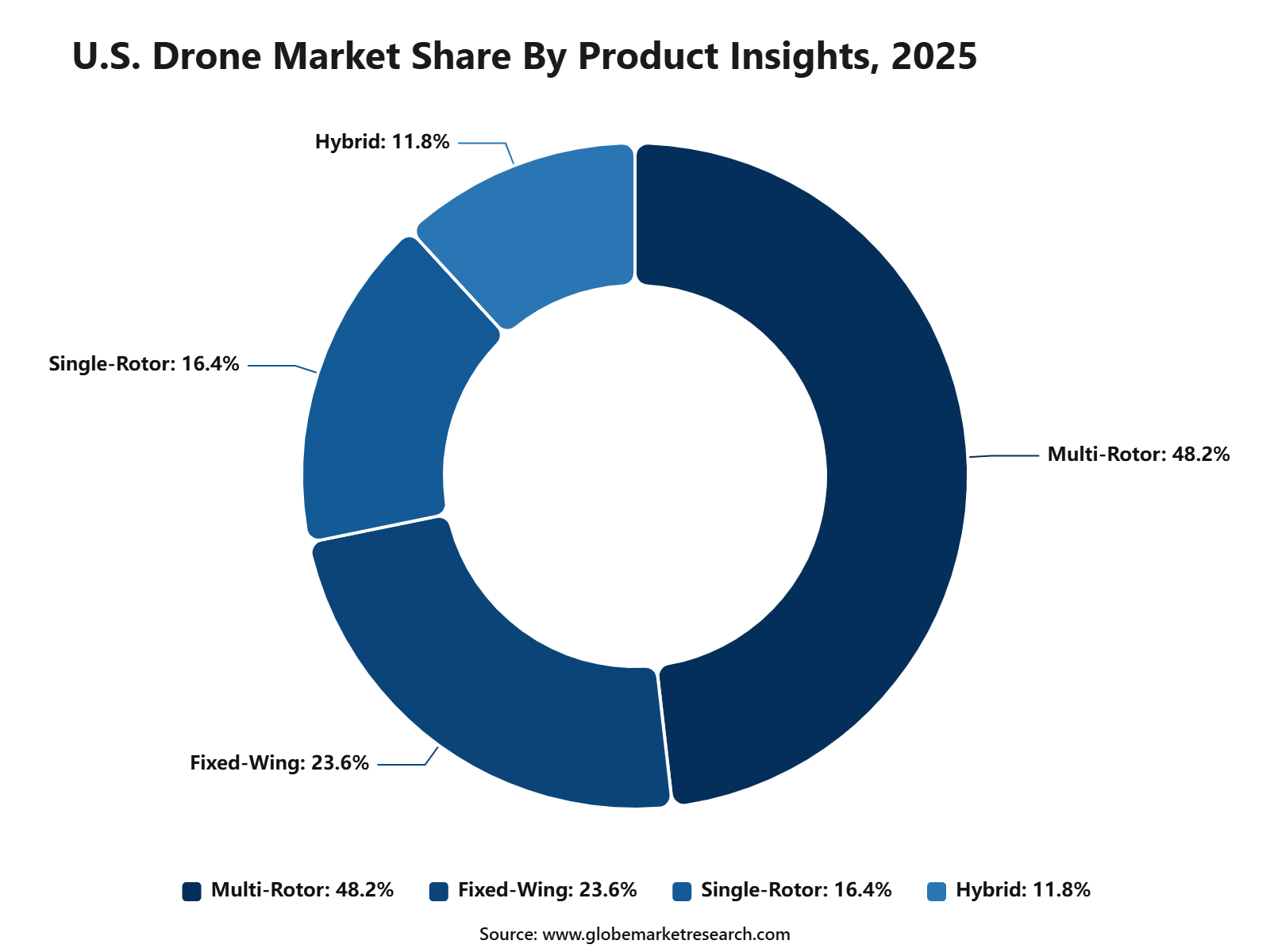 iThe graph shows projected market growth until 2035 based on CAGR analysis. Actual outcomes may vary depending on changing demand, competition, and economic factors.To gain greater insights - request a sample report PDF
Technology Insights
Remotely operated systems accounted for 59.0% of the U.S. Drone Market by technology. Human-controlled flight remains important because operators can respond directly to changing weather, obstacles and mission requirements. Remote operation is widely used in inspection, filming, mapping, emergency response and military missions.
The FAA listed 481,760 certificated remote pilots in the United States in 2026. The size of this licensed workforce shows that human-supervised drone operation continues to form a major part of the national drone ecosystem, even as autonomous flight technologies develop.
Remotely operated drones are increasingly supported by automated take-off, route stabilization and return-to-home functions. Human operators remain responsible for mission decisions and regulatory compliance. Wider use will require secure communication links, effective pilot training and dependable control during signal disruption.
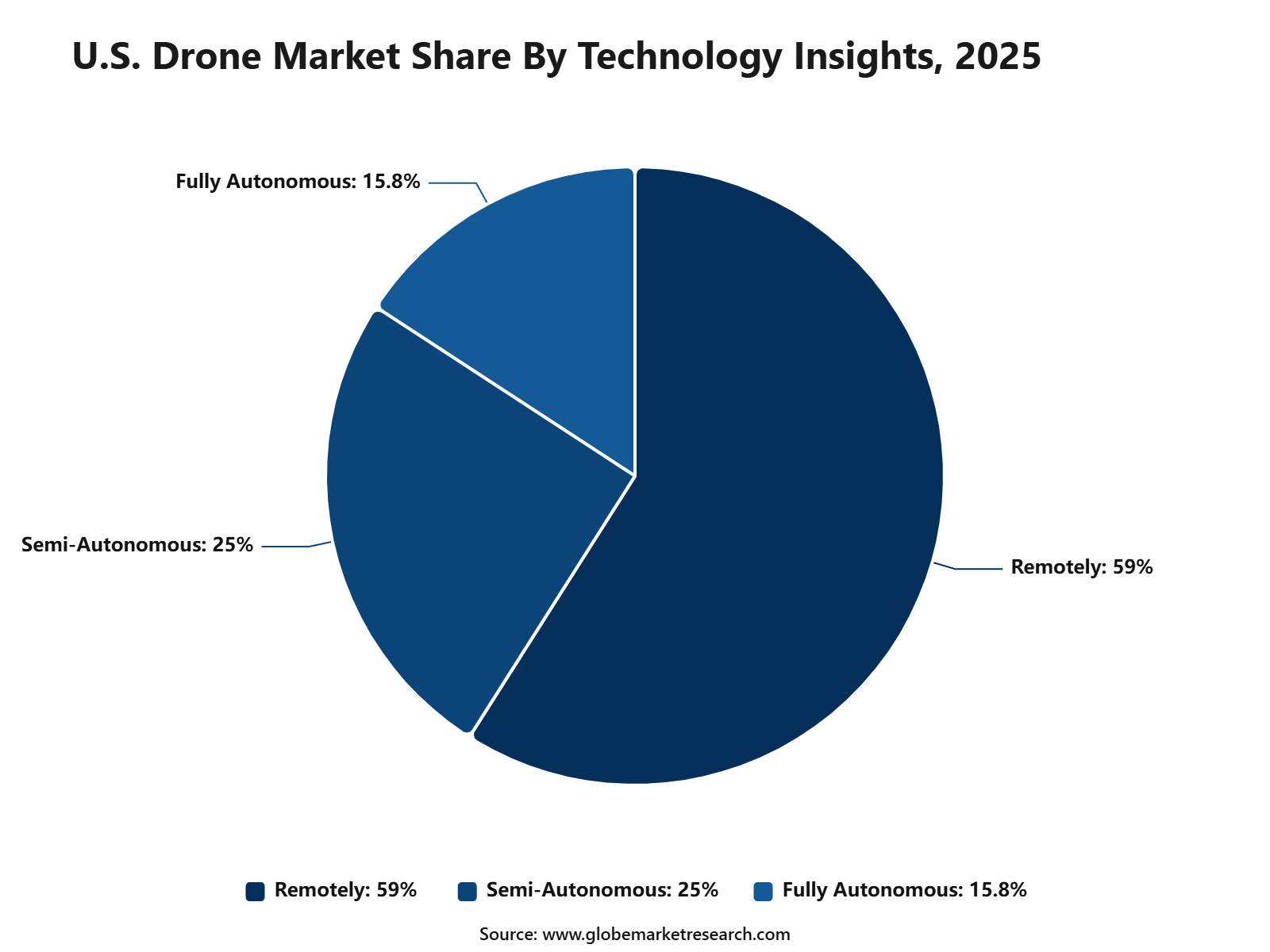 iThe graph shows projected market growth until 2035 based on CAGR analysis. Actual outcomes may vary depending on changing demand, competition, and economic factors.To gain greater insights - request a sample report PDF
Payload Capacity Insights
Drones carrying payloads of up to 2 kg accounted for 53.3% of the market by payload capacity. Lightweight payload systems are used for cameras, compact sensors, small parcels and inspection equipment. Their lower weight helps improve flight duration, portability and operational flexibility.
The FAA’s 2025 drone-delivery analysis estimated that more than half of daily package-delivery activity would be concentrated across 19 U.S. metropolitan and combined metropolitan areas during the 2025 to 2031 period. This concentration supports compact drones designed for small, frequent deliveries in populated service areas.
Payload Capacity | Market Share |
|---|---|
Up to 2 kg | 53.3% |
2 kg to 19 kg | 21.4% |
20 kg to 200 kg | 15.2% |
Over 200 kg | 10.1% |
Light-payload drones can serve local delivery, real-estate imaging, agriculture and infrastructure inspection without requiring large launch areas. Manufacturers are improving payload mounts and stabilizers to protect equipment during flight. Successful adoption will depend on maintaining useful range while meeting safety and airspace requirements.
Power Source Insights
Battery-powered drones accounted for 57.4% of the U.S. Drone Market by power source. Electric propulsion supports simple maintenance, low operating noise and rapid deployment. Rechargeable batteries are especially suitable for multi-rotor drones used in commercial imaging, inspection and public-safety missions.
In January 2026, the U.S. Department of Energy announced USD 30 million for technologies designed to improve energy storage for applications including drones, robots and electric vertical take-off aircraft. The program targets higher energy density and better performance for electrically powered systems.
Power Source | Market Share |
|---|---|
Battery-Powered | 57.4% |
Gasoline-Powered | 20.4% |
Hydrogen Fuel Cell | 13.1% |
Solar | 9.1% |
Battery performance continues to limit flight time, particularly when drones carry cameras or delivery payloads. Suppliers are therefore focusing on faster charging, thermal safety and higher energy storage within lighter battery packs. Battery-management software will also become more important for estimating remaining range during active missions.
End-Use Insights
Military applications accounted for 43.5% of the U.S. Drone Market by end use. The military uses drones for intelligence, surveillance, reconnaissance, communication, logistics and combat support. Demand includes both large unmanned aircraft and smaller systems that can be deployed by individual units.
The U.S. fiscal year 2026 defense budget allocated USD 9.4 billion for unmanned and remotely operated aerial vehicles. This formed the largest portion of the USD 13.4 billion autonomy and autonomous-systems allocation, demonstrating the importance of aerial drones within U.S. defense modernization.
End Use | Market Share |
|---|---|
Military | 43.5% |
Commercial | 24.7% |
Government and Law Enforcement | 17.2% |
Consumer | 14.6% |
Military buyers are prioritizing secure communication, domestic production and systems that can operate in contested environments. Demand is moving toward lower-cost drones that can be procured in larger numbers and updated rapidly. Suppliers must also provide resistance to electronic interference and integration with existing command systems.
Key Market Drivers
Large registered drone and pilot base: The FAA currently reports 837,513 registered drones and 481,760 certificated remote pilots in the United States. This established ecosystem is supporting demand for aircraft, batteries, sensors, software, training, maintenance, insurance, and data-analysis services.
Progress toward routine BVLOS operations: The FAA proposed a national framework in August 2025 for beyond-visual-line-of-sight operations. The proposed rules cover aircraft requirements, operational authorization, separation from other aircraft, security, reporting, and recordkeeping.
Expansion of commercial applications: The proposed BVLOS framework is intended to support package delivery, agricultural operations, aerial surveying, public safety, filmmaking, energy production, and medical-supply transportation. These applications require drones to operate across larger areas with less dependence on visual observers.
Growth of drone delivery services: FAA-approved delivery operations are being developed under Part 135 air-carrier requirements. Delivery aircraft can include fixed-wing, multirotor, and hybrid vertical take-off and landing systems operating mainly below 400 feet.
Increasing defence demand: The U.S. Defense Department announced plans in July 2025 to accelerate the production and deployment of low-cost drones for military personnel. The initiative is focused on reducing procurement barriers, increasing domestic production, and placing larger numbers of affordable systems into operational units.
Dedicated management of military unmanned systems: A July 2026 directive established a direct-reporting portfolio manager for unmanned systems. The initiative supports the procurement, integration, and operational use of low-cost, high-performance drones manufactured in the United States.
Emerging Trends in the U.S. Drone Market
Beyond-visual-line-of-sight deployment: BVLOS is becoming the central requirement for scaling delivery, utility inspection, agriculture, emergency response, mapping, and long-distance surveillance. The proposed Part 108 framework would replace many case-by-case approvals with standardized operating requirements.
AI-powered autonomous flight: Drones are increasingly being equipped with computer vision, route planning, obstacle avoidance, object recognition, and automated landing capabilities. These functions allow aircraft to respond to changing environments while reducing continuous manual control.
Drone-in-a-box systems: Automated stations allow drones to launch, complete scheduled missions, return, recharge, transfer collected data, and prepare for the next operation. The model is particularly suitable for utilities, warehouses, construction sites, mines, ports, campuses, and security operations.
Unmanned Aircraft System Traffic Management: UTM platforms are being developed to coordinate multiple low-altitude drone flights. These systems can support identification, flight authorization, route information, conflict management, and communication between operators and aviation authorities.
Expansion of delivery networks: Drone delivery is moving from individual demonstrations toward repeatable route networks for medicines, retail products, food, laboratory samples, and industrial components. Wider deployment will depend on BVLOS approvals, local infrastructure, public acceptance, and reliable traffic-management systems.
Domestic defence-drone production: Military procurement is shifting toward larger quantities of smaller and less expensive systems that can be updated rapidly. This approach is creating opportunities for U.S. component suppliers, software developers, contract manufacturers, and autonomous-system specialists.
5 Best Drone Technologies in the United States in 2026
AI-Powered Autonomous Flight Systems: These systems combine computer vision, sensor fusion, navigation, obstacle avoidance, and automated mission planning. They are useful for inspection, mapping, surveillance, delivery, agriculture, and emergency response.
BVLOS and Detect-and-Avoid Systems: Detect-and-avoid technology uses cameras, radar, transponders, acoustic sensors, and aviation traffic data to identify nearby aircraft. It is a critical requirement for scalable long-distance commercial drone operations.
Drone-in-a-Box and Fleet Automation Platforms: Automated docking systems provide charging, environmental protection, mission scheduling, remote control, data transfer, and equipment monitoring. They enable repeatable operations without placing a pilot at every operating location.
UTM and Airspace-Management Platforms: These platforms coordinate low-altitude flights, operator identification, airspace authorization, geographic restrictions, and traffic information. UTM development is expected to become increasingly important as package delivery and BVLOS activity expand.
Counter-Unmanned Aircraft Systems: Counter-drone systems combine radio-frequency sensors, radar, optical cameras, acoustic detection, identification software, and legally authorized mitigation tools. Demand is being strengthened by security concerns around critical infrastructure, military sites, airports, and major public venues.
Key Market Segments
By Component
Hardware
Software
Services
By Product
Fixed-Wing
Multi-Rotor
Single-Rotor
Hybrid
By Technology
Remotely Operated
Semi-Autonomous
Fully Autonomous
By Payload Capacity
Up to 2 kg
2 kg to 19 kg
20 kg to 200 kg
Over 200 kg
By Power Source
Battery-Powered
Gasoline-Powered
Hydrogen Fuel Cell
Solar
By End Use
Consumer
Commercial
Military
Government and Law Enforcement
Market Dynamics
Drivers Impact Analysis
The US Drone Market is driven by rising use of unmanned aerial systems across defense, public safety, agriculture, construction, logistics, energy inspection, telecom monitoring, mapping, and emergency response. Drones help organizations collect data faster, reduce human risk, and lower inspection and surveillance costs. The U.S. market benefits from strong defense demand, enterprise adoption, drone software innovation, sensor development, and expanding commercial use cases. Demand is especially strong where aerial data improves speed, safety, and operating efficiency.
Impact Factor | Estimated CAGR Impact | Regional Relevance | Market Impact |
|---|---|---|---|
Rising defense drone procurement | +2.9% | United States | Drives high-value platform demand. |
Growth in commercial inspection | +2.4% | Energy, telecom, construction | Reduces manual inspection cost. |
Precision agriculture adoption | +2.0% | U.S. farming regions | Supports crop monitoring and spraying. |
Public safety drone use | +1.7% | Police, fire, disaster response | Improves emergency visibility. |
Drone software and analytics growth | +1.4% | Enterprise users | Converts flight data into business value. |
Restraints Impact Analysis
The market faces restraints from airspace regulation, beyond-visual-line-of-sight limitations, privacy concerns, battery endurance, payload limitations, and compliance cost. These factors can slow adoption in delivery, urban operations, and large-scale fleet deployment. Another restraint is the high cost of advanced drone systems. Enterprise and defense-grade drones often need thermal sensors, LiDAR, secure communication, trained operators, software licenses, maintenance, and insurance.
Impact Factor | Estimated CAGR Impact | Regional Relevance | Market Impact |
|---|---|---|---|
Airspace regulation complexity | -1.4% | United States | Slows broad commercial deployment. |
BVLOS approval limitations | -1.2% | Delivery and inspection operations | Restricts long-range use. |
Battery life constraints | -1.0% | Agriculture, logistics, inspection | Limits flight duration. |
Privacy and safety concerns | -0.8% | Urban and public areas | Raises acceptance barriers. |
High enterprise system cost | -0.7% | Industrial and public agencies | Limits smaller buyer adoption. |
Opportunities Impact Analysis
Opportunities are strong in defense drones, autonomous inspection, agricultural drones, public safety systems, drone-as-a-service, infrastructure mapping, energy asset monitoring, warehouse security, and emergency response. These applications support recurring service demand.
Higher-value opportunities are emerging in AI-enabled drones, long-endurance systems, autonomous docking stations, counter-drone technology, logistics testing, and integrated drone data platforms. Companies combining hardware, software, analytics, and compliance support can capture stronger value.
Impact Factor | Estimated CAGR Impact | Regional Relevance | Market Impact |
|---|---|---|---|
AI-enabled autonomous drones | +2.8% | United States | Improves mission automation. |
Drone-as-a-service models | +2.3% | Enterprise and public users | Lowers adoption barriers. |
Defense and border surveillance | +2.0% | Federal and defense agencies | Builds high-value demand. |
Energy and infrastructure inspection | +1.7% | Utilities, oil and gas, telecom | Supports recurring use. |
Counter-drone systems | +1.4% | Airports, defense, critical sites | Adds security-led demand. |
Challenges Impact Analysis
The main challenge is scaling drone operations safely in complex U.S. airspace. Operators need reliable detect-and-avoid systems, remote identification, secure communications, fleet management, and regulatory approval for wider commercial missions. Another challenge is building trust among enterprise buyers and public agencies. Buyers need drones that can perform consistently in difficult weather, sensitive areas, and high-security environments.
Impact Factor | Estimated CAGR Impact | Regional Relevance | Market Impact |
|---|---|---|---|
Airspace integration challenges | -1.3% | United States | Limits large-scale fleet use. |
Weather and operating limitations | -1.1% | Outdoor drone applications | Affects mission reliability. |
Cybersecurity and data risk | -0.9% | Defense and enterprise users | Requires secure systems. |
Payload and endurance tradeoffs | -0.8% | Delivery and industrial use | Limits operational scope. |
Operator training requirements | -0.6% | Commercial users | Raises operating complexity. |
Recent Developments
Market News
In January 2026, Zipline announced that it had completed more than two million commercial deliveries and raised over USD 600 million at a USD 7.6 billion valuation. The company also announced U.S. service expansion into Houston and Phoenix.
In July 2026, the FCC tentatively moved to prohibit imports of certain foreign-produced military-grade drones, including systems with infrared and swarm capabilities. The proposed restrictions exclude federal purchases and non-military drones but reinforce demand for trusted domestic products and components.
Acquisitions
In June 2026, Motorola announced a USD 1.5 billion agreement to purchase the counter-drone technology provider. D-Fend’s radio-frequency cyber platform has been deployed across government, public-safety, and enterprise environments in more than 30 countries.
In January 2026, Bentley acquired Talon and Pointivo’s technology and technical expertise to strengthen infrastructure asset analytics. The acquired capabilities include drone-data processing, geolocation, three-dimensional modelling, and AI-supported damage identification.
In June 2026, Mobix Labs signed a binding letter of intent to acquire the Montana-based producer of U.S.-built drones. Vision Aerial serves defence, public safety, energy, government, and critical-infrastructure customers.
Funding
In March 2026, the company disclosed USD 1.5 billion in Series G financing and USD 500 million in fixed-return preferred equity at a USD 12.7 billion post-money valuation. The capital supports autonomous flight software, next-generation aircraft, simulation, manufacturing, and international deployment.
In April 2026, the U.S. drone manufacturer completed a Series F round led by existing investors at a USD 4.4 billion valuation. The financing supports autonomous drones for public safety, defence, infrastructure inspection, and enterprise fleet operations.
In April 2026, the California-based drone and airborne intelligence company priced 16 million shares at USD 20 each. The company provides unmanned intelligence, surveillance, reconnaissance, and strike-support capabilities to the U.S. government and allied customers.
Competitive Landscape
The market is characterized by intense competition among established players and emerging companies. Strategic partnerships, mergers and acquisitions, and product innovation are key strategies employed by market participants.
Key Market Players
AeroVironment, Inc.
Northrop Grumman Corporation
RTX Corporation
L3Harris Technologies, Inc.
Lockheed Martin Corporation
General Atomics Aeronautical Systems, Inc.
Teledyne FLIR LLC
The Boeing Company
Skydio, Inc.
BlueHalo
3DR, Inc.
Other Key Players
Research Methodology
This market study is prepared using a combination of primary and secondary research. Primary research includes discussions with manufacturers, suppliers, distributors, consultants, industry experts, and end users. Secondary research covers company reports, government databases, trade associations, technical publications, regulatory sources, and trusted industry documents. The collected information is used to assess market demand, pricing trends, technology adoption, competitive activity, and regional performance.
AI language models are not used as primary data sources, and publicly available AI-generated content is not treated as market evidence. Computational tools may be used to support data processing, translation, data classification, and pattern identification. However, every published assessment is supported by verified sources, human review, and primary market discussions.
Market estimates are developed through top-down and bottom-up approaches and validated using data triangulation. Revenue, production, shipment, pricing, and application-level data are compared across multiple sources. Forecasts consider economic conditions, regulatory changes, investment activity, innovation, supply chain developments, and industry risks. All findings are reviewed through source verification and internal quality checks before publication.
Part I
Source Management & Input Data Standards
Who provides data, how sources are qualified, and what types of evidence are admissible.
Part II
Research Scope & Market Coverage
How we define the markets we assess and the parameters that govern each product.
Part III
Data Collection, Verification & Submission
The mechanics of gathering, cross-checking, and hierarchically ranking evidence.
Part IV
Assessment Determination & Quality Controls
How raw data becomes a published assessment — normalisation, expert judgement, and outlier exclusion.
Part V
Publication, Corrections & Revision
Our publication schedule, corrections policy, and methodology review cycle.
Part VI
Independence, Ethics & Complaints
Conflict-of-interest policies, editorial independence, and how clients raise concerns.
Google · Preferred Sources
Don't miss the latest market research insights and industry updates on Google.
Add Globe Market Research as a preferred source in the Google app to see our reports, analysis, and market stories in your news suggestions.
Meet the Team
This report was prepared by our expert analysts with deep industry knowledge and research experience.
Kimaya brings more than five years of experience in market research, content review, and industry analysis to Globe Market Research. She plays an important role in maintaining the accuracy, clarity, consistency, and relevance of research content across a wide range of industries. Her responsibilities include reviewing market data, segment analysis, competitive landscapes, industry trends, company developments, and strategic insights. Each report is carefully assessed to ensure that the findings are supported by reliable data, presented in a structured format, and aligned with the information needs of business decision-makers. Kimaya has research experience across healthcare, information technology, consumer goods, and several cross-industry domains.
Prashant S. is a Research Analyst at Globe Market Research with more than four years of experience in market research and industry analysis. He specializes in the Aerospace and Defence, Automotive and Transportation, Semiconductor and Electronics, Information and Technology sectors, with expertise in market sizing, trend analysis, competitive assessment, and industry forecasting. He applies primary and secondary research, data validation, company analysis, and market estimation methods to deliver reliable insights for strategic planning and business decision-making.
Frequently Asked Questions
Related Reports
More in Aerospace and Defence
Space Tourism Market Size to Reach USD 30.1 Billion By 2035
Space Tourism Market Size, Share and Growth Analysis Report By Type (Orbital, Sub-Orbital), By End Use (Government, Commercial), By Regional Insights, Technology Trends, Competitive Landscape, Strategic Opportunities and Growth Forecast, 2026-2035
Ballistic Protective Equipment Market Size to hit USD 11.6 billion by 2035
Ballistic Protective Equipment Market Size, Share, Trends and Growth Analysis Report By Product (Head Protection, Soft Armor, Hard Armor), By Material Type (Aramid, Composites, Ultra-High-Molecular-Weight Polyethylene, Steel, Other Materials), By End Use (Defense, Law Enforcement and Security, Commercial), By Regional Insights, Technology Trends, Competitive Landscape, Strategic Opportunities and Growth Forecast, 2026-2035
Drone Market Size to hit USD 103.9 billion by 2035 | CAGR of 10.9%
Drone Market Size, Share, Trends and Growth Analysis Report By Type (Fixed-Wing, Rotary-Wing, Hybrid), By Component (Hardware, Software, Accessories), By Payload Capacity (Below 25 Kilograms, 25-170 Kilograms, Above 170 Kilograms), By Point of Sale (Original Equipment Manufacturers, Aftermarket), By End-Use Industry (Construction, Agriculture, Military and Defense, Law Enforcement, Logistics, Media and Entertainment, Other Industries), By Regional Insights, Technology Advancements, Competitive Landscape, Strategic Opportunities and Growth Forecast, 2026-2035
Defense Cybersecurity Market Size to Reach USD 114.7 Billion By 2035
Defense Cybersecurity Market Size, Share, Trends and Growth Analysis Report By Offering (Hardware, Services, Software), By Security Type (Application Security, Cloud Security, Critical Infrastructure Security and Resilience, Endpoint Security, Network Security), By Application (Communication Networks, Military Operations, Public Utilities, Other Applications), By Solution (Content Security, Cyber Threat Protection, Data Loss Prevention Management, Enterprise Risk and Compliance, Identity and Access Management, Managed Security Services, Network Fortification, Security and Vulnerability Management, Threat Evaluation, Training Services, Unified Threat Management, Other Solutions), By Deployment (Cloud, On-Premises), By End User (Air Force, Army, Navy), By Enterprise Size (Large Enterprises, Small and Medium-Sized Enterprises), By Regional Insights, Technology Trends, Competitive Landscape, Strategic Opportunities and Growth Forecast, 2026-2035