

Revenue, 2025
$ 760.4 Bn
Forecast, 2035
$ 1,323.7 Bn
CAGR, 2025-2035
5.7%
Report Coverage
Global
Market Size and Forecast
The Global Speciality Chemicals Market was worth USD 760.4 billion in 2025 and is expected to reach USD 1,323.7 billion by 2035, growing at a CAGR of 5.7% from 2025 to 2035. Asia Pacific held the largest regional share of 50.4% in 2025, supported by strong industrial production, expanding chemical manufacturing, rising construction activity, and high demand from agriculture, automotive, electronics, textiles, and consumer goods industries.
The Speciality Chemicals Market includes performance-based chemicals used to improve product quality, durability, efficiency, and functionality across different industries. These chemicals include agrochemicals, construction chemicals, specialty polymers, surfactants, water treatment chemicals, textile chemicals, dyes and pigments, cosmetic ingredients, oilfield chemicals, and electronic chemicals. The market is closely linked with innovation, formulation expertise, industrial processing, and end-use performance requirements.
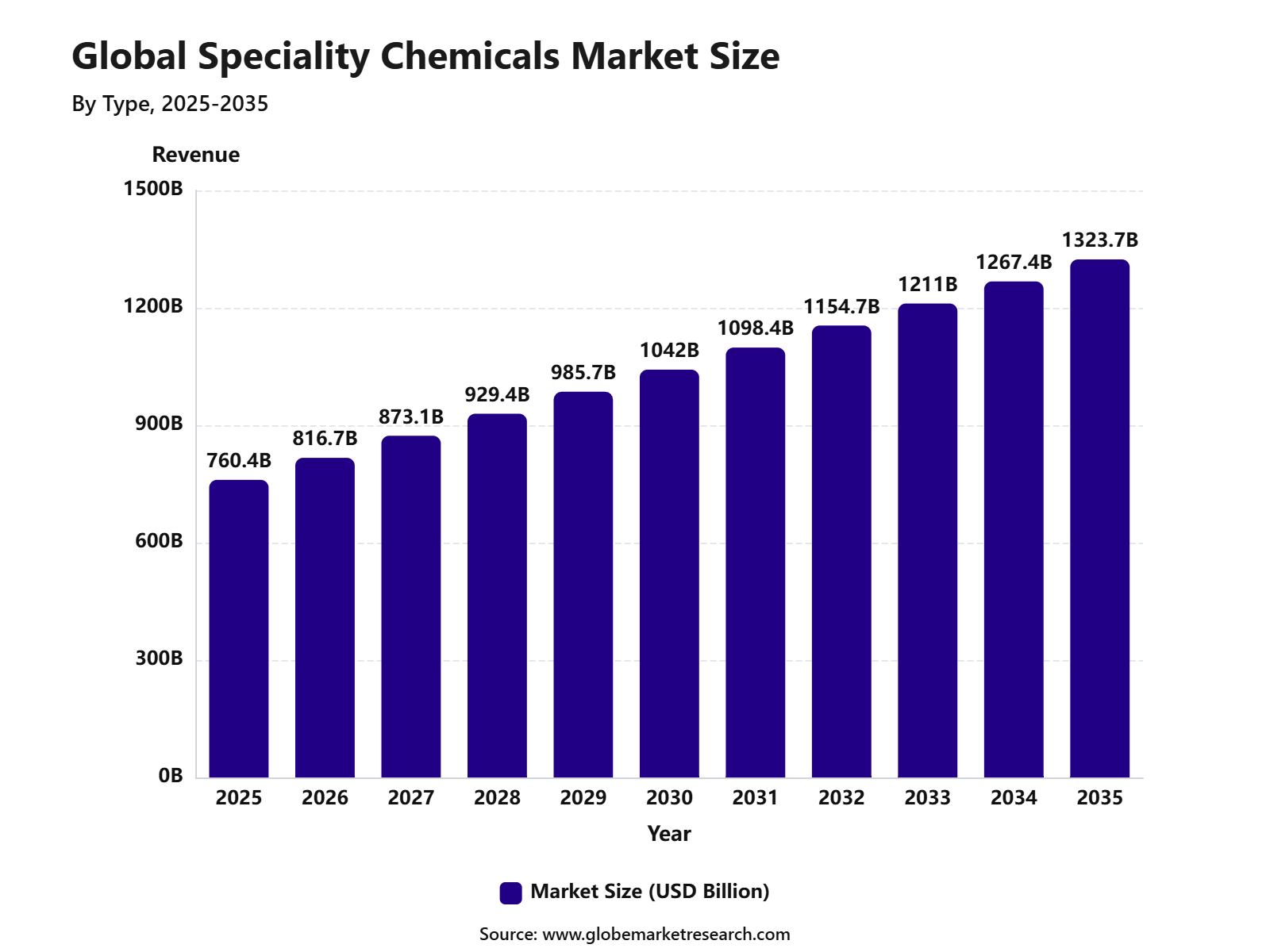 iThe graph shows projected market growth until 2035 based on CAGR analysis. Actual outcomes may vary depending on changing demand, competition, and economic factors.To gain greater insights - request a sample report PDF
The market outlook remains steady as industries continue to demand customized, high-value, and application-specific chemical solutions. Growth can be attributed to rising use of specialty chemicals in clean water treatment, crop protection, infrastructure development, personal care, electronics, and advanced manufacturing. The expansion of sustainable formulations, high-performance materials, and regionally integrated chemical supply chains is expected to support long-term market demand.
Report Highlights | Details |
|---|---|
Market Revenue (2025) | USD 760.4 Billion |
Forecast Revenue (2035) | USD 1,323.7 Billion |
CAGR (2025-2035) | 5.7% |
Base Year for Estimation | 2025 |
Historic Data | 2020-2024 |
Forecast Period | 2025-2035 |
Key Market Insights
Agrochemicals led the type segment with 30.1% share , supported by strong demand for crop protection products, fertilizers, seed treatment chemicals, and productivity-enhancing farm inputs.
Institutional and industrial cleaner s accounted for 33.5% share by application type, driven by rising use of specialty formulations in commercial cleaning, industrial hygiene, sanitation, and facility maintenance.
Asia Pacific led the speciality chemicals market with 50.4% share , supported by strong manufacturing activity, expanding agriculture demand, rising industrial consumption, and large chemical production capacity across China, India, Japan, and Southeast Asia.
Top Funding and Investment Highlights
One Equity Partners agreed to acquire Bozzetto Group in February 2026. Bozzetto is a global speciality chemicals provider, while Aimia stated that the sale of its interest in Bozzetto is expected to generate net proceeds of CAD 265 million to CAD 271 million . The deal highlights private equity interest in specialty platforms serving textile, construction, water treatment, personal care, and agricultural chemical applications.
BASF inaugurated its Zhanjiang Verbund site in China in March 2026, with investment of around €8.7 billion . The site covers about 4 square kilometers , employs more than 2,000 people , and is powered by 100% renewable electricity. The project supports a wide chemical portfolio, including intermediates, performance materials, and speciality chemical applications for mobility, electronics, consumer goods, and industrial users.
CSPC, a Shell and CNOOC joint venture, approved a major petrochemical expansion in China in 2025. The project includes a 1.6 million tons per year ethylene cracker and a new facility producing 320,000 tons per year of high-performance speciality chemicals, including polycarbonates and carbonate solvents. These materials support electric vehicles, energy storage, lubricants, detergents, construction, healthcare, and consumer goods.
Solenis completed the acquisition of Diversey in an all-cash transaction valued at about USD 4.6 billion . Solenis is a speciality chemicals producer focused on water-intensive industries, while Diversey provides hygiene, infection prevention, cleaning products, and related technologies. After the acquisition, Solenis expanded its global footprint across more than 130 countries, strengthening its position in water treatment, industrial cleaning, institutional hygiene, and process chemicals.
By Type
Agrochemicals held 30.1% share in the Speciality Chemicals market, making it the leading type segment. This dominance can be attributed to the strong use of specialty chemical formulations in crop protection, seed treatment, fertilizers, soil health products, and yield improvement solutions.
The segment is supported by rising demand for food security, improved crop productivity, and efficient farming inputs. Farmers and agribusiness companies are increasingly using advanced agrochemical products to control pests, improve nutrient delivery, reduce crop losses, and support higher agricultural output.
Agrochemicals are expected to remain a major revenue contributor as agriculture becomes more technology-driven and input-efficient. Demand is also supported by population growth, shrinking arable land, climate-related crop stress, and the need for specialty formulations that improve performance while meeting changing regulatory standards.
By Application Type
Institutional and industrial cleaners accounted for 33.5% share in the Speciality Chemicals market, making it the leading application type segment. The segment is supported by strong demand from healthcare facilities, food processing units, hotels, offices, manufacturing plants, and public infrastructure.
The use of specialty chemicals in cleaning products is driven by the need for effective disinfection, surface protection, grease removal, odor control, and hygiene maintenance. These formulations often include surfactants, solvents, enzymes, biocides, and performance additives that improve cleaning efficiency across heavy-use environments.
This segment is expected to maintain steady demand as hygiene standards remain strict across commercial and industrial settings. Growth is also supported by rising awareness of workplace safety, infection prevention, food safety compliance, and demand for cleaning products that are more effective, concentrated, and environmentally responsible.
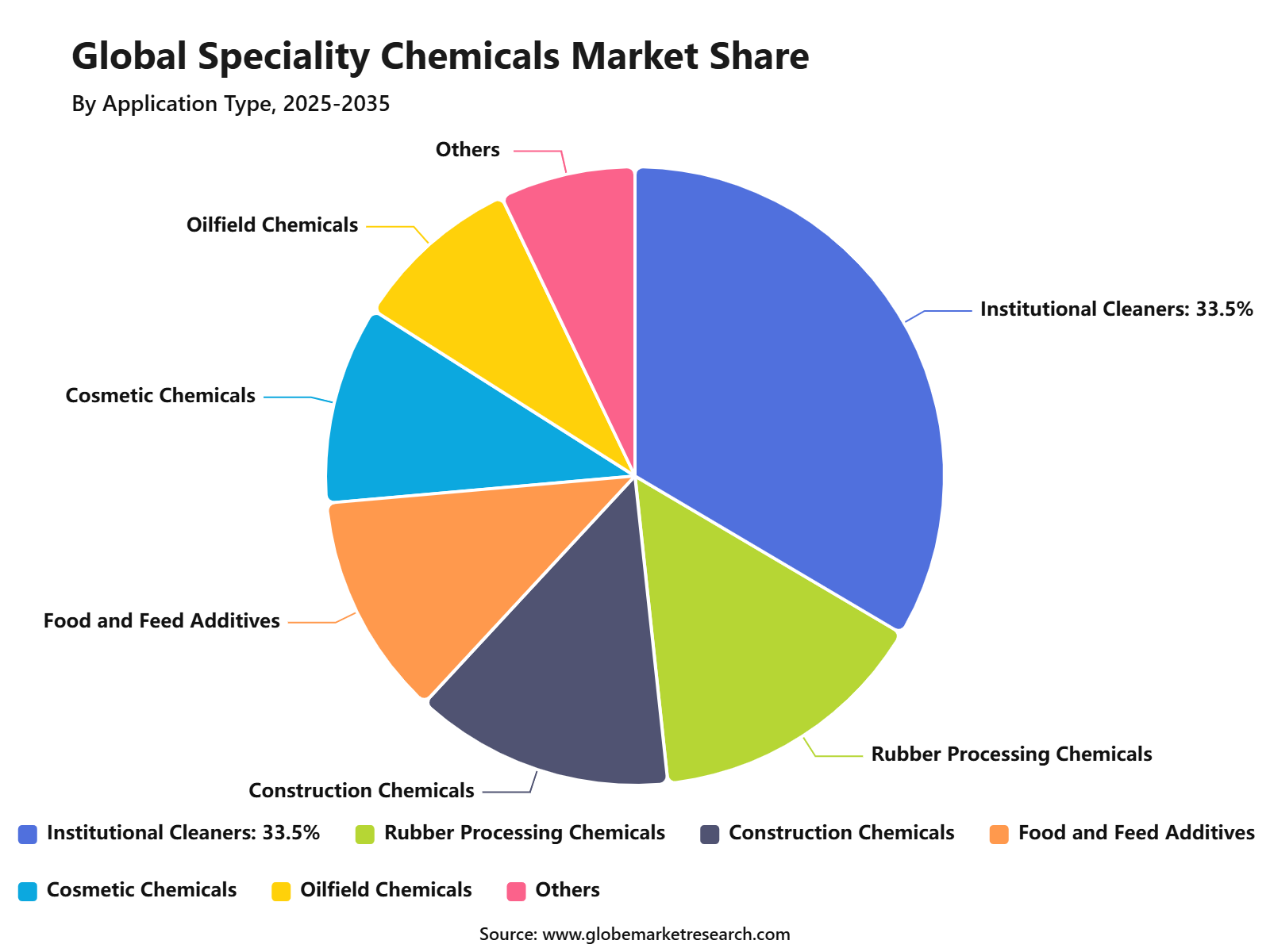 iThe graph shows projected market growth until 2035 based on CAGR analysis. Actual outcomes may vary depending on changing demand, competition, and economic factors.To gain greater insights - request a sample report PDF
By Region
Asia Pacific held 50.4% share in the Speciality Chemicals market, making it the leading regional market. The region’s dominance is supported by large-scale chemical production, expanding agriculture, strong manufacturing activity, and rising demand from construction, automotive, electronics, textiles, and consumer goods industries.
China, India, Japan, South Korea, and Southeast Asian countries are key contributors to regional growth. These countries have strong industrial bases, rising domestic consumption, cost-efficient production capabilities, and growing investments in specialty chemical plants and downstream processing.
Asia Pacific is expected to retain its strong position due to continued expansion in agrochemicals, industrial cleaners, polymers, coatings, personal care ingredients, and water treatment chemicals. Rising urbanization, infrastructure development, and industrial modernization are also strengthening demand for performance-based chemical solutions across the region.
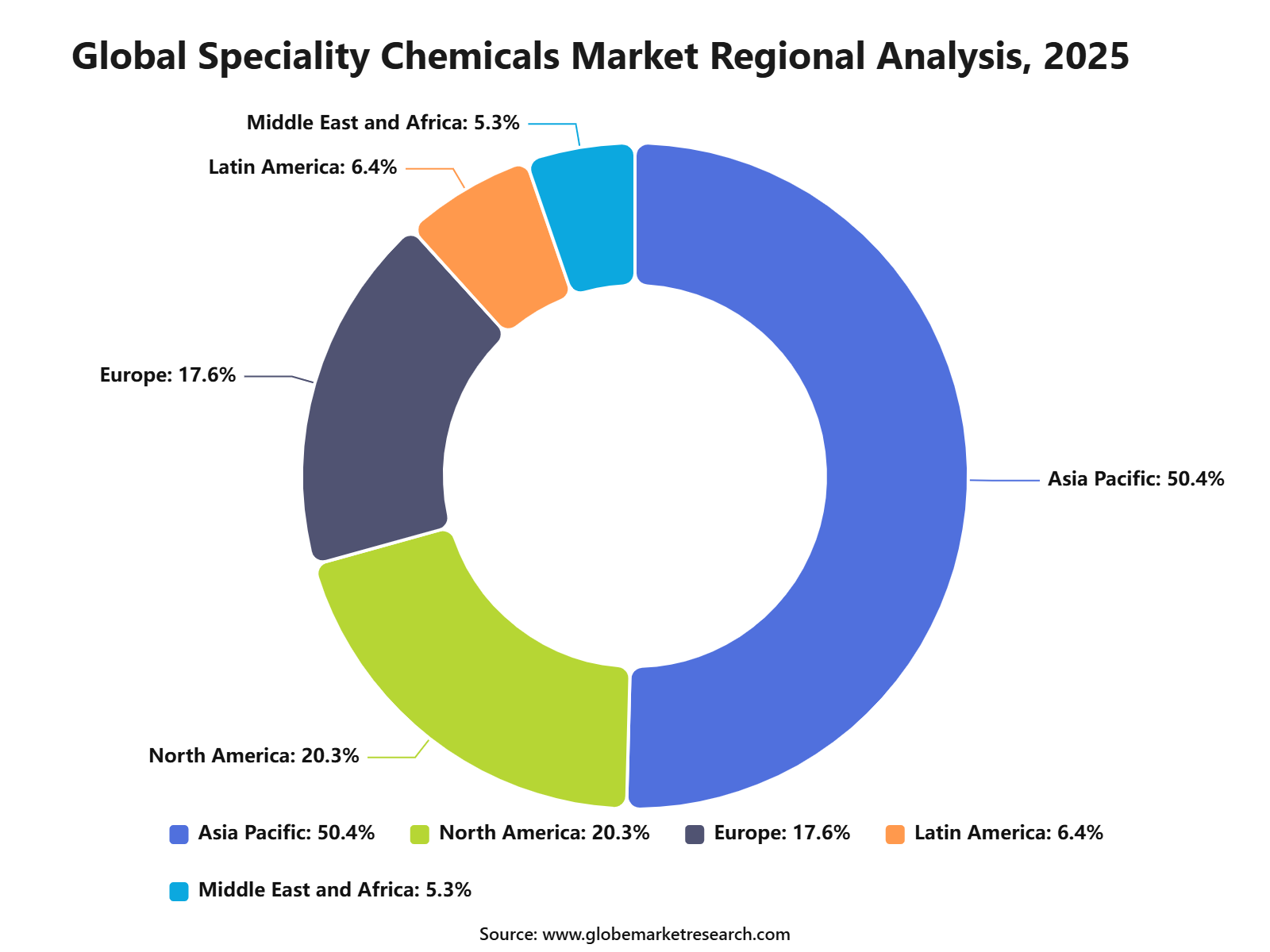 iThe graph shows projected market growth until 2035 based on CAGR analysis. Actual outcomes may vary depending on changing demand, competition, and economic factors.To gain greater insights - request a sample report PDF
Regional Impact Analysis
China and India remain major contributors due to scale, cost competitiveness, and expanding domestic consumption. North America and Europe remain important for high-performance chemicals, sustainable ingredients, advanced coatings, water treatment, and specialty industrial applications. These regions are likely to support higher-margin products because of stricter quality, safety, and environmental requirements.
Impact Factor | Estimated CAGR Impact | Regional Relevance | Market Impact |
|---|---|---|---|
Asia Pacific market leadership | +2.2% | Asia Pacific, 50.4% share in 2025 | Leads global demand. |
China industrial chemical scale | +1.4% | China | Drives regional volume. |
India agriculture and construction demand | +1.1% | India | Supports future growth. |
North America specialty innovation | +0.8% | U.S. and Canada | Builds value demand. |
Europe sustainability-led adoption | +0.7% | Germany, France, UK, Netherlands | Supports premium products. |
Drivers Impact Analysis
The Speciality Chemicals Market is driven by rising demand from agriculture, construction, electronics, personal care, water treatment, coatings, textiles, and industrial processing. These chemicals are used for specific performance benefits such as durability, adhesion, cleaning, protection, formulation stability, crop yield improvement, and process efficiency.
Asia Pacific remains the strongest growth region because of large manufacturing output, chemical production capacity, infrastructure development, and expanding consumer industries. China, India, Japan, South Korea, and Southeast Asia support demand across agrochemicals, specialty polymers, surfactants, construction chemicals, and water treatment chemicals.
Impact Factor | Estimated CAGR Impact | Regional Relevance | Market Impact |
|---|---|---|---|
Rising demand from end-use industries | +1.5% | Asia Pacific, North America, Europe | Drives broad consumption. |
Growth in agrochemicals and crop protection | +1.2% | India, China, Latin America | Supports food production. |
Expansion of construction chemicals | +1.0% | Asia Pacific, Middle East, North America | Builds infrastructure demand. |
Increasing use in personal care and cleaning | +0.9% | Global consumer markets | Supports formulation growth. |
Demand for high-performance materials | +0.8% | Electronics, automotive, industrial sectors | Improves product value. |
Restraints Impact Analysis
The market faces restraints from raw material price volatility, energy cost pressure, and complex regulatory requirements. Since speciality chemicals depend on petrochemical, mineral, bio-based, and intermediate inputs, cost fluctuations can directly affect margins.
Environmental and safety regulations also increase production complexity. Producers must manage emissions, hazardous substances, wastewater, worker safety, and product compliance, especially in Europe, North America, Japan, and South Korea.
Impact Factor | Estimated CAGR Impact | Regional Relevance | Market Impact |
|---|---|---|---|
Raw material price volatility | -0.9% | Global producers | Pressures margins. |
Strict environmental regulations | -0.8% | Europe, U.S., Japan, South Korea | Raises compliance cost. |
High R&D and formulation cost | -0.7% | Global speciality suppliers | Limits small players. |
Supply chain disruption risk | -0.6% | Asia Pacific, Europe, North America | Affects delivery stability. |
Competition from low-cost alternatives | -0.5% | Emerging and price-sensitive markets | Reduces pricing power. |
Opportunities Impact Analysis
Major opportunities are emerging in sustainable chemicals, bio-based ingredients, high-performance coatings, electronic chemicals, water treatment, and specialty polymers. Customers are increasingly looking for products that improve performance while reducing toxicity, emissions, and waste.
Higher-value growth can also come from customized formulations. Companies that provide application-specific products, technical service, and regional supply support can strengthen customer loyalty and capture better margins than commodity chemical suppliers.
Impact Factor | Estimated CAGR Impact | Regional Relevance | Market Impact |
|---|---|---|---|
Sustainable and bio-based chemicals | +1.4% | Europe, North America, Asia Pacific | Supports green demand. |
Electronic and semiconductor chemicals | +1.2% | Taiwan, South Korea, China, U.S. | Builds high-value growth. |
Water treatment chemical expansion | +1.0% | Asia Pacific, Middle East, Africa | Supports utility demand. |
Specialty polymers and additives | +0.9% | Automotive, packaging, electronics | Improves material performance. |
Customized formulation services | +0.8% | Global industrial customers | Strengthens customer retention. |
Challenges Impact Analysis
The main challenge is balancing performance, cost, and sustainability. Customers want chemicals that meet technical requirements, but they also expect safer ingredients, lower environmental impact, and stable pricing.
Another challenge is maintaining innovation speed across many end-use markets. Speciality chemical companies must continuously develop new grades, meet regulatory changes, and support customer-specific applications across agriculture, construction, electronics, personal care, and industrial sectors.
Impact Factor | Estimated CAGR Impact | Regional Relevance | Market Impact |
|---|---|---|---|
Balancing cost and performance | -0.8% | Global customers | Affects purchase decisions. |
Meeting sustainability expectations | -0.7% | Europe, North America, developed Asia | Raises innovation burden. |
Managing complex product portfolios | -0.6% | Global producers | Increases operating pressure. |
Maintaining technical differentiation | -0.5% | Competitive chemical markets | Protects margins. |
Regulatory approval delays | -0.5% | Agrochemicals, personal care, industrial uses | Slows product launches. |
Segment Covered in the Report
By Type
Agrochemicals
Dyes and Pigments
Construction Chemicals
Specialty Polymers
Textile Chemicals
Base Ingredients
Surfactants
Functional Ingredients
Water Treatment Chemicals
Others
By Application Type
Institutional and Industrial Cleaners
Rubber Processing Chemicals
Construction Chemicals
Food and Feed Additives
Cosmetic Chemicals
Oilfield Chemicals
Others
By Region
North America
Europe
Asia Pacific
Latin America
Middle East and Africa
Market Trend Analysis
The market trend is moving toward high-performance, sustainable, and application-specific chemicals. Demand is increasing for products that support durability, efficiency, safety, reduced emissions, and better lifecycle performance.
Speciality polymers, surfactants, functional ingredients, construction chemicals, electronic chemicals, and water treatment chemicals are gaining importance. Asia Pacific continues to shape volume demand, while Europe and North America support premium innovation and sustainability-led product development.
Impact Factor | Estimated CAGR Impact | Regional Relevance | Market Impact |
|---|---|---|---|
High-performance formulations gain demand | +1.3% | Global | Leads value growth. |
Sustainable chemistry adoption increases | +1.1% | Europe, North America, Asia Pacific | Supports cleaner products. |
Construction chemical usage expands | +1.0% | Asia Pacific, Middle East | Builds infrastructure demand. |
Functional ingredients gain traction | +0.9% | Personal care, food, industrial sectors | Adds premium demand. |
Localized production becomes important | +0.7% | Asia Pacific, U.S., Europe | Improves supply security. |
Investor Type Impact Matrix
Investors should focus on speciality chemical companies with diversified product portfolios, strong application development, technical service, and exposure to high-growth industries. Scale is important, but product differentiation and customer-specific solutions are stronger value drivers.
Strategic investors can also target sustainable chemistry, electronics materials, water treatment, specialty polymers, and construction chemicals. These segments provide better resilience because they are linked to essential industries, regulatory needs, and performance-based purchasing.
Investor Type | Estimated CAGR Impact | Regional Relevance | Market Impact |
|---|---|---|---|
Speciality Chemical Producers | +1.3% | Global | Expands product capacity. |
Diversified Chemical Companies | +1.1% | Asia Pacific, Europe, North America | Supports broad demand. |
Industrial and Infrastructure Investors | +0.9% | Asia Pacific, Middle East, North America | Drives construction demand. |
Sustainability-Focused Investors | +0.8% | Europe, North America, Asia Pacific | Funds green chemistry. |
Private Equity and Strategic Investors | +0.7% | Global speciality segments | Supports portfolio growth. |
Recent Developments
In June 2026, Olin and Huntsman announced a merger of equals to create OlinHuntsman, a combined North American chemicals company with about USD 12.5 billion in 2025 revenue. The deal combines Olin’s chlorine, caustic soda, and manufacturing base with Huntsman’s downstream products and formulation expertise.
In February 2026, Henkel agreed to acquire speciality coatings company Stahl for EUR 2.1 billion. Stahl generated about EUR 725 million in adjusted sales in 2025 and employed around 1,700 people. The acquisition strengthens Henkel’s Adhesive Technologies business and supports its strategy of expanding in higher-margin industrial segments such as coatings, leather chemicals, performance coatings, and surface technologies.
Competitive Landscape
The market is characterized by intense competition among established players and emerging companies. Strategic partnerships, mergers and acquisitions, and product innovation are key strategies employed by market participants.
Key Market Players
BASF SE
Evonik Industries AG
Solvay S.A.
Clariant AG
Akzo Nobel N.V.
Eastman Chemical Company
Dow Inc.
DuPont
Albemarle Corporation
Huntsman Corporation
INEOS Group
Syngenta AG
Others key Players
Research Methodology
This market study is prepared using a combination of primary and secondary research. Primary research includes discussions with manufacturers, suppliers, distributors, consultants, industry experts, and end users. Secondary research covers company reports, government databases, trade associations, technical publications, regulatory sources, and trusted industry documents. The collected information is used to assess market demand, pricing trends, technology adoption, competitive activity, and regional performance.
AI language models are not used as primary data sources, and publicly available AI-generated content is not treated as market evidence. Computational tools may be used to support data processing, translation, data classification, and pattern identification. However, every published assessment is supported by verified sources, human review, and primary market discussions.
Market estimates are developed through top-down and bottom-up approaches and validated using data triangulation. Revenue, production, shipment, pricing, and application-level data are compared across multiple sources. Forecasts consider economic conditions, regulatory changes, investment activity, innovation, supply chain developments, and industry risks. All findings are reviewed through source verification and internal quality checks before publication.
Part I
Source Management & Input Data Standards
Who provides data, how sources are qualified, and what types of evidence are admissible.
Part II
Research Scope & Market Coverage
How we define the markets we assess and the parameters that govern each product.
Part III
Data Collection, Verification & Submission
The mechanics of gathering, cross-checking, and hierarchically ranking evidence.
Part IV
Assessment Determination & Quality Controls
How raw data becomes a published assessment — normalisation, expert judgement, and outlier exclusion.
Part V
Publication, Corrections & Revision
Our publication schedule, corrections policy, and methodology review cycle.
Part VI
Independence, Ethics & Complaints
Conflict-of-interest policies, editorial independence, and how clients raise concerns.
Google · Preferred Sources
Don't miss the latest market research insights and industry updates on Google.
Add Globe Market Research as a preferred source in the Google app to see our reports, analysis, and market stories in your news suggestions.
Meet the Team
This report was prepared by our expert analysts with deep industry knowledge and research experience.
Kimaya brings more than five years of experience in market research, content review, and industry analysis to Globe Market Research. She plays an important role in maintaining the accuracy, clarity, consistency, and relevance of research content across a wide range of industries. Her responsibilities include reviewing market data, segment analysis, competitive landscapes, industry trends, company developments, and strategic insights. Each report is carefully assessed to ensure that the findings are supported by reliable data, presented in a structured format, and aligned with the information needs of business decision-makers. Kimaya has research experience across healthcare, information technology, consumer goods, and several cross-industry domains.
Pratiksha K. is a Senior Research Analyst with more than five years of experience in market research, industry analysis, competitive intelligence, and business strategy. She has contributed to detailed market reports, customized research studies, company profiling, market sizing, trend analysis, and strategic consulting projects for clients across different regions. Her industry expertise covers Chemical and Material, Consumer Goods, Food & Beverages and Energy & Power. She closely evaluates changing customer requirements, technology developments, regulatory conditions, supply chain structures, investment activity, and competitive strategies to provide clear and practical market insights.
Frequently Asked Questions
Related Reports
More in Chemical and Material
Sulfuric Acid Market to Hit USD 61.5 Billion by 2035
Sulfuric Acid Market Size, Share, Analysis By Raw Material (Elemental Sulfur, Base Metal Smelters, Pyrite Ore, Others), By Application (Fertilizers, Chemical Manufacturing, Metal Processing, Petroleum Refining, Textile, Automotive, Pulp and Paper, Others), By Distribution Channel (Direct Sales, Distributors), By Regional Insights, Business plan and Project Report, Investment Opportunities, Profitability, Industry Trends, Leading Companies and Growth Forecasts by 2026-2035
Powder Metallurgy Market to Hit USD 17.0 Billion by 2035
Powder Metallurgy Market Size, Share, Analysis By Material (Ferrous Metals, Non-Ferrous Metals, Others), By Process (Additive Manufacturing, Powder Metal Hot Isostatic Pressing, Conventional Powder Metallurgy), By Application (Automotive, Aerospace and Defense, Healthcare, Electrical and Electronics, Industrial Machinery, Others) , By Regional Insights, Business plan and Project Report, Investment Opportunities, Profitability, Industry Trends, Leading Companies and Growth Forecasts by 2026-2035
Bromine Market to Hit USD 1.5 Billion by 2035
Bromine Market Size, Share, Analysis By Derivative (Organobromine, Clear Brine Fluids, Hydrogen Bromide, Others), By Application (Flame Retardants, Oil and Gas Drilling, Biocides, PTA Synthesis, Plasma Etching, Pharmaceuticals, Energy Storage, Others), By End-Use Industry (Chemicals, Oil and Gas, Pharmaceuticals, Electrical and Electronics, Automotive, Agriculture, Others), By Regional Insights, Business plan and Project Report, Investment Opportunities, Profitability, Industry Trends, Leading Companies and Growth Forecasts by 2026-2035
Hydrogen Cyanide Market to Hit USD 5.95 Billion by 2035
Hydrogen Cyanide Market Size, Share, Analysis By Product Form (Hydrogen Cyanide Liquid, Hydrogen Cyanide Gas), By Application (Adiponitrile, Acetone Cyanohydrin, Sodium Cyanide and Potassium Cyanide, Methionine, Cyanuric Chloride, Others), By End-Use Industry (Chemicals, Mining and Metallurgy, Pharmaceuticals, Agriculture, Textiles, Others), By Regional Insights, Business plan and Project Report, Investment Opportunities, Profitability, Industry Trends, Leading Companies and Growth Forecasts by 2026-2035