

Revenue, 2026
USD 565.2 Bn
Forecast, 2035
USD 2,199.9 Bn
CAGR, 2026-2035
16.3%
Report Coverage
Global
Market Size and Forecast
The subscription economy is a business model in which customers make recurring payments for continued access to products, services or digital content. It includes video and music streaming, cloud software, telecommunications, memberships, mobility services, education platforms, food delivery and subscription-based consumer goods. Companies are increasingly using monthly plans, annual packages, usage-based pricing, bundled services and hybrid payment models to improve predictable revenue and customer retention.
According to Globe Market Research, the global Subscription Economy Market was valued at USD 565.2 billion in 2026 and is projected to reach approximately USD 2,199.9 billion by 2035, growing at a CAGR of 16.3% from 2026 to 2035. North America accounted for around 44.2% of the market in 2025. The U.S. market was valued at approximately USD 201.8 billion in 2026 and is expected to expand at a CAGR of 15.6%. Growth is being supported by digital payment adoption, cloud-based billing systems, mobile commerce, personalised plans and rising demand for flexible access instead of direct ownership.
Key Parameter | Report Details |
|---|---|
Market Revenue, 2026 | USD 565.2 Billion |
Projected Revenue, 2035 | USD 2,199.9 Billion |
CAGR, 2026-2035 | 16.3% |
Largest Region | North America, Around 44.2% Share in 2025 |
U.S. Market Revenue, 2025 | USD 201.8 Billion |
U.S. CAGR | 15.6% |
Market Concentration | Medium |
Base Year | 2025 |
Forecast Period | 2026-2035 |
Agentic AI is improving subscription management by monitoring customer activity, predicting churn, personalizing plans and automatically recovering failed payments. According to Recurly’s 2026 analysis of 76 million subscribers and 2,200 merchants, 40% of subscription companies are using AI for revenue recovery and churn prediction. Around 43% of consumers are comfortable allowing AI to manage subscriptions, while 56% support its use for fraud prevention and 50% for content personalization.
Agentic AI is also becoming important as competition and customer cancellations increase. Recurly reported that subscription growth slowed to 12.6% in 2026, while 52% of consumers cancelled at least one subscription due to limited use. RevenueCat’s 2026 study covered more than 115,000 subscription apps, USD 16 billion in revenue and over one billion transactions, highlighting the scale of data available for automated pricing, retention and subscriber engagement decisions.
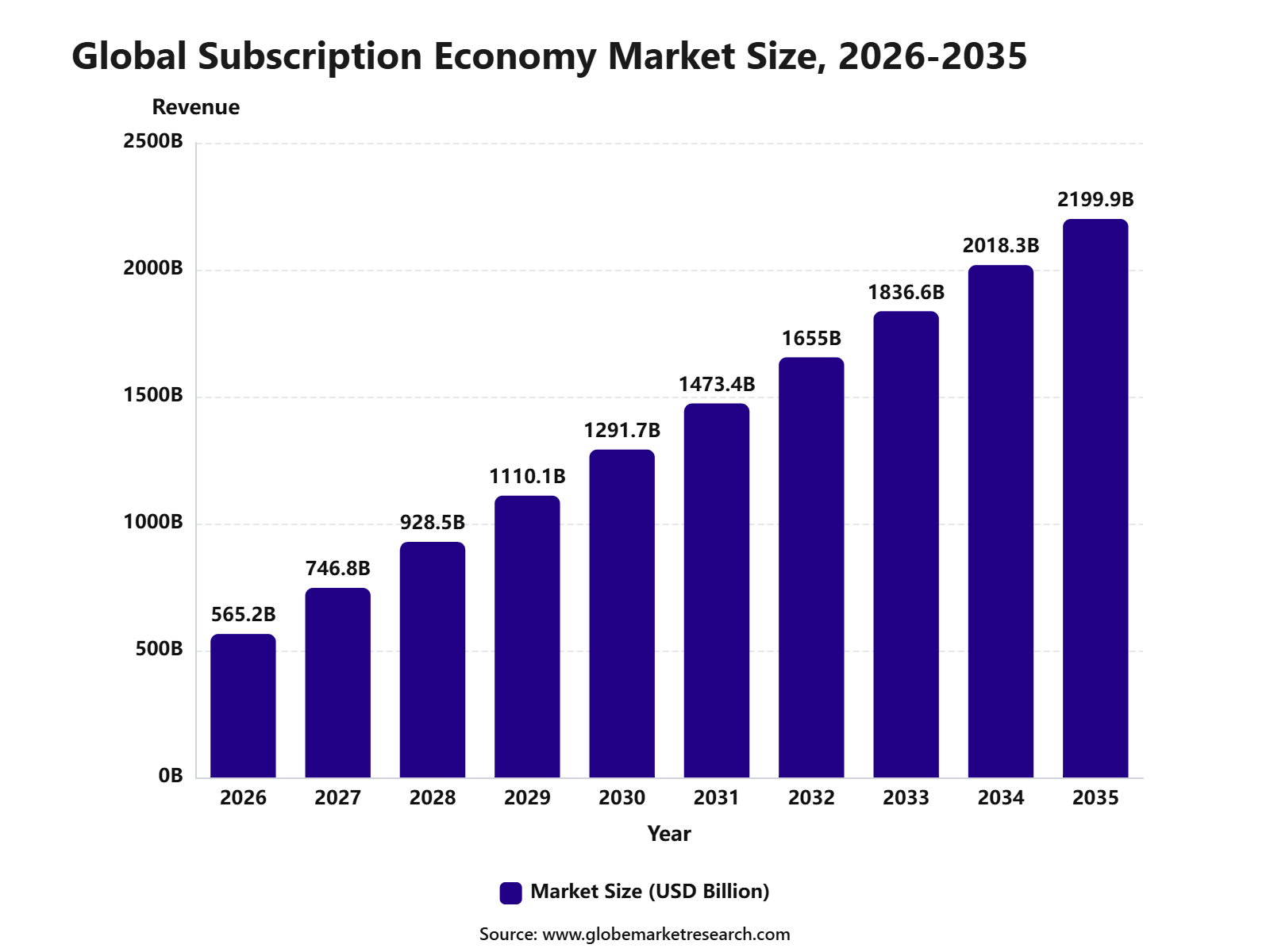 iThe graph shows projected market growth until 2035 based on CAGR analysis. Actual outcomes may vary depending on changing demand, competition, and economic factors.To gain greater insights - request a sample report PDF
Key Market Insights
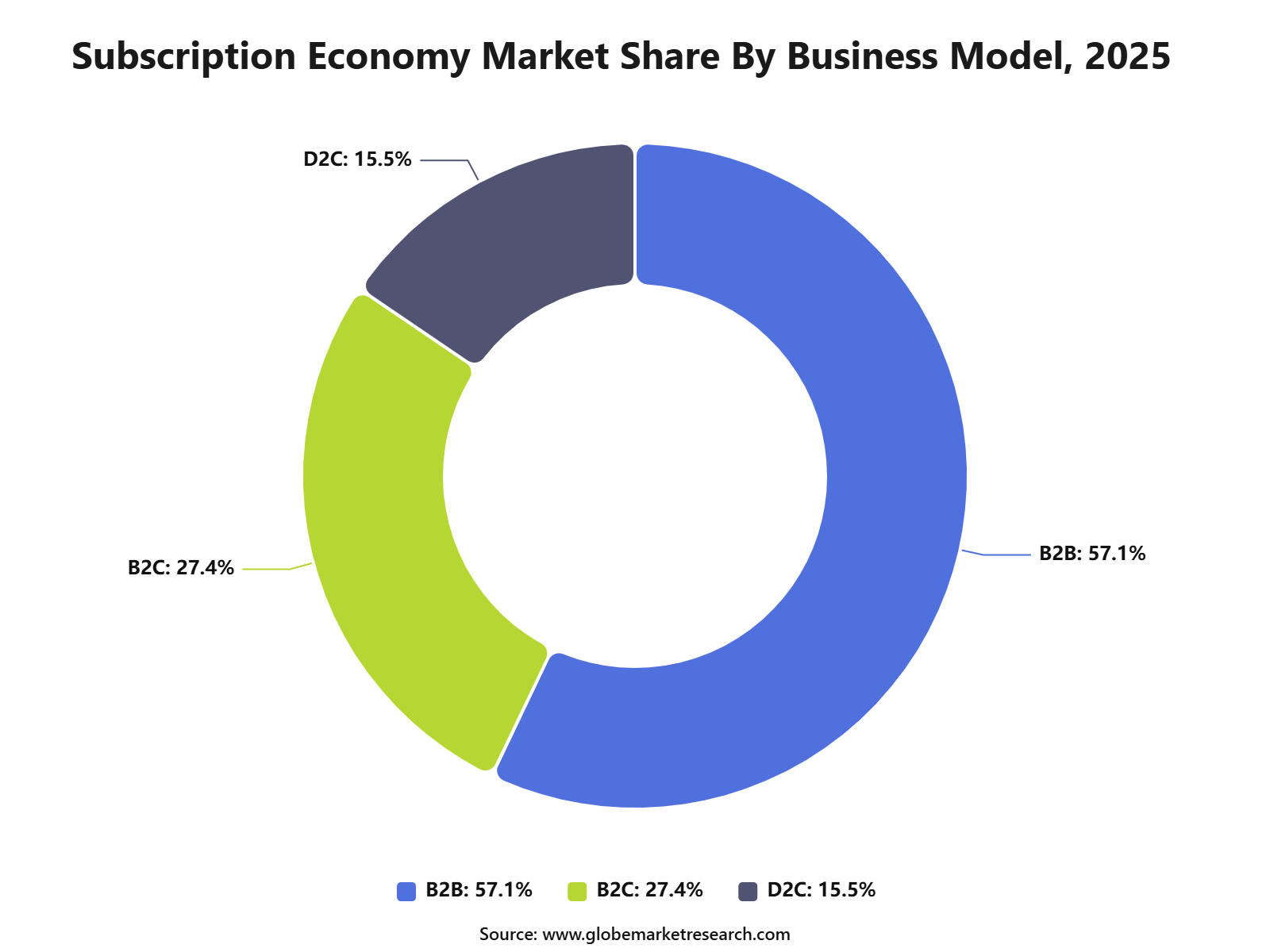
B2B subscriptions led the business model segment with 57.1% share, supported by recurring demand for SaaS tools, enterprise platforms, professional services, and business workflow solutions.
Web-based platforms accounted for 55.1% share by delivery platform, driven by easy access, lower setup needs, browser-based usage, and strong adoption across digital subscription services.
Large enterprises held 63.5% share by organization size, supported by higher spending capacity, complex operational needs, and wider use of subscription-based software, data, and service models.
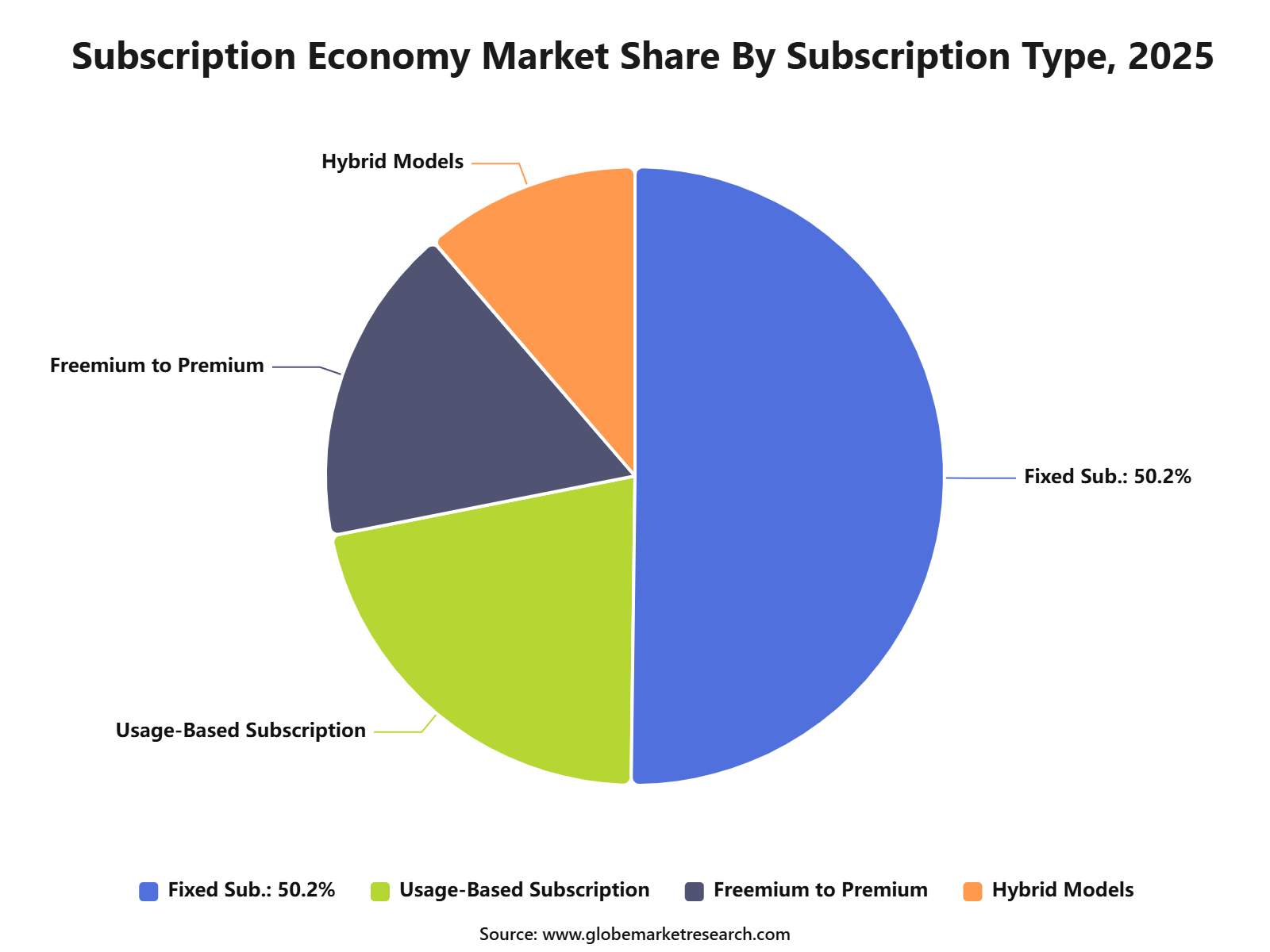
Fixed subscriptions captured 50.2% share by subscription type, driven by predictable billing, stable customer relationships, and easier revenue planning for service providers.
Media and entertainment led the industry vertical segment with 20.1% share, supported by strong demand for streaming platforms, digital content, gaming subscriptions, and paid media services.
Adoption Rate and Usage Statistics
Subscription adoption is being supported by flexible pricing, bundled services, ad-supported plans, and automated account management. According to Bango, 68% of U.S. consumers access at least one subscription through a bundle or third-party channel. According to Deloitte, 68% of subscription video households used at least one ad-supported streaming service in March 2026. According to Chargebee, 67% of consumers would switch to usage-based or hybrid pricing when offered, while Recurly reported that 43% are comfortable allowing artificial intelligence to manage their subscriptions. These figures show that convenience, affordability, flexibility, and simplified management are becoming major subscription adoption factors.
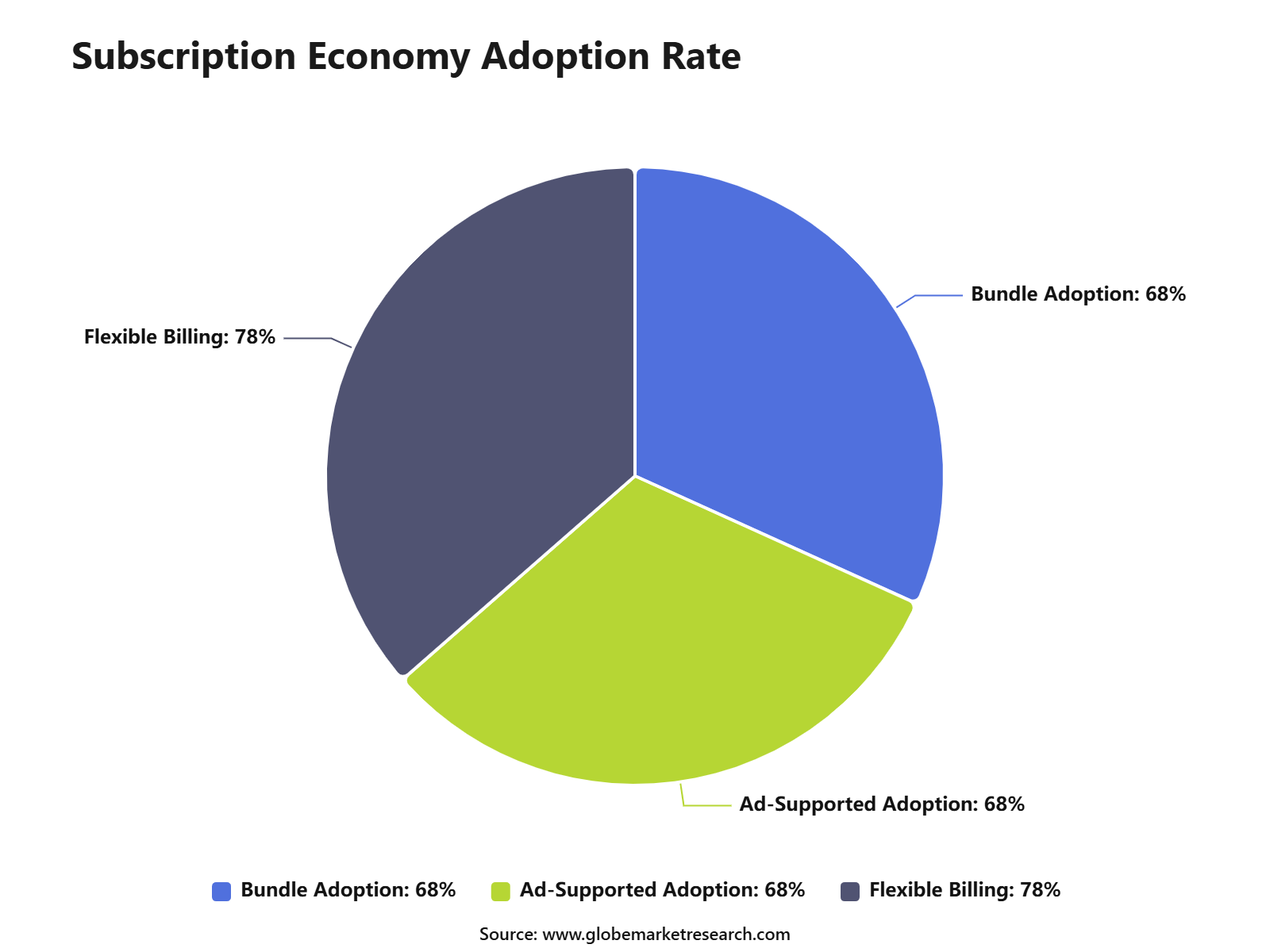 iThe graph shows projected market growth until 2035 based on CAGR analysis. Actual outcomes may vary depending on changing demand, competition, and economic factors.To gain greater insights - request a sample report PDF
Subscription usage remains high, although consumers are actively reviewing, pausing, and cancelling services based on value and frequency of use. According to Bango, the average U.S. subscriber pays for 5.4 subscriptions, including two obtained through bundles or third-party platforms. According to Recurly, 52% of consumers cancelled at least one subscription during the previous year because it was not used sufficiently. According to Chargebee, 58% of consumers have paused a subscription instead of cancelling it, indicating growing demand for flexible subscription controls and easy reactivation options.
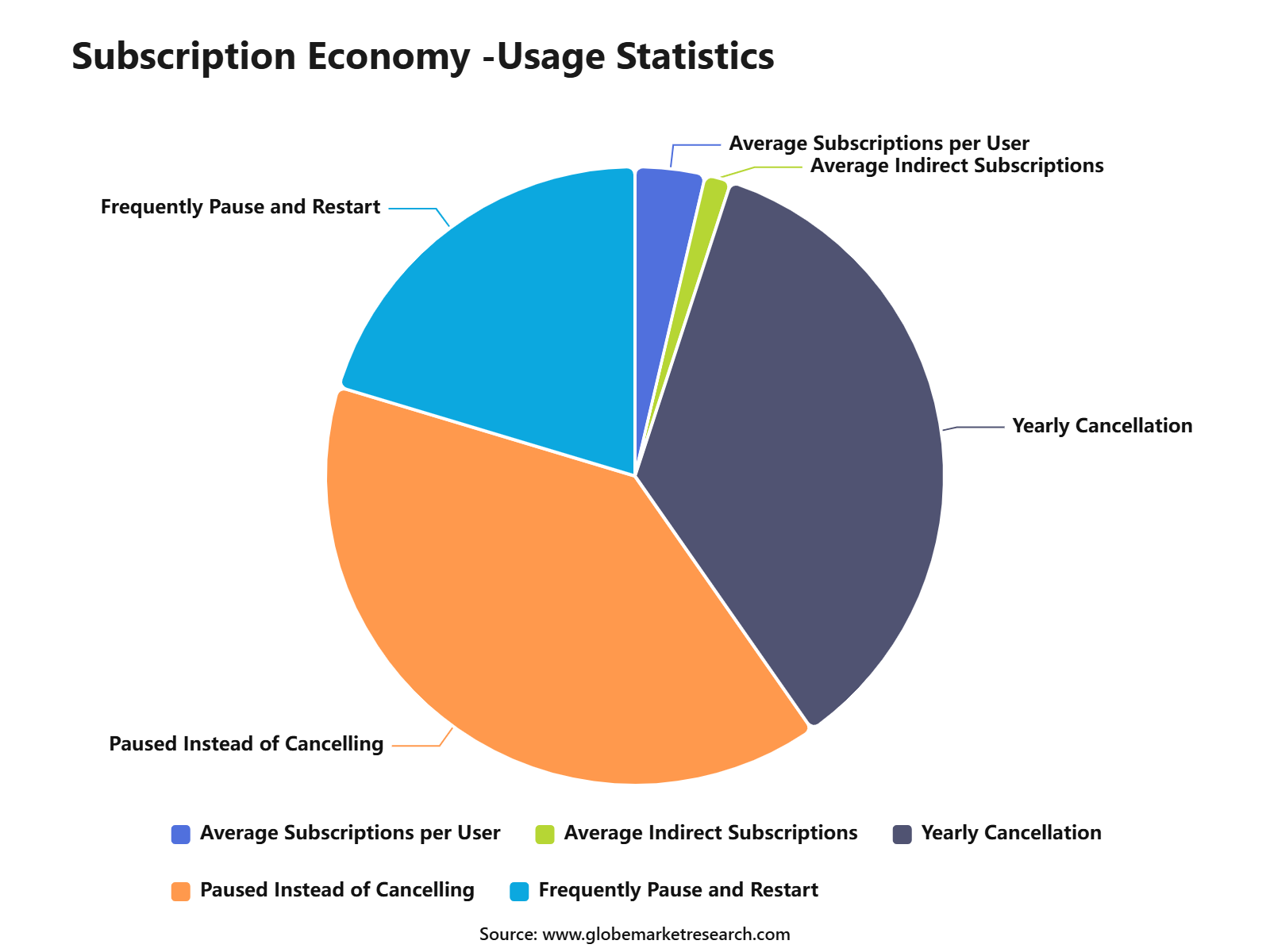 iThe graph shows projected market growth until 2035 based on CAGR analysis. Actual outcomes may vary depending on changing demand, competition, and economic factors.To gain greater insights - request a sample report PDF
Business Model Insights
The B2B segment accounted for 57.1% of the Subscription Economy Market by business model. Its leading position can be attributed to the growing use of recurring contracts for business software, cloud infrastructure, cybersecurity, data analytics, professional services and equipment access. Subscription arrangements allow organizations to spread costs over time while receiving regular updates, technical support and additional features.
According to Eurostat, 52.74% of EU enterprises used paid cloud computing services in 2025, while 40.89% purchased at least one sophisticated cloud service. Strong demand was recorded for email, office software, data storage, security applications and financial management tools. These services are commonly purchased through monthly or annual business subscriptions.
B2B subscribers usually require more than access to a standard product. Integration support, service-level commitments, user administration, data protection and flexible billing are important purchasing factors. Providers that offer multi-user plans, usage reporting and easy contract expansion are better positioned to retain business customers and increase account value.
 iThe graph shows projected market growth until 2035 based on CAGR analysis. Actual outcomes may vary depending on changing demand, competition, and economic factors.To gain greater insights - request a sample report PDF
Delivery Platform Insights
Web-based platforms represented 55.1% of the market by delivery platform. Their strong position is supported by easy browser access, centralized software updates and compatibility across computers, tablets and mobile devices. Customers can use subscription services without installing complex software or maintaining separate versions on different systems. According to the International Telecommunication Union, approximately 6 billion people, equal to 74% of the global population, were using the internet in 2025.
The number of internet users increased from 5.8 billion in 2024, adding a wider addressable audience for web-delivered subscription services. Web-based delivery also gives providers better control over feature releases, account management, security patches and customer activity tracking. Its adoption is particularly strong for software, education, media, financial tools and professional information services. Future competition will be influenced by page speed, payment security, interface quality and reliable performance across low-bandwidth networks.
Organization Size Insights
Large enterprises held 63.5% of the Subscription Economy Market by organization size. These organizations commonly purchase subscriptions across multiple departments, countries and employee groups. Their spending is supported by requirements for enterprise software, cloud capacity, cybersecurity, communications, workforce management and data intelligence.
According to Eurostat, 84.67% of large EU enterprises used paid cloud computing services in 2025. Eurostat also reported that 88.71% of large enterprises used enterprise resource planning software, compared with 41.08% of small enterprises. These figures demonstrate the greater dependence of large organizations on continuously delivered digital services.
Large enterprise contracts often include thousands of users, customized permissions, integration services and dedicated support. This creates attractive recurring revenue opportunities but also increases implementation complexity and sales cycles. Providers must demonstrate security, regulatory compliance, system availability and measurable operational benefits before large contracts are approved.
Subscription Type Insights
Fixed subscriptions accounted for 50.2% of the market by subscription type. This model remains widely accepted because customers know the amount that will be charged during each billing period. It is suitable for services with regular usage patterns, clearly defined benefits and stable access requirements. According to Deloitte’s 2025 Digital Media Trends survey, 47% of consumers believed they were paying too much for their streaming services. The study also found that 60% would be likely to cancel their preferred service following a price increase of USD 5.
These findings show that fixed subscriptions offer predictability, but their pricing must remain closely connected to perceived value. Fixed plans make budgeting easier for consumers and provide predictable revenue visibility for service providers. However, rigid pricing can become a weakness when customer usage varies significantly. Providers are therefore introducing several fixed tiers, annual discounts, pause options and limited upgrades to improve flexibility without moving completely toward usage-based billing.
 iThe graph shows projected market growth until 2035 based on CAGR analysis. Actual outcomes may vary depending on changing demand, competition, and economic factors.To gain greater insights - request a sample report PDF
Industry Vertical Insights
Media and entertainment captured 20.1% of the Subscription Economy Market by industry vertical. The segment includes video streaming, music, digital publishing, gaming, sports content, podcasts and premium creator services. Recurring access has become an established payment method because consumers expect large content libraries, frequent releases and access across multiple devices.
According to EY’s 2025 survey of 20,500 households across 14 countries, 38% of households paying for streaming services had either cancelled or planned to cancel a service. The study also found that 37% of respondents wanted to reduce the number of platforms they paid for. Attractive pricing, specific content and extensive libraries were identified as important subscription selection factors.
Media subscription providers must continuously invest in relevant content while controlling production, licensing and distribution costs. Bundled packages, live programming, regional content and lower-priced advertising plans are being used to improve retention. Long-term performance will depend on whether platforms can maintain regular engagement and provide enough differentiated content to justify recurring payments.
Regional Insights
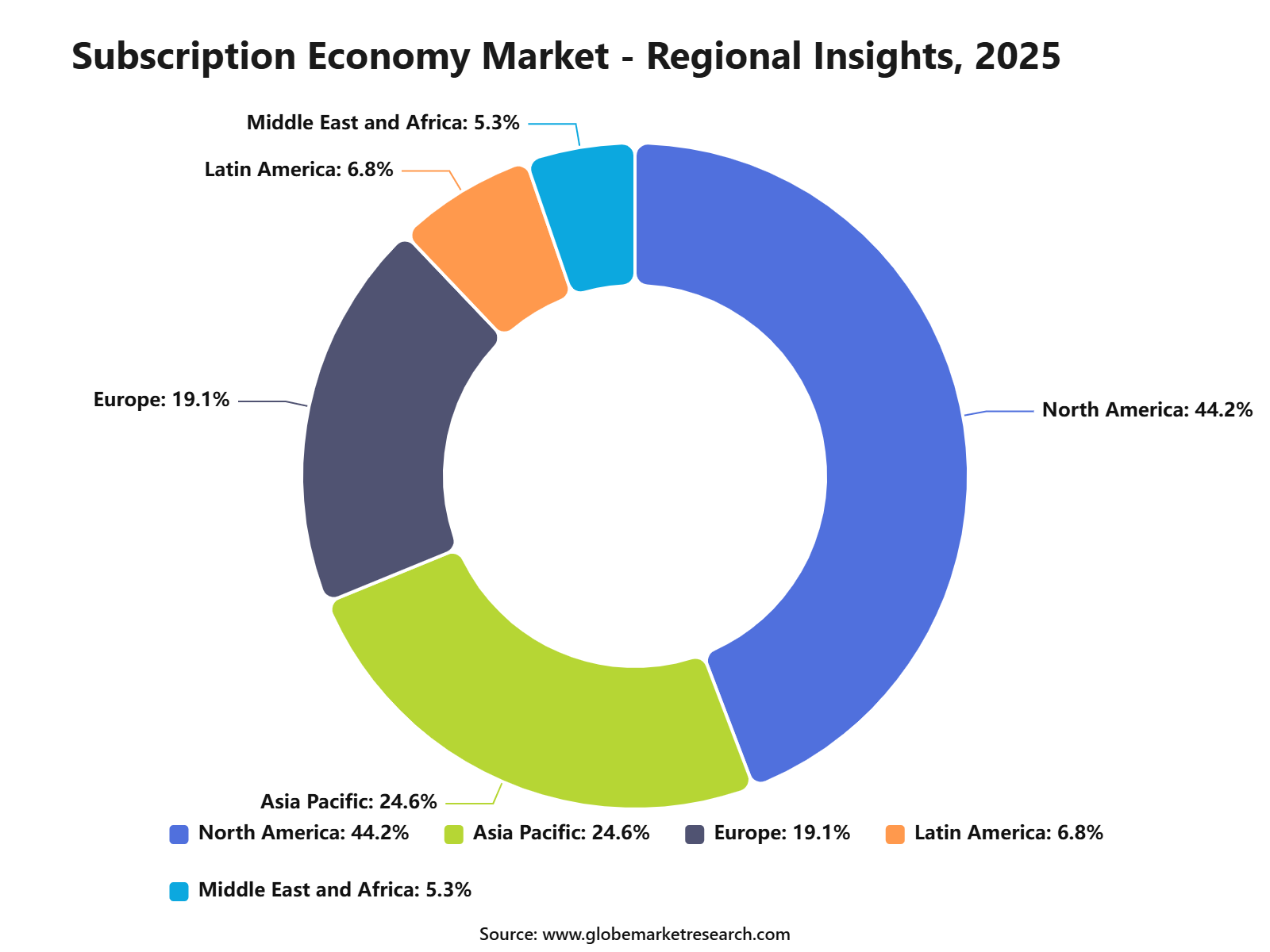
North America held the leading position in the Subscription Economy Market, accounting for approximately 44.2% of the global market in 2025. The region benefits from high digital service adoption, strong online payment infrastructure and widespread use of recurring billing across software, media, entertainment, retail, mobility and professional services.
The U.S. Subscription Economy Market was valued at USD 201.8 billion and is expected to expand at a CAGR of 15.6% during the forecast period. Growth is being supported by the increasing use of subscription-based software, streaming services, digital memberships, cloud platforms and direct-to-consumer offerings across households and enterprises.
Regional competition is increasingly focused on customer retention, flexible billing and personalized service bundles. Providers are introducing annual plans, family packages, usage-based options and integrated subscriptions to improve customer value. Clear pricing, simple cancellation processes and consistent service quality will remain important for reducing subscription fatigue and maintaining long-term revenue.
 iThe graph shows projected market growth until 2035 based on CAGR analysis. Actual outcomes may vary depending on changing demand, competition, and economic factors.To gain greater insights - request a sample report PDF
Key Market Segments
By Business Model
B2B
B2C
D2C
By Delivery Platform
Web-based Platforms
Mobile Apps
Multi-channel
By Organization Size Analysis
Large Enterprises
Small and Medium-sized Enterprises (SMEs)
By Subscription Type
Fixed Subscription
Usage-Based Subscription
Freemium to Premium
Hybrid Models
By Industry Vertical Outlook
Software & Technology
Media & Entertainment
E-commerce & Retail
Telecommunications
Healthcare & Wellness
Automotive & Mobility
Others
By Region
North America
Europe
Asia Pacific
Latin America
Middle East and Africa
Market Dynamics
Drivers Impact Analysis
The Subscription Economy Market is driven by rising demand for recurring digital services, software subscriptions, streaming platforms, e-commerce memberships, cloud services, fitness apps, online education, and subscription-based consumer products. Businesses prefer subscription models because they improve revenue visibility, customer retention, and lifetime value.
North America leads the market because of strong SaaS adoption, high digital payment usage, mature streaming consumption, and large enterprise spending on recurring software and cloud platforms. The U.S. remains the largest country market due to its strong base of subscription software companies, media platforms, digital commerce brands, and enterprise technology buyers.
Impact Factor | Estimated CAGR Impact | Regional Relevance | Market Impact |
|---|---|---|---|
Rising SaaS and cloud subscription adoption | +4.8% | North America, Europe, Asia Pacific | Drives recurring enterprise revenue. |
Growth in streaming and digital media subscriptions | +3.9% | U.S., Canada, Europe, Asia Pacific | Supports consumer subscription spending. |
Expansion of e-commerce memberships | +3.2% | North America and urban markets | Builds loyalty-driven revenue. |
Business shift from ownership to access models | +2.7% | Global enterprises | Supports recurring service demand. |
Digital payment and billing infrastructure growth | +2.1% | Developed and emerging markets | Improves subscription scalability. |
Restraints Impact Analysis
The market faces restraints from subscription fatigue, price sensitivity, high customer churn, data privacy concerns, and growing competition among digital platforms. Consumers and businesses are reviewing recurring expenses more carefully, which increases pressure on value delivery. Another restraint is rising acquisition cost. Subscription companies often spend heavily on marketing, onboarding, free trials, discounts, and retention programs, which can pressure margins if churn is not controlled.
Impact Factor | Estimated CAGR Impact | Regional Relevance | Market Impact |
|---|---|---|---|
Subscription fatigue among consumers | -2.3% | North America, Europe | Increases cancellation risk. |
High customer churn | -2.0% | Digital services and SaaS platforms | Reduces recurring revenue stability. |
Price sensitivity and plan downgrades | -1.7% | Consumer and SMB segments | Limits revenue expansion. |
Data privacy and billing concerns | -1.4% | Regulated digital markets | Raises compliance burden. |
High customer acquisition cost | -1.2% | Competitive subscription sectors | Pressures profitability. |
Opportunities Impact Analysis
Opportunities are strong in SaaS, subscription video, music streaming, gaming subscriptions, digital fitness, online learning, subscription commerce, AI tools, cybersecurity subscriptions, and cloud-based business platforms. These categories benefit from recurring usage, convenience, personalization, and scalable digital delivery.
Higher-value opportunities are emerging in bundled subscriptions, usage-based pricing, hybrid subscription models, AI-powered personalization, enterprise workflow subscriptions, and loyalty-led memberships. Companies that reduce churn and increase customer lifetime value can capture stronger long-term growth.
Impact Factor | Estimated CAGR Impact | Regional Relevance | Market Impact |
|---|---|---|---|
SaaS and enterprise software subscriptions | +4.6% | U.S., Canada, Europe, Asia Pacific | Builds high-value recurring revenue. |
AI tool subscriptions | +3.8% | North America and global digital markets | Adds new growth category. |
Subscription commerce and memberships | +3.1% | U.S., UK, Canada, urban Asia | Supports loyalty-driven sales. |
Bundled subscription services | +2.5% | Telecom, media, e-commerce | Improves retention. |
Usage-based and flexible pricing models | +2.0% | SaaS and cloud platforms | Expands customer adoption. |
Challenges Impact Analysis
The main challenge is keeping subscribers engaged over time. Companies need continuous product improvement, personalized offers, useful content, reliable service, and transparent pricing to reduce cancellations. Another challenge is managing billing complexity across monthly, annual, freemium, usage-based, tiered, and bundled plans. Subscription businesses need strong payment systems, renewal management, customer support, and churn analytics.
Impact Factor | Estimated CAGR Impact | Regional Relevance | Market Impact |
|---|---|---|---|
Maintaining long-term subscriber engagement | -2.1% | Global subscription businesses | Affects retention and lifetime value. |
Managing complex billing models | -1.8% | SaaS, media, commerce platforms | Raises operational complexity. |
Reducing involuntary churn from payment failures | -1.5% | Digital subscription platforms | Impacts recurring revenue. |
Differentiating in crowded categories | -1.3% | Streaming, SaaS, consumer apps | Increases marketing pressure. |
Balancing growth and profitability | -1.1% | Venture-backed subscription firms | Influences investor confidence. |
Go-to-Market and Sales Economics
According to Globe Market Research, the go-to-market approach for the Subscription Economy Market should focus on clear customer value, flexible contracts, easy onboarding and reliable recurring service delivery. Companies should target customers through web-based platforms, direct enterprise sales, mobile applications and digital partner channels. The 2025 Subscription Economy Index found that subscription-focused companies recorded an 11% faster revenue growth rate than the broader economy, supporting continued adoption of recurring business models.
Customer acquisition strategies should use free trials, introductory plans, annual discounts and personalized product bundles. The service experience must demonstrate continuing value after the initial purchase because retention has a greater financial effect than one-time acquisition. According to the latest consumer findings published in 2025, 84% of subscribers believed they were receiving the same or greater value from their subscription services.
The strongest selling model will combine fixed subscriptions with usage-based charges, premium features and selected one-time purchases. This approach allows customers to choose predictable monthly costs while paying more when consumption increases. Companies using at least four revenue models achieved 2.3% faster average revenue per account growth than businesses using two or three models, demonstrating the value of diversified pricing.
Revenue Potential Analysis
Revenue Landscape Across
Media and entertainment remain important subscription revenue channels because consumers regularly pay for streaming, music, gaming, news and digital content. Revenue can be expanded through advertising-supported plans, premium memberships, content bundles and household account options. Netflix exceeded 325 million paid memberships during the fourth quarter of 2025, showing the scale that can be achieved through global content distribution and multiple pricing tiers.
Software subscriptions provide strong recurring income through monthly licenses, annual contracts, cloud storage, technical support and feature upgrades. Enterprise customers can also be charged for user seats, data consumption, integrations and AI capabilities. Adobe reported total annualized recurring revenue of USD 27.10 billion at the end of its second fiscal quarter of 2026, reflecting continued demand for professional subscription software.
Retail membership programs create revenue through annual fees while increasing customer purchase frequency and loyalty. Income can be strengthened through premium membership levels, financial services, delivery benefits and exclusive pricing. Costco generated USD 1.37 billion in membership fees during the third quarter of fiscal 2026, showing that membership income can become a stable revenue source alongside product sales.
Financial Impact
The financial performance of subscription businesses depends on acquisition costs, renewal rates, customer lifetime value and voluntary cancellations. Price-sensitive customers can reduce or cancel discretionary subscriptions when household budgets become tighter. A 2025 U.S. consumer survey found that 27% of internet adults had fewer paid online video subscriptions than in the previous year, highlighting the need for affordable tiers and visible service value.
Billing complexity can create revenue leakage, delayed invoices and higher administrative expenses. Subscription operators must manage upgrades, downgrades, credits, usage charges, taxation and contract changes across several customer groups. A recent finance survey found that 74% of finance leaders believed their existing systems could not support the complex pricing structures required by their businesses.
Recurring contracts can improve revenue visibility, but only when billing, collections and revenue recognition are managed accurately. Long-term subscriptions and committed contracts help companies forecast future income and plan operating expenditure. Adobe reported USD 22.27 billion in remaining performance obligations during its second fiscal quarter of 2026, demonstrating the financial visibility created by contracted recurring revenue.
Recent Developments
Market Latest News
In January 2026, Recurly released its 2026 State of Subscriptions findings based on the behaviour of 76 million subscribers. The company reported that 52% of surveyed consumers had cancelled at least one subscription during the previous year, highlighting the growing importance of retention, pricing flexibility, and payment recovery.
In January 2026, DealHub.io secured USD 100 million in growth funding to expand its quote-to-revenue platform. The platform combines configure-price-quote tools, subscription management, billing, revenue recognition, contract lifecycle management, and support for usage-based and AI-consumption pricing.
In February 2026, Stripe reported that businesses operating on its platform generated USD 1.9 trillion in total payment volume during 2025, increasing by 34% from the previous year. The update reflected the growing scale of digital payments supporting subscriptions, marketplaces, SaaS services, memberships, and recurring commerce.
In March 2026, Darwin CX signed an agreement to acquire Poool, combining subscription management infrastructure with audience conversion, registration, paywall, and customer journey tools for media publishers. The transaction was positioned as a move toward an integrated subscription platform covering acquisition, conversion, billing, retention, and renewal.
In April 2026, Mastercard highlighted the increasing use of digital banking applications for subscription management. The approach allows consumers to identify, pause, manage, or cancel recurring payments through banking channels while helping merchants reduce disputes, payment blocks, and avoidable chargebacks.
Acquisitions
In March 2026, Darwin CX agreed to acquire Poool to create a unified subscription platform for publishers. The combination connects front-end audience engagement and conversion tools with back-end subscriber management, billing, retention, and customer lifecycle operations.
In April 2026, Recharge announced that Skio was joining the company. The combination expands Recharge’s position in e-commerce subscriptions by bringing together merchant scale, checkout tools, customer portals, recurring order management, payment recovery, retention capabilities, and subscription analytics.
In June 2026, Adyen entered into a definitive agreement to acquire Orb for USD 335 million through a reverse triangular merger. Orb provides usage-based billing infrastructure for software and digital businesses, while Adyen provides payment processing and financial technology, making the transaction an important step toward unified billing and payments.
In June 2026, Fox Corporation agreed to acquire Roku in a transaction valued at approximately USD 22 billion. The deal is expected to give Fox stronger access to Roku’s connected television platform, streaming distribution, consumer relationships, subscription channels, advertising inventory, and first-party viewing data.
Funding
In January 2026, DealHub.io secured USD 100 million in growth funding led by Riverwood Capital. The investment is being used to expand its quote-to-revenue infrastructure for subscriptions, product-led growth, sales-led contracts, usage-based billing, AI consumption models, revenue recognition, and contract management.
In April 2026, Nas.com raised USD 27 million in Series A funding to expand its AI-powered platform for independent entrepreneurs. The platform operates through subscription fees and transaction-based charges, showing continued investor interest in tools that help individuals launch digital storefronts and recurring-revenue businesses.
In May 2026, Flexprice raised USD 1.5 million in seed funding led by Shastra VC. The company is developing open-source billing and metering infrastructure for AI and API-based businesses using token consumption, API calls, computing usage, hybrid subscriptions, and outcome-based pricing.
In 2026, funding for subscription technology was concentrated in platforms supporting flexible monetization rather than basic recurring invoicing. Investment interest was strongest in usage metering, AI-service billing, quote-to-cash automation, revenue recognition, retention analytics, and integrated payment infrastructure.
Competitive Landscape
The market is characterized by intense competition among established players and emerging companies. Strategic partnerships, mergers and acquisitions, and product innovation are key strategies employed by market participants.
Key Market Players
Amazon.com, Inc.
Microsoft Corporation
Apple Inc.
Netflix, Inc.
Salesforce, Inc.
Oracle Corporation
Spotify Technology S.A.
Zuora, Inc.
Atlassian Corporation
Dropbox, Inc.
Other Key Players
Research Methodology
This market study is prepared using a combination of primary and secondary research. Primary research includes discussions with manufacturers, suppliers, distributors, consultants, industry experts, and end users. Secondary research covers company reports, government databases, trade associations, technical publications, regulatory sources, and trusted industry documents. The collected information is used to assess market demand, pricing trends, technology adoption, competitive activity, and regional performance.
AI language models are not used as primary data sources, and publicly available AI-generated content is not treated as market evidence. Computational tools may be used to support data processing, translation, data classification, and pattern identification. However, every published assessment is supported by verified sources, human review, and primary market discussions.
Market estimates are developed through top-down and bottom-up approaches and validated using data triangulation. Revenue, production, shipment, pricing, and application-level data are compared across multiple sources. Forecasts consider economic conditions, regulatory changes, investment activity, innovation, supply chain developments, and industry risks. All findings are reviewed through source verification and internal quality checks before publication.
Part I
Source Management & Input Data Standards
Who provides data, how sources are qualified, and what types of evidence are admissible.
Part II
Research Scope & Market Coverage
How we define the markets we assess and the parameters that govern each product.
Part III
Data Collection, Verification & Submission
The mechanics of gathering, cross-checking, and hierarchically ranking evidence.
Part IV
Assessment Determination & Quality Controls
How raw data becomes a published assessment — normalisation, expert judgement, and outlier exclusion.
Part V
Publication, Corrections & Revision
Our publication schedule, corrections policy, and methodology review cycle.
Part VI
Independence, Ethics & Complaints
Conflict-of-interest policies, editorial independence, and how clients raise concerns.
Google · Preferred Sources
Don't miss the latest market research insights and industry updates on Google.
Add Globe Market Research as a preferred source in the Google app to see our reports, analysis, and market stories in your news suggestions.
Meet the Team
This report was prepared by our expert analysts with deep industry knowledge and research experience.
Prashant S. is a Research Analyst at Globe Market Research with more than four years of experience in market research and industry analysis. He specializes in the Aerospace and Defence, Automotive and Transportation, Semiconductor and Electronics, Information and Technology sectors, with expertise in market sizing, trend analysis, competitive assessment, and industry forecasting. He applies primary and secondary research, data validation, company analysis, and market estimation methods to deliver reliable insights for strategic planning and business decision-making.
Sayali brings more than 7 years of experience to Globe Market Research, supporting the accuracy, clarity, and relevance of research content across multiple industries. She reviews market data, segment analysis, competitive insights, and industry trends to ensure each report meets strong quality standards and provides practical value to business decision-makers. Her expertise spans healthcare, information technology, consumer goods, and diverse cross-industry domains. With a strong focus on data reliability, structured analysis, and clear presentation, Sayali helps ensure that each research output delivers well-reviewed insights for clients, investors, consultants, and industry stakeholders.
Frequently Asked Questions
Related Reports
More in Information and Technology
South Korea Physical AI Market Size to Reach USD 3.6 billion by 2035
South Korea Physical AI Market Size, Share, Trends and Growth Analysis Report By Deployment (On-Device AI, Cloud-Based AI), By Component (Hardware, Software, Services), By Technology (Computer Vision, Speech and Natural Language Processing, Gesture and Movement Recognition, Reinforcement Learning and Control Systems, Other Technologies), By Robot Type (Service Robots, Humanoid and Social Robots, Collaborative Robots, Exoskeletons and Prosthetics, Mobile Robots and Drones, Industrial Robots), By Application (Healthcare, Manufacturing and Automotive, Logistics and Warehousing, Retail and Hospitality, Other Applications), By Technology Trends, Competitive Landscape, Strategic Opportunities and Growth Forecast, 2026-2035
Physical AI Market Size to hit USD 2,129.0 billion by 2035
Physical AI Market Size, Share, Trends and Growth Analysis Report By Component (Hardware, Software, Services), By Technology (Computer Vision, Machine Learning and Deep Learning, Natural Language Processing, Edge AI, Other Technologies), By Product (Robots, Exoskeletons, Autonomous Systems, Smart Appliances), By Application (Automation and Manufacturing, Logistics and Supply Chain, Healthcare, Automotive, Defense and Security, Retail, Education, Other End Uses), By Regional Insights, Technology Trends, Competitive Landscape, Strategic Opportunities and Growth Forecast, 2026-2035
Edtech SaaS Tools Market Size to hit USD 217.6 billion by 2035
EdTech SaaS Tools Market Size, Share, Trends and Growth Analysis Report By Software (Classroom Management Systems, Document Management Systems, Learning and Gamification Platforms, Learning Management Systems, Student Collaboration Systems, Assessment and Analytics Tools, Content Authoring Tools, Other Software), By Sector (Preschool, K-12, Higher Education, Other Education Sectors), By Deployment (Cloud-Based, Hybrid), By End Use (Businesses, Educational Institutions, Individual Learners and Consumers), By Regional Insights, Technology Trends, Competitive Landscape, Strategic Opportunities and Growth Forecast, 2026–2035
Marketing Technology Market Size to Reach USD 3,810.8 billion by 2035
Marketing Technology Market Size, Share, Trends and Growth Analysis Report By Marketing Type (Digital Marketing, Offline Marketing), By Product (Social Media Tools, Content Marketing Tools, Rich Media Tools, Marketing Automation Tools, Data and Analytics Tools, Sales Enablement Tools), By Deployment (Cloud-Based, On-Premises, Other Deployment Models), By Enterprise Type (Large Enterprises, Small and Medium-Sized Enterprises), By Application (IT and Telecommunication, Retail and E-commerce, Healthcare, Media and Entertainment, Sports and Events, BFSI, Real Estate, Other Applications), By Regional Insights, Technology Trends, Competitive Landscape, Strategic Opportunities and Growth Forecast, 2026-2035