
Revenue, 2026
USD 5.8 Bn
Forecast, 2035
USD 11.4 Bn
CAGR, 2026-2035
7.8%
Report Coverage
Global
Market Size and Forecast
The Global Trenchless Pipe Rehabilitation Market was worth USD 5.8 billion in 2026 and is expected to reach USD 11.4 billion by 2035, growing at a CAGR of 7.8% from 2026 to 2035. North America held the largest regional share of 37.2% in 2026, valued at around USD 2.1 billion, supported by aging water pipelines, sewer network upgrades, urban infrastructure renewal, and rising demand for low-disruption repair methods.
The Trenchless Pipe Rehabilitation Market includes cured-in-place pipe lining, pipe bursting, sliplining, spray-in-place pipe, robotic repair, and other non-invasive pipeline restoration technologies. These methods are widely used for water mains, wastewater pipelines, stormwater drains, gas pipelines, and industrial piping systems. Trenchless rehabilitation is preferred because it reduces excavation, traffic disruption, project time, surface damage, and overall repair complexity.
Market growth is being supported by rising investment in municipal water infrastructure, sewer maintenance, and underground utility modernization. Cities and utility operators are adopting trenchless solutions to extend pipe life, reduce leakage, improve flow capacity, and avoid costly open-cut replacement. Demand is also increasing as climate stress, urban flooding, and stricter water-loss control push utilities toward faster and more reliable rehabilitation methods.
Key Parameter | Report Details |
|---|---|
Market Revenue, 2026 | USD 5.8 Billion |
Projected Revenue, 2035 | USD 11.4 Billion |
CAGR (2026-2035) | 7.8% |
Largest Region | North America (37.2%, USD 2.1 Bn) |
Fastest Growing Region | Asia Pacific |
Market Concentration | Medium |
Base Year | 2025 |
Forecast Period | 2026-2035 |
North America is expected to remain a leading region due to its large base of aging underground infrastructure and strong adoption of advanced pipeline repair technologies. Municipal utilities, industrial facilities, contractors, and public infrastructure agencies continue to use trenchless methods for cost-effective asset renewal. Long-term market growth will depend on public infrastructure funding, skilled contractor availability, material performance, regulatory standards, and wider use of digital inspection tools.
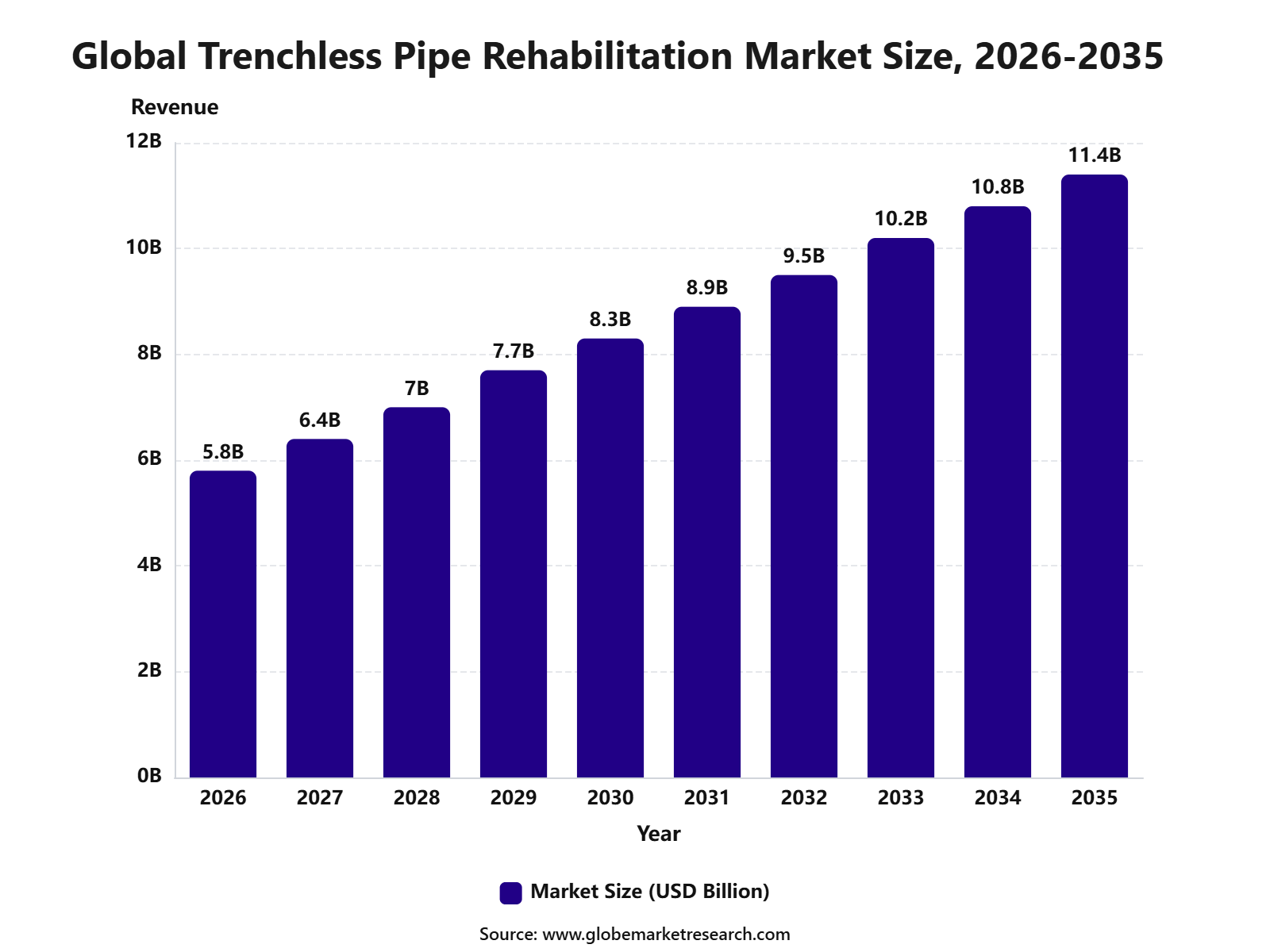 iThe graph shows projected market growth until 2035 based on CAGR analysis. Actual outcomes may vary depending on changing demand, competition, and economic factors.To gain greater insights - request a sample report PDF
Key Market Insights
Cured-in-place pipe led the method type segment with 43.6% share, supported by its lower excavation need, faster installation, cost efficiency, and strong use in repairing aging underground pipelines.
Pipes below 18 inches accounted for 56.9% share by diameter, driven by wide use in municipal water lines, sewer systems, residential networks, and urban utility infrastructure.
Water main pipes held 45.6% share by pipe type, supported by rising need to repair leakage, improve water flow, extend pipeline life, and reduce disruption during rehabilitation work.
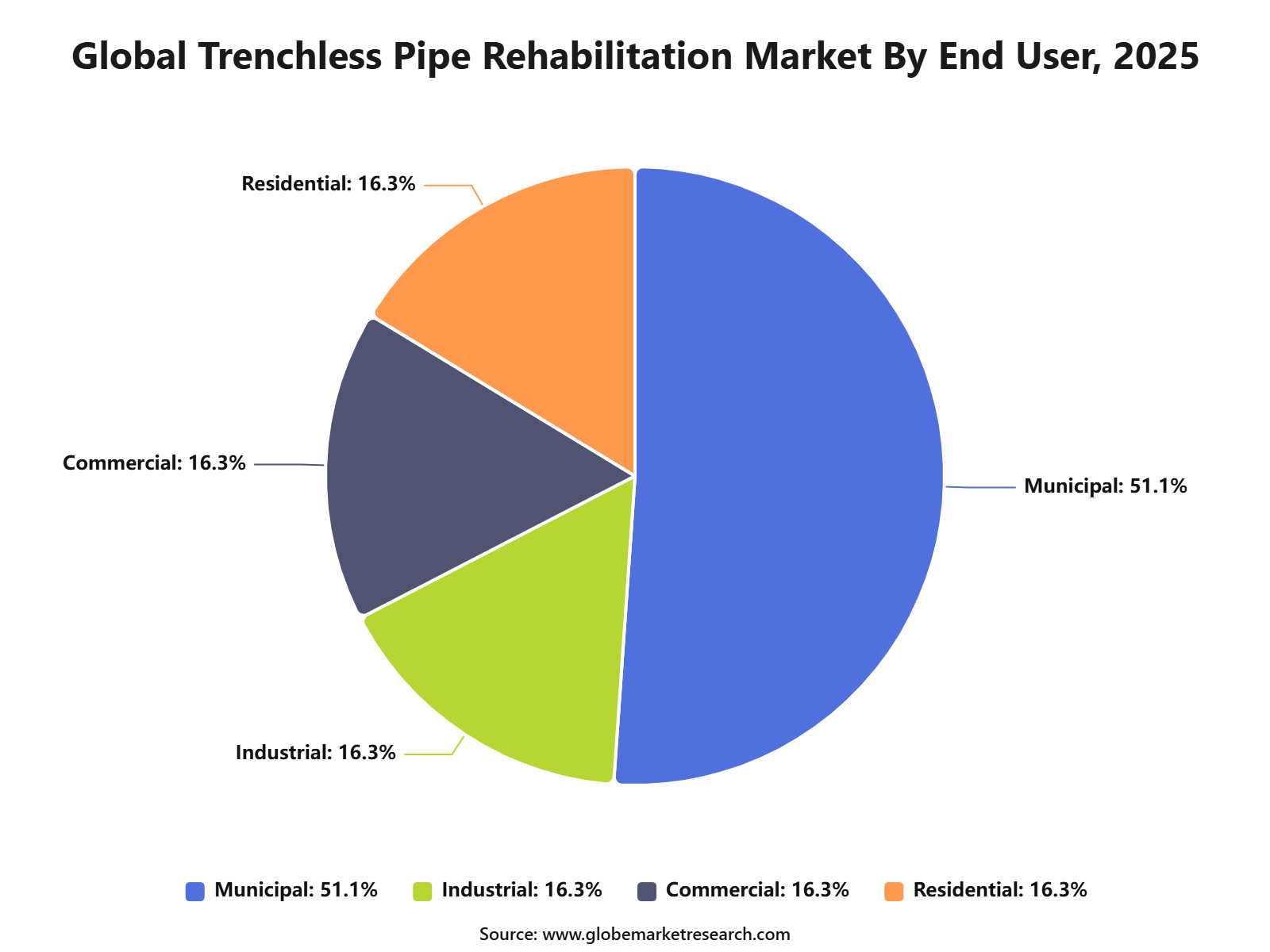
Municipal end users captured 51.1% share, driven by aging public utility networks, urban infrastructure upgrades, water loss reduction programs, and demand for cost-effective pipeline repair.
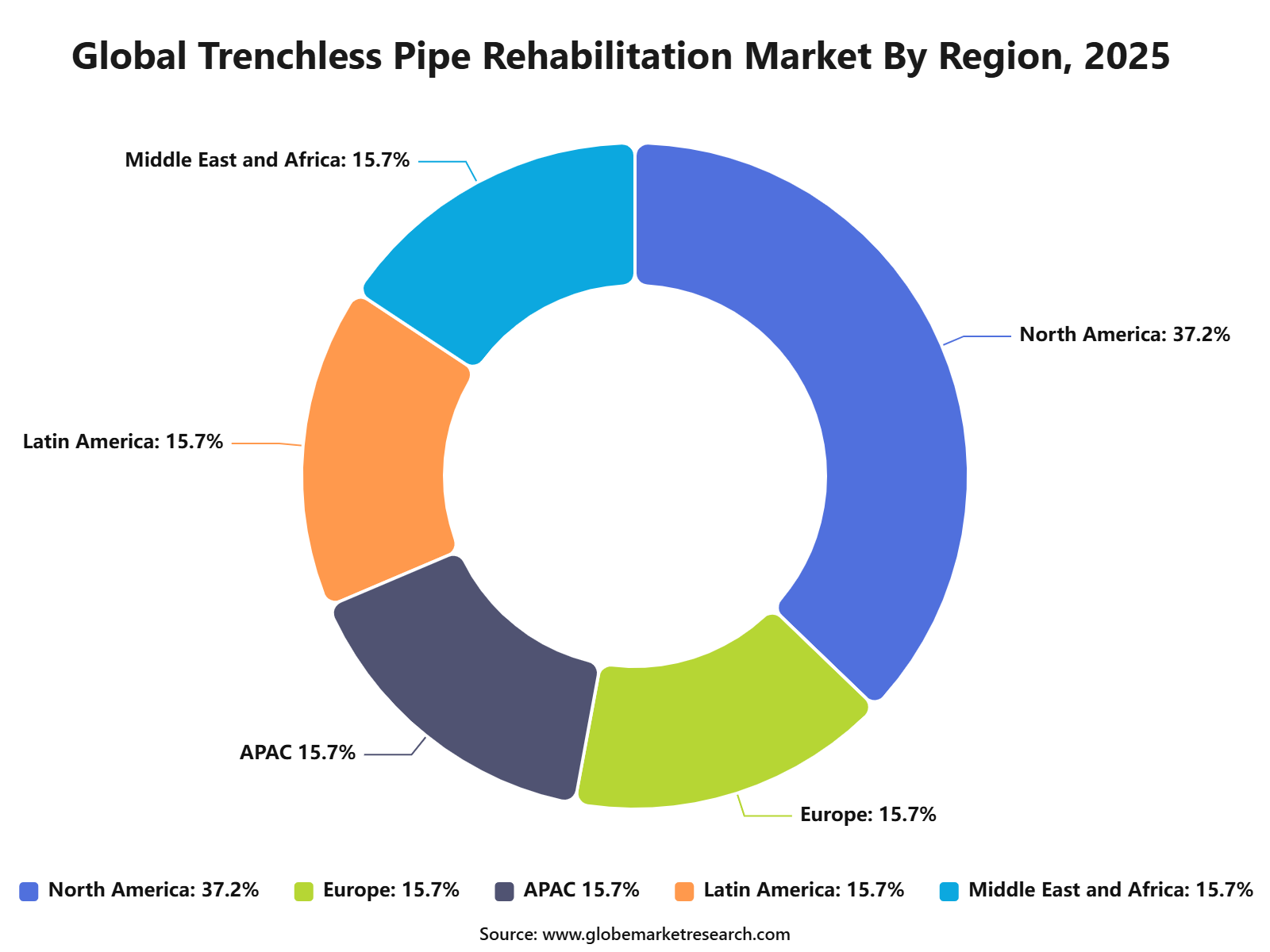
North America led the trenchless pipe rehabilitation market with 37.2% share, valued at USD 2.1 billion, supported by aging water infrastructure, strong municipal investment, and wider adoption of low-disruption repair methods.
Top Funding and Investment
Top Investments
In September 2025, Beaumont, Texas, included USD 80 million for sewer infrastructure within its five-year community investment plan. The allocation covers trunk sewer rehabilitation, lift-station improvements, and wastewater treatment upgrades, creating direct demand for trenchless inspection, lining, and pipe-renewal services.
In 2025, Waterbury, Connecticut, recorded approximately USD 33.7 million in water-system repairs and infrastructure improvements after major pipeline failures. The improvement program included relining large pipelines, upgrading pumps, installing isolation valves, and strengthening water and sewer system reliability.
In December 2025, Eagle Merchant Partners made a strategic investment in Atlantic Pipe Services, a Florida-based provider of wastewater and stormwater inspection, cleaning, and trenchless rehabilitation. Atlantic Pipe Services operated from seven locations, while the investment was structured to support new equipment, workforce expansion, geographic growth, and complementary acquisitions.
In November 2025, HCAP Partners invested in Federal EC alongside Crescent Peak and FVLCRUM Funds. Federal EC provides CIPP lining, cast-in-place pipe rehabilitation, storm-drain repair, hydro-jetting, and underground utility construction. The financing will support workforce development, operational expansion, and future acquisitions, although the investment amount was not disclosed.
In January 2025, the City of Manistee, Michigan, awarded a USD 124,135 contract to Corby Energy Services to rehabilitate three deteriorated concrete sewer mains. The project uses cured-in-place pipe lining without extensive excavation and is expected to extend the service life of the rehabilitated pipelines by more than 50 years.
Top Funding Developments
In April 2026, PENNVEST approved USD 284.2 million for 33 drinking-water, wastewater, stormwater, and pollution-control projects across 20 Pennsylvania counties. The financing covers rehabilitation of ageing systems, pipeline replacement, treatment upgrades, and water-quality improvements, supporting demand for trenchless renewal where excavation can be reduced.
In 2025, Long Branch secured approximately USD 1.4 million in grant funding for sewer collection-system rehabilitation. The fully funded project was designed to renew priority sections of the municipal sewer network and reduce structural failure and infiltration risks without placing the entire financial burden on local ratepayers.
In 2025, Owendale, Michigan, received a USD 476,000 state grant for sanitary sewer-system improvements. The award formed part of a USD 2.5 million Michigan program supporting infrastructure projects in financially distressed municipalities and provided capital for upgrading ageing wastewater assets.
Top Acquisitions
In November 2025, Azuria Water Solutions acquired Atlantic Coast Contractors, a trenchless pipeline rehabilitation company based in Denver, North Carolina. Azuria acquired the company’s rehabilitation workforce, equipment, municipal customer relationships, and capabilities in pipeline cleaning, inspection, CIPP lining, manhole rehabilitation, and underground infrastructure renewal.
In September 2025, Shenandoah acquired Nu-Pipe LLC, expanding its trenchless rehabilitation presence across North Carolina, South Carolina, and Florida. Shenandoah acquired Nu-Pipe’s spin-cast pipe lining, CIPP, injection-grouting expertise, operating team, customer relationships, and specialty rehabilitation capabilities.
By Method Type
Cured-in-place pipe accounted for 43.6% share of the Trenchless Pipe Rehabilitation Market. This leading position is supported by its wide use in repairing aging sewer, water, stormwater, and industrial pipelines without full excavation.
The method is preferred because it creates a new pipe lining inside the existing damaged pipe. It helps restore structural strength, reduce leakage, improve flow performance, and extend pipeline service life while limiting road closures and surface disruption.
Demand for cured-in-place pipe is expected to remain strong as municipalities and utilities focus on repairing old underground networks more efficiently. Its suitability for urban areas, faster installation, and lower restoration costs will continue to support segment leadership.
By Pipe Diameter
Below 18 inches pipe diameter accounted for 56.9% share of the Trenchless Pipe Rehabilitation Market. This dominance is driven by the large number of small and medium-diameter pipelines used in municipal water, wastewater, residential, and commercial utility networks.
These pipelines are commonly found under streets, neighborhoods, buildings, and local distribution systems. Trenchless rehabilitation is widely used for this diameter range because excavation can be expensive, disruptive, and time-consuming in populated areas.
Demand is expected to remain strong as small-diameter pipes require frequent inspection, lining, sealing, and structural repair. The segment will continue to benefit from municipal pipeline renewal, leakage reduction programs, and growing use of cost-efficient rehabilitation methods.
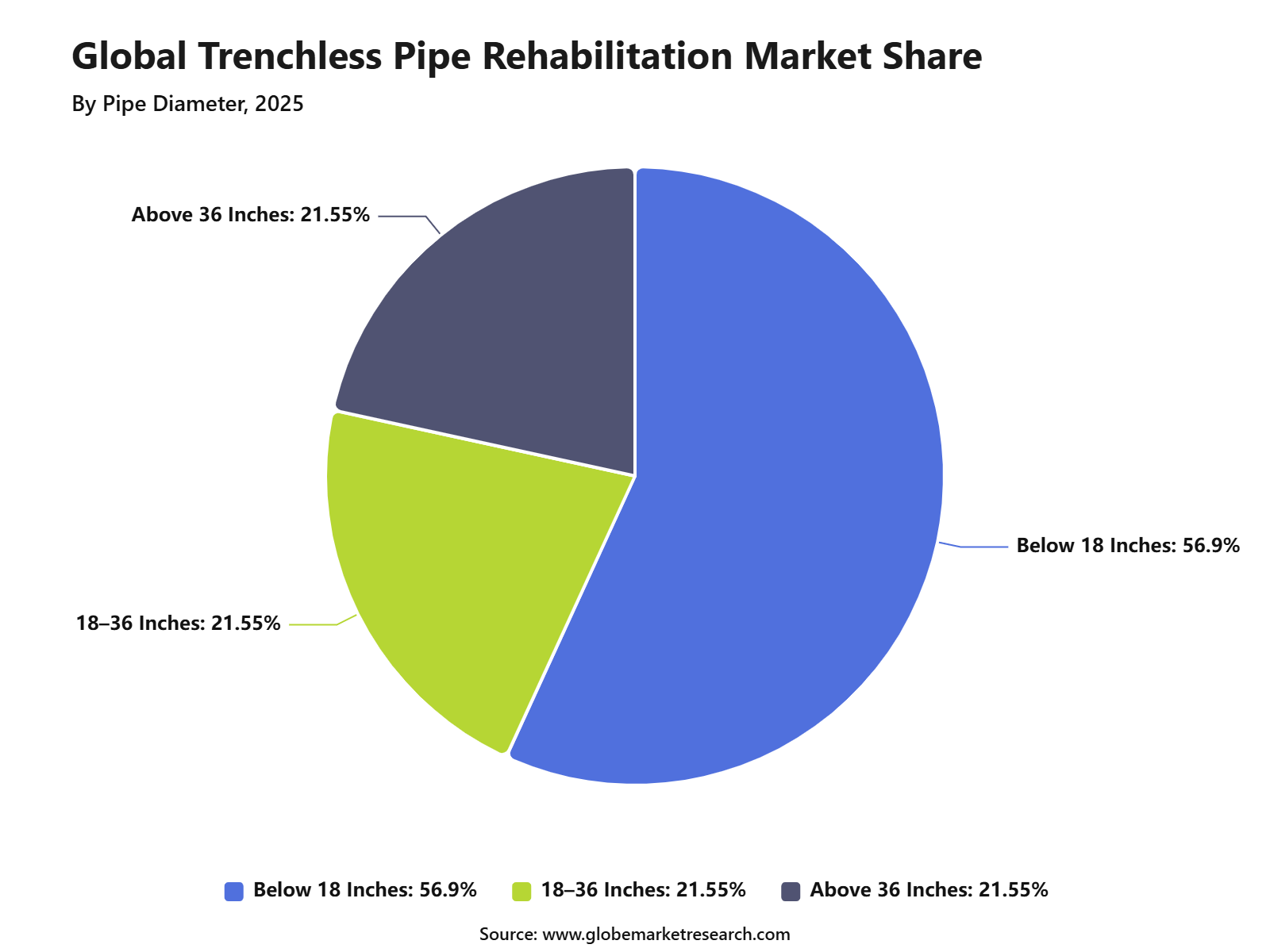 iThe graph shows projected market growth until 2035 based on CAGR analysis. Actual outcomes may vary depending on changing demand, competition, and economic factors.To gain greater insights - request a sample report PDF
By Pipe Type
Water main pipes accounted for 45.6% share of the Trenchless Pipe Rehabilitation Market. This leading share is supported by the urgent need to repair aging drinking water pipelines, reduce water loss, and improve supply reliability.
Water mains are critical assets because they carry treated water to households, commercial buildings, industries, and public facilities. Trenchless rehabilitation helps utilities restore pipe strength, control leakage, prevent contamination risk, and reduce service interruptions without large-scale excavation.
Demand for water main pipe rehabilitation is expected to remain strong as utilities focus on non-revenue water reduction and infrastructure modernization. The need for safe drinking water delivery and longer pipeline life will continue to support this pipe type segment.
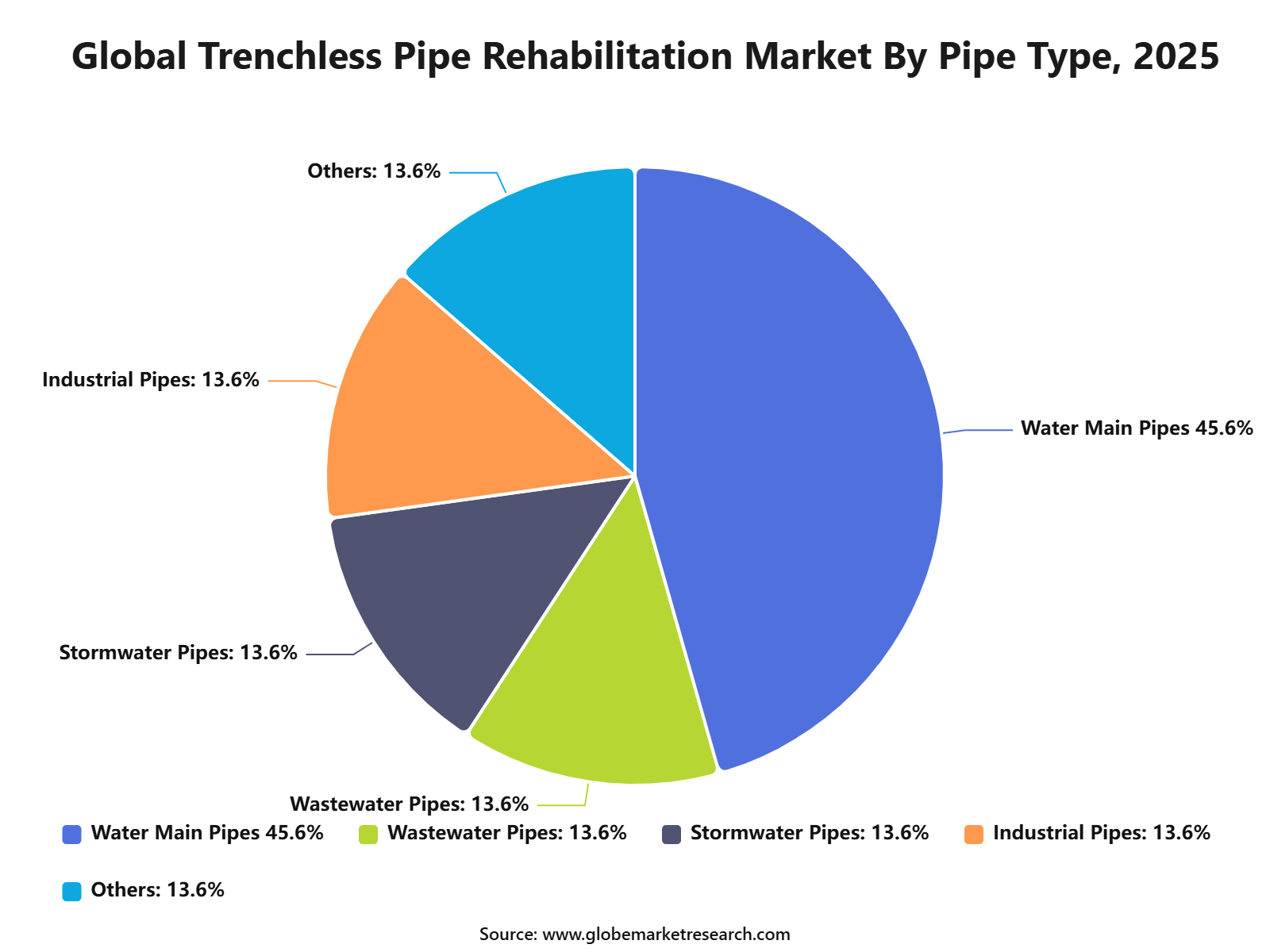 iThe graph shows projected market growth until 2035 based on CAGR analysis. Actual outcomes may vary depending on changing demand, competition, and economic factors.To gain greater insights - request a sample report PDF
By End User
Municipal end users accounted for 51.1% share of the Trenchless Pipe Rehabilitation Market. This leadership is supported by high demand from city water departments, wastewater utilities, public works agencies, and local government infrastructure programs.
Municipalities use trenchless rehabilitation to repair sewer lines, water mains, storm drains, and aging underground networks while reducing traffic disruption and public inconvenience. These methods also help manage budget pressure by lowering excavation, restoration, and labor costs.
The segment is expected to remain dominant as urban areas continue to face aging pipe networks and rising maintenance needs. Municipal investment in water security, wastewater management, and resilient infrastructure will continue to support trenchless rehabilitation demand.
 iThe graph shows projected market growth until 2035 based on CAGR analysis. Actual outcomes may vary depending on changing demand, competition, and economic factors.To gain greater insights - request a sample report PDF
By Region
North America accounted for 37.2% share of the Trenchless Pipe Rehabilitation Market, reaching USD 2.1 billion. The region’s leadership is supported by aging water and wastewater infrastructure, strong municipal spending, and high adoption of trenchless repair technologies.
The United States and Canada are key contributors due to extensive underground utility networks and rising need for pipe renewal. Demand is strong across water mains, sewer systems, stormwater pipelines, and municipal utility assets where excavation-based replacement can be costly and disruptive.
North America is expected to maintain a strong position as utilities continue to prioritize asset life extension and leakage control. Demand will remain supported by cured-in-place pipe methods, municipal infrastructure upgrades, and growing preference for faster, less disruptive rehabilitation solutions.
 iThe graph shows projected market growth until 2035 based on CAGR analysis. Actual outcomes may vary depending on changing demand, competition, and economic factors.To gain greater insights - request a sample report PDF
Regional Impact Analysis
North America leads the Trenchless Pipe Rehabilitation Market with 37.2% share in 2026, valued at around USD 2.2 billion, supported by aging municipal water and sewer networks, strong contractor capability, and large-scale infrastructure renewal needs. The U.S. remains the main contributor because of extensive underground pipe assets and rising demand for low-disruption repair.
Europe remains important due to wastewater system upgrades, strict environmental standards, and urban pipeline renewal programs. Asia Pacific supports future growth through rapid urbanization, expanding municipal utilities, and rising adoption of trenchless technologies in China, India, Japan, Australia, and Southeast Asia.
Impact Factor | Estimated CAGR Impact | Regional Relevance | Market Impact |
|---|---|---|---|
North America market leadership | +2.3% | North America, 37.2% share in 2026 | Leads global value demand. |
U.S. aging pipeline rehabilitation | +1.8% | U.S. | Drives major project demand. |
Canada water and wastewater upgrades | +1.2% | Canada | Supports regional growth. |
Europe sewer renewal programs | +1.0% | Germany, UK, France, Italy | Adds steady rehabilitation demand. |
Asia Pacific urban utility expansion | +0.9% | China, India, Japan, Australia | Builds future market growth. |
Go-To-Market and Sales Economics
Trenchless rehabilitation contractors should target municipal utilities, water authorities, and engineering consultants before annual capital plans are finalised. EPA announced USD 7.2 billion in FY2026 revolving-fund allotments for drinking-water and clean-water projects. Condition assessment, hydraulic modelling, pilot lining, and multi-year framework pricing can improve tender conversion and provide steadier crew utilisation.
Cooperative purchasing and technology-neutral specifications can shorten public-sector sales cycles. EPA estimates that U.S. drinking-water systems require USD 625 billion over 20 years for pipe replacement, treatment upgrades, storage, and other assets. Suppliers should offer cured-in-place pipe, sliplining, pipe bursting, spray lining, and pressure-pipe solutions matched to diameter, condition, access, and service requirements.
Regional contractor networks are essential for smaller communities that lack internal engineering and procurement capacity. USDA announced more than USD 11 million for Kansas water projects in April 2026, including 12,000 feet of collection lines and 22,000 feet of water mains. Local crews, equipment depots, emergency response, and grant-application support can improve market access.
Risk Factors & Market Barriers
Public procurement timing remains a major barrier because funding approval, design, environmental review, and bidding can extend well beyond one budget year. EPA’s WIFIA programme accepts applications on a rolling basis, but borrowers must prepare detailed letters of interest and financial documentation. Contractors should maintain flexible backlogs and avoid ordering project-specific materials before receiving formal approval.
Execution risk increases where pipelines cross railways, roads, rivers, and active public spaces. An Azuria case involved a 1,785-foot pressure pipeline beneath a busy railway, while another rehabilitated 1,600 feet beneath an active bike path. Bypass planning, access-pit design, curing control, inspection, and contingency allowances are required to prevent delays, leakage, and warranty claims.
Delivery capacity may tighten as regulated investment programmes expand. Ofwat approved GBP 104 billion for water infrastructure across England and Wales from 2025 to 2030. Skilled labour shortages, resin and liner availability, specialist equipment, traffic management, permitting, and subcontractor coordination can raise bid prices, extend schedules, and weaken margins under fixed-price rehabilitation contracts.
Revenue Potential Analysis
Revenue Landscape Across
Drinking-water rehabilitation offers sustained revenue through mains, transmission pipelines, service lines, and pressure systems. EPA identifies USD 625 billion of U.S. drinking-water infrastructure needs and estimates approximately four million lead service lines. Contractors can capture revenue from inspection, cleaning, structural lining, pipe bursting, connection reinstatement, disinfection, testing, and long-term condition-monitoring services.
Wastewater networks provide repeat opportunities across gravity sewers, force mains, laterals, and manholes. EPA allocated USD 90 million in April 2026 for Tribal and rural drinking-water and wastewater improvements, including repair of aged infrastructure and replacement of deteriorated collection systems. Small-diameter lining, manhole rehabilitation, bypass pumping, and emergency repairs can generate recurring municipal contracts.
England and Wales provide a visible international project pipeline through a GBP 104 billion expenditure programme running from 2025 to 2030. Ofwat states that investment in new infrastructure and resources will reach approximately GBP 44 billion, four times the previous level. Qualified suppliers can pursue sewer upgrades, leakage reduction, network resilience, and urban rehabilitation packages.
Financial Impact
Flexible public financing can improve project affordability and accelerate contract awards. EPA currently offers USD 6.5 billion through WIFIA and another USD 550 million through State WIFIA. Long-term loans, interest-rate resets, debt sculpting, and combined project financing can help utilities bundle rehabilitation schemes, creating larger contracts and improved revenue visibility for qualified contractors.
Trenchless methods can improve project economics where excavation would disrupt transport, businesses, or environmentally sensitive locations. Azuria reported that a pressure-line installation beneath a railway was completed in two days, while a Grand Canyon rehabilitation reduced the planned timeline by 50%. Shorter schedules can reduce traffic control, surface restoration, labour exposure, and customer disruption.
Large programmes support multi-year revenue but create substantial working-capital requirements. EPA’s FY2026 revolving funds total USD 7.2 billion, while Ofwat’s 2025–2030 programme totals GBP 104 billion. Contractors should use milestone billing, mobilisation payments, material escalation clauses, and disciplined bid selection to finance liners, resin, bypass systems, inspection equipment, and specialist crews before payment.
Drivers Impact Analysis
The Trenchless Pipe Rehabilitation Market is driven by aging water and wastewater pipelines, rising sewer repair needs, urban infrastructure renewal, and demand for low-disruption repair methods. Trenchless technologies help utilities restore underground pipelines without large-scale excavation, reducing traffic disruption, surface damage, and project completion time.
North America leads the market due to large aging municipal pipe networks, high rehabilitation spending, advanced contractor capability, and strong use of cured-in-place pipe solutions. The U.S. remains the key regional contributor because of major water main, sewer, stormwater, and municipal infrastructure rehabilitation needs.
Impact Factor | Estimated CAGR Impact | Regional Relevance | Market Impact |
|---|---|---|---|
Aging water and sewer infrastructure | +2.2% | North America, Europe, Asia Pacific | Drives core rehabilitation demand. |
Rising municipal pipeline repair needs | +1.8% | U.S., Canada, Europe | Supports recurring project activity. |
Need to reduce excavation disruption | +1.5% | Urban and high-traffic areas | Increases trenchless method adoption. |
Growth in wastewater network upgrades | +1.2% | Municipal and industrial markets | Adds demand for sewer rehabilitation. |
Demand for faster project completion | +0.9% | Cities and utility contractors | Improves trenchless project preference. |
Restraints Impact Analysis
The market faces restraints from high equipment cost, skilled labor requirements, project-specific design needs, and limited suitability for severely collapsed pipelines. Trenchless rehabilitation requires technical inspection, pipe condition assessment, resin selection, curing control, and trained operators.
Another restraint is public-sector budget pressure. Municipalities often face funding limitations, permitting delays, and competing infrastructure priorities, which can slow pipeline rehabilitation projects.
Impact Factor | Estimated CAGR Impact | Regional Relevance | Market Impact |
|---|---|---|---|
High equipment and setup cost | -1.0% | Contractors and municipalities | Limits small contractor participation. |
Skilled workforce shortage | -0.8% | North America and Europe | Slows project execution. |
Municipal budget constraints | -0.7% | Public utility markets | Delays rehabilitation programs. |
Limited use in collapsed pipes | -0.6% | Severely damaged pipeline networks | Requires replacement instead of rehab. |
Resin and material cost volatility | -0.5% | CIPP and lining systems | Pressures project margins. |
Opportunities Impact Analysis
Opportunities are strong in cured-in-place pipe, sliplining, pipe bursting, spray-in-place pipe, sewer lining, water main rehabilitation, stormwater systems, and industrial pipeline repair. These methods benefit from lower surface disruption and better lifecycle economics compared with open-cut replacement.
Higher-value opportunities are emerging in smart pipe inspection, robotic cutting, UV-cured liners, pressure pipe rehabilitation, asset management software, and long-term municipal service contracts. Contractors that combine inspection, engineering, rehabilitation, and maintenance support can capture stronger demand.
Impact Factor | Estimated CAGR Impact | Regional Relevance | Market Impact |
|---|---|---|---|
Cured-in-place pipe adoption | +2.1% | North America, Europe, Asia Pacific | Builds core market opportunity. |
Water main rehabilitation projects | +1.7% | U.S., Canada, urban Asia | Adds high-value utility demand. |
UV-cured liner technology | +1.3% | Developed infrastructure markets | Improves speed and quality control. |
Robotic inspection and cutting | +1.0% | Large municipal projects | Supports accurate rehabilitation work. |
Long-term municipal contracts | +0.8% | Public utility markets | Improves revenue visibility. |
Challenges Impact Analysis
The main challenge is selecting the right rehabilitation method for different pipe conditions, diameters, materials, and service requirements. Contractors must evaluate pipe age, cracks, infiltration, corrosion, root intrusion, flow conditions, and structural integrity before choosing a solution.
Another challenge is ensuring long-term liner performance. Poor curing, improper cleaning, incorrect resin selection, or weak installation quality can reduce service life and create warranty or compliance issues.
Impact Factor | Estimated CAGR Impact | Regional Relevance | Market Impact |
|---|---|---|---|
Method selection complexity | -0.9% | Municipal and industrial projects | Affects project success. |
Installation quality control | -0.8% | CIPP and lining contractors | Impacts service life. |
Managing bypass pumping needs | -0.6% | Sewer and wastewater projects | Adds project complexity. |
Site access and utility coordination | -0.5% | Dense urban areas | Slows project schedules. |
Warranty and performance risk | -0.4% | Contractors and utilities | Raises liability concerns. |
Segment Covered in the Report
By Method Type
Cured-in-Place Pipe
Pipe Bursting
Sliplining
Spray-in-Place Pipe
Others
By Pipe Diameter
Below 18 Inches
18–36 Inches
Above 36 Inches
By Pipe Type
Water Main Pipes
Wastewater Pipes
Stormwater Pipes
Industrial Pipes
Others
By End User
Municipal
Industrial
Commercial
Residential
By Region
North America
Europe
Asia Pacific
Latin America
Middle East and Africa
Market Trend Analysis
The market trend is moving toward cured-in-place pipe systems, UV curing, robotic pipeline inspection, pressure pipe rehabilitation, and digital asset management. Utilities are shifting from reactive repair toward planned pipeline renewal to reduce leaks, failures, and service interruptions.
North America remains the largest value region because of its aging water and sewer networks, mature trenchless contractor base, and strong municipal rehabilitation spending. Europe supports steady demand through wastewater upgrades, while Asia Pacific is expanding through urbanization and utility modernization.
Impact Factor | Estimated CAGR Impact | Regional Relevance | Market Impact |
|---|---|---|---|
CIPP remains the leading method | +2.0% | North America, Europe, Asia Pacific | Supports high-volume rehabilitation. |
UV curing technology grows | +1.5% | Urban and regulated markets | Improves curing speed and consistency. |
CCTV and robotic inspection expands | +1.2% | Municipal utility networks | Improves project planning. |
Pressure pipe rehabilitation increases | +1.0% | Water main systems | Adds higher-value applications. |
Digital asset management adoption | +0.8% | Public utilities | Supports planned maintenance. |
Investor Type Impact Matrix
Investors should focus on companies with strong municipal relationships, skilled trenchless crews, proven installation quality, reliable equipment, and access to liner and resin supply. Project execution, safety, warranty performance, and cost control are key success factors.
Strategic investors can also target CIPP contractors, trenchless technology providers, inspection robotics firms, UV curing equipment companies, resin suppliers, and infrastructure asset management platforms. Companies that combine field capability with advanced inspection and lining technology are better positioned for long-term growth.
Investor Type | Estimated CAGR Impact | Regional Relevance | Market Impact |
|---|---|---|---|
CIPP Contractors | +1.6% | North America, Europe, Asia Pacific | Expands core rehabilitation services. |
Trenchless Equipment Providers | +1.3% | Global contractor markets | Supports technology adoption. |
Liner and Resin Suppliers | +1.1% | Pipe rehabilitation supply chains | Builds recurring material demand. |
Inspection Robotics Companies | +0.9% | Municipal and industrial networks | Improves project planning and quality. |
Strategic Infrastructure Investors | +0.7% | Global water and wastewater markets | Funds service expansion and modernization. |
Recent Developments
In June 2026, Aegion’s successor, Azuria Water Solutions, acquired RSM Lining Supplies, adding global CIPP materials, equipment and services for gravity and pressure pipelines measuring 50 to 2,000 millimetres.
In March 2026, SANEXEN opened a Quebec City office to strengthen its regional presence, improve project coordination and expand delivery capacity for environmental remediation, industrial water treatment, dredging, dewatering and biosolids services.
In January 2026, Michels merged Mi-Tech with J.D. Hair & Associates, combining trenchless, geotechnical, structural and utility engineering capabilities while retaining employees and expanding alternative project-delivery services for infrastructure customers nationwide.
In March 2026, RELINE delivered its 150th UV curing system to Rohrsanierung Jensen. The REE4000 provides up to 24,000 watts and cures thick-wall liners in pipeline dimensions reaching DN 2000.
Competitive Landscape
The market is characterized by intense competition among established players and emerging companies. Strategic partnerships, mergers and acquisitions, and product innovation are key strategies employed by market participants.
Key Market Players
Aegion Corporation
SAERTEX multiCom
Sekisui Chemical Co., Ltd.
Sak Construction
Michels Corporation
Granite Construction
Inliner Solutions
Sanexen Environmental Services
Perma-Liner Industries
Reline Europe
Trelleborg AB
Insituform Technologies
Nu Flow Technologies
Vortex Companies
LMK Technologies
Other Key Players
Research Methodology
This market study is prepared using a combination of primary and secondary research. Primary research includes discussions with manufacturers, suppliers, distributors, consultants, industry experts, and end users. Secondary research covers company reports, government databases, trade associations, technical publications, regulatory sources, and trusted industry documents. The collected information is used to assess market demand, pricing trends, technology adoption, competitive activity, and regional performance.
AI language models are not used as primary data sources, and publicly available AI-generated content is not treated as market evidence. Computational tools may be used to support data processing, translation, data classification, and pattern identification. However, every published assessment is supported by verified sources, human review, and primary market discussions.
Market estimates are developed through top-down and bottom-up approaches and validated using data triangulation. Revenue, production, shipment, pricing, and application-level data are compared across multiple sources. Forecasts consider economic conditions, regulatory changes, investment activity, innovation, supply chain developments, and industry risks. All findings are reviewed through source verification and internal quality checks before publication.
Part I
Source Management & Input Data Standards
Who provides data, how sources are qualified, and what types of evidence are admissible.
Part II
Research Scope & Market Coverage
How we define the markets we assess and the parameters that govern each product.
Part III
Data Collection, Verification & Submission
The mechanics of gathering, cross-checking, and hierarchically ranking evidence.
Part IV
Assessment Determination & Quality Controls
How raw data becomes a published assessment — normalisation, expert judgement, and outlier exclusion.
Part V
Publication, Corrections & Revision
Our publication schedule, corrections policy, and methodology review cycle.
Part VI
Independence, Ethics & Complaints
Conflict-of-interest policies, editorial independence, and how clients raise concerns.
Google · Preferred Sources
Don't miss the latest market research insights and industry updates on Google.
Add Globe Market Research as a preferred source in the Google app to see our reports, analysis, and market stories in your news suggestions.
Meet the Team
This report was prepared by our expert analysts with deep industry knowledge and research experience.
Pratiksha K. is a Senior Research Analyst with more than five years of experience in market research, industry analysis, competitive intelligence, and business strategy. She has contributed to detailed market reports, customized research studies, company profiling, market sizing, trend analysis, and strategic consulting projects for clients across different regions. Her industry expertise covers Chemical and Material, Consumer Goods, Food & Beverages and Energy & Power. She closely evaluates changing customer requirements, technology developments, regulatory conditions, supply chain structures, investment activity, and competitive strategies to provide clear and practical market insights.
Sayali brings more than 7 years of experience to Globe Market Research, supporting the accuracy, clarity, and relevance of research content across multiple industries. She reviews market data, segment analysis, competitive insights, and industry trends to ensure each report meets strong quality standards and provides practical value to business decision-makers. Her expertise spans healthcare, information technology, consumer goods, and diverse cross-industry domains. With a strong focus on data reliability, structured analysis, and clear presentation, Sayali helps ensure that each research output delivers well-reviewed insights for clients, investors, consultants, and industry stakeholders.
Frequently Asked Questions
Related Reports
More in Chemical and Material
Sulfuric Acid Market to Hit USD 61.5 Billion by 2035
Sulfuric Acid Market Size, Share, Analysis By Raw Material (Elemental Sulfur, Base Metal Smelters, Pyrite Ore, Others), By Application (Fertilizers, Chemical Manufacturing, Metal Processing, Petroleum Refining, Textile, Automotive, Pulp and Paper, Others), By Distribution Channel (Direct Sales, Distributors), By Regional Insights, Business plan and Project Report, Investment Opportunities, Profitability, Industry Trends, Leading Companies and Growth Forecasts by 2026-2035
Powder Metallurgy Market to Hit USD 17.0 Billion by 2035
Powder Metallurgy Market Size, Share, Analysis By Material (Ferrous Metals, Non-Ferrous Metals, Others), By Process (Additive Manufacturing, Powder Metal Hot Isostatic Pressing, Conventional Powder Metallurgy), By Application (Automotive, Aerospace and Defense, Healthcare, Electrical and Electronics, Industrial Machinery, Others) , By Regional Insights, Business plan and Project Report, Investment Opportunities, Profitability, Industry Trends, Leading Companies and Growth Forecasts by 2026-2035
Bromine Market to Hit USD 1.5 Billion by 2035
Bromine Market Size, Share, Analysis By Derivative (Organobromine, Clear Brine Fluids, Hydrogen Bromide, Others), By Application (Flame Retardants, Oil and Gas Drilling, Biocides, PTA Synthesis, Plasma Etching, Pharmaceuticals, Energy Storage, Others), By End-Use Industry (Chemicals, Oil and Gas, Pharmaceuticals, Electrical and Electronics, Automotive, Agriculture, Others), By Regional Insights, Business plan and Project Report, Investment Opportunities, Profitability, Industry Trends, Leading Companies and Growth Forecasts by 2026-2035
Hydrogen Cyanide Market to Hit USD 5.95 Billion by 2035
Hydrogen Cyanide Market Size, Share, Analysis By Product Form (Hydrogen Cyanide Liquid, Hydrogen Cyanide Gas), By Application (Adiponitrile, Acetone Cyanohydrin, Sodium Cyanide and Potassium Cyanide, Methionine, Cyanuric Chloride, Others), By End-Use Industry (Chemicals, Mining and Metallurgy, Pharmaceuticals, Agriculture, Textiles, Others), By Regional Insights, Business plan and Project Report, Investment Opportunities, Profitability, Industry Trends, Leading Companies and Growth Forecasts by 2026-2035