

Revenue, 2026
USD 2.1 Bn
Forecast, 2035
USD 6.72 Bn
CAGR, 2026-2035
13.8%
Report Coverage
Global
Market Size and Forecast
The Global Ultra-High Purity Manganese Sulphate Market was worth USD 2.1 billion in 2026 and is expected to reach USD 6.72 billion by 2035, growing at a CAGR of 13.8% from 2026 to 2035. Asia Pacific held the largest regional share of 48.2% in 2026, valued at around USD 1.0 billion, supported by strong battery material production, electric vehicle manufacturing, and growing investment in lithium-ion battery supply chains.
The Ultra-High Purity Manganese Sulphate Market includes high-grade manganese sulphate used mainly in battery cathode materials, especially for electric vehicles and energy storage systems. It is also used in specialty chemicals and advanced industrial applications where strict purity levels are required. The product is gaining importance because battery manufacturers need stable, low-impurity raw materials to improve performance, safety, and lifecycle efficiency.
Market growth is being supported by rising demand for nickel-manganese-cobalt and lithium manganese-based battery chemistries. Battery producers are using ultra-high purity manganese sulphate to support higher energy density, cost optimization, and reliable cathode production. Demand is also increasing as governments and companies expand clean mobility, grid storage, and localized battery material processing.
Key Parameter | Report Details |
|---|---|
Market Revenue, 2026 | USD 2.1 Billion |
Projected Revenue, 2035 | USD 6.72 Billion |
CAGR (2026-2035) | 13.8% |
Largest Region | Asia Pacific (48.2%, USD 1.0 Bn) |
Market Concentration | Medium |
Base Year | 2025 |
Forecast Period | 2026-2035 |
Asia Pacific is expected to remain the leading region due to its strong electric vehicle ecosystem, large battery manufacturing base, and growing cathode material capacity. China, South Korea, Japan, and emerging Southeast Asian supply chains are supporting regional demand through battery chemicals, refining, and cell production. Long-term growth will depend on raw material security, purity control, processing capacity, environmental compliance, and stronger demand from EV and energy storage applications.
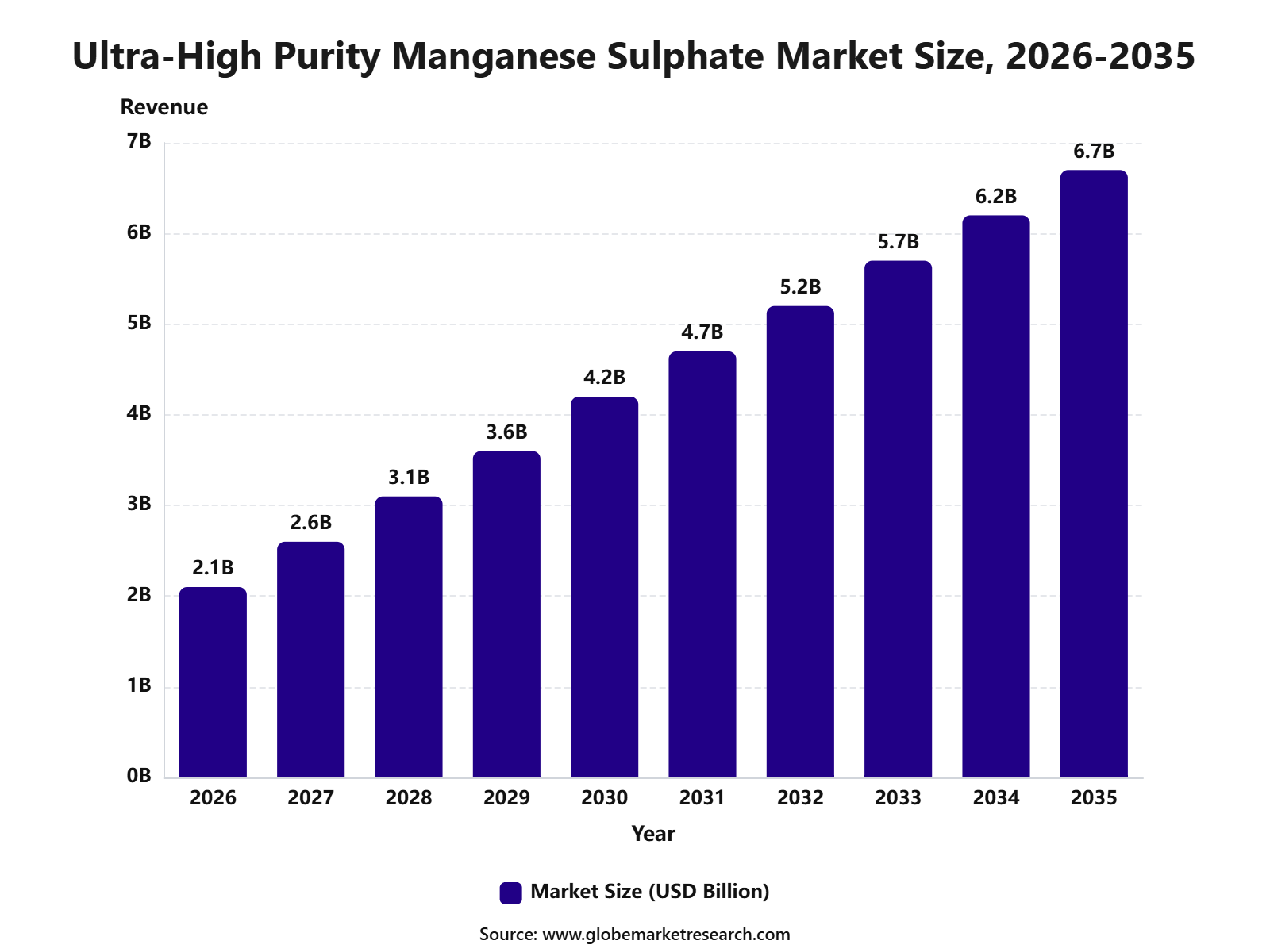 iThe graph shows projected market growth until 2035 based on CAGR analysis. Actual outcomes may vary depending on changing demand, competition, and economic factors.To gain greater insights - request a sample report PDF
Key Market Insights
Battery grade led the grade segment with 63.3% share, supported by strong demand for high-purity manganese materials used in advanced lithium-ion battery cathode production.
Batteries accounted for 59.2% share by application, driven by rising use of ultra-high purity manganese sulphate in electric vehicles, energy storage systems, and rechargeable battery technologies.
Automotive held 50.4% share by end user, supported by growing electric vehicle production and increasing demand for battery materials that improve performance, cost efficiency, and supply chain stability.
Offline distribution captured 85.1% share, driven by bulk purchasing, long-term supplier contracts, direct industrial procurement, and quality-sensitive supply arrangements with battery and chemical manufacturers.
Asia Pacific led the ultra-high purity manganese sulphate market with 48.2% share, valued at USD 1.0 billion, supported by strong battery manufacturing, expanding EV production, and high demand across China, Japan, South Korea, and India.
Top Funding and Investment
Top Investments
In 2026, Manganese Metal Company continued commissioning its MTX-1 plant in Mbombela, South Africa. The facility has an annual capacity of 6,000 tonnes of high-purity manganese sulphate monohydrate, with qualification production scheduled for the second half of 2026.
In 2025, Giyani Metals produced high-purity manganese sulphate monohydrate at its Johannesburg demonstration plant. The facility was constructed at approximately one-tenth of the engineering scale planned for the commercial K.Hill operation in Botswana and is being used to provide material for customer qualification.
In 2025, Element 25 advanced its proposed battery-grade HPMSM refinery in Ascension Parish, Louisiana. The facility is intended to process manganese concentrate from the company’s Butcherbird operation and establish a U.S.-based supply of high-purity manganese sulphate for electric-vehicle batteries.
During 2025 and 2026, South32 progressed the Clark deposit within its Hermosa project in Arizona. The planned operation is designed to support production of up to 185,000 tonnes per year of high-purity manganese products, strengthening the development of a domestic U.S. battery-material supply chain.
In 2025, Euro Manganese continued investing in the development and customer-qualification activities of the Chvaletice Manganese Project in the Czech Republic. The project is designed to recover manganese from historic mine tailings and produce high-purity manganese products for European battery manufacturers.
Top Funding Developments
In January 2025, Element 25 signed a USD 166 million grant agreement with the U.S. Department of Energy for its Louisiana HPMSM refinery. The funding will support construction of a battery-grade high-purity manganese sulphate facility, alongside previously committed support from General Motors and Stellantis.
In 2025, U.S. federal records showed approximately USD 123 million in obligated funding for South32 Hermosa’s high-purity manganese development. The broader award supports the planned commercial-scale production of battery-grade manganese materials from the Clark deposit in Arizona.
In May 2025, Euro Manganese completed a C$11.2 million, approximately A$12.3 million, financing package. It included a C$9.8 million private placement and a C$1.4 million share-purchase plan, with proceeds allocated to Chvaletice project development, customer engagement and potential offtake arrangements.
Top Acquisitions
In May 2025, Exxaro agreed to acquire a manganese asset portfolio for approximately ZAR 11.67 billion, or about USD 636 million. The company acquired interests including 74% of Ntsimbintle Mining, 19.99% of Jupiter Mines, 51% of Mokala Manganese, 9% of Hotazel Manganese Mines and 100% of Ntsimbintle Marketing and Trading. These assets provide upstream manganese feedstock exposure relevant to future high-purity processing.
In November 2025, Marula Mining announced the acquisition of a majority interest in a South African manganese mining project. The transaction provided Marula with rights to the mining area and access to nearby crushing, washing and screening infrastructure, with initial production targeting 1,000 tonnes of run-of-mine manganese ore by December 2025.
By Grade
Battery grade ultra-high purity manganese sulphate accounted for 63.3% share of the Ultra-High Purity Manganese Sulphate Market. This leading position is supported by its critical use in lithium-ion battery cathode materials, especially nickel-manganese-cobalt and lithium manganese iron phosphate chemistries.
The segment is widely preferred because battery manufacturing requires high-purity input materials with strict control over impurities, particle consistency, and chemical stability. Battery grade manganese sulphate supports cathode performance, safety, cycle life, and energy density in electric vehicle and energy storage batteries.
Demand is expected to remain strong as battery producers increase capacity and seek lower-cost, high-performance cathode materials. The growing focus on manganese-rich battery chemistries will continue to support battery grade ultra-high purity manganese sulphate.
By Application
Batteries accounted for 59.2% share of the Ultra-High Purity Manganese Sulphate Market. This dominance is driven by rising demand for manganese-based materials in rechargeable batteries used across electric vehicles, energy storage systems, consumer electronics, and industrial power applications.
Ultra-high purity manganese sulphate is used as a key precursor in cathode active material production. Its role is important because cathode quality directly affects battery durability, charging performance, thermal stability, and overall cell efficiency.
The segment is expected to remain the largest application area as battery supply chains expand globally. Demand will remain supported by electric mobility, stationary energy storage, and growing interest in manganese-rich cathode formulations that can reduce dependence on higher-cost battery metals.
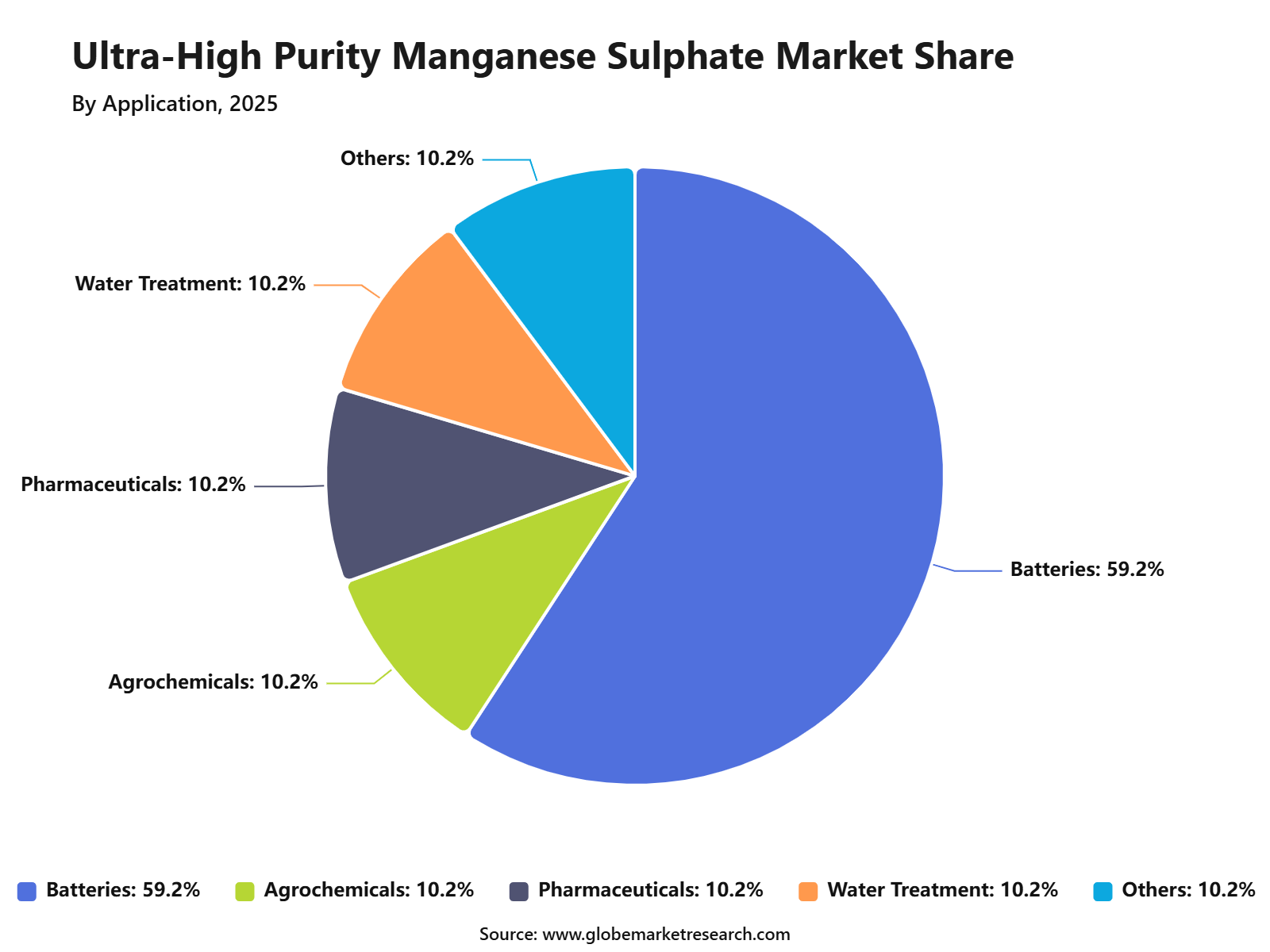 iThe graph shows projected market growth until 2035 based on CAGR analysis. Actual outcomes may vary depending on changing demand, competition, and economic factors.To gain greater insights - request a sample report PDF
By End User
The automotive sector accounted for 50.4% share of the Ultra-High Purity Manganese Sulphate Market. This leading share is supported by the rising use of lithium-ion batteries in electric vehicles, plug-in hybrids, and next-generation mobility platforms.
Automotive battery makers use ultra-high purity manganese sulphate to produce cathode materials that support longer driving range, stable performance, and improved battery economics. Manganese is gaining importance because it can help balance cost, safety, and performance in battery chemistry development.
Demand from automotive end users is expected to remain strong as electric vehicle production continues to scale. Growth will be supported by battery gigafactories, cathode material investments, and wider adoption of manganese-containing battery chemistries across passenger and commercial vehicles.
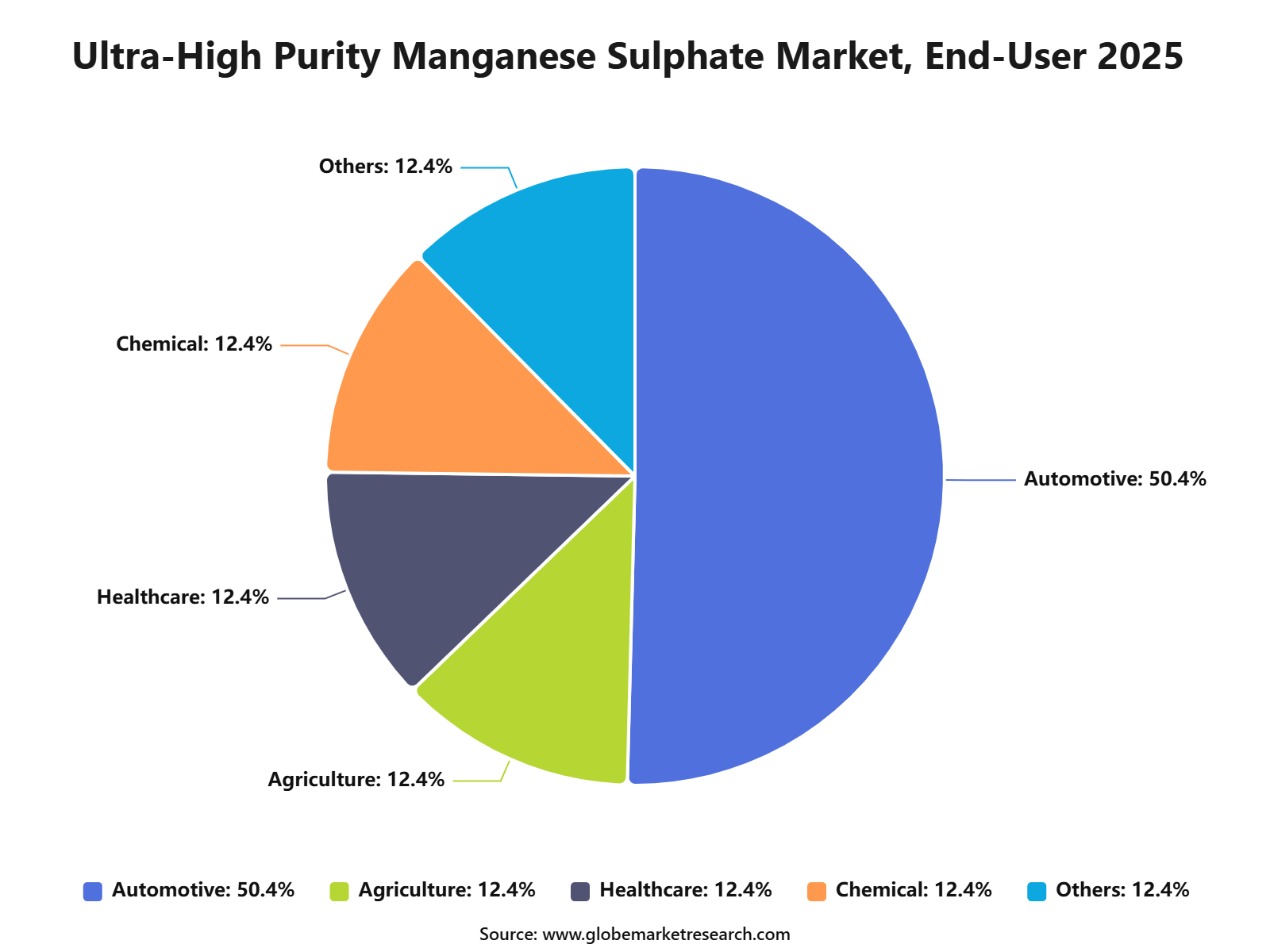 iThe graph shows projected market growth until 2035 based on CAGR analysis. Actual outcomes may vary depending on changing demand, competition, and economic factors.To gain greater insights - request a sample report PDF
By Distribution Channel
Offline distribution accounted for 85.1% share of the Ultra-High Purity Manganese Sulphate Market. This dominance is supported by the technical nature of the product, bulk procurement requirements, and long-term supply agreements between chemical producers, cathode manufacturers, and battery companies.
Offline channels are preferred because buyers require strict quality checks, material certification, logistics coordination, and direct supplier relationships. In battery-grade chemicals, consistency, traceability, and supply reliability are more important than simple transactional purchasing.
The segment is expected to maintain its leading position as battery material supply chains remain contract-driven and qualification-based. Direct sales, distributor networks, and industrial procurement relationships will continue to support large-volume movement of ultra-high purity manganese sulphate.
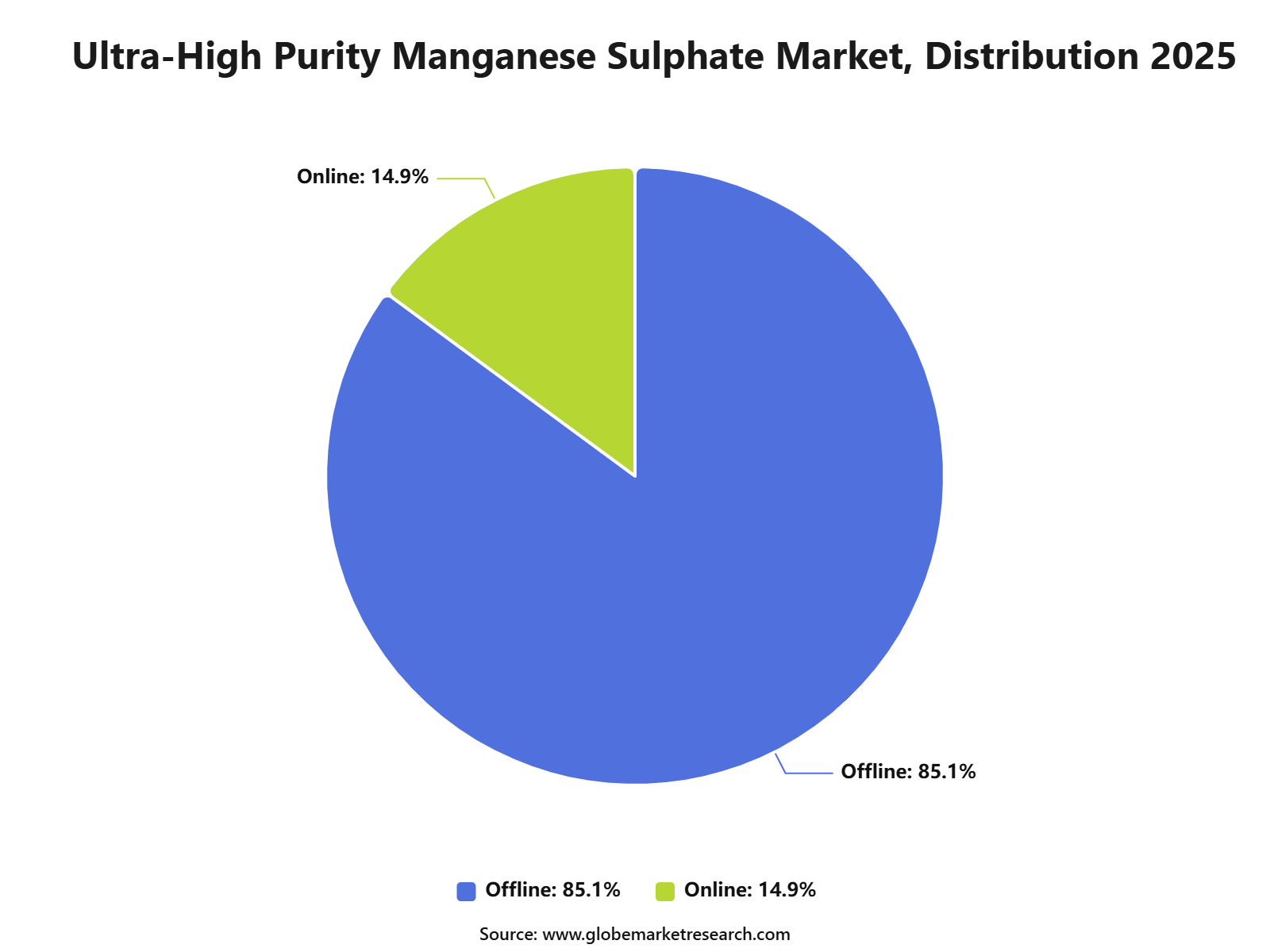 iThe graph shows projected market growth until 2035 based on CAGR analysis. Actual outcomes may vary depending on changing demand, competition, and economic factors.To gain greater insights - request a sample report PDF
By Region
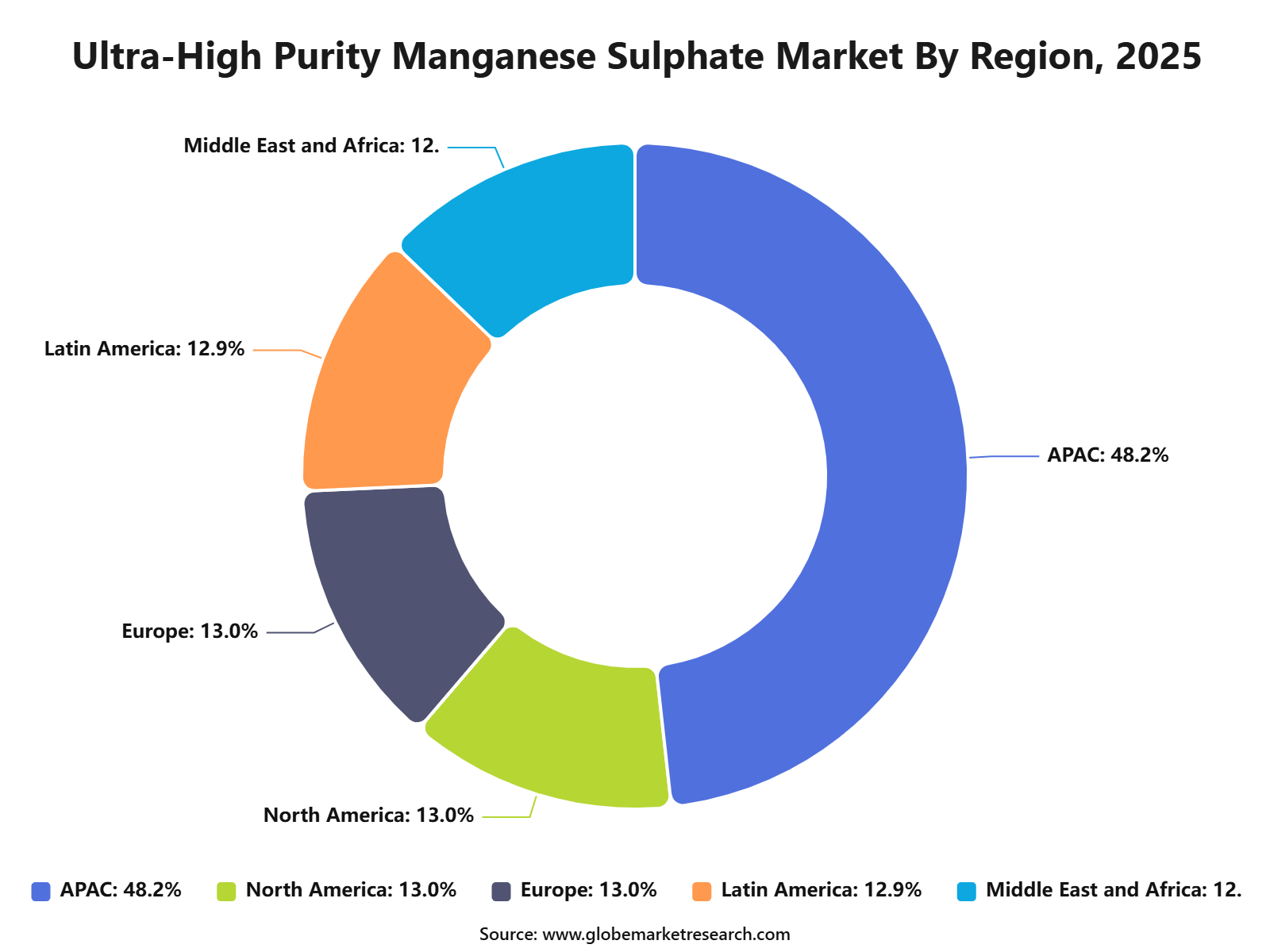
Asia Pacific accounted for 48.2% share of the Ultra-High Purity Manganese Sulphate Market, reaching USD 1.0 billion. The region’s leadership is supported by strong battery manufacturing capacity, cathode material production, electric vehicle output, and chemical processing infrastructure.
China, Japan, South Korea, India, and Southeast Asian countries are key contributors to regional demand. The region benefits from established battery supply chains, large-scale cathode production, and rising investment in localized raw material processing.
Asia Pacific is expected to maintain its leading position as electric vehicle production and energy storage deployment continue to expand. Demand will remain supported by battery grade materials, automotive battery growth, offline industrial supply channels, and increasing use of manganese-based cathode technologie
 iThe graph shows projected market growth until 2035 based on CAGR analysis. Actual outcomes may vary depending on changing demand, competition, and economic factors.To gain greater insights - request a sample report PDF
Regional Impact Analysis
Asia Pacific leads the Ultra-High Purity Manganese Sulphate Market with 48.2% share in 2026, valued at around USD 1.0 billion, supported by large cathode material production, EV battery manufacturing, and battery chemical processing capacity. China, South Korea, Japan, and India remain key regional markets.
North America remains important because of EV battery investments, energy storage demand, and efforts to reduce battery material supply dependence. Europe supports growth through local battery manufacturing, recycling projects, and stricter sustainability requirements.
Impact Factor | Estimated CAGR Impact | Regional Relevance | Market Impact |
|---|---|---|---|
Asia Pacific market leadership | +4.1% | Asia Pacific, 48.2% share in 2026 | Leads global value demand. |
China cathode material scale | +3.2% | China | Drives high-volume consumption. |
South Korea and Japan battery supply chains | +2.6% | South Korea, Japan | Supports premium battery-grade demand. |
India battery material localization | +2.0% | India | Adds future regional opportunity. |
Europe and North America battery localization | +1.8% | U.S., Canada, Germany, France | Supports supply security investment. |
Go-To-Market and Sales Economics
Ultra-high purity manganese sulphate suppliers should sell directly to cathode active material producers, cell manufacturers, and automotive purchasing teams. The IEA expects global electric-car sales to reach 23 million in 2026, equal to 28% of total car sales. Multi-year qualification, traceability records, impurity control, and indexed offtake contracts can improve conversion and revenue visibility.
Regional sales plans should reflect where battery production is concentrated. In 2025, China represented 60% of EV battery deployment, the European Union almost 15%, and the United States 10%. Suppliers should place sample preparation, technical service, and inventory near cathode plants, while using local logistics and customs expertise to shorten qualification and delivery cycles.
Commercial entry should begin with demonstration-scale material and customer validation before full plant construction. Giyani’s May 2026 feasibility study reported 87% manganese recovery after successful demonstration-plant operation. Producers should provide consistent batch chemistry, lifecycle data, pilot quantities, and conversion support because automotive customers usually require extensive testing before approving long-term battery-material supply.
Risk Factors & Market Barriers
Chemistry substitution is the largest demand risk. In 2025, LFP represented more than half of EV batteries and over 90% of storage batteries, while its prices were more than 40% below NMC. Ultra-pure manganese suppliers must therefore support NMC, LMFP, sodium-ion, and manganese-rich chemistries rather than depend on one cathode pathway.
Supply concentration creates geopolitical and customer-qualification barriers. Giyani’s 2026 study stated that China controlled 95% of manganese processing capacity. New producers must prove reliable purification, waste management, carbon performance, and scale-up capability, while buyers may hesitate to sign bankable offtake agreements until samples meet tight sodium, calcium, iron, and heavy-metal specifications.
Ore supply is geographically concentrated and prices can move sharply. USGS estimated 2025 world manganese mine production at 20 million tonnes, including 7.6 million tonnes from South Africa and 5 million tonnes from Gabon. The same 2026 publication reported a 22% decline in Chinese 44%-grade ore prices, increasing procurement, inventory, and project-financing uncertainty.
Revenue Potential Analysis
Revenue Landscape Across
Electric mobility provides the largest addressable revenue channel for battery-grade material. Nearly 22 million electric cars were produced globally in 2025, more than 25% above the previous year. Revenue can be captured through HPMSM supply for NMC precursors, manganese-rich cathodes, and emerging LMFP formulations, supported by long-term volume commitments and technical collaboration.
North America offers supply-security revenue because the United States remained 100% import-reliant for manganese in 2025 and recorded no domestic mine production. Qualified producers can target cathode plants, cell factories, and automakers seeking regional content, traceable ore, lower transport exposure, and stable contracts, particularly where public funding supports domestic battery-material processing.
Europe offers value through policy-backed diversification and local cathode manufacturing. The Critical Raw Materials Act targets domestic capacity equal to 10% of extraction, 40% of processing, and 25% of recycling needs by 2030, while limiting dependence on one country to 65%. Regional HPMSM projects can compete through traceability, low-carbon processing, and shorter supply chains.
Financial Impact
Project economics can be attractive when ore quality, recovery, energy use, and reagent consumption are controlled. Giyani’s May 2026 feasibility study estimated a post-tax NPV of USD 481.5 million, a 20.3% internal rate of return, USD 1.6 billion in lifecycle free cash flow, and a 46% operating margin. These remain project estimates, not realised results.
Capital intensity remains a major financial hurdle. Euro Manganese’s 2026 assessment estimated initial capital expenditure of USD 627.5 million and a post-tax NPV of USD 492 million for its Chvaletice project, assuming production begins in 2032. Returns will depend on financing terms, construction discipline, product pricing, plant utilisation, and timely customer qualification.
Pricing power is constrained by battery-cell economics. The IEA reported in 2026 that cathode active materials account for 40% to 50% of NMC cell-production costs, while many cathode producers have operated at significant losses since 2023. HPMSM suppliers should use staged capacity, customer prepayments, price floors, and reagent pass-through clauses to protect cash flow.
Drivers Impact Analysis
The Ultra-High Purity Manganese Sulphate Market is driven by rising demand from lithium-ion battery cathodes, electric vehicles, energy storage systems, and high-manganese battery chemistries. Ultra-high purity manganese sulphate is used in battery-grade precursor materials where chemical purity, impurity control, and consistent quality are critical.
Asia Pacific leads the market due to strong battery manufacturing, cathode material production, EV supply chains, and chemical processing capacity. China, South Korea, Japan, and India remain key contributors because of large-scale battery production and rising investment in localized battery material supply.
Impact Factor | Estimated CAGR Impact | Regional Relevance | Market Impact |
|---|---|---|---|
Rising EV battery production | +3.9% | Asia Pacific, Europe, North America | Drives core battery-grade demand. |
Growth in cathode precursor manufacturing | +3.4% | China, South Korea, Japan | Supports high-purity material use. |
Expansion of energy storage systems | +2.8% | Asia Pacific, Europe, U.S. | Adds stationary battery demand. |
Demand for high-manganese cathode chemistries | +2.3% | Battery innovation markets | Supports future material adoption. |
Localization of battery supply chains | +1.9% | Asia Pacific, Europe, North America | Encourages domestic processing capacity. |
Restraints Impact Analysis
The market faces restraints from complex purification requirements, raw material quality variation, high processing cost, and strict battery-grade specifications. Producing ultra-high purity manganese sulphate requires advanced refining, impurity removal, filtration, crystallization, and quality testing.
Another restraint is demand uncertainty across cathode chemistries. Battery manufacturers may shift between NMC, LFP, LMFP, sodium-ion, and other chemistries depending on cost, performance, safety, and supply chain strategy.
Impact Factor | Estimated CAGR Impact | Regional Relevance | Market Impact |
|---|---|---|---|
High purification and processing cost | -2.1% | Global battery material producers | Pressures margins and pricing. |
Raw material quality variation | -1.8% | Manganese ore and intermediate supply chains | Affects product consistency. |
Strict battery-grade impurity limits | -1.5% | Cathode and precursor suppliers | Raises qualification requirements. |
Cathode chemistry competition | -1.3% | EV and energy storage markets | Creates demand uncertainty. |
Environmental and waste treatment cost | -1.0% | Chemical processing regions | Increases compliance burden. |
Opportunities Impact Analysis
Opportunities are strong in battery-grade manganese sulphate, cathode precursor materials, high-manganese NMC, LMFP batteries, localized refining capacity, recycling-derived manganese, and long-term supply agreements with battery makers. These areas benefit from EV growth and battery supply chain security needs.
Higher-value opportunities are emerging in low-carbon processing, closed-loop recycling, high-purity crystallization, impurity-control technology, and integrated cathode material supply. Producers with consistent purity, stable supply, and strong customer qualification can capture stronger value.
Impact Factor | Estimated CAGR Impact | Regional Relevance | Market Impact |
|---|---|---|---|
Battery-grade manganese sulphate capacity | +3.7% | Asia Pacific, Europe, North America | Builds core market opportunity. |
High-manganese cathode development | +3.1% | EV battery innovation markets | Supports next-generation demand. |
Localized refining and processing | +2.6% | China, South Korea, Europe, U.S. | Improves supply security. |
Recycling-derived manganese supply | +2.0% | Battery recycling markets | Adds circular material opportunity. |
Long-term offtake agreements | +1.6% | Battery and cathode supply chains | Improves revenue visibility. |
Challenges Impact Analysis
The main challenge is achieving consistent purity at commercial scale. Battery customers require tight control over impurities such as iron, calcium, magnesium, sodium, potassium, heavy metals, and other contaminants that can affect cathode performance.
Another challenge is securing reliable feedstock and managing chemical waste. Manganese processing can involve complex leaching, purification, and crystallization steps, so producers need strong process control and environmental management.
Impact Factor | Estimated CAGR Impact | Regional Relevance | Market Impact |
|---|---|---|---|
Scaling high-purity production | -2.0% | Global battery material plants | Affects supply reliability. |
Impurity control complexity | -1.7% | Battery-grade chemical producers | Impacts customer approval. |
Feedstock availability and quality | -1.4% | Manganese mining and refining regions | Creates supply risk. |
Battery customer qualification cycles | -1.2% | Cathode and cell manufacturers | Slows commercial adoption. |
Wastewater and by-product handling | -1.0% | Chemical processing sites | Raises operating cost. |
Segment Covered in the Report
By Grade
Battery Grade
Industrial Grade
Pharmaceutical Grade
By Application
Batteries
Agrochemicals
Pharmaceuticals
Others
By End-User
By Distribution Channel
Online
Offline
By Region
North America
Europe
Asia Pacific
Latin America
Middle East and Africa
Market Trend Analysis
The market trend is moving toward battery-grade manganese sulphate, high-manganese cathodes, regionalized battery material supply, lower-cost cathode chemistries, and cleaner processing routes. Battery makers are increasingly looking for materials that can reduce cost while supporting energy density and supply chain stability.
Asia Pacific remains the largest value region because of its strong cathode, precursor, and battery manufacturing base. Europe and North America are also building opportunities through EV battery projects, supply chain localization, and battery recycling development.
Impact Factor | Estimated CAGR Impact | Regional Relevance | Market Impact |
|---|---|---|---|
Battery-grade material demand rises | +3.6% | Asia Pacific, Europe, North America | Supports high-purity product growth. |
High-manganese cathode trend grows | +3.0% | EV and storage battery markets | Adds future demand potential. |
Regional battery supply chains expand | +2.5% | Asia Pacific, Europe, U.S. | Supports local production investment. |
Cleaner processing gains attention | +1.9% | Regulated chemical markets | Improves sustainability positioning. |
Battery recycling integration increases | +1.5% | EV recycling ecosystems | Adds secondary supply potential. |
Investor Type Impact Matrix
Investors should focus on companies with high-purity processing capability, reliable manganese feedstock access, battery-grade qualification, environmental compliance, and long-term customer relationships with cathode and battery manufacturers. Purity consistency, cost control, and supply reliability are key success factors.
Strategic investors can also target manganese sulphate producers, cathode precursor suppliers, purification technology firms, recycling companies, battery material processors, and chemical logistics providers. Companies that combine purity, scale, and battery customer approval are better positioned for long-term growth.
Investor Type | Estimated CAGR Impact | Regional Relevance | Market Impact |
|---|---|---|---|
Battery-Grade Manganese Sulphate Producers | +3.0% | Asia Pacific, Europe, North America | Expands core material supply. |
Cathode Precursor Material Companies | +2.5% | Battery manufacturing regions | Supports integrated battery supply chains. |
Purification Technology Providers | +2.1% | High-purity chemical producers | Improves product quality and yield. |
Battery Recycling Firms | +1.7% | EV and energy storage markets | Adds circular raw material supply. |
Strategic Battery Material Investors | +1.3% | Global battery supply chains | Funds capacity and localization. |
Recent Developments
In April 2026, Nippon Denko advanced its ferromanganese manufacturing decarbonization and energy-conservation technology into NEDO’s practical-development phase, supporting lower-emission production processes and improved energy efficiency across its established manganese-alloy operations.
In March 2026, Autlán announced that its DELIO and EMD+ projects received Basque Government and European Union support through the HAZITEK program, advancing business-led research and development within its electrolytic manganese dioxide operations.
In February 2026, American Manganese’s successor, RecycLiCo, opened an Innovation Centre laboratory in Delta, British Columbia, supporting hydrometallurgical research, flowsheet validation, pilot testing, and commercialization of battery-material and critical-mineral processing technologies.
In January 2026, South32 reported manganese production increased 58% during the December 2025 half-year as Australia Manganese returned to normalized operating rates, following completion of the operation’s recovery and stabilization program.
Competitive Landscape
The market is characterized by intense competition among established players and emerging companies. Strategic partnerships, mergers and acquisitions, and product innovation are key strategies employed by market participants.
Key Market Players
American Manganese Inc.
Element 25 Limited
Giyani Metals Corp.
Euro Manganese Inc.
Mesa Minerals Limited
Manganese X Energy Corp.
South32 Limited
Nippon Denko Co., Ltd.
Eramet Group
Compañía Minera Autlán S.A.B. de C.V.
MOIL Limited
OM Holdings Limited
Tosoh Corporation
Prince International Corporation
Guangxi Yuanchen Manganese Industry
Hunan Huitong Science & Technology
Guizhou Dalong Huicheng New Material
Fengda Alloy Co., Ltd.
Other Key Players
Research Methodology
This market study is prepared using a combination of primary and secondary research. Primary research includes discussions with manufacturers, suppliers, distributors, consultants, industry experts, and end users. Secondary research covers company reports, government databases, trade associations, technical publications, regulatory sources, and trusted industry documents. The collected information is used to assess market demand, pricing trends, technology adoption, competitive activity, and regional performance.
AI language models are not used as primary data sources, and publicly available AI-generated content is not treated as market evidence. Computational tools may be used to support data processing, translation, data classification, and pattern identification. However, every published assessment is supported by verified sources, human review, and primary market discussions.
Market estimates are developed through top-down and bottom-up approaches and validated using data triangulation. Revenue, production, shipment, pricing, and application-level data are compared across multiple sources. Forecasts consider economic conditions, regulatory changes, investment activity, innovation, supply chain developments, and industry risks. All findings are reviewed through source verification and internal quality checks before publication.
Part I
Source Management & Input Data Standards
Who provides data, how sources are qualified, and what types of evidence are admissible.
Part II
Research Scope & Market Coverage
How we define the markets we assess and the parameters that govern each product.
Part III
Data Collection, Verification & Submission
The mechanics of gathering, cross-checking, and hierarchically ranking evidence.
Part IV
Assessment Determination & Quality Controls
How raw data becomes a published assessment — normalisation, expert judgement, and outlier exclusion.
Part V
Publication, Corrections & Revision
Our publication schedule, corrections policy, and methodology review cycle.
Part VI
Independence, Ethics & Complaints
Conflict-of-interest policies, editorial independence, and how clients raise concerns.
Google · Preferred Sources
Don't miss the latest market research insights and industry updates on Google.
Add Globe Market Research as a preferred source in the Google app to see our reports, analysis, and market stories in your news suggestions.
Meet the Team
This report was prepared by our expert analysts with deep industry knowledge and research experience.
Pratiksha K. is a Senior Research Analyst with more than five years of experience in market research, industry analysis, competitive intelligence, and business strategy. She has contributed to detailed market reports, customized research studies, company profiling, market sizing, trend analysis, and strategic consulting projects for clients across different regions. Her industry expertise covers Chemical and Material, Consumer Goods, Food & Beverages and Energy & Power. She closely evaluates changing customer requirements, technology developments, regulatory conditions, supply chain structures, investment activity, and competitive strategies to provide clear and practical market insights.
Sayali brings more than 7 years of experience to Globe Market Research, supporting the accuracy, clarity, and relevance of research content across multiple industries. She reviews market data, segment analysis, competitive insights, and industry trends to ensure each report meets strong quality standards and provides practical value to business decision-makers. Her expertise spans healthcare, information technology, consumer goods, and diverse cross-industry domains. With a strong focus on data reliability, structured analysis, and clear presentation, Sayali helps ensure that each research output delivers well-reviewed insights for clients, investors, consultants, and industry stakeholders.
Frequently Asked Questions
Related Reports
More in Chemical and Material
Sulfuric Acid Market to Hit USD 61.5 Billion by 2035
Sulfuric Acid Market Size, Share, Analysis By Raw Material (Elemental Sulfur, Base Metal Smelters, Pyrite Ore, Others), By Application (Fertilizers, Chemical Manufacturing, Metal Processing, Petroleum Refining, Textile, Automotive, Pulp and Paper, Others), By Distribution Channel (Direct Sales, Distributors), By Regional Insights, Business plan and Project Report, Investment Opportunities, Profitability, Industry Trends, Leading Companies and Growth Forecasts by 2026-2035
Powder Metallurgy Market to Hit USD 17.0 Billion by 2035
Powder Metallurgy Market Size, Share, Analysis By Material (Ferrous Metals, Non-Ferrous Metals, Others), By Process (Additive Manufacturing, Powder Metal Hot Isostatic Pressing, Conventional Powder Metallurgy), By Application (Automotive, Aerospace and Defense, Healthcare, Electrical and Electronics, Industrial Machinery, Others) , By Regional Insights, Business plan and Project Report, Investment Opportunities, Profitability, Industry Trends, Leading Companies and Growth Forecasts by 2026-2035
Bromine Market to Hit USD 1.5 Billion by 2035
Bromine Market Size, Share, Analysis By Derivative (Organobromine, Clear Brine Fluids, Hydrogen Bromide, Others), By Application (Flame Retardants, Oil and Gas Drilling, Biocides, PTA Synthesis, Plasma Etching, Pharmaceuticals, Energy Storage, Others), By End-Use Industry (Chemicals, Oil and Gas, Pharmaceuticals, Electrical and Electronics, Automotive, Agriculture, Others), By Regional Insights, Business plan and Project Report, Investment Opportunities, Profitability, Industry Trends, Leading Companies and Growth Forecasts by 2026-2035
Hydrogen Cyanide Market to Hit USD 5.95 Billion by 2035
Hydrogen Cyanide Market Size, Share, Analysis By Product Form (Hydrogen Cyanide Liquid, Hydrogen Cyanide Gas), By Application (Adiponitrile, Acetone Cyanohydrin, Sodium Cyanide and Potassium Cyanide, Methionine, Cyanuric Chloride, Others), By End-Use Industry (Chemicals, Mining and Metallurgy, Pharmaceuticals, Agriculture, Textiles, Others), By Regional Insights, Business plan and Project Report, Investment Opportunities, Profitability, Industry Trends, Leading Companies and Growth Forecasts by 2026-2035