
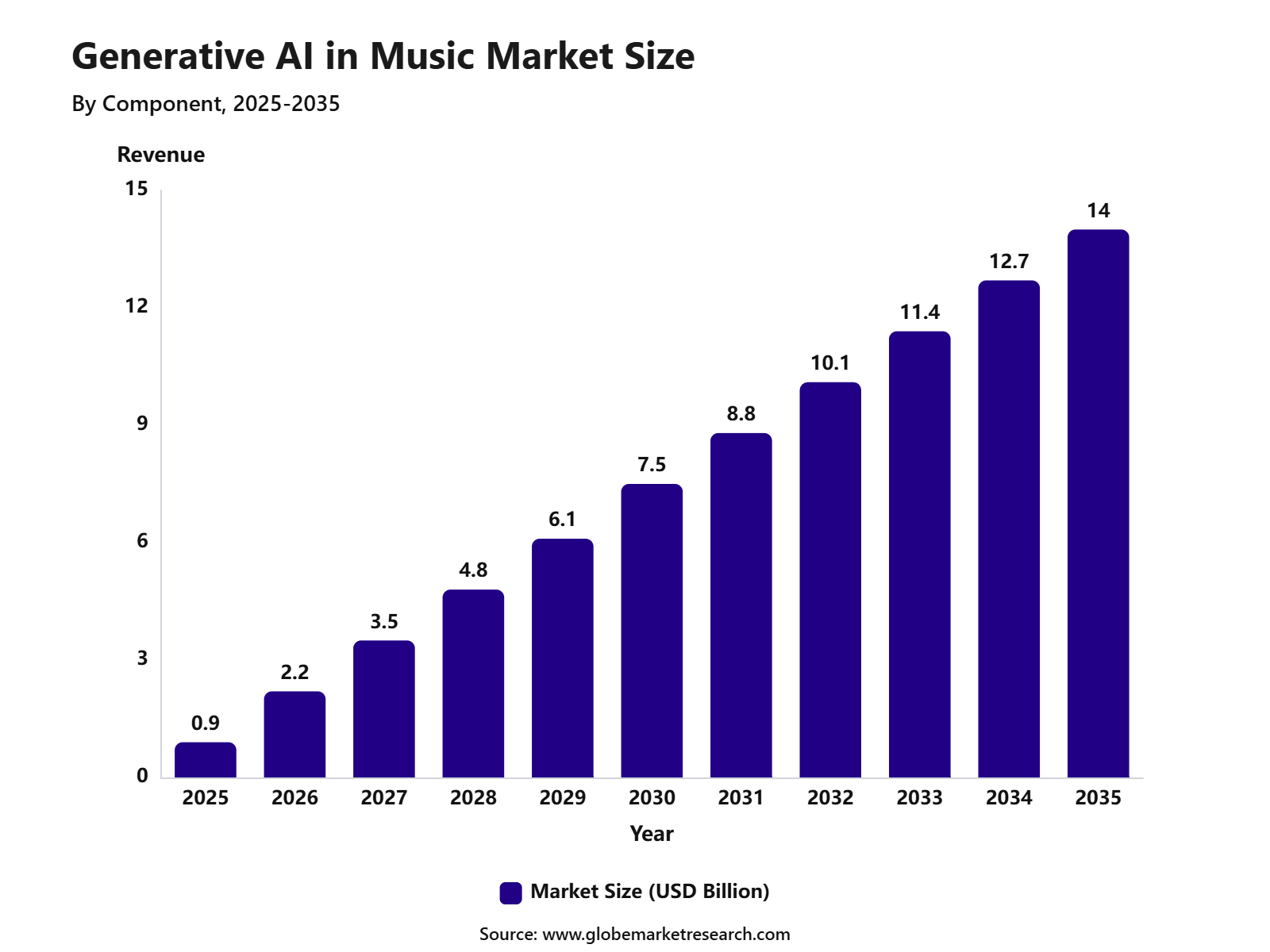
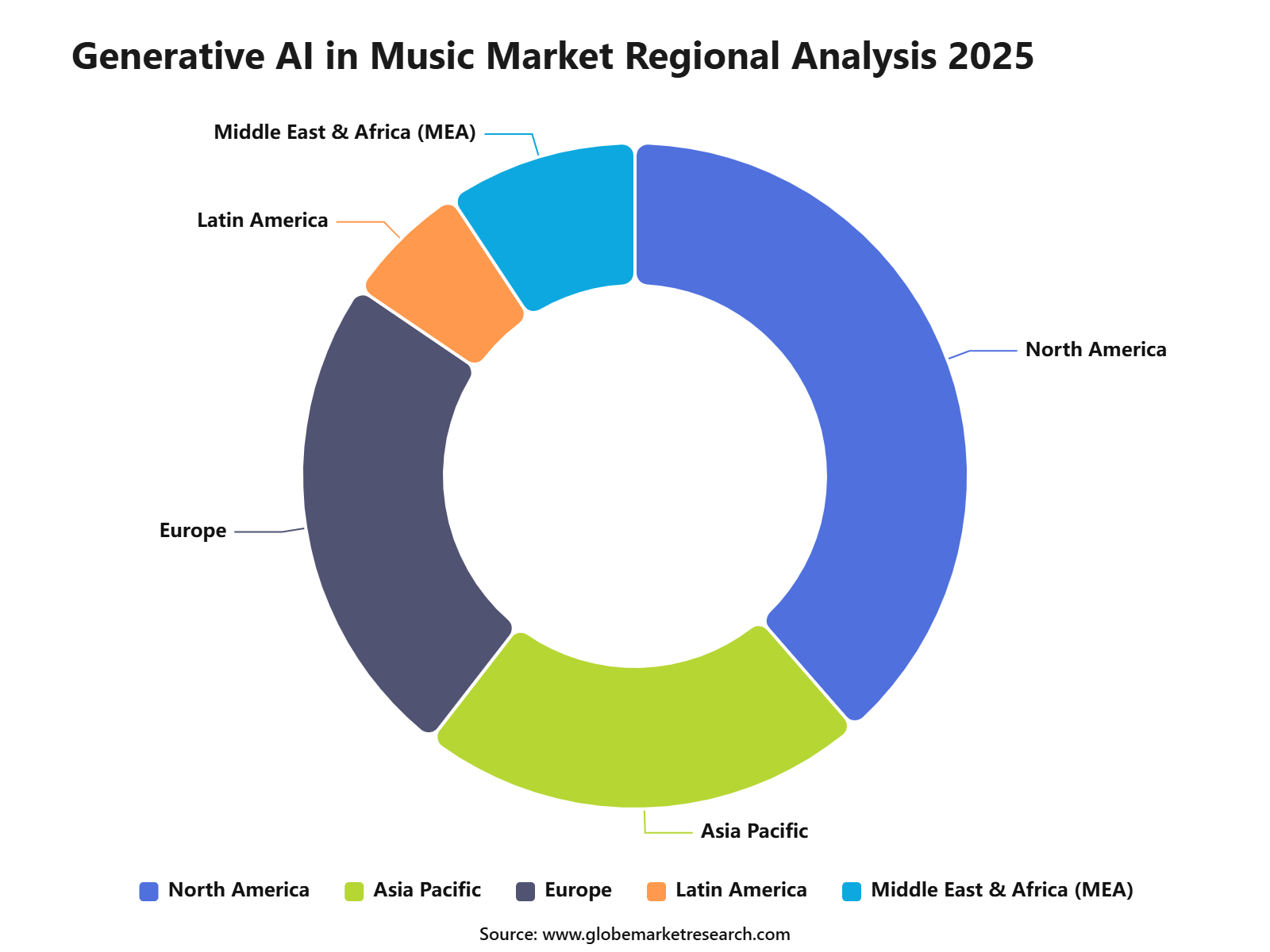
According to Globe Market Research, The Global Generative AI in Music Market was valued at USD 0.9 billion in 2025 and is expected to reach USD 14.0 billion by 2035, growing at a strong CAGR of 31.6% from 2025 to 2035. North America dominated the market in 2025 with a 38.6% share, driven by early adoption of AI-powered music tools, strong digital content creation activity, advanced music production infrastructure, and growing use of AI solutions by artists, producers, media companies, and independent creators.
The Generative AI in Music Market refers to AI-powered tools and platforms used to create, compose, edit, remix, master, and personalize music. These solutions support automated music generation, sound design, lyric assistance, voice synthesis, background scoring, and adaptive audio for games, films, advertisements, social media, and digital content. The market is closely connected with cloud-based music platforms, creator tools, virtual studios, licensing workflows, and AI-assisted production systems.
The market outlook remains highly promising as artists, producers, media companies, and independent creators increasingly use AI to reduce production time and improve creative output. Growth can be attributed to rising demand for personalized music, faster content creation, wider use of AI in gaming and video production, and growing adoption of subscription-based music creation platforms. The expansion of cloud deployment, real-time collaboration, and ethical licensing models is expected to strengthen commercial adoption over the forecast period.
Top Market Takeaways
Solutions led the component segment with 69.2% share, supported by the growing use of AI music platforms, automated composition tools, sound design systems, and workflow solutions used by artists, producers, and studios.
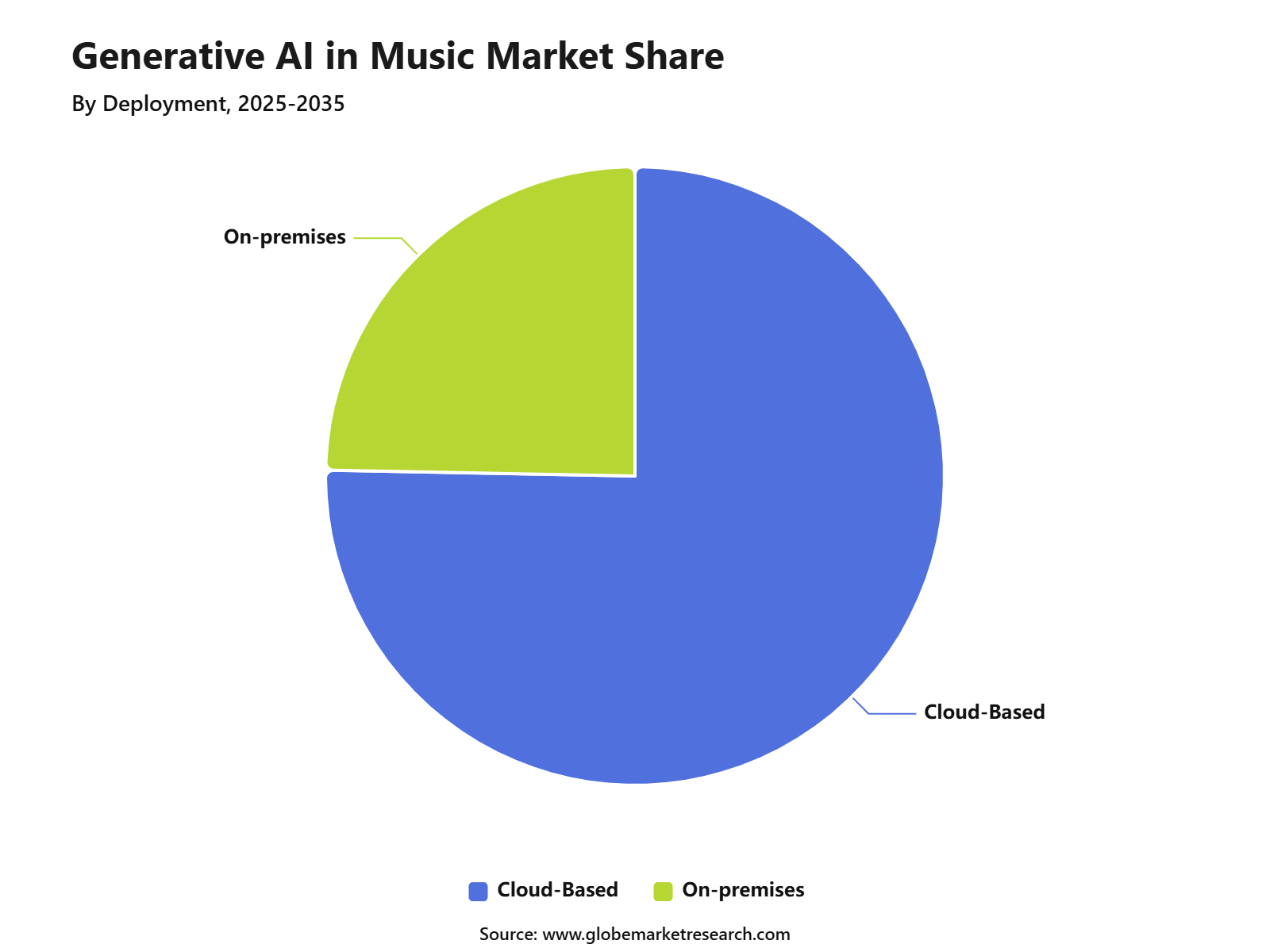
Cloud-based deployment dominated with 75.3% share, driven by remote collaboration, scalable computing power, faster tool access, and the increasing need to manage AI-based music creation across distributed creative teams.
Music composition and generation accounted for 29.6% share by application, supported by rising demand for automated track creation, background scores, style transfer, adaptive music, and personalized soundtracks.
North America held 38.6% share of the market, supported by early AI adoption, strong music production infrastructure, high digital content consumption, and the presence of advanced creator and streaming ecosystems.
Role of Generative AI in Music
Generative AI is becoming an important creative and operational tool in the music industry. It is being used to support music composition, lyric writing, voice modeling, sound design, background scoring, mixing, mastering, and personalized music creation. The role of AI is not limited to replacing manual work. Its stronger value is in helping artists, producers, labels, game studios, advertisers, and content creators produce more music faster, test more versions, and reduce repetitive production tasks.
The rise of AI in music is closely linked with the growth of digital music consumption. Global recorded music revenue reached USD 31.7 billion in 2025, growing 6.4%, supported by continued paid streaming adoption and digital engagement. This creates a strong base for AI tools because streaming platforms, creator platforms, and short-form video channels require a constant supply of fresh audio content.
One of the clearest roles of generative AI is faster content creation. Independent creators can now generate demo tracks, beats, melodies, voice guides, and background music without needing a full studio setup. This is useful for YouTubers, podcasters, game developers, advertisers, and small music producers who need affordable and quick audio assets. AI tools are also helping professional musicians explore multiple creative directions before final recording.
Go-to-Market and Sales Economics
The go-to-market strategy for the generative AI in music market should focus on licensed music creation tools, creator platforms, game studios, advertising agencies, film and video producers, podcast teams, social media creators, and music library users. The strongest commercial route is not only selling AI music generation software, but also offering legally safer workflows for background music, sound design, demo creation, voice-safe composition, and royalty-cleared production. Deezer reported in April 2026 that nearly 75,000 AI-generated tracks were being uploaded to its platform every day, equal to 44% of all new music uploads, showing how fast AI-made music supply is expanding.
Sales economics are driven by subscription pricing, enterprise licensing, API access, usage-based generation credits, rights-cleared music libraries, and partnerships with content platforms. Companies that can prove licensed training data, protect artist rights, and provide clear commercial-use terms are better positioned than tools with unclear copyright exposure. IFPI has stated that many AI developers are training models on copyright-protected music and sound recordings without authorization or payment, making responsible licensing a key sales differentiator.
Revenue Potential Analysis
Revenue potential is spread across music creation software, stock music, adaptive gaming audio, ad production, creator content, film scoring, podcast editing, and synthetic voice workflows. Generative AI tools reduce the time needed to create drafts, jingles, background scores, mood tracks, loops, stems, and localized music versions. CISAC reported that generative AI music outputs could reach a cumulative EUR 40 billion over five years and rise to EUR 16 billion annually by 2028, with strong impact on streaming platforms and music libraries.
Higher revenue can be generated through business-grade solutions that offer licensed datasets, human-in-the-loop editing, stem separation, metadata tagging, rights management, and fraud detection. The opportunity is stronger in sectors where speed, volume, and customization matter more than celebrity-led music, such as advertising, short-form video, gaming, wellness apps, education content, and corporate media. WIPO noted that the 2025 IFPI Global Music Report showed more than 750 million paid streaming subscription accounts globally, which indicates a large digital music environment where AI tools can be used for discovery, production, and catalog management.
Revenue Landscape Across
The revenue landscape across generative AI in music includes B2C creator tools, B2B production platforms, licensing marketplaces, API-based sound generation, music library automation, game audio engines, and creator economy integrations. Streaming platforms may use AI for tagging, recommendation support, fraud detection, and catalog moderation, while production teams can use it for ideation, background scoring, and rapid versioning. Deezer’s AI detection data also shows that AI music volume is rising faster than listener demand, which makes curation, verification, and platform governance commercially important.
Music libraries are likely to be one of the most affected revenue pools because AI can produce large volumes of functional background music at lower cost. CISAC estimated that by 2028, generative AI music could account for about 20% of traditional music streaming platform revenues and about 60% of music library revenues. This creates opportunity for AI-native libraries, but it also increases pressure on traditional composers, producers, and rights holders.
Financial Impact
The financial impact is positive for companies that use AI to reduce production time, cut licensing delays, and create multiple music variations for campaigns, games, and videos. Brands and studios can lower costs by generating draft tracks, alternate moods, tempo variations, and localized audio before final human review. At the same time, platforms face higher moderation costs because large AI upload volumes create risks related to spam, fraud, copyright misuse, and low-quality catalog growth.
For creators and rights owners, the financial impact is mixed. CISAC warned that 24% of music creator revenues could be at risk by 2028 as AI-generated outputs compete with human-created works in streaming and music library markets. Deezer also reported that up to 85% of streams on AI-generated music were fraudulent in 2025, showing that royalty pool protection and fraud control are becoming direct financial priorities.
Risk Factors and Market Barriers
The main risks include copyright litigation, unclear training data ownership, voice cloning misuse, fake artist profiles, streaming fraud, low consumer trust, and platform restrictions. Legal risk is rising because music companies and creator groups are challenging the use of copyrighted songs and recordings in AI training. In June 2026, Jamendo filed a lawsuit against Nvidia, alleging unauthorized use of hundreds of thousands of audio files and metadata to train AI audio systems, with statutory damages sought of up to USD 150,000 per infringed copyright.
Market barriers are also created by unclear ownership of AI-generated music. Buyers may hesitate to use AI tracks in commercial campaigns if rights, licenses, training sources, and output originality are not clearly documented. Platforms may also limit or demonetize AI tracks when they are suspected of fraud, impersonation, or mass-upload spam. As a result, market adoption will favor vendors that provide transparent rights terms, content provenance, watermarking, and indemnity-backed enterprise contracts.
Regulatory and Compliance Risks
Regulatory risk is centered on copyright, human authorship, digital replicas, consent, and fair use. The U.S. Copyright Office reported that Part 2 of its AI report addresses copyrightability of outputs created using generative AI, while Part 3 addresses generative AI training and the use of copyrighted works. This shows that both output ownership and training-data legality are under formal policy review.
Compliance risk is especially high for tools that generate music in the style of known artists, clone voices, or use protected recordings without permission. WIPO summarized the U.S. Copyright Office position by noting that fully AI-generated work cannot be copyrighted, while sufficiently original human selection, arrangement, or modification may be protectable. This means companies need clear workflows showing where human creative input exists, how training data was sourced, and what rights are granted to users.
Market Adoption Barriers
Adoption barriers include legal uncertainty, creator resistance, unclear royalty treatment, platform moderation, and concerns about quality. Professional musicians, publishers, and labels are more likely to support AI tools when licensing, attribution, and payment systems are clear. Without these protections, AI music tools may face resistance from artists, collecting societies, labels, and regulators.
Another barrier is buyer confidence. Advertisers, game studios, film producers, and agencies need assurance that AI-generated tracks will not create future copyright disputes. Adoption can improve through licensed training data, opt-in artist models, traceable metadata, watermarking, clean commercial-use licenses, and hybrid workflows where human composers guide and approve the final output.
By Component
Solutions led the component segment with 69.2% share, supported by the rising use of AI music platforms, composition engines, vocal generation tools, sound design software, and production workflow systems. The segment is gaining importance because artists, studios, content creators, and music producers are using AI tools to create drafts, test melodies, generate background scores, and speed up editing tasks.
The demand for solutions is also supported by the need for licensed, controllable, and workflow-ready tools. As copyright and creator protection remain important concerns, buyers are giving more preference to platforms that offer transparency, rights management, audio quality control, and professional integration with existing production systems.
By Deployment
Cloud-based deployment dominated the market with 75.3% share, driven by the need for scalable computing, easy access, and remote collaboration. Generative AI music tools often require high processing power for model inference, audio rendering, voice synthesis, and multi-track generation, which makes cloud delivery more practical than device-only deployment.
Cloud models also support faster updates, shared project access, and lower upfront infrastructure needs for creators and enterprises. This is especially useful for music teams working across different locations, as they can access the same tools, libraries, and generated files without relying on local hardware capacity.
By Application
Music composition and generation accounted for 29.6% share by application, supported by strong demand for automated song ideas, melodies, beats, background scores, and adaptive soundtracks. The segment is expanding because AI tools are being used as creative assistants rather than only as final-output systems.
The use of AI in composition is also growing across videos, games, podcasts, advertising, social media, and independent music production. These users often need quick, low-cost, and customizable audio assets, which makes AI-supported generation valuable for faster creative testing and content delivery.
By Region
North America held 38.6% share of the market, supported by its strong music production base, advanced digital infrastructure, high streaming usage, and early adoption of AI-enabled creative tools. The region also benefits from a mature creator economy where artists, producers, platforms, and media companies actively test new audio technologies.
The regional position is further strengthened by the United States, which remains one of the world’s most important recorded music markets. Strong broadband access, established streaming behavior, and active investment in AI-based creative workflows continue to support the adoption of generative AI in music production and distribution.
Top Two Opportunities for Generative AI in Music Market
For the Generative AI in Music Market, the strongest near-term opportunities are expected to come from rights-cleared AI music platforms and AI tools for creator-led music production. These areas are supported by the continued rise of streaming, higher demand for faster content creation, and growing pressure to build legally safe AI music models.
1. Build rights-cleared AI music generation platforms
The most attractive opportunity is the development of licensed AI music platforms where artists, labels, publishers, and technology providers can work under clear permission-based models. This is becoming important because global recorded music revenues reached USD 31.7 billion in 2025, while streaming represented 69.6% of total global recorded music income. Paid subscription streaming also grew 8.8%, showing that digital listening remains the strongest commercial base for new AI music services.
Companies should focus on AI platforms that use licensed catalogs, artist opt-in models, royalty tracking, and transparent attribution. This approach can reduce copyright risk and create new revenue streams through subscriptions, remix tools, brand music, background scores, and personalized fan experiences. Recent licensing moves between major music companies and AI music platforms show that the industry is shifting from legal conflict toward controlled commercial partnerships.
The recommended strategy is to position AI music tools as a revenue-supporting layer, not as a replacement for artists. Platforms that clearly protect voice, likeness, composition rights, and master recording rights are likely to gain stronger acceptance from labels, creators, advertisers, and streaming partners. This is especially important because the U.S. Copyright Office has clarified that copyright protection for AI-assisted work depends heavily on meaningful human creative contribution.
2. Expand AI-assisted music tools for creators, brands, gaming, and short-form content
The second major opportunity is AI-assisted music production for independent creators, video editors, podcasters, game studios, advertisers, and social media teams. Demand is rising because creators need faster ways to produce background music, sound effects, loops, jingles, voice-matched demos, and short audio assets for digital channels. Research on YouTube content creation found that generative AI is already being used across planning, production, editing, and uploading workflows, including audio and visual material generation.
This opportunity should be approached through workflow-based tools rather than full-song replacement. The strongest use cases include mood-based soundtrack generation, adaptive music for games, royalty-safe background tracks for videos, AI mastering, lyric assistance, demo creation, and multilingual audio adaptation. In the U.S., streaming revenues reached USD 9.5 billion in 2025, representing 82% of total recorded music revenue, while paid streaming accounts reached 106.5 million. This large digital user base supports demand for scalable music tools connected to streaming, social content, and creator platforms.
The recommended strategy is to offer easy, low-cost tools with strong commercial-use clarity. Subscription plans, API access, creator bundles, and enterprise licensing can be used to serve different user groups. The best positioning will be “fast, safe, and creator-controlled music production,” because brands and creators need usable music without legal uncertainty, takedown risk, or unclear ownership.
Key Market Segments
By Component
Solutions
Services
By Deployment
Cloud-based
On-premises
By Application
Composition and Music Generation
Performance Enhancement and Virtual Collaboration
Personalized Music Recommendations
Music Production and Remixing
Music Transcription and Analysis
Other Applications
By Region
North America
Europe
Asia Pacific
Latin America
Middle East & Africa
Recent Developments
June 2026: Warner Music Group announced an agreement to acquire Sureel AI, an AI attribution startup. Sureel’s technology creates "AI DNA" for music works and helps trace how songs, voices, likenesses, and musical elements are used in AI training or AI-generated outputs. Financial terms were not disclosed.
June 2026: Suno raised more than USD 400 million in Series D funding at a USD 5.4 billion post-money valuation. The round was led by Bond Capital, with participation from IVP, Forerunner, Union Square Ventures, Alkeon, Quiet, Matrix, Lightspeed, Menlo Ventures, and Schroders Capital.
People Also Ask
1. How big is the generative AI in music market?
The global generative AI in music market was valued at USD 0.9 billion in 2025 and is projected to reach USD 14.0 billion by 2035. The market is expected to grow at a CAGR of 31.6% during 2025 to 2035.
2. What is generative AI in music?
Generative AI in music refers to artificial intelligence tools that can create or assist with music production. These tools can generate melodies, beats, lyrics, vocals, background scores, and sound effects based on user prompts or uploaded inputs.
3. How is AI changing the music industry?
AI is changing the music industry by making music production faster, cheaper, and more accessible. It is helping creators generate ideas, produce tracks, master audio, and create background music for digital content. At the same time, it is creating new questions around copyright, licensing, artist identity, and revenue sharing.
4. Can AI-generated music be copyrighted?
AI-generated music may face copyright limits if it is created without meaningful human creative input. In many cases, human selection, arrangement, editing, lyrics, performance, or production decisions may be important for protection. The legal position depends on the country, the level of human involvement, and the specific output.
5. Why is generative AI popular in music creation?
Generative AI is popular because it helps creators produce music quickly and at lower cost. It is useful for early-stage ideas, background tracks, demo production, short-form videos, podcasts, and game audio. It also allows non-musicians to create usable audio content with simple prompts.
6. What are the risks of generative AI in music?
The main risks include copyright infringement, unauthorized voice cloning, fake artist tracks, unclear ownership, and low-quality mass-generated music. There is also concern that AI-generated content may reduce income opportunities for some musicians if licensing and royalty systems are not managed properly.