Market Size and Growth
The Solvents Market includes liquid chemical substances used to dissolve, dilute, extract, clean, disperse, or carry other materials in industrial and consumer applications. Solvents are widely used in paints and coatings, printing inks, adhesives, pharmaceuticals, personal care products, industrial cleaning, agrochemicals, polymers, electronics cleaning, and chemical processing.
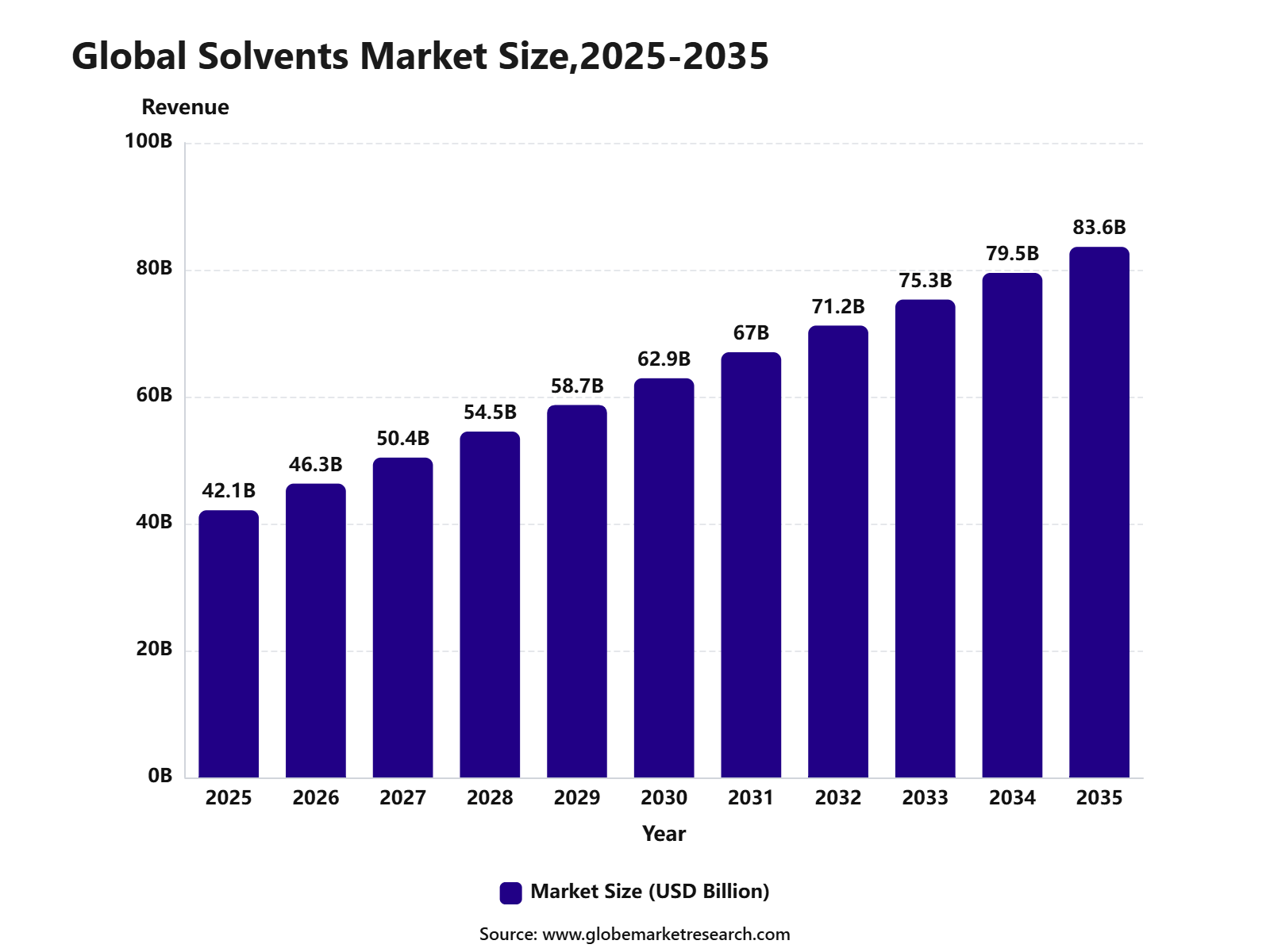
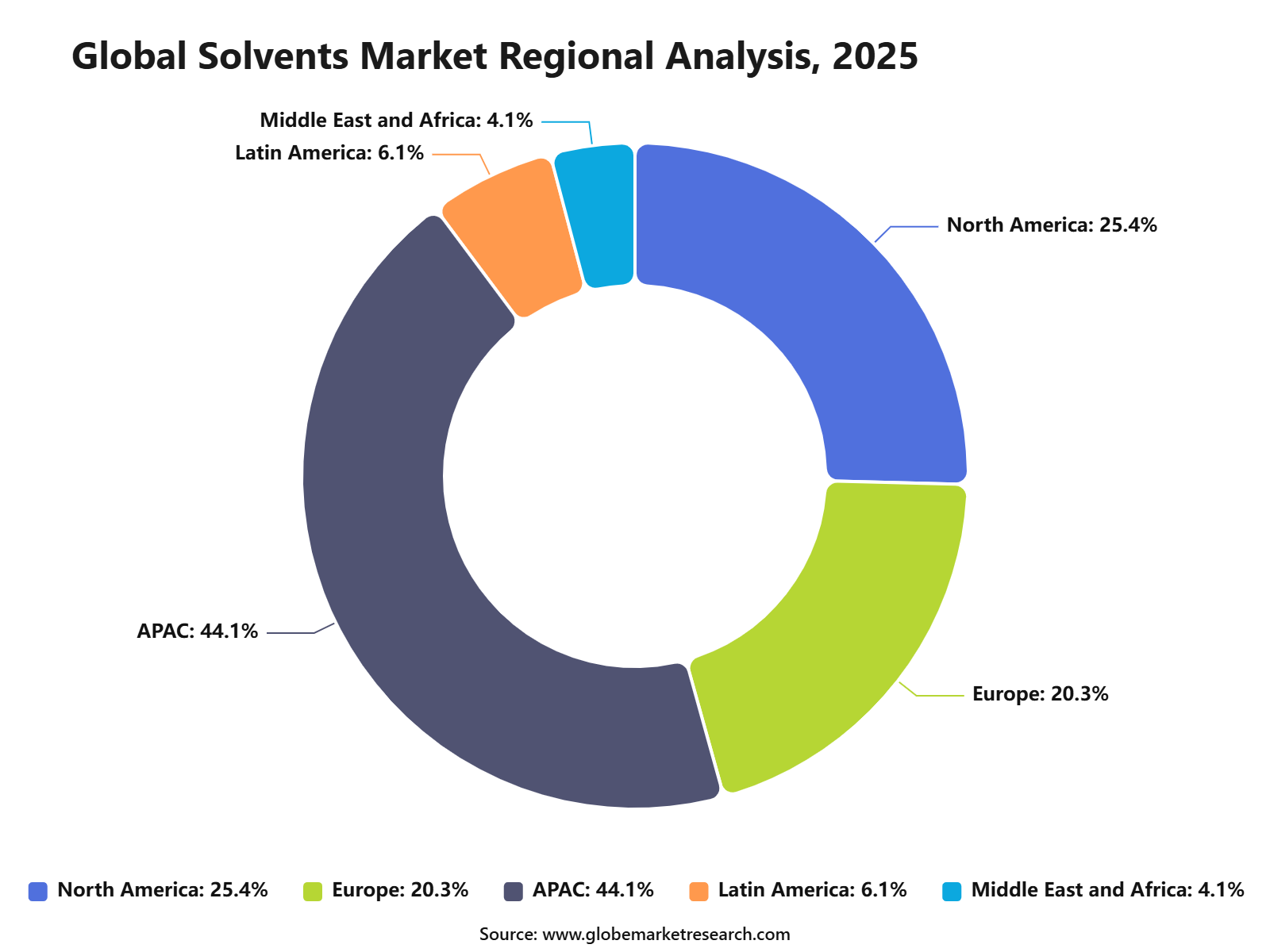
According to Globe Market Research, the global Solvents Market was worth USD 42.1 billion in 2025 and is expected to reach USD 83.6 billion by 2035, growing at a 7.1% CAGR from 2025 to 2035. Based on this growth rate, the market is estimated to reach around USD 46.3 billion in 2026. Asia Pacific held the largest regional share of 44.1% in 2025, valued at around USD 18.5 billion, supported by strong chemical manufacturing, paints and coatings demand, pharmaceutical production, and industrial processing activity.
Key Parameter | Report Details |
|---|---|
Market Revenue, 2025 | USD 42.1 Billion |
Projected Revenue, 2035 | USD 83.6 Billion |
CAGR (2025-2035) | 7.1% |
Largest Region | Asia Pacific (44.1% Share, USD 18.5 Bn) |
Market Concentration | Medium |
Base Year | 2025 |
Forecast Period | 2025-2035 |
The market outlook remains steady because solvents are closely linked with construction, coatings, healthcare manufacturing, packaging, automotive, specialty chemicals, electronics, and industrial cleaning. Demand is also shifting toward safer solvents, low-VOC systems, bio-based solvents, solvent recovery, and high-purity grades as regulatory and sustainability pressure increases.
Why the Solvents Market Is Growing
The market is growing because solvents remain essential in paints and coatings, adhesives, pharmaceuticals, personal care, printing inks, cleaning products, agrochemicals, and chemical processing. The report identifies growth in paints and coatings demand as a +1.9% impact, expansion of pharmaceutical manufacturing as +1.5%, rising adhesive and sealant production as +1.3%, and cleaning and degreasing applications as +1.1%.
Paints, coatings, inks, adhesives, and cleaning products continue to require solvents for viscosity control, resin dissolution, surface preparation, drying performance, and film formation. U.S. construction spending reached a seasonally adjusted annual rate of USD 2,210.2 billion in May 2026, supporting demand for coatings, adhesives, sealants, and related solvent systems.
The wider chemical cycle is still uneven. The American Chemistry Council expects global chemical production to grow only 0.5% in 2026, while specialty chemical output is expected to decline slightly by 0.3%. This means solvent suppliers need stronger customer targeting, contract retention, specialty grades, and compliance-led product positioning.
Key Market Drivers
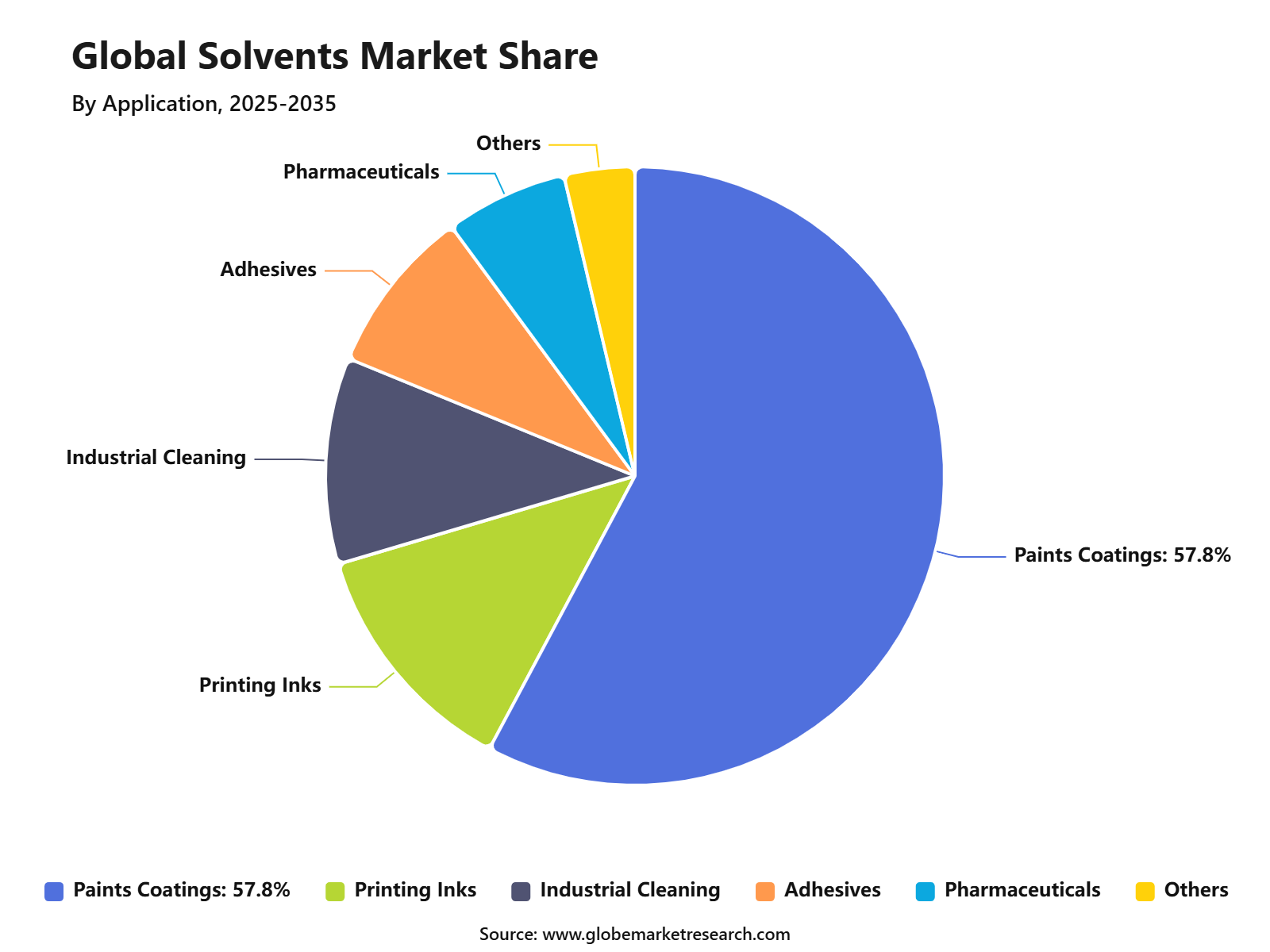
Paints and coatings consumption: Solvents are used for resin dissolution, viscosity control, surface wetting, film formation and drying. Paints and coatings accounted for 57.8% of total solvent demand in 2025.
Pharmaceutical manufacturing: High-purity solvents are required for active pharmaceutical ingredient production, extraction, crystallization, purification and equipment cleaning. Supply reliability and documentation are important because solvent quality can affect manufacturing consistency.
Industrial cleaning requirements: Manufacturing facilities use solvents to remove oils, grease, adhesives, coatings and processing residues from machinery, components and production surfaces.
Expansion of chemical processing: Solvents act as reaction carriers, extraction media and formulation components across specialty chemicals, agrochemicals, polymers, personal care products and printing inks.
Demand for sustainable alternatives: Environmental and worker-safety concerns are increasing investment in bio-based, recycled, low-toxicity and low-VOC solvents. The American Chemical Society identifies solvent replacement and reduction as important areas for improving chemical process sustainability.
Market Segmentation
Alcohols: Alcohols led the product category with a 44.2% share in 2025. Ethanol, isopropanol, methanol and butanol are widely used because of their solvency, evaporation properties and compatibility with industrial formulations.
Ketones and esters: Acetone, methyl ethyl ketone, ethyl acetate and similar products are used in coatings, adhesives, printing inks, electronics cleaning and chemical synthesis where fast drying and strong solvency are required.
Hydrocarbons and glycol ethers: These products are used in industrial cleaning, coatings, degreasing and formulation processes. Regulatory pressure is encouraging the replacement of higher-risk products with safer grades and lower-emission blends.
Paints and coatings: The application segment accounted for 57.8% of market revenue. Solvents support architectural coatings, automotive refinishing, protective coatings, marine finishes and industrial maintenance products.
Pharmaceuticals, adhesives and cleaning: These applications provide opportunities for high-purity, specialty and performance-focused solvents that meet strict safety, quality and formulation requirements.
Technology and Adoption Trends
Bio-based solvent development: Agricultural residues, spent coffee grounds and lignocellulosic feedstocks are being evaluated for the production of ethyl acetate, ethyl lactate, butyl acetate and other industrial solvents.
Solvent recycling and recovery: Distillation, filtration and purification systems are being used to recover organic solvents from industrial waste streams. These systems can lower raw material consumption, disposal costs and environmental impact.
High-purity processing: Semiconductor and pharmaceutical production is increasing demand for solvents with tightly controlled moisture, metal and particle levels. ExxonMobil is upgrading its Baton Rouge facility to produce 99.999% pure isopropyl alcohol for semiconductor manufacturing.
Low-VOC formulations: Coatings, adhesives and cleaning-product manufacturers are adopting lower-emission solvents, water-based systems and alternative formulation methods to meet environmental standards.
Digital formulation tools: Molecular modelling, automated testing and data-based solvent selection are being applied to predict solubility, compatibility, evaporation performance and potential environmental impact before commercial production.
Regional Breakdown and Supply Chain
Asia Pacific: The region held 44.1% of global market revenue in 2025. China, India, Japan and South Korea are major demand centres because of their chemical, coatings, pharmaceutical, electronics and manufacturing industries.
North America: Demand is supported by specialty chemicals, pharmaceuticals, semiconductor manufacturing, coatings and industrial cleaning. Investment in domestic high-purity solvent capacity is also being encouraged by the expansion of U.S. chip production.
Europe: Market development is being shaped by strict VOC regulations, solvent recovery, circular production and bio-based chemistry. High energy costs and weaker chemical demand remain important operating concerns.
Latin America, Middle East and Africa: Solvent demand is being supported by construction, mining, automotive refinishing, packaging, agriculture and industrial processing. Growth remains connected to local manufacturing investment and feedstock availability.
Supply chain: The solvent value chain includes crude oil and natural gas suppliers, petrochemical producers, bio-feedstock processors, solvent manufacturers, distributors, formulators, recyclers and end-use industries. Feedstock prices, transportation requirements and hazardous-material storage rules directly influence profitability and product availability.
Impact Factor | Estimated CAGR Impact | Regional Relevance | Market Impact |
|---|---|---|---|
Asia Pacific market leadership | +2.5% | Asia Pacific, 44.1% share in 2025 | Leads global demand. |
China coatings and chemical production | +1.5% | China | Drives regional consumption. |
India pharmaceutical and industrial growth | +1.2% | India | Supports future demand. |
North America specialty solvent demand | +0.9% | U.S. and Canada | Adds value growth. |
Europe low-VOC and green solvent adoption | +0.8% | Germany, France, UK, Italy | Supports premium solutions. |
Solvent Recovery and Recycling Are Becoming More Important
Solvent recovery and recycling are gaining importance as manufacturers try to reduce waste, control operating costs, and meet environmental requirements. The report assigns solvent recovery and recycling a +0.8% trend impact, especially across industrial processing facilities.
In April 2026, SUEZ and partners advanced a RMB 190 million organic solvent recycling project in Chongqing, China, with Phase I capacity of 30,000 tonnes per year. This shows that solvent recycling is moving from compliance activity toward commercial infrastructure investment.
Recovery systems can help producers and end users reduce virgin solvent purchases, lower disposal costs, improve sustainability performance, and reduce exposure to hazardous-waste handling. This opportunity is especially relevant for coatings, electronics, pharmaceuticals, printing, chemical processing, and industrial cleaning operations.
Revenue Potential and Financial Impact
Revenue potential is distributed across oxygenated solvents, hydrocarbon solvents, halogenated solvents, bio-based solvents, glycol ethers, alcohols, ketones, esters, and specialty blends. Paints and coatings, printing inks, adhesives, personal care, agrochemicals, pharmaceuticals, electronics cleaning, and industrial cleaning remain major demand areas.
Financial value is strongest where solvents improve production yield, drying speed, formulation stability, cleaning efficiency, and regulatory compliance. High-purity pharmaceutical solvents, electronics cleaning solvents, low-VOC coatings solvents, and safer specialty blends can support stronger margins than commodity bulk solvents.
Price pressure remains important. Eastman reported more than 10% sequential sales volume and mix improvement in specialty businesses in Q1 2026, but also implemented around USD 500 million of price increases across its portfolio to offset raw material and distribution inflation. This shows why solvent producers must manage pricing, feedstock exposure, and customer contracts carefully.
Risk Factors and Market Barriers
VOC emission regulations are the leading restraint, with an estimated -1.0% impact. Solvents used in coatings, inks, adhesives, cleaning, and industrial processing must meet stricter air-emission, worker-exposure, and environmental requirements across Europe, North America, Japan, and China.
Health and safety concerns carry a -0.9% impact. EPA’s methylene chloride rule prohibits manufacturing, processing, and distribution for all consumer uses and restricts most industrial and commercial uses, including many paint and coating remover applications. This raises reformulation needs and pushes users toward safer alternatives.
Raw material price volatility has a -0.8% impact because many solvents depend on crude oil, natural gas liquids, petrochemical intermediates, logistics, and energy costs. BASF’s July 2026 outlook update raised its Brent crude assumption to USD 80 per barrel from USD 65, showing how quickly energy-linked assumptions can change for chemical producers.
Recent Developments
In May 2026, Sasol Chemicals announced solvent price increases effective May 7, 2026, covering methyl ethyl ketone and isopropyl alcohol. The company’s solvent portfolio includes ketones, alcohols, and acrylates used across industrial applications.
In April 2026, Eastman reported more than 10% sequential sales volume and mix improvement in specialty businesses and around USD 500 million of price increases across its portfolio to offset raw material and distribution inflation.
In March 2025, ExxonMobil announced a USD 100 million Baton Rouge upgrade to produce 99.999% high-purity isopropyl alcohol for semiconductor cleaning, with production targeted by 2027.
In April 2026, SUEZ and partners advanced a RMB 190 million organic solvent recycling project in Chongqing, China, with Phase I capacity of 30,000 tonnes per year.
Competitive Landscape
The Solvents Market is competitive, with petrochemical companies, specialty chemical producers, solvent blenders, high-purity solvent suppliers, bio-based solvent developers, and regional distributors competing across cost, purity, safety, compliance, technical support, and supply reliability.
Key companies include:
Exxon Mobil Corporation
Shell plc
BASF SE
LyondellBasell Industries Holdings B.V.
Dow Inc.
Eastman Chemical Company
INEOS Group
Celanese Corporation
Solvay S.A.
Sasol Limited
Mitsubishi Chemical Group
Ashland Global Holdings Inc.
Huntsman Corporation
Arkema S.A.
Honeywell International Inc.
Other Key Players
Competition is expected to increase as customers shift toward low-VOC products, bio-based solvents, high-purity grades, solvent recycling, and safer industrial formulations. Companies with stronger feedstock access, regional supply, regulatory documentation, and formulation support are likely to perform better.
The strongest players will be those that can balance performance, cost, safety, and compliance. In this market, customers are not buying only solvent volume. They are buying reliable formulation performance, regulatory confidence, supply continuity, and lower operational risk.
Market Concentration: Medium
The Solvents Market has medium concentration because large petrochemical and specialty chemical companies have strong feedstock access, production scale, logistics networks, and customer relationships. However, regional distributors, specialty solvent blenders, high-purity suppliers, and bio-based solvent producers continue to compete in targeted applications.
Competition is expected to remain strong across alcohols, ketones, esters, hydrocarbons, glycol ethers, and specialty blends. Suppliers with strong regulatory capability, technical support, cost control, and sustainable solvent portfolios are likely to gain stronger long-term positioning.
Conclusion
The Solvents Market is entering a steady growth phase supported by paints and coatings, alcohol solvents, pharmaceutical manufacturing, adhesives, industrial cleaning, electronics cleaning, chemical processing, and Asia Pacific demand. The market is projected to grow from USD 42.1 billion in 2025 to USD 83.6 billion by 2035, supported by a 7.1% CAGR.
Future growth will be led by alcohols, paints and coatings, Asia Pacific manufacturing, bio-based solvents, low-VOC systems, high-purity pharmaceutical solvents, electronics cleaning solvents, and solvent recovery services. Companies that manage feedstock volatility while improving safety, sustainability, purity, and regulatory support will be better positioned in this market.
Contact Us
Global Business Development Team
Email: [email protected]