
Market Size and Growth
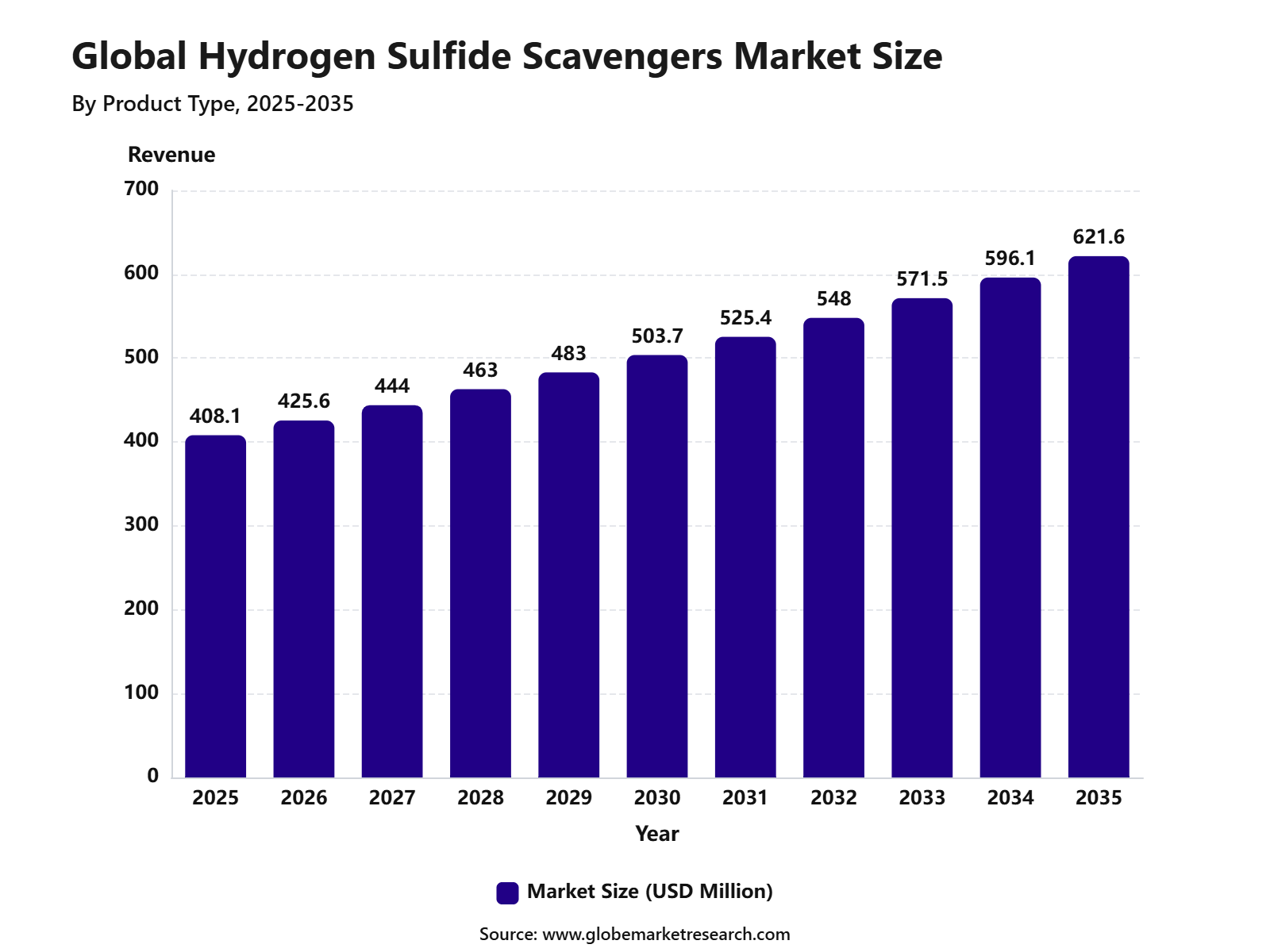
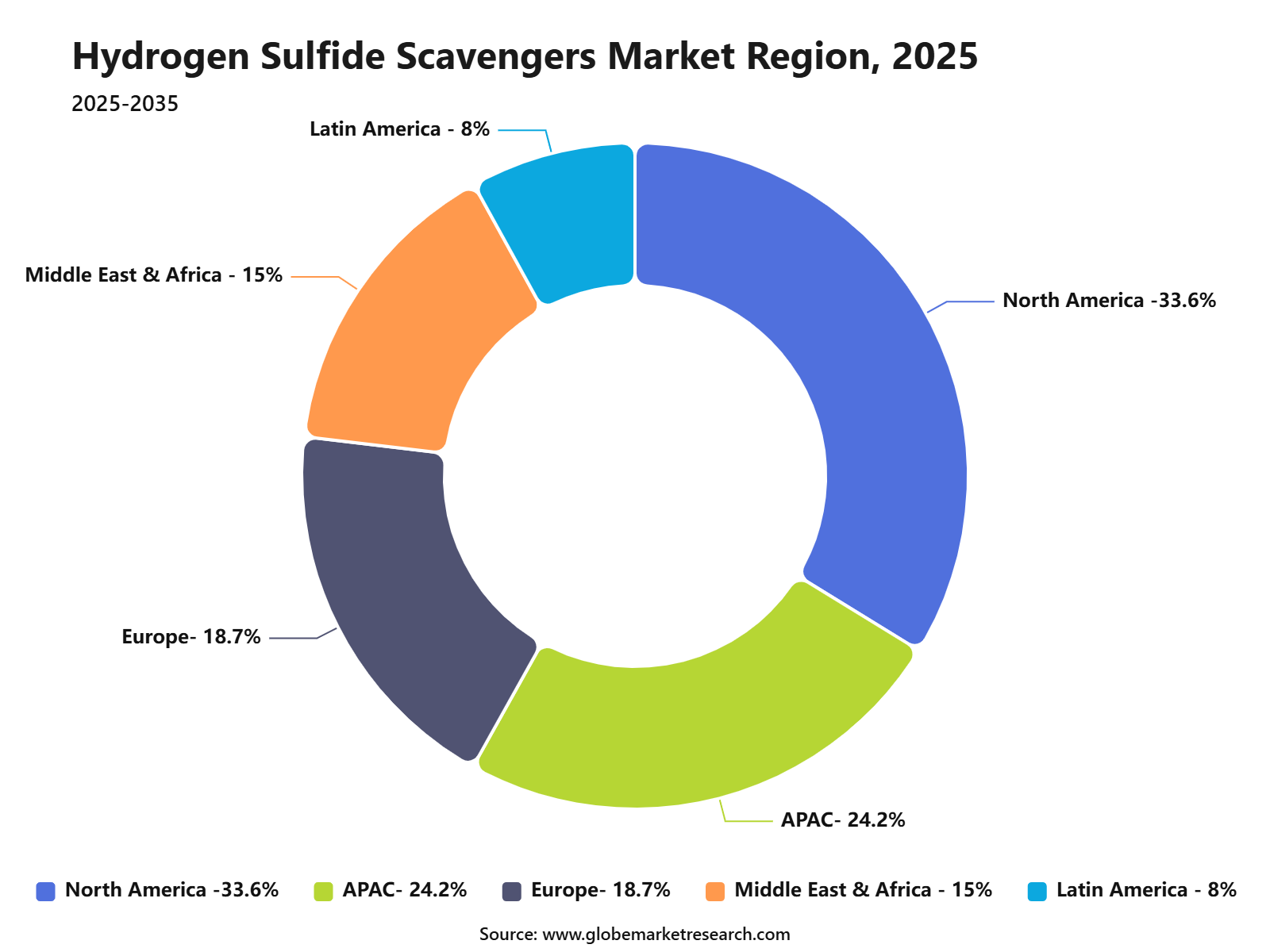
The global Hydrogen Sulfide Scavengers Market reached USD 408.1 million in 2025 and is expected to reach USD 621.6 million by 2035, growing at a CAGR of 4.3% from 2025 to 2035. The market is being supported by the need to remove toxic and corrosive hydrogen sulfide from natural gas, crude oil, refinery streams, produced water and industrial wastewater. North America held the largest regional share of 33.6% in 2025, generating approximately USD 137.1 million.
Key Parameter | Report Details |
|---|---|
Market Revenue, 2025 | USD 408.1 Million |
Projected Revenue, 2035 | USD 621.6 Million |
CAGR, 2025-2035 | 4.3% |
Largest Region | North America, 33.6% Share |
Market Concentration | Medium |
Base Year | 2025 |
Forecast Period | 2025-2035 |
Hydrogen sulfide scavengers are chemical or solid treatment products that react with H₂S and reduce its concentration in gas or liquid streams. Their use is important because hydrogen sulfide can damage pipelines and processing equipment, reduce hydrocarbon quality and create serious risks for workers. OSHA maintains a general industry ceiling limit of 20 ppm, while NIOSH identifies 100 ppm as immediately dangerous to life or health.
Key Market Drivers
Increasing natural gas production: Higher natural gas production and processing volumes are increasing the number of gas streams that require sweetening, corrosion control and H₂S management. The U.S. Energy Information Administration projects U.S. dry natural gas production to increase from 107.65 Bcf/d in 2025 to 111.25 Bcf/d in 2026 and 115.30 Bcf/d in 2027.
Expansion of sour gas development: Deeper formations and increasing gas-to-oil ratios are exposing producers to higher concentrations of hydrogen sulfide in several producing regions. This is increasing demand for treatment at wellheads, separators, gathering systems and gas processing plants.
Worker safety requirements: Hydrogen sulfide is highly toxic and can quickly become fatal at high concentrations. Regulatory exposure limits encourage oilfield operators, refineries, wastewater plants and industrial facilities to maintain reliable detection, ventilation and scavenger treatment systems.
Corrosion prevention: H₂S can contribute to sulfide stress cracking, iron sulfide formation and corrosion of pipelines, tanks, compressors and processing equipment. Scavengers are used to protect assets and reduce unplanned shutdowns.
Pipeline and product specifications: Natural gas, crude oil and refined products must remain within defined sulfur and H₂S limits before transportation, storage or sale. Off-specification products can result in price reductions, rejected shipments or additional treatment costs.
Growth in wastewater and biogas treatment: Hydrogen sulfide is generated in sewers, wastewater facilities, landfills and anaerobic digestion systems. Scavengers, adsorbents and biological treatment systems are increasingly being used to control odor, corrosion and worker exposure.
Market Segmentation
By product type: The market is divided into regenerative and non-regenerative scavengers.
Non-regenerative scavengers: This segment held the leading market share of 55.3% in 2025. These products are commonly selected for field applications because they are easy to inject, react quickly and do not require a complex regeneration unit. Common chemistries include triazines, metal oxides, aldehydes and other liquid or solid formulations.
Regenerative scavengers: Regenerative systems are generally used when H₂S concentrations and treatment volumes are high enough to justify the recovery and reuse of the active treatment material. These systems can offer lower long-term chemical consumption but require greater capital investment and operating control.
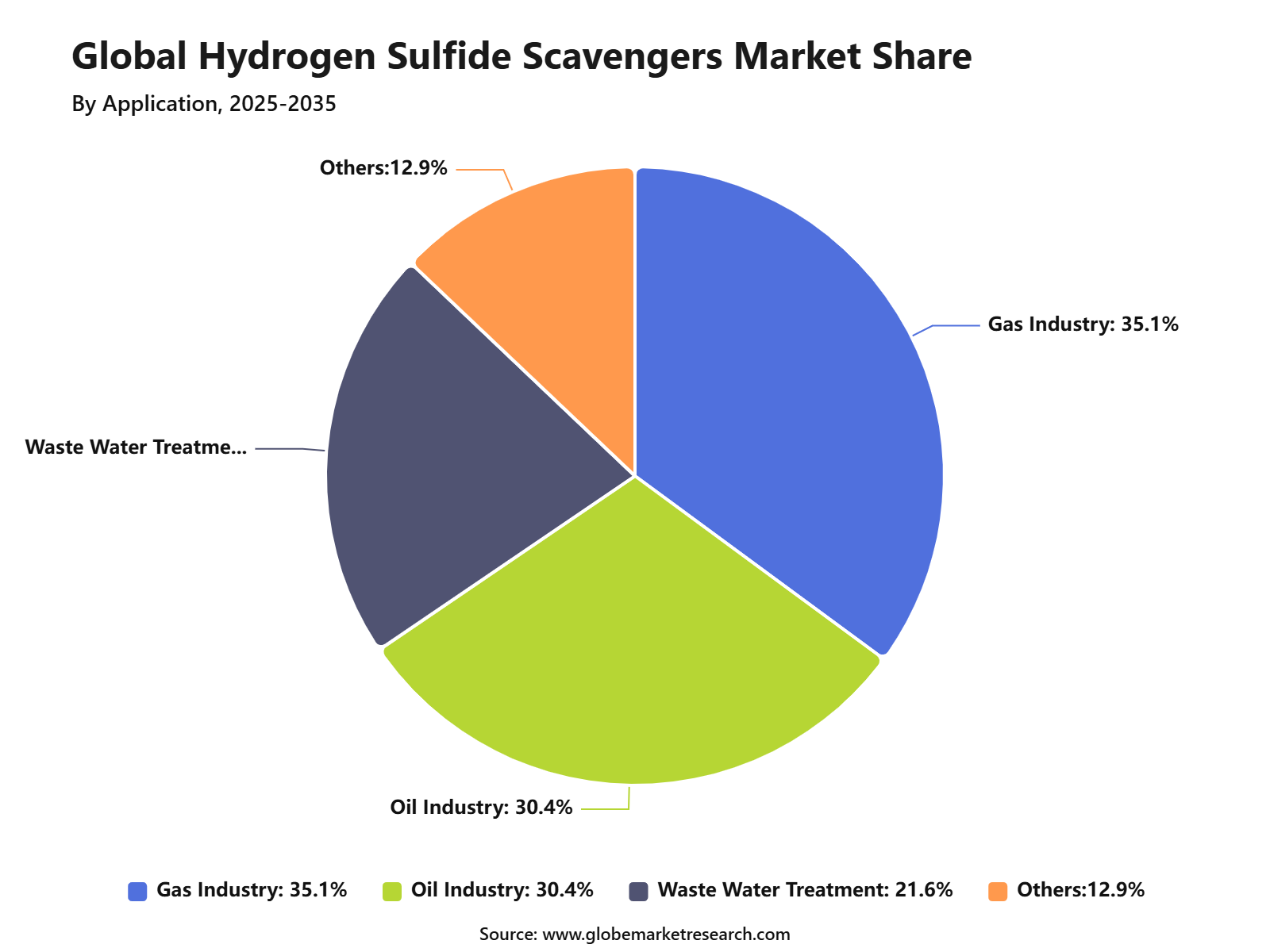
By application: The market is segmented into the gas industry, oil industry, wastewater treatment and other industrial applications.
Gas industry: The gas industry led the application segment with a 35.1% share in 2025. Scavengers are used during natural gas production, gathering, processing, transmission and storage to control toxicity, corrosion and gas quality.
Oil industry: Crude oil producers, terminals, storage facilities, tank farms and refineries use scavengers to reduce H₂S in crude oil, condensate and refined products before transportation or processing.
Wastewater treatment: Municipal and industrial wastewater facilities use H₂S control products to reduce odor, protect concrete and metal infrastructure and improve workplace conditions.
Other applications: Additional uses are found in biogas, pulp and paper, mining, geothermal operations, chemical processing and industrial waste treatment.
Technology and Adoption Trends
Shift toward non-triazine formulations: Traditional triazine scavengers remain widely used, but operators are seeking alternatives that reduce nitrogen content, solids formation, scaling and downstream contamination. SLB has reported field use of nitrogen-free and pH-neutral scavengers designed to reduce H₂S while lowering deposits and chemical consumption.
Low-corrosion scavengers: Product development is being directed toward formulations that remove H₂S without increasing the risk of scale, solids or corrosion. This is particularly important for offshore production, condensate systems and high-water-cut wells.
Catalytic liquid treatment: New aqueous catalytic processes are being developed to convert H₂S into soluble sulfur compounds. In a 2026 field trial, Merichem’s ECOTREAT process removed more than 99% of H₂S without producing solid waste and treated inlet concentrations reaching 14,000 ppm.
Engineered solid adsorbents: Iron oxide and mixed-metal-oxide media are being used in fixed-bed systems for dry and water-saturated gas streams. These systems can provide predictable removal performance with limited moving equipment and relatively low operator involvement.
Skid-mounted treatment systems: Prefabricated lead-and-lag vessel systems are gaining attention because they can be transported to operating sites and installed with lower initial capital requirements. Merichem introduced a lease programme for skid-mounted SULFURTRAP systems in March 2025.
Subsea chemical injection: Offshore operators are moving scavenger injection closer to the production source. In a North Sea application, subsea injection reduced H₂S from 170 ppm to 60 ppm, lowered topside scavenger use and eliminated regular hydrocyclone cleaning.
Automated dosing and monitoring: Sensors, flow meters and chemical injection controls are being integrated to adjust scavenger dosage according to H₂S concentration, flow rate, temperature and water content. This can reduce overtreatment, chemical waste and operating costs.
Regional Breakdown & Supply Chain
North America: North America held 33.6% of the market in 2025. Demand is supported by U.S. and Canadian oil and gas production, shale activity, sour gas processing, refinery capacity and established chemical treatment infrastructure. Continued production growth in the Permian Basin is expected to support chemical treatment demand.
Asia Pacific: Asia Pacific accounted for 24.2% of the market. China, India, Australia, Indonesia and Southeast Asian countries represent important demand centres due to natural gas processing, refining, petrochemical production, wastewater treatment and industrial expansion.
Europe: Europe held an 18.7% share. Demand is generated by offshore production in the North Sea, refineries, wastewater infrastructure and biogas facilities. Environmental requirements are encouraging greater use of lower-toxicity and low-discharge formulations.
Middle East and Africa: The region accounted for 15.2% of the market. Saudi Arabia, the UAE, Qatar and other hydrocarbon-producing countries require H₂S treatment for sour gas fields, refineries, gas processing facilities and petrochemical operations.
Latin America: Latin America represented approximately 8.0% of the market. Brazil, Mexico, Argentina, Colombia and other producing countries offer opportunities in offshore fields, refineries, natural gas processing and industrial wastewater treatment.
The supply chain includes chemical feedstocks, active scavenger ingredients, catalysts, iron oxides, metal oxides, activated carbon, reaction vessels, storage tanks, pumps and dosing equipment. Products are supplied directly by chemical companies or through regional distributors and oilfield service providers. Field testing, dosage optimisation, safety documentation and technical support are important parts of the sales process because scavenger performance can change according to H₂S concentration, pressure, temperature, water content and hydrocarbon composition.
Future Outlook, 2026–2035
The market is expected to record steady expansion through 2035 as natural gas production, sour field development, wastewater treatment and industrial safety requirements continue to increase. Non-regenerative products are expected to remain widely used in small and medium-volume applications, while regenerative and catalytic systems are likely to gain importance in facilities with high H₂S loads and continuous treatment requirements.
Future purchasing decisions will increasingly be based on the total cost of treatment rather than the price per litre or kilogram of scavenger. Operators will assess dosage requirements, chemical consumption, reaction by-products, equipment corrosion, waste disposal, worker exposure and production losses. Products capable of delivering reliable removal at lower dosage rates are expected to receive stronger interest.
The adoption of nitrogen-free, low-corrosion and low-solids formulations is also expected to increase. Suppliers that combine chemicals with monitoring equipment, field testing, dosing services and long-term performance support will be better positioned than companies offering only standard products.
Key Opportunities
High-H₂S gas fields: Increasing production from sour gas formations will create demand for high-capacity treatment systems and specialised chemical programmes.
Permian Basin infrastructure: Rising natural gas production and new sour gas treating capacity in the Delaware Basin offer opportunities for scavenger chemicals, adsorbents and treatment equipment.
Non-triazine scavengers: Operators are seeking formulations that limit solids formation, nitrogen contamination and wastewater treatment problems.
Wastewater odor and corrosion control: Municipal sewer systems, treatment plants and industrial wastewater facilities offer opportunities for liquid scavengers, iron salts, activated carbon and biological treatment.
Biogas and renewable natural gas: Anaerobic digesters, landfill gas systems and renewable natural gas plants require H₂S removal before gas upgrading, compression or pipeline injection.
Offshore production: Subsea-compatible and pH-neutral formulations can support offshore assets where equipment access, space and chemical handling are restricted.
Skid-mounted and leased systems: Mobile and leased treatment equipment can reduce capital costs for temporary projects, production testing, remote fields and changing H₂S conditions.
Treatment-as-a-service: Chemical suppliers can generate recurring revenue through monitoring, dosage management, inventory control and performance-based service agreements.
Challenges and Restraints
Volatile oil and gas activity: Lower drilling, production or refinery utilisation can reduce chemical consumption and delay treatment projects.
Chemical handling risks: Several scavenger formulations require controlled storage, protective equipment and trained personnel.
Waste generation: Spent media, reacted chemicals and sulfur-containing by-products may require treatment or regulated disposal.
Triazine-related solids: Some conventional triazine treatments can produce deposits that affect separators, pipelines, produced water systems and downstream equipment.
Variable operating conditions: Product performance can be affected by temperature, pressure, water content, pH, fluid composition and changes in H₂S concentration.
Alternative treatment methods: Amine systems, biological desulfurisation, activated carbon, membrane separation and regenerative sulfur removal processes can reduce dependence on disposable scavengers.
Price sensitivity: Smaller operators may prioritise low initial product prices instead of lifecycle performance, creating pressure on specialty formulations.
Qualification requirements: New products must often complete laboratory testing, compatibility studies and field trials before being approved for critical operating systems.
Key Players
The competitive environment includes international oilfield service companies, specialty chemical manufacturers, water treatment companies and sulfur removal technology providers. Competition is based on reaction speed, treatment capacity, dosage efficiency, corrosion performance, waste generation, technical support and regional supply availability. Product qualification and field performance are particularly important because unsuccessful H₂S treatment can create safety risks, production shutdowns and off-specification products.
Key participants include:
SLB
SUEZ
Arkema Group
NuGenTec
Dorf Ketal
Halliburton
Baker Hughes
Paqell B.V.
Nalco Water
ChemTreat
Merichem Technologies
CARADAN Chemicals International
Verdant Specialty Solutions
Strategic Implications
Manufacturers should concentrate on formulations that provide lower dosage rates, reduced corrosion, fewer solids and safer reaction by-products. Clear field-performance data will be important because buyers need evidence that a product can maintain H₂S specifications under changing production conditions. Laboratory testing should therefore be supported by controlled field trials and measurable treatment results.
Suppliers should also expand their service capabilities. Injection system design, chemical storage, dosage optimisation, monitoring and spent-product management can provide additional revenue and improve customer retention. Local manufacturing or regional stock points will be important in oil-producing regions where treatment chemicals may be required at short notice.
End users should compare products on a total treatment cost basis. The review should include chemical consumption, waste disposal, maintenance, corrosion, process interruptions and worker safety. A lower-priced scavenger may create higher overall costs when excessive dosage or solids formation occurs.
Recent Developments
In June 2026, Merichem Technologies reported the successful completion of a month-long ECOTREAT field trial in the Delaware Basin. The aqueous catalytic system achieved sustained H₂S removal above 99%, treated concentrations of up to 2% and produced no solid waste. The technology is being moved toward full-scale commercial use.
In January 2026, Verdant Specialty Solutions completed the acquisition of Lubrizol’s Elmendorf, Texas, manufacturing and research assets. The transaction added H₂S scavengers, scale inhibitors, corrosion inhibitors and other oilfield chemicals to Verdant’s product portfolio.
In September 2025, MPLX completed its USD 2.375 billion acquisition of Northwind Midstream. The acquired system included 150 MMcf/d of sour gas treating capacity, more than 200 miles of gathering pipelines and two operating acid gas injection wells. Expansion projects are expected to increase treating capacity to 440 MMcf/d.
In June 2025, SLB published results from a North Sea offshore application using subsea injection of its HR-2746 scavenger. H₂S was reduced from 170 ppm to 60 ppm, topside chemical use was lowered and regular hydrocyclone cleaning was eliminated.
In March 2025, Merichem Technologies introduced SULFURTRAP skid-mounted lead-and-lag vessel systems through a lease programme. The systems were designed to remove H₂S and light mercaptans from gas streams while reducing initial capital requirements.
Conclusion
The Hydrogen Sulfide Scavengers Market is expected to maintain stable growth as oil and gas producers, refineries, wastewater facilities and industrial operators strengthen H₂S control. The gas industry will remain a major demand source, while wastewater, biogas and offshore production will provide additional growth opportunities.
Competition will increasingly be influenced by treatment efficiency, chemical safety, waste generation and lifecycle cost. Non-triazine formulations, catalytic processes, solid adsorbents, subsea injection and automated dosing systems are expected to receive greater attention. Companies offering technically proven products with regional supply and field service capabilities will be well positioned through 2035.
Source of information - https://www.globemarketresearch.com/reports/hydrogen-sulfide-scavengers-market