Market Size and Growth
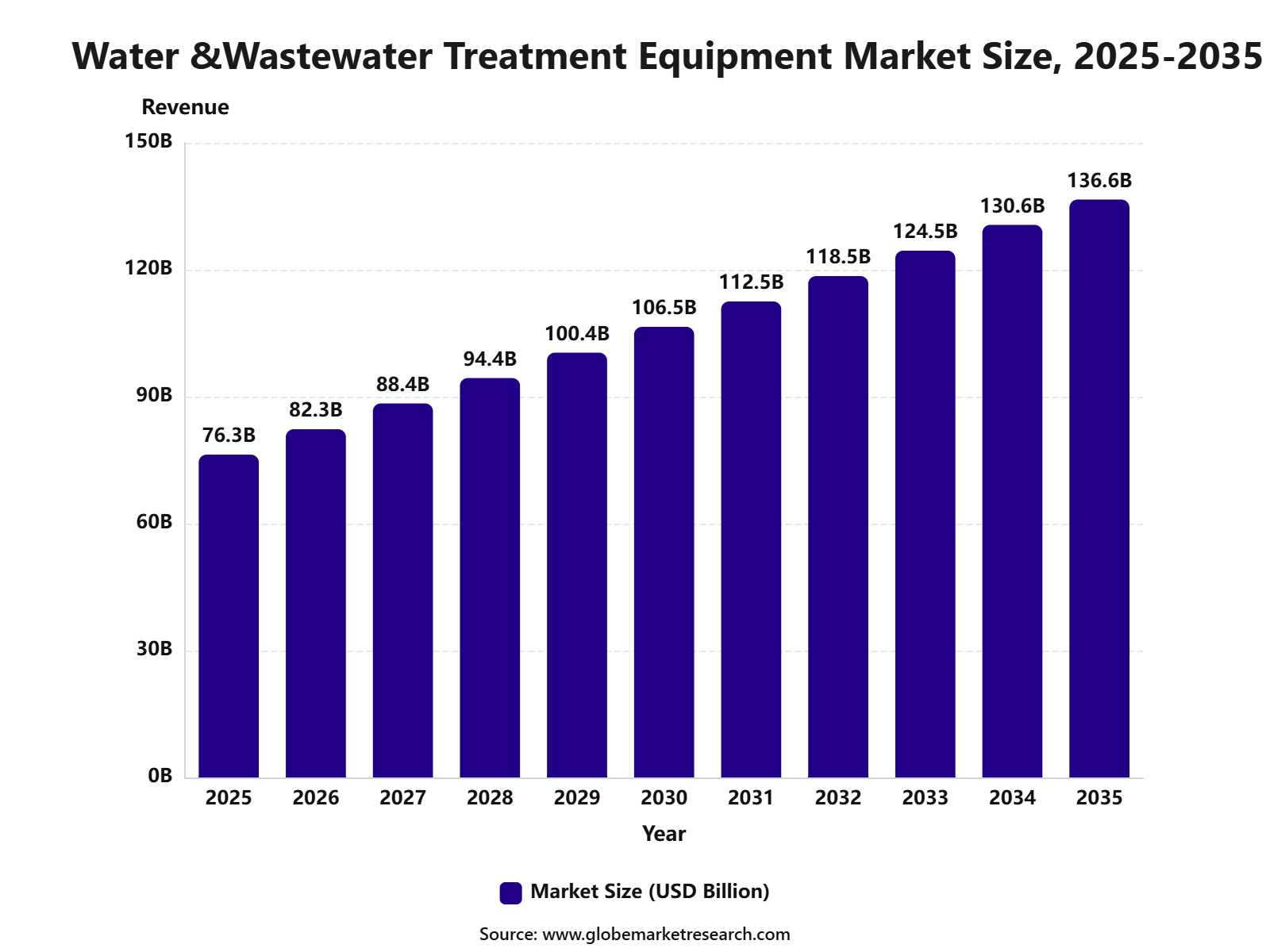
According to a recent report by Globe Market Research, the global Water and Wastewater Treatment Equipment Market was valued at USD 76.3 billion in 2025 and is projected to reach USD 136.6 billion by 2035, growing at a CAGR of 6.0% from 2025 to 2035. This represents an absolute revenue increase of USD 60.3 billion during the forecast period. Demand is being supported by urban population growth, aging water infrastructure, industrial water requirements, wastewater discharge regulations and the need to expand access to safe drinking water and sanitation.
Key Parameter | Report Details |
|---|---|
Market Revenue, 2025 | USD 76.3 Billion |
Projected Revenue, 2035 | USD 136.6 Billion |
CAGR, 2025-2035 | 6.0% |
Largest Region | Asia Pacific, 42.7% Share |
Market Concentration | Medium |
Base Year | 2025 |
Forecast Period | 2025-2035 |
Municipal utilities are expected to remain the largest buyers of filtration units, pumps, clarifiers, aeration systems, disinfection equipment, membranes and sludge treatment systems. Industrial demand will also increase as semiconductor, pharmaceutical, chemical, food processing, power generation and manufacturing facilities seek to reduce freshwater use and meet stricter discharge limits.
Key Market Drivers
Limited access to safe water and sanitation: Approximately 2.1 billion people lacked safely managed drinking water in 2024, while 3.4 billion lacked safely managed sanitation. These service gaps are increasing investment requirements for drinking water plants, sewerage systems and decentralized treatment equipment.
High volume of untreated wastewater: Around 44% of household wastewater is not treated properly. Industrial wastewater reporting also remains limited, with available country data showing substantial treatment gaps. This creates demand for primary, secondary and advanced treatment systems.
Aging municipal infrastructure: The United States has identified USD 630.1 billion in clean water infrastructure needs. Advanced wastewater treatment accounts for USD 83.6 billion , while decentralized wastewater systems account for USD 74.7 billion of the reported requirement.
Stricter treatment regulations: The revised European Union Urban Wastewater Treatment Directive entered into force on January 1, 2025. It expands requirements for nutrient removal, micropollutant treatment, water reuse and energy-efficient wastewater plants.
Growing water reuse requirements: Water scarcity is encouraging municipalities and industrial facilities to treat wastewater for cooling, irrigation, manufacturing and potable or non-potable reuse. The U.S. Environmental Protection Agency launched Water Reuse Action Plan 2.0 in April 2026 to support wider reuse adoption.
Rising infrastructure financing: Developing countries face an estimated annual spending shortfall of USD 131.4 billion to USD 140.8 billion for achieving universal access to safe water and sanitation. Closing part of this gap would create significant equipment and engineering opportunities.
Market Segmentation
By application: Municipal applications held the largest market share of 68.4% in 2025. Demand is supported by drinking water production, sewage treatment, stormwater management, sanitation services and the replacement of aging public treatment equipment.
Industrial application: The industrial segment represented the remaining share and includes chemicals, pharmaceuticals, food and beverages, mining, semiconductors, power generation, textiles and oil and gas. Equipment is purchased for process-water treatment, zero-liquid-discharge systems, effluent treatment and water recycling.
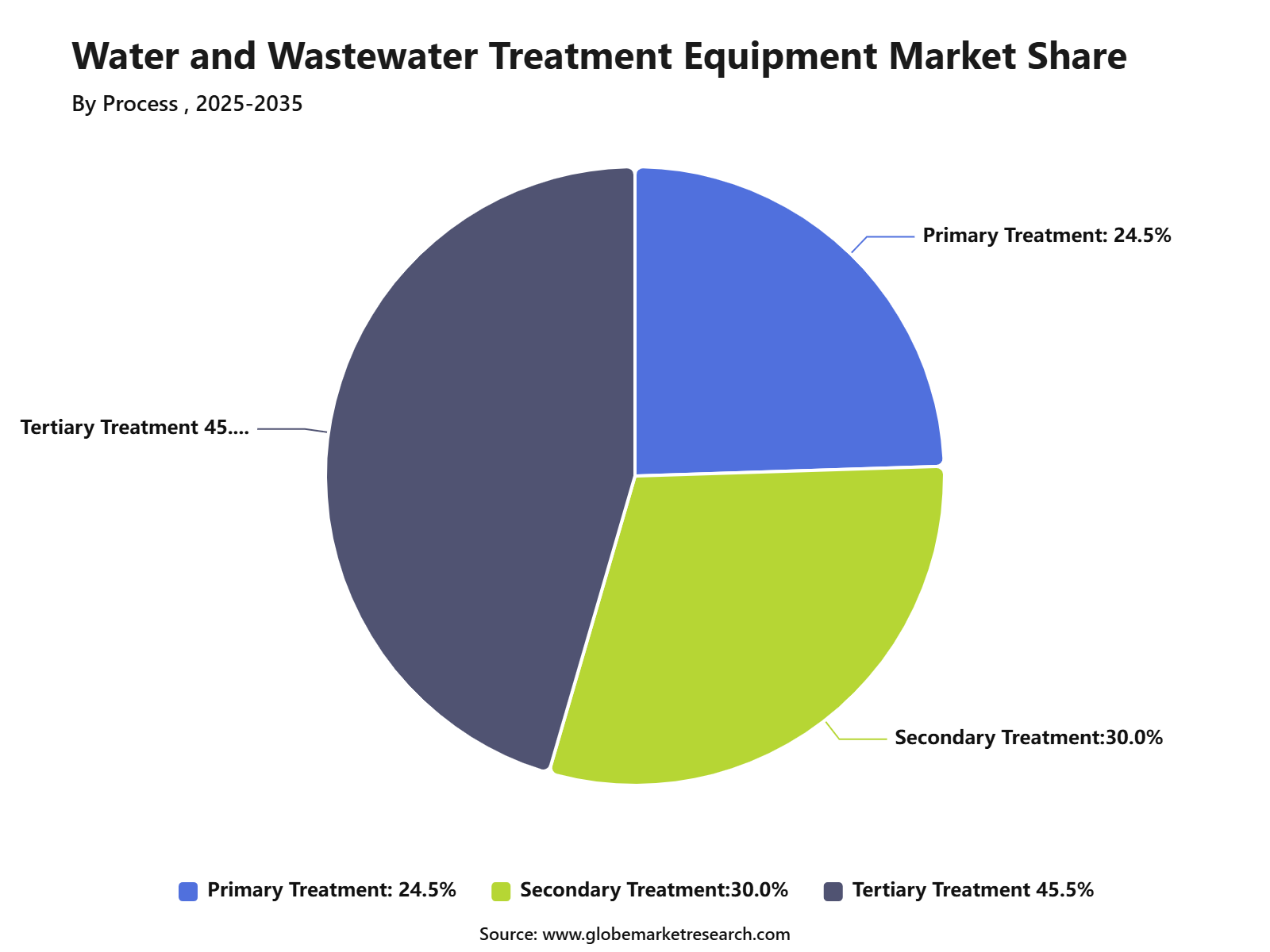
By process: Tertiary treatment led the process segment with a 45.5% share in 2025. Its position is supported by the need to remove nutrients, pathogens, trace pollutants, suspended solids and remaining contaminants before water is discharged or reused.
Primary and secondary treatment: Primary systems include screening, sedimentation, clarification and physical separation. Secondary treatment includes activated sludge, biological reactors, aeration systems, moving-bed biofilm reactors and membrane bioreactors.
Technology and Adoption Trends
Membrane-based treatment: Reverse osmosis, ultrafiltration, nanofiltration and membrane bioreactor systems are gaining importance in desalination, industrial water purification and wastewater reuse. Equipment manufacturers are focusing on lower operating pressure, higher recovery rates and improved resistance to fouling.
Energy-efficient membranes: In December 2025, DuPont introduced a low-energy, fouling-resistant reverse osmosis element for seawater desalination. Such developments are intended to reduce chemical cleaning requirements, pressure losses and operating costs.
Digital plant design and optimisation: Cloud-based modelling tools are being used to compare equipment configurations, chemical consumption, energy requirements and water recovery rates before construction. DuPont launched WAVE PRO for ultrafiltration modelling in March 2025 and later expanded the platform to include ion-exchange systems.
Smart monitoring and leak management: Utilities are adopting sensors, analytics platforms, automated controls and predictive maintenance tools. Xylem and Amazon announced smart water projects in Mexico City and Monterrey that are expected to save more than 1.3 billion litres of water annually through improved leak detection and network management.
Advanced water reuse: Hybrid and batch reverse osmosis systems are being tested to improve water recovery while reducing energy use and wastewater volumes. In April 2026, SUEZ and Salinity Solutions launched an industrial pilot for Hybrid Batch Reverse Osmosis in municipal wastewater reuse.
PFAS and micropollutant treatment: Activated carbon, ion-exchange resins, high-pressure membranes and destructive treatment processes are receiving greater attention. U.S. drinking water systems are required to meet federal PFOA and PFOS limits by April 2029 under the current compliance schedule.
Resource recovery: Wastewater plants are increasingly being designed to recover biogas, heat, phosphorus and reusable water. The revised EU wastewater rules require greater circularity and seek energy-neutral urban wastewater treatment plants by 2045.
Regional Breakdown & Supply Chain
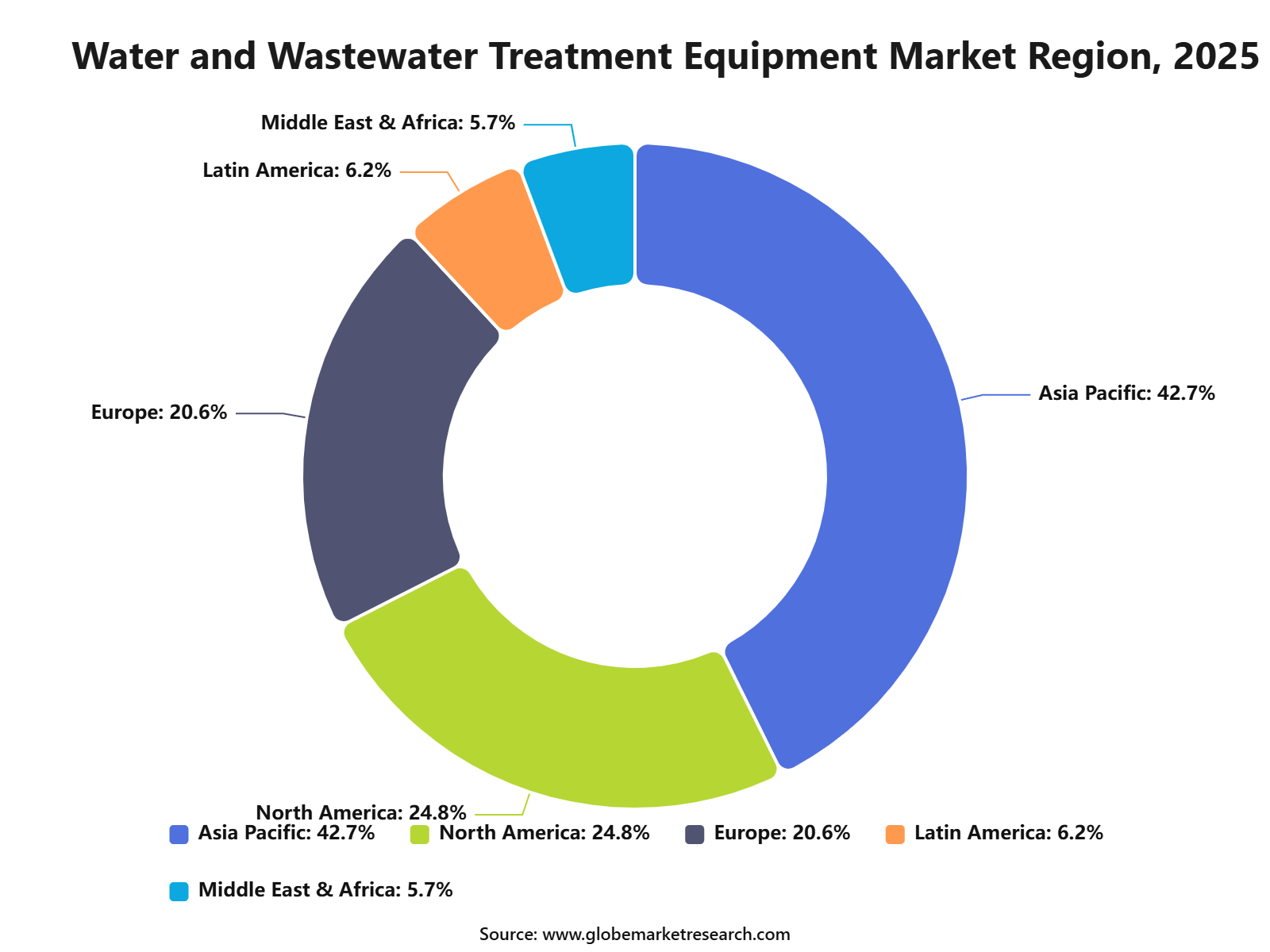
Asia Pacific: Asia Pacific led the global market with a 42.7% share in 2025. China, India, Japan, South Korea, Indonesia and Vietnam are investing in municipal wastewater treatment, industrial reuse and urban sanitation. Regional demand is supported by population density, industrial development and increasing pressure on freshwater resources.
North America: North America accounted for 24.8% of the market. Replacement of aging infrastructure, PFAS treatment, water reuse and digital utility management are creating demand for filtration equipment, activated carbon, ion-exchange systems, pumps, monitoring equipment and advanced treatment units.
Europe: Europe held a 20.6% share. The revised wastewater directive is expected to support investment in tertiary treatment, quaternary treatment, micropollutant removal, nutrient recovery and energy-efficient equipment.
Latin America: Latin America represented 6.2% of the market. Investment is being directed toward wastewater collection, treatment expansion and water reuse. In September 2025, the World Bank approved a USD 200 million programme supporting wastewater management and circular water use in Peru.
Middle East and Africa: The region accounted for 5.7% of the market. Desalination, industrial reuse and decentralized sanitation systems are important demand areas. However, limited financing, electricity availability and technical capacity continue to affect project execution.
Supply chain structure: The equipment supply chain includes stainless steel and engineered plastics, pumps, valves, membranes, activated carbon, ion-exchange resins, aeration equipment, ultraviolet systems, dosing units, sensors and control software. Equipment producers are supported by engineering, procurement and construction companies, distributors, plant operators and maintenance providers.
Localisation requirements: Public buyers are increasingly seeking local assembly, spare-parts availability and long-term maintenance support. Companies with regional engineering centres, established distributors and trained service teams are likely to have an advantage in public infrastructure tenders.
Future Outlook, 2026-2035
The market is expected to maintain steady growth through 2035 as water treatment changes from a basic public service requirement into an important part of industrial continuity, climate resilience and resource security. Municipal projects will continue to generate substantial equipment demand, but faster technology adoption is likely to be recorded in advanced treatment, industrial recycling, desalination, contaminant removal and digital plant management.
Investment decisions will increasingly be based on total lifecycle cost rather than initial equipment price. Energy consumption, membrane replacement, chemical use, sludge generation, water recovery and equipment uptime will be assessed together. As a result, suppliers offering equipment, digital monitoring, maintenance and performance guarantees within one contract are expected to gain stronger commercial positions.
Segment covered in the Report
By Application
Municipal
Industrial
By Process
Primary Treatment
Secondary Treatment
Tertiary Treatment
By Region
Asia Pacific
North America
Europe
Middle East & Africa
Latin America
Key Opportunities
Tertiary and quaternary treatment: Stricter limits on nutrients, pharmaceuticals, pathogens and micropollutants will increase demand for advanced filtration, oxidation, adsorption and disinfection systems.
Industrial water recycling: Semiconductor , data centre , pharmaceutical, food processing and chemical facilities require reliable high-purity water and wastewater recovery systems.
PFAS treatment: Activated carbon, ion-exchange resins, reverse osmosis and PFAS destruction technologies offer opportunities in North America, Europe and developed Asian markets.
Modular and decentralized systems: Containerised and prefabricated plants can serve rural communities, industrial sites, hotels, hospitals and smaller municipalities where central sewer networks are unavailable.
Digital water solutions: Sensors, automated controls, digital twins, remote monitoring and predictive maintenance can reduce leakage, equipment failure, energy consumption and chemical use.
Sludge and resource recovery: Anaerobic digestion, sludge dewatering, nutrient recovery and biogas production can convert treatment by-products into energy or reusable materials.
Long-term operation contracts: Design-build-operate and build-operate-transfer contracts provide equipment suppliers and engineering companies with recurring service and maintenance revenue.
Challenges and Restraints
High capital requirements: Advanced treatment plants require significant expenditure on civil construction, equipment, pipelines, power systems and monitoring infrastructure.
Public financing limitations: Budget constraints and weak tariff collection can delay projects, particularly in smaller municipalities and developing economies.
Energy consumption: Aeration, pumping, desalination and high-pressure membrane systems can create substantial electricity costs.
Maintenance complexity: Membrane fouling, corrosion, sludge handling and equipment wear require trained operators, spare parts and regular technical support.
Long approval cycles: Environmental approvals, tender processes, land acquisition and public funding decisions can extend project timelines.
Waste disposal requirements: Spent activated carbon, concentrated brine, contaminated resins and sludge must be managed safely, which can increase operating costs.
Workforce gaps: Limited access to qualified engineers and plant operators can reduce equipment performance and shorten system life.
Cybersecurity exposure: Connected treatment equipment and remote monitoring systems require stronger network security, access controls and data protection.
Key Players
Competition is based on treatment performance, energy efficiency, equipment reliability, project execution, regulatory knowledge and service availability. Large companies provide complete treatment systems, while specialised manufacturers focus on membranes, pumps, chemicals, ultraviolet disinfection, activated carbon, digital controls and sludge management. Partnerships between equipment suppliers, engineering contractors and technology developers are becoming more common as treatment requirements become more complex.
Prominent Global Market Leaders
Veolia Water Technologies and Solutions
SUEZ
Xylem Inc.
Ecolab Inc., including Nalco Water
DuPont Water Solutions
Pentair plc
Kurita Water Industries Ltd.
Kemira Oyj
Aquatech International LLC
VA Tech WABAG Limited
Acciona
Thermax Limited
Trojan Technologies
Calgon Carbon Corporation
Toshiba Water Solutions
BioMicrobics
Hydro International
3M
Strategic Implications
Equipment manufacturers should give greater priority to modular product design, lower energy consumption, digital monitoring and local maintenance capability. Products should be positioned around measurable outcomes such as water recovery, contaminant removal, energy savings, reduced chemical use and plant uptime. Strong technical documentation and compliance support will also be necessary for public-sector and industrial buyers.
Engineering companies and system integrators should develop partnerships with membrane manufacturers, digital platform providers and financing organisations. Long-term operation and maintenance contracts can improve recurring revenue while helping customers manage technical workforce shortages. For buyers, procurement decisions should include lifecycle cost, equipment compatibility, cybersecurity, spare-parts availability and the supplier’s ability to meet future discharge standards.
Recent Developments
In May 2026, VA Tech WABAG secured a design-build-operate order from the Delhi Jal Board for a 17 million -gallon-per-day wastewater treatment plant at Mitraon. The project includes sludge dewatering, pumping stations and associated pipelines, followed by 15 years of operation and maintenance.
In April 2026, VINCI received a EUR 192 million contract to modernise Prague’s main wastewater treatment plant. The project includes rebuilding and refurbishing settling tanks and installing new water treatment technologies.
In April 2026, SUEZ and Salinity Solutions launched the first industrial Hybrid Batch Reverse Osmosis pilot for municipal wastewater reuse in Béziers, France.
In December 2025, DuPont introduced a low-energy, fouling-resistant reverse osmosis element designed for seawater desalination systems. The product is intended to reduce cleaning frequency and improve operating efficiency.
In September 2025, Xylem and Amazon announced smart water infrastructure projects in Mexico City and Monterrey. Digital monitoring and leak management systems are expected to save more than 1.3 billion litres of water annually.
In May 2025, Veolia agreed to acquire CDPQ’s remaining 30% stake in Water Technologies and Solutions for USD 1.75 billion . Full ownership is expected to strengthen Veolia’s position in industrial water technologies and generate approximately EUR 90 million in annual cost synergies.
Conclusion
The Water and Wastewater Treatment Equipment Market is expected to expand steadily as governments, utilities and industries respond to water scarcity, pollution, aging infrastructure and stronger treatment standards. Municipal applications will remain the principal revenue source, while advanced industrial treatment, water reuse and contaminant removal will provide higher-value growth opportunities.
Future competition will be shaped by energy-efficient membranes, smart monitoring, modular treatment systems, PFAS removal, resource recovery and long-term service models. Companies that combine reliable equipment with local engineering, digital controls and lifecycle support will be better positioned to secure major infrastructure and industrial projects through 2035.