
Surfactants Market Size and Forecast
Surfactants are chemical compounds that reduce surface tension between liquids or between liquids and solids. They are widely used as cleaning, foaming, wetting, emulsifying and dispersing agents in detergents, personal care products, industrial cleaners, agricultural chemicals, food processing, textiles, paints and oilfield applications. Product development is increasingly focused on biodegradable formulations, renewable raw materials, concentrated products and surfactants that perform effectively at lower temperatures.
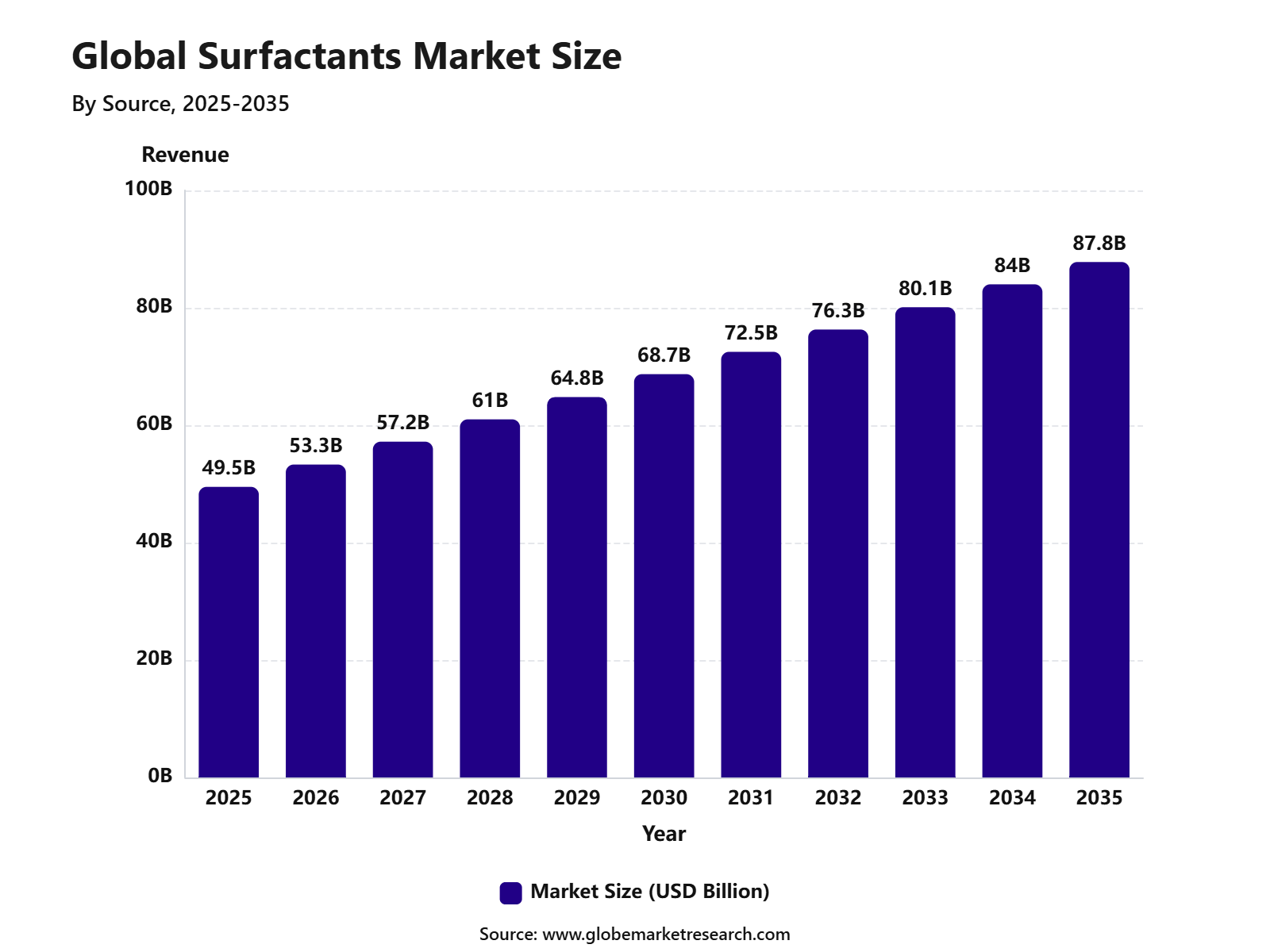
According to Globe Market Research, the global Surfactants Market was valued at USD 49.5 billion in 2025 and is projected to reach approximately USD 87.8 billion by 2035, growing at a CAGR of 5.9% from 2025 to 2035. Based on the stated growth rate, the market is estimated to reach around USD 53.3 billion in 2026. Asia Pacific accounted for approximately 37.8% of the market in 2025, representing nearly USD 18.7 billion. Regional leadership is supported by large detergent and personal care industries, expanding manufacturing activity, urbanisation and growing demand for household and institutional cleaning products.
Key Parameter | Report Details |
|---|---|
Market Revenue, 2025 | USD 49.5 Billion |
Projected Revenue, 2035 | USD 87.8 Billion |
CAGR, 2025-2035 | 5.9% |
Largest Region | Asia Pacific, 37.8% Share |
Market Concentration | Medium |
Base Year | 2025 |
Forecast Period | 2026-2035 |
Consumer cleaning activity and sustainable product development are strengthening demand. The American Cleaning Institute found that 80% of Americans planned to undertake spring cleaning in 2025, while 45% expected to clean or organise more than usual. BASF introduced a readily biodegradable amphoteric surfactant for shampoo, bath and skin-cleansing applications in April 2025 and continued expanding its plant-based surfactant portfolio in Asia. New European detergent rules adopted in 2026 also strengthened biodegradability, safety and environmental requirements, supporting the transition toward lower-impact surfactant formulations.
Why the Surfactants Market Is Growing
The market is growing because homecare, personal care, industrial cleaning, agriculture chemicals, textiles, food processing, and paints and coatings all depend on surfactants for product performance. The report identifies rising household cleaning demand as a +1.5% growth impact, personal care products as +1.3%, and industrial cleaning expansion as +1.1%.
Homecare remains a strong demand base because consumers continue to use detergents, dishwashing liquids, surface cleaners, fabric softeners, and disinfectant products regularly. A 2026 American Cleaning Institute survey found that 78% of Americans clean as much as or more than their parents did, while 39% now use digital channels such as internet search, social media, or AI for cleaning advice.
Sustainability is also changing the market. Bio-based surfactants, alkyl polyglucosides, glycolipid biosurfactants, mild amphoteric surfactants, and biodegradable detergent ingredients are gaining attention as brands respond to environmental, skin mildness, and regulatory expectations.
Petroleum-Based Surfactants Lead by Source
Petroleum-based surfactants held 88.4% share of the Surfactants Market in 2025. Their leadership is supported by cost efficiency, large-scale availability, stable performance, and wide use across homecare, personal care, industrial cleaning, textiles, agriculture, oilfield chemicals, and food processing.
These surfactants remain important because they provide strong cleaning, foaming, emulsifying, wetting, and dispersing properties. Their consistent performance makes them suitable for detergents, shampoos, cleaners, paints, coatings, lubricants, and industrial process chemicals.
Source | Market Share |
|---|---|
Petroleum-Based | 88.4% |
Bio-Based | 11.6% |
However, bio-based surfactants are gaining strategic importance. Producers are investing in renewable feedstocks, oleochemical-based ingredients, alkyl polyglucosides, rhamnolipids, and low-toxicity formulations to meet customer demand for safer and more biodegradable products.
Non-Ionic Surfactants Lead by Product Type
Non-ionic surfactants accounted for 38.8% share by product type in 2025. Their leadership is supported by low sensitivity to water hardness, strong emulsification ability, mildness, and compatibility with anionic, cationic, and amphoteric surfactants.
Non-ionic surfactants are widely used in laundry detergents, dishwashing liquids, industrial cleaners, personal care products, agrochemical formulations, paints, coatings, and textile processing. They are valued because they perform well in both acidic and alkaline conditions.
Product Type | Market Share |
|---|---|
Non-Ionic Surfactants | 38.8% |
Anionic Surfactants | 27.6% |
Cationic Surfactants | 15.4% |
Amphoteric Surfactants | 10.2% |
Others | 8.0% |
The segment is also gaining from specialty formulations. Customers need surfactants that improve oil removal, foam control, stability, rinsing, and formulation flexibility across different water conditions and temperatures.
Homecare Leads by Application
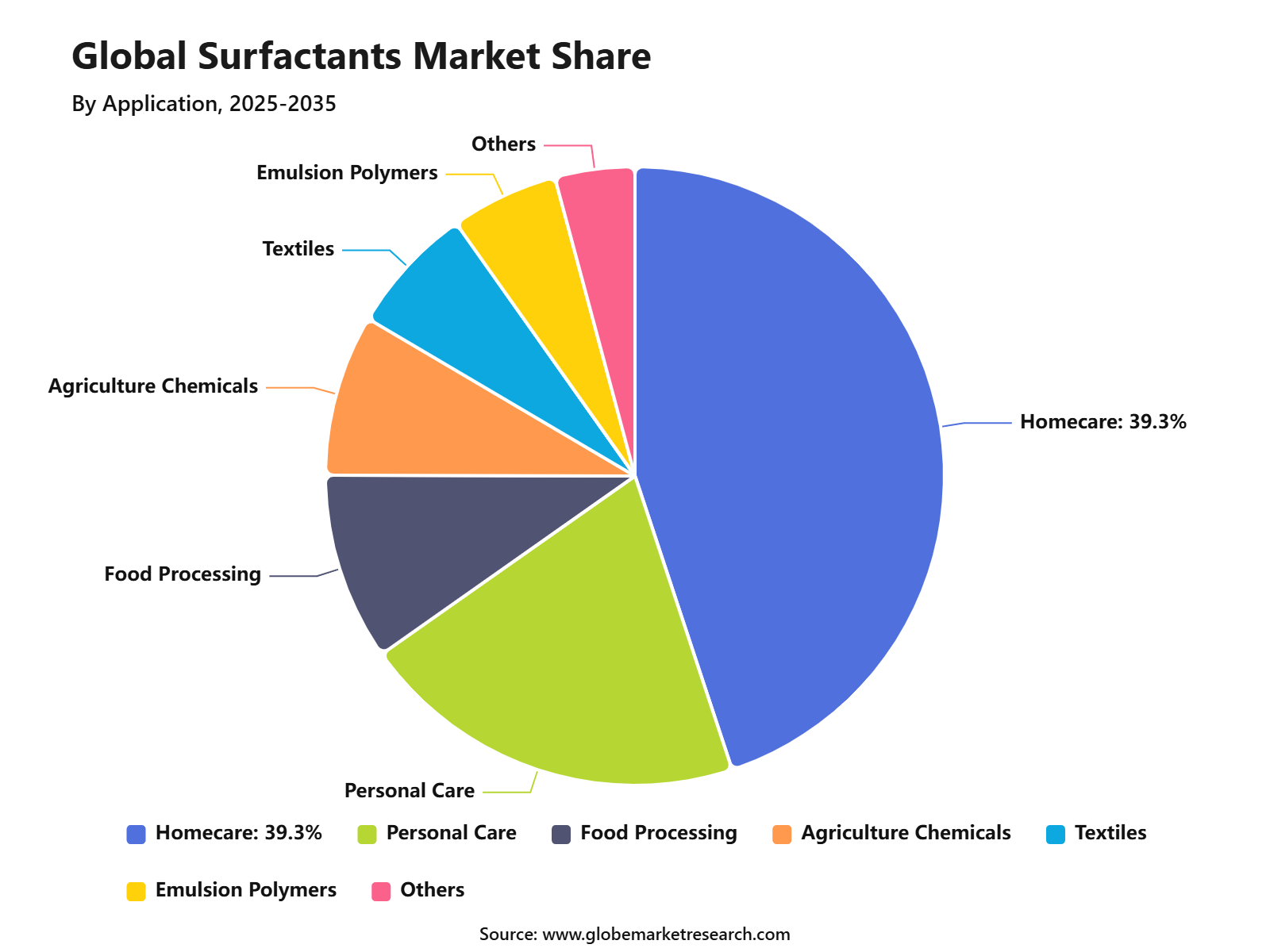
Homecare applications captured 39.3% share of the Surfactants Market in 2025. This leading position is driven by high surfactant consumption in laundry detergents, dishwashing products, surface cleaners, fabric softeners, disinfectant cleaners, and household hygiene products.
Surfactants are central to homecare products because they help remove oil, dirt, grease, stains, and microbes from different surfaces. They improve wetting, foaming, soil suspension, emulsification, and rinsing performance.
Application | Market Share |
|---|---|
Homecare | 39.3% |
Personal Care | 17.4% |
Food Processing | 10.8% |
Agriculture Chemicals | 9.2% |
Textiles | 8.1% |
Others | 7.9% |
Emulsion Polymers | 7.3% |
The segment is expected to remain a major demand center as consumers continue buying convenient cleaning products. Concentrated detergents, liquid laundry products, dishwasher tablets, refill formats, and low-water cleaning systems are creating opportunities for more efficient surfactant blends.
Asia Pacific Leads the Surfactants Market
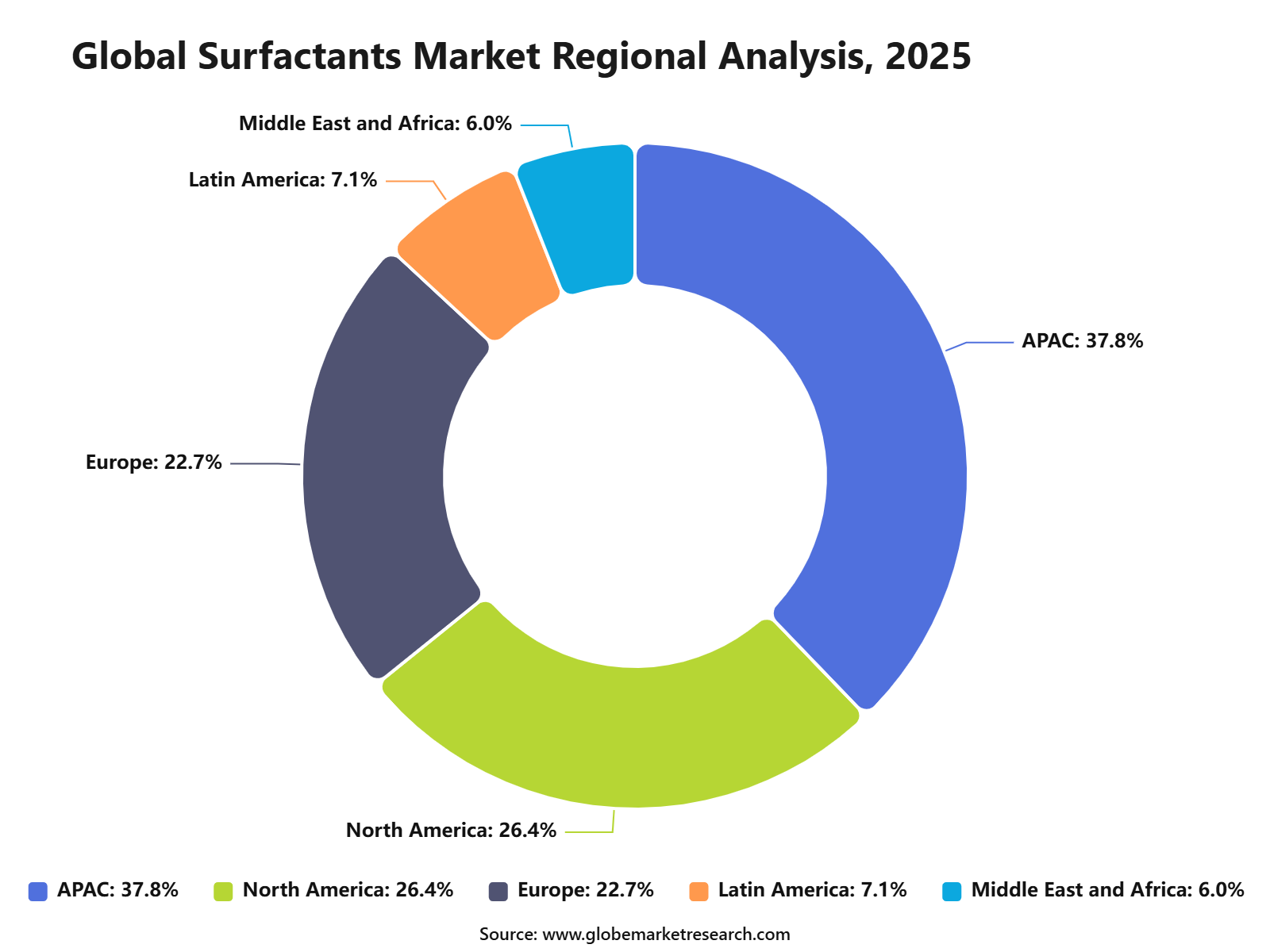
Asia Pacific held 37.8% share of the Surfactants Market in 2025, making it the leading regional market. Growth is supported by strong demand from homecare, personal care, textiles, agriculture, food processing, paints and coatings, and industrial manufacturing.
Region | Market Share |
|---|---|
Asia Pacific | 37.8% |
Europe | 23.4% |
North America | 21.7% |
Latin America | 9.1% |
Middle East and Africa | 8.0% |
China, India, Japan, South Korea, Indonesia, Vietnam, and Southeast Asia are key demand centers. The region benefits from large consumer populations, detergent manufacturing, textile processing, personal care production, and strong industrial output. North America is identified as the fastest-growing region in the report. Growth is being supported by premium personal care, sustainable detergent reformulation, industrial cleaning, and demand for safer chemical ingredients.
Bio-Based and Mild Surfactants Are Creating New Value
Bio-based surfactant development carries a +1.4% opportunity impact, while mild surfactants for personal care carry +1.2%. This shows that growth is not only coming from volume demand, but also from higher-value and lower-impact formulations.
Evonik highlighted industrial-scale rhamnolipid biosurfactants at PCHi 2026, including RHEANCE One, SOPHANCE LA-A, and REWOFERM products for personal care and household cleaning. The company stated that these fully biodegradable glycolipids are already used in multiple end-products launched in China.
Research on sucrose ester surfactants also shows why bio-based chemistry is attracting attention. Sucrose esters, derived from sucrose and fatty acids, are described as biodegradable and non-toxic surfactants used in food, cosmetics, and pharmaceutical formulations.
Market Trend Analysis
The market trend is moving toward biodegradable surfactants, bio-based ingredients, mild formulations, sulfate-free personal care products, concentrated detergents, low-foam industrial cleaners, and multifunctional surfactants. Sustainability and performance are becoming major purchase criteria.
Asia Pacific remains the largest value region because of high-volume detergent production, growing personal care consumption, and industrial manufacturing scale. Europe and North America support premium growth through green cleaning, regulatory-driven reformulation, and bio-based product development.
Impact Factor | Estimated CAGR Impact | Regional Relevance | Market Impact |
|---|---|---|---|
Biodegradable surfactants gain traction | +1.4% | Europe, North America, Asia Pacific | Supports sustainable chemistry growth. |
Sulfate-free personal care products rise | +1.1% | Cosmetics and skincare markets | Drives mild surfactant demand. |
Concentrated cleaning formulations expand | +0.9% | Home care and institutional cleaning | Improves efficiency and packaging use. |
Multifunctional surfactants increase | +0.7% | Industrial and consumer formulations | Adds formulation value. |
Low-foam industrial cleaners grow | +0.6% | Manufacturing and process industries | Supports specialty surfactant use. |
Technology Adoption Analysis
Technology adoption is focused on bio-based surfactant production, enzyme-assisted processing, fermentation-based surfactants, improved sulfonation technology, advanced emulsification systems, and green chemistry. These technologies help improve performance, safety, and environmental profile.
Manufacturers are also adopting digital formulation tools, quality control automation, process optimization, and wastewater treatment technologies. These upgrades support cleaner production and better consistency across high-volume surfactant manufacturing.
Impact Factor | Estimated CAGR Impact | Regional Relevance | Market Impact |
|---|---|---|---|
Bio-based production technologies | +1.3% | Europe, North America, Asia Pacific | Supports sustainable surfactant supply. |
Fermentation-based surfactants | +1.0% | Specialty chemical markets | Adds high-value innovation. |
Advanced sulfonation processes | +0.8% | Large surfactant producers | Improves efficiency and consistency. |
Digital formulation and testing tools | +0.6% | Personal care and home care R&D | Speeds product development. |
Cleaner wastewater treatment systems | +0.5% | Industrial production sites | Improves environmental compliance. |
Demand Analysis
Demand is led by household detergents, laundry care, dishwashing liquids, shampoos, body washes, cosmetics, industrial cleaners, agrochemicals, paints, coatings, textiles, food processing, and pharmaceuticals. Home care remains a major demand area due to daily use of cleaning and hygiene products.
Demand is also rising from consumers seeking safer, milder, and environmentally responsible products. Asia Pacific’s large population base, growing middle class, and expanding manufacturing sector keep regional demand strong.
Impact Factor | Estimated CAGR Impact | Regional Relevance | Market Impact |
|---|---|---|---|
Demand from household detergents | +1.5% | Asia Pacific, North America, Europe | Leads high-volume consumption. |
Demand from personal care products | +1.2% | China, India, Japan, South Korea | Supports premium surfactant use. |
Demand from industrial cleaning | +0.9% | Manufacturing and institutional sectors | Adds steady commercial demand. |
Demand from agriculture chemicals | +0.7% | Asia Pacific, Latin America | Supports wetting and dispersion use. |
Demand from paints, coatings, and textiles | +0.6% | Industrial manufacturing markets | Adds specialty formulation demand. |
Investment Opportunity Analysis
Investment opportunities are strongest in bio-based surfactants, mild personal care surfactants, green cleaning ingredients, specialty industrial surfactants, agricultural adjuvants, and high-performance emulsifiers. These areas benefit from sustainability demand and product differentiation.
Asia Pacific offers strong volume-based opportunities due to its large regional share, manufacturing scale, and rising consumer goods demand. Europe and North America provide value opportunities through sustainable formulations, regulatory-driven replacement, and premium personal care products.
Impact Factor | Estimated CAGR Impact | Regional Relevance | Market Impact |
|---|---|---|---|
Bio-based surfactant producers | +1.4% | Europe, North America, Asia Pacific | Builds sustainable ingredient value. |
Personal care surfactant suppliers | +1.1% | Asia Pacific and premium markets | Supports mild formulation growth. |
Green cleaning ingredient companies | +0.9% | Developed and urban markets | Adds eco-friendly product demand. |
Specialty industrial surfactant firms | +0.7% | Manufacturing and process industries | Improves margin potential. |
Agricultural surfactant suppliers | +0.6% | Asia Pacific and Latin America | Supports agrochemical efficiency. |
Regional Impact Analysis
Asia Pacific leads the Surfactants Market with 37.8% share in 2025, valued at around USD 18.7 billion, supported by large-scale detergent production, personal care manufacturing, industrial activity, and rising household hygiene demand. China and India remain major regional contributors due to population size, urbanization, and expanding consumer goods production.
North America remains important because of strong demand for household cleaning, personal care, oilfield chemicals, and industrial cleaning. Europe supports value growth through biodegradable ingredients, sustainable chemistry, and regulatory-led reformulation.
Impact Factor | Estimated CAGR Impact | Regional Relevance | Market Impact |
|---|---|---|---|
Asia Pacific market leadership | +1.7% | Asia Pacific, 37.8% share in 2025 | Leads global value demand. |
China detergent and industrial production | +1.2% | China | Drives high-volume consumption. |
India personal care and home care growth | +1.0% | India | Supports future demand expansion. |
Southeast Asia consumer goods expansion | +0.8% | Indonesia, Vietnam, Thailand | Adds regional growth momentum. |
Europe and North America sustainable formulations | +0.6% | Germany, France, UK, U.S., Canada | Supports bio-based surfactant demand. |
Investor Type Impact Matrix
Investors should focus on companies with strong raw material access, scalable production, regulatory compliance, formulation expertise, and customer relationships across home care, personal care, industrial, and agricultural applications. Sustainability, cost efficiency, and product performance are key success factors.
Strategic investors can also target bio-based surfactant developers, specialty chemical producers, detergent ingredient suppliers, personal care surfactant companies, and green chemistry platforms. Companies that combine scale with sustainable product innovation are better positioned for long-term growth.
Investor Type | Estimated CAGR Impact | Regional Relevance | Market Impact |
|---|---|---|---|
Surfactant Manufacturers | +1.2% | Global | Expands core chemical supply. |
Bio-Based Ingredient Producers | +1.0% | Europe, North America, Asia Pacific | Supports sustainable formulation growth. |
Personal Care Ingredient Suppliers | +0.8% | Asia Pacific and premium markets | Adds mild surfactant demand. |
Industrial Cleaning Chemical Firms | +0.6% | Manufacturing and institutional markets | Builds stable B2B revenue. |
Strategic Specialty Chemical Investors | +0.5% | Global surfactant ecosystem | Funds capacity and green chemistry expansion. |
Recent Developments
In March 2026, BASF-Hannong Specialty Chemicals inaugurated its non-ionic surfactant site in Seosan, Korea. BASF’s source confirms that the site was inaugurated on March 17, 2026, strengthening local supply for specialty non-ionic surfactants in Asia Pacific.
In March 2026, Evonik highlighted its industrial-scale rhamnolipid biosurfactants at PCHi 2026. Its portfolio includes RHEANCE One and SOPHANCE LA-A for personal care and REWOFERM products for household cleaners and detergents.
In 2025, Godrej Industries’ chemicals business announced a capacity expansion plan of more than INR 700 crore, including an additional 30,000 tons per year of primary surfactants capacity. The company also planned to increase renewable energy usage to 75%.
In November 2025, BASF inaugurated a new alkyl polyglucosides production plant at its Bangpakong site in Thailand. APGs are bio-based, biodegradable, non-ionic surfactants used in personal care, home care, industrial cleaning, and agricultural formulations.
Competitive Landscape
The Surfactants Market is competitive, with global chemical companies, specialty surfactant producers, oleochemical suppliers, detergent ingredient manufacturers, and regional formulation suppliers competing across cost, performance, sustainability, technical support, and supply reliability.
Top companies include:
AkzoNobel N.V.
BASF SE
Evonik Industries AG
Solvay S.A.
Clariant AG
Huntsman International LLC
Dow Inc.
Kao Corporation
Henkel Adhesives Technologies India Private Limited
Bayer AG
Godrej Industries Limited
Stepan Company
Other Key Players
Competition is expected to increase as customers demand bio-based ingredients, biodegradable surfactants, low-irritation personal care systems, concentrated detergent solutions, and stronger formulation support. Companies with reliable raw material access, application testing, regional production, and sustainability documentation are likely to perform better.
The strongest players will be those that can balance cost, cleaning performance, foam behavior, mildness, biodegradability, and formulation stability. In this market, buyers are not purchasing only surfactant volume. They are purchasing performance, compliance, supply security, and formulation confidence.
Market Concentration: Medium
The Surfactants Market has medium concentration because large chemical companies have scale advantages, global supply networks, production assets, technical teams, and established relationships with homecare, personal care, industrial, and agrochemical customers. Companies such as BASF, Evonik, Solvay, Dow, Clariant, Kao, Stepan, and Godrej have strong positions in different surfactant chemistries and regions.
At the same time, the market remains fragmented across regional producers, specialty chemical suppliers, oleochemical manufacturers, formulation houses, and local distributors. This creates room for niche companies focused on bio-based surfactants, mild personal care ingredients, agrochemical adjuvants, and customized industrial blends.
Conclusion
The Surfactants Market is entering a steady growth phase supported by homecare consumption, personal care production, industrial cleaning, agriculture chemicals, textiles, paints and coatings, and food processing. The market is projected to grow from USD 49.5 billion in 2025 to USD 87.8 billion by 2035, supported by a 5.9% CAGR.
Future growth will be led by non-ionic surfactants, homecare applications, Asia Pacific demand, bio-based surfactants, mild personal care ingredients, sustainable detergents, agrochemical adjuvants, and specialty industrial formulations. Companies that manage feedstock volatility while improving sustainability, technical service, and formulation performance will be better positioned in this market.
Explore key industry insights across a comprehensive 220+ page report, featuring 112+ market data tables, figures, and charts covering the "Surfactants Market By Source (Petroleum-Based, Bio-Based), By Product Type (Non-Ionic Surfactants, Anionic Surfactants, Cationic Surfactants, Amphoteric Surfactants, Others), By Application (Homecare, Personal Care, Food Processing, Agriculture Chemicals, Textiles, Emulsion Polymers, Others), By Regional Insights, Business plan and Project Report, Investment Opportunities, Profitability, Industry Trends, Leading Companies and Growth Forecasts by 2025-2035"
Get Detailed Report @ https://www.globemarketresearch.com/reports/surfactants-market
Contact:
Global Business Development Team
Syndicated Market Reports | Custom Research | Consulting & Advisory
Email: [email protected]