Revenue, 2026
USD 1.4 Bn
Forecast, 2035
USD 7.8 Bn
CAGR, 2026-2035
20.8%
Report Coverage
Global
Market Size and Forecast
According to Globe Market Research, the global AI Agent Identity Management Market was valued at USD 1.4 billion in 2026 and is projected to reach USD 7.8 billion by 2035, growing at a CAGR of 20.8% from 2026 to 2035. North America accounted for around 42.3% of the market, equivalent to approximately USD 0.59 billion in 2026. The region’s strong market position reflects early enterprise AI adoption, mature identity and access management infrastructure, extensive cloud deployment and increasing investment in AI agent security and governance.
Key Parameter | Report Details |
|---|---|
Market Revenue, 2026 | USD 1.4 Billion |
Projected Revenue, 2035 | USD 7.8 Billion |
CAGR, 2026-2035 | 20.8% |
Largest Region | North America: 42.3% Share |
Market Concentration | Medium |
Forecast Period | 2026-2035 |
What is the AI Agent Identity Management Market?
The AI agent identity management market includes platforms and services used to discover, register, authenticate, authorize, govern, monitor and revoke digital identities assigned to AI agents. It covers agent identity governance, credential and secret management, privileged access control, behavioural monitoring, compliance auditing and lifecycle management across cloud-based, on-premises and hybrid environments. These systems provide each AI agent with a unique identity and control its access to applications, data, tools and APIs.
Demand increased in 2026 as AI agents moved from basic assistance toward autonomous actions involving enterprise systems and sensitive information. The Cloud Security Alliance reported that organisations manage around 45 non-human identities for every human identity, while a 2026 industry survey found that 79% of IT professionals felt unprepared to prevent attacks involving non-human identities. NIST has also advanced standards-based work for identifying, authorizing and securely managing software and AI agents.
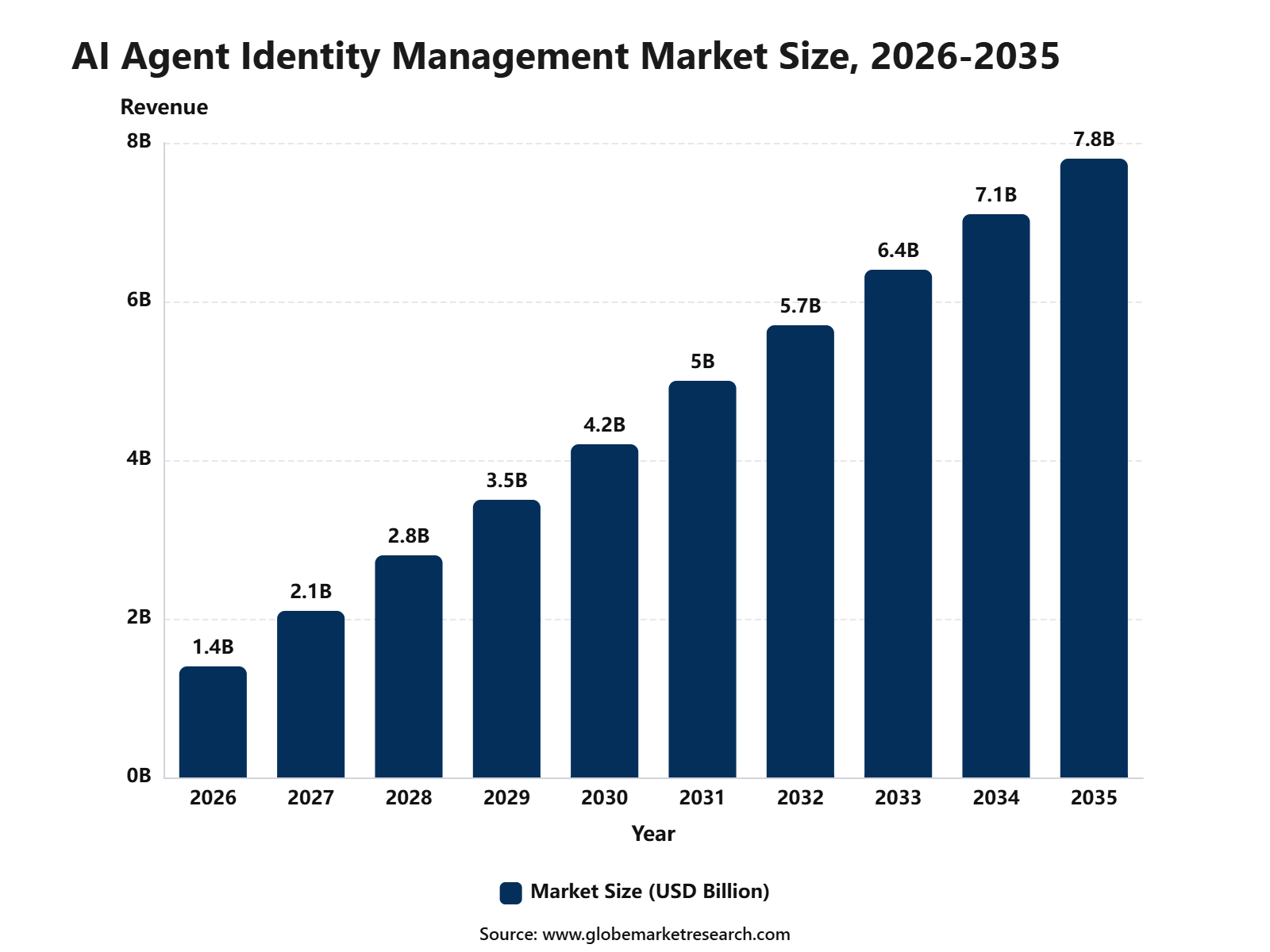 iThe graph shows projected market growth until 2035 based on CAGR analysis. Actual outcomes may vary depending on changing demand, competition, and economic factors.To gain greater insights - request a sample report PDF
Key Market Insights
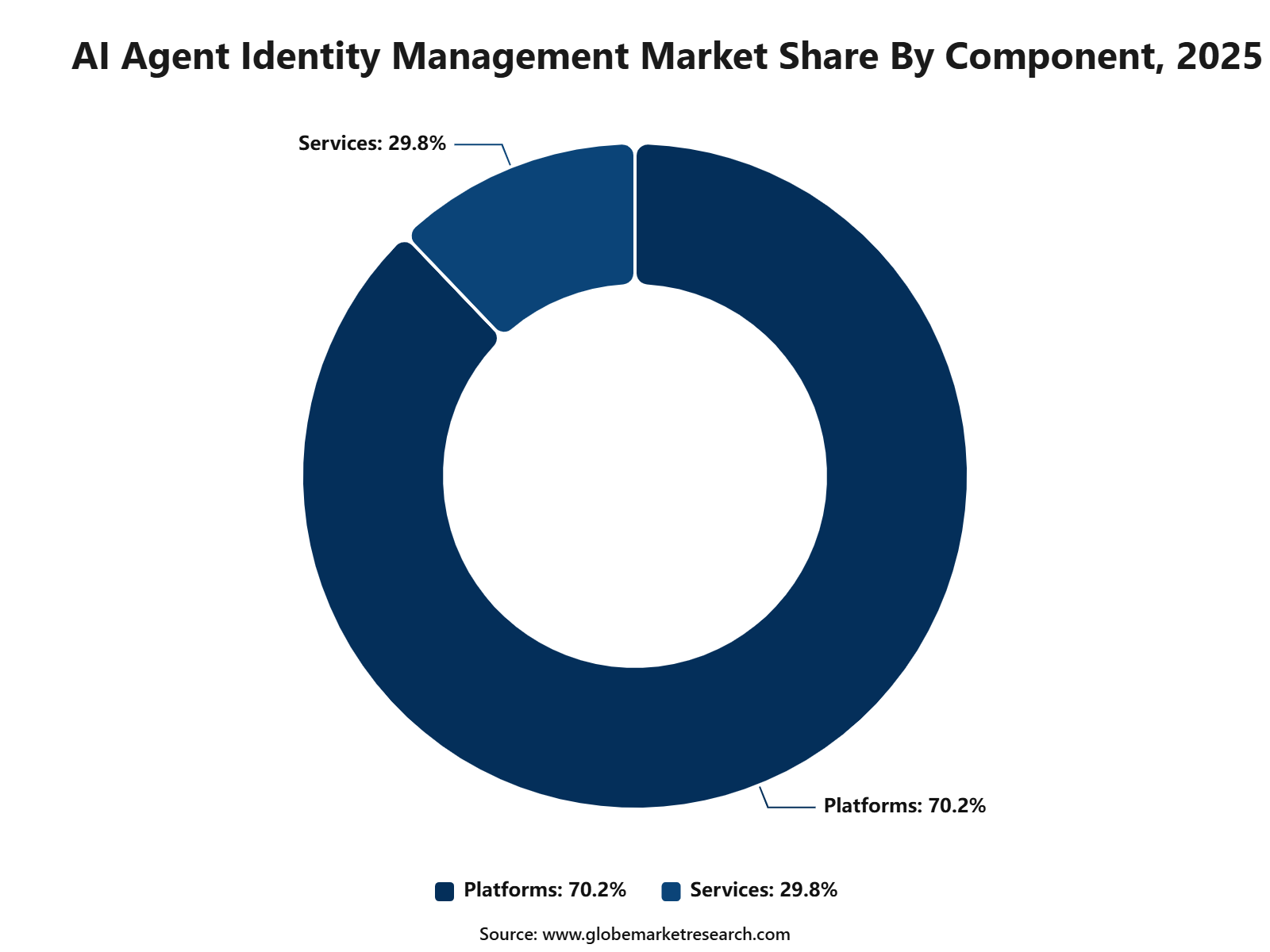
Platforms led the component segment with a 70.2% share, supported by rising demand for centralized identity governance, agent access control, credential management, and policy enforcement.
Authentication and authorization accounted for 32.3% of the market by identity function, driven by the need to verify AI agent identities and control access to enterprise systems, applications, and data.
Semi-autonomous AI agents held a 59.6% share by agent type, reflecting their growing use in workflows that combine automated decision-making with human supervision and approval.
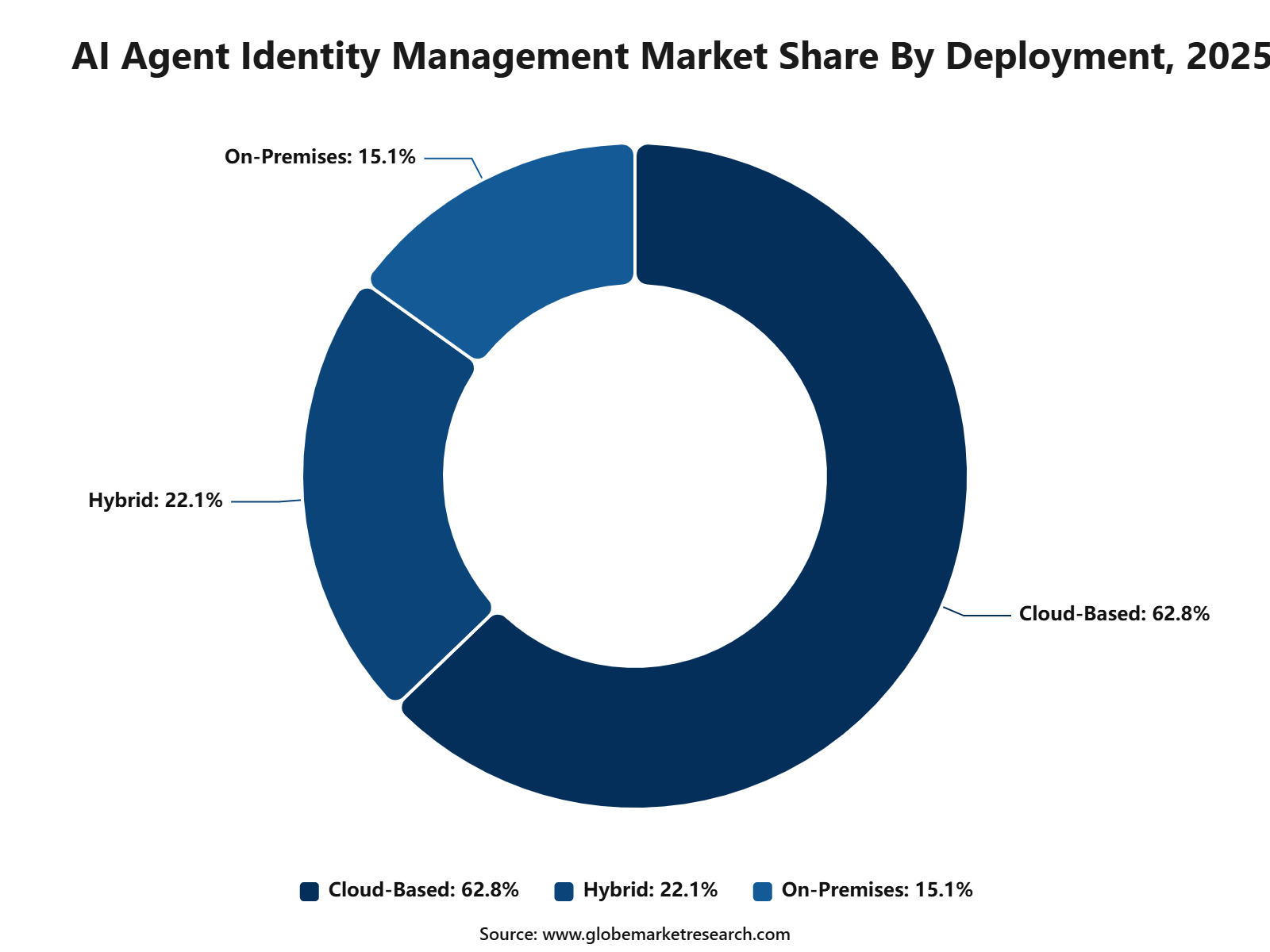
Cloud-based deployment dominated the market with a 62.8% share, supported by scalable infrastructure, faster implementation, remote accessibility, and integration with cloud-based AI applications.
Large enterprises captured a 72.2% share by organization size, driven by complex identity environments, higher cybersecurity spending, and the need to manage large numbers of AI agents across business functions.
BFSI led the end-user industry segment with a 27.3% share, supported by strict security requirements and increasing adoption of AI agents in fraud detection, customer service, compliance, and financial operations.
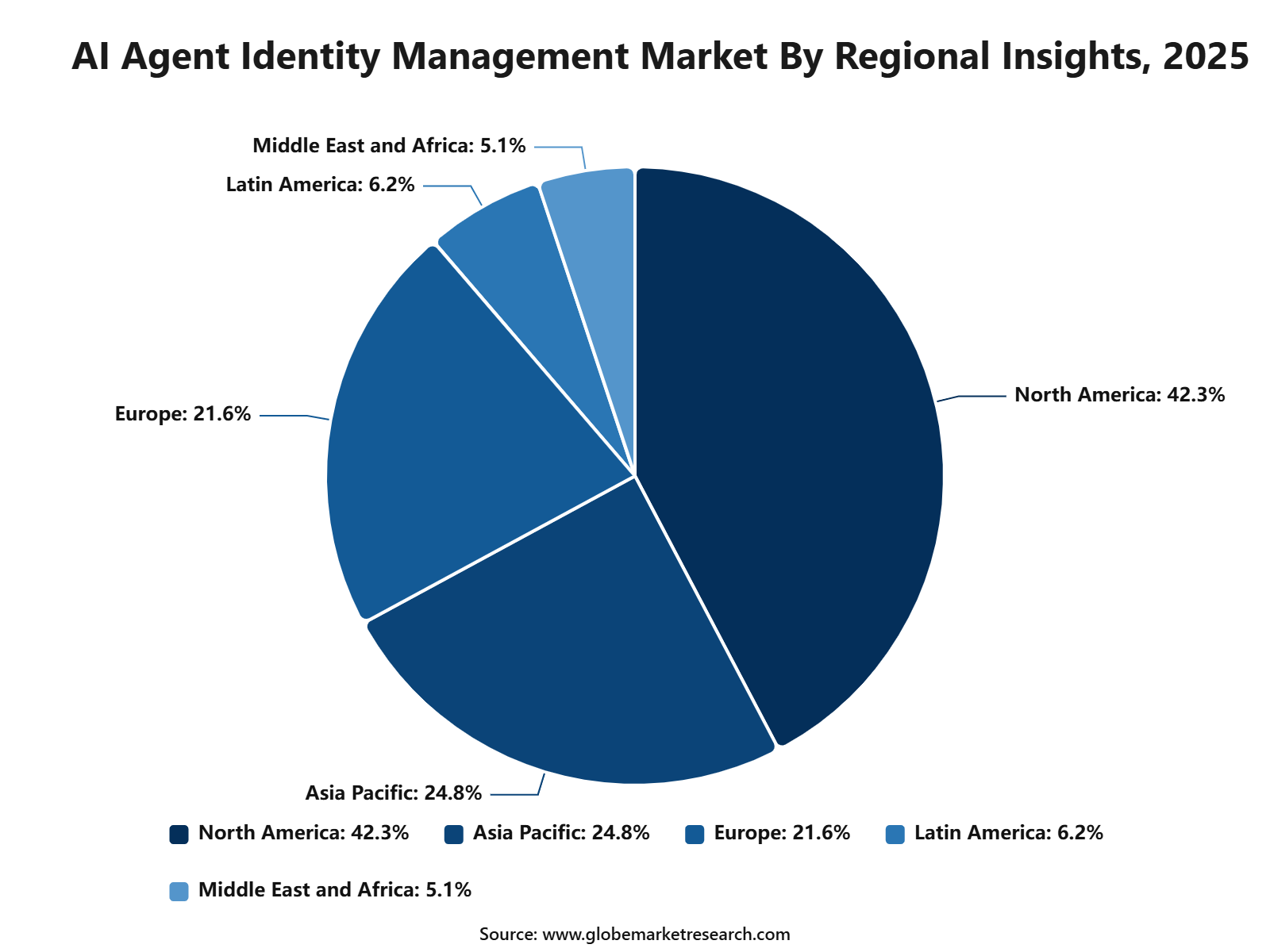
North America dominated the AI agent identity management market with a 42.3% share, supported by early enterprise AI adoption, advanced cybersecurity infrastructure, and strong demand for identity governance solutions.
Adoption Rate and Usage Statistics
According to the Cloud Security Alliance and Gravitee, only 21.9% of organizations treat AI agents as independent identities, while just 18% determine access through agent-specific permissions. Full security approval covers only 14.4% of enterprise agent fleets, and fewer than one-quarter of organizations have formally adopted AI identity creation and removal policies. On average, 47.1% of deployed agents are actively monitored or secured.
Metric | Adoption Rate |
|---|---|
Independent Agent IDs | 21.9% |
Agent-Based Permissions | 18% |
Full Security Approval | 14.4% |
Formal Identity Policies | Less than 25% |
Active Agent Monitoring | 47.1% |
According to the Cloud Security Alliance and Gravitee, 45.6% of organizations continue to use shared API keys for agent authentication. Nearly three-quarters report that agents receive more access than required, while 79% identify new access pathways that are difficult to monitor. Around 81% are concerned that manipulated prompts could expose credentials, and 68% cannot clearly separate agent actions from human activity.
Metric | Identity Usage |
|---|---|
Shared API Keys | 45.6% |
Excessive Agent Access | Nearly 75% |
New Access Pathways | 79% |
Credential Exposure Risk | 81% |
Attribution Gap | 68% |
Component Insights
Platforms led the component segment with 70.2% share. These platforms provide centralized systems for registering AI agents, assigning identities, managing credentials, defining permissions, monitoring activities, and revoking access when an agent is compromised or retired.
The segment leads because organizations require a unified control layer for human, machine, application, and AI-agent identities. Platform-based solutions support policy enforcement, identity discovery, credential rotation, privileged access controls, behavioral monitoring, audit trails, and integration with existing security systems.
A 2025 survey of 1,200 security leaders found that 81% considered machine identity security essential for protecting artificial intelligence systems. It also showed that 79% expected the number of machine identities within their organizations to increase over the following year.
 iThe graph shows projected market growth until 2035 based on CAGR analysis. Actual outcomes may vary depending on changing demand, competition, and economic factors.To gain greater insights - request a sample report PDF
Identity Function Insights
Authentication and authorization accounted for 32.3% share by identity function. Authentication confirms that an AI agent is genuine, while authorization determines which data, applications, tools, APIs, and business processes the agent is permitted to access.
This function leads because AI agents may operate across several systems and perform actions on behalf of employees or customers. Strong controls are required to verify agent identity, restrict delegated authority, enforce least-privilege access, validate tokens, and prevent unauthorized transactions.
Identity Function | Market Share, 2025 (%) |
|---|---|
Authentication and Authorization | 32.3% |
Identity Governance and Administration | 14.8% |
Credential and Secret Management | 12.7% |
Privileged Access Management | 10.9% |
Behavioral Monitoring | 9.4% |
Audit and Compliance | 8.5% |
Agent Discovery and Registration | 6.8% |
Agent Revocation | 4.6% |
A global identity survey published in 2025 found that 68% of users reused passwords across digital services. This continued dependence on weak authentication practices increases the need for passwordless methods, multifactor authentication, short-lived credentials, and fine-grained authorization for both human and AI identities.
Agent Type Insights
Semi-autonomous AI agents held 59.6% share by agent type. These agents can complete defined tasks independently but require human approval for sensitive decisions, high-value transactions, policy changes, or actions involving regulated information.
The segment leads because semi-autonomous models offer a practical balance between automation and human control. Organizations can improve productivity while maintaining oversight through approval workflows, permission limits, escalation rules, activity logs, and real-time intervention mechanisms.
Agent Type | Market Share, 2025 (%) |
|---|---|
Semi-Autonomous AI Agents | 59.6% |
AI Copilots | 18.7% |
Multi-Agent Systems | 12.8% |
Fully Autonomous AI Agents | 8.9% |
In a 2025 survey covering 6,750 consumers, 38% stated that human oversight of AI-agent decisions would be important for increasing trust. This supports the adoption of semi-autonomous agents that combine automated execution with accountable human supervision.
Deployment Insights
Cloud-based deployment led with 62.8% share. Cloud identity platforms allow enterprises to create and manage AI-agent identities across software applications, data environments, digital workflows, APIs, and infrastructure without deploying separate systems at every location.
Cloud deployment leads because AI agents are frequently developed and operated through cloud-based models, applications, and automation services. Centralized cloud platforms provide scalable authentication, policy updates, credential management, continuous monitoring, and integration across geographically distributed operations.
A 2025 survey of 1,800 senior IT decision-makers found that 56% preferred public cloud environments for AI workloads. The findings also showed that 84% used private cloud infrastructure for both conventional enterprise applications and modern cloud-native workloads.
 iThe graph shows projected market growth until 2035 based on CAGR analysis. Actual outcomes may vary depending on changing demand, competition, and economic factors.To gain greater insights - request a sample report PDF
Organization Size Insights
Large enterprises accounted for 72.2% share. These organizations operate extensive digital environments containing thousands of employees, applications, service accounts, APIs, devices, automated processes, cloud workloads, and emerging AI agents.
Large enterprises require identity management platforms because agent access must be controlled across multiple business units, subsidiaries, regulatory jurisdictions, and technology systems. Centralized governance helps prevent excessive permissions, unmanaged credentials, agent duplication, unauthorized delegation, and gaps between security teams.
Half of the organizations included in a 2025 security survey had experienced a breach associated with compromised machine identities during the preceding 12 months. Among the affected organizations, 43% reported unauthorized access to sensitive systems or information.
Organization Size | Market Share, 2025 (%) |
|---|---|
Large Enterprises | 72.2% |
Small and Medium Enterprises | 27.8% |
End-User Industry Insights
BFSI led the end-user industry segment with 27.3% share. Banks, insurers, payment companies, investment firms, and financial technology providers are adopting AI agents for customer service, fraud detection, compliance checks, risk analysis, transaction processing, and employee assistance.
The industry leads because financial AI agents interact with confidential customer records, payment systems, account information, and regulated workflows. Each agent requires a verifiable identity, limited permissions, transaction-level authorization, continuous monitoring, and complete audit records.
A 2026 financial crime study found that 90% of surveyed financial professionals had observed increased AI-driven attacks during the previous two years. In response, 75% of financial institutions planned to expand their use of AI for financial crime detection.
End-User Industry | Market Share, 2025 (%) |
|---|---|
BFSI | 27.3% |
IT and Telecommunications | 19.2% |
Healthcare and Life Sciences | 13.7% |
Government and Defense | 11.8% |
Retail and E-commerce | 10.1% |
Manufacturing | 8.4% |
Energy and Utilities | 5.7% |
Others | 3.8% |
Regional Insights
North America led the AI Agent Identity Management Market with 42.3% share. Regional leadership is supported by extensive enterprise AI investment, established cloud infrastructure, advanced cybersecurity capabilities, and early adoption of agent-based automation.
The United States remains the primary contributor due to strong activity across technology, banking, healthcare, government, and professional services. The region is also advancing standards for secure AI agents, digital identity, authorization, interoperability, and accountable agent activity.
U.S. private investment in artificial intelligence reached USD 285.9 billion in 2025, more than 23 times the amount recorded in China. The country also had 1,953 newly funded AI companies during the year, creating a large potential user base for agent identity and access management platforms.
 iThe graph shows projected market growth until 2035 based on CAGR analysis. Actual outcomes may vary depending on changing demand, competition, and economic factors.To gain greater insights - request a sample report PDF
Key Market Segments
By Component
Platforms
Services
By Identity Function
Agent Discovery and Registration
Authentication and Authorization
Identity Governance and Administration
Credential and Secret Management
Privileged Access Management
Behavioral Monitoring
Audit and Compliance
Agent Revocation
By Agent Type
AI Copilots
Semi-Autonomous AI Agents
Fully Autonomous AI Agents
Multi-Agent Systems
By Deployment
Cloud-Based
On-Premises
Hybrid
By Organization Size
Small and Medium Enterprises
Large Enterprises
By End-User Industry
BFSI
Healthcare and Life Sciences
IT and Telecommunications
Government and Defense
Retail and E-commerce
Manufacturing
Energy and Utilities
Others
Top 5 Key Market Drivers
Rapid enterprise deployment of AI agents: Organizations are introducing agents that can plan tasks and perform actions across business systems. As agent autonomy increases, every agent requires a verified identity, defined ownership, and controlled access to applications and data.
Growing risk from excessive permissions: Agents may receive access to databases, emails, source code, financial systems, and external tools. Over-permissioned or compromised agents can misuse legitimate access, making least-privilege authorization a central security requirement.
Need to manage expanding non-human identities: Enterprises must identify approved agents, assign responsible owners, and distinguish AI agents from users, service accounts, and conventional software applications. This is increasing demand for centralized agent registries and identity-governance platforms.
Expansion of tool-connected agent ecosystems: AI agents are increasingly connected to applications and services through APIs and protocols such as MCP. These connections introduce authentication, authorization, input-validation, and communication-security requirements.
Development of agent identity standards: NIST launched an AI Agent Standards Initiative in February 2026 to support secure agent authentication, identity infrastructure, open protocols, and trusted human-agent and multi-agent interactions.
Top 5 Emerging Trends
Dedicated identities for individual AI agents: Organizations are moving away from shared service accounts and assigning each agent a separate identity. This supports authentication, policy enforcement, risk assessment, access revocation, and investigation of agent activity.
Agent lifecycle governance: Identity platforms are adding controls for agent creation, ownership, sponsorship, approval, access reviews, and retirement. These controls help prevent abandoned or unauthorized agents from retaining access to enterprise resources.
Dynamic least-privilege authorization: Agent permissions are increasingly being limited according to the task, user authority, requested tool, data sensitivity, and operating context. Conditional access and temporary credentials can reduce the damage caused by compromised agents.
Agent discovery and activity monitoring: Enterprises are introducing inventories that identify active agents, connected tools, credentials, owners, permissions, and data access. Detailed records of authentication, tool calls, decisions, and actions improve auditability and accountability.
Standards-based agent communication: Open identity and authorization protocols are being developed to support secure communication between users, agents, applications, and other agents. Authentication, message integrity, authorization, and interoperability are becoming important requirements for multi-agent environments.
Market Dynamics
Drivers Impact Analysis
The AI Agent Identity Management Market is driven by the rapid adoption of autonomous and semi-autonomous AI agents, growing use of enterprise AI copilots, increasing machine-to-machine interactions, and stronger requirements for secure agent authentication. Organizations require systems that can identify, authorize, monitor, and control AI agents operating across applications, cloud platforms, databases, and digital workflows.
North America leads the market due to high enterprise AI adoption, advanced cloud infrastructure, strict cybersecurity requirements, and strong investment in identity and access management. The United States remains the main contributor, supported by financial institutions, technology companies, healthcare providers, government agencies, and cloud service providers deploying AI agents across critical business processes.
Impact Factor | Estimated CAGR Impact | Regional Relevance | Market Impact |
|---|---|---|---|
Rapid enterprise AI agent adoption | +6.1% | North America, Europe, Asia Pacific | Expands demand for secure agent identities and access controls. |
Growth in autonomous digital workflows | +5.4% | Technology, BFSI, healthcare, manufacturing | Increases machine identity and authorization requirements. |
Rising cybersecurity and access risks | +4.8% | Global enterprise markets | Supports continuous authentication and behavioural monitoring. |
Expansion of cloud-based AI platforms | +4.2% | North America and global cloud markets | Creates demand for scalable identity management platforms. |
Increasing regulatory compliance requirements | +3.6% | North America, Europe, regulated Asian markets | Strengthens demand for audit, governance, and access reporting. |
Restraints Impact Analysis
The market faces restraints from high implementation costs, limited standards for AI agent identity, integration challenges with existing identity systems, and uncertainty regarding accountability for autonomous actions. Enterprises must connect AI agent identity platforms with directories, privileged access systems, cloud environments, application programming interfaces, and security monitoring tools.
Another restraint is the difficulty of defining access rights for agents that learn, adapt, or operate independently. Excessive permissions can create security risks, while restrictive permissions can reduce agent performance. Organizations must establish policies covering agent ownership, credentials, delegated authority, data access, session duration, and revocation.
Impact Factor | Estimated CAGR Impact | Regional Relevance | Market Impact |
|---|---|---|---|
High platform and integration costs | -3.0% | Large enterprises and regulated industries | Slows deployment among cost-sensitive organizations. |
Lack of common agent identity standards | -2.6% | Global technology ecosystems | Creates interoperability and vendor integration issues. |
Integration with legacy IAM systems | -2.2% | Established enterprises and public agencies | Increases implementation time and technical complexity. |
Unclear accountability for agent actions | -1.9% | Regulated and mission-critical industries | Raises legal, compliance, and operational concerns. |
Shortage of specialized identity professionals | -1.5% | Emerging AI adoption markets | Limits effective platform configuration and governance. |
Opportunities Impact Analysis
Opportunities are expanding in AI agent authentication, credential and secret management, privileged access control, behavioural monitoring, agent discovery, identity governance, and automated revocation. These capabilities allow organizations to manage AI agents as independent digital identities rather than treating them as standard software applications.
Higher-value opportunities are emerging in zero-trust agent security, multi-agent identity orchestration, real-time policy enforcement, cloud-native agent governance, and compliance reporting. Vendors that combine identity management, cybersecurity, observability, and AI governance within a single platform can capture stronger demand from enterprises operating large AI agent environments.
Impact Factor | Estimated CAGR Impact | Regional Relevance | Market Impact |
|---|---|---|---|
Agent authentication and authorization | +6.0% | North America, Europe, Asia Pacific | Secures access to enterprise applications and sensitive data. |
Identity governance for autonomous agents | +5.3% | BFSI, healthcare, government, technology | Improves oversight, compliance, and accountability. |
Credential and secret management | +4.7% | Cloud and application environments | Protects tokens, certificates, passwords, and API credentials. |
Zero-trust security for AI agents | +4.1% | Large enterprises and regulated sectors | Supports continuous verification and least-privilege access. |
Multi-agent identity orchestration | +3.5% | Advanced AI and automation environments | Controls interactions among multiple autonomous agents. |
Challenges Impact Analysis
The main challenge is managing the identity lifecycle of rapidly changing AI agents. Agents may be created temporarily, assigned new tasks, connected to multiple applications, or removed after completing a workflow. Identity systems must register, authenticate, monitor, update, suspend, and revoke these agents without disrupting business operations.
Another challenge is detecting abnormal agent behaviour. A valid AI agent may perform unauthorized actions because of compromised credentials, incorrect instructions, manipulated data, or excessive permissions. Organizations need real-time monitoring systems that can distinguish legitimate autonomous activity from security threats while maintaining performance and operational efficiency.
Impact Factor | Estimated CAGR Impact | Regional Relevance | Market Impact |
|---|---|---|---|
Complex AI agent identity lifecycle | -2.9% | Large multi-agent enterprise environments | Complicates registration, monitoring, and revocation processes. |
Detection of abnormal agent behaviour | -2.5% | Security-sensitive industries | Requires continuous monitoring and advanced analytics. |
Excessive permissions and access rights | -2.1% | Cloud and enterprise application environments | Increases the risk of unauthorized data or system access. |
Multi-agent interaction complexity | -1.8% | Autonomous workflow environments | Makes accountability and policy enforcement difficult. |
Rapid evolution of AI agent technologies | -1.5% | Global AI software markets | Requires frequent security and identity platform updates. |
AI Agent Identity Management Market Case Study
Microsoft Entra Agent ID
Microsoft Entra Agent ID demonstrates how enterprises can assign unique digital identities to AI agents and manage them through existing identity-security systems. The platform supports agent registration, ownership assignment, authentication, authorization, Conditional Access, identity-risk protection and lifecycle governance. Agents can be created without default permissions and granted just-in-time, least-privilege access that is automatically withdrawn when it is no longer required.
The implementation addresses a growing gap between AI-agent adoption and identity governance. Okta reported that 91% of surveyed organizations were already using AI agents, but only 10% had a well-developed strategy for managing non-human identities. Only 36% of organizations had established a centralized AI-governance model. Without dedicated controls, agents may inherit excessive user permissions, retain long-lived access tokens or connect with business applications without clear ownership.
Platforms account for 70.2% of the AI Agent Identity Management Market, while authentication and authorization lead the identity-function segment with 32.3%. Semi-autonomous AI agents represent 59.6%, cloud-based deployment holds 62.8%, large enterprises account for 72.2%, BFSI represents 27.3%, and North America leads with 42.3%. Demand is rising as enterprises require secure agent discovery, access control, monitoring, auditing, and deprovisioning.
Recent Developments
Market News
February 2026, NIST launched the AI Agent Standards Initiative: The programme supports research into agent authentication, identity infrastructure, authorization, interoperability, security evaluation, and trusted communication between humans and autonomous agents. NIST also requested industry input on practical approaches for identifying, managing, and authorizing software and AI agents.
March 2026, Ping Identity launched Identity for AI: The platform became generally available globally by March 31, 2026. Its Agent IAM Core, Agent Gateway, and Agent Detection capabilities establish unique agent identities, delegated authority, runtime authorization, MCP protection, activity monitoring, and risk-based access controls.
March 2026, Cisco introduced Zero Trust controls for the agentic workforce: Cisco extended identity, access, and behavioural security controls to autonomous agents. The framework is designed to discover agents, authenticate their identities, authorize individual actions, and intervene when their behaviour creates risks for enterprise data or infrastructure.
March 2026, Akeyless introduced Agentic Runtime Authority: The platform evaluates the identity, intent, context, and behaviour associated with each agent request. It supports zero-standing privileges, just-in-time access, session monitoring, action-level enforcement, data-lineage tracking, and immediate revocation when an agent performs an unsafe operation.
Acquisitions
January 2026, CrowdStrike agreed to acquire SGNL: The USD 740 million transaction was intended to add continuous identity capabilities that dynamically grant and revoke access for human, machine, and AI identities according to real-time risk. SGNL’s platform evaluates access throughout active enterprise sessions rather than only during initial authentication.
May 2026, Cisco announced plans to acquire Astrix Security: Astrix provides discovery, risk analysis, credential protection, and threat detection for AI agents, service accounts, API keys, OAuth applications, and other non-human identities. Cisco planned to integrate these capabilities with Duo, Secure Access, Identity Intelligence, and Splunk.
June 2026, SailPoint completed its acquisition of Entro Security: Entro added non-human identity discovery, credentials security, and monitoring for more than 1,200 types of secrets, tokens, and certificates. The acquired technology is being combined with SailPoint Agentic Fabric to manage human accountability and detailed machine-level identity risks within one platform.
Funding
January 2026, WitnessAI raised USD 58 million: The financing included participation from Sound Ventures, Fin Capital, Qualcomm Ventures, and Samsung Ventures. WitnessAI plans to expand its enterprise AI security platform, which controls data flows, monitors agent interactions, and governs non-human access to corporate information systems.
March 2026, Linx Security raised USD 50 million: The Series B round was led by Insight Partners, with participation from Cyberstarts and Index Ventures. The transaction increased Linx’s total funding to USD 83 million and supports its AI-native identity governance platform for human, machine, and agent identities.
June 2026, Arcade.dev raised USD 60 million: The Series A round was led by SYN Ventures, with participation from Morgan Stanley and Wipro. Arcade develops authorization technology that separates agent reasoning from the action layer, allowing enterprises to control what agents can do across applications, databases, APIs, and MCP servers.
June 2026, NeuralTrust raised USD 20 million: The seed financing supports engineering, European expansion, and further integration of its agent gateway, runtime security, posture management, and red-teaming products. Its platform discovers, identifies, secures, and governs agents operating across enterprise environments.
June 2026, funding moved toward runtime identity enforcement: Investment was increasingly directed toward companies that can verify agent ownership, issue scoped credentials, evaluate individual actions, monitor behaviour, and revoke access during execution. This reflects the growing importance of continuous authorization rather than login-only identity controls.
Competitive Landscape
The market is characterized by intense competition among established players and emerging companies. Strategic partnerships, mergers and acquisitions, and product innovation are key strategies employed by market participants.
Key Market Players
Microsoft Corporation
Amazon Web Services, Inc.
Google LLC
CyberArk Software Ltd.
Okta, Inc.
Palo Alto Networks, Inc.
Cisco Systems, Inc.
Zscaler, Inc.
Cato Networks Ltd.
Wiz, Inc.
Astrix Security
Oasis Security
Aembit, Inc.
SailPoint Technologies, Inc.
Other Key Players
Research Methodology
This market study is prepared using a combination of primary and secondary research. Primary research includes discussions with manufacturers, suppliers, distributors, consultants, industry experts, and end users. Secondary research covers company reports, government databases, trade associations, technical publications, regulatory sources, and trusted industry documents. The collected information is used to assess market demand, pricing trends, technology adoption, competitive activity, and regional performance.
AI language models are not used as primary data sources, and publicly available AI-generated content is not treated as market evidence. Computational tools may be used to support data processing, translation, data classification, and pattern identification. However, every published assessment is supported by verified sources, human review, and primary market discussions.
Market estimates are developed through top-down and bottom-up approaches and validated using data triangulation. Revenue, production, shipment, pricing, and application-level data are compared across multiple sources. Forecasts consider economic conditions, regulatory changes, investment activity, innovation, supply chain developments, and industry risks. All findings are reviewed through source verification and internal quality checks before publication.
Part I
Source Management & Input Data Standards
Who provides data, how sources are qualified, and what types of evidence are admissible.
Part II
Research Scope & Market Coverage
How we define the markets we assess and the parameters that govern each product.
Part III
Data Collection, Verification & Submission
The mechanics of gathering, cross-checking, and hierarchically ranking evidence.
Part IV
Assessment Determination & Quality Controls
How raw data becomes a published assessment — normalisation, expert judgement, and outlier exclusion.
Part V
Publication, Corrections & Revision
Our publication schedule, corrections policy, and methodology review cycle.
Part VI
Independence, Ethics & Complaints
Conflict-of-interest policies, editorial independence, and how clients raise concerns.
Google · Preferred Sources
Don't miss the latest market research insights and industry updates on Google.
Add Globe Market Research as a preferred source in the Google app to see our reports, analysis, and market stories in your news suggestions.
Meet the Team
This report was prepared by our expert analysts with deep industry knowledge and research experience.
Kimaya brings more than five years of experience in market research, content review, and industry analysis to Globe Market Research. She plays an important role in maintaining the accuracy, clarity, consistency, and relevance of research content across a wide range of industries. Her responsibilities include reviewing market data, segment analysis, competitive landscapes, industry trends, company developments, and strategic insights. Each report is carefully assessed to ensure that the findings are supported by reliable data, presented in a structured format, and aligned with the information needs of business decision-makers. Kimaya has research experience across healthcare, information technology, consumer goods, and several cross-industry domains.
Prashant S. is a Research Analyst at Globe Market Research with more than four years of experience in market research and industry analysis. He specializes in the Aerospace and Defence, Automotive and Transportation, Semiconductor and Electronics, Information and Technology sectors, with expertise in market sizing, trend analysis, competitive assessment, and industry forecasting. He applies primary and secondary research, data validation, company analysis, and market estimation methods to deliver reliable insights for strategic planning and business decision-making.
Frequently Asked Questions
Related Reports
More in Information and Technology
AI Agent Observability Market Size to Reach USD 14.0 Billion By 2035
AI Agent Observability Market Size, Share, and Trends Analysis by Offering (Monitoring and Alerting, Guardrails and Quality, Tracing and Evaluation, and Others), by Capability (Cost and Token Monitoring, Latency and Performance Monitoring, Agent Tracing, Prompt and Output Evaluation, and Others), by Model Type Monitored (Proprietary and Closed Models, Open-Source Models, and Fine-Tuned and Custom Models), by Deployment (Cloud, On-Premises, and Hybrid), by Organization Size (Small and Medium Enterprises and Large Enterprises), by End-User Industry (BFSI, IT and Telecommunications, Healthcare, Retail and E-commerce, Manufacturing, Government, and Others), Regional Insights, Technology Trends, Competitive Landscape, Strategic Opportunities, and Growth Forecast, 2026-2035
Micro Investing App Market Size to Reach USD 9.1 billion by 2035
Micro Investing App Market Size, Share, and Trends Analysis by Platform (iOS, Android, and Web-Based), by Investment Type (Stocks, Exchange-Traded Funds, Bonds, Mutual Funds, Cryptocurrencies, and Others), by End User (Individual Investors and Institutional Investors), by Age Group (Millennials, Generation Z, Generation X, and Baby Boomers), Regional Insights, Technology Trends, Competitive Landscape, Strategic Opportunities, and Growth Forecast, 2026-2035
Shooting Games Market Size to hit USD 238.9 bn by 2035 | CAGR of 10.7%
Shooting Games Market Insights Analysis by Product (Shooting Gallery, Light Gun Shooter, First-Person Shooter, Third-Person Shooter, and Others), by Device Type (PC/MMO, Tablet, Mobile Phone, and TV/Console), by End User (Male and Female), Regional Insights, Technology Trends, Competitive Landscape, Strategic Opportunities, and Growth Forecast, 2026-2035
AI Data Centre Cooling Market Size to Reach USD 52.2 billion by 2035
AI Data Centre Cooling Market Size, Share, Trends and Growth Analysis Report By Cooling Type (Air Cooling, Liquid Cooling, Hybrid Cooling Systems), By Data Centre Type (Hyperscale Data Centres, Colocation Data Centres, Enterprise Data Centres, Edge Data Centres), By Cooling Component (Cooling Units, Chillers, Air Handling Units, Pumps, Heat Exchangers), By End User (Cloud Service Providers, Colocation Providers, Enterprises, Government and Defense), By Regional Insights, Technology Trends, Competitive Landscape, Strategic Opportunities and Growth Forecast, 2026-2035