

Revenue, 2025
$15.9 Bn
Forecast, 2035
$213.4 Bn
CAGR, 2025-2035
29.6%
Report Coverage
Global
Market Size and Forecast
The Global AI in Food Processing Market was worth USD 15.9 billion in 2025 and is expected to reach around USD 213.4 billion by 2035, growing at a CAGR of 29.6% from 2025 to 2035. North America held the largest regional share of 45.5% in 2025, supported by strong food automation adoption, advanced manufacturing infrastructure, higher investment in AI-based quality control, and growing use of smart processing systems across packaged food, meat, dairy, bakery, and beverage production.
Key Parameter | Report Details |
|---|---|
Market Revenue, 2025 | USD 15.9 Billion |
Projected Revenue, 2035 | USD 213.4 Billion |
CAGR, 2025-2035 | 29.6% |
Largest Region | North America, 45.5% Share |
Market Concentration | Medium |
Base Year | 2025 |
Forecast Period | 2025-2035 |
The AI in Food Processing Market includes the use of artificial intelligence, machine learning, computer vision, robotics, predictive analytics, and automation software across food production facilities. These solutions are used for quality inspection, sorting, grading, contamination detection, process optimization, predictive maintenance, demand planning, and food safety monitoring. The market is closely linked with smart factories, digital supply chains, automated packaging, food traceability systems, and real-time production analytics.
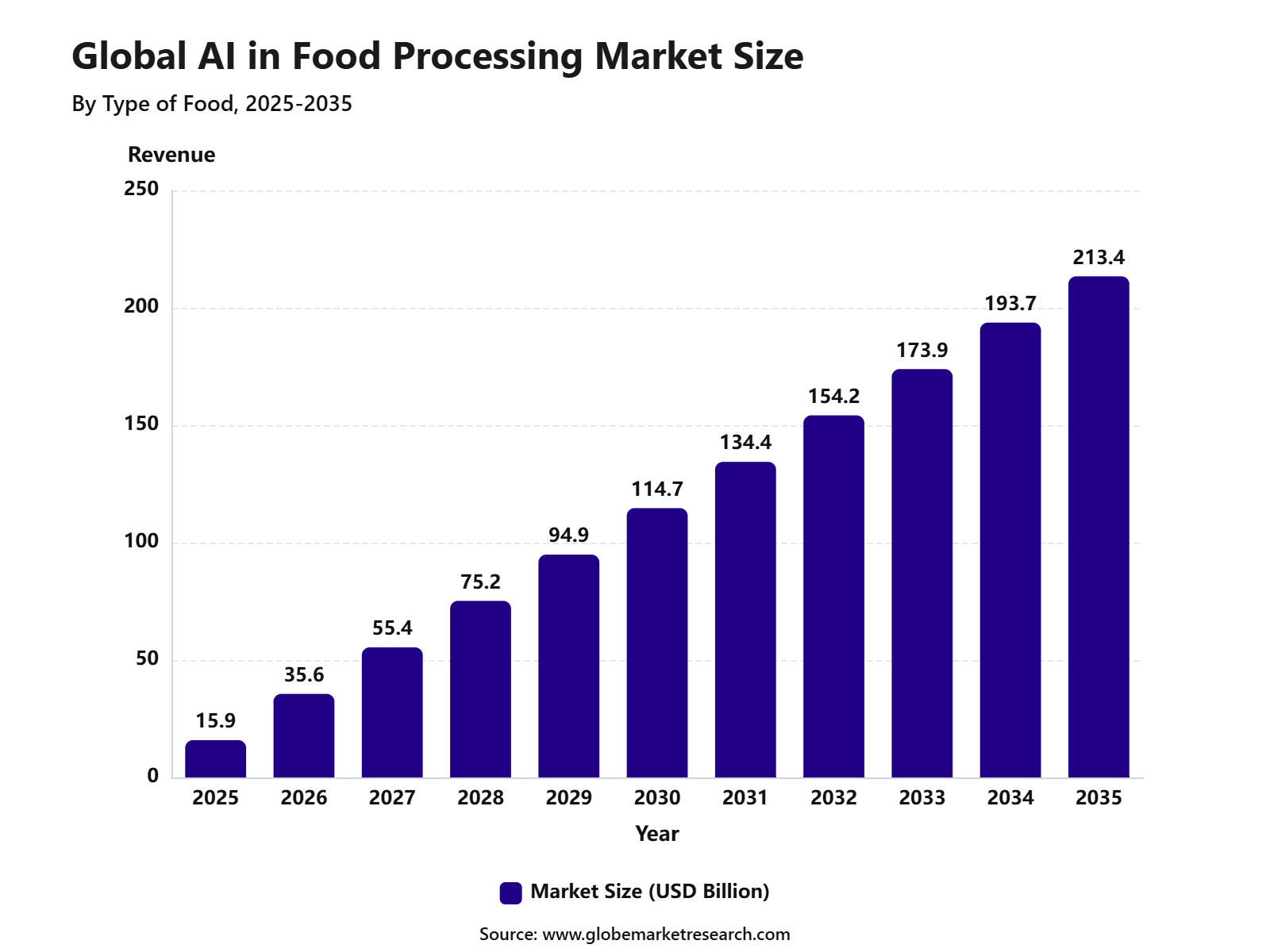 iThe graph shows projected market growth until 2035 based on CAGR analysis. Actual outcomes may vary depending on changing demand, competition, and economic factors.To gain greater insights - request a sample report PDF
The market outlook remains strong as food manufacturers focus on improving efficiency, reducing waste, and maintaining consistent product quality. Growth can be attributed to rising demand for automated food inspection, labor cost pressure, stricter food safety standards, and increasing need for faster production decisions. The expansion of AI-enabled vision systems, robotic processing lines, and data-driven food manufacturing platforms is expected to support long-term market growth.
Key Market Insights
Convenience food and snacks led the type of food segment with 33.5% share, supported by high production volume, changing eating habits, and rising demand for ready-to-eat products.
Quality control and safety compliance accounted for 35.9% share by application, driven by the need for faster inspection, contamination detection, and consistent food quality.
Machine learning and deep learning held 43.1% share by technology, supported by their strong use in defect detection, process automation, demand forecasting, and recipe optimization.
Software captured 50.5% share by component, driven by the growing use of AI platforms for monitoring, analytics, production planning, and quality management.
Cloud deployment accounted for 59.9% share, supported by easier data access, lower infrastructure needs, and flexible integration across food processing facilities.
Food manufacturers held 63.8% share by end user, driven by rising automation, strict safety standards, and growing pressure to improve production efficiency.
North America led the AI in food processing market with 45.5% share, supported by advanced food manufacturing systems, strong technology adoption, and high investment in automation.
AI Adoption, Impact and Barriers in Food Processing
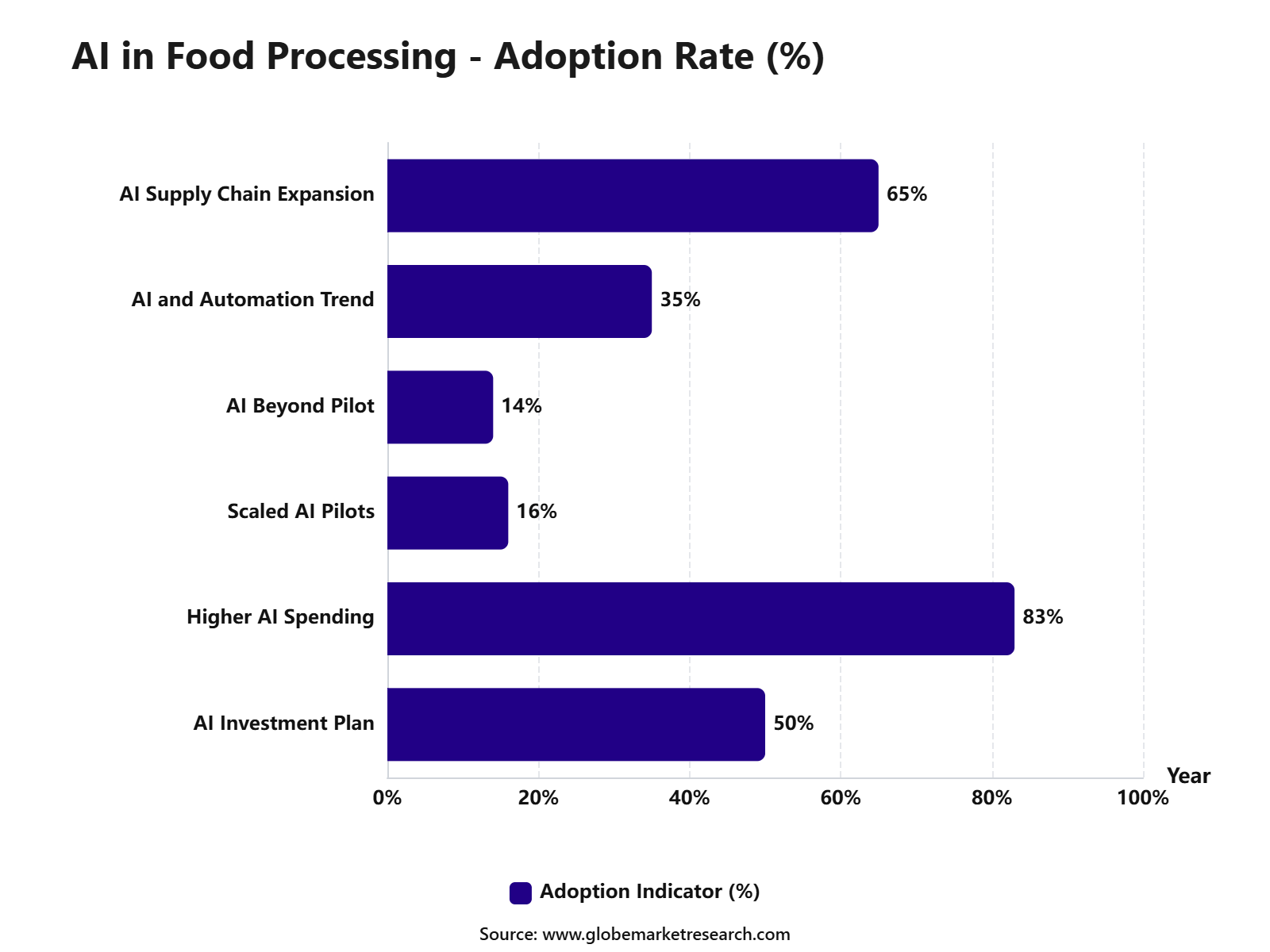
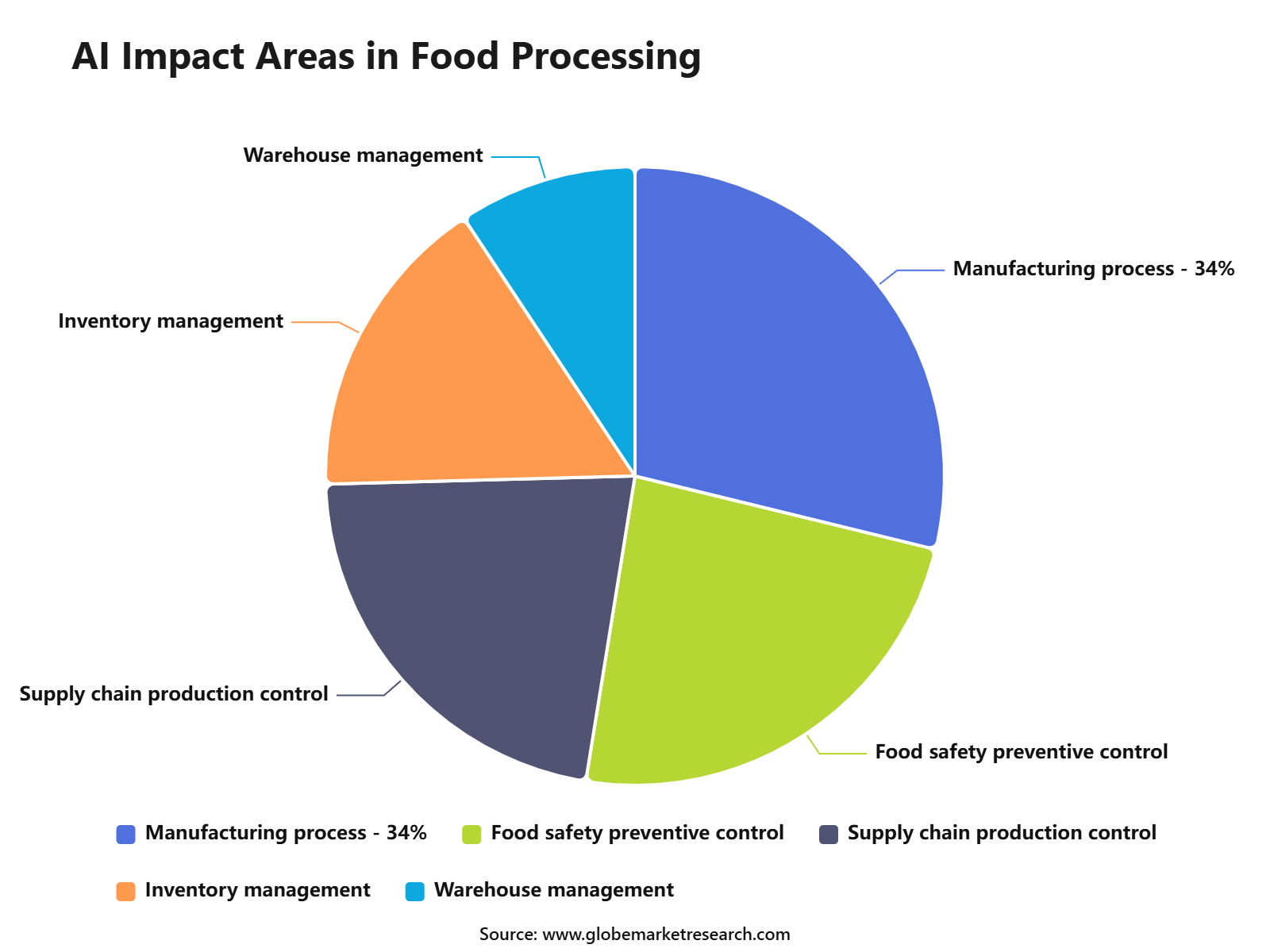
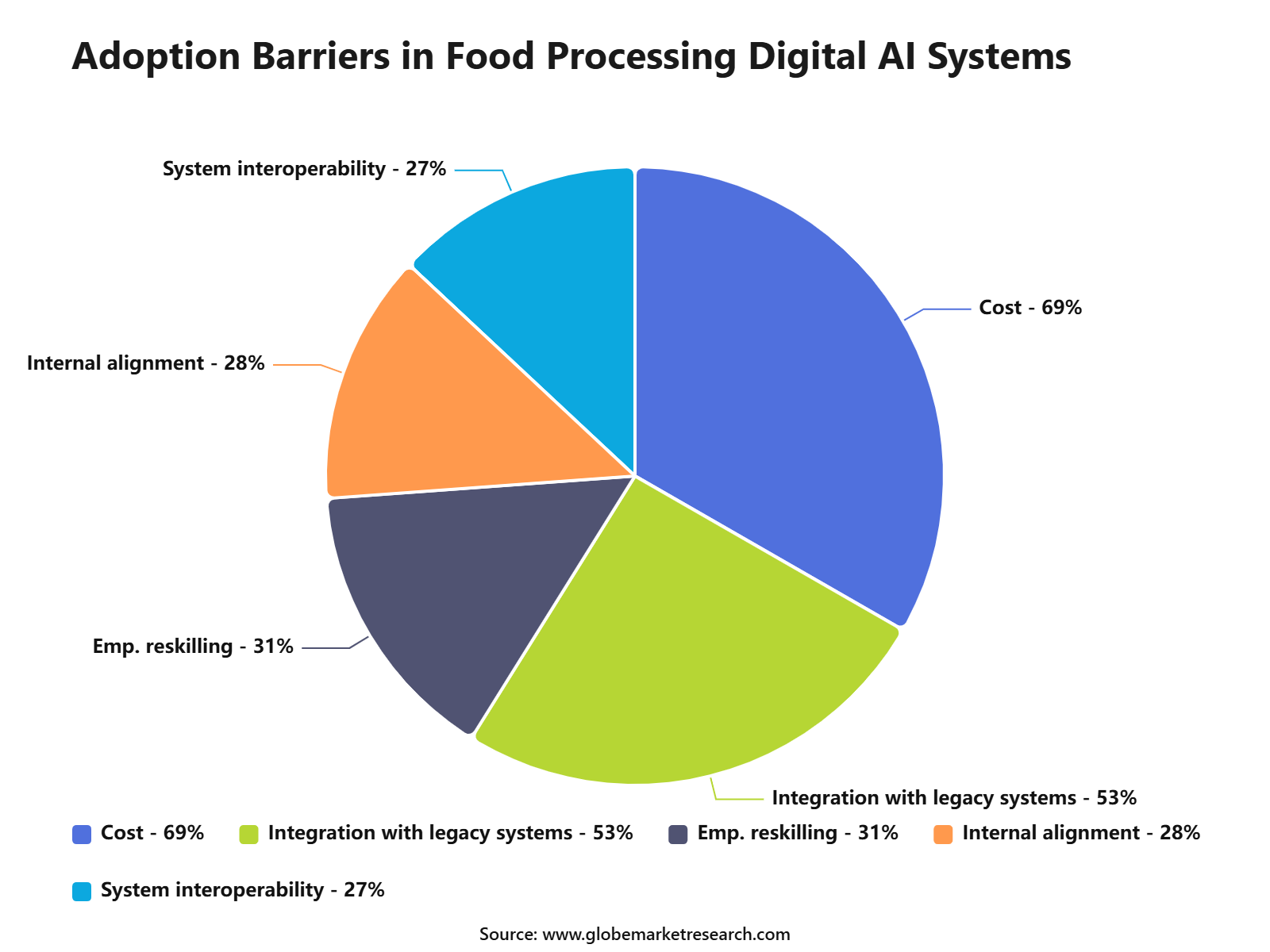
AI adoption in food processing is increasing as manufacturers focus on better quality control, safer production, lower downtime, and stronger supply chain visibility. Investment is being directed toward AI-driven monitoring, predictive analytics, automation, traceability, and real-time decision-making systems. However, adoption is still uneven across the industry, as high implementation cost, legacy equipment, system integration issues, and workforce training needs continue to slow full-scale deployment. Overall, AI is becoming an important operational tool in food processing, with the strongest impact seen in production efficiency, food safety, preventive maintenance, and inventory control.
 iThe graph shows projected market growth until 2035 based on CAGR analysis. Actual outcomes may vary depending on changing demand, competition, and economic factors.To gain greater insights - request a sample report PDF
 iThe graph shows projected market growth until 2035 based on CAGR analysis. Actual outcomes may vary depending on changing demand, competition, and economic factors.To gain greater insights - request a sample report PDF
 iThe graph shows projected market growth until 2035 based on CAGR analysis. Actual outcomes may vary depending on changing demand, competition, and economic factors.To gain greater insights - request a sample report PDF
Market Entry and Revenue Strategy
The go-to-market strategy for the AI in food processing market is being shaped by quality control, food safety, production efficiency, predictive maintenance, demand planning and traceability. Food processors are adopting AI where measurable savings can be shown, such as lower defect rates, fewer labeling errors, reduced downtime, better batch consistency and faster inspection. A 2025 food technology survey found that 50% of industry professionals planned to invest in AI, while 48% planned to invest in supply-chain tracking systems, showing that AI adoption is moving from testing to practical plant-level use.
The strongest sales model is solution-led selling, where AI software is bundled with sensors, machine vision, edge devices, cloud dashboards, automation systems and integration services. This is important because food factories often need AI to fit into existing processing lines, packaging machines, ERP systems and compliance workflows. In broader smart manufacturing, 29% of surveyed manufacturers were already using AI or machine learning at facility or network level in 2025, while 24% had deployed generative AI at the same scale.
AI vendors can gain faster traction by targeting high-cost pain points first. These include visual inspection, allergen control, foreign object detection, recipe optimization, temperature monitoring, equipment failure prediction and shelf-life forecasting. Recent research on AI in food industry automation highlights its use in food safety testing, production processing, production data analysis and quality improvement, which supports its growing role across processing plants.
By Type of Food
Convenience food and snacks led the type of food segment with 33.5% share, supported by rising demand for ready-to-eat, easy-to-carry, and quick-consumption food formats. AI is being used in this segment to improve recipe consistency, shelf-life prediction, automated sorting, packaging checks, and demand planning.
The segment is also supported by changing snacking behavior. The 2026 State of Snacking report found that 6 in 10 consumers in selected global markets snack at least once a day, while nearly 50% sometimes replace meals with snacks. This creates strong demand for AI-enabled processing systems that can support high-volume, consistent, and fast-moving snack production.
Convenience food manufacturers are also responding to healthier and functional snacking trends. In 2025, 55% of Indian consumers preferred preservative-free snacks, 52% favored eco-conscious packaging, and 45% preferred on-the-go snack formats. These trends increase the need for AI tools that can support ingredient optimization, clean-label formulation, quality inspection, and packaging efficiency.
By Application
Quality control and safety compliance led the application segment with 35.9% share, driven by the need to reduce defects, contamination risks, labeling errors, and product recalls. AI-based visual inspection, sensor analytics, and predictive quality systems are being used to detect shape, color, texture, foreign material, and packaging issues faster than manual inspection.
Food safety pressure remains high across the processing industry. The CDC reported in November 2025 that 48 million people in the U.S. get sick from foodborne illness each year, with 128,000 hospitalizations and 3,000 deaths. This public health burden supports stronger investment in AI-enabled inspection, traceability, and compliance tools.
Regulatory traceability is also increasing the need for digital compliance systems. The FDA’s Food Traceability Rule requires covered firms to maintain key data elements for critical tracking events and provide relevant traceability information to the FDA within 24 hours during certain public health investigations. This supports the use of AI and digital systems for faster record search, anomaly detection, and recall response.
By Technology
Machine learning and deep learning led the technology segment with 43.1% share, supported by their strong use in defect detection, sorting, recipe optimization, quality grading, predictive maintenance, and process control. These technologies can learn from production data and improve accuracy as more images, sensor readings, and process records are collected.
A 2025 review of machine learning for food quality control found that neural networks dominated the reviewed approaches, accounting for 59.3% of model applications. The same review found that classification tasks appeared in 50% of studies, reflecting the strong role of machine learning in defect detection, sorting, quality decisions, and safety monitoring.
Deep learning is also gaining ground because food processing often depends on image-heavy and sensor-heavy decisions. A 2026 review reported that machine learning, computer vision, and predictive analytics have achieved detection accuracy above 98% in some food processing applications, while also contributing to energy savings of 15% to 20% through real-time optimization.
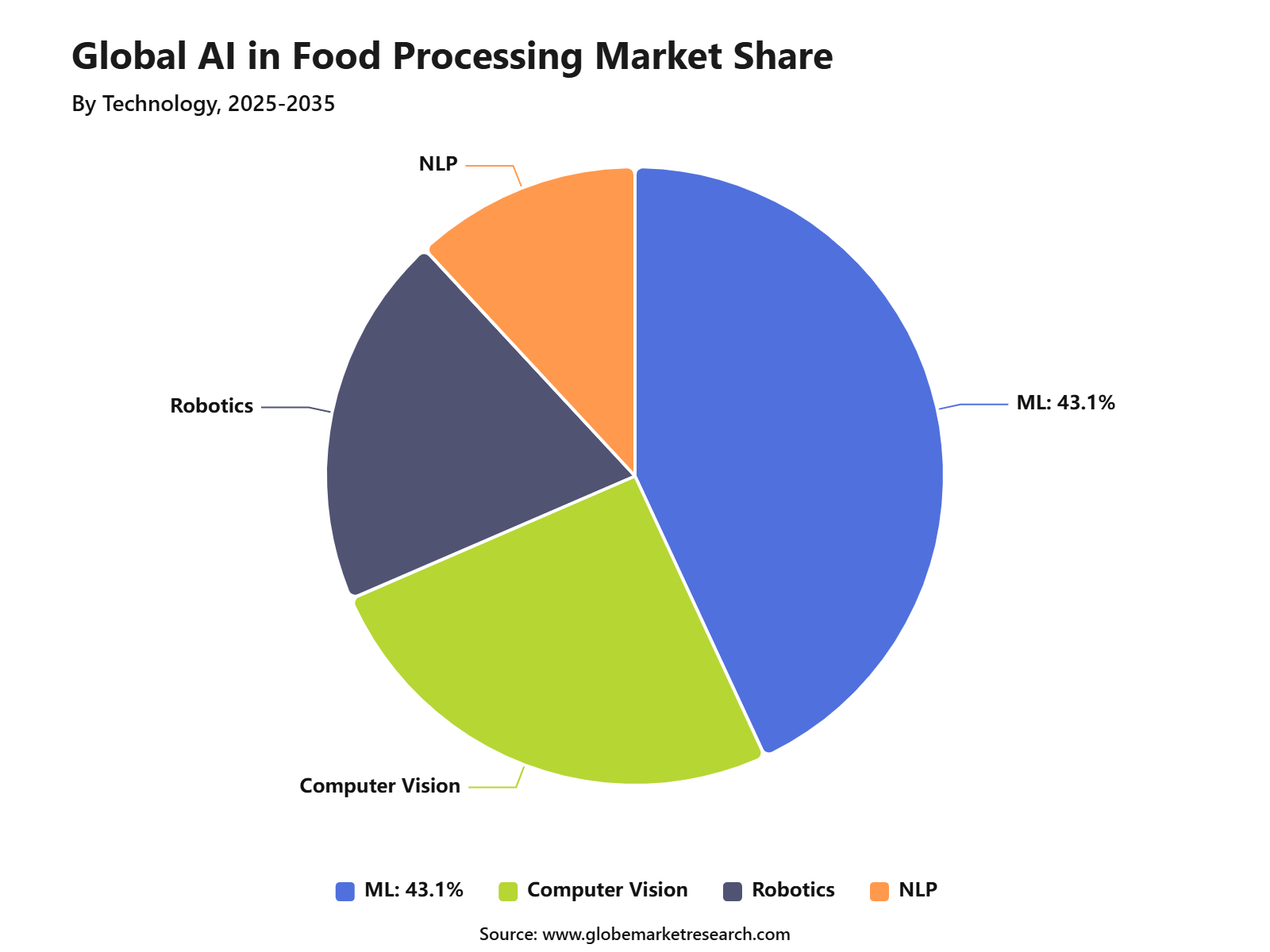 iThe graph shows projected market growth until 2035 based on CAGR analysis. Actual outcomes may vary depending on changing demand, competition, and economic factors.To gain greater insights - request a sample report PDF
By Component
Software accounted for 50.5% share, supported by growing demand for AI platforms, image analytics, production dashboards, digital twins, compliance tools, and predictive maintenance systems. Software is central because it connects sensors, cameras, machines, enterprise systems, and quality teams into one decision-support layer.
The software segment is also supported by the wider rise of AI use across business functions. Stanford’s 2025 AI Index reported that 78% of organizations used AI in 2024, up from 55% in 2023. This shows that AI software adoption has moved into mainstream business operations, including manufacturing, supply chain, quality, and product development functions.
Food-specific AI software is expanding across formulation, processing, traceability, and consumer insight use cases. In 2025, the AI Institute for Next Generation Food Systems identified five key areas shaping AI in food manufacturing, including supply chain, formulation and processing, consumer insights, nutrition and health, and education. This supports the leadership of software as the main layer where AI models are deployed and managed.
By Deployment Mode
Cloud led the deployment mode segment with 59.9% share, supported by scalable computing, remote access, centralized data storage, and easier integration across multiple production sites. Cloud platforms allow food processors to manage AI models, quality records, supplier data, and production analytics without depending only on local systems.
Cloud adoption is being reinforced by the rise of AI workloads. Flexera’s 2026 State of the Cloud report found that 73% of organizations operate hybrid cloud environments, while generative AI public cloud services reached 58% usage. This supports cloud-based AI deployment for food processors that need flexible computing power for image analysis, forecasting, and traceability systems.
Cloud use also helps food companies manage cost and operational visibility, although governance remains important. Flexera reported that estimated wasted cloud spend rose to 29% in 2026, partly due to growing complexity from AI and new cloud services. This shows why food processors are expected to combine cloud adoption with stronger cost controls, cybersecurity, and data governance.
By End User
Food manufacturers led the end-user segment with 63.8% share, driven by their direct need for automation, quality consistency, production efficiency, waste reduction, and regulatory compliance. AI is most valuable at the manufacturing stage because it can be applied directly to processing lines, packaging systems, inspection points, and plant-level planning.
The end-user base is large and operationally complex. USDA ERS reported in 2026 that the U.S. food and beverage manufacturing sector employed 1.7 million people and operated across thousands of plants that transform agricultural materials into intermediate and final food products. This scale creates a strong need for AI systems that can support labor productivity, quality control, and process reliability.
Food manufacturers are also being pushed toward smarter systems by fragmented data, workforce skill gaps, and the need for explainable models. AIFS noted in 2025 that food manufacturing AI requires interoperable data standards, explainable models, ethical governance, and a digitally skilled workforce. These requirements place manufacturers at the center of AI adoption because they control the production data and factory workflows needed for effective deployment.
By Region
North America led the regional segment with 45.5% share, supported by strong AI investment, advanced food manufacturing infrastructure, mature cloud adoption, and strict food safety standards. The region benefits from a large base of food processors, technology vendors, research institutions, and regulatory systems that encourage digital quality and traceability adoption.
The U.S. remains a major driver of AI capability in the region. Stanford’s 2026 AI Index reported that U.S. private AI investment reached USD 285.9 billion in 2025, with 1,953 newly funded AI companies. This strong AI ecosystem supports faster development of computer vision, predictive analytics, automation software, and cloud platforms used in food processing.
North America’s leadership is also supported by food safety and traceability pressure. The FDA’s traceability framework covers firms that manufacture, process, pack, or hold listed foods, while the CDC’s 2025 foodborne illness figures show the continued public health need for better prevention and faster response. This makes the region a strong early adopter of AI tools for quality inspection, safety compliance, digital records, and recall readiness.
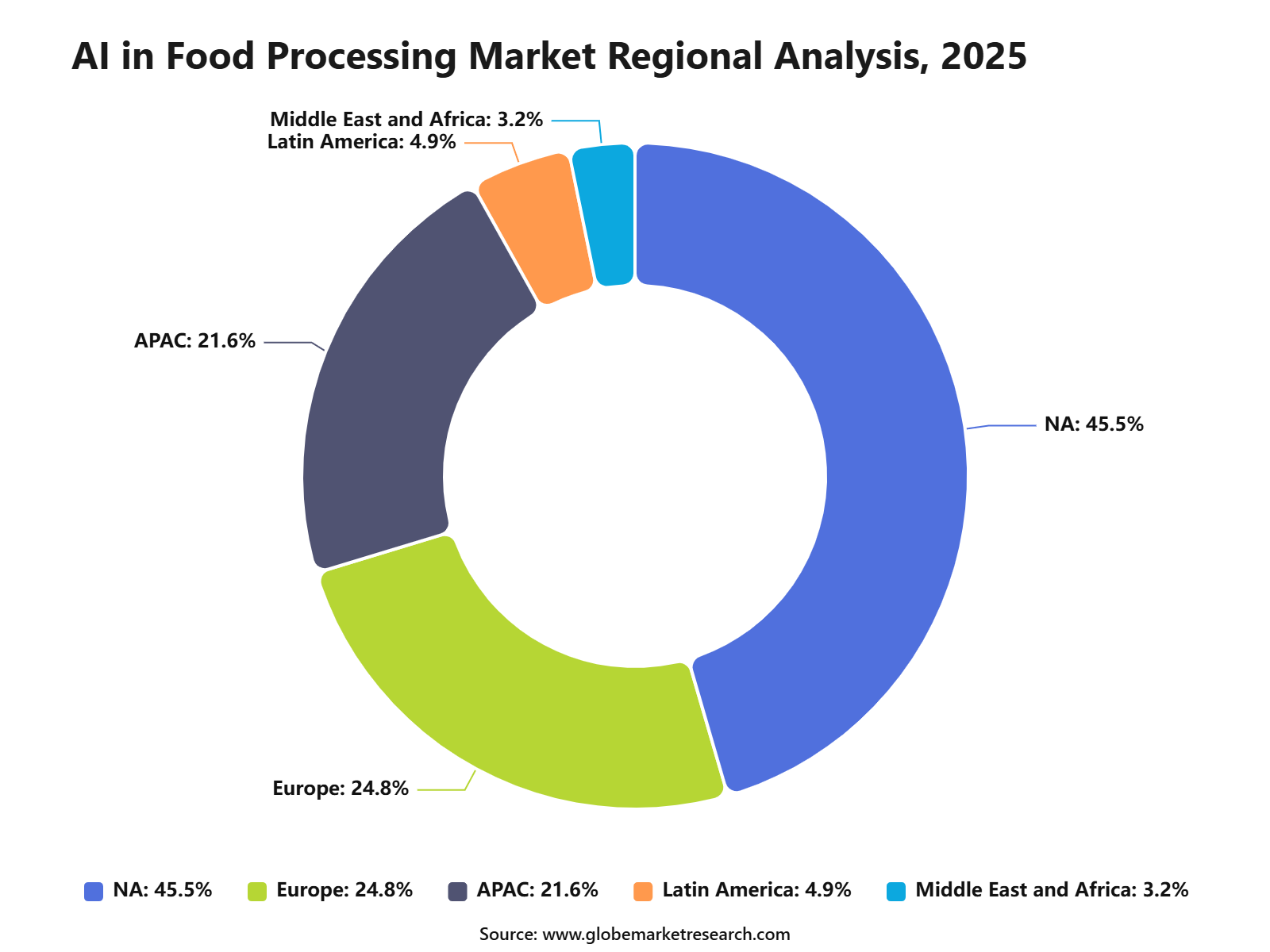 iThe graph shows projected market growth until 2035 based on CAGR analysis. Actual outcomes may vary depending on changing demand, competition, and economic factors.To gain greater insights - request a sample report PDF
Revenue Potential Analysis
Revenue Landscape Across
Revenue potential is spread across machine vision inspection, predictive maintenance, quality analytics, food safety monitoring, robotic sorting, demand forecasting, supply-chain traceability, formulation tools and automated documentation. Quality control is one of the strongest revenue areas because food recalls can damage brand trust and increase operating costs. FDA recall data continues to show active recall activity linked to allergens, Listeria, Salmonella and labeling issues, which supports demand for AI-enabled inspection, verification and compliance systems.
Food safety and labeling compliance are also strong commercial entry points. The FDA states that milk is the most common cause of recalls related to undeclared major food allergens, while around one-third of serious food risk reports submitted through the Reportable Food Registry from September 2009 to September 2014 involved undeclared allergens. These risks create demand for AI tools that can verify labels, compare ingredient records, track allergens and flag packaging-line mismatches before products leave the plant.
Labor support is another key revenue pool. The U.S. Bureau of Labor Statistics projects employment of food processing equipment workers to grow 5% from 2024 to 2034, with about 37,500 openings each year on average. This supports demand for AI-assisted production systems that help operators monitor lines, detect faults, guide maintenance work and improve throughput without fully replacing human workers.
Financial Impact
The financial impact of AI in food processing is mainly linked to lower waste, fewer quality failures, better uptime and improved production planning. In a UK food factory trial reported in 2025, an AI tool helped cut edible food waste by 87% over two weeks, with potential annual savings of up to 700 tonnes of surplus food, 1.5 million meals and around £14 million in cost savings. This shows that AI can create measurable financial value when applied to waste tracking, inventory decisions and redistribution workflows.
Traceability also has a direct financial role because poor data flow can increase spoilage, delay recalls and weaken supplier accountability. A 2025 World Economic Forum article noted that 78% of stakeholders in a fresh produce supply-chain project viewed food loss as a major challenge caused by inefficient and non-transparent data flows. AI-based traceability can reduce this risk by connecting batch data, sensor records, supplier information and product movement in near real time.
Segment Covered in the Report
By Type of Food
Fruits and Vegetables
Convenience Food and Snacks
Dairy
Meat and Poultry
Others
By Application
Quality Control and Safety Compliance
Food Sorting
Production and Packaging
Customer Engagement
Maintenance
By Technology
Machine Learning
Robotics and Automation
Computer Vision
Natural Language Processing
By Component
Software
Hardware
Services
By Deployment Mode
Cloud
On-Premises
By End User
Food Manufacturers
Food Packaging Companies
Food Logistics Providers
Others
By Region
North America
Europe
Asia Pacific
Latin America
Middle East and Africa
Driver Analysis
Automation and Quality Control Demand
The AI in Food Processing Market is being driven by rising demand for automated quality control, faster inspection, and consistent production output. The International Federation of Robotics reported that U.S. industrial robot installations increased 11% in 2025 to 38,000 units, while food industry robot adoption rose 30% and reached about 3,000 installations. This supports stronger use of AI-enabled vision systems, sorting machines, robotic handling, and automated inspection across food plants. AI is being adopted because it can detect defects, monitor product consistency, reduce manual errors, and improve production speed.
Food processors are also using AI to manage labor pressure and improve plant efficiency. The Manufacturing Institute reported that U.S. manufacturing may need up to 3.8 million workers between 2024 and 2033, and about 1.9 million roles could remain unfilled if workforce challenges continue. In food processing, AI can support repetitive tasks such as grading, packing, quality checks, temperature monitoring, and predictive maintenance. This helps plants maintain output even when skilled labor availability remains tight.
Restraint Analysis
High Integration Cost and Data Readiness Gaps
A major restraint for the AI in Food Processing Market is the cost and complexity of integrating AI into existing food plants. Many facilities still depend on older machines, manual inspection, paper records, and separate software systems. AI systems need clean production data, connected sensors, stable internet infrastructure, trained workers, and proper validation before they can be used at scale. A 2025 review on AI in food automation noted that AI can improve safety testing, production processing, data analysis, and prediction, but its business use still faces technical and operational limitations.
Data readiness is also a serious restraint because food processing involves variable raw materials, changing recipes, temperature sensitivity, hygiene rules, and strict batch tracking. A 2025 AI food manufacturing white paper stated that adoption remains uneven due to heterogeneous datasets, limited system interoperability, and a skills gap between data scientists and food experts. This means many companies may need to invest first in digital infrastructure and staff training before AI can deliver reliable results. Smaller processors may face slower adoption because the upfront cost is harder to justify.
Opportunity Analysis
Food Safety, Traceability, and Waste Reduction
A strong opportunity is emerging from food safety and traceability requirements. CDC estimates that 48 million people in the U.S. get sick from foodborne illness each year, with 128,000 hospitalizations and 3,000 deaths. AI can help processors detect contamination risk, identify foreign materials, monitor hygiene conditions, and flag abnormal production data before products reach consumers. This creates demand for AI-based vision inspection, pathogen risk modeling, smart sensors, and real-time quality monitoring systems.
Regulatory traceability also creates an opportunity for AI-based data systems. FDA’s Food Traceability Final Rule requires covered firms that manufacture, process, pack, or hold listed foods to maintain Key Data Elements linked to Critical Tracking Events and provide required information to FDA within 24 hours when requested. AI can support faster batch tracking, supplier risk analysis, recall management, and compliance documentation. This is important because food companies need systems that can connect plant-level production data with wider supply chain records.
Challenge Analysis
Skills, Trust, and Responsible AI Use
The key challenge for the AI in Food Processing Market is building trust in AI decisions across safety-sensitive production environments. Food manufacturers must ensure that AI systems do not create false approvals, missed defects, wrong ingredient decisions, or poor batch recommendations. This is especially important in products where small changes in temperature, moisture, formulation, or contamination levels can affect safety and quality. Human oversight, model testing, audit trails, and explainable outputs will remain important for large-scale adoption.
Another challenge is the shortage of workers who understand both food science and AI. The 2025 AI food manufacturing white paper highlighted the need for interoperable data standards, transparent models, privacy-preserving data sharing, and interdisciplinary training. Without these foundations, AI adoption may stay limited to isolated inspection or automation use cases rather than full plant optimization. Companies that combine food domain knowledge with strong data governance will be better placed to scale AI safely and effectively.
Recent Developments
Market News
In April 2026, Chef Robotics expanded its physical AI models into baked goods packing, produce packing, and meatpacking automation. The company also reported that its robots had completed 100 million servings in production, showing that AI-enabled robots are moving from pilot use to commercial food manufacturing lines. This development is important because food products vary in shape, texture, and placement, making adaptive robotics more useful than fixed automation in meal assembly and packaging.
In June 2026, JBT Marel introduced a subscription-based software model for food processors. The model was designed to reduce large upfront software costs and make digital processing tools easier to access for food manufacturers. This supports wider adoption of AI, production monitoring, line optimization, and digital workflow tools across food processing plants.
In May 2025, Bühler launched the SORTEX AI700 optical sorter in London. The machine uses deep learning for impurity detection, with its first application focused on removing gluten-containing grains from oats. This is a strong development for grain processing because AI-based sorting can improve food safety, gluten-free product integrity, and yield control.
Mergers
In January 2025, JBT completed the settlement of its voluntary takeover offer for Marel and started trading as JBT Marel Corporation. The combination created a larger food and beverage technology provider with stronger equipment, service, software, and digital expertise. The deal is relevant to AI in food processing because both companies serve automation-heavy food categories such as poultry, meat, seafood, plant-based foods, and prepared foods.
The proposed JBT and Marel merger was earlier valued at about EUR 3.5 billion on an enterprise value basis. The strategic rationale included expanded product offerings, stronger R&D capability, better global support, and digital solutions such as OmniBlu and Innova. This indicates that large food processing equipment companies are using consolidation to strengthen automation, software, and data-led plant performance.
Acquisitions
In June 2026, Foodics completed the full acquisition of Greece-based Norma AI after first taking a partial stake in Q1 2025. Norma AI’s analytics agent and business intelligence application were integrated into Foodics’ platform and adopted across more than 10,000 customer branches. Although this acquisition is closer to foodservice operations than factory processing, it is relevant because AI is increasingly being used across the broader food value chain for demand planning, kitchen operations, inventory decisions, and real-time business insights.
Funding
In February 2026, Germany-based Foodforecast raised EUR 8 million in Series A funding. The company uses AI-based demand and production forecasting for ultra-fresh food categories, where products may have a shelf life of only a few hours to one day. Its technology is aimed at reducing waste, improving product availability, and automating manual production and ordering workflows.
In March 2025, Chef Robotics raised USD 43.1 million in Series A funding, including USD 20.6 million in equity and USD 22.5 million in equipment financing. The capital was planned for scaling AI-enabled robotic systems used in meal assembly and food packaging. The company also reported more than 44 million servings produced at the time, supported by real-world production data used to train its AI models.
In December 2025, MEQ Solutions secured A $23 million, equal to about US$15 million, in Series A funding from Insight Partners. The company uses AI models and proprietary imaging to measure red meat quality, yield, and eating attributes from live animals to finished products. This funding is important because meat processors still depend heavily on manual inspection and subjective grading, while AI can provide faster, more consistent, and more data-backed quality assessment.
Research Methodology
Methodology Area | Coverage Details |
|---|---|
Primary Research | Interviews with manufacturers, suppliers, distributors, consultants, procurement teams, and industry experts. |
Secondary Research | Company filings, annual reports, regulatory databases, government publications, trade associations, and verified industry sources. |
Data Validation | Cross-verification through source triangulation, historical trend review, demand-side checks, and supply-side assessment. |
Market Estimation | Bottom-up and top-down analysis based on product demand, regional consumption, company presence, and application-level usage. |
Forecasting Approach | Forecasts based on regulatory shifts, infrastructure investment, technology adoption, pricing trends, industrial expansion, and end-use demand. |
Quality Review | Analyst review, peer validation, outlier checks, internal consistency review, and final publication approval. |
AI Policy | AI is not used as a primary data source. All published insights are reviewed against human-verified evidence. |
Competitive Landscape
The market is characterized by intense competition among established players and emerging companies. Strategic partnerships, mergers and acquisitions, and product innovation are key strategies employed by market participants.
Key Market Players
ABB Ltd.
Rockwell Automation, Inc.
Siemens AG
Honeywell International Inc.
KUKA AG
Key Technology, Inc.
TOMRA Systems ASA
Marel hf.
Bühler Group
GREEFA
JBT Corporation
GEA Group AG
Sesotec GmbH
Raytec Vision SpA
Other Key Players
Meet the Team
This report was prepared by our expert analysts with deep industry knowledge and research experience.
Pratiksha is market research analyst with strong experience in industry research, market forecasting, and competitive analysis. She specializes in identifying market trends, evaluating growth opportunities, and preparing data-driven insights across global industries. Her work supports businesses in understanding market dynamics, customer demand, regional opportunities, and strategic investment areas.
Sayali brings more than 5 years of experience to Globe Market Research, supporting the accuracy, clarity, and relevance of research content across multiple industries. She reviews market data, segment analysis, competitive insights, and industry trends to ensure each report meets strong quality standards and provides practical value to business decision-makers. Her expertise spans healthcare, information technology, consumer goods, and diverse cross-industry domains. With a strong focus on data reliability, structured analysis, and clear presentation, Sayali helps ensure that each research output delivers well-reviewed insights for clients, investors, consultants, and industry stakeholders.
Frequently Asked Questions
Related Reports
More in Information and Technology
AI Visual Inspection System Market Revenue to Hit USD 315.2 billion by 2035
Global AI Visual Inspection System Market Size, Growth Analysis By Offering (Hardware Systems, Industrial Cameras, Sensors and Imaging Hardware, Software Platforms, AI Inspection Software, Vision Analytics Tools, Services), By Technology (Deep Learning-Based Vision Systems, Machine Learning Algorithms, Traditional Computer Vision Systems, Edge AI Vision Processing, Other AI Vision Technologies), By Application (Defect Detection & Quality Control, Assembly Verification, Measurement & Gauging, Packaging & Label Inspection, Other Industrial Inspection Applications), By Industry Vertical (Electronics & Semiconductor Manufacturing, Automotive Industry, Pharmaceuticals & Healthcare, Food & Beverage Manufacturing, Logistics & Warehousing, Other Industrial Verticals), By Regional Insights, Business plan and Project Report, Investment Opportunities, Profitability, Industry Trends, Leading Companies and Growth Forecasts By 2025-2035
Cloud Computing Market Size to Surpass USD 17.5 Trillion by 2035
Global Cloud Computing Market Size, Share Analysis By Type (Public Cloud, Private Cloud, Hybrid Cloud), By Service Model (Software as a Service, Infrastructure as a Service, Platform as a Service), By Enterprise Type (Large Enterprises, Small and Medium Enterprises), By Industry (BFSI, IT and Telecommunications, Government, Consumer Goods and Retail, Healthcare, Manufacturing, Others), By Regional Insights, Business plan and Project Report, Investment Opportunities, Profitability, Industry Trends, Leading Companies and Growth Forecasts By 2025-2035
Agentic AI For Financial Services Market Size to Reach USD 315.5 billion by 2035
Agentic AI For Financial Services Market Size, Share Segmented by Application (Fraud Detection and Anti-Money Laundering, Virtual Assistants and Chatbots, Credit Assessment, Risk and Compliance Management, Investment Advisory, Claims Processing, and Others), By Component (Solutions and Services), By Deployment Mode (Cloud, On-Premise, and Hybrid), By End-User (Commercial Banks, Investment Banks, Asset Management Firms, and Other Financial Institutions), By Regional Insights, Business plan and Project Report, Investment Opportunities, Profitability, Industry Trends, Leading Companies and Growth Forecasts By 2025-2035
Agentic AI in HR & Recruitment Market Size to Reach USD 120.5 billion by 2035
Global Agentic AI in HR & Recruitment Market Size, Go-to-Market and Sales Strategy Analysis By Deployment Mode (Cloud-Based, On-Premises), By Enterprises (Small and Medium Enterprises (SMEs), Large Enterprises), By Application (Talent Acquisition & Recruitment, Employee Onboarding, Employee Engagement & Retention, Workforce Analytics, Others), By End-User Industry (IT & Telecommunications, Healthcare, Retail & E-commerce, BFSI, Manufacturing, Education, Others), By Regional Insights, Business plan and Project Report, Investment Opportunities, Profitability, Industry Trends, Leading Companies and Growth Forecasts By 2025-2035