
Revenue, 2026
USD 5.3 Bn
Forecast, 2035
USD 35.4 Bn
CAGR, 2026-2035
23.5%
Report Coverage
Global
Market Size and Forecast
AI sales development representatives are software agents that automate prospect research, lead qualification, personalised outreach, follow-up communication, meeting scheduling and customer relationship management updates. These systems use generative AI, natural language processing, intent data and workflow automation to engage potential buyers through email, voice, chat and professional networking platforms. Human sales teams are increasingly using AI SDRs to expand prospect coverage, reduce administrative work and prioritise accounts with stronger purchase intent.
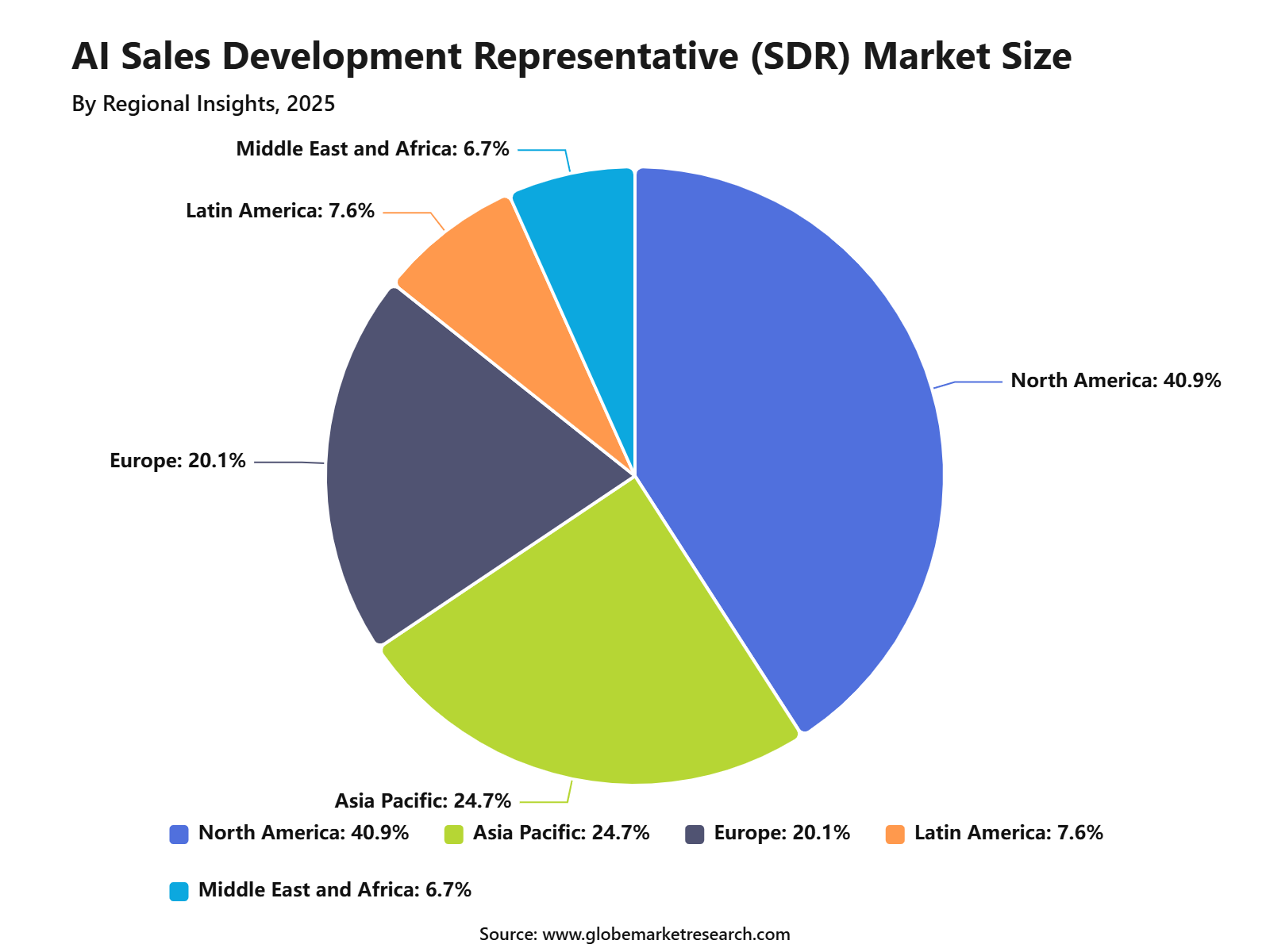
According to Globe Market Research, the global AI Sales Development Representative (SDR) Market was valued at USD 5.3 billion in 2026 and is projected to reach approximately USD 35.4 billion by 2035, growing at a CAGR of 23.5% from 2026 to 2035. North America accounted for around 40.9% of the market in 2025. Regional leadership is being supported by high CRM adoption, strong enterprise software investment, advanced generative AI capabilities and growing demand for automated prospecting, lead scoring and personalised business-to-business engagement.
Key Parameter | Insights |
|---|---|
Market Revenue, 2026 | USD 5.3 Billion |
Projected Revenue, 2035 | USD 35.4 Billion |
CAGR, 2026-2035 | 23.5% |
Largest Region | North America, 40.9% Share in 2025 |
Market Concentration | Medium |
Base Year | 2025 |
Forecast Period | 2026-2035 |
AI agents are becoming a central part of sales operations. Salesforce’s 2026 survey of 4,050 sales professionals found that nine in ten sales teams already use AI agents or expect to adopt them within two years, while agents are expected to reduce prospect research time by 34%. In addition, 89% of AI users reported improved customer understanding. LinkedIn found that 56% of sales professionals used AI daily in 2025, based on research involving 1,250 global sales professionals. HubSpot also reported that AI was the most widely used sales technology category among 37% of representatives, while 84% said it saved time and improved efficiency.
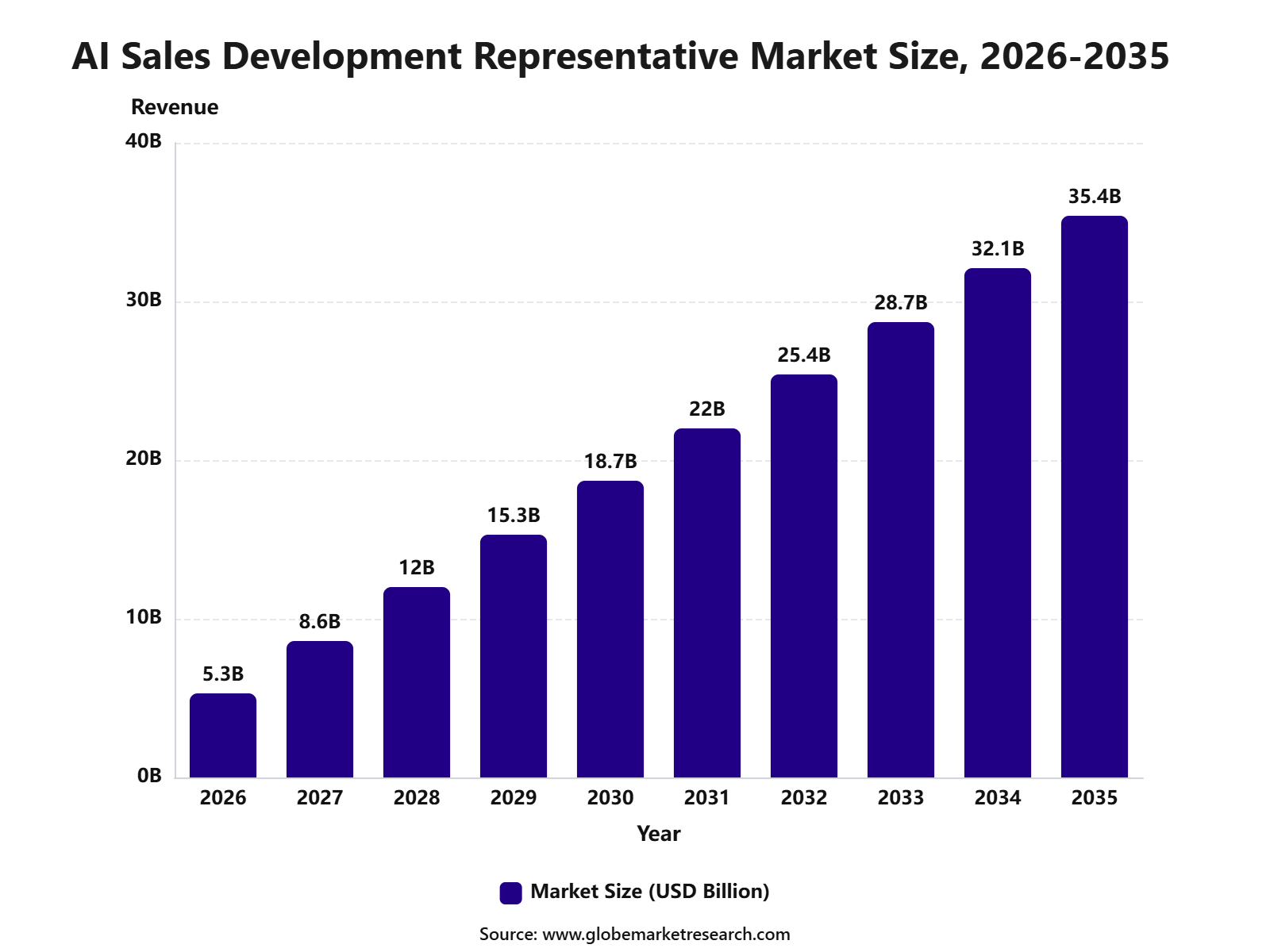 iThe graph shows projected market growth until 2035 based on CAGR analysis. Actual outcomes may vary depending on changing demand, competition, and economic factors.To gain greater insights - request a sample report PDF
Key Market Insights
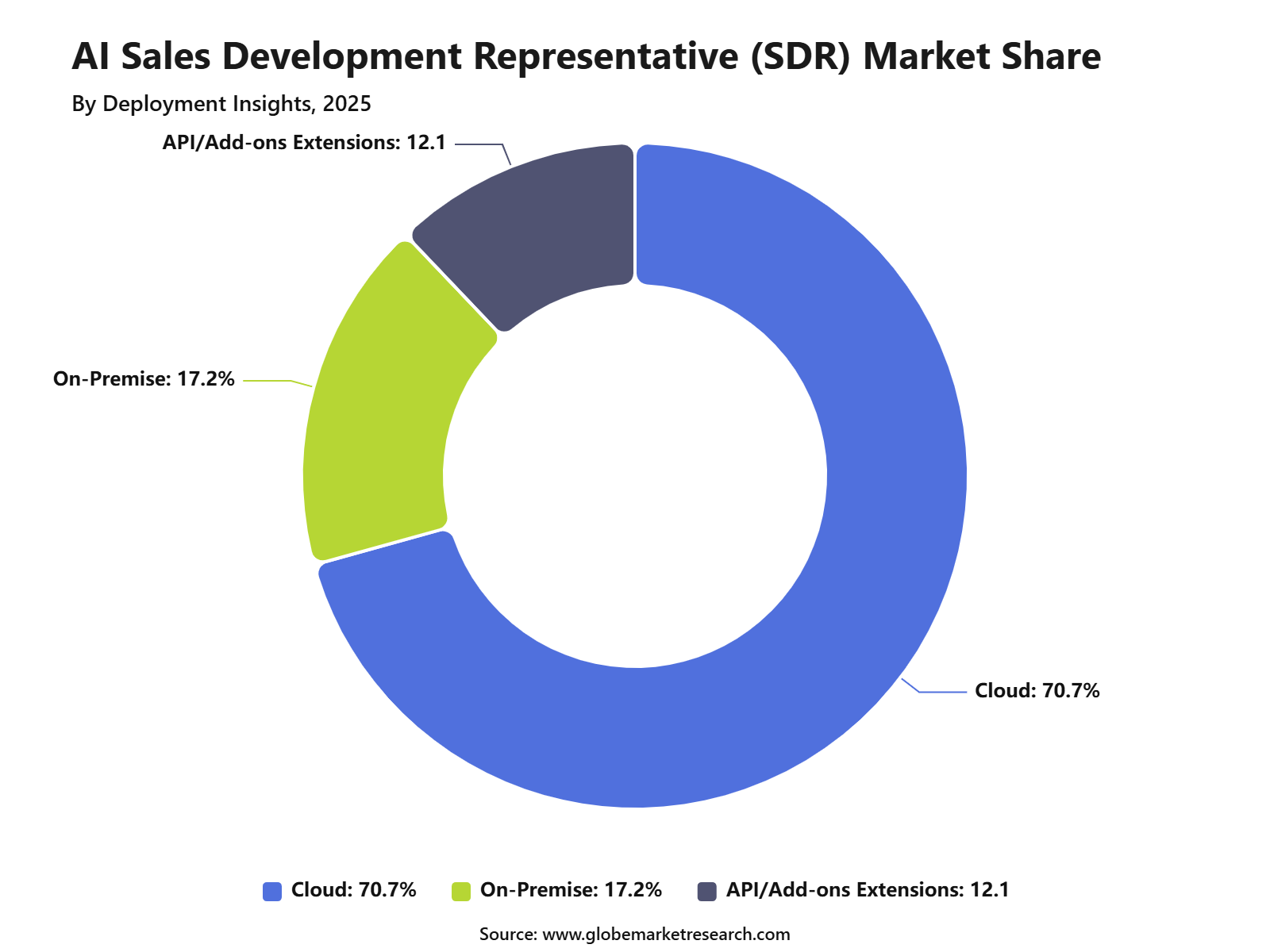
Cloud deployment led the deployment segment with 70.7% share, supported by faster setup, scalable usage, remote access, and easier integration with CRM, email, calling, and sales automation tools.
Software accounted for 69.2% share by offering, driven by strong demand for AI prospecting platforms, lead scoring tools, outreach automation, conversation intelligence, and sales workflow management.
Outbound sales channels held 45.8% share, supported by rising use of AI SDRs for prospect identification, email sequencing, follow-ups, cold outreach, and pipeline generation.
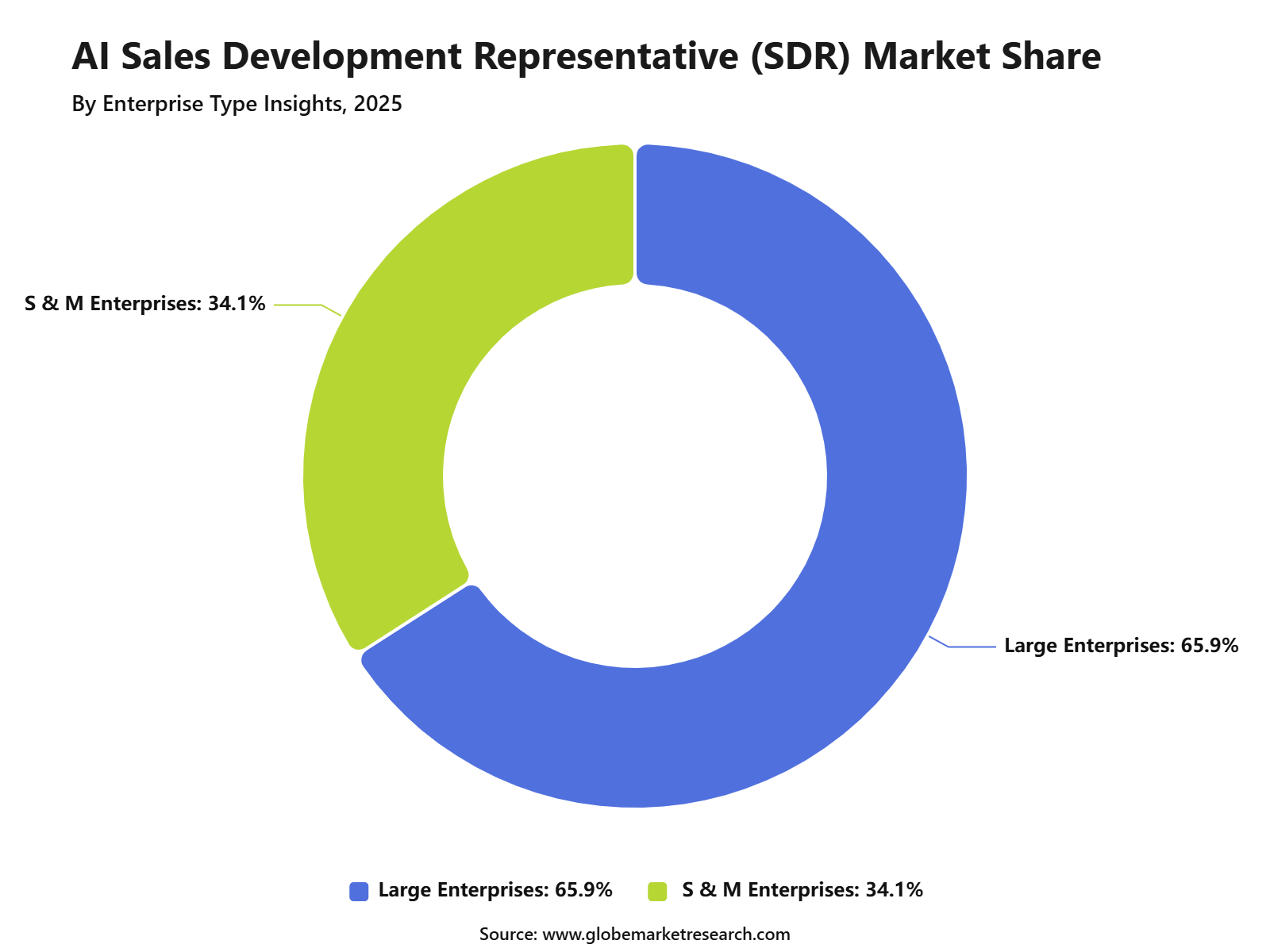
Large enterprises captured 65.9% share by enterprise type, driven by larger sales teams, higher lead volumes, stronger automation budgets, and growing need to improve sales productivity.
BFSI led the industry segment with 30.2% share, supported by strong use of AI SDR tools for lead qualification, customer acquisition, cross-selling, appointment booking, and relationship management.
North America led the AI Sales Development Representative market with 40.9% share, supported by advanced sales technology adoption, strong SaaS spending, mature CRM ecosystems, and high demand for AI-driven revenue operations.
Adoption Rate and Usage Statistics
According to Salesforce, 87% of sales organizations use AI for activities such as prospecting, lead scoring, forecasting, and email drafting. AI agents have already been adopted by 54% of sales teams, while another 34% expect to deploy them within two years. Around 55% of sales professionals use AI for prospecting, although only 34% of teams with agents currently use dedicated prospecting agents, showing significant expansion potential for AI SDR platforms.
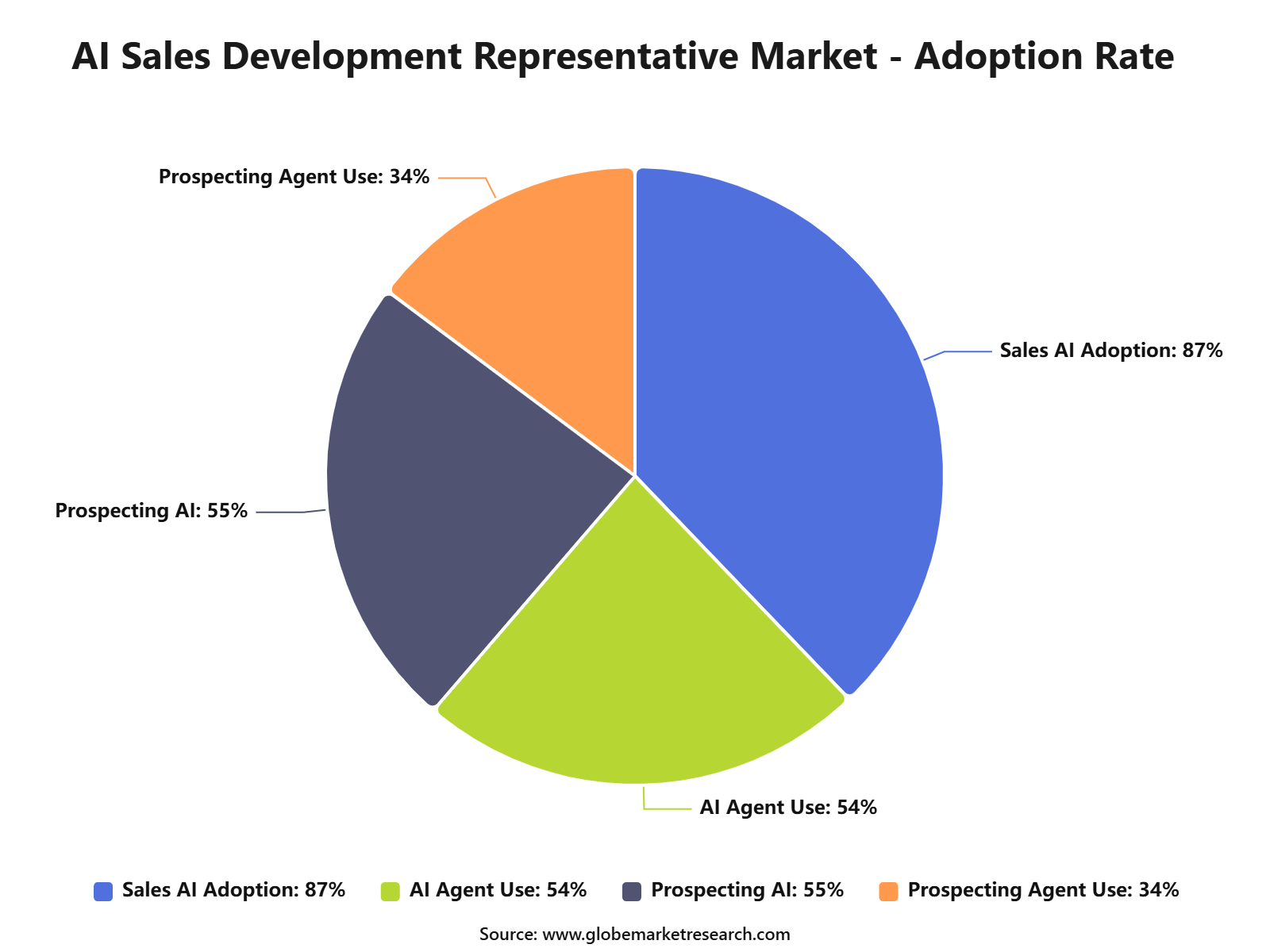 iThe graph shows projected market growth until 2035 based on CAGR analysis. Actual outcomes may vary depending on changing demand, competition, and economic factors.To gain greater insights - request a sample report PDF
92% of sales professionals using AI agents reported benefits in prospecting, while 90% stated that agents improved their understanding of customers and 88% reported higher productivity. Salesforce’s internal prospecting agents contacted 130,000 previously untouched leads and created 3,200 sales opportunities within four months, demonstrating how AI SDR systems can automate lead engagement, qualification, personalized outreach, and pipeline development at scale.
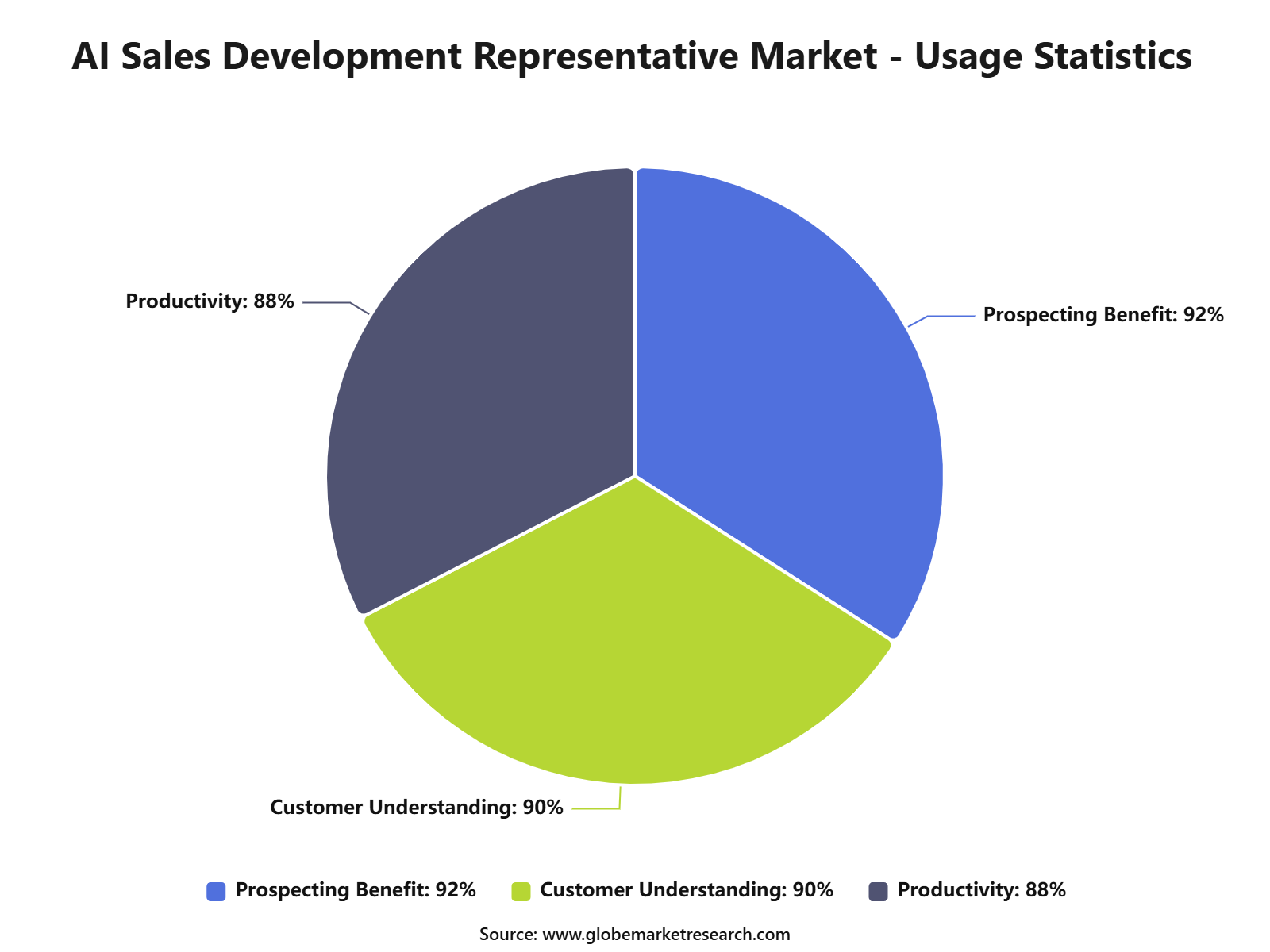 iThe graph shows projected market growth until 2035 based on CAGR analysis. Actual outcomes may vary depending on changing demand, competition, and economic factors.To gain greater insights - request a sample report PDF
Deployment Insights
Cloud deployment accounted for 70.7% of the AI Sales Development Representative Market. Cloud-based systems allow sales teams to introduce AI SDRs without installing or maintaining extensive local infrastructure. They also support remote access, centralized updates and connections with customer relationship management, email, calendar and marketing automation platforms.
Eurostat reported that 52.74% of EU enterprises purchased cloud computing services in 2025. Among cloud users, 77.53% purchased sophisticated services and were classified as highly dependent on cloud infrastructure. This adoption provides a strong technical base for deploying AI agents across sales and customer engagement workflows.
Cloud deployment makes it easier to increase prospecting capacity during campaigns, product launches and regional expansion. However, organizations must control access to customer data, email accounts and internal sales records. Providers offering secure integrations, activity monitoring, configurable permissions and reliable service availability are likely to receive stronger demand.
 iThe graph shows projected market growth until 2035 based on CAGR analysis. Actual outcomes may vary depending on changing demand, competition, and economic factors.To gain greater insights - request a sample report PDF
Offering Insights
Software represented 69.2% of the market by offering. AI SDR software is used to research prospects, score leads, write personalized messages, schedule follow-ups and update sales records. Software-led delivery also enables new models, workflow features and compliance controls to be introduced without replacing existing hardware.
Salesforce reported in 2026 that 94% of sales leaders using AI agents considered them critical for meeting business demands. Sales software is increasingly being used to reduce repetitive work and support sales planning, customer retention and prospecting. These capabilities are moving AI SDR tools from experimental applications into regular sales operations.
Offering | Market Share |
|---|---|
Software | 69.2% |
Services | 30.8% |
Demand will increasingly favor platforms that combine prospect intelligence, outreach automation and performance reporting within one interface. Buyers are also expected to evaluate data accuracy, message quality and integration with existing sales systems. Human review remains important where communication involves major accounts, regulated industries or complex purchasing decisions.
Sales Channel Insights
Outbound sales accounted for 45.8% of the market by sales channel. AI SDRs are particularly suited to outbound activity because prospecting requires repeated research, account selection, message preparation and follow-up. Automated systems can handle large lead lists while adjusting outreach based on industry, job role, company activity and previous interactions.
Salesforce reported that 55% of sales professionals were already using AI for prospecting in 2026, while another 38% planned to use it. The data indicate that AI-assisted prospect identification and outreach are becoming common elements of sales development rather than isolated trials.
Sales Channel | Market Share |
|---|---|
Outbound | 45.8% |
Inbound | 31.6% |
Hybrid | 22.6% |
Successful outbound deployment depends on relevance rather than message volume alone. AI SDRs must identify suitable prospects, select appropriate communication times and stop outreach when a lead declines further contact. Providers that support personalization, response detection and controlled follow-up sequences can help sales teams improve engagement without creating repetitive or unwanted communication.
Enterprise Type Insights
Large enterprises held 65.9% of the market by enterprise type. These organizations operate large sales teams, extensive customer databases and multiple product portfolios across different regions. AI SDRs can be assigned by territory, industry, product category or account type, allowing sales development processes to be standardized at scale.
The U.S. Census Bureau reported that 37% of businesses with at least 250 employees were using AI in their operations during the period ending May 2026. This was higher than the 32% recorded among businesses with 100 to 249 employees, demonstrating stronger AI adoption among larger organizations.
Large enterprises can spread software, integration and governance costs across more sales users and prospect accounts. However, deployments must accommodate multiple languages, data systems, approval processes and regulatory requirements. Central administration and detailed audit records are therefore important when AI agents communicate externally on behalf of a large organization.
 iThe graph shows projected market growth until 2035 based on CAGR analysis. Actual outcomes may vary depending on changing demand, competition, and economic factors.To gain greater insights - request a sample report PDF
Industry Insights
BFSI accounted for 30.2% of the market by industry. Banks, insurers and financial service providers manage large volumes of customer enquiries, business accounts, policy leads and financial product prospects. AI SDRs can support lead qualification, appointment scheduling, product matching and follow-up while directing complex cases to licensed sales representatives.
Statistics Canada reported that 40.4% of finance and insurance businesses used AI to produce goods or deliver services in the second quarter of 2026. Among AI-using businesses in this sector, text analytics and large language models were each used by 38.8%, showing strong adoption of technologies relevant to digital sales communication and lead analysis.
Industry | Market Share |
|---|---|
BFSI | 30.2% |
IT and Telecom | 20.1% |
Retail and E-commerce | 16.4% |
Healthcare | 13.2% |
Education | 10.1% |
Others | 10.0% |
BFSI deployments require stronger controls because sales messages may include financial information, eligibility conditions and regulated product statements. AI-generated communication should be based on approved content and reviewed where financial advice could be inferred. Consent management, data protection and accurate transfer to qualified human representatives will remain essential.
Regional Insights
North America accounted for 40.9% of the AI Sales Development Representative Market. Regional leadership is supported by advanced cloud infrastructure, high customer relationship management adoption and strong demand for sales automation. Businesses across technology, financial services, professional services and business-to-business commerce are introducing AI agents to improve prospecting capacity.
Stanford’s 2026 AI Index reported that U.S. private AI investment reached USD 285.9 billion in 2025. The United States also recorded 1,953 newly funded AI companies, more than ten times the number in the next-highest country. This investment environment supports the development and enterprise adoption of specialized sales agents.
North American buyers are expected to place greater attention on measurable sales outcomes, data security and compliance with communication rules. AI SDR providers must demonstrate that their systems can generate qualified conversations rather than simply increase outreach volume. Accurate reporting on replies, meetings, lead quality and human intervention will be important for long-term adoption.
 iThe graph shows projected market growth until 2035 based on CAGR analysis. Actual outcomes may vary depending on changing demand, competition, and economic factors.To gain greater insights - request a sample report PDF
U.S. AI Sales Development Representative (SDR) Market Insight
The United States represents the central adoption market for AI SDR solutions in North America. The country has a large concentration of business software users, cloud service providers and companies with structured outbound sales operations. AI SDR systems are being introduced to support prospect research, message preparation, lead qualification and meeting scheduling.
U.S. Census Bureau data show that overall business AI use remained between 17% and 20% from December 2025 to May 2026. Adoption reached 37% among businesses with at least 250 employees and 32% among firms with 100 to 249 employees. AI use was also reported by 39.7% of information-sector businesses and 33.9% of finance and insurance companies.
Europe AI Sales Development Representative (SDR) Market Insight
Europe provides a growing market for AI SDR technology, supported by the digitalization of business services and increased use of cloud-based sales platforms. Demand is developing across technology, manufacturing, financial services and professional services. Multilingual prospecting capabilities are particularly important because sales teams frequently operate across several national markets.
Eurostat reported that 20% of EU enterprises used AI technologies in 2025, increasing by 6.5% points from 2024. Adoption reached 55.03% among large enterprises. Among businesses using AI, 34.70% applied the technology to marketing or sales, confirming the growing relevance of AI within commercial functions.
U.K. AI Sales Development Representative (SDR) Market Insight
The U.K. market is supported by a large professional services sector, established software adoption and a strong base of technology-led businesses. AI SDR systems can be used to support business development in financial services, consulting, recruitment, technology and other service-led industries. These sectors commonly manage large prospect lists and repeated follow-up activity.
U.K. government research published in February 2026 found that 16% of businesses were using at least one AI technology, while another 5% planned to adopt AI. Among AI users, marketing and administration were each identified by 72% as current or planned application areas. Around 80% of adopting businesses used AI at least once a week.
Germany AI Sales Development Representative (SDR) Market Insight
Germany presents an important opportunity for AI SDR systems because of its strong industrial, technology and business-to-business economy. Manufacturers, software providers and engineering companies frequently use structured account-based sales processes. AI SDRs can support research into target companies, identify suitable decision-makers and prepare industry-specific outreach.
The ifo Institute reported that 40.9% of German companies were using AI in their business processes in June 2025, representing a substantial increase from the previous year. A further 18.9% planned to begin using AI within the following months. OECD research also found that 38.7% of German SMEs used generative AI, the highest level among the countries included in that survey.
Asia-Pacific AI Sales Development Representative (SDR) Market Insight
Asia-Pacific is developing as a major adoption region due to its large digital business population, expanding cloud infrastructure and high use of online sales channels. The region includes both mature enterprise technology markets and rapidly digitalizing economies. AI SDR platforms can help businesses manage multilingual prospecting across several countries from a centralized system.
KPMG reported in 2026 that 69% of surveyed Asia-Pacific firms had achieved measurable benefits from AI, including productivity gains, cost reductions, revenue improvements or better decision-making. Separate regional research found that only 57% of companies were redesigning workflows to integrate AI effectively, indicating that many deployments remained at an early operational stage.
Japan AI Sales Development Representative (SDR) Market Insight
Japan offers growing potential for AI SDR tools as businesses respond to labor shortages and seek greater efficiency in administrative and customer-facing work. The technology can assist sales employees with account research, initial communication and meeting coordination. Human involvement will remain important because Japanese business development often depends on trust and long-term relationships.
OECD research published in 2025 found that 23.5% of Japanese SMEs used generative AI. Among Japanese generative AI users, 34.8% reported that internal rules or guidelines had been established for appropriate AI use, while another 12.4% said such guidelines were being prepared. Around 30% of Japanese AI users had received company-provided or funded AI training.
China AI Sales Development Representative (SDR) Market Insight
China provides a significant operating environment for AI SDR technology due to its large internet population, established digital commerce systems and expanding domestic AI ecosystem. Businesses can use AI SDRs to manage online inquiries, identify commercial prospects and support outbound engagement across digital platforms. Local model access and Chinese-language capability will be central requirements.
China had 602 million generative AI users by December 2025, representing 42.8% of the population covered by the official internet statistics. By the end of 2025, 748 generative AI services had completed national filing and 435 AI applications or functions had been registered. By April 2026, these totals had increased to 868 services and 530 applications or functions.
Analyst Perspective
Why Revenue Teams Adopt AI SDRs?
Revenue teams are adopting AI Sales Development Representatives to increase prospecting capacity while controlling recruitment and operating costs. AI SDRs can continuously research accounts, identify relevant contacts, score leads and execute follow-up sequences without being restricted by working hours. In 2026, 87% of sales organizations reported using AI, while 54% of sales professionals had already used AI agents.
Productivity improvement is another major adoption factor. Sales representatives frequently spend substantial time researching prospects, drafting emails, updating CRM records and preparing call summaries. Salesforce estimates that AI agents can reduce prospect research time by 34% and sales content creation time by 36%. Around 85% of representatives using agents also reported that AI allowed them to concentrate on higher-value sales activities.
AI SDR adoption is also being supported by the need for faster and more relevant buyer engagement. These systems can analyse CRM data, website activity, previous interactions and intent signals to determine which prospects should be contacted and what message should be delivered. HubSpot found that 84% of sales representatives using AI reported time savings, while Salesforce reported that 92% of sellers using AI agents experienced benefits in prospecting.
What Is the Business Case for AI SDR Adoption in 2026?
The business case for AI Sales Development Representative adoption in 2026 is based on increasing qualified pipeline without raising sales headcount at the same rate. AI SDRs can research prospects, prioritize accounts, personalize outreach, manage follow-ups and update CRM records continuously. In Salesforce’s 2026 survey of more than 4,000 sales professionals, 87% of sales organizations were using AI, while 55% of sales professionals were using AI specifically for prospecting.
The clearest financial benefit is the reduction of time spent on low-value work. Sales representatives spend approximately 60% of their working time on non-selling activities, including data entry, content searches and internal administration. Once fully deployed, sales professionals expect AI agents to reduce prospect research time by 34% and email drafting time by 36%. This allows human representatives to concentrate on discovery, relationship development, negotiation and closing activities.
Major AI SDR Use Cases
Prospect and account research: AI SDRs can collect information from company websites, CRM records, engagement history and other approved data sources. The information can be summarized into account profiles containing company size, industry, likely requirements, recent activity and potential purchasing signals. Salesforce expects AI agents to reduce prospect research time by approximately 34%.
Lead scoring and prioritization: Predictive models can evaluate demographic, firmographic and behavioral signals to identify prospects with a higher probability of conversion. Leads can then be ranked according to intent, engagement, account fit and previous sales outcomes, helping representatives focus on the most relevant opportunities.
Personalized outbound outreach: AI SDRs can prepare role-specific emails, social messages and follow-up sequences using CRM data and prospect activity. HubSpot reported that 83% of sales professionals believe AI improves personalization, while 84% stated that it saves time. Salesforce expects agents to reduce email drafting time by approximately 36%.
Inbound lead engagement: AI agents can respond to website visitors, answer initial product questions, collect qualification information and identify buying intent at any time of day. Qualified visitors can be routed to an appropriate salesperson, while early-stage prospects can be placed into a structured nurturing sequence. Salesforce specifically recommends using agents for both inbound and outbound leads.
Automated follow-up: AI SDR platforms can schedule follow-ups according to prospect behavior, previous responses and sales-stage rules. The system can draft the next message, recommend a suitable action and prevent interested leads from being missed because of inconsistent manual follow-up.
Lead qualification and meeting booking: AI agents can ask predefined discovery questions covering business requirements, authority, timing, budget range and current solutions. When qualification conditions are met, the agent can offer available meeting times, update the CRM and transfer the complete conversation history to a human SDR or account executive.
CRM data entry and enrichment: Contact information, engagement records, qualification notes, meeting outcomes and next actions can be entered automatically into the CRM. This improves record consistency and reduces the time representatives spend on manual administration. Salesforce identified data accuracy as the leading area where sales teams receive benefits from AI agents.
Conversation analysis and sales coaching: AI can analyse call transcripts, identify objections, capture commitments, detect competitor mentions and prepare follow-up summaries. Sales managers can use these insights to provide more focused coaching and improve message consistency across SDR teams.
Key Market Segments
By Deployment
Cloud
On-Premise
API and Add-on Extensions
By Offering
Software
Services
By Sales Channel
Inbound
Outbound
Hybrid
By Enterprise Type
Large Enterprises
Small and Medium-Sized Enterprises
By Industry
BFSI
IT and Telecom
Retail and E-commerce
Healthcare
Education
Other Industries
By Region
North America
Europe
Asia Pacific
Latin America
Middle East and Africa
Market Dynamics
Drivers Impact Analysis
The AI Sales Development Representative Market is driven by rising demand for automated prospecting, lead qualification, outbound email personalization, CRM updates, meeting scheduling, and sales pipeline acceleration. AI SDR tools help sales teams reduce manual outreach work while improving response targeting and follow-up speed.
North America leads the market due to strong adoption among B2B SaaS companies, technology vendors, enterprise sales teams, and revenue operations departments. Demand is also supported by high labor cost, large CRM software usage, and growing pressure to improve sales productivity.
Impact Factor | Estimated CAGR Impact | Regional Relevance | Market Impact |
|---|---|---|---|
Rising sales automation demand | +6.8% | North America, Europe, Asia Pacific | Drives core AI SDR adoption. |
Growth in B2B SaaS sales teams | +5.7% | U.S., Canada, Europe | Supports faster market penetration. |
Need for lead qualification at scale | +4.9% | Enterprise and mid-market sales | Improves pipeline efficiency. |
CRM and RevOps workflow automation | +4.2% | North America and global enterprises | Increases platform integration demand. |
Rising customer acquisition cost pressure | +3.5% | B2B and technology sectors | Encourages AI-led productivity tools. |
Restraints Impact Analysis
The market faces restraints from data privacy concerns, email deliverability issues, spam regulations, low-quality automated outreach, and buyer resistance to generic AI messages. Sales teams must balance automation with personalization and brand trust. Another restraint is integration complexity. AI SDR platforms often need access to CRM data, prospect databases, email systems, sales engagement tools, intent data, and calendar workflows, which can slow adoption for companies with fragmented sales technology stacks.
Impact Factor | Estimated CAGR Impact | Regional Relevance | Market Impact |
|---|---|---|---|
Data privacy and compliance risk | -3.2% | North America, Europe | Raises governance requirements. |
Email deliverability challenges | -2.7% | B2B outbound sales teams | Reduces campaign effectiveness. |
Buyer resistance to generic AI outreach | -2.3% | Enterprise sales markets | Limits trust and response rates. |
CRM and system integration complexity | -1.9% | Mid-market and enterprise users | Slows implementation. |
Risk of inaccurate lead targeting | -1.5% | Sales and marketing teams | Affects pipeline quality. |
Opportunities Impact Analysis
Opportunities are strong in autonomous prospecting, AI lead scoring, personalized email sequencing, conversational AI calling, meeting booking, account-based selling, CRM enrichment, and revenue intelligence. These use cases directly support sales productivity and pipeline growth.
Higher-value opportunities are emerging in vertical-specific AI SDRs, multilingual outreach, voice-based AI SDRs, signal-based selling, buyer intent integration, and human-in-the-loop sales workflows. Vendors that improve accuracy, compliance, and personalization can capture stronger enterprise demand.
Impact Factor | Estimated CAGR Impact | Regional Relevance | Market Impact |
|---|---|---|---|
Autonomous prospecting agents | +6.5% | B2B SaaS and enterprise sales | Builds high-value automation demand. |
AI-powered lead scoring | +5.2% | North America and Europe | Improves pipeline prioritization. |
Personalized outbound sequencing | +4.6% | Sales engagement platforms | Raises response potential. |
Voice and conversational AI SDRs | +3.9% | Inside sales and contact centers | Expands channel coverage. |
Vertical-specific AI sales workflows | +3.2% | Healthcare, BFSI, IT, manufacturing | Adds industry-focused value. |
Challenges Impact Analysis
The main challenge is creating outreach that feels relevant, accurate, and human. AI SDR tools must avoid generic messaging, wrong contacts, poor timing, and inaccurate company research because these issues can damage brand reputation. Another challenge is maintaining sales team trust. Account executives and sales managers need clear visibility into AI actions, lead quality, response history, and handoff rules before allowing AI SDRs to manage meaningful parts of the pipeline.
Impact Factor | Estimated CAGR Impact | Regional Relevance | Market Impact |
|---|---|---|---|
Maintaining message relevance | -3.0% | B2B outbound sales | Affects reply rates. |
Avoiding brand reputation risk | -2.5% | Enterprise sales organizations | Limits aggressive automation. |
Human oversight requirements | -2.1% | Regulated and complex sales teams | Increases workflow design needs. |
Measuring real pipeline contribution | -1.8% | Revenue operations teams | Affects budget approval. |
Managing AI hallucination risk | -1.5% | Prospect research and personalization | Reduces buyer trust. |
Market Trend Analysis
The market trend is moving toward agentic sales workflows, buyer-intent-based outreach, CRM-native AI agents, AI calling, automated meeting booking, and multichannel sales engagement. AI SDR tools are shifting from simple email automation to autonomous revenue workflow assistants.
North America remains the strongest value region because of early adoption in SaaS, cloud software, cybersecurity, fintech, and enterprise technology sales. Europe is growing through compliant AI sales automation, while Asia Pacific is expanding with digital selling and startup ecosystem growth.
Impact Factor | Estimated CAGR Impact | Regional Relevance | Market Impact |
|---|---|---|---|
Agentic sales workflow adoption | +6.2% | North America and global SaaS | Supports advanced AI SDR growth. |
Intent-based prospecting increases | +5.0% | Enterprise and ABM teams | Improves lead targeting. |
CRM-native AI SDR tools expand | +4.4% | Salesforce, HubSpot, enterprise CRM users | Drives workflow adoption. |
Multichannel outreach automation grows | +3.7% | Email, LinkedIn, phone, chat | Expands engagement coverage. |
Human-in-the-loop sales AI becomes standard | +3.0% | Regulated and enterprise sales | Builds safer adoption. |
Go-to-Market and Sales Economics
According to Globe Market Research, the go-to-market approach for the AI Sales Development Representative Market should focus on automated lead research, account prioritization, personalized outreach, qualification and meeting scheduling. Integration with customer relationship management, email and sales-engagement platforms will remain essential. In 2026, 87% of sales organizations were using AI for activities such as prospecting, forecasting, lead scoring or email drafting.
Sales strategies should begin with a controlled group of inbound, dormant or lower-priority leads where response time, qualification accuracy and meeting conversion can be measured. AI SDRs should be positioned as capacity-support systems that allow human representatives to focus on qualified prospects. Salesforce found that 48% of sales representatives lacked sufficient capacity for adequate cold outreach, despite spending nearly one working day each week on prospecting.
The strongest commercial model will combine platform subscriptions, usage-based charges, implementation services, CRM integration and managed campaign support. Outcome-based pricing may also be linked to qualified conversations, accepted meetings or completed agent actions. Salesforce introduced a consumption model priced at USD 500 per 100,000 Flex Credits, with a standard Agentforce action valued at approximately USD 0.10.
Financial Impact
The financial impact of AI SDR deployment will depend on the number of leads processed, meetings accepted, opportunities created and human working hours saved. Higher labor costs strengthen the case for automating repetitive research and initial outreach. Average hourly earnings for U.S. private-sector employees reached USD 37.64 in June 2026, increasing the value of tools that allow sales teams to manage more prospects without proportional headcount expansion.
Compliance will create direct operating and financial risks, particularly for autonomous email campaigns. AI SDR platforms must manage consent, sender identification, unsubscribe requests, physical-address disclosures and suppression lists. The U.S. Federal Trade Commission states that each commercial email violating the CAN-SPAM Act may result in penalties of up to USD 53,088, making automated compliance checks and campaign auditing essential.
Recent Developments
Market News
In January 2026, Zig.ai launched an agentic sales execution platform that integrates with CRM data, internal documents, and business software. The platform uses AI agents to analyze historical sales performance, identify operational gaps, execute revenue tasks, and continuously learn from completed work. Zig.ai also introduced outcome-based pricing, under which customers are charged for verified work rather than software seats.
In February 2026, Monaco launched its AI-native sales platform in public beta. The platform was designed to bring prospecting, demand generation, outbound engagement, pipeline management, and customer tracking into a single system for early-stage and growth companies.
In February 2026, Simple AI raised USD 14 million to expand voice AI agents for inbound and outbound sales. Its agents can access product catalogues, customer histories, pricing data, and inventory information to answer questions, recommend products, place orders, and provide call summaries and analytics.
Acquisitions
In March 2026, Salesforce completed its acquisition of Momentum, a conversational intelligence and revenue orchestration platform. Momentum analyzes information from sales calls, meetings, emails, and third-party communication channels and converts unstructured conversations into signals that can be used by Agentforce and other sales workflows.
Funding
In February 2026, Orange Slice raised USD 5.3 million in seed funding co-led by 1984 Ventures and Moxxie Ventures. The company is developing AI agents inside a spreadsheet-based interface to help sales teams identify suitable companies using real-time information and natural-language instructions.
In February 2026, Simple AI raised USD 14 million in seed funding led by First Harmonic, with participation from Y Combinator, Massive Tech Ventures, and True Ventures. The funding is being used to develop voice-based sales agents, proprietary AI models, analytics, and customer insight capabilities.
In April 2026, Actively raised USD 45.1 million in Series B funding, bringing its total funding to USD 68 million. The round was co-led by TCV and First Harmonic, with participation from Bain Capital Ventures, First Round Capital, and Alkeon.
In May 2026, Monaco raised USD 50.1 million in Series B funding led by Benchmark. The investment brought the company’s total funding to more than USD 85.1 million and is being used to expand its AI-native sales platform, engineering capabilities, and customer base.
Competitive Landscape
The market is characterized by intense competition among established players and emerging companies. Strategic partnerships, mergers and acquisitions, and product innovation are key strategies employed by market participants.
Key Market Players
HubSpot, Inc.
Salesforce, Inc.
6sense Insights, Inc.
Salesloft, Inc.
11x AI
Conversica, Inc.
AiSDR Inc.
Artisan AI
Regie.ai
Persana AI
Warmly
SuperAGI
Klenty
Floworks
Relevance AI
Other Key Players
Research Methodology
This market study is prepared using a combination of primary and secondary research. Primary research includes discussions with manufacturers, suppliers, distributors, consultants, industry experts, and end users. Secondary research covers company reports, government databases, trade associations, technical publications, regulatory sources, and trusted industry documents. The collected information is used to assess market demand, pricing trends, technology adoption, competitive activity, and regional performance.
AI language models are not used as primary data sources, and publicly available AI-generated content is not treated as market evidence. Computational tools may be used to support data processing, translation, data classification, and pattern identification. However, every published assessment is supported by verified sources, human review, and primary market discussions.
Market estimates are developed through top-down and bottom-up approaches and validated using data triangulation. Revenue, production, shipment, pricing, and application-level data are compared across multiple sources. Forecasts consider economic conditions, regulatory changes, investment activity, innovation, supply chain developments, and industry risks. All findings are reviewed through source verification and internal quality checks before publication.
Part I
Source Management & Input Data Standards
Who provides data, how sources are qualified, and what types of evidence are admissible.
Part II
Research Scope & Market Coverage
How we define the markets we assess and the parameters that govern each product.
Part III
Data Collection, Verification & Submission
The mechanics of gathering, cross-checking, and hierarchically ranking evidence.
Part IV
Assessment Determination & Quality Controls
How raw data becomes a published assessment — normalisation, expert judgement, and outlier exclusion.
Part V
Publication, Corrections & Revision
Our publication schedule, corrections policy, and methodology review cycle.
Part VI
Independence, Ethics & Complaints
Conflict-of-interest policies, editorial independence, and how clients raise concerns.
Google · Preferred Sources
Don't miss the latest market research insights and industry updates on Google.
Add Globe Market Research as a preferred source in the Google app to see our reports, analysis, and market stories in your news suggestions.
Meet the Team
This report was prepared by our expert analysts with deep industry knowledge and research experience.
Prashant S. is a Research Analyst at Globe Market Research with more than four years of experience in market research and industry analysis. He specializes in the Aerospace and Defence, Automotive and Transportation, Semiconductor and Electronics, Information and Technology sectors, with expertise in market sizing, trend analysis, competitive assessment, and industry forecasting. He applies primary and secondary research, data validation, company analysis, and market estimation methods to deliver reliable insights for strategic planning and business decision-making.
Sayali brings more than 7 years of experience to Globe Market Research, supporting the accuracy, clarity, and relevance of research content across multiple industries. She reviews market data, segment analysis, competitive insights, and industry trends to ensure each report meets strong quality standards and provides practical value to business decision-makers. Her expertise spans healthcare, information technology, consumer goods, and diverse cross-industry domains. With a strong focus on data reliability, structured analysis, and clear presentation, Sayali helps ensure that each research output delivers well-reviewed insights for clients, investors, consultants, and industry stakeholders.
Frequently Asked Questions
Related Reports
More in Information and Technology
South Korea Physical AI Market Size to Reach USD 3.6 billion by 2035
South Korea Physical AI Market Size, Share, Trends and Growth Analysis Report By Deployment (On-Device AI, Cloud-Based AI), By Component (Hardware, Software, Services), By Technology (Computer Vision, Speech and Natural Language Processing, Gesture and Movement Recognition, Reinforcement Learning and Control Systems, Other Technologies), By Robot Type (Service Robots, Humanoid and Social Robots, Collaborative Robots, Exoskeletons and Prosthetics, Mobile Robots and Drones, Industrial Robots), By Application (Healthcare, Manufacturing and Automotive, Logistics and Warehousing, Retail and Hospitality, Other Applications), By Technology Trends, Competitive Landscape, Strategic Opportunities and Growth Forecast, 2026-2035
Physical AI Market Size to hit USD 2,129.0 billion by 2035
Physical AI Market Size, Share, Trends and Growth Analysis Report By Component (Hardware, Software, Services), By Technology (Computer Vision, Machine Learning and Deep Learning, Natural Language Processing, Edge AI, Other Technologies), By Product (Robots, Exoskeletons, Autonomous Systems, Smart Appliances), By Application (Automation and Manufacturing, Logistics and Supply Chain, Healthcare, Automotive, Defense and Security, Retail, Education, Other End Uses), By Regional Insights, Technology Trends, Competitive Landscape, Strategic Opportunities and Growth Forecast, 2026-2035
Edtech SaaS Tools Market Size to hit USD 217.6 billion by 2035
EdTech SaaS Tools Market Size, Share, Trends and Growth Analysis Report By Software (Classroom Management Systems, Document Management Systems, Learning and Gamification Platforms, Learning Management Systems, Student Collaboration Systems, Assessment and Analytics Tools, Content Authoring Tools, Other Software), By Sector (Preschool, K-12, Higher Education, Other Education Sectors), By Deployment (Cloud-Based, Hybrid), By End Use (Businesses, Educational Institutions, Individual Learners and Consumers), By Regional Insights, Technology Trends, Competitive Landscape, Strategic Opportunities and Growth Forecast, 2026–2035
Marketing Technology Market Size to Reach USD 3,810.8 billion by 2035
Marketing Technology Market Size, Share, Trends and Growth Analysis Report By Marketing Type (Digital Marketing, Offline Marketing), By Product (Social Media Tools, Content Marketing Tools, Rich Media Tools, Marketing Automation Tools, Data and Analytics Tools, Sales Enablement Tools), By Deployment (Cloud-Based, On-Premises, Other Deployment Models), By Enterprise Type (Large Enterprises, Small and Medium-Sized Enterprises), By Application (IT and Telecommunication, Retail and E-commerce, Healthcare, Media and Entertainment, Sports and Events, BFSI, Real Estate, Other Applications), By Regional Insights, Technology Trends, Competitive Landscape, Strategic Opportunities and Growth Forecast, 2026-2035