

Revenue, 2026
USD 9.2 Bn
Forecast, 2035
USD 14.0 Bn
CAGR, 2026-2035
4.8%
Report Coverage
Global
Market Size and Forecast
The Global Aluminium Conductor Steel-reinforced Cable (ACSR) Market was worth USD 9.2 billion in 2026 and is expected to reach USD 14.0 billion by 2035, growing at a CAGR of 4.8% from 2026 to 2035. Asia Pacific held the largest regional share of 45.8% in 2026, valued at around USD 4.2 billion, supported by power transmission expansion, grid modernization, rural electrification, and rising electricity demand across industrial and urban areas.
The ACSR Market includes overhead power transmission and distribution cables made with aluminium conductors reinforced by a steel core. These cables are widely used in high-voltage transmission lines, utility grids, substations, railway electrification, renewable energy evacuation, and long-distance electricity networks. ACSR cables are preferred because they offer good conductivity, mechanical strength, durability, and cost efficiency for large-scale grid infrastructure.
Market growth is being supported by rising investment in electricity networks, renewable energy integration, and replacement of aging transmission assets. Utilities are using ACSR cables to improve grid reliability, reduce transmission losses, and support higher electricity loads. Demand is also increasing as solar, wind, hydropower, and industrial power projects require stronger transmission connectivity.
Key Parameter | Report Details |
|---|---|
Market Revenue, 2026 | USD 9.2 Billion |
Projected Revenue, 2035 | USD 14.0 Billion |
CAGR (2026-2035) | 4.8% |
Largest Region | Asia Pacific (45.8%, USD 4.2 Bn) |
Market Concentration | Medium |
Base Year | 2025 |
Forecast Period | 2026-2035 |
Asia Pacific is expected to remain the leading region due to large power infrastructure projects in China, India, Southeast Asia, Japan, South Korea, and Australia. Rapid urbanization, industrial growth, renewable power expansion, and government-backed grid upgrades are supporting regional demand. Long-term market growth will depend on stable aluminium supply, grid investment, utility procurement, and modernization of transmission and distribution networks.
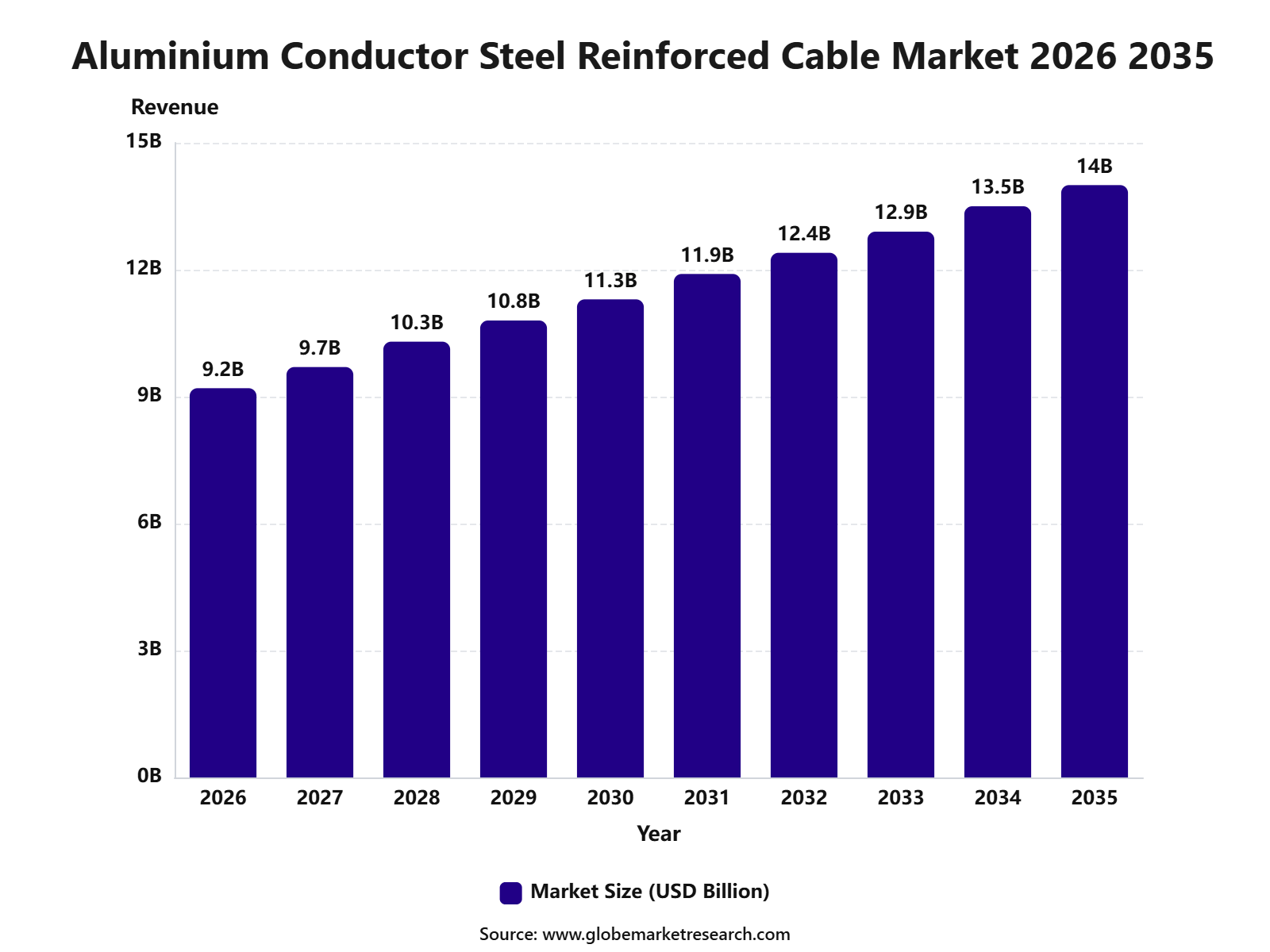 iThe graph shows projected market growth until 2035 based on CAGR analysis. Actual outcomes may vary depending on changing demand, competition, and economic factors.To gain greater insights - request a sample report PDF
Key Market Insights
Conventional ACSR led the type segment with 59.1% share, supported by its high tensile strength, cost efficiency, proven reliability, and wide use in long-distance overhead power lines.
Bare overhead transmission conductors accounted for 48.2% share by application, driven by strong demand for grid expansion, rural electrification, and high-voltage power transmission networks.
Power transmission held 55.5% share by end use, supported by rising electricity demand, renewable power integration, and ongoing investment in transmission infrastructure.
Asia Pacific led the ACSR market with 45.8% share, valued at USD 4.2 billion, supported by rapid grid modernization, large-scale power infrastructure development, and rising electricity consumption across China, India, and Southeast Asia.
Top Funding and Investment
Top Investments
AEP Transmission Grid Modernization Investment
In October 2025, American Electric Power indicated that its five-year capital investment program could be increased from USD 54 billion to approximately USD 64 billion. The additional spending is intended to strengthen transmission infrastructure and support around 24 GW of expected new electricity demand from data centres, artificial intelligence facilities, manufacturing plants, and other large power users.
The program includes the replacement and modernization of existing overhead transmission lines, creating direct procurement opportunities for ACSR conductors, high-capacity conductors, towers, insulators, connectors, and related grid equipment.
UK Advanced Cable and Grid Equipment Investment
In 2025, the UK energy regulator Ofgem approved approximately GBP 4 billion in early investment for National Grid, SSE, and ScottishPower to secure cables and electricity-network equipment before final transmission project approvals.
The funding will help utilities reserve manufacturing capacity and reduce equipment-delivery delays. The UK is expected to require around 600 miles of new onshore power lines and 2,800 miles of offshore transmission infrastructure by 2030, supporting long-term demand for overhead conductors and related transmission components.
RR Kabel Manufacturing Expansion
In 2025, RR Kabel advanced a INR 1,050 crore investment at its Waghodia manufacturing facility in Gujarat. The project is designed to raise the company’s wire and cable manufacturing capacity by approximately 54%, equivalent to an additional 36,000 metric tonnes.
The expansion strengthens domestic production capabilities for power and infrastructure cables and supports increasing electricity transmission, distribution, renewable-energy, industrial, and construction requirements.
UltraTech Cable Manufacturing Investment
In 2025, UltraTech Cement approved an investment of approximately INR 1,800 crore, equivalent to about USD 216 million, to enter the wires and cables manufacturing sector.
The proposed Gujarat facility is expected to begin production by December 2026. The investment will add a major industrial participant to India’s electrical cable supply chain and increase manufacturing competition across power, infrastructure, industrial, and building cable categories.
KEC International Aluminium Conductor Plant
In February 2025, KEC International commissioned the first phase of its aluminium conductor manufacturing plant in Vadodara, India. The facility involved an investment of approximately INR 60 crore.
After completion of the final phase, the plant was expected to support annual revenue of nearly INR 600 crore. The investment directly strengthens KEC International’s capacity to manufacture aluminium conductors used in electricity transmission and distribution networks.
Top Funding Developments
AEP Transmission Loan Guarantee
In October 2025, the U.S. Department of Energy finalized a USD 1.6 billion loan guarantee for AEP Transmission. The funding will support the modernization of nearly 5,000 miles of transmission lines across Indiana, Michigan, Ohio, Oklahoma, and West Virginia.
The initial work will cover approximately 100 miles of transmission lines in Ohio and Oklahoma. The upgrades will replace ageing infrastructure within existing rights-of-way, improve grid capacity and reliability, and create demand for replacement conductors, including conventional ACSR and higher-capacity alternatives.
DOE SPARK Reconductoring Funding
In 2026, the U.S. Department of Energy introduced the USD 1.9 billion Speed to Power through Accelerated Reconductoring, or SPARK, program. The program is focused on increasing electricity-transfer capacity by replacing existing transmission conductors with higher-capacity conductor systems.
Investor-owned utilities and large eligible organizations may receive federal support covering up to 50% of project costs, while electric cooperatives may qualify for funding covering up to 75%. The program is directly relevant to ACSR replacement, reconductoring activity, and advanced overhead conductor deployment.
DOE Transmission and Grid Resilience Funding
For fiscal year 2025, the U.S. Department of Energy’s Grid and Transmission Program Conductor identified up to USD 1.08 billion in combined financing opportunities for transmission development and grid-resilience projects.
The funding supports electricity-network modernization, transmission capacity improvements, system resilience, and conductor replacement. These programs can generate procurement demand for ACSR conductors, advanced aluminium conductors, towers, substations, and grid-monitoring technologies.
Top Acquisitions
Hubbell Acquired DMC Power
In 2025, Hubbell agreed to acquire DMC Power for USD 825 million from Golden Gate Capital. DMC Power supplies connectors, installation tooling, and engineered connection systems used in substations and electricity transmission networks.
Through the transaction, Hubbell acquired DMC Power’s patented swage-connection technology, manufacturing facilities in California and Mississippi, engineering capabilities, utility relationships, and portfolio of high-reliability substation and transmission connectors. DMC Power employed more than 350 people and was expected to generate approximately USD 130 million in annual revenue.
Power Grid Corporation Acquired MEL Power Transmission
In June 2025, Power Grid Corporation of India acquired MEL Power Transmission Limited for INR 8.53 crore through India’s tariff-based competitive bidding framework.
Power Grid acquired the complete project-specific special-purpose company and its rights to develop the associated interstate electricity transmission project. The transaction added transmission infrastructure development rights, project approvals, network assets, and future conductor procurement requirements to Power Grid’s portfolio.
By Type
Conventional ACSR accounted for 59.1% share of the Aluminium Conductor Steel-reinforced Cable Market. This leading position is supported by its long operating history, strong mechanical strength, reliable conductivity, and wide use across overhead power transmission networks.
The segment is widely preferred because it combines aluminium’s electrical conductivity with steel’s tensile strength. This makes conventional ACSR suitable for long-span transmission lines, high-voltage networks, rural electrification, and grid expansion projects.
Demand is expected to remain strong as utilities continue to upgrade aging transmission infrastructure and expand power delivery networks. Its cost efficiency, proven performance, and broad availability will continue to support segment leadership.
By Application
Bare overhead transmission conductors accounted for 48.2% share of the Aluminium Conductor Steel-reinforced Cable Market. This dominance is driven by their extensive use in high-voltage and extra-high-voltage transmission lines where efficient long-distance electricity transfer is required.
ACSR cables are widely used as bare overhead conductors because they offer strong sag resistance, high tensile strength, and reliable current-carrying capacity. These features are important for transmission corridors exposed to wind, temperature variation, and long-span installation conditions.
The segment is expected to remain the largest application area as electricity demand, renewable power integration, and grid interconnection projects continue to increase. Demand will remain supported by transmission line expansion, replacement of old conductors, and stronger grid reliability requirements.
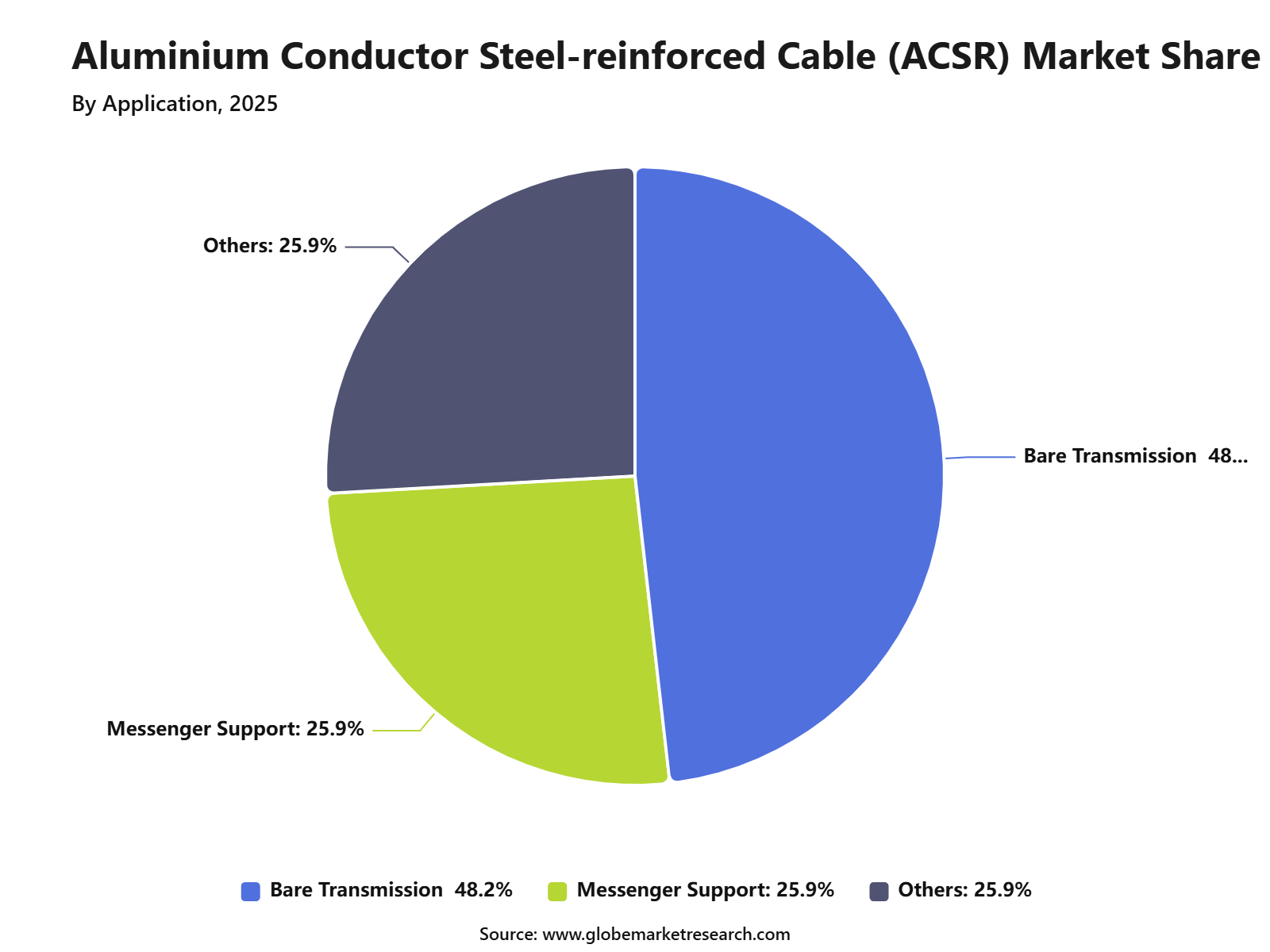 iThe graph shows projected market growth until 2035 based on CAGR analysis. Actual outcomes may vary depending on changing demand, competition, and economic factors.To gain greater insights - request a sample report PDF
By End Use
Power transmission accounted for 55.5% share of the Aluminium Conductor Steel-reinforced Cable Market. This leading share is supported by the critical use of ACSR cables in transferring electricity from generation plants to substations and regional distribution networks.
The segment benefits from rising investment in grid modernization, renewable energy evacuation, cross-border transmission, and long-distance electricity movement. ACSR cables remain important because they can support high mechanical loads while maintaining efficient power transfer over large distances.
Demand from power transmission is expected to remain strong as utilities strengthen electricity infrastructure to support industrial growth, urbanization, and clean energy projects. The need for stable, durable, and cost-effective conductors will continue to support ACSR adoption in transmission networks.
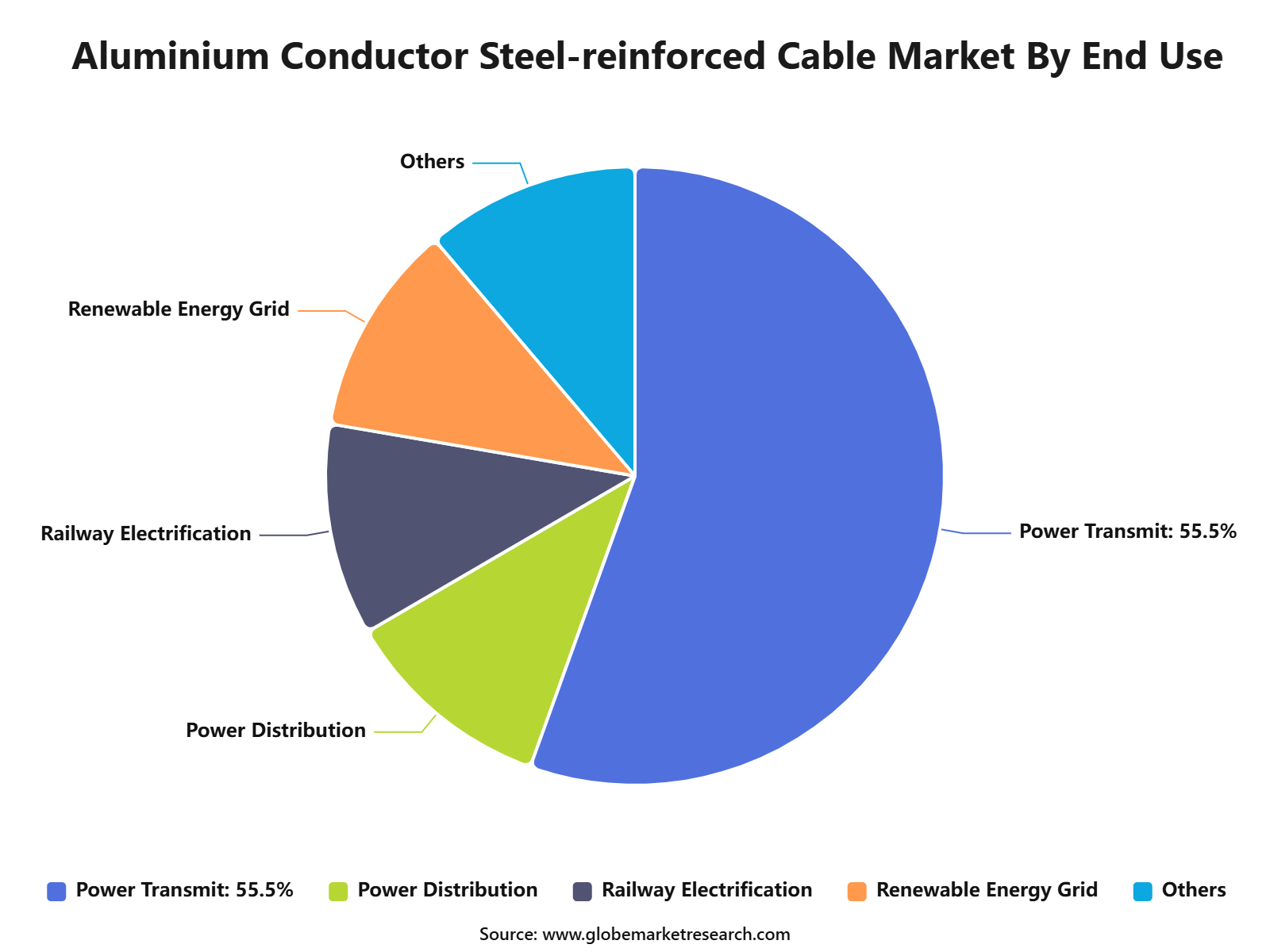 iThe graph shows projected market growth until 2035 based on CAGR analysis. Actual outcomes may vary depending on changing demand, competition, and economic factors.To gain greater insights - request a sample report PDF
By Region
Asia Pacific accounted for 45.8% share of the Aluminium Conductor Steel-reinforced Cable Market, reaching USD 4.2 billion. The region’s leadership is supported by rapid electricity demand growth, large-scale transmission projects, industrial expansion, and strong investment in power infrastructure.
China, India, Japan, South Korea, Indonesia, Vietnam, and other Southeast Asian countries are key contributors to regional demand. The region benefits from grid expansion, renewable power integration, rural electrification, and replacement of aging transmission lines.
Asia Pacific is expected to maintain its leading position as governments and utilities continue to invest in reliable power transmission systems. Demand will remain supported by rising electricity consumption, clean energy capacity additions, and the need for stronger interregional power networks.
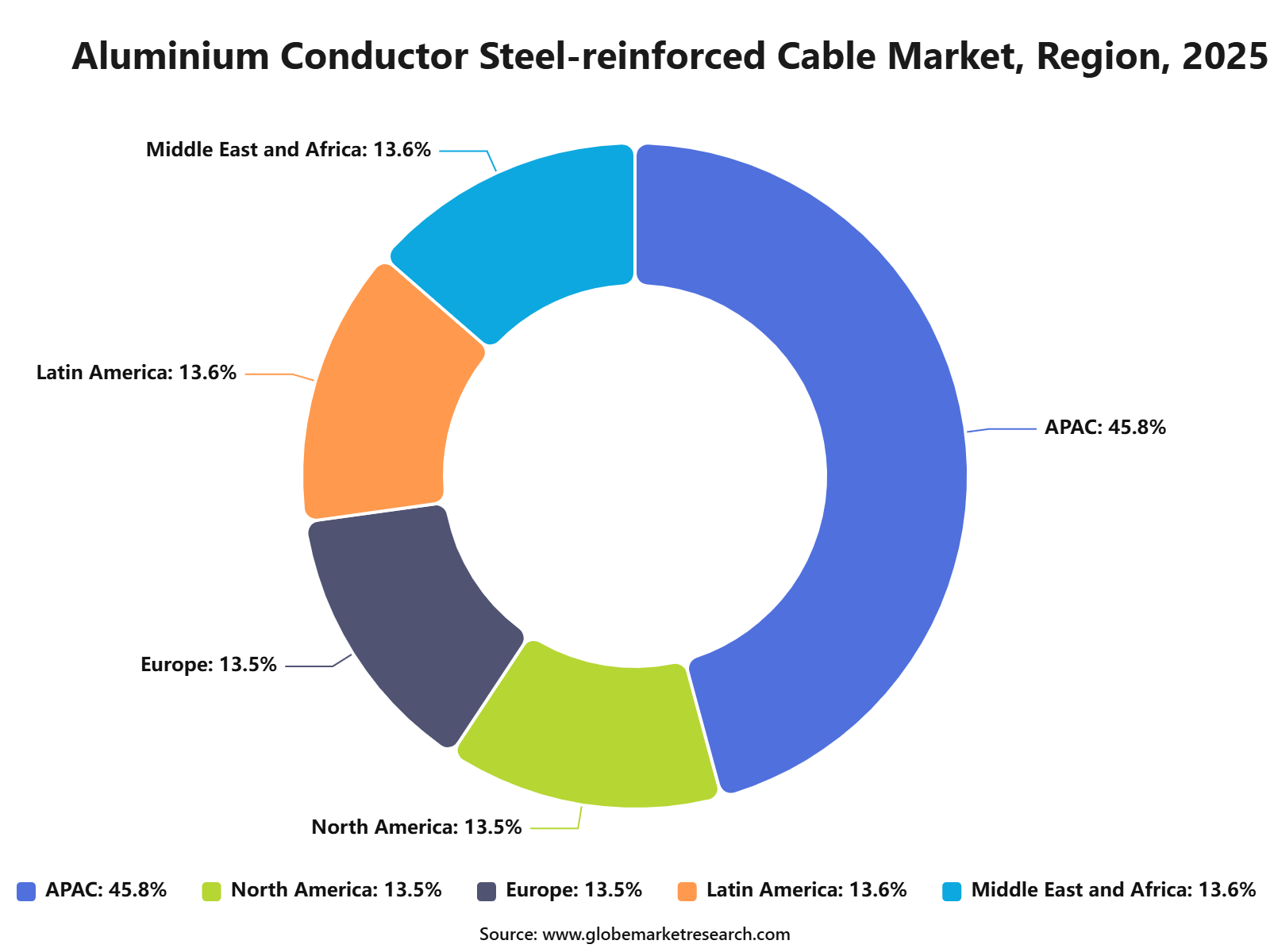 iThe graph shows projected market growth until 2035 based on CAGR analysis. Actual outcomes may vary depending on changing demand, competition, and economic factors.To gain greater insights - request a sample report PDF
Regional Impact Analysis
Asia Pacific leads the Aluminium Conductor Steel-reinforced Cable Market with 45.8% share in 2026, valued at around USD 4.2 billion, supported by large transmission projects, renewable power integration, rural electrification, and rapid electricity demand growth. China and India remain the largest regional contributors because of major grid investments and expanding power infrastructure.
North America remains important because of grid replacement, transmission reliability upgrades, and renewable interconnection needs. Europe supports steady demand through modernization, clean energy integration, and cross-border transmission projects.
Impact Factor | Estimated CAGR Impact | Regional Relevance | Market Impact |
|---|---|---|---|
Asia Pacific market leadership | +1.6% | Asia Pacific, 45.8% share in 2026 | Leads global value demand. |
China transmission grid scale | +1.1% | China | Drives high-volume conductor demand. |
India electrification and renewable growth | +0.9% | India | Supports future expansion. |
Southeast Asia grid development | +0.7% | Indonesia, Vietnam, Thailand | Adds regional cable demand. |
North America and Europe grid replacement | +0.5% | U.S., Canada, Germany, UK | Supports steady modernization demand. |
Go-To-Market and Sales Economics
ACSR suppliers should sell through utilities, transmission owners, engineering contractors, and approved tender platforms rather than broad industrial distribution. The IEA states that annual grid investment must rise about 50% from the current USD 400 billion level by 2030. Early specification work, utility registration, local testing, and framework pricing can improve bid visibility and conversion.
Framework agreements can produce steadier volumes than one-off project bidding. Nexans reported first-quarter 2026 PWR-Grid standard sales of EUR 322 million, supported by 5.7% organic growth, customer call-offs, data-centre activity, and renewable projects. ACSR manufacturers should pair conductor supply with fittings, technical design support, installation guidance, traceability, and scheduled delivery programmes.
Sales coverage should be organised around incumbent utilities because they control most transmission construction. The U.S. Department of Energy found that 8,700 to 12,500 circuit-miles were energised annually from 2016 through 2023, with incumbent utilities delivering the vast majority. Local warehousing, emergency replacement stock, and qualified EPC partnerships can strengthen procurement access.
Risk Factors & Market Barriers
Aluminium volatility is a direct margin risk because the metal forms most of an ACSR conductor’s weight. USGS reported that the average U.S. aluminium market price increased 39% in 2025, while net import reliance reached 60% and primary output was 660,000 tonnes. Indexed contracts, hedging, scrap recovery, and shorter quotation validity are therefore important.
Steel-core economics are exposed to global oversupply, trade measures, and regional price differences. The OECD expects excess steelmaking capacity to reach 745 million tonnes by 2028, with up to 138.8 million tonnes of planned additions. Suppliers should qualify several wire-rod sources, monitor tariffs, and maintain mechanical testing to prevent lower-cost material from weakening conductor performance.
Long procurement cycles can delay revenue and increase working-capital requirements. The IEA reports that cable procurement now takes two to three years and that cable prices have nearly doubled since 2019. ACSR producers should secure aluminium rod, galvanised steel wire, reels, and production slots early, while using milestone billing and escalation clauses for long-duration utility projects.
Revenue Potential Analysis
Revenue Landscape Across
India offers substantial conductor demand through network expansion, reconductoring, and renewable evacuation projects. The Ministry of Power reported approximately 494,732 circuit-kilometres of transmission lines in the FY2025-26 network. Revenue can be developed through central and state utility tenders, domestic-content compliance, regional depots, high-temperature variants, and lifecycle services for aging overhead corridors.
European revenue opportunities are supported by national grid-development programmes. Spain’s electricity plan targets upgrades to 8,000 kilometres of existing network, 2,700 kilometres of new transmission lines, and 700 kilometres of subsea interconnections. ACSR suppliers should target onshore reinforcements, cross-border links, renewable connection corridors, and uprating projects where conventional conductors remain technically and economically suitable.
Great Britain provides a visible overhead-line pipeline within regulated transmission investment. Ofgem’s May 2026 approvals included a new 106-kilometre, 400 kV double-circuit line and refurbishment of 38 kilometres of existing overhead infrastructure. Revenue opportunities extend across conductors, hardware, insulators, installation services, testing, and replacement materials secured through early construction funding.
Financial Impact
Manufacturing profitability depends on metal pass-through and contract execution, not revenue growth alone. Prysmian’s Power Grid business generated EUR 1.012 billion in first-quarter 2026 revenue, up 16.2% organically, but adjusted EBITDA fell to EUR 107 million and margin declined to 12.4%. Higher metal premiums can therefore dilute earnings despite strong conductor and grid demand.
Backlogs improve revenue visibility but require production capacity, inventory, guarantees, and disciplined project selection. Prysmian reported an approximately EUR 17 billion transmission backlog in the first quarter of 2026, plus about EUR 2 billion of awarded projects not yet included. ACSR manufacturers should prioritise contracts with secure payment terms, price adjustment mechanisms, and realistic delivery schedules.
Large regulated investment programmes can support multi-year cash flow for qualified suppliers. Ofgem stated in May 2026 that electricity transmission expenditure could reach around GBP 70 billion over five years. Financial returns will depend on framework share, factory utilisation, conductor mix, milestone collections, warranty exposure, and the ability to secure scarce raw materials before project mobilisation.
Drivers Impact Analysis
The Aluminium Conductor Steel-reinforced Cable Market is driven by rising electricity demand, grid expansion, transmission line upgrades, renewable energy integration, and rural electrification. ACSR cables remain important in overhead transmission because they offer strength, conductivity, cost efficiency, and suitability for long-span power lines.
Asia Pacific leads the market due to large-scale grid infrastructure, rising power consumption, renewable energy projects, and transmission investments across fast-growing economies. China, India, Japan, South Korea, Indonesia, Vietnam, and Australia remain key contributors because of power generation growth and grid modernization needs.
Impact Factor | Estimated CAGR Impact | Regional Relevance | Market Impact |
|---|---|---|---|
Expansion of power transmission networks | +1.4% | Asia Pacific, Middle East, Africa | Drives core ACSR cable demand. |
Rising electricity consumption | +1.1% | China, India, Southeast Asia | Supports new grid connections. |
Renewable energy grid integration | +0.9% | Asia Pacific, Europe, North America | Increases transmission line requirements. |
Rural electrification and distribution growth | +0.7% | India, Indonesia, Africa | Adds overhead conductor demand. |
Replacement of aging transmission lines | +0.6% | Mature and developing grids | Supports recurring cable demand. |
Restraints Impact Analysis
The market faces restraints from aluminium and steel price volatility, high installation cost, right-of-way issues, and competition from advanced conductors. Transmission projects also require approvals, land access, engineering planning, and utility funding.
Another restraint is the growing use of high-temperature low-sag conductors and compact transmission technologies in selected projects. While ACSR remains widely used, some utilities may choose advanced alternatives where higher capacity and lower sag are required.
Impact Factor | Estimated CAGR Impact | Regional Relevance | Market Impact |
|---|---|---|---|
Aluminium and steel price volatility | -0.7% | Global cable producers | Affects margins and pricing. |
Right-of-way and permitting delays | -0.6% | Transmission project markets | Slows project execution. |
Competition from advanced conductors | -0.5% | Urban and high-capacity grids | Limits selected demand. |
High logistics and installation cost | -0.4% | Remote transmission projects | Adds project cost pressure. |
Utility budget constraints | -0.3% | Emerging power markets | Delays grid investment. |
Opportunities Impact Analysis
Opportunities are strong in high-voltage transmission, bare overhead conductors, renewable power evacuation, interregional grid links, rural electrification, and utility replacement programs. ACSR cables remain attractive where cost, mechanical strength, and proven field performance are important.
Higher-value opportunities are emerging in grid expansion linked to solar, wind, hydropower, industrial zones, mining areas, and cross-border electricity transmission. Manufacturers with reliable supply, quality certification, and utility relationships can capture stronger demand.
Impact Factor | Estimated CAGR Impact | Regional Relevance | Market Impact |
|---|---|---|---|
Renewable power evacuation projects | +1.3% | India, China, Australia, Southeast Asia | Builds new transmission demand. |
High-voltage overhead line expansion | +1.0% | Asia Pacific and emerging regions | Supports large-scale cable use. |
Utility replacement programs | +0.8% | Mature and aging grids | Adds recurring demand. |
Rural and remote electrification | +0.6% | India, Indonesia, Africa | Expands distribution network demand. |
Cross-border power transmission | +0.5% | Asia Pacific, Europe, Africa | Supports grid interconnection. |
Challenges Impact Analysis
The main challenge is managing material cost, quality consistency, and delivery timelines for large transmission projects. ACSR cables require consistent aluminium quality, steel core strength, accurate stranding, and compliance with utility specifications.
Another challenge is maintaining performance under weather, corrosion, wind load, thermal stress, and long-span operating conditions. Utilities need cables that provide reliable service life while reducing maintenance and outage risk.
Impact Factor | Estimated CAGR Impact | Regional Relevance | Market Impact |
|---|---|---|---|
Maintaining conductor quality standards | -0.6% | Utility and EPC projects | Affects supplier qualification. |
Managing weather and corrosion exposure | -0.5% | Coastal, industrial, humid regions | Influences lifecycle performance. |
Long project execution cycles | -0.4% | Transmission infrastructure markets | Delays revenue recognition. |
Meeting utility testing requirements | -0.4% | Global power utilities | Raises compliance needs. |
Competition on price and tender terms | -0.3% | Emerging cable markets | Pressures profitability. |
Segment Covered in the Report
By Type
Conventional ACSR
ACSR/TW
ACSR/SD
Others
By Application
Bare Overhead Transmission Conductor
Messenger Support
Others
By End Use
Power Transmission
Power Distribution
Railway Electrification
Renewable Energy Grid Connection
Others
By Region
North America
Europe
Asia Pacific
Latin America
Middle East and Africa
Market Trend Analysis
The market trend is moving toward transmission grid strengthening, renewable power connectivity, higher-voltage networks, utility modernization, and cost-efficient overhead conductors. ACSR remains widely used because utilities understand its performance, installation practices, and maintenance requirements.
Asia Pacific remains the largest value region because of fast electricity demand growth, large grid programs, and renewable capacity expansion. Europe and North America support steady replacement demand, while Middle East and Africa add opportunities through electrification and power infrastructure development.
Impact Factor | Estimated CAGR Impact | Regional Relevance | Market Impact |
|---|---|---|---|
Grid modernization programs increase | +1.2% | Asia Pacific, Europe, North America | Supports conductor replacement. |
Renewable-linked transmission grows | +1.0% | China, India, Australia | Adds new overhead line demand. |
High-voltage power corridors expand | +0.8% | Large power markets | Improves bulk power transfer. |
Utility preference for proven conductors | +0.6% | Emerging and mature grids | Supports continued ACSR use. |
Regional manufacturing localization | +0.4% | Asia Pacific and Middle East | Improves supply security. |
Investor Type Impact Matrix
Investors should focus on companies with strong aluminium sourcing, conductor manufacturing capacity, utility approvals, quality certifications, and relationships with power utilities and EPC contractors. Cost control, delivery reliability, and compliance with technical standards are key success factors.
Strategic investors can also target ACSR cable producers, aluminium wire rod suppliers, steel core manufacturers, transmission EPC firms, testing and certification providers, and grid infrastructure suppliers. Companies that combine scale, quality, and utility tender access are better positioned for steady long-term growth.
Investor Type | Estimated CAGR Impact | Regional Relevance | Market Impact |
|---|---|---|---|
ACSR Cable Manufacturers | +1.0% | Global | Expands core overhead conductor supply. |
Aluminium Wire Rod Suppliers | +0.8% | Asia Pacific and global cable markets | Supports upstream material availability. |
Steel Core and Galvanizing Providers | +0.6% | Conductor supply chains | Improves mechanical strength and durability. |
Transmission EPC Companies | +0.5% | Grid infrastructure markets | Supports installation and project delivery. |
Strategic Power Infrastructure Investors | +0.4% | Asia Pacific, Europe, North America | Funds grid expansion and modernization. |
Recent Developments
In March 2026, APAR Industries approved an additional investment of up to USD 5 million in APAR USA LLC, supporting expansion of its conductor and cable business and strengthening manufacturing-led growth in the United States.
In February 2026, Gupta Power Infrastructure attracted expressions of interest from 22 prospective bidders, including Jindal Power, Vedanta and Havells, while undergoing insolvency resolution involving admitted creditor claims of INR 4,240 crore.
In June 2025, CTC Global partnered with Google to accelerate deployment of U.S.-manufactured ACCC advanced conductors, helping utilities reconductor existing transmission corridors, increase grid capacity and support rising electricity demand from data centres.
Competitive Landscape
The market is characterized by intense competition among established players and emerging companies. Strategic partnerships, mergers and acquisitions, and product innovation are key strategies employed by market participants.
Key Market Players
Nexans
Southwire Company
Apar Industries
Hengtong Group
Sumitomo Electric Industries
Prysmian Group
LS Cable & System
ZTT Group
KEI Industries
Sterlite Power
Midal Cables
Henan Tong-Da Cable
Gupta Power Infrastructure
JSK Industries
Taihan Cable & Solution
Other Key Players
Research Methodology
This market study is prepared using a combination of primary and secondary research. Primary research includes discussions with manufacturers, suppliers, distributors, consultants, industry experts, and end users. Secondary research covers company reports, government databases, trade associations, technical publications, regulatory sources, and trusted industry documents. The collected information is used to assess market demand, pricing trends, technology adoption, competitive activity, and regional performance.
AI language models are not used as primary data sources, and publicly available AI-generated content is not treated as market evidence. Computational tools may be used to support data processing, translation, data classification, and pattern identification. However, every published assessment is supported by verified sources, human review, and primary market discussions.
Market estimates are developed through top-down and bottom-up approaches and validated using data triangulation. Revenue, production, shipment, pricing, and application-level data are compared across multiple sources. Forecasts consider economic conditions, regulatory changes, investment activity, innovation, supply chain developments, and industry risks. All findings are reviewed through source verification and internal quality checks before publication.
Part I
Source Management & Input Data Standards
Who provides data, how sources are qualified, and what types of evidence are admissible.
Part II
Research Scope & Market Coverage
How we define the markets we assess and the parameters that govern each product.
Part III
Data Collection, Verification & Submission
The mechanics of gathering, cross-checking, and hierarchically ranking evidence.
Part IV
Assessment Determination & Quality Controls
How raw data becomes a published assessment — normalisation, expert judgement, and outlier exclusion.
Part V
Publication, Corrections & Revision
Our publication schedule, corrections policy, and methodology review cycle.
Part VI
Independence, Ethics & Complaints
Conflict-of-interest policies, editorial independence, and how clients raise concerns.
Google · Preferred Sources
Don't miss the latest market research insights and industry updates on Google.
Add Globe Market Research as a preferred source in the Google app to see our reports, analysis, and market stories in your news suggestions.
Meet the Team
This report was prepared by our expert analysts with deep industry knowledge and research experience.
Sayali brings more than 7 years of experience to Globe Market Research, supporting the accuracy, clarity, and relevance of research content across multiple industries. She reviews market data, segment analysis, competitive insights, and industry trends to ensure each report meets strong quality standards and provides practical value to business decision-makers. Her expertise spans healthcare, information technology, consumer goods, and diverse cross-industry domains. With a strong focus on data reliability, structured analysis, and clear presentation, Sayali helps ensure that each research output delivers well-reviewed insights for clients, investors, consultants, and industry stakeholders.
Frequently Asked Questions
Related Reports
More in Chemical and Material
Sulfuric Acid Market to Hit USD 61.5 Billion by 2035
Sulfuric Acid Market Size, Share, Analysis By Raw Material (Elemental Sulfur, Base Metal Smelters, Pyrite Ore, Others), By Application (Fertilizers, Chemical Manufacturing, Metal Processing, Petroleum Refining, Textile, Automotive, Pulp and Paper, Others), By Distribution Channel (Direct Sales, Distributors), By Regional Insights, Business plan and Project Report, Investment Opportunities, Profitability, Industry Trends, Leading Companies and Growth Forecasts by 2026-2035
Powder Metallurgy Market to Hit USD 17.0 Billion by 2035
Powder Metallurgy Market Size, Share, Analysis By Material (Ferrous Metals, Non-Ferrous Metals, Others), By Process (Additive Manufacturing, Powder Metal Hot Isostatic Pressing, Conventional Powder Metallurgy), By Application (Automotive, Aerospace and Defense, Healthcare, Electrical and Electronics, Industrial Machinery, Others) , By Regional Insights, Business plan and Project Report, Investment Opportunities, Profitability, Industry Trends, Leading Companies and Growth Forecasts by 2026-2035
Bromine Market to Hit USD 1.5 Billion by 2035
Bromine Market Size, Share, Analysis By Derivative (Organobromine, Clear Brine Fluids, Hydrogen Bromide, Others), By Application (Flame Retardants, Oil and Gas Drilling, Biocides, PTA Synthesis, Plasma Etching, Pharmaceuticals, Energy Storage, Others), By End-Use Industry (Chemicals, Oil and Gas, Pharmaceuticals, Electrical and Electronics, Automotive, Agriculture, Others), By Regional Insights, Business plan and Project Report, Investment Opportunities, Profitability, Industry Trends, Leading Companies and Growth Forecasts by 2026-2035
Hydrogen Cyanide Market to Hit USD 5.95 Billion by 2035
Hydrogen Cyanide Market Size, Share, Analysis By Product Form (Hydrogen Cyanide Liquid, Hydrogen Cyanide Gas), By Application (Adiponitrile, Acetone Cyanohydrin, Sodium Cyanide and Potassium Cyanide, Methionine, Cyanuric Chloride, Others), By End-Use Industry (Chemicals, Mining and Metallurgy, Pharmaceuticals, Agriculture, Textiles, Others), By Regional Insights, Business plan and Project Report, Investment Opportunities, Profitability, Industry Trends, Leading Companies and Growth Forecasts by 2026-2035