

Revenue, 2025
USD 135.4 Bn
Forecast, 2035
USD 317.6 Bn
CAGR, 2025-2035
8.9%
Report Coverage
Global
Market Size and Forecast
The Global Battery Technology Market was worth USD 135.4 billion in 2025 and is expected to reach USD 317.6 billion by 2035, growing at a CAGR of 8.9% from 2025 to 2035. Based on this growth rate, the market is estimated to reach around USD 153.6 billion in 2026. Asia Pacific held the largest regional share of 42.3% in 2025, valued at around USD 57.27 billion, supported by strong battery manufacturing capacity, electric vehicle production, consumer electronics demand, and large-scale energy storage investments.
The Battery Technology Market includes advanced battery systems, materials, components, and storage solutions used to store and deliver electrical energy across multiple applications. It covers lithium-ion batteries, solid-state batteries, lead-acid batteries, sodium-ion batteries, flow batteries, nickel-based batteries, battery management systems, separators, electrolytes, cathodes, and anodes. The market is closely linked with electric mobility, renewable energy storage, grid stability, portable electronics, and industrial electrification.
Key Parameter | Report Details |
|---|---|
Market Revenue, 2025 | USD 135.4 Billion |
Projected Revenue, 2035 | USD 317.6 Billion |
CAGR (2025-2035) | 8.9% |
Largest Region | Asia Pacific (42.3%, USD 57.27 Bn) |
Market Concentration | Medium |
Base Year | 2024 |
Forecast Period | 2025-2035 |
The market outlook remains strong as batteries become a central part of the clean energy and transportation transition. Growth can be attributed to rising electric vehicle adoption, expanding renewable power integration, increasing demand for backup power, and rapid improvements in battery safety, charging speed, and energy density. The expansion of Asia Pacific gigafactories, battery recycling capacity, and next-generation chemistries is expected to support long-term market demand.
Demand is also rising as companies and governments focus on reducing carbon emissions, improving energy security, and building reliable storage infrastructure. Battery technology is moving beyond vehicles and electronics into data centers, telecom towers, residential storage, microgrids, and utility-scale energy projects. This shift makes the market important for manufacturers, energy providers, automakers, and investors looking for long-term growth opportunities.
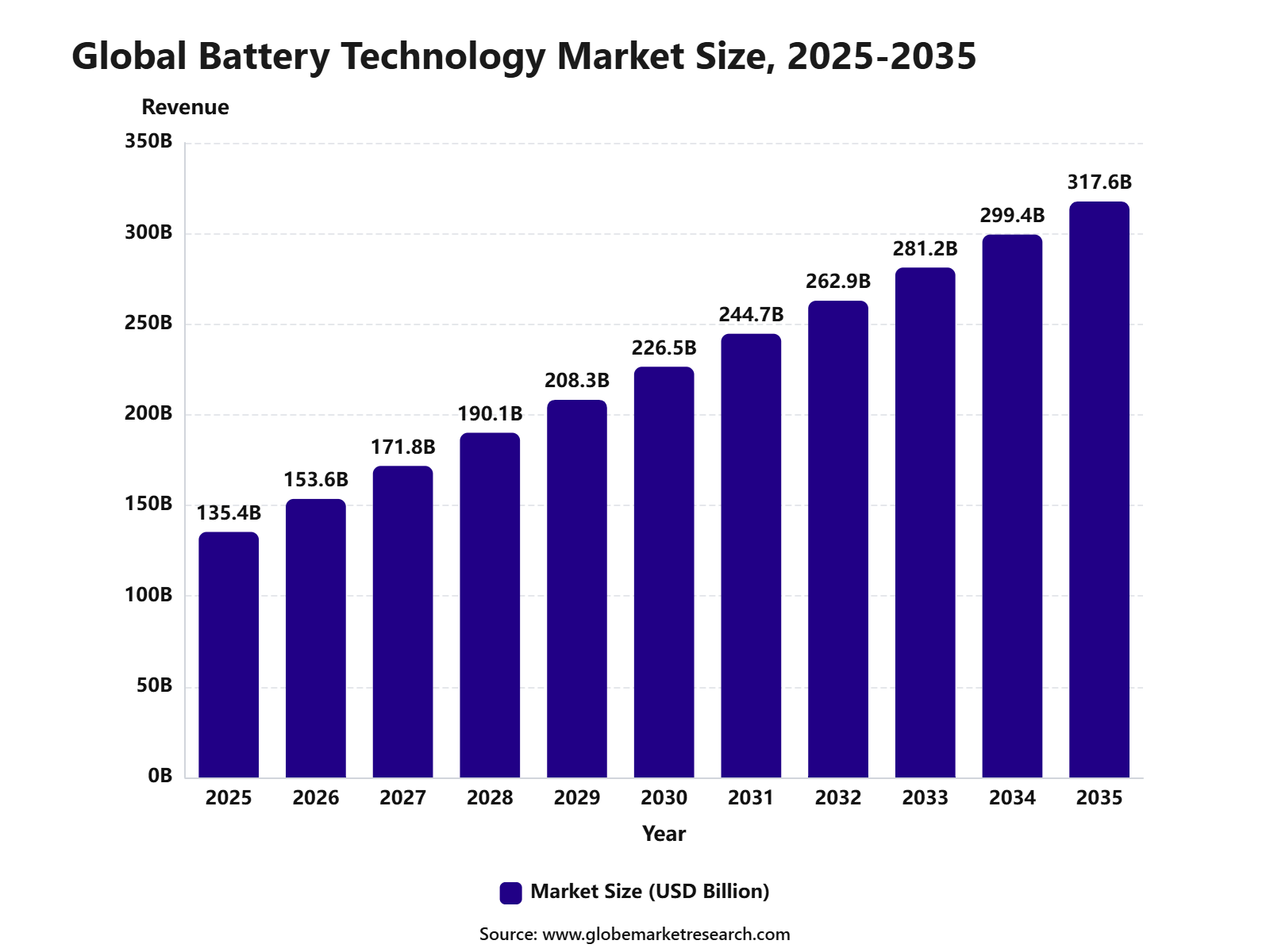 iThe graph shows projected market growth until 2035 based on CAGR analysis. Actual outcomes may vary depending on changing demand, competition, and economic factors.To gain greater insights - request a sample report PDF
Key Market Insights
Lithium-ion batteries led the product type segment with 46.3% share, supported by their high energy density, longer cycle life, faster charging capability, and strong use across electric vehicles, electronics, and energy storage systems.
Automobile end use accounted for 35.2% share, driven by rising electric vehicle production, hybrid vehicle adoption, battery-powered mobility, and growing demand for efficient rechargeable battery systems.
Industrial batteries held 38.9% share by application, supported by increasing use in backup power, grid storage, telecom infrastructure, manufacturing operations, and heavy-duty energy storage needs.
Asia Pacific led the battery technology market with 42.3% share, valued at USD 57.27 billion, supported by large-scale battery manufacturing, strong EV production, expanding electronics output, and high demand across China, Japan, South Korea, and India.
Top Funding and Investment
Top Investments
Toyota started production at its new battery manufacturing plant in Liberty, North Carolina, with a total investment of nearly USD 14 billion. The facility is designed to produce 30 GWh annually at full capacity and includes 14 battery production lines for hybrid, plug-in hybrid, and battery electric vehicles. The plant is expected to create up to 5,100 jobs, making it one of the largest battery manufacturing investments in the U.S.
CATL’s subsidiary Brunp, along with ANTAM and Indonesia Battery Corporation, broke ground on a battery integration project in Indonesia with planned investment of nearly USD 6 billion. The project covers nickel mining, processing, battery materials, battery manufacturing, and recycling. The first battery plant phase is planned at 6.9 GWh, while the full project is expected to produce 142,000 tons of nickel, 30,000 tons of cathode materials, and process about 20,000 tons of recycled batteries annually.
Panasonic Energy opened its lithium-ion battery facility in De Soto, Kansas, backed by a USD 4 billion investment. The facility will manufacture cylindrical 2170 lithium-ion cells for automotive use and is targeting annual production capacity of 32 GWh. The site covers around 300 acres, includes about 4.7 million sq. ft. of building area, and is expected to employ up to 4,000 people.
AESC secured a GBP 1 billion funding package for a new EV battery gigafactory in Sunderland, U.K. The package included GBP 680 million in financing backed by the National Wealth Fund and UK Export Finance, with the remaining GBP 320 million coming from private financing and new AESC equity. The plant is expected to support more than 1,000 jobs and produce batteries for up to 100,000 electric vehicles per year.
The European Commission awarded EUR 852 million in grants to six EV battery cell manufacturing projects under the Innovation Fund. The investment is intended to scale advanced battery cell production in Europe and strengthen domestic battery technology capacity for electric vehicles.
Top Funding Developments
Base Power raised USD 1 billion in Series C financing, led by Addition. The company installs home batteries for participating customers and uses its distributed battery fleet to lower peak-demand supply costs and provide whole-home backup power. The funding supports the expansion of residential battery deployment and distributed power infrastructure.
Group14 Technologies closed a USD 463 million Series D funding round led by SK Inc., with participation from Porsche Investments, ATL, OMERS, Decarbonization Partners, Lightrock Climate Impact Fund, Microsoft Climate Innovation Fund, and others. The funding will be used to scale production of SCC55 silicon battery material in the U.S. and South Korea, supporting higher-performance lithium-ion batteries.
Redwood Materials closed a USD 350 million Series E funding round, led by Eclipse, with participation from strategic investors including NVentures, NVIDIA’s venture capital arm. The company said the funding supports its integrated business lines across critical battery materials such as cobalt, nickel, copper, lithium, cathode active material, and energy storage.
Top Acquisitions
Lyten entered binding agreements to acquire Northvolt’s remaining assets in Sweden, Poland, and Germany, along with remaining Northvolt intellectual property. What it acquired includes 16 GWh of operational battery manufacturing capacity, 15 GWh under construction, infrastructure to scale beyond 100 GWh, Europe’s advanced battery R&D facility, a 6 GWh BESS manufacturing facility, and clean energy agreements at gigafactory locations. Lyten also completed the acquisition of Northvolt Dwa in Poland in October 2025 and later moved to acquire the Revolt battery recycling site in Sweden in 2026.
Glencore acquired Li-Cycle, a lithium-ion battery recycling company, on August 8, 2025. What it acquired was Li-Cycle’s battery recycling platform, which has been moved under Glencore Battery Recycling for future services and customer support. The acquisition strengthened Glencore’s role in battery material recovery and circular battery supply chains.
By Product Type
Lithium-ion batteries accounted for 46.3% share of the Battery Technology Market. This leading position is supported by their high energy density, long cycle life, fast charging ability, and strong use across electric vehicles, consumer electronics, industrial systems, and energy storage applications.
The segment is widely preferred because lithium-ion batteries offer better performance compared with many traditional battery formats. They are used in smartphones, laptops, electric cars, power tools, medical devices, backup power systems, and grid-scale storage projects.
Demand for lithium-ion batteries is expected to remain strong as electrification continues across transport, manufacturing, utilities, and digital devices. Their role in clean mobility, renewable energy storage, and portable electronics will continue to support market leadership.
By End Use
The automobile segment accounted for 35.2% share of the Battery Technology Market. This dominance is driven by rising demand for electric vehicles, hybrid vehicles, plug-in hybrids, and advanced automotive battery systems.
Battery technology is becoming a core part of modern vehicle design because it supports driving range, charging performance, safety, and power delivery. Automakers are using advanced batteries in passenger cars, commercial vehicles, two-wheelers, buses, and fleet vehicles.
The segment is expected to remain a major demand area as vehicle electrification expands worldwide. Growth will be supported by battery pack innovation, charging infrastructure development, and rising investment in electric mobility platforms.
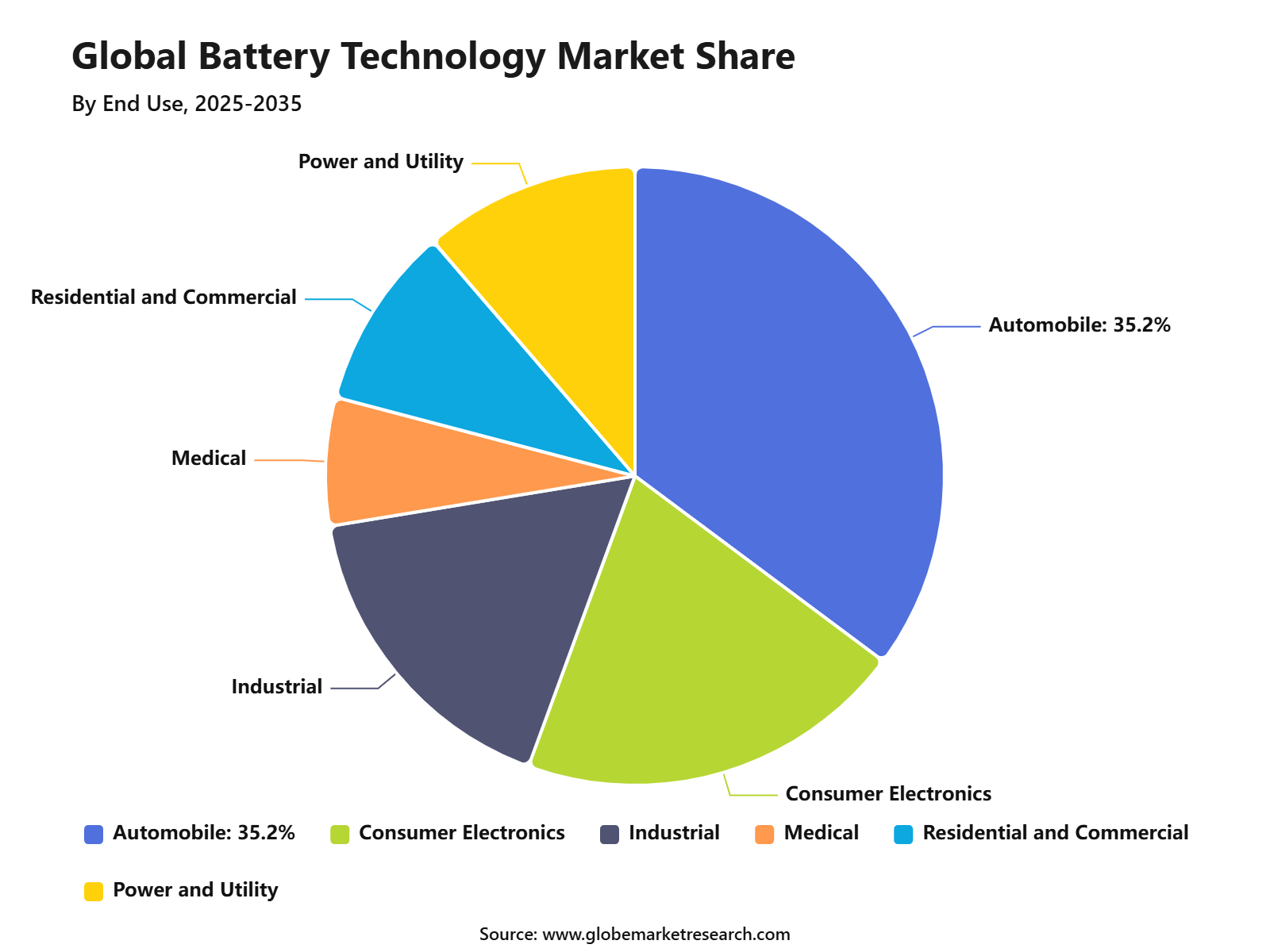 iThe graph shows projected market growth until 2035 based on CAGR analysis. Actual outcomes may vary depending on changing demand, competition, and economic factors.To gain greater insights - request a sample report PDF
By Application
Industrial batteries held 38.9% share of the Battery Technology Market. This leading position is supported by their wide use in backup power, material handling equipment, telecom towers, utilities, manufacturing plants, data centers, and energy storage systems.
These batteries are important because they provide reliable power during outages, peak-load periods, and continuous industrial operations. They are also used in forklifts, automated guided vehicles, UPS systems, grid support, and renewable energy storage projects.
Demand for industrial batteries is expected to remain strong as industries focus on energy reliability, automation, and power backup. Rising use of smart factories, logistics automation, and distributed energy systems will further support this application segment.
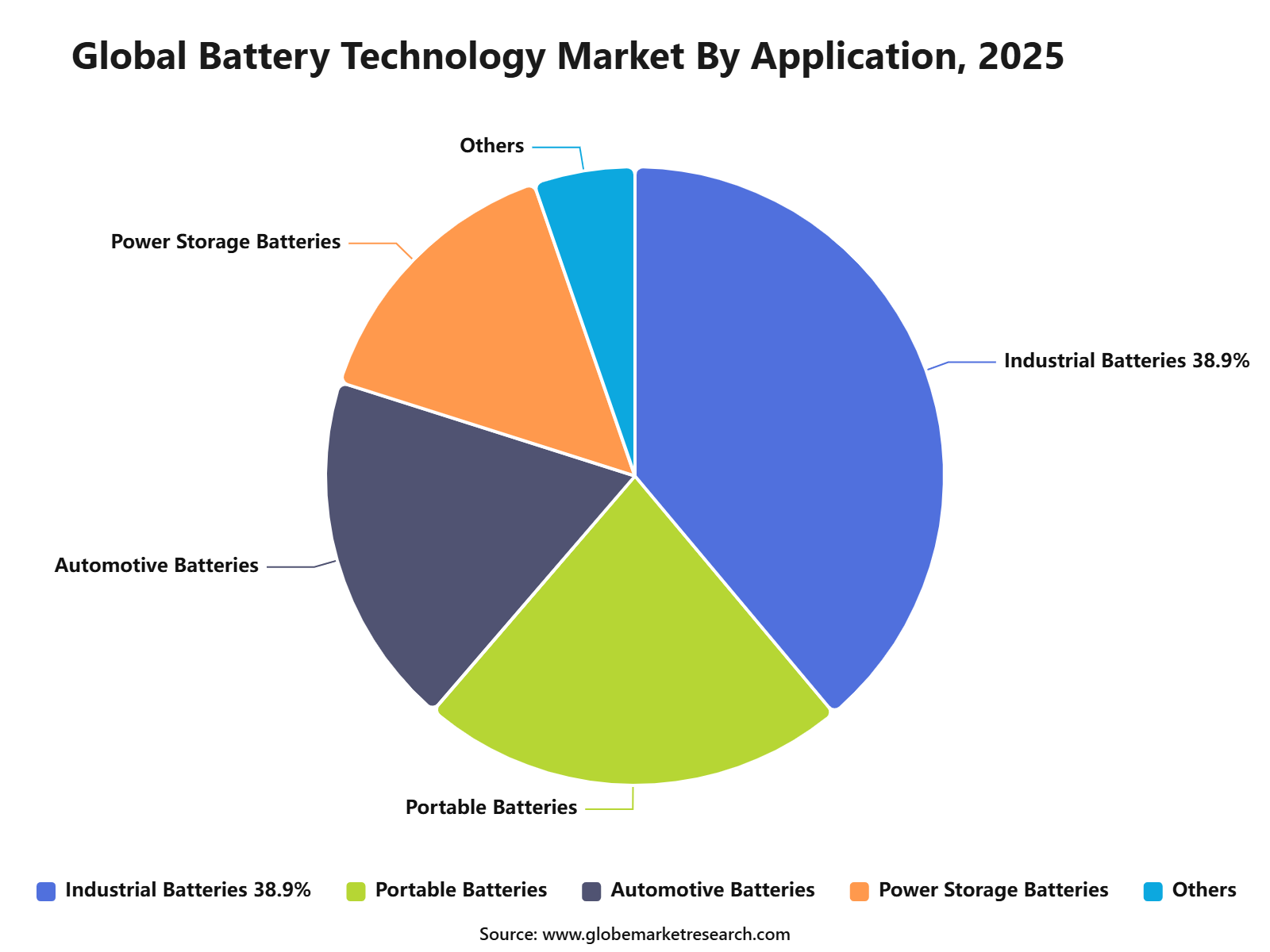 iThe graph shows projected market growth until 2035 based on CAGR analysis. Actual outcomes may vary depending on changing demand, competition, and economic factors.To gain greater insights - request a sample report PDF
By Region
Asia Pacific accounted for 42.3% share of the Battery Technology Market, reaching USD 57.27 billion. The region’s leadership is supported by strong battery manufacturing capacity, electric vehicle production, electronics output, and rising demand for energy storage systems.
China, Japan, South Korea, India, and Southeast Asian countries are key contributors to regional demand. The region benefits from large-scale cell production, strong automotive supply chains, growing renewable energy deployment, and high consumer electronics consumption.
Asia Pacific is expected to maintain its leading position as investment in battery materials, gigafactories, electric vehicles, and industrial energy storage continues to expand. Demand will remain supported by clean mobility, grid modernization, and rising need for reliable power across industrial and consumer applications.
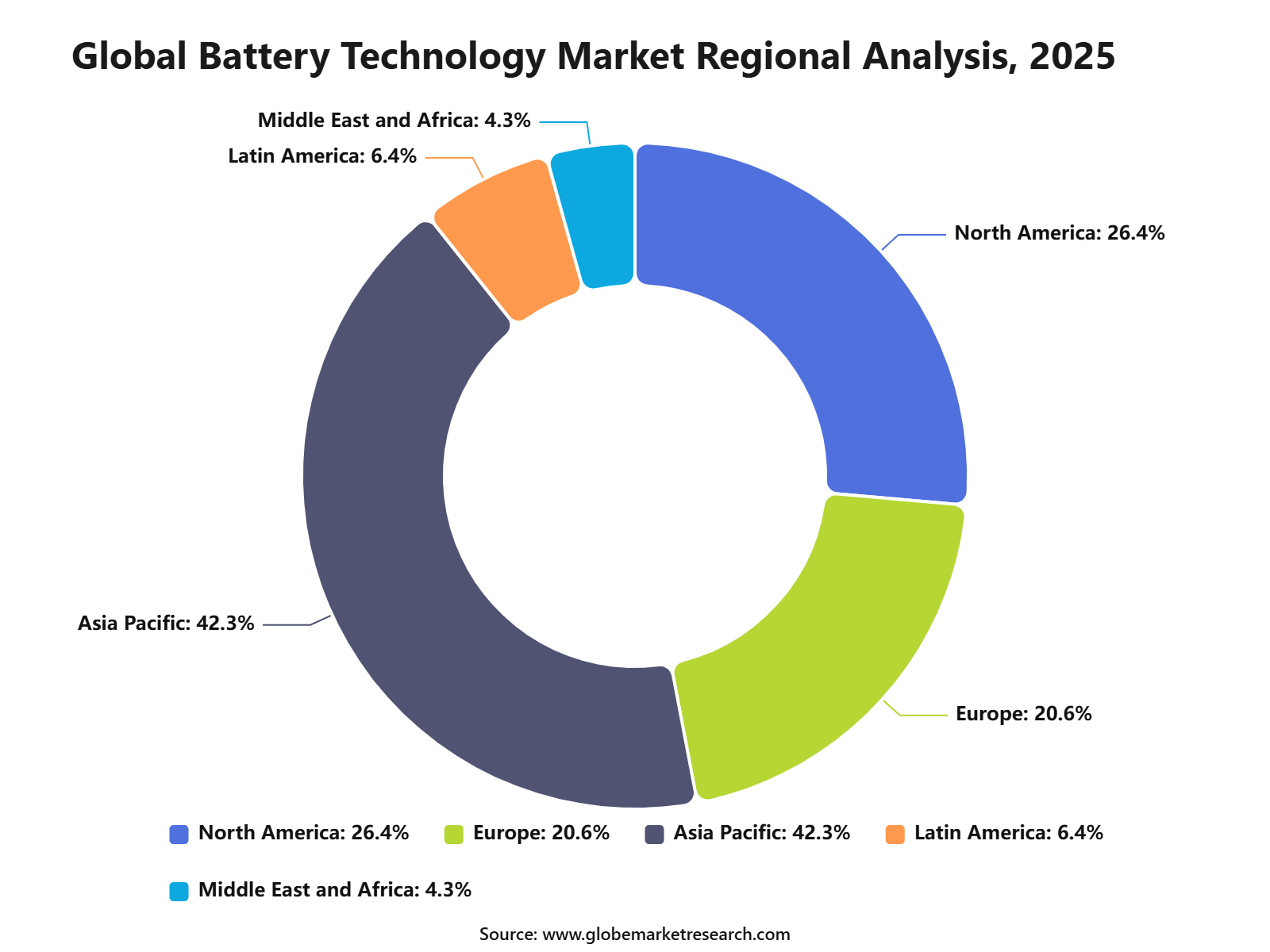 iThe graph shows projected market growth until 2035 based on CAGR analysis. Actual outcomes may vary depending on changing demand, competition, and economic factors.To gain greater insights - request a sample report PDF
Regional Impact Analysis
Asia Pacific leads the Battery Technology Market with 42.3% share in 2025, valued at around USD 57.3 billion, supported by large battery manufacturing capacity, EV production, electronics demand, and strong battery materials supply chains. China, Japan, South Korea, and India remain major regional contributors.
North America remains important because of EV adoption, energy storage deployment, domestic battery manufacturing, and clean technology investment. Europe supports value growth through EV battery plants, renewable storage demand, recycling regulation, and battery supply chain localization.
Impact Factor | Estimated CAGR Impact | Regional Relevance | Market Impact |
|---|---|---|---|
Asia Pacific market leadership | +3.0% | Asia Pacific, 42.3% share in 2025 | Leads global value demand. |
China battery manufacturing scale | +2.0% | China | Drives regional capacity. |
Japan and South Korea battery innovation | +1.5% | Japan, South Korea | Supports advanced technology. |
North America domestic battery investment | +1.2% | U.S. and Canada | Adds supply chain value. |
Europe EV battery and recycling growth | +1.0% | Germany, France, Sweden, Poland | Supports localized demand. |
Go-To-Market and Sales Economics
Battery technology is commercialized through EV OEM contracts, cell makers, grid-storage developers, electronics brands, utilities, data centers, and recycling partners. EVs remain the main demand route, as global EV battery deployment reached 1.2 TWh in 2025, up almost 30% from 2024 and more than seven times higher than 2020.
Sales economics are also improving in stationary storage, where batteries are sold through utility-scale projects, solar-plus-storage packages, commercial systems, and behind-the-meter installations. Global battery storage additions reached 108 GW in 2025, up around 40%, with utility-scale systems accounting for about 87 GW. This supports inverter, software, EPC, and service revenue.
The go-to-market model is shifting toward chemistry choice, local supply, recycling, and system integration. Average battery prices declined 8% in 2025, while LFP batteries represented over 55% of EV batteries deployed globally. In 2026, the U.S. DOE also announced USD 500 million for domestic critical materials processing, recycling, and battery manufacturing.
Risk Factors & Market Barriers
Supply concentration remains the largest barrier. Global lithium-ion battery nameplate manufacturing capacity exceeded 4 TWh by end-2025, but China accounted for more than 80% of global capacity, while the EU and U.S. each held only 6% to 7%. This creates procurement, policy, and geopolitical exposure for automakers and storage buyers.
Raw material volatility can quickly affect project economics. IEA reported that lithium prices at the beginning of 2026 were more than twice the level seen in the same period of 2025, although still around 70% below the 2022 peak. This makes supply contracts, recycling, and chemistry diversification financially important.
Profitability pressure is another barrier as capacity expands faster than demand in some regions. LG Energy Solution posted KRW 6.6 trillion in Q1 2026 revenue but recorded a KRW 207.8 billion operating loss, partly due to ESS ramp-up costs and weaker EV pouch battery shipments in North America.
Revenue Potential Analysis
Revenue Landscape Across
Revenue is spread across EV batteries, battery energy storage systems, consumer electronics, industrial backup power, data centers, two-wheelers, trucks, battery management systems, recycling, and battery materials. Electric car sales topped 20 million globally in 2025, equal to one in four new cars sold, creating a large battery demand base.
Stationary storage is becoming a separate revenue pillar. China added just over 63 GW of battery capacity in 2025, the U.S. added 19 GW, and Europe added around 6.2 GW. Energy shifting represented more than 90% of new battery storage projects in 2025, strengthening grid revenue opportunities.
Supplier revenue is also moving toward regional production and storage-focused contracts. LG Energy Solution secured over 100 GWh of new 46-Series cylindrical EV battery orders in Q1 2026 and targeted more than 50 GWh of North American ESS production capacity by year-end 2026.
Financial Impact
Battery technology creates financial impact by reducing fuel use, supporting renewable integration, improving grid flexibility, and enabling lower operating costs for EV fleets. Battery storage projects can also be built quickly, with median utility-scale construction times near 275 days, compared with more than two years for gas and over six years for nuclear.
Financial returns depend on cell cost, degradation, cycle life, warranty risk, safety, software control, and dispatch strategy. Tesla deployed 8.8 GWh of energy storage products in Q1 2026, showing continued commercial demand for battery systems even when quarterly deployment can fluctuate by customer project timing.
The strongest financial impact is expected from LFP batteries, sodium-ion development, solid-state R&D, recycling, data-center storage, grid-scale batteries, and EV fleet applications. However, returns will depend on secure minerals, local manufacturing incentives, reliable cell quality, and long-term customer offtake. Companies with integrated technology and service capabilities are better positioned.
Drivers Impact Analysis
The Battery Technology Market is driven by rising electric vehicle adoption, renewable energy storage, consumer electronics demand, grid modernization, industrial electrification, and backup power needs. Batteries are becoming central to clean mobility, distributed energy, portable devices, and reliable power systems.
Asia Pacific leads the market due to strong battery manufacturing capacity, large EV production, electronics supply chains, and government support for energy storage and electrification. China, Japan, South Korea, and India remain major contributors because of strong cell production, battery materials processing, and expanding domestic demand.
Impact Factor | Estimated CAGR Impact | Regional Relevance | Market Impact |
|---|---|---|---|
Rising electric vehicle adoption | +2.5% | Asia Pacific, Europe, North America | Drives core battery demand. |
Growth in renewable energy storage | +2.1% | China, India, U.S., Europe | Supports grid-scale deployment. |
Expansion of consumer electronics | +1.7% | Asia Pacific and global markets | Builds steady battery usage. |
Industrial electrification and automation | +1.4% | Manufacturing-heavy regions | Adds commercial demand. |
Government support for clean energy | +1.1% | Asia Pacific, Europe, North America | Improves investment confidence. |
Restraints Impact Analysis
The market faces restraints from raw material price volatility, supply chain concentration, safety concerns, recycling gaps, and high capital cost for battery manufacturing. Lithium, nickel, cobalt, graphite, and other critical materials can affect production cost and long-term pricing.
Another restraint is technology performance limitation. Battery users want higher energy density, faster charging, longer cycle life, better thermal safety, and lower degradation, but these improvements require continuous research, testing, and manufacturing upgrades.
Impact Factor | Estimated CAGR Impact | Regional Relevance | Market Impact |
|---|---|---|---|
Raw material price volatility | -1.4% | Global battery supply chains | Pressures production cost. |
Supply chain concentration risk | -1.2% | Asia Pacific and importing regions | Raises sourcing concerns. |
Battery safety and overheating risks | -1.0% | EVs, electronics, energy storage | Affects customer confidence. |
Recycling infrastructure limitations | -0.8% | Global battery markets | Slows circular supply benefits. |
High gigafactory investment cost | -0.7% | Battery producers | Limits smaller entrants. |
Opportunities Impact Analysis
Opportunities are strong in lithium-ion batteries, solid-state batteries, sodium-ion batteries, battery energy storage systems, fast-charging technologies, and battery recycling. These areas benefit from rising demand for safer, cheaper, longer-lasting, and higher-performance battery systems.
Higher-value opportunities are also emerging in EV battery packs, grid storage, stationary backup systems, second-life batteries, advanced battery management systems, and domestic cell manufacturing. Companies that improve cost, safety, charging speed, and lifecycle performance can capture stronger long-term demand.
Impact Factor | Estimated CAGR Impact | Regional Relevance | Market Impact |
|---|---|---|---|
EV battery pack expansion | +2.4% | Asia Pacific, Europe, North America | Builds largest opportunity. |
Grid-scale battery storage | +2.0% | China, India, U.S., Europe | Supports renewable integration. |
Solid-state battery development | +1.6% | Japan, South Korea, U.S., Europe | Adds premium technology value. |
Sodium-ion battery commercialization | +1.3% | China, India, Europe | Supports lower-cost storage. |
Battery recycling and second-life use | +1.1% | Global battery ecosystems | Improves resource security. |
Challenges Impact Analysis
The main challenge is scaling battery production while maintaining quality, safety, and cost competitiveness. Battery factories need advanced process control, high material purity, strong testing systems, and stable supplier networks.
Another challenge is reducing dependence on critical minerals. Manufacturers must improve chemistry design, recycling, alternative materials, and sourcing strategies to protect margins and reduce exposure to supply disruption.
Impact Factor | Estimated CAGR Impact | Regional Relevance | Market Impact |
|---|---|---|---|
Scaling high-quality cell manufacturing | -1.2% | Asia Pacific, Europe, North America | Affects output consistency. |
Reducing critical mineral dependence | -1.0% | Global battery producers | Improves supply resilience. |
Managing thermal safety risks | -0.9% | EVs and energy storage systems | Protects market trust. |
Improving charging speed and lifespan | -0.8% | Mobility and electronics markets | Influences product adoption. |
Standardizing battery recycling systems | -0.7% | Mature and emerging markets | Supports circular growth. |
Segment Covered in the Report
By Product Type
Lithium-ion Batteries
Lead Acid Batteries
Nickel Metal Hydride Batteries
Nickel Cadmium Batteries
Others
By End Use
Automobile
Consumer Electronics
Industrial
Medical
Residential and Commercial
Power and Utility
By Application
Industrial Batteries
Portable Batteries
Automotive Batteries
Power Storage Batteries
Others
By Region
North America
Europe
Asia Pacific
Latin America
Middle East and Africa
Market Trend Analysis
The market trend is moving toward higher energy density cells, lithium iron phosphate batteries, solid-state technology, sodium-ion chemistry, battery recycling, and grid-scale storage systems. Battery technology is shifting from only portable power to core infrastructure for transport and energy systems.
Asia Pacific remains the largest value region because of its strong manufacturing base and large EV ecosystem. North America and Europe are expanding through domestic battery plants, clean energy policies, EV incentives, and rising demand for secure battery supply chains.
Impact Factor | Estimated CAGR Impact | Regional Relevance | Market Impact |
|---|---|---|---|
LFP battery adoption rises | +2.2% | China, India, Europe, U.S. | Supports lower-cost EVs and storage. |
Solid-state battery innovation grows | +1.8% | Japan, South Korea, U.S., Europe | Improves future performance. |
Battery recycling gains priority | +1.5% | Global battery markets | Supports material recovery. |
Sodium-ion batteries gain attention | +1.2% | Asia Pacific and cost-sensitive markets | Adds alternative chemistry demand. |
Stationary storage deployment expands | +1.0% | Renewable-heavy power markets | Supports grid flexibility. |
Investor Type Impact Matrix
Investors should focus on battery companies with strong chemistry platforms, manufacturing scale, raw material access, safety performance, recycling capability, and long-term supply agreements. Cost reduction, quality control, and supply chain security are key success factors.
Strategic investors can also target cell manufacturers, battery material suppliers, battery recycling firms, BMS providers, grid storage integrators, and next-generation battery developers. Companies that combine scale, safety, and chemistry innovation are better positioned for long-term growth.
Investor Type | Estimated CAGR Impact | Regional Relevance | Market Impact |
|---|---|---|---|
Battery Cell Manufacturers | +2.2% | Global | Expands core battery supply. |
Battery Material Suppliers | +1.8% | Asia Pacific, North America, Europe | Supports production security. |
Battery Recycling Companies | +1.5% | Mature EV and storage markets | Builds circular supply value. |
Battery Management System Providers | +1.2% | EVs and energy storage systems | Improves safety and efficiency. |
Strategic Energy Storage Investors | +1.0% | Global clean energy markets | Funds scale and technology growth. |
Recent Developments
May 2026: CATL and HyperStrong signed a three-year sodium-ion energy storage cooperation agreement covering 60 GWh supply, supporting industrialization of sodium-ion batteries and large-scale stationary storage deployment.
March 2026: Samsung SDI signed a mid-to-long-term LFP cathode material agreement with L&F, securing about KRW 1.6 trillion supply for ESS battery production from 2027.
February 2026: LG Energy Solution agreed to acquire Stellantis’ 49% stake in NextStar Energy, taking full ownership of the Canadian battery joint venture and strengthening North American cell manufacturing control.
January 2026: Tesla reported record Megapack-driven energy storage deployments and planned Megapack 3 and Megablock production at Megafactory Houston in 2026, strengthening grid-scale battery storage manufacturing.
Competitive Landscape
The market is characterized by intense competition among established players and emerging companies. Strategic partnerships, mergers and acquisitions, and product innovation are key strategies employed by market participants.
Key Market Players
CATL
LG Energy Solution
Panasonic Energy
Samsung SDI
BYD
SK On
Tesla
Northvolt
EnerSys
Saft
Exide Technologies
Envision AESC
Maxell Holdings
Other Key Players
Research Methodology
This market study is prepared using a combination of primary and secondary research. Primary research includes discussions with manufacturers, suppliers, distributors, consultants, industry experts, and end users. Secondary research covers company reports, government databases, trade associations, technical publications, regulatory sources, and trusted industry documents. The collected information is used to assess market demand, pricing trends, technology adoption, competitive activity, and regional performance.
AI language models are not used as primary data sources, and publicly available AI-generated content is not treated as market evidence. Computational tools may be used to support data processing, translation, data classification, and pattern identification. However, every published assessment is supported by verified sources, human review, and primary market discussions.
Market estimates are developed through top-down and bottom-up approaches and validated using data triangulation. Revenue, production, shipment, pricing, and application-level data are compared across multiple sources. Forecasts consider economic conditions, regulatory changes, investment activity, innovation, supply chain developments, and industry risks. All findings are reviewed through source verification and internal quality checks before publication.
Part I
Source Management & Input Data Standards
Who provides data, how sources are qualified, and what types of evidence are admissible.
Part II
Research Scope & Market Coverage
How we define the markets we assess and the parameters that govern each product.
Part III
Data Collection, Verification & Submission
The mechanics of gathering, cross-checking, and hierarchically ranking evidence.
Part IV
Assessment Determination & Quality Controls
How raw data becomes a published assessment — normalisation, expert judgement, and outlier exclusion.
Part V
Publication, Corrections & Revision
Our publication schedule, corrections policy, and methodology review cycle.
Part VI
Independence, Ethics & Complaints
Conflict-of-interest policies, editorial independence, and how clients raise concerns.
Google · Preferred Sources
Don't miss the latest market research insights and industry updates on Google.
Add Globe Market Research as a preferred source in the Google app to see our reports, analysis, and market stories in your news suggestions.
Meet the Team
This report was prepared by our expert analysts with deep industry knowledge and research experience.
Kimaya brings more than five years of experience in market research, content review, and industry analysis to Globe Market Research. She plays an important role in maintaining the accuracy, clarity, consistency, and relevance of research content across a wide range of industries. Her responsibilities include reviewing market data, segment analysis, competitive landscapes, industry trends, company developments, and strategic insights. Each report is carefully assessed to ensure that the findings are supported by reliable data, presented in a structured format, and aligned with the information needs of business decision-makers. Kimaya has research experience across healthcare, information technology, consumer goods, and several cross-industry domains.
Pratiksha K. is a Senior Research Analyst with more than five years of experience in market research, industry analysis, competitive intelligence, and business strategy. She has contributed to detailed market reports, customized research studies, company profiling, market sizing, trend analysis, and strategic consulting projects for clients across different regions. Her industry expertise covers Chemical and Material, Consumer Goods, Food & Beverages and Energy & Power. She closely evaluates changing customer requirements, technology developments, regulatory conditions, supply chain structures, investment activity, and competitive strategies to provide clear and practical market insights.
Frequently Asked Questions
Related Reports
More in Energy and Power
Oil and Gas Turbomachinery Market to Hit USD 26.9 Billion by 2035
Oil and Gas Turbomachinery Market Size, Share, Analysis By Type (Gas Compressors, Gas and Steam Turbines, Pumps, Other Types), By Deployment (Onshore, Offshore), By Industry (Upstream, Midstream, Downstream), By Regional Insights, Business plan and Project Report, Investment Opportunities, Profitability, Industry Trends, Leading Companies and Growth Forecasts by 2025-2035
Liquefied Natural Gas (LNG) Bunkering Market to Hit USD 51.7 Billion by 2035
Liquefied Natural Gas (LNG) Bunkering Market Size, Share, Analysis By Product Type (Ship-to-Ship, Truck-to-Ship, Port-to-Ship, Portable Tanks), By Application (Cargo Fleet, Tanker Fleet, Container Fleet, Ferries, Inland Vessels, Others), By Regional Insights, Business plan and Project Report, Investment Opportunities, Profitability, Industry Trends, Leading Companies and Growth Forecasts by 2025-2035
Wind Energy Market to Hit USD 348.1 Billion by 2035
Wind Energy Market Size, Share, Analysis By Location (Onshore, Offshore), By Application (Utility, Non-Utility), By Component(Turbine, Support Structure, Electrical Infrastructure, Others), By Regional Insights, Business plan and Project Report, Investment Opportunities, Profitability, Industry Trends, Leading Companies and Growth Forecasts by 2025-2035
Power EPC Market to Hit USD 1,516.1 Billion by 2035
Power EPC Market Size, Share, Analysis By Type of Power Generation (Thermal Power, Renewable Energy, Nuclear Power, Hydropower, Others), By Service Type (Engineering, Procurement, Construction), By Equipment Type (Steam Turbines, Gas Turbines, Solar PV Systems, Wind Turbines, Boilers, Generators, Others), By Regional Insights, Business plan and Project Report, Investment Opportunities, Profitability, Industry Trends, Leading Companies and Growth Forecasts by 2025-2035