

Revenue, 2025
USD 15.6 Bn
Forecast, 2035
USD 26.9 Bn
CAGR, 2025-2035
5.6%
Report Coverage
Global
Market Size and Forecast
The Global Oil and Gas Turbomachinery Market was worth USD 15.6 billion in 2025 and is expected to reach USD 26.9 billion by 2035, growing at a CAGR of 5.6% from 2025 to 2035. Based on this growth rate, the market is estimated to reach around USD 16.7 billion in 2026. Middle East and Africa held the largest regional share of 31.7% in 2025, valued at around USD 4.9 billion, supported by large upstream projects, gas processing capacity, LNG infrastructure, refinery operations, and continued investment in oil and gas production assets.
The Oil and Gas Turbomachinery Market includes compressors, turbines, pumps, expanders, and related rotating equipment used across upstream, midstream, and downstream operations. These systems support gas compression, crude oil movement, LNG processing, refinery operations, pipeline transmission, power generation, and petrochemical production. The market is closely linked with energy security, production efficiency, process reliability, and long-term asset performance.
Key Parameter | Report Details |
|---|---|
Market Revenue, 2025 | USD 15.6 Billion |
Projected Revenue, 2035 | USD 26.9 Billion |
CAGR (2025-2035) | 5.6% |
Largest Region | Middle East and Africa (31.7%, USD 4.9 Bn) |
Fastest Growing Region | Asia Pacific |
Market Concentration | Medium |
Base Year | 2024 |
Forecast Period | 2025-2035 |
The market outlook remains steady as oil and gas companies continue modernizing critical equipment to improve efficiency and reduce downtime. Growth can be attributed to rising natural gas demand, LNG project expansion, refinery upgrades, and the need for high-performance turbomachinery in harsh operating environments. The strong presence of Middle East and Africa hydrocarbon reserves, export terminals, and large-scale energy projects is expected to support long-term market demand.
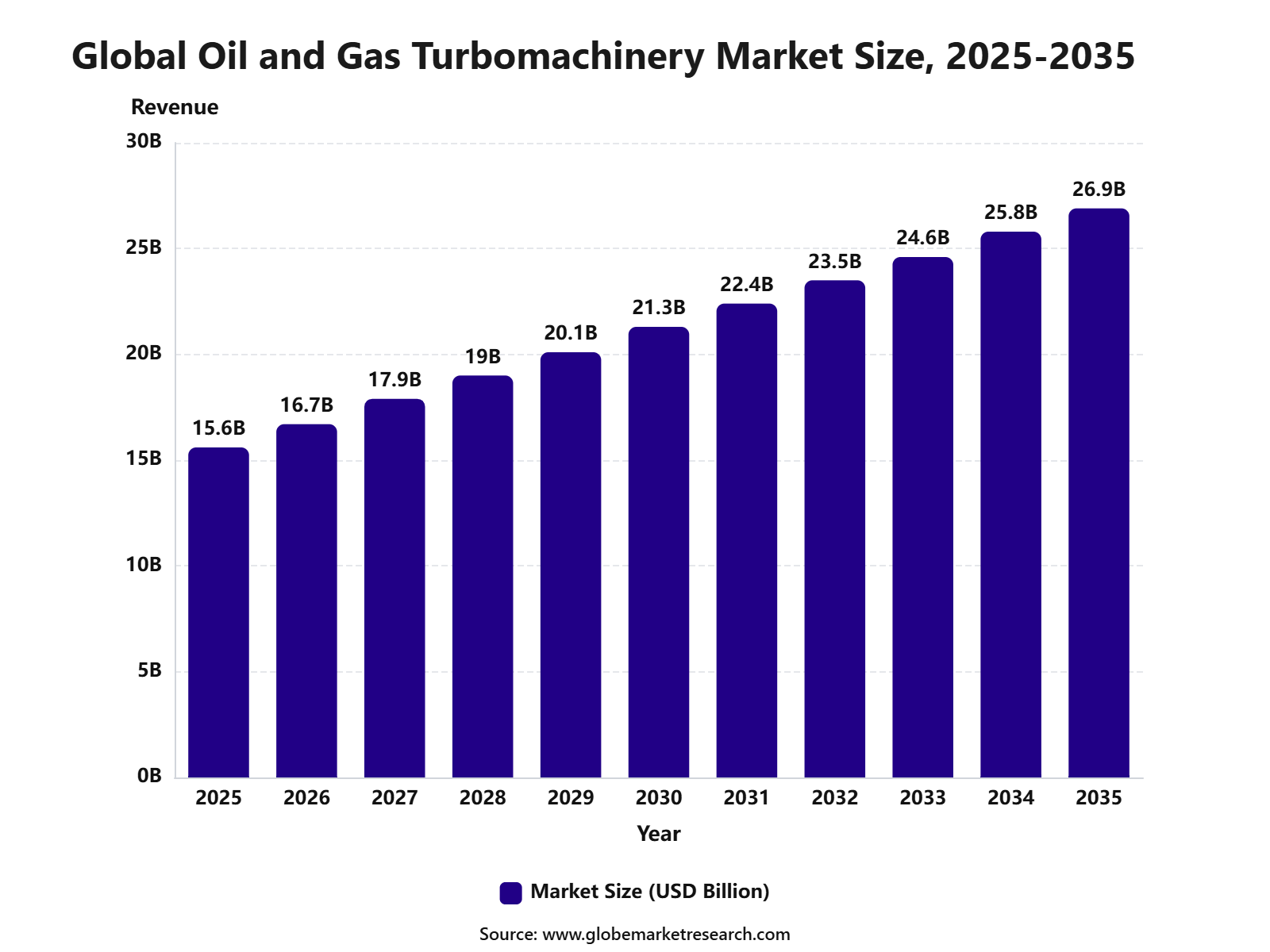 iThe graph shows projected market growth until 2035 based on CAGR analysis. Actual outcomes may vary depending on changing demand, competition, and economic factors.To gain greater insights - request a sample report PDF
Key Market Insights
Gas compressors led the type segment with 35.6% share, supported by strong use in gas processing, pipeline transportation, pressure boosting, LNG facilities, and midstream operations.
Onshore deployment accounted for 73.2% share, driven by large-scale oil and gas production sites, processing plants, compressor stations, and easier equipment installation and maintenance.
Midstream applications held 40.9% share by industry, supported by rising demand for turbomachinery in gas gathering, compression, transportation, storage, and pipeline infrastructure.
Middle East and Africa led the oil and gas turbomachinery market with 31.7% share, valued at USD 4.9 billion, supported by strong hydrocarbon production, gas infrastructure expansion, and continued investment in upstream and midstream energy assets.
Top Funding and Investment
Top Investments
Siemens Energy announced a USD 1 billion investment to expand its U.S. manufacturing and service network, creating more than 1,500 skilled jobs. The program includes additional large gas turbine production and upgrades at facilities in Houston, Texas, and Painted Post, New York, which manufacture and service compression equipment used to transport gas and liquids through pipelines.
Baker Hughes committed EUR 300 million over five years to expand its Italian manufacturing facilities. Investments in Florence, Massa, and Avenza will increase NovaLT gas turbine and turbine-compressor production through new machinery, test benches, automation, and robotics. Its Bari pump facility will also begin producing compressor components for LNG, natural gas, and other energy applications.
GE Vernova announced nearly USD 300 million in investments to increase heavy-duty gas turbine manufacturing and servicing capacity. More than USD 160 million was allocated to Greenville, South Carolina, while additional capital was assigned to facilities in Schenectady, Parsippany, and Bangor. The program is designed to support production of up to 80 heavy-duty gas turbines annually, equal to approximately 20 GW of generation capacity.
Sulzer opened a 2,600-square-metre rotating equipment service centre in Ezeiza, Argentina. The facility expands regional maintenance, repair, engineering, and lifecycle support for critical rotating equipment. Sulzer’s service portfolio covers pumps, turbines, compressors, motors, and generators used across oil production, gas processing, refining, petrochemicals, and pipeline operations.
Burckhardt Compression expanded its presence in Saudi Arabia by opening a new service facility. The centre supports compressor monitoring, maintenance, technical services, and lifecycle management for petrochemical and gas-processing customers. The expansion also supports a major digital monitoring contract covering reciprocating compressors at a large Saudi petrochemical facility.
Top Funding Transactions
Baker Hughes issued USD 6.5 billion of senior notes across five tranches and EUR 3 billion across four tranches. The financing was raised principally to fund part of the cash consideration for its proposed acquisition of Chart Industries. Chart designs process technologies and equipment used for gas and liquid molecule handling, including LNG, compression, cryogenic, heat-transfer, and gas-processing systems.
Arbor Energy raised USD 55 million in Series A funding to advance its turbine-based power technology. The capital is being used to complete a 1 MW ATLAS pilot system and design the company’s 25 MW HALCYON commercial power system. The technology uses supercritical carbon dioxide turbomachinery and can operate using natural gas and other fuels.
Sapphire Technologies secured USD 18 million in Series C funding to expand its manufacturing facility in Cypress, California, and support new commercial projects. The company produces FreeSpin inline turboexpander generators, which convert pressure energy in natural gas pipelines and industrial gas systems into electricity. The equipment is available across kilowatt- and megawatt-scale applications.
Top Acquisitions
Honeywell completed its USD 2.16 billion all-cash acquisition of Sundyne. Through the transaction, Honeywell acquired Sundyne’s engineered centrifugal pumps, reciprocating compressors, gas compressors, aftermarket services, intellectual property, installed equipment base, and approximately 1,000 employees. These systems are used in LNG, refining, petrochemical processing, carbon capture, hydrogen, and other critical industrial operations.
Atlas Copco completed the acquisition of ABC Compressors, a Spanish manufacturer of reciprocating compressors for gas and air applications. The acquired business included its compressor technologies, manufacturing operations, service activities, and facilities in Spain and China. ABC Compressors employed approximately 319 people and generated around EUR 84 million in revenue during 2024. The purchase consideration was not publicly disclosed.
By Type
Gas compressors accounted for 35.6% share of the Oil and Gas Turbomachinery Market. This leading position is supported by their critical role in gas gathering, processing, transportation, storage, reinjection, LNG operations, and refinery systems.
The segment is widely preferred because compressors help increase gas pressure and maintain reliable flow across pipelines, processing plants, and midstream networks. They are used in upstream production fields, gas treatment plants, compression stations, petrochemical facilities, and LNG terminals.
Demand for gas compressors is expected to remain strong as natural gas infrastructure, LNG trade, and pipeline networks continue to expand. Their importance in maintaining gas movement, plant efficiency, and operational reliability will continue to support segment leadership.
By Deployment
Onshore deployment accounted for 73.2% share of the Oil and Gas Turbomachinery Market. This dominance is supported by large-scale use of turbines, compressors, pumps, and related systems across land-based production sites, refineries, pipelines, processing plants, and storage facilities.
Onshore turbomachinery is preferred because installation, inspection, servicing, and equipment replacement are generally easier compared with offshore environments. These systems support continuous operations in gas compression stations, crude oil transport, refining units, and petrochemical production facilities.
The segment is expected to maintain its leading position as operators continue to invest in onshore oil and gas production, gas processing, and midstream infrastructure. Demand will also be supported by modernization of aging assets and efficiency upgrades across land-based facilities.
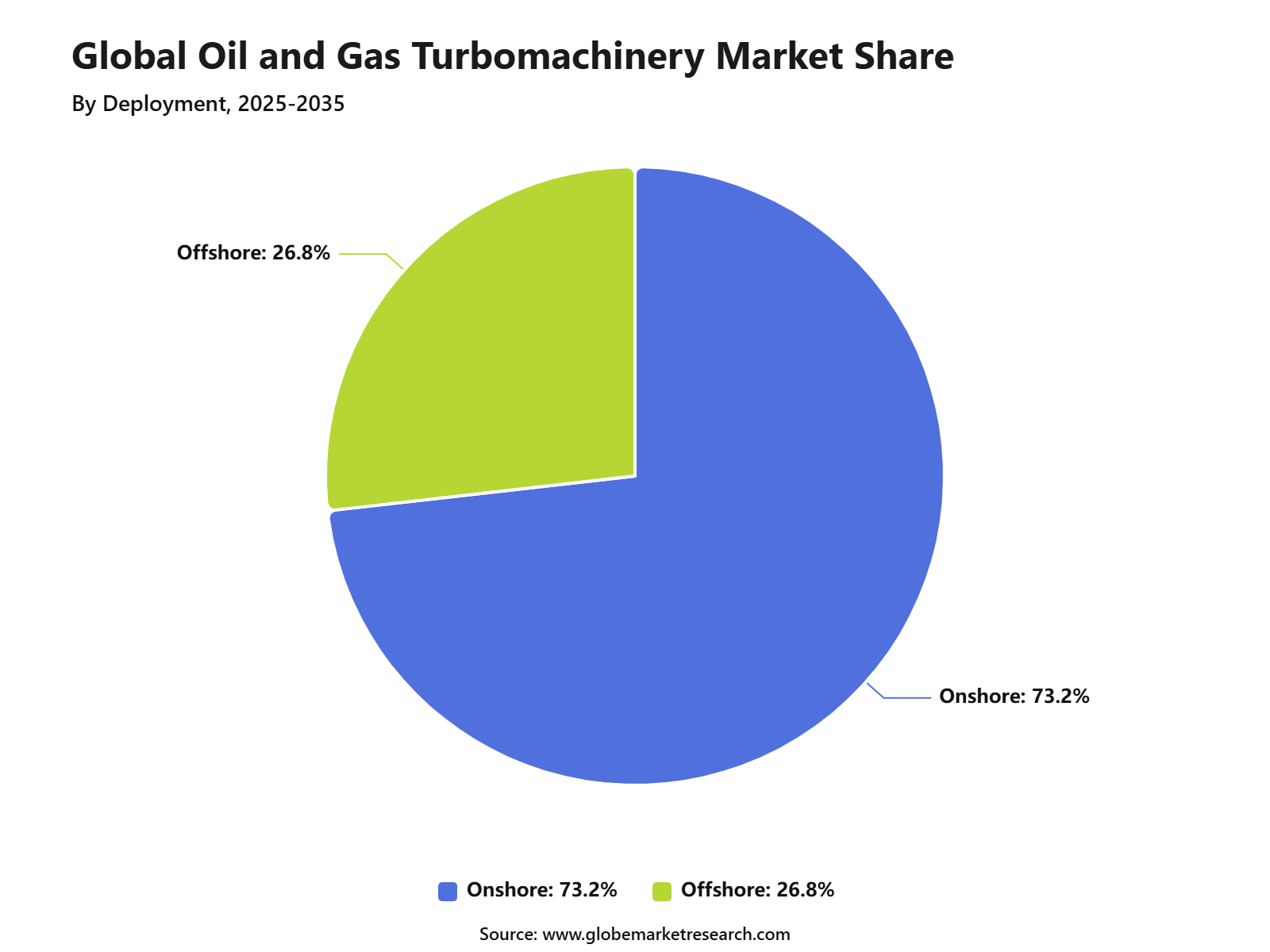 iThe graph shows projected market growth until 2035 based on CAGR analysis. Actual outcomes may vary depending on changing demand, competition, and economic factors.To gain greater insights - request a sample report PDF
By Industry
The midstream industry held 40.9% share of the Oil and Gas Turbomachinery Market. This leading share is driven by the high use of turbomachinery in transportation, compression, storage, gas processing, pipeline operations, and LNG handling.
Midstream operators depend on gas compressors, pumps, turbines, and drivers to move hydrocarbons safely and efficiently across long distances. These systems help maintain pressure, improve flow control, reduce downtime, and support stable supply between production fields, refineries, terminals, and end users.
Demand from the midstream sector is expected to remain strong as natural gas demand, LNG exports, and cross-border pipeline activity increase. The need for reliable compression, pumping, and process efficiency will continue to support turbomachinery adoption across midstream assets.
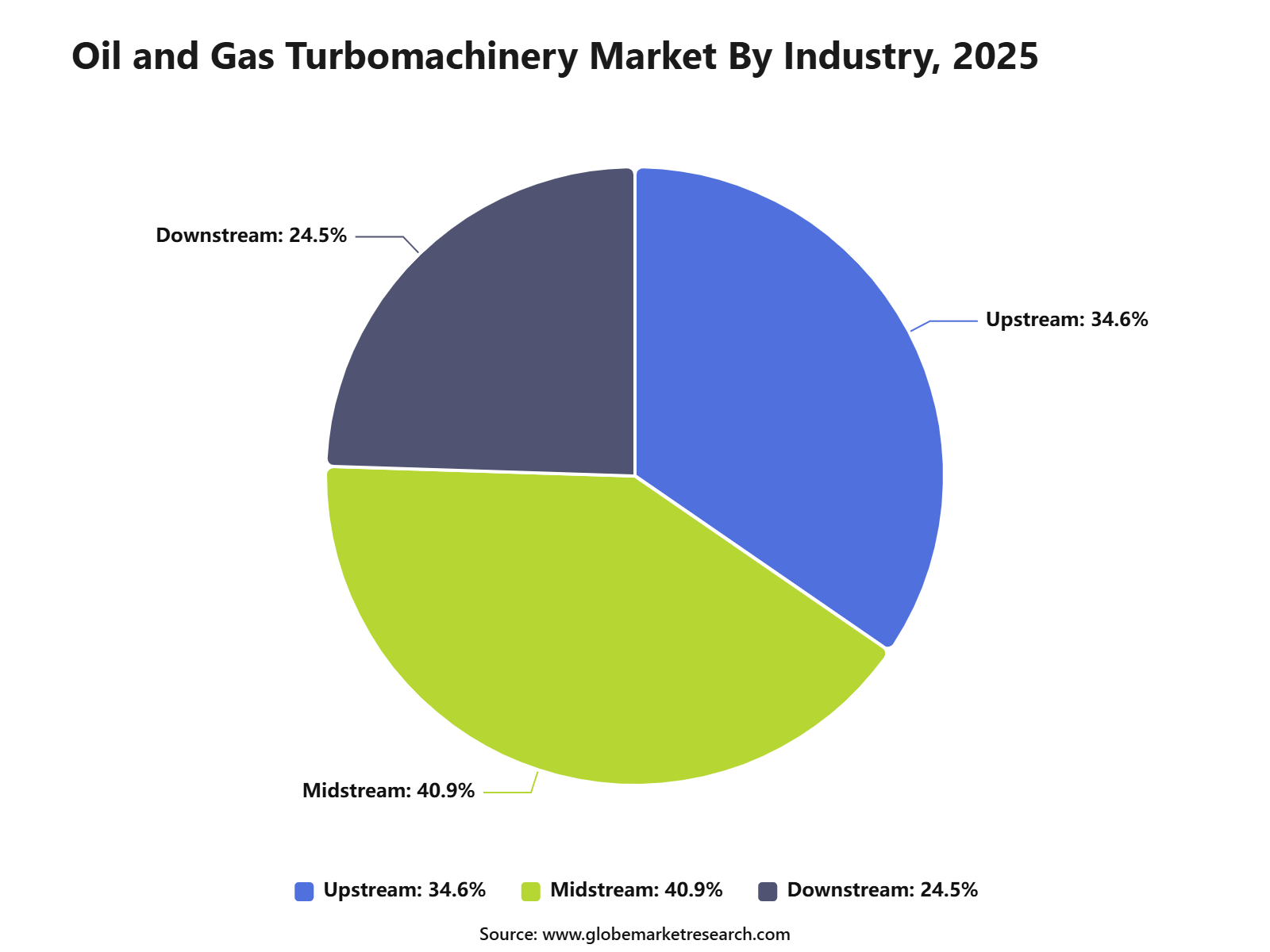 iThe graph shows projected market growth until 2035 based on CAGR analysis. Actual outcomes may vary depending on changing demand, competition, and economic factors.To gain greater insights - request a sample report PDF
By Region
Middle East and Africa accounted for 31.7% share of the Oil and Gas Turbomachinery Market, reaching USD 4.9 billion. The region’s leadership is supported by large oil and gas reserves, strong production activity, extensive pipeline networks, and continued investment in refining and gas processing capacity.
Saudi Arabia, the United Arab Emirates, Qatar, Kuwait, Oman, Iraq, Nigeria, Angola, and South Africa are key contributors to regional demand. Turbomachinery is widely used across upstream fields, LNG facilities, refineries, petrochemical plants, and midstream infrastructure.
Middle East and Africa is expected to maintain a strong position as producers invest in field development, gas monetization, refinery upgrades, and export infrastructure. Demand will remain supported by compressors, turbines, and pumps used to improve operating efficiency and asset reliability.
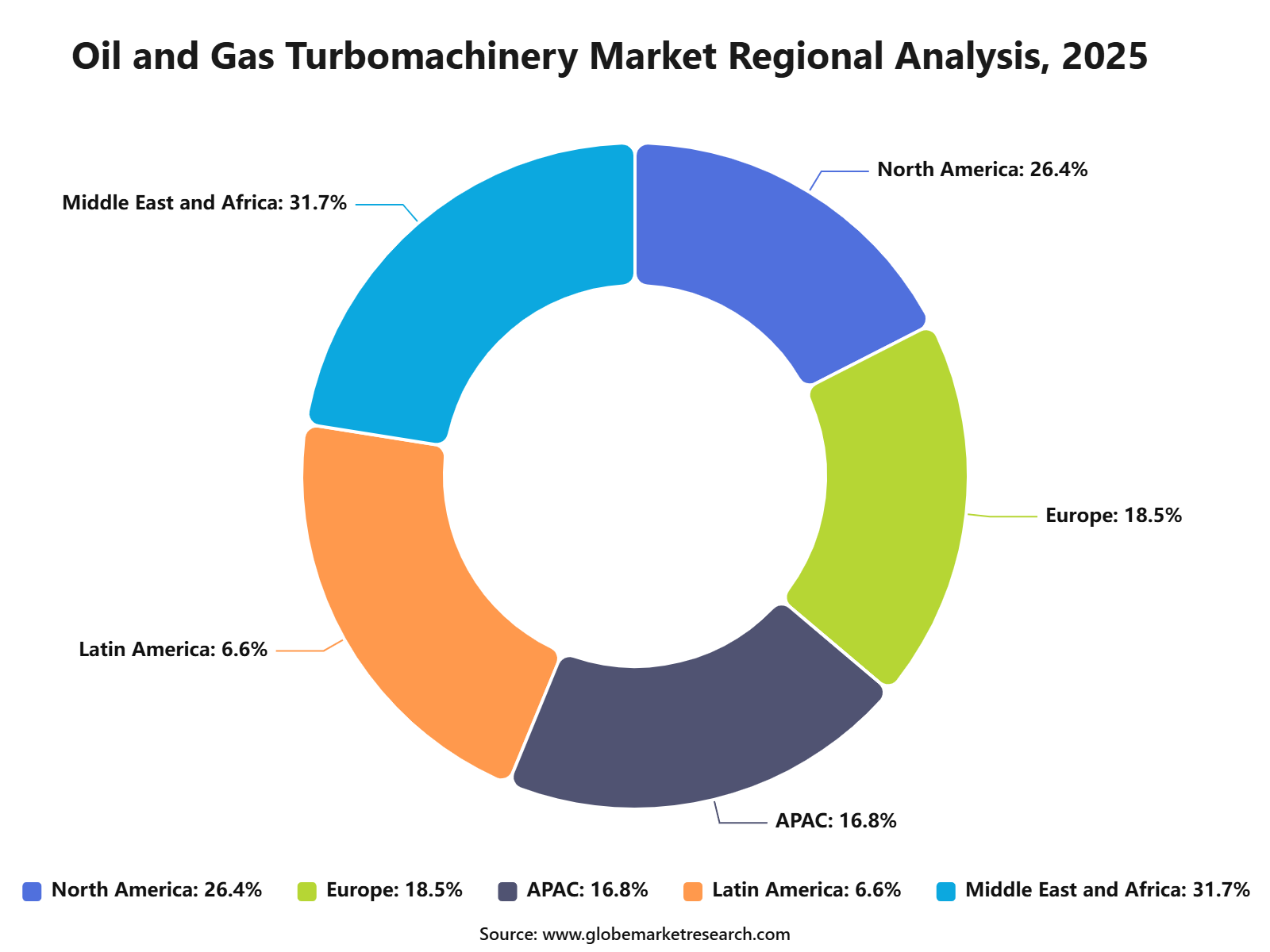 iThe graph shows projected market growth until 2035 based on CAGR analysis. Actual outcomes may vary depending on changing demand, competition, and economic factors.To gain greater insights - request a sample report PDF
Regional Impact Analysis
Middle East and Africa leads the Oil and Gas Turbomachinery Market with 31.7% share in 2025, valued at around USD 4.9 billion, supported by oil and gas production, LNG infrastructure, refinery projects, pipeline systems, and harsh-environment operations. Saudi Arabia, UAE, Qatar, Kuwait, Nigeria, Angola, and Egypt remain key regional markets.
North America remains important because of shale gas production, pipeline networks, LNG export terminals, and gas processing facilities. Asia Pacific supports future growth through refinery expansion, petrochemical investment, LNG imports, and rising natural gas infrastructure demand.
Impact Factor | Estimated CAGR Impact | Regional Relevance | Market Impact |
|---|---|---|---|
Middle East and Africa market leadership | +1.8% | Middle East and Africa, 31.7% share in 2025 | Leads global value demand. |
Gulf LNG and refinery activity | +1.3% | Qatar, UAE, Saudi Arabia, Kuwait | Drives regional equipment demand. |
African upstream and gas projects | +0.9% | Nigeria, Angola, Egypt | Supports compressor and turbine use. |
North America gas infrastructure | +0.8% | U.S. and Canada | Adds pipeline and LNG demand. |
Asia Pacific refining and LNG growth | +0.7% | China, India, Japan, South Korea | Builds future expansion. |
Go-To-Market and Sales Economics
Oil and gas turbomachinery suppliers should focus on producers, pipeline operators, LNG developers, refiners, and petrochemical companies with large rotating-equipment fleets. The EIA projects U.S. dry natural gas production at 111.25 Bcf per day and LNG exports at 17.4 Bcf per day in 2026. These volumes support demand for compressors, turbines, pumps, controls, and field services.
Large projects should be pursued through early engineering engagement, technology qualification, and multi-year supply agreements. In April 2026, Baker Hughes disclosed a QatarEnergy LNG award covering six Frame 9 gas turbines, twelve centrifugal compressors, three Frame 6 turbines, and three generators. Integrated equipment, commissioning, spares, and digital monitoring can increase contract value and improve customer retention.
Regional sales teams should be supported by authorised service centres and local repair capacity. Siemens Energy booked 102 gas turbines in its first fiscal quarter of 2026, with 40% of orders from the United States, 35% from Europe, and 15% from the Middle East and China. This distribution supports market-specific account strategies and service coverage.
Risk Factors & Market Barriers
Demand volatility can delay final investment decisions and weaken equipment utilisation. The IEA expects global natural gas demand to fall by around 0.5%, or 20 bcm, in 2026, while world oil demand is forecast to decline by 420,000 barrels per day to 104 million barrels per day. Flexible manufacturing and staged procurement can reduce exposure.
Manufacturing capacity is another barrier because heavy-duty turbines require specialised castings, blades, vanes, and qualified labour. Siemens Energy stated in March 2026 that turbine capacity was sold out through fiscal 2028, with 2029 slots filling rapidly and some 2030 positions already booked. Buyers may face longer schedules, higher deposits, and limited specification changes.
Emissions rules are raising qualification and operating requirements. The European Commission plans to launch its Methane Transparency Database in September 2026, while EU operators must repair detected leaks mostly within five or fifteen working days. Suppliers are therefore being pushed toward efficient seals, electric drives, monitoring systems, and documented emissions performance across compressor and turbine installations.
Revenue Potential Analysis
Revenue Landscape Across
Upstream projects remain a major revenue source for gas compression, injection, pumping, and power-generation equipment. Aramco set 2026 capital-investment guidance at USD 50 billion to USD 55 billion, with 65% to 70% directed toward upstream projects. Suppliers can capture value through packaged trains, condition monitoring, upgrades, spare parts, and long-term maintenance contracts.
LNG and pipeline developments provide high-value equipment packages with extended service potential. Baker Hughes’ March 2026 agreement for the ST LNG project includes two gas-turbine-driven centrifugal compressor trains and three turbine-generator packages for an initial 2.1-million-tonne-per-year phase. The wider development is planned for 8.4 million tonnes annually, supporting future expansion orders.
Carbon-management infrastructure is creating an adjacent revenue stream for compressor manufacturers and engineering service providers. Baker Hughes received a 2026 QatarEnergy LNG contract for six electrically driven centrifugal compressor trains serving a facility designed to capture and transport up to 4.1 million tonnes of carbon dioxide annually. Electrification and emissions monitoring can further expand project scope.
Financial Impact
Strong aftermarket demand can improve margins because installed turbines and compressors require inspections, overhauls, parts, and performance upgrades. Baker Hughes reported first-quarter 2026 Industrial and Energy Technology revenue of USD 3.35 billion and EBITDA of USD 678 million, producing a 20.2% margin. Gas Technology Services revenue increased 34% year over year to USD 791 million.
Customer advances and long-cycle orders can strengthen cash generation before final delivery. Siemens Energy reported second-quarter fiscal 2026 free cash flow before tax of EUR 1.98 billion, supported by advance payments. Gas Services expects 16% to 18% comparable revenue growth and a 14% to 16% profit margin for the full fiscal year.
Large equipment backlogs provide revenue visibility, but they also require investment in factories, suppliers, and skilled labour. GE Vernova’s gas-power equipment backlog and slot reservations reached 100 GW in the first quarter of 2026, while company adjusted EBITDA approached USD 0.9 billion. Disciplined pricing and milestone billing will remain important for converting orders into cash.
Drivers Impact Analysis
The Oil and Gas Turbomachinery Market is driven by rising upstream production, gas processing expansion, LNG infrastructure, refinery modernization, petrochemical growth, and the need for reliable compression and power generation equipment. Turbomachinery supports critical operations such as gas compression, pumping, turbine-driven power, and process flow control.
Middle East and Africa leads the market due to large oil and gas reserves, LNG projects, refinery investments, and major upstream and midstream infrastructure. Saudi Arabia, UAE, Qatar, Kuwait, Nigeria, Angola, and Egypt remain important contributors because of ongoing production, processing, and export-linked energy projects.
Impact Factor | Estimated CAGR Impact | Regional Relevance | Market Impact |
|---|---|---|---|
Growth in oil and gas production | +1.5% | Middle East and Africa, North America | Drives compressor and turbine demand. |
Expansion of LNG infrastructure | +1.2% | Qatar, UAE, Nigeria, Egypt, U.S. | Supports high-value turbomachinery use. |
Refinery and petrochemical modernization | +1.0% | Middle East, Asia Pacific, Africa | Adds replacement and upgrade demand. |
Rising gas processing requirements | +0.8% | Gas-producing regions | Supports compression and separation systems. |
Need for reliable power at remote sites | +0.6% | Offshore and desert operations | Improves operational continuity. |
Restraints Impact Analysis
The market faces restraints from high capital cost, long procurement cycles, complex maintenance needs, and oil and gas price volatility. Turbomachinery equipment requires precision engineering, skilled service teams, spare parts, and strict performance testing before deployment.
Another restraint is the pressure to reduce emissions from oil and gas operations. Operators are investing in cleaner and more efficient systems, but this can increase upfront cost and make purchasing decisions more complex.
Impact Factor | Estimated CAGR Impact | Regional Relevance | Market Impact |
|---|---|---|---|
High equipment and installation cost | -0.8% | Global oil and gas operators | Slows new purchases. |
Oil and gas investment volatility | -0.7% | Upstream and midstream projects | Affects order timing. |
Complex maintenance requirements | -0.6% | Remote and offshore sites | Raises lifecycle cost. |
Long lead times for large equipment | -0.5% | EPC and project developers | Delays project execution. |
Emission reduction pressure | -0.4% | Middle East, Europe, North America | Requires technology upgrades. |
Opportunities Impact Analysis
Opportunities are strong in LNG compressors, gas turbines, pumps, steam turbines, refinery rotating equipment, pipeline compression, and gas processing facilities. These applications benefit from rising gas demand, energy security planning, and infrastructure modernization.
Higher-value opportunities are also emerging in digital monitoring, predictive maintenance, high-efficiency compressors, hydrogen-ready turbines, and equipment retrofits. Companies that improve reliability, efficiency, and lifecycle service support can capture stronger long-term demand.
Impact Factor | Estimated CAGR Impact | Regional Relevance | Market Impact |
|---|---|---|---|
LNG compressor and turbine demand | +1.4% | Middle East, Africa, Asia Pacific | Builds premium equipment demand. |
Pipeline and gas processing expansion | +1.1% | Gas-rich regions | Supports steady project growth. |
Refinery rotating equipment upgrades | +0.9% | Middle East, Asia Pacific, North America | Adds modernization opportunity. |
Predictive maintenance platforms | +0.7% | Large oil and gas operators | Improves uptime and service revenue. |
Hydrogen-ready turbomachinery development | +0.5% | Europe, Middle East, North America | Supports future fuel transition. |
Challenges Impact Analysis
The main challenge is delivering turbomachinery that can operate reliably under high pressure, high temperature, corrosive gases, and continuous operating conditions. Equipment failure can cause production losses, safety risks, and expensive shutdowns.
Another challenge is maintaining skilled service availability across remote oilfields, offshore platforms, LNG plants, and desert facilities. Operators need fast technical support, spare parts access, and condition monitoring to reduce downtime.
Impact Factor | Estimated CAGR Impact | Regional Relevance | Market Impact |
|---|---|---|---|
Reliability under harsh conditions | -0.7% | Offshore, desert, sour gas fields | Affects equipment selection. |
Skilled service workforce shortage | -0.6% | Remote oil and gas sites | Raises downtime risk. |
Spare parts and repair delays | -0.5% | Global project locations | Impacts operating continuity. |
Efficiency requirements for large systems | -0.4% | Refineries and LNG plants | Increases design complexity. |
Integration with legacy plants | -0.4% | Mature oil and gas assets | Slows upgrades. |
Segment Covered in the Report
By Type
Gas Compressors
Gas and Steam Turbines
Pumps
Other Types
By Deployment
Onshore
Offshore
By Industry
Upstream
Midstream
Downstream
By Region
North America
Europe
Asia Pacific
Latin America
Middle East and Africa
Market Trend Analysis
The market trend is moving toward high-efficiency compressors, low-emission gas turbines, digital diagnostics, remote monitoring, modular turbomachinery packages, and lifecycle service contracts. Oil and gas operators are focusing on equipment that improves reliability while reducing fuel use and emissions.
Middle East and Africa remains the largest value region because of strong hydrocarbon production, LNG capacity, refinery operations, and harsh-field service requirements. Asia Pacific and North America also support growth through gas infrastructure, petrochemical expansion, and equipment modernization.
Impact Factor | Estimated CAGR Impact | Regional Relevance | Market Impact |
|---|---|---|---|
High-efficiency compressor adoption | +1.3% | LNG, pipeline, processing plants | Improves operating performance. |
Digital turbomachinery monitoring rises | +1.0% | Large oil and gas facilities | Reduces unplanned downtime. |
Low-emission turbine upgrades increase | +0.8% | Middle East, Europe, North America | Supports cleaner operations. |
Modular equipment packages expand | +0.6% | Upstream and midstream projects | Speeds installation. |
Long-term service contracts grow | +0.5% | Global oil and gas operators | Builds recurring aftermarket revenue. |
Investor Type Impact Matrix
Investors should focus on turbomachinery companies with strong engineering capability, installed base, aftermarket network, digital monitoring tools, and exposure to LNG, pipelines, refineries, and gas processing. Reliability, efficiency, service quality, and project execution are key success factors.
Strategic investors can also target compressor manufacturers, turbine suppliers, pump companies, control system providers, sealing technology firms, and predictive maintenance platforms. Companies that combine equipment supply with long-term service revenue are better positioned for steady growth.
Investor Type | Estimated CAGR Impact | Regional Relevance | Market Impact |
|---|---|---|---|
Compressor Manufacturers | +1.2% | Global oil and gas markets | Expands core compression supply. |
Gas and Steam Turbine Suppliers | +1.0% | LNG, refinery, upstream operations | Supports power and process needs. |
Pump and Flow Equipment Providers | +0.8% | Refineries and processing plants | Adds process reliability value. |
Aftermarket Service Companies | +0.7% | Mature oil and gas assets | Builds recurring service revenue. |
Strategic Oil and Gas Equipment Investors | +0.6% | Global energy infrastructure markets | Funds modernization and digital upgrades. |
Recent Developments
n July 2026, Everllence secured an order for eight compressor trains for Azule Energy’s offshore Angola FPSO, expanding its turbomachinery role in gas processing, reinjection and production operations on floating facilities.
In February 2026, Siemens Energy announced a USD 1 billion United States manufacturing expansion, including restored gas-turbine production in Charlotte, North Carolina, to increase capacity and create more than 1,500 skilled jobs.
In February 2026, Mitsubishi Heavy Industries Compressor acquired Switzerland-based AST Turbo, strengthening international field services, maintenance, repair and technical support capabilities for compressors, turbines and other rotating equipment.
Competitive Landscape
The market is characterized by intense competition among established players and emerging companies. Strategic partnerships, mergers and acquisitions, and product innovation are key strategies employed by market participants.
Key Market Players
Baker Hughes
Siemens Energy
GE Vernova
Mitsubishi Heavy Industries
Caterpillar Inc.
Sulzer Ltd.
Atlas Copco
Ingersoll Rand
MAN Energy Solutions
Kawasaki Heavy Industries
Elliott Group
Ansaldo Energia
Everllence SE
Other Key Players
Research Methodology
This market study is prepared using a combination of primary and secondary research. Primary research includes discussions with manufacturers, suppliers, distributors, consultants, industry experts, and end users. Secondary research covers company reports, government databases, trade associations, technical publications, regulatory sources, and trusted industry documents. The collected information is used to assess market demand, pricing trends, technology adoption, competitive activity, and regional performance.
AI language models are not used as primary data sources, and publicly available AI-generated content is not treated as market evidence. Computational tools may be used to support data processing, translation, data classification, and pattern identification. However, every published assessment is supported by verified sources, human review, and primary market discussions.
Market estimates are developed through top-down and bottom-up approaches and validated using data triangulation. Revenue, production, shipment, pricing, and application-level data are compared across multiple sources. Forecasts consider economic conditions, regulatory changes, investment activity, innovation, supply chain developments, and industry risks. All findings are reviewed through source verification and internal quality checks before publication.
Part I
Source Management & Input Data Standards
Who provides data, how sources are qualified, and what types of evidence are admissible.
Part II
Research Scope & Market Coverage
How we define the markets we assess and the parameters that govern each product.
Part III
Data Collection, Verification & Submission
The mechanics of gathering, cross-checking, and hierarchically ranking evidence.
Part IV
Assessment Determination & Quality Controls
How raw data becomes a published assessment — normalisation, expert judgement, and outlier exclusion.
Part V
Publication, Corrections & Revision
Our publication schedule, corrections policy, and methodology review cycle.
Part VI
Independence, Ethics & Complaints
Conflict-of-interest policies, editorial independence, and how clients raise concerns.
Google · Preferred Sources
Don't miss the latest market research insights and industry updates on Google.
Add Globe Market Research as a preferred source in the Google app to see our reports, analysis, and market stories in your news suggestions.
Meet the Team
This report was prepared by our expert analysts with deep industry knowledge and research experience.
Kimaya brings more than five years of experience in market research, content review, and industry analysis to Globe Market Research. She plays an important role in maintaining the accuracy, clarity, consistency, and relevance of research content across a wide range of industries. Her responsibilities include reviewing market data, segment analysis, competitive landscapes, industry trends, company developments, and strategic insights. Each report is carefully assessed to ensure that the findings are supported by reliable data, presented in a structured format, and aligned with the information needs of business decision-makers. Kimaya has research experience across healthcare, information technology, consumer goods, and several cross-industry domains.
Pratiksha K. is a Senior Research Analyst with more than five years of experience in market research, industry analysis, competitive intelligence, and business strategy. She has contributed to detailed market reports, customized research studies, company profiling, market sizing, trend analysis, and strategic consulting projects for clients across different regions. Her industry expertise covers Chemical and Material, Consumer Goods, Food & Beverages and Energy & Power. She closely evaluates changing customer requirements, technology developments, regulatory conditions, supply chain structures, investment activity, and competitive strategies to provide clear and practical market insights.
Frequently Asked Questions
Related Reports
More in Energy and Power
Liquefied Natural Gas (LNG) Bunkering Market to Hit USD 51.7 Billion by 2035
Liquefied Natural Gas (LNG) Bunkering Market Size, Share, Analysis By Product Type (Ship-to-Ship, Truck-to-Ship, Port-to-Ship, Portable Tanks), By Application (Cargo Fleet, Tanker Fleet, Container Fleet, Ferries, Inland Vessels, Others), By Regional Insights, Business plan and Project Report, Investment Opportunities, Profitability, Industry Trends, Leading Companies and Growth Forecasts by 2025-2035
Wind Energy Market to Hit USD 348.1 Billion by 2035
Wind Energy Market Size, Share, Analysis By Location (Onshore, Offshore), By Application (Utility, Non-Utility), By Component(Turbine, Support Structure, Electrical Infrastructure, Others), By Regional Insights, Business plan and Project Report, Investment Opportunities, Profitability, Industry Trends, Leading Companies and Growth Forecasts by 2025-2035
Power EPC Market to Hit USD 1,516.1 Billion by 2035
Power EPC Market Size, Share, Analysis By Type of Power Generation (Thermal Power, Renewable Energy, Nuclear Power, Hydropower, Others), By Service Type (Engineering, Procurement, Construction), By Equipment Type (Steam Turbines, Gas Turbines, Solar PV Systems, Wind Turbines, Boilers, Generators, Others), By Regional Insights, Business plan and Project Report, Investment Opportunities, Profitability, Industry Trends, Leading Companies and Growth Forecasts by 2025-2035
Sodium Nickel Chloride Battery Market to Hit USD 8.3 Billion by 2035
Sodium nickel chloride battery market Size, Share, Analysis By Product Type (Stationary Sodium Nickel Chloride Batteries, Mobile Sodium Nickel Chloride Batteries, Industrial Sodium Nickel Chloride Batteries, Backup Power Battery Systems), By Application (Renewable Energy Storage, Telecom Backup, Industrial UPS, Grid Stabilization, Electric Mobility), By Regional Insights, Business plan and Project Report, Investment Opportunities, Profitability, Industry Trends, Leading Companies and Growth Forecasts by 2025-2035