

Revenue, 2025
$ 2.1Bn
Forecast, 2035
$ 5.3Bn
CAGR, 2025-2035
9.1%
Report Coverage
Global
Market Size and Forecast
The Global Gaming Mouse Bundle Market was valued at USD 2.1 billion in 2025 and is projected to reach USD 5.3 billion by 2035, growing at a CAGR of 9.1% from 2025 to 2035. Asia Pacific held the largest regional share of 56.6% in 2025, supported by a large gaming user base, rising esports participation, growing demand for affordable gaming accessories, and strong adoption of PC and online gaming across China, India, Japan, South Korea, and Southeast Asia.
Gaming mouse bundles include gaming mice sold with accessories such as keyboards, mousepads, headsets, wrist rests, charging docks, or full gaming peripheral kits. The growth of the market can be attributed to increasing demand for cost-effective gaming setups, higher interest in competitive gaming, and rising preference for bundled products that offer better value to entry-level and mid-range gamers.
The market outlook remains positive as gamers continue to seek precision, comfort, durability, and customization in gaming accessories. Demand is expected to rise for wireless gaming mice, RGB lighting, programmable buttons, lightweight designs, high-DPI sensors, and ergonomic bundles. Asia Pacific is expected to maintain its leading position due to expanding gaming communities, increasing disposable income among young consumers, and strong growth in online retail channels for gaming peripherals.
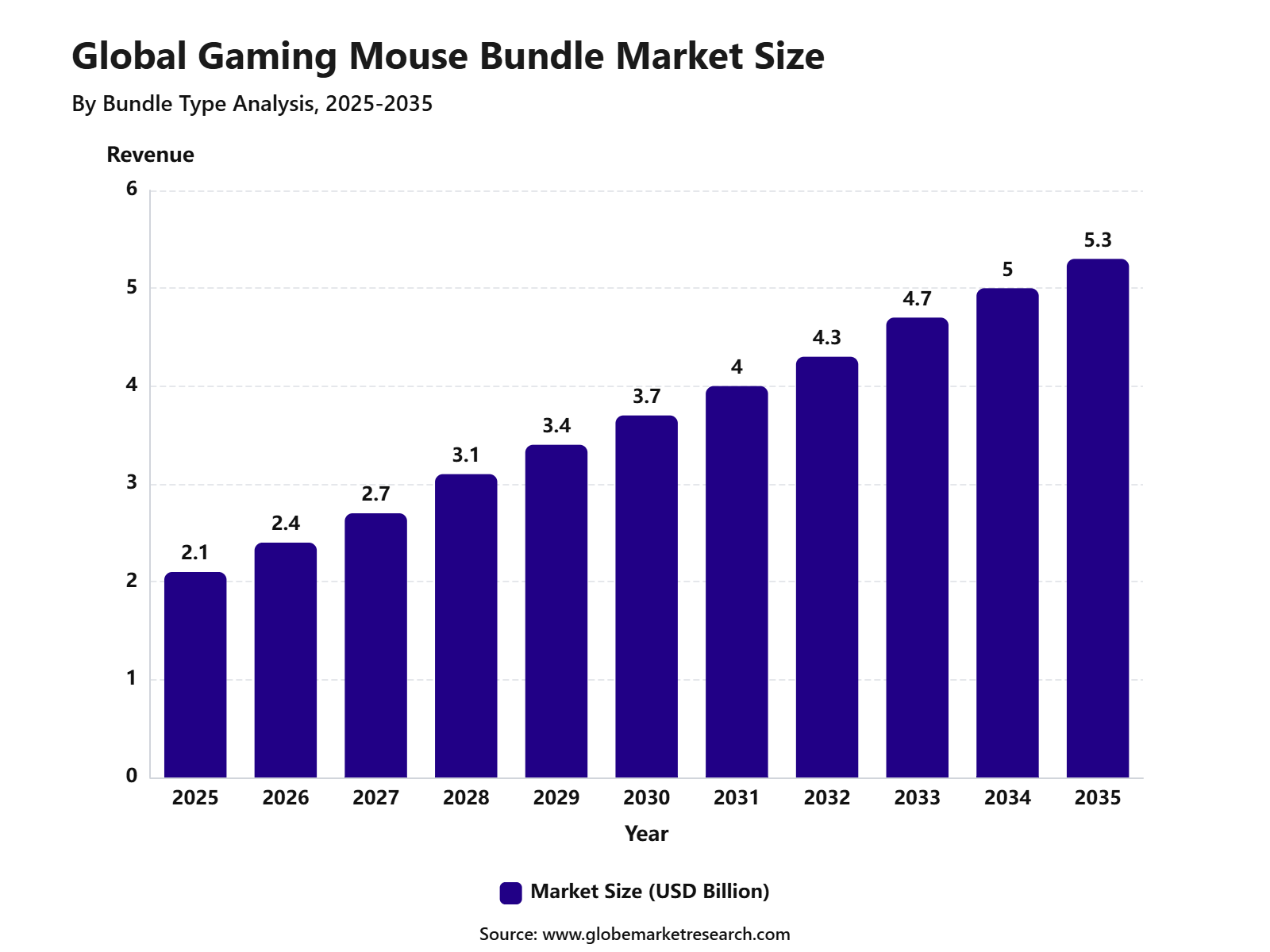 iThe graph shows projected market growth until 2035 based on CAGR analysis. Actual outcomes may vary depending on changing demand, competition, and economic factors.To gain greater insights - request a sample report PDF
Key Market Insights
Keyboard and mouse bundles led the bundle type segment with 56.2% share, supported by value pricing, convenience, and strong demand from entry-level and mid-range gamers.
Mechanical keyboards accounted for 67.4% share, driven by better tactile feedback, durability, faster response time, and strong preference among gaming enthusiasts.
Wired connectivity held 78.1% share, supported by lower latency, stable performance, and reliability during competitive gaming.
Budget price range captured 48.8% share, driven by high demand for affordable gaming accessories among casual gamers and students.
Online channels accounted for 54.1% share, supported by wide product availability, competitive pricing, user reviews, and growing e-commerce adoption.
Individual gamers represented 70.5% share, supported by rising gaming participation, esports engagement, and increasing demand for personal gaming setups.
Asia Pacific led the gaming keyboard bundle market with 55.8% share, supported by a large gaming population, strong esports ecosystem, rising disposable income, and expanding online retail platforms.
Go-to-Market and Sales Strategy
The Gaming Mouse Bundle Market needs a performance-led and gamer-type-led go-to-market strategy. Brands should create separate bundles for casual gamers, esports players, streamers, FPS players, MMO players, students, and budget PC users. A strong bundle can include a gaming mouse, mousepad, grip tape, spare skates, charging cable, wireless dongle, carrying case, software access, or keyboard-mouse combination.
The main buying factors are sensor accuracy, DPI range, polling rate, low latency, weight, ergonomics, programmable buttons, battery life, and warranty support. Demand is supported by the large gaming user base. The Entertainment Software Association reported in June 2026 that 212.3 million Americans play video games every week, up by 7.2 million compared with 2025. It also reported that 67% of Americans aged 5 to 90 play games weekly, which supports demand for affordable gaming accessories and entry-level bundles.
Bundle Type Analysis
Mouse and keyboard bundles led the Gaming Mouse Bundle Market with 53.8% share, supported by strong demand for complete input-device sets among PC gamers. These bundles are preferred because they provide better compatibility, consistent design, and easier setup compared with buying each device separately. The growth of this segment can be attributed to rising demand from entry-level gamers, casual PC users, esports beginners, students, and home gaming users.
A mouse and keyboard bundle gives buyers a ready-to-use gaming setup at a practical price point, which supports strong adoption across budget and mid-range categories. The segment is expected to remain strong as brands continue to improve bundled offerings with RGB lighting, programmable buttons, anti-ghosting keys, ergonomic mouse designs, and gaming-grade sensors. Demand is likely to remain high across online marketplaces, gaming cafes, home PC setups, and first-time gaming accessory buyers.
Mouse Type Analysis
Wired gaming mouse products accounted for 74.5% share, making them the leading mouse type in the Gaming Mouse Bundle Market. Wired products are widely preferred because they offer stable connectivity, low latency, and uninterrupted performance during fast gameplay. The segment is especially strong among competitive gamers and esports users who need accurate input response and consistent tracking.
Wired gaming mice also remain attractive for budget buyers because they are generally more affordable than premium wireless gaming mice. Wired gaming mouse demand is expected to remain solid due to its performance advantage and lower ownership complexity. However, wireless gaming mice may gradually gain share in premium categories as battery life, charging speed, and wireless response quality continue to improve.
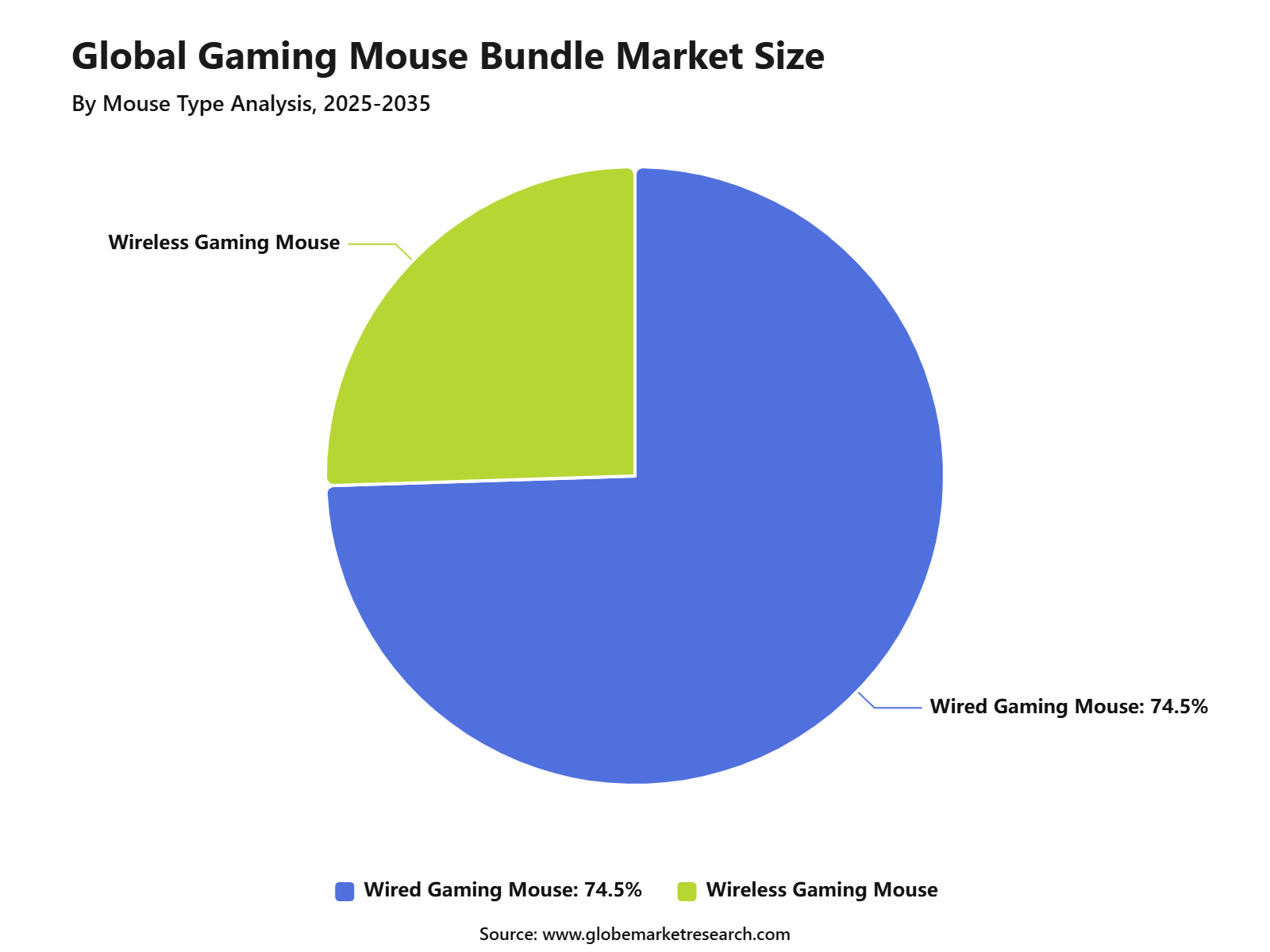 iThe graph shows projected market growth until 2035 based on CAGR analysis. Actual outcomes may vary depending on changing demand, competition, and economic factors.To gain greater insights - request a sample report PDF
Sensor Type Analysis
Optical sensors led the sensor type segment with 82.6% share, supported by their high accuracy, strong tracking performance, and wide use in gaming mice. Optical sensors are preferred because they provide smooth movement detection, reliable cursor control, and strong performance across common gaming surfaces. The growth of this segment can be attributed to rising demand for precision and speed in PC gaming.
Gamers use optical-sensor mice for first-person shooter games, multiplayer online battle arena games, strategy games, and general esports titles where quick reaction and accurate targeting are important. Optical sensors are expected to remain the dominant technology in gaming mouse bundles because they offer a strong balance of performance, durability, and cost efficiency. Brands are likely to continue improving DPI range, polling rate, lift-off distance, and tracking stability to meet gamer expectations.
Price Range Analysis
Budget gaming mouse bundles held 49.1% share, supported by strong demand from students, casual gamers, first-time buyers, and price-sensitive consumers. This segment is attractive because it provides essential gaming features at a lower purchase cost. The growth of budget bundles is being supported by the rising number of gamers in emerging markets and the wider availability of affordable gaming peripherals.
Many budget bundles now include features such as RGB lighting, adjustable DPI, programmable buttons, braided cables, and ergonomic shapes. Budget products are expected to remain important as gaming becomes more mainstream and accessible. Companies that offer reliable build quality, clear feature value, attractive design, and competitive pricing are likely to gain stronger demand in this segment.
Distribution Channel Analysis
Online distribution led the Gaming Mouse Bundle Market with 57.3% share, supported by wide product availability, price comparison, customer reviews, and fast delivery. E-commerce platforms allow gamers to compare specifications, designs, bundle prices, sensor types, and brand ratings before making a purchase. The segment is growing because gaming accessories are highly research-driven products.
Buyers often depend on product images, review videos, user ratings, discount campaigns, and influencer recommendations before selecting a gaming mouse bundle. Online channels are expected to remain the leading distribution route as brands expand direct-to-consumer sales and marketplace visibility. Demand will continue to be supported by seasonal sales, gaming events, bundled offers, easy returns, and faster product discovery through digital platforms.
End User Analysis
Individual gamers accounted for 71.1% share, making them the leading end-user group in the Gaming Mouse Bundle Market. This segment includes casual gamers, competitive gamers, students, streamers, home PC users, and esports-focused players who buy gaming accessories for personal use. The growth of this segment is being driven by the rising popularity of PC gaming, live streaming, online multiplayer games, and home gaming setups.
Individual users are investing in better mice, keyboards, headsets, monitors, and chairs to improve comfort, control, and overall gaming performance. Individual gamers are expected to remain the largest buyer group as gaming continues to expand as a major entertainment activity. Demand is likely to remain strong for affordable, durable, high-performance, and visually appealing mouse bundles that improve the gaming experience.
Regional Analysis
Asia Pacific led the Gaming Mouse Bundle Market with 56.6% share, supported by a large gaming population, strong esports participation, rapid growth of online gaming, and high demand for affordable gaming accessories. China, India, Japan, South Korea, and Southeast Asian countries remain major contributors to regional demand. The growth of Asia Pacific can be attributed to rising PC gaming activity, gaming cafes, esports tournaments, content creation, and increasing digital retail adoption.
The region also benefits from strong electronics manufacturing and wide product availability across budget, mid-range, and premium gaming peripherals. Asia Pacific is expected to remain the leading regional market due to its large gamer base and strong demand for value-focused gaming products. Growth opportunities are likely to remain strong in wired gaming mouse bundles, optical-sensor products, budget accessories, online retail sales, and personal gaming setups.
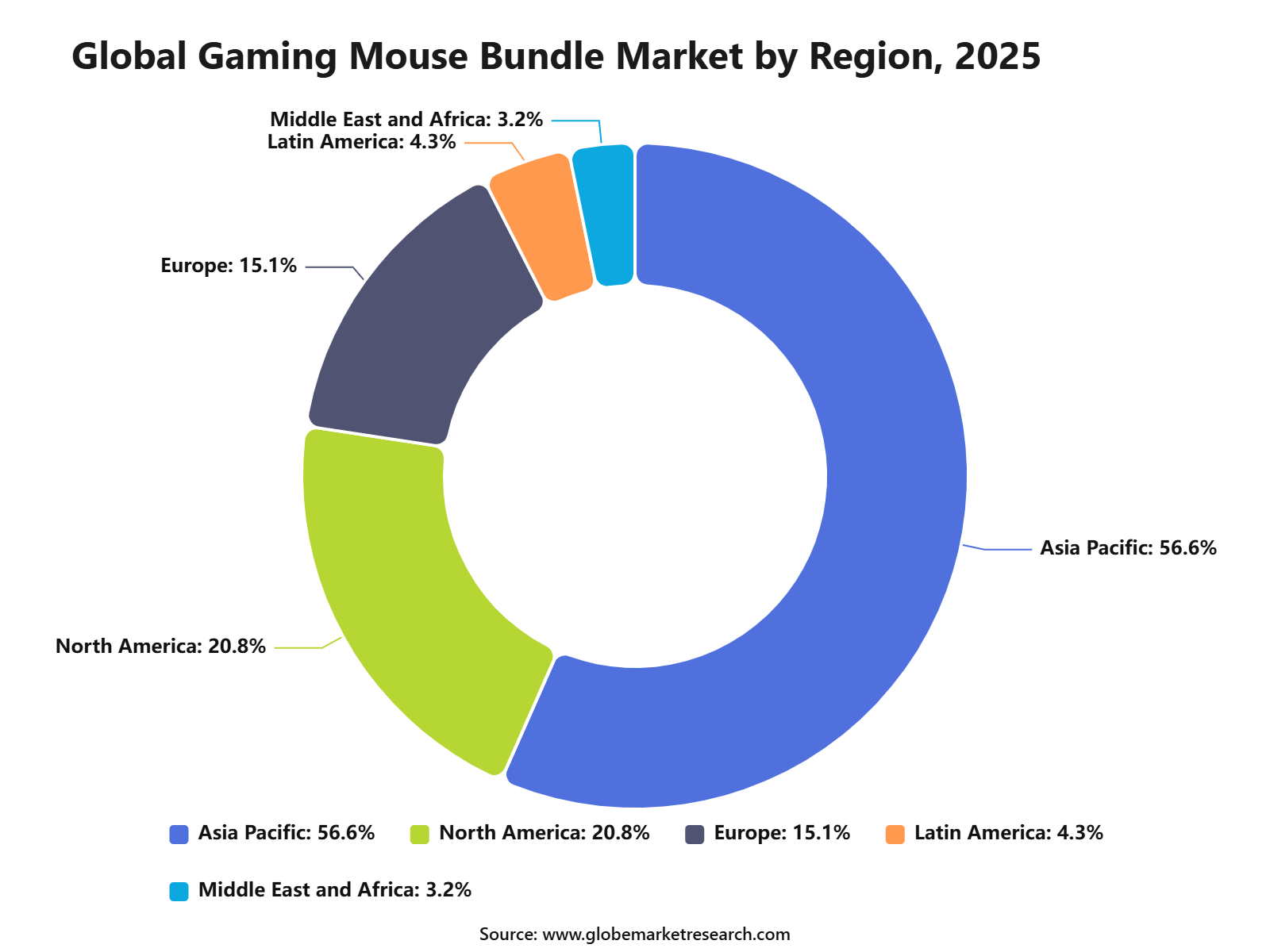 iThe graph shows projected market growth until 2035 based on CAGR analysis. Actual outcomes may vary depending on changing demand, competition, and economic factors.To gain greater insights - request a sample report PDF
Regional Impact Analysis
Impact Factor | Estimated CAGR Impact | Regional Relevance | Market Impact |
|---|---|---|---|
Asia Pacific market leadership | +2.8% | China, India, Japan, South Korea, Southeast Asia | Drives volume demand. |
North America premium gaming demand | +1.8% | U.S. and Canada | Supports high-value sales. |
Europe esports and PC gaming adoption | +1.5% | Germany, UK, France, Nordics | Builds steady growth. |
Latin America emerging gaming base | +0.9% | Brazil, Mexico, Chile, Colombia | Supports gradual adoption. |
Middle East and Africa gaming cafe growth | +0.8% | UAE, Saudi Arabia, South Africa | Shows future potential. |
Revenue Potential Analysis
Revenue Landscape Across
The revenue landscape is spread across wired gaming mouse bundles, wireless gaming mouse bundles, mouse and mousepad bundles, keyboard and mouse bundles, esports mouse bundles, RGB accessory bundles, lightweight mouse bundles, streamer bundles, and premium performance bundles. Entry-level bundles can drive volume because new gamers often want a complete setup at a lower cost. Premium bundles can support stronger margins when they include low-weight designs, high-end sensors, faster polling rates, long battery life, premium skates, and advanced software control.
Revenue opportunities are also supported by product refresh cycles and gaming accessory upgrades. Reuters reported that Logitech’s gaming product sales rose 12% in its latest reported quarter, supported by new product launches. This indicates that gaming accessory buyers continue to respond to improved design and performance claims, especially when products are positioned for esports, streaming, and PC gaming upgrades.
Financial Impact
The financial impact can be positive for brands that manage bundle economics carefully. Bundling can increase average order value, reduce separate packaging costs, improve promotional appeal, and help move related products together. Better margins can be achieved through private-label bundles, direct-to-consumer sales, limited-edition colors, influencer collaborations, bundled mousepads, replacement skates, grip tapes, and software-based customization. A complete mouse bundle also reduces buying friction for customers who want a ready gaming setup.
Financial risk remains linked to tariffs, returns, warranty claims, product defects, inventory aging, discounting, and electronics compliance. E-waste rules are becoming more important because gaming mice have short replacement cycles and contain electronic parts. Eurostat reported that 11.6 kg of electrical and electronic equipment waste was collected per inhabitant in the EU in 2023. The strongest financial resilience is expected from brands that improve durability, reduce return rates, diversify sourcing, meet electronics rules, and compete on value rather than only low price.
Risk Factors & Market Barriers
The main risk factor is strong price competition. Gaming mice and mouse bundles are widely available across online marketplaces, electronics retailers, gaming stores, and direct-to-consumer websites. Many low-cost brands offer similar features such as RGB lighting, adjustable DPI, braided cables, lightweight shells, and extra buttons, which makes differentiation difficult. To protect margins, brands need stronger proof around sensor quality, click durability, low-latency wireless performance, software reliability, and after-sales support.
Another barrier is short product replacement and fast feature cycles. Gamers are influenced by new sensor launches, lighter shells, magnetic switches, high polling rates, ergonomic shapes, esports endorsements, and influencer reviews. Reuters reported that Logitech’s fourth-quarter sales reached USD 1.09 billion, up 7%, with gaming accessories helping to drive growth. This confirms that product refreshes can support demand, but it also means bundle sellers must keep designs updated to remain competitive.
Regulatory & Compliance Risks
Regulatory risk is important because gaming mouse bundles are electronic products. Wired and wireless mice, charging cables, receivers, RGB lighting, and lithium battery components must meet electrical safety, electromagnetic compatibility, radio-frequency, labeling, and waste rules in key markets. In the U.S., FCC Part 15 applies to intentional, unintentional, and incidental radio-frequency devices, including products marketed without an individual license when they meet required conditions. This is especially relevant for wireless gaming mice using Bluetooth or 2.4 GHz receivers.
Europe adds further compliance requirements. The European Commission states that common charging requirements apply to keyboards and mice sold in the EU from December 28, 2024, while laptops are covered from April 28, 2026. This means rechargeable wireless gaming mice sold in the EU must be checked for USB-C charging compliance, labeling, CE documentation, RoHS compliance, WEEE obligations, and battery safety requirements.
Market Adoption Barriers
Market adoption barriers are mainly linked to trust, comfort, compatibility, and product quality. Gamers may avoid unknown brands if they are unsure about sensor accuracy, click life, software safety, wireless stability, battery life, or return policy. Competitive players are more selective because mouse shape, weight balance, sensor tracking, click response, and glide quality directly affect gameplay. This makes verified reviews, warranty support, and clear technical specifications important for adoption.
PC compatibility remains a key advantage, but brands must still support different user setups. Steam’s May 2026 Hardware Survey showed that Windows accounted for 93.85% of users on the platform, while Windows 11 64-bit reached 69.76%. This supports Windows-focused software and driver development for gaming mouse bundles, but brands should also consider macOS, Linux, gaming laptops, and selected console compatibility where possible.
Segment Covered in the Report
By Bundle Type
Mouse and Mousepad Bundle
Mouse and Keyboard Bundle
Mouse and Headset Bundle
Full Gaming Accessory Bundle
By Mouse Type
Wired Gaming Mouse
Wireless Gaming Mouse
By Sensor Type
Optical Sensor
Laser Sensor
By Price Range
Budget
Mid-range
Premium
By Distribution Channel
Online
Specialty Stores
Supermarkets and Hypermarkets
Others
By End User
Individual Gamers
Esports Players
Gaming Cafes
Others
By Region
North America
Europe
Asia Pacific
Latin America
Middle East and Africa
Drivers Impact Analysis
Impact Factor | Estimated CAGR Impact | Regional Relevance | Market Impact |
|---|---|---|---|
Rising global gaming participation | +2.4% | Asia Pacific, North America, Europe | Drives bundle demand. |
Growth in esports and competitive gaming | +2.1% | China, South Korea, U.S., India, Germany | Supports performance accessories. |
Increasing demand for wired gaming mice | +1.8% | Global gaming markets | Improves response reliability. |
Expansion of online gaming accessory sales | +1.5% | Global | Improves product access. |
Rising preference for bundled gaming setups | +1.3% | Online and specialty retail channels | Increases purchase convenience. |
Restraints Impact Analysis
Impact Factor | Estimated CAGR Impact | Regional Relevance | Market Impact |
|---|---|---|---|
Strong price competition | -1.2% | Asia Pacific, Latin America, online channels | Pressures margins. |
High cost of premium bundles | -1.0% | Emerging markets, budget gamers | Limits premium adoption. |
Competition from standalone gaming mice | -0.9% | Global | Affects bundle sales. |
Counterfeit and low-quality products | -0.7% | Online marketplaces | Reduces buyer confidence. |
Short replacement and upgrade cycle | -0.6% | Global gaming users | Raises loyalty pressure. |
Opportunities Impact Analysis
Impact Factor | Estimated CAGR Impact | Regional Relevance | Market Impact |
|---|---|---|---|
Growth in mouse and keyboard bundles | +2.2% | Asia Pacific, North America, Europe | Drives core sales. |
Expansion of wireless gaming mouse bundles | +1.8% | U.S., China, Japan, South Korea | Supports premium demand. |
Rising demand for optical sensor mice | +1.6% | Global | Improves performance value. |
Customizable RGB and ergonomic designs | +1.4% | Developed gaming markets | Builds product differentiation. |
Growth in gaming cafes and esports centers | +1.2% | Asia Pacific, Middle East, Latin America | Supports bulk purchases. |
Challenges Impact Analysis
Impact Factor | Estimated CAGR Impact | Regional Relevance | Market Impact |
|---|---|---|---|
Fast-changing sensor and connectivity standards | -1.0% | Global | Requires frequent innovation. |
Durability and warranty concerns | -0.8% | Global | Affects repeat purchases. |
Supply chain pressure for electronic components | -0.7% | Asia Pacific, global brands | Impacts product availability. |
Brand differentiation difficulty | -0.6% | Mature gaming markets | Limits pricing power. |
Low awareness in emerging markets | -0.5% | Africa, Latin America, rural Asia | Slows adoption speed. |
Recent Developments
March 2026, Razer introduced the Viper V4 Pro with a 50K optical sensor, true 8,000 Hz wireless polling, optical scroll wheel, and starting price of USD 159.99. The product is designed for competitive gamers who need low latency, light weight, and high tracking accuracy. This supports the premium gaming mouse segment and also strengthens demand for branded mouse and mousepad bundles.
April 2026, SteelSeries introduced the Aerox 3 Gen 2 series with 4K polling rate, improved battery life, lightweight design, and updated software support. The company also launched new QcK Heavy mousepads with matching colors, which directly supports mouse and mousepad bundle demand. This development shows that brands are using design, color matching, and performance upgrades to increase accessory attach rates.
April 2026, Turtle Beach launched its Command Series covering gaming keyboards, keypad, and mice. The lineup includes the MC3 wired mouse, MC5 wireless mouse, and MC7 wireless mouse with a touchscreen command display. The MC7 was reported at around USD 160, while the MC5 and MC3 were positioned at lower price points, giving Turtle Beach a stronger presence in mouse, keyboard, and full accessory bundles.
Report Scope
Report Highlights | Details |
|---|---|
Market Revenue (2025) | USD 2.1 Billion |
Forecast Revenue (2035) | USD 5.3 Billion |
CAGR (2025-2035) | 9.1% |
Base Year for Estimation | 2025 |
Historic Data | 2020-2024 |
Forecast Period | 2025-2035 |
Report Coverage | AI market impact analysis, market surveys, trade analysis, Industry & competitive intelligence, Revenue projections, company positioning, competitive analysis, growth drivers, and emerging market trends, Strategic Consultation & Advisory Services |
Segments Covered | By Bundle Type (Mouse and Mousepad Bundle, Mouse and Keyboard Bundle, Mouse and Headset Bundle, Full Gaming Accessory Bundle), By Mouse Type (Wired Gaming Mouse, Wireless Gaming Mouse), By Sensor Type (Optical Sensor, Laser Sensor), By Price Range (Budget, Mid-range, Premium), By Distribution Channel (Online, Specialty Stores, Supermarkets and Hypermarkets, Others), By End User (Individual Gamers, Esports Players, Gaming Cafes, Others) |
Regional Analysis | North America - US, Canada; Europe - Germany, France, The UK, Spain, Italy, Russia, Netherlands, Rest of Europe; Asia Pacific - China, Japan, South Korea, India, New Zealand, Singapore, Thailand, Vietnam, Rest of Latin America; Latin America - Brazil, Mexico, Rest of Latin America; Middle East & Africa - South Africa, Saudi Arabia, UAE, Rest of MEA |
Key companies profiled | Logitech International S.A., Razer Inc., Corsair Gaming, Inc., SteelSeries ApS, HyperX, ASUSTeK Computer Inc., Cooler Master Technology Inc., Turtle Beach Corporation, Dell Technologies Inc., Micro-Star International Co., Ltd. and Other Key Players |
Customization Scope | Tailored insights for specific regions, countries, and market segments can be provided. Additional report customization is available upon request. |
Competitive Landscape
The market is characterized by intense competition among established players and emerging companies. Strategic partnerships, mergers and acquisitions, and product innovation are key strategies employed by market participants.
Key Market Players
Logitech International S.A.
Razer Inc.
Corsair Gaming, Inc.
SteelSeries ApS
HyperX
ASUSTeK Computer Inc.
Cooler Master Technology Inc.
Turtle Beach Corporation
Dell Technologies Inc.
Micro-Star International Co., Ltd.
Other Key Players
Research Methodology
This market study is prepared using a combination of primary and secondary research. Primary research includes discussions with manufacturers, suppliers, distributors, consultants, industry experts, and end users. Secondary research covers company reports, government databases, trade associations, technical publications, regulatory sources, and trusted industry documents. The collected information is used to assess market demand, pricing trends, technology adoption, competitive activity, and regional performance.
AI language models are not used as primary data sources, and publicly available AI-generated content is not treated as market evidence. Computational tools may be used to support data processing, translation, data classification, and pattern identification. However, every published assessment is supported by verified sources, human review, and primary market discussions.
Market estimates are developed through top-down and bottom-up approaches and validated using data triangulation. Revenue, production, shipment, pricing, and application-level data are compared across multiple sources. Forecasts consider economic conditions, regulatory changes, investment activity, innovation, supply chain developments, and industry risks. All findings are reviewed through source verification and internal quality checks before publication.
Part I
Source Management & Input Data Standards
Who provides data, how sources are qualified, and what types of evidence are admissible.
Part II
Research Scope & Market Coverage
How we define the markets we assess and the parameters that govern each product.
Part III
Data Collection, Verification & Submission
The mechanics of gathering, cross-checking, and hierarchically ranking evidence.
Part IV
Assessment Determination & Quality Controls
How raw data becomes a published assessment — normalisation, expert judgement, and outlier exclusion.
Part V
Publication, Corrections & Revision
Our publication schedule, corrections policy, and methodology review cycle.
Part VI
Independence, Ethics & Complaints
Conflict-of-interest policies, editorial independence, and how clients raise concerns.
Google · Preferred Sources
Don't miss the latest market research insights and industry updates on Google.
Add Globe Market Research as a preferred source in the Google app to see our reports, analysis, and market stories in your news suggestions.
Meet the Team
This report was prepared by our expert analysts with deep industry knowledge and research experience.
Pratiksha K. is a Senior Research Analyst with more than five years of experience in market research, industry analysis, competitive intelligence, and business strategy. She has contributed to detailed market reports, customized research studies, company profiling, market sizing, trend analysis, and strategic consulting projects for clients across different regions. Her industry expertise covers Chemical and Material, Consumer Goods, Food & Beverages and Energy & Power. She closely evaluates changing customer requirements, technology developments, regulatory conditions, supply chain structures, investment activity, and competitive strategies to provide clear and practical market insights.
Sayali brings more than 7 years of experience to Globe Market Research, supporting the accuracy, clarity, and relevance of research content across multiple industries. She reviews market data, segment analysis, competitive insights, and industry trends to ensure each report meets strong quality standards and provides practical value to business decision-makers. Her expertise spans healthcare, information technology, consumer goods, and diverse cross-industry domains. With a strong focus on data reliability, structured analysis, and clear presentation, Sayali helps ensure that each research output delivers well-reviewed insights for clients, investors, consultants, and industry stakeholders.
Frequently Asked Questions
Related Reports
More in Semiconductor and Electronics
KNX Products Market Size to Reach USD 50.8 billion by 2035
KNX Products Market Size, Share, Trends and Growth Analysis Report By Product Type (Sensors, Actuators, System Devices, Communication Devices, User Interfaces, Management Software, Others), By Application (Lighting Control, HVAC Control, Energy Management, Security and Access Control, Shutter and Blind Control, Others), By Installation Type (New Installations, Retrofit Installations), By End-Use Sector (Residential Buildings, Commercial Buildings, Industrial Facilities, Public Buildings), By Technology (Wired KNX Products, Wireless KNX Products, KNX IP Products), By Regional Insights, Technology Trends, Competitive Landscape, Strategic Opportunities and Growth Forecast, 2026-2035
Hardware in The Loop (HIL) Market Size to Reach USD 2.8 Billion by 2035
Hardware in The Loop (HIL) Market Size, Share and Growth Analysis By Type (Closed-Loop HIL, Open-Loop HIL), By Component (Software, Hardware, Services), By Application (Automotive, Aerospace & Defense, Semiconductor & Electronics, Industrial Automation, Power Systems), By End User (OEMs, Component Manufacturers, Research Institutions, Government-Funded Test Facilities), By Regional Insights, Technology Trends, Competitive Landscape, Strategic Opportunities and Growth Forecast, 2026-2035
Semiconductor IP Market Size to Reach USD 24.3 Billion By 2035
Global Semiconductor IP Market Size, Growth Analysis By Design IP (Interface IP, Processor IP, Memory IP, Others); By Core Type (Hard Core, Soft Core); By Revenue Source (Royalty, Licensing); By Industry (Consumer Electronics, IT and Telecommunications, Automotive, Industrial, Aerospace and Defense, Others), By Regional Insights, Value Chain & Trade Analysis, Investment Opportunities, Industry Trends, Competitive Analysis and Growth Forecasts By 2025-2035
US LED Lighting Market Size to Reach USD 36.9 billion by 2035
United States LED Lighting Market Size, Go-to-Market and Sales Strategy Analysis By Product Category (LED Lamps, LED Luminaires and Fixtures), By Sales Channel (Direct Sales, Wholesale and Retail Stores, E-Commerce), By Installation Type (New Installations, Retrofit Installations), By Application (Commercial Offices, Retail Spaces, Industrial Facilities, Residential Buildings, Public Infrastructure, Others), and By End User (Indoor Lighting, Outdoor Lighting, Automotive Lighting), By Regional Insights, Business plan and Project Report, Investment Opportunities, Profitability, Industry Trends, Leading Companies and Growth Forecasts By 2025-2035