

Revenue, 2026
USD 18.8 Bn
Forecast, 2035
USD 50.8 Bn
CAGR, 2026-2035
11.7%
Report Coverage
Global
Market Size and Forecast
KNX products are standardised building-automation devices used to connect and control lighting, heating, ventilation, air conditioning, energy systems, security, access control, blinds and smart appliances. The product ecosystem includes sensors, actuators, system devices, communication modules, user interfaces and management software. Wired KNX, KNX IP and KNX RF technologies allow equipment from different manufacturers to operate through a common open standard across residential, commercial, industrial and public buildings.
The global KNX Products Market was valued at USD 18.8 billion in 2026 and is projected to reach approximately USD 50.8 billion by 2035, growing at a CAGR of 11.7% from 2026 to 2035. Europe accounted for around 44.2% of the market, equivalent to approximately USD 8.3 billion at the stated 2026 value. Regional leadership is being supported by established building-automation practices, strict energy-efficiency requirements, extensive renovation activity and growing adoption of smart lighting, HVAC control and energy-management systems.
Key Parameter | Report Details |
|---|---|
Market Revenue, 2026 | USD 18.8 Billion |
Projected Revenue, 2035 | USD 50.8 Billion |
CAGR, 2026-2035 | 11.7% |
Largest Region | Europe, 44.2% Share |
Market Concentration | Medium |
Base Year | 2025 |
Forecast Period | 2026-2035 |
The KNX ecosystem includes more than 8,000 certified devices from over 500 manufacturers, with the standard used across more than 180 countries and supported by approximately 140,000 installers. Europe provides a strong demand base because buildings are responsible for around 40% of regional energy use and emissions. The European Union’s Renovation Wave targets the renovation of 35 million buildings by 2030, while public authorities are subject to an annual 3% building-renovation obligation, supporting demand for interoperable controls, energy monitoring, smart HVAC and retrofit KNX installations.
Energy optimisation will be a major application because buildings account for about 30% of global final energy consumption and more than half of electricity use. Agentic AI can continuously reduce unnecessary loads, shift consumption away from peak periods, manage renewable power and identify maintenance needs before equipment failure. Regulatory targets will further support intelligent KNX installations. EU countries are required to reduce average residential primary energy use by 16% by 2030 and 20% to 22% by 2035, while the current annual building renovation rate remains around 1%.
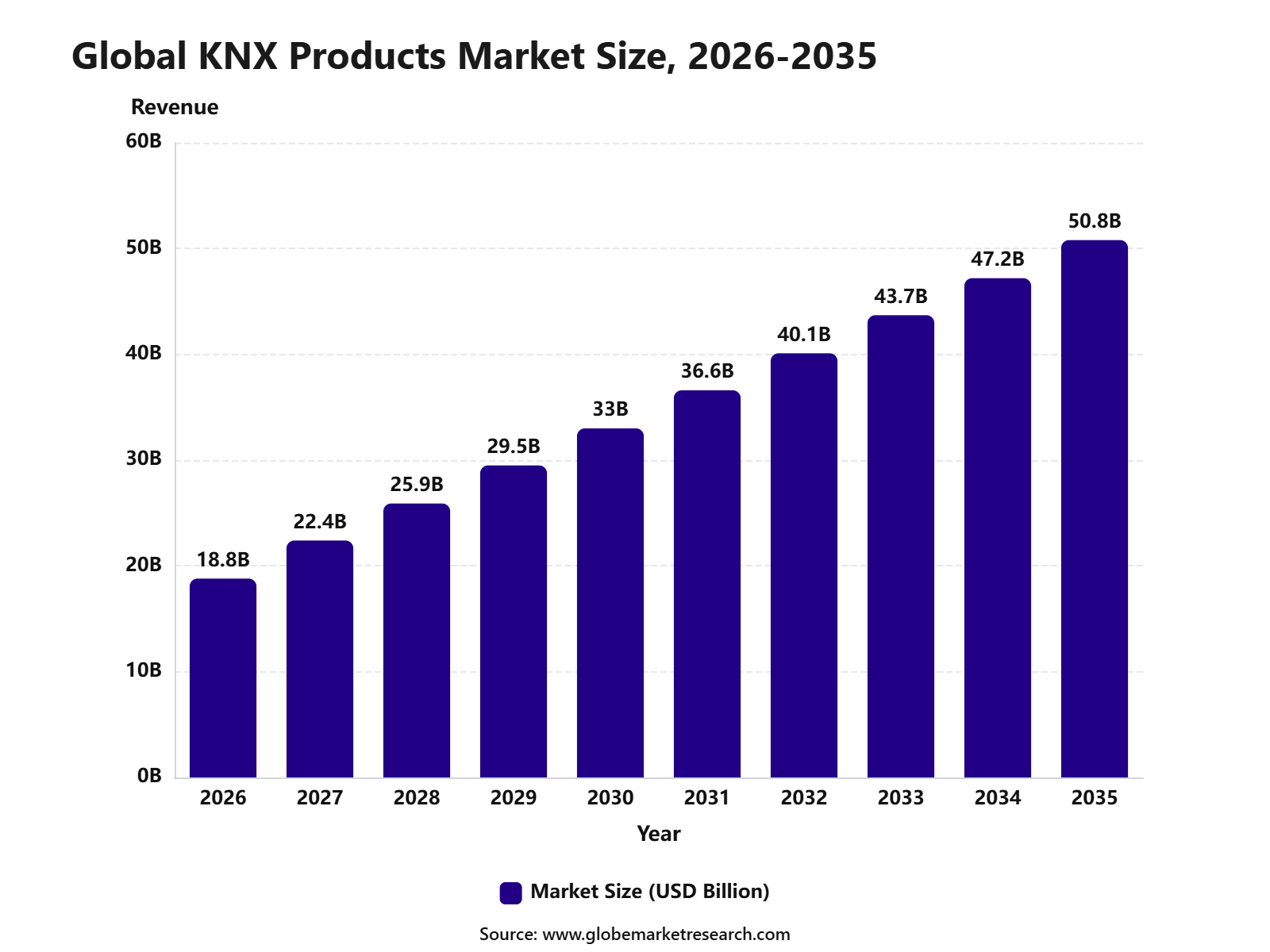 iThe graph shows projected market growth until 2035 based on CAGR analysis. Actual outcomes may vary depending on changing demand, competition, and economic factors.To gain greater insights - request a sample report PDF
Key Market Insights
Sensors led the product type segment with 36.2% share, supported by strong use in motion detection, temperature monitoring, light sensing, occupancy control, and automated building management.
Lighting control accounted for 33.1% share by application, driven by rising demand for energy-efficient lighting, smart room control, dimming systems, and automated commercial building operations.
New installations held 60.3% share, supported by growing adoption of KNX systems in newly built smart homes, offices, hotels, hospitals, and public buildings.
Commercial buildings captured 48.2% share by end-use sector, driven by strong demand for centralized automation, energy savings, security integration, and efficient facility management.
Wired KNX products led the technology segment with 64.7% share, supported by reliable performance, stable communication, long service life, and strong use in large-scale building automation projects.
Europe led the KNX products market with 44.2% share, supported by high smart building adoption, strong energy efficiency standards, mature automation infrastructure, and wide KNX protocol acceptance.
Adoption Rate and Usage Statistics
According to the Association for Smarter Homes & Buildings, HVAC and climate-control systems recorded the highest smart-building adoption rate at 68%, followed by lighting at 66%. Electrical power distribution and security or access control each reached 58%, while fire and life-safety systems reached 54%. These KNX-addressable applications support demand for sensors, actuators, controllers, gateways, switches, and energy-management products.
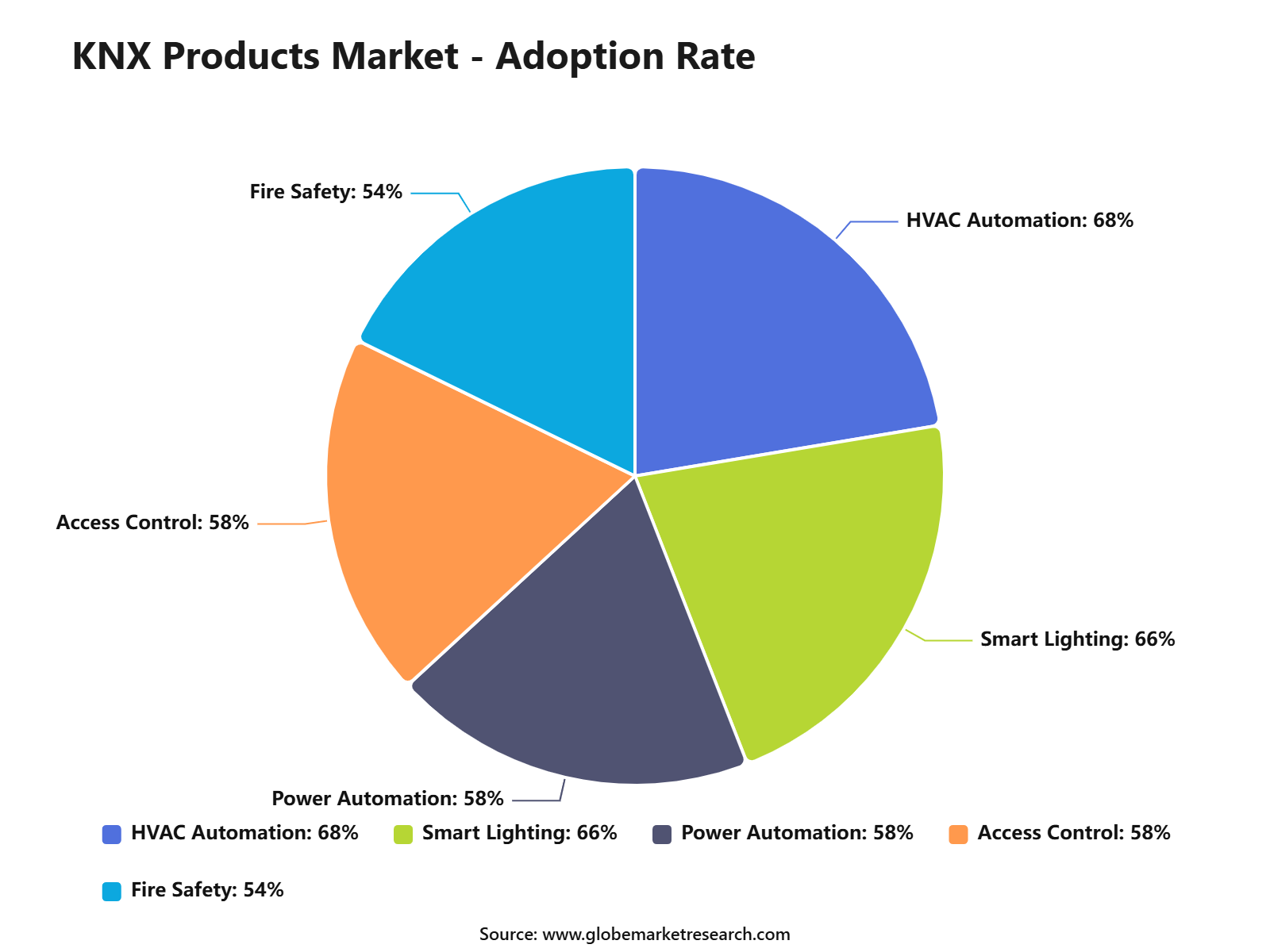 iThe graph shows projected market growth until 2035 based on CAGR analysis. Actual outcomes may vary depending on changing demand, competition, and economic factors.To gain greater insights - request a sample report PDF
According to the KNX Association, the KNX ecosystem includes more than 8,000 certified products from over 500 manufacturers. More than 140,000 certified KNX professionals operate across 190 countries, supported by over 500 accredited training centres. This extensive network strengthens product interoperability, installer availability, technical skills, and adoption across residential, commercial, hospitality, healthcare, education, and infrastructure projects.
Metric | Ecosystem Usage |
|---|---|
Certified Products | Over 8,000 |
KNX Manufacturers | Over 500 |
Certified Installers | Over 140,000 |
Country Presence | 190 countries |
Training Centres | Over 500 |
Product Type Insights
Sensors accounted for 36.2% of the KNX Products Market by product type. Their leading position is supported by the need to collect real-time information on occupancy, temperature, humidity, brightness, air quality and movement. This data allows building systems to adjust lighting, heating, ventilation, shading and security functions based on actual conditions.
The European Commission’s Smart Readiness Indicator evaluates whether buildings can sense, interpret, communicate and respond to changing conditions. Its assessment covers nine technical areas, including heating, cooling, ventilation, lighting, electricity, monitoring and control. This framework highlights the central role of sensors in smart building performance.
Product Type | Market Share |
|---|---|
Sensors | 36.2% |
Actuators | 18.4% |
System Devices | 12.7% |
Communication Devices | 10.8% |
User Interfaces | 9.2% |
Management Software | 7.4% |
Others | 5.3% |
Demand is also supported by the expanding KNX product ecosystem. KNX currently connects more than 8,000 certified devices from over 500 manufacturers, providing building designers with a broad selection of interoperable sensors, actuators and control devices. Multi-sensors that combine occupancy, brightness, temperature and air-quality measurements can reduce installation complexity and improve room-level automation.
Application Insights
Lighting control represented 33.1% of the KNX Products Market by application. Lighting is commonly one of the first building functions to be automated because its operation can be adjusted through occupancy detection, daylight measurement, schedules, dimming and predefined scenes. KNX systems also allow lighting to operate alongside blinds, HVAC and energy-management systems.
The International Energy Agency estimated that lighting in buildings and outdoor applications consumed around 2,200 TWh in 2024, equal to approximately 8% of global electricity demand. Current LEDs average close to 100 lumens per watt, while leading professional products can reach as much as 230 lumens per watt.
Application | Market Share |
|---|---|
Lighting Control | 33.1% |
HVAC Control | 20.6% |
Energy Management | 15.4% |
Security and Access Control | 12.8% |
Shutter and Blind Control | 10.1% |
Others | 8.0% |
Lighting-control demand is moving beyond simple switching toward automatic adjustment based on daylight, room use and energy conditions. The IEA estimated that indoor lighting electricity consumption would have been around 70% higher if lighting efficiency and adoption rates had remained unchanged over the previous decade. KNX products can support further savings by connecting efficient luminaires with sensors and centralized controls.
Installation Type Insights
New installations accounted for 60.3% of the market by installation type. KNX systems can be planned more efficiently during the design and construction stages because bus cables, sensors, control panels and distribution equipment can be incorporated before walls and ceilings are completed. This reduces rewiring requirements and allows several building functions to be designed as one connected system.
The revised European Energy Performance of Buildings Directive establishes zero-emission performance as the standard for new buildings and requires new properties to be prepared for solar installations. It also introduces building automation and control requirements for non-residential buildings, supporting the inclusion of intelligent controls during initial construction.
New construction also allows designers to prepare systems for future expansion. KNX Twisted Pair is identified by the association as particularly suitable for new builds and major renovations because dedicated cabling can be integrated during construction. Early planning can improve device placement, electrical coordination, cybersecurity and the connection of lighting, HVAC, shading and energy systems.
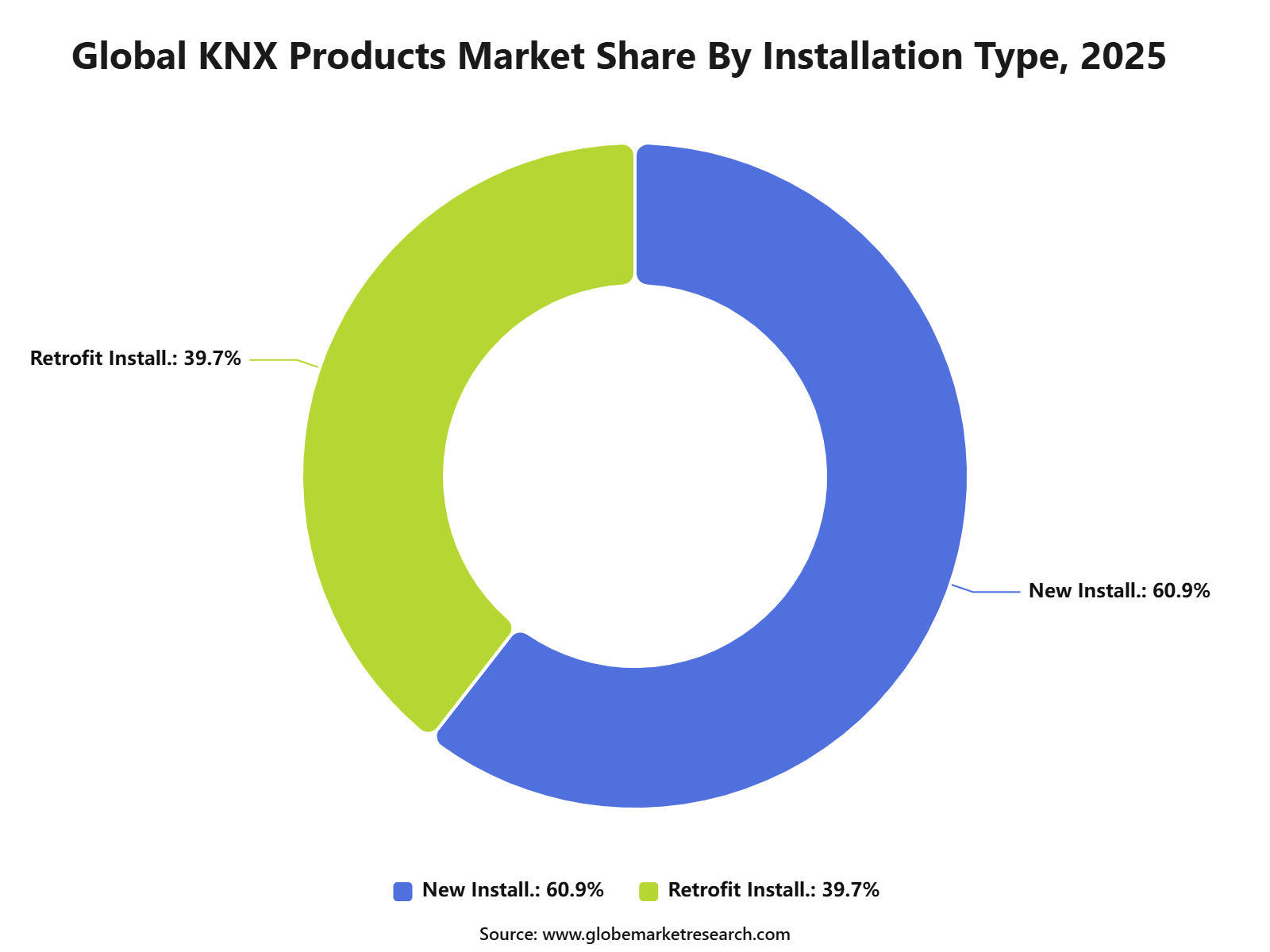 iThe graph shows projected market growth until 2035 based on CAGR analysis. Actual outcomes may vary depending on changing demand, competition, and economic factors.To gain greater insights - request a sample report PDF
End-Use Sector Insights
Commercial buildings accounted for 48.2% of the KNX Products Market by end-use sector. Offices, hotels, hospitals, educational facilities, retail properties and transport buildings contain numerous rooms and technical systems that must be managed throughout the day. KNX products help facility teams coordinate lighting, climate control, access, shading and energy monitoring from a common environment.
Buildings account for around 30% of global energy demand, with commercial and public buildings representing approximately 30% of total building-sector consumption. Their large floor areas, longer operating hours and changing occupancy patterns create a strong requirement for automated control and energy-performance monitoring.
End-Use Sector | Market Share |
|---|---|
Commercial Buildings | 48.2% |
Residential Buildings | 24.6% |
Industrial Facilities | 15.2% |
Public Buildings | 12.0% |
A European study published in 2025 found that building automation and control systems could improve non-residential building energy ratings by as much as 1.3 classes. Installation costs were estimated at approximately €10 per square metre, with payback periods of less than four years. These operating benefits support KNX adoption in commercial properties where energy savings can be measured across large portfolios.
Technology Insights
Wired KNX products represented 64.7% of the market by technology. Wired systems are widely used because dedicated bus connections provide stable communication, predictable performance and low dependence on batteries or local wireless conditions. This makes them suitable for buildings that require reliable control over lighting, HVAC, security and energy-management functions.
KNX Twisted Pair is described as the most established and widely deployed KNX transmission medium. It uses a dedicated bus cable to connect and power compatible devices, while supporting more than 8,000 certified products from over 500 manufacturers. Its broad product base strengthens its use in professional residential, commercial and industrial installations.
The wired ecosystem continues to be maintained through formal technical and certification updates. KNX Standard Version 3.0.4 became the official registration and certification reference from the end of August 2025. Wired systems are increasingly combined with KNX IP and wireless components, allowing dependable local control to operate alongside remote management and internet-based services.
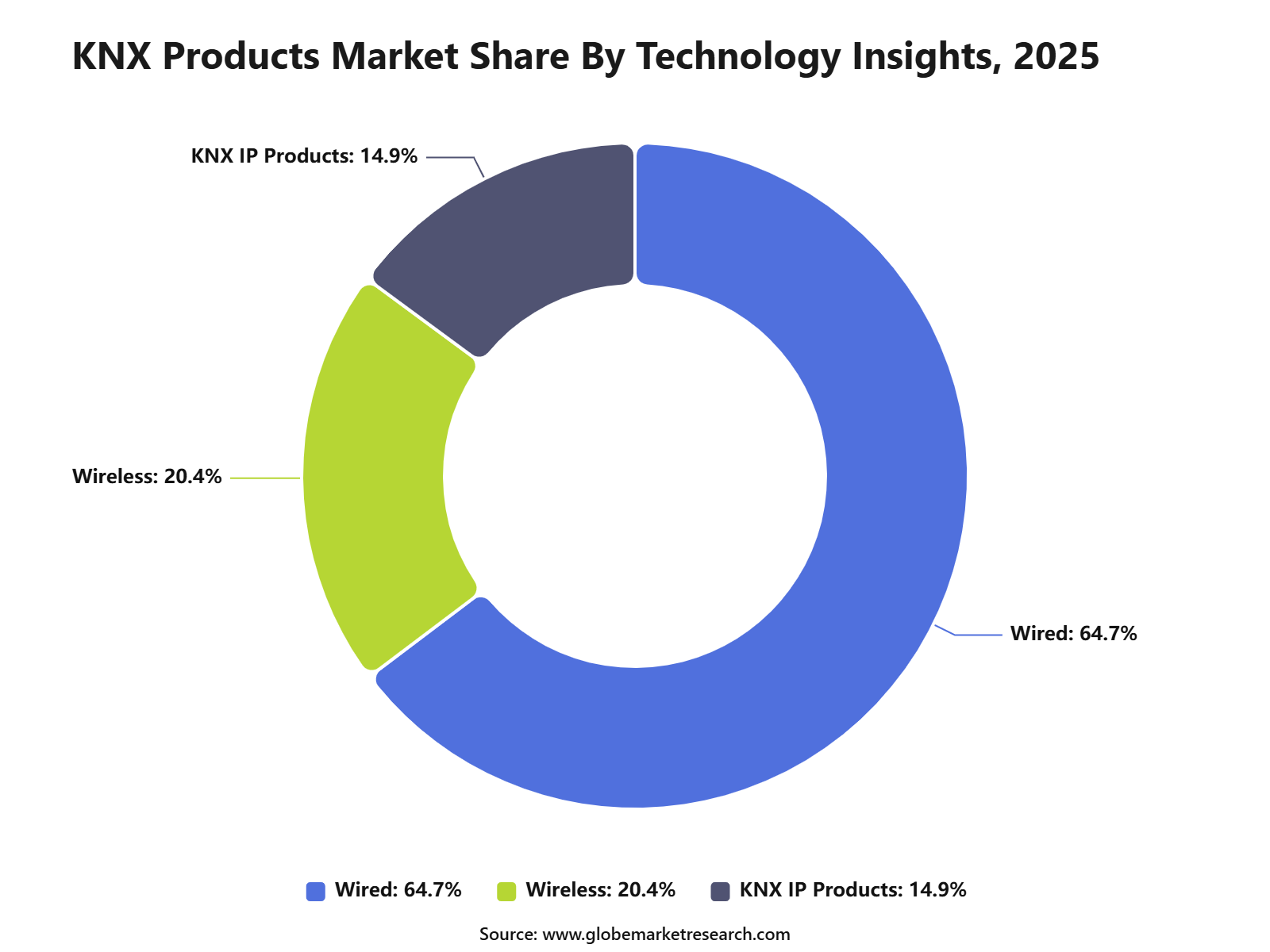 iThe graph shows projected market growth until 2035 based on CAGR analysis. Actual outcomes may vary depending on changing demand, competition, and economic factors.To gain greater insights - request a sample report PDF
Regional Insights
Europe accounted for 44.2% of the KNX Products Market. Regional leadership is supported by a long-established building automation industry, extensive KNX installer expertise and strict building energy-performance policies. Demand is generated across residential properties, offices, hotels, public facilities and industrial buildings.
KNX reported in February 2026 that its global ecosystem included more than 500 member organizations and over 140,000 certified partners operating across 190 countries. Europe remains central to this ecosystem through its concentration of manufacturers, engineering companies, training centres and established smart-building projects.
European regulation is strengthening the role of building controls. Minimum building automation and control requirements were to be established for non-residential systems above 290 kW, with the threshold scheduled to fall to 70 kW by 2029. The European Commission may also require Smart Readiness Indicator assessments for large non-residential buildings following its implementation review, supporting continued investment in connected sensors, controls and energy-management products.
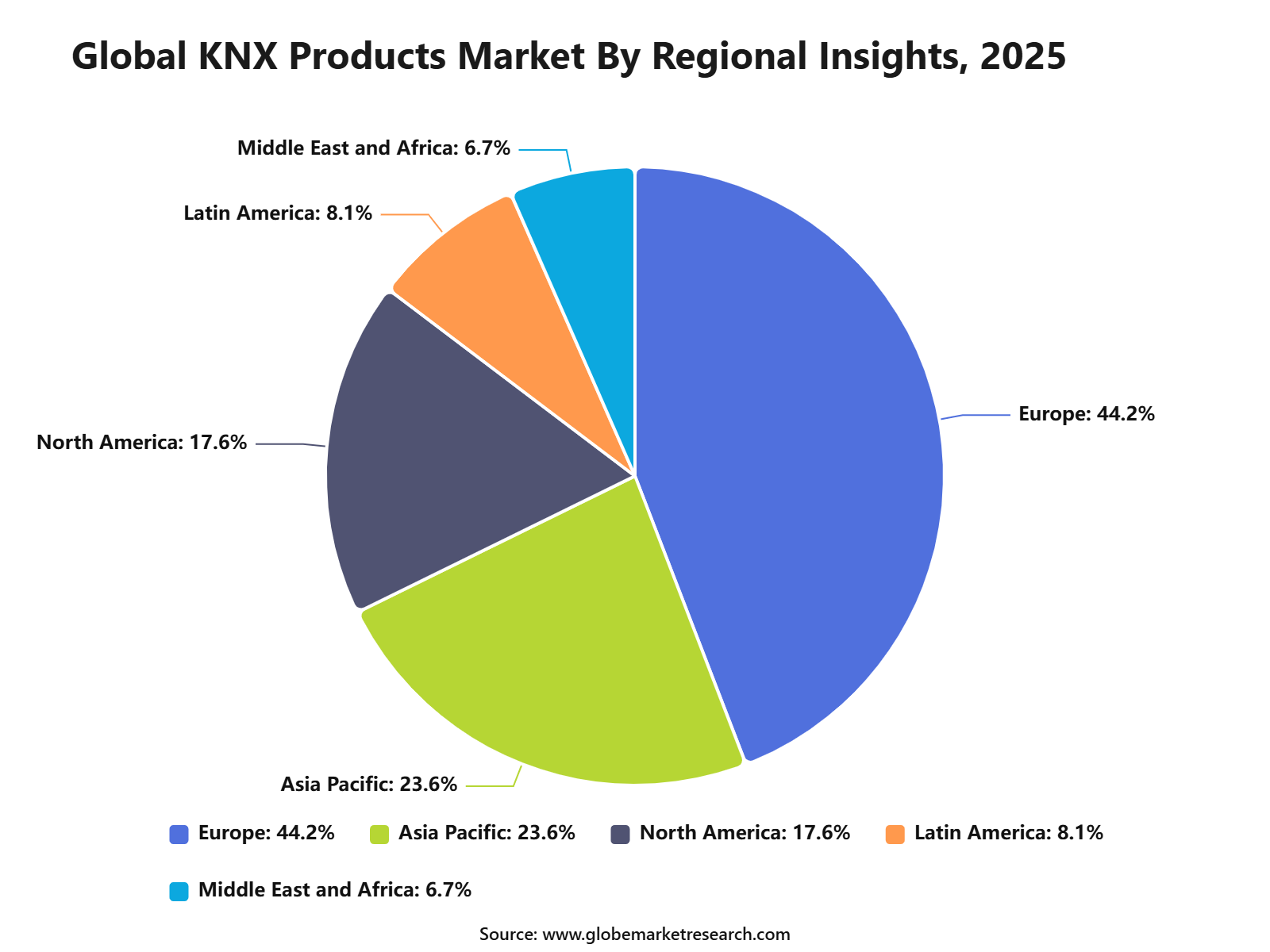 iThe graph shows projected market growth until 2035 based on CAGR analysis. Actual outcomes may vary depending on changing demand, competition, and economic factors.To gain greater insights - request a sample report PDF
U.S. KNX Products Market Insight
The U.S. KNX products market is being supported by demand for interoperable building controls across offices, hotels, educational facilities, healthcare buildings and premium residential properties. KNX allows lighting, HVAC, shading, access control and energy-monitoring devices to operate through a shared automation system.
The U.S. Department of Energy states that properly implemented high-performance controls can reduce commercial building HVAC energy use by approximately 30%. This saving potential supports demand for occupancy sensors, room controllers, actuators and management interfaces that adjust building systems according to real operating conditions.
Market development will depend on greater awareness among engineers, electrical contractors and property owners. KNX suppliers must provide training, local technical support and compatibility with systems commonly used in American buildings. Open integration will be particularly important when new controls are introduced into properties containing equipment from several manufacturers.
Europe KNX Products Market Insight
Europe remains the most developed regional environment for KNX products because of its established installer network, building energy regulations and large base of automated properties. Demand is supported by residential, commercial and public-sector projects requiring coordinated lighting, heating, ventilation, shading and energy management.
The European Smart Readiness Indicator testing program had expanded to 16 countries by the end of 2025. More than 1,000 properties had already been assessed across the European Union, providing practical information on how buildings use automation, digital controls and grid-responsive technologies.
The expanding assessment framework is increasing attention on measurable building intelligence rather than simple device connectivity. KNX products are well positioned because they can connect technical functions through a standardized system. Future demand will favor solutions that provide energy data, secure communication and documented improvement in building performance.
U.K. KNX Products Market Insight
The U.K. KNX products market is being influenced by building renovation, energy-performance disclosure and demand for smarter commercial properties. Offices, public buildings, hotels and high-value homes are adopting connected controls to improve comfort, reduce unnecessary operation and manage energy use more effectively.
During January to March 2026, approximately 460,000 Energy Performance Certificates were lodged for domestic and non-domestic properties in England and Wales. Among new dwellings in England, 87% received an A or B energy-efficiency rating, showing that high-performing buildings represent a growing part of new construction activity.
KNX products can support this transition by connecting heating, ventilation, lighting and monitoring devices within one operating structure. Adoption will depend on correct system design and commissioning because energy savings are achieved only when sensors, schedules and control sequences reflect actual building use.
Germany KNX Products Market Insight
Germany represents an important national market for KNX due to its strong electrical engineering industry and established building automation expertise. KNX is used across offices, industrial properties, hotels, public facilities and residential projects requiring reliable control of several technical systems.
Germany’s Building Energy Act requires non-residential buildings with heating or air-conditioning systems above 290 kW to use building automation and control systems. The requirement supports demand for networked sensors, energy-monitoring devices, controllers and software capable of detecting inefficient system operation.
German buyers commonly place strong importance on reliability, security and long-term product availability. KNX suppliers that offer detailed performance documentation and compatibility with existing HVAC and electrical equipment are likely to receive stronger demand. Retrofit solutions will also be required because many affected properties contain older technical systems.
Asia-Pacific KNX Products Market Insight
Asia-Pacific provides a broad opportunity for KNX products through new commercial construction, smart-city development and premium residential projects. Demand is being generated by hotels, offices, transport facilities, hospitals and mixed-use developments that require centralized control across multiple building functions.
The International Telecommunication Union reported that 77% of the Asia-Pacific population used the internet in 2025. This level of connectivity supports remote building management, KNX IP systems, mobile control interfaces and cloud-linked energy monitoring across connected properties.
Regional expansion will require products that can serve different electrical standards, climates and construction practices. Training and system integration capabilities will be essential because KNX installations require careful planning. Suppliers that combine wired automation with IP and wireless connectivity can address both new projects and existing buildings.
Japan KNX Products Market Insight
Japan’s KNX products market is developing around strict energy-efficiency requirements, advanced building technology and demand for reliable automation. Offices, hotels, public buildings and luxury residential properties can use KNX to coordinate lighting, HVAC, shading, audiovisual equipment and security systems.
Japan expanded mandatory energy-efficiency compliance to almost all new buildings from April 1, 2025. Only construction with a floor area of 10 m² or less is excluded from the wider requirement, increasing the need for energy-efficient equipment and intelligent operating controls across new projects.
KNX adoption in Japan will be influenced by installation quality, local-language technical support and compatibility with domestic building equipment. The strongest opportunities are expected in projects where automation is planned during the design stage. Reliable operation and precise room-level control will remain more important than adding unnecessary connected features.
China KNX Products Market Insight
China provides significant potential for KNX products through its large urban building base, green construction programs and continuing investment in public and commercial infrastructure. KNX can support hotels, offices, residential developments and public buildings that require integrated lighting, climate, shading and energy-management functions.
A national climate progress report published in 2025 found that green buildings represented 97.9% of the gross floor area of newly constructed urban buildings in China. Newly started prefabricated projects covered 672 million m², creating a large construction base where building controls can be integrated during initial development.
The same report identified 74.12 million m² of building floor area that underwent energy-efficiency upgrades. This activity creates opportunities for retrofit sensors, KNX IP gateways and centralized monitoring systems. Suppliers will need to support local building standards, large project volumes and integration with domestic control and communication platforms.
Key Market Segements
By Product Type
Sensors
Actuators
System Devices
Communication Devices
User Interfaces
Management Software
Others
By Application
Lighting Control
HVAC Control
Energy Management
Security and Access Control
Shutter and Blind Control
Others
By Installation Type
New Installations
Retrofit Installations
By End-Use Sector
Residential Buildings
Commercial Buildings
Industrial Facilities
Public Buildings
By Technology
Wired KNX Products
Wireless KNX Products
KNX IP Products
By Region
North America
Europe
Asia Pacific
Latin America
Middle East and Africa
Market Dynamics
Drivers Impact Analysis
The KNX Products Market is driven by rising demand for smart buildings, energy-efficient automation, lighting control, HVAC optimization, security systems, and connected building management. KNX products help buildings reduce energy use, improve comfort, automate operations, and connect multiple building functions through one interoperable system.
Europe leads the market because KNX adoption is strong across commercial buildings, residential automation, public infrastructure, and energy-efficient construction. Germany, France, the UK, Italy, Spain, Switzerland, and the Nordic countries remain key markets due to strong building automation standards and sustainability-focused renovation activity.
Impact Factor | Estimated CAGR Impact | Regional Relevance | Market Impact |
|---|---|---|---|
Growth in smart building automation | +3.5% | Europe, North America, Asia Pacific | Drives core KNX product adoption. |
Rising energy efficiency requirements | +2.9% | Europe and developed building markets | Supports lighting and HVAC automation. |
Demand for integrated building control | +2.4% | Commercial and residential buildings | Expands multi-system KNX use. |
Growth in commercial building upgrades | +1.9% | Offices, hotels, retail, public buildings | Adds retrofit demand. |
Increasing demand for comfort and security | +1.5% | Residential and premium buildings | Supports user interface and sensor demand. |
Restraints Impact Analysis
The market faces restraints from high installation cost, skilled installer requirements, system design complexity, and competition from lower-cost wireless smart home platforms. KNX projects often require professional planning, certified products, wiring expertise, and proper commissioning. Another restraint is slower adoption in cost-sensitive markets. Many small residential buyers choose cheaper standalone devices, while larger buildings may delay automation investments due to budget limits or integration concerns.
Impact Factor | Estimated CAGR Impact | Regional Relevance | Market Impact |
|---|---|---|---|
High upfront installation cost | -1.5% | Residential and small commercial users | Limits price-sensitive adoption. |
Need for trained installers | -1.2% | Emerging and retrofit markets | Slows deployment speed. |
System design complexity | -1.0% | Large building projects | Increases planning requirements. |
Competition from low-cost smart devices | -0.8% | Consumer smart home markets | Pressures entry-level demand. |
Retrofit disruption concerns | -0.6% | Existing buildings | Delays building upgrade decisions. |
Opportunities Impact Analysis
Opportunities are strong in lighting control, HVAC control, energy management, security and access control, shutter and blind automation, user interfaces, and KNX IP-based systems. These applications benefit from demand for building efficiency, lower operating cost, and centralized control.
Higher-value opportunities are emerging in wired KNX products, KNX IP gateways, wireless KNX retrofits, cloud-linked building management, smart meters, occupancy sensors, and commercial energy optimization. Vendors that combine interoperability, reliability, and cybersecurity can capture stronger demand.
Impact Factor | Estimated CAGR Impact | Regional Relevance | Market Impact |
|---|---|---|---|
Lighting control automation | +3.2% | Commercial and residential buildings | Builds core market opportunity. |
HVAC energy optimization | +2.7% | Offices, hotels, hospitals, public buildings | Supports operating cost reduction. |
KNX IP product expansion | +2.2% | Smart building networks | Adds connectivity value. |
Retrofit automation projects | +1.8% | Europe and mature building markets | Expands installed-base opportunity. |
Security and access control integration | +1.4% | Commercial and premium residential users | Adds multi-function system demand. |
Challenges Impact Analysis
The main challenge is integrating KNX products with modern smart building platforms, cloud systems, wireless devices, and legacy infrastructure. Building owners expect seamless control, but integration can become complex when multiple vendors and protocols are involved. Another challenge is maintaining product reliability and cybersecurity. As KNX systems connect to IP networks and building management platforms, device security, access control, updates, and system monitoring become more important.
Impact Factor | Estimated CAGR Impact | Regional Relevance | Market Impact |
|---|---|---|---|
Multi-protocol integration complexity | -1.3% | Smart building projects | Affects system deployment. |
Cybersecurity requirements | -1.1% | KNX IP and connected buildings | Raises technical expectations. |
Legacy building compatibility issues | -0.9% | Retrofit projects | Increases project complexity. |
Installer skill gap | -0.8% | Emerging markets | Limits faster adoption. |
Vendor pricing pressure | -0.6% | Competitive automation markets | Affects margins. |
Top 5 Use Cases of KNX Products Market
Smart Lighting Control: KNX products are widely used for automatic switching, dimming, occupancy-based control, daylight adjustment, scheduled lighting and customized lighting scenes. Lighting remains a leading KNX application because it improves user comfort while reducing unnecessary electricity consumption in homes, offices, hotels, hospitals and retail buildings. KNX identifies lighting as one of its main certified product application areas.
Heating, Ventilation and Air Conditioning Control: KNX sensors, thermostats, actuators and room controllers can automatically manage temperature, airflow, fan speed and heating or cooling schedules. HVAC systems can respond to occupancy, indoor temperature, weather conditions and user preferences, supporting better room comfort and lower building energy use. HVAC is listed as a core KNX product category.
Shading, Blinds and Shutter Automation: KNX products can control blinds, curtains, shutters and external shading based on sunlight, indoor temperature, wind, rain and time schedules. Automated shading can reduce solar heat gain, support natural lighting and decrease the cooling load placed on HVAC systems. KNX systems also enable sun-tracking and weather-protection functions.
Energy Management and Smart Metering: KNX energy meters, gateways and control devices are used to monitor electricity consumption, coordinate solar generation, manage heating equipment and control high-consumption building systems. Real-time monitoring helps facility managers identify waste and optimize energy use across lighting, HVAC and other electrical loads. KNX supports integrated energy management across residential and commercial buildings.
Security and Access Control: KNX products can connect motion sensors, door contacts, access systems, alarms, cameras and automated lighting within a unified building-control network. Users can receive alerts, monitor building conditions and remotely control security functions. KNX Secure also supports encrypted device communication and protected communication over IP networks.
Recent Developments
Market News
In January 2026, KNX Association presented its technology and market roadmap for 2026 and beyond. The programme prioritised simpler ETS workflows, wider artificial intelligence integration, an expanded KNX IoT stack, secure connected products, and energy-management functions covering photovoltaic systems, electric vehicles, heat pumps, and battery storage.
In March 2026, MDT presented more than 300 new sales products at Light + Building. The portfolio included KNX Secure actuators, new two-inch and four-inch Glass Touch Smart versions, the VisuControl Plus Panel, and actuators with a Virtual Interface for testing functions through ETS without visiting the control cabinet.
In March 2026, Siemens introduced updated documentation for its KNX Line Coupler Secure N 140S11. The device can operate as a line, area, or segment coupler and supports KNX Data Secure, secure proxy functions, intelligent programming protection, and controlled communication between separate KNX bus lines.
Market Impact
In 2026, KNX Secure is becoming a standard purchasing requirement rather than a premium product feature. Manufacturers are expanding Data Secure and IP Secure across actuators, couplers, gateways, room controllers, presence sensors, and HVAC integration products.
The European Cyber Resilience Act is increasing pressure on connected-product manufacturers to address authentication, encrypted communication, vulnerability management, firmware integrity, secure updates, and long-term security support. KNX Association has positioned KNX Secure and KNX IoT as important components of its compliance approach.
Wireless products are expanding the addressable market for KNX. MDT’s KNX RF+ portfolio and Gira’s KNX RF Multi developments are designed to reduce the need for new control wiring, making the standard more suitable for apartments, rental properties, historic buildings, renovations, and phased smart-home projects.
Simplified configuration is also lowering adoption barriers. The KNX Digital Twin, KAI Builder, ETS Bulk Linker, MDT homeXpert, and improved online product databases are intended to reduce planning time, manual linking, configuration complexity, and commissioning errors.
Competitive Landscape
The market is characterized by intense competition among established players and emerging companies. Strategic partnerships, mergers and acquisitions, and product innovation are key strategies employed by market participants.
Key Market Players
Schneider Electric SE
ABB Ltd.
Siemens AG
Hager Group
Legrand S.A.
Gira Giersiepen GmbH & Co. KG
Albrecht Jung GmbH & Co. KG
Theben AG
Berker GmbH & Co. KG
MDT Technologies GmbH
Steinel GmbH
Somfy S.A.
Weinzierl Engineering GmbH
GVS Smart Co., Ltd.
Rishun Technology Co., Ltd.
Other Key Players
Research Methodology
This market study is prepared using a combination of primary and secondary research. Primary research includes discussions with manufacturers, suppliers, distributors, consultants, industry experts, and end users. Secondary research covers company reports, government databases, trade associations, technical publications, regulatory sources, and trusted industry documents. The collected information is used to assess market demand, pricing trends, technology adoption, competitive activity, and regional performance.
AI language models are not used as primary data sources, and publicly available AI-generated content is not treated as market evidence. Computational tools may be used to support data processing, translation, data classification, and pattern identification. However, every published assessment is supported by verified sources, human review, and primary market discussions.
Market estimates are developed through top-down and bottom-up approaches and validated using data triangulation. Revenue, production, shipment, pricing, and application-level data are compared across multiple sources. Forecasts consider economic conditions, regulatory changes, investment activity, innovation, supply chain developments, and industry risks. All findings are reviewed through source verification and internal quality checks before publication.
Part I
Source Management & Input Data Standards
Who provides data, how sources are qualified, and what types of evidence are admissible.
Part II
Research Scope & Market Coverage
How we define the markets we assess and the parameters that govern each product.
Part III
Data Collection, Verification & Submission
The mechanics of gathering, cross-checking, and hierarchically ranking evidence.
Part IV
Assessment Determination & Quality Controls
How raw data becomes a published assessment — normalisation, expert judgement, and outlier exclusion.
Part V
Publication, Corrections & Revision
Our publication schedule, corrections policy, and methodology review cycle.
Part VI
Independence, Ethics & Complaints
Conflict-of-interest policies, editorial independence, and how clients raise concerns.
Google · Preferred Sources
Don't miss the latest market research insights and industry updates on Google.
Add Globe Market Research as a preferred source in the Google app to see our reports, analysis, and market stories in your news suggestions.
Meet the Team
This report was prepared by our expert analysts with deep industry knowledge and research experience.
Prashant S. is a Research Analyst at Globe Market Research with more than four years of experience in market research and industry analysis. He specializes in the Aerospace and Defence, Automotive and Transportation, Semiconductor and Electronics, Information and Technology sectors, with expertise in market sizing, trend analysis, competitive assessment, and industry forecasting. He applies primary and secondary research, data validation, company analysis, and market estimation methods to deliver reliable insights for strategic planning and business decision-making.
Sayali brings more than 7 years of experience to Globe Market Research, supporting the accuracy, clarity, and relevance of research content across multiple industries. She reviews market data, segment analysis, competitive insights, and industry trends to ensure each report meets strong quality standards and provides practical value to business decision-makers. Her expertise spans healthcare, information technology, consumer goods, and diverse cross-industry domains. With a strong focus on data reliability, structured analysis, and clear presentation, Sayali helps ensure that each research output delivers well-reviewed insights for clients, investors, consultants, and industry stakeholders.
Frequently Asked Questions
Related Reports
More in Semiconductor and Electronics
Hardware in The Loop (HIL) Market Size to Reach USD 2.8 Billion by 2035
Hardware in The Loop (HIL) Market Size, Share and Growth Analysis By Type (Closed-Loop HIL, Open-Loop HIL), By Component (Software, Hardware, Services), By Application (Automotive, Aerospace & Defense, Semiconductor & Electronics, Industrial Automation, Power Systems), By End User (OEMs, Component Manufacturers, Research Institutions, Government-Funded Test Facilities), By Regional Insights, Technology Trends, Competitive Landscape, Strategic Opportunities and Growth Forecast, 2026-2035
Semiconductor IP Market Size to Reach USD 24.3 Billion By 2035
Global Semiconductor IP Market Size, Growth Analysis By Design IP (Interface IP, Processor IP, Memory IP, Others); By Core Type (Hard Core, Soft Core); By Revenue Source (Royalty, Licensing); By Industry (Consumer Electronics, IT and Telecommunications, Automotive, Industrial, Aerospace and Defense, Others), By Regional Insights, Value Chain & Trade Analysis, Investment Opportunities, Industry Trends, Competitive Analysis and Growth Forecasts By 2025-2035
US LED Lighting Market Size to Reach USD 36.9 billion by 2035
United States LED Lighting Market Size, Go-to-Market and Sales Strategy Analysis By Product Category (LED Lamps, LED Luminaires and Fixtures), By Sales Channel (Direct Sales, Wholesale and Retail Stores, E-Commerce), By Installation Type (New Installations, Retrofit Installations), By Application (Commercial Offices, Retail Spaces, Industrial Facilities, Residential Buildings, Public Infrastructure, Others), and By End User (Indoor Lighting, Outdoor Lighting, Automotive Lighting), By Regional Insights, Business plan and Project Report, Investment Opportunities, Profitability, Industry Trends, Leading Companies and Growth Forecasts By 2025-2035
Gaming Mouse Bundle Market to hit USD 5.3 billion by 2035
Global Gaming Mouse Bundle Market Size, Go-to-Market Strategy Analysis By Bundle Type (Mouse and Mousepad Bundle, Mouse and Keyboard Bundle, Mouse and Headset Bundle, Full Gaming Accessory Bundle), By Mouse Type (Wired Gaming Mouse, Wireless Gaming Mouse), By Sensor Type (Optical Sensor, Laser Sensor), By Price Range (Budget, Mid-range, Premium), By Distribution Channel (Online, Specialty Stores, Supermarkets and Hypermarkets, Others), By End User (Individual Gamers, Esports Players, Gaming Cafes, Others), By Regional Insights, Business plan and Project Report, Investment Opportunities, Profitability, Industry Trends, Leading Companies and Growth Forecasts By 2025-2035