

Revenue, 2026
USD 0.9 Bn
Forecast, 2035
USD 2.8 Bn
CAGR, 2026-2035
12.1%
Report Coverage
Global
Market Size and Forecast
Hardware-in-the-loop testing connects physical controllers and electronic components with real-time simulation software to evaluate system performance under controlled operating conditions. It allows engineers to test electronic control units, sensors, actuators and embedded software without using a complete physical prototype. Compared with conventional road, flight or field testing, HIL systems can reduce development costs, identify software faults earlier and safely reproduce difficult or hazardous operating conditions.
According to Globe Market Research, the global Hardware-in-the-Loop (HIL) Market was valued at USD 0.9 billion in 2026 and is projected to reach approximately USD 2.82 billion by 2035, growing at a CAGR of 12.1% from 2025 to 2035. North America held the largest regional share of 39.3% in 2025, representing approximately USD 0.35 billion. Market growth is being supported by the increasing complexity of electronic control systems used in electric vehicles, autonomous driving, aircraft, industrial equipment, power systems and defence platforms.
Key Parameter | Report Details |
|---|---|
Market Revenue, 2026 | USD 0.9 Billion |
Projected Revenue, 2035 | USD 2.82 Billion |
CAGR, 2026-2035 | 12.1% |
Largest Region | North America, 39.3% Share |
Market Concentration | Medium |
Base Year | 2025 |
Forecast Period | 2026-2035 |
Demand is also being influenced by expanding electric vehicle production and semiconductor activity. According to the International Energy Agency, global electric car sales reached approximately 21 million units in 2025, accounting for one in four new cars sold worldwide. The Semiconductor Industry Association reported that global semiconductor sales reached USD 791.7 billion in 2025, up 25.6%, while monthly sales increased to USD 120.6 billion in May 2026. The growing number of electronic components and software-controlled functions is increasing the requirement for HIL testing across automotive, electronics, aerospace and industrial applications.
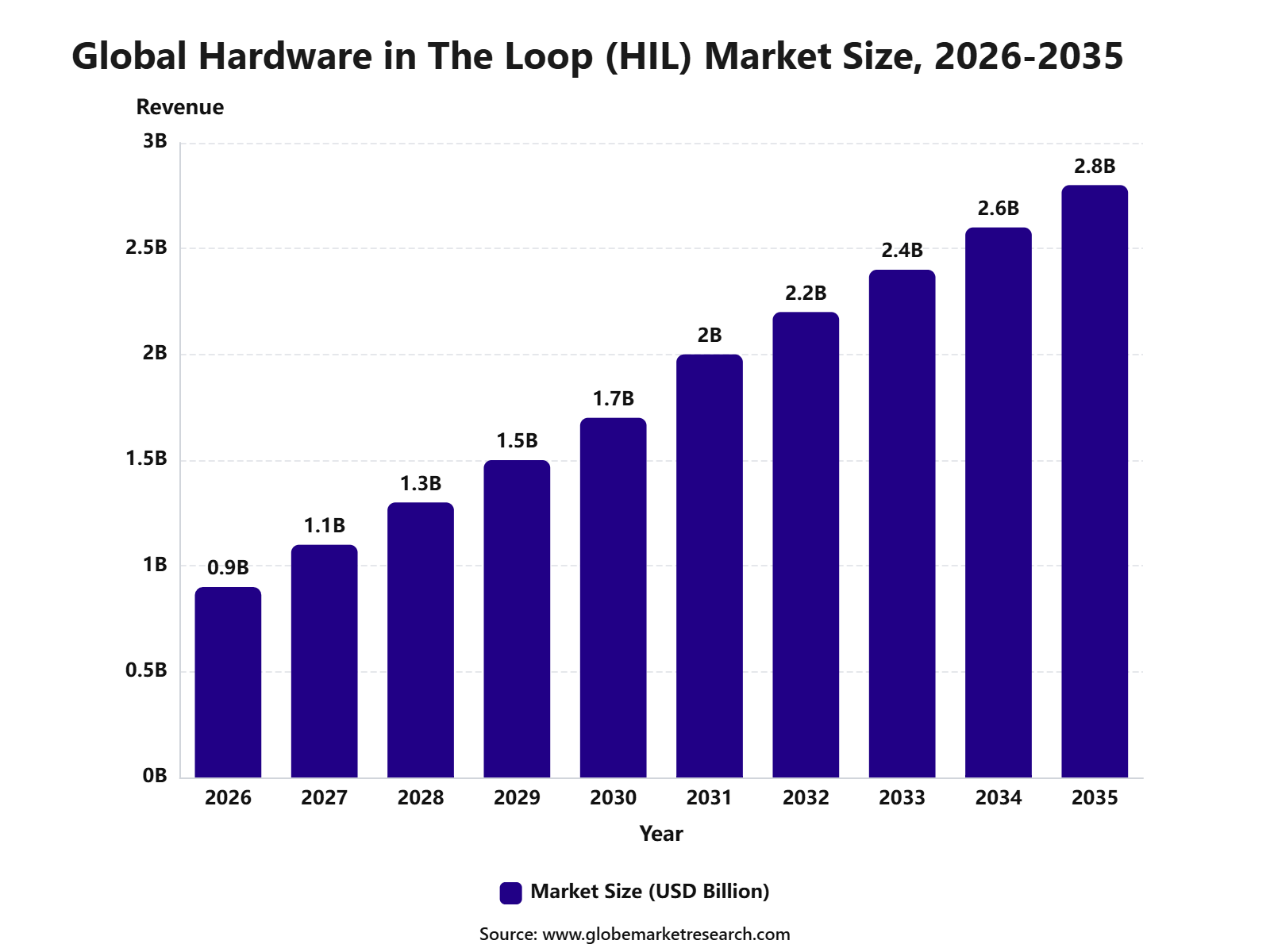 iThe graph shows projected market growth until 2035 based on CAGR analysis. Actual outcomes may vary depending on changing demand, competition, and economic factors.To gain greater insights - request a sample report PDF
Agentic AI is improving HIL testing by automatically creating test scenarios, selecting high-risk cases, monitoring real-time results and adjusting validation sequences without continuous manual control. In January 2025, dSPACE and Microsoft began evaluating generative AI to accelerate the creation and updating of virtual electronic control units, supporting closer integration between virtual testing and physical HIL systems. Automotive manufacturers are increasingly combining AI, software-in-the-loop and HIL testing to shorten development cycles.
Stellantis conducts 80% to 85% of testing for its new technology platforms through software-in-the-loop systems, starts validation up to one year before production hardware is available and has accelerated some development processes by up to 100 times. Synopsys also demonstrated a virtual automotive prototype operating around 100 times faster than comparable QEMU-based simulation in 2025, increasing the volume of tests completed before final HIL validation.
Key Market Insights
North America led the Hardware-in-the-Loop market with a 39.3% share, supported by strong automotive, aerospace, defense, and industrial testing activity.
Open-Loop HIL accounted for 60.6% of the market, reflecting its wide use in early-stage testing, control validation, and system performance assessment.
Hardware held a 56.2% share of the component segment due to rising demand for real-time processors, input-output modules, interfaces, and test equipment.
Automotive applications represented 44.0% of the market, driven by increasing validation requirements for electric vehicles, autonomous systems, electronic control units, and advanced driver assistance technologies.
OEMs captured a 49.2% share of the end-user segment as manufacturers expanded in-house testing to reduce development time, control costs, and improve product reliability.
Type Insights
Open-loop HIL accounted for the largest type share of 60.6%. This approach provides the device under test with fixed, recorded or scripted inputs, while its outputs are measured without a complete feedback loop. It is suitable for interface checks, signal validation, data replay and early-stage controller testing.
Open-loop systems are widely used to evaluate perception and sensor-fusion functions using recorded camera, radar, lidar and network data. A 2026 technical guide stated that open-loop HIL is appropriate when hardware outputs, message timing, relay commands or pulse-width modulation responses must be checked against planned input sequences.
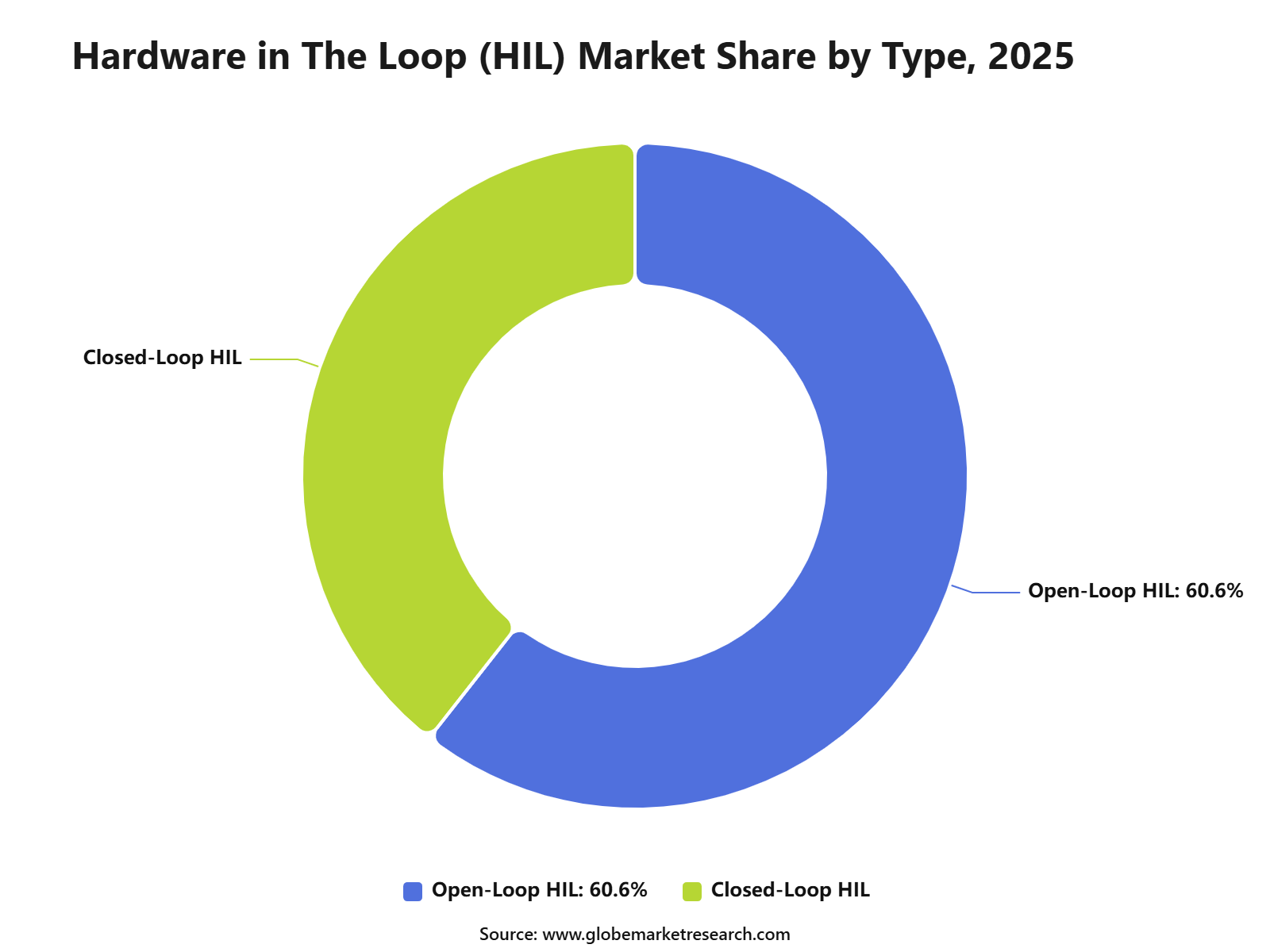 iThe graph shows projected market growth until 2035 based on CAGR analysis. Actual outcomes may vary depending on changing demand, competition, and economic factors.To gain greater insights - request a sample report PDF
Component Insights
Hardware represented the leading component share of 56.2%. This category includes real-time processors, input and output boards, communication interfaces, signal-conditioning units, load simulation modules, connectors and test racks. These components are required to reproduce physical signals and maintain precise communication with the controller under test.
The complexity of modern HIL benches strengthens hardware demand. A whole-vehicle HIL platform presented in 2026 connected approximately 40 electronic control units, more than 1,500 input and output signals, over 35 network connections and 9 real-time processing cores. These requirements demonstrate the substantial physical infrastructure needed for system-level validation.
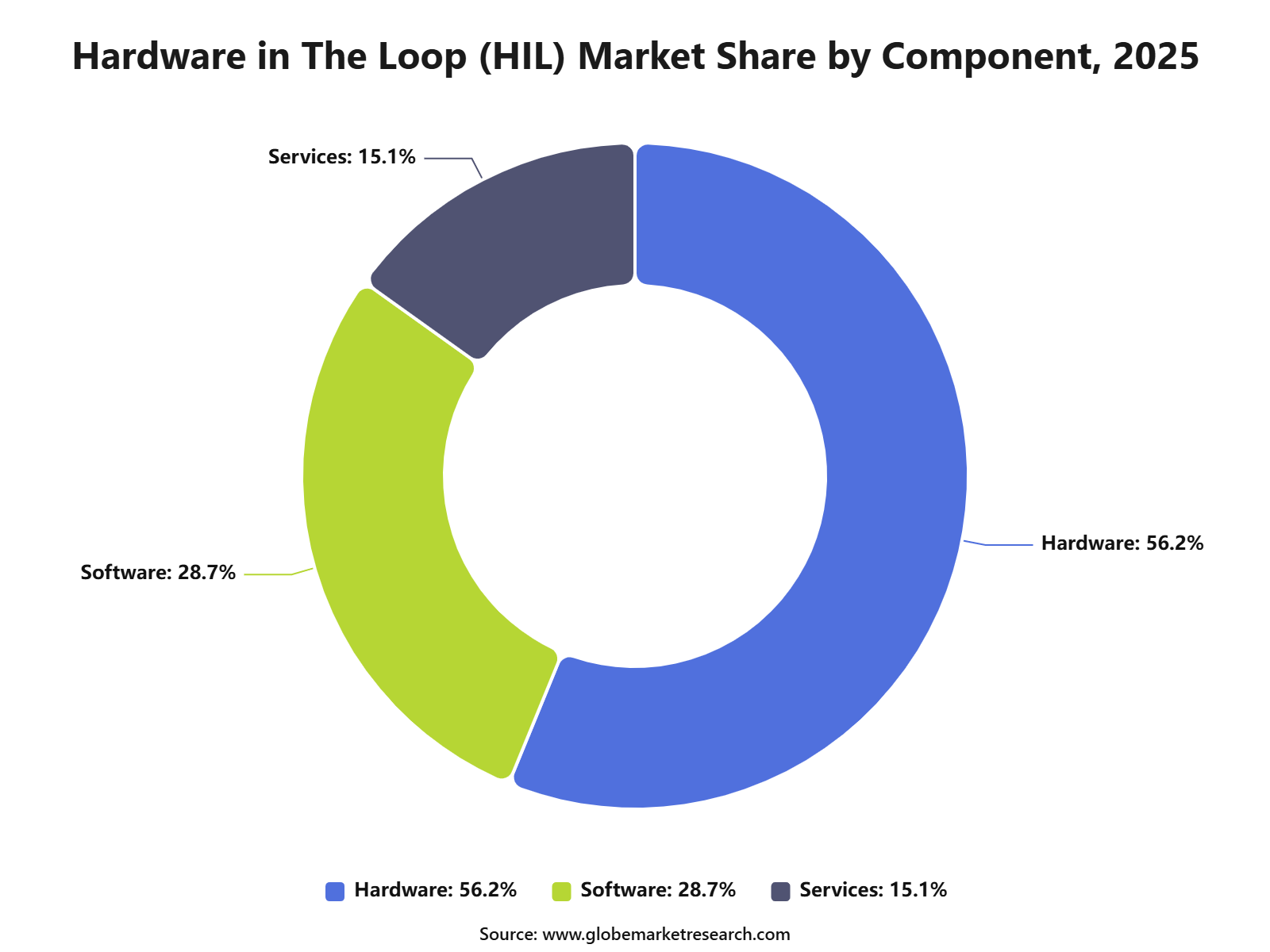 iThe graph shows projected market growth until 2035 based on CAGR analysis. Actual outcomes may vary depending on changing demand, competition, and economic factors.To gain greater insights - request a sample report PDF
Application Insights
Automotive applications held the largest market share of 44.0%. HIL systems are used to test powertrain controllers, battery-management systems, braking systems, steering units, vehicle-control modules, infotainment networks and driver-assistance functions. Testing can be repeated under dangerous or unusual conditions without placing a physical vehicle or driver at risk.
U.S. new light-vehicle sales reached 16.2 million units in 2025, including 1.26 million battery-electric vehicles and 2.05 million conventional hybrid vehicles. Hybrid sales increased by 27.6%, indicating greater powertrain diversity and additional control-system complexity that must be validated before production.
End User Insights
Original equipment manufacturers accounted for the largest end-user share of 49.2%. OEMs use HIL systems to evaluate integrated products before prototypes are fully available. Testing is conducted across component, subsystem and complete-system levels to verify software behaviour, network communication, fault handling and compliance with internal engineering requirements.
Whole-vehicle HIL is becoming important as OEMs integrate more electronic control units and interconnected software functions. A 2026 automotive validation case showed that HIL was used for early, flexible and repeatable testing across different operating scenarios, while supporting broader test coverage and reusable validation methods for future vehicle platforms.
Region Insights
North America led the Hardware-in-the-Loop Market with a share of 39.3%. The region benefits from a strong base of automotive manufacturers, aerospace contractors, semiconductor developers, industrial automation companies and power-system laboratories. These industries use HIL platforms to validate embedded controllers, communication networks and safety functions before physical deployment.
The scale of the U.S. automotive sector supports regional testing demand. Total vehicle sales reached a seasonally adjusted annual rate of 16.95 million units in June 2026. Rising vehicle software content, electrified powertrains and advanced driver-assistance functions are increasing the number of control systems that require repeatable real-time validation.
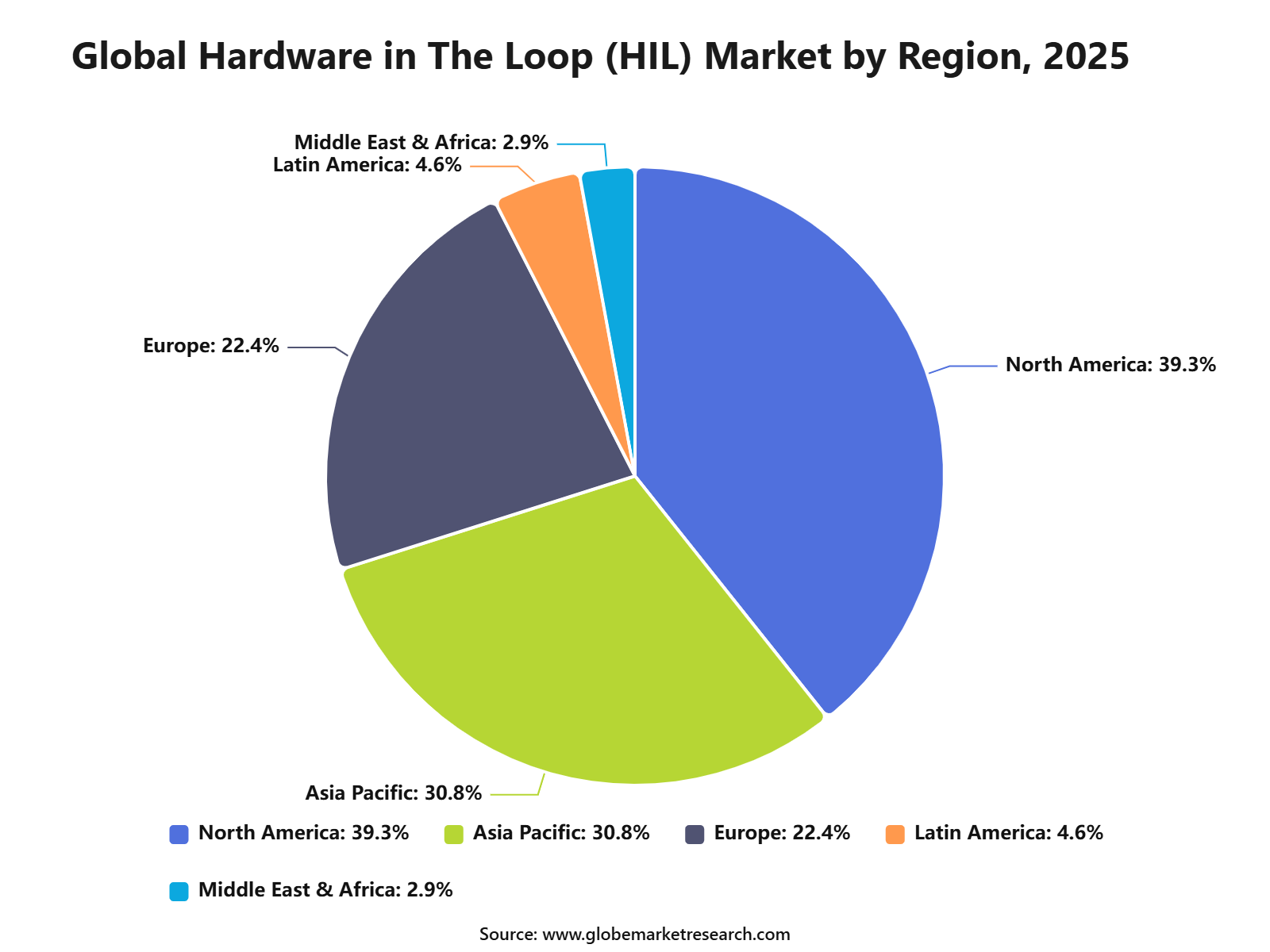 iThe graph shows projected market growth until 2035 based on CAGR analysis. Actual outcomes may vary depending on changing demand, competition, and economic factors.To gain greater insights - request a sample report PDF
Key Market Segments
By Type
Closed-Loop HIL
Open-Loop HIL
By Component
Software
Hardware
Services
By Application
Automotive
Aerospace & Defense
Semiconductor & Electronics
Industrial Automation
Power Systems
By End User
OEMs
Component Manufacturers
Research Institutions
Government-Funded Test Facilities
By Region
North America
Europe
Asia Pacific
Latin America
Middle East and Africa
Drivers Impact Analysis
The Hardware in The Loop Market is driven by rising demand for real-time testing, faster product validation, software-defined systems, electric vehicles, autonomous driving, aerospace electronics, and industrial automation. HIL testing helps companies validate embedded systems, controllers, sensors, and software before physical deployment.
North America leads the market due to strong automotive R&D, aerospace and defense programs, semiconductor testing, EV development, and advanced automation projects. The U.S. remains the main regional contributor because of its strong base in automotive software, defense electronics, power systems, and control engineering.
Impact Factor | Estimated CAGR Impact | Regional Relevance | Market Impact |
|---|---|---|---|
Growth in software-defined vehicles | +3.3% | North America, Europe, Asia Pacific | Drives real-time controller testing. |
Rising EV and battery system validation | +2.8% | U.S., Germany, China, Japan | Expands demand for HIL platforms. |
Autonomous and ADAS development | +2.4% | North America and Europe | Supports sensor and control testing. |
Aerospace and defense electronics testing | +2.0% | U.S. and Canada | Adds high-reliability demand. |
Need to reduce physical prototype cost | +1.6% | Global engineering teams | Improves testing efficiency. |
Restraints Impact Analysis
The market faces restraints from high setup cost, system integration complexity, skilled workforce requirements, and long customization cycles. HIL systems often need real-time simulators, I/O modules, test benches, software models, and domain-specific configuration. Another restraint is limited adoption among smaller manufacturers. Many SMEs still depend on physical testing or basic simulation tools because full HIL platforms require investment in hardware, software, model development, and test automation expertise.
Impact Factor | Estimated CAGR Impact | Regional Relevance | Market Impact |
|---|---|---|---|
High initial system cost | -1.6% | Global engineering teams | Slows adoption among smaller users. |
Complex model and test setup | -1.3% | Automotive, aerospace, industrial sectors | Increases deployment time. |
Skilled testing workforce shortage | -1.1% | North America, Europe, Asia Pacific | Limits efficient usage. |
Customization for each application | -0.9% | OEMs and component suppliers | Raises project cost. |
Integration with legacy tools | -0.7% | Mature engineering organizations | Slows workflow adoption. |
Opportunities Impact Analysis
Opportunities are strong in EV powertrain testing, battery management systems, ADAS validation, autonomous systems, aerospace control systems, power electronics, renewable energy controls, and semiconductor validation. These applications require safe, repeatable, and real-time test environments.
Higher-value opportunities are emerging in cloud-connected HIL, virtual ECU testing, digital twins, AI-assisted test automation, and integrated software-in-the-loop plus HIL workflows. Companies that reduce testing time and improve system reliability can capture stronger long-term demand.
Impact Factor | Estimated CAGR Impact | Regional Relevance | Market Impact |
|---|---|---|---|
EV powertrain and battery testing | +3.2% | North America, Europe, Asia Pacific | Builds major growth opportunity. |
ADAS and autonomous vehicle validation | +2.7% | U.S., Germany, Japan, South Korea | Adds high-value testing demand. |
Aerospace control system testing | +2.2% | North America and Europe | Supports mission-critical validation. |
Power electronics and inverter testing | +1.8% | EV, renewable, industrial sectors | Expands technical applications. |
Digital twin and virtual testing integration | +1.5% | Advanced R&D centers | Improves test coverage. |
Challenges Impact Analysis
The main challenge is creating accurate real-time models that reflect actual system behavior. HIL testing depends on precise simulation of sensors, actuators, vehicle dynamics, power electronics, batteries, motors, aircraft systems, and control logic. Another challenge is managing fast-changing software and hardware architectures. As vehicles, aircraft, and industrial machines become more software-defined, HIL platforms must support frequent updates, new interfaces, cybersecurity testing, and higher system complexity.
Impact Factor | Estimated CAGR Impact | Regional Relevance | Market Impact |
|---|---|---|---|
Real-time model accuracy | -1.5% | Automotive, aerospace, power systems | Affects test reliability. |
Fast-changing embedded architectures | -1.2% | Software-defined systems | Requires frequent upgrades. |
Test automation complexity | -1.0% | Large engineering teams | Increases validation effort. |
Interface and protocol compatibility | -0.8% | OEMs and suppliers | Adds integration burden. |
Cybersecurity validation needs | -0.7% | Connected systems | Expands test requirements. |
Go-to-Market and Sales Economics
According to Globe Market Research, the go-to-market approach for the Hardware in the Loop Market should focus on electric vehicles, advanced driver assistance systems, software-defined vehicles, power electronics and safety-critical embedded controls. Customers should be approached with application-specific test systems rather than general simulation platforms. Global electric car sales reached approximately 21 million units in 2025, increasing the requirement for battery management, motor-control, charging and vehicle-control validation.
Sales strategies should begin with limited engineering projects that demonstrate lower testing time, improved fault detection and reduced dependence on physical prototypes. HIL providers can offer feasibility assessments, model development, interface design and pilot test benches before proposing full laboratory deployment. Sub-Zero reported that its NI-based HIL testing process reduced product validation time from weeks to hours while supporting the company’s established 20-year appliance reliability requirement.
The strongest commercial model will combine real-time simulation hardware with software licences, I/O modules, test automation, integration support and annual maintenance. Suppliers can generate additional income from model libraries, system upgrades, calibration and engineer training. In February 2025, dSPACE introduced power-electronics simulation software capable of supporting switching-frequency simulations of up to 500 kHz, addressing high-speed control testing in electric mobility, aerospace and railway applications.
Financial Impact
The financial impact of HIL adoption is mainly determined by development-cycle reduction, test reuse, fault-detection speed and laboratory utilization. Greater savings can be achieved when simulation models are reused across software-in-the-loop, HIL and vehicle-level testing. AVL reported in November 2025 that its AI-supported modelling approach could generate virtual twins within two days, helping engineering teams begin validation earlier in the development process.
Cybersecurity and regulated-system requirements will increase implementation costs but may also support premium HIL offerings. Automotive, aerospace and defence customers require controlled software environments, traceable test results and secure access to test equipment. NI added Federal Information Processing Standards support and 64-bit compatibility to VeriStand during its 2025 Q2 release, strengthening its suitability for customers with strict security and computing requirements.
Long-term profitability will depend on modular hardware, open interfaces, software compatibility and controlled system-upgrade costs. Closed test architectures can create expensive replacements when controllers, communication protocols or computing platforms change. Stellantis began integrating dSPACE simulation technology into its Virtual Engineering Workbench in January 2025, demonstrating how cloud-based development, software testing and physical HIL validation are being connected within a common engineering process.
Common HIL Usage Areas
Metric | Practical Use |
|---|---|
Automotive ECUs | Engine control, body control, braking, steering, and vehicle control validation |
EV powertrain | Battery management, inverter control, motor control, charging, and thermal system testing |
ADAS systems | Sensor simulation, lane assistance, emergency braking, adaptive cruise, and autonomous driving checks |
Aerospace systems | Flight control, avionics, propulsion, actuator control, and mission-system validation |
Defense systems | Radar, guidance, embedded control, communication, and safety-critical mission testing |
Power electronics | Converters, inverters, grid interfaces, protection relays, and renewable energy controllers |
Industrial automation | PLCs, robotics, motion control, factory automation, and machine safety testing |
Railway systems | Train control, braking, traction, signaling, and safety validation |
Medical devices | Embedded controller validation for safety-critical medical equipment |
Research labs | Real-time simulation, controller prototyping, fault injection, and academic testing |
Recent Developments
In January 2026, dSPACE showcased AI-supported software-in-the-loop and hardware-in-the-loop solutions at CES 2026 for software-defined vehicle development and validation.
In February 2026, Typhoon HIL released Typhoon HIL Control Center 2026.1, adding new features and improvements for HIL projects across power electronics, e-mobility, and grid modernization.
In March 2026, Speedgoat opened a larger North American facility in Framingham, Massachusetts to support locally integrated real-time HIL test systems and customer services in the U.S. and Canada.
In April 2026, OPAL-RT released HYPERSIM 2026.1 to standardize controller integration and advance grid modeling workflows for real-time simulation and HIL applications.
Market Concentration
The Hardware-in-the-Loop Market shows a moderately consolidated structure because a limited number of established testing and simulation providers supply advanced real-time processors, software platforms and integrated validation systems. High technical requirements, system integration needs and long customer approval cycles create entry barriers for new participants.
At the same time, the market remains fragmented across applications and regions. Specialist companies serve automotive, aerospace, energy, semiconductor and industrial automation users with customized HIL platforms, interface modules and engineering services. Regional suppliers also compete through application-specific expertise, flexible integration and local technical support.
Competitive Landscape
The market is characterized by intense competition among established players and emerging companies. Strategic partnerships, mergers and acquisitions, and product innovation are key strategies employed by market participants.
Key Market Players
National Instruments Corporation
dSPACE GmbH
Vector Informatik GmbH
OPAL-RT Technologies Inc.
Siemens AG
Speedgoat GmbH
Typhoon HIL Inc.
Typhoon HIL Inc.
ETAS GmbH
Keysight Technologies
MathWorks Inc.
IPG Automotive GmbH
Other Key Players
Research Methodology
This market study is prepared using a combination of primary and secondary research. Primary research includes discussions with manufacturers, suppliers, distributors, consultants, industry experts, and end users. Secondary research covers company reports, government databases, trade associations, technical publications, regulatory sources, and trusted industry documents. The collected information is used to assess market demand, pricing trends, technology adoption, competitive activity, and regional performance.
AI language models are not used as primary data sources, and publicly available AI-generated content is not treated as market evidence. Computational tools may be used to support data processing, translation, data classification, and pattern identification. However, every published assessment is supported by verified sources, human review, and primary market discussions.
Market estimates are developed through top-down and bottom-up approaches and validated using data triangulation. Revenue, production, shipment, pricing, and application-level data are compared across multiple sources. Forecasts consider economic conditions, regulatory changes, investment activity, innovation, supply chain developments, and industry risks. All findings are reviewed through source verification and internal quality checks before publication.
Part I
Source Management & Input Data Standards
Who provides data, how sources are qualified, and what types of evidence are admissible.
Part II
Research Scope & Market Coverage
How we define the markets we assess and the parameters that govern each product.
Part III
Data Collection, Verification & Submission
The mechanics of gathering, cross-checking, and hierarchically ranking evidence.
Part IV
Assessment Determination & Quality Controls
How raw data becomes a published assessment — normalisation, expert judgement, and outlier exclusion.
Part V
Publication, Corrections & Revision
Our publication schedule, corrections policy, and methodology review cycle.
Part VI
Independence, Ethics & Complaints
Conflict-of-interest policies, editorial independence, and how clients raise concerns.
Google · Preferred Sources
Don't miss the latest market research insights and industry updates on Google.
Add Globe Market Research as a preferred source in the Google app to see our reports, analysis, and market stories in your news suggestions.
Meet the Team
This report was prepared by our expert analysts with deep industry knowledge and research experience.
Prashant S. is a Research Analyst at Globe Market Research with more than four years of experience in market research and industry analysis. He specializes in the Aerospace and Defence, Automotive and Transportation, Semiconductor and Electronics, Information and Technology sectors, with expertise in market sizing, trend analysis, competitive assessment, and industry forecasting. He applies primary and secondary research, data validation, company analysis, and market estimation methods to deliver reliable insights for strategic planning and business decision-making.
Sayali brings more than 7 years of experience to Globe Market Research, supporting the accuracy, clarity, and relevance of research content across multiple industries. She reviews market data, segment analysis, competitive insights, and industry trends to ensure each report meets strong quality standards and provides practical value to business decision-makers. Her expertise spans healthcare, information technology, consumer goods, and diverse cross-industry domains. With a strong focus on data reliability, structured analysis, and clear presentation, Sayali helps ensure that each research output delivers well-reviewed insights for clients, investors, consultants, and industry stakeholders.
Frequently Asked Questions
Related Reports
More in Semiconductor and Electronics
KNX Products Market Size to Reach USD 50.8 billion by 2035
KNX Products Market Size, Share, Trends and Growth Analysis Report By Product Type (Sensors, Actuators, System Devices, Communication Devices, User Interfaces, Management Software, Others), By Application (Lighting Control, HVAC Control, Energy Management, Security and Access Control, Shutter and Blind Control, Others), By Installation Type (New Installations, Retrofit Installations), By End-Use Sector (Residential Buildings, Commercial Buildings, Industrial Facilities, Public Buildings), By Technology (Wired KNX Products, Wireless KNX Products, KNX IP Products), By Regional Insights, Technology Trends, Competitive Landscape, Strategic Opportunities and Growth Forecast, 2026-2035
Semiconductor IP Market Size to Reach USD 24.3 Billion By 2035
Global Semiconductor IP Market Size, Growth Analysis By Design IP (Interface IP, Processor IP, Memory IP, Others); By Core Type (Hard Core, Soft Core); By Revenue Source (Royalty, Licensing); By Industry (Consumer Electronics, IT and Telecommunications, Automotive, Industrial, Aerospace and Defense, Others), By Regional Insights, Value Chain & Trade Analysis, Investment Opportunities, Industry Trends, Competitive Analysis and Growth Forecasts By 2025-2035
US LED Lighting Market Size to Reach USD 36.9 billion by 2035
United States LED Lighting Market Size, Go-to-Market and Sales Strategy Analysis By Product Category (LED Lamps, LED Luminaires and Fixtures), By Sales Channel (Direct Sales, Wholesale and Retail Stores, E-Commerce), By Installation Type (New Installations, Retrofit Installations), By Application (Commercial Offices, Retail Spaces, Industrial Facilities, Residential Buildings, Public Infrastructure, Others), and By End User (Indoor Lighting, Outdoor Lighting, Automotive Lighting), By Regional Insights, Business plan and Project Report, Investment Opportunities, Profitability, Industry Trends, Leading Companies and Growth Forecasts By 2025-2035
Gaming Mouse Bundle Market to hit USD 5.3 billion by 2035
Global Gaming Mouse Bundle Market Size, Go-to-Market Strategy Analysis By Bundle Type (Mouse and Mousepad Bundle, Mouse and Keyboard Bundle, Mouse and Headset Bundle, Full Gaming Accessory Bundle), By Mouse Type (Wired Gaming Mouse, Wireless Gaming Mouse), By Sensor Type (Optical Sensor, Laser Sensor), By Price Range (Budget, Mid-range, Premium), By Distribution Channel (Online, Specialty Stores, Supermarkets and Hypermarkets, Others), By End User (Individual Gamers, Esports Players, Gaming Cafes, Others), By Regional Insights, Business plan and Project Report, Investment Opportunities, Profitability, Industry Trends, Leading Companies and Growth Forecasts By 2025-2035