

Revenue, 2025
USD 9.2 Bn
Forecast, 2035
USD 24.3 Bn
CAGR, 2025-2035
10.2%
Report Coverage
Global
Market Size and Forecast
The global Semiconductor IP Market was valued at USD 9.2 billion in 2025 and is projected to reach USD 24.3 billion by 2035, growing at a CAGR of 10.2% from 2025 to 2035. Asia Pacific held the largest regional share of 54.3% in 2025. Market growth is being supported by rising demand for reusable processor, interface, memory, security and connectivity IP in smartphones, artificial intelligence accelerators, data centres, automotive electronics, industrial equipment and Internet of Things devices.
Key Parameter | Report Details |
|---|---|
Market Revenue, 2025 | USD 9.2 Billion |
Projected Revenue, 2035 | USD 24.3 Billion |
CAGR, 2025-2035 | 10.2% |
Largest Region | Asia Pacific, 54.3% Share |
Market Concentration | Medium |
Base Year | 2025 |
Forecast Period | 2025-2035 |
Semiconductor IP includes pre-designed and verified functional blocks that can be integrated into system-on-chip and application-specific integrated circuit designs. These blocks may include processor cores, memory controllers, communication interfaces, graphics units, security modules and analog functions. Compared with developing every chip function internally, licensed IP can shorten design cycles, reduce engineering costs, lower verification risks and allow semiconductor companies to focus on product-specific performance and differentiation.
Demand is also being influenced by the wider expansion of the semiconductor industry. According to the Semiconductor Industry Association (SIA), global semiconductor sales reached USD 120.6 billion in May 2026, up 9.2% from USD 110.5 billion in April 2026 and 104.1% from USD 59.1 billion in May 2025. The WSTS-compiled figures represent a three-month moving average, while SIA represents 99% of the U.S. semiconductor industry by revenue and nearly two-thirds of non-U.S. chip companies.
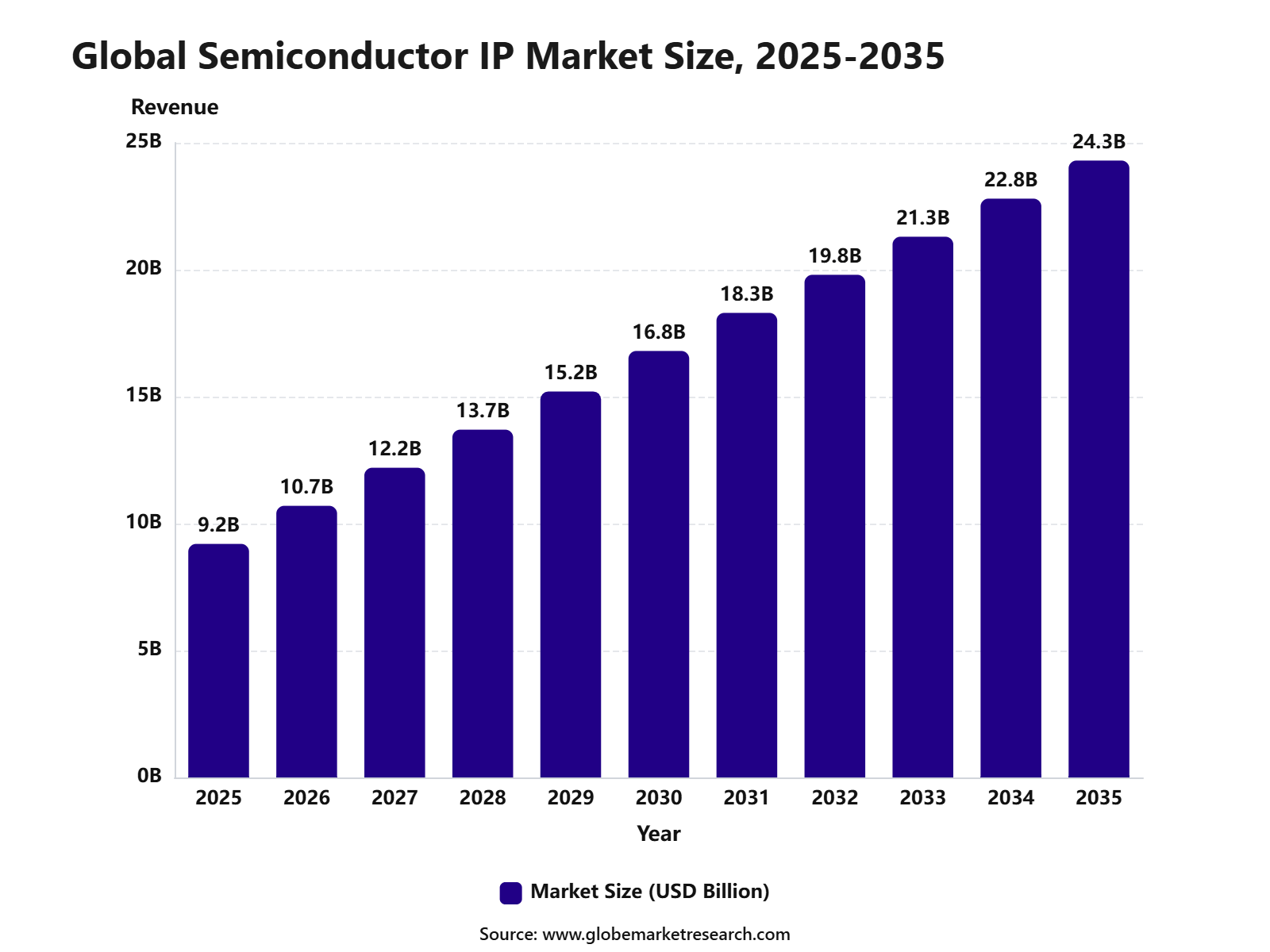 iThe graph shows projected market growth until 2035 based on CAGR analysis. Actual outcomes may vary depending on changing demand, competition, and economic factors.To gain greater insights - request a sample report PDF
Market Key Insights
Processor IP led the design IP segment with 46.2% share, supported by rising demand for advanced processors used in smartphones, AI chips, automotive electronics, data centers, and connected devices.
Hard core IP accounted for 53.4% share, driven by its optimized performance, lower integration risk, faster time-to-market, and strong use in complex semiconductor designs.
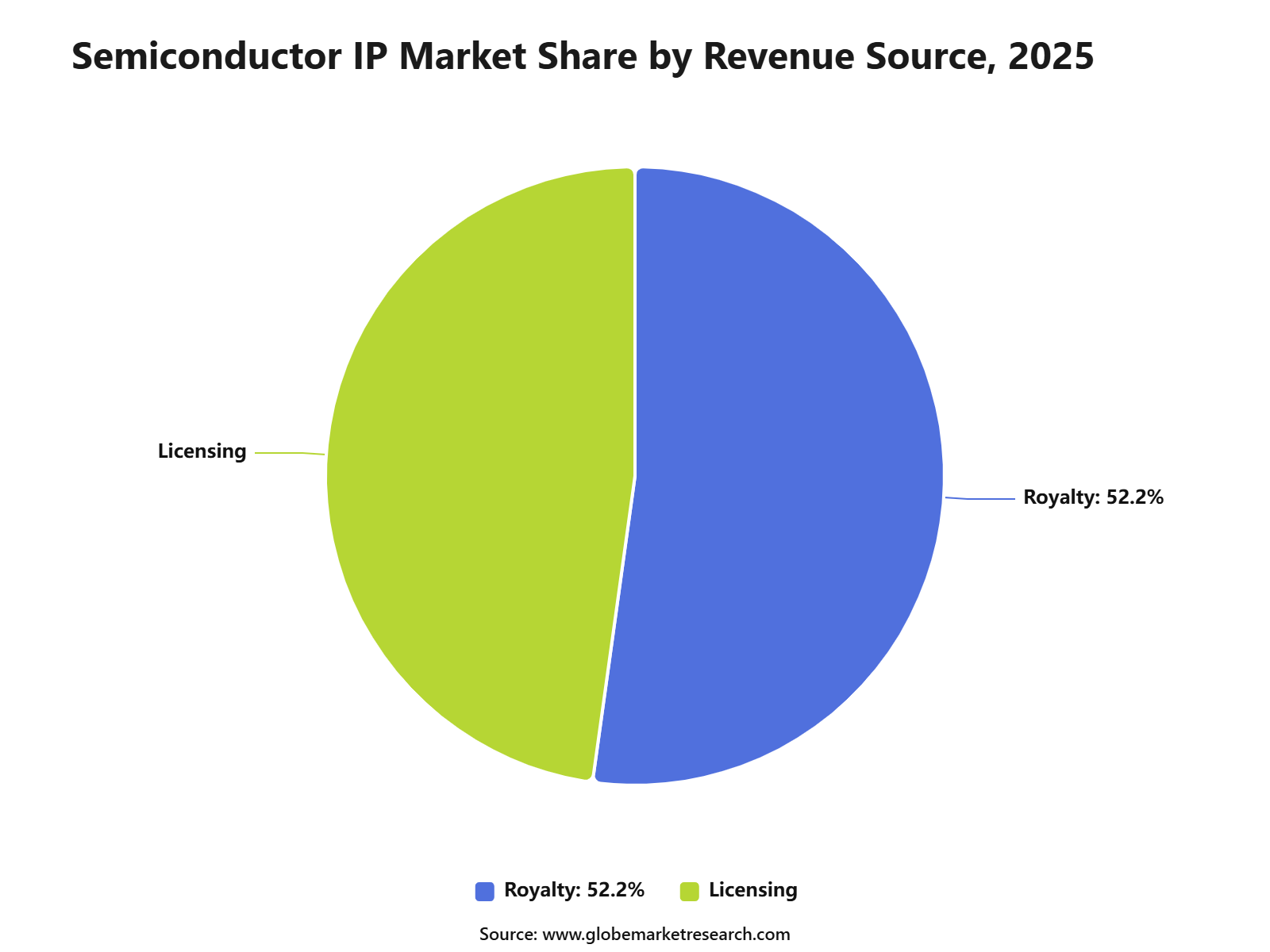
Royalty-based revenue held above 52.2% share, supported by recurring income from licensed IP used across high-volume chip production and long-term semiconductor design programs.
Consumer electronics captured 33.2% share by industry, driven by strong demand for smartphones, wearables, smart TVs, gaming devices, and other connected electronic products.
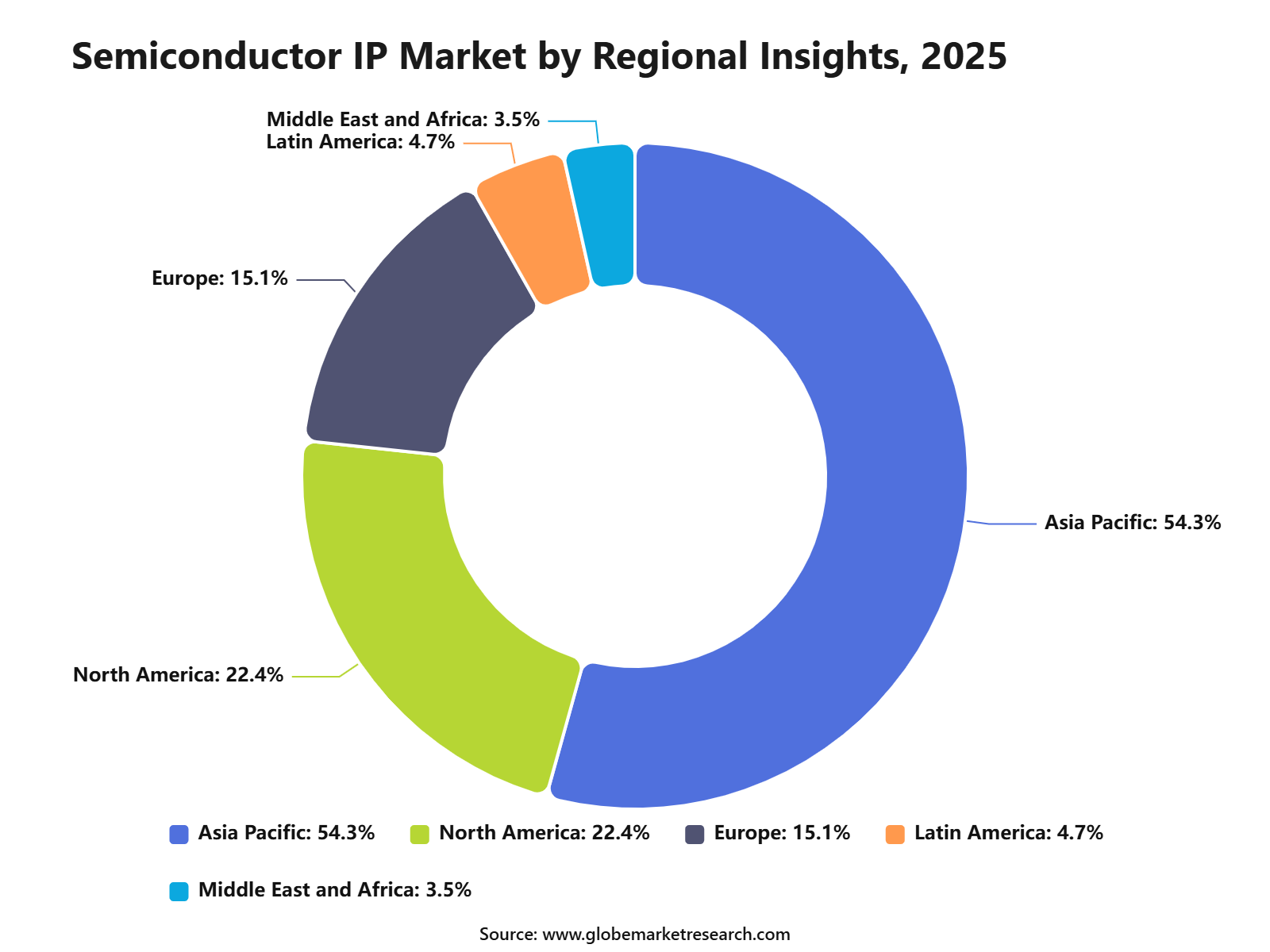
Asia Pacific led the semiconductor IP market with 54.3% share, supported by large chip manufacturing capacity, strong electronics production, expanding fabless design activity, and high demand across China, Taiwan, South Korea, Japan, and India.
Semiconductor IP Adoption and Usage Area Statistics
Semiconductor IP adoption is increasing as chip designs become more complex and companies move toward custom silicon, AI processors, RISC-V architectures, and advanced SoC development. Recent indicators from capgemini show strong demand for reusable and pre-verified IP blocks, supported by a 10.2% market growth rate, 24.3% RISC-V growth, 34% in-house chip design activity, and 78% use of design automation technologies. The need for faster development cycles, lower design risk, and improved first-silicon success is making semiconductor IP more important across AI, automotive, data center, telecom, and connected device applications.
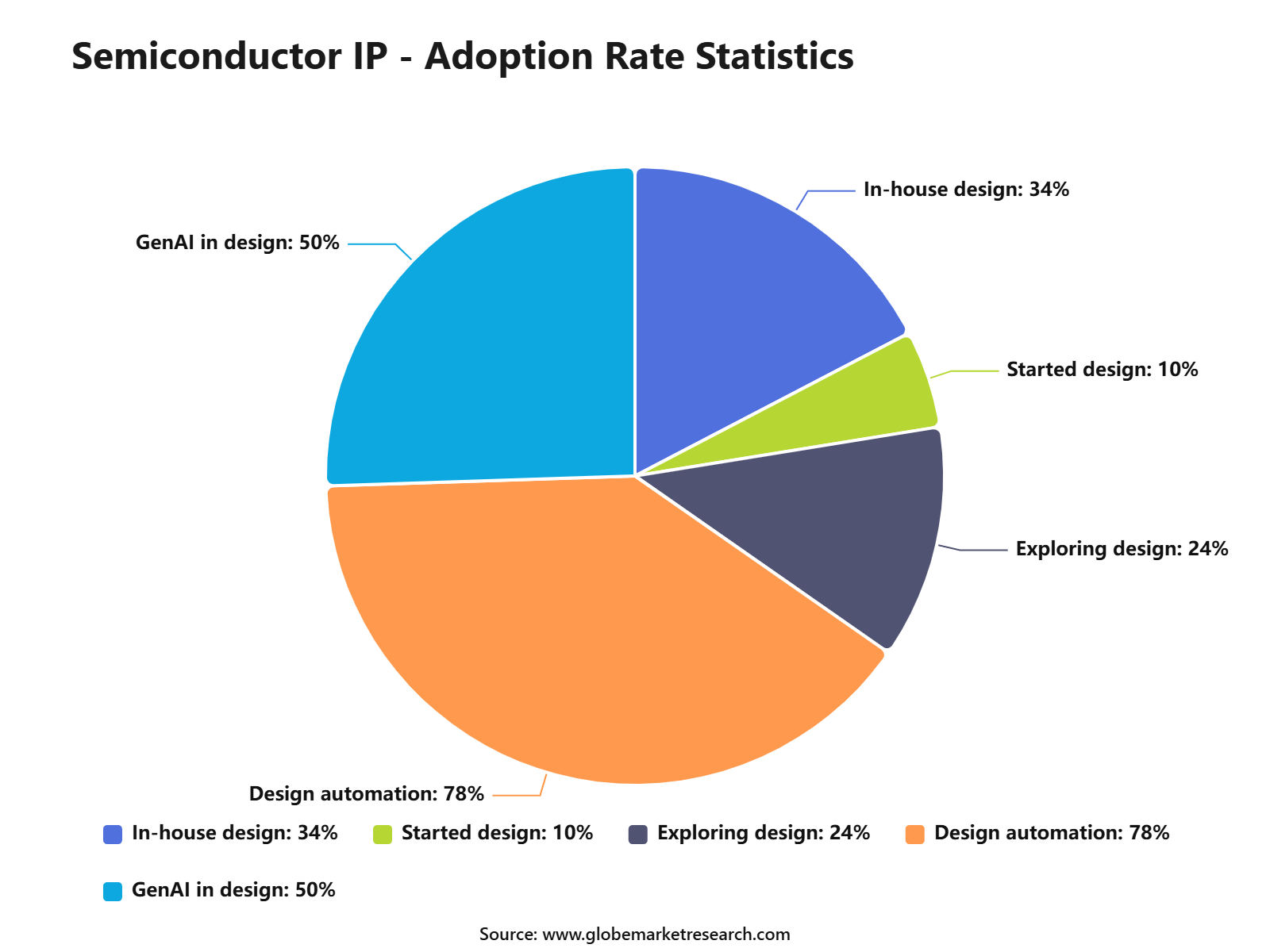 iThe graph shows projected market growth until 2035 based on CAGR analysis. Actual outcomes may vary depending on changing demand, competition, and economic factors.To gain greater insights - request a sample report PDF
Semiconductor IP is mainly used in processor cores, AI accelerators, memory interfaces, custom ASICs, GPUs, DPUs, security modules, and high-speed connectivity blocks. According to Capgemini, demand is being supported by rising need for NPUs at 58%, GPUs at 57%, memory-intensive chips at 56%, custom chips at 40%, and AI acceleration chips at 88%. Companies are using IP to improve performance, reduce power consumption, speed up design timelines, support customization, and build chips for AI, edge computing, high-performance computing, automotive electronics, and advanced data center workloads.
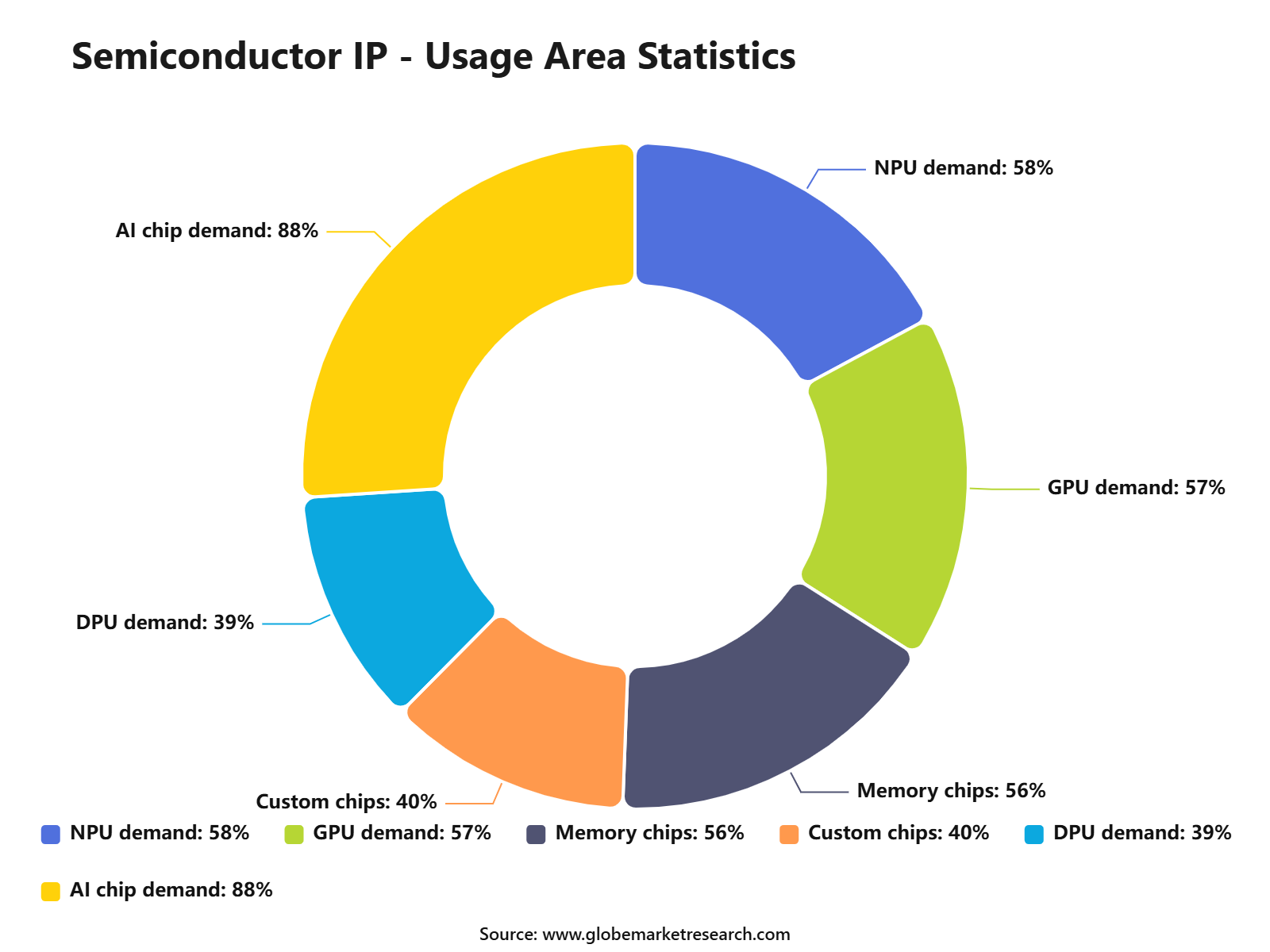 iThe graph shows projected market growth until 2035 based on CAGR analysis. Actual outcomes may vary depending on changing demand, competition, and economic factors.To gain greater insights - request a sample report PDF
Impact of AI
Artificial intelligence is increasing demand for processor, neural processing, memory, interface, interconnect and security IP used in data centres, edge devices, autonomous vehicles and robotics. Arm reported quarterly revenue of USD 1.24 billion for the third quarter of fiscal 2026, up 26% year over year. Its royalty revenue increased by 27% to USD 737 million, while licensing revenue rose by 25% to USD 505 million, supported partly by growing demand across cloud AI, physical AI and edge AI applications.
AI is also improving the speed and efficiency of semiconductor design. Cadence reported more than 25% year-over-year growth in its IP business during the second quarter of 2025, while its AI-enabled platform was reported to provide up to 20% improvement in power, performance and area and deliver chips 5 to 10 times faster. Synopsys also reported that AI and accelerated computing could improve circuit simulation speeds by up to 30 times, while users of its generative AI design assistant achieved an average productivity improvement of two times. These advances are supporting faster IP verification, integration and commercialization.
Design IP Insights
Processor IP accounted for the largest share of 46.2%. Its leading position can be attributed to the central role of processors in system-on-chip designs. CPUs, GPUs, neural processing units and digital signal processors are required to manage computing, control functions and AI workloads across a wide range of electronic systems.
Demand is also being supported by the wider use of reusable processor architectures in smartphones, data centres, vehicles, industrial equipment and connected devices. Arm reported that more than 350 billion chips based on its architecture had been shipped by May 2026, while RISC-V International recorded faster commercial adoption of its open processor architecture during 2025.
Core Type Insights
Hard core IP held a leading share of 53.4%. Hard cores are supplied as fixed and physically optimized circuit layouts, allowing chip designers to achieve predictable power use, performance and silicon area. They are commonly selected for functions where timing accuracy and reliable operation are more important than design flexibility.
The segment is supported by the growing integration of high-speed interfaces, memory controllers, security blocks, processors and transceivers within complex chips. Pre-verified hardened cores can also reduce integration work and lower the risk of design errors before manufacturing, making them suitable for advanced and high-volume semiconductor products.
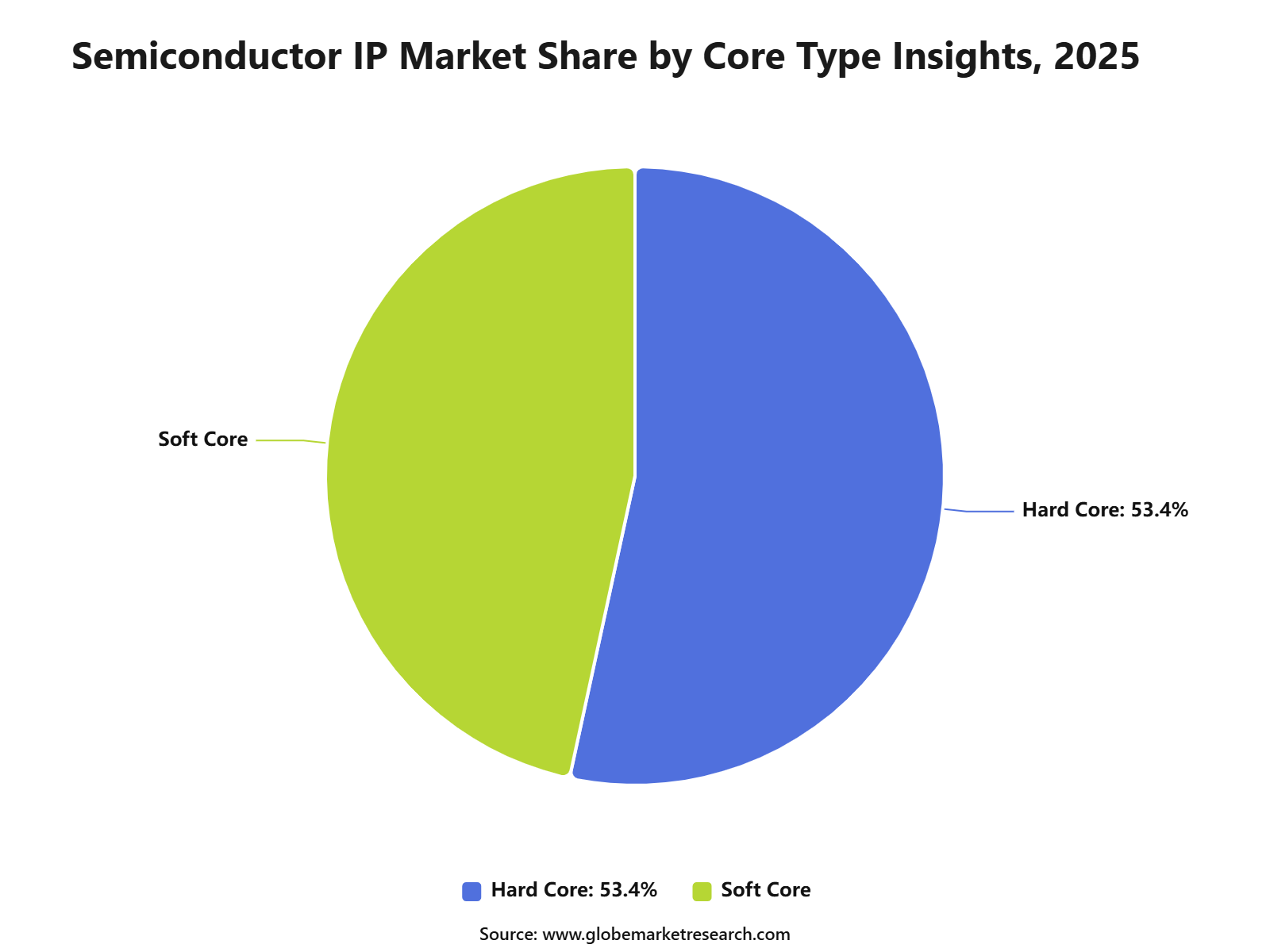 iThe graph shows projected market growth until 2035 based on CAGR analysis. Actual outcomes may vary depending on changing demand, competition, and economic factors.To gain greater insights - request a sample report PDF
Revenue Source Insights
Royalty-based revenue represented more than 52.2% of the market. Under this model, semiconductor IP providers receive recurring payments based on the number or value of chips shipped by their customers. This structure allows IP developers to benefit from the commercial success of several products without directly manufacturing the chips.
The model is particularly effective for processor and interface IP used across smartphones, automotive chips, connected devices and data-centre processors. In fiscal 2026, Arm reported a 21% increase in royalty revenue, supported partly by greater use of technologies carrying higher royalty rates per chip. This indicates that advanced IP content can generate recurring income throughout a product’s shipment cycle.
 iThe graph shows projected market growth until 2035 based on CAGR analysis. Actual outcomes may vary depending on changing demand, competition, and economic factors.To gain greater insights - request a sample report PDF
Industry Insights
Consumer electronics accounted for the largest industry share of 33.2%. Smartphones, tablets, smart televisions, gaming devices, wearables and home electronics require several reusable IP blocks, including processors, graphics units, memory interfaces, connectivity functions and security systems.
Demand is increasingly linked to higher semiconductor content within each device rather than only growth in unit shipments. The Consumer Technology Association indicated that U.S. consumer technology retail revenue was expected to increase by 3.4% in 2026, while overall unit shipments remained relatively stable. This pattern suggests that more advanced features and higher-value electronics are supporting IP demand.
Regional Breakdown & Supply Chain
Asia Pacific led the Semiconductor IP Market with a share of 54.3%. The region benefits from its strong position in semiconductor manufacturing, chip design, electronics assembly, packaging and testing. Large consumer electronics and automotive production bases also generate steady demand for processor, memory, interface and connectivity IP.
Regional semiconductor activity continues to support this position. Semiconductor sales in Asia Pacific and other covered markets increased by 45.0% during 2025. In addition, China, Taiwan and South Korea together accounted for 79% of global semiconductor equipment spending in the same year, reflecting the concentration of manufacturing capability and chip-related investment within Asia.
 iThe graph shows projected market growth until 2035 based on CAGR analysis. Actual outcomes may vary depending on changing demand, competition, and economic factors.To gain greater insights - request a sample report PDF
Asia Pacific remains central to fabrication and packaging: Taiwan, South Korea, China, Japan, and Southeast Asia contain extensive foundry, memory, substrate, assembly, testing, materials, and equipment networks. Around 75% of global semiconductor manufacturing capacity has historically been concentrated in China and East Asia, highlighting the region’s importance as well as its exposure to geopolitical, logistics, water, energy, and natural-disaster risks.
Taiwan and South Korea remain important for advanced production: Their established foundry, memory, and advanced packaging capabilities make them essential manufacturing partners for IP-based chip companies. However, geographic concentration is encouraging chip developers to qualify IP across additional foundries, process nodes, and packaging locations.
Europe is strengthening advanced chip production: The European Chips Act is intended to support chip design, manufacturing, research, and advanced packaging, with planned public and private investment exceeding €43 billion. The European Union has set a target of increasing its share of global semiconductor production to 20%, supported by demand from automotive, industrial automation, energy, telecommunications, and defence applications.
India is expanding its role in design, packaging, and IP development: As of December 2025, 10 semiconductor projects involving approximately ₹1.60 lakh crore had been approved across six states. The next phase of the India Semiconductor Mission is expected to place greater focus on design IP, equipment, materials, supply chains, research centres, advanced packaging, and domestic manufacturing capabilities.
Supply-chain diversification is influencing IP selection: Semiconductor companies are increasingly assessing whether an IP block can be implemented across multiple foundries, process nodes, packaging technologies, and manufacturing regions. Process-portable and foundry-qualified IP can reduce dependence on a single production location.
Advanced packaging is becoming a strategic supply-chain layer: Chiplet adoption is increasing the importance of outsourced semiconductor assembly and testing facilities, interposers, substrates, thermal materials, and high-density packaging. Availability of packaging capacity can now influence architecture decisions at the beginning of the chip design process.
Cross-border collaboration remains necessary: Semiconductor production depends on specialized design expertise, fabrication equipment, wafers, chemicals, gases, substrates, packaging services, software, and IP sourced from several regions. Full regional self-sufficiency would be costly, making trusted partnerships, supplier qualification, inventory planning, and transparent licensing terms important for supply continuity.
Export controls and licensing rules are becoming important considerations: IP suppliers and chip developers must review customer locations, end-use restrictions, technology-transfer rules, and permitted manufacturing destinations. Compliance capabilities are becoming an important part of IP licensing, technical support, and supply-chain planning.
Technology and Adoption Trends
Chiplet-based architectures are increasing IP reuse: Semiconductor design is moving from large monolithic chips toward smaller chiplets connected within an advanced package. This approach allows processor, memory, interface, and accelerator IP to be combined according to the performance needs of each device.
Standardised die-to-die connectivity is gaining importance: The UCIe 3.0 specification supports 48 GT/s and 64 GT/s data rates, runtime recalibration, extended sideband reach of up to 100 mm, and improved system management. These developments are supporting demand for die-to-die PHY, controller, protocol, security, and verification IP.
Multi-vendor IP integration is becoming more practical: Open chiplet standards are designed to allow semiconductor developers to combine components from different suppliers within customised system-on-chip platforms. This can shorten development cycles, reduce repeated design work, and support faster product upgrades.
RISC-V adoption is expanding across applications: RISC-V is moving beyond basic embedded controllers into AI computing, automotive electronics, telecom infrastructure, security systems, and higher-performance processors. The ecosystem had more than 4,120 members across 52 countries by the end of 2024, while its 2025 annual review reported continued commercial and technical adoption.
Security and functional safety are being integrated at the design stage: Automotive, defence, healthcare, communications, and industrial applications require secure boot, hardware isolation, encryption, fault monitoring, and safety documentation. Semiconductor IP developers are increasingly required to provide these capabilities as part of the core design package rather than as later additions.
Flexible and configurable IP is supporting product differentiation: Chip developers are seeking configurable processor, interface, and memory IP that can be adapted for different power, performance, area, and security requirements. This trend is particularly important for companies developing multiple products from a common semiconductor platform.
Core Drivers Fueling Market Growth
Rapid expansion of AI computing: AI servers, data centres, edge devices, smartphones, and industrial systems require specialised processors and accelerators. This is increasing the use of CPU, GPU, neural processing, high-speed interface, memory controller, and data-movement IP.
Growing complexity of chip design: Advanced system-on-chip designs may combine processor cores, memory subsystems, connectivity blocks, security functions, and AI accelerators. Licensing proven IP helps manufacturers reduce development time, limit design risks, and avoid recreating standard functions.
Increasing adoption of chiplet architectures: Chiplets allow different functional blocks to be developed separately and combined within one package. UCIe provides an open die-to-die interconnect standard, while UCIe 3.0 supports data rates of 48 GT/s and 64 GT/s, creating opportunities for interface, controller, packaging, and verification IP.
Expansion of RISC-V-based designs: RISC-V is gaining adoption in embedded devices, AI computing, automotive systems, industrial equipment, and high-performance applications. The ecosystem includes more than 4,120 members across 52 countries, supporting broader demand for configurable processor cores, accelerators, software tools, and supporting IP.
Greater demand for custom silicon: Cloud service providers, automotive manufacturers, telecom operators, and consumer electronics companies are developing chips optimised for their own workloads. Configurable IP enables these organisations to customise performance, power consumption, security, and functionality without designing every component internally.
Stronger focus on security and functional safety: Secure boot, encryption, trusted execution, device authentication, fault monitoring, and hardware isolation are being integrated directly into semiconductor designs. This is supporting demand for verified security and safety IP across automotive, industrial, healthcare, defence, and communications applications.
Government support for domestic semiconductor ecosystems: Public programmes are supporting chip research, design, manufacturing, packaging, and workforce development. The European Chips Act aims to strengthen design and production capacity, improve supply-chain resilience, and increase Europe’s global semiconductor production share to 20%.
Rising cost of advanced-node development: Designing chips at smaller process nodes requires substantial engineering, verification, software, and manufacturing resources. Reusable IP lowers the need for repeated development and spreads design costs across several products, customers, and chip generations.
Segment Covered in the Report
By Design IP
Interface IP
Processor IP
Memory IP
Others
By Core Type
Hard Core
Soft Core
By Revenue Source
Royalty
Licensing
By Industry
Consumer Electronics
IT and Telecommunications
Automotive
Industrial
Aerospace and Defense
Others
By Region
North America
Europe
Asia Pacific
Latin America
Middle East and Africa
Drivers Impact Analysis
The Semiconductor IP Market is driven by rising demand for chip design reuse, system-on-chip development, AI processors, automotive semiconductors, consumer electronics, 5G devices, and advanced computing systems. Semiconductor IP helps chip companies reduce development time, lower design cost, and speed up product launches.
Asia Pacific leads the market due to strong semiconductor manufacturing, large electronics production, growing chip design activity, and demand from smartphones, automotive electronics, data centers, and industrial devices. China, Taiwan, South Korea, Japan, and India remain key contributors because of expanding semiconductor ecosystems and government-backed chip initiatives.
Impact Factor | Estimated CAGR Impact | Regional Relevance | Market Impact |
|---|---|---|---|
Rising system-on-chip design demand | +2.8% | Asia Pacific, North America, Europe | Drives core IP licensing growth. |
Growth in AI and edge computing chips | +2.4% | Taiwan, China, South Korea, U.S. | Supports advanced IP demand. |
Expansion of automotive semiconductors | +2.0% | Asia Pacific, Europe, North America | Adds safety and connectivity use cases. |
Increasing 5G and IoT device adoption | +1.6% | China, India, Japan, South Korea | Builds recurring design demand. |
Need to reduce chip development time | +1.3% | Global fabless and IDM companies | Improves design efficiency. |
Restraints Impact Analysis
The market faces restraints from high licensing cost, IP integration complexity, security concerns, and dependence on a limited number of leading IP vendors. Advanced processor, interface, and memory IP can be expensive, especially for smaller chip design companies. Another restraint is the complexity of verification and compatibility. Semiconductor IP must work reliably with different process nodes, design tools, foundry requirements, and end-use performance targets, which increases engineering effort.
Impact Factor | Estimated CAGR Impact | Regional Relevance | Market Impact |
|---|---|---|---|
High IP licensing and royalty cost | -1.3% | Global chip design firms | Limits adoption by smaller firms. |
Complex IP integration and verification | -1.1% | Advanced SoC developers | Increases design effort. |
Security and IP protection risks | -0.9% | Global semiconductor supply chains | Raises trust concerns. |
Vendor dependency and lock-in | -0.8% | Fabless companies and OEMs | Limits design flexibility. |
Process node compatibility challenges | -0.7% | Advanced foundry ecosystems | Delays product development. |
Opportunities Impact Analysis
Opportunities are strong in processor IP, interface IP, memory IP, AI accelerator IP, automotive safety IP, chiplet-based designs, and RISC-V-based IP. These areas benefit from higher chip complexity and growing demand for specialized computing. Higher-value opportunities are also emerging in AI data center chips, electric vehicles, advanced driver assistance systems, industrial IoT, 5G infrastructure, and custom silicon. Companies that provide verified, scalable, and secure IP blocks can capture stronger long-term demand.
Impact Factor | Estimated CAGR Impact | Regional Relevance | Market Impact |
|---|---|---|---|
AI accelerator IP development | +2.7% | Asia Pacific, U.S., Europe | Builds premium growth opportunity. |
RISC-V IP adoption | +2.2% | China, India, U.S., Europe | Expands open architecture demand. |
Automotive safety and connectivity IP | +1.8% | Japan, South Korea, Europe, U.S. | Supports vehicle electronics growth. |
Chiplet and advanced packaging IP | +1.5% | Taiwan, South Korea, U.S. | Adds next-generation design value. |
High-speed interface IP demand | +1.2% | Data centers and consumer electronics | Improves device connectivity. |
Challenges Impact Analysis
The main challenge is meeting performance, power, area, and security requirements across increasingly complex chips. Semiconductor IP must support faster processing, lower energy use, smaller footprints, and stronger security without increasing design risk. Another challenge is keeping IP updated for advanced process nodes and new chip architectures. As foundries move to smaller geometries and advanced packaging, IP vendors must continuously invest in validation, testing, and design support.
Impact Factor | Estimated CAGR Impact | Regional Relevance | Market Impact |
|---|---|---|---|
Meeting power and performance targets | -1.1% | AI, mobile, automotive chips | Increases design complexity. |
Maintaining IP security and trust | -0.9% | Global semiconductor markets | Protects customer confidence. |
Supporting advanced process nodes | -0.8% | Taiwan, South Korea, U.S., Japan | Requires continuous validation. |
Managing verification workload | -0.7% | SoC design teams | Delays time to market. |
Keeping pace with architecture shifts | -0.6% | Processor and AI chip markets | Raises R&D pressure. |
Market Trend Analysis
The market trend is moving toward AI-focused IP, RISC-V processor IP, high-speed interface IP, automotive semiconductor IP, security IP, and chiplet-ready designs. Chip companies are using more licensed IP to reduce design cycles and manage rising SoC complexity. Asia Pacific remains the largest value region because of strong electronics production, foundry leadership, and increasing regional chip design activity. North America and Europe support value growth through processor design, automotive electronics, AI chips, and advanced semiconductor research.
Impact Factor | Estimated CAGR Impact | Regional Relevance | Market Impact |
|---|---|---|---|
AI and machine learning IP expands | +2.6% | Asia Pacific, U.S., Europe | Supports specialized chip design. |
RISC-V ecosystem gains traction | +2.1% | China, India, Europe, U.S. | Adds architecture flexibility. |
Interface IP demand strengthens | +1.7% | Data centers, mobile, networking | Supports high-speed connectivity. |
Automotive IP adoption rises | +1.4% | Japan, South Korea, Europe, U.S. | Builds safety-critical demand. |
Chiplet-ready IP becomes important | +1.2% | Advanced semiconductor hubs | Supports modular chip design. |
Go-to-Market and Sales Economics
According to Globe Market Research, the go-to-market approach for the Semiconductor IP Market should focus on reusable chip design blocks, faster design cycles and lower engineering risk. Demand is being supported by AI chips, automotive electronics, data center processors, edge devices, smartphones, networking chips and chiplet-based architectures. Global semiconductor sales reached USD 120.6 billion in May 2026, the highest monthly total recorded, showing strong downstream demand for advanced chip design and IP reuse.
Sales economics are strongest where IP is difficult to build internally and expensive to verify. These include processor IP, interface IP, memory IP, security IP, foundation IP, embedded processors, logic libraries and verification IP. Synopsys reported that its Design IP segment includes logic libraries, embedded memories, wired interface IP, memory interface IP, security IP and embedded processors, which shows how broad the commercial IP stack has become for chip companies.
The strongest selling model is licensing plus royalty revenue. Arm’s fiscal 2026 revenue reached USD 4.92 billion, with royalty revenue of USD 2.61 billion and licensing revenue of USD 2.31 billion. This highlights the financial strength of IP models where one architecture can be licensed across smartphones, cloud AI, edge AI, automotive and physical AI devices.
Revenue Potential Analysis
Revenue Landscape Across
Revenue potential is spread across processor cores, interface IP, memory subsystems, security modules, analog IP, foundation libraries, verification IP, chiplet interconnects and embedded software stacks. Processor IP remains one of the largest opportunity areas because chipmakers need scalable CPU, GPU, NPU and accelerator architectures. RISC-V adoption is also expanding, with more than 13 billion RISC-V cores shipped across AI, wireless, automotive, data center, space, IoT and embedded applications.
Advanced foundry ecosystems are also creating strong revenue channels for IP suppliers. TSMC’s Q1 2026 net revenue reached USD 35.90 billion, while gross margin stood at 66.2%, reflecting strong demand for leading-edge process technologies. As chips move toward advanced nodes and 3D packaging, customers need foundry-qualified IP, EDA flows, design services and 3DFabric-compatible solutions.
EDA and design software companies remain important commercialization partners for semiconductor IP. Cadence reported USD 1.474 billion in Q1 2026 revenue and raised its full-year 2026 revenue outlook to USD 6.125 billion to USD 6.225 billion, supported by AI-driven chip design demand. This indicates that IP growth is closely linked with design automation, simulation, verification and system-level engineering tools.
Financial Impact
The financial impact of semiconductor IP is mainly linked to shorter design cycles, lower internal R&D burden and faster tape-out readiness. Synopsys reported USD 454.2 million in Design IP revenue in Q2 fiscal 2026, equal to 20.0% of total revenue for the quarter. This shows that IP remains a meaningful revenue line even within large design automation businesses.
Margin performance depends on IP mix, product maturity and customer qualification cycles. Synopsys reported a 24.4% adjusted operating margin for its Design IP segment in Q2 fiscal 2026, while Design Automation margin stood higher at 43.3%. This shows that IP suppliers need strong reuse, broad customer licensing and efficient support models to protect profitability.
The main financial risk is rising design complexity, talent shortage and export-control exposure. SIA noted that semiconductor design accounts for roughly half of industry R&D investment and value add, while the U.S. semiconductor design industry is on track to face a shortage of 23,000 designers by 2030. This strengthens the business case for reusable IP, AI-assisted design tools and third-party design services, especially for companies building complex AI and automotive chips.
Recent Developments
Market News
In January 2026, GlobalFoundries announced an agreement to acquire Synopsys’ ARC Processor IP Solutions business to expand RISC-V, AI processor IP, software tools, and custom silicon capabilities for physical AI applications.
In March 2026, Ceva’s NeuPro-Nano NPU IP won the Artificial Intelligence category at Embedded World 2026, highlighting stronger demand for ultra-efficient edge AI processor IP in resource-constrained devices.
In April 2026, Synopsys partnered with TSMC to advance silicon-proven IP and certified EDA flows across advanced TSMC nodes, including 3nm, 2nm, A16, and A14 technologies.
In April 2026, Cadence expanded its collaboration with TSMC to support next-generation AI silicon using certified flows, silicon-proven IP, chiplet design tools, and advanced-node design infrastructure.
In May 2026, Rambus introduced PCIe 7.0 Switch IP with Time Division Multiplexing to support scalable AI, cloud, HPC, and disaggregated compute infrastructure.
In May 2026, SiFive launched third-generation Performance P550 and P570 RISC-V processor IP, targeting demanding edge AI, consumer, commercial IoT, and high-performance computing applications.
Acquisitions
In January 2026, Arteris closed its acquisition of Cycuity to add semiconductor cybersecurity assurance technology to its system IP and NoC interconnect portfolio.
In February 2026, Cadence completed its acquisition of Hexagon’s Design and Engineering business for about EUR 2.7 billion, expanding its system design and analysis portfolio for physical AI and advanced engineering workflows.
In June 2026, GlobalFoundries completed its acquisition of Synopsys’ ARC Processor IP Solutions business, adding ARC-V, ARC-Classic, ARC VPX-DSP, ARC NPX NPU, ASIP Designer, and ASIP Programmer assets to its processor IP portfolio.
In 2026, Synopsys continued integrating Ansys after completing the acquisition in 2025, with the combined roadmap focused on multiphysics analysis, EDA, IP, simulation, and multi-die advanced packaging capabilities.
Funding
In January 2026, AheadComputing raised USD 30 million in Seed2 funding to develop high-performance RISC-V CPU microarchitecture for AI workloads, bringing total funding to USD 53 million.
In April 2026, SiFive raised USD 400 million in Series G funding at a USD 3.65 billion valuation to accelerate RISC-V CPU and AI IP solutions for data center applications.
Market Impact
In 2026, semiconductor IP is becoming more strategic because chip design complexity is increasing across AI, automotive, data center, and edge devices. Companies are using pre-validated IP blocks to reduce engineering cost, shorten development cycles, and lower tapeout risk.
In 2026, RISC-V is one of the strongest growth themes in semiconductor IP. SiFive, AheadComputing, MIPS, and ARC-related updates show that open-standard processor IP is moving from embedded use cases toward data center, AI infrastructure, automotive, robotics, and physical AI systems.
In 2026, high-speed interface IP is becoming critical for AI infrastructure. Synopsys, Cadence, and Rambus updates show stronger demand for PCIe 7.0, UCIe, HBM4, LPDDR6, DDR5 MRDIMM, 224G connectivity, and chiplet-ready IP to solve bandwidth, latency, and data movement challenges.
In 2026, security IP and hardware assurance are becoming more important. Arteris’ Cycuity acquisition shows that customers are paying more attention to silicon-level security, hardware vulnerabilities, data movement protection, and secure chiplet-based architectures.
In 2026, the strongest opportunities are expected in processor IP, interface IP, foundation IP, embedded memory IP, AI NPU IP, security IP, chiplet interconnect IP, and automotive-grade IP. Vendors that can provide silicon-proven, standards-aligned, low-power, and foundry-ready IP are expected to gain stronger adoption among fabless chip designers, hyperscalers, automotive companies, and industrial AI platform developers.
Market Concentration
The market is moderately to highly concentrated: A limited number of established suppliers control a significant part of processor, interface, memory, security, and physical IP licensing. Their position is supported by extensive patent portfolios, proven designs, long-term customer relationships, and compatibility with major semiconductor manufacturing processes.
Processor IP shows the highest concentration: Processor architectures require large software ecosystems, developer support, operating-system compatibility, verification tools, and application libraries. These requirements create high entry barriers and make it difficult for new suppliers to compete with established architectures. More than 350 billion Arm-based chips have been shipped, while over 22 million software developers work within its ecosystem, demonstrating the scale advantage held by major processor IP platforms.
Interface and physical IP are concentrated among technically established suppliers: High-speed IP such as PCIe, UCIe, DDR, HBM, Ethernet, USB, and SerDes must be validated for specific foundries and manufacturing nodes. Customers generally prefer silicon-proven designs because interface failures can delay production and increase redesign costs.
Design software and IP portfolios are becoming closely connected: Major electronic design automation providers are expanding their semiconductor IP businesses to offer design tools, verification systems, interface IP, memory IP, embedded processors, and multi-die solutions within one platform. Synopsys officially reports Design IP as a separate business segment covering logic libraries, embedded memories, wired interfaces, memory interfaces, security IP, and embedded processors.
Portfolio breadth strengthens supplier power: Customers increasingly prefer suppliers that can provide multiple IP blocks, verification support, reference designs, software integration, and foundry qualification. Cadence reported that its IP business grew nearly 25% in 2025, supported by demand for HBM, UCIe, PCIe, DDR, and SerDes technologies.
Competitive Landscape
The market is characterized by intense competition among established players and emerging companies. Strategic partnerships, mergers and acquisitions, and product innovation are key strategies employed by market participants.
Key Market Players
Arm Limited
Synopsys, Inc.
Cadence Design Systems, Inc.
Imagination Technologies Limited
CEVA, Inc.
Lattice Semiconductor Corporation
Rambus Inc.
eMemory Technology Inc.
Faraday Technology Corporation
Silicon Creations
Alphawave Semi
VeriSilicon Holdings Co., Ltd.
Achronix Semiconductor Corporation
Achronix Semiconductor Corporation
Other Key Playes
Research Methodology
This market study is prepared using a combination of primary and secondary research. Primary research includes discussions with manufacturers, suppliers, distributors, consultants, industry experts, and end users. Secondary research covers company reports, government databases, trade associations, technical publications, regulatory sources, and trusted industry documents. The collected information is used to assess market demand, pricing trends, technology adoption, competitive activity, and regional performance.
AI language models are not used as primary data sources, and publicly available AI-generated content is not treated as market evidence. Computational tools may be used to support data processing, translation, data classification, and pattern identification. However, every published assessment is supported by verified sources, human review, and primary market discussions.
Market estimates are developed through top-down and bottom-up approaches and validated using data triangulation. Revenue, production, shipment, pricing, and application-level data are compared across multiple sources. Forecasts consider economic conditions, regulatory changes, investment activity, innovation, supply chain developments, and industry risks. All findings are reviewed through source verification and internal quality checks before publication.
Part I
Source Management & Input Data Standards
Who provides data, how sources are qualified, and what types of evidence are admissible.
Part II
Research Scope & Market Coverage
How we define the markets we assess and the parameters that govern each product.
Part III
Data Collection, Verification & Submission
The mechanics of gathering, cross-checking, and hierarchically ranking evidence.
Part IV
Assessment Determination & Quality Controls
How raw data becomes a published assessment — normalisation, expert judgement, and outlier exclusion.
Part V
Publication, Corrections & Revision
Our publication schedule, corrections policy, and methodology review cycle.
Part VI
Independence, Ethics & Complaints
Conflict-of-interest policies, editorial independence, and how clients raise concerns.
Google · Preferred Sources
Don't miss the latest market research insights and industry updates on Google.
Add Globe Market Research as a preferred source in the Google app to see our reports, analysis, and market stories in your news suggestions.
Meet the Team
This report was prepared by our expert analysts with deep industry knowledge and research experience.
Prashant S. is a Research Analyst at Globe Market Research with more than four years of experience in market research and industry analysis. He specializes in the Aerospace and Defence, Automotive and Transportation, Semiconductor and Electronics, Information and Technology sectors, with expertise in market sizing, trend analysis, competitive assessment, and industry forecasting. He applies primary and secondary research, data validation, company analysis, and market estimation methods to deliver reliable insights for strategic planning and business decision-making.
Sayali brings more than 7 years of experience to Globe Market Research, supporting the accuracy, clarity, and relevance of research content across multiple industries. She reviews market data, segment analysis, competitive insights, and industry trends to ensure each report meets strong quality standards and provides practical value to business decision-makers. Her expertise spans healthcare, information technology, consumer goods, and diverse cross-industry domains. With a strong focus on data reliability, structured analysis, and clear presentation, Sayali helps ensure that each research output delivers well-reviewed insights for clients, investors, consultants, and industry stakeholders.
Frequently Asked Questions
Related Reports
More in Semiconductor and Electronics
KNX Products Market Size to Reach USD 50.8 billion by 2035
KNX Products Market Size, Share, Trends and Growth Analysis Report By Product Type (Sensors, Actuators, System Devices, Communication Devices, User Interfaces, Management Software, Others), By Application (Lighting Control, HVAC Control, Energy Management, Security and Access Control, Shutter and Blind Control, Others), By Installation Type (New Installations, Retrofit Installations), By End-Use Sector (Residential Buildings, Commercial Buildings, Industrial Facilities, Public Buildings), By Technology (Wired KNX Products, Wireless KNX Products, KNX IP Products), By Regional Insights, Technology Trends, Competitive Landscape, Strategic Opportunities and Growth Forecast, 2026-2035
Hardware in The Loop (HIL) Market Size to Reach USD 2.8 Billion by 2035
Hardware in The Loop (HIL) Market Size, Share and Growth Analysis By Type (Closed-Loop HIL, Open-Loop HIL), By Component (Software, Hardware, Services), By Application (Automotive, Aerospace & Defense, Semiconductor & Electronics, Industrial Automation, Power Systems), By End User (OEMs, Component Manufacturers, Research Institutions, Government-Funded Test Facilities), By Regional Insights, Technology Trends, Competitive Landscape, Strategic Opportunities and Growth Forecast, 2026-2035
US LED Lighting Market Size to Reach USD 36.9 billion by 2035
United States LED Lighting Market Size, Go-to-Market and Sales Strategy Analysis By Product Category (LED Lamps, LED Luminaires and Fixtures), By Sales Channel (Direct Sales, Wholesale and Retail Stores, E-Commerce), By Installation Type (New Installations, Retrofit Installations), By Application (Commercial Offices, Retail Spaces, Industrial Facilities, Residential Buildings, Public Infrastructure, Others), and By End User (Indoor Lighting, Outdoor Lighting, Automotive Lighting), By Regional Insights, Business plan and Project Report, Investment Opportunities, Profitability, Industry Trends, Leading Companies and Growth Forecasts By 2025-2035
Gaming Mouse Bundle Market to hit USD 5.3 billion by 2035
Global Gaming Mouse Bundle Market Size, Go-to-Market Strategy Analysis By Bundle Type (Mouse and Mousepad Bundle, Mouse and Keyboard Bundle, Mouse and Headset Bundle, Full Gaming Accessory Bundle), By Mouse Type (Wired Gaming Mouse, Wireless Gaming Mouse), By Sensor Type (Optical Sensor, Laser Sensor), By Price Range (Budget, Mid-range, Premium), By Distribution Channel (Online, Specialty Stores, Supermarkets and Hypermarkets, Others), By End User (Individual Gamers, Esports Players, Gaming Cafes, Others), By Regional Insights, Business plan and Project Report, Investment Opportunities, Profitability, Industry Trends, Leading Companies and Growth Forecasts By 2025-2035