

Revenue, 2026
USD 14.28 Bn
Forecast, 2035
USD 280.4 Bn
CAGR, 2026-2035
39.2%
Report Coverage
Global
Market Size and Forecast
Generative AI 2.0 represents the next stage of generative AI, combining advanced reasoning, multimodal processing, persistent memory, real-time data access and autonomous task execution. These systems can understand and generate text, images, audio, video and software code while using external tools to complete multi-step activities. Adoption is expanding across content creation, customer service, software development, research, marketing, healthcare, financial services and enterprise automation.
The Generative AI 2.0 Market was valued at USD 14.28 billion in 2026 and is projected to reach approximately USD 280.4 billion by 2035, growing at a CAGR of 39.2% from 2026 to 2035. North America accounted for around 45.2% of the market, representing approximately USD 6.5 billion in 2026. Regional leadership is being supported by strong cloud infrastructure, high enterprise AI adoption, substantial technology investment and the presence of leading model developers and software companies.
Key Parameter | Report Details |
|---|---|
Market Revenue, 2026 | USD 14.28 Billion |
Projected Revenue, 2035 | USD 280.4 Billion |
CAGR, 2026-2035 | 39.2% |
Largest Region | North America, 45.2% Share |
Market Concentration | Medium |
Base Year | 2025 |
Forecast Period | 2026-2035 |
Demand is being strengthened by the rapid movement of generative AI from basic chat tools toward reasoning models, coding agents and multimodal enterprise systems. According to Stanford HAI, generative AI reached 53% population adoption within three years, while the estimated annual value delivered to U.S. consumers reached USD 172 billion by early 2026.
Generative AI adoption is moving rapidly from basic chat applications toward reasoning models, coding assistants, multimodal platforms and autonomous agents. Stanford HAI reported that generative AI reached approximately 53% population-level adoption within three years, while the estimated annual value delivered to U.S. consumers reached USD 172 billion by early 2026. Microsoft found that AI usage increased from 16.3% to 17.8% of the global working-age population during the first quarter of 2026.
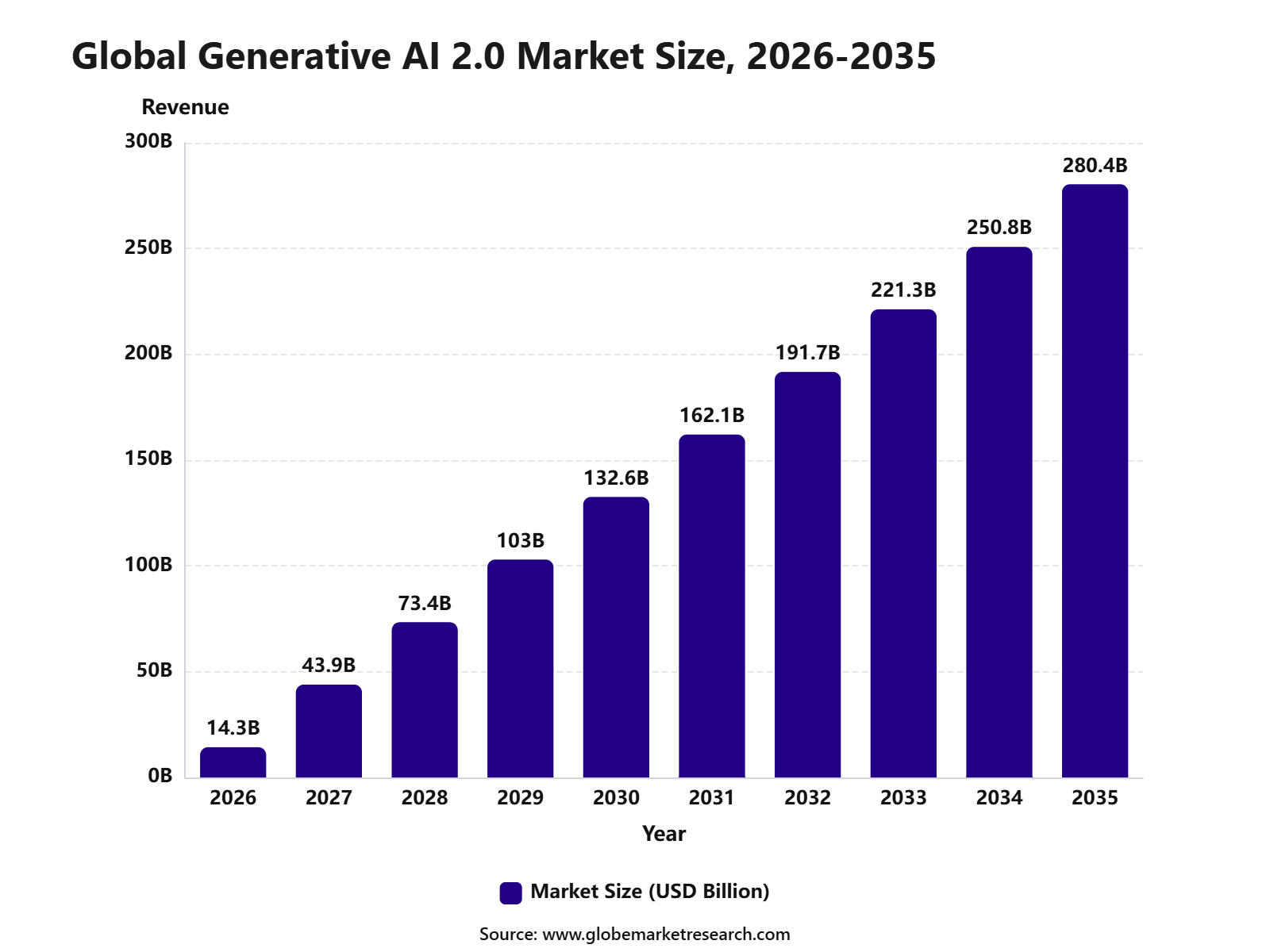 iThe graph shows projected market growth until 2035 based on CAGR analysis. Actual outcomes may vary depending on changing demand, competition, and economic factors.To gain greater insights - request a sample report PDF
Key Market Insights
Software led the offering segment with 58.3% share, supported by strong demand for AI platforms, model development tools, APIs, workflow automation software, and enterprise-ready generative AI applications.
Text-based models accounted for 35.6% share by data modality, driven by wide use in content writing, summarization, translation, coding support, document processing, and conversational AI.
Content creation captured 37.8% share by application, supported by rising adoption of generative AI for marketing copy, images, videos, blogs, product content, and creative production workflows.
Media and entertainment held 28.7% share by industry, driven by growing use of generative AI in digital content production, animation, gaming, advertising, script development, and audience engagement.
Adoption Rate and Usage Statistics
According to the Stanford Institute for Human-Centered Artificial Intelligence, organizational AI adoption reached 88% in 2025, while generative AI reached 53% of the global population within three years. Adoption was particularly strong among university students, with four in five students using generative AI. The UAE and Singapore recorded population adoption rates of 64% and 61%, respectively, indicating strong demand for advanced text, multimodal, reasoning and agent-based AI applications.
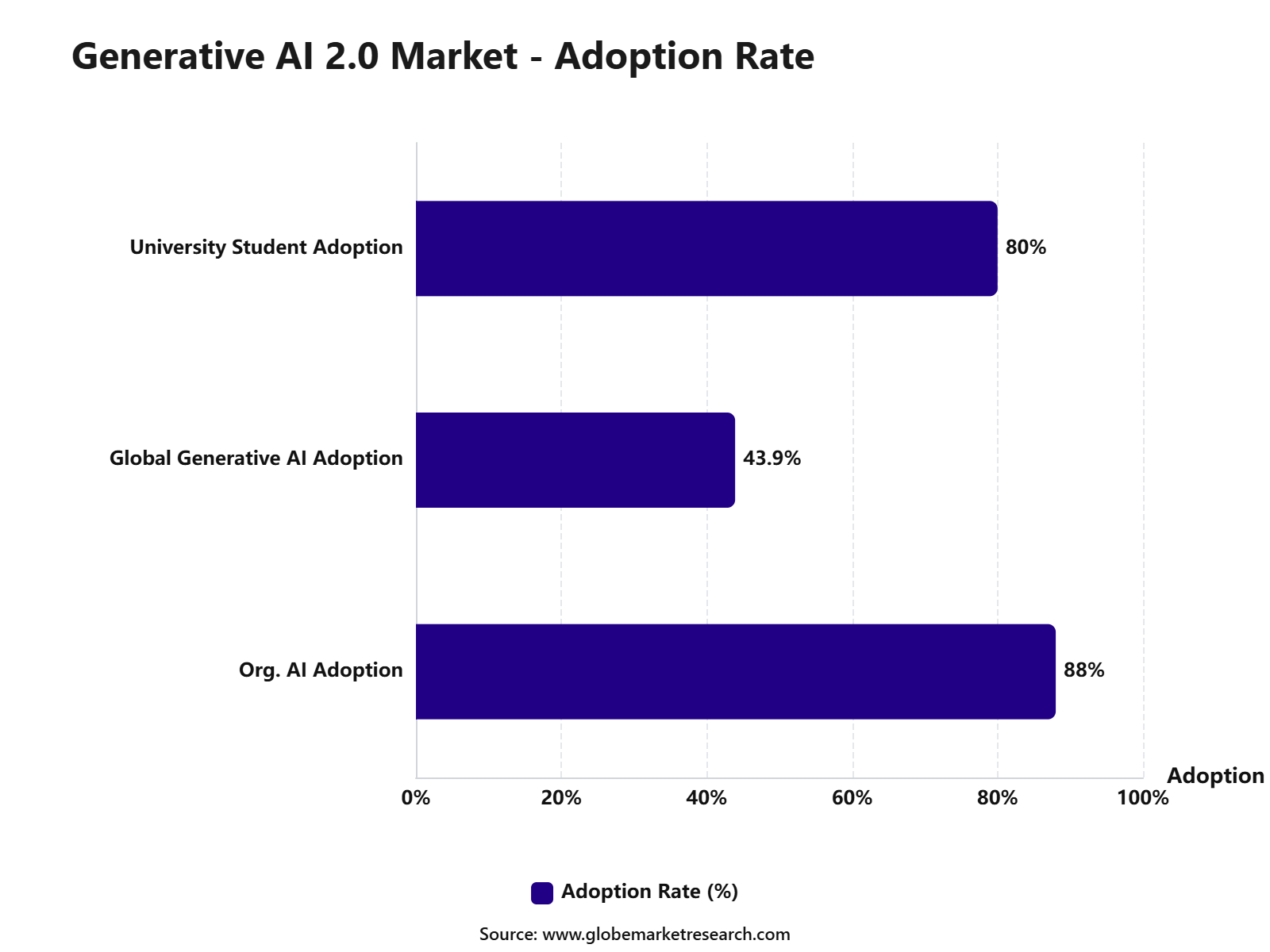 iThe graph shows projected market growth until 2035 based on CAGR analysis. Actual outcomes may vary depending on changing demand, competition, and economic factors.To gain greater insights - request a sample report PDF
According to Meta, Alphabet, Adobe and OpenAI, generative AI platforms are recording substantial consumer and enterprise usage. Meta AI serves more than 1 billion monthly active users, while the Gemini application exceeds 750 million monthly active users. Google’s AI services process more than 980 trillion tokens per month, and Adobe Firefly has generated over 29 billion creative assets. OpenAI also reported that users primarily communicating in languages other than English account for more than half of active ChatGPT users, showing that generative AI usage is becoming increasingly global.
Offering Insights
Software accounted for 58.3% of the Generative AI 2.0 Market by offering. Its leading position is supported by the growing use of AI assistants, content platforms, application programming interfaces, coding tools and enterprise automation systems. Software-based delivery also allows models to be updated frequently without requiring users to replace physical infrastructure.
According to industry survey 2025 global survey, 88% of respondents reported that their organizations were regularly using AI in at least one business function, compared with 78% in the previous survey. According to EY India, 47% of surveyed enterprises had multiple generative AI use cases operating in production, while 91% identified deployment speed as the main factor affecting buy-versus-build decisions.
Demand is moving toward software that can connect with existing business data, applications and employee workflows. Buyers are expected to place greater importance on model accuracy, security, administrative controls and integration flexibility. Software providers must also support human review and clear usage policies as generative AI becomes embedded in important business processes.
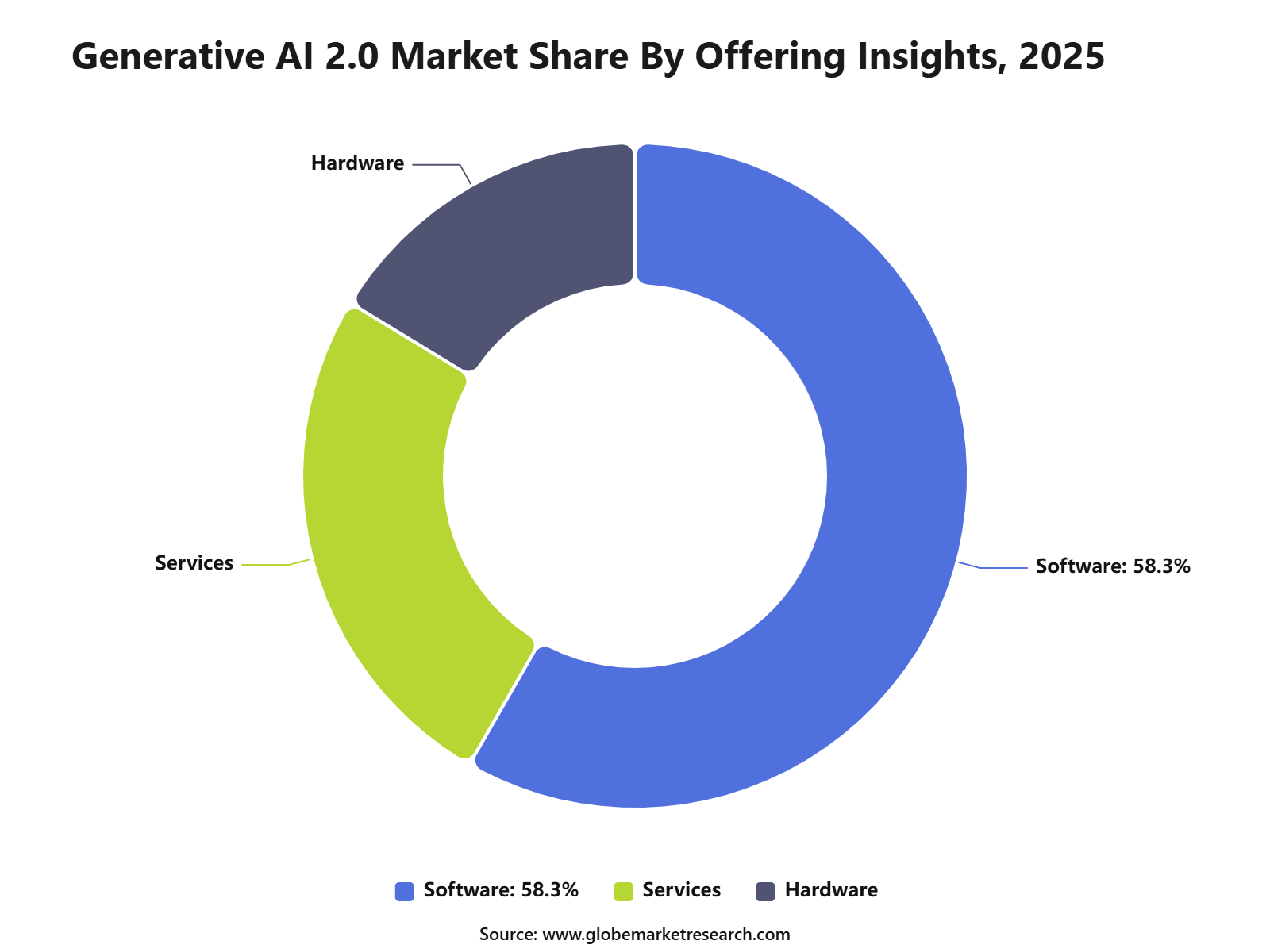 iThe graph shows projected market growth until 2035 based on CAGR analysis. Actual outcomes may vary depending on changing demand, competition, and economic factors.To gain greater insights - request a sample report PDF
Data Modality Insights
Text-based models represented 35.6% of the market by data modality. Text remains the most widely accessible format because users can interact with these systems through natural language without requiring technical skills. Common tasks include writing, summarization, translation, research assistance, document analysis, customer support and code generation.
According to the Higher Education Policy Institute’s 2025 survey, 92% of surveyed students had used an AI tool, with text generation identified as the most common reason for use. According to the same survey, 51% used AI to save time and 50% used it to improve the quality of their work, demonstrating the practical value of text-led interaction.
Text models are also easier to integrate into email, search, office software, learning platforms and customer service systems. Their position will increasingly depend on reasoning quality, multilingual performance and the ability to work with long documents. Competition from image, audio and video models will increase, but text is expected to remain the main interface through which users control multimodal systems.
Application Insights
Content creation held 37.8% of the Generative AI 2.0 Market by application. The segment includes idea development, copywriting, image generation, video editing, audio production, design support and content localization. Generative AI is being adopted because it can reduce the time required to move from an initial concept to a workable draft.
According to Adobe’s 2026 survey of more than 16,000 creators, 75% described creative AI as integrated or essential to their workflow. 93% stated that creative AI helped them produce content faster, although 57% said generated outputs still required moderate or extensive editing before publication.
The strongest demand is expected to come from workflows where AI supports rather than replaces human creativity. Users still need to review factual accuracy, tone, originality and brand consistency before content is published. Platforms that offer editing controls, style customization and clear ownership protections are likely to gain greater trust among professional creators.
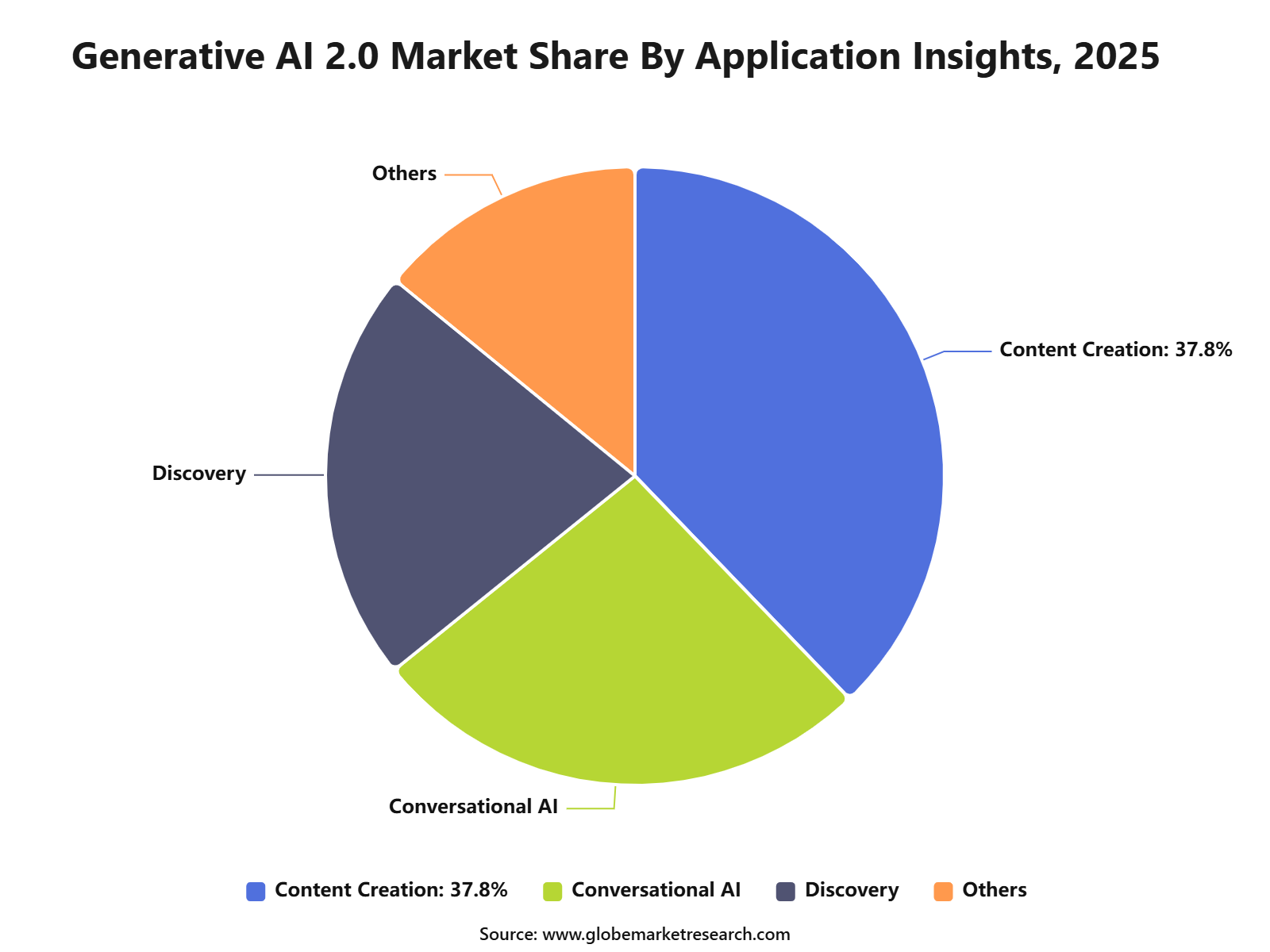 iThe graph shows projected market growth until 2035 based on CAGR analysis. Actual outcomes may vary depending on changing demand, competition, and economic factors.To gain greater insights - request a sample report PDF
Industry Insights
Media and entertainment accounted for 28.7% of the market by industry. The sector generates large volumes of video, audio, images, scripts, advertising material and localized content. Generative AI is being used to support story development, visual effects, content recommendations, dubbing, subtitling and audience personalization.
According to EY research, content development was identified by 92% of surveyed media and entertainment respondents as a leading generative AI application. Product development and design were cited by 69%, while customer engagement was identified by 65%, showing that adoption is spreading across both production and audience-facing activities.
Media organizations must balance faster production with intellectual property protection, content authenticity and audience trust. Human supervision will remain important for creative direction, cultural accuracy and final approval. Clear disclosure practices and stronger rights-management systems will become more important as AI-generated and AI-assisted content becomes more common.
Regional Insights
North America accounted for 45.2% of the Generative AI 2.0 Market. The region’s leadership is supported by advanced cloud infrastructure, high enterprise technology spending and rapid integration of generative AI into software development, customer service, content production and business analysis. Strong research capabilities and access to skilled AI professionals have also supported early commercial deployment.
Around 18% of U.S. businesses had adopted AI by the end of 2025. According to the Federal Reserve Bank of St. Louis, generative AI adoption among U.S. adults reached 54.6% in 2025, while workplace usage increased to 37.4%. These figures show that AI adoption is expanding across both consumer and professional environments.
North American demand is increasingly shifting from experimental tools toward AI systems connected with company data and daily workflows. Data privacy, model accuracy, cybersecurity and regulatory compliance will remain important purchasing factors. Providers that offer secure deployment, transparent model controls and reliable integration with existing business systems are likely to strengthen their regional position.
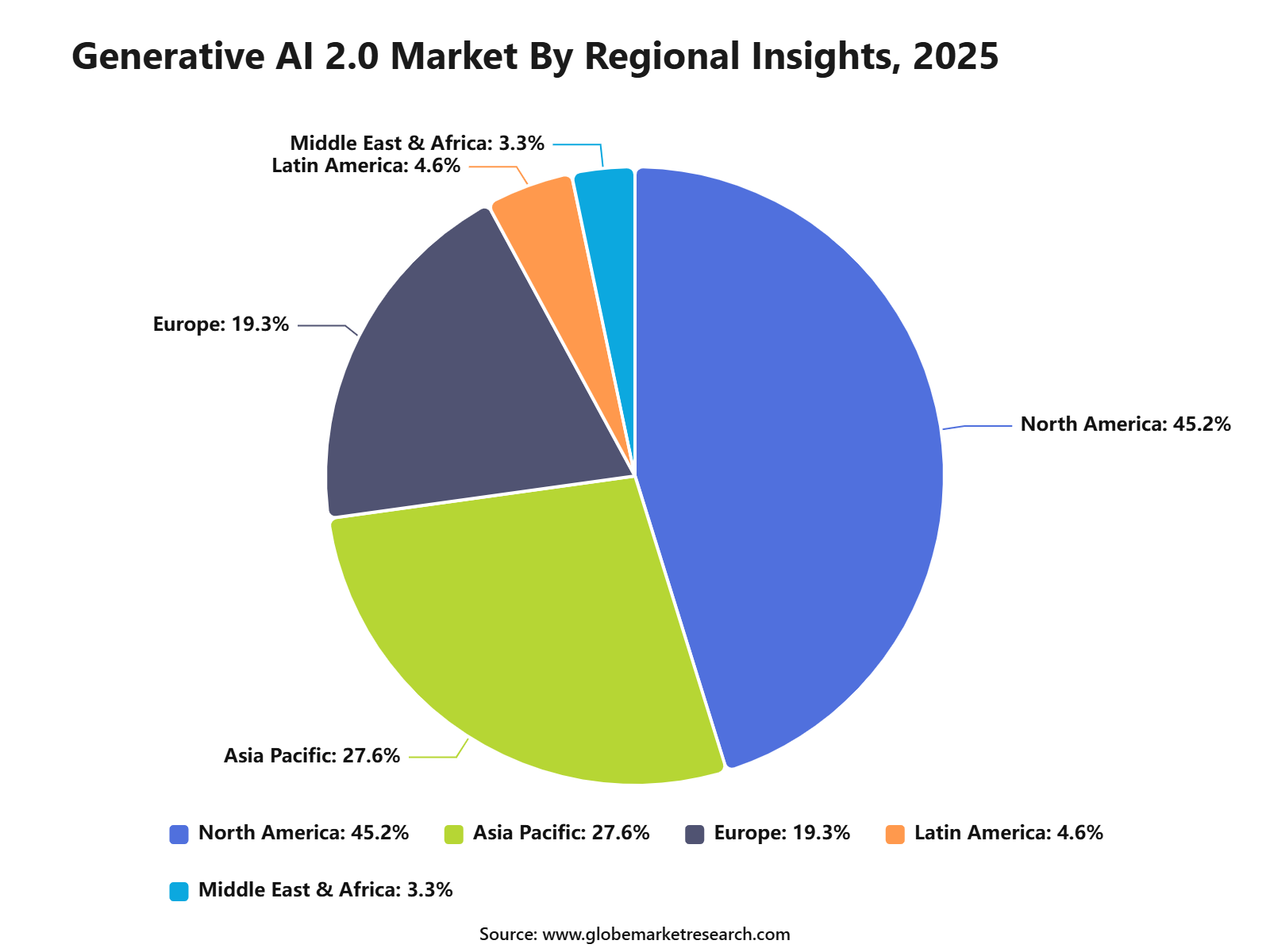 iThe graph shows projected market growth until 2035 based on CAGR analysis. Actual outcomes may vary depending on changing demand, competition, and economic factors.To gain greater insights - request a sample report PDF
Key Market Segments
By Offering
Software
Services
Hardware
By Data Modality
Text
Multimodal
Image
Video
Audio and Speech
Code
By Application
Content Generation
Conversational AI
Product Discovery and Personalization
Code Development
Synthetic Data Creation
By Industry Vertical
Media and Entertainment
Healthcare
BFSI
E-commerce and Retail
Automotive
Marketing and Advertising
Other Industries
By Region
North America
Europe
Asia Pacific
Latin America
Middle East and Africa
Market Dynamics
Drivers Impact Analysis
The Generative AI 2.0 Market is driven by rising enterprise adoption of advanced AI models, multimodal AI, autonomous agents, AI copilots, synthetic content tools, code generation, and personalized digital experiences. Businesses are using generative AI 2.0 to improve productivity, automate workflows, reduce content creation time, and support faster decision-making.
North America leads the market due to strong AI infrastructure, cloud platforms, venture funding, enterprise AI adoption, and the presence of major AI model developers. The U.S. remains the largest contributor because of high investment in foundation models, GPUs, AI applications, enterprise software, and AI-powered productivity tools.
Impact Factor | Estimated CAGR Impact | Regional Relevance | Market Impact |
|---|---|---|---|
Rising enterprise AI adoption | +11.5% | North America, Europe, Asia Pacific | Drives large-scale generative AI deployment. |
Growth in multimodal AI models | +9.8% | U.S., Canada, Europe, China, Japan | Expands text, image, audio, video, and code use cases. |
AI copilots and workflow automation | +8.9% | Enterprise software markets | Improves productivity-led demand. |
Cloud and GPU infrastructure expansion | +7.6% | North America and Asia Pacific | Supports model training and inference. |
Demand for personalized digital content | +6.4% | Media, marketing, retail, education | Builds high-volume application usage. |
Restraints Impact Analysis
The market faces restraints from high computing cost, data privacy concerns, copyright risk, model reliability issues, and enterprise governance challenges. Many organizations are still testing generative AI because accuracy, security, compliance, and return on investment remain important decision factors.
Another restraint is infrastructure dependency. Advanced generative AI 2.0 models require strong cloud capacity, GPUs, model optimization, skilled teams, and secure data pipelines, which can increase adoption cost for small and mid-sized companies.
Impact Factor | Estimated CAGR Impact | Regional Relevance | Market Impact |
|---|---|---|---|
High AI infrastructure cost | -6.8% | Global enterprise markets | Slows adoption among cost-sensitive users. |
Data privacy and security concerns | -5.9% | North America, Europe, regulated sectors | Raises compliance requirements. |
Copyright and content ownership risks | -4.8% | Media, publishing, software, education | Creates legal uncertainty. |
Model hallucination and reliability issues | -4.2% | Enterprise and public-sector users | Limits full automation. |
Shortage of AI-skilled talent | -3.5% | Global technology markets | Delays implementation and scaling. |
Opportunities Impact Analysis
Opportunities are strong in AI agents, enterprise copilots, multimodal content creation, code generation, synthetic data, customer service automation, product discovery, personalization, and industry-specific AI platforms. These applications benefit from rising demand for automation, faster content workflows, and smarter digital interaction.
Higher-value opportunities are emerging in healthcare AI, BFSI workflow automation, e-commerce personalization, marketing automation, education content tools, legal AI assistants, and industrial knowledge management. Companies that combine strong AI models with secure enterprise deployment can capture stronger long-term value.
Impact Factor | Estimated CAGR Impact | Regional Relevance | Market Impact |
|---|---|---|---|
AI agents and autonomous workflows | +11.2% | North America, Europe, Asia Pacific | Creates next-stage automation demand. |
Enterprise copilots | +9.6% | U.S., Canada, UK, Germany, Japan | Builds recurring software revenue. |
Synthetic data generation | +8.1% | Healthcare, finance, automotive, AI labs | Supports model training and privacy use cases. |
AI-powered customer service | +7.2% | Retail, BFSI, telecom, SaaS | Reduces service cost and improves response speed. |
Industry-specific AI platforms | +6.5% | Healthcare, BFSI, manufacturing, education | Adds vertical market growth. |
Challenges Impact Analysis
The main challenge is moving from experimentation to measurable business impact. Companies need clear use cases, quality controls, governance systems, trained teams, and integration with existing software to generate real value. Another challenge is managing trust and risk. Generative AI 2.0 systems must handle sensitive data, explain outputs, reduce bias, protect intellectual property, and meet regulatory expectations across industries.
Impact Factor | Estimated CAGR Impact | Regional Relevance | Market Impact |
|---|---|---|---|
Moving pilots into production | -5.7% | Global enterprise markets | Slows revenue conversion. |
Managing bias and output quality | -4.9% | Regulated and customer-facing sectors | Affects trust and adoption. |
Enterprise integration complexity | -4.3% | Large organizations | Raises implementation cost. |
AI governance and compliance burden | -3.8% | North America and Europe | Requires stronger risk controls. |
Vendor lock-in and model dependency | -3.1% | Cloud and AI platform users | Creates procurement risk. |
Market Trend Analysis
The market trend is moving toward multimodal AI, AI agents, small and specialized models, enterprise copilots, retrieval-augmented generation, domain-specific AI, and secure private AI deployments. Companies are shifting from simple content generation toward AI systems that can reason, interact, search, summarize, generate, and take actions across workflows.
North America remains the largest value region because of strong AI model development, cloud infrastructure, enterprise adoption, and capital investment. Asia Pacific is expanding quickly through AI infrastructure, consumer AI apps, e-commerce use cases, and government-backed AI initiatives.
Impact Factor | Estimated CAGR Impact | Regional Relevance | Market Impact |
|---|---|---|---|
Multimodal AI adoption rises | +10.8% | North America, Europe, Asia Pacific | Expands model use across content types. |
AI agents become mainstream | +9.4% | Enterprise and SaaS markets | Supports autonomous workflow execution. |
Private and secure AI deployment grows | +7.9% | BFSI, healthcare, government, enterprise | Improves trust and compliance. |
Domain-specific models expand | +6.8% | Legal, healthcare, finance, manufacturing | Increases accuracy for specialized tasks. |
Smaller optimized models gain adoption | +5.6% | Edge, enterprise, regulated markets | Lowers inference cost. |
Technology Adoption Analysis
Technology adoption is focused on large language models, multimodal models, transformer architectures, retrieval-augmented generation, vector databases, AI orchestration, model monitoring, fine-tuning, synthetic data, and inference optimization. These technologies help improve accuracy, speed, personalization, and enterprise readiness. Companies are also adopting AI safety systems, guardrails, prompt management, workflow automation tools, model evaluation platforms, and private cloud AI infrastructure. These upgrades support safer deployment and stronger business adoption.
Impact Factor | Estimated CAGR Impact | Regional Relevance | Market Impact |
|---|---|---|---|
Large language model deployment | +10.5% | Global AI software markets | Drives core generative AI usage. |
Retrieval-augmented generation | +8.9% | Enterprise knowledge systems | Improves accuracy and business relevance. |
Multimodal model infrastructure | +7.8% | Media, retail, healthcare, education | Supports richer AI applications. |
Model monitoring and AI guardrails | +6.4% | Regulated and enterprise markets | Improves safe deployment. |
Inference optimization technology | +5.7% | Cloud, edge, enterprise AI | Reduces operating cost. |
Recent Developments
Market News
In February 2026, Anthropic launched Claude Opus 4.6 with improved coding, debugging, computer-use, search, and long-running agentic capabilities. The model introduced a one-million-token context window in beta, allowing it to process larger document collections, codebases, and enterprise knowledge sources.
In March 2026, NVIDIA introduced the AI-Q open agent blueprint, enabling developers to create AI agents that can identify relevant enterprise data, reason across information, select appropriate tools, and explain how answers were generated. NVIDIA also expanded its Nemotron model family across language, vision, voice, reasoning, and safety applications.
In April 2026, OpenAI released GPT-5.5 and GPT-5.5 Pro, followed by API availability on April 24. The model supports a one-million-token context window and is designed for coding, professional knowledge work, computer use, vision, tool use, financial analysis, and complex multi-step tasks.
In May 2026, Google introduced Gemini Omni at Google I/O. The model combines Gemini intelligence with generative media systems and is designed to create outputs from different input formats, beginning with video generation, multimodal understanding, and content editing.
Mergers
In February 2026, OpenAI and Microsoft confirmed the continuation of their strategic relationship. Microsoft retained an important role in providing cloud access to OpenAI models, while the agreement continued to define the companies’ commercial, infrastructure, and intellectual property arrangements.
In March 2026, NVIDIA formed the Nemotron Coalition with AI model developers and technology companies including Black Forest Labs, Cursor, LangChain, Mistral AI, Perplexity, Reflection AI, Sarvam, and Thinking Machines Lab. The coalition is intended to support the development of open frontier models through shared expertise, data, and computing resources.
In April 2026, Meta expanded its partnership with Broadcom to jointly develop multiple generations of custom artificial intelligence chips. The collaboration is intended to improve Meta’s training and inference infrastructure across generative AI, recommendation systems, advertising, and consumer AI services.
Acquisitions
In March 2026, OpenAI announced the acquisition of Promptfoo, an AI security and evaluation platform. Promptfoo’s technology is being integrated into OpenAI Frontier to support automated red-teaming, prompt-injection testing, data-leak detection, compliance reporting, and enterprise agent monitoring.
In March 2026, OpenAI agreed to acquire Astral, the developer of open-source Python tools including uv, Ruff, and ty. The acquisition is intended to strengthen Codex across software planning, code modification, dependency management, testing, verification, and long-term software maintenance.
Funding
In January 2026, xAI completed an upsized USD 20 billion Series E funding round, exceeding its original USD 15 billion target. The company stated that the funding would support model development, computing infrastructure, and the expansion of large GPU clusters.
In February 2026, Anthropic raised USD 30 billion in Series G funding at a USD 380 billion post-money valuation. Anthropic also reported that Claude Code had exceeded USD 2.5 billion in annualized run-rate revenue and that its weekly active users had doubled since the beginning of 2026.
In March 2026, OpenAI closed a funding round with USD 122 billion in committed capital at a USD 852 billion post-money valuation. The investment is expected to support model research, computing capacity, product development, enterprise deployment, and wider API availability.
Competitive Landscape
The market is characterized by intense competition among established players and emerging companies. Strategic partnerships, mergers and acquisitions, and product innovation are key strategies employed by market participants.
Key Market Players
Microsoft
Amazon Web Services (AWS)
Meta Platforms, Inc.
Google (Alphabet / DeepMind)
OpenAI
Anthropic
IBM Corporation
Adobe Inc.
Salesforce, Inc.
Oracle Corporation
SAP SE
Cohere
Other Key Players
Research Methodology
This market study is prepared using a combination of primary and secondary research. Primary research includes discussions with manufacturers, suppliers, distributors, consultants, industry experts, and end users. Secondary research covers company reports, government databases, trade associations, technical publications, regulatory sources, and trusted industry documents. The collected information is used to assess market demand, pricing trends, technology adoption, competitive activity, and regional performance.
AI language models are not used as primary data sources, and publicly available AI-generated content is not treated as market evidence. Computational tools may be used to support data processing, translation, data classification, and pattern identification. However, every published assessment is supported by verified sources, human review, and primary market discussions.
Market estimates are developed through top-down and bottom-up approaches and validated using data triangulation. Revenue, production, shipment, pricing, and application-level data are compared across multiple sources. Forecasts consider economic conditions, regulatory changes, investment activity, innovation, supply chain developments, and industry risks. All findings are reviewed through source verification and internal quality checks before publication.
Part I
Source Management & Input Data Standards
Who provides data, how sources are qualified, and what types of evidence are admissible.
Part II
Research Scope & Market Coverage
How we define the markets we assess and the parameters that govern each product.
Part III
Data Collection, Verification & Submission
The mechanics of gathering, cross-checking, and hierarchically ranking evidence.
Part IV
Assessment Determination & Quality Controls
How raw data becomes a published assessment — normalisation, expert judgement, and outlier exclusion.
Part V
Publication, Corrections & Revision
Our publication schedule, corrections policy, and methodology review cycle.
Part VI
Independence, Ethics & Complaints
Conflict-of-interest policies, editorial independence, and how clients raise concerns.
Google · Preferred Sources
Don't miss the latest market research insights and industry updates on Google.
Add Globe Market Research as a preferred source in the Google app to see our reports, analysis, and market stories in your news suggestions.
Meet the Team
This report was prepared by our expert analysts with deep industry knowledge and research experience.
Prashant S. is a Research Analyst at Globe Market Research with more than four years of experience in market research and industry analysis. He specializes in the Aerospace and Defence, Automotive and Transportation, Semiconductor and Electronics, Information and Technology sectors, with expertise in market sizing, trend analysis, competitive assessment, and industry forecasting. He applies primary and secondary research, data validation, company analysis, and market estimation methods to deliver reliable insights for strategic planning and business decision-making.
Sayali brings more than 7 years of experience to Globe Market Research, supporting the accuracy, clarity, and relevance of research content across multiple industries. She reviews market data, segment analysis, competitive insights, and industry trends to ensure each report meets strong quality standards and provides practical value to business decision-makers. Her expertise spans healthcare, information technology, consumer goods, and diverse cross-industry domains. With a strong focus on data reliability, structured analysis, and clear presentation, Sayali helps ensure that each research output delivers well-reviewed insights for clients, investors, consultants, and industry stakeholders.
Frequently Asked Questions
Related Reports
More in Information and Technology
South Korea Physical AI Market Size to Reach USD 3.6 billion by 2035
South Korea Physical AI Market Size, Share, Trends and Growth Analysis Report By Deployment (On-Device AI, Cloud-Based AI), By Component (Hardware, Software, Services), By Technology (Computer Vision, Speech and Natural Language Processing, Gesture and Movement Recognition, Reinforcement Learning and Control Systems, Other Technologies), By Robot Type (Service Robots, Humanoid and Social Robots, Collaborative Robots, Exoskeletons and Prosthetics, Mobile Robots and Drones, Industrial Robots), By Application (Healthcare, Manufacturing and Automotive, Logistics and Warehousing, Retail and Hospitality, Other Applications), By Technology Trends, Competitive Landscape, Strategic Opportunities and Growth Forecast, 2026-2035
Physical AI Market Size to hit USD 2,129.0 billion by 2035
Physical AI Market Size, Share, Trends and Growth Analysis Report By Component (Hardware, Software, Services), By Technology (Computer Vision, Machine Learning and Deep Learning, Natural Language Processing, Edge AI, Other Technologies), By Product (Robots, Exoskeletons, Autonomous Systems, Smart Appliances), By Application (Automation and Manufacturing, Logistics and Supply Chain, Healthcare, Automotive, Defense and Security, Retail, Education, Other End Uses), By Regional Insights, Technology Trends, Competitive Landscape, Strategic Opportunities and Growth Forecast, 2026-2035
Edtech SaaS Tools Market Size to hit USD 217.6 billion by 2035
EdTech SaaS Tools Market Size, Share, Trends and Growth Analysis Report By Software (Classroom Management Systems, Document Management Systems, Learning and Gamification Platforms, Learning Management Systems, Student Collaboration Systems, Assessment and Analytics Tools, Content Authoring Tools, Other Software), By Sector (Preschool, K-12, Higher Education, Other Education Sectors), By Deployment (Cloud-Based, Hybrid), By End Use (Businesses, Educational Institutions, Individual Learners and Consumers), By Regional Insights, Technology Trends, Competitive Landscape, Strategic Opportunities and Growth Forecast, 2026–2035
Marketing Technology Market Size to Reach USD 3,810.8 billion by 2035
Marketing Technology Market Size, Share, Trends and Growth Analysis Report By Marketing Type (Digital Marketing, Offline Marketing), By Product (Social Media Tools, Content Marketing Tools, Rich Media Tools, Marketing Automation Tools, Data and Analytics Tools, Sales Enablement Tools), By Deployment (Cloud-Based, On-Premises, Other Deployment Models), By Enterprise Type (Large Enterprises, Small and Medium-Sized Enterprises), By Application (IT and Telecommunication, Retail and E-commerce, Healthcare, Media and Entertainment, Sports and Events, BFSI, Real Estate, Other Applications), By Regional Insights, Technology Trends, Competitive Landscape, Strategic Opportunities and Growth Forecast, 2026-2035