

Revenue, 2025
$ 408.1 Mn
Forecast, 2035
$ 621.6 Mn
CAGR, 2025-2035
4.3%
Report Coverage
Global
Market Size and Forecast
The Global Hydrogen Sulfide Scavengers Market reached USD 408.1 million in 2025 and is expected to grow to USD 621.6 million by 2035, registering a CAGR of 4.3% from 2025 to 2035. The market is supported by rising demand for safe handling of sour gas, crude oil, refinery streams, wastewater, and industrial process fluids. Hydrogen sulfide scavengers are widely used to remove or neutralize H₂S, which is toxic, corrosive, and harmful to equipment, workers, and downstream operations. Demand is also increasing as oil and gas operators, refineries, and industrial plants focus on asset protection, odor control, emission reduction, and compliance with safety standards.
North America held the largest regional share of 33.6% in 2025, supported by mature oil and gas production, large shale operations, refinery activity, and strong use of chemical treatment solutions across upstream, midstream, and downstream facilities. The region’s demand is driven by the need to control H₂S in natural gas processing, crude oil production, pipeline transport, storage tanks, and produced water treatment. Market growth is further supported by continued investment in gas processing infrastructure, sour field management, and corrosion prevention technologies. Opportunities are expected to remain steady in non-regenerative scavengers, triazine-based formulations, water treatment, and custom chemical programs for high-H₂S operations.
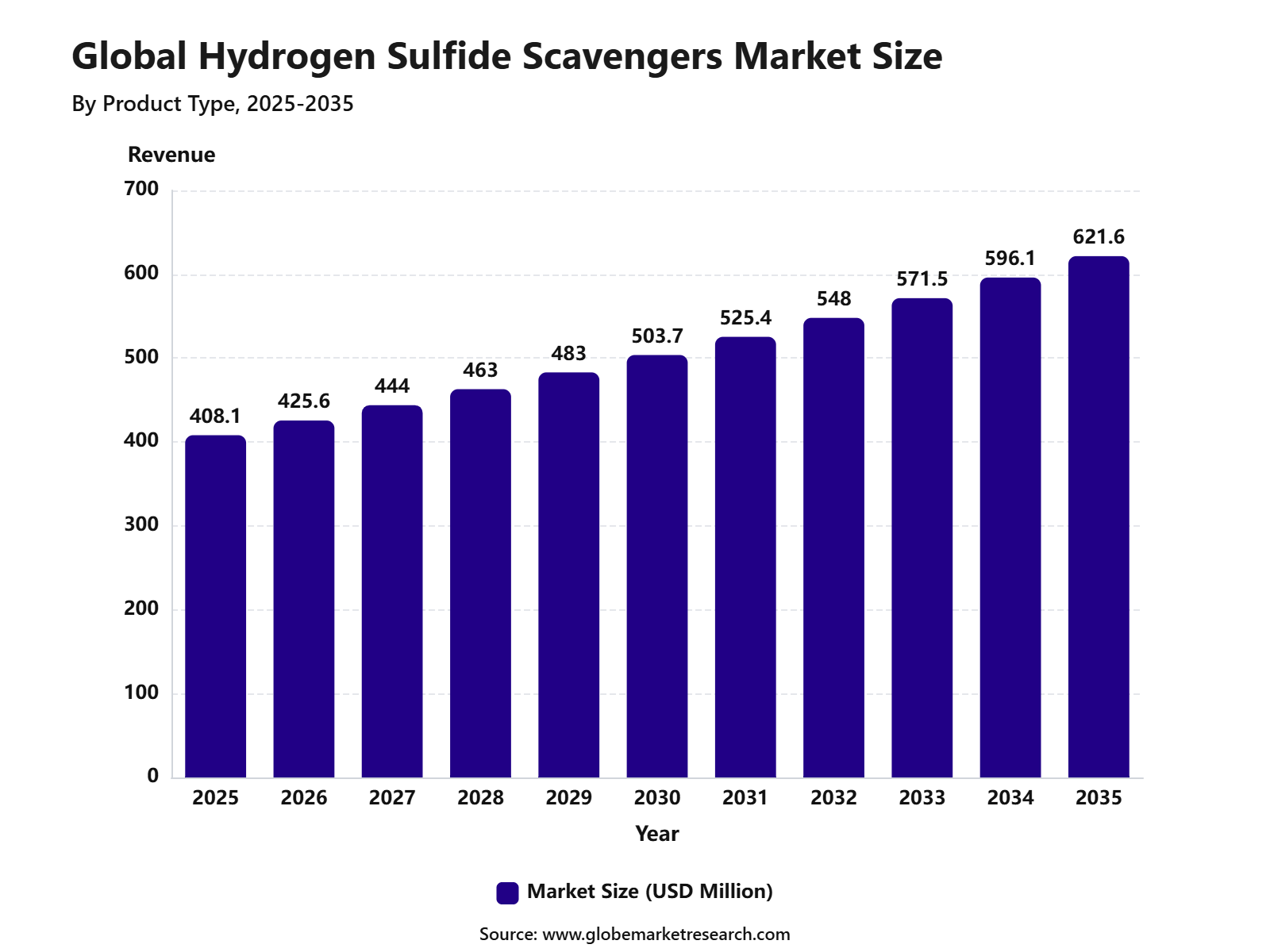 iThe graph shows projected market growth until 2035 based on CAGR analysis. Actual outcomes may vary depending on changing demand, competition, and economic factors.To gain greater insights - request a sample report PDF
Key Market Insights
Non-regenerative hydrogen sulfide scavengers led the product type segment with 55.3% share, supported by their ease of use, lower operational complexity, and strong adoption in field-based H₂S removal applications.
The gas industry accounted for 35.1% share by application, driven by the need to remove hydrogen sulfide from natural gas streams, protect equipment, meet safety standards, and reduce corrosion risks.
North America held 33.6% share of the hydrogen sulfide scavengers market, supported by strong oil and gas production, shale gas activity, pipeline infrastructure, and strict gas treatment requirements.
Market Overview
Hydrogen sulfide scavengers are chemical treatment products used to remove or neutralize H₂S from natural gas, crude oil, refinery streams, produced water, wastewater, and industrial process fluids. Their use is critical because H₂S is highly toxic, corrosive, flammable, and harmful to both workers and equipment. OSHA lists hydrogen sulfide exposure limits of 20 ppm as a general industry ceiling limit and 100 ppm as immediately dangerous to life or health, which shows why continuous control is required in sour gas, oilfield, refinery, and wastewater operations. These safety risks support steady demand for scavenger chemicals in upstream production, midstream pipelines, storage tanks, gas processing plants, refineries, and industrial odor control systems.
The market is also supported by continued oil and gas production, rising gas processing needs, and tighter focus on corrosion control and worker safety. EIA reported that U.S. dry natural gas production reached a record 39 trillion cubic feet in 2025, rising more than 4% from 2024, with growth led by Appalachia, Permian, and Haynesville regions. EIA also noted that marketed natural gas production is forecast to continue increasing in 2026 and 2027, which can raise the need for treatment chemicals where H₂S is present in production and processing streams. Demand is expected to remain strong for non-regenerative scavengers, triazine-based solutions, and customized chemical programs used in high-H₂S and corrosion-sensitive operating environments.
Customer Acquisition Strategy
The go-to-market approach for hydrogen sulfide scavengers should be built around oil and gas production sites, gas processing plants, refineries, wastewater treatment units, biogas facilities, and geothermal operations. The product should be positioned as a safety, compliance, odor control, and corrosion-management solution rather than only as an oilfield chemical. This positioning is important because hydrogen sulfide exposure is tightly controlled, with OSHA listing a 20 ppm ceiling limit for general industry, a 50 ppm peak limit for up to 10 minutes, and NIOSH classifying 100 ppm as immediately dangerous to life or health.
Sales economics are expected to remain usage-based and service-led, as chemical consumption depends on H₂S concentration, gas or liquid volume, water cut, temperature, and process upsets. The demand base is supported by continued U.S. gas activity, as EIA forecasts U.S. marketed natural gas production to grow by 3.3% in 2026 and another 2.5% in 2027, while U.S. dry natural gas production is projected at 111.00 Bcf/d in 2026. For suppliers, better margins can be achieved through field testing, dosage optimization, tank and injection support, safety documentation, and long-term service contracts instead of one-time chemical sales.
Product Type Analysis
Non-regenerative hydrogen sulfide scavengers led the Hydrogen Sulfide Scavengers Market with 55.3% share, supported by their strong use in applications where quick reaction, easy handling, and simple treatment are required. These scavengers are widely used to remove hydrogen sulfide from natural gas, crude oil, produced water, drilling fluids, storage tanks, and refinery streams. The growth of this segment can be attributed to operational convenience and lower system complexity compared with regenerative systems.
Non-regenerative scavengers are often preferred where H2S concentrations are manageable, treatment volumes are moderate, and operators need a practical chemical solution without installing complex recovery units. Demand is expected to remain strong across oilfield operations, gas processing, pipeline treatment, refinery units, and industrial odor control. The segment is also supported by strict worker safety requirements, corrosion control needs, and the need to protect downstream equipment from sour gas exposure.
Application Analysis
The gas industry accounted for 35.1% share of the Hydrogen Sulfide Scavengers Market, making it the leading application segment. Hydrogen sulfide removal is critical in natural gas production, processing, transmission, and storage because sour gas can damage equipment, create safety risks, and reduce gas quality. Growth in this segment is being supported by rising natural gas production, expanding gas processing capacity, and increasing demand for cleaner fuel streams.
H2S scavengers are used to protect pipelines, compressors, amine units, storage systems, and end-use customers from toxic gas exposure and corrosion-related damage. The gas industry is expected to remain a major demand center as operators continue to process sour gas reserves and meet pipeline gas quality standards. Strong demand is likely to continue for fast-acting scavengers, low-corrosion formulations, field-ready chemicals, and treatment solutions that improve operational safety and reduce downtime.
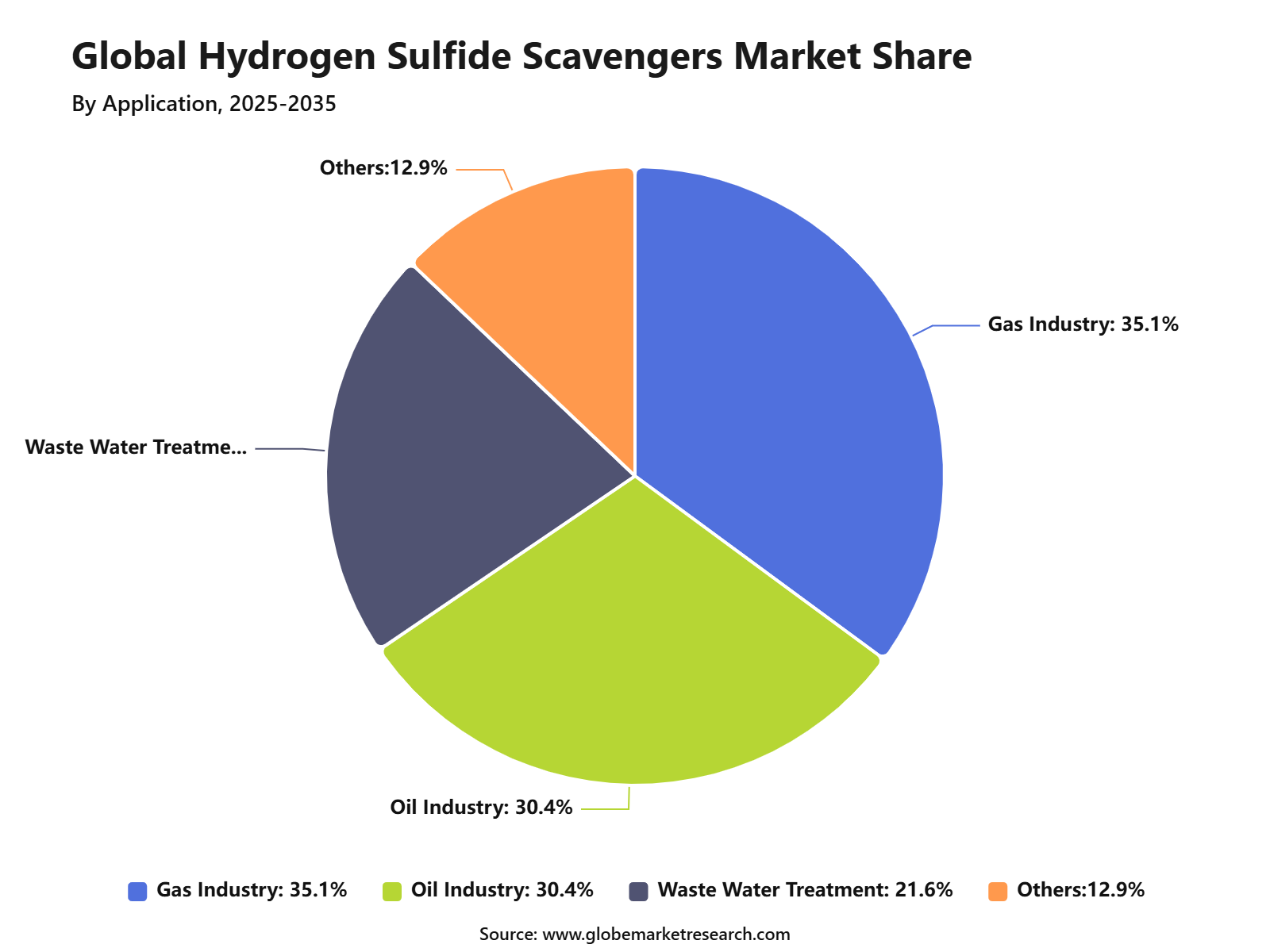 iThe graph shows projected market growth until 2035 based on CAGR analysis. Actual outcomes may vary depending on changing demand, competition, and economic factors.To gain greater insights - request a sample report PDF
Regional Analysis
North America held 33.6% share of the Hydrogen Sulfide Scavengers Market, generating around USD 137.1 million in revenue. The region remained a key market due to large-scale oil and gas production, active shale gas operations, strong refining capacity, and strict workplace safety standards for sour gas handling.
The growth of the region can be attributed to rising demand for H2S removal in natural gas processing, crude oil production, pipeline treatment, storage systems, and refinery operations. Hydrogen sulfide scavengers are widely used to reduce toxicity risks, protect workers, prevent corrosion, and maintain required gas quality standards.
Region | Market Share (%) |
|---|---|
North America | 33.6% |
Asia Pacific | 24.2% |
Europe | 18.7% |
Middle East & Africa | 15.2% |
Latin America | 8.0% |
The U.S. continued to be the major contributor within North America, supported by record natural gas production and strong activity across key producing basins. Demand is expected to remain steady as operators focus on safer sour gas treatment, lower-corrosion chemical formulations, regulatory compliance, and operational reliability across upstream, midstream, and downstream assets.
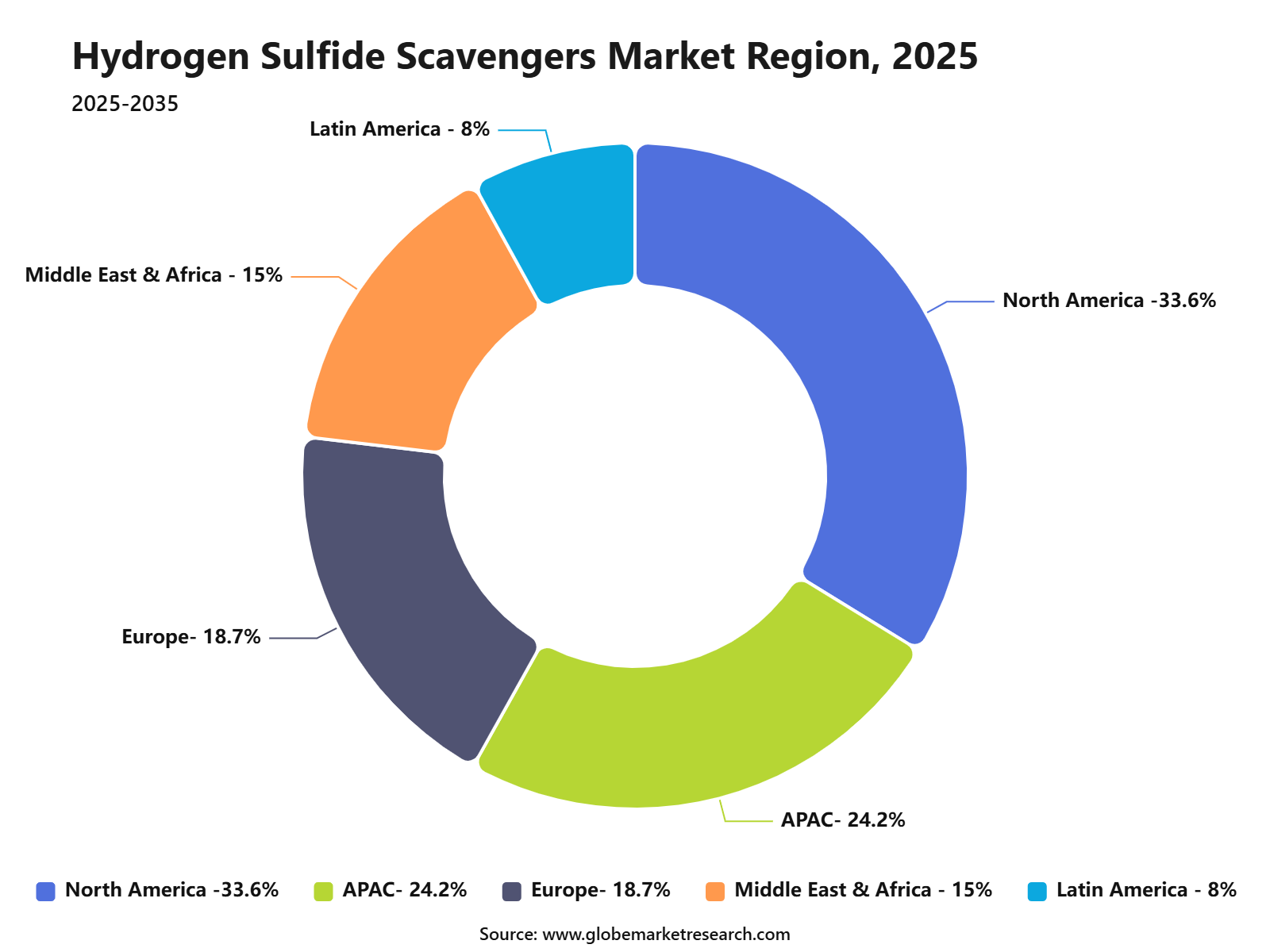 iThe graph shows projected market growth until 2035 based on CAGR analysis. Actual outcomes may vary depending on changing demand, competition, and economic factors.To gain greater insights - request a sample report PDF
Segment covered in the Report
By Product Type
Regenerative
Non-Regenerative
By Application
Gas Industry
Others
By Region
North America
Asia Pacific
Europe
Middle East & Africa
Latin America
Risk Factors & Market Barriers
Regulatory & Compliance Risks
Hydrogen sulfide scavenger suppliers face high compliance risk because the product is linked to toxic gas control, worker safety, air emissions, wastewater odor, corrosion prevention, and chemical handling. In the U.S., OSHA lists a 20 ppm ceiling exposure limit for hydrogen sulfide, with a 50 ppm peak exposure allowed only once for up to 10 minutes when no other measurable exposure occurs during the work shift. NIOSH also lists hydrogen sulfide at 100 ppm as immediately dangerous to life or health, which makes incorrect dosing, weak monitoring, or poor field handling a serious operational and legal risk.
Compliance pressure is also rising because oil and gas operations are being monitored more closely for methane, volatile organic compounds, and other harmful emissions. EPA’s oil and gas rule framework covers new, modified, reconstructed, and existing sources, while a 2026 EPA action also shows that technical provisions in the rule remain under active review after industry petitions. For hydrogen sulfide scavenger vendors, this creates a mixed risk: tighter emissions control can increase demand, but changing rules can delay customer approvals, increase documentation needs, and raise testing costs before commercial adoption.
Market Adoption Barriers
Market adoption is restricted by chemical performance uncertainty, site-specific dosing requirements, and operator concerns over byproducts. A scavenger that performs well in one sour gas field may not perform the same way in another field because H₂S load, water cut, pH, temperature, residence time, flow rate, and hydrocarbon composition can vary significantly. This makes field trials, compatibility checks, lab validation, and corrosion testing necessary before larger contracts are approved, which lengthens the sales cycle and increases pre-sales cost.
Another key barrier is customer resistance to switching from established triazine-based or regenerative systems to newer formulations. Operators tend to be cautious because failed H₂S control can create safety shutdowns, odor complaints, asset corrosion, and off-spec gas or crude. Adoption is expected to improve where suppliers can prove lower dosage rates, reduced solids formation, better environmental profile, and lower total treatment cost. Recent U.S. upstream activity supports testing opportunities, as active U.S. oil and gas rigs reached 563 in the week ended June 18, 2026, up 2% from a year earlier, with 433 oil rigs and 122 gas rigs active.
Drivers Impact Analysis
Impact Factor | Estimated CAGR Impact | Regional Relevance | Market Impact |
|---|---|---|---|
Rising demand from oil and gas production | +1.2% | North America, Middle East, Asia Pacific | Drives core consumption. |
Increasing need for gas sweetening | +1.0% | U.S., GCC, China, India | Supports treatment demand. |
Strict workplace safety requirements | +0.8% | North America, Europe, developed Asia | Increases chemical use. |
Growth in sour gas and crude processing | +0.7% | Middle East, North America, Latin America | Expands scavenger demand. |
Rising focus on corrosion prevention | +0.6% | Global energy and industrial sites | Protects equipment life. |
Restraints Impact Analysis
Impact Factor | Estimated CAGR Impact | Regional Relevance | Market Impact |
|---|---|---|---|
Volatility in oil and gas activity | -0.8% | Global | Affects product demand. |
High chemical handling and disposal cost | -0.6% | North America, Europe | Raises operating burden. |
Environmental concerns over chemical use | -0.5% | Europe, North America | Pressures formulations. |
Price sensitivity among end users | -0.4% | Emerging markets | Limits premium adoption. |
Availability of alternative treatment methods | -0.4% | Developed energy markets | Reduces chemical dependence. |
Opportunities Impact Analysis
Impact Factor | Estimated CAGR Impact | Regional Relevance | Market Impact |
|---|---|---|---|
Expansion of non-regenerative scavengers | +1.1% | North America, Middle East, Asia Pacific | Supports field-level treatment. |
Growth in natural gas processing | +0.9% | U.S., Qatar, Saudi Arabia, Australia | Increases treatment use. |
Demand from refining and petrochemical plants | +0.8% | Asia Pacific, GCC, North America | Supports industrial adoption. |
Development of low-toxicity formulations | +0.7% | Europe, North America, Japan | Improves regulatory fit. |
Expansion in offshore oil and gas operations | +0.6% | Gulf of Mexico, North Sea, Middle East | Builds specialized demand. |
Recent Developments
In June 2026, Merichem Technologies reported successful field trial results for its ECOTREAT hydrogen sulfide removal process in the Permian Basin. The technology achieved sustained removal of more than 99% of H2S gas without producing solid waste, using an aqueous catalytic process that converts H2S into thiosulfate. The trial was conducted for one month in the Delaware Basin and handled H2S concentrations up to 2%, which shows rising demand for advanced sour gas treatment solutions in oil and gas production.
In September 2025, MPLX closed its acquisition of Northwind Midstream, strengthening sour gas treating and processing capacity in the Delaware Basin. The acquired system included more than 200,000 dedicated acres, over 200 miles of gathering pipelines, two operating acid gas injection wells, and 150 MMcf/d of sour gas treating capacity. Expansion work is expected to raise capacity to 440 MMcf/d in the second half of 2026, supporting stronger demand for H2S management infrastructure.
Report Scope
Report Highlights | Details |
|---|---|
Market Revenue (2025) | USD 408.1 Million |
Forecast Revenue (2035) | USD 621.6 Million |
CAGR (2025-2035) | 4.3% |
Base Year for Estimation | 2025 |
Historic Data | 2020-2024 |
Forecast Period | 2025-2035 |
Report Coverage | AI market impact analysis, market surveys, trade analysis, Industry & competitive intelligence, Revenue projections, company positioning, competitive analysis, growth drivers, and emerging market trends, Strategic Consultation & Advisory Services |
Segments Covered | By Product Type (Regenerative, Non-Regenerative), By Application (Gas Industry , Oil Industry, Waste Water Treatment, Others) |
Regional Analysis | North America - US, Canada; Europe - Germany, France, The UK, Spain, Italy, Russia, Netherlands, Rest of Europe; Asia Pacific - China, Japan, South Korea, India, New Zealand, Singapore, Thailand, Vietnam, Rest of Latin America; Latin America - Brazil, Mexico, Rest of Latin America; Middle East & Africa - South Africa, Saudi Arabia, UAE, Rest of MEA |
Key companies profiled | SUEZ, Schlumberger Limited, Arkema Group, NuGenTec, Dorf-Ketal, Halliburton, Paqell BV, NALCO Water, ChemTreat, Inc., Merichem Company, CARADAN CHEMICALS INTERNATIONAL |
Customization Scope | Tailored insights for specific regions, countries, and market segments can be provided. Additional report customization is available upon request. |
Competitive Landscape
The market is characterized by intense competition among established players and emerging companies. Strategic partnerships, mergers and acquisitions, and product innovation are key strategies employed by market participants.
Key Market Players
SUEZ
Schlumberger Limited
Arkema Group
NuGenTec
Dorf-Ketal
Halliburton
Paqell BV
NALCO Water
ChemTreat, Inc.
Merichem Company
CARADAN CHEMICALS INTERNATIONAL
Research Methodology
This market study is prepared using a combination of primary and secondary research. Primary research includes discussions with manufacturers, suppliers, distributors, consultants, industry experts, and end users. Secondary research covers company reports, government databases, trade associations, technical publications, regulatory sources, and trusted industry documents. The collected information is used to assess market demand, pricing trends, technology adoption, competitive activity, and regional performance.
AI language models are not used as primary data sources, and publicly available AI-generated content is not treated as market evidence. Computational tools may be used to support data processing, translation, data classification, and pattern identification. However, every published assessment is supported by verified sources, human review, and primary market discussions.
Market estimates are developed through top-down and bottom-up approaches and validated using data triangulation. Revenue, production, shipment, pricing, and application-level data are compared across multiple sources. Forecasts consider economic conditions, regulatory changes, investment activity, innovation, supply chain developments, and industry risks. All findings are reviewed through source verification and internal quality checks before publication.
Part I
Source Management & Input Data Standards
Who provides data, how sources are qualified, and what types of evidence are admissible.
Part II
Research Scope & Market Coverage
How we define the markets we assess and the parameters that govern each product.
Part III
Data Collection, Verification & Submission
The mechanics of gathering, cross-checking, and hierarchically ranking evidence.
Part IV
Assessment Determination & Quality Controls
How raw data becomes a published assessment — normalisation, expert judgement, and outlier exclusion.
Part V
Publication, Corrections & Revision
Our publication schedule, corrections policy, and methodology review cycle.
Part VI
Independence, Ethics & Complaints
Conflict-of-interest policies, editorial independence, and how clients raise concerns.
Google · Preferred Sources
Don't miss the latest market research insights and industry updates on Google.
Add Globe Market Research as a preferred source in the Google app to see our reports, analysis, and market stories in your news suggestions.
Meet the Team
This report was prepared by our expert analysts with deep industry knowledge and research experience.
Pratiksha K. is a Senior Research Analyst with more than five years of experience in market research, industry analysis, competitive intelligence, and business strategy. She has contributed to detailed market reports, customized research studies, company profiling, market sizing, trend analysis, and strategic consulting projects for clients across different regions. Her industry expertise covers Chemical and Material, Consumer Goods, Food & Beverages and Energy & Power. She closely evaluates changing customer requirements, technology developments, regulatory conditions, supply chain structures, investment activity, and competitive strategies to provide clear and practical market insights.
Sayali brings more than 7 years of experience to Globe Market Research, supporting the accuracy, clarity, and relevance of research content across multiple industries. She reviews market data, segment analysis, competitive insights, and industry trends to ensure each report meets strong quality standards and provides practical value to business decision-makers. Her expertise spans healthcare, information technology, consumer goods, and diverse cross-industry domains. With a strong focus on data reliability, structured analysis, and clear presentation, Sayali helps ensure that each research output delivers well-reviewed insights for clients, investors, consultants, and industry stakeholders.
Frequently Asked Questions
Related Reports
More in Chemical and Material
Sulfuric Acid Market to Hit USD 61.5 Billion by 2035
Sulfuric Acid Market Size, Share, Analysis By Raw Material (Elemental Sulfur, Base Metal Smelters, Pyrite Ore, Others), By Application (Fertilizers, Chemical Manufacturing, Metal Processing, Petroleum Refining, Textile, Automotive, Pulp and Paper, Others), By Distribution Channel (Direct Sales, Distributors), By Regional Insights, Business plan and Project Report, Investment Opportunities, Profitability, Industry Trends, Leading Companies and Growth Forecasts by 2026-2035
Powder Metallurgy Market to Hit USD 17.0 Billion by 2035
Powder Metallurgy Market Size, Share, Analysis By Material (Ferrous Metals, Non-Ferrous Metals, Others), By Process (Additive Manufacturing, Powder Metal Hot Isostatic Pressing, Conventional Powder Metallurgy), By Application (Automotive, Aerospace and Defense, Healthcare, Electrical and Electronics, Industrial Machinery, Others) , By Regional Insights, Business plan and Project Report, Investment Opportunities, Profitability, Industry Trends, Leading Companies and Growth Forecasts by 2026-2035
Bromine Market to Hit USD 1.5 Billion by 2035
Bromine Market Size, Share, Analysis By Derivative (Organobromine, Clear Brine Fluids, Hydrogen Bromide, Others), By Application (Flame Retardants, Oil and Gas Drilling, Biocides, PTA Synthesis, Plasma Etching, Pharmaceuticals, Energy Storage, Others), By End-Use Industry (Chemicals, Oil and Gas, Pharmaceuticals, Electrical and Electronics, Automotive, Agriculture, Others), By Regional Insights, Business plan and Project Report, Investment Opportunities, Profitability, Industry Trends, Leading Companies and Growth Forecasts by 2026-2035
Hydrogen Cyanide Market to Hit USD 5.95 Billion by 2035
Hydrogen Cyanide Market Size, Share, Analysis By Product Form (Hydrogen Cyanide Liquid, Hydrogen Cyanide Gas), By Application (Adiponitrile, Acetone Cyanohydrin, Sodium Cyanide and Potassium Cyanide, Methionine, Cyanuric Chloride, Others), By End-Use Industry (Chemicals, Mining and Metallurgy, Pharmaceuticals, Agriculture, Textiles, Others), By Regional Insights, Business plan and Project Report, Investment Opportunities, Profitability, Industry Trends, Leading Companies and Growth Forecasts by 2026-2035