

Revenue, 2026
USD 6.0 Bn
Forecast, 2035
USD 22.1 Bn
CAGR, 2026-2035
15.5%
Report Coverage
Global
Market Size and Forecast
Recipe apps provide step-by-step cooking instructions, meal planning, ingredient management, nutritional guidance and personalised food recommendations through smartphones, tablets and connected kitchen devices. Platforms are increasingly adding artificial intelligence, voice guidance, instructional videos, dietary filters, shopping-list creation and grocery delivery integration. These features help users discover recipes based on available ingredients, health goals, food preferences, preparation time and household budgets.
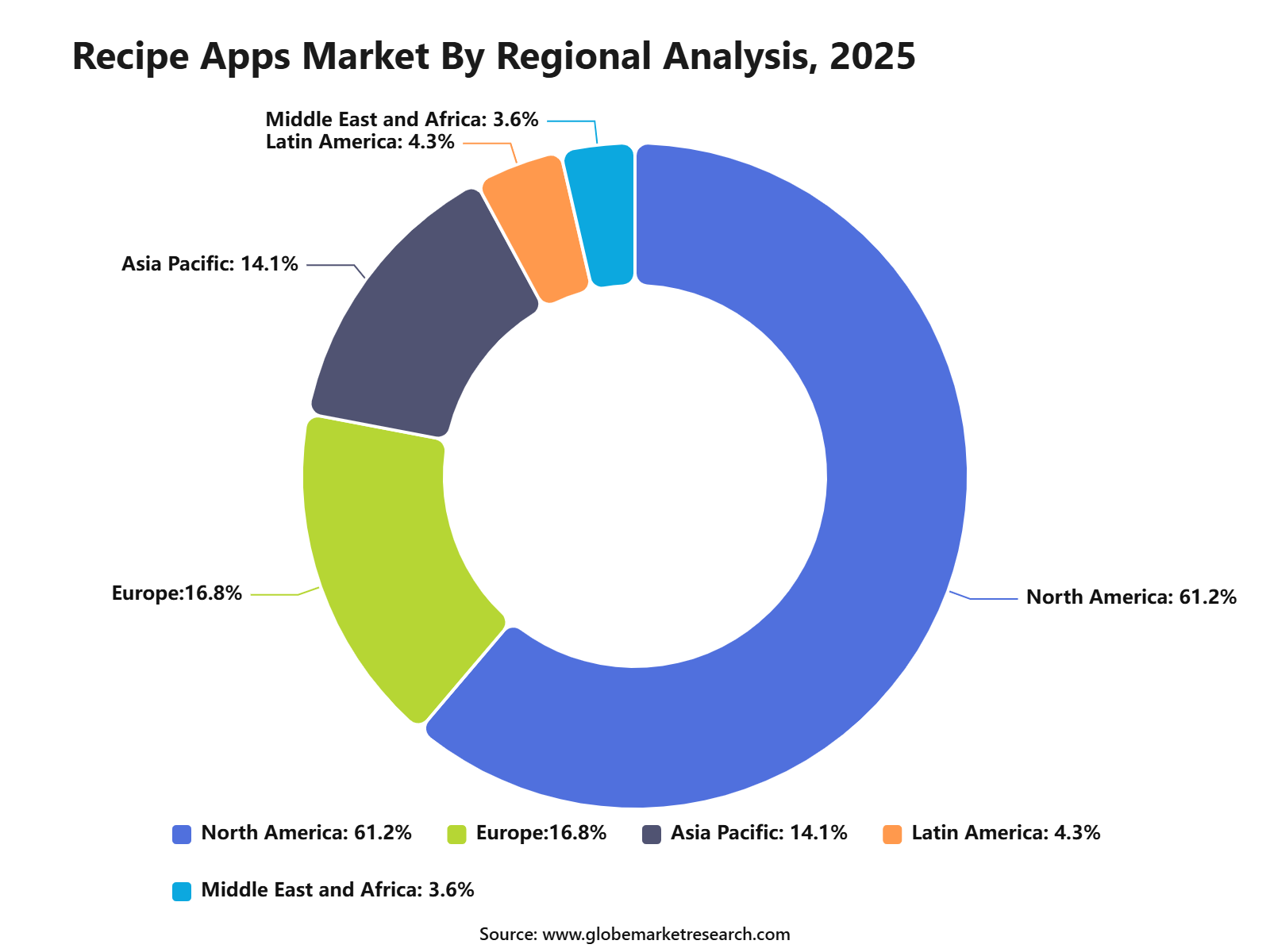
According to Globe Market Research, the global Recipe Apps Market was valued at USD 6.0 billion in 2026 and is projected to reach approximately USD 22.1 billion by 2035, growing at a CAGR of 15.5% from 2026 to 2035. North America accounted for around 61.2% of the market, equivalent to approximately USD 3.7 billion at the stated 2026 value. Regional leadership is supported by high smartphone usage, established app-subscription models, strong interest in home cooking and widespread integration between recipe platforms, grocery retailers and food-delivery services.
Key Parameter | Report Details |
|---|---|
Market Revenue, 2026 | USD 6.0 Billion |
Projected Revenue, 2035 | USD 22.1 Billion |
CAGR, 2026-2035 | 15.5% |
Largest Region | North America, 61.2% Share |
Market Concentration | Medium |
Base Year | 2025 |
Forecast Period | 2026-2035 |
Digital meal planning and personalised nutrition are becoming important adoption drivers. PwC’s 2025 consumer survey found that 47% of respondents were comfortable using generative AI for meal planning and menu suggestions, while 45% supported AI-generated nutrition and diet plans. Around 33% were willing to connect AI with smart kitchen appliances to receive recipes based on ingredients already available at home. The same research found that 70% used at least one healthcare app or wearable device, indicating wider acceptance of technology-supported health, nutrition and lifestyle management.
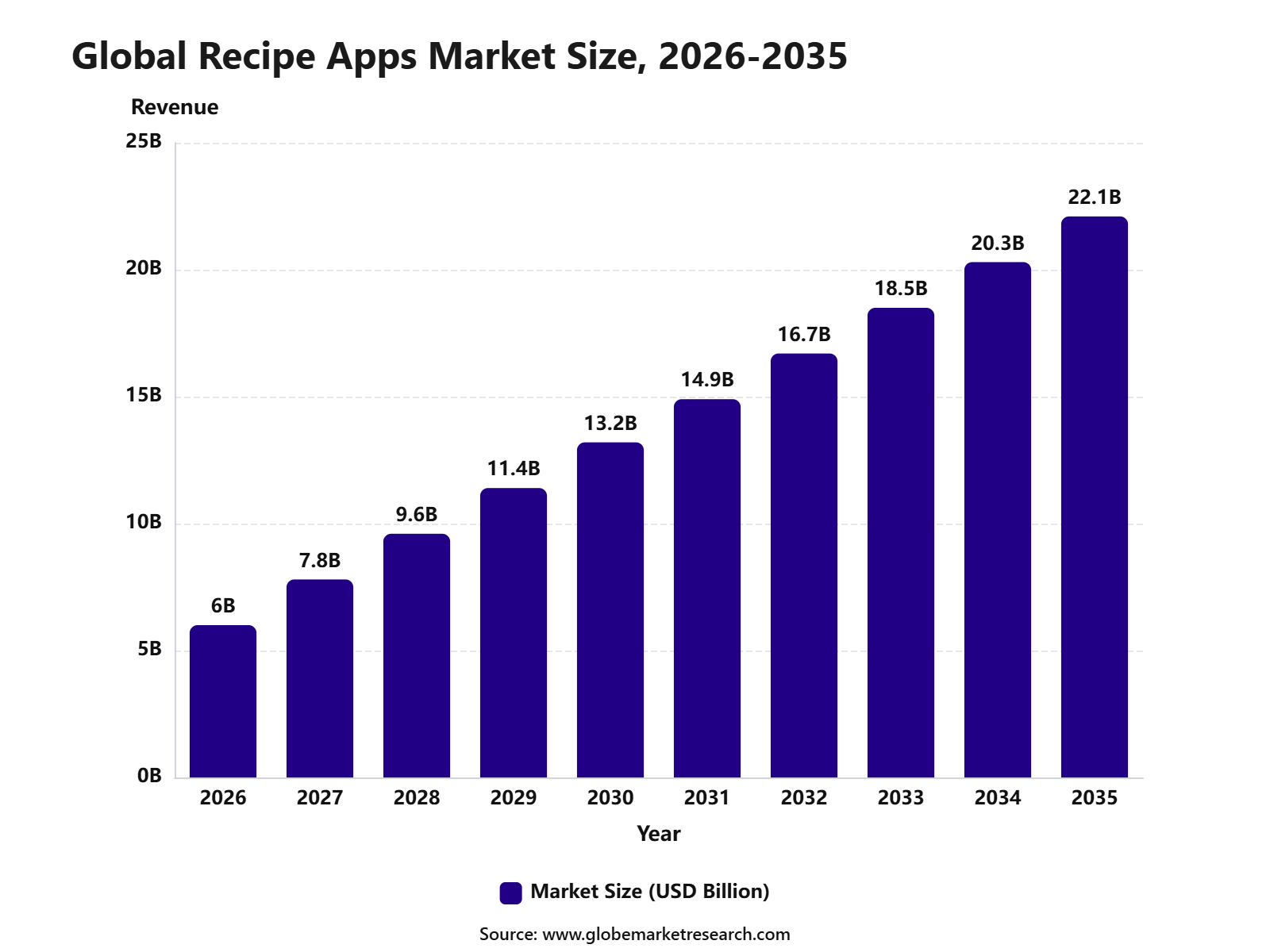 iThe graph shows projected market growth until 2035 based on CAGR analysis. Actual outcomes may vary depending on changing demand, competition, and economic factors.To gain greater insights - request a sample report PDF
Key Market Insights
Subscription-based revenue models led the market with 39.9% share, supported by premium meal plans, personalized recipes, ad-free access, grocery list tools, nutrition tracking, and paid cooking content.
Smartphones accounted for 47.2% share by device type, driven by easy mobile access, app-based meal planning, quick recipe search, grocery shopping support, and kitchen-friendly usage.
American cuisine held 30.5% share, supported by strong demand for everyday meals, comfort food recipes, quick-prep dishes, and high user engagement across North American audiences.
Vegan recipes captured 20.2% share by dietary restrictions, driven by rising interest in plant-based diets, health-focused eating, sustainability, and allergen-friendly meal options.
Meal planning led the purpose segment with 36.6% share, supported by demand for weekly menus, grocery lists, calorie tracking, family meal organization, and budget-friendly cooking.
North America led the recipe app market with 61.2% share, supported by high smartphone penetration, strong subscription app usage, mature digital food platforms, and rising demand for personalized meal planning.
Impact of Agentic AI on the Recipe Apps Market
Agentic AI is transforming recipe apps from searchable content libraries into proactive cooking assistants that can plan meals, recognise available ingredients, adjust portions, accommodate dietary preferences, prepare shopping lists and coordinate grocery purchases. A 2025 survey of more than 20,000 consumers across 28 markets found that 47% were comfortable allowing AI to support meal planning and menu suggestions.
In addition, 45% accepted personalised nutrition plans, 41% supported AI-based food budgeting, 36% accepted predictive grocery lists and 33% were comfortable connecting AI with smart kitchen appliances. These behaviours support the development of recipe apps that manage the complete journey from meal discovery to ingredient purchasing and cooking guidance. The commercial impact will be reflected in stronger user retention, premium subscriptions, grocery affiliate revenue and partnerships with retailers, nutrition platforms and connected-appliance providers.
However, autonomous recommendations create risks related to allergens, incorrect quantities, unsafe substitutions, nutritional accuracy and cooking temperatures. A 2025 cooking-planning study found that an LLM combined with a recipe-verification network successfully executed four of five cooking plans, compared with only one of five plans produced by an LLM without verification. Although the study focused on robotic cooking, the result indicates that recipe apps should validate ingredients, measurements, temperatures and preparation sequences before agent-generated instructions are presented to users
Adoption Rate and Usage Statistics
According to The Guardian, Nextin Research, and Qlik, recipe apps are increasingly being adopted for cooking inspiration, weekly meal planning, dietary management, and AI-supported food preparation. Around 76% of Guardian Feast users access the app for recipe inspiration, while 38% use it for quick weeknight meal planning. Recipe websites and apps are also used by 41% of surveyed consumers participating in weight-management programs or using GLP-1 treatments.
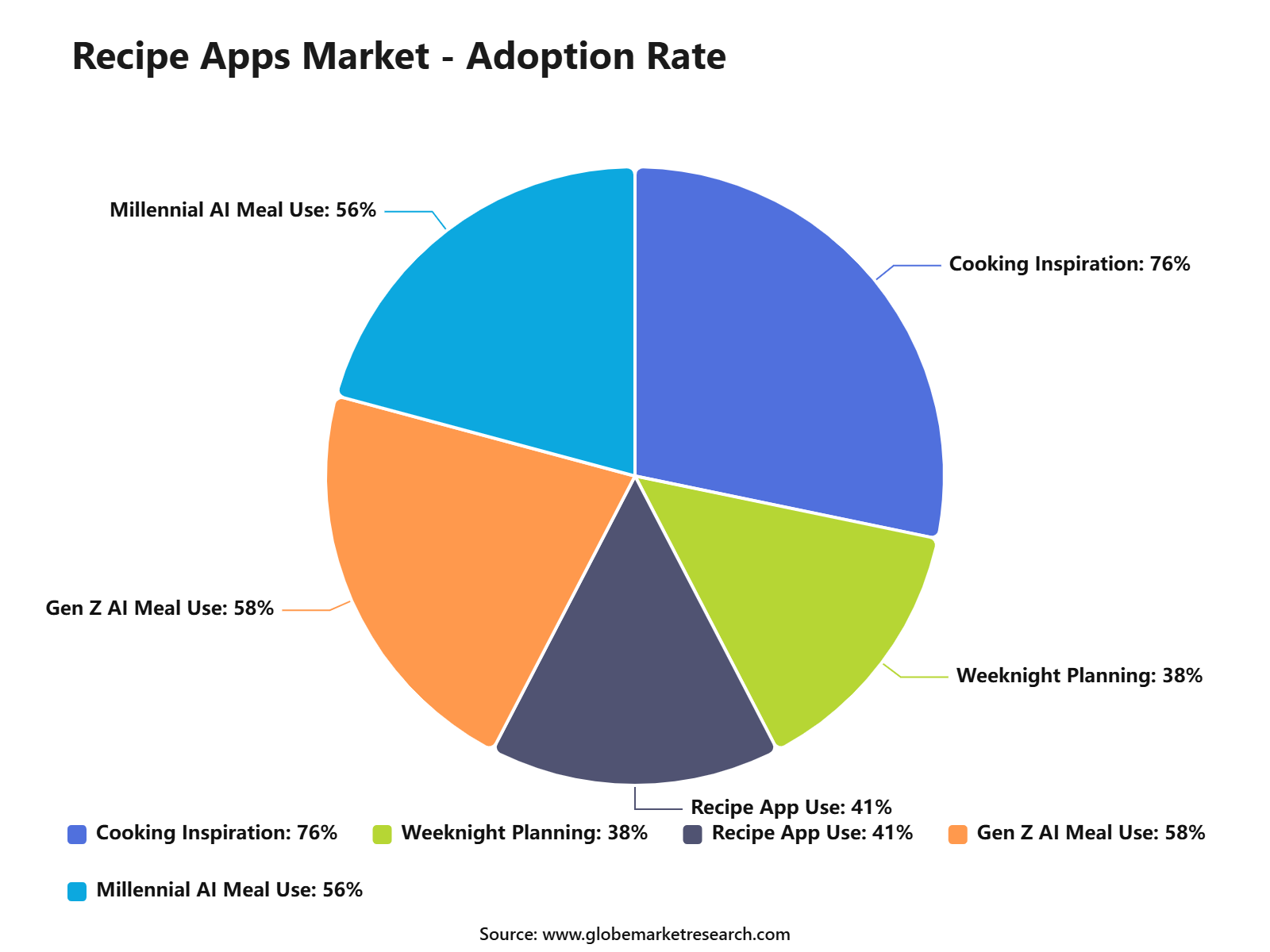 iThe graph shows projected market growth until 2035 based on CAGR analysis. Actual outcomes may vary depending on changing demand, competition, and economic factors.To gain greater insights - request a sample report PDF
According to Samsung, The Guardian, and Plan to Eat, recipe apps are developing into integrated platforms for recipe discovery, meal scheduling, grocery-list creation, and personalized nutrition. Samsung Food has attracted more than six million users, while the Feast app provides over 6,000 recipes from 150 chefs and adds approximately 100 recipes each month. Plan to Eat users reported a 47.5% reduction in time spent on meal planning and grocery shopping.
Metric | Usage Value |
|---|---|
Samsung Food Users | Over 6 million |
Feast Recipes | Over 6,000 |
Featured Chefs | 150 chefs |
Monthly Recipe Additions | Around 100 recipes |
Planning Time Reduction | 47.5% |
Revenue Model Insights
Subscription-based services accounted for 39.9% of the Recipe App Market by revenue model. This model provides recurring access to premium recipes, personalized meal plans, nutritional guidance, shopping lists and ad-free browsing. Monthly and annual plans also allow applications to update content regularly and build longer relationships with active users.
RevenueCat’s 2026 subscription study analyzed more than 115,000 applications. Trials lasting 17 to 32 days achieved a median conversion rate of 42.5%, compared with 25.5% for trials shorter than four days. These findings show that users require enough time to test recipe libraries and meal-planning features before paying.
Revenue Model | Market Share |
|---|---|
Subscription-Based | 39.9% |
In-App Purchases | 34.4% |
Advertising | 25.7% |
Retention will depend on whether subscribers receive regular value after the first few weeks. Seasonal collections, household profiles, personalized recommendations and automatic grocery lists can improve continued use. Clear cancellation controls and flexible monthly plans will also be important because 35% of annual subscription cancellations occur during the first month.
Device Type Insights
Smartphones represented 47.2% of the Recipe App Market by device type. Their leading position is supported by portability and immediate access during shopping, food preparation and cooking. Users can search for recipes, watch instructional videos, check measurements and mark completed steps without leaving the kitchen.
Mobile connectivity has created a broad addressable user base for recipe applications. GSMA reported that unique mobile subscribers represented around 70% of the global population in 2025. Mobile services have become central to how consumers access digital content, make payments and use personalized applications.
Recipe applications must therefore be designed for one-handed use, readable instructions and reliable performance during active cooking. Voice controls, screen-wake settings and offline access can improve usability. Developers must also limit battery consumption and reduce the amount of personal information collected through camera, location and dietary-profile features.
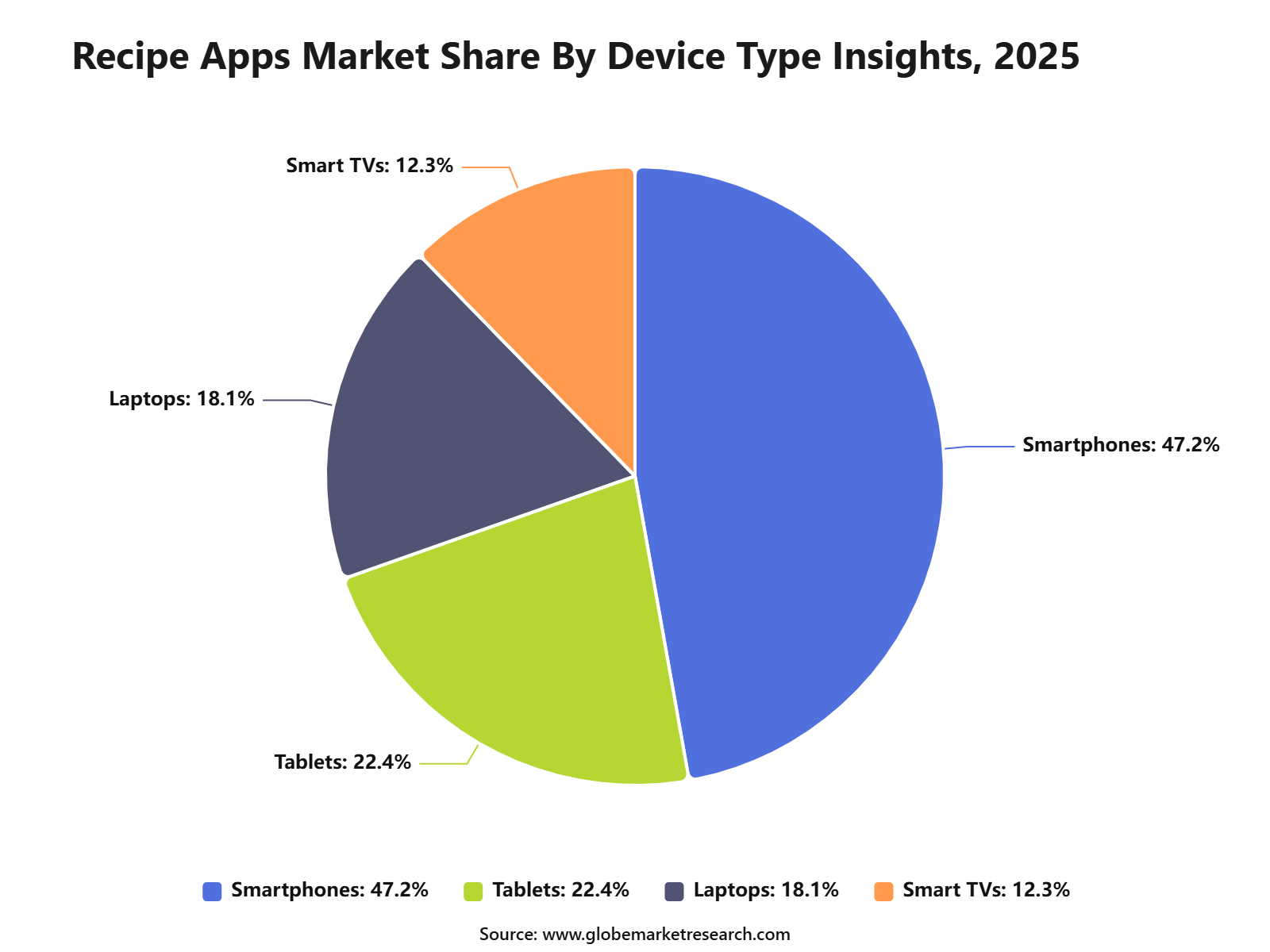 iThe graph shows projected market growth until 2035 based on CAGR analysis. Actual outcomes may vary depending on changing demand, competition, and economic factors.To gain greater insights - request a sample report PDF
Cuisine Insights
American cuisine accounted for 30.5% of the Recipe App Market by cuisine. Its position is supported by the wide popularity of burgers, barbecue, grilled foods, casseroles, baked goods, sandwiches and comfort meals. Many dishes use familiar ingredients and can be adapted for different household sizes, cooking skills and preparation times.
The American Culinary Federation’s 2025 trends report found that 46% of consumers believed American cuisine would have the greatest influence on future food trends. This placed it ahead of Asian cuisine at 45%, indicating that familiar American dishes continue to shape cooking interests despite rising demand for international flavours.
Cuisine | Market Share |
|---|---|
American | 30.5% |
Italian | 18.4% |
Asian | 16.7% |
Mexican | 13.2% |
Other Cuisines | 12.1% |
French | 9.1% |
Recipe platforms can expand engagement by presenting regional variations from Southern, Tex-Mex, Cajun, Creole, New England and Californian cooking. Healthier ingredient substitutions and air-fryer adaptations can widen their audience. Authentic descriptions and tested instructions will remain important when traditional dishes are modified for modern dietary needs.
Dietary Restrictions Insights
Vegan recipes represented 20.2% of the market by dietary restriction. Demand is supported by users seeking meals without meat, dairy, eggs or other animal-derived ingredients. Recipe apps simplify this process by filtering unsuitable ingredients and suggesting plant-based substitutes for protein, milk, butter, cheese and binding agents.
The Good Food Institute reported that 60% of U.S. households purchased plant-based foods in 2025. Among these households, 78% made repeat purchases. Plant-based milk reached 38% household penetration, showing that plant-focused food choices extend beyond consumers who follow a completely vegan diet.
Dietary Restrictions | Market Share |
|---|---|
Vegan | 20.2% |
Vegetarian | 19.4% |
Other Diets | 18.9% |
Gluten-Free | 16.8% |
Dairy-Free | 13.5% |
Paleo | 11.2% |
Recipe applications should provide more than basic ingredient removal. Users require balanced meals, reliable cooking results and accurate nutritional information. Clear allergen labels, protein guidance and affordable ingredient alternatives can improve adoption among vegans, vegetarians and consumers who are simply reducing their intake of animal products.
Purpose Insights
Meal planning accounted for 36.6% of the Recipe App Market by purpose. Meal-planning functions help households organize weekly menus, control grocery spending and reduce repeated decision-making. They can also connect recipes with serving sizes, dietary goals, available ingredients and automatically prepared shopping lists.
A 2025 and 2026 U.S. home-cooking survey found that 93% of adults expected to cook as much as before or more during the following year. The study also found that 69% had used AI to help prepare dinner or were open to doing so, supporting demand for automated recipe selection and planning.
The strongest platforms will consider practical household conditions rather than recommending recipes in isolation. Plans should reflect available time, budget, dietary restrictions and leftover ingredients. Calendar integration, pantry tracking and adjustable portions can turn a recipe library into a useful daily food-management tool.
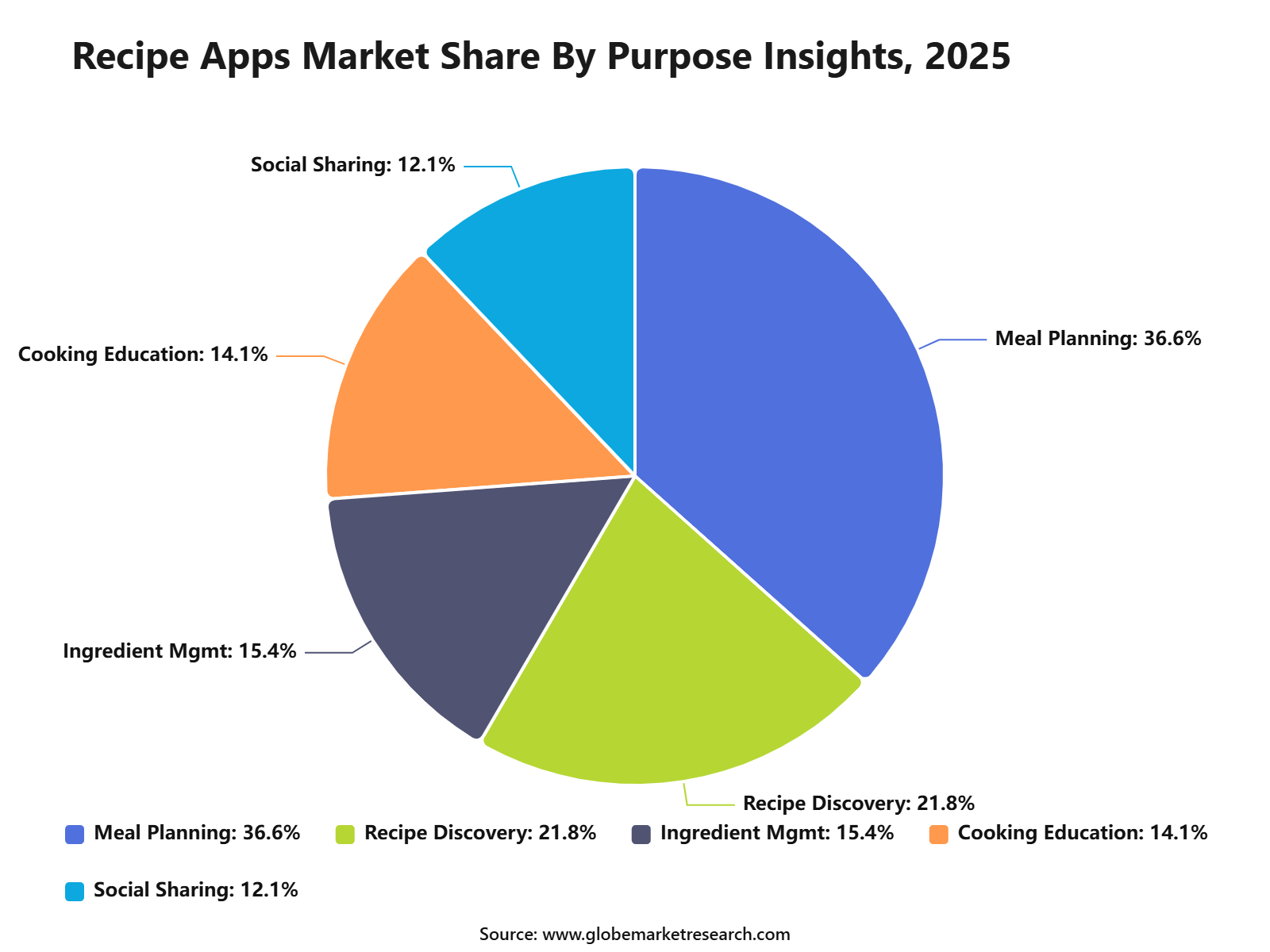 iThe graph shows projected market growth until 2035 based on CAGR analysis. Actual outcomes may vary depending on changing demand, competition, and economic factors.To gain greater insights - request a sample report PDF
Regional Analysis
North America accounted for 61.2% of the Recipe App Market. Regional leadership is supported by high smartphone use, established subscription payments and regular home cooking. Consumers also have access to diverse grocery products and a broad range of cuisine, nutrition and lifestyle content through digital channels.
The 2025 IFIC Food and Health Survey found that 87% of Americans cooked at home at least once a week. Nearly eight in ten prepared meals at home several times weekly, creating frequent occasions for recipe discovery, ingredient guidance and meal organization. Canada also provides a highly connected user base.
Statistics Canada reported that average monthly mobile data use reached 11 GB per subscriber during the third quarter of 2025, increasing from 9.6 GB one year earlier. Higher mobile data use supports video instructions, image-rich recipes and real-time kitchen assistance.
 iThe graph shows projected market growth until 2035 based on CAGR analysis. Actual outcomes may vary depending on changing demand, competition, and economic factors.To gain greater insights - request a sample report PDF
U.S. Recipe App Market Trends
The U.S. represents the primary national market within North America. Demand is supported by regular home cooking, high mobile connectivity and strong interest in convenience. Recipe applications are being used to discover meals, manage dietary goals and respond to higher grocery and restaurant costs.
The 2025 IFIC survey found that 57% of Americans had followed a specific eating pattern or diet during the previous year, compared with 36% in 2018. This change supports applications offering filters for high-protein, low-sugar, vegetarian, allergy-sensitive and other personalized eating requirements.
Online grocery activity also strengthens the connection between recipes and shopping. IFIC found that 18% of Americans purchased groceries online at least weekly in 2025. Recipe apps can respond by converting ingredient lists into shopping carts, comparing pantry supplies and recommending meals based on current household budgets.
Europe Recipe App Market Trends
Europe provides an established digital environment for recipe applications, supported by widespread internet access and online purchasing. Demand is distributed across national cuisines and languages, making localization an important competitive requirement. Consumers also show growing interest in food-waste reduction, sustainable eating and nutritional transparency. Eurostat reported that 95% of EU residents aged 16 to 74 had used the internet in 2025.
Among internet users, 78% had ordered goods or services online, demonstrating broad familiarity with digital transactions and paid online services. Food management provides another practical use case. EU households generated 69 kg of food waste per person in the latest data published in 2025. Recipe platforms can help reduce avoidable waste through leftover recipes, portion controls, expiry reminders and meal plans based on ingredients already available at home.
U.K. Recipe App Market Trends
The U.K. market is supported by regular home cooking and strong demand for convenient meal ideas. Users commonly seek quick recipes, ingredient substitutions and guidance for healthier meals. Applications can also help households balance scratch cooking with prepared foods and meal-kit services.
YouGov reported in 2025 that 19% of U.K. adults almost always prepared meals from basic ingredients, while 23% cooked from scratch on most days. Another 21% did so several times per week, showing that recipe guidance remains relevant across a large proportion of households.
Food-waste management is becoming an important feature opportunity. WRAP found that self-reported waste across bread, milk, chicken and potatoes declined from 21% in 2024 to 18.8% in 2025. Apps that provide storage advice, serving calculations and leftover suggestions can support further improvements.
Germany Recipe App Market Trends
Germany offers a favourable environment for recipe platforms due to widespread digital access and strong consumer attention to nutrition, quality and price. Applications can support structured weekly planning, seasonal cooking and comparison of ingredients across traditional German and international meals.
Germany’s 2025 federal nutrition report found that 71% of respondents consumed fruit and vegetables at least once daily. The same survey showed that 64% consumed dairy products such as yogurt or cheese every day, indicating regular demand for nutrition-focused meal and recipe content.
Price sensitivity will influence premium conversion and recipe selection. The federal survey found that 59% of German consumers considered affordable prices when purchasing food. Platforms offering budget filters, seasonal ingredient recommendations and cost-per-serving estimates can address this requirement more effectively.
Asia-Pacific Recipe App Market Trends
Asia-Pacific presents a large and diverse opportunity for recipe applications. The region includes highly connected economies and rapidly expanding mobile-first markets. Demand is influenced by extensive cuisine diversity, younger digital populations and growing interest in convenient home-cooking support.
The ITU reported that 77% of the Asia-Pacific population used the internet in 2025. This was above the global average and provides a substantial foundation for mobile recipe discovery, video cooking guidance and online grocery integration. The GSMA reported that the mobile sector contributed 5.6% of Asia-Pacific GDP in 2024, with the findings published in its 2025 regional report. The scale of the mobile ecosystem supports app distribution and payment access, although pricing and language strategies must be adapted for each country.
Japan Recipe App Market Trends
Japan provides demand for recipe applications that combine traditional meals with convenience and precise preparation guidance. Aging households, single-person living and busy work schedules are increasing the need for smaller portions, short preparation times and effective use of packaged ingredients.
A Japanese survey published in January 2025 found that 45% of single women and 38.7% of single men preferred cooking from scratch with basic ingredients. The results suggest that recipe apps can support independent households while simplifying planning and portion management.
Mobile access is well established among the main cooking-age population. Japan’s 2025 Statistical Handbook reported smartphone internet use above 80% across every age group from 13 to 59 years. Recipe platforms should therefore prioritize clear Japanese instructions, vertical video and hands-free kitchen functions.
China Recipe App Market Trends
China provides a large mobile-first audience for recipe applications. Demand can be supported by regional cuisine diversity, short-form food videos and widespread digital payments. Applications must provide accurate Chinese-language content and adapt recipes to local ingredients, appliances and cooking methods.
Official figures showed that China had more than 1.12 billion internet users by June 2025, with internet penetration reaching 79.7%. The scale of the connected population creates a broad base for digital recipe discovery, nutrition tools and food-content communities. CNNIC reported that mobile phones were used to access the internet by 99.7% of Chinese internet users in its report published in 2025. Online meal ordering also reached 592 million users in the underlying data, indicating strong consumer familiarity with mobile food services.
5 Best Apps to Organize Recipes on Android
Paprika Recipe Manager 3: Best for building a structured personal cookbook. Recipes can be imported from websites, edited and arranged into categories. The app also includes pantry tracking, meal calendars and grocery lists that combine ingredients and organize them by aisle.
Recipe Keeper: Best for digitizing printed, handwritten and online recipes. Users can categorize recipes by course or custom collection, add photographs, mark favourites and access their collection across Android, tablets and computers.
Samsung Food: Best for combining recipe storage with weekly meal planning. Recipes can be saved from websites, organized into collections and converted into meal plans and grocery lists. It is available on Android and does not require a Samsung phone.
COOKmate: Best for importing recipes from multiple sources. Users can create a private digital cookbook, import recipes from websites, generate shopping lists, plan meals and synchronize recipes between the Android app and web platform.
AnyList: Best for families that want shared recipe and grocery organization. It provides a recipe box, synchronized shopping lists and a meal-planning calendar that household members can view and update together.
7 Best Recipe Apps in 2026
Rank | Recipe App | Best For | Key Features |
|---|---|---|---|
1 | Samsung Food | Best overall recipe app | Saves recipes from websites, organizes collections, supports meal planning and creates grocery lists. Available on Android and iOS. |
2 | Paprika Recipe Manager 3 | Recipe organization | Website recipe importing, customizable categories, pantry management, ingredient scaling and daily, weekly or monthly meal calendars. |
3 | Mealime | Personalized meal planning | Customizable meal plans, dietary preference filters and automatically generated grocery lists designed for individuals, couples and families. |
4 | Recipe Keeper | Scanning and preserving personal recipes | Imports recipes from websites and documents, supports custom categories, photographs, ratings, favourites and cross-device access. |
5 | Tasty | Video-based cooking guidance | Provides thousands of recipes, ingredient and cuisine filters, step-by-step instructions and a personal recipe-saving section. |
6 | Kitchen Stories | Beginner-friendly guided cooking | Offers more than 10,000 recipes, instructional videos, step-by-step cooking mode and personal digital cookbooks. |
7 | Cookpad | Community recipes and Indian cooking | Provides user-created recipes, guided instructions, recipe folders, ingredient-based discovery and tools for publishing personal dishes. |
Key Market Segments
By Revenue Model
Subscription-Based
In-App Purchases
Advertising
By Device Type
Smartphones
Tablets
Laptops
Smart TVs
By Cuisine
American
Italian
Mexican
Asian
French
Other Cuisines
By Dietary Restrictions
Vegan
Vegetarian
Gluten-Free
Dairy-Free
Paleo
Other Diets
By Purpose
Meal Planning
Ingredient Management
Recipe Discovery
Cooking Education
Social Sharing
By Region
North America
Europe
Asia Pacific
Latin America
Middle East and Africa
Market Dynamics
Drivers Impact Analysis
The Recipe Apps Market is driven by rising use of mobile cooking platforms, personalized meal planning, healthy eating preferences, grocery delivery integration, and AI-based recipe recommendations. Consumers are using recipe apps to save time, discover new dishes, manage diets, reduce food waste, and plan weekly meals.
North America leads the market due to high smartphone penetration, strong digital subscription adoption, online grocery usage, and demand for health-focused meal planning. The U.S. remains the largest contributor because of strong app monetization, food media engagement, and connected kitchen behavior.
Impact Factor | Estimated CAGR Impact | Regional Relevance | Market Impact |
|---|---|---|---|
Rising mobile cooking app usage | +4.3% | North America, Europe, Asia Pacific | Drives core user growth. |
Growth in personalized meal planning | +3.7% | U.S., Canada, Europe | Supports premium subscriptions. |
Healthy eating and diet tracking demand | +3.1% | North America and urban markets | Adds wellness-led adoption. |
Grocery delivery and shopping list integration | +2.6% | U.S., Canada, UK, Australia | Improves app utility and retention. |
AI-based recipe recommendations | +2.2% | Digital-first consumer markets | Enhances personalization and engagement. |
Restraints Impact Analysis
The market faces restraints from high app competition, free recipe content availability, subscription fatigue, low user retention, and dependence on platform algorithms. Many consumers use free websites, social media videos, and search engines instead of paying for recipe apps. Another restraint is content trust and quality. Users expect accurate recipes, clear nutrition data, reliable cooking times, and easy instructions. Poor recipe performance can reduce app ratings and repeat usage.
Impact Factor | Estimated CAGR Impact | Regional Relevance | Market Impact |
|---|---|---|---|
Free recipe content availability | -2.0% | Global digital users | Limits paid subscription growth. |
High app competition | -1.7% | North America and Europe | Increases customer acquisition cost. |
Subscription fatigue | -1.4% | Mature digital markets | Reduces premium conversion. |
Low user retention risk | -1.2% | Consumer app markets | Affects recurring revenue. |
Inaccurate recipe or nutrition data | -1.0% | Health-focused users | Reduces trust and engagement. |
Opportunities Impact Analysis
Opportunities are strong in AI meal planning, diet-specific recipes, grocery commerce, smart kitchen integration, family meal planning, budget cooking, and creator-led recipe communities. These features make recipe apps more useful beyond simple cooking instructions.
Higher-value opportunities are emerging in premium subscriptions, personalized nutrition, diabetic-friendly meal plans, fitness-linked diets, video-first cooking lessons, and regional cuisine discovery. Apps that combine content, shopping, personalization, and health tracking can capture stronger long-term value.
Impact Factor | Estimated CAGR Impact | Regional Relevance | Market Impact |
|---|---|---|---|
AI-powered meal planning | +4.1% | North America, Europe, Asia Pacific | Builds premium app value. |
Grocery commerce integration | +3.4% | U.S., Canada, UK | Creates transaction-led revenue. |
Diet-specific recipe libraries | +2.9% | Health and wellness users | Improves user relevance. |
Smart kitchen and appliance connectivity | +2.3% | Developed consumer markets | Adds connected cooking demand. |
Creator-led recipe communities | +1.9% | Social-first users | Supports engagement and retention. |
Challenges Impact Analysis
The main challenge is converting casual users into paying subscribers. Many users download recipe apps for occasional cooking needs, but regular monetization requires strong personalization, saved preferences, shopping tools, and meal planning value. Another challenge is keeping content fresh and practical. Recipe apps must offer simple meals, local ingredients, accurate nutrition data, dietary filters, and fast search experiences to remain useful in daily routines.
Impact Factor | Estimated CAGR Impact | Regional Relevance | Market Impact |
|---|---|---|---|
Paid conversion difficulty | -1.9% | Consumer subscription apps | Limits revenue growth. |
Maintaining fresh recipe content | -1.5% | Global recipe platforms | Affects engagement. |
Local ingredient availability issues | -1.2% | International markets | Reduces recipe usability. |
Nutrition data accuracy challenges | -1.0% | Wellness and diet users | Impacts trust. |
Dependence on app store visibility | -0.8% | Mobile-first markets | Raises acquisition risk. |
Market Trend Analysis
The market trend is moving toward AI recipe assistants, personalized meal plans, shoppable recipes, short-form cooking videos, nutrition-aware recommendations, and family-focused planning tools. Users want apps that help them decide what to cook, buy ingredients, and manage dietary goals in one place.
North America remains the strongest value region because of high digital spending, strong online grocery penetration, and mature subscription behavior. Asia Pacific supports future growth through smartphone adoption, food delivery ecosystems, and demand for local-language cooking content.
Impact Factor | Estimated CAGR Impact | Regional Relevance | Market Impact |
|---|---|---|---|
AI cooking assistant adoption | +3.9% | North America and digital markets | Improves personalization. |
Shoppable recipes grow | +3.2% | U.S., Canada, Europe | Links content with grocery purchases. |
Short-form recipe video trend | +2.7% | Social media-driven users | Improves discovery. |
Nutrition-first recipe search | +2.2% | Health-conscious consumers | Adds wellness value. |
Local cuisine personalization | +1.8% | Asia Pacific and global markets | Supports regional expansion. |
Key Recipe App Market Trends
AI-Personalized Meal Planning: Artificial intelligence is being used to create weekly meal plans based on dietary preferences, cooking time, health goals, available ingredients and household size. Samsung Food+ offers AI-personalized recipes, tailored meal plans, goal tracking and detailed nutrition information through a subscription model.
Ingredient Recognition and Pantry Management: Recipe apps are increasingly using computer vision to identify food items from photographs. Samsung Food allows users to photograph ingredients and automatically add identified items to a digital food list covering refrigerators, freezers and pantries. Recipes can then be suggested according to ingredients that are already available.
Integration with Grocery Shopping: Recipe-to-cart functionality is becoming an important part of recipe app development. Shopping lists can be generated directly from recipes, sorted by aisle, shared with household members and connected with online grocery services. Samsung Food states that its platform can convert a recipe or meal plan into a smart shopping list with one action.
Growing Interest in Visual and Trending Recipes: Visual discovery platforms are influencing which recipes consumers search for and prepare. Pinterest reported that searches connected with summer detox drinks increased by 566% in 2025 as users explored garden-to-table cooking, urban farming and fresh seasonal recipes.
Major Recipe App Use Cases
Recipe Discovery: Users can search for meals by cuisine, ingredient, preparation time, skill level, cooking method or meal type. Personalized recommendation systems can study saved recipes, ratings and previous searches to present more relevant options. This use case reduces the time spent browsing unrelated content. It is particularly useful for consumers who need quick breakfast, lunch, dinner, snack or seasonal recipe ideas.
Weekly Meal Planning: Recipe apps can arrange selected meals across a daily or weekly calendar. Users can plan breakfast, lunch and dinner while controlling serving sizes and avoiding repeated ingredients. Samsung Food allows free users to prepare daily and weekly meal plans, add recipes from the internet, collaborate with family members and convert meal plans into shopping lists.
Personalized Nutrition: Nutrition-focused applications can recommend recipes according to calorie targets, protein requirements, dietary preferences and wellness goals. Filters may be provided for vegetarian, vegan, low-carbohydrate, high-protein, gluten-free and dairy-free eating patterns. The 2025 IFIC survey showed that consumers continued to place importance on food, health, ingredient information and weight management.
Cooking with Available Ingredients: Consumers can enter ingredients already stored at home and receive recipes that use those products. Camera-based identification can make this process faster by recognizing several ingredients from a single image. This feature is especially useful at the end of the shopping cycle, when households have limited ingredients remaining. It can reduce unnecessary purchases and encourage the use of products before they lose quality.
Automated Shopping Lists: Ingredients can be transferred from one or more recipes into a combined shopping list. Quantities can be adjusted according to serving size, while duplicate ingredients can be grouped together. Shared lists also support household coordination. Samsung Food allows shopping lists and meal plans to be shared and edited in real time, helping families avoid duplicate purchases.
Smart Kitchen Integration: Recipe applications can connect with compatible ovens, refrigerators and other kitchen appliances. Selected cooking instructions may be transferred to connected devices, allowing temperature, cooking mode and preparation time to be set more efficiently. Samsung expanded its food platform across selected smart ovens, refrigerators and microwaves, showing how recipe software is becoming part of the wider connected-kitchen ecosystem.
Go-to-Market and Sales Economics
The go-to-market approach for the Recipe App Market should focus on personalized recipe discovery, meal planning, ingredient-based search, dietary filters and guided cooking. Social and visual discovery platforms can be used to reach consumers while they are actively searching for food ideas. Pinterest recorded 570 million monthly active users in the first quarter of 2025, indicating the scale of the audience available for visual recipe promotion and food-content discovery.
Customer acquisition strategies should combine free content, simple onboarding, seasonal collections, creator-led recipes and useful planning tools. The Guardian reported in March 2026 that its Feast recipe app had been downloaded more than half a million times since launch. This result shows that trusted food content, recognised contributors and regular editorial updates can help recipe platforms build a broad mobile audience.
The strongest commercial model will combine free recipe access with premium subscriptions, advertising, grocery affiliate commissions and sponsored food content. Early onboarding must clearly demonstrate value through personalised recommendations, saved collections and shopping-list creation. RevenueCat reported in 2025 that more than 80% of subscription-app trials began immediately after installation, making the first session a critical point for converting recipe-app users into paying customers.
Revenue Landscape Across
Premium content provides revenue through monthly subscriptions, annual memberships, exclusive chef collections, cooking classes and advanced meal-planning tools. Recipe apps can increase renewal potential by publishing fresh content for seasons, holidays and dietary requirements. The Guardian’s Feast app provided more than 6,000 curated recipes from 150 chefs by July 2025, demonstrating how editorial depth and contributor variety can support a paid digital cooking service.
Grocery commerce creates another revenue channel through ingredient ordering, retailer referrals, sponsored product placement and shoppable recipes. Applications can allow users to transfer recipe ingredients directly into online shopping baskets while adjusting quantities for household size. Instacart processed 91.2 million orders during the first quarter of 2026, indicating the commercial scale available to recipe platforms that integrate meal inspiration with grocery purchasing.
Recent Developments
Market News
In February 2026, Uber Eats introduced Cart Assistant, an AI-powered grocery shopping feature that accepts text prompts and images of shopping lists. Uber stated that the assistant would be expanded to support recipe inspiration, meal planning, follow-up questions, and a broader range of retail partners.
In February 2026, ReciMe launched a new brand identity as the company repositioned the platform beyond basic recipe organization. The app supports recipes imported from Instagram, TikTok, Facebook, YouTube, Pinterest, handwritten notes, and other sources, reflecting the growing importance of social-media recipe discovery.
In February 2026, Cookpad expanded its recipe-importing capabilities, allowing users to transfer recipes from social media platforms and websites into the Cookpad app. Its 2026 app releases also support recipe imports from Instagram, TikTok, X, websites, photographs, handwritten notes, and printed cookbooks.
In March 2026, the United Nations Environment Programme highlighted the use of AI applications and digital kitchen technologies to reduce food waste across households, retailers, and hospitality businesses. The update demonstrated how ingredient recognition, waste monitoring, inventory tracking, and recipe recommendations are becoming connected parts of digital food-management systems.
Funding
In July 2026, Plate Up closed an oversubscribed funding round of nearly GBP 500,000 after exceeding its original GBP 400,000 target within six weeks. Investors included former retail executives, finance industry leaders, chefs, and food-content creators.
Plate Up reported more than 10,000 monthly active users and over 50,000 registered users at the time of the funding announcement. The capital is being directed toward retail partnerships, brand relationships, AI recommendations, meal-planning tools, and cooking education.
In February 2026, Foodforecast raised EUR 8 million for an adjacent AI food-planning platform that helps retailers forecast demand for fresh products. Although Foodforecast does not operate as a consumer recipe application, the investment reflects broader funding interest in AI systems that improve food planning, inventory decisions, and waste reduction.
Market Impact
In 2026, recipe applications are becoming decision-support platforms rather than simple collections of cooking instructions. Users increasingly expect one application to recommend meals, recognize ingredients, import recipes, estimate nutrition, create shopping lists, manage pantry items, and guide the cooking process.
Food prices are strengthening demand for budget-aware meal planning. The USDA forecast in June 2026 that total U.S. food prices would increase by 3.2% during 2026, while food-at-home prices were expected to rise by 2.8%. Fresh vegetable prices were forecast to increase by 7.7%, making ingredient substitution and price-based recipe recommendations more valuable.
U.S. consumers spent USD 2.51 trillion on food in 2025 and allocated an average of 9.7% of disposable personal income to food. Recipe applications that reduce unnecessary purchases, reuse overlapping ingredients, and connect meal plans with household budgets can therefore provide measurable financial value.
Competitive Landscape
The market is characterized by intense competition among established players and emerging companies. Strategic partnerships, mergers and acquisitions, and product innovation are key strategies employed by market participants.
Key Market Players
Yummly
Allrecipes
Epicurious
Tasty
BigOven
Cookpad Inc.
Samsung Food
Food Network Kitchen
MyFitnessPal
Paprika Recipe Manager
Mealime
SideChef Inc.
BBC Good Food
NYT Cooking
Kitchen Stories
Forks Over Knives
Love and Lemons
Other Key Players
Research Methodology
This market study is prepared using a combination of primary and secondary research. Primary research includes discussions with manufacturers, suppliers, distributors, consultants, industry experts, and end users. Secondary research covers company reports, government databases, trade associations, technical publications, regulatory sources, and trusted industry documents. The collected information is used to assess market demand, pricing trends, technology adoption, competitive activity, and regional performance.
AI language models are not used as primary data sources, and publicly available AI-generated content is not treated as market evidence. Computational tools may be used to support data processing, translation, data classification, and pattern identification. However, every published assessment is supported by verified sources, human review, and primary market discussions.
Market estimates are developed through top-down and bottom-up approaches and validated using data triangulation. Revenue, production, shipment, pricing, and application-level data are compared across multiple sources. Forecasts consider economic conditions, regulatory changes, investment activity, innovation, supply chain developments, and industry risks. All findings are reviewed through source verification and internal quality checks before publication.
Part I
Source Management & Input Data Standards
Who provides data, how sources are qualified, and what types of evidence are admissible.
Part II
Research Scope & Market Coverage
How we define the markets we assess and the parameters that govern each product.
Part III
Data Collection, Verification & Submission
The mechanics of gathering, cross-checking, and hierarchically ranking evidence.
Part IV
Assessment Determination & Quality Controls
How raw data becomes a published assessment — normalisation, expert judgement, and outlier exclusion.
Part V
Publication, Corrections & Revision
Our publication schedule, corrections policy, and methodology review cycle.
Part VI
Independence, Ethics & Complaints
Conflict-of-interest policies, editorial independence, and how clients raise concerns.
Google · Preferred Sources
Don't miss the latest market research insights and industry updates on Google.
Add Globe Market Research as a preferred source in the Google app to see our reports, analysis, and market stories in your news suggestions.
Meet the Team
This report was prepared by our expert analysts with deep industry knowledge and research experience.
Prashant S. is a Research Analyst at Globe Market Research with more than four years of experience in market research and industry analysis. He specializes in the Aerospace and Defence, Automotive and Transportation, Semiconductor and Electronics, Information and Technology sectors, with expertise in market sizing, trend analysis, competitive assessment, and industry forecasting. He applies primary and secondary research, data validation, company analysis, and market estimation methods to deliver reliable insights for strategic planning and business decision-making.
Sayali brings more than 7 years of experience to Globe Market Research, supporting the accuracy, clarity, and relevance of research content across multiple industries. She reviews market data, segment analysis, competitive insights, and industry trends to ensure each report meets strong quality standards and provides practical value to business decision-makers. Her expertise spans healthcare, information technology, consumer goods, and diverse cross-industry domains. With a strong focus on data reliability, structured analysis, and clear presentation, Sayali helps ensure that each research output delivers well-reviewed insights for clients, investors, consultants, and industry stakeholders.
Frequently Asked Questions
Related Reports
More in Information and Technology
South Korea Physical AI Market Size to Reach USD 3.6 billion by 2035
South Korea Physical AI Market Size, Share, Trends and Growth Analysis Report By Deployment (On-Device AI, Cloud-Based AI), By Component (Hardware, Software, Services), By Technology (Computer Vision, Speech and Natural Language Processing, Gesture and Movement Recognition, Reinforcement Learning and Control Systems, Other Technologies), By Robot Type (Service Robots, Humanoid and Social Robots, Collaborative Robots, Exoskeletons and Prosthetics, Mobile Robots and Drones, Industrial Robots), By Application (Healthcare, Manufacturing and Automotive, Logistics and Warehousing, Retail and Hospitality, Other Applications), By Technology Trends, Competitive Landscape, Strategic Opportunities and Growth Forecast, 2026-2035
Physical AI Market Size to hit USD 2,129.0 billion by 2035
Physical AI Market Size, Share, Trends and Growth Analysis Report By Component (Hardware, Software, Services), By Technology (Computer Vision, Machine Learning and Deep Learning, Natural Language Processing, Edge AI, Other Technologies), By Product (Robots, Exoskeletons, Autonomous Systems, Smart Appliances), By Application (Automation and Manufacturing, Logistics and Supply Chain, Healthcare, Automotive, Defense and Security, Retail, Education, Other End Uses), By Regional Insights, Technology Trends, Competitive Landscape, Strategic Opportunities and Growth Forecast, 2026-2035
Edtech SaaS Tools Market Size to hit USD 217.6 billion by 2035
EdTech SaaS Tools Market Size, Share, Trends and Growth Analysis Report By Software (Classroom Management Systems, Document Management Systems, Learning and Gamification Platforms, Learning Management Systems, Student Collaboration Systems, Assessment and Analytics Tools, Content Authoring Tools, Other Software), By Sector (Preschool, K-12, Higher Education, Other Education Sectors), By Deployment (Cloud-Based, Hybrid), By End Use (Businesses, Educational Institutions, Individual Learners and Consumers), By Regional Insights, Technology Trends, Competitive Landscape, Strategic Opportunities and Growth Forecast, 2026–2035
Marketing Technology Market Size to Reach USD 3,810.8 billion by 2035
Marketing Technology Market Size, Share, Trends and Growth Analysis Report By Marketing Type (Digital Marketing, Offline Marketing), By Product (Social Media Tools, Content Marketing Tools, Rich Media Tools, Marketing Automation Tools, Data and Analytics Tools, Sales Enablement Tools), By Deployment (Cloud-Based, On-Premises, Other Deployment Models), By Enterprise Type (Large Enterprises, Small and Medium-Sized Enterprises), By Application (IT and Telecommunication, Retail and E-commerce, Healthcare, Media and Entertainment, Sports and Events, BFSI, Real Estate, Other Applications), By Regional Insights, Technology Trends, Competitive Landscape, Strategic Opportunities and Growth Forecast, 2026-2035