

Revenue, 2025
$ 1.7 Bn
Forecast, 2035
$ 3.6 Bn
CAGR, 2025-2035
7.9%
Report Coverage
Global
Market Size and Forecast
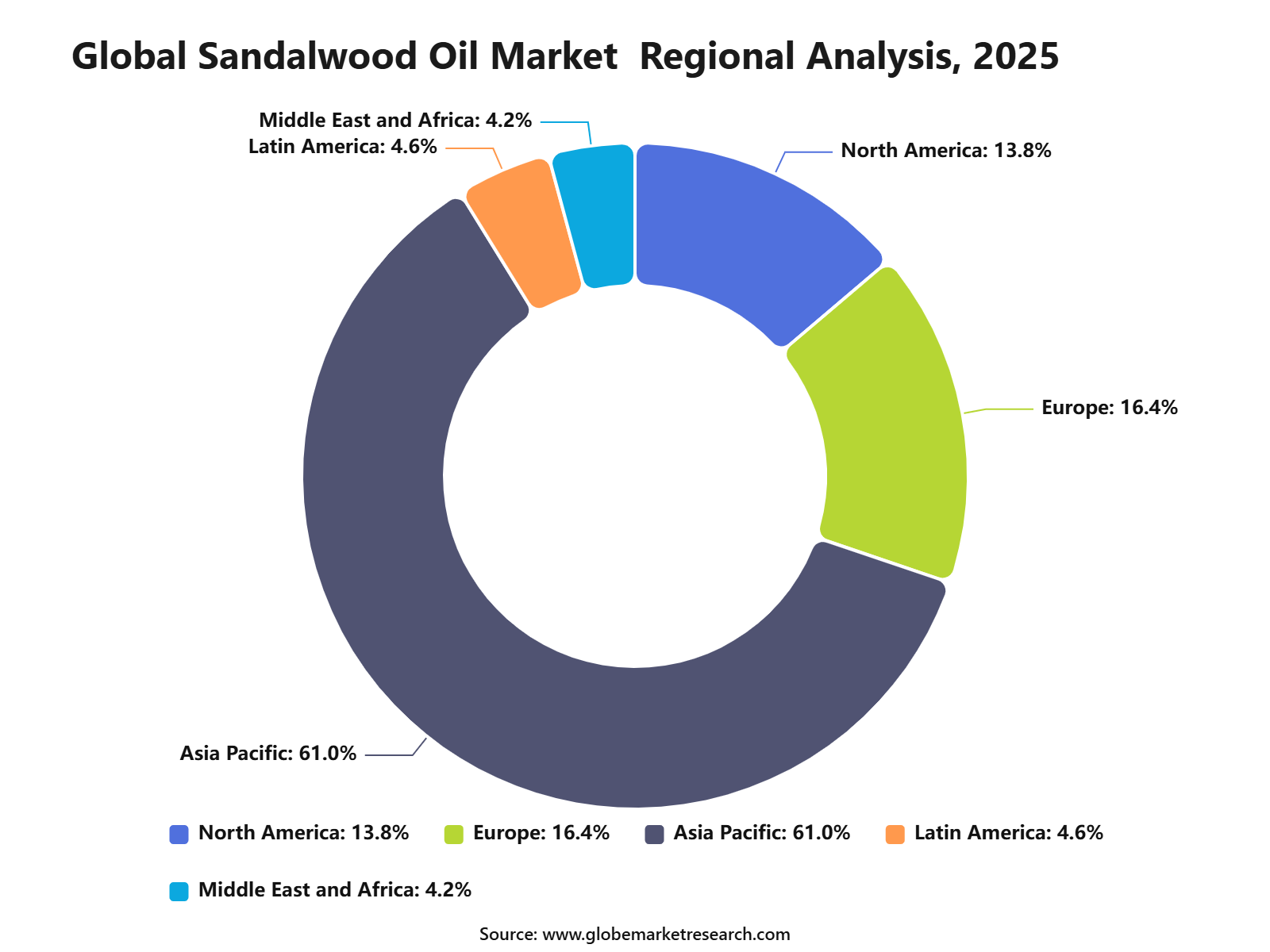
The Global Sandalwood Oil Market was worth USD 1.7 billion in 2025 and is expected to reach USD 3.6 billion by 2035, growing at a CAGR of 7.9% from 2025 to 2035. Asia Pacific held the largest regional share of 61.0% in 2025, supported by strong sandalwood cultivation, traditional use in personal care and wellness products, and rising demand from fragrance, cosmetics, aromatherapy, and pharmaceutical applications.
The Sandalwood Oil Market includes natural essential oil extracted from sandalwood trees, mainly used for its rich aroma, skin-soothing properties, and high value in premium formulations. It is widely used in perfumes, cosmetics, soaps, skincare products, aromatherapy oils, incense, traditional medicine, and luxury personal care products. The market is closely linked with sandalwood plantations, essential oil distillation, natural ingredient sourcing, and premium fragrance manufacturing.
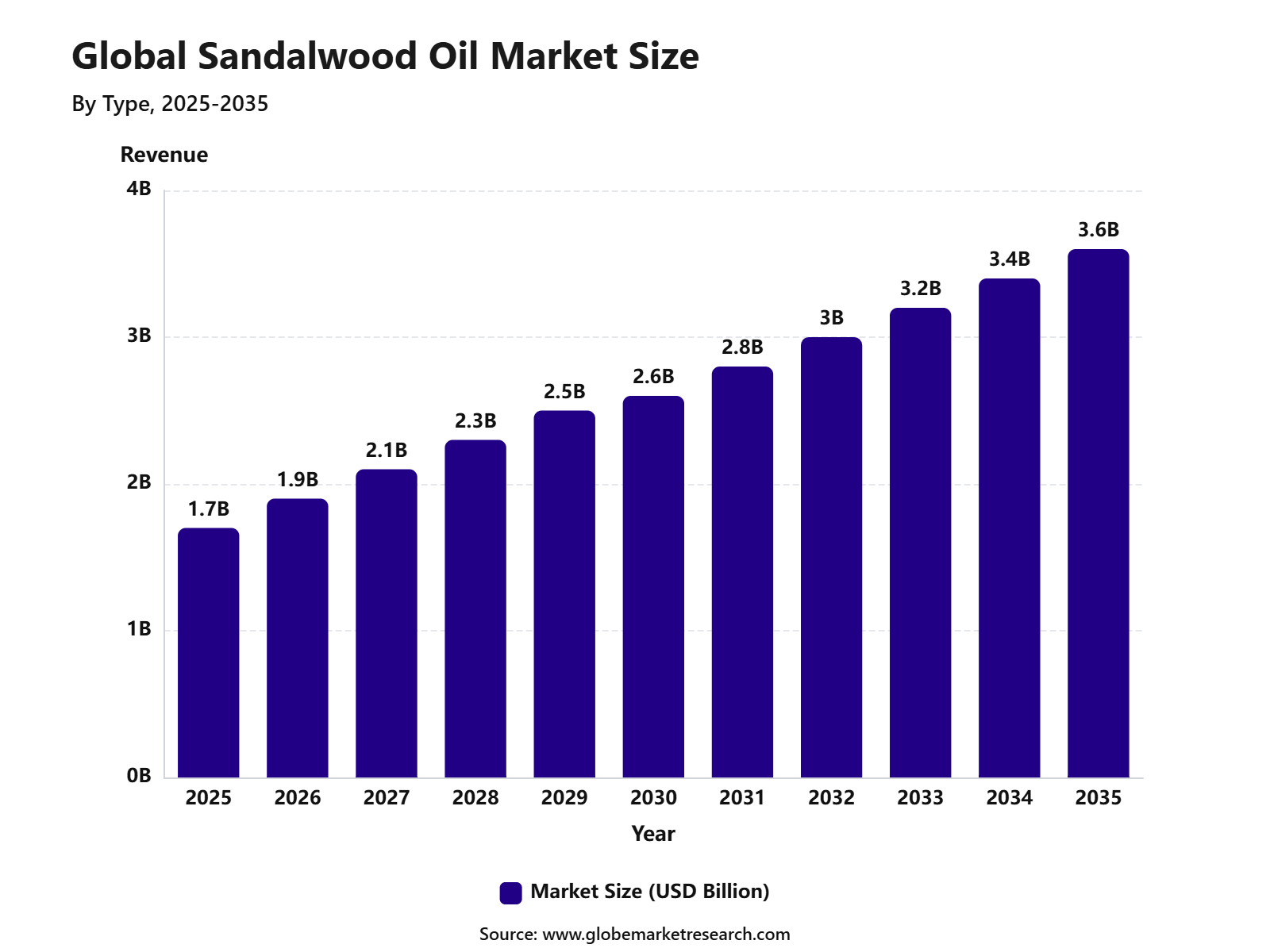 iThe graph shows projected market growth until 2035 based on CAGR analysis. Actual outcomes may vary depending on changing demand, competition, and economic factors.To gain greater insights - request a sample report PDF
The market outlook remains positive as consumers continue to prefer natural, plant-based, and premium aromatic ingredients. Growth can be attributed to rising demand for clean-label cosmetics, increasing use of essential oils in wellness products, and growing preference for long-lasting natural fragrances. The expansion of sustainable sandalwood farming, certified sourcing, and high-end personal care formulations is expected to support long-term market growth.
Report Highlights | Details |
|---|---|
Market Revenue (2025) | USD 1.7 Billion |
Forecast Revenue (2035) | USD 3.6 Billion |
CAGR (2025-2035) | 7.9% |
Base Year for Estimation | 2025 |
Historic Data | 2020-2024 |
Forecast Period | 2025-2035 |
Key Market Insights
Natural sandalwood oil led the type segment with 71.3% share, supported by strong demand for pure, plant-based, and premium aromatic ingredients in personal care, perfumery, and wellness products.
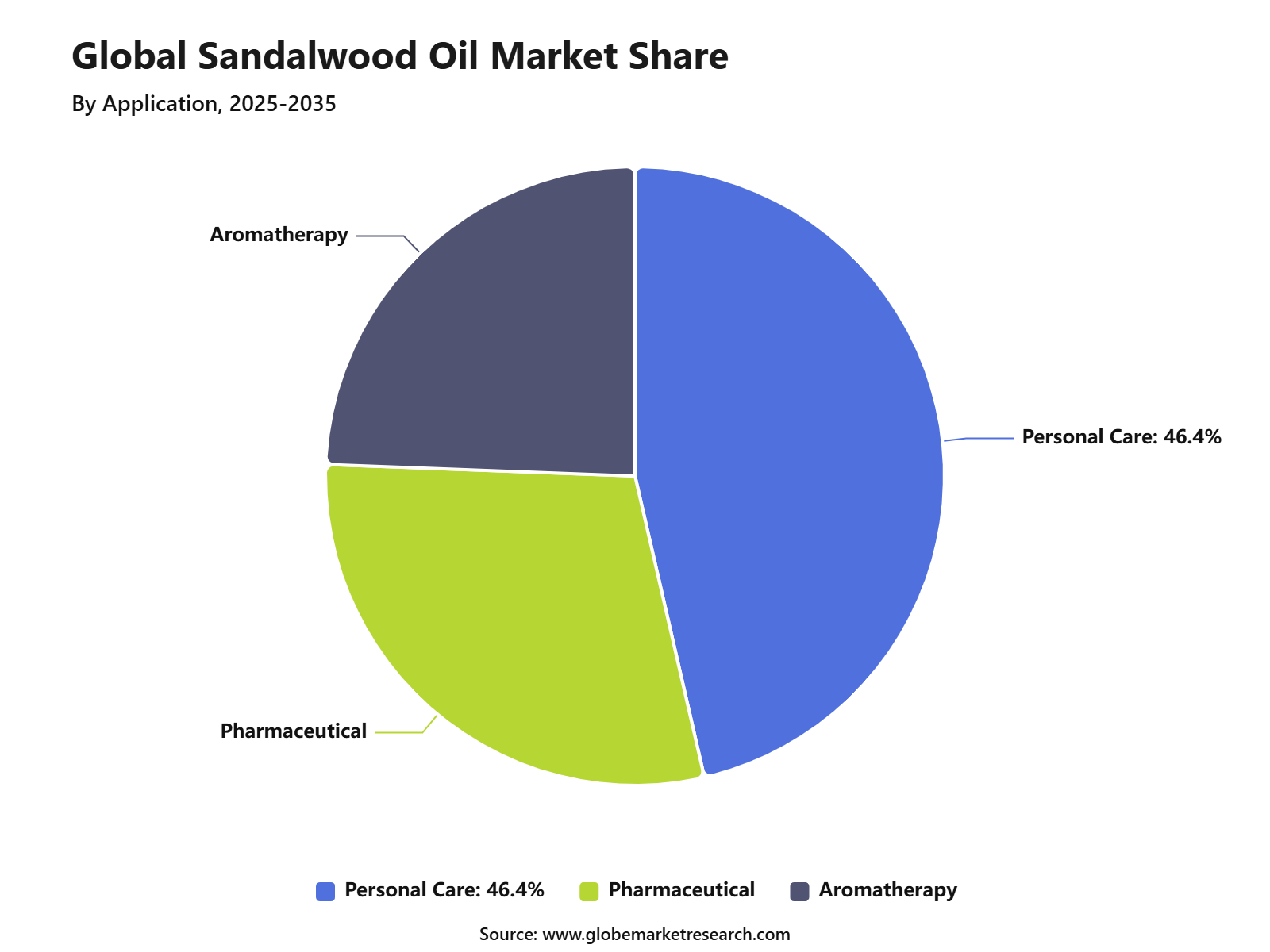
Personal care accounted for 46.4% share by application, driven by rising use of sandalwood oil in skincare, haircare, soaps, creams, lotions, and fragrance-based formulations.
Asia Pacific led the sandalwood oil market with 61.0% share, supported by strong sandalwood cultivation, traditional use in cosmetics and wellness products, and growing demand from personal care and fragrance industries.
Top Funding and Investment Highlights
Quintis received A$145 million in cash funding after its recapitalisation, with BlackRock becoming the majority owner. The company stated that the funding would support operations for the next four to five years. At that time, Quintis managed around 12,500 hectares of Indian sandalwood plantations, including 5.5 million trees, with about 3,000 hectares owned directly and 9,500 hectares managed for investors. This funding was important for maintaining one of the world’s largest sustainable sandalwood oil supply bases.
TFS Corporation reported that it had received foreign investment of more than USD 65.0 million from a Middle Eastern sovereign fund and a AAA-rated U.S. institution. The company also stated that five-year options with both institutions could amount to a further USD 270.0 million. This investment supported Indian sandalwood plantation expansion and helped build long-term supply for sandalwood oil, wood, fragrance, and cosmetic applications.
Santanol became one of Australia’s leading Indian sandalwood oil producers through long-term financial backing from KKR. KKR became a majority shareholder in 2013 and funded a USD 70.0 million acquisition of plantations controlled by Elders. Later, Mercer International acquired Santanol, including about 2,500 hectares of plantations in the Ord Valley, a processing facility in Kununurra, and an oil distillation and refining facility in Perth.
India’s Khadi and Village Industries Commission launched a sandalwood plantation initiative by planting 500 sandalwood saplings at its Nashik training centre, which covers 262 acres. The project was designed to monetize unused institutional land and encourage commercial sandalwood cultivation. The plantation was expected to generate around ₹50 crore to ₹60 crore over 10 to 15 years, as sandalwood trees mature for oil, wood, and fragrance-linked uses.
Adoption and Demand Indicators
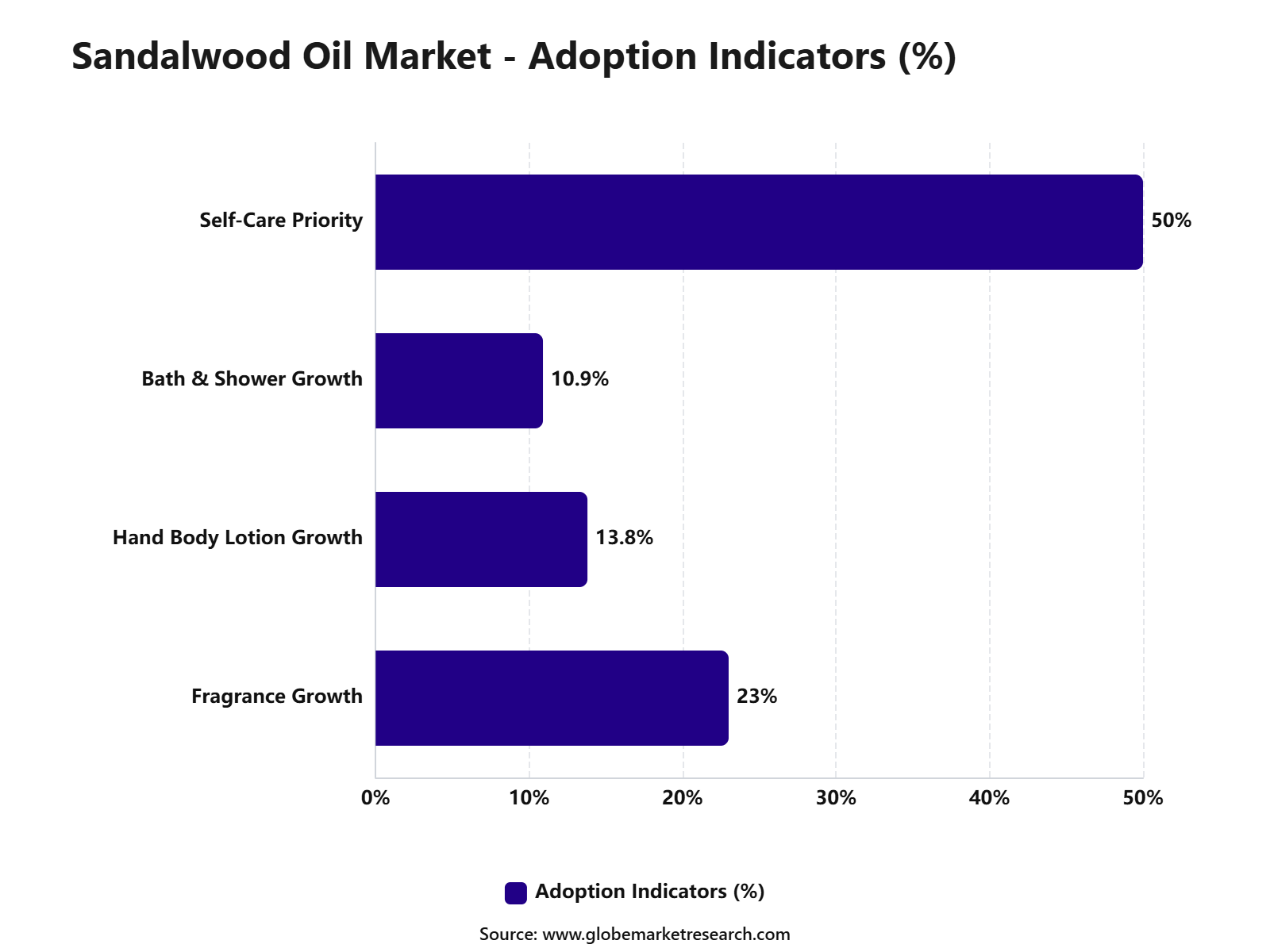
According to ECRM, The Sandalwood Oil Market is supported by demand from fragrance, personal care, wellness, and aromatherapy products. Since public adoption-rate data is limited, demand indicators such as 23.0% fragrance growth, 13.8% hand and body lotion growth, and 10.9% bath and shower growth show stronger market relevance. Rising self-care preference among 50% of global consumers further supports its use in premium and natural formulations.
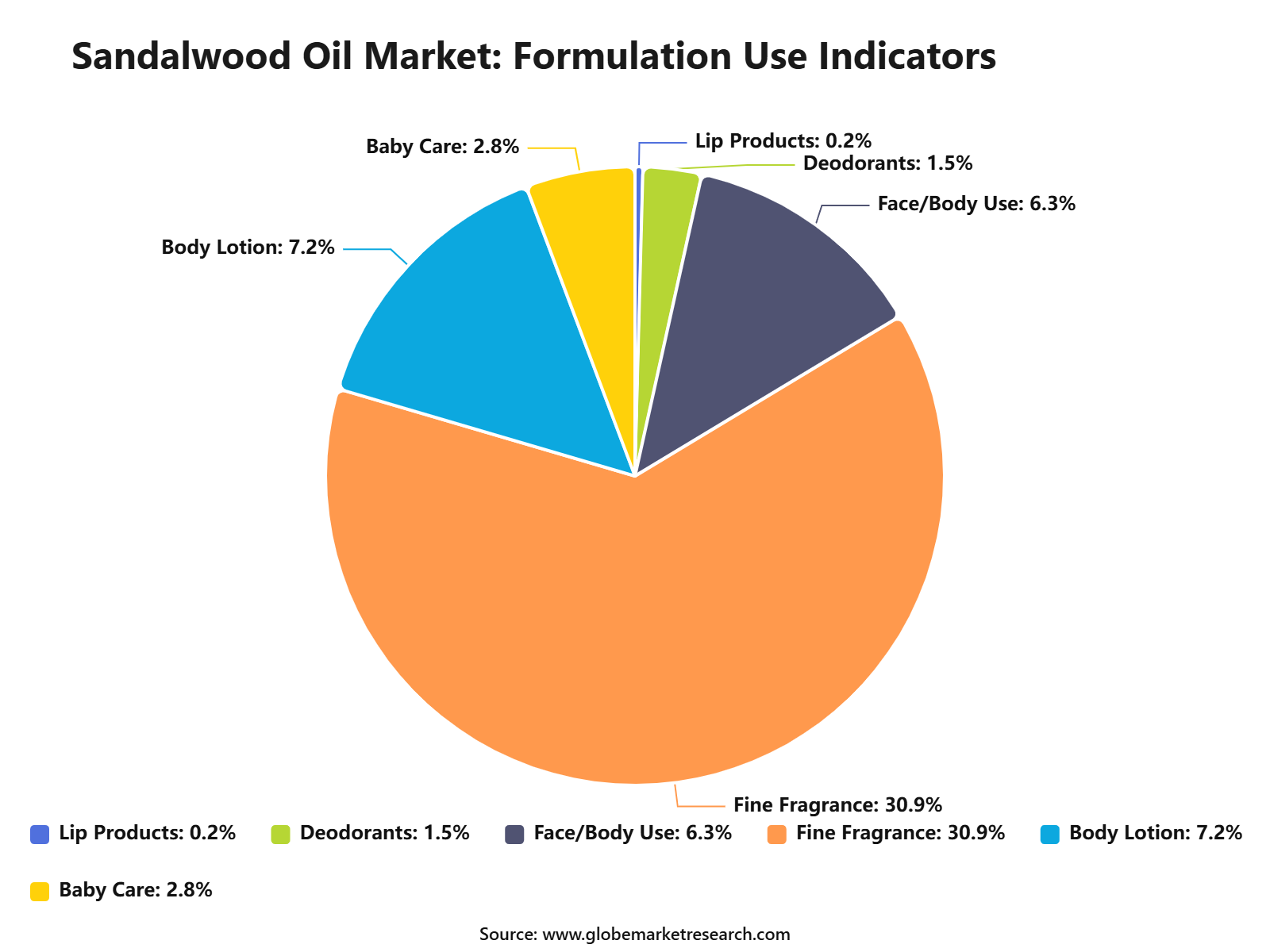
Based on data from Avena Lab, Sandalwood oil also shows wide formulation flexibility across product types. IFRA-related limits allow use of 30.09% in fine fragrances, 7.27% in body lotions, 43.33% in rinse-off skin products, and up to 100% in non-skin-contact products such as candles and incense. These are not market shares, but they show strong practical use across fragrance, beauty, and wellness applications.
 iThe graph shows projected market growth until 2035 based on CAGR analysis. Actual outcomes may vary depending on changing demand, competition, and economic factors.To gain greater insights - request a sample report PDF
 iThe graph shows projected market growth until 2035 based on CAGR analysis. Actual outcomes may vary depending on changing demand, competition, and economic factors.To gain greater insights - request a sample report PDF
By Type
Natural sandalwood oil held 71.3% share in the Sandalwood Oil market, making it the leading type segment. Its dominance can be attributed to strong consumer preference for plant-based, authentic, and premium fragrance ingredients across personal care, aromatherapy, and wellness products.
The segment is supported by the high value of natural sandalwood oil in perfumes, skincare, soaps, incense, and therapeutic formulations. It's warm aroma, long-lasting fragrance profile, and traditional use in wellness applications make it more preferred than synthetic alternatives in premium product categories.
Natural sandalwood oil is expected to remain important as consumers continue to shift toward clean-label, botanical, and naturally sourced ingredients. Demand is also supported by luxury fragrance brands and personal care manufacturers that use natural oils to improve product positioning and consumer trust.
By Application
Personal care accounted for 46.4% share in the Sandalwood Oil market, supported by its wide use in skincare, haircare, perfumes, body oils, creams, lotions, and soaps. The segment benefits from rising demand for natural fragrance ingredients and plant-derived actives in beauty products.
The use of sandalwood oil in personal care is driven by its pleasant scent, skin-soothing properties, and premium positioning. It is often used in formulations aimed at relaxation, skin nourishment, anti-aging care, and natural wellness, which supports demand from both mass and luxury beauty brands.
This segment is expected to maintain strong growth as consumers increasingly prefer natural and wellness-focused personal care products. Rising demand for Ayurvedic, herbal, organic, and aromatherapy-based formulations is also strengthening the role of sandalwood oil in the personal care industry.
 iThe graph shows projected market growth until 2035 based on CAGR analysis. Actual outcomes may vary depending on changing demand, competition, and economic factors.To gain greater insights - request a sample report PDF
By Region
Asia Pacific held 61.0% share in the Sandalwood Oil market, making it the leading regional market. The region’s strong position is supported by traditional use of sandalwood oil in personal care, religious practices, aromatherapy, medicines, and cultural wellness applications.
India, China, Japan, Australia, and Southeast Asian countries are key contributors to regional demand. India has a long-established cultural and commercial connection with sandalwood, while Australia has become an important producer due to plantation-based sandalwood cultivation.
Asia Pacific is expected to remain dominant due to rising demand for natural beauty products, herbal wellness solutions, and premium fragrance ingredients. Growing consumer income, expanding cosmetics production, and increasing exports of natural essential oils further support the region’s leadership in the Sandalwood Oil market.
 iThe graph shows projected market growth until 2035 based on CAGR analysis. Actual outcomes may vary depending on changing demand, competition, and economic factors.To gain greater insights - request a sample report PDF
Go-To-Market Strategy
The go-to-market approach for the Sandalwood Oil Market should focus on premium natural positioning, certified sourcing and application-specific purity. Buyers in perfumery, cosmetics, wellness and pharmaceuticals require reliable aroma profile, origin traceability and consistent oil quality. Western Australia’s Forest Products Commission stated in February 2026 that strong demand continues for sandalwood in incense, perfume, cosmetics and pharmaceutical products, showing that the product remains linked to high-value end uses.
Sales economics are strongly shaped by limited legal supply and sustainability controls. The Forest Products Commission manages up to 2,500 tonnes of wild sandalwood harvest each year, with around half from green sandalwood and half from dead sandalwood. In 2024-25, the reported total quota was 1,208 tonnes, which shows that legal supply remains carefully controlled and supports premium pricing for verified oil producers.
The strongest selling model should combine direct supply to fragrance houses, cosmetic ingredient distributors, aromatherapy brands and wellness product manufacturers. Supplier selection is expected to depend on certification, legality and responsible sourcing. Western Australian wild sandalwood harvested by the Forest Products Commission is covered by ISO 14001 environmental management and PEFC chain-of-custody certification, giving buyers stronger assurance on supply origin and compliance.
Risk Factors & Market Barriers
The main barrier is raw material scarcity and long crop maturity. Sandalwood trees require many years before harvestable heartwood and oil quality are developed. This creates limited short-term supply flexibility, higher working capital needs, and stronger dependence on plantation planning, survival rates, host-tree management, rainfall, pests, and long-term land security.
Regulatory and conservation pressure is also high. Indian sandalwood, Santalum album, is assessed as Vulnerable by IUCN, with a suspected population decline of at least 30% over three generations due to overharvesting and trade pressure. This makes legal sourcing, export permits, plantation proof, and chain-of-custody documentation critical for market access.
Price risk remains a major barrier because sandalwood oil is expensive and exposed to supply shocks. In 2026-linked Indian industry commentary, good-quality heartwood was cited at about Rs. 7,500 per kg, while sandalwood oil was around Rs. 1.5 lakh per kg. High prices can encourage adulteration, substitution, and illegal trade.
Revenue Potential Analysis
Revenue Landscape Across
Revenue potential is spread across fine fragrance, luxury skincare, soaps, incense, aromatherapy oils, pharmaceutical ingredients, wellness products and natural cosmetic formulations. The U.S. beauty market remained strong in Q1 2026, with prestige beauty retail sales rising 6% to USD 8.1 billion, while mass beauty sales increased 7% to USD 18.1 billion. This supports demand for premium aroma ingredients used in fragrance-led personal care.
Essential oil exporters also have a strong opportunity in Europe because regulatory and sustainability expectations are increasing. A January 2026 CBI guidance note for essential oil exporters highlighted EU requirements covering cosmetics regulation, CLP, REACH, sustainability rules and corporate due diligence. This means sandalwood oil suppliers with traceable plantations, documentation and responsible sourcing claims can access higher-value European cosmetic and fragrance buyers.
Plantation-backed supply is becoming more important for long-term revenue security. Australia’s 2025 forest indicators reported around 21,000 hectares of Santalum spicatum plantations in central-south Western Australia, while private investment established more than 17,000 hectares of Indian sandalwood plantations in northern Australia. This supports future supply diversification beyond wild harvesting and creates scope for stable long-term contracts.
Financial Impact
The financial impact of sandalwood oil is mainly driven by scarcity, high-value applications and supply authentication. Since legal sandalwood harvest is restricted, suppliers with verified sourcing can command better margins than informal or adulterated supply chains. Western Australia also applies strict penalties for illegal wild sandalwood harvesting, with maximum penalties of AUD 200,000 for individuals and AUD 1 million for corporations, increasing the value of compliant sourcing.
India remains important on the demand side through sandalwood-based soaps, personal care and cultural products. Karnataka Soaps and Detergents Limited reported ₹2,016 crore revenue and ₹507 crore profit in FY2025-26, showing the commercial strength of sandalwood-linked consumer products in India. This supports demand for authentic sandalwood oil in premium soaps, cosmetics and heritage personal care brands.
Drivers Impact Analysis
The Sandalwood Oil Market is driven by rising demand from perfumes, cosmetics, aromatherapy, personal care, pharmaceuticals, and traditional wellness products. Sandalwood oil is valued for its premium fragrance, skin-care benefits, calming aroma, and long-lasting base note in luxury formulations.
Asia Pacific leads the market due to strong sandalwood cultivation, cultural use, and demand from personal care and wellness industries. India, Australia, China, Japan, and Southeast Asia support demand through fragrances, Ayurvedic products, incense, cosmetics, and spa applications.
Impact Factor | Estimated CAGR Impact | Regional Relevance | Market Impact |
|---|---|---|---|
Rising demand for natural fragrances | +2.0% | Asia Pacific, Europe, North America | Drives premium use. |
Growth in cosmetics and personal care | +1.7% | Asia Pacific, Europe, U.S. | Supports formulation demand. |
Increasing aromatherapy adoption | +1.4% | North America, Europe, Asia Pacific | Builds wellness usage. |
Strong use in traditional medicine | +1.1% | India, China, Southeast Asia | Supports cultural demand. |
Demand from luxury perfumery | +0.9% | Europe, Middle East, Asia Pacific | Adds high-value growth. |
Restraints Impact Analysis
The market faces restraints from limited sandalwood tree availability, long cultivation cycles, and high raw material cost. Since sandalwood trees take many years to mature, supply growth is slower than demand expansion.
Another restraint is the risk of adulteration and inconsistent oil quality. Premium buyers require authentic, traceable, and high-purity sandalwood oil, which increases testing, certification, and sourcing costs for suppliers.
Impact Factor | Estimated CAGR Impact | Regional Relevance | Market Impact |
|---|---|---|---|
Limited natural sandalwood supply | -1.1% | Asia Pacific, Australia, India | Restricts availability. |
Long tree cultivation cycle | -0.9% | Producing regions | Slows capacity growth. |
High product pricing | -0.8% | Global buyers | Limits mass adoption. |
Adulteration and quality concerns | -0.7% | Global fragrance markets | Reduces buyer trust. |
Strict harvesting regulations | -0.6% | India, Australia, Southeast Asia | Raises sourcing burden. |
Opportunities Impact Analysis
Opportunities are growing in premium perfumes, clean beauty, aromatherapy oils, natural skin-care products, wellness products, and pharmaceutical ingredients. Consumers are increasingly choosing plant-based and traceable ingredients, which supports high-quality sandalwood oil demand.
Sustainable plantations also create strong investment potential. Producers that can offer certified, ethical, and consistent sandalwood oil can attract luxury fragrance brands, personal care companies, and wellness product manufacturers.
Impact Factor | Estimated CAGR Impact | Regional Relevance | Market Impact |
|---|---|---|---|
Sustainable sandalwood plantations | +1.8% | Australia, India, Asia Pacific | Improves supply security. |
Premium perfume formulations | +1.5% | Europe, Middle East, Asia Pacific | Builds luxury demand. |
Clean beauty product growth | +1.3% | North America, Europe, Asia Pacific | Supports natural ingredients. |
Aromatherapy and wellness products | +1.1% | Global wellness markets | Expands retail demand. |
Certified and traceable oil supply | +0.9% | Developed consumer markets | Strengthens buyer confidence. |
Challenges Impact Analysis
The main challenge is balancing rising demand with sustainable production. Sandalwood oil depends on tree maturity, plantation management, and controlled harvesting, making supply expansion slower than many other essential oils.
Another challenge is maintaining consistent fragrance profile and chemical composition. Buyers in perfumery, cosmetics, and wellness products need stable quality, which requires proper sourcing, distillation, testing, and storage practices.
Impact Factor | Estimated CAGR Impact | Regional Relevance | Market Impact |
|---|---|---|---|
Scaling sustainable production | -1.0% | Asia Pacific, Australia, India | Limits rapid growth. |
Maintaining oil purity | -0.8% | Global suppliers | Protects product quality. |
Managing illegal harvesting risk | -0.7% | Producing regions | Raises compliance needs. |
Price sensitivity in mass products | -0.6% | Emerging consumer markets | Restricts wider use. |
Ensuring fragrance consistency | -0.5% | Luxury and cosmetic brands | Affects formulation quality. |
Segment Covered in the Report
By Type
Natural Sandalwood Oil
Lab-Created Sandalwood Oil
By Application
Personal Care
Pharmaceutical
Aromatherapy
By Region
North America
Europe
Asia Pacific
Latin America
Middle East and Africa
Regional Impact Analysis
Asia Pacific leads the Sandalwood Oil Market with 61.0% share in 2025, supported by strong cultural demand, plantation activity, traditional medicine use, and personal care consumption. India, China, Japan, Southeast Asia, and Australia remain important regional contributors.
Europe and North America are important value markets because of strong demand from luxury perfumery, clean beauty, and aromatherapy. The Middle East also supports premium fragrance demand due to high use of natural oils in personal fragrances and traditional scent products.
Impact Factor | Estimated CAGR Impact | Regional Relevance | Market Impact |
|---|---|---|---|
Asia Pacific market leadership | +2.8% | Asia Pacific, 61.0% share in 2025 | Leads regional demand. |
India traditional and wellness use | +1.8% | India | Supports cultural consumption. |
Australia plantation-based supply | +1.3% | Australia | Improves supply stability. |
Europe luxury fragrance demand | +1.0% | France, Germany, UK, Italy | Builds premium value. |
North America aromatherapy growth | +0.8% | U.S. and Canada | Supports wellness demand. |
Market Trend Analysis
The market trend is moving toward natural, organic, and sustainably sourced sandalwood oil. Buyers are placing more importance on traceability, ethical sourcing, and verified botanical origin, especially in premium perfumes and clean beauty products.
Aromatherapy and wellness applications are also gaining attention as consumers seek calming and natural ingredients. Sandalwood oil’s use in diffusers, massage oils, skin-care blends, and spiritual wellness products supports steady market expansion.
Impact Factor | Estimated CAGR Impact | Regional Relevance | Market Impact |
|---|---|---|---|
Natural sandalwood oil preference rises | +1.8% | Global premium markets | Leads product demand. |
Organic and certified oils gain traction | +1.5% | Europe, North America, Asia Pacific | Supports premium pricing. |
Aromatherapy use expands | +1.3% | Global wellness markets | Builds consumer demand. |
Luxury fragrance applications grow | +1.1% | Europe, Middle East, Asia Pacific | Adds high-value use. |
Plantation-based supply increases | +0.9% | Australia, India, Southeast Asia | Improves supply stability. |
Investor Type Impact Matrix
Investors should focus on businesses with sustainable plantation access, strong distillation capability, reliable quality control, and premium buyer relationships. Sandalwood oil is a specialized market where authenticity and traceability are major value drivers.
Strategic investors can also target fragrance ingredient suppliers, clean beauty brands, wellness product makers, and certified essential oil exporters. Companies that combine ethical sourcing with consistent product quality are better positioned for long-term growth.
Investor Type | Estimated CAGR Impact | Regional Relevance | Market Impact |
|---|---|---|---|
Sandalwood Plantation Operators | +1.7% | Asia Pacific, Australia, India | Secures long-term supply. |
Essential Oil Producers | +1.4% | Global | Expands oil production. |
Fragrance and Perfume Companies | +1.2% | Europe, Middle East, Asia Pacific | Drives premium demand. |
Cosmetics and Personal Care Brands | +1.0% | Global | Builds formulation usage. |
Wellness and Aromatherapy Investors | +0.8% | North America, Europe, Asia Pacific | Supports retail growth. |
Recent Developments
In February 2026, KSDL appointed Tamannaah Bhatia as brand ambassador and relaunched Mysore Sandal Soap with a more contemporary look. The two-year brand agreement was reported at ₹6.2 crore, showing that established sandalwood oil brands are investing in national visibility and younger consumer reach.
In January 2026, Karnataka Soaps and Detergents Limited set an all-time monthly production record of 4,895 metric tonnes. This is important for the Sandalwood Oil Market because Mysore Sandal Soap remains one of the most visible sandalwood oil-based consumer products in India, and higher production shows stronger demand for sandalwood-based personal care products.
Competitive Landscape
The market is characterized by intense competition among established players and emerging companies. Strategic partnerships, mergers and acquisitions, and product innovation are key strategies employed by market participants.
Key Market Players
Quintis Australia Pty Ltd
Santanol Group
Karnataka Soaps and Detergents Limited
Khadi Natural Healthcare
AOS Products Pvt. Ltd.
Eden Botanicals
Eden Botanicals
Albert Vieille SAS
doTERRA International LLC
Kanta Enterprises
Katyani Exports
Sandalwood Forests
Sandalwood Oil Australia
Sandalwood Essential Oils
Sandalwood Oil India
Other Key Players
Research Methodology
This market study is prepared using a combination of primary and secondary research. Primary research includes discussions with manufacturers, suppliers, distributors, consultants, industry experts, and end users. Secondary research covers company reports, government databases, trade associations, technical publications, regulatory sources, and trusted industry documents. The collected information is used to assess market demand, pricing trends, technology adoption, competitive activity, and regional performance.
AI language models are not used as primary data sources, and publicly available AI-generated content is not treated as market evidence. Computational tools may be used to support data processing, translation, data classification, and pattern identification. However, every published assessment is supported by verified sources, human review, and primary market discussions.
Market estimates are developed through top-down and bottom-up approaches and validated using data triangulation. Revenue, production, shipment, pricing, and application-level data are compared across multiple sources. Forecasts consider economic conditions, regulatory changes, investment activity, innovation, supply chain developments, and industry risks. All findings are reviewed through source verification and internal quality checks before publication.
Part I
Source Management & Input Data Standards
Who provides data, how sources are qualified, and what types of evidence are admissible.
Part II
Research Scope & Market Coverage
How we define the markets we assess and the parameters that govern each product.
Part III
Data Collection, Verification & Submission
The mechanics of gathering, cross-checking, and hierarchically ranking evidence.
Part IV
Assessment Determination & Quality Controls
How raw data becomes a published assessment — normalisation, expert judgement, and outlier exclusion.
Part V
Publication, Corrections & Revision
Our publication schedule, corrections policy, and methodology review cycle.
Part VI
Independence, Ethics & Complaints
Conflict-of-interest policies, editorial independence, and how clients raise concerns.
Google · Preferred Sources
Don't miss the latest market research insights and industry updates on Google.
Add Globe Market Research as a preferred source in the Google app to see our reports, analysis, and market stories in your news suggestions.
Meet the Team
This report was prepared by our expert analysts with deep industry knowledge and research experience.
Kimaya brings more than five years of experience in market research, content review, and industry analysis to Globe Market Research. She plays an important role in maintaining the accuracy, clarity, consistency, and relevance of research content across a wide range of industries. Her responsibilities include reviewing market data, segment analysis, competitive landscapes, industry trends, company developments, and strategic insights. Each report is carefully assessed to ensure that the findings are supported by reliable data, presented in a structured format, and aligned with the information needs of business decision-makers. Kimaya has research experience across healthcare, information technology, consumer goods, and several cross-industry domains.
Pratiksha K. is a Senior Research Analyst with more than five years of experience in market research, industry analysis, competitive intelligence, and business strategy. She has contributed to detailed market reports, customized research studies, company profiling, market sizing, trend analysis, and strategic consulting projects for clients across different regions. Her industry expertise covers Chemical and Material, Consumer Goods, Food & Beverages and Energy & Power. She closely evaluates changing customer requirements, technology developments, regulatory conditions, supply chain structures, investment activity, and competitive strategies to provide clear and practical market insights.
Frequently Asked Questions
Related Reports
More in Chemical and Material
Sulfuric Acid Market to Hit USD 61.5 Billion by 2035
Sulfuric Acid Market Size, Share, Analysis By Raw Material (Elemental Sulfur, Base Metal Smelters, Pyrite Ore, Others), By Application (Fertilizers, Chemical Manufacturing, Metal Processing, Petroleum Refining, Textile, Automotive, Pulp and Paper, Others), By Distribution Channel (Direct Sales, Distributors), By Regional Insights, Business plan and Project Report, Investment Opportunities, Profitability, Industry Trends, Leading Companies and Growth Forecasts by 2026-2035
Powder Metallurgy Market to Hit USD 17.0 Billion by 2035
Powder Metallurgy Market Size, Share, Analysis By Material (Ferrous Metals, Non-Ferrous Metals, Others), By Process (Additive Manufacturing, Powder Metal Hot Isostatic Pressing, Conventional Powder Metallurgy), By Application (Automotive, Aerospace and Defense, Healthcare, Electrical and Electronics, Industrial Machinery, Others) , By Regional Insights, Business plan and Project Report, Investment Opportunities, Profitability, Industry Trends, Leading Companies and Growth Forecasts by 2026-2035
Bromine Market to Hit USD 1.5 Billion by 2035
Bromine Market Size, Share, Analysis By Derivative (Organobromine, Clear Brine Fluids, Hydrogen Bromide, Others), By Application (Flame Retardants, Oil and Gas Drilling, Biocides, PTA Synthesis, Plasma Etching, Pharmaceuticals, Energy Storage, Others), By End-Use Industry (Chemicals, Oil and Gas, Pharmaceuticals, Electrical and Electronics, Automotive, Agriculture, Others), By Regional Insights, Business plan and Project Report, Investment Opportunities, Profitability, Industry Trends, Leading Companies and Growth Forecasts by 2026-2035
Hydrogen Cyanide Market to Hit USD 5.95 Billion by 2035
Hydrogen Cyanide Market Size, Share, Analysis By Product Form (Hydrogen Cyanide Liquid, Hydrogen Cyanide Gas), By Application (Adiponitrile, Acetone Cyanohydrin, Sodium Cyanide and Potassium Cyanide, Methionine, Cyanuric Chloride, Others), By End-Use Industry (Chemicals, Mining and Metallurgy, Pharmaceuticals, Agriculture, Textiles, Others), By Regional Insights, Business plan and Project Report, Investment Opportunities, Profitability, Industry Trends, Leading Companies and Growth Forecasts by 2026-2035