

Revenue, 2026
USD 6.4 Bn
Forecast, 2035
USD 18.6 Bn
CAGR, 2026-2035
12.6%
Report Coverage
Global
Market Size and Forecast
The Global Silicon Carbide Market was worth USD 6.4 billion in 2026 and is expected to reach USD 18.6 billion by 2035, growing at a CAGR of 12.6% from 2026 to 2035. Asia Pacific held the largest regional share of 62.1% in 2026, valued at around USD 3.9 billion, supported by strong semiconductor manufacturing, electric vehicle production, renewable energy systems, and industrial electronics demand.
The Silicon Carbide Market includes SiC wafers, powders, ceramics, fibers, and semiconductor devices used across power electronics, automotive, energy, aerospace, defense, industrial machinery, and electronics manufacturing. Silicon carbide is valued for its high thermal conductivity, wide bandgap properties, hardness, chemical resistance, and ability to operate under high voltage and high-temperature conditions.
Market growth is being supported by rising demand for electric vehicles, fast-charging infrastructure, solar inverters, wind power systems, and high-efficiency power modules. Companies are using silicon carbide to improve energy efficiency, reduce power losses, and support compact electronic designs. Demand is also increasing in abrasives, refractories, advanced ceramics, and industrial cutting applications.
Key Parameter | Report Details |
|---|---|
Market Revenue, 2026 | USD 6.4 Billion |
Projected Revenue, 2035 | USD 18.6 Billion |
CAGR (2026-2035) | 12.6% |
Largest Region | Asia Pacific (62.1%, USD 3.9 Bn) |
Market Concentration | Medium |
Base Year | 2025 |
Forecast Period | 2026-2035 |
Asia Pacific is expected to remain the leading region due to its strong electronics supply chain, large EV manufacturing base, and growing investments in semiconductor capacity. China, Japan, South Korea, Taiwan, and India are supporting demand through power electronics, battery systems, industrial automation, and renewable energy projects. Long-term growth will depend on wafer supply stability, production cost reduction, quality improvement, and wider adoption of SiC-based power devices.
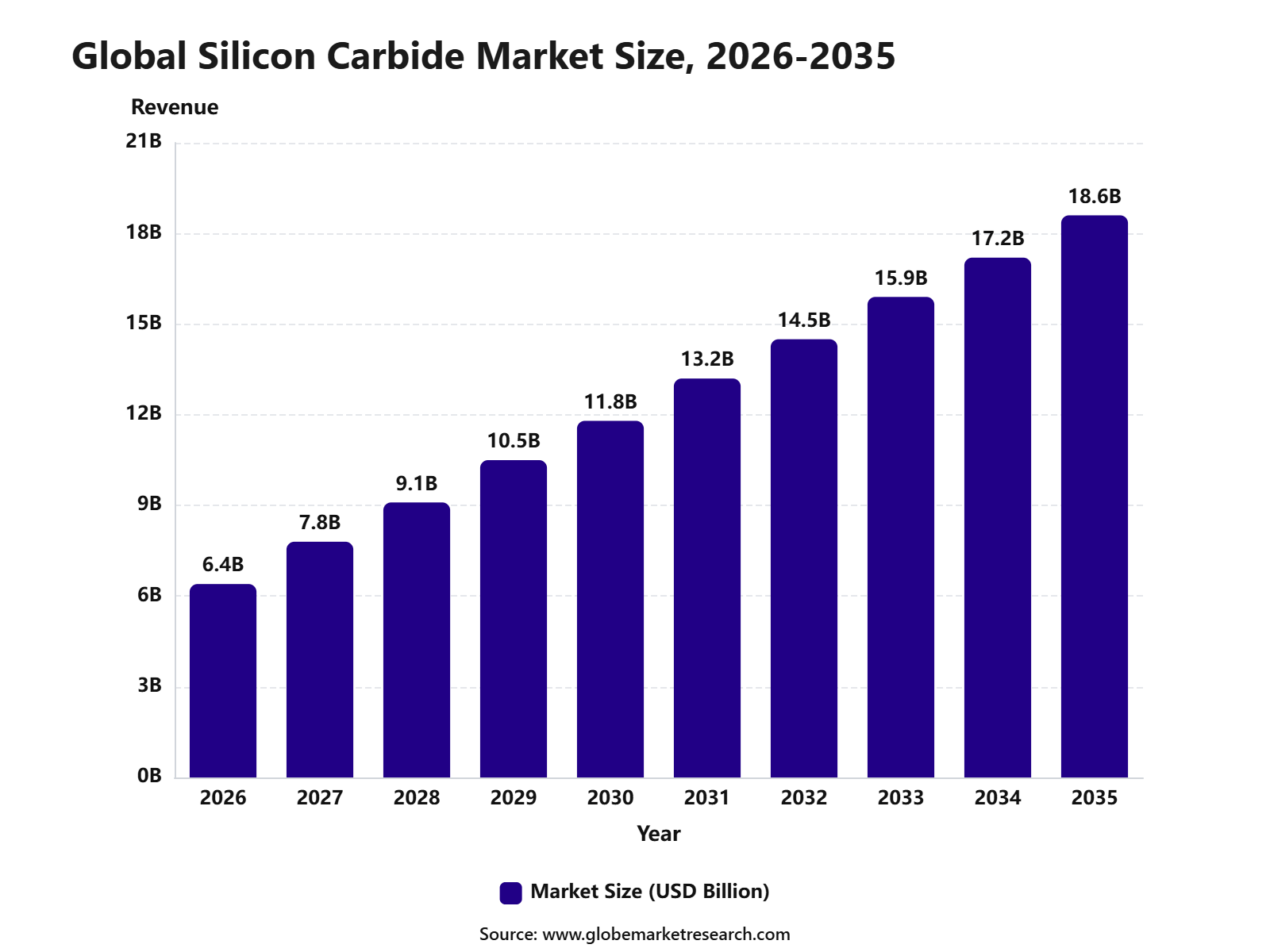 iThe graph shows projected market growth until 2035 based on CAGR analysis. Actual outcomes may vary depending on changing demand, competition, and economic factors.To gain greater insights - request a sample report PDF
Key Market Insights
Black SiC led the product segment with 57.6% share, supported by its strong hardness, thermal stability, cost efficiency, and wide use in abrasives, refractories, ceramics, and industrial materials.
Electrical and electronics applications accounted for over 30.5% share, driven by rising use of silicon carbide in power electronics, EV systems, renewable energy equipment, and high-voltage devices.
MOSFET devices held 34.2% share, supported by strong demand for faster switching, lower power loss, higher efficiency, and compact designs in advanced power systems.
6-inch wafers captured 37.8% share, driven by their established manufacturing base, improving yield performance, and wider adoption in SiC device production.
Asia Pacific led the silicon carbide market with 62.1% share, valued at USD 3.9 billion, supported by strong electronics manufacturing, EV production, semiconductor capacity, and rising demand across China, Japan, South Korea, and India.
Top Funding and Investment
Top Investments
1. Bosch Roseville SiC Semiconductor Facility
In July 2026, Bosch began sample production at its silicon carbide semiconductor facility in Roseville, California, following a total site transformation investment of approximately USD 2 billion. The project includes USD 225 million in U.S. CHIPS funding, with commercial production scheduled to begin later in 2026.
The converted facility will manufacture SiC chips on 200-millimetre wafers for electric vehicles, renewable-energy systems, industrial equipment, and data-centre power infrastructure. At full capacity, the plant is expected to represent more than 40% of U.S.-based SiC device manufacturing capacity.
2. SiCSem Odisha Compound Semiconductor Facility
In November 2025, SiCSem advanced a INR 2,067 crore investment to establish a compound semiconductor fabrication and assembly, testing, marking, and packaging facility in Bhubaneswar, Odisha.
The facility will manufacture silicon carbide devices for electric vehicles, railway systems, data centres, renewable-energy equipment, and automotive applications. The plant is expected to become operational during 2027-28, strengthening India’s domestic wide-bandgap semiconductor supply chain.
3. ROHM SiC Manufacturing Program
In 2025, ROHM revised its silicon carbide investment program to approximately JPY 150 billion for the period extending through fiscal 2027. The program covers the establishment of 8-inch SiC production lines, capacity expansion, device development, and manufacturing-efficiency improvements.
ROHM is expanding 8-inch SiC device capacity at its Chikugo and Miyazaki operations. The company is also developing fifth-, sixth-, and seventh-generation SiC MOSFETs, with targeted reductions of approximately 30% in specific on-resistance for each generation.
4. RIR Power Electronics Odisha Plant
In September 2025, RIR Power Electronics confirmed an investment of approximately INR 618 crore for a silicon carbide semiconductor facility in Bhubaneswar, Odisha.
The project is intended to establish domestic production of high-power SiC semiconductor devices used in electric vehicles, renewable-energy systems, industrial power conversion, and other high-voltage applications. The investment supports India’s expansion into compound-semiconductor manufacturing beyond conventional silicon-based chips.
5. Mitsubishi Electric Shisui SiC Wafer Plant
In October 2025, Mitsubishi Electric completed its new Shisui wafer plant in Kumamoto Prefecture, Japan. The company allocated approximately JPY 49.85 billion from green-bond proceeds toward SiC power-semiconductor manufacturing investments, including plant construction and production-line installation.
The facility will process 200-millimetre, or 8-inch, SiC wafers using automated production and material-handling systems. Pilot production is scheduled during 2026, supporting SiC devices for electric vehicles, home appliances, renewable-energy systems, railways, and industrial equipment.
Top Funding Developments
1. I-Pulse CHIPS Technology Award
In June 2026, I-Pulse secured a USD 250 million award from the U.S. Department of Commerce’s CHIPS Research and Development Office.
The funding will support advanced semiconductor and pulsed-power technology development, including silicon carbide semiconductor systems for high-power and energy-efficient applications. The program is also intended to strengthen U.S. semiconductor research, manufacturing capability, and supply-chain resilience.
2. Wolfspeed Restructuring Financing
In June 2025, Wolfspeed secured commitments for USD 275 million in new financing through second-lien convertible notes backed by existing convertible debtholders.
The financing formed part of Wolfspeed’s financial restructuring program, which targeted a reduction of approximately USD 4.6 billion in debt. The capital was intended to support continuing operations and preserve the company’s SiC wafer, material, power-device, and module manufacturing activities during restructuring.
3. ESK-SIC Factory Public Funding
In August 2025, the government of North Rhine-Westphalia and the European Union approved EUR 30 million in funding for ESK-SIC’s new silicon carbide production facility in Frechen, Germany.
The funding supports the development of a new factory focused on improving the security and sustainability of SiC raw-material production. ESK-SIC produces high-quality silicon carbide powder used in technical ceramics, additive manufacturing, industrial components, and other high-performance material applications.
Top Acquisitions
1. onsemi Acquired Qorvo’s SiC JFET Business
In January 2025, onsemi completed the acquisition of Qorvo’s silicon carbide junction field-effect transistor technology business for USD 115 million in cash.
The acquisition included the United Silicon Carbide subsidiary, SiC JFET technologies, intellectual property, engineering expertise, and associated product capabilities. These assets were added to onsemi’s EliteSiC portfolio for AI data-centre power supplies, electric vehicles, renewable-energy equipment, and industrial power systems.
2. Schunk Group Acquired ESK-SIC
Effective January 1, 2025, Schunk Group fully acquired ESK-SIC, a Germany-based manufacturer of high-quality silicon carbide powder. The financial value of the transaction was not publicly disclosed.
Schunk acquired ESK-SIC’s SiC powder production operations, manufacturing knowledge, workforce of approximately 160 employees, distribution capabilities, and raw-material portfolio. The acquisition gives Schunk greater control over a strategic input used in its technical ceramics and silicon carbide 3D-printing operations.
By Product
Black silicon carbide accounted for 57.6% share of the Silicon Carbide Market. This leading position is supported by its high hardness, strong thermal conductivity, wear resistance, and wide use in abrasives, refractories, grinding wheels, ceramics, and metallurgical applications.
The segment is widely preferred because black SiC offers cost efficiency and reliable performance in high-temperature and high-pressure environments. It is used in cutting tools, polishing materials, kiln furniture, brake components, and industrial wear parts where durability is required.
Demand is expected to remain strong as industries continue to use black SiC for surface finishing, steel production, foundry operations, and advanced ceramic components. Its broad industrial use and established production base will continue to support segment leadership.
By Application
Electrical and electronics applications held over 30.5% share of the Silicon Carbide Market. This dominance is driven by rising use of SiC in power electronics, electric vehicles, renewable energy systems, charging infrastructure, data centers, and industrial power supplies.
Silicon carbide is preferred in electronics because it supports higher voltage operation, faster switching, lower power loss, and better thermal performance compared with traditional silicon in demanding power applications. These advantages make it valuable for inverters, converters, diodes, modules, and advanced semiconductor devices.
The segment is expected to remain a major growth area as energy-efficient electronics and electrification continue to expand. Demand will remain supported by electric mobility, solar inverters, wind power systems, 5G infrastructure, and industrial automation.
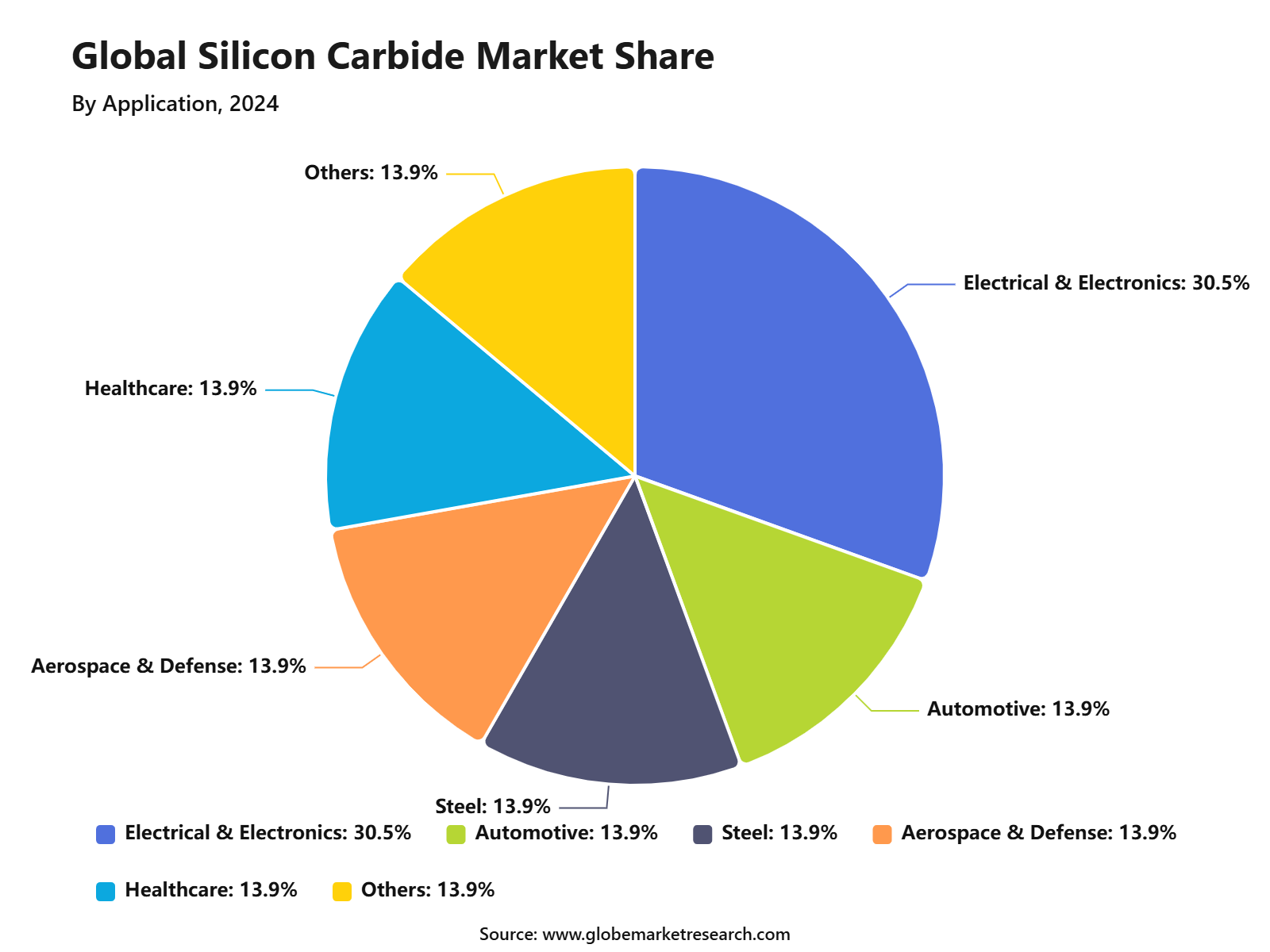 iThe graph shows projected market growth until 2035 based on CAGR analysis. Actual outcomes may vary depending on changing demand, competition, and economic factors.To gain greater insights - request a sample report PDF
By Device Type
MOSFET devices accounted for 34.2% share of the Silicon Carbide Market. This leading share is supported by their strong role in high-efficiency power conversion across electric vehicles, charging stations, solar inverters, motor drives, and industrial equipment.
SiC MOSFETs are preferred because they offer high switching speed, lower energy loss, compact design, and better heat management. These features help reduce system size, improve power density, and increase efficiency in demanding power electronics applications.
Demand for SiC MOSFETs is expected to remain strong as manufacturers focus on advanced power semiconductor solutions. Growth will be supported by electric vehicle platforms, fast-charging systems, renewable energy projects, and high-performance industrial power systems.
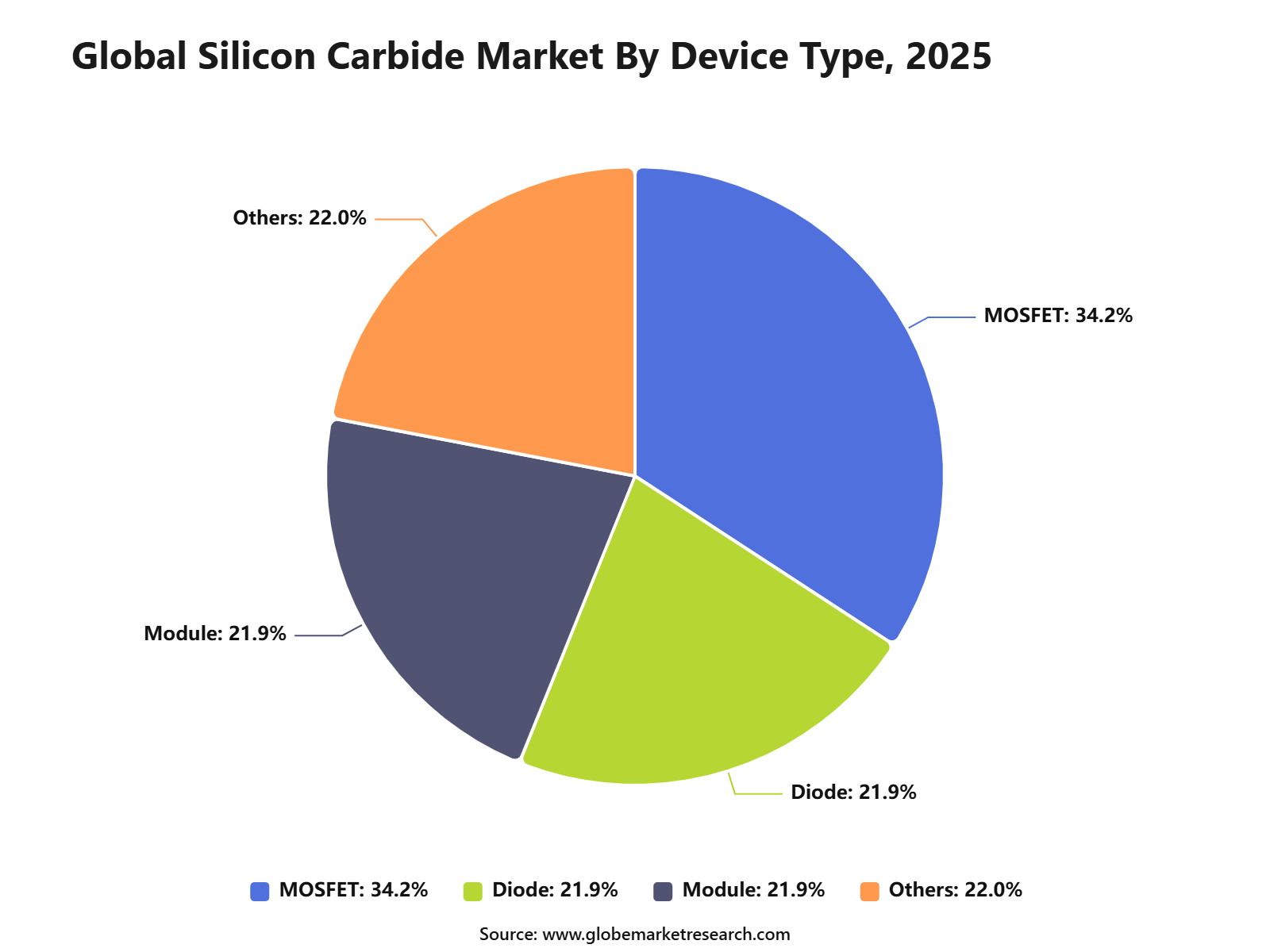 iThe graph shows projected market growth until 2035 based on CAGR analysis. Actual outcomes may vary depending on changing demand, competition, and economic factors.To gain greater insights - request a sample report PDF
By Wafer Size
The 6-inch wafer segment held 37.8% share of the Silicon Carbide Market. This leading position is supported by its strong use in commercial SiC device manufacturing and its balance between production efficiency, yield management, and cost control.
Six-inch wafers are widely used for producing SiC MOSFETs, Schottky diodes, power modules, and other semiconductor devices. This wafer size allows manufacturers to scale production while maintaining process stability and device quality.
The segment is expected to remain important as demand for SiC-based electronics rises. However, the industry is also moving toward larger wafer sizes to improve output and reduce cost per device, especially as electric vehicle and renewable energy demand grows.
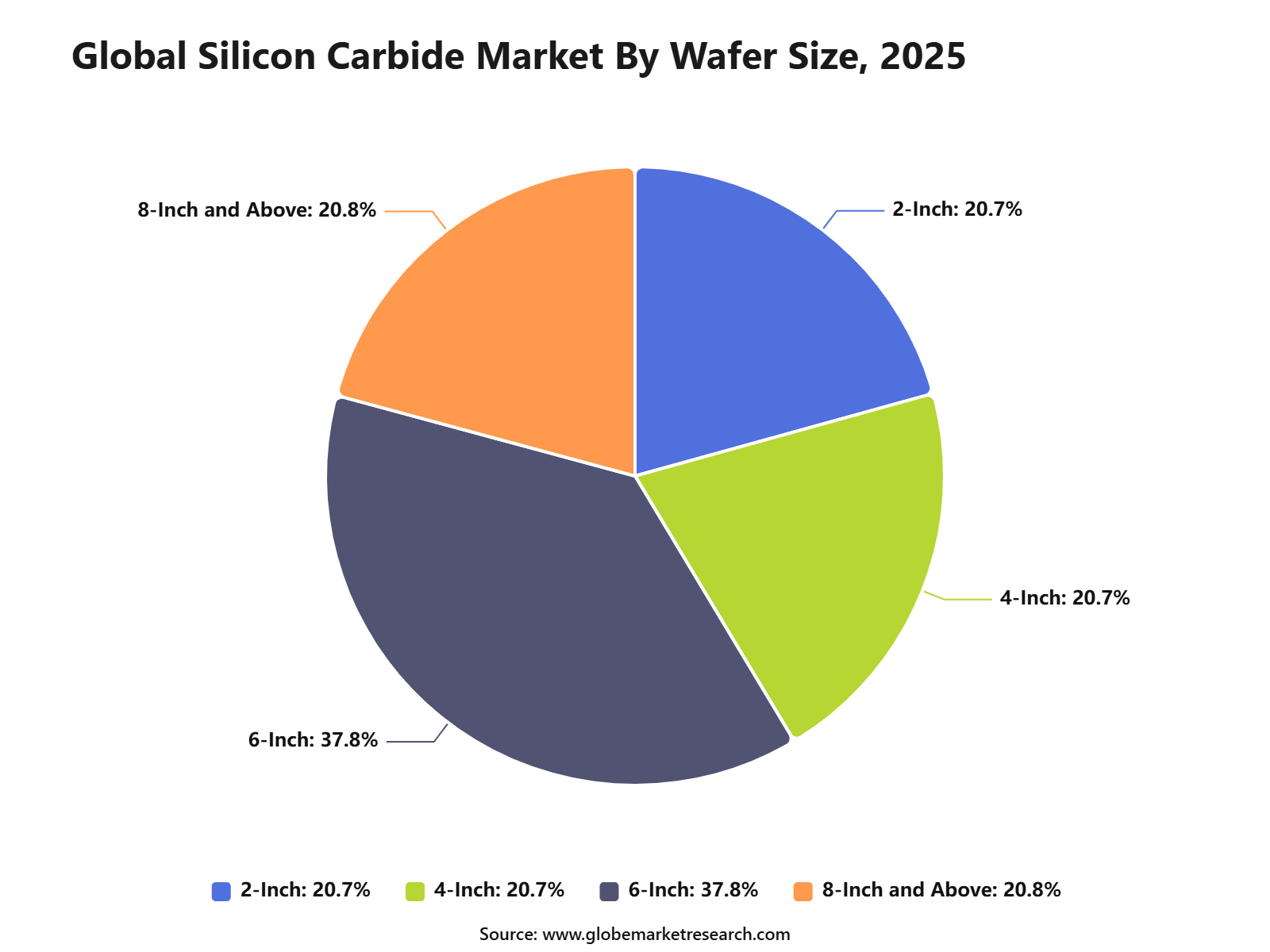 iThe graph shows projected market growth until 2035 based on CAGR analysis. Actual outcomes may vary depending on changing demand, competition, and economic factors.To gain greater insights - request a sample report PDF
By Region
Asia Pacific accounted for 62.1% share of the Silicon Carbide Market, reaching USD 3.9 billion. The region’s leadership is supported by strong electronics manufacturing, electric vehicle production, semiconductor fabrication, abrasives demand, and industrial material processing.
China, Japan, South Korea, India, and Southeast Asian countries are key contributors to regional demand. The region benefits from large manufacturing capacity, expanding EV supply chains, strong renewable energy investment, and growing use of SiC materials in industrial and semiconductor applications.
Asia Pacific is expected to maintain its leading position as battery electric vehicles, power electronics, solar inverters, and advanced manufacturing continue to expand. Demand will remain supported by black SiC, 6-inch wafer production, MOSFET devices, and strong electrical and electronics applications.
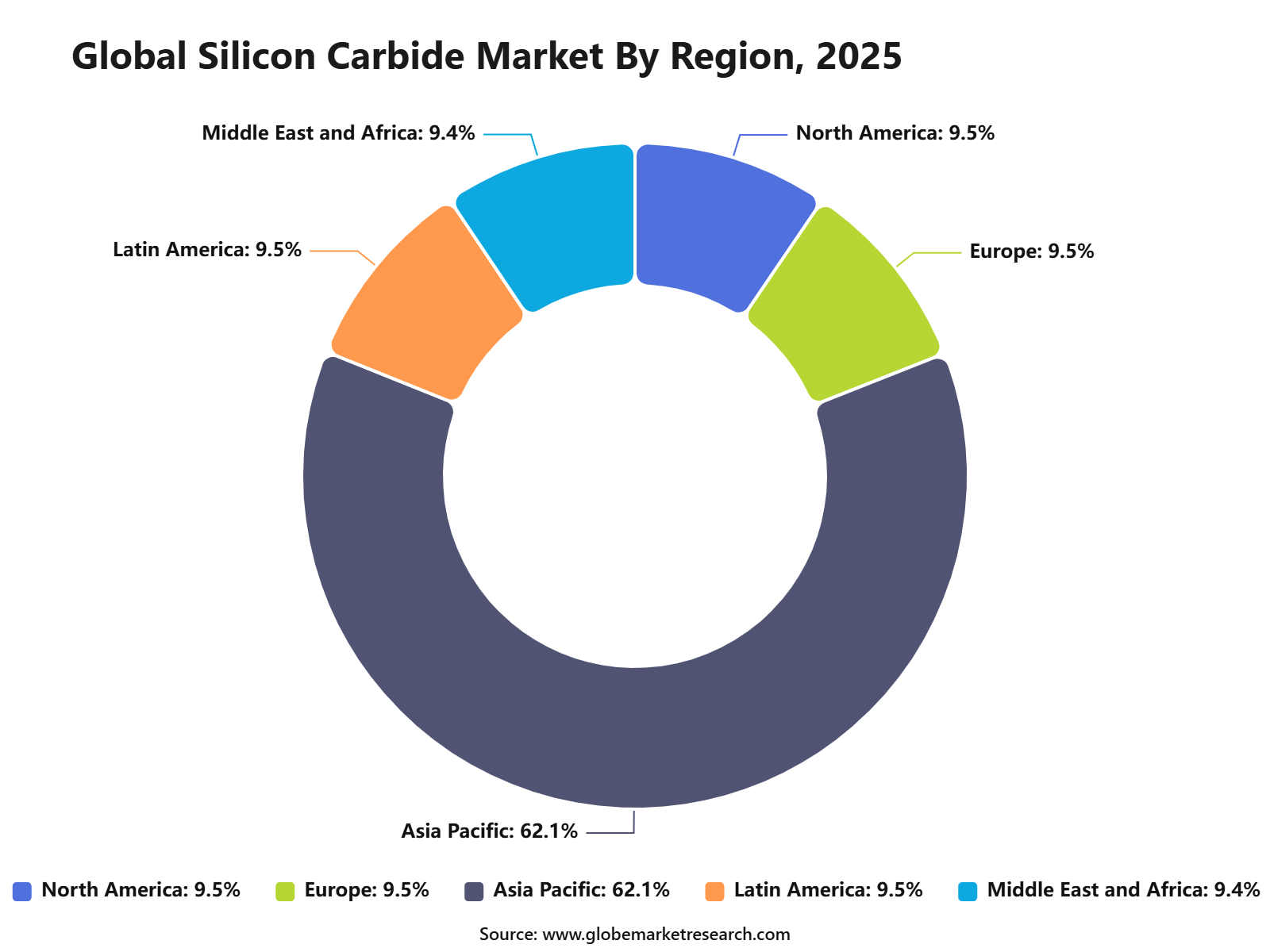 iThe graph shows projected market growth until 2035 based on CAGR analysis. Actual outcomes may vary depending on changing demand, competition, and economic factors.To gain greater insights - request a sample report PDF
Regional Impact Analysis
Asia Pacific leads the Silicon Carbide Market with 62.1% share in 2026, valued at around USD 4.0 billion, supported by strong EV production, semiconductor manufacturing, electronics assembly, renewable energy deployment, and power electronics demand. China, Japan, South Korea, Taiwan, and India remain key regional markets.
North America remains important because of advanced semiconductor investment, EV adoption, data center growth, and clean energy infrastructure. Europe supports strong demand through automotive electrification, power module production, industrial automation, and renewable energy expansion.
Impact Factor | Estimated CAGR Impact | Regional Relevance | Market Impact |
|---|---|---|---|
Asia Pacific market leadership | +3.8% | Asia Pacific, 62.1% share in 2026 | Leads global value demand. |
China EV and power electronics scale | +2.9% | China | Drives high-volume SiC demand. |
Japan and South Korea semiconductor strength | +2.3% | Japan, South Korea | Supports advanced device development. |
Taiwan electronics supply chain role | +1.8% | Taiwan | Adds wafer and device ecosystem value. |
North America and Europe EV demand | +1.6% | U.S., Germany, France, UK | Supports premium SiC adoption. |
Go-To-Market and Sales Economics
Silicon carbide suppliers should pursue direct design-in programmes with electric-vehicle manufacturers, Tier 1 inverter companies, and charging-system producers. In the first five months of 2026, the EU registered 950,521 battery-electric cars, representing 20% of new registrations. Early engineering support, automotive qualification, samples, and multi-year supply agreements can improve programme conversion and revenue visibility.
Industrial and data-centre sales should be organised around system partners rather than individual component transactions. Infineon and DG Matrix began a 2026 collaboration using silicon carbide in solid-state transformers, a technology described as up to 14 times smaller and 40 times lighter than conventional equipment. Reference designs, joint testing, and reliability guarantees can accelerate customer adoption.
Regional application laboratories and secure wafer supply are essential because customers require long qualification and validation cycles. STMicroelectronics plans to start production at its integrated Italian silicon carbide campus in 2026, supported by approximately EUR 5 billion of investment. Local technical teams, packaging support, traceability, and dependable allocation can differentiate suppliers during high-volume sourcing decisions.
Risk Factors & Market Barriers
Manufacturing economics remain difficult because silicon carbide substrates have higher defect sensitivity and more complex processing than conventional silicon. STMicroelectronics states that SiC chips remain more difficult and costly to manufacture, even as producers move toward 200-millimetre wafers. Weak yields, qualification failures, and slow ramp-up can raise unit costs and delay customer deliveries.
Capacity expansion can create severe financial pressure when demand develops more slowly than planned. Wolfspeed reported fiscal third-quarter 2026 revenue of USD 150.2 million, cost of revenue of USD 190.2 million, and a USD 40 million gross loss. Manufacturers should phase equipment purchases, secure customer commitments, and closely manage factory utilisation and cash consumption.
Automotive demand remains uneven across countries and vehicle platforms, creating forecasting and pricing risk. Although EU battery-electric registrations reached 20% share through May 2026, growth ranged from 75.7% in Italy to only 2.8% in Belgium. Suppliers should diversify across vehicle manufacturers, industrial drives, renewable systems, rail, aerospace, and data-centre power applications.
Revenue Potential Analysis
Revenue Landscape Across
Electric mobility provides revenue across traction inverters, onboard chargers, DC-to-DC converters, fast chargers, and power modules. EU battery-electric registrations increased to 950,521 units during the first five months of 2026, while plug-in hybrids reached 460,217 units. Suppliers can increase account value through complete chipsets, gate drivers, thermal design support, and qualified automotive packaging.
Renewable energy and grid modernisation provide additional revenue for silicon carbide diodes, MOSFETs, modules, and inverter systems. IRENA reported 692 GW of renewable capacity additions in 2025, including 511 GW of solar and 159 GW of wind. Opportunities are being created across solar inverters, storage converters, wind systems, microgrids, and high-voltage direct-current equipment.
AI infrastructure is opening a higher-value application channel for efficient power conversion and protection. The IEA expects data-centre electricity consumption to increase from 485 TWh in 2025 to 950 TWh by 2030. Silicon carbide suppliers can target solid-state transformers, uninterruptible power systems, energy storage, circuit breakers, and medium-voltage power distribution architectures.
Financial Impact
Strong power-semiconductor demand can support earnings when product mix and capacity utilisation are controlled. Infineon reported fiscal second-quarter 2026 revenue of EUR 3.812 billion, segment result of EUR 653 million, and a 17.1% segment margin. Broader automotive and industrial portfolios can help absorb silicon carbide investment while customer programmes progress toward higher production volumes.
Large integrated factories can lower future unit costs, but they require substantial capital and sustained wafer loading. STMicroelectronics’ Italian silicon carbide campus represents approximately EUR 5 billion of planned investment, including about EUR 2 billion of public support, and targets up to 15,000 wafers weekly at full build-out. Returns will depend on yields, pricing, and utilisation.
Financial outcomes can diverge sharply during technology transitions. STMicroelectronics reported first-quarter 2026 revenue of USD 3.10 billion and a 33.8% gross margin, while Wolfspeed recorded a gross loss in its fiscal third quarter. Investors and manufacturers should evaluate cash flow, unused-capacity charges, customer concentration, depreciation, and the timing of 200-millimetre production ramps.
Drivers Impact Analysis
The Silicon Carbide Market is driven by rising demand for power electronics, electric vehicles, renewable energy systems, industrial motors, fast charging infrastructure, and high-efficiency semiconductors. Silicon carbide is gaining strong adoption because it supports higher voltage, faster switching, lower energy loss, and better thermal performance than traditional silicon in many power applications.
Asia Pacific leads the market due to strong semiconductor manufacturing, electric vehicle production, electronics supply chains, renewable energy deployment, and power device fabrication. China, Japan, South Korea, Taiwan, and India remain key contributors because of growing demand for SiC wafers, MOSFETs, diodes, and power modules.
Impact Factor | Estimated CAGR Impact | Regional Relevance | Market Impact |
|---|---|---|---|
Rising electric vehicle adoption | +3.5% | Asia Pacific, Europe, North America | Drives SiC power device demand. |
Growth in renewable energy systems | +2.9% | China, India, Japan, Europe, U.S. | Supports inverter and power conversion use. |
Expansion of fast charging infrastructure | +2.4% | EV-focused markets | Increases demand for high-voltage SiC devices. |
Demand for energy-efficient power electronics | +2.0% | Industrial and consumer electronics markets | Improves adoption across applications. |
Semiconductor manufacturing expansion | +1.6% | Asia Pacific | Builds wafer and device supply. |
Restraints Impact Analysis
The market faces restraints from high wafer cost, complex manufacturing, substrate defects, supply concentration, and qualification challenges in automotive and industrial applications. SiC devices require advanced crystal growth, wafer processing, epitaxy, and packaging, which increases production cost.
Another restraint is competition from silicon and gallium nitride in selected applications. While SiC is strong in high-voltage and high-power systems, some lower-power applications may continue using silicon or GaN due to cost and design requirements.
Impact Factor | Estimated CAGR Impact | Regional Relevance | Market Impact |
|---|---|---|---|
High SiC wafer production cost | -2.1% | Global semiconductor producers | Limits faster mass adoption. |
Substrate defects and yield issues | -1.8% | Wafer and device manufacturing | Affects supply and pricing. |
Long automotive qualification cycles | -1.5% | EV and power module markets | Delays product commercialization. |
Competition from silicon and GaN | -1.2% | Power electronics applications | Limits use in selected segments. |
Supply chain concentration risk | -1.0% | Asia Pacific and global markets | Creates sourcing pressure. |
Opportunities Impact Analysis
Opportunities are strong in SiC MOSFETs, Schottky diodes, power modules, 6-inch and 8-inch wafers, electric vehicle inverters, onboard chargers, solar inverters, energy storage systems, and industrial power supplies. These areas benefit from rising demand for compact, efficient, and high-voltage power systems.
Higher-value opportunities are emerging in 8-inch wafer transition, automotive-grade SiC modules, traction inverters, grid-scale energy systems, rail traction, data center power supplies, and aerospace electronics. Companies with strong wafer quality, device reliability, and packaging capability can capture stronger value.
Impact Factor | Estimated CAGR Impact | Regional Relevance | Market Impact |
|---|---|---|---|
SiC MOSFET adoption | +3.3% | EV, industrial, and renewable sectors | Builds high-value device demand. |
8-inch wafer transition | +2.8% | Asia Pacific, U.S., Europe | Supports cost reduction and scale. |
EV traction inverter growth | +2.5% | China, Japan, South Korea, Europe | Adds strong automotive demand. |
Solar and energy storage inverters | +2.0% | Renewable energy markets | Expands power conversion use. |
Automotive-grade power modules | +1.6% | Global EV supply chains | Supports premium semiconductor growth. |
Challenges Impact Analysis
The main challenge is scaling production while improving quality, yield, and cost competitiveness. SiC manufacturing needs precise crystal growth, wafer slicing, epitaxy, device fabrication, and thermal packaging to meet strict performance standards.
Another challenge is managing customer qualification and supply agreements. Automotive, industrial, and energy customers require reliability testing, stable supply, and long-term product availability before large-scale adoption.
Impact Factor | Estimated CAGR Impact | Regional Relevance | Market Impact |
|---|---|---|---|
Scaling high-quality wafer production | -2.0% | Global SiC supply chains | Affects volume availability. |
Improving device yield | -1.7% | Semiconductor fabrication plants | Influences cost and margin. |
Thermal packaging complexity | -1.4% | Power module manufacturers | Raises design requirements. |
Long customer validation cycles | -1.2% | Automotive and industrial markets | Slows revenue conversion. |
Managing capacity expansion timing | -0.9% | Wafer and device suppliers | Creates oversupply or shortage risk. |
Segment Covered in the Report
By Product
Black SiC
Green SiC
Others
By Application
Electrical & Electronics
Aerospace & Defense
Others
By Device Type
MOSFET
Diode
Module
Others
By Wafer Size
2-Inch
4-Inch
6-Inch
8-Inch and Above
By Region
North America
Europe
Asia Pacific
Latin America
Middle East and Africa
Market Trend Analysis
The market trend is moving toward 8-inch SiC wafers, automotive-grade MOSFETs, high-voltage modules, EV inverter integration, and renewable energy power conversion. SiC is becoming a preferred material in applications where efficiency, compact size, and heat resistance are important.
Asia Pacific remains the largest value region because of strong EV manufacturing, electronics production, and semiconductor supply chains. North America and Europe support growth through automotive electrification, grid modernization, energy storage, and advanced semiconductor investment.
Impact Factor | Estimated CAGR Impact | Regional Relevance | Market Impact |
|---|---|---|---|
8-inch SiC wafer development rises | +3.1% | Asia Pacific, U.S., Europe | Improves production scale. |
Automotive SiC module demand grows | +2.6% | EV manufacturing regions | Supports powertrain efficiency. |
High-voltage device adoption increases | +2.2% | Renewable and industrial markets | Expands power electronics use. |
Vertical integration strengthens | +1.8% | Wafer, device, and module suppliers | Improves supply control. |
SiC use in energy storage grows | +1.4% | Grid and battery systems | Adds future demand. |
Investor Type Impact Matrix
Investors should focus on companies with strong wafer quality, device design capability, automotive qualification, manufacturing scale, packaging expertise, and long-term customer agreements. Yield, reliability, cost reduction, and supply security are key success factors.
Strategic investors can also target SiC wafer producers, MOSFET manufacturers, power module firms, epitaxy providers, crystal growth technology companies, and thermal packaging suppliers. Companies that combine technology strength with scalable production are better positioned for long-term growth.
Investor Type | Estimated CAGR Impact | Regional Relevance | Market Impact |
|---|---|---|---|
SiC Wafer Producers | +2.8% | Asia Pacific, U.S., Europe | Expands core upstream supply. |
SiC Power Device Manufacturers | +2.4% | EV, renewable, industrial markets | Builds high-value semiconductor revenue. |
Automotive Power Module Suppliers | +2.0% | Global EV supply chains | Supports traction inverter adoption. |
Epitaxy and Crystal Growth Firms | +1.6% | Semiconductor supply chains | Improves wafer quality and yield. |
Strategic Semiconductor Investors | +1.3% | Global SiC ecosystem | Funds capacity and technology expansion. |
Recent Developments
In January 2026, Cree’s successor company, Wolfspeed, produced a single-crystal 300-millimetre silicon carbide wafer. Cree has not operated independently since its official corporate name changed to Wolfspeed in October 2021.
In May 2026, Bosch reported continued conversion of its Roseville, California, wafer facility for 200-millimetre silicon carbide production, supported by planned investment of approximately USD 1.5 billion and workforce retraining.
In June 2025, Renesas agreed to restructure its USD 2.062 billion Wolfspeed deposit, linked to silicon carbide wafer supplies, into convertible notes, common shares, and warrants through Wolfspeed’s financial restructuring.
In March 2025, Toshiba completed a new back-end manufacturing building for automotive power semiconductors at Himeji and installed solar generation expected to produce 316,000 kilowatt-hours annually, reducing emissions by 126 tonnes.
Competitive Landscape
The market is characterized by intense competition among established players and emerging companies. Strategic partnerships, mergers and acquisitions, and product innovation are key strategies employed by market participants.
Key Market Players
Wolfspeed
STMicroelectronics
Infineon Technologies
ROHM Semiconductor
ON Semiconductor
Coherent Corp.
SK Siltron CSS
Toshiba Corporation
Renesas Electronics
Mitsubishi Electric
Fuji Electric
Bosch
Cree, Inc.
II-VI Incorporated
Microchip Technology
Other Key Players
Research Methodology
This market study is prepared using a combination of primary and secondary research. Primary research includes discussions with manufacturers, suppliers, distributors, consultants, industry experts, and end users. Secondary research covers company reports, government databases, trade associations, technical publications, regulatory sources, and trusted industry documents. The collected information is used to assess market demand, pricing trends, technology adoption, competitive activity, and regional performance.
AI language models are not used as primary data sources, and publicly available AI-generated content is not treated as market evidence. Computational tools may be used to support data processing, translation, data classification, and pattern identification. However, every published assessment is supported by verified sources, human review, and primary market discussions.
Market estimates are developed through top-down and bottom-up approaches and validated using data triangulation. Revenue, production, shipment, pricing, and application-level data are compared across multiple sources. Forecasts consider economic conditions, regulatory changes, investment activity, innovation, supply chain developments, and industry risks. All findings are reviewed through source verification and internal quality checks before publication.
Part I
Source Management & Input Data Standards
Who provides data, how sources are qualified, and what types of evidence are admissible.
Part II
Research Scope & Market Coverage
How we define the markets we assess and the parameters that govern each product.
Part III
Data Collection, Verification & Submission
The mechanics of gathering, cross-checking, and hierarchically ranking evidence.
Part IV
Assessment Determination & Quality Controls
How raw data becomes a published assessment — normalisation, expert judgement, and outlier exclusion.
Part V
Publication, Corrections & Revision
Our publication schedule, corrections policy, and methodology review cycle.
Part VI
Independence, Ethics & Complaints
Conflict-of-interest policies, editorial independence, and how clients raise concerns.
Google · Preferred Sources
Don't miss the latest market research insights and industry updates on Google.
Add Globe Market Research as a preferred source in the Google app to see our reports, analysis, and market stories in your news suggestions.
Meet the Team
This report was prepared by our expert analysts with deep industry knowledge and research experience.
Pratiksha K. is a Senior Research Analyst with more than five years of experience in market research, industry analysis, competitive intelligence, and business strategy. She has contributed to detailed market reports, customized research studies, company profiling, market sizing, trend analysis, and strategic consulting projects for clients across different regions. Her industry expertise covers Chemical and Material, Consumer Goods, Food & Beverages and Energy & Power. She closely evaluates changing customer requirements, technology developments, regulatory conditions, supply chain structures, investment activity, and competitive strategies to provide clear and practical market insights.
Sayali brings more than 7 years of experience to Globe Market Research, supporting the accuracy, clarity, and relevance of research content across multiple industries. She reviews market data, segment analysis, competitive insights, and industry trends to ensure each report meets strong quality standards and provides practical value to business decision-makers. Her expertise spans healthcare, information technology, consumer goods, and diverse cross-industry domains. With a strong focus on data reliability, structured analysis, and clear presentation, Sayali helps ensure that each research output delivers well-reviewed insights for clients, investors, consultants, and industry stakeholders.
Frequently Asked Questions
Related Reports
More in Chemical and Material
Sulfuric Acid Market to Hit USD 61.5 Billion by 2035
Sulfuric Acid Market Size, Share, Analysis By Raw Material (Elemental Sulfur, Base Metal Smelters, Pyrite Ore, Others), By Application (Fertilizers, Chemical Manufacturing, Metal Processing, Petroleum Refining, Textile, Automotive, Pulp and Paper, Others), By Distribution Channel (Direct Sales, Distributors), By Regional Insights, Business plan and Project Report, Investment Opportunities, Profitability, Industry Trends, Leading Companies and Growth Forecasts by 2026-2035
Powder Metallurgy Market to Hit USD 17.0 Billion by 2035
Powder Metallurgy Market Size, Share, Analysis By Material (Ferrous Metals, Non-Ferrous Metals, Others), By Process (Additive Manufacturing, Powder Metal Hot Isostatic Pressing, Conventional Powder Metallurgy), By Application (Automotive, Aerospace and Defense, Healthcare, Electrical and Electronics, Industrial Machinery, Others) , By Regional Insights, Business plan and Project Report, Investment Opportunities, Profitability, Industry Trends, Leading Companies and Growth Forecasts by 2026-2035
Bromine Market to Hit USD 1.5 Billion by 2035
Bromine Market Size, Share, Analysis By Derivative (Organobromine, Clear Brine Fluids, Hydrogen Bromide, Others), By Application (Flame Retardants, Oil and Gas Drilling, Biocides, PTA Synthesis, Plasma Etching, Pharmaceuticals, Energy Storage, Others), By End-Use Industry (Chemicals, Oil and Gas, Pharmaceuticals, Electrical and Electronics, Automotive, Agriculture, Others), By Regional Insights, Business plan and Project Report, Investment Opportunities, Profitability, Industry Trends, Leading Companies and Growth Forecasts by 2026-2035
Hydrogen Cyanide Market to Hit USD 5.95 Billion by 2035
Hydrogen Cyanide Market Size, Share, Analysis By Product Form (Hydrogen Cyanide Liquid, Hydrogen Cyanide Gas), By Application (Adiponitrile, Acetone Cyanohydrin, Sodium Cyanide and Potassium Cyanide, Methionine, Cyanuric Chloride, Others), By End-Use Industry (Chemicals, Mining and Metallurgy, Pharmaceuticals, Agriculture, Textiles, Others), By Regional Insights, Business plan and Project Report, Investment Opportunities, Profitability, Industry Trends, Leading Companies and Growth Forecasts by 2026-2035