

Revenue, 2025
USD 120.1 Mn
Forecast, 2035
USD 3,600.0 Mn
CAGR, 2025-2035
40.5%
Report Coverage
South Korea
Market Size and Forecast
Humanoid robots combine mechanical hardware, artificial intelligence software, sensors, actuators, cameras and control systems to perform tasks in human-oriented environments. These systems can support material handling, assembly, inspection, logistics, personal assistance, caregiving, education and public services. Compared with conventional industrial robots, humanoid platforms offer greater mobility and flexibility for facilities, equipment and workflows originally designed for human workers.
According to Globe Market Research’s latest industry analysis, the South Korea Humanoid Robot Market was valued at USD 120.1 million in 2025 and is projected to reach approximately USD 3,600.0 million by 2035, growing at a CAGR of 40.5% from 2025 to 2035. Market growth is being supported by rising investment in physical AI, advanced manufacturing automation and intelligent robotic systems. Labour shortages, an ageing population and the need for safer workplaces are also encouraging the development of robots capable of working alongside people.
Key Parameter | Report Details |
|---|---|
Market Revenue, 2025 | USD 120.1 Million |
Projected Revenue, 2035 | USD 3,600.0 Million |
CAGR, 2025-2035 | 40.5% |
Country Scope | South Korea |
Market Concentration | Medium |
Base Year | 2024 |
Forecast Period | 2025-2035 |
Demand is also being influenced by South Korea’s highly automated manufacturing sector and national humanoid development programmes. In April 2026, the International Federation of Robotics reported that South Korea had the world’s highest industrial robot density, with 1,220 robots per 10,000 manufacturing employees. The Manufacturing AX Alliance, launched with participation from more than 1,000 companies and institutions, aims to develop an industrial humanoid foundation model by 2028 and establish annual production capacity of at least 1,000 humanoid robots from 2029.
Agentic AI is enabling humanoid robots to understand instructions, plan multi-step activities and adapt their movements to changing environments. In March 2026, NVIDIA reported that its GR00T N2 foundation model completed new tasks in unfamiliar environments more than twice as successfully as leading vision-language-action models. The model also ranked first on the MolmoSpaces and RoboArena benchmarks for general-purpose robotic policies.
Commercial deployment is also advancing across manufacturing and logistics. By November 2025, Agility Robotics’ Digit humanoid had moved more than 100,000 totes at a commercial facility, while Toyota Motor Manufacturing Canada signed a commercial deployment agreement in February 2026 following a successful pilot. The wider automation market remains supportive, with global industrial robot installations expected to reach 575,000 units in 2025 and exceed 700,000 units annually by 2028.
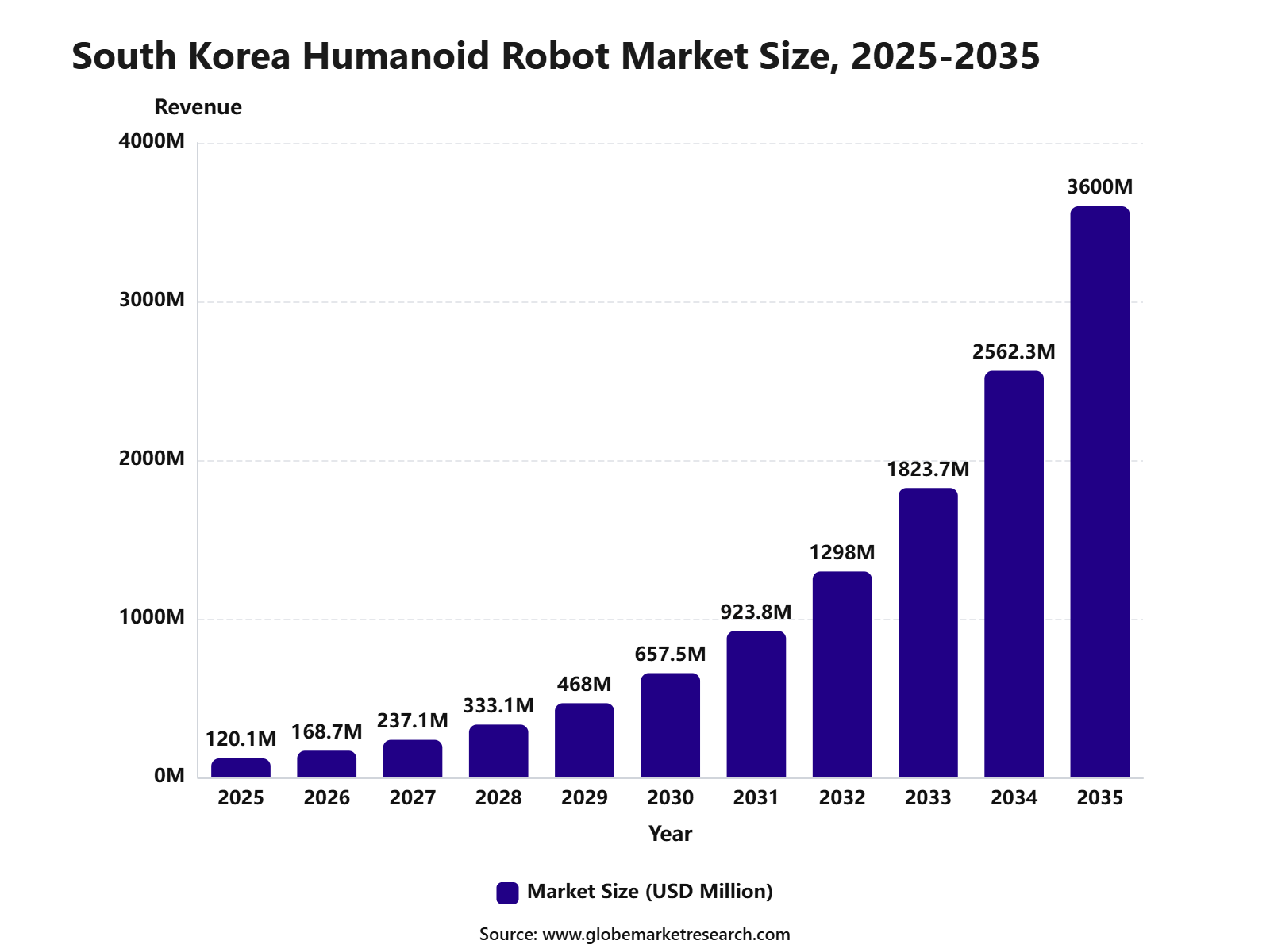 iThe graph shows projected market growth until 2035 based on CAGR analysis. Actual outcomes may vary depending on changing demand, competition, and economic factors.To gain greater insights - request a sample report PDF
Key Market Insights
The South Korea Humanoid Robot Market was valued at USD 120.1 million in 2025 and is expected to reach USD 3,600.0 million by 2035, growing at a CAGR of 40.5% from 2025 to 2035.
The Global Humanoid Robot Market was valued at USD 9.7 billion in 2025 and is projected to reach USD 263.6 billion by 2035, growing at a CAGR of 39.1% during the forecast period. Asia Pacific led the market with 44.6% share in 2025,
Hardware led the component segment with 81.6% share, supported by strong demand for actuators, sensors, control units, cameras, processors, batteries, and robotic body structures.
Biped humanoid robots accounted for around 86.3% share by motion type, driven by their human-like movement, suitability for personal assistance, caregiving, service tasks, and interaction-based applications.
Personal assistance and caregiving held 37.8% share by application, supported by South Korea’s aging population, rising demand for care support, and growing use of robots in homes, healthcare, and assisted living environments.
Adoption and Usage Area Statistics
According to the International Federation of Robotics, South Korea recorded a robot density of 1,012 units per 10,000 manufacturing workers and installed approximately 30,600 industrial robots in 2024. Although installations declined by 3%, the country continues to maintain a highly automated industrial base. These figures represent industrial robot adoption indicators rather than direct humanoid robot adoption rates, but they demonstrate strong infrastructure, workforce familiarity and manufacturing readiness for future humanoid deployment.
Metric | Latest Value | What It Means |
|---|---|---|
Robot density | 1,012 robots per 10,000 workers | South Korea remains one of the world’s most automated manufacturing economies, creating a strong foundation for humanoid robot deployment in factories. |
Density growth | 5% average annual growth | Robot density has increased steadily since 2018, indicating long-term industrial automation readiness. |
Robot installations | 30,600 units | South Korea installed 30,600 industrial robots in 2024, ranking as the fourth-largest market by annual installations. |
Installation change | Down 3% | Installations declined slightly in 2024, although annual demand has remained close to 31,000 units since 2019. |
According to industry survey, South Korea’s humanoid robot usage outlook is being supported by KRW 700 billion in 2026 government-backed manufacturing AI support, a national target to produce 1,000 humanoid robots per year by 2029 and expected Korean supply-chain support for around 74,000 humanoid units by 2030 and 412,000 units by 2035. This shows that the country is preparing humanoid robots mainly for industrial, logistics, service, and care-related use cases, rather than only research-stage demonstrations.
According to South Korea’s Ministry of Science and ICT, reported by Korea Herald, the government will invest KRW 50.4 billion through 2030 to develop domestic AI humanoid core technologies. Hyundai and Boston Dynamics are also supporting commercialization, with Atlas expected to work in Hyundai plants by 2028 and Hyundai planning annual production capacity of around 30,000 humanoid robots. These investments indicate that near-term usage will be strongest in smart factories, automotive plants, warehouse movement, inspection, and industrial support tasks.
Metric | Latest Value/% | Practical Use |
|---|---|---|
Government investment | KRW 700 billion | South Korea is supporting manufacturing AI and humanoid robotics through a national manufacturing alliance. |
Core technology fund | KRW 50.4 billion | Government funding will support the development of domestic AI-based humanoid technologies through 2030. |
Commercialization target | 2028 | South Korea aims to establish foundation AI models and commercial humanoid robot capabilities by 2028. |
Mass-production target | 2029 | The country plans to begin large-scale humanoid robot production from 2029. |
Hyundai production capacity | 30,000 units annually | Hyundai plans to establish annual humanoid robot production capacity of 30,000 units by 2028. |
Korean supply-chain potential | Around 74,000 units | Domestic component and manufacturing supply chains may support approximately 74,000 humanoid robot units by 2030. |
By Component Insights
Hardware accounted for the dominant component share of 81.6%. Humanoid robots require actuators, precision reducers, motors, sensors, cameras, batteries, control boards and lightweight body frames. The high number of moving joints and the need for stable full-body movement make physical components the largest cost and engineering area.
South Korea’s advanced manufacturing base supports local hardware development. In April 2026, the country recorded the world’s highest industrial robot density at 1,220 robots per 10,000 manufacturing employees, with density increasing by an average of 7% annually since 2019. This established automation ecosystem provides strong engineering, testing and component-production capabilities for humanoid platforms.
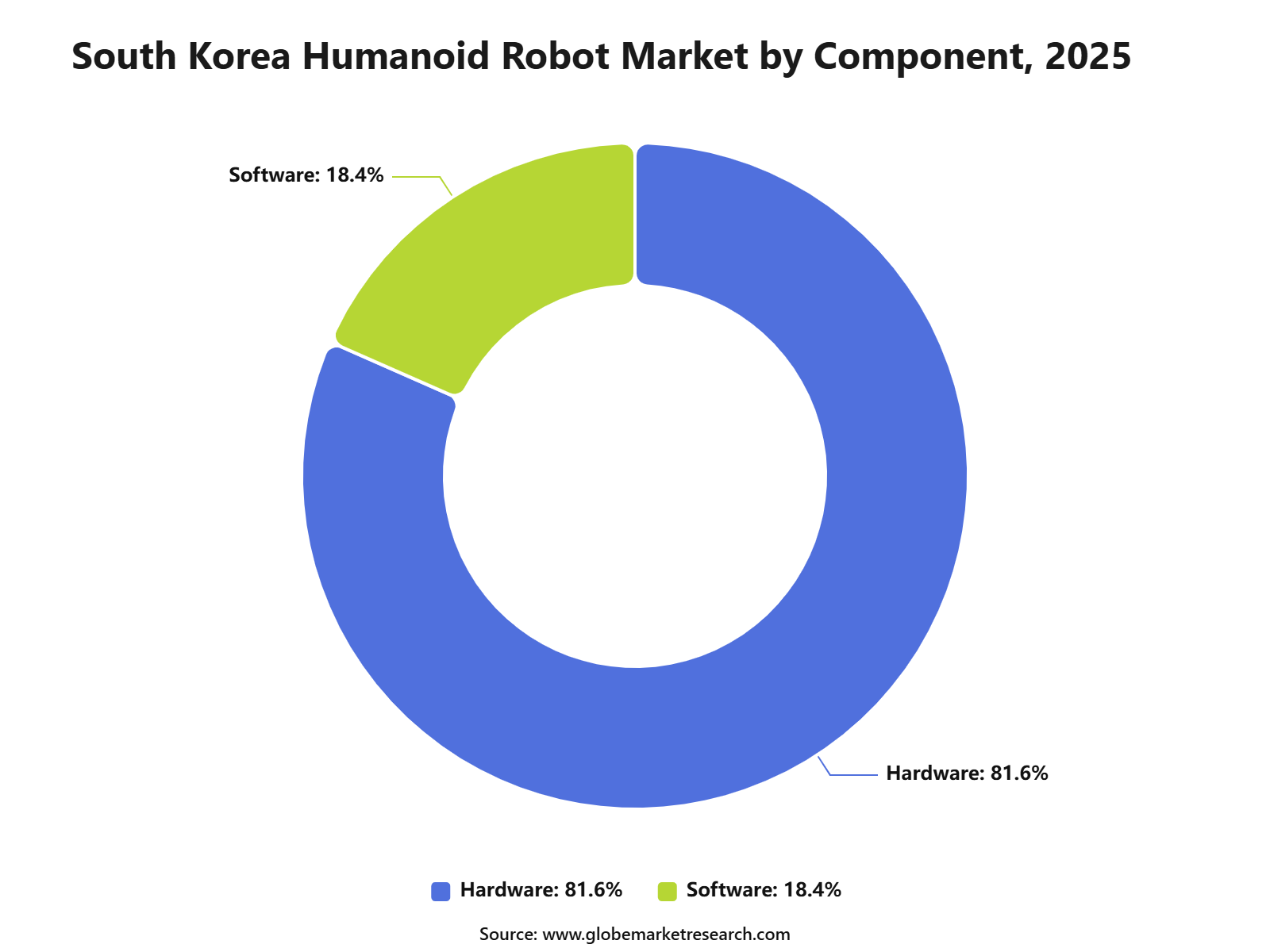 iThe graph shows projected market growth until 2035 based on CAGR analysis. Actual outcomes may vary depending on changing demand, competition, and economic factors.To gain greater insights - request a sample report PDF
By Motion Type Insights
Biped humanoid robots represented approximately 86.3% of the motion-type segment. Two-legged movement allows robots to operate in spaces designed for people, including homes, hospitals, offices, factories and public buildings. Biped systems can use stairs, narrow passages and existing workstations without major changes to the surrounding infrastructure.
South Korea’s K-Humanoid Alliance reflects the national focus on advanced walking robots. The alliance aims to develop a commercial humanoid weighing below 60 kg, equipped with at least 50 joints, capable of carrying more than 20 kg and moving at over 2.5 metres per second. These technical targets require continued progress in joint control, balance, actuators and real-time motion planning.
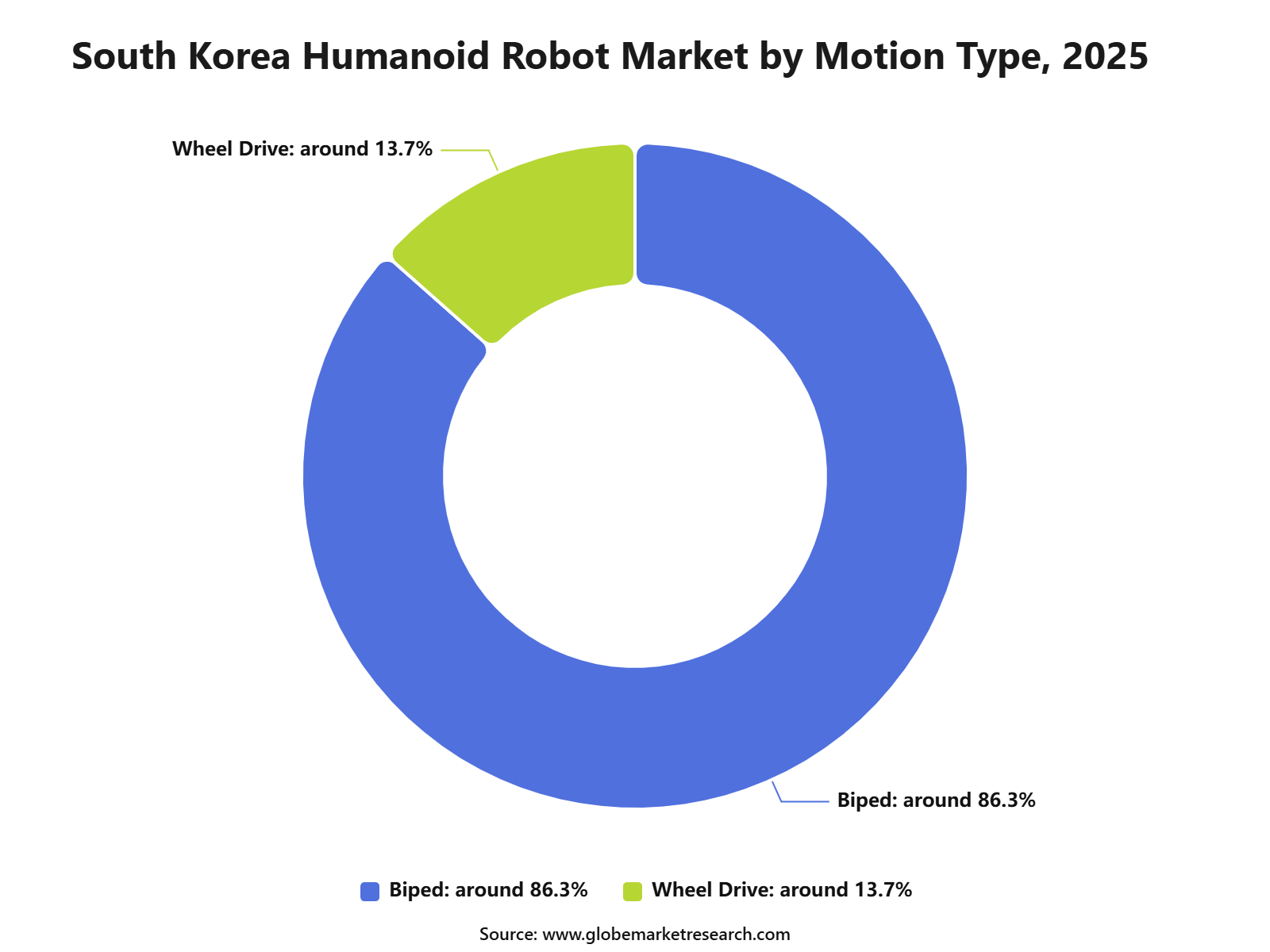 iThe graph shows projected market growth until 2035 based on CAGR analysis. Actual outcomes may vary depending on changing demand, competition, and economic factors.To gain greater insights - request a sample report PDF
By Application Insights
Personal assistance and caregiving accounted for the leading application share of 37.8%. Humanoid robots can support medicine reminders, object delivery, mobility assistance, basic monitoring and social interaction. Their human-like structure is suitable for care environments because they can use household tools and operate around furniture designed for people.
Demographic and labour indicators are strengthening the need for assisted-care technologies. South Korea had 16.447 million people aged 55 to 79 in May 2025, including 8.029 million people aged 65 to 79. Among older people who had left their longest-held job, 14.7% cited the need to care for family members, indicating continued pressure on household caregivers and supporting demand for robotic assistance solutions.
Drivers Impact Analysis
The South Korea Humanoid Robot Market is driven by rising automation demand, strong robotics manufacturing capability, aging population, labor shortages, AI adoption, and government support for advanced robotics. Humanoid robots are gaining attention for service, healthcare, education, logistics, retail, and industrial support applications. South Korea has a strong base in electronics, semiconductors, sensors, batteries, AI software, and precision manufacturing. This makes the country well-positioned to develop humanoid robots that can combine mobility, perception, speech interaction, and task automation.
Impact Factor | Estimated CAGR Impact | Regional Relevance | Market Impact |
|---|---|---|---|
Rising labor shortage and aging population | +10.8% | South Korea | Drives demand for assistive and service robots. |
Strong robotics and electronics ecosystem | +9.4% | South Korea | Supports local manufacturing and innovation. |
Growth in AI and machine vision adoption | +8.3% | Seoul, Daejeon, Gyeonggi region | Improves robot intelligence and usability. |
Demand from healthcare and elderly care | +6.9% | Hospitals and care facilities | Builds social service applications. |
Government support for robotics innovation | +5.8% | National robotics programs | Improves commercialization confidence. |
Restraints Impact Analysis
The market faces restraints from high hardware cost, limited commercial readiness, safety concerns, and complex real-world deployment. Humanoid robots require advanced sensors, actuators, batteries, processors, software, and safety systems, which increases product cost. Another restraint is the lack of proven large-scale business models. Many humanoid robots are still in pilot or early commercial stages, so buyers need proof of return on investment, reliability, maintenance support, and clear use-case value.
Impact Factor | Estimated CAGR Impact | Regional Relevance | Market Impact |
|---|---|---|---|
High development and production cost | -6.5% | South Korea | Limits mass-market adoption. |
Limited commercial readiness | -5.7% | Service and industrial users | Slows real deployment. |
Safety and liability concerns | -4.8% | Public and workplace environments | Raises approval requirements. |
Short battery life and mobility limits | -4.0% | Mobile humanoid robots | Affects operating time. |
Unclear near-term ROI | -3.3% | SMEs and service businesses | Delays purchase decisions. |
Opportunities Impact Analysis
Opportunities are strong in elderly care, hospital assistance, education, hospitality, retail, logistics, security, smart factories, and public service robots. South Korea’s aging population and advanced digital infrastructure create strong demand for human-support robots.
Higher-value opportunities are emerging in AI humanoid assistants, industrial cobot-humanoid systems, multilingual service robots, rehabilitation support robots, and robots for public facilities. Companies that combine safe motion, natural interaction, and practical task execution can capture stronger growth.
Impact Factor | Estimated CAGR Impact | Regional Relevance | Market Impact |
|---|---|---|---|
Elderly care humanoid robots | +10.5% | South Korea | Builds major social demand. |
Hospital and rehabilitation support robots | +8.8% | Healthcare sector | Adds high-value service use. |
Education and training robots | +7.3% | Schools and universities | Supports interactive learning. |
Retail and hospitality robots | +6.1% | Urban service businesses | Expands customer-facing use. |
Smart factory humanoid assistants | +5.2% | Manufacturing hubs | Supports flexible automation. |
Challenges Impact Analysis
The main challenge is making humanoid robots reliable enough for daily use. Robots must handle movement, balance, object recognition, voice interaction, safety, and task execution in changing environments. Another challenge is building public trust. Since humanoid robots work near people, customers and regulators need confidence in safety, privacy, data protection, and responsible AI behavior.
Impact Factor | Estimated CAGR Impact | Regional Relevance | Market Impact |
|---|---|---|---|
Real-world movement reliability | -6.0% | Indoor and public spaces | Affects customer acceptance. |
Human-robot safety requirements | -5.2% | Healthcare, retail, factories | Raises compliance needs. |
Data privacy and AI governance | -4.4% | Public and service robots | Impacts trust. |
Maintenance and repair complexity | -3.7% | Commercial users | Increases lifecycle cost. |
Limited skilled robotics workforce | -3.0% | Robot developers and operators | Slows deployment scale. |
Segment Covered in the Report
By Component
Hardware
Software
By Motion Type
Biped
Wheel Drive
By Application
Personal Assistance
Caregiving
Education
Public Relations
Search and Rescue
Manufacturing
Market Trend Analysis
The market trend is moving toward AI-enabled humanoid robots, service robots, healthcare robots, smart factory robots, voice-enabled assistants, and robots with improved mobility and perception. Companies are shifting from display-focused robots to task-oriented robots that can support real operational needs. South Korea is expected to remain a strong innovation hub because of its advanced technology base and high automation readiness. Demand will grow as humanoid robots become more affordable, safer, and easier to integrate into daily business and public services.
Impact Factor | Estimated CAGR Impact | Regional Relevance | Market Impact |
|---|---|---|---|
AI-powered humanoid platforms expand | +10.2% | South Korea | Leads product evolution. |
Healthcare and elderly care use rises | +8.6% | Hospitals and care homes | Builds long-term demand. |
Smart factory humanoid trials increase | +7.0% | Industrial regions | Supports flexible automation. |
Human-like interaction improves | +5.8% | Service and education sectors | Enhances user acceptance. |
Robot-as-a-service models grow | +4.9% | Commercial users | Reduces upfront purchase burden. |
Technology Adoption Analysis
Technology adoption is focused on AI models, computer vision, speech recognition, tactile sensors, motion control, lightweight actuators, edge computing, batteries, and advanced processors. These technologies help humanoid robots move, understand surroundings, respond to users, and perform practical tasks. South Korean companies can also benefit from domestic strengths in semiconductors, displays, sensors, batteries, and 5G connectivity. These technologies support better robot performance, faster data processing, and more reliable human-machine interaction.
Impact Factor | Estimated CAGR Impact | Regional Relevance | Market Impact |
|---|---|---|---|
AI and natural language processing | +9.8% | South Korea | Improves human interaction. |
Computer vision and perception systems | +8.2% | Robotics and automation firms | Supports navigation and recognition. |
Advanced actuators and motion control | +6.9% | Humanoid robot makers | Improves mobility. |
Edge computing and 5G connectivity | +5.7% | Smart cities and factories | Enables faster response. |
Battery and power management systems | +4.8% | Mobile robot platforms | Extends operating time. |
Recent Developments
Market News
In January 2026, Hyundai Motor Group announced its AI robotics strategy at CES 2026 and said it aims to build a scalable production system capable of manufacturing 30,000 robot units annually by 2028.
In January 2026, Boston Dynamics unveiled the product version of Atlas and said 2026 deployments were scheduled with Hyundai and Google DeepMind, with additional customers expected to follow in 2027.
In January 2026, Doosan Robotics unveiled AI-powered robotic solutions at CES 2026, including Scan & Go, AI Depalletizer, and solutions using AI motion algorithms for industrial automation.
In February 2026, Reuters reported that Hyundai Motor Group was preparing a 10 trillion won investment in South Korea’s Saemangeum region, focused on robotics, an AI data center, and hydrogen infrastructure.
In March 2026, South Korea’s Ministry of Trade, Industry and Resources held an AI Robot M.AX Alliance meeting to support K-humanoid robotics, with participation from Hyundai Motor, AeiROBOT, Robros, Yuil Robotics, Tesollo, Higen RNM, Seoul National University, KEIT, and KETI.
In March 2026, the Korean government said policy discussions would focus on humanoid robot training data, domestic actuator capabilities, robotic hands, industrial demonstrations, industry-academia-research collaboration, and regulation improvement.
Acquisitions
In 2025, Rainbow Robotics was incorporated into Samsung Electronics’ consolidated financial structure, strengthening Samsung’s position in domestic humanoid robot development and advanced robotics.
In 2026, Hyundai Motor Group continued to benefit from its earlier acquisition of Boston Dynamics as Atlas moved from research demonstration toward industrial deployment and production planning. Boston Dynamics said Atlas deployments in 2026 were committed to Hyundai and Google DeepMind.
Funding and Investments
In February 2026, Hyundai Motor Group’s planned Saemangeum investment was reported at about 10 trillion won over five years, with robotics included alongside AI data center and hydrogen infrastructure.
In March 2026, South Korea’s Ministry of Trade, Industry and Resources said it would boost R&D and demonstration support under the AI Robot M.AX Alliance to strengthen the national humanoid robotics ecosystem.
In July 2026, Tesollo, a South Korean robotic hand specialist, began IPO preparations after completing a Series B funding round, with investors including POSCO Technology Investment, KB Investment, Enlight Ventures, Daesung Hi-Tech, and HL Mando.
In 2025, Tesollo raised 6 billion won in Series A funding to accelerate its entry into the humanoid robot market, bringing cumulative funding to 8.5 billion won.
Market Impact
In 2026, South Korea has one of the strongest automation bases for humanoid robot commercialization. The International Federation of Robotics reported that South Korea recorded the world’s highest robot density, with 1,220 robots per 10,000 employees and 7% average annual growth since 2019.
In 2026, South Korea’s manufacturing strength is becoming a major advantage for humanoid robot scale-up. The country already has deep automation demand from electronics and automotive manufacturing, which are also the two largest customer industries for industrial robots.
In 2026, industrial deployment is becoming the main commercial direction. Hyundai’s Atlas strategy, Doosan’s AI robot solutions, Rainbow Robotics’ mobile manipulation platforms, and Tesollo’s robotic hands show that humanoid development is moving toward factories, logistics, inspection, material handling, and skilled industrial tasks.
In 2026, component localization is becoming a key growth factor. The Korean government’s focus on actuators, robotic hands, training data, and field demonstrations shows that the market is not only about complete humanoid robots. A large opportunity is also expected in humanoid components, AI control systems, dexterous manipulation, simulation tools, and robotics software.
In 2026, labor concerns are also emerging as a market barrier. Reuters reported that Hyundai Motor’s Korean labor union warned against humanoid robot deployment without labor-management agreement, showing that workforce acceptance, safety rules, and job transition planning will be important for large-scale adoption.
Competitive Landscape
The market is characterized by intense competition among established players and emerging companies. Strategic partnerships, mergers and acquisitions, and product innovation are key strategies employed by market participants.
Key Market Players
Samsung Electronics
Hyundai Motor Group
ROBOTIS Co., Ltd.
Rainbow Robotics
Doosan Robotics
LG Electronics
SoftBank Robotics
UBTECH Robotics
Toyota Motor Corporation
Honda Motor Co., Ltd.
Kawada Robotics
Boston Dynamics
Hanson Robotics
Other Key Players
Research Methodology
This market study is prepared using a combination of primary and secondary research. Primary research includes discussions with manufacturers, suppliers, distributors, consultants, industry experts, and end users. Secondary research covers company reports, government databases, trade associations, technical publications, regulatory sources, and trusted industry documents. The collected information is used to assess market demand, pricing trends, technology adoption, competitive activity, and regional performance.
AI language models are not used as primary data sources, and publicly available AI-generated content is not treated as market evidence. Computational tools may be used to support data processing, translation, data classification, and pattern identification. However, every published assessment is supported by verified sources, human review, and primary market discussions.
Market estimates are developed through top-down and bottom-up approaches and validated using data triangulation. Revenue, production, shipment, pricing, and application-level data are compared across multiple sources. Forecasts consider economic conditions, regulatory changes, investment activity, innovation, supply chain developments, and industry risks. All findings are reviewed through source verification and internal quality checks before publication.
Part I
Source Management & Input Data Standards
Who provides data, how sources are qualified, and what types of evidence are admissible.
Part II
Research Scope & Market Coverage
How we define the markets we assess and the parameters that govern each product.
Part III
Data Collection, Verification & Submission
The mechanics of gathering, cross-checking, and hierarchically ranking evidence.
Part IV
Assessment Determination & Quality Controls
How raw data becomes a published assessment — normalisation, expert judgement, and outlier exclusion.
Part V
Publication, Corrections & Revision
Our publication schedule, corrections policy, and methodology review cycle.
Part VI
Independence, Ethics & Complaints
Conflict-of-interest policies, editorial independence, and how clients raise concerns.
Google · Preferred Sources
Don't miss the latest market research insights and industry updates on Google.
Add Globe Market Research as a preferred source in the Google app to see our reports, analysis, and market stories in your news suggestions.
Meet the Team
This report was prepared by our expert analysts with deep industry knowledge and research experience.
Prashant S. is a Research Analyst at Globe Market Research with more than four years of experience in market research and industry analysis. He specializes in the Aerospace and Defence, Automotive and Transportation, Semiconductor and Electronics, Information and Technology sectors, with expertise in market sizing, trend analysis, competitive assessment, and industry forecasting. He applies primary and secondary research, data validation, company analysis, and market estimation methods to deliver reliable insights for strategic planning and business decision-making.
Sayali brings more than 7 years of experience to Globe Market Research, supporting the accuracy, clarity, and relevance of research content across multiple industries. She reviews market data, segment analysis, competitive insights, and industry trends to ensure each report meets strong quality standards and provides practical value to business decision-makers. Her expertise spans healthcare, information technology, consumer goods, and diverse cross-industry domains. With a strong focus on data reliability, structured analysis, and clear presentation, Sayali helps ensure that each research output delivers well-reviewed insights for clients, investors, consultants, and industry stakeholders.
Frequently Asked Questions
Related Reports
More in Information and Technology
South Korea Physical AI Market Size to Reach USD 3.6 billion by 2035
South Korea Physical AI Market Size, Share, Trends and Growth Analysis Report By Deployment (On-Device AI, Cloud-Based AI), By Component (Hardware, Software, Services), By Technology (Computer Vision, Speech and Natural Language Processing, Gesture and Movement Recognition, Reinforcement Learning and Control Systems, Other Technologies), By Robot Type (Service Robots, Humanoid and Social Robots, Collaborative Robots, Exoskeletons and Prosthetics, Mobile Robots and Drones, Industrial Robots), By Application (Healthcare, Manufacturing and Automotive, Logistics and Warehousing, Retail and Hospitality, Other Applications), By Technology Trends, Competitive Landscape, Strategic Opportunities and Growth Forecast, 2026-2035
Physical AI Market Size to hit USD 2,129.0 billion by 2035
Physical AI Market Size, Share, Trends and Growth Analysis Report By Component (Hardware, Software, Services), By Technology (Computer Vision, Machine Learning and Deep Learning, Natural Language Processing, Edge AI, Other Technologies), By Product (Robots, Exoskeletons, Autonomous Systems, Smart Appliances), By Application (Automation and Manufacturing, Logistics and Supply Chain, Healthcare, Automotive, Defense and Security, Retail, Education, Other End Uses), By Regional Insights, Technology Trends, Competitive Landscape, Strategic Opportunities and Growth Forecast, 2026-2035
Edtech SaaS Tools Market Size to hit USD 217.6 billion by 2035
EdTech SaaS Tools Market Size, Share, Trends and Growth Analysis Report By Software (Classroom Management Systems, Document Management Systems, Learning and Gamification Platforms, Learning Management Systems, Student Collaboration Systems, Assessment and Analytics Tools, Content Authoring Tools, Other Software), By Sector (Preschool, K-12, Higher Education, Other Education Sectors), By Deployment (Cloud-Based, Hybrid), By End Use (Businesses, Educational Institutions, Individual Learners and Consumers), By Regional Insights, Technology Trends, Competitive Landscape, Strategic Opportunities and Growth Forecast, 2026–2035
Marketing Technology Market Size to Reach USD 3,810.8 billion by 2035
Marketing Technology Market Size, Share, Trends and Growth Analysis Report By Marketing Type (Digital Marketing, Offline Marketing), By Product (Social Media Tools, Content Marketing Tools, Rich Media Tools, Marketing Automation Tools, Data and Analytics Tools, Sales Enablement Tools), By Deployment (Cloud-Based, On-Premises, Other Deployment Models), By Enterprise Type (Large Enterprises, Small and Medium-Sized Enterprises), By Application (IT and Telecommunication, Retail and E-commerce, Healthcare, Media and Entertainment, Sports and Events, BFSI, Real Estate, Other Applications), By Regional Insights, Technology Trends, Competitive Landscape, Strategic Opportunities and Growth Forecast, 2026-2035